A Bigger Vet School

10 10 2013

cropped-100_1794.jpg

I’ve only ever been in the vet school once, to deliver an invitation for a wine and cheese event to an alum of my fraternity house who worked as a researcher at the vet school.  When it came to getting photos, I would just take advantage of my Bradfield perch, take my photos, and that was that.

The vet school is not unlike the rest of the school in that it’s been built in spurts. The original vet school was in James Law Hall, where Ives Hall stands now (and even prior to that, it shared space in the north wing of Goldwin Smith Hall, the old dairy science building). The vet school moved further east with the construction of Schurman Hall in 1957, and expanded with the Vet Research Tower in 1974, the Vet Education Center and Vet Medical Center in 1993 and 1996, and the East Campus Research Facility and Vet Diagnostic Lab in 2006 and 2010 respectively.  Essentially, the vet school is like many human hospitals, a mish-mash of additions and new wings/buildings, incoherent and even incompatible. The completion of the the  VDL building left a large amount of vacant space in Schurman Hall that was difficult to repurpose, hence the approved plan – demolish 68,000 square feet of space, build 65,000 square feet of new space, and renovate 33,000 square feet of existing space, to be done in two phases with a combined cost of $63 million.

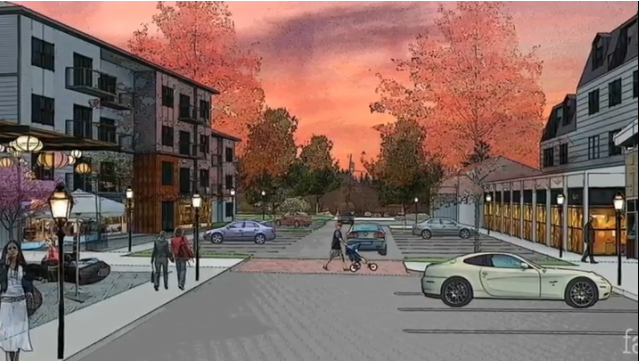
Looking east from Tower Avenue. Rendering property of Cornell.

Looking east from Tower Avenue. Rendering property of Cornell.

Given those stats, it seems like a misnomer to call it an expansion, but one of the effects of the reconstruction will be to increase the number of matriculating vet students in a year from 102 to 120 – and given Cornell’s #1 vet school ranking, they will not be lacking in applicants. Over four years, you have 72 more professional students – you’re welcome, Ithaca landlords. Among the details, the old auditorium will be torn down, and in its place comes the new Flower-Sprecher library, two new lecture halls, a new dining hall, large gathering spaces (i.e. yet another open atrium) offices, an expanded anatomy lab, and a green roof. The architects of this plan are New York-based Weiss/Mandfredi, who specialize in hypermodern glassy spaces.

Looking west from new courtyard. Rendering property of Cornell.

Looking west from new courtyard. Rendering property of Cornell.

As for the time frame, Phase I, which comprises the tear-down and new construction, will start in April 2014 and be completed in a 12-month time frame. Phase II, the renovation component, will commence at that time and proceed towards a tentative completion in October 2016. I will already be beyond my 5-year reunion, so that kinda freaks me out.

Straying a bit here, but I’ve heard from my vet school friends that the market isn’t absorbing new grads like it used to, and not at the salaries that it used to. A for-profit school planned for Buffalo was recently cancelled. But, I suppose for the #1 school, these are concerns that the college is reasonably shielded from. Adopting a dog in the next couple years is on my priorities list (if I can ever establish enough of a schedule that makes me feel like I’d have adequate time to love it), so in my totally uneducated opinion, more vets is fine by me.

News tidbits 10/2/13: Old People and Affordable Housing

2 10 2013

A smattering of news articles worth noting, but not worth going to the trouble of giving their own articles…

lanpres_canc

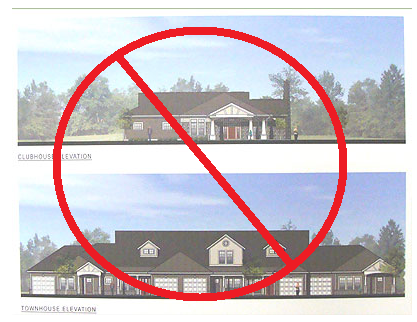
1. Lansing Reserve is dead. The 65-unit project slated for a wooded parcelnorthwest of the intersection of 13 and Warren Road has been bought out by the village of Lansing, which intends to use the space as a “park”. The project, originally proposed in early 2011, has been beset with issues since the first public meeting, with concerns of traffic and wetland protection and “ruining the unique of [the] village”. Apart from Wal-Mart, it’s probably the only project I’ve seen proposed in recent years that the locals created their own websites and exaggerated figures/renderings in their efforts to oppose the project. Lansing town and village seemed to have struck an anti-development tone in the past several months, with this and the cancellation of the town’s sewer project (again).

2. Meanwhile, the same two groups that proposed Lansing Preserve are now looking to develop a parcel in the town of Ithaca, on West Hill near the hospital (aka the Biggs property). The town put out a request for bids on the parcel in late summer 2012, which I covered previously. Nothing formal proposed yet, but the project is expected to contain about 60 townhomes in the affordable housing market range (30-90% of local median income). Shades of Lansing playing out here, as the anti-development Ithaca West neighborhood group has been opposed to the sale of the parcel, let alone its development (the reasons cited – traffic and an increase in crime). However, their stance pits them against Ecovillage and their connections, so this should be an entertaining show. Ithaca Builds provides more coverage here.

3. Deep-pocketed retirement facility Kendal at Ithaca is preparing an expansion of its own. The 212 unit (indepedent living) and 71-bed (assisted/skilled care) facility plans to add 24 more indepdent living units (the parcel allows a max of 250) and 13 more beds to its skilled care group. This would be achieved with the construction of a new 2-story apartment building and three new 1-story wings for the reconfigured skilled care space. Chiang O’Brien are the architects and the project should be completed in the spring of 2014. Kendal at Ithaca first opened in 1995. to by Cornell-centric readers, the only reason you might care about this is that the facility hosts a sizable number of retired CU faculty/staff.

-65+60+24 = +19 units. Well noted.

Kendal_1


News Tidbits 8/27/13: Gannett Expansion Gets Greenlighted

27 08 2013

100_6620

With the donation of $5 million from the chair of trustees Robert Harrison ’76 to launch the fund raising aspect of the project, the Gannett expansion has now solidified into a concrete project in the planning stages. Initial plans call for an increase in the size of the building from 38,000 sq ft to 96,000 sq ft, and a targeted completion date for October 2017 (which means the vast majority of kids that just started at Cornell this week will never see the building completed while students at Ezra’s university). I imagine that, giving a year or so for construction, and an expected price tag of $55 million (one-third of which will be funded via donations), that a couple of years of fund raising is more than enough time for some deep-pocketed alumni to throw their cash into the kitty, and end up with a waiting room or doctor’s office named for them in return.  Gannett Health Center opened its doors in 1955 (named for Frank Gannett 1898, the mid-century media titan), and expanded in 1979.

Proposals to expand Gannett have been floating around since at least 2005, and shows up in Cornell’s 2008 master plan. At the time, the plan called for a 90,000-130,000 sq ft building, which means that the above firm proposal falls within those nascent specifications. HOLT architects did a 2007 design study proposing a 119,000 sq ft building. It’s nice to see this one come out of the hazy ether of vague proposals and become a formal proposal. The next question, of course, will be what the design of the structure will be. Given the university’s trend, my inclination is to expect another hypermodern box.

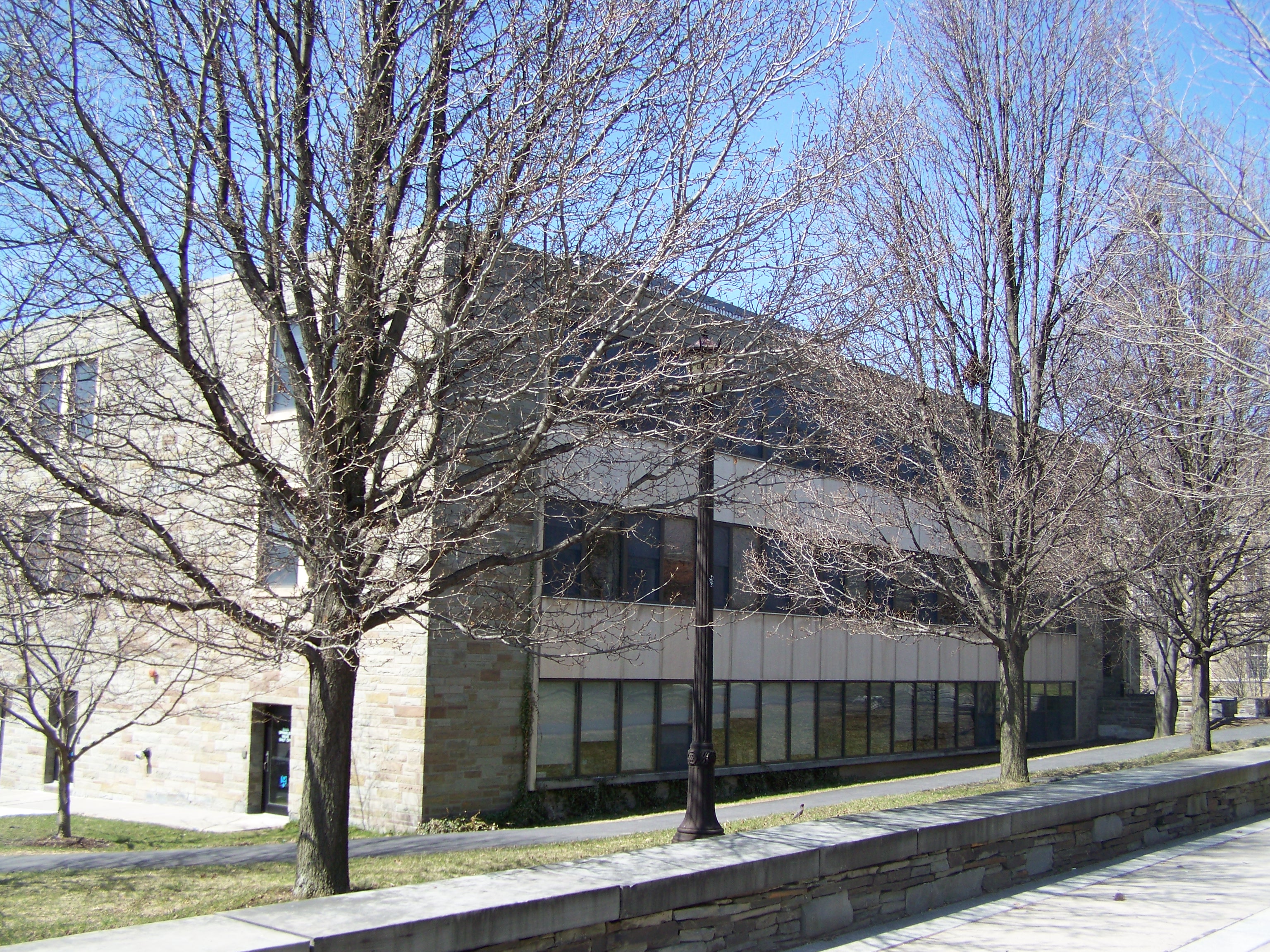
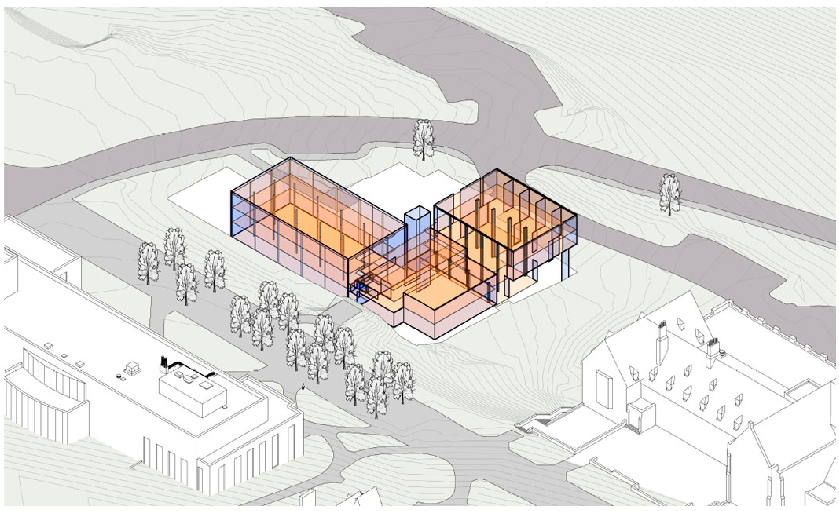
Update 8/28: Ithaca Builds’ Jason Henderson has kindly passed on a link from Chiang O’Brien, a local firm started in 2012 by some former employees of also Ithaca-based HOLT Architects. The two follow similar themes, simple forms but big on geometric detailing, and most of their designs could be described as revamped modern or hypermodern. Looking at their website, I see some massing diagrams of the current facility, but nothing yet for what’s planned.

gannett1


The Final Draft of Harold’s Square

21 08 2013

hsrqev1

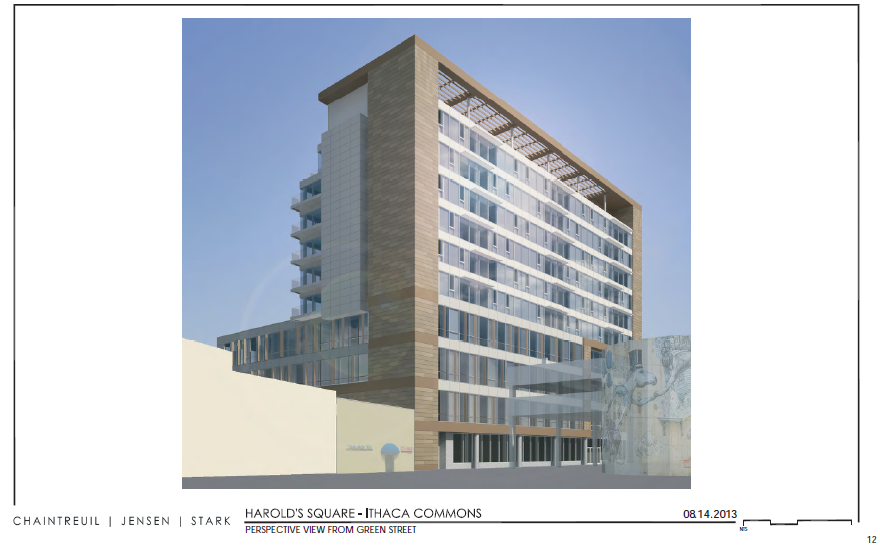
Given the previous re-design for Harold’s Square, I’m willing to accept this. The glazed curtainwall banding on the south face makes it a little less brutal on the eyes.

hsqrev2

Ithaca Builds notes that the developers hope to have fencing up (i.e. initiating site prep) by Labor Day, for completion in late April 2015.


Dear Cayuga Place, Please Settle On A Design

17 08 2013

cayugaplace_v5

This building has become the bane of this blog’s existence. From the Planning Board:

The applicant is requesting modifications to site plan approved on August 28, 2012, including: a reduction in the site footprint to 6,920 SF (from 9,400 SF); an increase in total floor space to 49,244 GSF (from 47,075 GSF); an increase in the number of stories to 7 (from 4); an increase in the number of units to 45 (from 39); a reduction in the height of the first‐floor elevation to 409’6” (from 410’); a reduction in floor‐to-floor height to 11’4”without mezzanine loft (from 15’6” with mezzanine loft); an increase in total building height to 81’4” (from 63’6”);the addition of 21 unit balconies and 18 false unit balconies; the addition of 4 unit walk‐outs; and the use of auger‐ grouted steel core displacement piles for the foundation (from a spread‐footing foundation).

So in sum, a taller building with a smaller footprint is being proposed, with a few more units of apartments. The gross area only changes slightly, and the ceilings aren’t as high as before. Given the prelim renderings of this latest version, the general design elements remain the same, although at just over 81 feet tall, the building should now fully mask the wall of the parking garage next door.

So let’s see here…here are original renderings v1, v2 and v3….an updated version of V3, v3.1 if you will….v4…..and now this latest one, which we’ll call version 5. This building has changed its “image” more times than a teenage girl.

At least with the current revision, the change may have been less for market concerns, and more out of engineering concerns. Note the change in the type of foundation; spread-footing foundations are shallow foundations, which spreads the weight out and doesn’t go as deep into the soil (you often see these in flood-prone areas). The replacement is a deep foundation, which is selected when the soil is poor in the shallow layer. My guess is that they were doing site testing, the near-surface soil was worse than expected (perhaps due to the presence of Six Mile Creek), so Bloomfield and Schon decided to build upwards on the more stable portion of the parcel, rather than out. Deep foundations are usually more expensive, which could explain the increase in number of units.

Will this be the incarnation that actually gets built? Good question. I’m kinda tired of flavor of the season, so I’m kinda hoping it just goes up already.


News Tidbits 8/11/13: Emerson’s Powerful Possibilities

12 08 2013

Image property of Welch Construction Inc.

Following up on Ithaca Times and Ithaca Builds, the big development news of the week is that a potential buyer is about to close on the Emerson Power Transmission property on South Hill. The discussions have been going on for quite a while; the last Emerson entry I wrote six months ago notes that a member of the Chamber of Commerce was dropping hints that negotiations for the sale of the property were ongoing.

The “sleeping giant” term the Times uses is certainly fitting. At nearly 94 acres and 800,000 square feet of space, the property is one of the most massive in the Ithaca metro. For the sake of comparison, the Collegetown Terrace project is redeveloping 12.4 acres (with another 4 acres of apartments being left as-is), has 610 units and about 629,000 square feet. Certainly, zoning would allow for demolition and reconstruction to suit the developer’s plan, and for this market, the possibilities are comparably limitless.

The article notes that the buyer has 12 to 18 months to choose to execute the purchase option, but they’ve committed for the time being by paying out for a multi-million dollar master plan and feasibility study. Given the span of the site, it’s no big surprise that the developer is looking into mixed use, with some residential components, and some industrial/manufacturing components. With 94 acres, there’s definitely a wide range of possibilities, and buildout will take years. But a redevelopment of Emerson could effectively mark an expansion of downtown Ithaca southward.

It appears Ithaca’s development boom has some big projects still coming down the pipeline. Or more links in the chain, if you will.


Belle Sherman Cottages, 7/2013

30 07 2013

7-26-2013 010

Next on my tour was a stop at the Belle Sherman Cottages to make a progress report.

7-26-2013 007

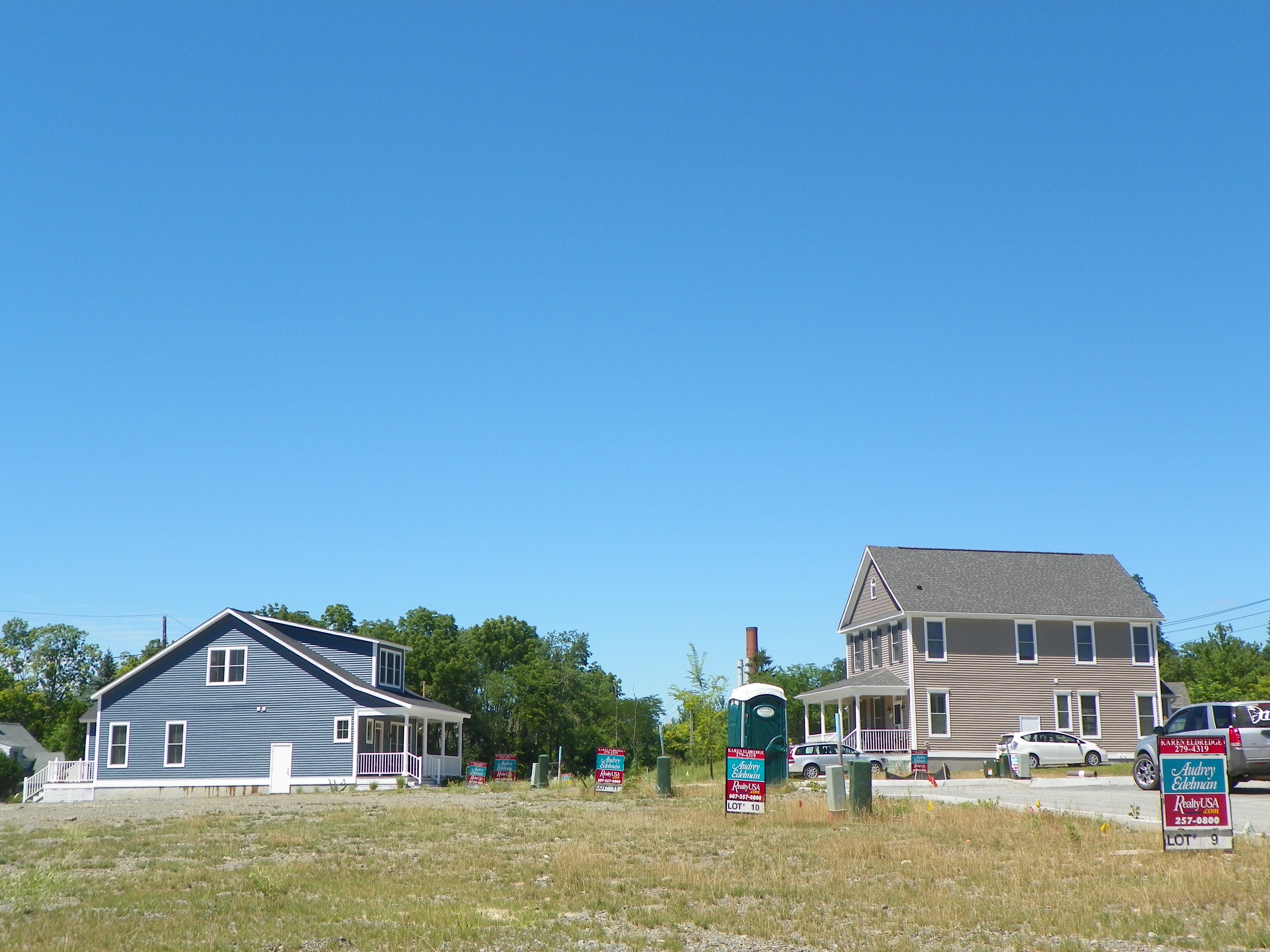
With four homes complete (Lots 1, 7, 8, and 14), one under construction (Lot 2), and one in site prep (Lot 19), the 29-unit development (19 homes, 10 townhouses) is beginning to resemble a settled neighborhood from a few very select angles.

7-26-2013 009


7-26-2013 008

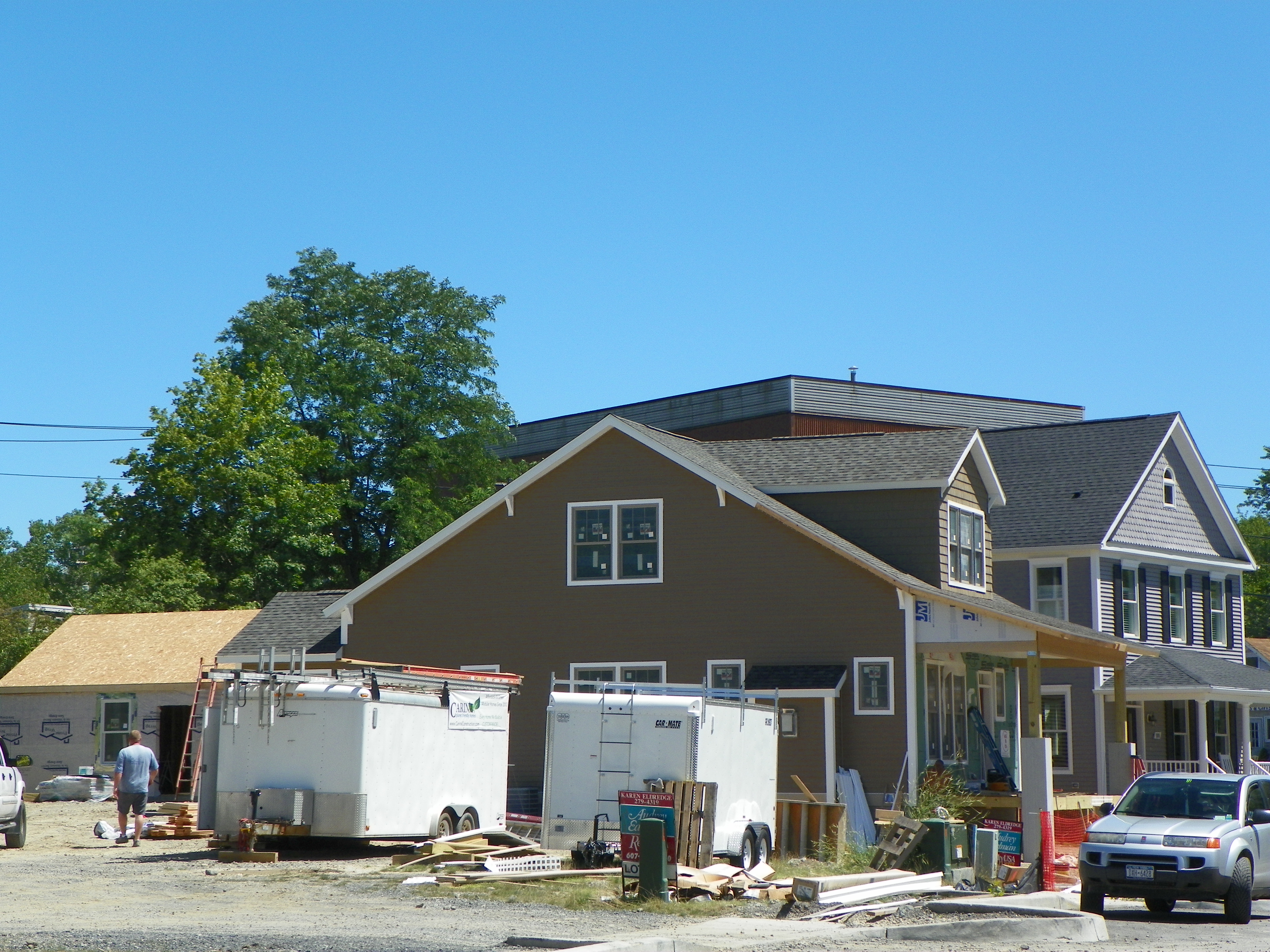
103 Walnut Street (Lot 2) is currently underway, and will be completed in the next couple weeks. Only three of the five styles are represented so far, the Victorian and Craftsman-style farmhouses have yet to be built.

7-26-2013 0057-26-2013 006

Lot 19 is tucked in the sharply-angled northern corner of the parcel, necessitating Agora LLC to insert the road extension. This extension is also where the townhouses will be built, although I’m not sure when they will start construction on those (i.e. what the sales thresholds are). Several lots are listed for sale with local RE agencies.

As noted at Ithaca Builds, these homes are built using modular pieces, which when done right can result in a quick turnaround from prep to construction to completion. It is likely the bungalow slated for Lot 19 will be completed by early fall, just as construction season starts to slow down in Ithaca.


130 East Clinton Goes Even More Boxy

10 06 2013

Not much in the way of new and exciting to mention as of late – the last planning board meeting focuses on projects already covered here and on Ithaca Builds (Harold’s Square, The Purity Project, the Thurston Ave. Apts and Klarman Hall), and the town cancelled its regularly scheduled meeting, which is what happens when no one has anything that needs to go to the boards. Thankfully (from this perspective anyway) it is construction season, so much work is underway around-and-abouts.

One detail work noting and sharing is a redesign for the 130 East Clinton project, designed by Sharma architects on behalf of  steretoypical one-percenter Jason Fane and his real estate company. No longer does it have hipped roofs.

130eclinton_rev1

130eclinton_rev2

130eclinton_rev3

Apparently, the architects decided to go with the “box of boxes” look, with a little bright color on the extensions for a little character. The design before was traditional and rather bland. Now it’s more modern but still fairly bland. But it’s density in a growing downtown, so I’m not complaining.


Ecovillage Has More Competition Coming

24 05 2013

newearth_1

As noted in the Ithaca Times, the eco-conscious folks who developed the Aurora Street Pocket Neighbrohood have a new proposal in the works. The location for this one, however, isn’t as urban – the site is located off of Five Mile Drive, just west of Elmira Road and the southwest area’s suburban big-box land (fun fact – the road starts at an intersection with Elmira Road five miles from the shores of Cayuga Lake, hence the name).  This general area has seen a sizable number of single-family homes built in the past decade, though nothing multi-unit like the proposal.

Speaking of which, the basic stats – ~36 units, “craftsman” style homes 1-2 floors, single or 3-unit properties depending on preference, and a common house/community center. Enough of seems to be up in the air style-wise that New Earth Living is asking interested parties to fill out surveys or email them, so they can flesh out their proposal. Style-wise, we already have a good idea what this might look like by looking at the Aurora Street Pocket Neighborhood, which consists of one renovated home and 4 units in three newly-built properties tucked in from the corner Aurora and Marshall. Green construction, solar panels, LED lighting, food grown on property, but no true farm on the property, and units are clustered but still separate – in some ways, this project seems like a toned-down version of Ecovillage.

Ithaca has a lot of folks that lean far left, and a lot of development going on as of late. This seems like a pretty natural outcome of those two forces. Hopefully, this will be a project the community can get excited about as it moves forward.


Cayuga Heights Wants A Real Community Center

16 05 2013


5-1-2012 184

So the folks in Cayuga Heights are getting in on the development game. In this case, local developers are interesting in taking one of the few mixed-use areas of the wealthy bedroom community, and densifying it.

chmap

The focus of this proposal is the Community Corners area, the small, mostly commercial parcel next to the awkward intersections of Triphammer, Hanshaw and East Upland Roads. According to the Ithaca Journal, Most of the new construction would be focused on the grassy parcel at lower left, while some of the buildings already exist would be expanded upon with additional floors, such as the Island Fitness in the lower left of the commercial patch. The two parcels, although owned by separate groups (The Ciaschi Family, the same ones for whom the corner of College and Dryden is named, own Community Corners; the grassy parcel by Mark Mecenas). Notably, this building only finished renovation last year; the bank in the lead image and the two-story office building at Triphammer and Upland are only about three years old.

chproposal1

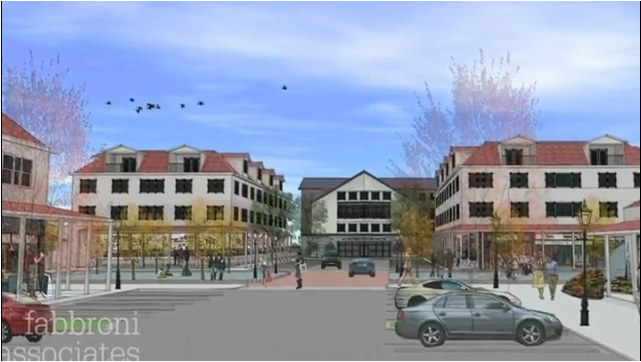
Incorporated into the proposal – more lower-level retail and office space, and about 100 units of housing, up to four floors in height. this would require a zoning variance, as the maximum height for Cayuga Heights is about 30 feet. The design thrown out there is from (Larry) Fabbroni Associates, who tend to be called on much more to discuss the civil engineering aspects of development projects rather than actual designs. I prefer to think of the above designs as more of a scheme than anything concrete.

chproposal3

Oh look, they even threw the vaguely hipster-like musician in there! How quaint!

chproposal2

Mecenas notes in the IJ article that build-out for this project would likely take a few years, and that’s after the village approves the zoning changes. But, a pedestrian-friendly mid-rise core to Cayuga Heights would definitely make it feel more like its own community rather than a wealthy branch of the Ithaca tree.