News Tidbits 9/10/16: Situations To Be Avoided

10 09 2016

Pardon the week hiatus. Sometimes, by the time there’s enough news to share, it’s already the weekend, so it just makes more sense to fun a longer feature the following week.

maguirebirdseye-620x420

1. The Maguire dealership proposal for Carpenter Business Park had a lukewarm reception at its public info session a week and a half ago. A copy of the application can be found here, and Second Ward Councilman Ducson Nguyen was kind enough to upload a 90-minute video of the meeting on his facebook page, and a transcript of the meeting can be found here. A second public info meeting will be held on the 14th.

You might recall news of the project broke last winter, followed shortly thereafter by a vote of the city Common Council to subject waterfront and waterfront-vicinity properties to a “Temporary Mandatory Planned Unit Development” (TM-PUD), meaning that any building proposal would be subject to a vote of the Common Council as a stipulation of approval (typically, projects only need the Planning Board’s consent, plus the BZA and/or ILPC if needed). One other project has gone through the TM-PUD process since then, the Cherry Artspace performing arts building. The small experimental theater held its public info meetings at the end of March and mid-April. It enjoyed fairly broad  public support, but two of the eight voting councilmen still voted against its construction at the May meeting. If a a project with widespread support has some trouble getting passage, you can already guess what will happen with the Maguire proposal.

There’s only about a year left in that TM-PUD. But for the Maguires, it was too late as soon as the TM-PUD was passed. Perhaps more concerning, this is creating one of those cases where everybody’s opinion is coming out of the woodwork – some demand it be a park, some say industrial space only, Form Ithaca advocates walkable mixed-uses, and then there was that verbal brawl on the Ithaca West list-serve about the evils of the Ithaca Community Garden. A lot of folks think their idea is the only reasonable option, so if this plays out like the old library site, there’s going to be a lot of acrimony in the long run. Hopefully when the TM-PUD expires, the city will have the new urban mixed-use zoning ready for implementation, so situations like this can be avoided in the future.
20160821_123800

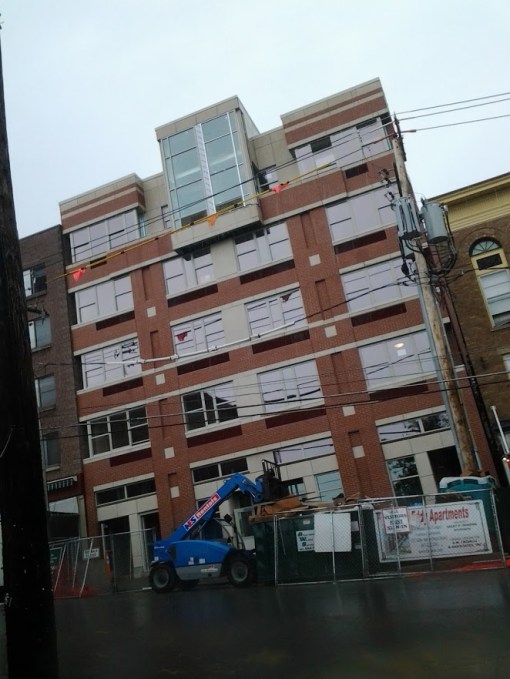
2. Can’t help but feel just a little sympathetic towards Steve Fontana – he tried to have this project open for move-in, and everything that could go wrong, was going wrong. The Journal’s Nick Reynolds reports that first it was a safety systems issue with the elevator holding up the certificate of occupancy, and then a water main burst. The latest planned opening date is September 9th, when the initial date was August 1st. Now it’s a financial issue, a public relations issue, and a mess for all involved. This could be used as an example of why Todd Fox put the 201 College site up for sale – it became clear that August 2017 opening wasn’t going to happen.
201_college_v5_1

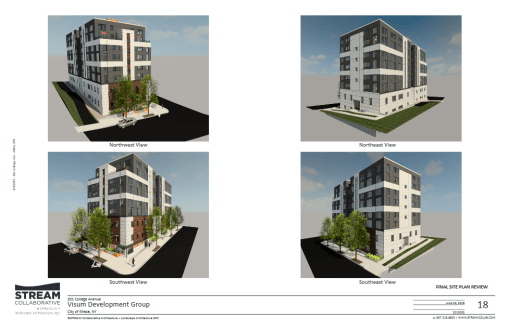
3. On that note, I’m going touch on 201 College real quick. Given the amount of time that went into the Collegetown Form District – six years – this just looks bad all around. On the one hand, Todd Fox could benefit from more patience (granted, we don’t know what the financing situation was), and the character attack on Neil Golder in his supporting documentation turned some people off to his cause. But what John Schroeder did also deserves strong scrutiny. It’s odd to claim a zoning code issue when the MU-1 code is only three pages, and he helped write it. He was also aware that 201 College went through pre-site plan review with the city’s Planning Department, and they gave it the okay to proceed with review. This looks very suspiciously like Schroeder was explicitly looking for anything he could to help out his old colleague Neil, and that small ambiguity was the best he could do, which he was able to parlay with success.

This continues an uncomfortable pattern we’ve seen with other projects like the Old Library where one government body gives the OK, and another stops it after the consent is given. The whole point of these laborious review processes is to prevent controversy from arising. Who wants to take on the risk of proposing condos, mixed-use and affordable housing when, given that many projects require the approvals of multiple boards and committees, there’s a track record of mixed signals?

Rezoning has come up as an idea, but it’s not as simple as it sounds. Spot rezoning (single-lot rezoning) would likely be deemed illegal because the current zoning is consistent with the recently-passed Comprehensive Plan, something the courts look for in zoning lawsuits. Thinking slightly broader, Collegetown’s MU-1 is nine parcels – Fox, Josh Lower and John Novarr, all major local developers, own seven of them. If 20% of those affected by a rezoning proposal file a protest petition, a super-majority of the Common Council – 75%, 8 of 10 in practice – is required for rezoning approval. That is what stopped the first Collegetown rezoning during the Peterson administration. If it couldn’t pass then, a similar super-majority event is unlikely to pass now.

4. On the edge of Ithaca’s South Side neighborhood, the CVS Pharmacy sold for a pretty penny – or rather, $4.09 million, on the 1st. The property is assessed at $1.8 million, but sold for $3.6 million in 2006. The buyer is an LLC traceable to a suburban Boston firm with a broad retail space portfolio, so whether they plan to keep things as they are, or propose something new, is anyone’s guess.

trebloc-future2-1-620x420

5. Finally, a copy of the Site Plan Review application for Newman Development Group’s City Centre project at 301 East State Street in Downtown Ithaca. Keep in mind, this is from the June filing, so things are likely to have been updated or revised in response to the planning board. The 9 story building tops out at 96 feet. The approximate construction cost at the time of the filing was $32 million, with a proposed build-out from February 2017 to October 2019, which seems lengthy, and in another part of the document it says construction will last only 20 months. 400 construction jobs, 50 permanent jobs by tenants in the 10,600 SF of first floor retail, and building service staff. Overall square footage isn’t given, but given the retail and 7,225 SF of amenity space, 160,000 SF probably isn’t a bad first guess. For comparison, State Street Triangle was 288,000 SF, later reduced to the same height and similar dimensions as City Centre. In a sense, City Centre started off where SST required months to get to. Hopefully that bodes well for the proposal.

arpt_pk_1

6. Remember that airport business park study from a while back? There’s no strong demand for a business park. But the NYS DOT wants to move their waterfront office and storage facility to the site. So removing those salt sheds and replacing them with mixed-use waterfront property won’t happen until the state buys whatever it needs here, builds and moves in to a new facility. Not sure what they’ll do with the property on Ellis Drive in Dryden that they’ve owned for the past decade; presumably sell it as surplus, but who knows?
chain_works_rev3_3

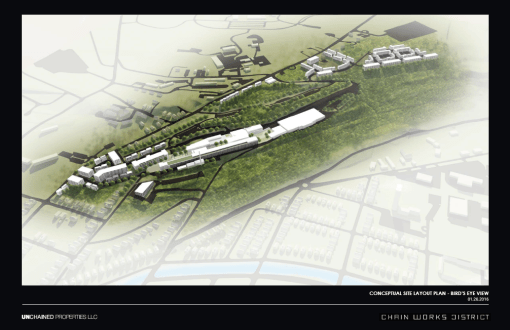
7. From the Ithaca Times: The Al-Huda Islamic Center hopes to start construction on their Graham Road mosque in 2017, and then obtain land for burials later this decade. In other news, new Times reporter Lori Sanken is reporting on the Chain Works progress, the Planning Board requesting color changes, careful consideration of heights, and debates about forest [preservation and Route 96B. Developer Dave Lubin of UnChained Properties wants to do renovations to existing buildings first, but seeing as they have yet to have the state sign off on a remediation place, they’re considering the construction of new buildings first, if NYS DEC approval for remediation gets delayed. And Catholic Charities and non-profit group Ithaca Welcomes Refugees are actively trying to procure affordable living space for 50 refugees who will be arriving in the Ithaca area after October 1st.

pinney_peruville_1
8. It’s been incubating for a while, but it looks like former Lansing town supervisor A. Scott Pinney’s plan for 15 duplexes (30 units) is moving forward. A gravel road will be extended from 4 existing duplexes at 390 Peruville Road (NYS 34B), looping through the property from Scofield to Peruville. The “Developer’s Conference” to talk about the project will be a part of the Lansing town planning board’s meeting next Monday. Also up for discussion are slight revisions to the Village Solars PDA, related to the community center and first-floor commercial space in the proposed Building F.
1001_n_aurora_1

9. From the Ithaca city Projects Memo for September, it looks like there’s a couple of subdivisions planned. One is for 404 Wood Street in the South Side neighborhood, where the owner wants to subdivide a double-lot he has for sale, allowing the vacant lot to be developed for a house or small apartment building. Quoting the application, “Instead of an empty grassy lot, there would be a building on it”. Points for simplicity.

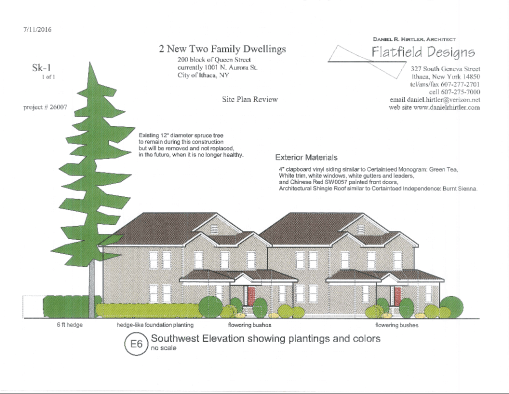
The other is a double lot at 1001 North Aurora Street in Fall Creek. This came up a couple of weeks ago in a weekly tidbits round-up, because the new owner, Stavros Stavropoulos, received a $400,000 loan to build a duplex. Turns out it’s actually two duplexes, which require a lot subdivision, and will trigger planning board review. The application notes that even with the density increase, it’s still less than the surrounding neighborhood. The two two-family homes with have 3 bedrooms and about 1200 SF per unit, and are designed by local architect Daniel R. Hirtler to fit in with the neighborhood. Unusually, the application includes documentation of the previous owner signing off on the redevelopment plan. Construction is estimated to run from this month through May 2017.



News Tidbits 7/30/16: The Unfortunate Surprise

30 07 2016

201_college_v5_1

201_college_site
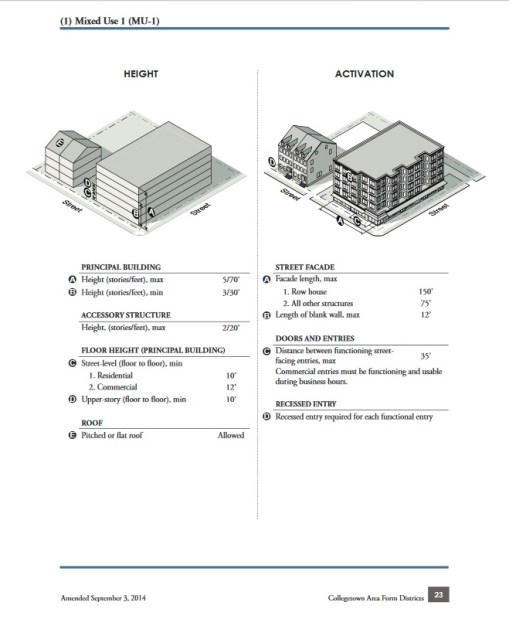
1. Pretty much everyone was caught off guard by the planning board’s decision to send 201 College Avenue to the Board of Zoning Appeals on a previously-undiscussed zoning technicality. The issue has to deal with facade height in connection to the length of a continuous wall – the argument being pushed by board member John Schroeder is that, since there are primary walls on College Avenue and Bool Street, the H-shaped proposal isn’t technically valid and the deep indentation actually has to be two separate buildings, one slightly shorter than the other since the site is on a slope. This was the subject of a prolonged and heated debate, since the code’s pretty ambiguous in that regard, and (as shown below) the design elements shown in the form district booklet demonstrate buildings with architectural indents/setbacks.

327_eddy_rev2_2

327_eddy_rev2_3

If recollection serves correctly, something similar came up in a previous discussion two years ago with 327 Eddy Street. The project fills the entirety of a sloped lot, but there was a hazy interpretation regarding one’s definition of floors and height where one could have called it 8 floors, so it had to be clarified and it became the average proposed height for cases with a sloped parcel. In this instance, there was one primary wall, on Eddy Street, which is why there’s just enough wiggle room left that a clarification request, however targeted it may be, is legally valid. The board agreed 4-3 to let the BZA issue a determination on 201 College, which could come anywhere from August 23rd to September 6th. That means a late September approval is maybe the best bet. That’s probably too late for an August 2017 opening, so whether or not the project would move forward (which could be immediately or in summer 2017 for a 2018 opening) if given approval is another question.

cafd_mu1

There is one other thing that is worrying from an impartiality standpoint. John Schroeder and Neil Golder served together as Collegetown’s Common Council reps in the 1990s. Although Schroeder’s not the biggest fan of Collegetown development, he hasn’t raised this much of a concern over other projects, and Neil has been very, very active in his outreach. There could be an argument that he should have recused himself from the decision-making process, or at least have formally acknowledged his longstanding professional relationship with the project’s primary opponent.

trebloc-future2-1-620x420

city_centre_site_options

2. Also from the Planning Board meeting, further discussion of the Trebloc project. Those following the IJ’s Nick Reynolds’ Twitter know that there was some talk about big changes with a lot of wonk talk, and this is what it has to do with. My thanks to my colleague Mike Smith for his notes.

Basically, Newman Development is floating a few different approaches to the site layout. One calls for a plaza area on State Street (the “accordion” approach”), one calls for green space (the “courtyard” approach), and the third actually breaks it up into two separate buildings. In these theoretical layouts, the square footage and number of units is kept roughly equal. All three also keep at least some emphasis on the corner facing the Commons, because that’s where the concentration of activity is, and that’s what’s going to appeal the most to first-floor retail/commercial tenants.

Each approach comes with pros and cons. The “accordion” approach opens up the sidewalk, but it opens away from the Commons (i.e. not appealing to pedestrians or retailers) and makes unit design tricky. The “courtyard” approach has public-ish green space, but it would be in unappealing, constant shadow – even if the building were just a few floors, the low angle of the sun in the cooler part of the year would keep light from reaching the courtyard. The two building approach offers an alley that could be interesting, but would likely not see much use since there’s very little activity towards that block of Green Street. Given the flaws in each, the inclination is to stay with the current “fish hook” shape, but the developers wanted to hear the planning board’s thought before committing to a layout.

Planning Board responses ran the gamut. A few members supported the State courtyard option, or stepping back the portion on State Street but building taller portions on Green if there’s a need to compensate (zoning’s 120 feet, so there’s perhaps two floors they could feasibly do that with, like an 11-story/9-story/7-story step down, without having to make a trip to the BZA and throwing additional, funding-jeopardizing uncertainty in there). One board member asked about a courtyard on the roof. The project will be pursuing tax abatements, with the hope that with those, density and smaller units, they can appeal to the middle of the rental market.

lansingapts600 lansingaptsmap600

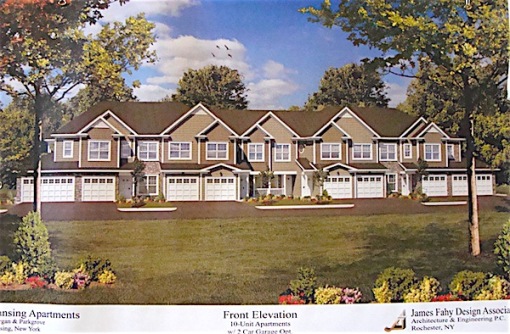
3. Thanks to Dan Veaner over at the Lansing Star, here’s a render and a site plan for the proposed Lansing Apartments / Parkgrove Apartments project for Bomax Drive in the village. The 19.46-acre property is currently owned by Cornell and is zoned to be part of its office/tech park. James Fahy Design Associates of Rochester is doing the design for the proposed 14-building, 140 unit project, and Park Grove LLC of Rochester is the developer, in tandem with retired Cornell Real Estate director and Lansing resident Tom Livigne.

According to the Star, “1,000 square foot one-bedroom apartments are anticipated to rent in the $1,300 to $1,400 range,  1,350 to 1,400 square foot two-bedroom apartments at around $1,600 to $1,700, and three-bedroom apartments up to 1,400 square feet would rent between $1,800 and $1,900.” The village of Lansing has to approve a zoning change from business to high-density residential in order for the project to move forward.

It’s a very auto-centric, premium-middle market project. For an area concerned about affordability and trying to move towards walkability and traditional neighborhoods, this really doesn’t seem like the most appropriate plan. It’s nothing against Livigne and Park Grove LLC, but I’m very critical of these kind of projects for just those reasons.

amabel_v4_1

4. It’s been a while since it’s last been discussed, but the 31-unit Amabel Project by New Earth Living’s Sue Cosentini has been approved by the state attorney general to start marketing units. According to a December presentation, the net-zero homes will range from 1600-2100 SF and market in the $385,000-$425,000 range. While that is a rather high price range, some of that cost would be paid off via energy savings, which could be up to a few thousand dollars per year compared to comparably-sized and priced older homes on the market, and other possible savings exist with water recycling and low-maintenance exterior materials. So the sales pitch becomes something of acknowledging the high up-front costs, but explaining the long-term savings.


5. The first of two state funding grants to not this week. Cayuga Addiction Recovery Services (CARS) has received a $1 million grant for a new 25-bed adult residential facility. The new facility will be built on the Trumansburg campus, which if these notes are correct, is actually two facilities, and this new one will be built adjacent to a 60-bed facility on Mecklenburg Road, near the county line a couple miles to the southwest of Trumansburg. An undisclosed number of jobs are expected to be created.

Founded in a Cornell U. fraternity house in 1972, CARS provides treatment, counseling, skills training and support services to help clients overcome addictions and rebuild lives. The current facility was opened in 2004.

Image Courtesy of Lansing Star

Image Courtesy of Lansing Star

6. Also in state grants, Ithaca-Tompkins Regional Airport received $619,935 to build a flight academy building for the East Hill Flying Club. The new facility is expected to be built in the next 2 to 3 years. When the EHFC has moved in to their new digs, the existing hangar will be offered up to rent to other tenants. The new building will offer more instructional space, the ability to engage in training for twin-engine aircraft, and what the flying academy née club hopes will include state-of-the-art flying simulators.


News Tidbits 6/4/16: A Stormy Summer Start

4 06 2016

201_college_v3_1
1. We’ll start this week off with a follow-up on the 201 College Avenue debate. All discussions of planning philosophy noted, one solid request, as reported by Josh Brokaw at the Ithaca Times, was to try and reduce the bulk from the College Avenue side, if not necessarily the building footprint. The above drawing was submitted by STREAM Collaborative’s Rob Morache earlier this week, with a cover letter describing the changes here. The modification reduces the building by 2 bedrooms, to 74, which to go by Todd Fox’s comment in the Times article, puts the project at the borderline of financial feasibility. The middle still pops out a little because that’s where the fire stairs are located. Some minor details were changed with the accent panels, and recessing the windows slightly on the south and west facades. For the record, the panels are Nichiha and Allura fiber cement, with painted metalwork and fiberglass window sashes.

Although now outdated, a shadow study for the previous design has since been uploaded by the city. There are two versions, with and without neighboring building shadows, here and here respectively.

Expect further detail refinements; the building is set to go in front of the Design Review Committee Tuesday morning.

20160414_120418

2. WSKG did a segment earlier this week on micro-apartments, with an interview with Frost Travis and the Carey Building project wrapping up on East State Street. A few details worth noting from the segment – 5 of the 20 rental units (which range from $1,225/month for the microunits to $2,699/month for a high-end penthouse 2-bedroom) are already spoken for and the building’s not even finished yet. For some reason, Monica Sandreczki says there will be about 35 residents at full occupancy, which is a big stretch since there are 16 micro-units and 4 two-bedroom units – going one person per micro-unit and bedroom, a better estimate would be 24.

The news piece also notes that the 201 College project contains micro-apartments – which is true, given that the building is 44 units and 74 bedrooms, and at least the early plans had a number of split-level 410-670 SF studio units.

401_lake

3. And 401 Lake Street will bite the dust. The Common Council voted 8-1 last Wednesday night to have structure demolished and the tax-foreclosed properties be designated as parkland. Cynthia Brock (D-1st) voted against the measure and preferred a sale for tax reasons, and her ward counterpart George McGonigal (D-1st) argued that the city was destroying historic working-class housing, though he ultimately supported the measure. Brock did take a whack at new affordable housing in the city, commenting that INHS is getting $75,000 for each townhouse, and Habitat for Humanity getting $75,000 for a duplex even with its volunteer labor, when there was a potential, cost-efficient opportunity for affordable housing designation with this unit. Josephine Martell (D-5th) seemed to be the strongest proponent for demo, stating that the unique potential to enhance the Ithaca Falls Natural Area should be taken every opportunity of. The city bought the tax-foreclosed property from the county; the background on that is on the Voice here.

The funds for the demolition, estimated at $25,000, will come from the sale of IURA land to the Hilton Canopy project. That measure was approved 6-3, with Brock, McGonigal and Graham Kerslick (D-4th) opposed. With work on the Lake Street Bridge currently underway, demolition is not expected for at least a few months.

There was a thought exercise regarding the selling the falls’ parking lot to INHS for development of 3-9 units of affordable housing; it’s an interesting idea, since 401 and the adjacent are right next to the Falls, but the 0.55 acres of city property adjacent to the Lake and Lincoln Streets intersection is still over 200 feet away at its closest point.

4. The rare bit of news out of Enfield. A $612,000 building loan was issued by the Bank of Greene County to provide funds for renovating and expanding the volunteer fire station at 172 Enfield Main Road.

Give that Enfield issues no more than a handful of new construction permits each year, it’s about the only other thing going on apart from the Black Oak Wind Farm debate. One would think that arguments like “the wind does not blow as much as it used to” would be easily shot down and things would move forward, but instead it’s Marguerite Wells, the project manager for BOWF, getting raked over the coals. I don’t have a dog in this fight, but I do feel bad for her.

5. In case anyone was wondering – county planner Megan McDonald says the Denter housing study will be publicly available by late July.

arpt_pk_1

6. Here’s something intriguing from the county’s Facilities and Infrastructure Committee agenda – a proposal to “Prepare airport land for future development“, seeking $500,000. None of the money comes from the county; it appears to be dependent on grants, or an interested developer. Which, given the fact that this shows up in budget docs going back to 2014, doesn’t exactly seem to be generating many queries.

The parcels are described as the “Cherry Road and Agway parcels”, which must be owned by the county since they want to lease out the land – but checking the deed records of parcels adjacent to the airport, there’s no record of an Agway in any of the deed histories. The parcels may be related to the properties in the airport business park feasibility study, shown above and awarded to the team of Clark Patterson Lee and Camoin Associates this past winter.

7. It’s unusual to see Cornell buying property these days, but this Friday, the university purchased the house at 1250 Trumansburg Road on Ithaca’s West Hill for $157,000. The house is a 19th century fixer-upper on 1.21 acres – Cornell owns the land surrounding it, some of which is being subdivided off to build the Cayuga Meadows affordable senior housing project. The house is assessed at $215,000, but the real estate listing notes it needs some work, and it’s been off and on the market for five years.

Several years ago, Cornell expressed intent to develop the 35 acres it owns into a mixed-use complex with a hotel institute, housing, offices and medical services, but the only part of the plan that ever really moved forward was Conifer’s project. I haven’t seen the plans in years, but I remember the early plans (there were a couple versions) were very sprawly; six, eight years ago, walkability was not as valued as it is now.

By buying the house, Cornell reduces its need to work around a neighbor and can incorporate the property into potential plans. This purchase would seem to suggest that Cornell still has strong interest in developing the rest of the West Hill property at some point. In the meanwhile, Cornell might rent it out while the school figures out what it wants to do with the acreage.

20160522_151346 20160522_151417

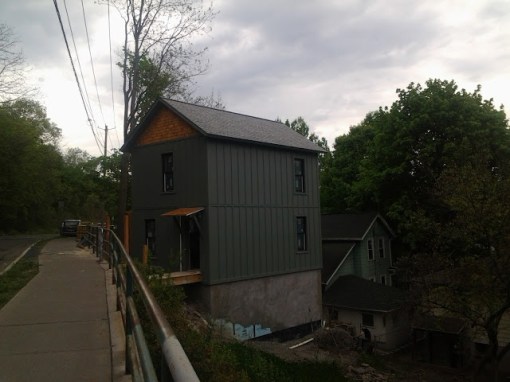
8. House of the week. From the outside, 228 West Spencer Street is almost done, and the interior is fairly far along as well, with finishing work underway. Architect Noah Demarest says the house will be put up for sale in a few weeks, if everything goes as planned.