News Tidbits 1/23/2016: A Doozy of A Week Ahead

23 01 2016

1. Over in the town of Ithaca, an update is being considered for the Rodeway Inn budget motel at 654 Elmira Road. Previously, the motel had been approved for renovations that would expand the size of the 25 existing units and provide 2 new inside corner units, along with the associated landscape and site improvements. This proposal was originally approved by the town in December 2013, but then the project never went forward, partially because the Maguire group was looking at buying the property and tearing it down to make way for their artisanal car dealerships and headquarters. With the Maguire’s plan filed away in the circular drawer, the owners of the Rodeway Inn have decided to reconsider the renovation project.

rodeway_1
Along with the room expansion, the new plan also calls for renovating an existing on-site residence into a new office by building an 1146 SF addition, while the existing motel office is renovated into a community room to serve travelers. Variances for side-yard setbacks granted for the previous proposal must also be re-approved, since zoning variances in the town of Ithaca are only valid if construction starts within 18 months of being granted (in other words, the variance expired last June).

Pennsylvania-based HEX 9 Architects is in charge of design, and JAMNA Hospitality is the developer.

chapteR_house_reconst_v4_2

chapteR_house_reconst_v4_1

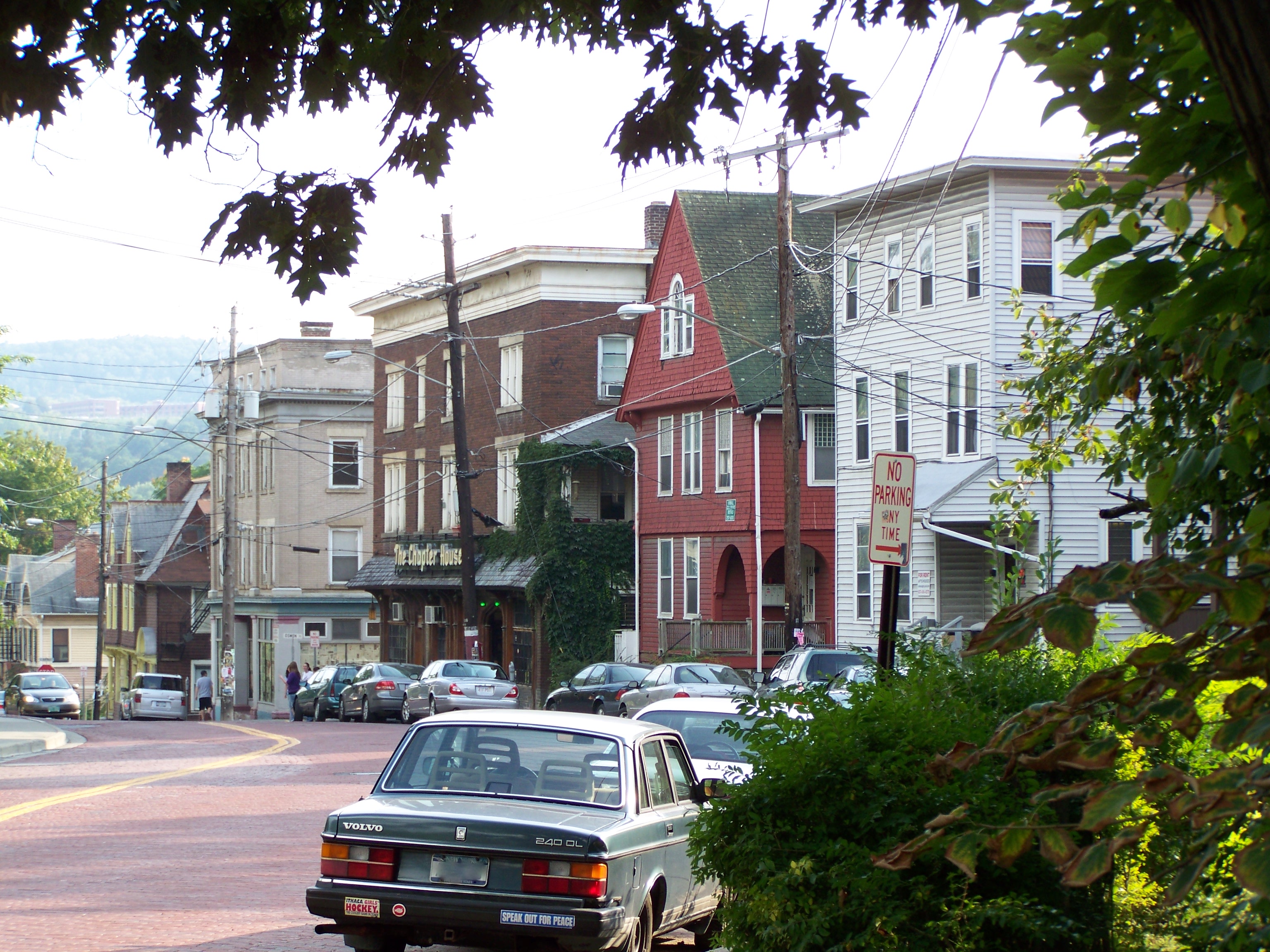
2. From the city of Ithaca Landmarks Preservation Council agenda next Tuesday, the latest iteration of the design plans for the Chapter House replacement and its neighbor at 406 Stewart Avenue. The Chapter House looks to be in the last stages of ILPC approval, while the apartment house next door is still in the early design review stage.

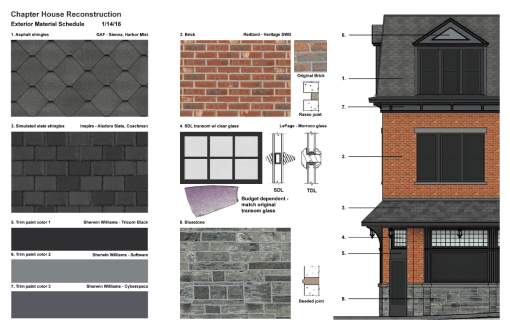
Looking at the Chapter house, the zinc roofing tiles have been replaced with asphalt, and two more paint colors will be included on the trim, which has gone from white to dark grey and black. The ILPC is doing what they do best, going over projects with a very fine toothed comb and debating every detail. Meanwhile, the current iteration of 406 Stewart Avenue calls for a 4-story apartment building with design features very similar to the previous 3-story building. That project still has some debates ahead of it, so we’ll see what happens moving forward.

Also on the agenda, discussion with the Planning Board about the DeWitt House/Old Library redevelopment, an update on repairs to 102 East Court Street, and some type of work being done at 210 Stewart Avenue (could be anything from paint color and shingle choices to major work; if it merits a post it’ll be included in a future update).
323taughannock_rev2_1

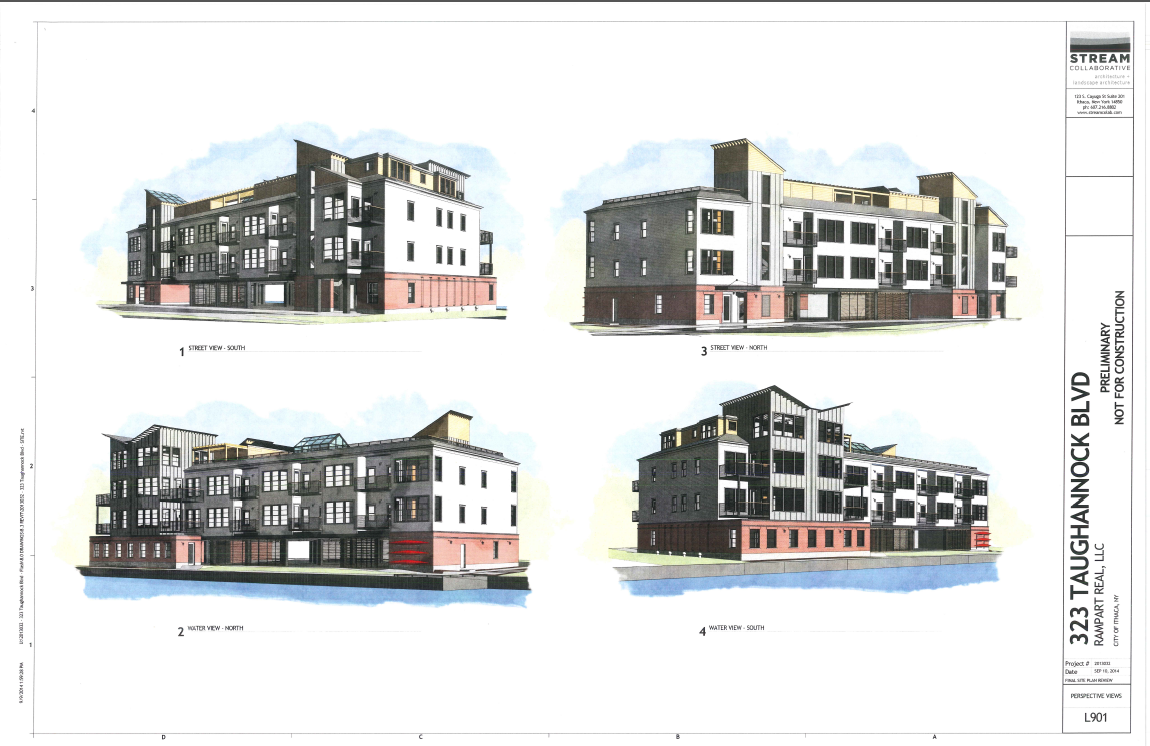
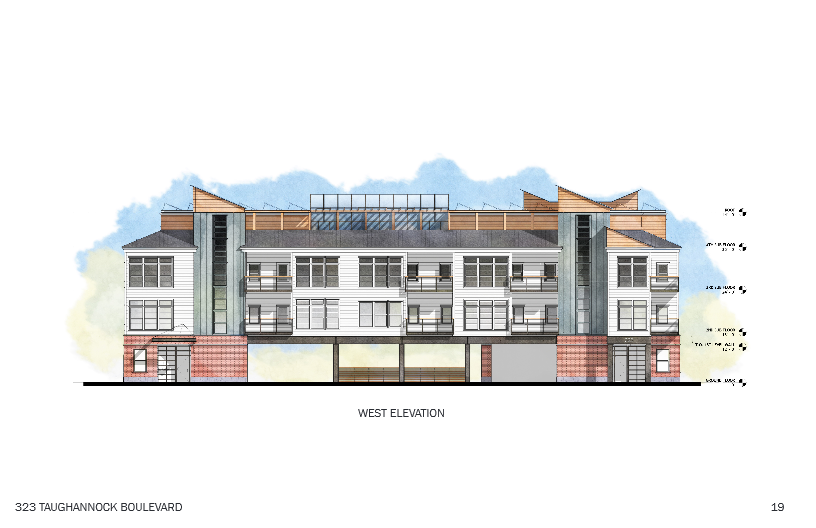
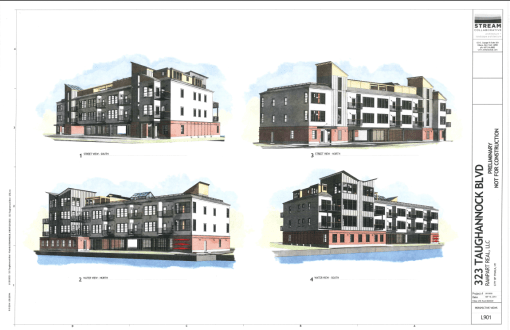
3. The Times’ Josh Brokaw wrote a nice summary of developments down at the Ithaca Waterfront, although I wish it hadn’t run when it did (re: HOLT update). Thanks to Josh, we have an idea of what’s going on with the approved but as-yet unbuilt 21-unit 323 Taughannock apartment project:

There was an “unexpected issue” that came up, Flash said, with the project, and so they must take “a sharper look at the engineering” to make the costs work.

I’m going to take a slightly educated guess – the soils were even crappier than anticipated. The high water table and easily-compacted soil in the West End and Waterfront pretty much mandate that multi-story projects have deep, expensive foundations to support the weight of structures. A soil issue was one of the problems that delayed the Lofts @ Six Mile project, and the reason why it’s built tall and narrow; also, since the Bloomfield/Schon has to pay for that deep foundation, it’s one of the reasons why the Lofts are so expensive. From the sounds of the Times article, balancing the deep foundation with adequate parking for the parcel is an issue. I’ll keep my fingers crossed, this project could be a real asset to that area.

Also, pretty sure that Cascadilla Landing still isn’t happening, and the Times has realized that. Anyway, it’s a good piece, and I’m not going to steal all of Josh’s thunder or his Myrick quotes, so spare two minutes and have a read through.

ith_big_plan_map_v2

4. For my moderate griping about timing with Josh’s Inlet Island development piece, I could note that this quote in the IURA Governance Commitee Agenda from city Planning and Economic Development Director JoAnn Cornish ties my article and his together:

“Cornish reported that the Planning and Economic Development Committee identified the Waterfront Neighborhood Plan as the Phase 2 plan of the Comprehensive Plan it would like to move forward with. Funding has been allocated for it. The plan would most likely be a hybrid Waterfront/West End neighborhood plan, in anticipation of significant development interest in that part of the city.”

In good news, affordable housing grants were thankfully saved in the federal budget, meaning that there will be a similar amount heading to NYS in 2016 as in 2015, and those funds would be available to future Ithaca projects should they jump through all the application hoops and be deemed worthy by Albany. The IURA is looking to smooth over any possible shortfalls by offering itself as a housing strategy consultant for the Waterfront/West End and Southside Phase II plans, and in the longer term, sales of parcels at the end of Cherry Street, at 410-426 Taughannock Boulevard, and Fire Station No. 9.

Also, the Argos Inn and Bandwagon Brewery/Restaurant have paid off their IURA loans. Proof that, although there have been failures (Finger Lakes Wine Center), the IURA can properly vet projects and be successful in its mission.

20160109_131947 20160109_132008

20160109_131909

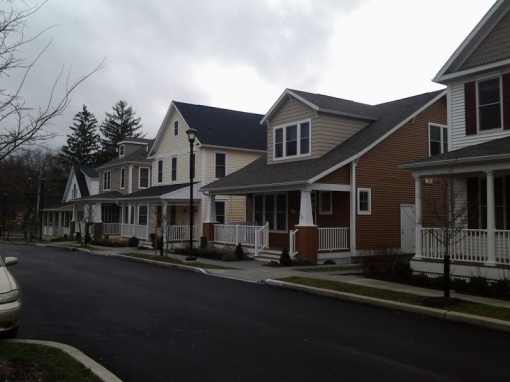
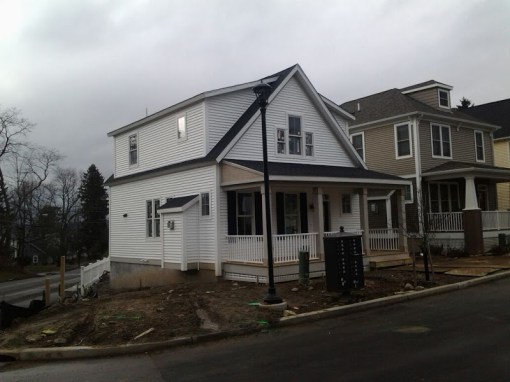
5. House of the week. 102 Walnut Street, town of Ithaca. the last of Agora Home LLC’s Belle Sherman Cottages is nearly complete, possibly to go on the market as a spec house. The house is a little small than its neighbors since the lot is smaller, but the unique design gives the street some extra diversity. Apart from landscaping, paving and some finish work (on the exterior trim at least, although being a Simplex modular means the inside is probably finishing up as well), the house is just about finished. Nice work Carina Construction.

6. Last but certainly not least, the Planning Board agenda for next Tuesday. It’s a big one.

I. Agenda Review
II. Public Comments
III. Special Order of Business – Chain Works District Redevelopment Project – Presentation of Draft Generic Envrionment Impact Statement (DGEIS) and Scheduling.
chain_works_rev1_1

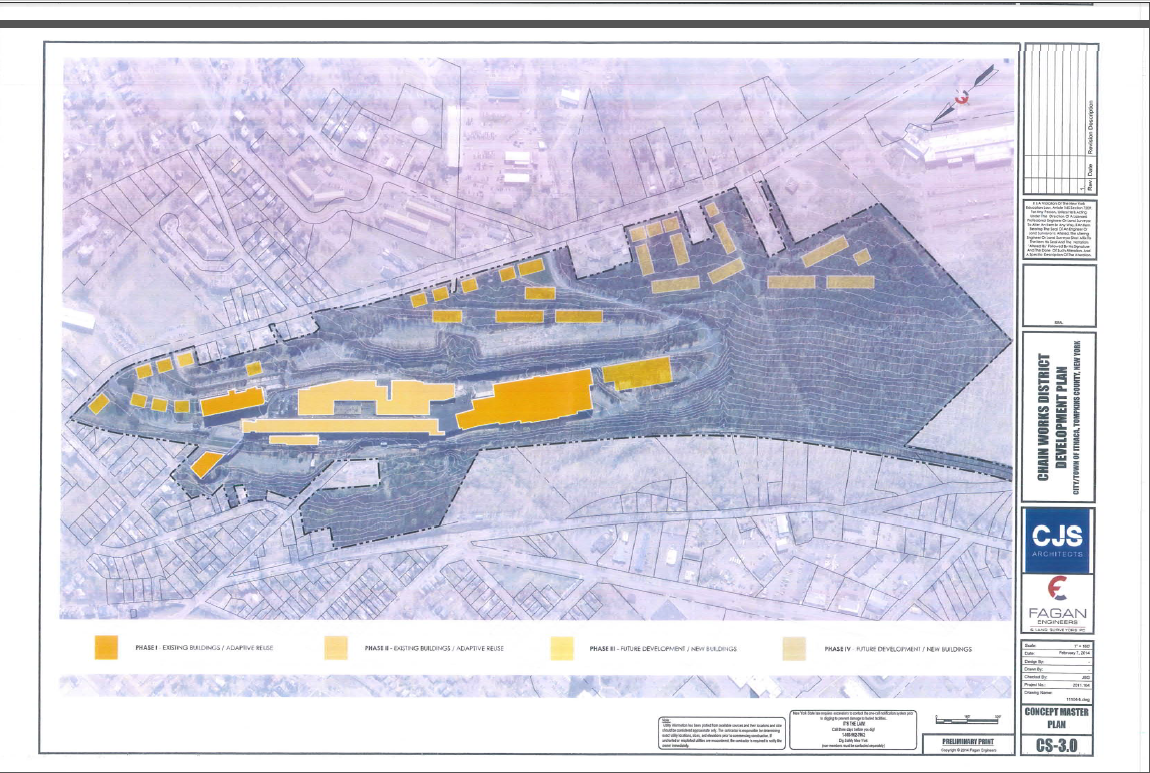
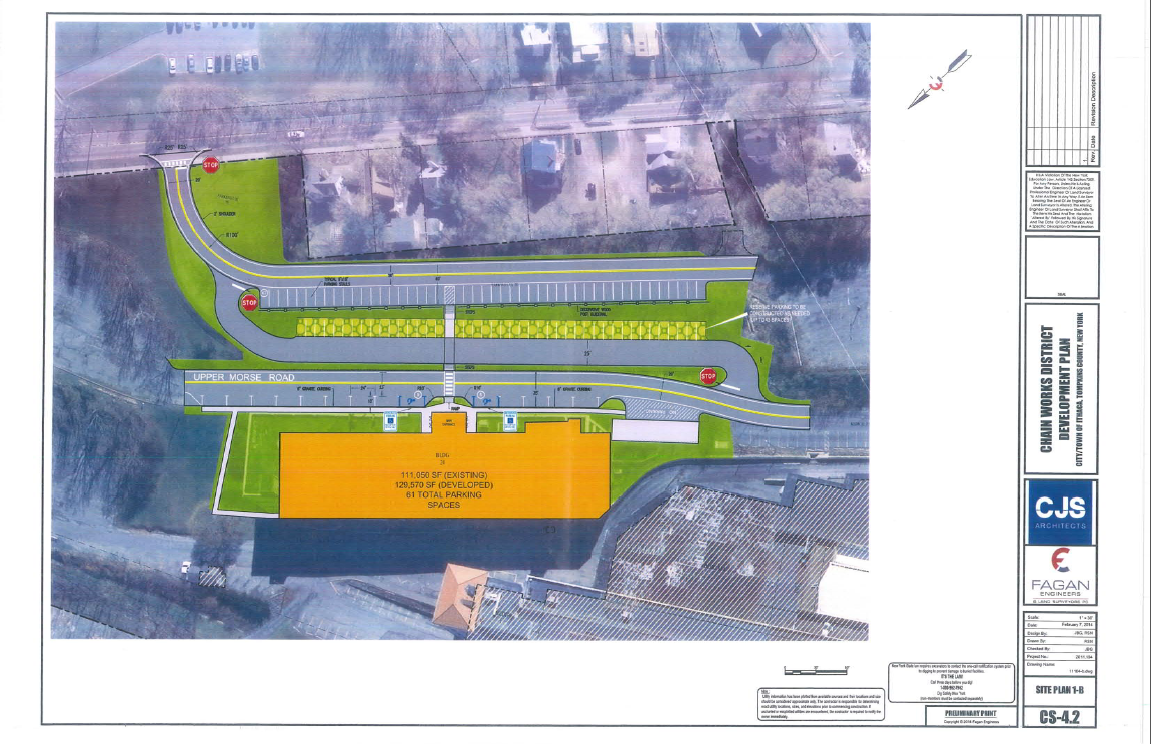
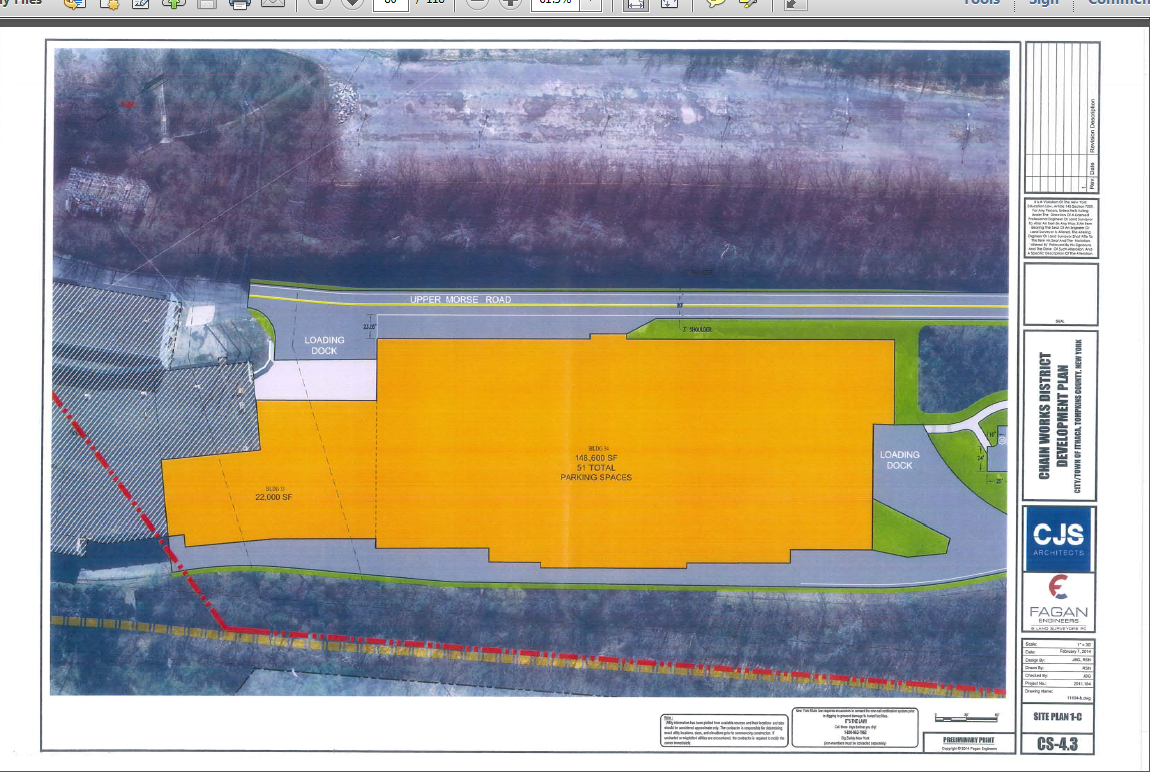
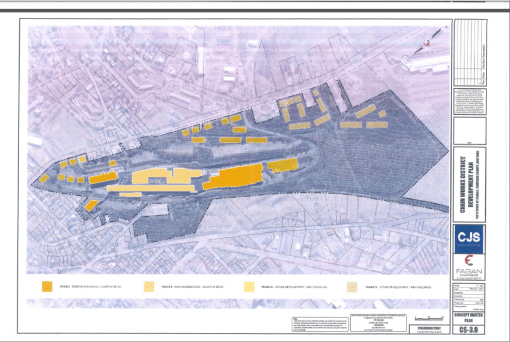
It’s finally moving forward. The Chain Works District, which was last presented at a meeting in November 2014, is finally ready to discuss parts of its environmental review and timelines. Per the agenda, “The project is a mixed‐use development consisting of four primary phases: (1) the redevelopment of four existing buildings (21, 24, 33, & 34); (2) the repurposing of the remaining existing buildings; (3) potential future development within areas of the remainder of the site adjacent to the existing buildings/parking areas; and (4) future developments within remaining areas of the site.” This will merit its own piece, but in the interest of time, Ithaca Builds offers a great summary of the previous steps and the proposal itself.

IV. Subdivision Review – 101-107 Morris Avenue. Declaration of Lead agency, Public Hearing, Declaration of Environmental Significance and Recommendation to the Board of Zoning Appeals (BZA). This subdivision proposed to reconfigure a pair of vacant North Side lots to allow a duplex to be built by Habitat for Humanity. The two 1400 SF units would be sold to families with modest incomes. There’s a letter of support and the Board has already drafted a recommendation to the BZA giving their thumbs-up.

V. Site Plan Review

A. Cayuga Green Phase II (Lofts @ Six Mile Creek). The applicant proposes to omit a green screen on the parking garage. A letter from the developer asserts that the wall will be adequately masked by trees.
canopy_hampton_rev8_comparo

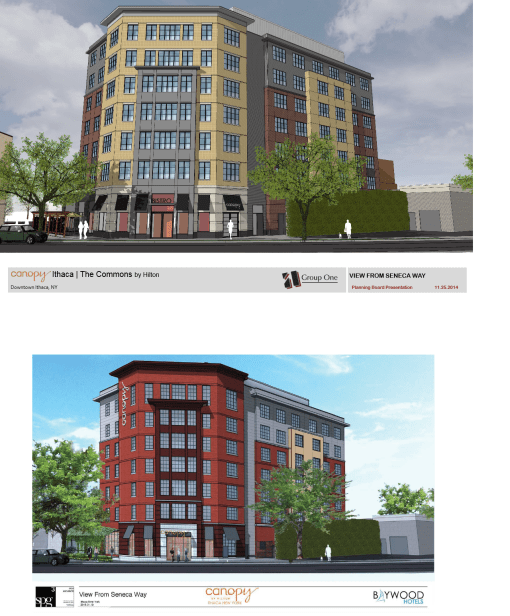
B. Hilton Canopy Hotel – Project Update, addressing conditions of Site Plan Approval and Requested Changes. Developer Neil Patel (and represented by Scott Whitham) requests to increase the number of hotel rooms from 123 to 131, and increase building size from 74,475 to 77,884 SF. Height would remain the same. Once again, this is something that could be the subject of its own post, but will have to keep it brief for the moment.

state_st_triangle_v6_1

C. State Street Triangle – Project update, no decisions planned. 9 stories, 96′, 180 units, 452 bedrooms, 12,300 SF ground-floor retail, including space for Ithaca Bakery and CTB. See Thursday night’s Voice article for more info. Smaller, shorter, and maybe palatable.

D. 424 Dryden, parking lot rearrangement, Declaration of Lead Agency

E. E-Hub, 409 College Avenue, renovations. While technically it doesn’t require review, Student Agencies and STREAM are asking for thoughtful feedback.

F. Sketch Plan – Elmira Savings Bank, Route 13. Pretty sure this is the one tied up in that PR disaster. WEDZ-1a Zoning allows up to 90% lot coverage, 5 floors and 65′, but given previous statements, the short-term work might just have to do with renovations of the former Pancho Villa restaurant, maybe a drive thru lane or other major exterior work. We’ll see. Background reading on the parcels themselves here.

G. Sketch Plan – Cherry Artspace. Developer: Performance Premises LLC/Samuel Buggeln. Cherry Artspace, a theater company, is located at (where else?) 102 Cherry Street on the city’s southwest side. The building was purchased in August 2015 for $240,000, it had previously housed Renovus Energy before the solar panel company decided to move out to more spacious digs in Ulysses. The theater company, directed by Sam Buggeln (pronounced “bug-ellen”), wishes to renovate the ca. 1980, 1,154 SF building into dedicated performing arts space.

VI. Zoning appeal recs for the Habitat duplex

VII. Planning Board Resolution to the BPW regarding Seneca Street Streetscape work, Cascadilla Street Railing Options, and potential rezoning of a section East State Street/MLK Blvd. from B-4 to the more restrictive and residential-focused R-3a. Glancing at the zoning map, only the north side of the 400 Block is B-4, so the downzoning is probably intended for the houses on the corner of E. State and Schuyler, 420 and 422-24 E.State/MLK, and 108 Schuyler Place.

travis_hude_libe_libe_v3

Also worth noting, the Travis Hyde Old Library project will be discussed separately with the ILPC. That meeting is at 6 PM at City Hall. The Planning Board meeting at City Hall starts at 6:45 PM.


206 Taughannock Construction Update, 4/2015

17 04 2015

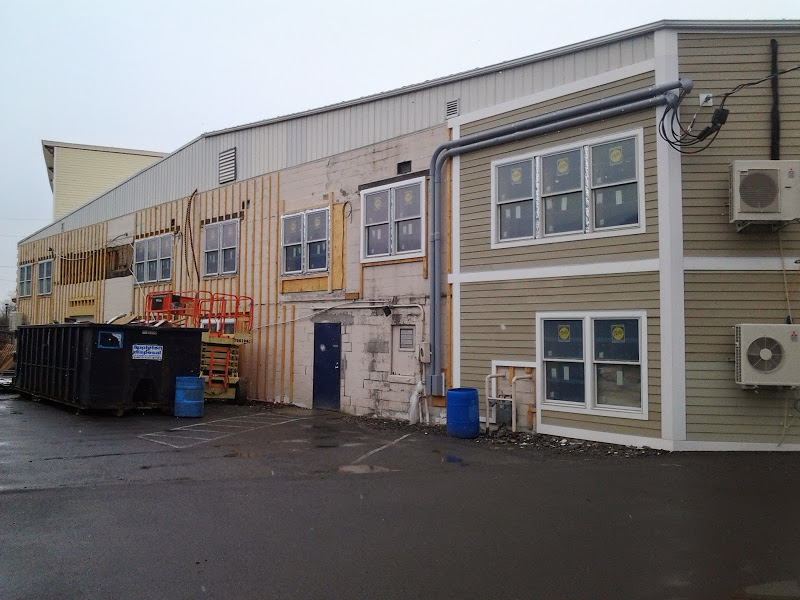
Work has progressed at the site of the apartment project at 206 Taughannock Boulevard on Ithaca’s Inlet Island, where seven apartments and office space are being built from the gut renovation of a furniture store and warehouse. The changes on the exterior have been slow, but given this past winter, the focus of the past few months has probably been on the interior space.

Since November, a little more siding (best guess, fiber cement/Hardie board) had been installed on the exterior, and the industrial steel siding at the front side of the roof has been replaced with an irregularly-shaped plywood-and-housewrap structure. Looking at the window spacing, siding and trim boards already applied to the front of the building, this rooftop re-do is likely intended to break up the bulk of the old warehouse by giving the impression of individual buildings within the greater structure. It could look nice or it could look clunky, we’ll have to wait and see.

206 Taughannock was until 2014 the site of the Unfinished Furniture Store (otherwise called the “Real Wood Furniture Store“) owned and operated by the Zaharis family. From the county records, the building itself is a 9,156 sq ft structure originally used for retail and warehouse space and dated to sometime in the 1970s. The store closed last April when its owners retired, and a building permit issues a few months later. Photos of the store before renovation can be seen here at Ithaca Builds. Perhaps the biggest loss in this renovation is the removal of a rather attractive mural from the front of the structure.

20150405_142011 20150405_142023 20150405_142140

Next door, work continues on a satellite office for the Ithaca Police Department in the ground floor space of the former Lehigh Valley House, now a six-unit condominium. The Lehigh Valley renovation was done by local developer Tim Ciaschi, with design work by local architect Claudia Brenner.

20150405_142152 20150405_142305

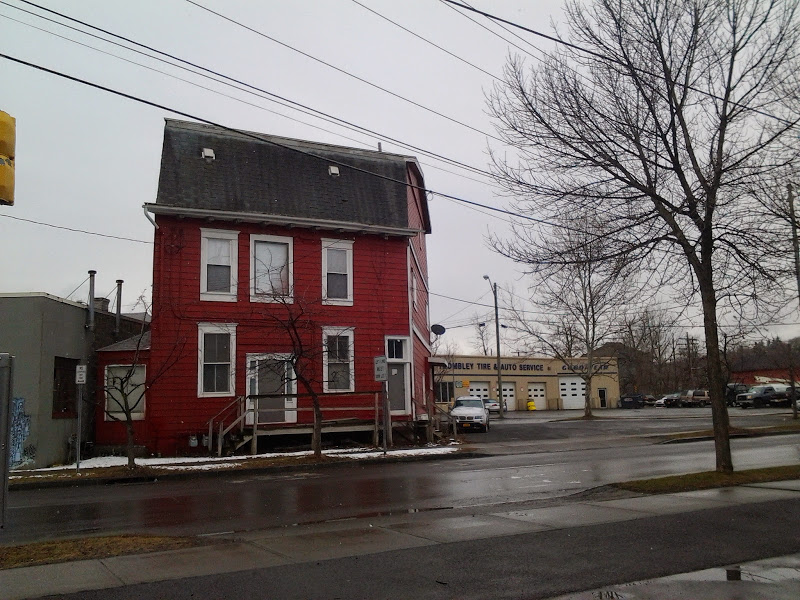
Two more Inlet Island projects are waiting in the wings, although only one is likely to start anytime soon. The 21-unit 323 Taughannock apartment project is expected to start construction this year, but no work appeared to be taking place when I checked the site at the start of April. Meanwhile, 12 affordable apartment units have been proposed for 910 West State Street in a project called “The Flatiron”. The developers, Alpern and Milton LLC, applied for affordable housing grant funding to help finance the project. However, the IURA has deemed the project a low priority because it wasn’t feasible as presented. The site as-is is shown below. The red building with the mansard roof would be renovated, and a structure of similar height and appearance would be built on the triangular lot to its left (west).

20150405_141933 20150405_142028


News Tidbits 9/20/14: Ithaca’s A Habitation Destination

20 09 2014

1. Expanding on the Ithaca Times piece on increased tax revenue from construction in the city, the IJ has come out with its own piece. Here are your spark notes:
I. Of the 6.16% increase in the tax base (an extra $1.2 million in revenue), 53% is due to commercial property construction.

II. “Only” 59.2% of property is tax-exempt now. Of which 83.5% of that 59.2% is Cornell and its holdings.

III. Building permits are lagging forecast revenue a little ($631k vs. $700k expected), but some larger projects are only getting their permits now, so it will probably balance itself out.

2. One more set of revisions for 323 Taughannock, pdf here. The differences compared to the previous revision are minor; the projecting “tower” on the southeast side has seen its windows tweaked, and the roof layout has been modified as well. This should be the last revision, since the project is up for final approval this month. The 20-unit residential waterfront project is set to begin in January, with a six-month build-out and $3.5 million price tag.

323taughannock_rev2_1

3. According to the IURA (Ithaca Urban Renewal Agency) meeting minutes, the city is very much interested in selling off a parcel it owns on Inlet Island, once it buys out the DEC’s property. Currently, 410-426 Taughannock Boulevard is used as a municipal parking lot. The 1.29 acre parcel was acquired for $1 by the city in May 2003. The parcel is assessed for over $300k, and that’s not including an adjacent parcel also used for parking (416 Taughannock). This is a large waterfront zoned (WF-1) piece of land, where the zoning is for one or more buildings with of 3-5 stories and nearly unrestricted lot coverage. For a developer, that means that there’s a lot of possibilities here. This would hit the market in early 2016 at the earliest, after 323 Taughannock has been built. But if 323 is successful, then I think this parcel will be highly desirable and any development on its land could potentially be quite large. Along with the DOT site up by the Farmer’s Market, Ithaca could have quite the developed waterfront at the end of the decade.

410_426_taughannock_1

4. Since approval in late summer of 2013, all has been quiet on the wooded and hilly site of 130 East Clinton. Frankly, given that it’s a Jason Fane project and he doesn’t usually dawdle (having significant resources allows him to secure construction loans with relative ease), I was surprised, and in private, this was a topic of debate. Well, now we know. He’s seeking tax abatements for his 36-unit market-rate project through the city’s CIITAP incentive program. As previously briefed on the Voice, CIITAP is a program that allows an abatement on a portion of property taxes for up to 7 years. The parcel needs to be in a targeted urban area, 3 stories, and receive at least $500,000 in developer investment (130 East Clinton’s projected cost is $4.5 million). The city’s meeting is the 18th, and if the city endorses the project, then chances are good the county IDA will grant the abatements.

Fane’s probably the least-liked developer in town due to his colorful local history (this would also explain why I had hits to the blog the other day with the search phrase “fane like mr. potter”), but there’s no compelling reason to deny his CIITAP application. He meets the program requirements, and for Fane, this is all about the money and taking advantage of an opportunity. Presumably, if the tax breaks are approved, we could see this one begin excavation and site prep before year’s end.

130eclinton_rev2

5. Another revision – this one the “Hampton Boutique Hotel” formerly known as the Hampton Inn downtown. A large number of major changes here – a floor has been added (bringing it to 123 rooms, 74,200 sq ft, 7 stories and 92 feet from ground to the mechanical penthouse roof), the external materials and the window layouts have been altered substantially, and of course, it’s no longer being proposed an a Hampton Inn (for comparison’s sake, the previous design is here). About the only thing that’s the same is the footprint. Part of these changes are likely the result of the Carey Building addition planned next door – the blank wall shown below faces the Carey’s rear side.

hampton_rev2_1

hampton_rev2_2

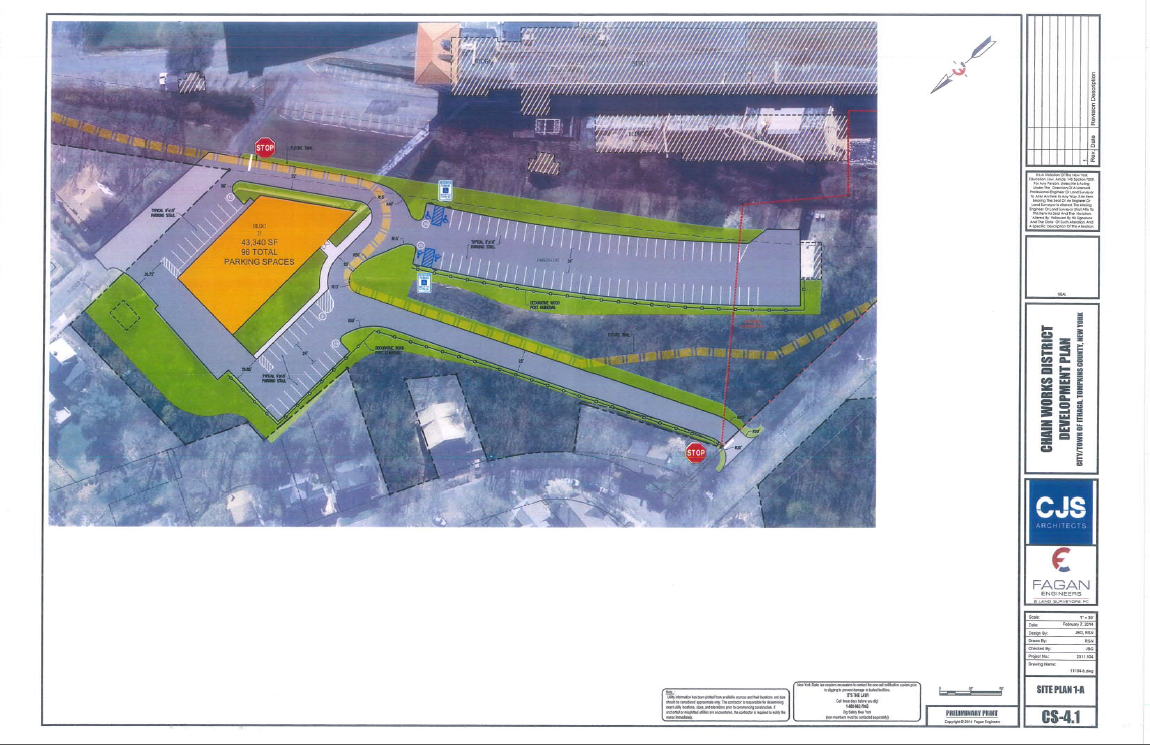
6. A lot more info about the Chain Works District proposal. For one, it will be in four phases. The first phase will consist of the redevelopment of 4 buildings on site – 21, 24, 33 and 34, which combined will create 343,510 sq ft of space, of which 18,520 sq ft will be new. Phase one is planned as office/mixed-use (21/24) and manufacturing space (33/34). New roads and parking lots will also be developed. Phase 2 will be renovations and selected demolition of the rest of the complex, and 3 and 4 will be brand new buildings on the factory’s 95-acre land. There’s no rush, phase 4 won’t be completed until about 2030. Note that the first image below is a hypothetical setup – none of those later phase site plans are set in stone.

chain_works_rev1_1 chain_works_rev1_2 chain_works_rev1_3 chain_works_rev1_4

7. Next week is going to be a fun week for this blog. Why, you ask? Well we’re going to have two new projects at the Planning Board meeting that will be presenting their sketch plans

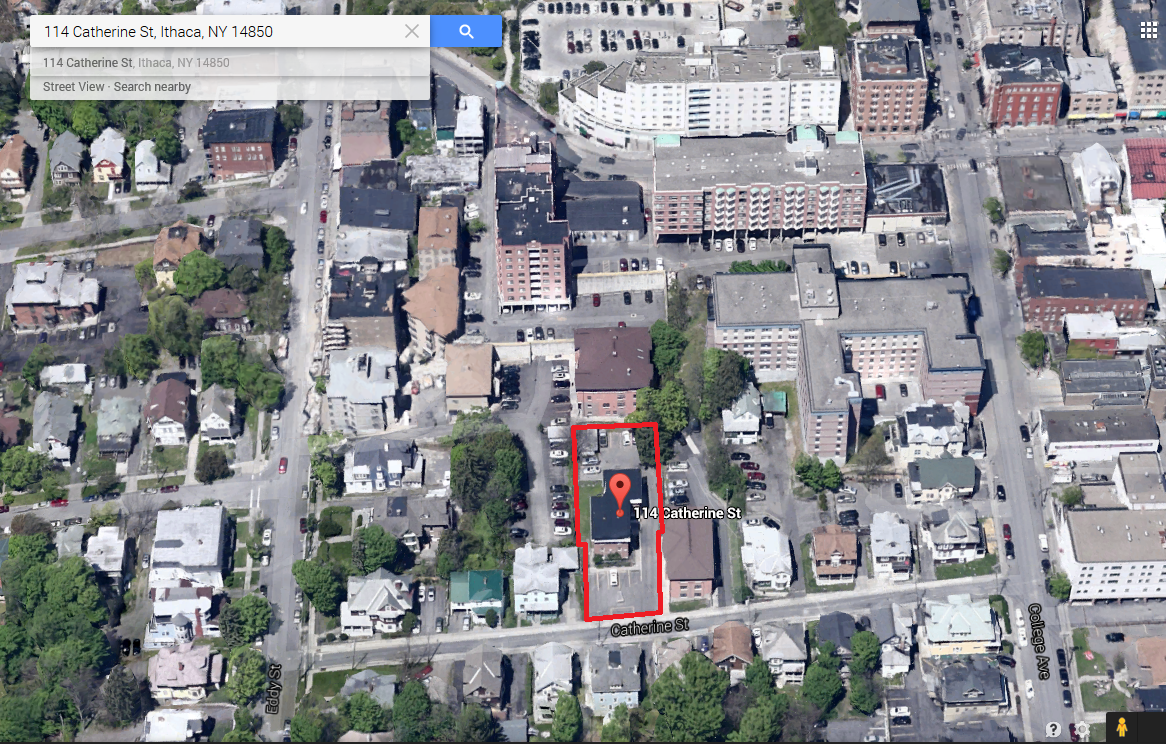
The first is 114 Catherine Street in Collegetown. Currently, 114 Catherine, also known as the “Mission Apartments”, is a 5-unit apartment building last renovated in 1985, assessed at about $590k, and owned by Lambrou Real Estate. 114 Catherine is in a CR-4 zone per the new form guidelines, which allows for a 2-4 floor all-residential building with no off-street parking required. At about 0.27 acres, 114 Catherine is fairly large as Collegetown lots go (much of the current site is used for parking), and given the Lambrous’s multiple building Collegetown Park development that abuts the property to the north, whatever gets proposed here is a likely continuation of that complex. Expect another Sharma Architecture design, as Jagat et al. have been the Lambrous’ go-to architects for the past couple decades.

114_catherine_1

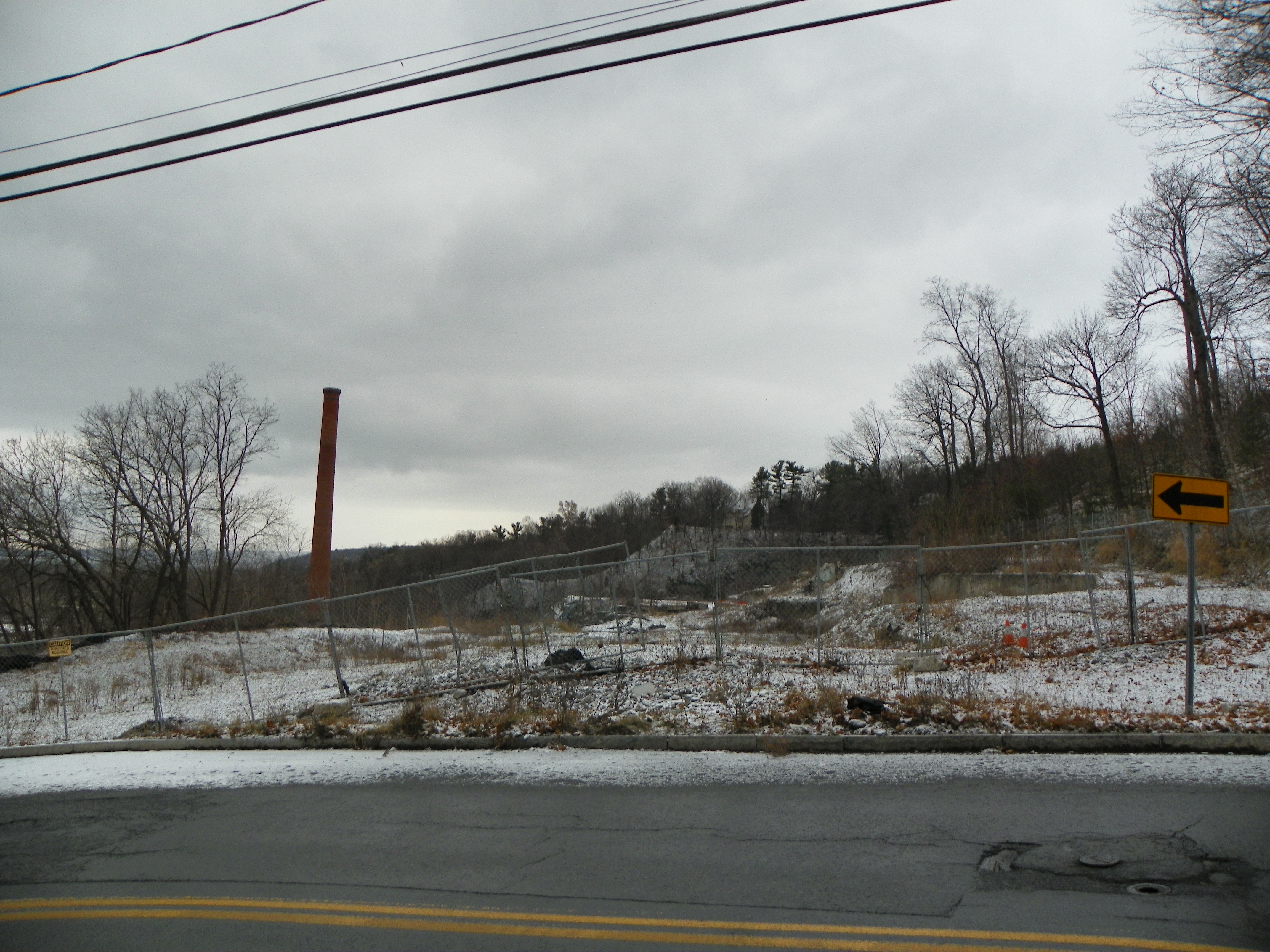
The second is…”Gun Hill Housing Project”…be still my beating heart. I’m cautiously optimistic that Travis Hyde Properties might finally, finally have achieved enough environmental rehabilitation of the once-toxic factory site that construction is now feasible. Fingers crossed, because this has been a huge pockmark on the city since the factory closed in 1986 (and demolished in 2008), has been in development hell for years, and redevelopment would really be a feather in the community’s cap. The last I heard, it would be about 45-50 units of non-student oriented condos, and most likely a HOLT Architects design (HOLT being a popular choice for Travis Hyde). I’m sure local environmental activist Walter Hang will be going over the project details with a fine-toothed comb, but like I said, fingers crossed.

12-29-2011 010


News Tidbits 8/23/14: Soooo Much Rendering

23 08 2014

In the news this week are a bunch of updated renders. The Planning Board meeting is next Tuesday and the city needs to have all their updated building proposal files in order. Let’s take a look.

1. This one was approved in July, but it’s worth noting that Cornell has been given the green light to begin construction with its addition to the Gannett Health Center off of Ho Plaza. This is probably about as smooth as the approvals process for a large project gets. Cornell knows everything the city wants (and vice versa), sending enough detailed renders and assessments to write a book, so the city is left with few questions that need to be asked, and any recommendations or suggestions from the board are addressed promptly. The finalized renders by Ithaca-based Chiang O’Brien can be found here. Looking back at the initial proposal, most of the differences are in the roof/skylight layout, and some of the window and facade banding was tweaked. The $25.5 million project is all clear for its March start date, for a completion in fall 2017.

gannett_rev1_final_1

2. Hark, developer Josh Lower’s 307 College might be nearing preliminary approval. A few more tweaks to this 46-apartment, 96-bedroom project since last time; the brick has been differentiated in the front and back, and the blank wall on the northwest corner now has slit windows, created by angling the walls slightly inward. As a result, the windows to their east, and the second-floor windows on that corner have been reduced. They look a little odd, and I wonder if they couldn’t have just done an art wall instead. As with many Collegetown midrises, the design is by local firm Sharma Architecture.

307college_rev2_1

3. Another project getting a mild makeover is Steve Flash’s 323 Taughannock project for the waterfront of Inlet Island. Revised PDF here. Compared to the previous renders, the waterfront side now comes with more balconies, the fourth floor has been redone, and the “first floor” parking area has been tweaked. All-in-all, it’s a fairly substantial design modification by architect STREAM Collaborative. The project seeks to add 20 residential units to Ithaca’s underutilized waterfront. For the naysayers, the argument will need to be something other than ecological; the environmental study was completed by Toxics Targeting (the company run by aggressive environmental activist Walter Hang), and 323 was given the all clear.

323taughannock_rev1_1 323taughannock_rev1_2

4. You want more renderings? You got it! Here we have revisions for the proposed 120-room Hampton Inn in downtown Ithaca. We also have project details from the Site Plan Review (SPR) – the project will cost $11.5 million, and is aiming for a construction period from Spring 2015 to Spring 2016. This project has been meeting with quite a few city officials, the Board of Public Works for the sale and transfer of the city parking lot to the developer, and the IURA for tax breaks. Looking over architect Scott Whitham’s refreshed design, the massing is still the same,but the facade materials have changed up. Gone is the yellow stucco-like material, and here comes the brick (hopefully not the stamp-Crete kind). At least the brick makes it more compatible with its neighbor the Carey Building.

hampton_rev2_1

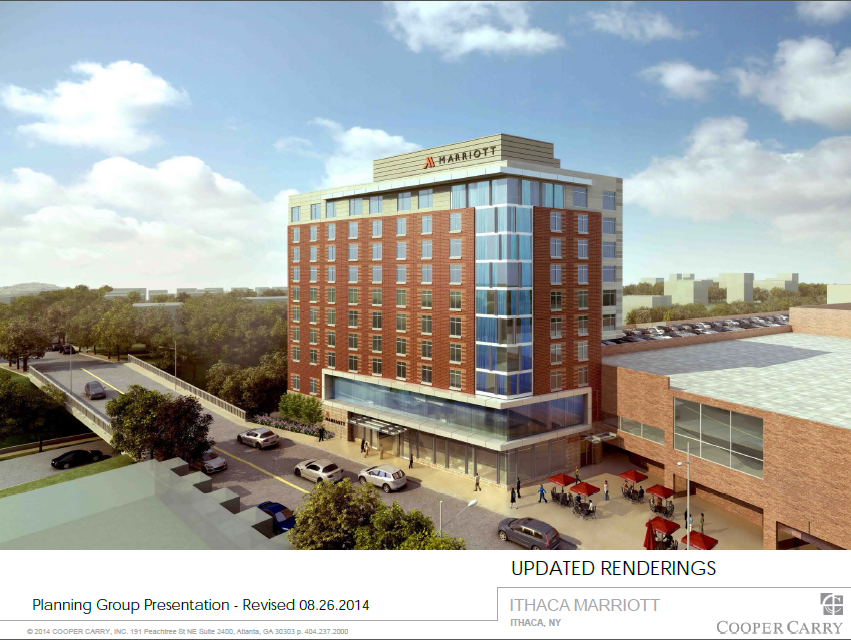
5. Last on the list, the 160-room Marriott. I thought this one was good to go, but apparently it still needs the Planning Board’s approval of the, uh, value engineered design, seen here. The protrusions on the top floor and roof have been trimmed back, the materials have been down-scaled, and the LED-light waterfall effect that was such a discussion point at the meeting last month is now being done with what the PDF calls panels (curtains, I think). The top few floors will be light blue, the middle floors medium blue, the lowest floors dark blue. The crown design has also been modified a bit. The start date for this has been pushed back so many times, I’ll sincerely be amazed when they have steel coming out of the ground.

marriott_rev1_1

I should note that a couple other projects, 205 Dryden (Dryden South) and 327 Eddy have also been revised, but it’s just their A/C vents, a very minor detail that I’m going to save the bandwidth and not bother re-hosting. If you’re really interest, revised plans for 205 here, and 327 here.

With all of these projects noted, it would appear that we have nothing brand new on the agenda for the PDC meeting on the 26th. Stone Quarry and the Marriott are up for revised final approval. The Carey Building addition, 205 Dryden (Dryden South) and 307 College (Collegetown Crossing) are under consideration for final approval, and 323 Taughannock is up for preliminary approval. The only project being reviewed and not up for approval is 327 Eddy, which will be undergoing “Declaration of Lead Agency”, which is an obscure way of saying the Planning Board agrees to conduct the environmental and design review. The approvals would result in 160 hotel rooms, and 117 additional housing units in (82+18+40+96+24) 260 bedrooms, if I have my numbers right. With the exception of Stone Quarry’s rumblings, there’s not a whole lot of opposition left at this point, which means this fall and next year could be pretty busy, with a lot of hardhats on the streets.

6. Now for something different. The vacant parcel at 707 East Seneca, discussed here previously, is being offered for sale at $175,000, well above its assessed value of $100,000. The agent makes note the property could allow four units, but does not note that it’s in a historic district subject to stringent design guidelines.


News Tidbits 8/2/14: It’s Gotta Go Somewhere

2 08 2014

Here’s the semi weekly digest for your mid-summer doldrums…

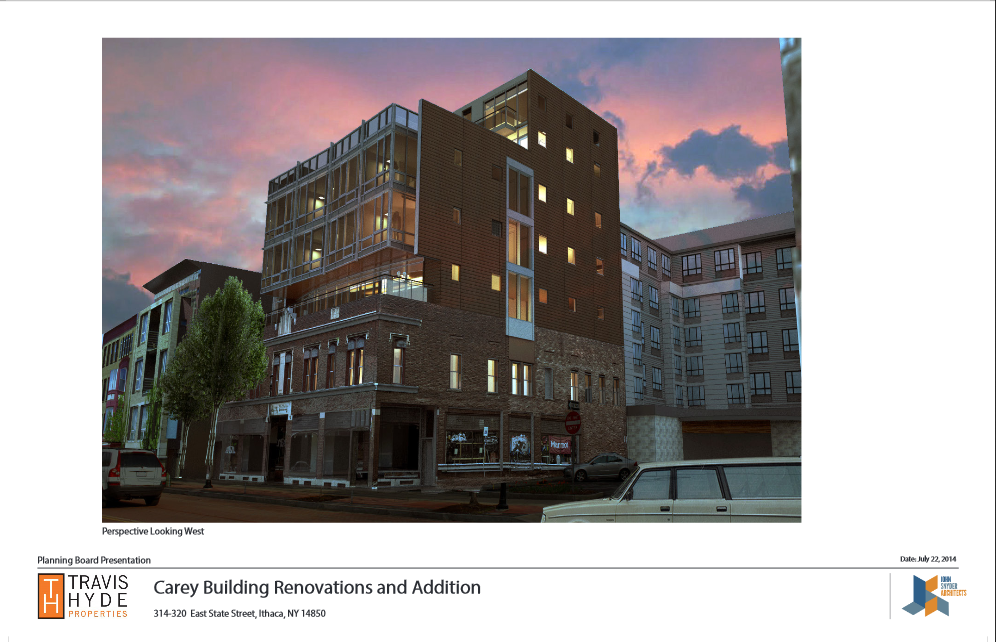
1. Yet another round of Carey Building design tweaks. Updated renders and more here. At least now the renders include the proposed Hampton Inn to its north, which shows just how dense this corner will be (not unlike its historical precedent, when the massive Strand Theatre occupied much of the block). Better yet, that blank wall on the west face has windows and will be home to a “art wall” for a mural. The roof and facade have been tweaked since the last update, and I think it’s fair to say that this is a substantial improvement over the initial proposal.

carey_rev4_1 carey_rev4_2 carey_rev4_3

2. I had the updated PDF of the 323 Taughannock Boulevard proposal stored away for the next news update, but Jason at IB wrote an in-depth article about the development in the meanwhile, which is much better than a blurb on this blog. Most notably this time around is the inclusion of color renders, which is just as much a hodgepodge of influences as the design itself. The 20-unit, 23,000 sq ft, $3.5 million waterfront development would be under construction in the first half of 2015, if approved. Replacing a run-down waterfront bar, it has the potential to pioneer development of Ithaca’s waterfront, where controversial zoning was passed in 2011 to allow for larger projects such as this.

313_rev1_1
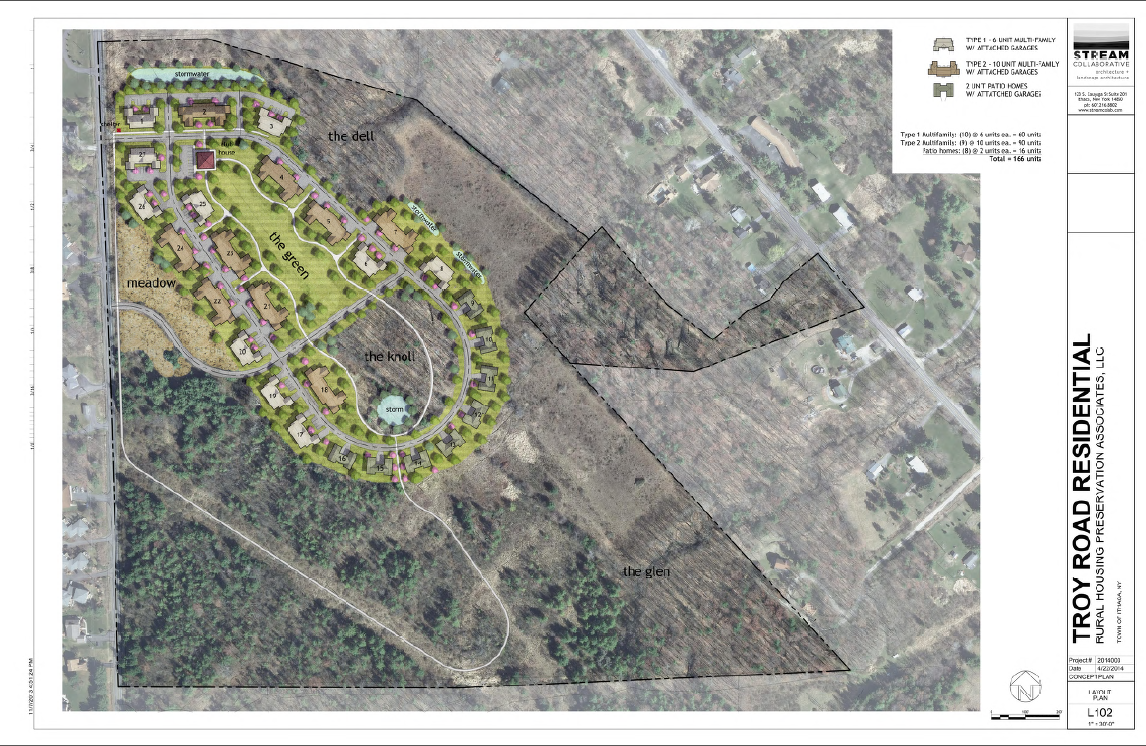
3. Now for something different. The project on Troy Road in the town of Ithaca is trapped in the red tape. At last check, the developers, the perhaps disingenuously-named Rural Preservation Housing Associates, were trying to figure out where to go, as they’re having difficulties gathering enough support from the town board for a Planned Development Zone. This PDZ is required because the project proposes 166 units; the max under cluster zoning, which doesn’t require a Town Board-approved PDZ, is either 153 or 154. According to a recent town Planning Committee meeting, the alternative to the 154 or so clustered units is up to 104 units of even more sprawling single-family housing (52 lots with two units each), which is within zoning and could be rented out if they have trouble selling. The developers have been considering community meetings to quell public dissent and to learn what would get the PDZ apartment development passed. For the record, they’ve said they are open to prohibiting undergrads from renting and occupying units, which is possible since students are not a protected class under the law.

TL;DR – it’s a mess. I’ll add that in with the Biggs parcel issue, and the (weakening) opposition to INHS’s Greenways in East Ithaca, that the town has achieved the trifecta of development battles on all of its hills.

There was an interesting housing study that I came across for the Troy Road parcel, created by some Cornell City and Regional Planning (CRP) students for a course. The first phase as designed by the students would have 14 affordable (owners making 80% of county median income) housing units with 11 1180 sq ft. 2-bedroom and 3, 1355 sq ft. 3-bedroom homes, utilizing state tax credits to keep sale costs between $140k and 155k. Their proposal would have require changing the current zone from low density to medium density, which would have made such a project a non-starter.

troy_rd_2

4. Meanwhile in Lansing, they’re weighing in on 102 townhomes. If Ithaca were an island, anti-development could be great. But since other towns are building housing and adding residents that will travel through the town to get to the employment centers in the city, then the residents of the town of Ithaca had better figure out a more effective strategy to managing growth other than knee-jerk no’s.

5. Some members of Ithaca’s West Hill community listserve is engaged in a thought exercise – seceding from the town and making their own village to specifically oppose any development proposed in their community. This isn’t without precedent; the village of Lansing was founded in 1974 due to fears stirred up by the construction of Pyramid Mall. West Hill, in turn, fears housing, especially low-income housing, due to the negative influence from low-income, high crime apartment complexes such as West Village. The “Minority Report” that they gave to the town planners was described as “a polemic of the proposed [Comprehensive] Plan as a whole, and offers few comments on any specific goals and recommendations“, and the town spent six pages excoriating the bombastic report. It’s another TL;DR for most, but the gist of the West Hill Minority Report is that the town encourages sprawl and ghettos and should only allow very small areas for development, even deconstructing some currently-built areas due to an increasingly unsustainable environment. I understand their angry reaction due to the high crime in southwest Ithaca, but all this is the administrative equivalent of over-correcting a car in a skid.

6. And then there were 5 – Since INHS is focusing on the Neighborhood Pride site, the non-profit is withdrawing from old library competition. Looks like John Schroeder can add DeWitt House to his entries in his “Unbuilt Ithaca” book draft. But don’t worry, they’ve already starting working towards redevelopment of the old grocery store, by issuing a request for qualifications (RFQ) for those interested and capable of designing their new infill project.

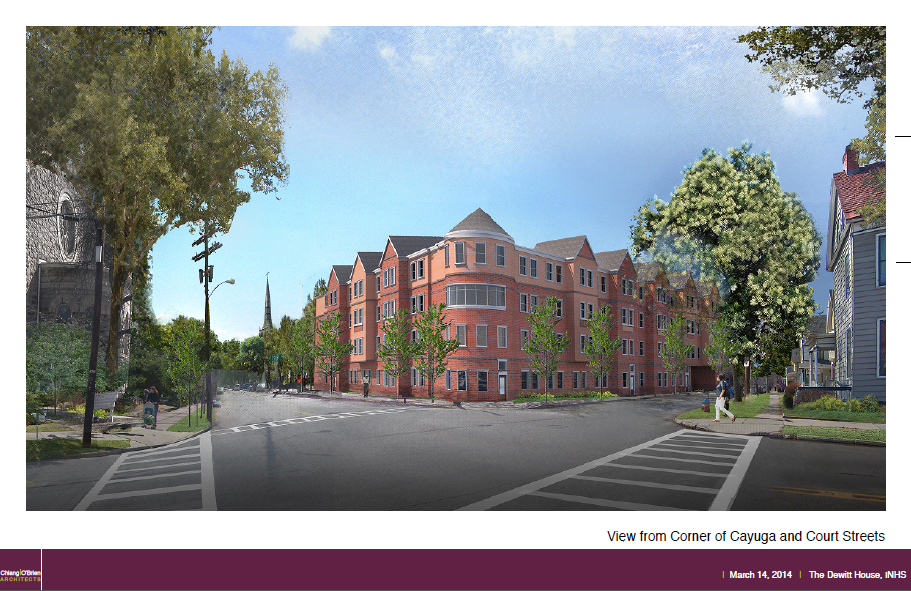
inhs_libe_0414

7. At a glance, this call for bids on this parcel of city land at Five Mile Drive would seem to be wide open…except a local green housing developer has been targeting this plot for quite a while. It’s a bit like advertising a job when you already have someone lined up for the position. Oddly enough, I have yet to hear opposition this one; maybe it’s too far south for West Hill to care.

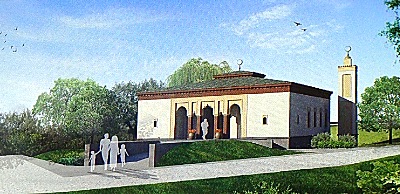
8. Lansing village is getting a mosque, according to the Star. The project, to be built at 112 Graham Road by the Al-Huda Islamic Center of the Finger Lakes, will result in a 4,828 sq ft mosque, with a small minaret if money provides.

Rendering courtesy of Lansing Star

Rendering courtesy of Lansing Star