News Tidbits 9/21/2012: Building Something That’s “Typically Ithacan”

22 09 2012

While the city debates the details of the Collegetown Crossing and Cascadilla Landing projects, here’s a couple of new interesting little news tidbits from this month’s planning board agenda:

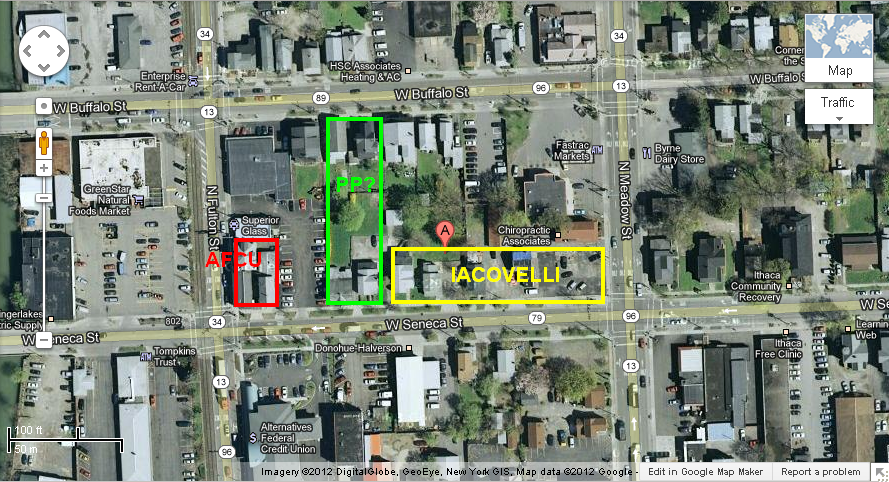
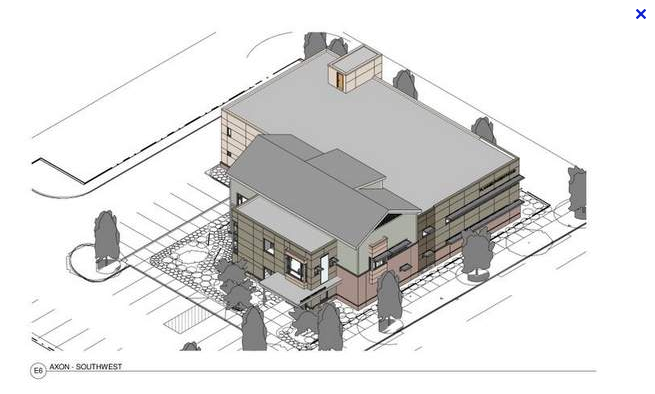
Planned Parenthood, the bane of most social conservatives’ existence, is building a new Ithaca (Southern Finger Lakes) facility. The two-story, 9,000 sq ft building will be built on half an acre of land occupying 616-626 West Seneca Street (WHCU claims 16,000 sq ft – I trust the planning board more). The new structure, its 27-space parking lot and landscaping will require the demolition of four homes. I’m still having trouble wrapping my head around the configuration of this, since the Iacovelli apartment building is going up next door, and AFCU’s new accessory lot on the vacant property on the corner of Fulton and Seneca. I had to check the photos I took last month to verify there were still two homes on the Seneca side of the proposed property, and since there are in fact two homes, I think the diagram below looks about right. The photo above is one of the homes, which I had initially intended in a gritty Ithaca photo blog entry somewhere down the line.
On to the other piece of news, INHS, the NPO developer of affordable housing in the city and town, is in the initial stages of its latest project, a 35-unit complex at 400 Spencer Street. This is on the edge of big box land, and the southern edge of residential Ithaca, in an area best described as low-density commercial/industrial hodge-podge. The project as proposed offers up two rows of townhomes (16 units), and a 3-story apartment building (19 units). INHS has been on a roll the past couple years, with the 39-unit Cedar Creek project completed, the 50-unit Breckinridge Place project downtown, and 11 townhomes underway in the town of Ithaca (with 11 more planned in a second phase of the “Holly Creek” project). This is in complement to their normal single-family renovation/new-construction work.

So, “affordable” housing projects, and a new building for Planned Parenthood. I’d say those fit the political interests of left-wing Ithaca fairly well.



Scoundrel, or Scapegoat?

18 09 2012

The Sun’s piece regarding the problems with Jason Fane is nothing new. Previous articles over the past several years have done the exact same thing. I personally have never, ever been a fan of Jason Fane. So, since he is the (man? villain?) of the hour, I figured it was worth taking a look at the man who owns so much of Ithaca.

Jason Fane, from as far as I can tell, has been a major landlord in the Ithaca area since the mid-1970s. He is New York bred, holds a civil engineering degree from MIT and a Harvard MBA, and is about 70 years old. The recent Sun article notes that his tenants refused to pay rent in 1974, citing deplorable maintenance of his properties. In 1979, he feuded with the city building commissioner, who condemned one of his properties (with 15 occupants still living in it). An academic study of Ithaca compares quotes from him in 1975 to 2000, where he goes from saying “students aren’t interested in aesthetics” to students “are looking for quality”. By quality, we’re talking $1,400/month in rent. To be fair, Jason Fane knows his business…and for better or worse, he knows how to milk his stakeholders to his advantage.

Cornell has a fairly wealthy student body, such that extremely high rents are acceptable, as some students have the means (or rather, their families do) to afford such rates. Business owners, however, tend to be a different story. A student pays high rents because of proximity to Cornell and high quality of services. For a business, setting up in Collegetown means suffering a major lack of business during academic breaks, not to mention extremely high rents for choice, high-traffic locations…many of which are owned by Jason Fane. As long as the apartments are rented, Fane has no need to try and fill the commercial space, no matter how much students, residents and local officials complain. He’s still making a tidy sum from his residential units, and rather than cut prices to lure in shopkeepers, would prefer to wait until that day when someone is willing to pay his high price – because occasionally, someone will.

Let’s be clear – the man is rich. He owns a real estate empire that stretches from New York City to Toronto, where he is currently developing high-rise condo towers. For more proof, here’s an article where he goes to court over $850k in gold and silver bullion. He also isn’t afraid to weigh in on anything that may affect his business – he was a major opponent of the Cayuga Green apartment project, and he also tried to have the city building commissioner shut down Cornell’s temporary freshman housing in student lounges – presumably, because both had an impact on his business.  He is not the compassionate and caring businessman pro-commerce groups like to promote. In fact, a few other c-words – cold, calculating, and controlling – come to mind instead.
In all fairness, Mr. Fane is under no obligation to fill the space, unless he feels a need to deepen his pockets further. But it certainly isn’t doing him any favors in the communities he’s invested in. I guess when you own ten Collegetown properties, several more in downtown Ithaca, and a couple suburban properties, you can afford to do as you please.


News Tidbits 9/12/2012: Reading Between the Lines

12 09 2012

I tend to look forward to the middle of the month, mostly because the new agendas are released for the Project Review Committee associated with the Ithaca Planning Board (and the first official news of new projects). Apart from this debatable unhealthy interest, I’ll sometimes check out the Planning and Economic Development Committee, not because it’s as interesting to me, but mostly because I’m trying to avoid another Cayuga Green screw-up from ever happening again. So, in engaging in my monthly routine, I looked to find that while nothing was posted yet for the planning board (meh, I can wait), a curious piece of news was embedded in the PEDC’s agenda.

There’s a note from the economic development planner asking for a brief revision in the description of waterfront zones. Waterfront zones are stated as five floors maximum, and in another section states a maximum height of 63 feet. She asks for it to be stated such that the building may be 63 feet max, or five floors. I like to imagine her busting out a magnifying glass for this trick.

 
Now, associated with this incredibly uninteresting detail is an interesting piece of news – the clarification was proposed because a property owner wishes to build a waterfront-zoned building within the 63′ height limit, but with more than five floors. Now, I double checked Cascadilla Landing, and the proposal calls for 5 floors maximum. So, unless something major changed, it’s not that project. This appears to be a new project, for a six-story building on/near the waterfront.

A couple of details can be gathered from this type of proposal. The project is likely six floors because 10′ is fairly standard for a residential development – anything less is rarely seen, due to material insulation/layering between floors, and some desire on the developer’s part  to have decent floor-to-ceiling space. Commercial entities generally have larger space requirements for equipment and space, along the lines of 12′-15′ per floor. So if I were a betting man, I’d wager a six story building, near the waterfront, all residential on the upper floors (the ground floor may have another use – perhaps a retail space with 12′ ceiling, for example). So in sum, I think the proposal for another large building on Ithaca’s waterfront may be in the works, and the densification of Ithaca’s waterfront continues.


The Descendants of Ezra

4 09 2012

The inspiration for this entry comes from a recent Sun article detailing the rescue of a woman from the gorge, in which the first responder was a Cornell student, and descendant of Ezra Cornell.

Some famous people, like William Shakespeare and Abraham Lincoln, have no living direct descendants. Ezra Cornell, who is at least famous to those who have spent four or more years in Ithaca, is quite the contrary.

Ezra Cornell had either nine or eleven children, which sounds prodigious until you realize that couples had as many children as possible back in the mid-19th century simply to ensure that nature and probability would allow at least a few of them to survive into adulthood. Indeed, four of Cornell’s children died before the age of 25. However, that leaves behinds seven children – three boys and four girls (or five children consisting of three boys and two girls, depending on which source is correct).

The most famous of Ezra’s direct descendants is likely his son Alonzo, who served as governor of New York from 1880 to 1882, and was married twice. The wikipedia article claims he had four boys. One of them, Charles Ezra Cornell (d. 1947), served as trustee and had three children of his own, of which at least one, William Cornell, survived to adulthood. So plenty of possibilities for descendants here.

Regarding Ezra’s other surviving children, Franklin Cornell, a banker, passed away in 1908, and at that time, three of his four children were still alive – one boy, Franklin Cornell, and two daughters, Ms. Dorothy Cornell and Mrs. Eunice Cornell Taylor.

Oliver Perry Cornell, the third son of Ezra, survived well into his mature years (d. 1911). He married and had at least one son.

As for the daughters, they tend to be less easy to track, since they take the names of their husbands. There was Mary Emily Cornell  and Emma Pettit Cornell Blair (d. 1914), of which I can be certain. A Dorothy and Emma Cornell also appear in one of the sources, but this could be a repeat, someone’s wife, or some other error (and this is why I would never wish to be a genealogist). Mary went to Vassar, passed away at the age of 87 in 1935 (making her the last of the first generation), and appears to have remained unmarried. But Emma did marry, and had three boys, Charles, Cornell, and Hamilton Blair.

So, given this illustration, it is likely that there are Cornell descendants sill kicking around today, many of whom still live near the Ithaca area. Among those, Ezra Cornell IV (class of 1970), and the kid from the Sun article, Thomas Ezra Cornell Collum ’14.

On a final note, in the early days of the university, direct descendants could attend free of charge. However, with the proliferation of descendants, this practice was discontinued beyond the fourth generation, by order of the Board of Trustees in 1932. The university notes that the last folks eligible were of college-age around sixty years ago. So even if you find out you’re a seventh-generation progeny of Ezra, it won’t help your pocketbook if you attend the Big Red. But I’m sure it would make a nice conversation piece.


End-of-Summer Construction Update, Part II

24 08 2012

I felt a little more comfortable exploring the non-college part of Ithaca. For the most part. I bought an Ithaca Beer Company root beer at the downtown pharmacy, and because it came in a traditional beer bottle, I was concerned I’d be stopped by police for looking like I was violating open container laws. Rather than put up with that, I sat next to the ice cream counter and read the real estate section of the paper. The photos show would I did elsewhere.

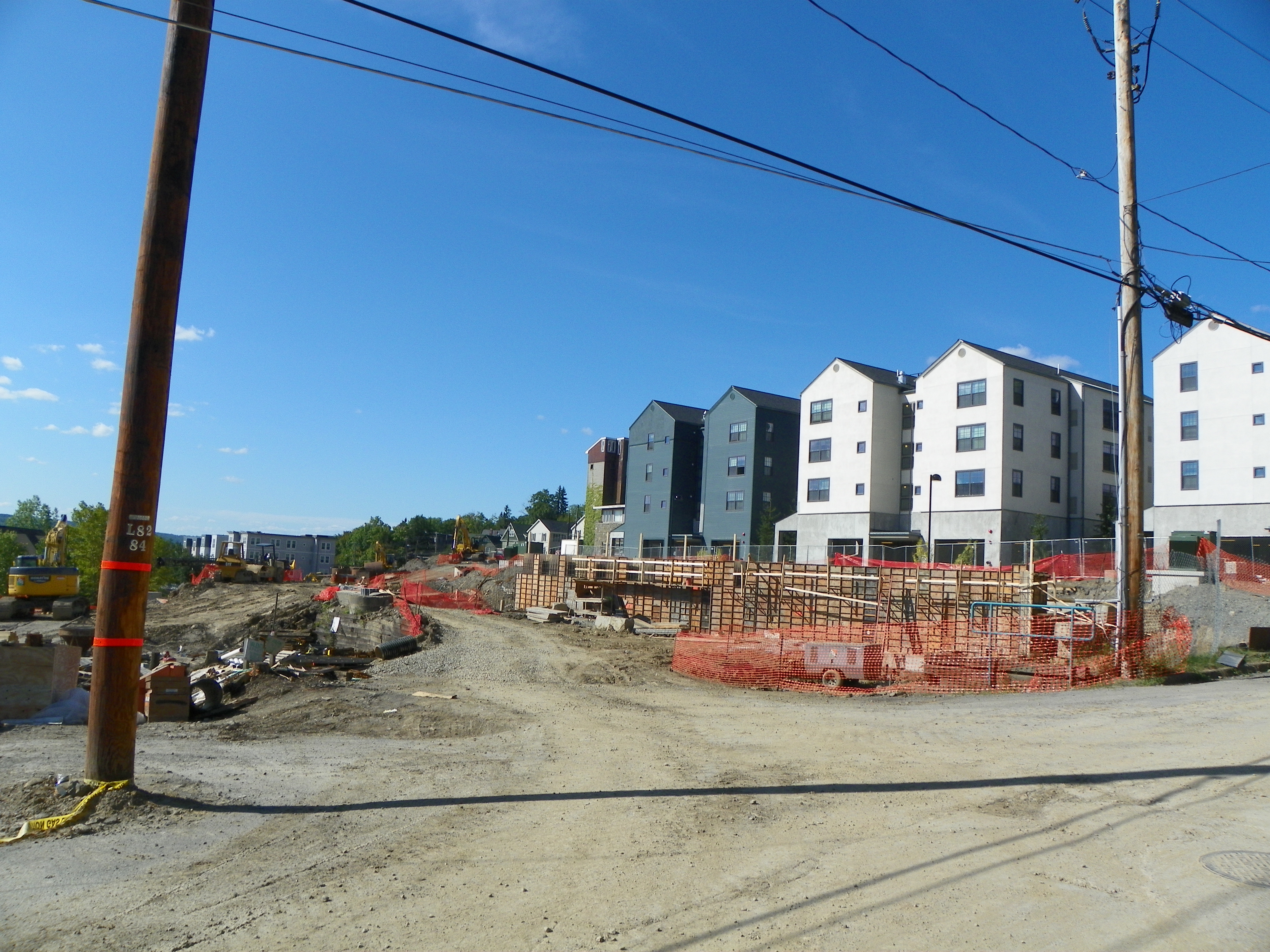
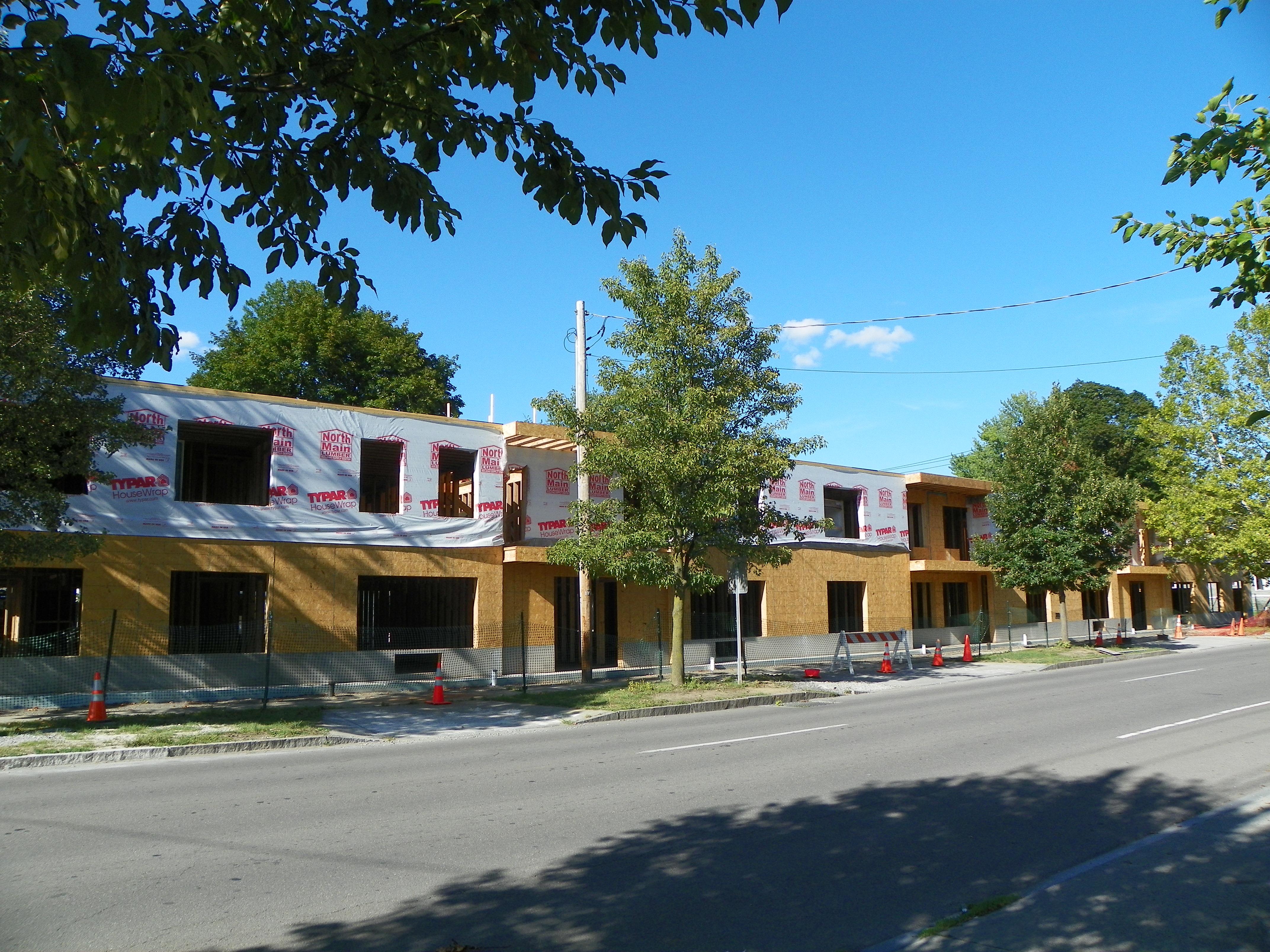
I felt bad because I’ve largely ignored this project. Not purposely; it’s out of my normal search range – on the 600 block of West Seneca, near 13. The site was previous home to a service station and four homes, all of which were in poor condition. The project beings 17 units into a part of the city that has traditionally been one of the most overlooked Ithacan neighborhoods.

The new Fairfield Inn down in big-box land has had its foundation laid, and will likely be finished sometime in the spring. The hotel was approved last fall, and to be honest, I had expected this one to be further along than it was. When complete, the hotel will over another 106 rooms to the 1,800 or so currently within the Ithaca metro. On another note, the city expects a chain restaurant to be built next to the Panera Bread strip of buildings, with construction beginning in the fall.

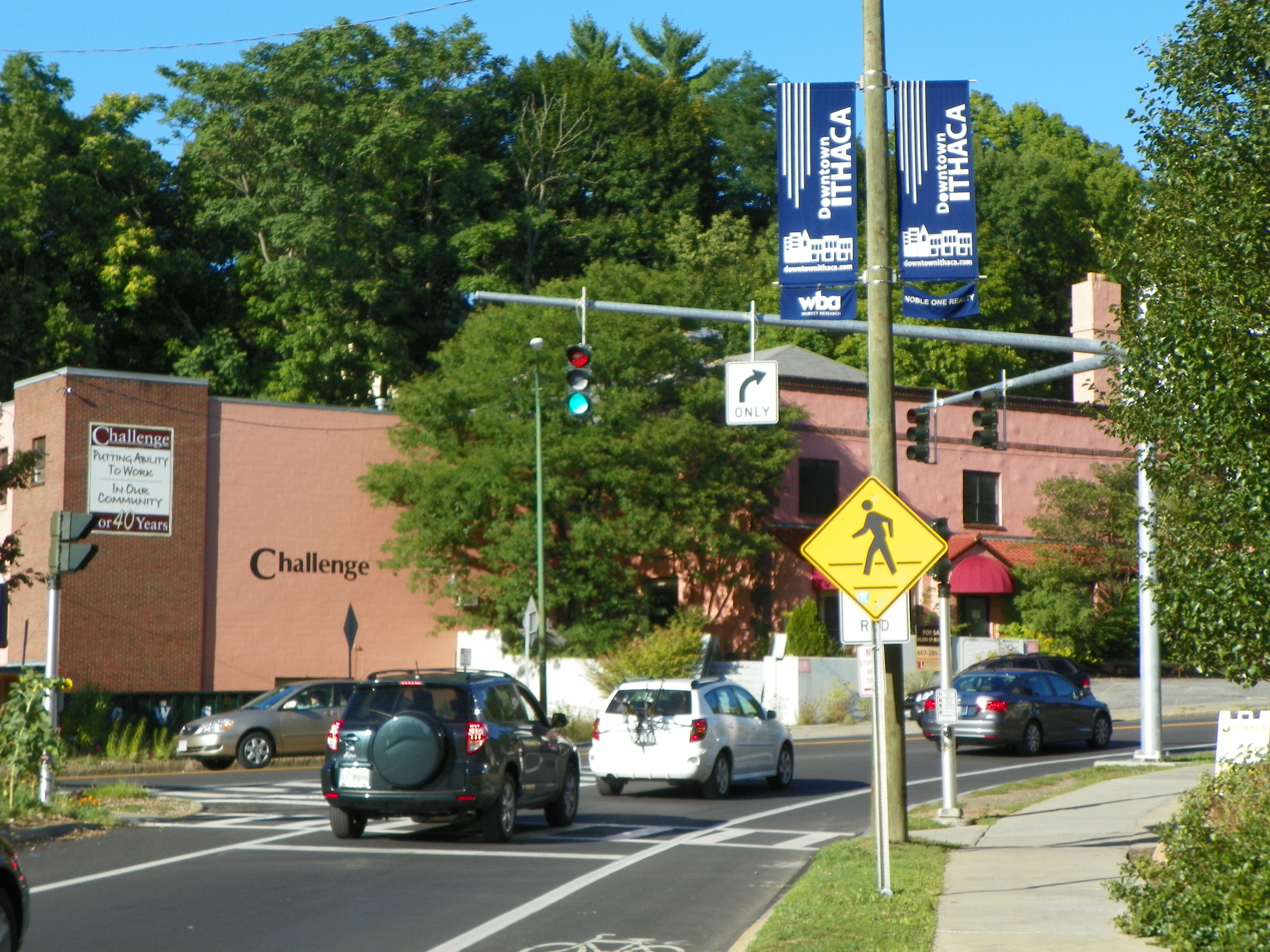
Likewise on the progress for the Seneca Way project. For all the trouble it went through, I would hope it at least sees the light of day. The project seeks to build 32 apartments and some commercial space in a five story building on the site of the former Challenge Industries building. As for the Hotel Ithaca, no news as of late, and likely still stuck in funding limbo, a sign of our poor economic times. UPDATE 8/29/12: Apparently the Hotel is being reconfigured, switching from luxury hotel operator Gemstone Resorts to the Marriott brand. The number of rooms will be raised to 159, and the design will be slightly modified at base level. The height should remain the same. Re-approvals are required, but are not expected to be difficult to obtain. Construction is slated to begin next March, with foundation work during the winter.

Almost the same story here, except these two actually have funding arranged. The Holiday Inn expansion site in the top photo, the Cayuga Green lofts below. The Holiday Inn project started prep in July for the tear-down of the lowrise portion, to make way for a new 9-story building and conference center (I believe it was made one floor shorter from the original 10 stories, and stretched slightly longer to compensate for the loss of that floor space). The Cayuga Green project may have prep underway, judging from the equipment, but needs to start by the end of the year regardless to keep the city lawyers at bay.

And finally, one project that has made substantial progress, the Breckenridge Place Apartments on the site of the Women’s Community Building. The project will bring 50 units into downtown when completed next year.

This was a b*tch to take photos of. Most of the perimeter of the lot was covered in a black opaque tarp, tied so sceurely I had to lay on the ground and reach under it to get a photo through the fence. The front side was a bit easier. Completion should be sometime in mid-2014, although it looks like most of the exterior glass curtain wall is installed – which would place the project ahead of schedule.

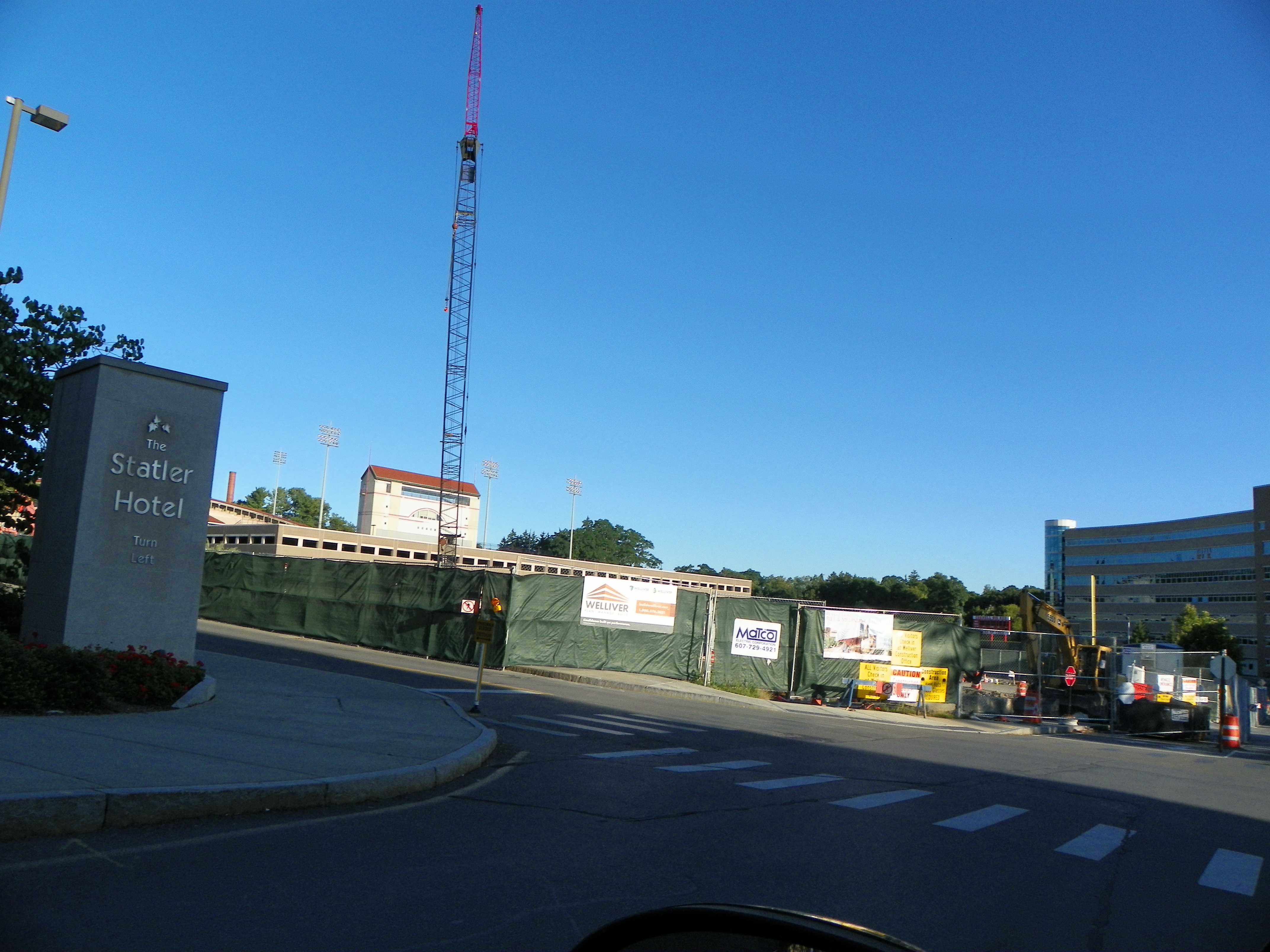
Do as I say, not as I do: never take photos and try to drive on a crowded campus at the same time. But, I was running late. Tarp and foundation work underway at Gates Hall. For the curious, I stopped by the site for the Big Red Marching Facility, and the site was still pristine – this makes sense, since site prep doesn’t start until next month.

Now that screen lags my typing by about thirty seconds, I’d better but the kibosh on uploading any more photos in this entry. However, I do have the good fortune of having one my best friends accept a research position at Cornell, so I now have a legitimate excuse to visit Ithaca periodically for the next couple of years.


End-of-Summer Construction Update, Part I

22 08 2012

I had the fortune this past weekend of being near Ithaca to attend a wedding. Deciding to kill two birds with one stone, I figured it was also a good opportunity to take photos of Ithaca’s ongoing construction. So I made the drive over and tackled as much as I could in three hours, all the while avoiding students, as if my aging is a contagious disease (mentally, this involved my brain screaming “Don’t look at me! I’m old! I was once like you, now I do quaint 20-something-year-old person things!”). Awkwardness aside, I was fairly successful in my photo tour.

The Belle Sherman Cottages project continues its prep work on the east side of on the edge of the city. The model house is complete and the roads have been laid. Despite the rather high prices, a casual inspection shows that at least two of the lots have been sold. In keeping with the theme of traditional streets, the street has been named “Walnut Street”, which is an interesting choice, since walnut trees can only grow in the moderated climate of the lake shore in these parts (same goes for peaches).

Phase II of the Coal Yard Apartments is complete. This phase brings to market 25 units, and ~40 beds.

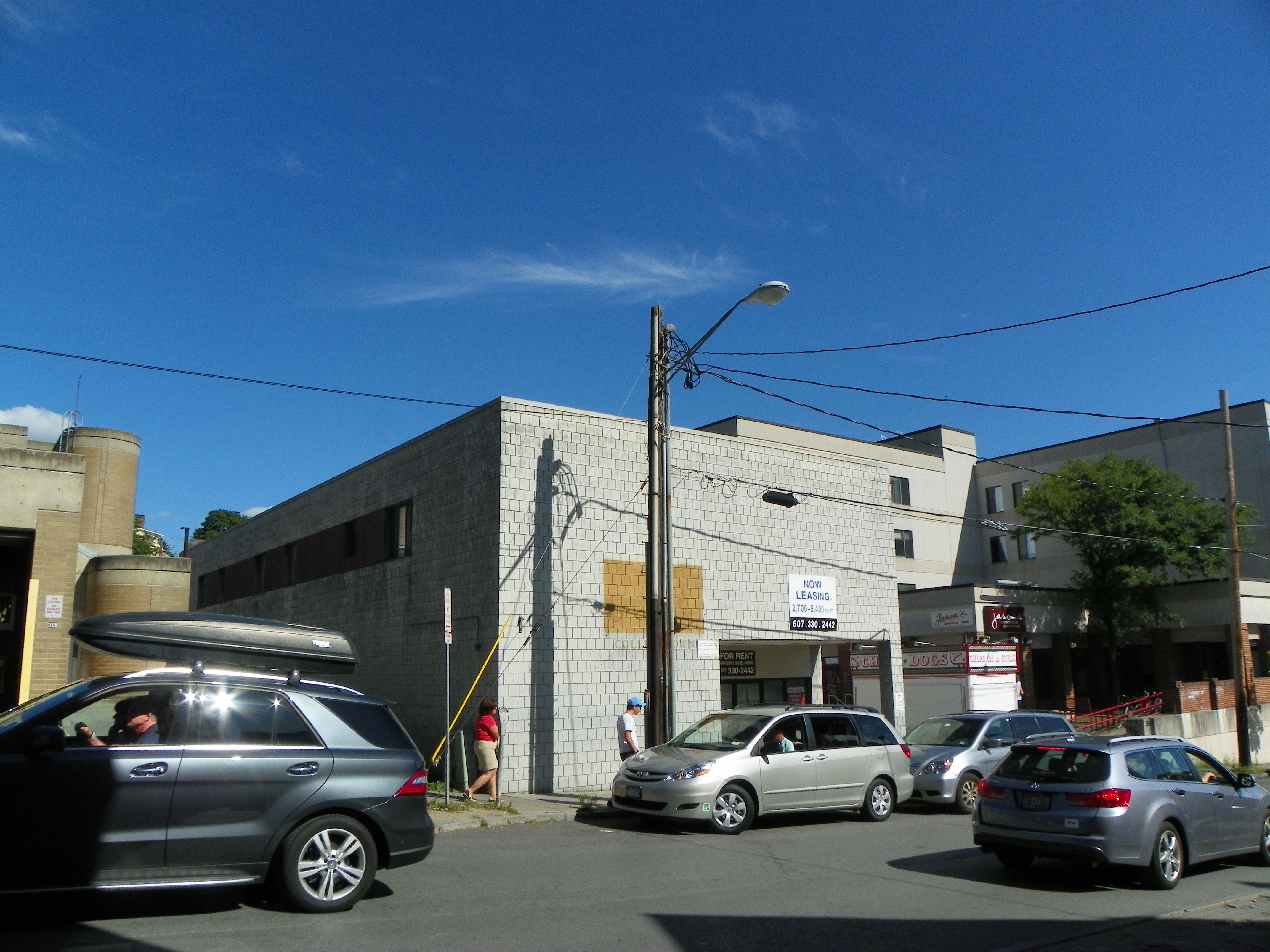
Josh Lower’s Project (Collegetown Crossing) is tied up in red tape as it seeks a very generous parking variance. Meanwhile, the current building sits underutilized, and somewhat barren. Rather disturbingly, this was a trend around much of Collegetown, with many old storefronts, such as Mama T’s and CTP, having closed their doors. It gave the entire area a derelict, ghetto quality. Not to mention some of the houses and their treatment, which I’ll cover in a future entry.

The townhouses at 107 Cook have had their framework completed. As you might recall, 107 Cook was the site of a deadly house fire in May of 2011.

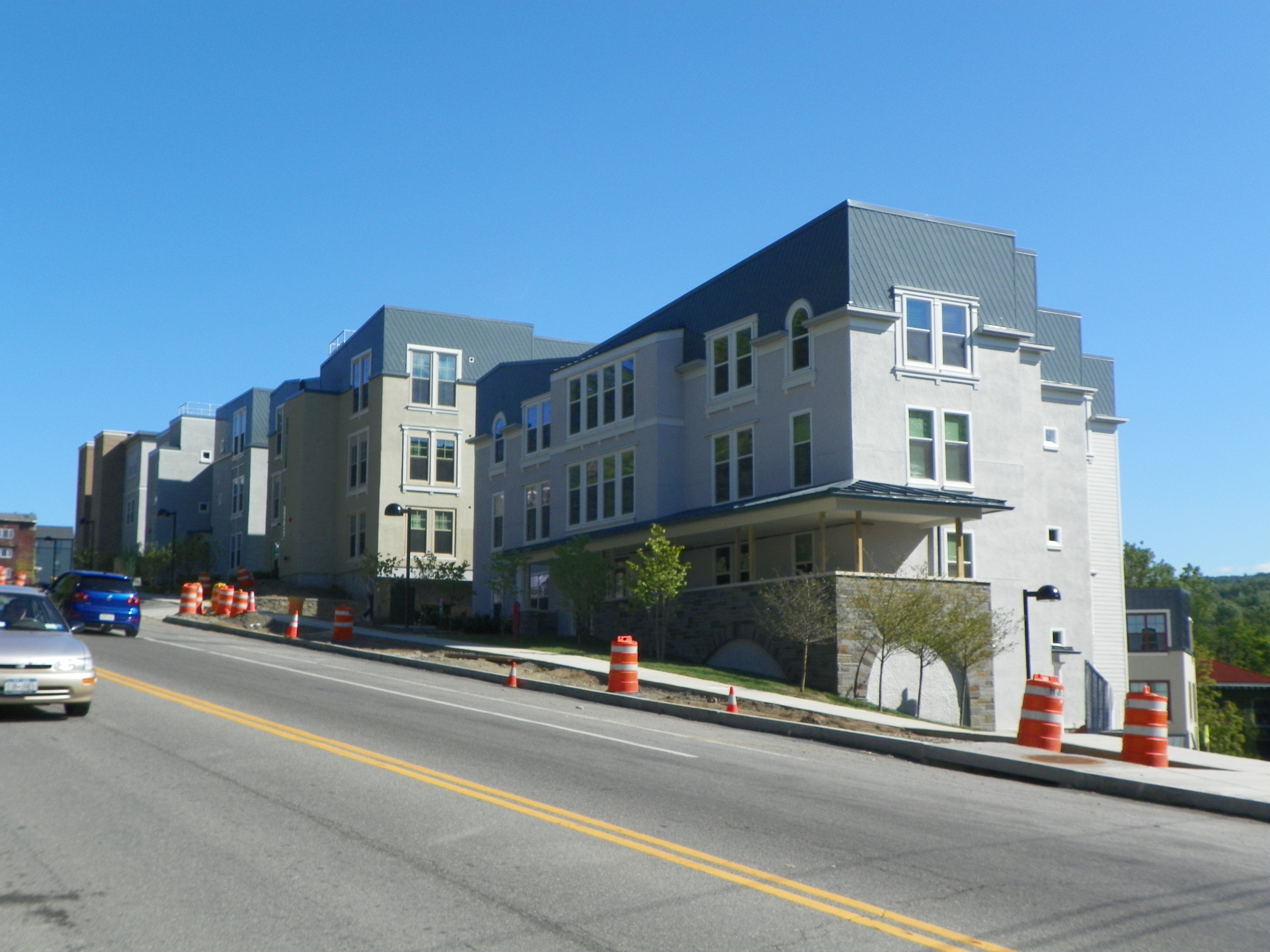
On a brighter note, 309 Eddy is complete. The building replaces a 3-story apartment house, and has 24 units with 41 beds. The building is tall enough to make an impact on the Collegetown skyline as seen from other parts of the city.

…and this image is a clue that Ithaca and the electrical authorities that be should consider burying the power lines under the street. Seriously.

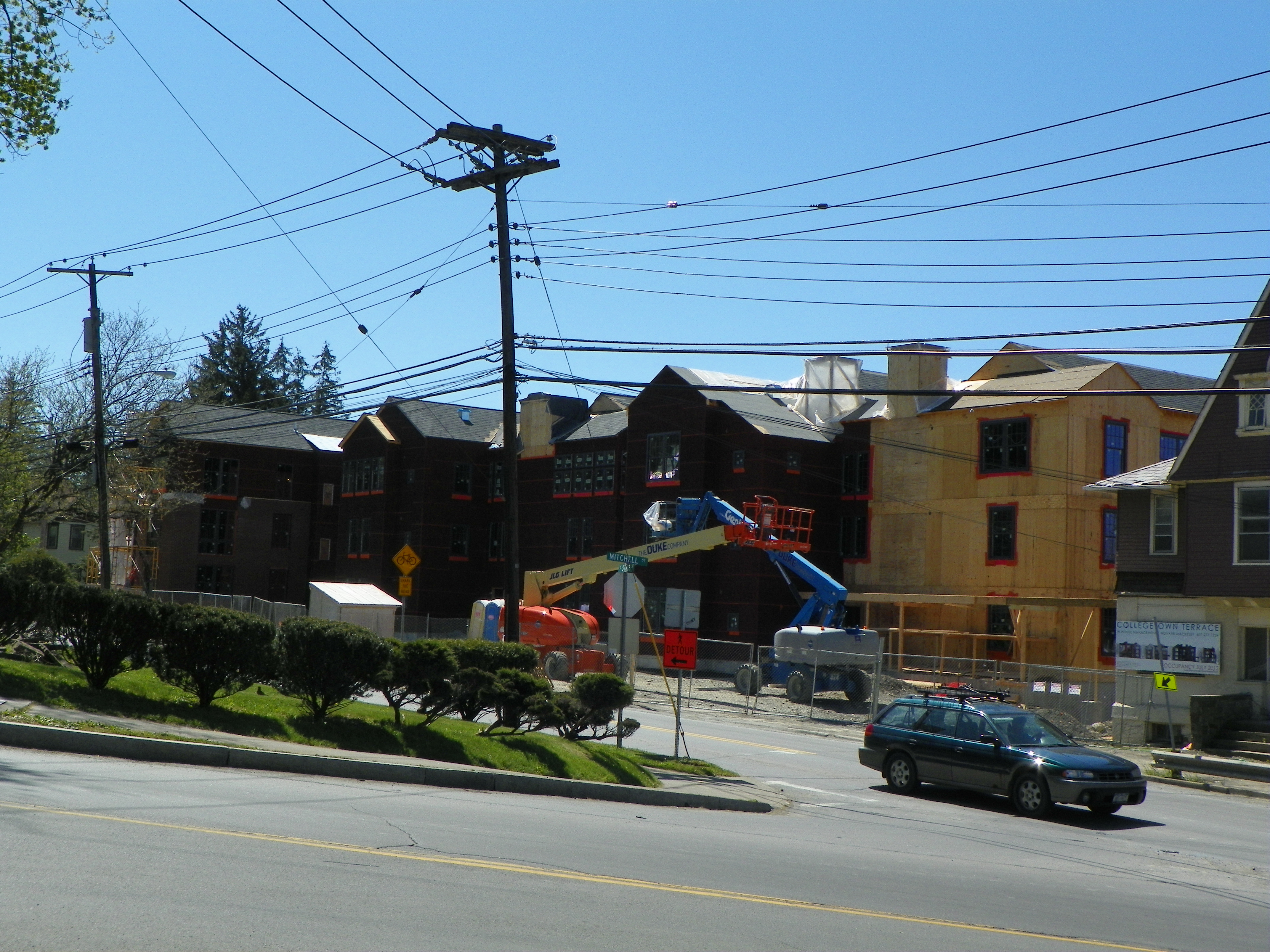
The massive Collegetown Terrace project by Novarr-Mackesey. In Phase I, which was just completed, eight buildings were built (seven on East State, one on N. Quarry). This amounts to about 1/5th of the projects intended 1250 or so bedrooms. Parking is generally under the building on concrete stilts, which is bad in earthquake regions, but I suppose it works for seismically-inactive Ithaca. Some of the current buildings, such as the Delano House and the Valentine Apartments, are still standing and rented, waiting to be torn down in a later phase (III, I imagine). The Williams House is not yet renovated, serving as the site office while building continues. By my guess, building “3” from the development plans is Phase II, and is one of the long wavy buildings, specifically the one that sits closest to East State. Phase II is underway for a completion next summer, with phase III (the final phase) being completed in the summer of 2014. I suspect at that time, we’ll be hearing significant news about whatever N-M has proposed for all the properties they bought on the Palms block of Dryden Avenue – I expect something substantial, a la Collegetown Plaza.

Redevelopment of this mostly derelict and empty block would be a blessing at this point.

So, trying to break up my update into manageable chunks here (since the tech format here isn’t keen on photo-laden posts), I’ll post the rest of Ithaca and Cornell’s Campus later in the week.


News Tidbits 8/17/2012: The Tax Argument

17 08 2012

I held off on this entry for a few days. Not because I was particularly low on time, but because I was waiting for the latest planning board project review minutes to come out, to see if there was anything newsworthy (and pretty much everything on there was minor, or I’ve already covered it, so…nope, nothing newsworthy). So I’m going to take a closer look at an article recently posted by the Ithaca Journal.

It was noted that the Collegetown Terrace (aka the giant hard hat-bedecked property south of State Street between Quarry and Valentine) is quite the tax revenue generator for the county. Now, here’s some of their numbers: The initial properties on the land, small apartment buildings and single-family homes (~29 total), were valued at $19,143,000, which would (by my calculation) generate taxes of around $700,000 per year. Just under half of that would go to the school district, with a little more than one-third (~35%) going to the city coffers, and the rest to the county. The partially-built property, as it was assessed in March, was assessed at $526,800, according to the IJ, with a property value of $14,430,000.

Now let’s keep in mind two things. The property wasn’t even finished, and finished properties garner much more in taxes; and the property is being developed in three phases, with the currently assessed phase counting for just 18 percent of that.

It would be hard for me to say what the value of the finished property is, so let’s conservatively go for 20% greater than the current value, for the sake of this exercise. That gives $17.32 million. Now let’s apply that to the developed project, 100% complete: ([100/18] * 17.316=) $96.2 million. Five times its former value before the property was sold. If taxes are kept the same, that would be a tax bill of about $3.5 million. And for the city, an extra $1 million in cash would go a long way, since the annual revenue is about $61.5 million. An extra million is equivalent to the amount Cornell pays annually in its PILOT agreement with the city.

It would not be out of place to think, “oh, but with the slow rate of growth, this is just cannibalizing other local properties”. To some extent, yes. But these are properties that have a very captive market, namely, 20,000+ Cornell students. The landlords that will be hurting the most will be those with properties furthest from campus, of which a good chunk of that hinterland lies outside city limits, in the neighboring town of Ithaca, or Lansing. In my mind, the biggest concern will be if this project pulls grad and professional students away from downtown and Fall Creek, but I imagine the effect will be minor, all things considered (most notably, because if apartments in this place are going for $1,000+ per month, then that $600 one bedroom in Fall Creek is still going to appeal to a lot of folks with tighter purse strings).

In conclusion, I think that if a developer approaches the city regarding new student housing in the Collegetown area, they’ll have a powerful card in there hand – the tax argument. I’ll be curious to see if Novarr-Mackesey mentions it when they release their proposal for the Palms property and its neighbors along the 200 block of Dryden Road.


Because When I Screw Up, I Go For the Gold

11 08 2012

A little while back, I vented about how the Cayuga Place Condos appeared to be a plain glass box. Based off all the data I had in front of me, it appeared that it was. The (small) images from the IJ gave the impression of one unbroken facade.

Well, I was casually glancing at the city website this afternoon, looking at the city’s IURA minutes out of curiosity, and I realized I made a tremendous mistake. One that merits its own new entry, it was that impressive of a screw up.

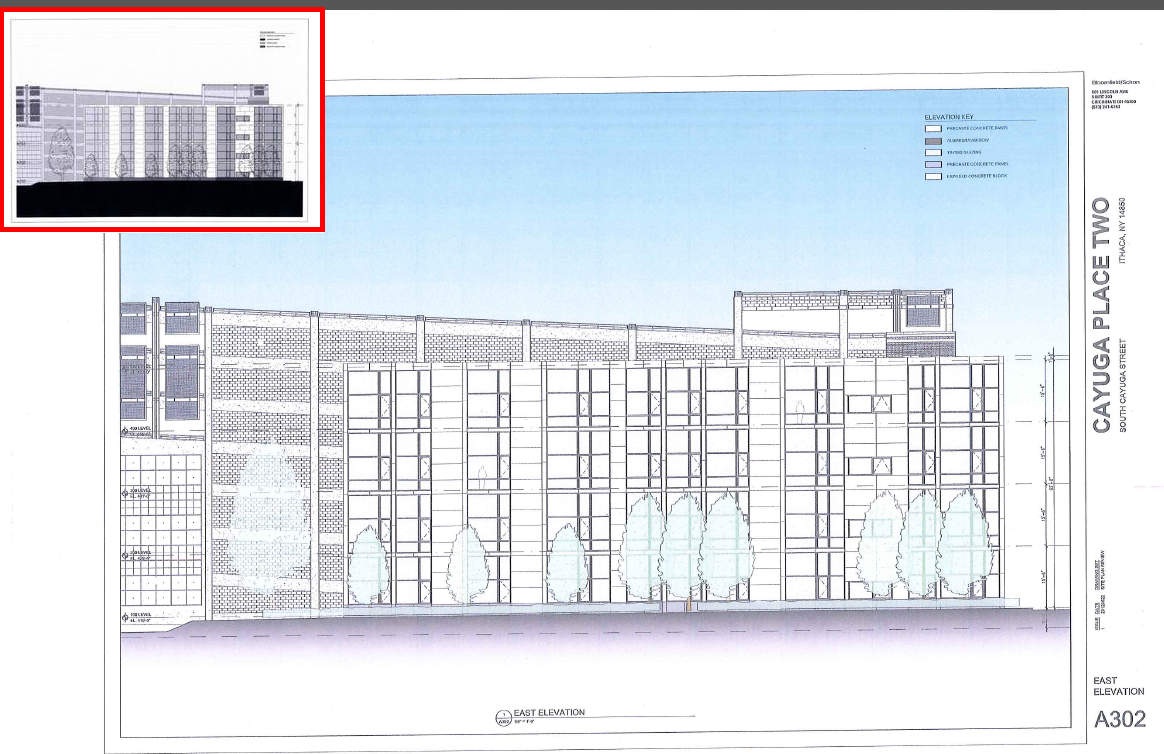
To illustrate my failure, I include the image from the IJ, plus the image from the IURA agenda (posted July 26th, 8 days after my rant):

Note that when you blow up the image to full size, that is the the native resolution of the IJ file in the upper left. 300×206 pixels. The side profile image that was also used in the news article is the elevation looking south – as it happens to be, the thick side of the building.

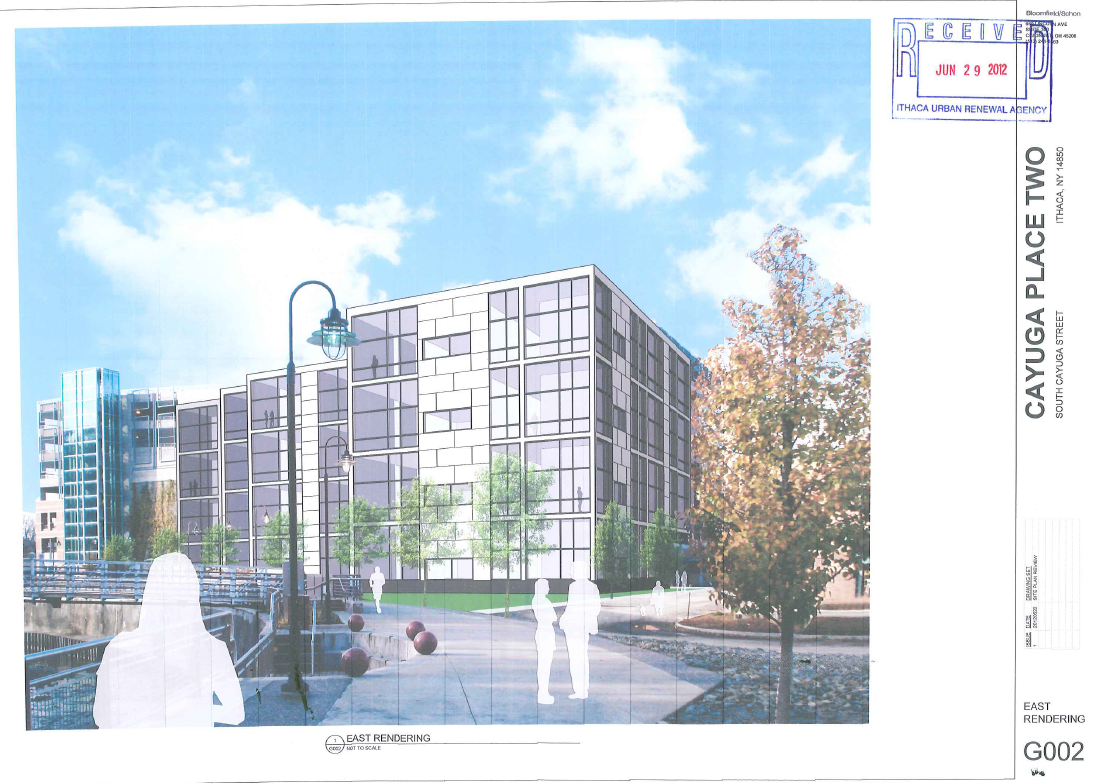
So, imagine my surprise and embarrassment when I see this:

This is not so different from the third incarnation as I thought it was. In my defense, given the images used in the article, I was mislead. Had I checked the city documents between July 26th and today, I would’ve caught the error sooner. As a result of my oversight, some of my criticisms about it being a featureless glass box, and the developer taking the cheap way out, were unmerited. It remains shorter than the previous version, so the parking garage looming over it remains an issue. But otherwise, it’s not tremendously different, or worse. My apologies to anyone who was mislead. So excuse me while I go and eat some crow.

For what it’s worth, the project has been approved for extension and is on its way to final site approval. With funding now in hand, the project may start construction sometime in the late fall.


From Suburbia, A Town Center

6 08 2012
Image Property of HOLT Architects

Image Property of HOLT Architects

Just about any reasonably-sized city in America has its suburban hinterlands – in Ithaca’s case, this is dominated by the town of Ithaca, and to a lesser extent, the towns/villages of Dryden and Lansing. Now, it would be wrong of me to address these communities like they were dominated by cul-de-sacs and power centers, since the village of Dryden, and some small hamlets, were around well before suburbanization – but they do make up a sizable proportion of developed real estate. So when those communities take steps to establish dense, walkable clusters of development, I tend to be impressed (because being satellite communities, I hold them to a lower standard).

In the town of Lansing’s case, its plans are pretty big – the town recently bought 156 acres of land to lift deed restrictions the state had placed on its development. The goal is to develop this land into a sort of “Town Center” – and not at all like the similarly named shopping mall near Syracuse.

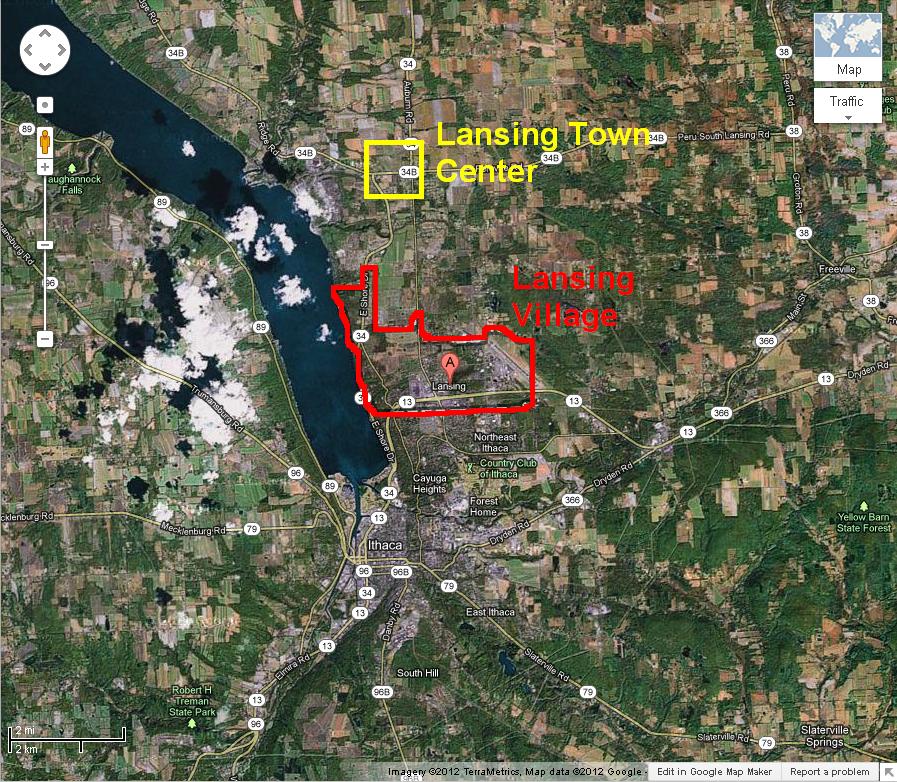
Lansing is unusual in that it never has really had a dense core, unlike Dryden (the town of Ithaca can’t be reasonably compared since it surrounds the city). The village was founded in 1974, and only includes the area from the airport west through the mall area and down to the lakeshore.

For the town center project (covered in great detail by the Lansing Star), the overarching design was created by Ithaca-based HOLT Architects, with landscaping by (also Ithaca-based) Trowbridge & Wolf. It consists of consolidated parking lots, pedestrian walks, bike paths, street beautification, and interactive landscaping (stone seating areas, etc). The area is subdivided into a large housing component, a small retail/professional area, and a business/tech complex (it would seem to me a little more interspersion of uses would be better, but I’m not a stakeholder here). So, rather than being a standard suburban build-out, an effort is being made to develop a pedestrian-friendly core.

Apparently, developers are quite interested in accessing the property. Two of the largest potential stakeholders are NRP Group and Calamar. The companies are willing to cover a large portion of the project’s road construction costs. NRP even took the step of flying Lansing officials to projects near Cleveland and Buffalo to showcase their work. Both companies are proposing senior housing complexes, one “affordable” (NRP) and one market-rate (Calamar). At least two other developments are currently proposed. The full build-out of the town center is expected to have 350,000 industrial/commercial sq feet, and 420 residential units.

There are a couple major hurdles to construction at this time – the more minor one being zoning, the more major issue being the construction of a sewer through southern Lansing. High-density housing doesn’t go well with septic tanks (nor is it permitted by the town code anyway), so the construction of a sewer to serve that area is required, and the proposal for construction is currently being refined before it is put out to vote.

The project has the potential to be a game changer – the town is on the verge of a large increase in development, with another 400+ units planned in the next several years in clustered developments outside of the town center project. As most of these will be suburban in nature, or at least vehicle-oriented, one might pessimistically look at the town center as a drop in the bucket for smart planning. But it’s certainly a step in the right direction on the way to establishing a genuine community center.


News Tidbits 8/1/2012: Because I Let Small Projects Go Under the Radar

1 08 2012

It would be wrong for me to play off the projects that I write about as being all that is going on in and around the city of Ithaca. Generally, I write about the major projects. I don’t do little projects, or I gloss over steps in major projects, mostly in an effort to maintain reader interest. However, like with many things, there’s a grey area – a project of merit, of moderate impact, that is not major enough for its own entry, but would benefit from a brief mentioning. I decided to group a few of those here.

Image Courtesy of Ithaca Times

The Ithaca Motion Picture Museum – A project in the planning stages, intended as a major renovation and addition to the old Wharton Studios building in Stewart Park, which is currently a low-use maintenance facility. The circa-1890s building is but a shell of its former glory, but a local NPO seeks to invest $3.5 million into its renovation. Fundraising is ongoing, but it will be a while before any new work breaks ground.

The town of Ithaca seeks to redevelop a parcel on West Hill into an Ecovillage type of housing development. The 25.5 acres, associated with the vacant Biggs facility near Indian Creek Road, is to be sold or leased to a private developer for a ~70-unit, mixed-use property with emphasis on green living and sustainability. The preferred area of development is closer to the Medical Center, leaving a large tree buffer on Indian Creek Road itself. The proposal runs with the assumption that a developer will actually want to agree with the town’s stipulations, although residential demand has been strong enough in recent years that it just might happen.  Bids are due in October, with a starting bid of a cool $500,000.

Property of New Earth Living LLC

On the topic of green living, four new housing units are being developed as a “pocket neighborhood” on the corner of N. Aurora and Marshall Streets (three blocks north of the William Henry Miller Inn). Three new structures will be built (a revision in design dropped the number of units from five to four), and a current house will be refurbished. The project, called the “Aurora Dwelling Circle” (an oddly befitting name for an Ithaca project) and to be built by Cosentini Construction, has been virtually approved for construction as of the last planning board meeting.

Last not, for those who like big-box strip malls – the old Cayuga Mall across 13 from the Marketplace and across Triphammer from the Shoppes @ Ithaca Mall is being renovated. The old P&C space will be converted to spaces for an Agway, Jo-Ann Fabrics and Party City, which is a whole lot of non-news since I suspect the first two are just relocating from their current Ithaca-area stores.