News Tidbits 8/15- CU ERL Project

15 08 2008

So, I’m writing this as I’m sitting at a desk within the hotel; granted, I’m on the job, but it would help if I had more than one customer every forty-five minutes. It’s a bit of a running joke among Cornell Store employees that the Statler requires a dress shirt, tie and a really long book. Luckily, one of the few benefits to working the Statler Hotel gift shop over the main store is that we actually are permitted to browse the internet (with discretion).

So, doing as I often love to, I was perusing the planning board notes for the August 19, 2008 meeting of the Town of Ithaca planning board. And lo and behold, look what pops up:

8:00 P.M.        

Consideration of a sketch plan for the proposed Cornell University Energy Recovery Linac (ERL) project located north of the Pine Tree Road and Dryden Road (NYS Route 366) intersection, Town of Ithaca Tax Parcel No.’s 63-1-8.2, 63-1-2.2, 63-1-12, 63-1-3.1 and 63-1-3.3, Low Density Residential Zone.  The proposal involves construction of an underground accelerator tunnel (14-foot diameter and 2 km long), a cryogenic facility and associated electric substation (+/- 15,000 square foot footprint), and an extension to the existing Wilson Laboratory (+/- 185,000 gross square feet of building space).  The project will also involve new stormwater facilities, parking, outdoor lighting, and landscaping.  Cornell University, Owner; Steve Beyers, P.E., Engineering Services Leader, Agent.

The other agenda items aren’t notable (a radio tower, continued discussion about the IC Athletic Complex, and the continued use of an equestrian facility).

So, the construction of 200,000 sq. ft of physical plant, a cryogenic facility and an accelerator tunnel require a bit of investigation.

The first thing I came across is this week-old Cornell Chronicle item. The particle accelerator has a planned timeframe of construction that would allow for the beginning of operations in 2011 [2].

Rather than try and explain the operations of the particle accelerator itself, I’m just going to quote the article (I’m excusing myself on the grounds that I study thermodynamics, not quantum physics).

The ERL would accelerate electrons to nearly the speed of light in a linear accelerator (linac) made of two straight tubes, each about 330 meters (0.2 miles) long, then feed them into the Cornell Electron Storage Ring, Hoffstaetter said. After a single rotation around the ring, the electrons would return to the linac, where their energy would be recovered and used to accelerate the next batch of electrons.

Meanwhile, at various points around the ring, the Cornell High Energy Synchrotron Source would use the electrons to produce ultra-bright, ultra-fast pulsing X-ray beams capable of imaging structures just a few atoms wide, and whose oscillations would be resolved with sub-picosecond resolution (less than a millionth of one millionth of a second). [2]”

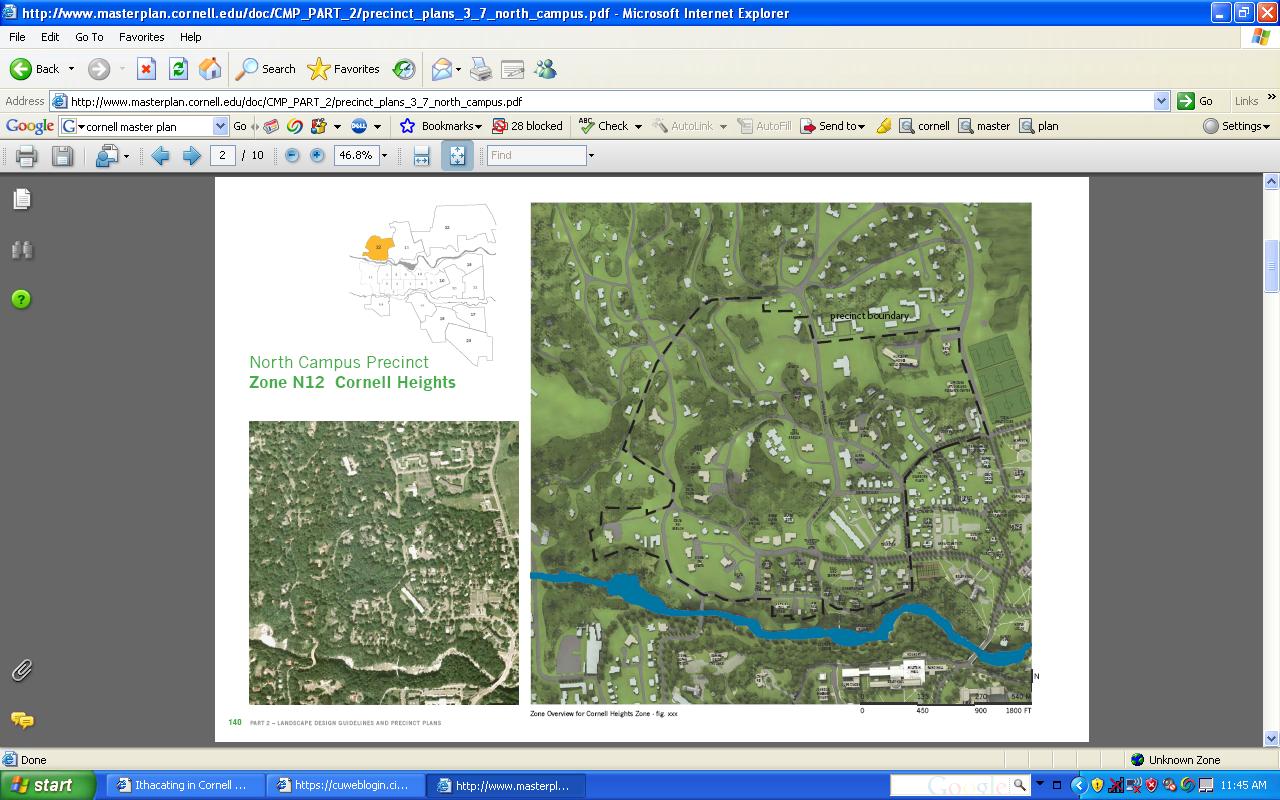
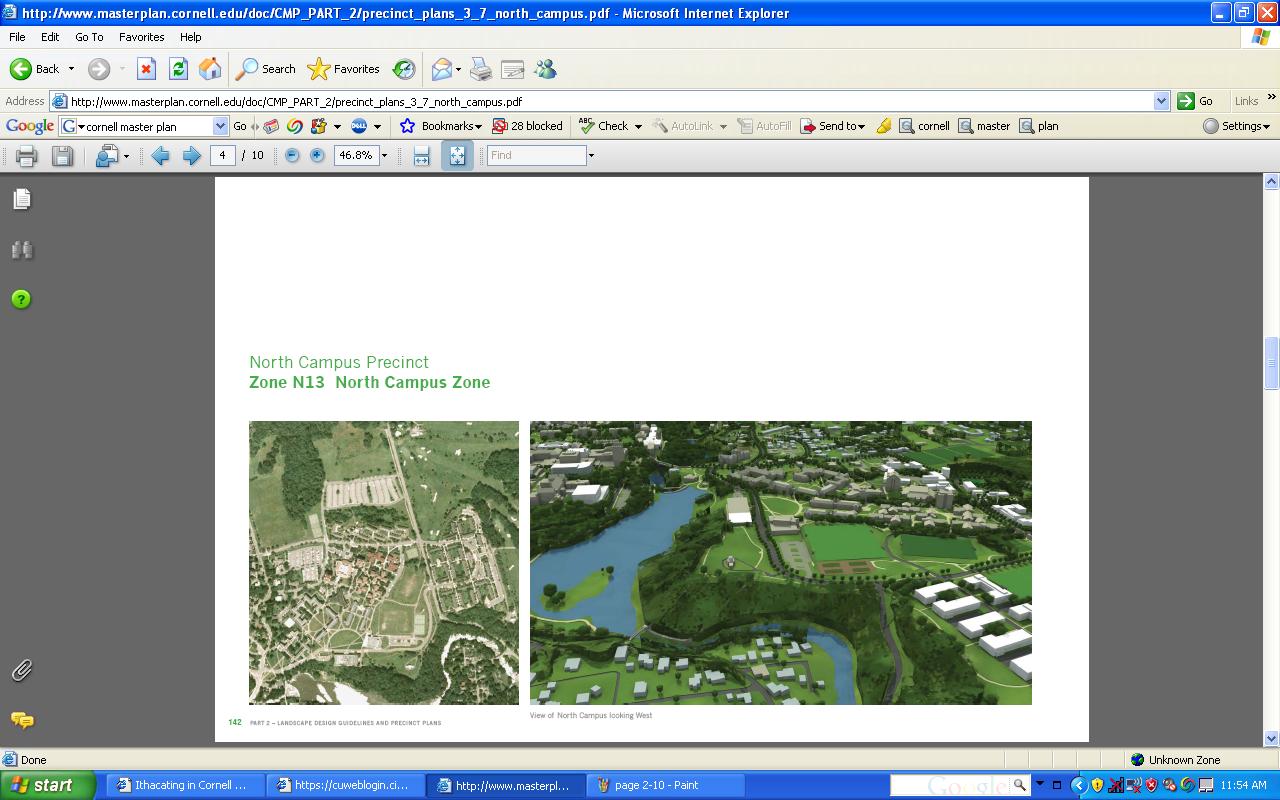
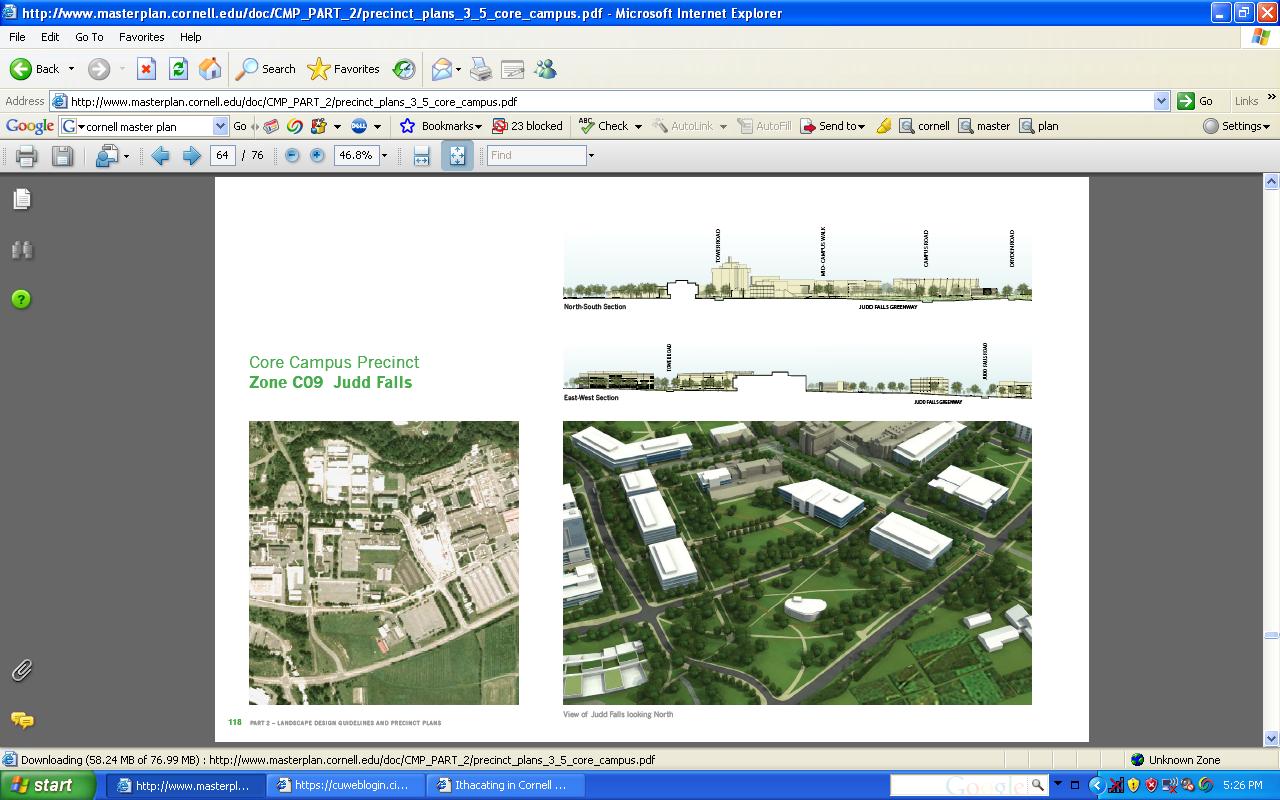
On another note, the building is visible in the master plan diagrams, as the large expansion that exists to the east of the current Wilson Lab structure:

So, our physical plant will continue to expand for some time yet.

[1]http://www.town.ithaca.ny.us/

[2]http://www.news.cornell.edu/stories/Aug08/ovp.forum.erl.html


Exploring West Campus

15 08 2008

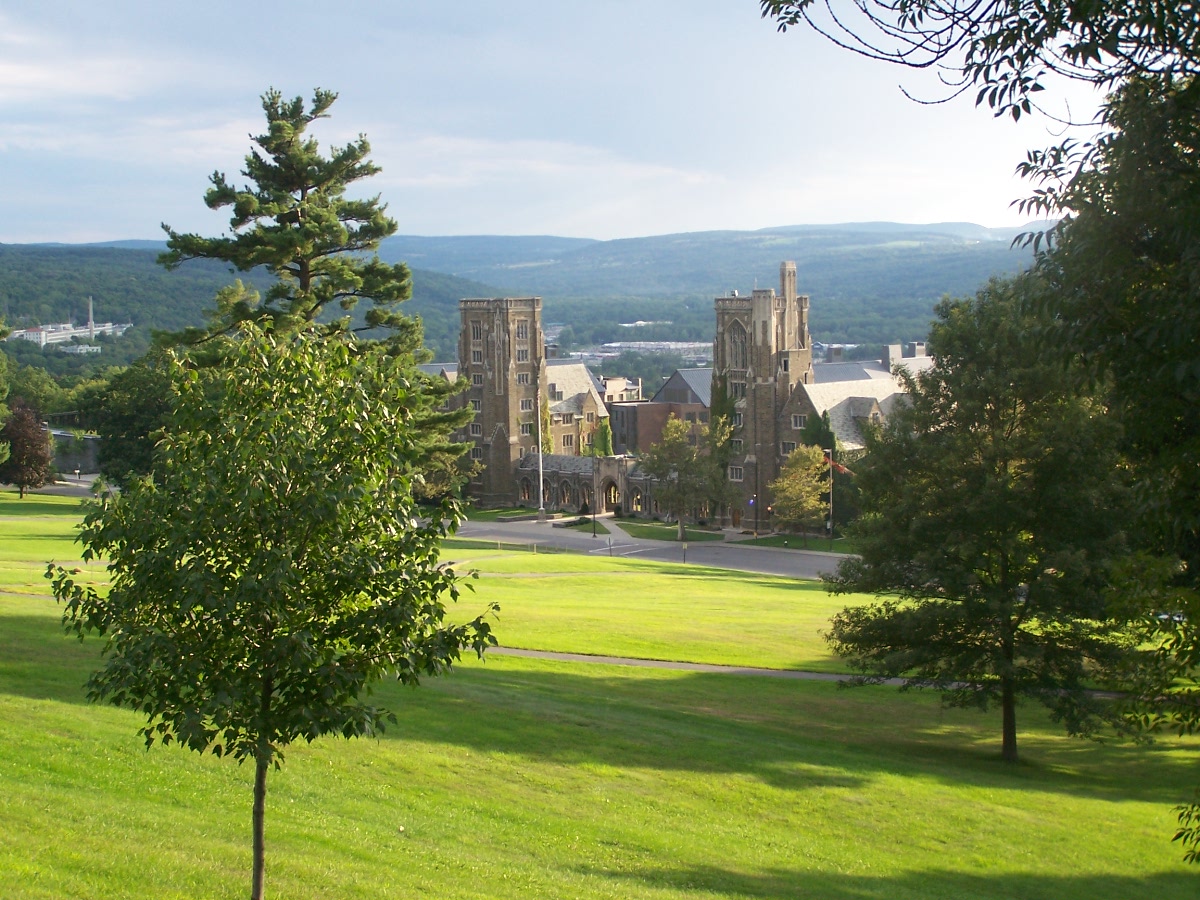
First off, let me say I do not support nor condone any illegal activity, especially for the purpose of information gathering. That being said, going into prohibited construction sites is a lot of fun if you’re careful where you step and you can avoid the workers leaving for the evening.

So, this started when a friend of mine who happened to figure out that I was the writer of this blog sent me a message asking if I could go through the new West Campus and take some photos. Knowing he wasn’t in Ithaca, I decided that I would be happy to oblige this time  (but I certainly won’t be making it a habit).

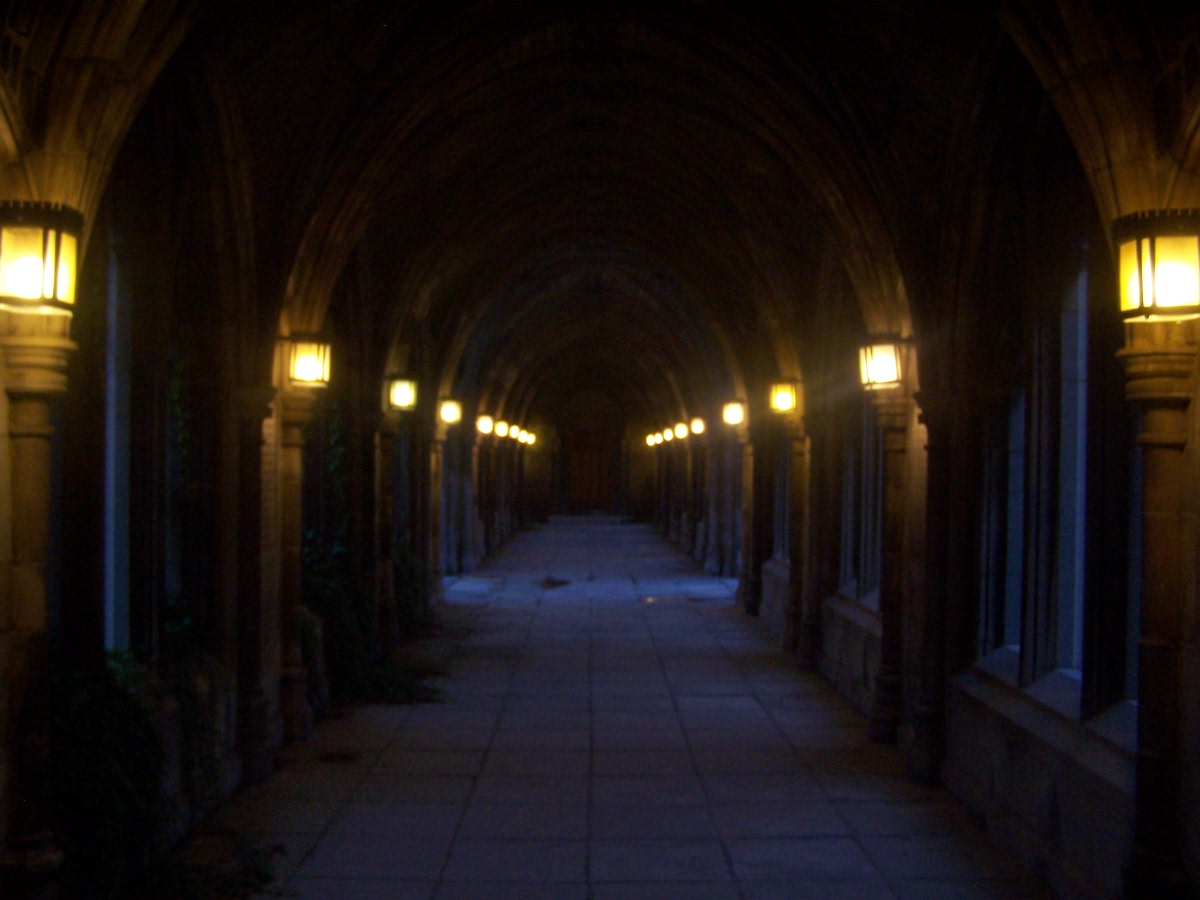
Token War Memorial shot.

First off, the War Memorial. These photos are actually from my fraternity photo tour last month. The War Memorial was constructed from 1926 to 1931. It honors the 264 Cornellians who were killed in action in World War I. However, it does not honor a 265th death, that of Hans Wagner 1912, who was killed in action while fighting for the Axis Powers [1].

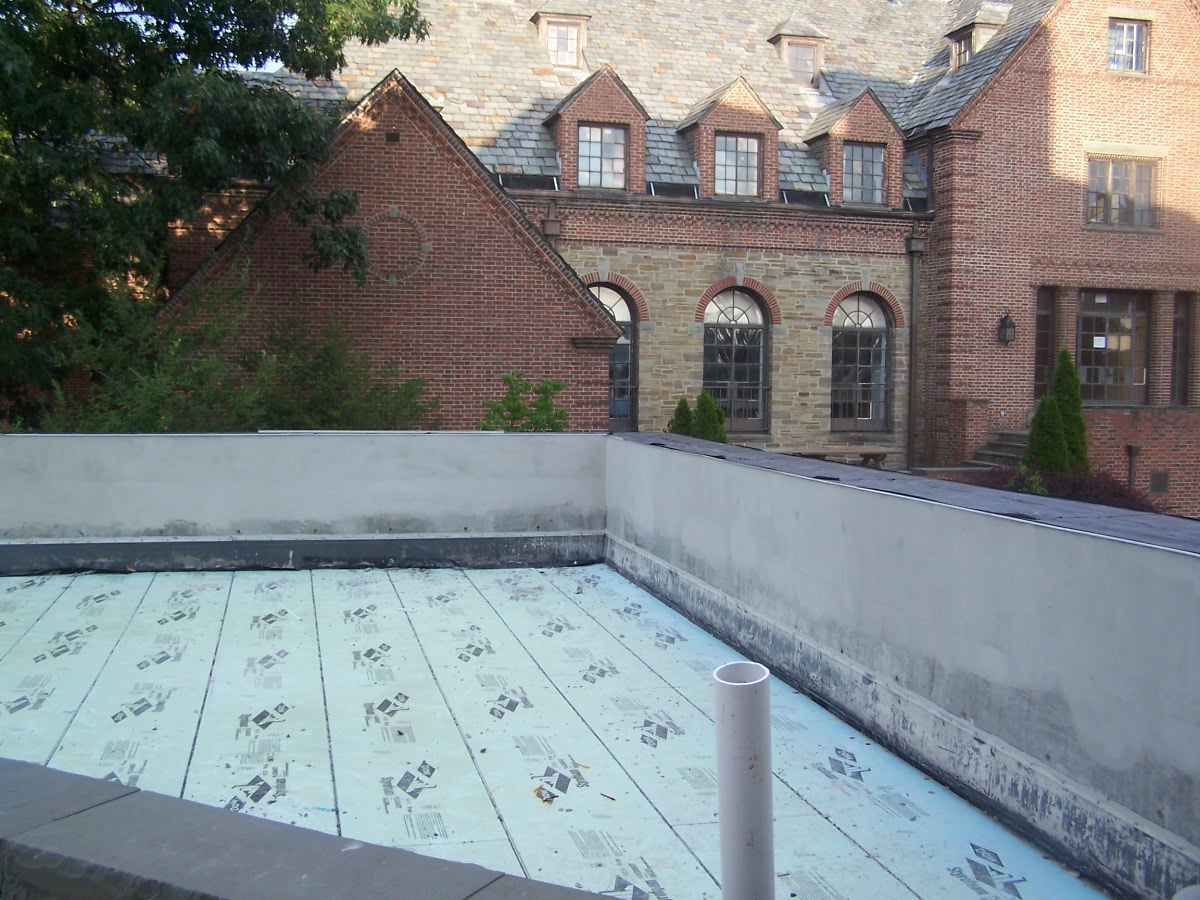
Noyes and Hans Bethe dining hall have grass roofs. Cornell, take note to not follow IC’s folly and set off fireworks right next to a building with a grass roof; it just might catch fire.

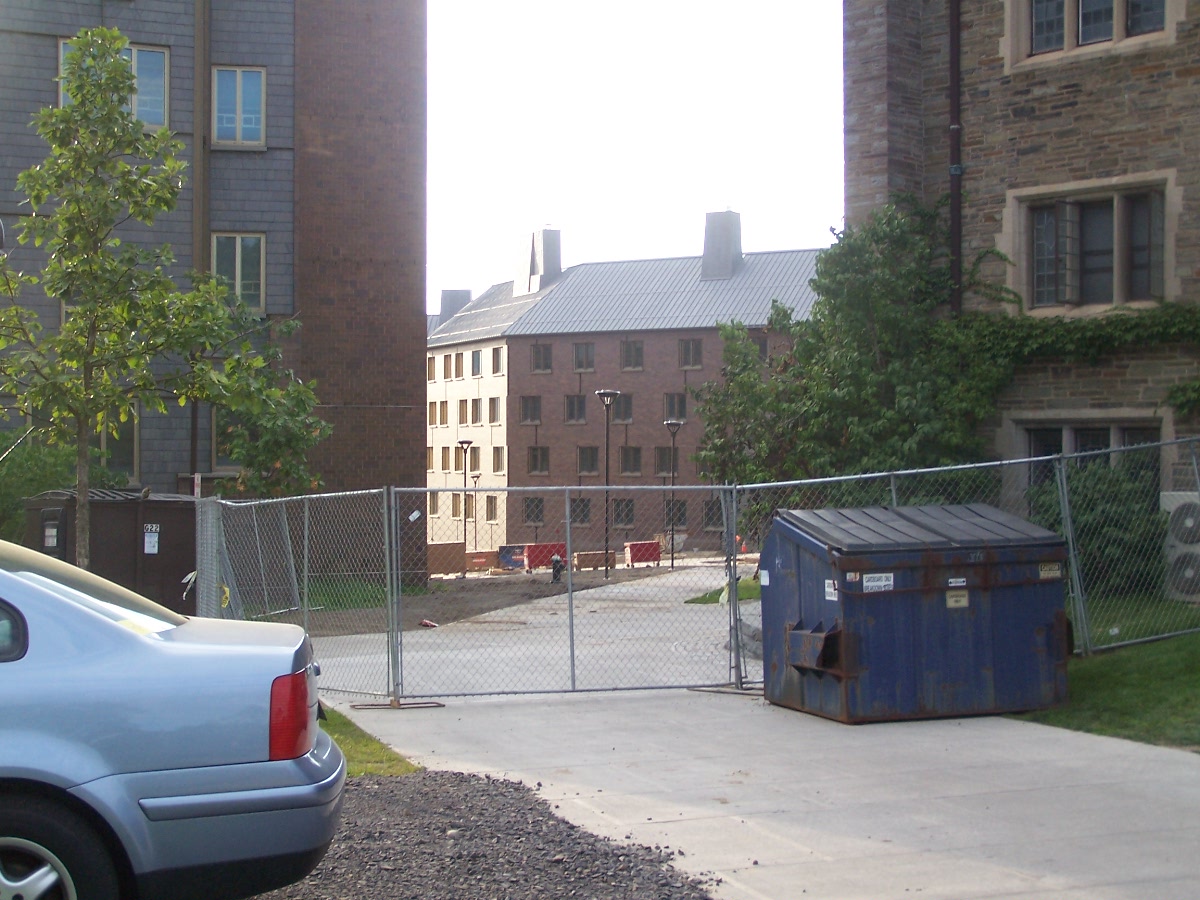
Any makeshift fence can be scaled. But why bother when there’s a narrow space between it and the wall?

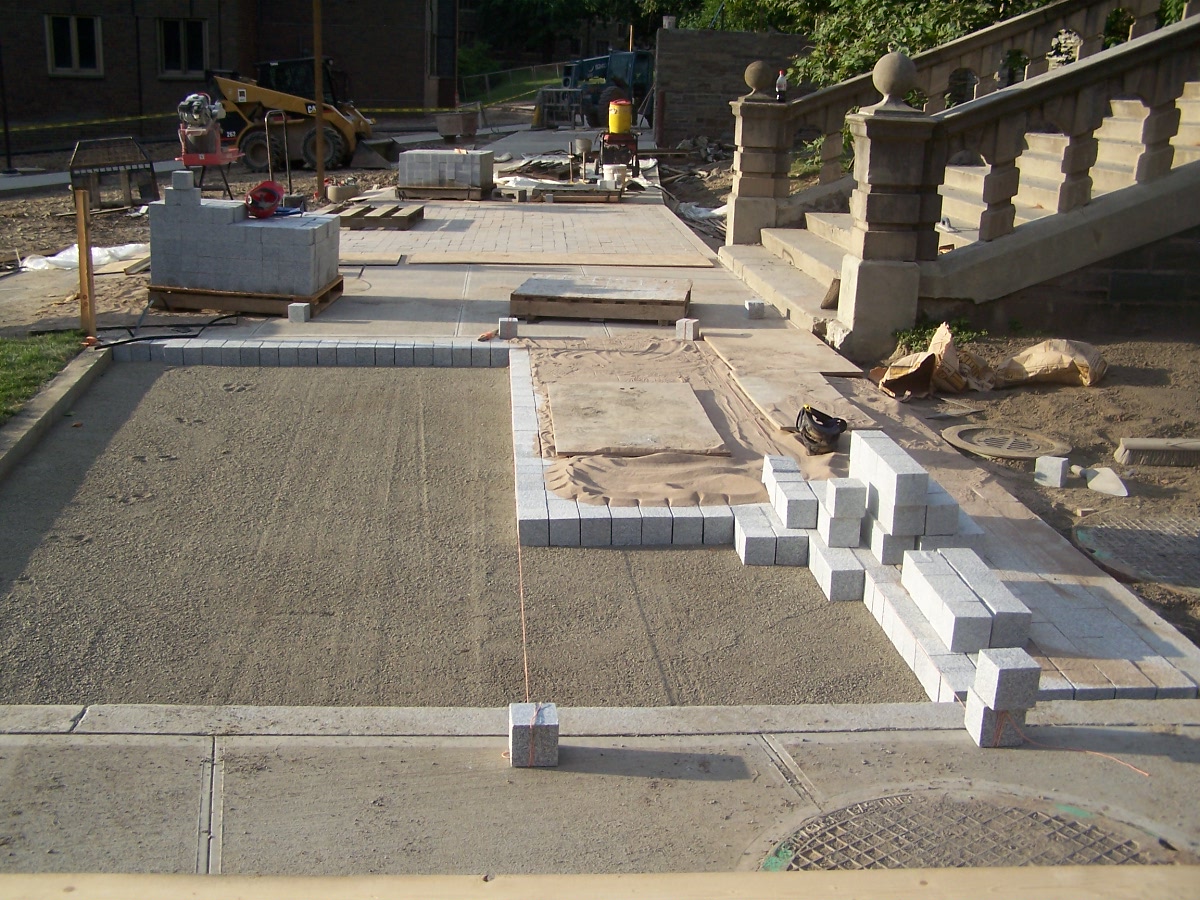
Base of the War Memorial steps, being renovated.

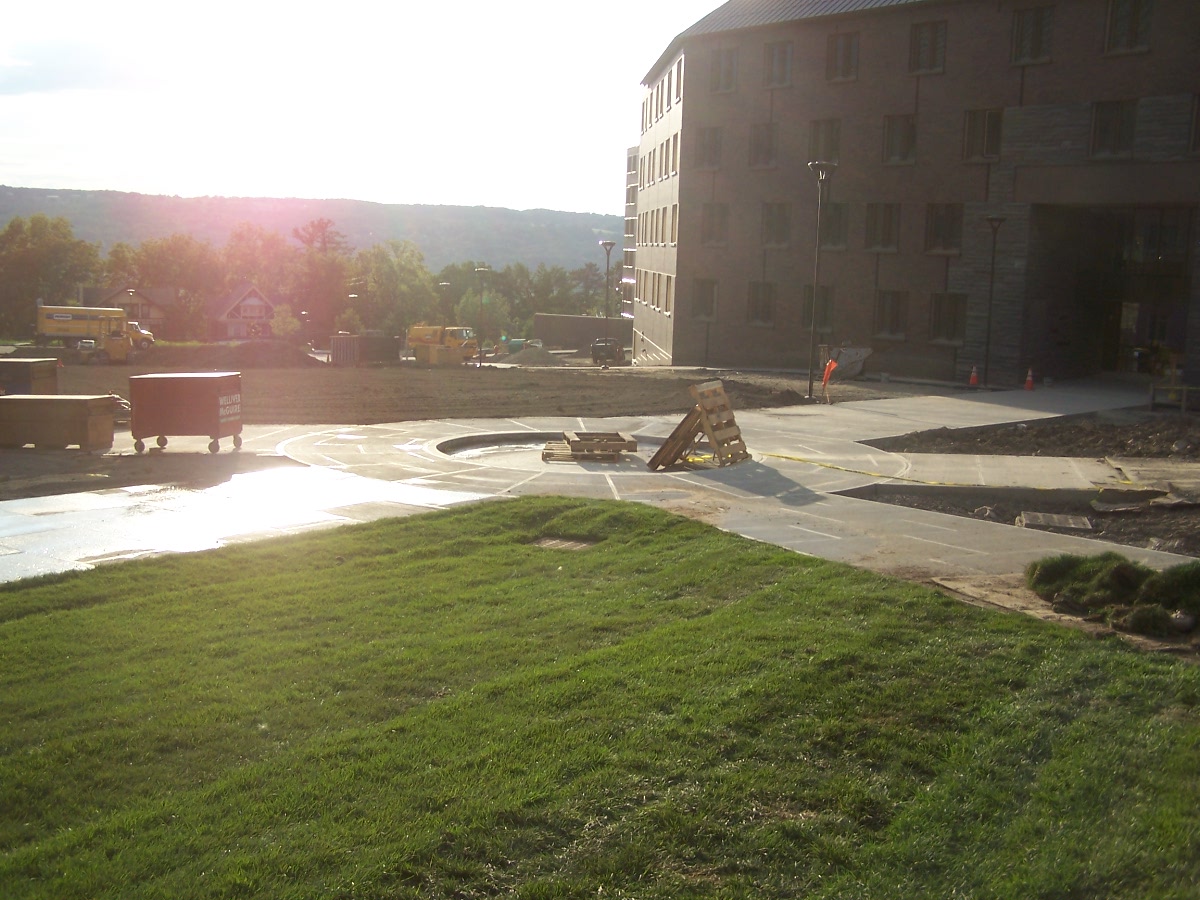
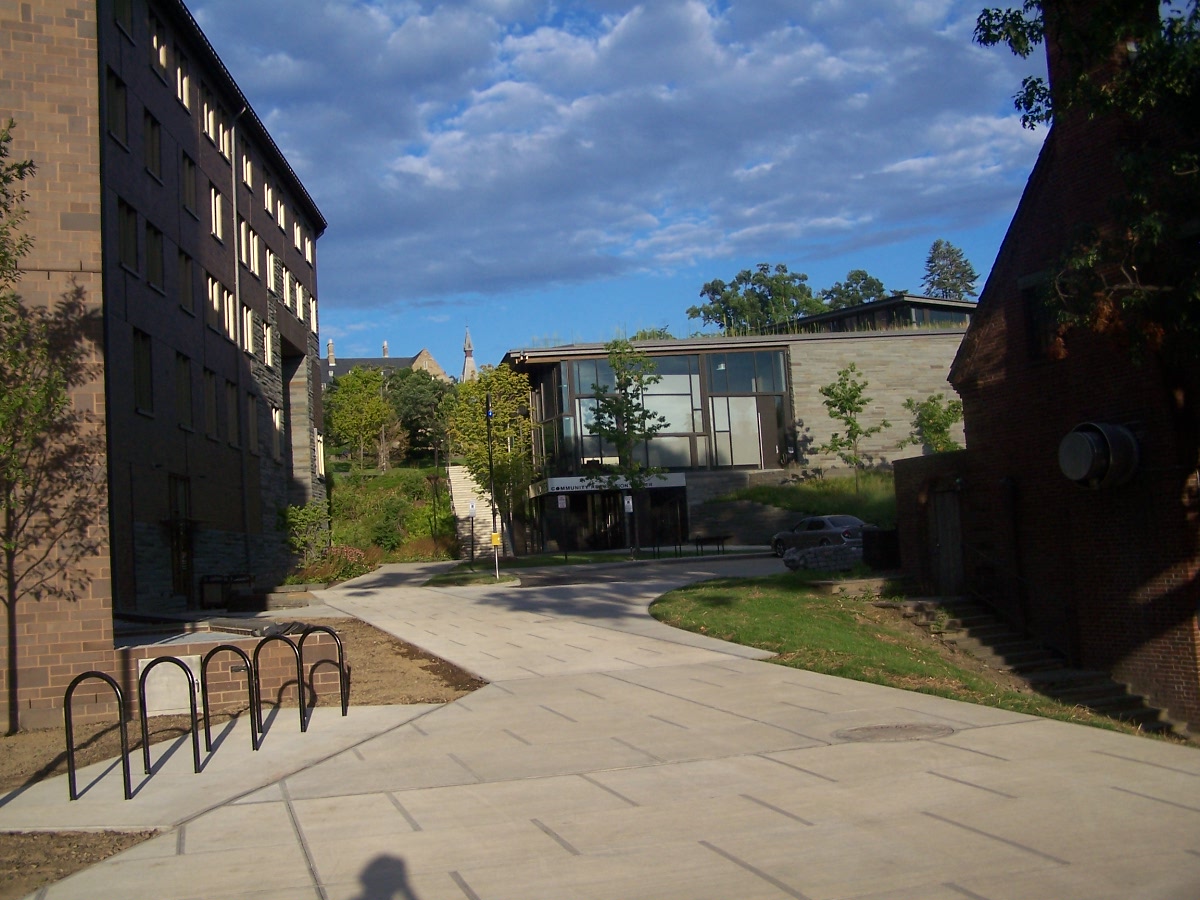
A new central plaza area between House 5 and Bethe.

House 5, south face

Don’t mind my shadow.

Curious horizontal window slits near the entrance of House 5.

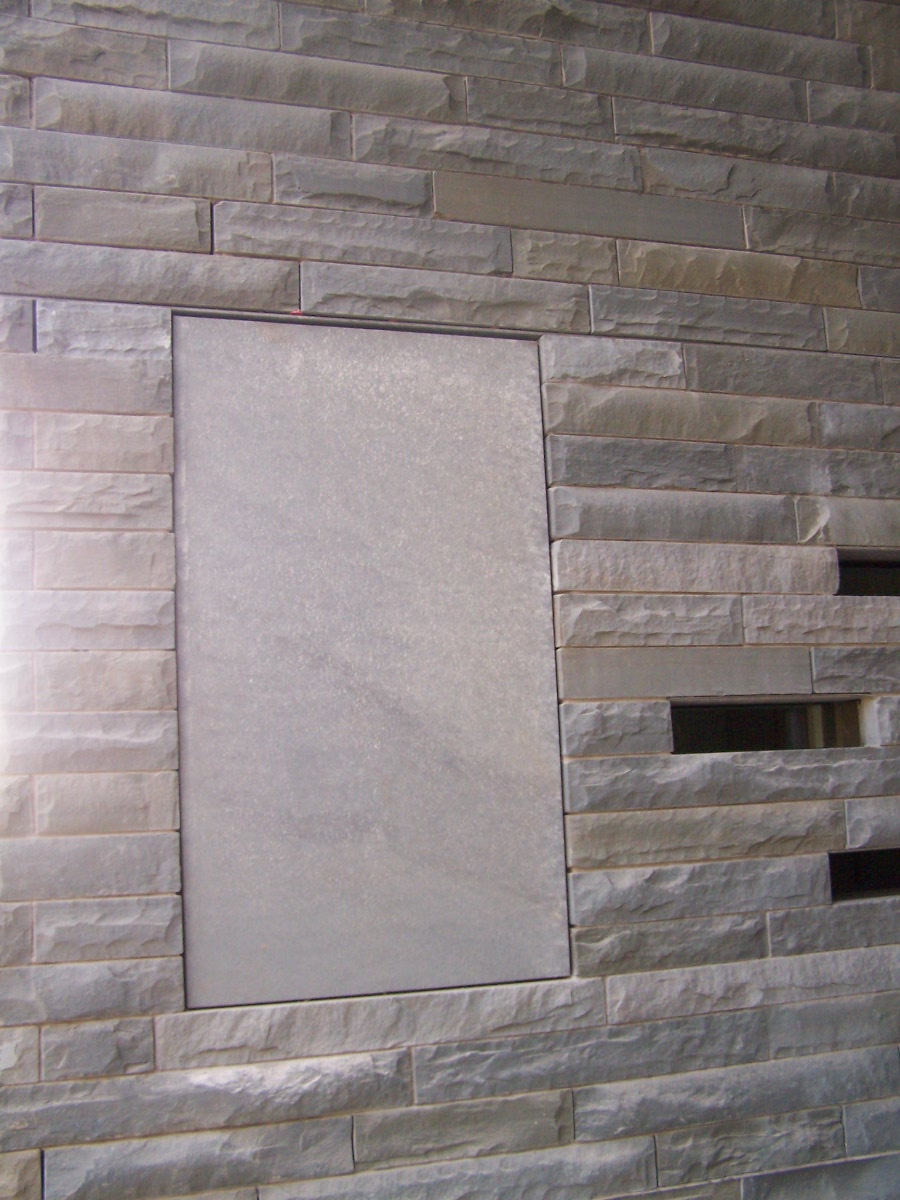
Nameplate, unfinished for now.

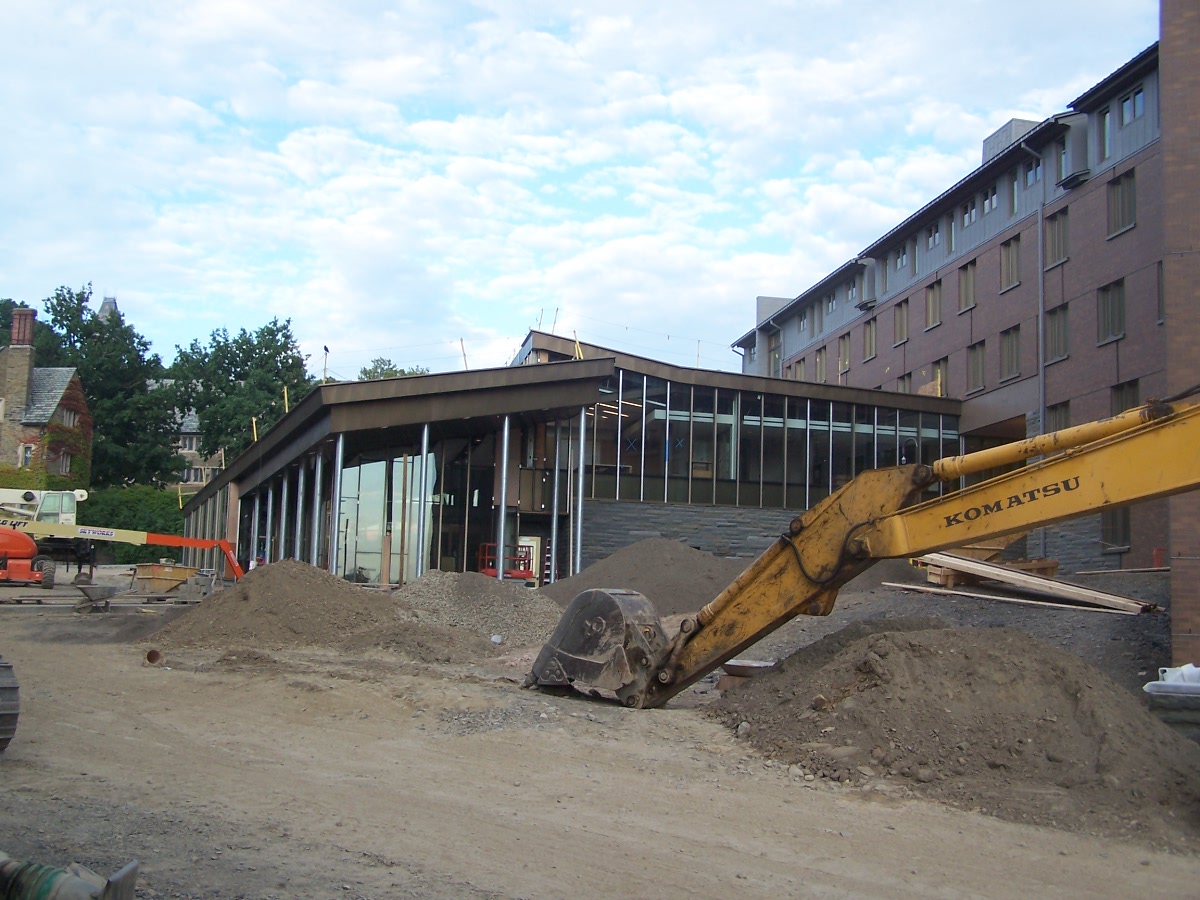
House 5 Dining area, NW corner

north face, house 5

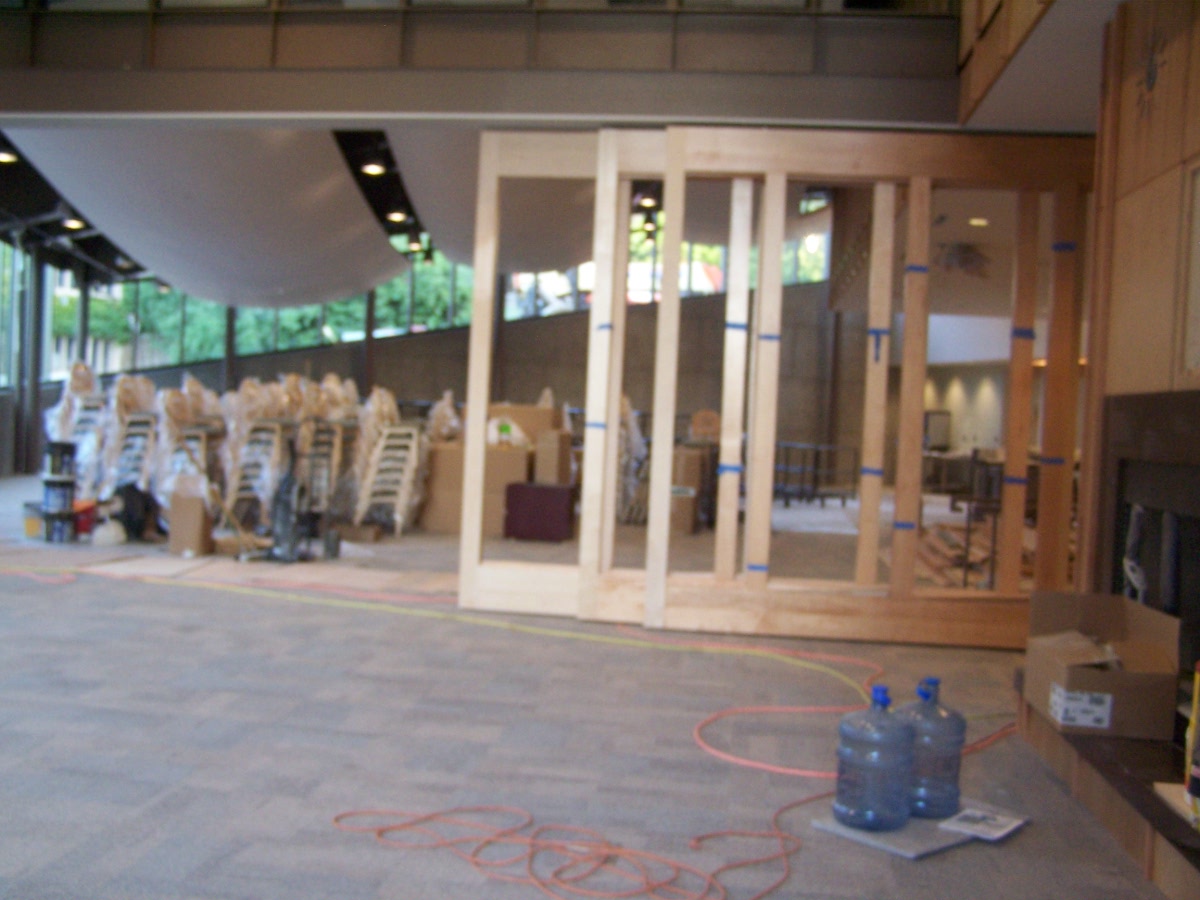
House 5 dining area interior, unfinished

Keeton House, north face

Noyes, from Keeton

A corner plaza next to Keeton. Psi Upsilon is in the back.

A plaza/planting area just outside of Keeton.

Keeton’s connective corridor.

A staircase at Keeton that leads under the corridor.

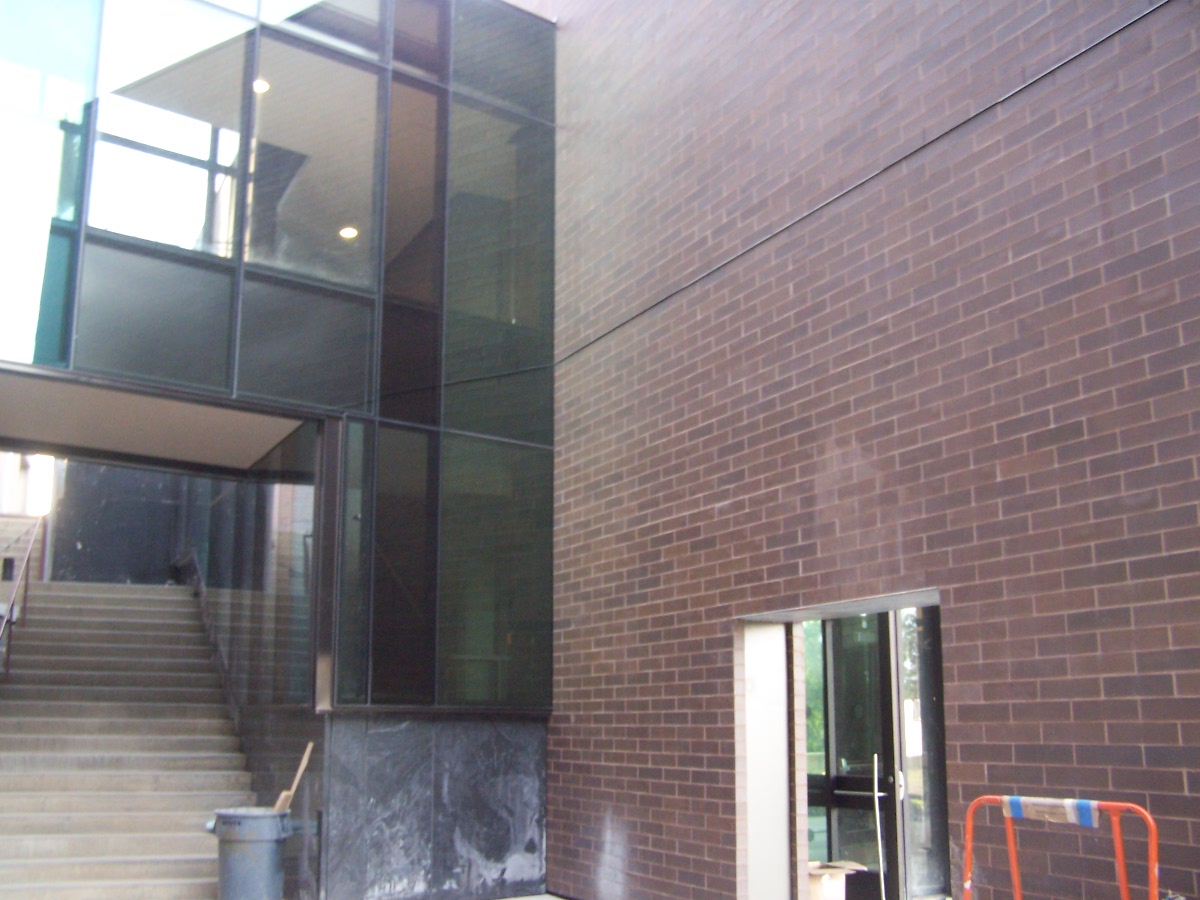
A large blank wall next to the previously mentioned staircase.

Note the coloration of the glass in the connective corridor.

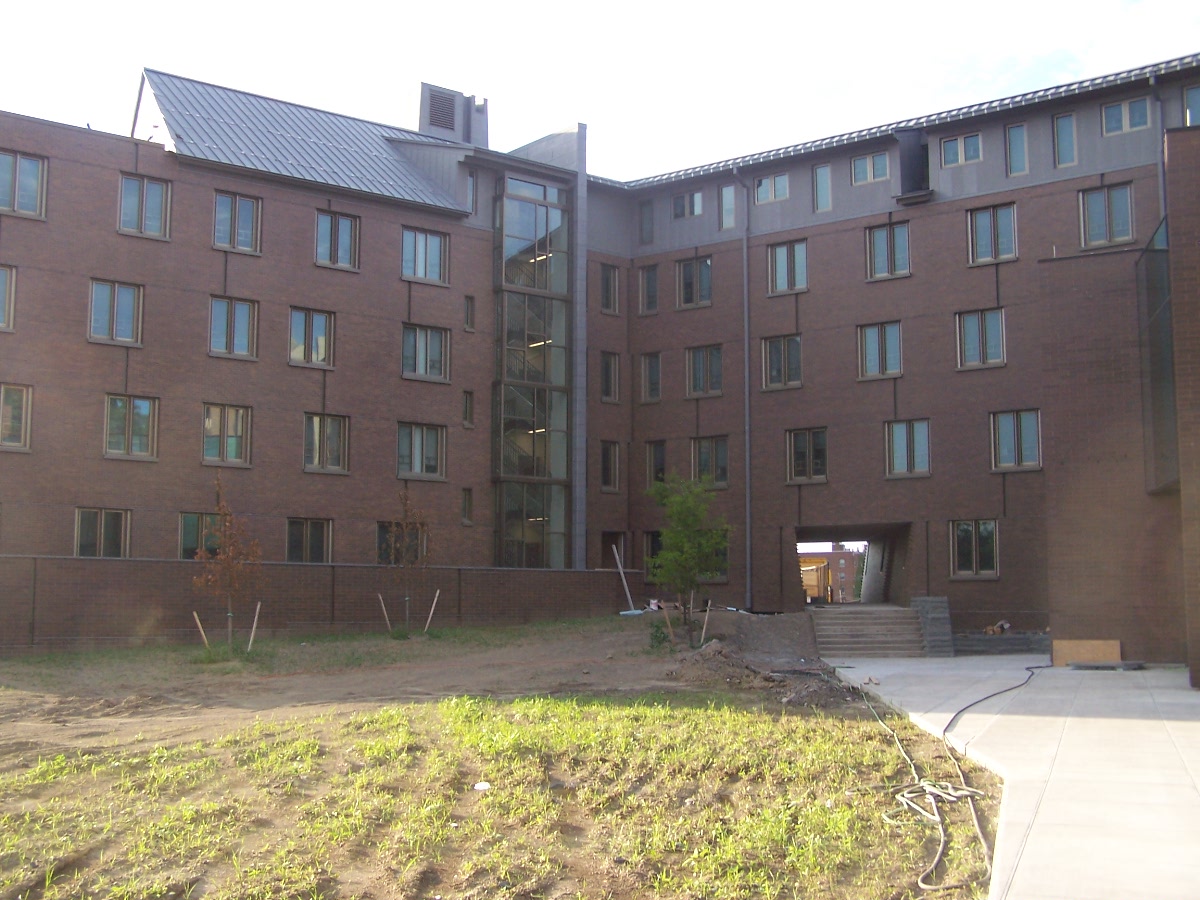
Keeton’s south wing. Notice how the top floor has a different window pattern and uses different materials.

An interesting if not aesthetically pleasing entrance area for Keeton’s north wing.

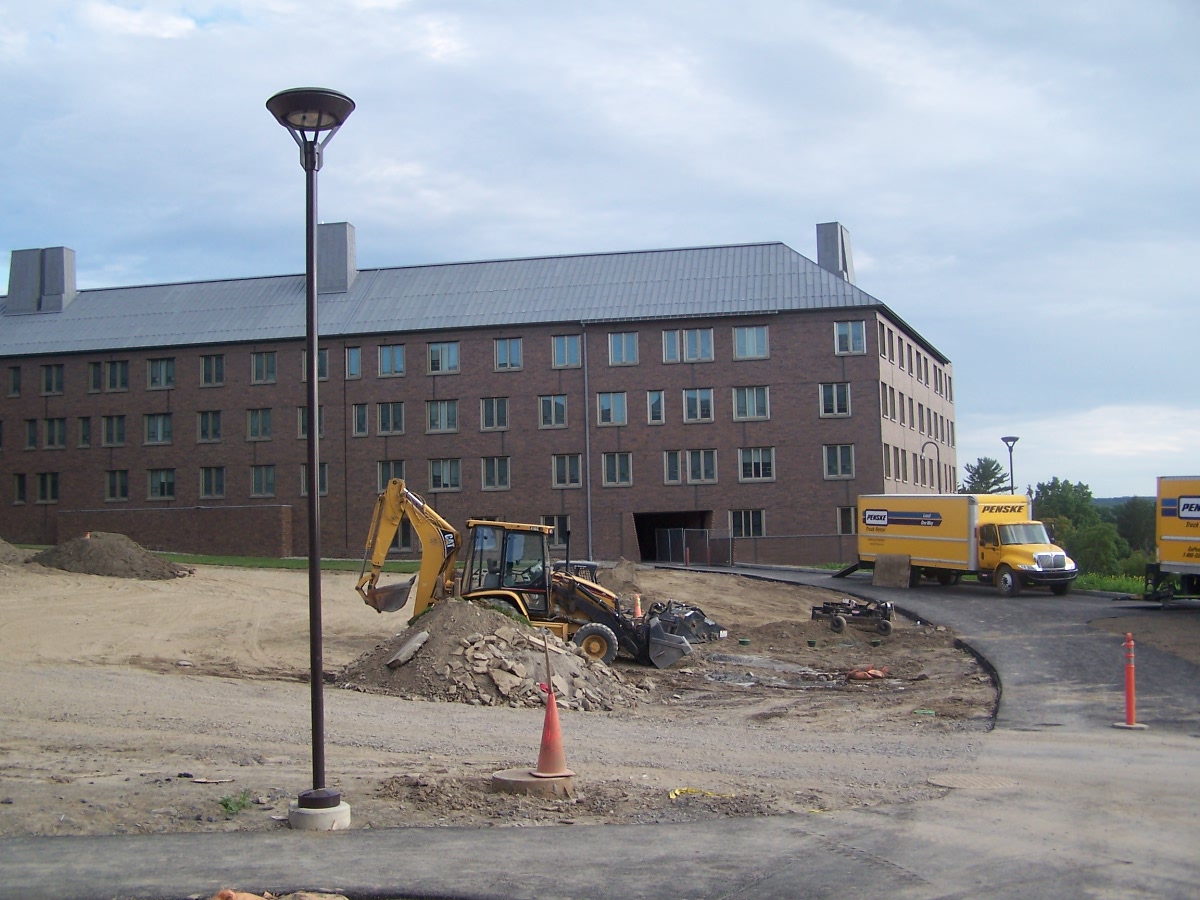
Had to hide from construction workers by hiding behind the board next to the Penske truck.

The unfinished nameplate for Keeton.

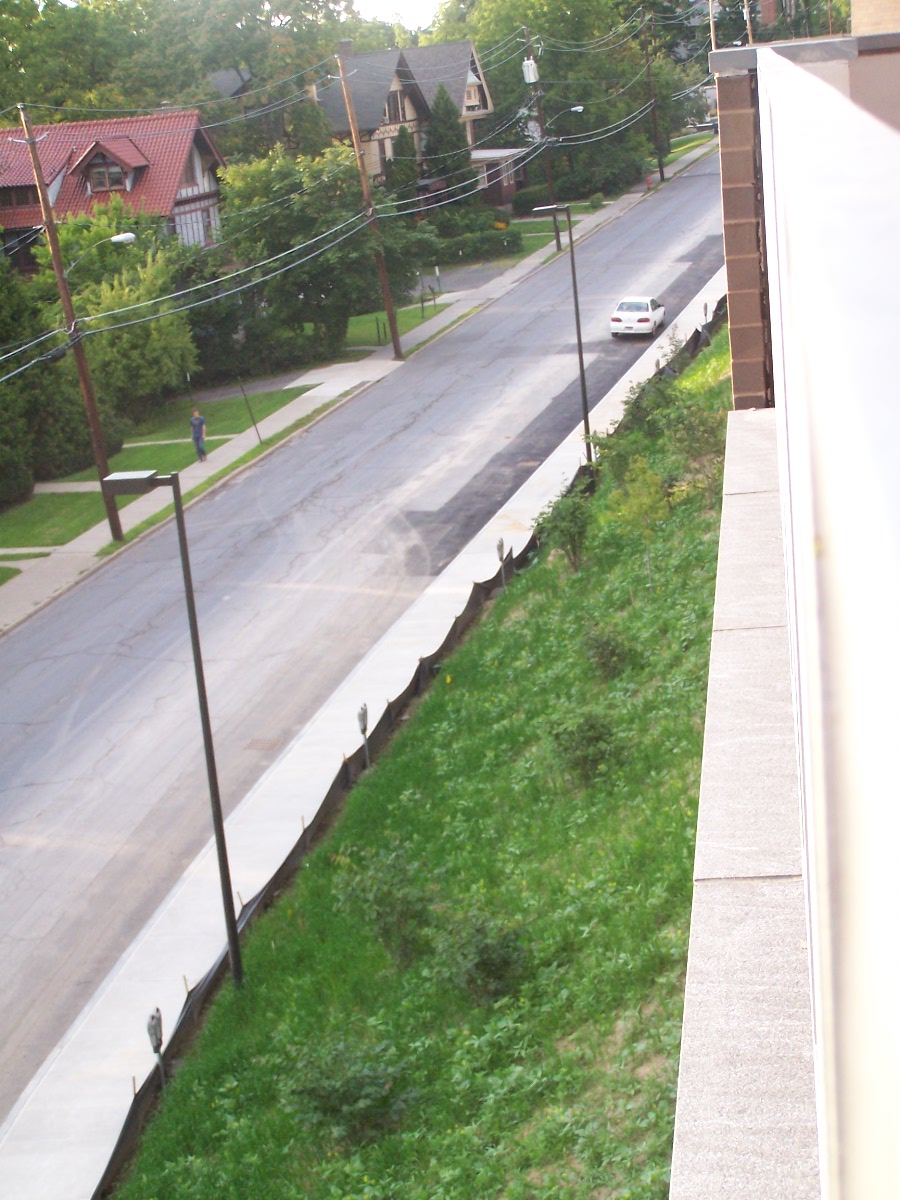
Keeton’s balcony.

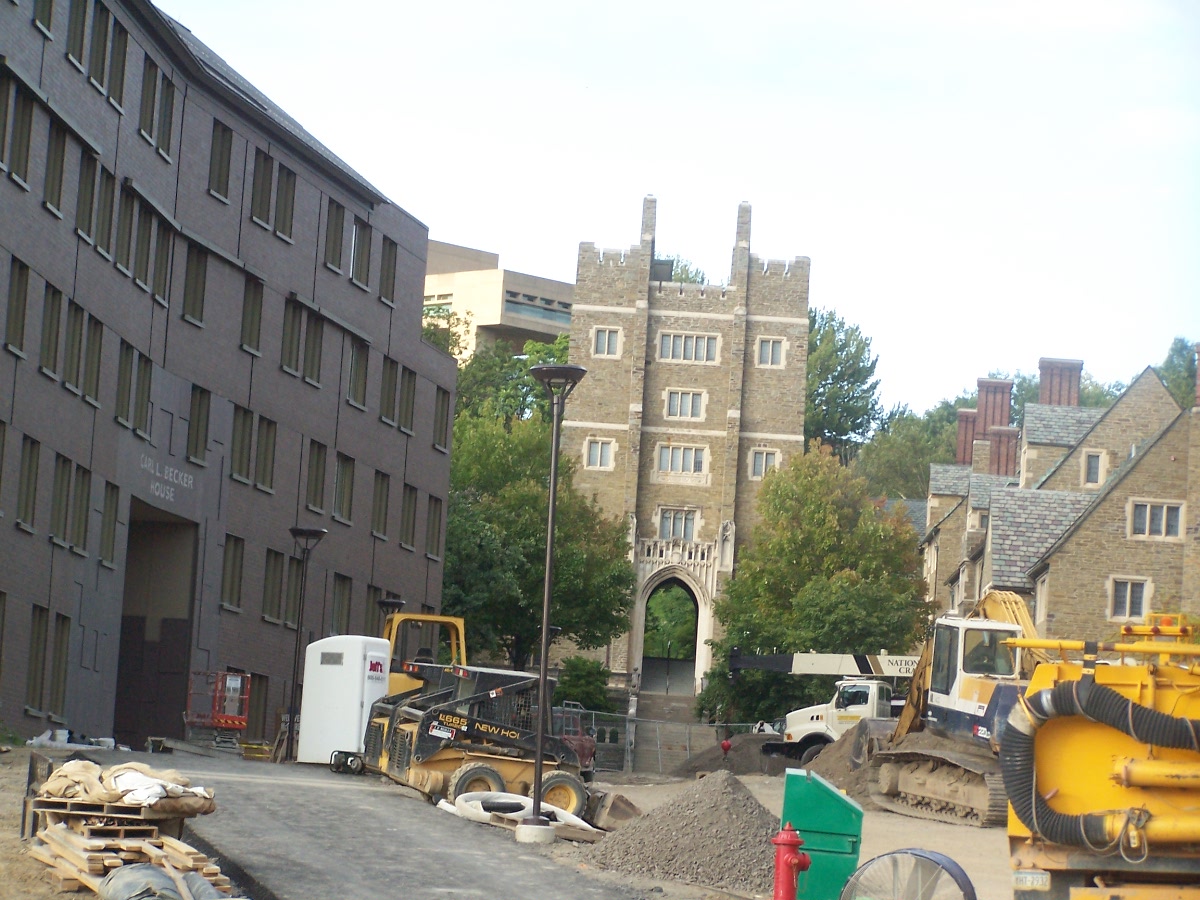
An architecturally interesting juxtaposition of Baker Tower, Becker House and the Johnson Museum.

Keeton’s lobby area

The dining area and an adjacent lounge in Keeton House.

A random hall of dorm rooms in Keeton.

***

Boldt Hall and Tower

ATO painted their house, it seems.

As for the photo request…consider it fulfilled.

[1]http://cornellsun.com/node/19107


North by Northwest of Campus

12 08 2008

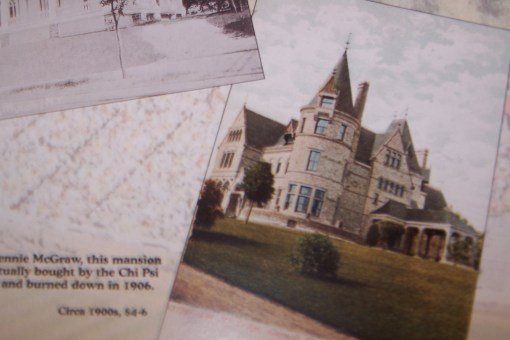
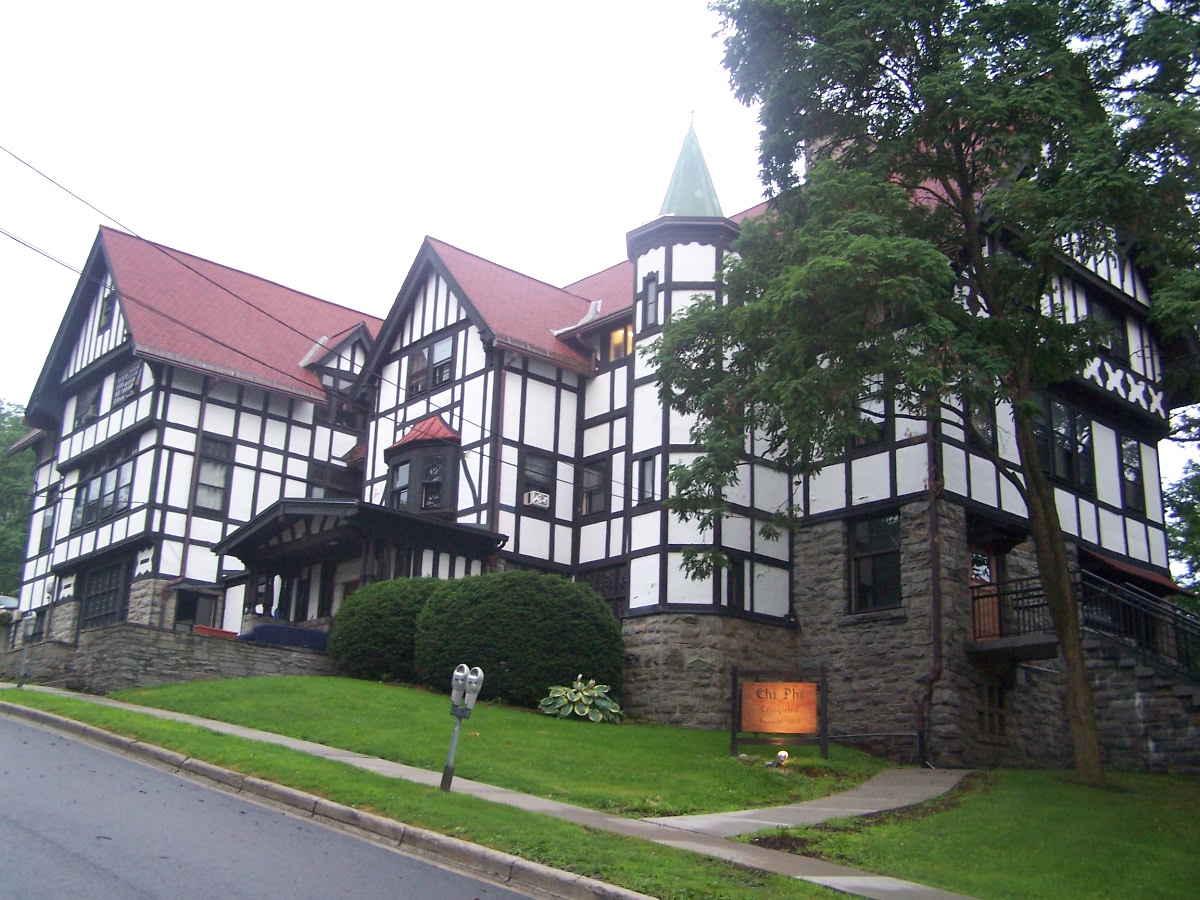
The house of the Chi Psi fraternity of Cornell University. Chi Psi has had a colorful if traumatic history in its century-plus long history here at Cornell. The Chapter at Cornell was founded in 1869. While they lived elsewhere, Jennie McGraw, the daughter of John McGraw, who was a wealthy lumber merchant and one of the first trustees of Cornell (for whom McGraw Hall is named) [1], fell in love with the first university librarian, Daniel Willard Fiske. She was old for loving at the time, pushing forty. She was also suffering from terminal tuberculosis. Regardless, she and Willard eloped and engaged in a whirlwind tour of Europe, while an opulent mansion was built on the edge of the gorge. She lived just long enough to see it with her own eyes, passing as they arrived home in 1881 [2]. Willard moved in, but his behavior was considered a little too exuberant for someone whose wife just died. Plus, due to some legal issues with Jennie’s will (which might make for a good entry another day), he and Cornell ended up on really bad terms, and he spent most of the rest of his life in Italy (on the bright side, he somewhat reconciled with Cornell in later years and donated his library upon his death in 1904 [3]).

That story is tangent to Chi Psi. Willard sold the opulent McGraw-Fiske mansion to the fraternity around 1881[4]. It was during the cold night of December 6th 1906 that the second deadliest campus tragedy in Cornell’s history occurred.

Sources tend to indicate it was caused by flammable polish being used on the floors. Others have gone as far to suggest that the house was cursed due to Jenny and Willard’s indiscretions. Regardless, the house caught fire. And in the days before real fire engines, any water to be used on the house (that wasn’t frozen) was a mere trickle. Of the twenty-six fraternity brothers living in the house, four died. When one of the exterior stone walls collapsed, it landed on volunteer firemen from the city of Ithaca, killing three of them. By the end of the night, the house was destroyed, and seven people were dead [5].

Photo Courtesy of "Greetings from Ithaca"

Photo Courtesy of “Greetings from Ithaca”

Through the tragedy, the fraternity persevered. They built the current house the following year (known as “The Lodge”), and have lived there since.

So, I took two photos partially to get a good idea of the shape and ornamentation of the house, but more because a woman in a towel came up from the gorge as I was taking photos…and I didn’t want to give the wrong idea. I ran south after a large guy appeared by her side, and she probably thinks I’m a creeper and pervert. I prefer photos of ornamental busts to women’s busts.

***

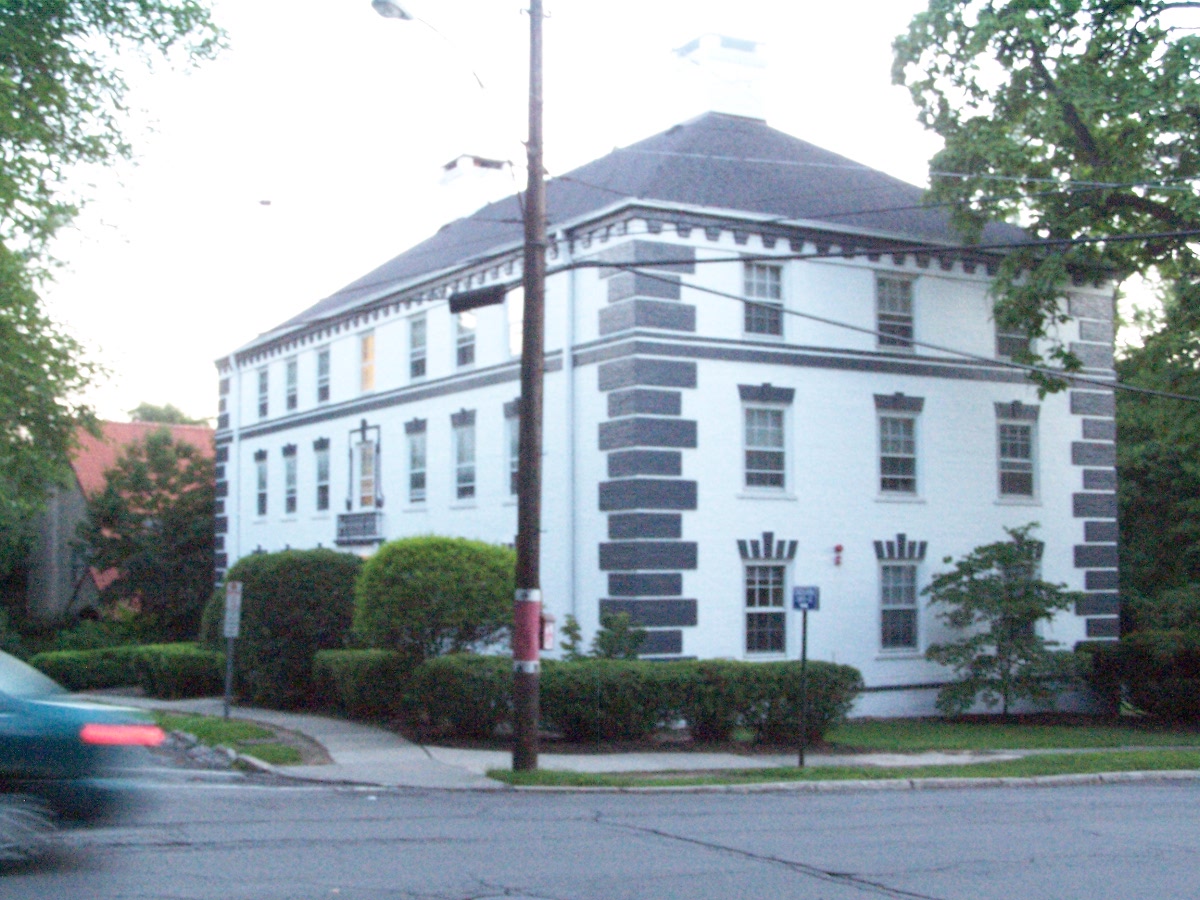
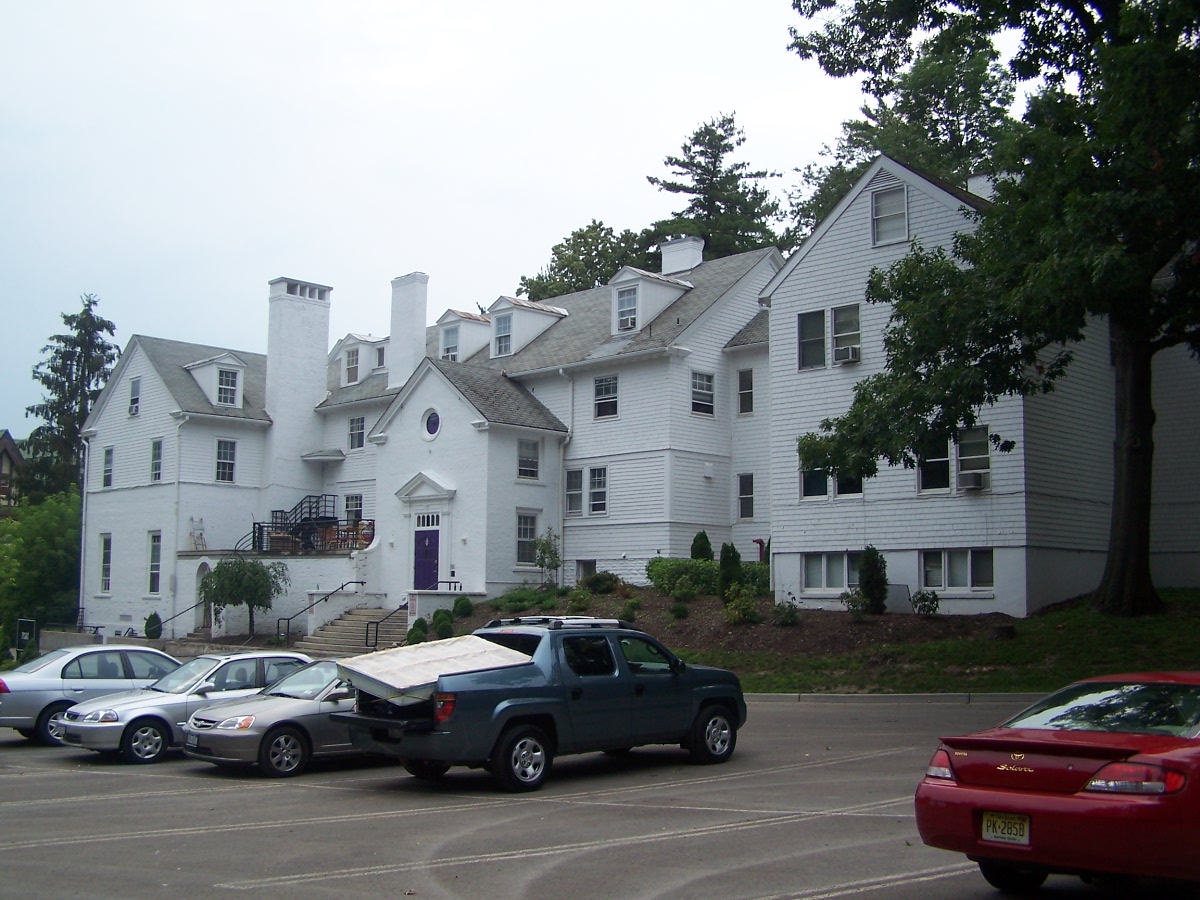
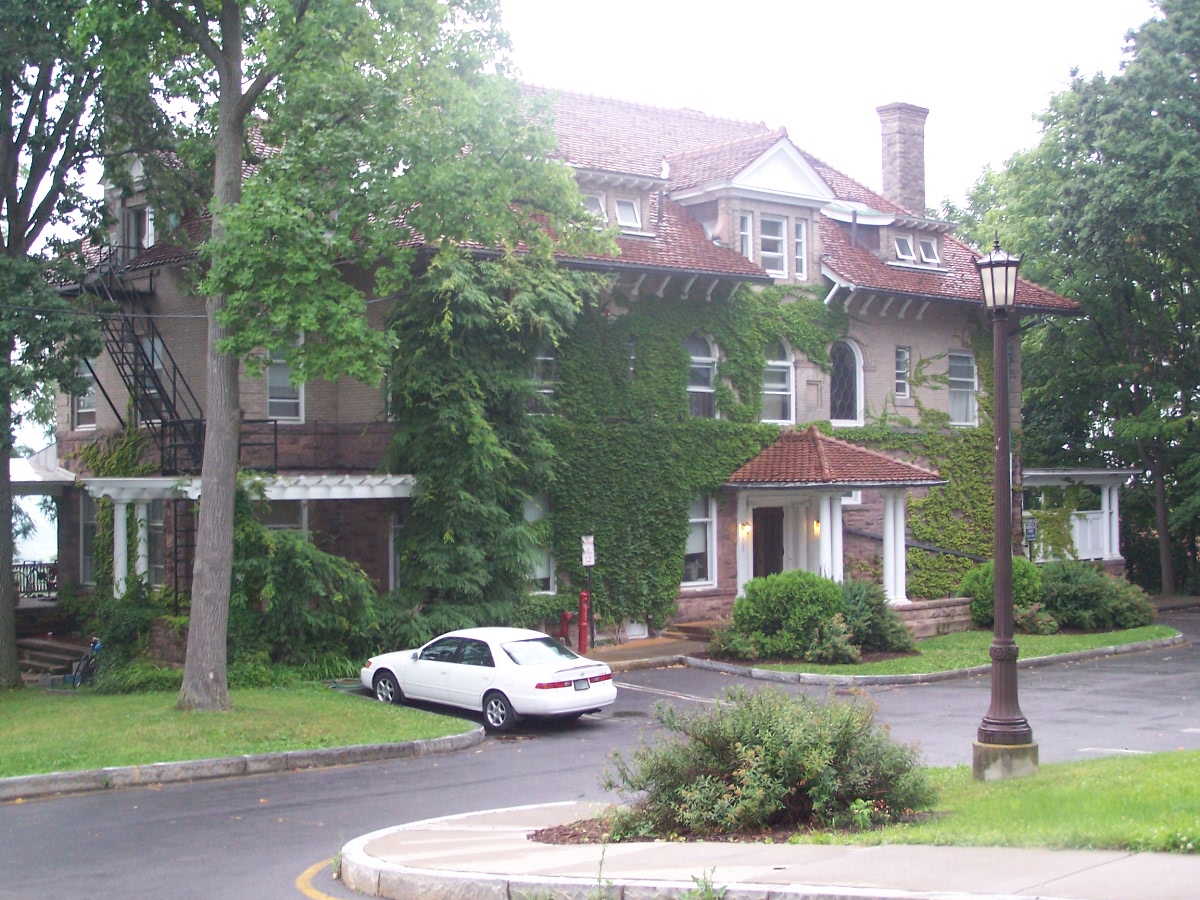
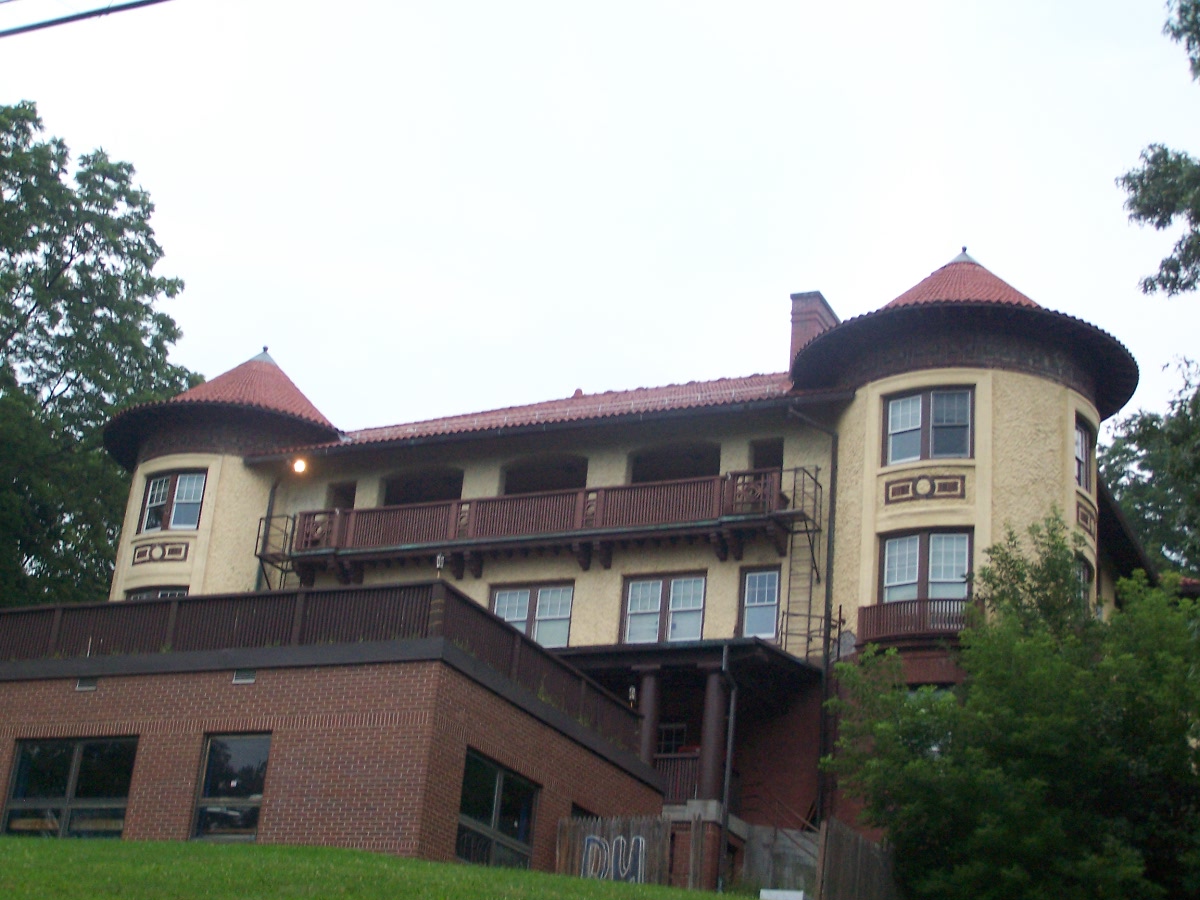
The Thurston Court Apartments is a 22-person university-owned apartment building with one and two-bedroom student apartments [6]. Primarily used for grad housing, in recent years the building has been opened up to undergrads as well. The building was built in 1932 (fun fact: the entire building was once painted white, including the ornamentation).

The house of Seal and Serpent fraternity, Cornell’s independent fraternity. The fraternity was founded in 1905, and the current house was built in 1929 in the Tudor Style [7]. In the past several years, the fraternity has suffered from a chronic shortage of interest; rumor mill says they only had three pledges last spring.

Maybe this has something to do with it:

“…Fraternities have a reason to fear such stereotyping. The Seal and Serpent society, a house which was primarily gay in the 1980s but now has just two gay brothers out of 16, has had some difficulty overcoming “the gay” label during rush…”

I s’pose this doesn’t help – I still hear this from a lot of people both in and out of the Greek community  (the quote is from a Nov. 2000 Sun article).  Going through this blog’s search bar history, there are over 200 hits for “gay fraternity”.  I’m willing to bet it’s not with good intention.


The house of Alpha Phi sorority. Alpha Phi Cornell was founded in 1889 with assistance from the Alpha Chapter at Syracuse University [8]. Originally based out of Sage College, they lived with Alpha Zeta for a year  and on their own in a couple different houses until they bought their current house from an Alpha Phi alum in 1921. The side wings were added in 1937, and a back wing (not pictured) was added in 1961. The chapter went under a reorganization sometime in the early 1990s due to low membership intake, but I’ve found nothing that indicates it ever closed. Currently, Alpha Phi has one of the highest sorority membership numbers at Cornell.

Hardly 500 feet away is the house of Kappa Kappa Gamma sorority. I know Kappa has been in the news lately; and it really sucks to be them right now (unless you like embarrassment over attention). The sorority’s Cornell (Psi) chapter was founded in 1883, and moved into the current house in 1921 [9]. The chapter was inactive from 1969 to 1977, a time period well-known for its anti-Greek sentiment.

Louie’s Lunch was founded in around 1918 by Louie Zounakos, who emigrated to NYC from Greece, and later moved up to Ithaca. The original Louie operated the truck up until 1955 [10]. The original truck was replaced in the late 1940s. The truck was then owned by the Machen family until 1997, and is now currently operated by Ron Beck. I do have a preference to one truck over the other, but I won’t say which.

100_3462

Photo courtesy of “Greetings from Ithaca”

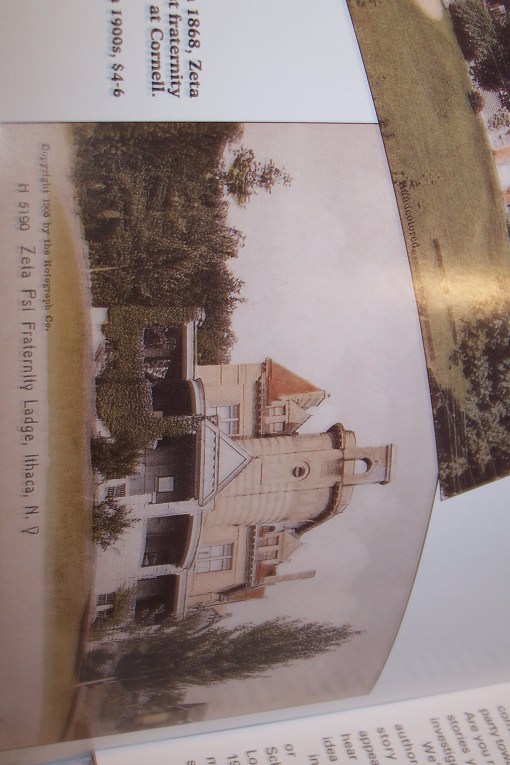
The house of Zeta Psi fraternity. The house, built in 1930, was originally that of Theta Xi. Zeta Psi, meanwhile, has the distinction of being the first fraternity founded by Cornell, even if it was decided by a coin flip (see the entry for Chi Phi). The chapter built a luxurious house in 1891 on the corner of Williams Street and Stewart Avenue, but moved out in the 1940s due to low numbers as brothers left to go fight in WWII. The original house burnt down in the late 1940s, and was replaced by a parking lot. In the meanwhile, Zeta Psi lived with Young Israel for a short while before moving into 660 Stewart Avenue in the late 1950s. A donation from a wealthy alumnus allowed them to buy the current house in 1972 [11].


[1]http://www.cornell.edu/search/index.cfm?tab=facts&q=&id=497

[2]http://en.wikipedia.org/wiki/Jennie_McGraw

[3]http://en.wikipedia.org/wiki/Daniel_Willard_Fiske

[4]http://www.adphicornell.org/adphicor/files/FraternityRow.pdf ***

***Page 10 has a picture of the McGraw estate in its heyday

[5]http://www.chipsi.org/news/6143/Cornell-Fire-Centenary.htm

[6]http://www.campuslife.cornell.edu/campuslife/housing/graduate/thurston-court-apartments.cfm

[7]http://www.sealandserpent.org/house.html#

[8]http://www.dos.cornell.edu/dos/greek/chapter_details.cfm?id=4679

[9]http://www.dos.cornell.edu/dos/greek/chapter_details.cfm?id=3280

[10]http://www.louieslunch.com/history.htm

[11]http://www.psiofzetapsi.org/History.html

[12]https://cornellsun.com/node/1720


The Cornell Master Plan, Part 5 of 5

10 08 2008

Well, it’s about time I wrap this up. I meant to do this a little earlier, but I became a little sick towards the end of last week, so feeling better was more important than maintaining the IiCH blog.

The Cornell Heights precinct sees change listed under the “although no specific development sites have been identified, additional development may be considered on and(sic) case-by-case basis.” Since this is a nationally-recognized histroic district, I wouldn’t expect anything out of character with the current sttuctures in the neighborhood.

Also, to tie this in with the disppearing suspension bridge incident, the image above has also apparently washed out the Stewart Avenue bridge, making it more likely it was just some half-fast work on the image.

For North Campus proper, there are some notable, but not really controversial changes in the physical plant. The only thing currently underway is the $15 million renovation expansion of Helen Newman designed by architectural firm Dagit-Saylor (they also designed Appel Commons[1]). If the site ever goes back online, you can view the exterior plans for the expansion at this website:

http://residential.alumni.cornell.edu/n_helennewman.cfm

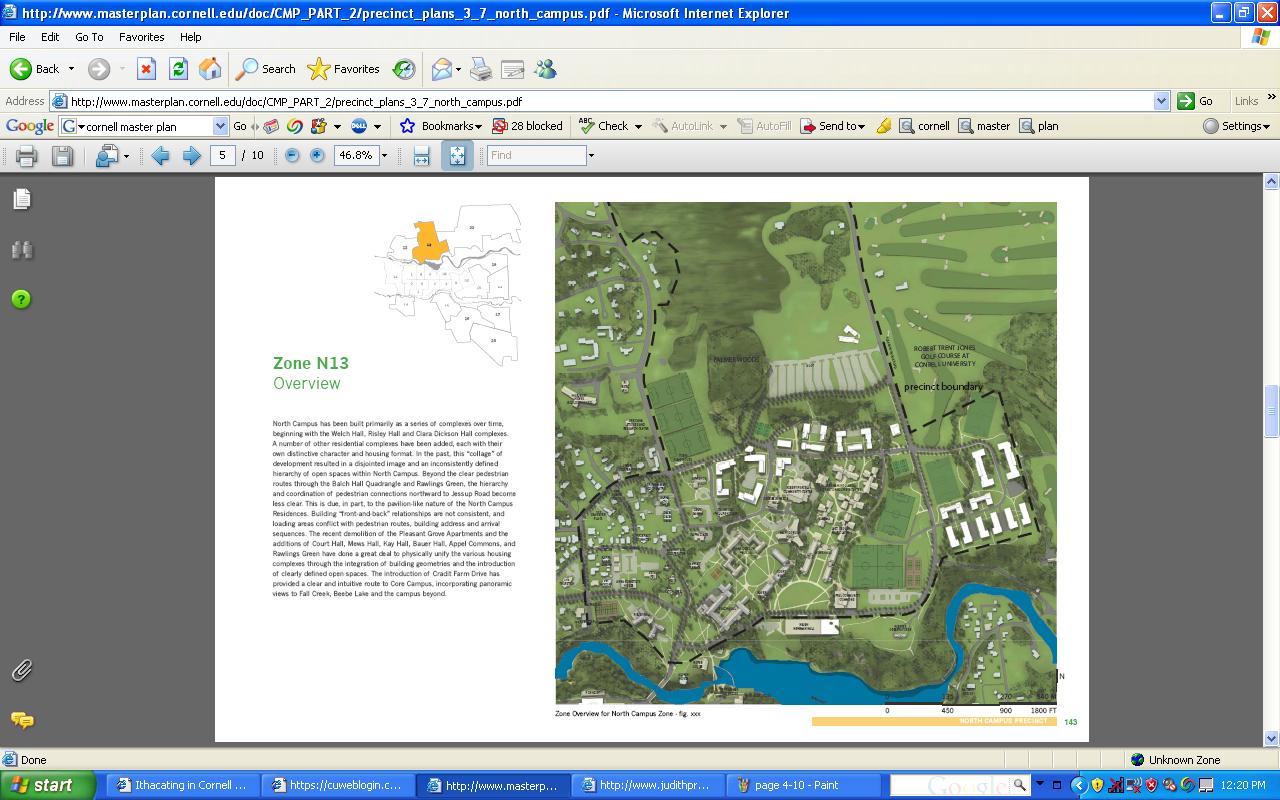
Some of the propsed changes include developing the CC parking lot into dorms, replacing the townhouses with a different set of dorms, and replacing Hasbrouck with some other form of housing. A new dorm would also be built across from the north-facing corner of RPU. I don’t hold much weight for plans for North Campus, probably because the plan developed by Richard Meier in the ’80s was eventually dropped[2], and Cornell just seems to decide spur-of-the-moment what will be built.

The plan suggests that dorm plans be two to four floors in height, but higher heights may be considered depending on the location. The hodge-podge necessitates that new constructions manage to make the North Campus more cohesive without interrupting intuitive pedestrian traffic flow. Which is big and fancy language just to say that it shouldn’t make getting around North more difficult than it already is.

I look at the designs for the more cluster-style developed to reaplce the townhouses and Hasbrouck, and I see a lot of opprotunities to name buildings. I’m sure Cornell could tote that to wealthy alumni that for only $3 million or $5 million, you could get a ten-unit dorm on North named after you. But, they didn’t really do it with the low-rise/high-rises, so they might just leave them nameless. Regardless, it seems rather poor planning that the townhouses, which were built as upperclassmen housing in 1989, would be torn down so soon. More athletic fields would be developed on the sapce freed up by the demolition of Hasbrouck, and some intersections would be realigned to better define the area and improve traffic flow. The idea is thrown out there that further development on Jessup Road have a “main street” character to it.

As for Collegetown, relatively little is mentioned. The plan hinges more on the recommendations of the Collegetown Vision Statement and finalized plan to be released in October of this year. The two primary itmes that are suggested are preserving the housing stock on Linden Avenue, and creating a pedestrian bridge from Eddygate and across the gorge to South Avenue. As someone who frequently commuted between Edgemoor Lane and Cascadilla last year, it wouls have been wonderful if this bridge has existed already. It was a little annoying that to walk a thousand feet as the crow flies, I had to walk up to College Avenue, cross that bridge, and then go down the steep and often icy hill next to the law school. A bridge from Eddygate to South Ave. would have been really nice, and it would definitely serve to make the neighborhood more cohesive with the far southwest portion of campus.

***

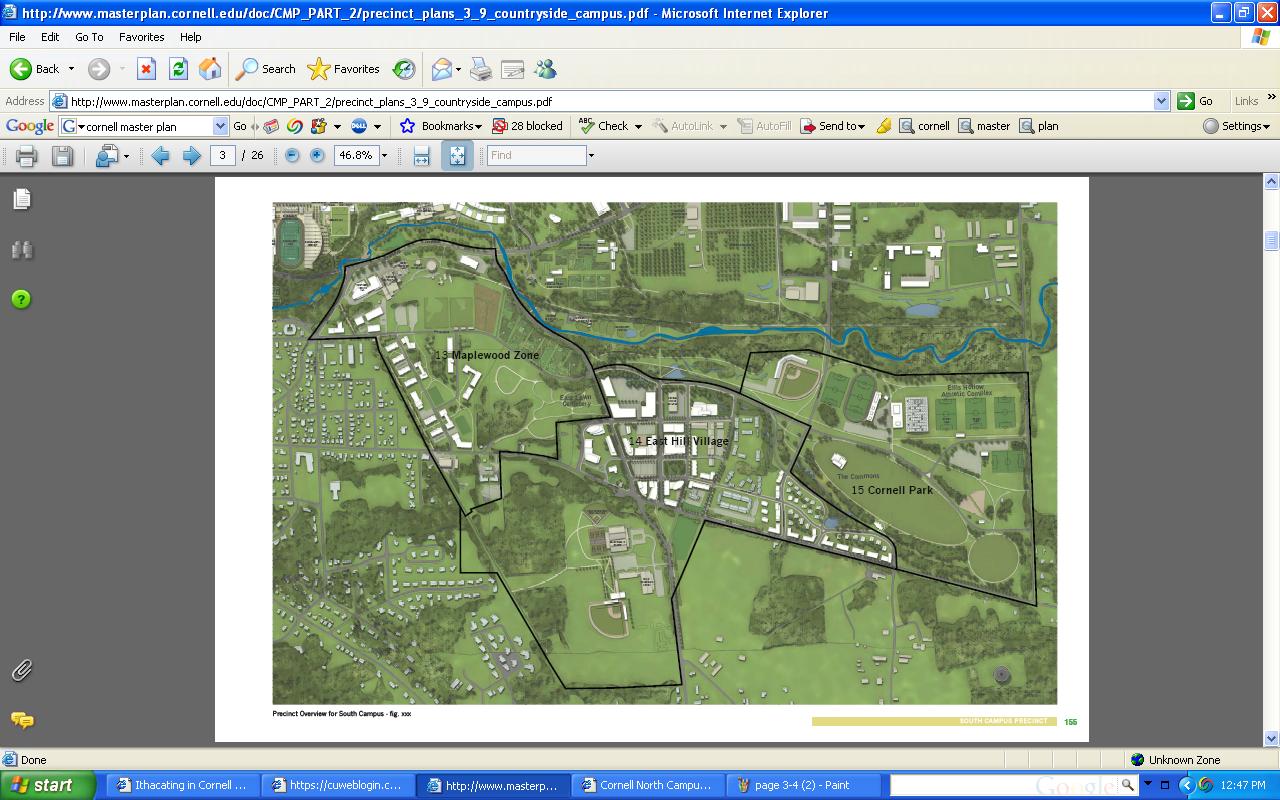
However, plans for a “South Campus” between Maplewood Park and East Hill are extensive. The area is devided into three zones- Maplewood, East Hill Village, and Cornell Park.

In the Maplewood Zone, the Maplewood Park Apartments are entirely replaced with “higher-quality”, more cohesive development. A site for townhouses also exists to the east of Maplewood Park. These areas are expected to be developed in the short-term (perhaps some of the $20 million Cornell is giving to Ithaca for affordable housing should go here?).

The total developed square footage will be between 450,000 and 1,000,000 sq. ft. With 240-480 residential units in the zone.

East Hill Village is an entirely different animal than its predecessor. The East Hill Plaza we currently know is essentially a strip mall, some apartments and a few outlying retail and office buildings (and Oxley Equestrian Center, if you count that). The plan wants to change that.

The area typifies a New Urbanism style development. Mixed-use buildings with an internal grid define most of East Hill Village. Active-use structures, like a grocery store, restaurants and retail stores are encouraged on the street level, with residential and/or office uses on the upper floors.

***

Meanwhile, the little-used fields to the east of East Hill become the site for Cornell’s new athletic fields and facilities (Ellis Hollow Athletic Complex). The park itself might be a large lawn or meadow that is used for general recreation or as a concert venue.

Cornell has big plans and big dreams. However, like any plan, conditions and preferences might change, so it would be unwise to consider everything to be set in stone. Still, it’s interesting that our insitution has such grand aspirations.


[1]http://www.judithpratt.com/Helen%20Newman%20Hall%20Proposal.pdf

[2]http://en.wikipedia.org/wiki/Cornell_North_Campus


Northwest of Campus

7 08 2008

The house of Sigma Alpha Epsilon fraternity. Sigma Alpha Epsilon is one of those fraternities that tends to come to mind when people want to typecast the Greek system at Cornell. It’s large (~80 men), and prestigious, and is the subject of so many dirty rumors (true or not) that it would make Lindsay Lohan blush. The house goes by the formal name “Hillcrest”, and was built in 1915 [1]. An addition was built in the early 1960s (on the left side of the photo). This is the fourth house of SAE and the second “Hillcrest”, the first having burnt down in a spectacular fire around 1911. SAE and Chi Psi have a standing rivalry.
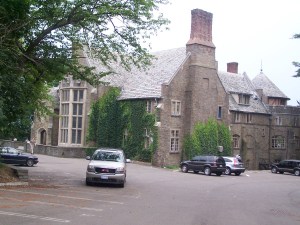
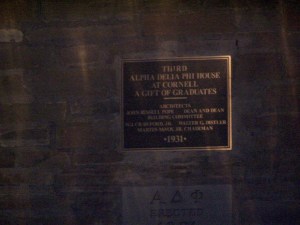
Next door to SAE is Alpha Delta Phi, colloquially known as Alpha Delt. The fraternity was established in 1868, and was among the first to build a chapter house, which was constructed in 1878 [2]. As students moved to different areas of campus, Alpha Delt launched plans to construct a new building in the prairie house style (which you can see on their homepage). This house was built around 1903, but due to electrical malfunctions, burnt down in a spectacular fire in February 1929. A new house, built in the collegiate gothic style (the current house) was built in 1931.
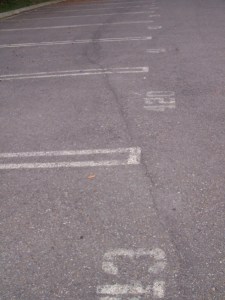
Alpha Delt has always struck me as a more upscale version of SAE. But, they’re not above visual humor; like their parking lot for instance.
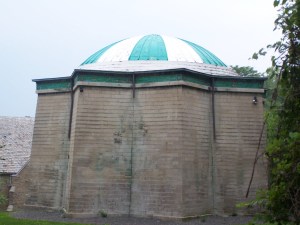
I wouldn’t be a good photographer if I didn’t get a photo of their super-sketchy windowless ritual building in front of the house.  Rumor mill says someone received third-degree burns in a ritual gone wrong two years ago at their initiation. Ah, so this is why fraternities like Delta Upsilon and Phi Kappa Tau were founded; to go against the cloak-and-dagger behaviors of other organizations.
***

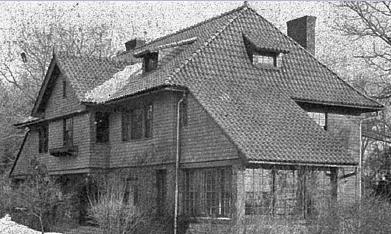
Although in a tightly packed area of high-profile houses, Phi Gamma Delta, or FIJI as it more commonly known, retains a distinct character. The house, known as “The Oaks”, is fairly nice-looking from the outside, especially since it was built around the 1900s. The original house, a private residence the fraternity bought,  looked like this before the extensive additions and modifications:
Throwing this disclaimer out there, I’m not a huge FIJI fan. The inside kinda scared me. That, and the Halloween party I went to there freshman year where some guy scantily-clad in leather was randomly hitting people in the crowd with a whip as he stood on a table. After the marks I received from that, I haven’t been inside since. Opinions aside, it’s a large house with a large membership.

One last thing…it rained shortly after I had taken the house photo. The mattress in the pickup was still there when I passed by a second time…and it was thoroughly soaked.

***
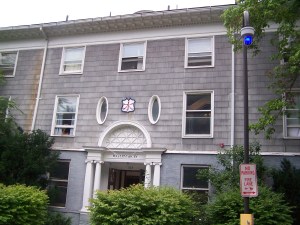
Mixed into the hodgepodge of frats is Watermargin, a co-op established in 1947 (co-ed since 1961/1968, the latter being the year it was formally approved[3]) by WWII verterans to promote undertanding and diversity in religion and race [94]. The name Watermargin comes from a Chinese Classical literary work, translated by Pearl Buck (All Men Are Brothers), in which fugitives fight the injustice of the Ming Dynasty at the water’s margin. Prior to 1947, the house served as a home for Phi Kappa Psi. The house was built in 1890 in the Colonial Revival style [5]. I’m still trying to determine what the house served as between 1912 and 1947.

Next door and contuinuing up University Avenue is Theta Delta Chi. They are colloquially known as “Thumpty”, or the much-maligned “Theta Drug”, supposedly because of the relative ease of obtaining drugs at the house. The house dates from the 1920s, making it one of the later constructions in the area. The running joke that I’m aware of suggests that its members are stoned all the time. Still, although they are the put of many jokes, they’ve managed to stay continuously active at Cornell since 1870, so they might as well take it in stride.
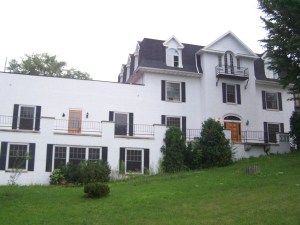
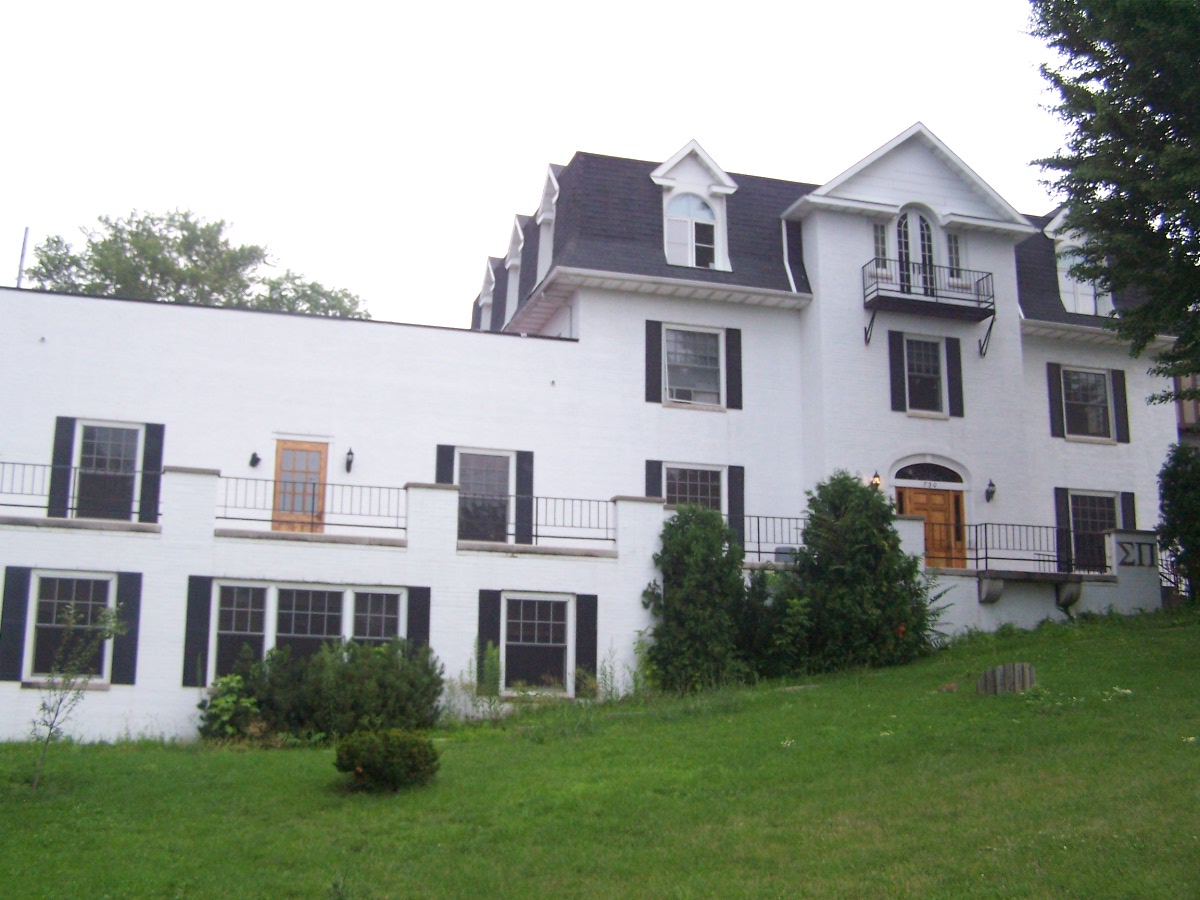
Sigma Pi is further up University Avenue. The original house on the property was built in 1870, burnt down in 1994, and a new, roughly-similar looking house, was designed by local architect Jagat Sharma and built in 1995 [6]. The fraternity was one of the largest at Cornell, until a nasty incident involving a Thanksgiving dinner gone wrong caused four freshmen to have to get their stomachs pumped[7], and Sig Pi losing recognition from the university (i.e. no pledge class). So, how about that fall rush…?
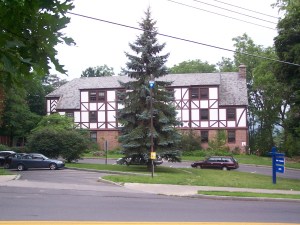
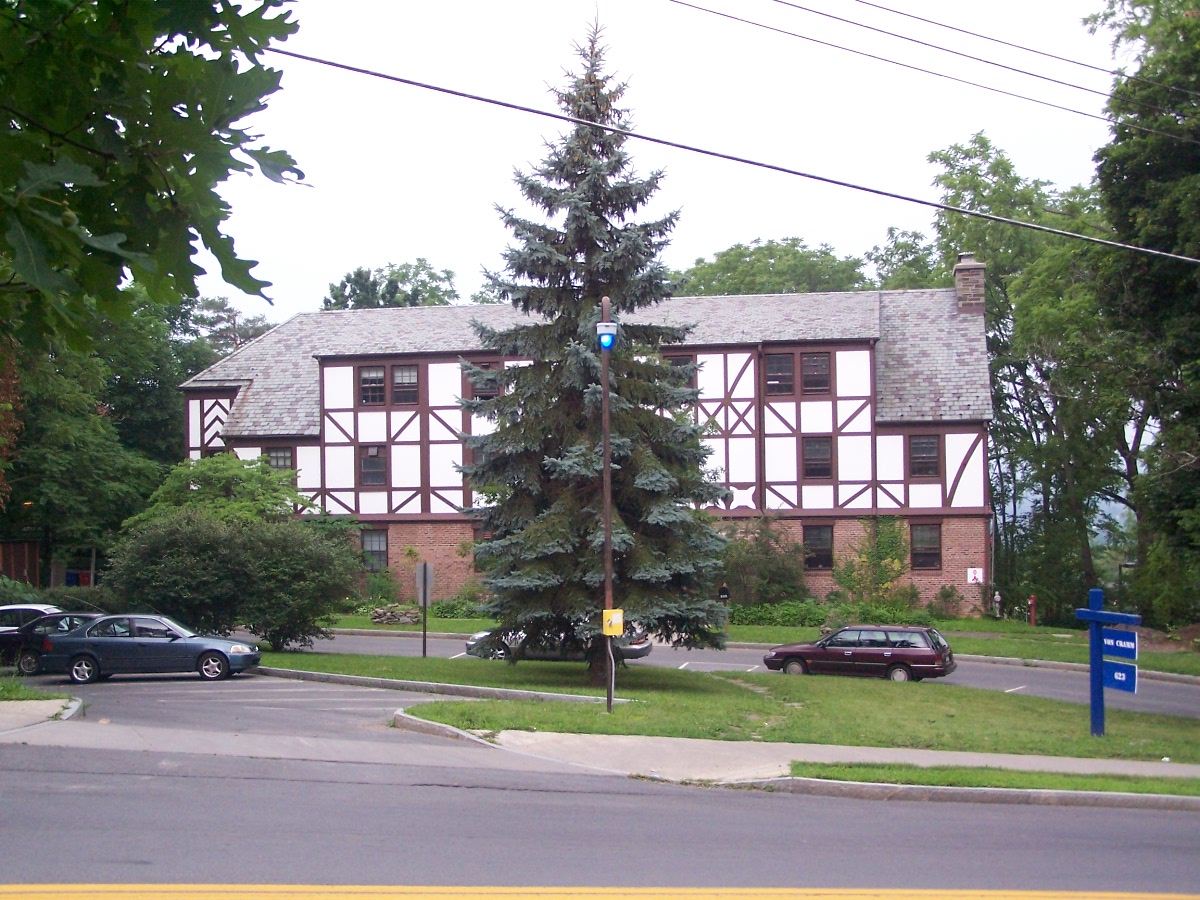
Going back the other way on University, we have Von Cramm Hall (I’ll hit Chi Psi at a later date). The co-op was founded in 1956 by an endowment from Thomas Gilchrist, in memory of his friend Baron Von Cramm. a Nazi German military officer who died trying to stop the Soviet retreat in 1941[8]. It is also the largest co-op, at 32 members. The house became open to women in the 1970s, and has a very strong leftist bent (Redbud Woods…). The house itself was built in 1955, standing on the property of one of the trio of homes owned by Robert Treman. The house, more of the textbook-style tudor, burned in 1944 [9].
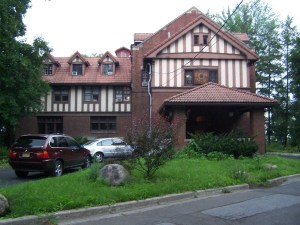
Sigma Nu’s house is tucked way at the end of Willard Way. The house dates from about 1910. The house is one of the more obscure ones to try and locate, but it has fantastic views of the West Hill in the town of Ithaca. Sigma Nu Cornell, founded in 1901, is a fraternity with a strong athletic presence.

Missed it the first time, not the second time. Sigma Phi Epsilon’s house on McGraw Place. The house was built in 1965 [10], replacing their former house at 112 Edgemoor Lane. After Sig Ep was gone in 2004 (google it, rumor mill had a field day with that one), ATO occupied the house, and Delta Chi shared it with them when they were rechaptered in 2006-07.

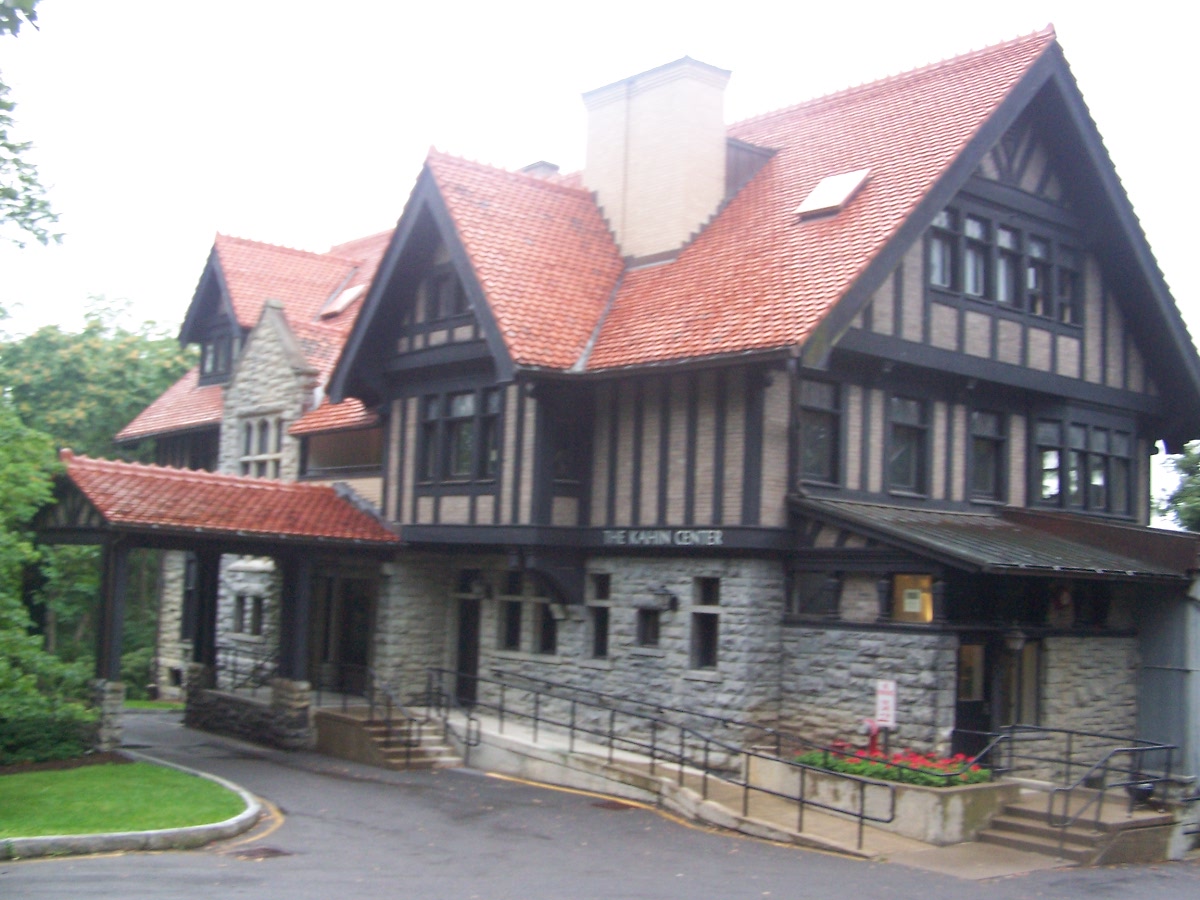
The Kahin Center is the second of the Treman trio. It was remodeled in 1945 as a lodge and as a communication arts center in 1970 [11]. It also mirrored the first house that burned in 1944.
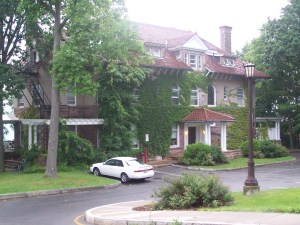
The last of the trio is 660 Stewart Avenue, built about 1902 as the home of Elizabeth Treman and her husband Mynderse Van Cleef [11b]. The house of Zeta Psi for a few decades ending in 1969, the house is currently a 27-person co-op. Unlike most co-ops, this one does not have a meal plan [12].
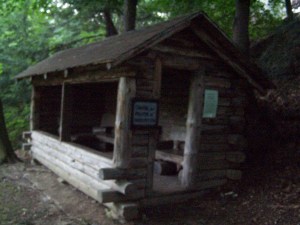
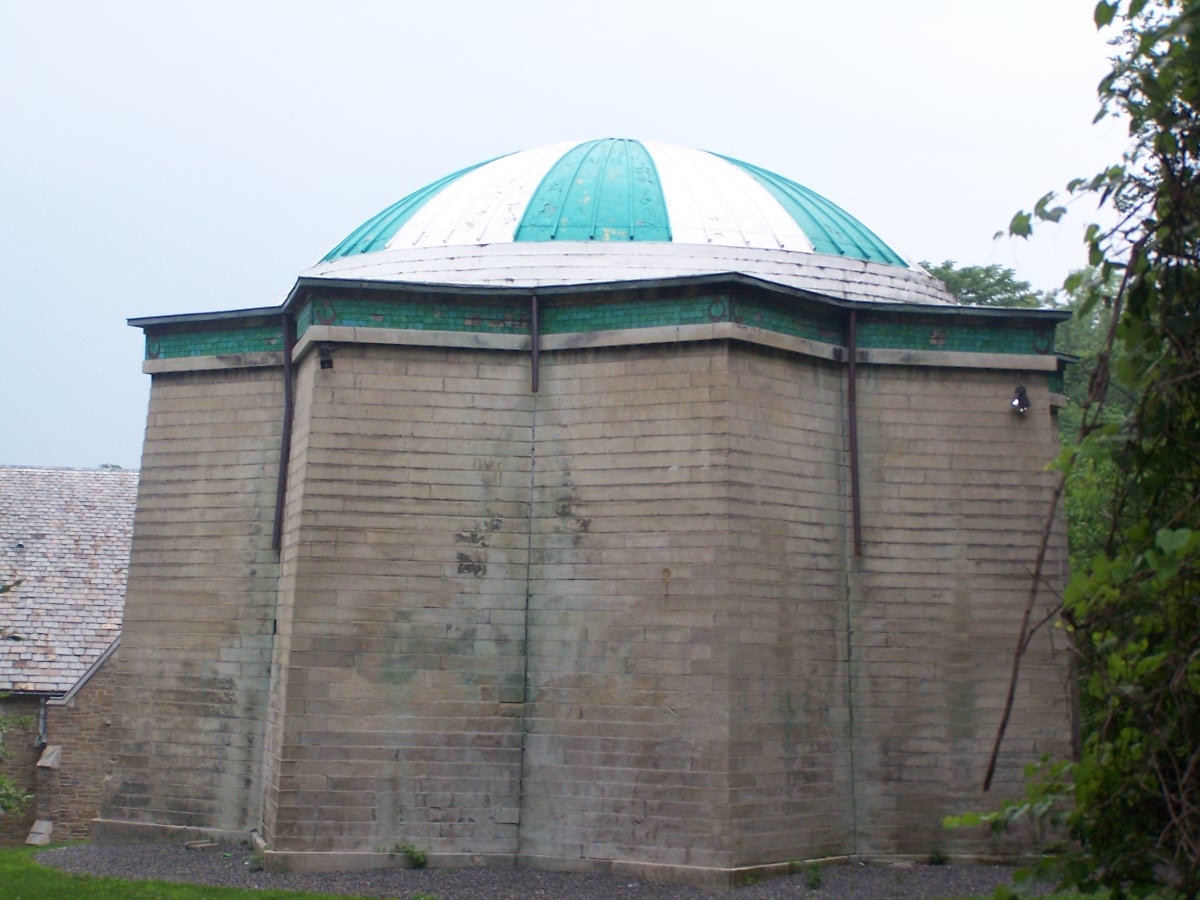
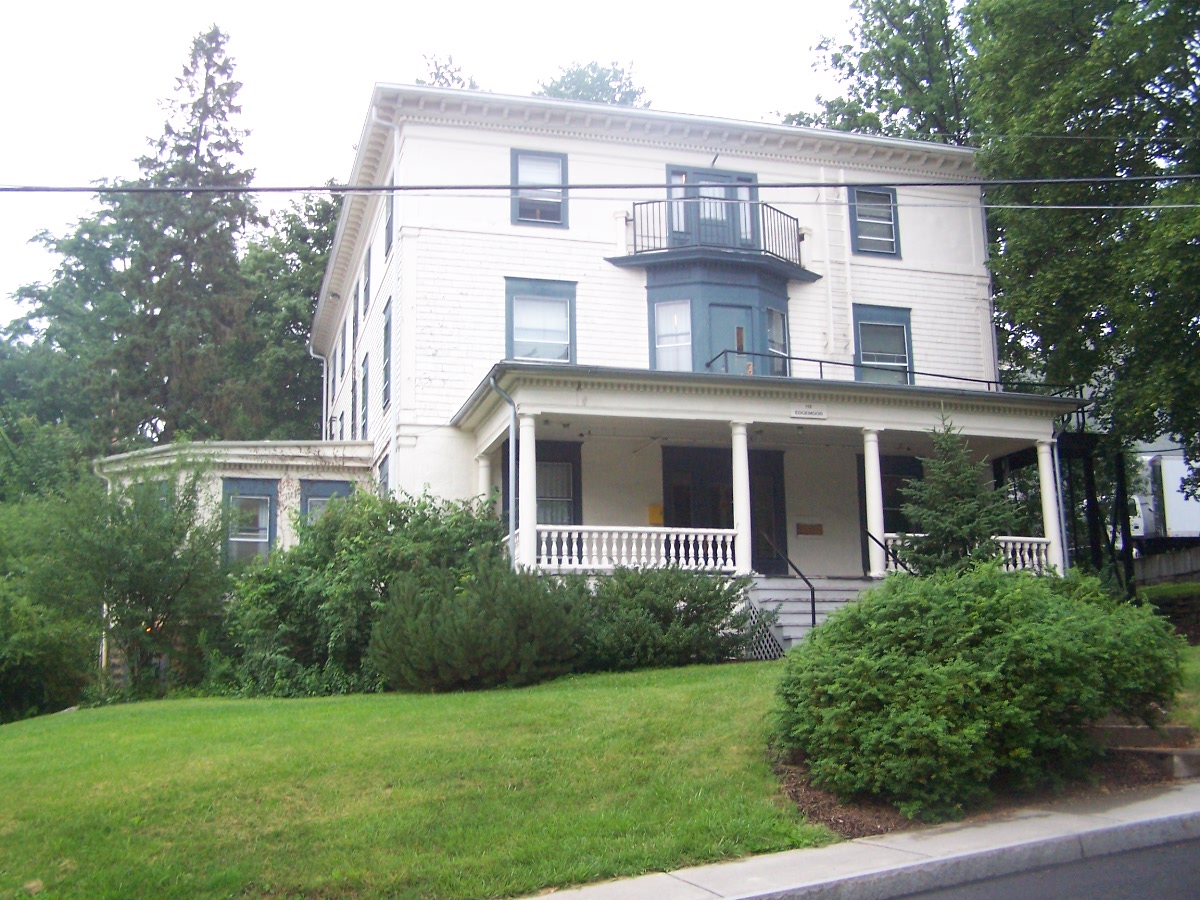
This was really cool, since it has polished wood and it provided shelter from a sudden rainstorm. “The Chapel for Prayer and Meditation”. And what a nice little chapel it is. On the outside was the posting for a service to Mahatma Gandhi on 9/11/07. And the other events that have happened on 9/11.

And it had a great view. And this is where I’ll leave off for now.

[1]http://www.sae-cornell.org/public6.asp

[2]http://www.adphicornell.org/public6.asp

[3]http://cornellsun.com/node/21924

[4]http://www.campuslife.cornell.edu/campuslife/housing/undergraduate/watermargin.cfm

[5]http://www.fs.cornell.edu/fs/facinfo/fs_facilInfo.cfm?facil_cd=4758

[6]http://sharma-arch.com/restoration.htm

[7]http://cornellsun.com/node/26714

[8]http://en.wikipedia.org/wiki/Von_Cramm_Coop

[9]http://www.fs.cornell.edu/fs/facinfo/fs_facilInfo.cfm?facil_cd=3121

[10] http://www.rso.cornell.edu/sigep/History.html

[11]http://www.fs.cornell.edu/fs/facinfo/fs_facilInfo.cfm?facil_cd=4736

[11b]http://cornellsun.com/node/24153

[12]http://www.campuslife.cornell.edu/campuslife/housing/undergraduate/660-stewart.cfm


News Tidbits 8/5/08: The Development of Ithaca Gun

6 08 2008

http://cornellsun.com/section/news/content/2008/07/30/city-ithaca-pledges-overhaul-contaminated-gun-factory-site


City of Ithaca Pledges to Overhaul Contaminated Gun Factory Site

July 30, 2008 – 12:35am
By Molly OToole

On May 30, the New York State Department of Environmental Conservation announced a final resolution for the Ithaca Gun Factory Site, closing a long and precarious chapter in the City of Ithaca’s history. However, many Ithacans feel the future of the site may still be up in the air.

The DEC — in cooperation with Mayor Carolyn Peterson, the City of Ithaca, developers Frost Travis, owner Wally Diehl and a previous pledge by the state — has authored a plan to dissolve the old Ithaca Gun Factory, which has been left stagnating above the rushing waters of Ithaca Falls for the past 125 years.

The $3.02 million public-private partnership — which includes the state’s Restore N.Y. grant contribution — aims to not only fully remediate the site, but to also return it to the public eye by putting in a new public park. A pledge of over $11 million from a voluntary cleanup program and private donations will fund 33 luxury condominiums to be built over this hazardous history with the hope of giving the site a healthier future.
The DEC intends to cover 90 percent of the investigation and remediation of Ithaca Falls Overlook Park with its pledged $700,200 from the 1996 Clean Water/Clean Air Bond Act, which is part of the Environmental Restoration Program. Dianne Carleton of the DEC described the program as a “funding mechanism to protect or improve water issues.” These funds join the $2.3 million Restore N.Y. Grant presented to the City in January by former governor Eliot Spitzer for demolition of the factory buildings.

According to a project file of the Ithaca Gun site provided by the New York State Department of Health, demolition is slated to begin in early August.

Optimistically, the new condos could be available for purchase sometime in late 2009 or mid-2010, according to Travis, but he added, “I can tell you the start and complete dates are somewhat of a moving target with respect to development and construction. We won’t know until we’re in the process.” (cont.)

***

So, I’m always curious about what a new construction will look like. Unfortunately, nothing’s been released for the time being, and probably won’t for the next several months. However, that doesn’t stop speculation.

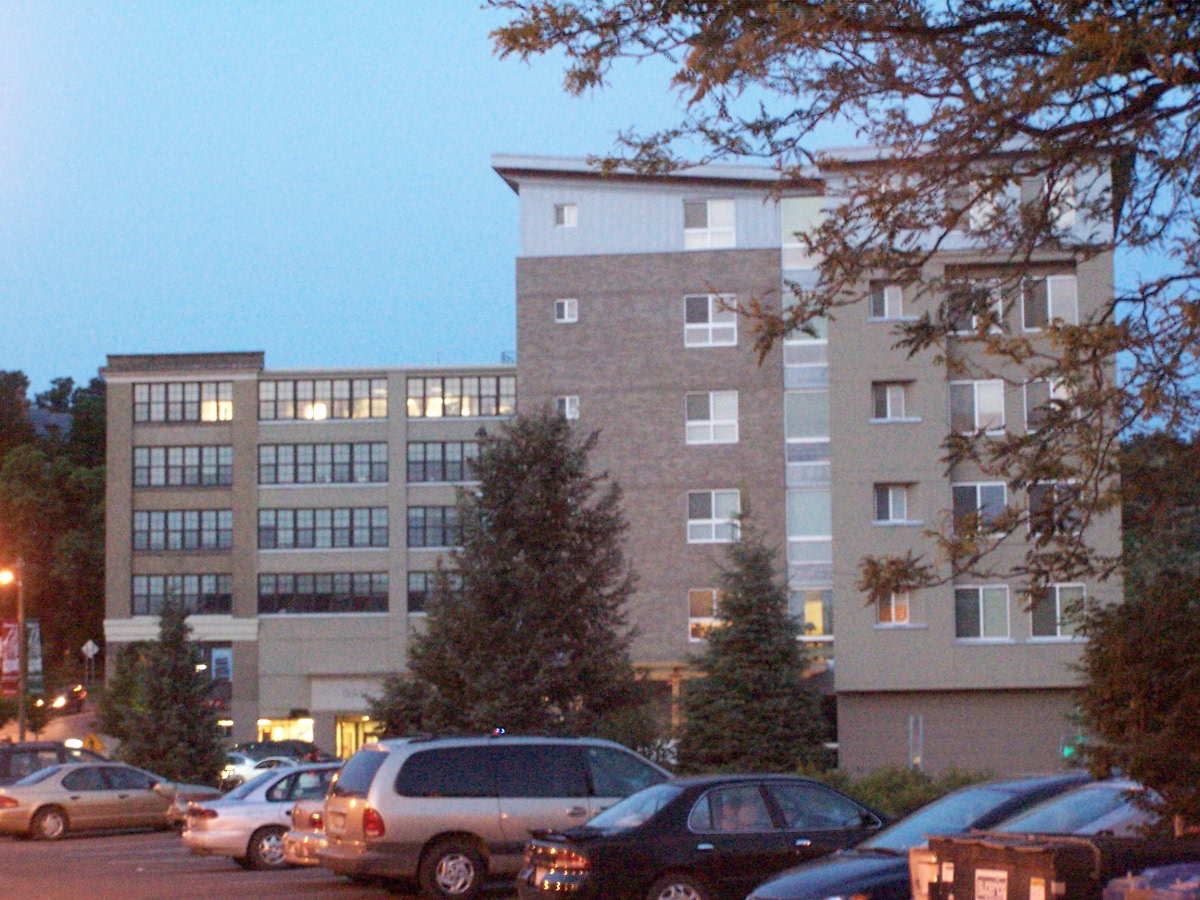
Consider the developer, Travis and Travis Inc. The firm is responsible for one other major new construction in the Ithaca area; Gateway Commons, a six-story apartment building on East State Street that was completed in early 2007.

The building on the right.


The building was designed by HOLT architects. Now, some developers end up forming a preference for a certain architectural firm. If this were the case with Travis and Travis, then they might seek a continued professional relationship with HOLT architects.

 In this case, the design is for 33 condominiums, limited in height to no more than about 50 feet. This was the end deal of an arduous and exasperating phase in its planning. Developer Wally Diehl wanted to develop the property in 2003, and turn it into a seven-story, 160-unit building with a two-story parking garage [1]. Needless to say, neighbors raised out, citing lost views and a loss of neighborhood character (apparently, the factory that was there 100 years was perfectly acceptable). Diehl tried an 80-unit, 50 ft. tall proposal (no higher than the old factory), but he complained that it was not privately feasible anymore, so the property sat, and a fire in August 2006 served as a wake-up call that the property had to be demolished ASAP (hobos and vandals go in all the time, so sit back and imagine the lawsuit on Ithaca city if someone went in and died inside, even though the factory is considered a hazardous site).

By hazardous site, a couple of things worth noting. The factory made guns for 126 years, closing in 1986. They used a lot of lead. This directly lead to the high lead levels in Fall Creek, where it flows next to the site, and where it was (is?) 500 times beyond the EPA safety level. An effort in 2004 to clean it was attempted by the EPA for 4.8 million dollars in Superfund money. But, lo and behold, they failed to adequately clean it, as lead levels were 460 times higher than the EPA’s goal. Ouch. Oh, and the IJ revealed in 2000 that the site was used to test uranium tubes, so there was uranium contamination as well [2]. So, the site was about as environmentally screwed up as it can get (with the exception of the Love Canal and Chernobyl).

 So the third proposal, backed by a $2.3 million dollar state grant and a $700,200 grant to reclean the site (and $10 million in private funding, through a partnership of Frost Travis and Wally Diehl), offers 33 high-end condos,a public promenade and a small public overlook that includes the smokestack of the factory. Finally, the majority of the opposed now appeased, it looks like everything is ready to go. One hopes.

So back to my curiosity about the design. Picking around the HOLT website [3], one finds their healthcare and higher ed portions of their portfolio. But, they designed student dorms for a couple of schools. So let’s profile those, since they were small-scale living units.

Townhouses, Colgate
Apartments, U. of Vermont

Apartments, U. of Vermont

 So, a rough idea of their design guidelines seems to be postmodern, with rustic influences. It helps that this company seems to have a strong attachment to Cornell; Carpenter Hall renovations, Tatkon Center, Sigma Chi renovations, Goldwin Smith reno, Donlon reno, among others. And they did several designs for IC buildings, so they just love it here (and considering they’re HQ’ed on N. Aurora Street, makes plenty of sense).

So, what might a high-end condo look like? I venture pitched roofs, dormers, and pillared entryways, with a height around 3 of 4 floors. The design will definitely not be a classic, but will have traditional elements, not too unlike the neighboring Gun Hill Apartments.

 [1]http://cornellsun.com/node/26431

[2]http://cornellsun.com/node/26384

[3]http://www.holt.com/S.html


Far West Campus, Second Photo Tour

4 08 2008

The house of the Cornell Chapter of Delta Upsilon fraternity. The house was built in 1890 in  the Queen Anne Style [1], and burned at least three times over the next thirty years [2]. The fraternity was founded to counter secret societies. Which, considering some members have most certainly been members of the Sphinx Head and the Quill and Dagger, is vaguely ironic.

Cornell’s Telluride House, located on South Avenue. The house was built in 1910 and originally housed electrical engineers working for Lucien L. Nunn, and who also attended Cornell [3]. The Cornell chapter was the first Telluride house. Telluride takes it name from the town of Telluride, Colorado, where Nunn lived most of his adult life [4]. The house’s website describes as an intense academic experience, and that members “enjoy tremendous autonomy”. So, I’m getting the impression of a fraternity, only much more academic and not nearly as social.

Photo Courtesy of "Greetings from Ithaca"

Photo Courtesy of "Greetings from Ithaca"

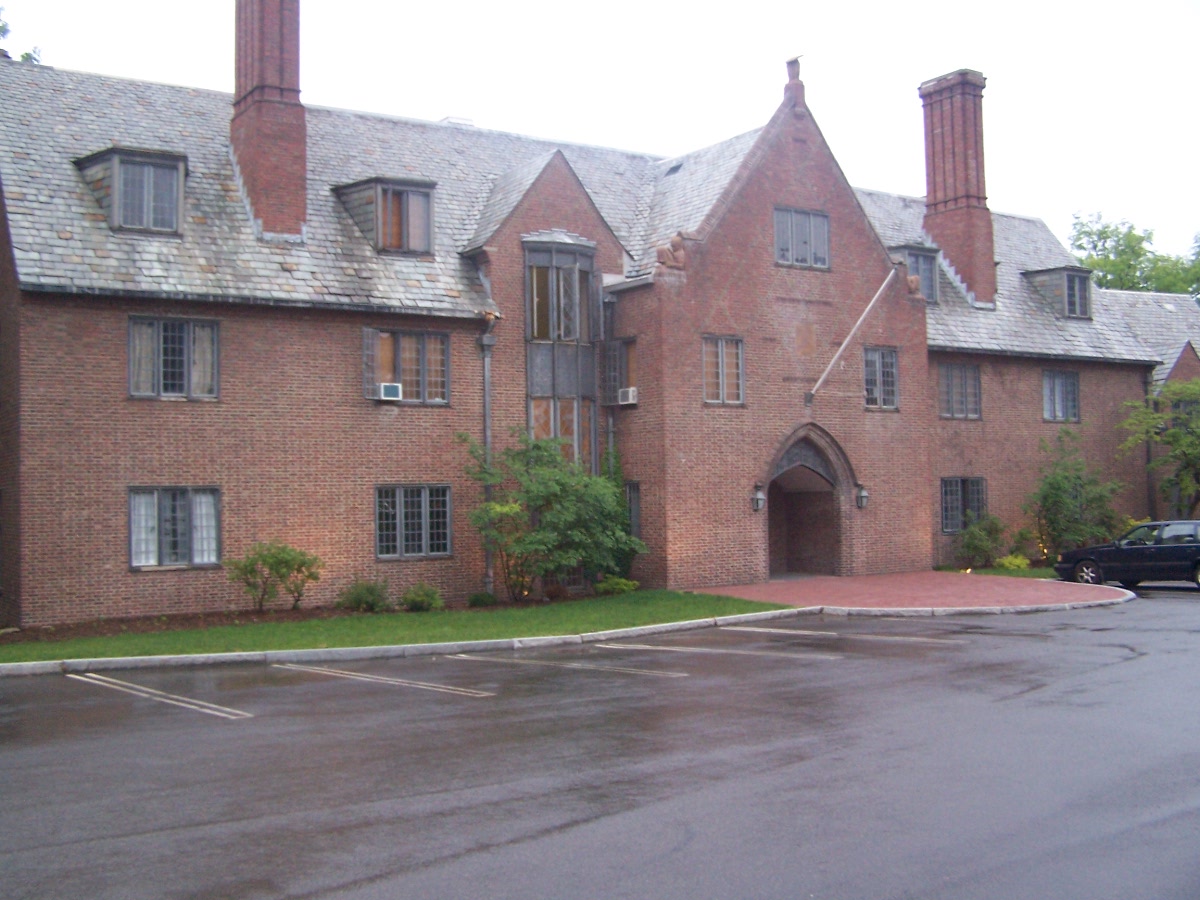
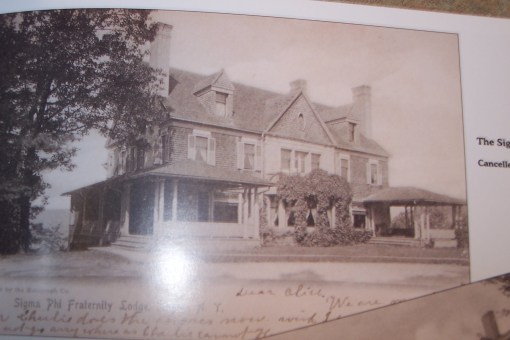
The house of the Sigma Phi Society. The first house was torn down to make way for the law school. The second and current house was built in 1932 and designed by Frederick L. Ackermann in the English Country House style. Ackermann also designed Psi Upsilon, the neighboring fraternity, and the relation between the two is obvious. If you can’t tell them apart though, you’ve probably had too many drinks at Sigma Phi and it’s time to go home. Detail-wise, the two differ considerably.


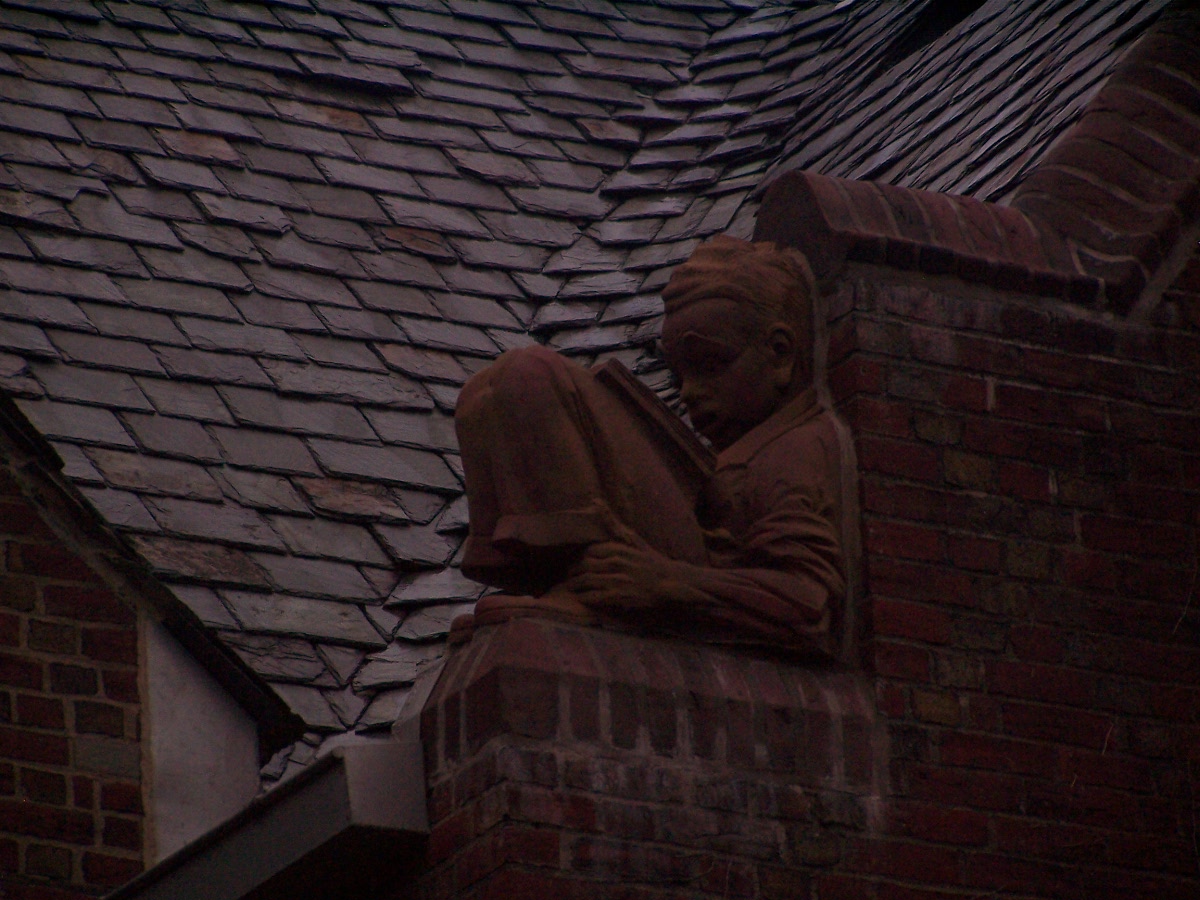
Although, one can never go wrong with the right ornamentation. I honestly thought that someone was sitting up there when I first glanced at it. No, I wasn’t drunk.

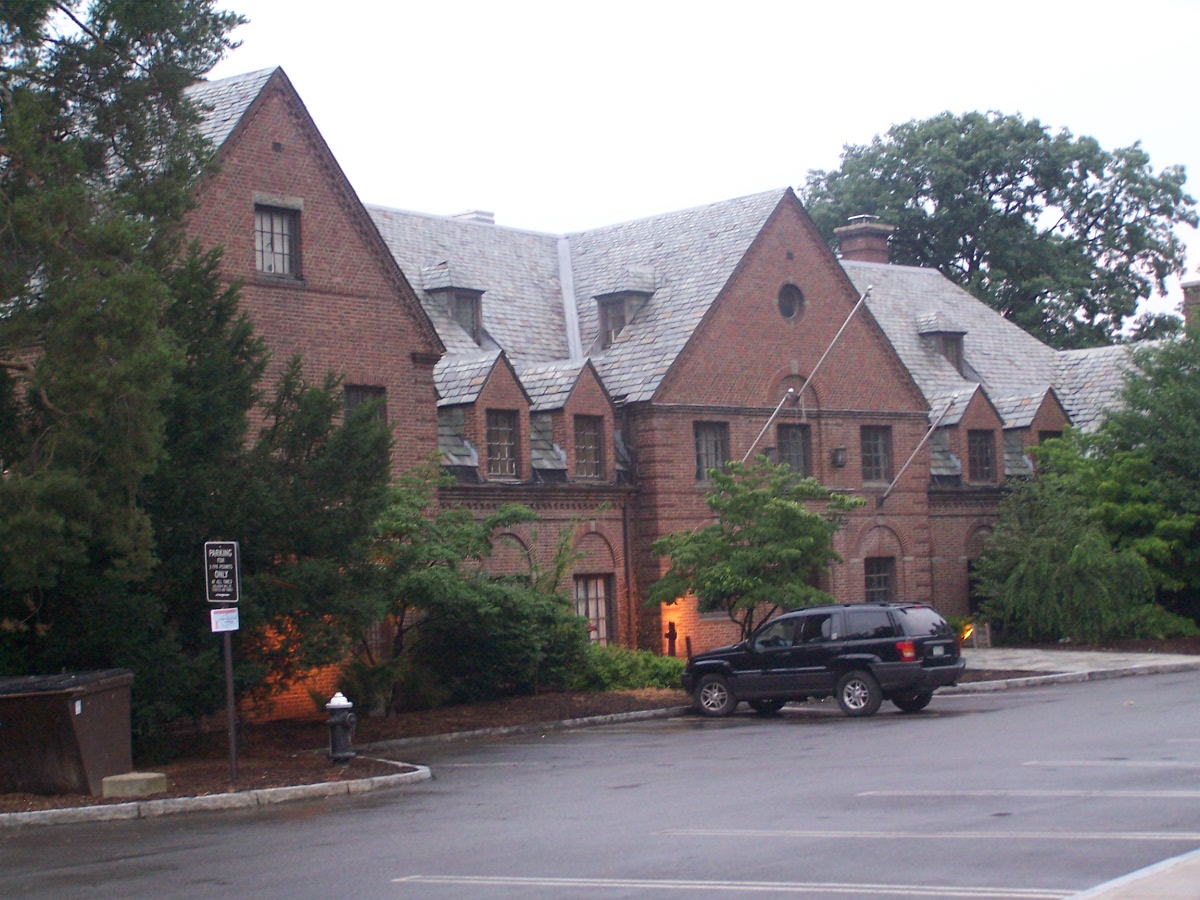
Psi Upsilon’s House was built in the same year. I believe this is also the fraternity that was known for having an indoor squash court, so Psi U. has a bit of a reputation of being wealthy. The chapter has also been booted off campus twice, the latest last month (the other case was in 1979). 

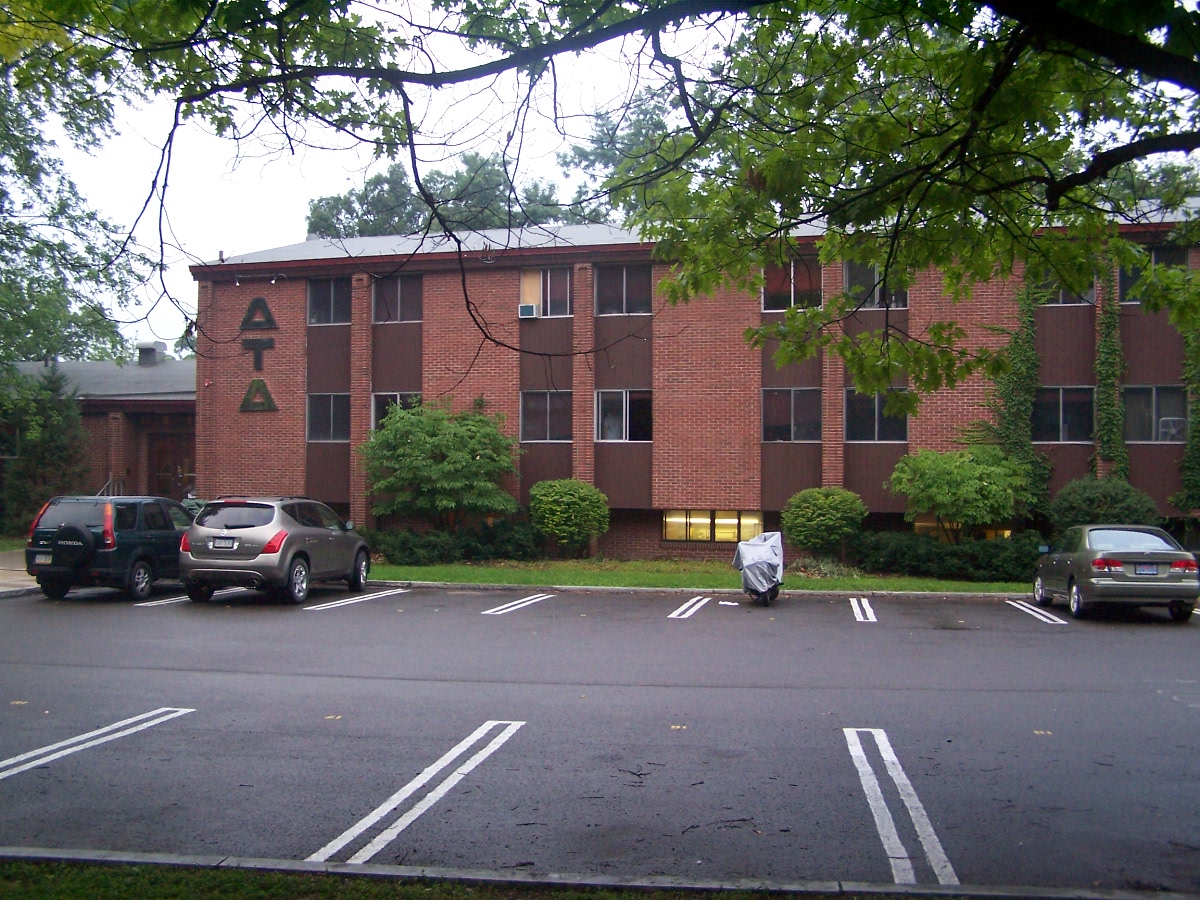
The house of Delta Tau Delta. The house was built in November 1965 [5], but they previously lived in a now-demolished house on Edgemoor Lane (the parking lot next to Theta is the site of their old house). The only reason I knew this house existed freshman year was that one of my roommates had a free magnet from DTD. Yeah, can’t say I care too much for that 60s archi-torture.

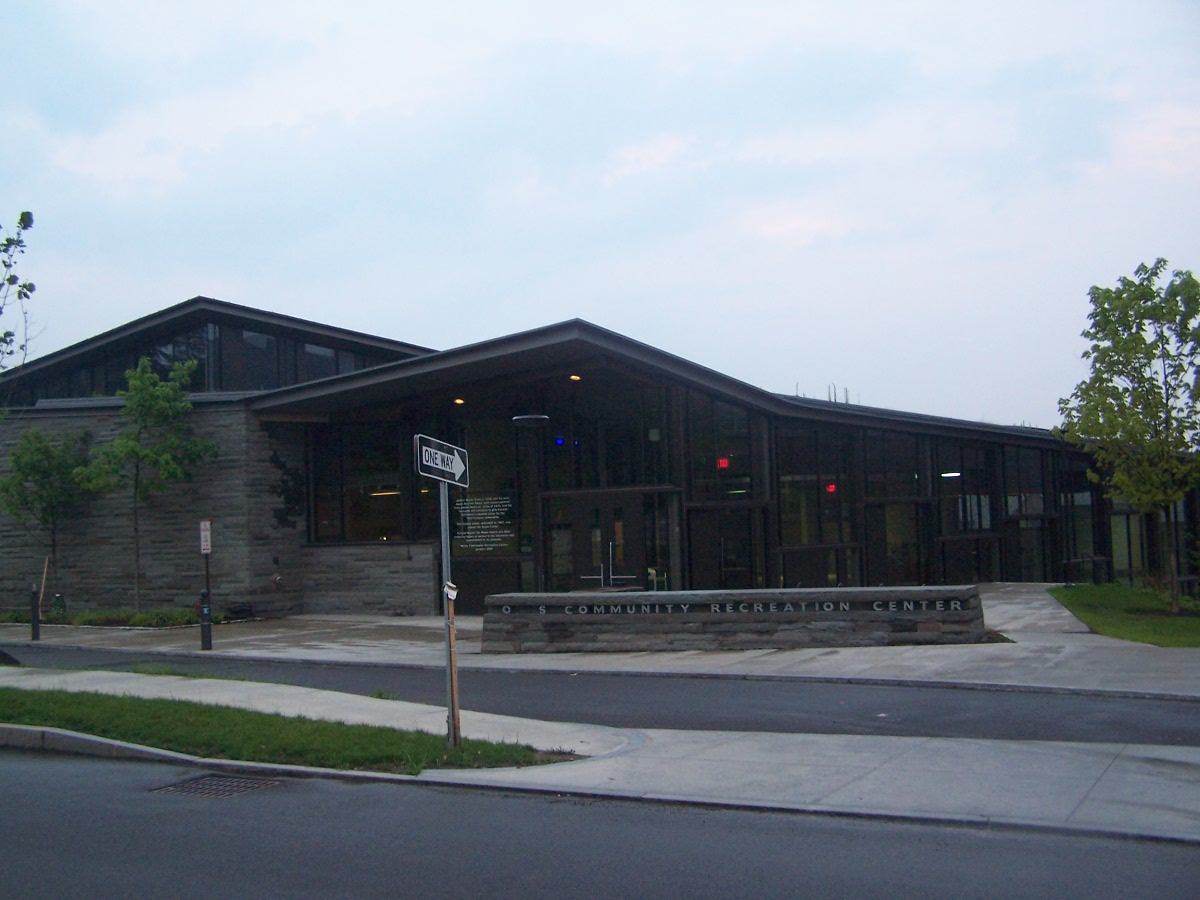
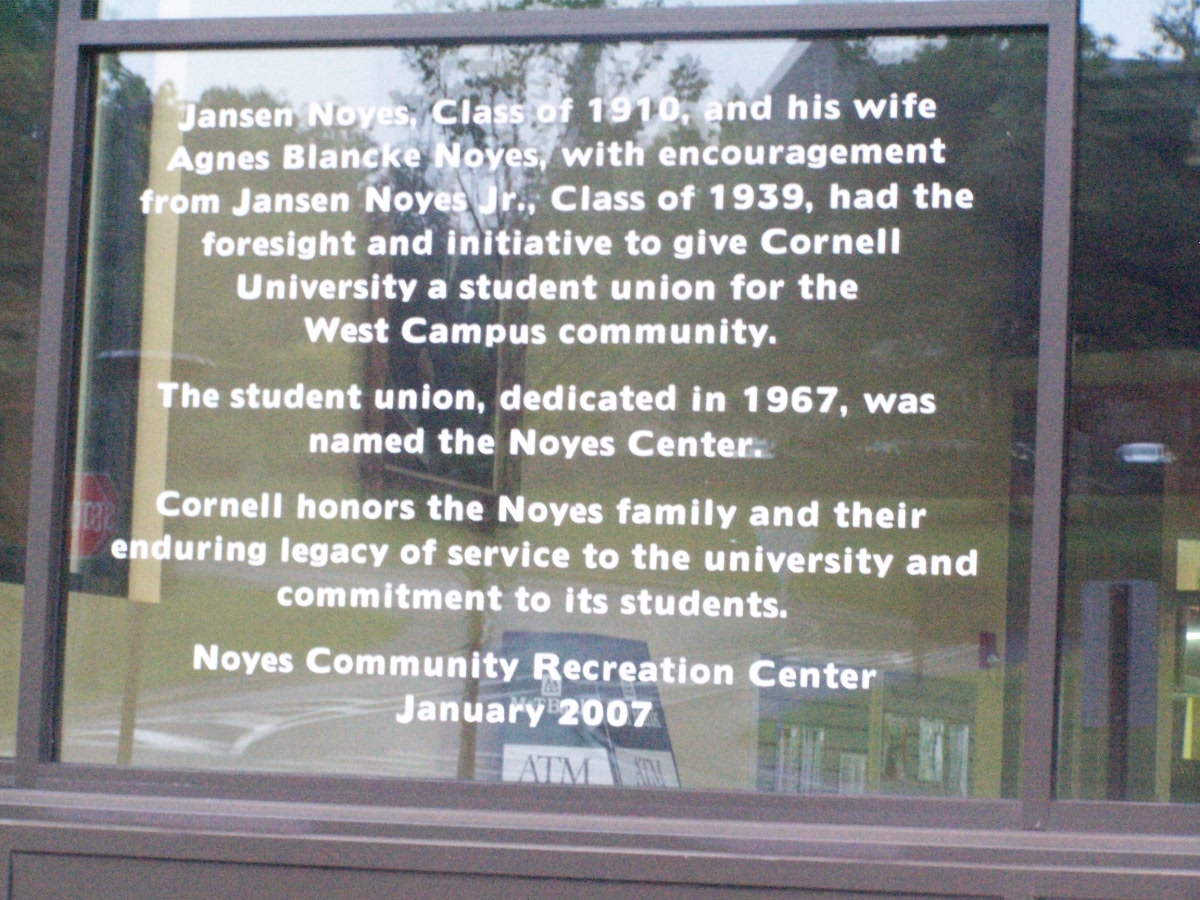
The new Noyes Center is about the only thing I like on the newly reconstructed West Campus. Completed in Janurary 2007, the building serves for community functions for West Campus (weight room, convenience store, etc.).

The original student union, a penal-style brutalist structure, was dedicated in 1967 to Jansen Noyes 1910. Before the legal drinking age was raised in 1986, it had a “pub” to serve students.

 (photo courtesy of http://andrew.loewer.name/musings/)


[1]http://www.fs.cornell.edu/fs/facinfo/fs_facilInfo.cfm?facil_cd=4722

[2]http://ecommons.library.cornell.edu/bitstream/1813/3536/23/021_18.pdf

[3]http://www.tellurideassociation.org/programs/university_students/cornell_branch/cb_general_information.html

[4]http://en.wikipedia.org/wiki/Telluride_Association

[5]http://www.fs.cornell.edu/fs/facinfo/fs_facilInfo.cfm?facil_cd=4776


Off Topic: The Keyword Bar

3 08 2008

So, one of the nice little extras included with WordPress is that they offer you a glance at what searches, googled or otherwise, brought up an entry from a blog. So, I find it a source of some amusement to see the search items people uses to find Ithacating in Cornell Heights.  

~Some of the entries are questions; for some unknown, and ultimately fruitless, reason, these are usually questions from pre-frosh concerning rooms:

“pictures doubles donlon”, “floor plan of clara dickson hall cornell”, “balch hall holes in walls”, etc.

I’m not sneaking into freshman dorms just to take photos, mind you. I’m a little sketchy, but not enough to do that.

~Also popular searches seem to be “cornell” and construction is some form. for example:

“cornell milstein hall”, “milstein hall cornell to be completed”, “gates hall cornell”, “corten architecture”, “cornell construction projects university”, “cornell does keeton have a dining hall”, etc.

To answer the last one, that is in fact a yes.

~Since I like to delve into the Greek System and it’s history, many of the searches are named of fraternities and sororities. But then there’s some eyebrow-raising ones:

“powerful, historical fraternities”, “dos and don’t of the alpha sigma phi”, “psi upsilon cornell kicked off campus” “homosexual ___ ___ ___”, etc…

The homosexual one seemed to be an attempt to find where there were gay men at certain Cornell fraternities. An interesting idea, but one that violates the privacy of others, and therefore not subject to this blog. I edited out the names out of respect.

~Lastly, and maybe the one that makes me squirm a little: “ithacating in cornell heights” seems to be coming up a fair amount. It’s odd to see people actually seeking this blog out.


Cornell Master Plan, Part 4 of 5

2 08 2008

Now that I’ve said my piece on the East Campus redevelopment, I’m going to move into the far east campus towards the vet school.

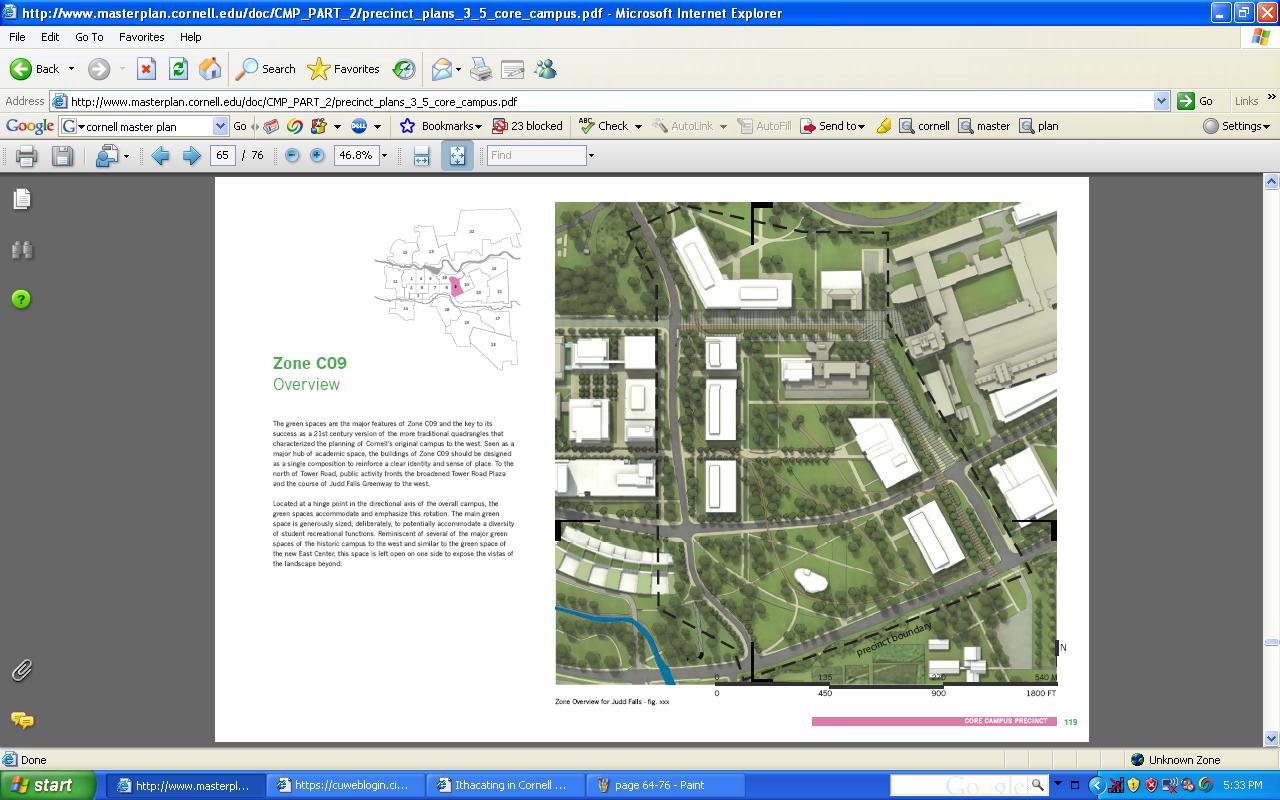
Precinct 9 is referred to in the master plan as the Judd Falls Precinct. For those of you who have never gone out towards the vet school for anything other than a prelim, Judd Falls is the name of the north-south road that passes through here, hence the name. The areas is home to some greenhouses, the U.S. Soils Lab (and its $51 million planned addition, to be completed in 2013 [1]), and Morrison Hall. The hideous piece of architecture known as the Boyce Thompson Institute (1978 ) also stands in this area.

Now, this area is almost wholly used for CALS and vet school activities. For the rest of us, it’s a relative dead zone; you’ll go to the Dairy Bar once in your time at Cornell just for the hell of it, decide its too far out from everything and not come back except for the rare event your exam was shoved in here because this was the only space available (you wanted the Statler Aud for your exam room, but you’ll be sweating it out in Morrison).

The plan to redevelop it is a praiseworthy one. Several buildings would be developed, and the area seems to be much more integrated into the rest of campus.

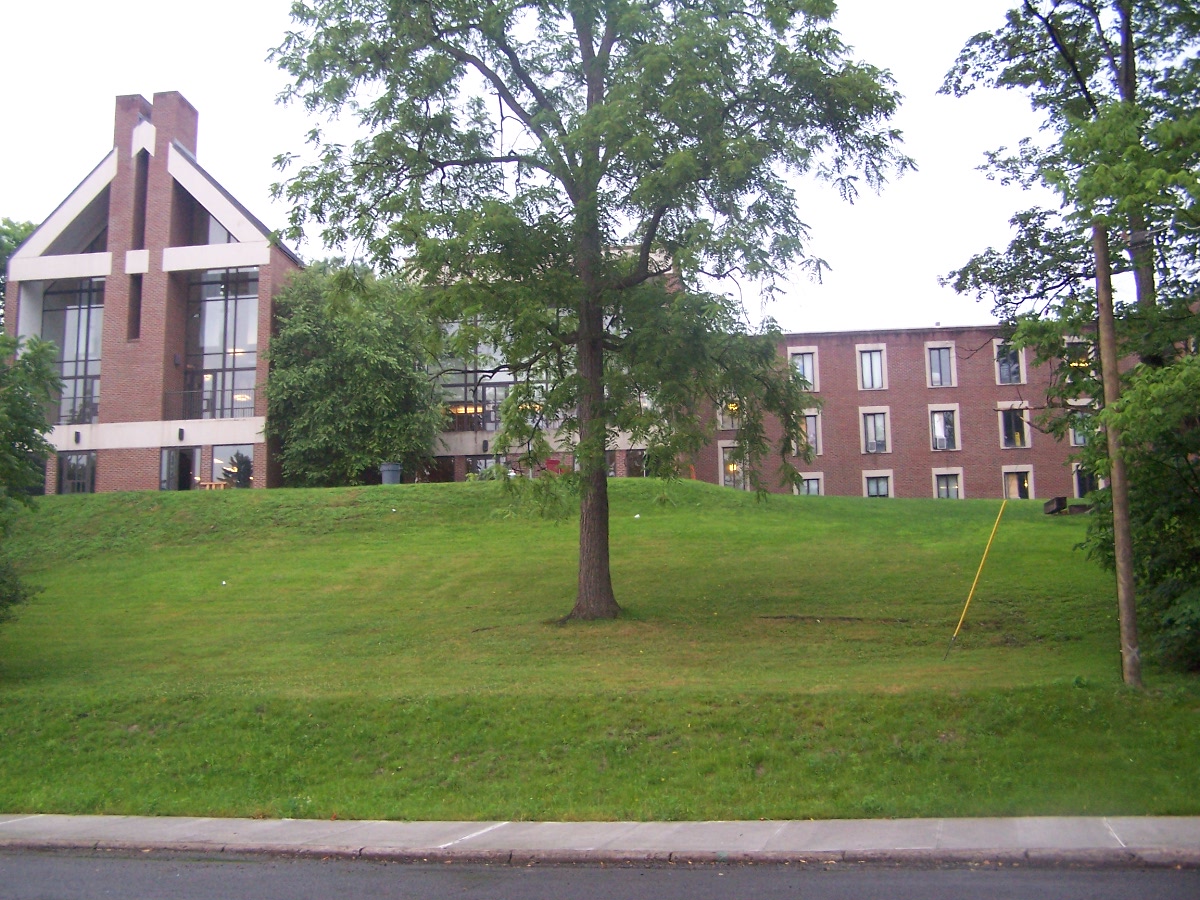
Because of the relative lack of use of this area, and its underdevelopment, the architects/design teams will have carte blanche to do as they wish with any future properties in this precinct. As a result, Morrison would see the wrecking ball; for some demonic reason, they decided to leave the wound on campus that is BTI. Seriously, it makes even Uris look attractive.

Photo obtained from facilities website

Photo obtained from facilities website

And this is the attractive side.

The buildings designed in the Judd Falls area should all maintain the same architectural style to enhance uniformity in the area. Considering its just a mish-mash of styles now, it would be interesting to see how this turns out. Lobby areas would be glassy and transparent. Total development space would be between 730,000 nd 1.33 million sq ft, and the buildings would average four floors (56 ft.) in height, give or take a floor. If they were to develop here, my personal hope would be that other academic uses are considered; moving some of the other departments out a little farther to fill up these buildings, perhaps. Or secondary space for the East Campus.

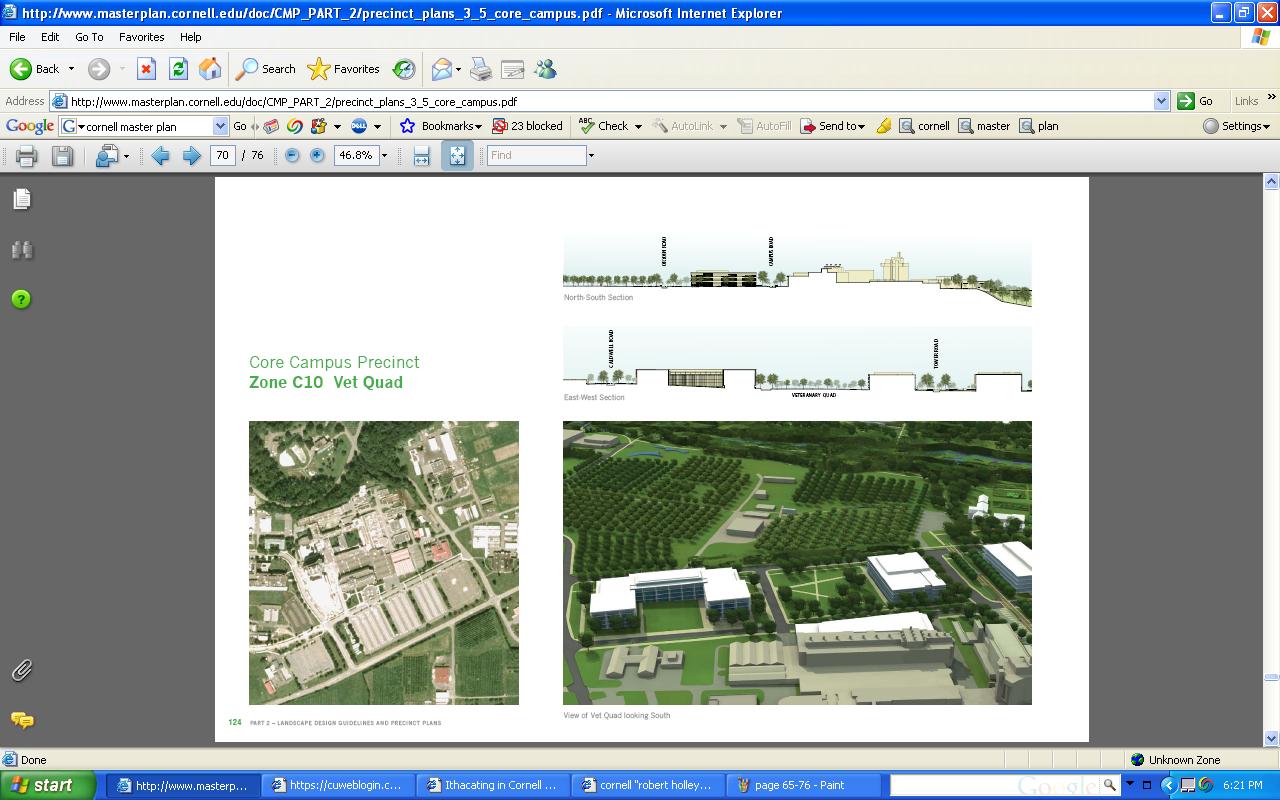
Precinct 10 is referred to as the Vet Quad. The new Vet Quad occupies an area dominated at the current time by parking lots; as the general rule seems to be in the Master Plan, parking lots should be hidden underground whenever possible, so this would never fit in if they didn’t do something with it.

A large building occupies the eastern end, possibly a centerpiece building to serve as an administrative building with some academic use mixed in. The building to the northeast is already under construction, an $80.5 million, 126,000 sq. ft Animal Diagnostic Hospital [2].

I like the plan here, for the most part. I feel it provides a dingified entryway for those coming into the university from the east, along Rt. 366. I’m not as fond of the random building they shoved in front of the animal hospital, because it strikes me as not being the best place to place another building and make the vet complex even more difficult to navigate than it already is. Things started to get confusing with Schurman Hall, and with the Vet Tower, Hospital and new wing, it’s just difficult to navigate within the Vet School (I for one became lost while trying to cut through to make it to a charity XC race on the other side of the vet school property). The total amount of space developed here would be between 400,000 and 700,000 sq. ft.

No surprise, but West Campus has no identified development parcels and the plan suggests treating developments here on a case-by-case basis. It also suggests restoring the cemetery, which I find humorous in a punny sort of way (restore the cemetery eh? Well, go to the morgue and pick up some shovels on the way over…). Yes, I’m aware that it actually means plantings and headstones.

Part 5 will cover Cornell’s New Urbanist development and North Campus. To be continued…

[1]http://forum.skyscraperpage.com/showthread.php?t=81652&page=47

[2]http://www.news.cornell.edu/stories/May08/AHDCGroundbreaking.kr.html


Far West Campus, the First Photo Tour

31 07 2008

The house of Phi Kappa Psi fraternity. As previously covered, the house was this dreadful brutalist monstrosity constructed in 1964 when the fraternity moved from 312 Thurston Avenue [1]. The house was extensively renovated in the second half of the 1990s, gaining a more postmodern appearance that has earned it the nickname “The Gables”. Prior to 312 Thurston (now demolished), Phi Kappa Psi lived in the Watermargin house. It was among the first fraternities chaptered at Cornell, established in 1868.

This house belongs to Kappa Alpha Theta sorority, currently the only sorority on West Campus. The house was built by Sigma Chi in the 19th century, who left it for Greystone Manor in 1923, and Theta Chi fraternity moved in. Bay the 1980s, Theta Chi had moved out of the house for a mansion on Ridgewood Road, and “Theta” moved in. Theta was dispelled from its national in 1965, but returned to campus in 1980 [1], and moved into this house during the 1980s.

Speaking of fraternities founded early in Cornell’s history, Chi Phi and north campus fraternity Zeta Psi were both founded on opening day 10/7/1868. The two flipped a coin to see who would be declared the first fraternity at Cornell. Well, Chi Phi still uses its early start in rush promos, but Zeta Psi is officially the first fraternity (Zeta Psi and Chi Phi have a rivalry to this day). Craigielea, their tudor-esque house, is well over a century old (1890, partiall rebuilt after a 1903 fire), and has continuously been in their posession. The house was designed by W. H. Miller of Uris Libe fame [2].

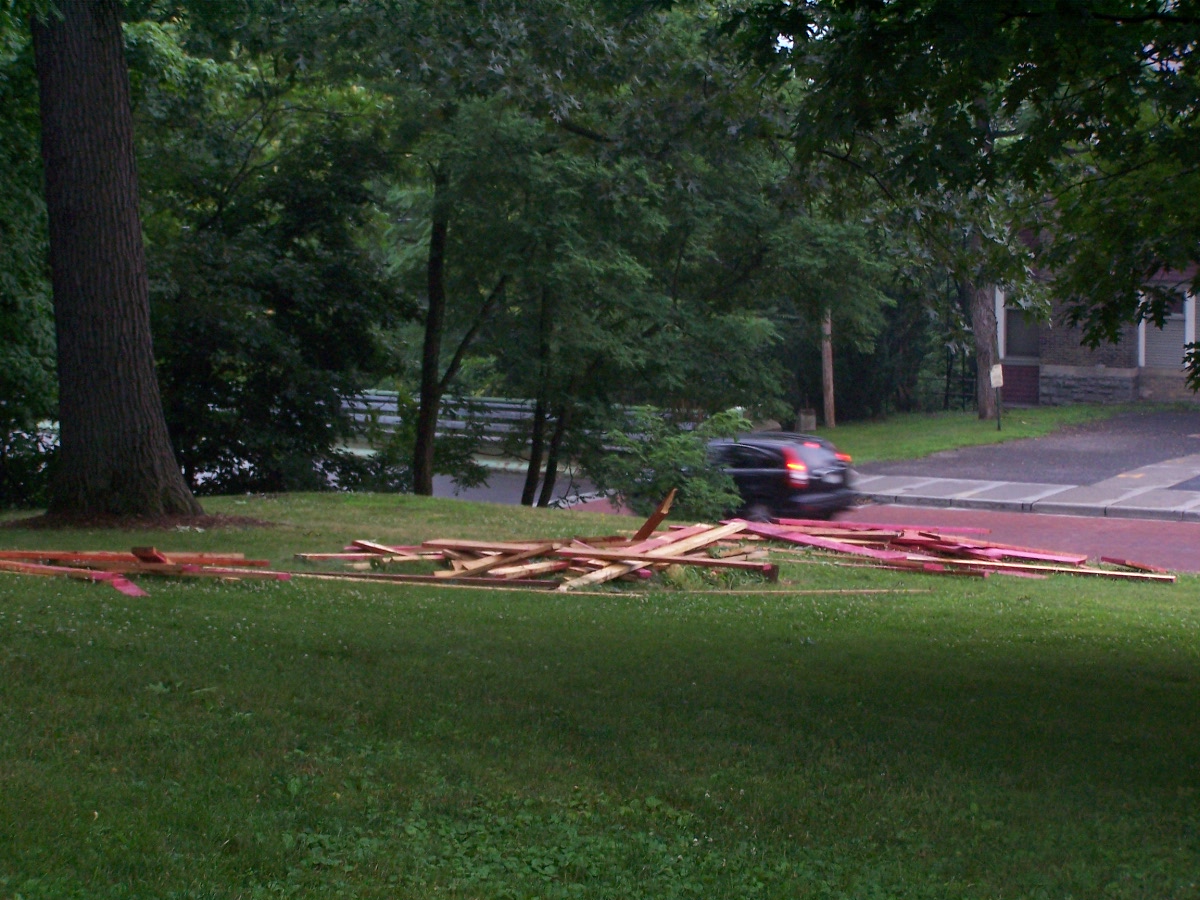
And this is what’s left of their (pledge?) project, bleachers that they built last April. Shame, really. I wonder if they did it or someone who hates Chi Phi did it.

Delta Kappa Epsilon (DEKE) fraternity house is a Romaneqaue Revival House built in 1893 by W.H. Miller [3]. The house is known as Gray Stone Castle, and sits on the National Register of Historic Places [4]. As amazing as the house is, the chapter hasn’t been doing all too recently; rumor mill says numbers were so low in recent years that actives had two rooms each.

112 Edgemoor Lane, a small campus dorm designed for about 20-25 occupants. As I explained in a previous entry, this house has a lot of significance to me personally. So, the house, built in the Colonial Revival style, was built in 1881. The house was home to Sigma Phi Epsilon up into the 1960s, when Sig Ep moved out and Triangle fraternity moved in. Previously, Triangle called a house at the junction of Campus Road and Stewart Avenue home, but the ca. 1839 farm house was torn down to make room for DTD’s new house [5]. After Triangle was deactivated by its national in 1985, the house was made into part of Cornell’s campus dorms.

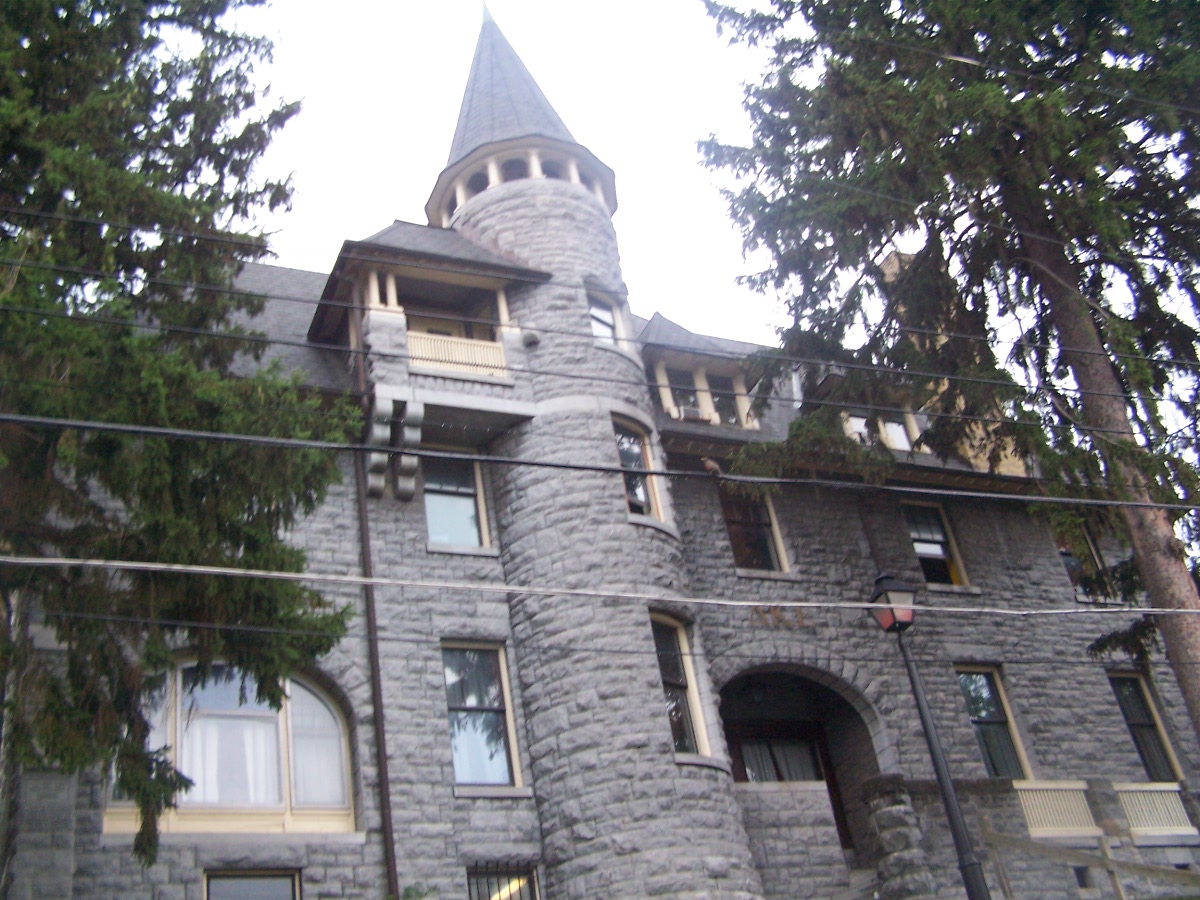
Lambda Chi Alpha’s house also sits on Edgemoor Lane. Originally known as ISWZA [5], Lambda Chi was chaptered in 1913, and the house was purchased around 1918 (it was built in 1899). Lambda Chi is known for having a feud with its neighbor Chi Phi. The house also maintains a gazebo on the edge of the gorge, which was built in recent years.

The house of Pi Kappa Alpha fraternity. The house was occupied by Beta Theta Pi, who occupied the house until they moved in 1906. About a decade later when Pi Kappa Alpha colonized on campus, the chapter moved into this house. My slight personal issue was that they had a steep driveway in the back, and some jackass in a Jetta would try to do 0-60 every time he went down the hill. The whining engine gets quite annoying after a while.

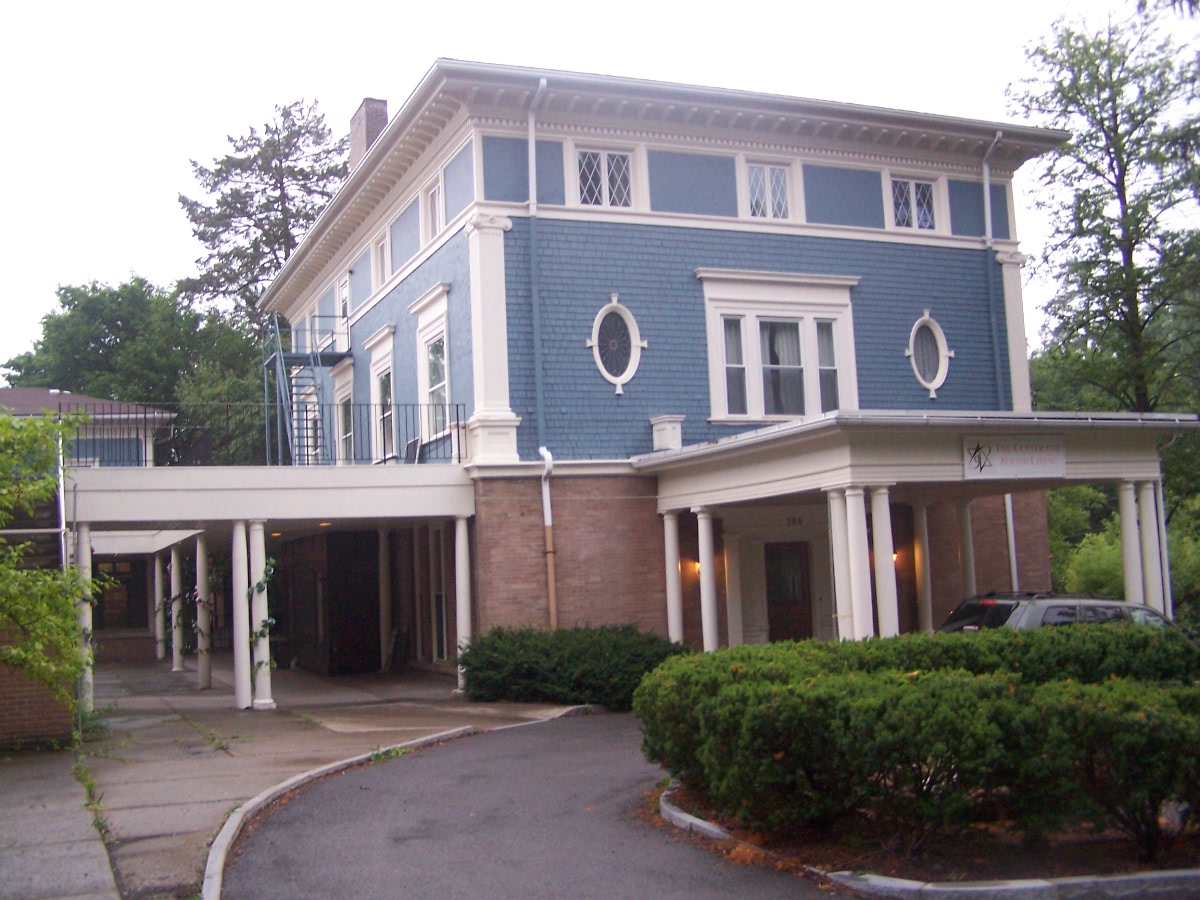
The Jewish Living Center. The house dates from the 1890s[6], with the kosher dining center to its south (not pictured) dating from the late 1980s. The center was known as Young Israel until the late 1990s. Judging from their website, the independent organization has had a contentious past with its relations to the University. The old fraternity house for Seal & Serpent (pre-1926) used to be next door, but it was demolished to make room for their parking lot.

[1]http://www.dos.cornell.edu/dos/greek/chapter_details.cfm?id=3278

[2]http://www.fs.cornell.edu/fs/facinfo/fs_facilInfo.cfm?facil_cd=4716

[3]http://www.fs.cornell.edu/fs/facinfo/fs_facilInfo.cfm?facil_cd=4719

[4]http://www.dke-cornell.org/public1.asp

[5]http://cdsun.library.cornell.edu/cgi-bin/cornell?a=d&d=CDS19650427.2.101.1#

[6]http://www.iswza.org/heritage

[7]http://www.cornellcjl.com/about/history.aspx