The Story of the Vet School Incinerator

18 09 2008

So, I enjoy telling a good story as much as the next guy, and this one was actually the subject presented by my professor in an air pollution course I’m enrolled in. I might have been the only one taking notes on this, because it was meant to merely illustrate an argument, it’s historical, and an interesting piece of history worth sharing.

So, in the early 1990s, The Vet School over on the East Campus had a problem. A large number of carcasses were being generated daily. Dissections, disease studies, putting some of the farm animals to sleep, etc. So on any given day, thousands of pounds of carcasses were being produced, and they had to be disposed of.

Well, Cornell, for all the things it does have, does not have an incinerator for cremation on any of its properties. So they would have to ship the carcasses out in container trucks with hazard labels and send them to an incinerator elsewhere in the county, where they could be properly disposed. As you might imagine, this built up quite a hefty amount of fees over time. So Cornell began to explore their options to alleviate the problem.

Well, the proposal that seems to work best was to build a waste disposal facility for the animal carcasses directly on the property. The site that was determined to be the best fit was just to the east of the Vet Research Tower. At this time, the Vet Hospital’s main building and the East Addition didn’t exist, so the complex was mostly barns, the tower, Schurman Hall and the scattered add-ons that comprised the property. The red square below was the approximate location for the project.
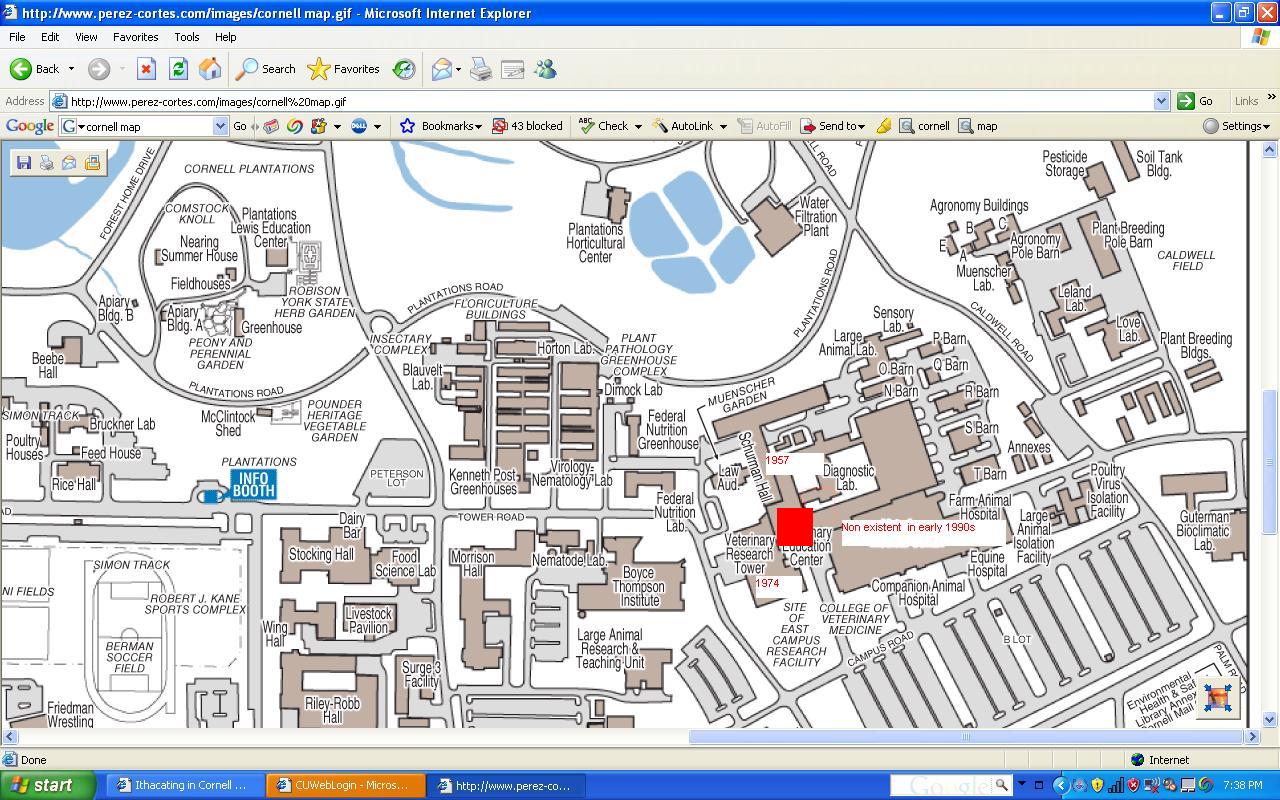
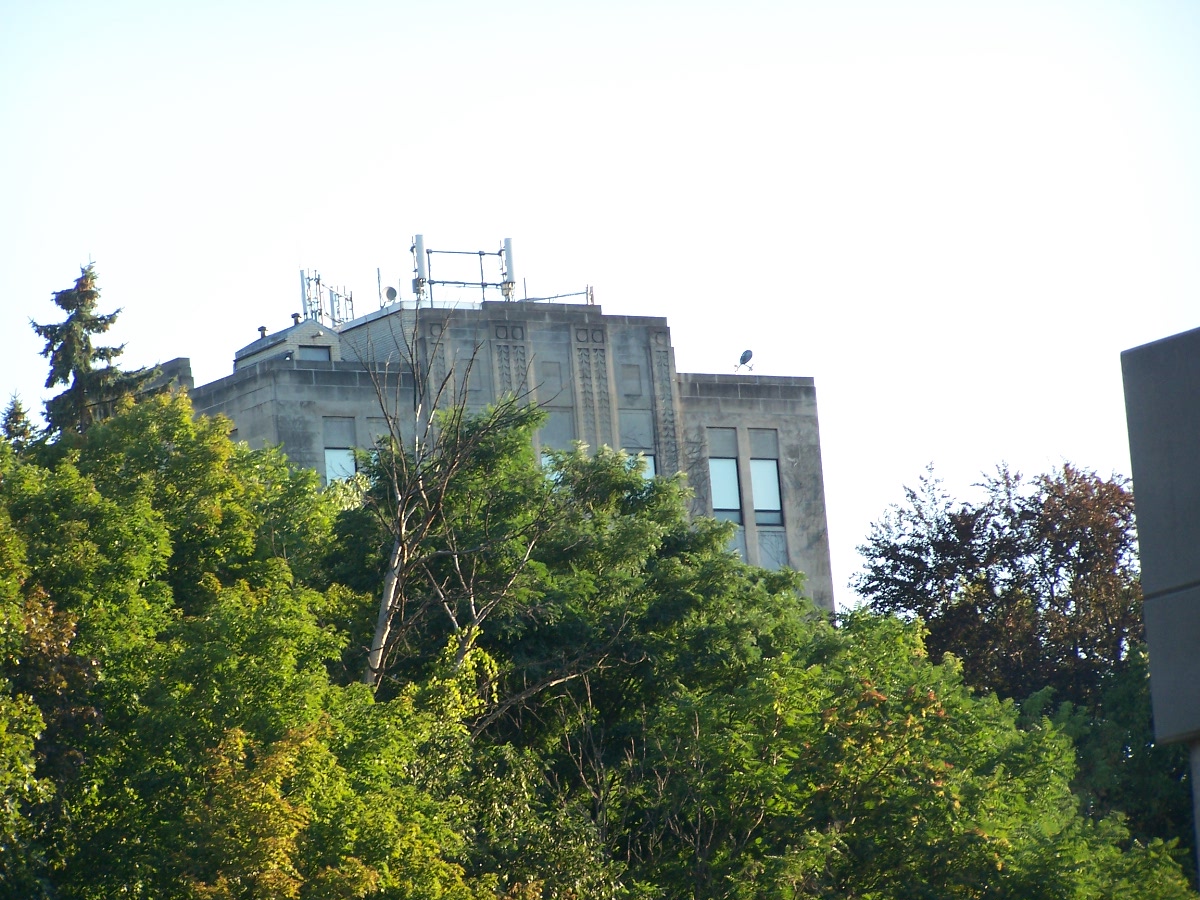
 The Vet Tower is a fairly large building, as it stands about 140 feet tall. So, in order to build the smokestack, the design had the smokestack stand about 180 feet tall, more than enough to clear the building.

Well, it went ahead in front of the town of Ithaca, and the residents of the neighboring hamlet of Forest Home had a fit. They’d be damned if they had to look at a giant smokestack from Cornell. So Cornell paid an engineering firm to survey the land from notable viewing radii to see if the structure would impose on the residents of Forest Home. Sure enough, if did, but only just barely. It was determined that if the design was shorter, it’d be okay.

So, Cornell proposed changing it to 160 feet. But, there was another issue with that. Bradfield Hall, just up the road, stands 167 feet tall. And the top floor has windows (ironically enough, the atmospheric science department is housed at the top).  So, that wasn’t going to fly unless Cornell did an air pollution study to prove it wouldn’t affect the occupants of Bradfield.

Well, here’s where we get into an issue. The company they hired, a New York-based engineering firm, decided that the air circulation patterns in Ithaca were the same as Syracuse. Syracuse built a power plant only a couple years earlier, so they decided to reuse the same data and apply it Ithaca. Essentially, they tried to swindle Cornell by selling them false data from another location.

Winds generally blow out of the west in Ithaca. However, in the situation where they would blow out of the east, as during some stormy days caused by east-coast lows, the pollution cloud was going to push over to Bradfield Hall and towards central campus. This pollution would have particulate matter that would drift down onto Tower Road and the Ag Quad. Well, no ones wants to be snowed on by cremated animal ash. Even worse, if it blew out of the northwest at a particularly strong clip, it was going to drift right over Forest Home. The increased height would have allowed it to carry farther away, but the new shorter height would cause particulates to fall a shorter diestance away, and they would be more concentrated, to unhealthy levels.

Well, the university didn’t know that at the time, so they bought the data. And it wasn’t until the final stages of the project that the mistake was realized (through an interdepartmental study independent of the project). The Town of Ithaca wouldn’t give final approval in light of the news. Well, Cornell was just a little upset, so they decided to bring a lawsuit onto the company for their actions, and Cornell had to scrap the 160-foot plan.

Well, due to the air ciruclation patterns and sight lines, a large smockstack just wouldn’t be suitable for their desired location. And Cornell was already set for a major expansion of the Vet School, so they scrapped the plan entirely. The Vet Education building, built in 1993, was the final incarnation of the incinerator project, in which there was no incinerator at all. And the large Vet Hospital would be built four years later, dooming any future proposal nearby.

So, some of you might be wondering about the heating plant, which is to the south. The smokestacks there are outfitted heavily with scrubbers, so the vast majority of the smoke is water vapor, and not nearly as toxic as the smoke from the vet school smokestack would have been.

~~~~

And in other news, House 5 has been deemed “Flora Rose House”, after a professor who was among the first to staff the school of Home Economics (Human Ecology).


Let’s Go Downtown, Part II

14 09 2008

The Cornell Daily Sun Building on West State Street. Notably, the Daily Sun was not the first newspaper on campus, but rather took the title from the Cornell Era, which was founded shortly after the school opened, and then after twenty years or so began to take a different direction (literary journal) that would lead it into obscurity and termination. The Sun also holds the prestigious title of being the oldest continually-independent college daily in the U.S. [1]. I believe the printing press is on site, but if someone wants to provide a little more detail on that, please be my guest.

As for the building itself, it was built in 1916 and was the home of the Elks Lodge in Ithaca. The Daily Sun’s Alumni Association bought the structure in 2003 and completely renovated it over the next several months. The building also happens to be located next door to the Ithaca’s Journal’s offices (who don’t even print here—they print in Johnson City, near Binghamton [2]).

The Immaculate Conception Church is a Catholic Church in Ithaca that falls under the Archdiocese in Rochester. The building was constructed in 1898 and designed by architect A.B. Wood [3].

Across the street is St. Catherine’s Greek Orthodox Chruch. It was constructed in the 1900s.

Shortstop Deli is a popular sub/deli/convenience store near downtown Ithaca. The Deli was founded in 1978 by Albert Smith [4], although by my guess the buidling dates from the 1950s. Shortstop is also the company that owns The Hot Truck.

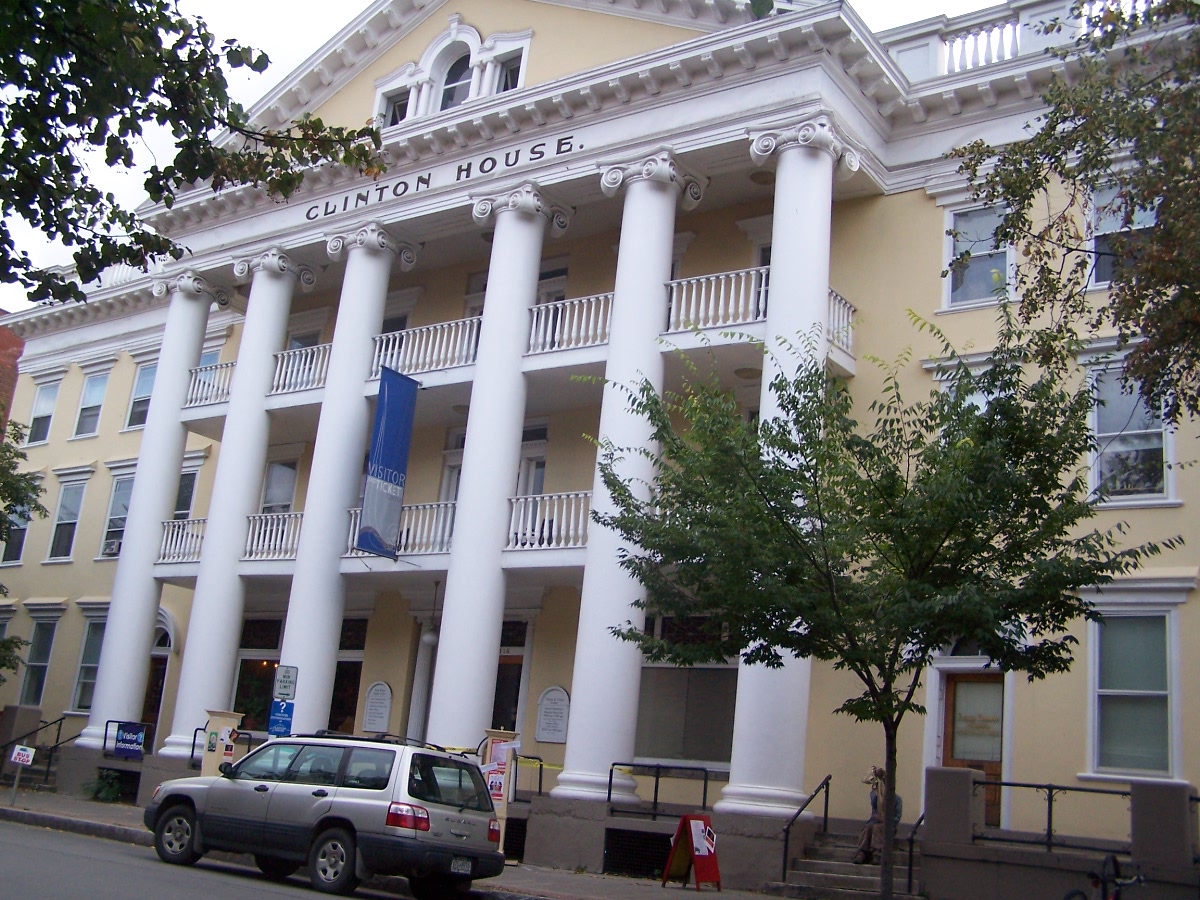
The Clinton House was built as an upscale office and hotel building in 1828-1829 [5]. Designed by Ira Tillotson, it is named for NY Governor DeWitt Clinton (DeWitt Park is up the street). The building has been renovated numerous times in its nearly 200-year history, which is clearly evident by the glass wall stairway addition in the rear of the structure and the colonial details that were added in a 1901 renovation of the building, after a fire destroyed the roof and upper floors. The building underwent renovations again in 1985-1987 and more recently in the mid 2000s, returning Clinton House to it’s “1852-1862 era appaearance”. The building is maintained by the NPO Historic Ithaca, but the last I heard they were seeking to sell it to a willing buyer.

Admit it, you’ve thought about going here if you haven’t already.

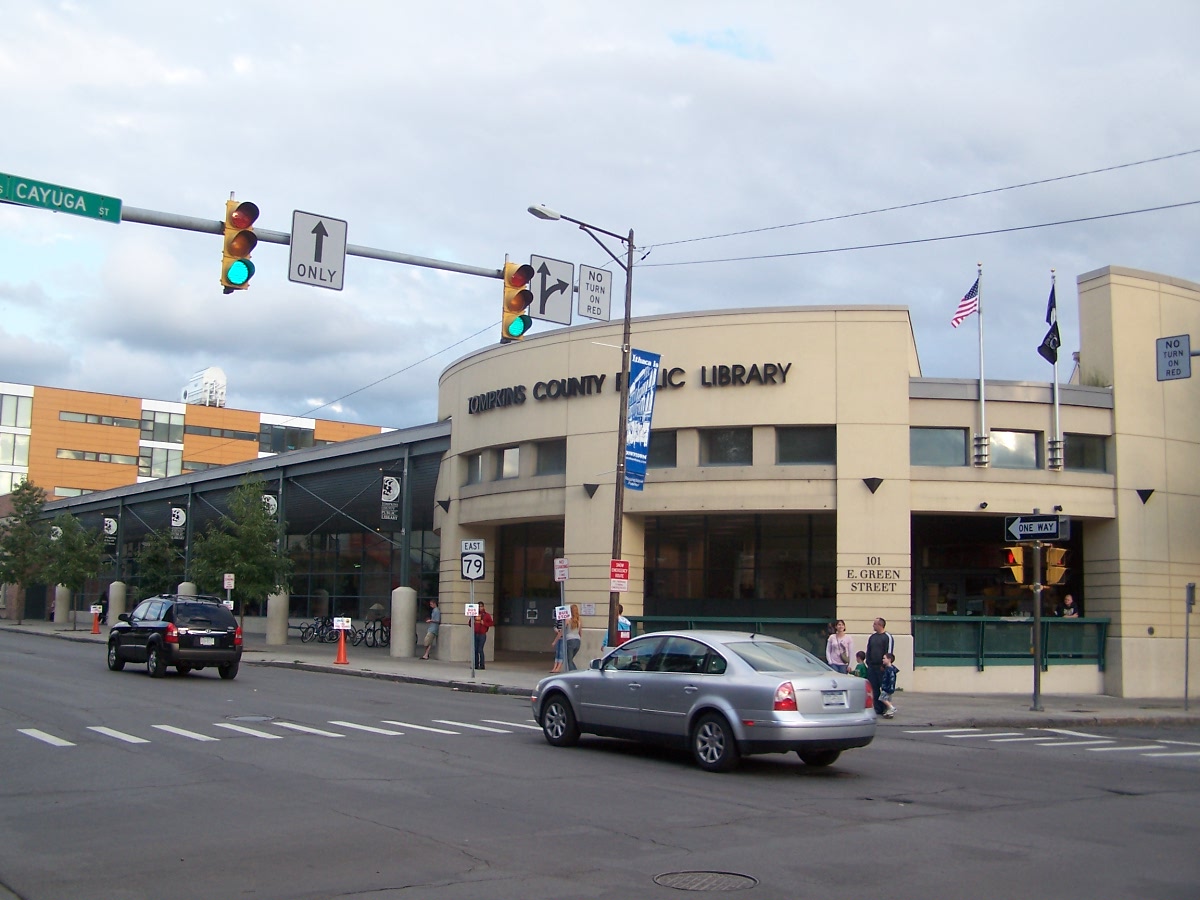
The Tompkins County Public Library (TCPL) on Green Street. The building was originally a Woolworth’s department store until it closed in 1998, and it was renovated into the library space in 2000. Prior to that time, the library was located about five block farther north in a ca. 1968 building. The first library was a gift from Ezra Cornell to the city, but later went into private use, and it was torn down in 1960 [6].

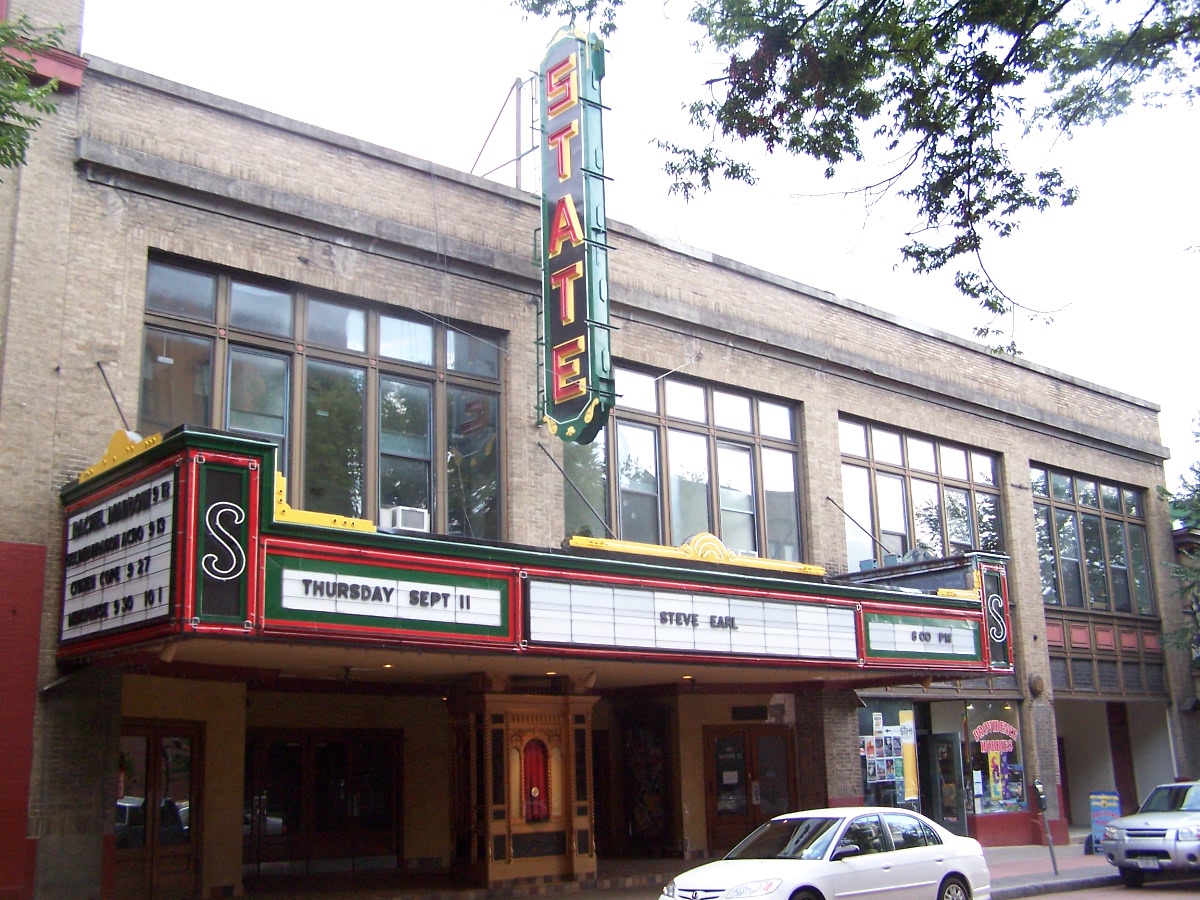
So I had a special request for this photo. The State Street Theater was originally built as the Ithaca Security Garage Auto Company and Dealership, built in 1915. The building was renovated into a theatre by the Berinstein family and opened as a theatre on December 6, 1928. Due to changing times, the theatre struggled to remain open past the mid-century and closed by the 1980s. Slated for demolition in the mid 1990s due to a number of structural and health concerns, a grassroots effort to resotre the theatre took hold, and enough funds and renovated were completed in the late 1990s that it was reopened on December 5, 2001 [7]. Today, the theatre continues a slow but steady renovation, and hosts a number of live acts from music groups to comedians.

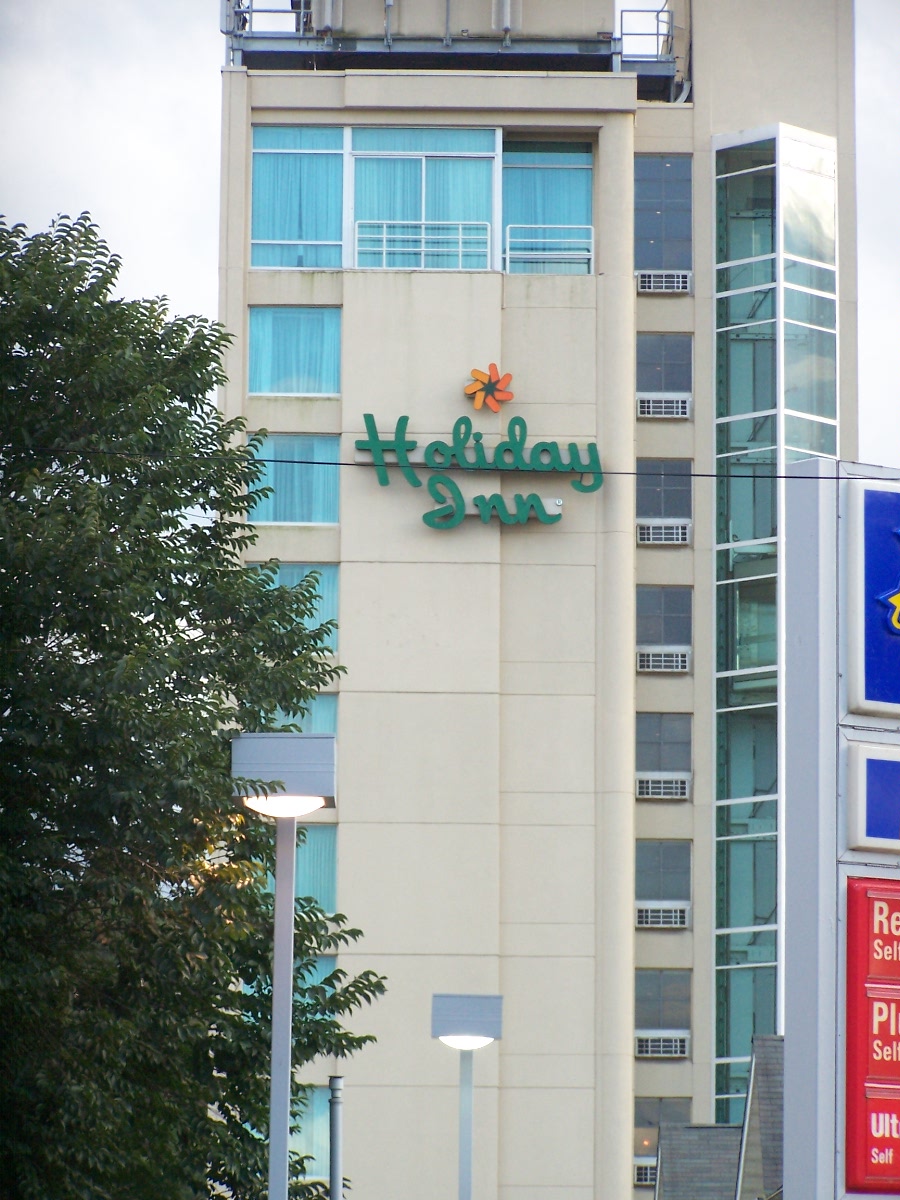
Yes, Ithaca has a Holiday Inn too. The low-rise portion of the building was built in 1972 as a Ramada Inn. The tower was built in 1984/85.

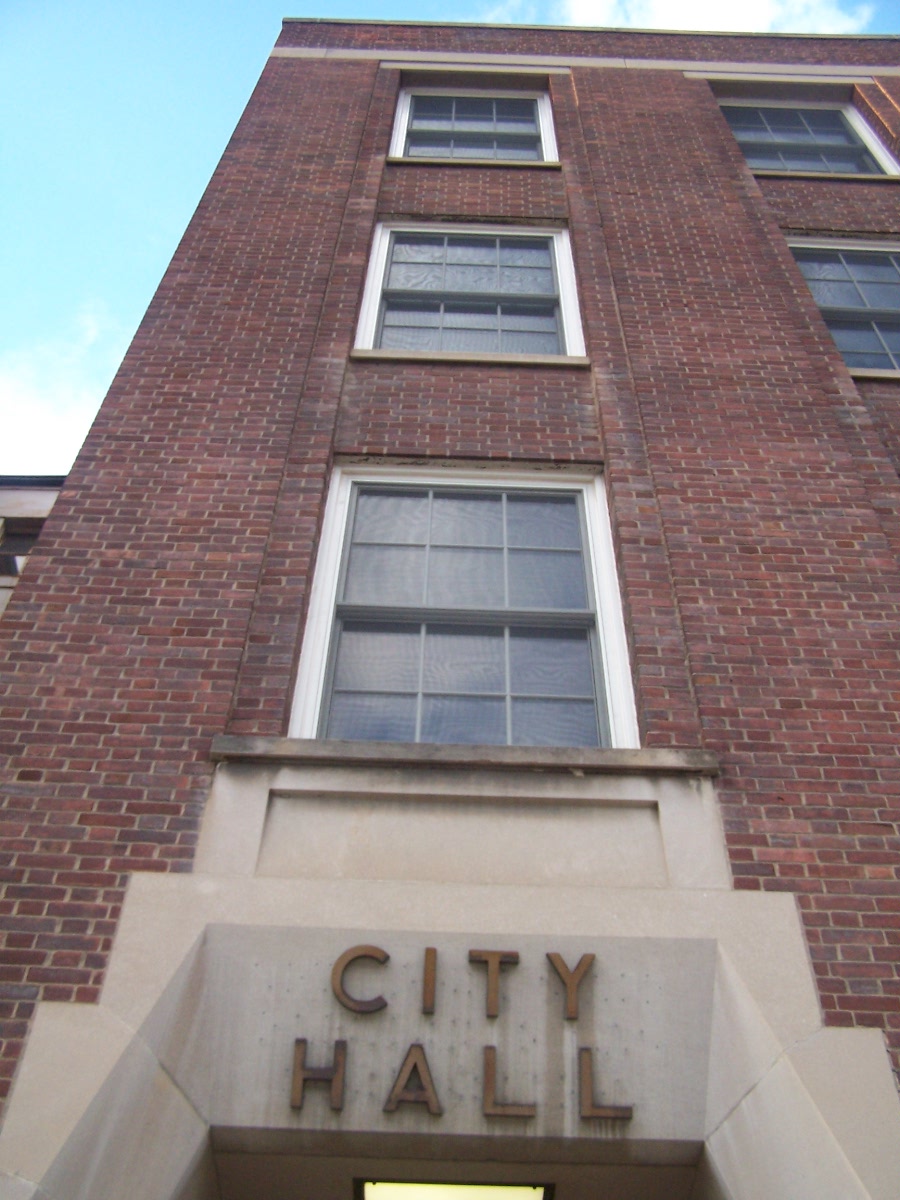
As I mentioned previously, the City Hall and Town Hall are two different structures for two different entities. City Hall dates from the 1930s. The original city hall, if you’re lucky enough to find an old photo of it, had the appearance of a country church.

[1]http://en.wikipedia.org/wiki/The_Cornell_Daily_Sun

[2]http://theithacajournal.com/apps/pbcs.dll/article?AID=/99999999/CUSTOMERSERVICE02/50411002

[3]http://www.immconch.org/history.html

[4]http://www.shortstopdeli.com/welcome.htm

[5]http://www.ci.ithaca.ny.us/index.asp?Type=B_BASIC&SEC=%7B0374E3DD-2B1E-49D3-AA16-ECA42FEF728F%7D&DE=%7B6C41E3A4-5DC1-4EA1-AD3F-32631AF0F4F4%7D

[6]http://www.tcpl.org/about/history.html

[7]http://www.stateofithaca.com/statetheatrehistory.html


9/7/08 News Tidbits: Alpha Omicron Pi to shut Cornell Chapter

6 09 2008

AoPi sisters confirmed Friday that their chapter will be closed as of the first of October, due to declining numbers within sorority rush. All current members will be moved to alumni status and allowed to live in the house until graduation. Once all current sisters have graduated, the intention is to reopen the house under a new set of women (this has been done with fraternities in the past. Pi Kappa Phi closed in 1986 and reopened in 1990, and Phi Kappa Tau closed in 1994 and reopened in 2000).

So, the news, while unfortunate, isn’t surprising to anyone familiar with the Cornell sororities. AOPi was typically derided and demeaned, and as a result of the nasty jokes associated with the house, women tended to avoid having it as a choice on their bids. Also consider that sorority rush turnout was lower than usual this past year, and you end up with a situation where the house can’t get enough women to make minimum member quotas. I feel really sorry for the current active membership of that sorority house.

This should really be a wake-up call to PanHel that something is amiss in the sorority system. Delta Phi Epsilon closed in 2003, as did Chi Omega. with Alpha Omicron Pi shutting down, this results in a net loss of two sororities in the past five years (PanHel selected Alpha Xi Delta to open on campus in 2004). With eleven left, is this really the system that they want? When some sororities have 140 women, and AOPi is closing with about 30 members left, as regulated as the system is for women you’d think the numbers could be a little more balanced.


Going Downtown

3 09 2008

Information that might be worth knowing about Downtown Ithaca, so you can impress your friends by making it sound like you actually leave Cornell and Collegetown.

Built in 1914, the quirky DeWitt Mall (named for Dewitt Clinton) formerly served as the city’s high school before the new facility on Lake Street was built in 1960-61. Apart from having a bunch or quirky shops and stores, the building’s sub-street storefront is home to Moosewood Restaurant (est. 1973 [1]) of vegetarian dining fame.

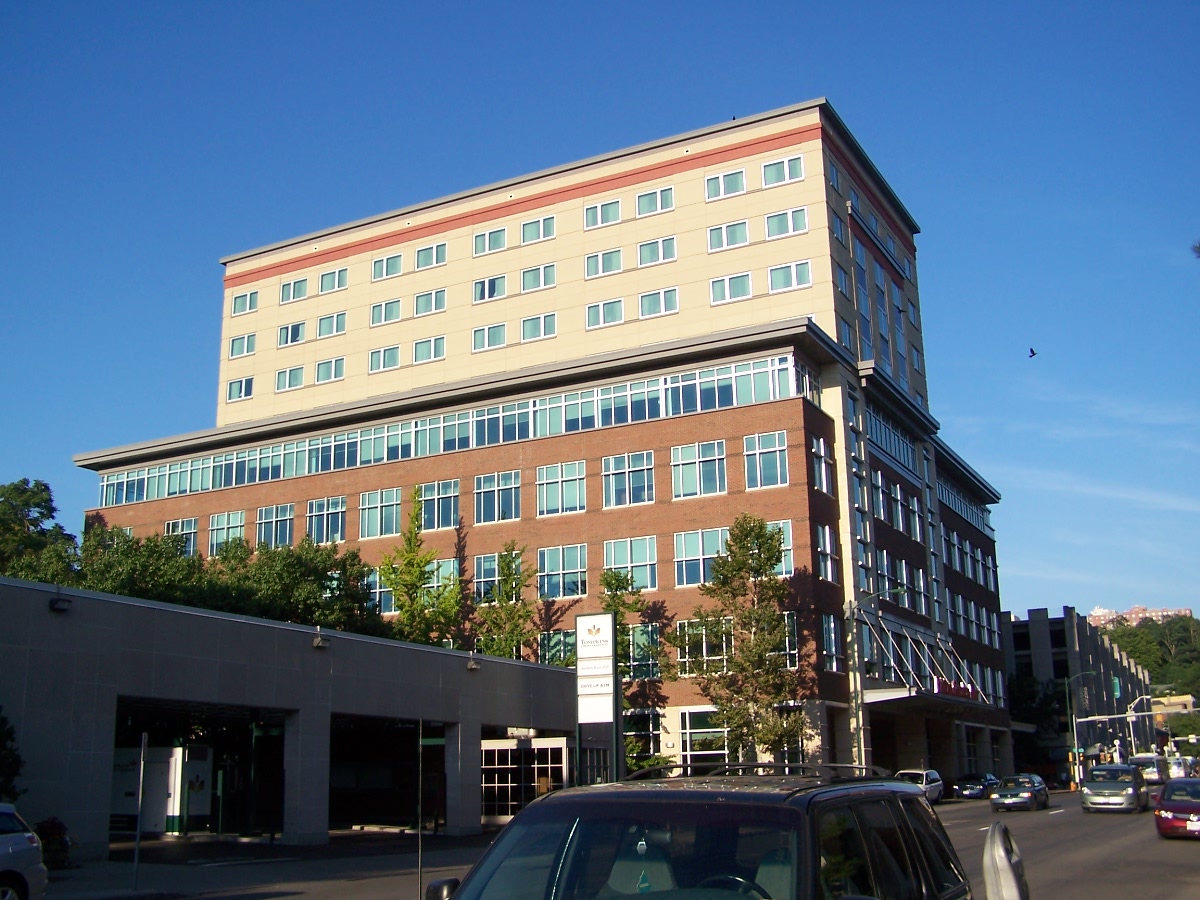
Seneca Place on the Commons is one of the largest buildings by gross area in downtown Ithaca. The 121-ft. tall, $32 million building was completed in 2005 by Criminelli Development [1]. It houses 100,000 sq. ft. of offices (Cornell is the primary tenant at about 70,000 sq. ft.) and a 104-room Hilton Garden Inn [2]. Starbucks and Kilpatrick’s faux-Irish pub make up the ground floor retail. The site was previous home to a parking area and two low-rise buildings.

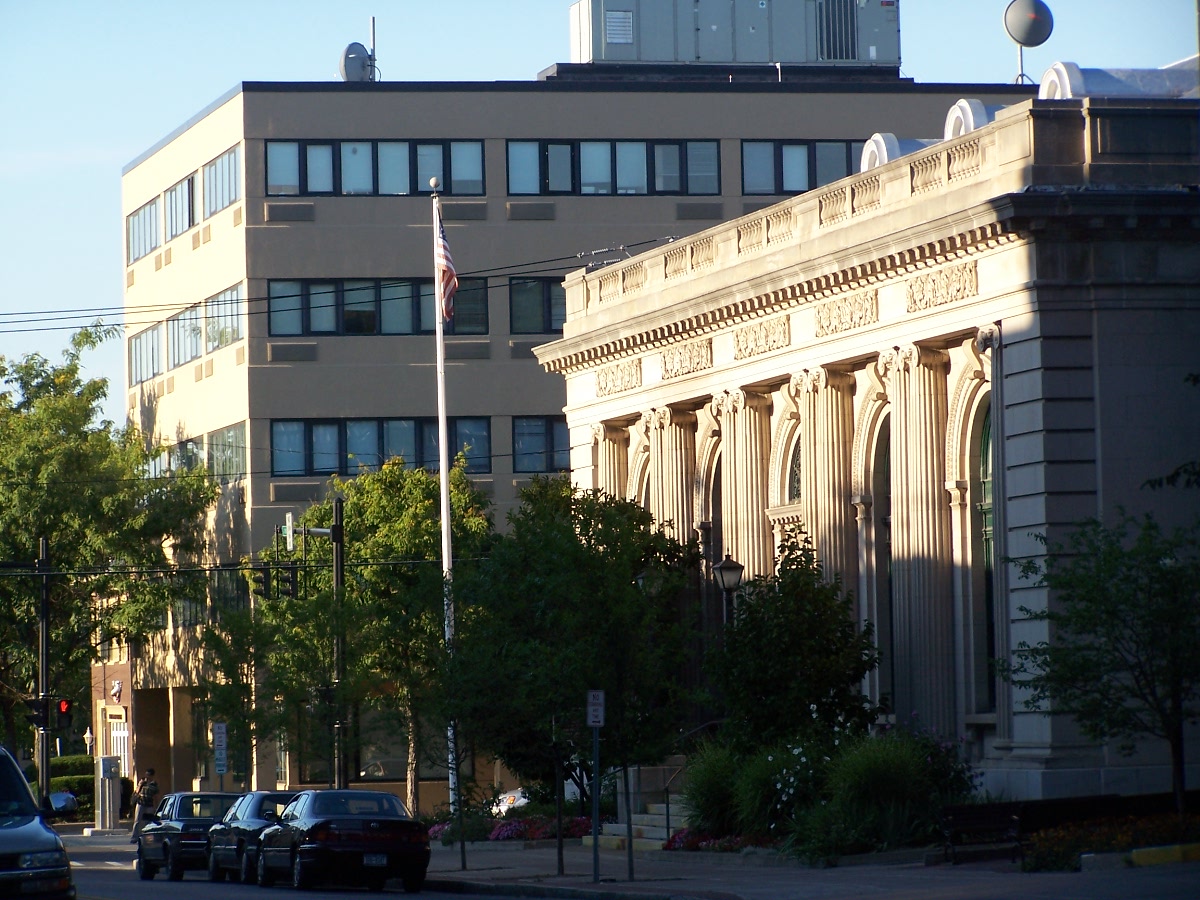
The beige box on the left is the Community Bank Building, which was built about 1981. The previous structure on the site, a four-story YMCA building, burnt down in a reported arson in 1978. The building on the right is the older portion of the Ithaca Town Hall (not that it’s not Ithaca City Hall, which is another building), which dates from 1858[3]. Prior to renovation in 2000, it was the (vastly underused) main Post Office in Ithaca.

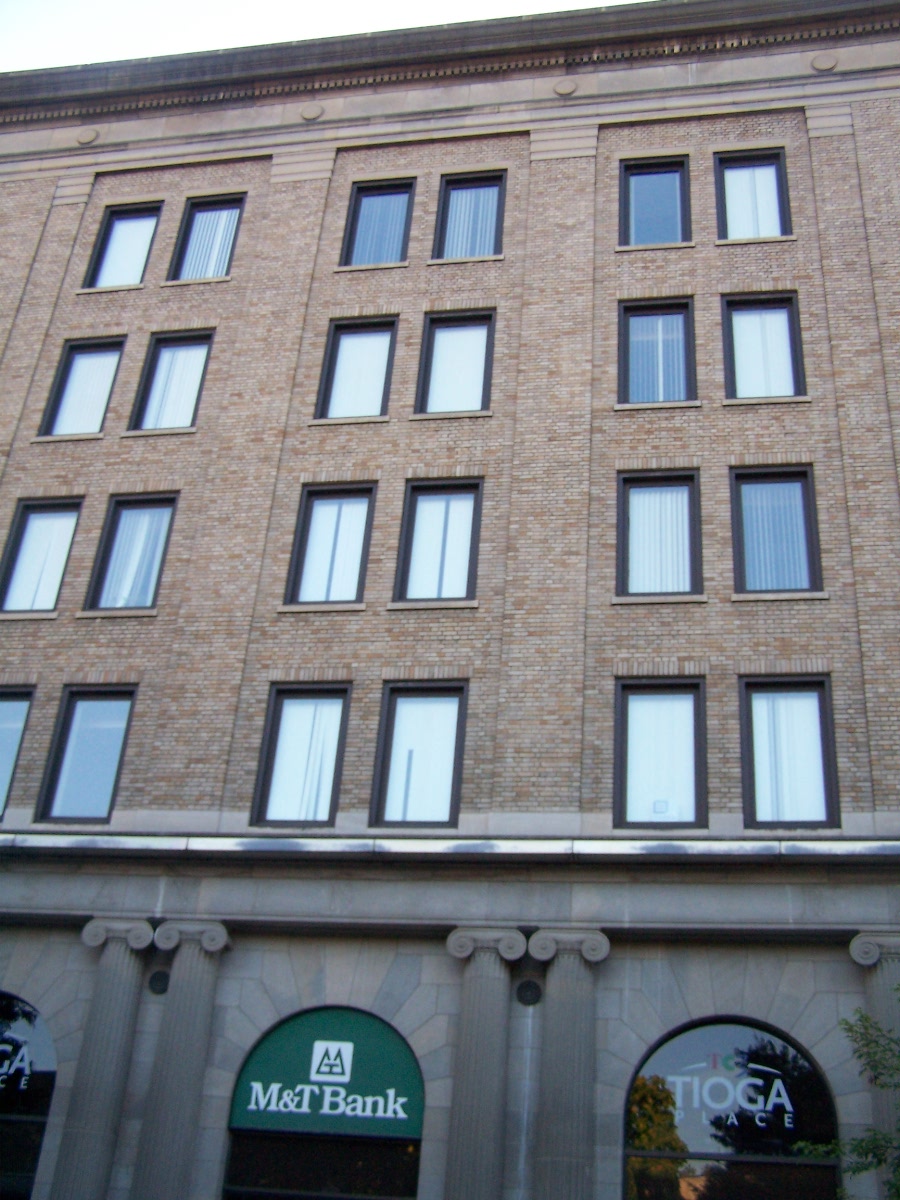
The M&T Bank Building, formally known as Tioga Place, was originally built in 1924 [4]. The awkward addition, like a piece of food stuck between someone’s two front teeth, was built on a half century later.

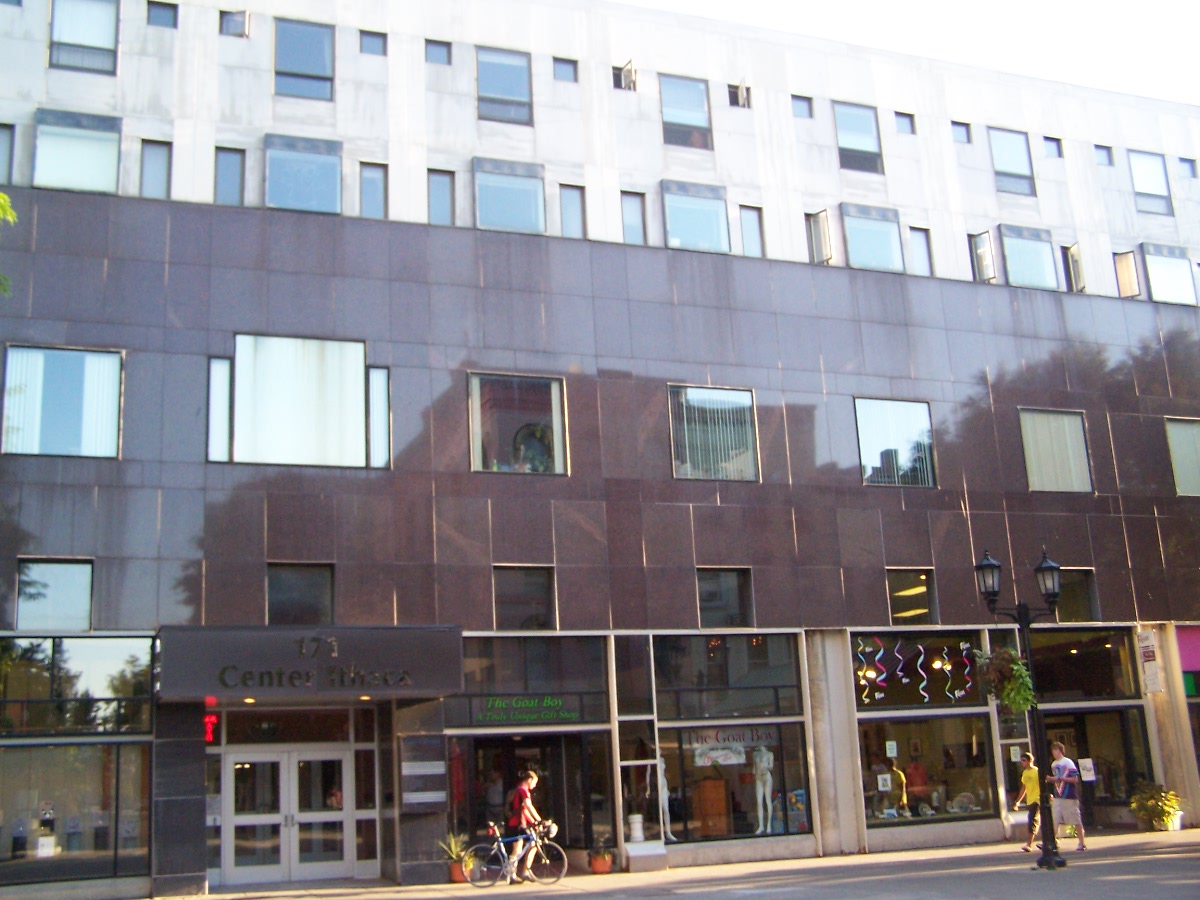
Center Ithaca, on the Commons. The building was built in 1981. It was an early attempt at a mixed-use structure designed to take advantage of the Commons and to make the area more lively. Well, didn’t really work out as planned. Rothschild’s, a department store that was the ground-floor anchor, closed early on. The 62 apartments were difficult to rent out at a time when downtowns were still considered dangerous places to be. And it ran over-budget, pushing its developer and the cash-strapped city into financial hell. Today, the building has worked out most of its kinks, but it didn’t fulfill its original goal, so it worked with mixed results.

Token Commons shot. Completed in 1974 on what was a part of State Street, the Commons was the brainchild on Thys Van Cort, the recently-selected city planner. Pedestrian malls were all the rage in the 1970s; most closed down within a few years. Ithaca’s has persisted, much to the delight (or loathing) of locals. Talk around, and you’ll find some adore the Commons, and some want it turned into a street with parking on the sides. Whichever you prefer, it’s there for the time being. The tracks in the foreground mark where the streetcars used to turn in the downtown area before they closed in 1935/36.

The foreground building that houses Viva Taqueria is the Wanzer Block, which dates from 1905. The building that hugs it in an L-shape is the Roy H. Park building, which was built in the 1990s. Roy H. Park was an Ithaca-residing executive for Proctor & Gamble who was also a substantial donor and investor in Ithaca College and  the surrounding area.

For now, it’s a parking lot. By 2010, as long as things stay on schedule, this will be the site of a 9-story, $17 million,  102-room Radisson hotel by Rimland Associates (rumors have it to be a Radisson, but it will be a recognized chain that occupies the new building) [6].

The center building is the Tompkins County Health Services Building, constructed in 1990 [7]. On the right is the nearly-finished Cayuga Green Apartments, a 59-unit building that will house Cinemapolis on the streetfront. The Parking garage on the left (built in 2005), will see the addition of a seven-story, 30-unit condo tower (Cayuga Green Condos) on the backside (the side facing this photo).

I know, bad photo, but it’s visible most everywhere else in Ithaca City. Limestone Tower, built in 1932, is slated for an apartment conversion and renovation by the Ithaca Rental Company and its head, Jason Fane. The building  was originally built for the G.L.F. Exchange Farmers’ Association.

Just outside of downtown is the William Henry Miller Inn. William Henry Miller, of course, was one of the first Cornell architect graduates, and also designed Uris Libe and Boardman Hall. He designed this house and its carriage house, which were built in 1880 and 1892 respectively [8].


[1]http://www.moosewoodrestaurant.com/aboutus.html

[2]http://www.re.cornell.edu/senecaplace.htm

[3]http://www.town.ithaca.ny.us/newtown.htm

[4]http://www.emporis.com/en/wm/bu/?id=tiogaplace-ithaca-ny-usa

[5]http://en.wikipedia.org/wiki/Roy_H._Park

[6]http://findarticles.com/p/articles/mi_qa3718/is_20080418/ai_n25443972

[7]http://www.kwikfold.com/Pictures-PhotoWork/Hascup.jpg

[8]http://www.millerinn.com/inn.htm


Arts Quad Photos

30 08 2008

Some people suggested that I might consider sharing a little history of a few of the campus buildings for those that are interesting. Well, it’s Friday evening, and I’ve already enjoyed a private 21st birthday celebration for a friend. So, why not?

Rand Hall, built in 1912, was built in the industrial style typical for the time period. The building was donated by Mrs. Henry Lang in honor of her father Jasper Rand [1], and her ubcle and brother of the same surname. The building housed machines shops as part of the Sibley School of Engineering, and eventually was reworked to be the studio for many of the architect student as part of the AAP school.

For those of us who aren’t architects, we rarely see the interior. We do, however, see the designs and phrases bored architects create on the compound windows.  The building has been proposed for demolition in recent years to make room for proposed addition to the AAP school (see the Milstein Hall entry), but the current design proposal for Milstein Hall spares the structure for the current time. The building doesn’t tend to make much news, with the slight exception of a time a peacockfrom a Cayuga Heights home broke into their computer lab a couple of years ago [2].

Lincoln Hall, across the path, has seen a much more varied history than its workhorse neighbor. Lincoln Hall was built in 1888 at the then-cost of $72,603, and housed the Civil Engineering until 1960 (it moved to Hollister Hall). The building was renovated for the music department, and they moved in the following year [3].

Lincoln Hall saw an 18,640 sq. ft., $19 million dollar expansion from 1999-2000 (the addition is on the left side of the photo). The firm that designed the addition also designed Kroch Libe in 1992 and the Law School addition in 1988.

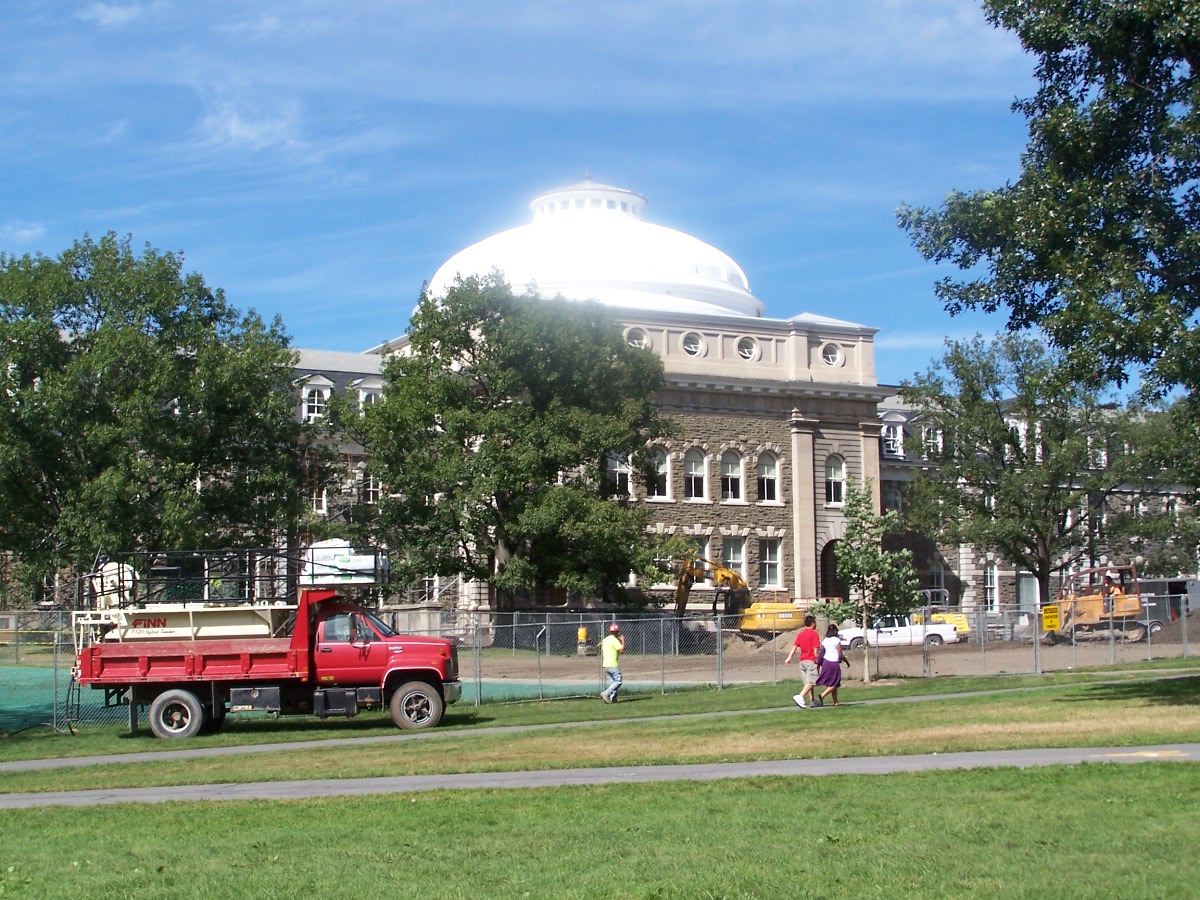
Sibley Hall, namesake of Hiram Sibley, has three seperate wings built at three seperate times. The West Wing began construction in August 1870. The building was dedicated to the “mechanical arts”, as so deemed by Hiram Sibley, an original trustee of the university. Sibley donated the money hinging on A.D. White building himself a president’s house on the campus [4]. The east wing was built in 1894, and the center area, including the photogenic dome, was built in 1902. Although the three portions were designed by three different architects, they form a relatively cohesive single structure that serves as the nucleus of the AAP school. The center area houses the Fine Arts Library.

The construction in the photo is some pipe work, and Sibley underwent minor renovations during the summer to make the building handicap-accessible, and to add more bathrooms to the structure.

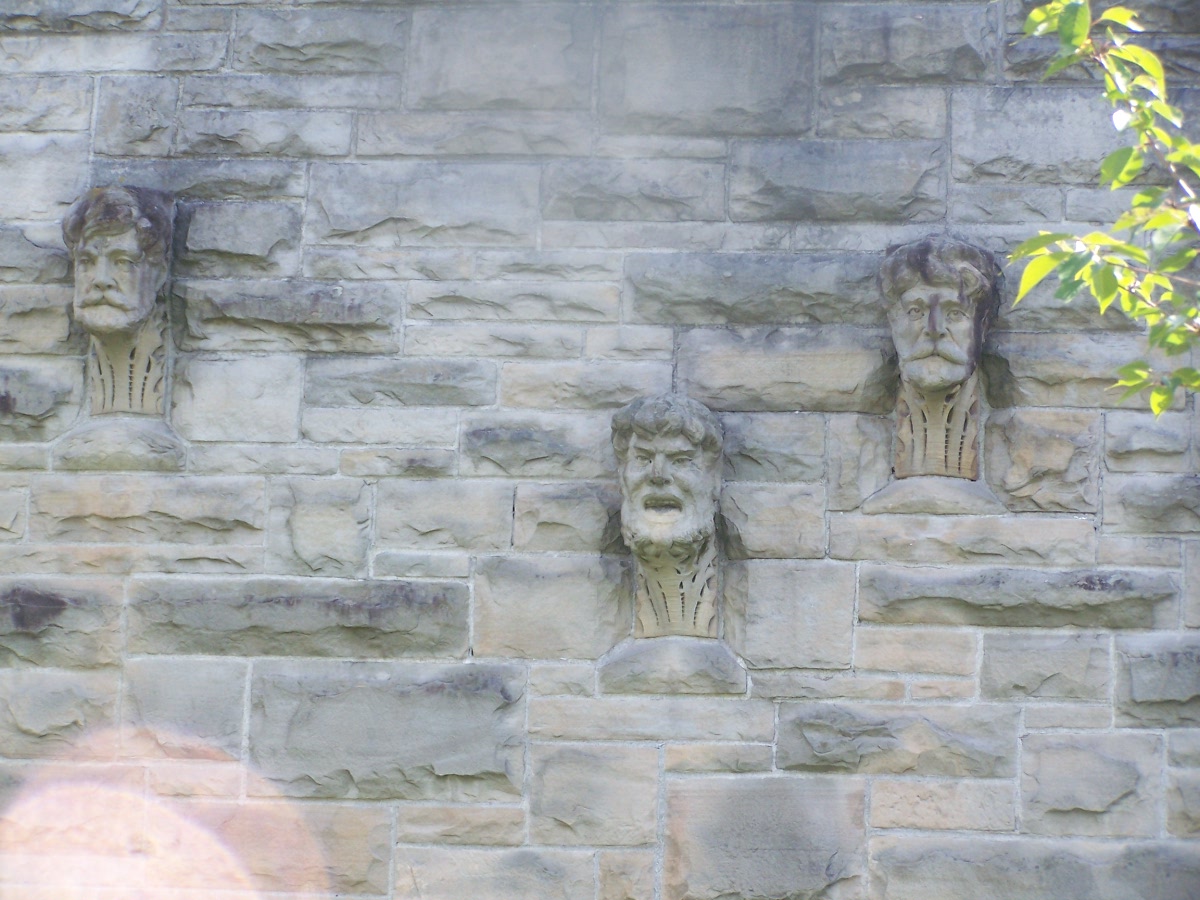
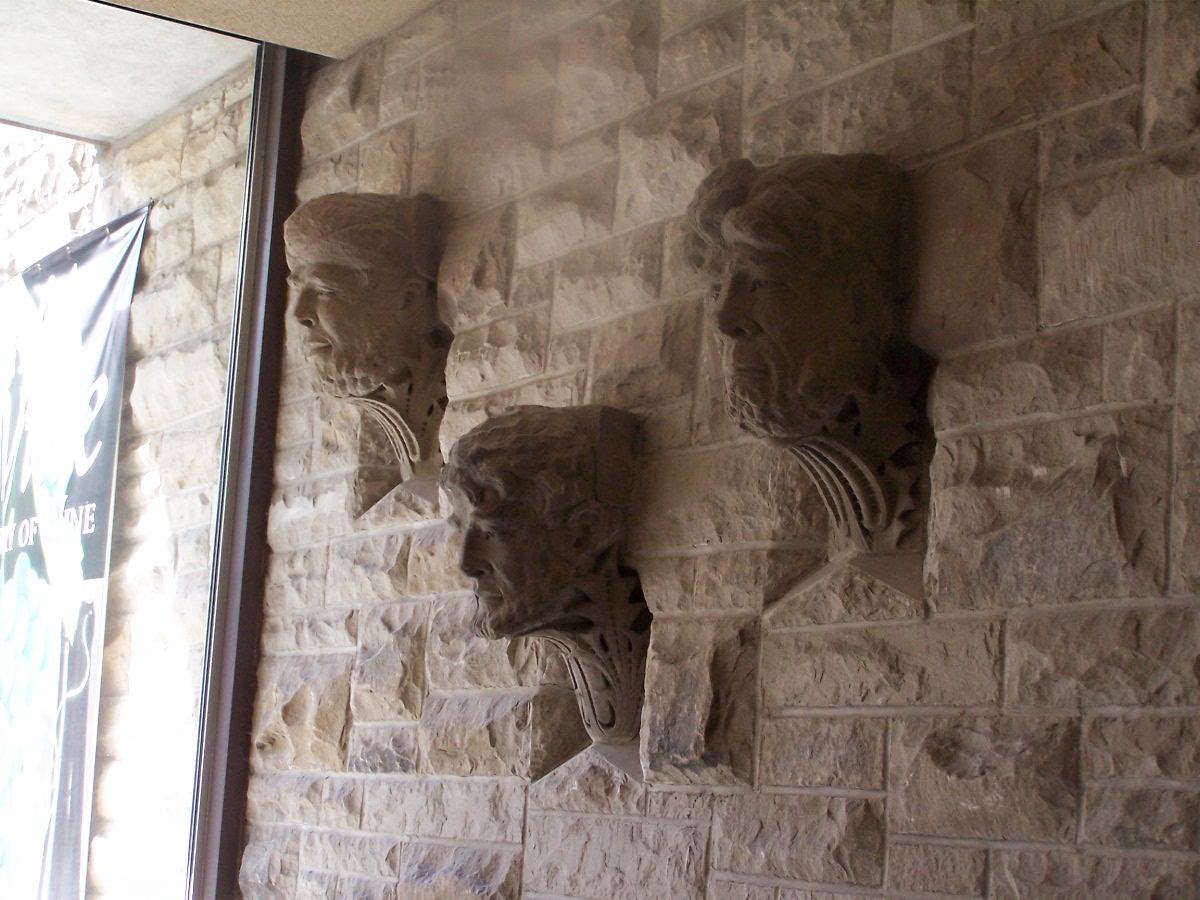
The John M. Olin Library shares the title of being the main library for the Cornell campus. The building was opened in 1961 [5]. To facilitate its 5.66 million dollar construction, the university demolished Boardman Hall (1892), which was the original home of the law school. Boardman was a former dean of the law school. The three stone faces on the outside and the three stone faces next to the interior staircase are artifacts from the exterior of Boardman Hall that were incorporated into Olin’s facade.

The Kroch Libary, largely underground except for four skylights next to Stimson Hall, was constructed in the fall of 1992 at a cost of $25 million dollars (namesake Carl Kroch ’35). For those who are curious, Olin has a utility tunnel to Uris, and Kroch has a utility stairway-tunnel that connects to Stimson, both of which are largely prohibited for non-staff use.

Olin’s entry way and cafe were renovated in 2002. The rest of the building is currently being prepped for a major renovation that will clean the exterior facade and renovate the interior to being it up to safety codes and to make it more conducive for current trends in upper education (think “pollinization spaces” not too unlike those in Duffield and Weill, without the atrium).

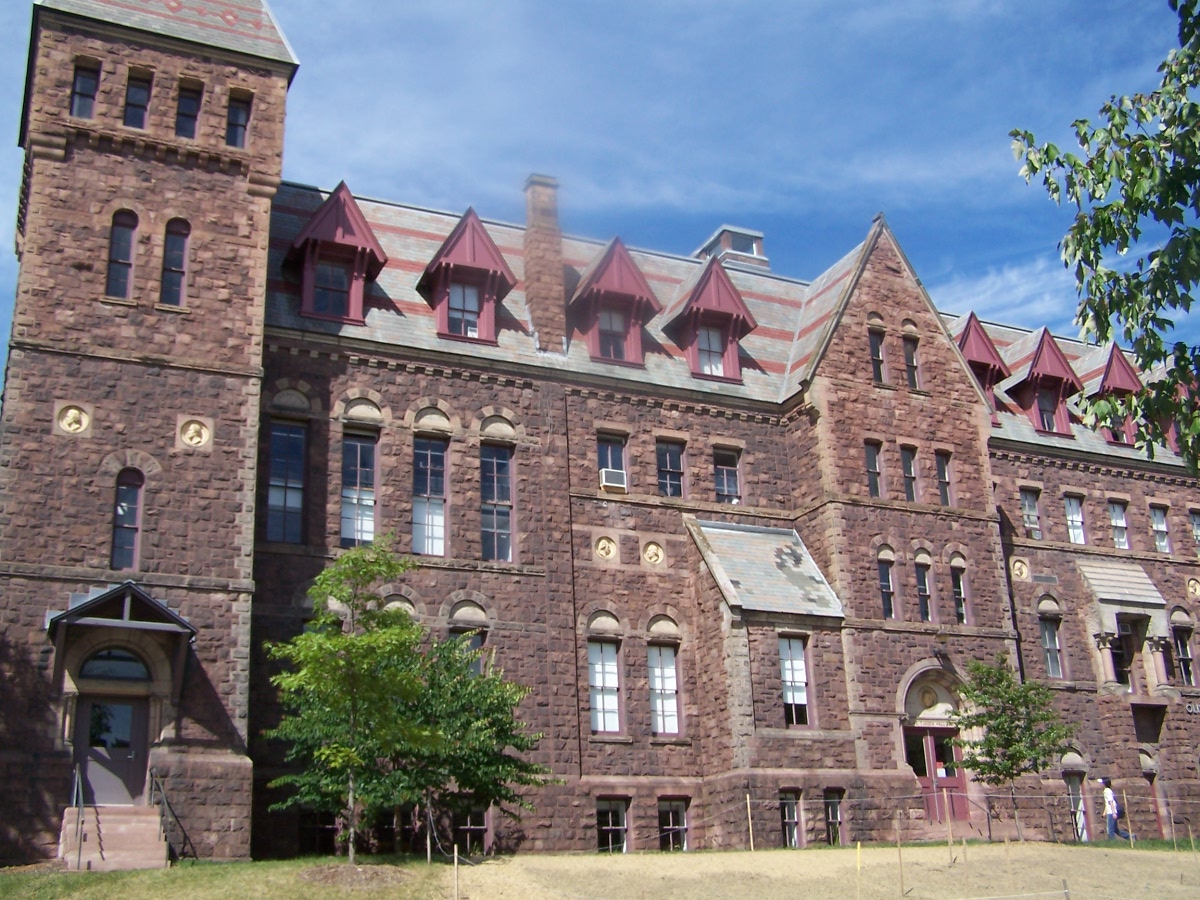
Tjaden was built as a “physical laboratory” in conjunction with West Sibley in 1883. Although $50,000 was budgeted, delays and material shortages drove the costs up to a final tally of $100,923, more than twice than was originally budgeted [6]. This is partially because of A.D, White insistance on the use of stone, and the medallions that decorate the building with the profile of prominent men in the mechanical arts. If you look closely enough, you can see that the window arches still have the names of great discoverers and inventors inscribed into the stone. The building was originally named Franklin Hall, in honor of the great innovator Benjamin Franklin.

The Department of Chemistry originally called the building home until it left for Morse Hall in 1890. The physics department left in 1906, and afterwards the building was incorporated into AAP as the Fine Arts building and workshops. The building was rededicated in 1981 to Olive Tjaden van Sickle ’25, a pioneering woman architect [6]. The building was renovated in 1998, at which time it regianed the hipped roof that I so inconveniently cropped off because I was too lazy to take a few steps back (the original hipped roof was deemed structurally unstable in the 1950s after a lightning strike set it on fire).

[1]http://www.aap.cornell.edu/aap/explore/rand.cfm

[2]http://www.news.cornell.edu/stories/June06/peacock.nabbed.dea.html

[3]http://www.arts.cornell.edu/music/LincolnRen-Exp.html

[4]http://www.aap.cornell.edu/aap/explore/sibley.cfm

[5]http://www.cornell.edu/search/index.cfm?tab=facts&q=&id=541

[6]http://www.aap.cornell.edu/aap/explore/tjaden.cfm


Add/Drop

27 08 2008

Wait, we moved add/drop from 6:30 AM to 10 AM this year? Well, that takes the fun out of it. What’s more exciting than staying up all night (or in my case last year, trudging to Uris Libe at 6 AM) to try and get in the mad stampede to fix and fill schedules for the upcoming semester. The freshman need the shock and frustration of getting up early and still not being able to get a certain class, it would help them adjust better.

I certainly don’t miss the wait and confusion of JTF; however, I can’t exactly say StudentCenter does a better job, because it takes forever to load a page, but at least tells you how many slots are still available in a class. The convenience of this development is that some professors, normally those teaching smaller classes, never set a limit (technical limit is 9999), so you can plan your order of enrollment accordingly, trying to get into the classes with limited spaces first and the null limit classes at one’s own leisure. These details can be checked regardless of whether or not add/drop is underway, so my personal recommendation is to check and plan the “method of attack” before it opens at 10 AM tomorrow.

All I have to do is switch out one class for another anyway.


News Tidbits 8/26/08

25 08 2008

So, perusing through the planning board meeting, this nifty little addition appeared for the city’s meeting Monday evening:

5. Site Plan Review
A. Site Plan Review, Delta Chi Fraternity Parking Lot Expansion, 102 The Knoll, Jagat P. Sharma,
Applicant for owner DCEF Cornell LLC. Lead Agency and Public Hearing. The applicant proposes to
expand the existing 10 car gravel parking lot along Barton Place to accommodate a total of 22 parking spaces. The proposed parking is one way, maintaining the current access and adding an egress point at the northern driveway on Barton Place. Proposed site work and improvements include removal of 2,700SF of trees, shrubs and vegetation, grading, new curbing at entrance and egress, relocation of guy wire, relocation of signage, landscaping, and installation of a masonry retaining wall approximately 4′ high and 80′ long along the northwest side of the parking area. Proposed surface of parking area is compacted gravel. This project received ILPC approval on 3-13-08. This is a Type 1 Action under both the City of Ithaca Environmental Quality Review Ordinance §176-4 B. (1) (h) [2] & [4] and an Unlisted Action under the State Environmental Quality Review Act and is subject to environmental review. (Materials sent previously)

~~~

Are you serious? Jagat Sharma, the architect of the project, has made his name by designing the apartment towers in Collegetown and some of the luxurious lakeside mansions in the Ithaca area. And Delta Chi hired his firm to design…a gravel parking lot expansion? I mean, couldn’t you get a standard construction company to just tear a base into the ground and lay the gravel without paying all the extra money for a bigger-name architectural firm to design it? If Delta Chi were building an addition, I could understand, but a gravel parking lot? Talk about money to burn.

I was wondering why there were construction permit signs going up over there with Sharma’s name listed as the architect. I honestly thought at first they were building a gatehouse or something. The other items for the meeting are nothing special; a house, roofwork on Eddygate, and a subdivision.

 EDIT 8/27: It’s a news tidbit, so I though I ‘d throw it in here.

http://cornellsun.com/node/31200

It’a a sun article talking about how Cornell gets bashed and we should give our detractors a f*ck off farewell. While I agree with the article’s sentiment wholeheartedly, I should point out one little fallacy- those pins with the “I’m the Hottest” crap were free. We gave them out as a promo to get you to buy random crap, and we still have a sh*t ton of them somewhere in our warehouse across town.


Off-Topic: Q & A

23 08 2008

I’m taking it easy with this post, since I was directing cars on the Balch Lawn for a large portion of the day (welcome freshmen, to what could be the best four years of your life!). Occasionally in the search bar, someone types in a question. Let’s take a look at what people want to know.

1. “llenroc kicked off campus”

Ans: To my knowledge, this has not happened in recent history.

2. “dke secrets fraternity initiation 60’s”

Ans: If they were secrets, chances are that information isn’t going to be readily accessible, so how it would even be on the internet or in libe documents is beyond me. Many fraternities operate with some clandestine functions, but in my experience, it’s less in terms of cloak-and-dagger and more because it makes pledging and private functions all the more interesting. Case in point, the fraternity of Phi Kappa Psi advertises secrets concerning spatial geometry on its website [1].

3. “new restaurants ithaca”

Ans: Well, Bistro Fry in Collegetwon has been replaced with Jack’s Collegetown Grill. And a couple buildings down from the State Street Diner is a new restaurant called “Fine Line Bistro”. TBP opens up a new location on the Commons next month, and a second restaurant will be moving into what used to be the used bookstore on the Commons. Olivia’s has also permanently closed. Fair enough?

4. “sigma nu kicked off campus cornell”

Also, not in any recent history. What is up with people thinking so many fraternities have been kicked off campus?

5. “why people love cornell university”

Yes, this was an actual question. However, I don’t feel I can provide an adequate answer. This isn’t because I haven’t enjoyed my time here; I’ve found Cornell to be a rewarding and stimulating experience, if a little academically frustrating at times. But everyone has their own reasons for loving Cornell. And unless I could somehow compile all the answer together in one long list, than I really can’t provide a full answer to that question. We all have our own reasons for loving the institution that is Cornell.

6. ” cornell fraternity fall rush 2008″

Haven’t heard anything about it. Registration is linked from the OFSA (Office of Fraternity and Sorority Affairs) website. Traditionally, fewer fraternities participate in the fall rush, which is primarily transfer students along with a few curious upperclassmen. However, the fall rush has been decsribed as more intimate by some of its proponents, in the sense that you get to know rushees better. I’m sure if you send an e-mail to the OFSA or IFC folks, they’ll be able to fill you in on which houses are doing rush and any other details you should know. Oh, and there might be a promotional pamphlet going out for fall rush at some time soon.

7.””anna comstock hall” latino”

Well, yes, yes it is. Originally built in 1924 as a combination of faculty and graduate housing, Anna Comstock Hall was programmed as the Latino Living Center in the fall of 1994. This was after a peaceful occupation of Day Hall from November 19-22, 1993, where several events that strongly concerned members of the school’s Hispanic population caused them to stage a demonstration and a sit-in on the building to voice their concerns [2]. Day Hall is a frequent target for occupation anyway (do a google search on Redbud Woods for another example).

8. “ithaca college cornell tension”

Really? There must not be a whole lot of it. If anything, it’s because Cornell’s larger and in the Ivy League, so they tend to steal attention away from IC. But as for tension, there’s not much from what I’ve heard. But we also don’t mingle too often, with the exception for some muscial and theater groups, and Cornell staffers with ICTV.

9. “cascadilla dorm + asylum”

For the last time, NO. Casca was built for the original purpose of a water sanitarium, but never even functioned as such. Old Ezra was a major investor who took the building for his own uses when it appeared the sanitarium project would never get off the ground. That was back in 1866.

10.  “cornell living above ctb”

Dunno what that must be like. A little loud at times, I would guess. Anyone care to give a more accurate description from their own experience?

[1]http://www.phikappapsi-cornell.org/141-tour-mystery.asp

[2]http://cornellsun.com/node/26269


Ithaca College Master Plan

21 08 2008

So, I know recently I devoted five entries and several hours of my life to coverage of the Cornell Master Plan. But, while I back the Big Red in the spotlight, it wouldn’t be fair if I didn’t give a little attention to the neighbors on South Hill.

Ithaca College has also completed a master plan, created by Sasaki Associates and finalized in September 2002 [1]. The plan is available for perusing online, but it comes in a rather crappy resolution pdf that makes it almost impossible to pick out some of the finer features. But, let’s give it a try anyway.

Note one thing as we glance through this: The Park Business School (architect Rober A.M. Stern) , the Gateway Center (HOLT architects), and the new Athletic Center have been recently built or are currently underway in some stage of approval or construction.

Park Business School (L) Gateway Center (R)

So, a brief history on the physical plant of Ithaca College; the first five dorms and the student union were built in 1961 (previously, the college occupied rented spaces in downtown Ithaca; classes were taught in the dorms and union from 1961-63). The first academic building, Friends Hall (it was paid for by the organization Friends of Ithaca College), was built in 1963. Five more residence halls and a health center were completed by the end of the year.

A little side note; for those unaware of the living arrangements of Ithaca College, it is an all-residential college, meaning that with the exception of seniors who choose to do so, all housing is on-campus. So they have more dorms than we at Cornell would be likely to suspect.

The campus expanded rapidly in the late 1960s, but saw very little construction in the 1970s, with the exception of a few smaller projects at the beginning of the decade and the end of the decade. The next wave of construction began with Smiddy Hall, which was completed in 1981. Ithaca College tends to play favorites with architects; Tallman & Tallman designed their first twenty or so buildings up to 1971, and then with a few exceptions, HOLT architects has designed most of the rest since the mid-1980s.

Go on and tell me the sixties weren't a bad decade for architectural design. I'm all ears for any justification.

Go on and tell me the sixties weren’t a bad decade for architectural design. I’m all ears for any justification.

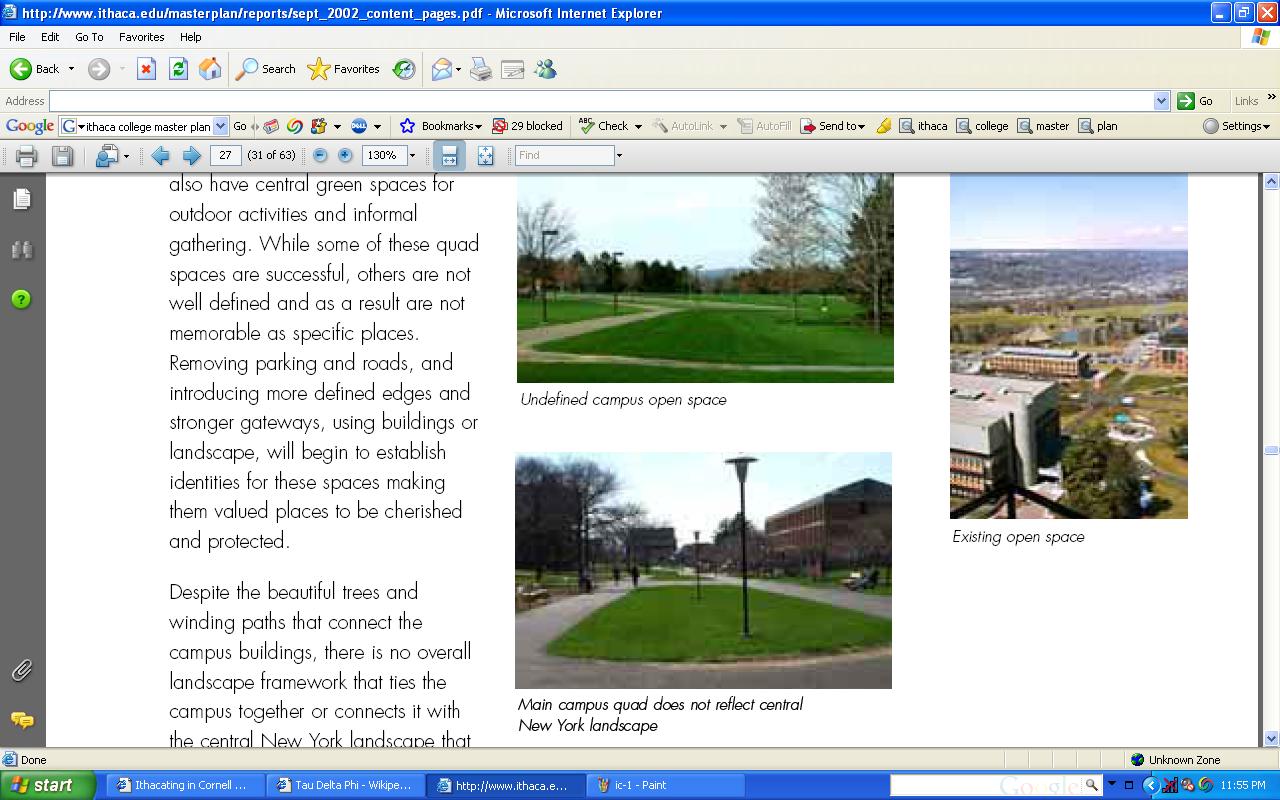
The master plan identifies the need for about 170,000 sq. ft of office space immediately, and another 200 parking spaces. It also says that despite the stunning local topography, that the campus’s open spaces fail to utilize the area properly and are unmemorable as a result.

In the Ithaca College master plan, new development is identified in a darker shade of orange, as compared to the lighter shade used to denote existing buildings in 2002.

One of the goals of the plan is to have everything on central campus within a 10-minte walk from any given location. As a result of this pursued ideal, the central campus is much denser.

The total academic/office space to be built is around 500,000 square feet, with an additional 380,000 sqaure feet of additional dorm space.

The central campus also features a “main street” connecting many of the important area of the campus.

In case anyone’s wondering, here’s a massing of the new athletic center in its location next to the rest of the campus:

So, it’s towards the Cornell-far-side, but I still think that due to its massive size, Collegetown residents will still be able to pick it out on the southern skyline.

So while we have our plans going to work, IC’s already implemented theirs and has been trying to meet their goals for a little while now. Here’s hoping that the plan is as successful as they hope it will be.

P.S. I wanted to write about the IJ article extending the Collegetown moratorium and limiting building heights even further in Collegetown (on the five or six parcels that would’ve actually been raised), but I’ve just decided that councilwoman Mary Tomlan isn’t worth the time and effort of deriding her as a backwards-thinking malcontent.


[1]http://www.ithaca.edu/masterplan/reports/sept_2002_content_pages.pdf


Finish Line of Photo Tours: Eastern Cornell Heights

17 08 2008

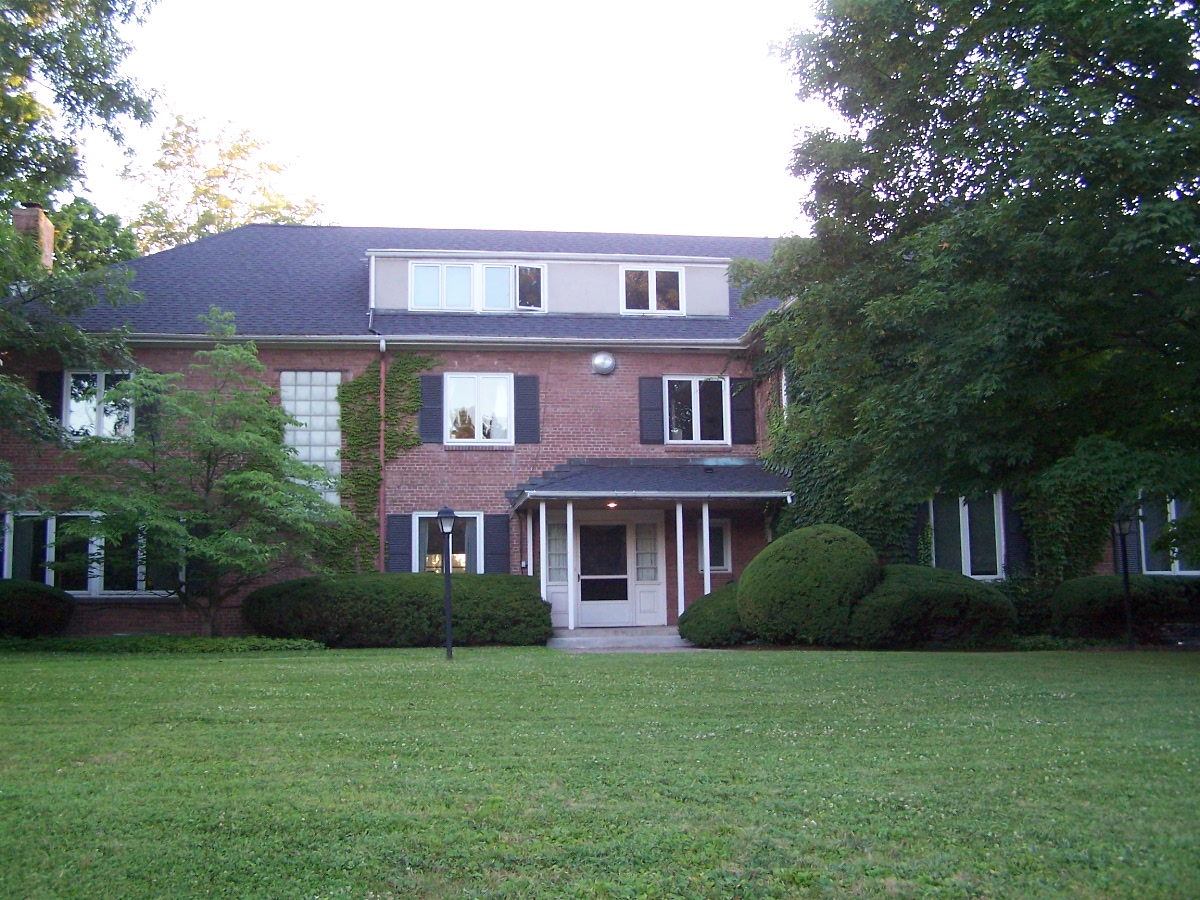
This is the house of the sorority Pi Beta Phi, which is kinda far out on Triphammer Road. Pi Beta Phi started out as a local chapter called Beta Phi. By 1919, they had become the NY Delta chapter of Pi Beta Phi sorority, and they first met in Risley Hall, which was at the time an all-women’s dormitory. After moving around from Eddy Street and Wait Avenue, they settled at 425 Wyckoff Avenue in 1937. By 1955, they has sold this house to Alpha Chi Sigma, and they built the current house in 1955-56 [1]. At least one sorority has made it easy for me to dig up some historical information about them.

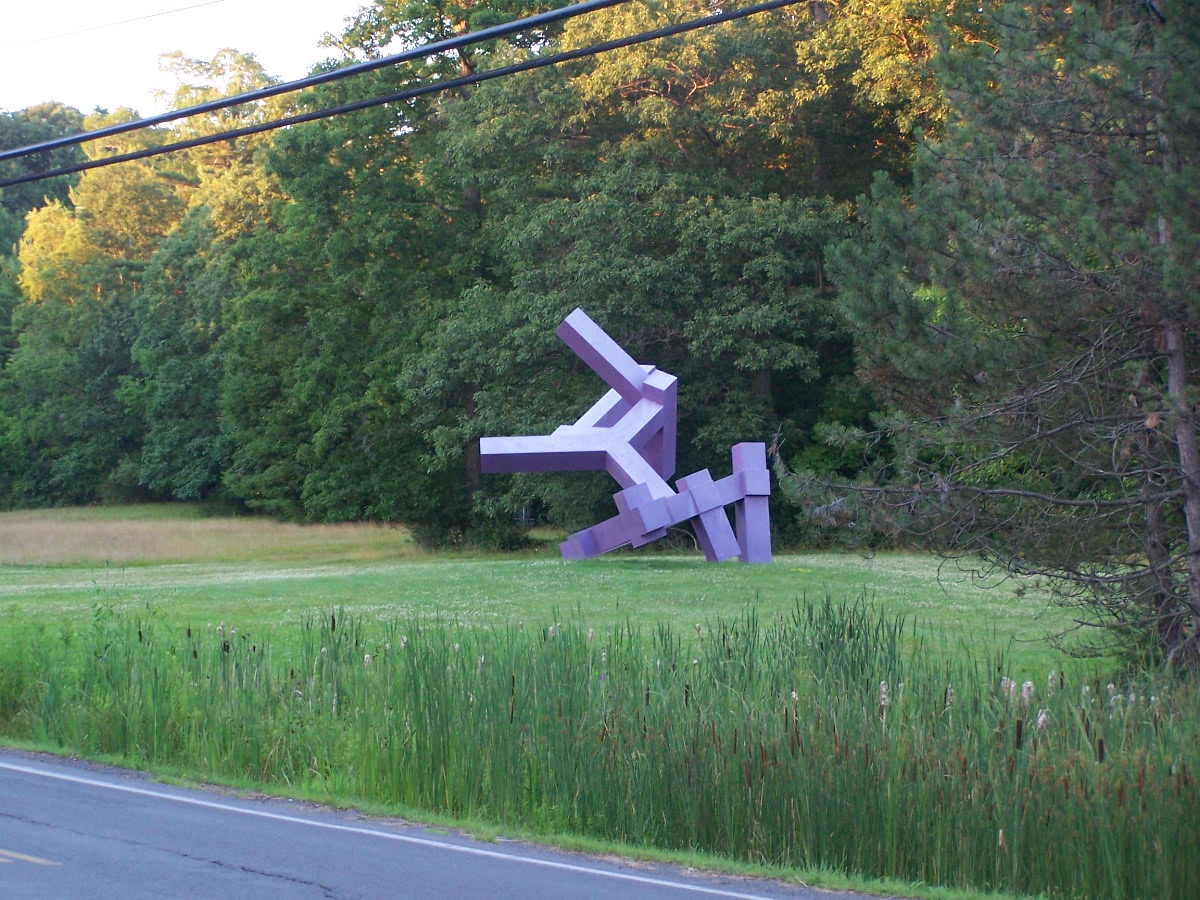
Token sculpture? Perhaps, but I’ll provide a little detail about it anyway. The sculpture is called “Richard Evans, 2nd, III”, and was created by Daniel Ben-Shmuel Barrett. It used to be located next to the art museum as part of an abstract art exhibit, but because they needed the space, it was moved to north campus in 2004 [2]. There are also sculptures next to Appel and near Akwewon.

Hurlburt House, or as it is more commonly known, EcoHouse. The building was originally constructed as a motel/travel lodge in 1953. Shortly afterwards (~1963) it was purchased by Cornell and renamed the Cornell Heights Residential Club. The building was used for graduate housing and for housing for students of an experimental accelerated PhD program [3]. On April 5, 1967, a devastating fire tore through one of the wings of the residence, killing eight students and a live-in faculty member [4]. Firemen said three bodies were found in the entrance lobby, one on the stairs between the first and second floors, one in a first floor room, and four in rooms on the second floor [5]. An investigation afterwards stated that inadequate fire safety (lack of fire escapes and alarms) combined with deadly toxic fumes released by the burning rubber-plastic furniture were the primarily factors in the devastating tragedy. In case you’re wondering, the PhD program was discontinued. As for the building, the wing where the fire took place was torn down, but several residents and visitors claim that the basement of the wing (which still exists) is haunted [6]. Haunted in this case means screaming, an oppressive heat, strange lights and the barking of a dog that dies in the fire. I’m going to stay skeptical on this one, and say it’s probably just some overactive imaginations. I’ve been inside only a couple of times, but I found the accomondations seemed luxurious compared to other dorms, and they were tightly-knit group.

This building is home to the Triphammer Co-Op. Built in 1912, the house originally housed a sorority known as Sigma Kappa. Around 1955, the sorority admitted an African-American woman, which was against their national’s rules and regulations (remember, this was at the beginning of the Civil Rights Era). The national ordered the women to get rid of her or risk being booted out of Sigma Kappa. Well, the Cornell chapter flipped their national the proverbial bird and became a ladies co-op. The co-op went co-ed in the early 1990s, and today houses 19 men and women in eleven singles and four doubles [7].

The co-op’s southern neighbor is the MGLC fraternity Pi Delta Psi (is this the only MGLC organization that maintains an official house right now?). The house itself dates from about 1915, but the house only came into the poession of the fraternity a few years ago, in 2003. Pi Delta Psi is an Asian-interest fraternity [8].

The house of Delta Delta Delta sorority, more commonly known as Tri-Delt. The Alpha Beta chapter here at Cornell began as the woman’s club “Sennightly” in 1895, taking their name from the fact that they held a meeting every seven days (heck, my fraternity barely manages to hold a meeting every two weeks without someone b*tching). The women petitioned a national sorority so they could stay in touch in later years as well as perpetuate their organization. By 1912 (yeah, missed the boat on that one), Tri-Delt national took interest, watched them as they threw a party, liked what they saw, and offered them a seat with their sorority. From 1912-1965, the house was on the 600 block of Thurston, in what is now the Alumni House; afterwards, they moved to this house on Triphammer with its Moorish influence [9]. The moorish house was home to Kappa Alpha Theta prior to their national disaffiliating them in 1965.

Right across the street from Tri-Delt is the sorority Delta Gamma. The sorority was established at Cornell in 1885 [10], but the current house dates from about the 1930s. My personal guess is that they were in the ladies’ dorms for a number of years and then lived in boarding houses until moving to their present location. The chapter was inactive from 1969 to 1975 (the Vietnam War era, when public interest in Greek life and other establishment groups waned significantly)

The house of Kappa Delta sorority. The Cornell Chapter was founded in 1916 by a transfer student who was a KD at her former institution. First based out of Sage and then out of a now-demolished house on Wait Avenue, the sorority purchased the land for their current house in 1923 and built on that property shortly thereafter, expanding several times over the years. [11]

[1]http://pibetaphi-cornell.org/public1.asp

[2]http://ezra.cornell.edu/searched.php Q5 2/7/08

[3]http://en.wikipedia.org/wiki/Cornell_North_Campus

[4]http://www.news.cornell.edu/stories/April07/1967Fire.kr.html

[5]http://www3.gendisasters.com/new-york/6971/ithaca-ny-dormitory-fire-cornell-university-april-1967

[6]http://ezra.cornell.edu/searched.php?search=haunted&question=&answer=&starttimestamp=&endtimestamp=&category_id=&offset=20&view=expanded

Q2 11/12/1992

[7]http://www.triphammercoop.org/place.php

[8]http://www.cornellpdpsi.com/version6/about.php

[9]http://www.rso.cornell.edu/tridelt/

[10]http://www.dos.cornell.edu/dos/greek/chapter_details.cfm?id=3277

[11]http://www.kappadeltaomegachi.org/kap2_about.taf