News Tidbits 7/22/10: Collegetown Terrace Goes Back to the Drawing Board (UPDATED)

22 07 2010

UPDATED: A sketch rendering of the new design has been released. Small, house-like apartments have designed along East State Street in place of buildings 2 and 4. Building 3 is still one continuous building, but the exterior breaks into subsections to minimize bulk and give the impression of multiple strcutures. The Delano House is still under consideration for preservation, but is more of a suggestion at this point (unless the preservation committee and the Common Council give it historic designation). I actually like it more than I did the original design. 

Also, Ithaca is getting a BJ’s Wholesale Club next to the Shops at Ithaca Mall, and a Tim Horton’s/Cold Stone Creamery is planned to be built near Buttermilk Falls. Which makes me wonder how mainstream Ithaca is going to become over the next few years. 

http://www.theithacajournal.com/article/20100721/NEWS01/7210425/City+reverses+on+Novarr+re-zoning  

So, for those who might’ve been following the news over the past few months, it’s been no big secret that Novarr-Mackesey Group’s Collegetown Terrace project has been rather contentious, drawing crowds of angry neighbors to planning board meetings who were upset with the sheer size and scale of the project. In response, the planning board voted to promote rezoning (which is done by the city council) the part of the property along East State Street, which would heavily alter the project. Plus, it was recommended that historic designation be sought for the Delano House, a former nurses’ dorm. Of course, if these actions were taken, then Novarr’s lawyers would be having a field day filing a lawsuit against the city.  

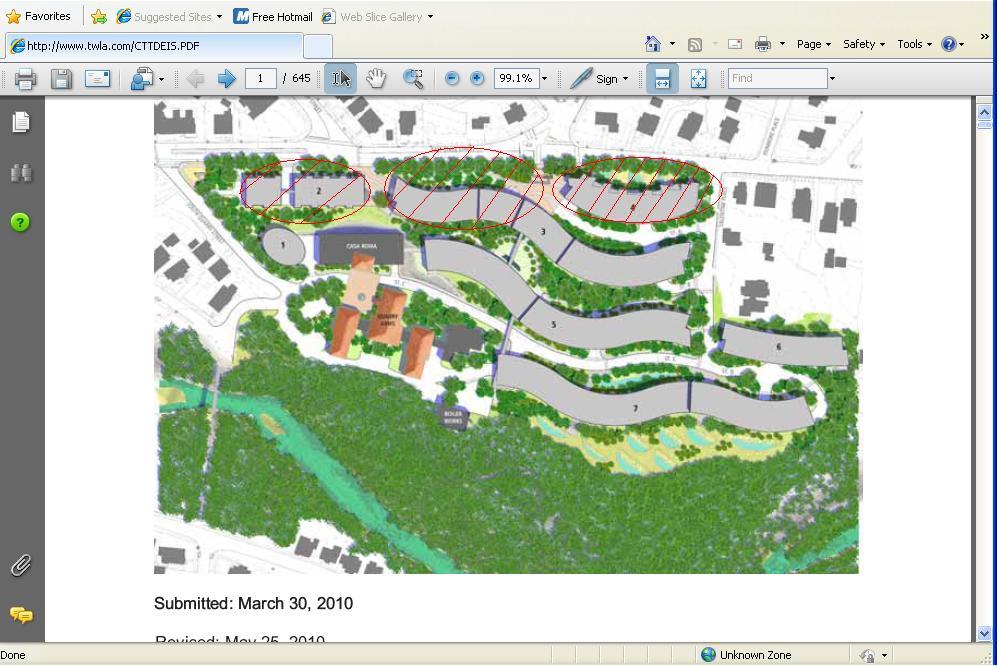
Well, it seems as if that potential issue has been averted. Talks between the board and John Novarr have resulted in something of a compromise. In exchange for not rezoning the area, Novarr will submit a redesign that will allow thirteen separate structures on East State Street. This has been one of the most contentious aspects on the original design, that the three structures that were originally proposed made State Street feel like “a wall”, “prison” or “fortress”.  The original design schematics and proposal can be found here, in a 645-page PDF.  
  

Delano House, photo property of Novarr-Mackesey Properties


Therefore, buildings 2 and 4 will be completely redesigned as designated by the agreement. Building 3 will also be redesigned, but only the north half is affected. To what extent the plans will change regarding the landscape of the development and the other buildings is uncertain. Also, some of the Ithaca preservationists might still be trying to push for special designation for Delano House, which is at 113-115 Valentine Place. That space would be occupied by buildings 6 and 7, so I don’t see the issue being completely settled just yet. But at least the two sides are willing to compromise. Personally, while I like some of the aspects of the project, I’ve kinda felt indifferent due to the sheer size, and the design hasn’t exactly won over my heart (for the record, I still don’t dislike it as much as I dislike anything by Thom Mayne, so I feel no urge to go on a rant like I did with Gates Hall). But trying to make it a smooth transition and trying to at least appease the neighbors while increasing density – I consider that a step in the right direction.  


Whatever Happened to the CU ERL Project? (UPDATED)

14 07 2010

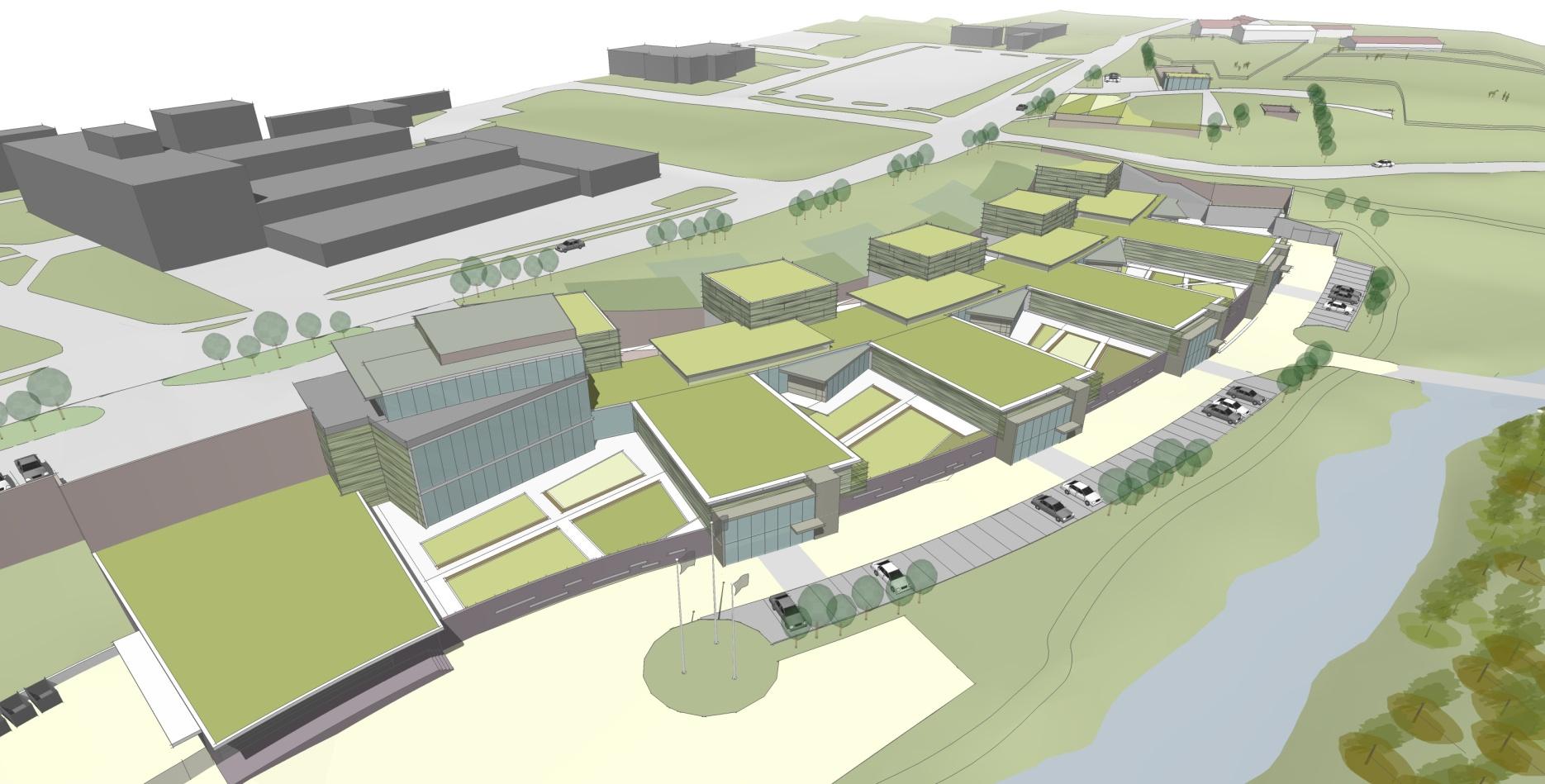
Renderings have been released through the Ithaca Journal’s website:


For reference, Riley-Robb Hall is in the upper level. This rendering is looking to the northeast. The cryogenic facility is to the upper right. More renderings can be found in the document attached to the main article.

***

About two years ago, I wrote an entry discussing the proposal of the Cornell University Energy Recovery Linac (ERL) X-Ray machine and how it was sechduled to start operation in 2011. Well, things kinda stalled when the Great Recession reared its ugly head far above Cayuga. In between compiling at my work computer, I decided to look at the the town of Ithaca’s latest planning board agenda. Lo and behold, it appears the project is back on. From the agenda:

Consideration of a revised sketch plan for the proposed Cornell University Energy Recovery Linac (ERL) project located north of the Pine Tree Road and Dryden Road (NYS Route 366) intersection, Town of Ithaca Tax Parcel No.’s 63-1-8.2, 63-1-2.2, 63-1-12, 63-1-3.1 and 63-1-3.3, Low Density Residential Zone. The proposal involves construction of an underground accelerator tunnel (14-foot diameter and +/- 1 km long), a cryogenic facility, and an extension to the existing Wilson Laboratory (+/- 185,000 gross square feet of building space). The project will also involve new stormwater facilities, parking, outdoor lighting, and landscaping. The Planning Board may also discuss the draft scoping document for the Environmental Impact Statement.

Now, long story short, the project consists of a massive extension to the Wilson Synchrotron and a large addition to the Wilson Lab, illustrated in the diagram (which I am virtually certain sure was designed by Munier Salem, as it shares similarities to his previous works and it’s part of an article he wrote for the Daily Sun back in the fall of 2008):

The article also goes into much greater detail about how it’s supposed to work; much more detail than I am going to go into here. Economically speaking, the project has considerable potential for the region: the University and project affiliates estimate over 200 jobs would be created and the facility would bring nearly a billion dollars in economic contribution in the five years of construction and ten years of operation. It’s certainly much better than the alternative, which would be the Synchrotron unit shutting down and taking away 200 jobs.

So, it’s good to see things are moving forward once again. Let’s hope that things can stay on track from here on out.


News Tidbits 7/9/10: Thom Mayne to Design Gates Hall

9 07 2010

I consider this a very bad sign.

http://www.news.cornell.edu/stories/July10/GatesHallArchitect.html

According to the Chronicle, Gates Hall will be located on the parking lot north of Hoy Field. This may or may not include demolition of the Grumman Squash Courts, as the article doesn’t clarify that. It will also be about 100,000 square feet and have a construction cost around $60 million. So, among other things, this means I shouldn’t pay attention to Cornell’s budget statements as they relate to building size, since it suggested 70,000 sq ft. More importantly, the site has been moved from its original location behind Thurston Hall. Schematic designs are expected by December, with completion by early 2014.

Now, Thom Mayne is another “starchitect”; which is nice, but shouldn’t be the big idea that’s being touted. Mayne’s firm is a rather small but highly respected company named Morphosis Architects. Morphosis has made their name doing really edgy, deconstructivist designs.

Uh oh.

For those unfamiliar with architecture, here’s the proposal that Morphosis submitted for Milstein Hall:

 That’s Lincoln Hall on the left. This proposal called for the demolition of Rand Hall and this…monstrosity to be built in its place. This isn’t pretty. It won’t even grow on you. This is outright hideous. It reminds me of Lady Gaga’s outfits — screams for attention, but wholly lacking in taste and functionality. This building actually makes me like Uris Hall.

Some might argue that they were purposely edgy since it was an architecture school building they were designing. I would love to believe that, but unfortunately that’s untrue.


This is one of their tamest designs, the Cahill Center for Astrophysics at Caltech. It’s bearable maybe. It sure as hell isn’t attractive. I wouldn’t dare point this out to prospective students and visitors if I were a tour guide. At least Weill and Milstein are inoffensive. This is analogous to mooning a bus full of orphans.

The San Francisco Federal Building? Another statement-maker of the unattractive kind. Thom Mayne is a great architect, but his designs are more for making statements than for being attractive. I want to know why Cornell thinks edgy design is the way to go. Many people have a strong avoidance of deconstructivism, and if MIT’s Stata Center is any clue, these buildings are so much more prone to rapid deterioration. To each their own I suppose. But I have a sinking feeling that Gates Hall is going to be a architectural blight onto the campus.


The Keyword Bar VIII

2 07 2010

Don’t mind me, I’ve just been plodding away in a lab with mounds of satellite data and computer code. In the meanwhile, I decided to do another keyword bar update. In what could be described as a “math fail”, I somehow managed to go from VI to V in the past two keyword bar entries; apparently 6 is the new 4. I make blunders quite a bit in writing up entries; there’s probably not a single entry of decent length where there isn’t a typo or grammatical error. Most importantly, though, is that the subject material remains as accurate as possible. So, without further ado…

1. ” ‘quill and dagger’ spring 2002″ (7/1/10)

The best bet to finding who was in their Spring ’02 tapping class would be to find the archived version of the Daily Sun papers from that semester and digging through them. Sucks, but that’s the only “legal” way of going about it. The graduation paper from that May would list who graduated from Q&D in 2002, so if you can’t find it in the normal paper, the graduation issue from 2003 (because Spring classes are generally comprised of juniors) might also be useful.

2. “apartments above urban outfitters ithaca” (6/31/10)

Yup, about 68 of them. Kinda funny, the story behind those. If you google the same phrase as the user who came to this site, one of the first articles you come across is Jason Fane’s editorial that Cayuga Green will fail. The article was written while the apartment building was still in the proposal phases, in November of 2005. He said, in short: 1)There is no demand for nicer housing, 2)parking is too far, contributing to 3)no retail will want to locate there and the project will fail. Note that this is coming from the same guy who owns upwards of a thousand units of housing in the Ithaca area, including most of the larger buildings in Collegetown (Jason Fane is the owner of the Ithaca Renting Company). More importantly, note that this is a man who had just renovated and opened an 85-unit apartment building (the Cityview, which opened in 2004) right across the creek from the site. This is a man who had every reason to want the project to fail, because it could take away potential renters.

Not everything went to plan for the Cayuga Green project. The cinema was reduced to a five-screen and Cinemapolis signed in to the project, thus avoiding a movie theater glut in the area. The bus stop helps with retail, but there’s always been a bus stop near the site so that’s a moot point. The Palmer Pharmacy, the Gimme! Coffee shop, and Urban Outfitters, which is considered a huge score for a project in any city let alone Ithaca — were not supposed to happen, according to Jason Fane. Also, Gateway Commons just down the street is a luxury apartment building that was built in 2006/07. That should have failed as well if we follow Fane’s logic, but as far as I know it’s doing just fine. So here’s hoping he feels just a little burned by his own words right now. The condos have yet to start construction due to the recession market, but I’m keeping my fingers crossed they’ll start sometime in the near future.

3.  how to grow ivy frat house (6/30/10)

Speaking as someone who grew up in a house that has a large amount of ivy on and around it (not really as charming as you might think since my family lives in a little ranch house), it really just grows well enough in . The older the leaves the darker they usually are. Trellises of some sort along the wall definitely help it climb but they are not necessary. It’s a low-maitenence plants that in warm, moist conditions (like a summer in the northeast) grows like a weed. A climbing weed.

4. “ithaca record cold” (6/30/2010)

This one has been covered before, but it seems a bit buried within google. The record low in Ithaca is -25 F (-32 C), set twice — Jan. 16 1957, and February 2, 1961. Record cold varies; the lowest July temperature, for instance, was a brisk 38 F, set on July 8, 1963. The last of the coldest colds for a month was set in March 1993 (-17 F, on the 19th and during the epic blizzard of 1993) and the last of the warmest warms was 69 F on December 7, 1998.  Note this is not the same as average warmth; but just google the “northeast regional climate center” for more information.

5. ” cornell cals reputation” (6/29/10)

For most of its (24?) programs, it’s among the top ten in the country. For a few, such as atmospheric science, plant science and entomology, it’s in the top three. That’s from the Gourman Report, which is published by the Princeton Review. So academically it’s well respected.

Within Cornell, CALS tends to be downcast for being a bit more state school and a bit less cosmopolitan than the other colleges. But then, every school has their negative stereotypes (we all know about engineers hiding themselves away or how easy the hotel school is).

6. “oliver s. schaufelberger cause of death”

…*edited*…

…Without meaning disrespect, I never wrote about how a student and three members of her family were killed in a car accident at the beginning of June, but that’s because it was a busy time period and I didn’t want to draw more attention to this blog for being a “list of death”, as one email put it.

EDIT: Someone asked that I take down the links and information that suggested a probable answer to the search query. I am only removing the statement out of politeness. But frankly, just because it’s no longer on this blog doesn’t make it any less plausible.

7. “gates hall 2012” (6-29-2010)

As a starting date maybe. Certainly not for completion. The reason for this is that a 70,000 sq ft building whose design hasn’t even been finalized, let alone approved by the city, would take, arguably, 12 to 18 months minimum (site prep is needed, and it’s a specialized building with sophisticated high tech components, so construction wouldn’t move all that fast). There’s nothing on the city’s planning board agenda that suggests this has come up to the board, and the building would take at least three months to get approvals. It won’t be starting anytime soon, so there’s unlikely to be completion by 2012. A start date during that year, however, is quite possible.


(UPDATED) Cornell’s Library Shutdown Count Up to Three

23 06 2010

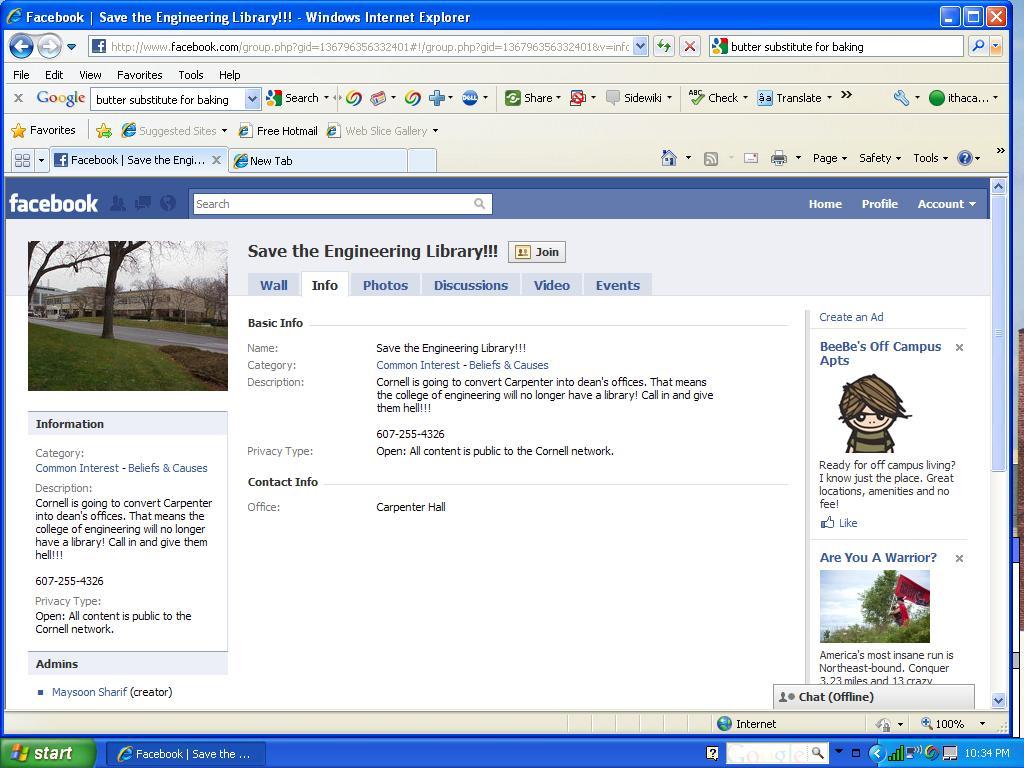
So, I log into facebook and find this page being posted into my news feed.

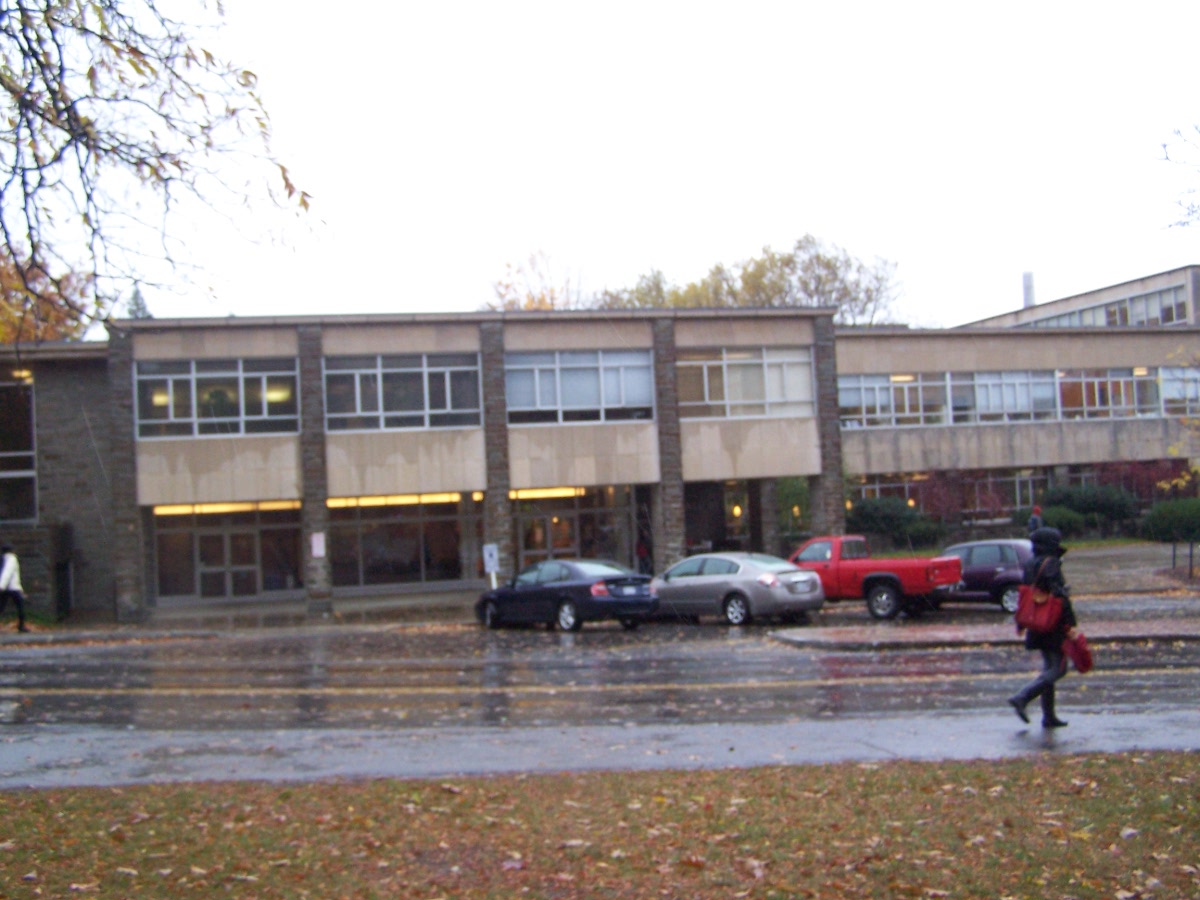
So, this comes as a bit of surprise. But I don’t buy into it. First of all, there’s nothing online — nothing on the Daily Sun, nothing on the engineering website, no data to back this up at all. Secondly, decisions like this are usually made over the span of months, even years (for example, the physical sciences library’s shutdown was formalized in March 2009 (an attentive reader of this blog actually told me about it before the Sun even had published the story); the library did not shut down until nearly a year afterwards (and no offense to Munier, but that library was definitely one of the lesser-used and therefore more expendable library facilties on campus). Decisions like this aren’t just “made” without a great deal of debate beforehand.

The one grain of truth I can throw into this is that the master plan indicates that the facilty to replace Hollister and Carpenter is under way — but that would suggest Carpenter getting demolished, not reappropriated. Plus, that’s still in the planning phases. Maybe a library would be in the Gates Hall plans, which are currently at the very beginning of the funding and approvals process; but I doubt it at this time.

I call bullcrap on this one until some information is published that indicates otherwise (see update). If there is any truth to it, going all alarmist  and calling the office staff (like the page suggests) is just going to make matters worse.

(UPDATED) So the author of the facebook page attached several official-lloking documents detailing the removal of the library’s book to Olin and Uris. IT would appear that the ACCEL computer labs would be kept and the labs would be made into a 24-hour unit (but isn’t that the lab in Upson exists?). Meanwhile, Munier has posted onto their page a link from Mann Library saying that the Entomology Library will be shut down and merged with Mann. So it would appear Cornell’s cost-cutting will shut down two more libraries they consider “less-used”.

I hope Cornell doesn’t release any more ads touting their expansive library system anytime soon.


Two Years Later

18 06 2010

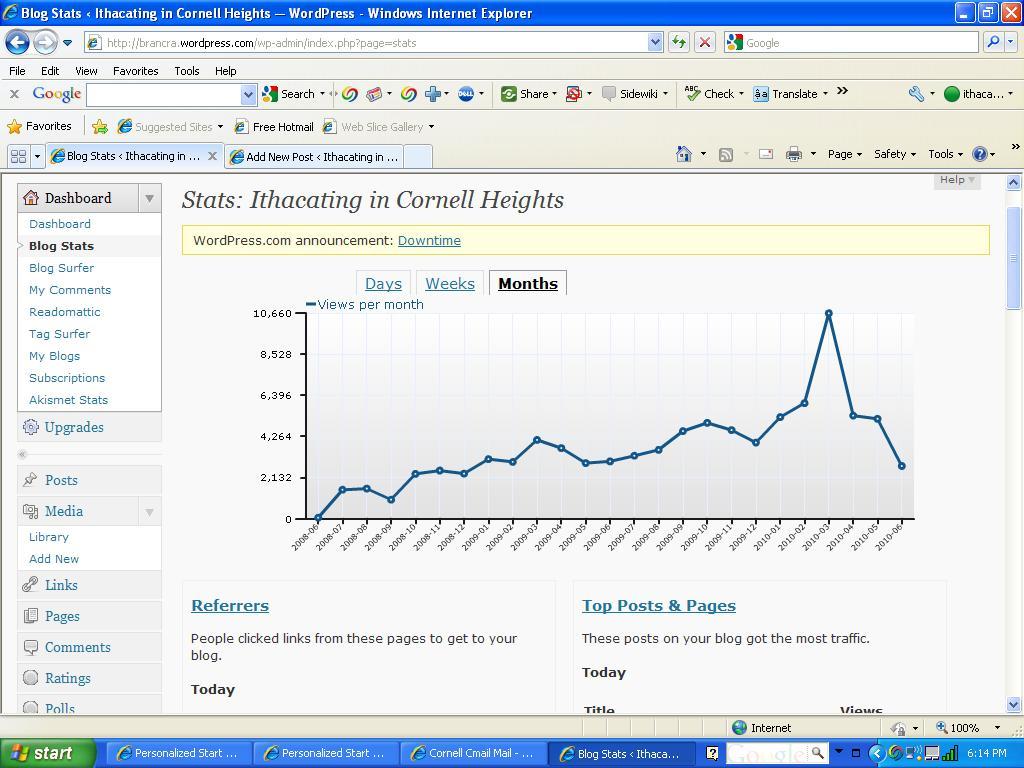
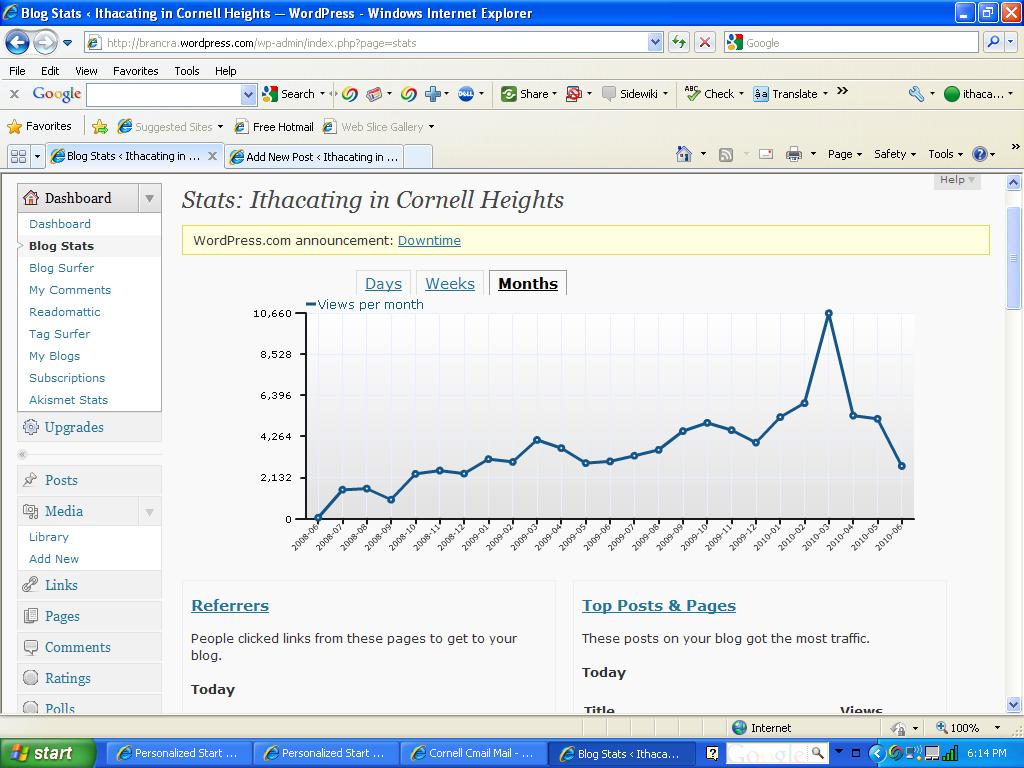
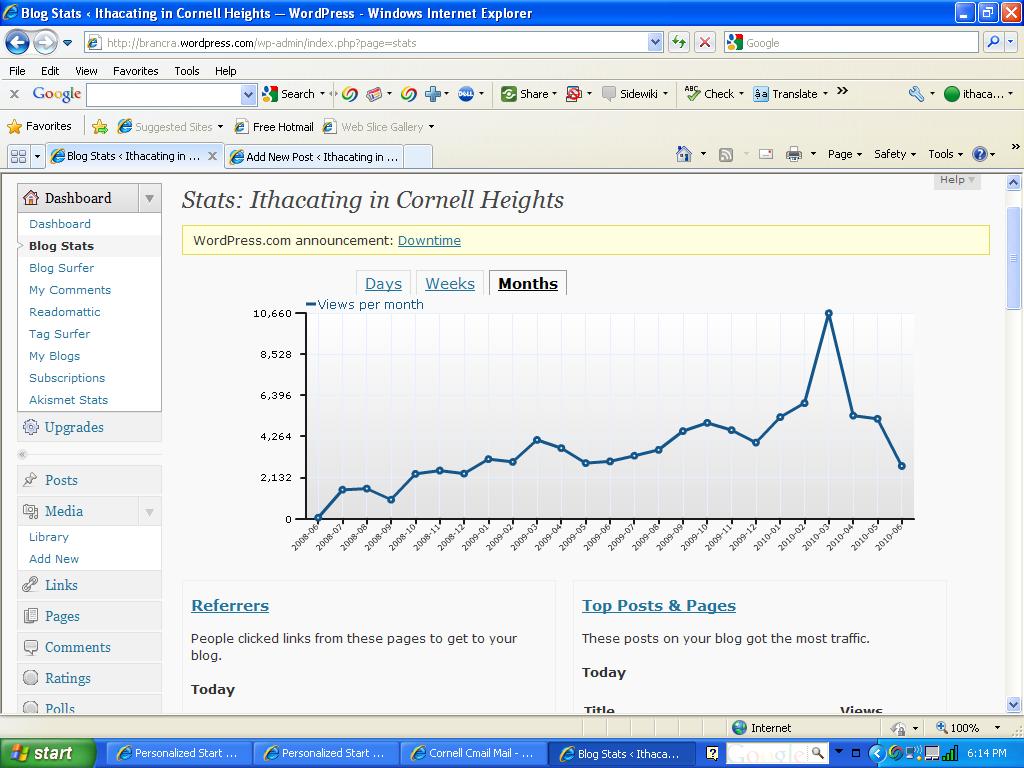
So, times change but this blog is still here. It has been almost exactly two years since this blog was launched (give or take an hour).  I’m not big on statistics for the site, but here’s some numbers:

Number of hits: 90,730 (about 124 hits/day; that’s up from an average of 82 hits/day for the first year alone; so roughly speaking, the second year averaged 166 hits/day)

Monthly stats:

 The highest month, with 10,659 hits, was March 2010. It’s trailed off since then, just as it did the previous year. The drop was so steep because March was when the news about the recent tragedies was most publicized. Which was my cue to take a step back and let things run their course, given the sensitive nature of the events.

Consider the following (and not nearly complete list of) events from the past year:

~The new Physical Sciences building continued its slow but steady construction, nearly complete at this point, while the Hotel School’s 12,000 sq ft addition was completed. The last half of construction also occurred for the Animal Health Diagnostic Center, nearly done as of this writing. Stocking Hall’s reconstruction and renovation was formally announced, and Milstein Hall began to take shape, next to the gaping hole where the mostly underground Johnson Museum addition is currently being constructed. MVR North added a glassy facade while interior work continues to take place, and Gates Hall still floats around in the approved planning phases. According to Cornell’s latest financial report, Gates Hall will be a 70.000 sq ft building, slightly smaller than the 100,000 suggested almost two years ago.

~Over at I.C., the Circle Apartments expansion has been proposed and the indoor athletic facility began to take shape, highly visible even from its collegiate neighbor on East Hill.

~In the city, the Cayuga Green condos still await construction. The ten-story Hotel Ithaca has been approved but has yet to start construction, while the debate over the 1200-bed Collegetown Terrace project off of State Street continues. The Ithaca Gun redevelopment stalled and had to have money reallocated for further remediation, with the hope that work will finally start progressing again in the near future. The Carrowmoor project continued to be trapped in red tape hell, but a Cornell-affiliated proposal for West Hill was announced. It would seem like most of the major private projects stalled this year in light of the recession. However, not all new is bad – a new 5-story apartment building was proposed for 309 Eddy Street and approvals were given for a 4-story 25 -unit expansion of the Coal Yard Apartments off of Maple Avenue. INHS finished its 39-unit Cedar Creek apartment complex and had begun plans for a new project on South Hill.

~In Greek Life, news was not good. Pi Beta Phi and Alpha Delta Phi became fodder for the Ivy League tabloid blog Ivygate, leading to embarassment, and in Alpha Delt’s case, social probation. Kappa Sigma was deactivated for pissing off its national organization, and Pi Kappa Alpha’s rush-gone-wrong brought about their suspension, and later, the university’s announcement that the chapter would be shut down. Let’s see, where there even high notes?…Seal and Serpent hosting Bob Saget is not exactly going to win people over on the Cornell Greek System.

A lot changes within a year. This years seems to be worse than the one prior. I’m keeping my fingers crossed for improvement.

I can remember when I started this blog, I was sitting in my shared bedroom in my apartment, it was pouring on-and-off outside, and feeling bored in Ithaca after settling into my summer jobs. Last year, I wrote the anniversary entry from the Harvey Library of Hampton University, and was rushing to finish because I knew the library would be closing shortly. Now here I am, writing in a cheap subletted apartment in Albany, doing research prior to starting my stint as a grad student at the SUNY for my master’s. Times change, and if anyone had told me this was where my path in life would take me, I would’ve called “bullshit” on that statement. I had general ideas what would happen and what my plans were, but I had no clue this is where I would be two years after starting this blog, and I have no clue where I’ll be one year or two years from now.

However, while the news has changed and a little more has been added to Cornell’s 140+ year history, the message of this blog stays the same. I hope that this blog has helped answer questions that people may have concerning Cornell U and its environs. If this blog makes someone a little more knowledgeable or at least serves as an interesting diversion, then it has done its job.


Cornell Students Party Too Much

13 06 2010

From the Cornell Era:

“Junior Ball week is getting rather overdone. What with the Sophomore Cotillion and the Glee Club concert and the Junior Promenade and numerous private and fraternity parties and the entertainment of guests, for a large number of students the entire week is consumed in pleasaure; more than one student cut all his university engagements last week. [1]”

The same argument could be made today, but the date of his editorial was February 11, 1893. The Cornell Era was a sort of predecessor to the Daily Sun. 

Some arguments never grow old.

[1] Morris Bishop, A History of Cornell, pp. 305.


The Alma Mater

4 06 2010

According to the greatness that is wikipedia, Alma Mater is Latin for “nourishing mother” — appropriate to its modern reference of being the institute of education where one receives their degree. I and perhaps 5,000 others joined the ranks (numbering 245,000 or so) of individuals who can call Cornell their alma mater. But it’s still strange to think that I’m an alumnus now.

So the experience of one class is different from another. If showcasing some of Cornell’s historical figures has proven anything, it’s that times change, as do the experiences change with time. Stuck in the Fast Lane delivered the message that although we are all Cornellians, no one has the same experience. If this blog has proven something, if anything, it merely emphasizes the point that Elie makes; although experiences vary, we all contribute some small amount to the long and finely woven Big Red tapestry.

A student in 1903 was subject to a typhoid epidemic that sickened over ten percent of the city and killed 29 Cornell students (about 1.5% of the school population — comparable to about 300 or so students today; and although directly caused by polluted water, some have indirectly linked the illness to Typhoid Mary Mellon). In contrast, a student in 1969 wondered if the campus would devolve into anarchy and violence, the tension culminating with the infamous Willard Straight Takeover in April of that year. A student this past year will probably remember the sheer number of tragedies that befell the Cornell community, especially the campus suicides. Perhaps on a lighter note, they’ll also remember it as the year the basketball team went to the Sweet Sixteen.

Point is, they’re all vastly different events, but they all still make up a part of Cornell history. As alumni, we’ve all lived through at least some part of that history as students, and hopefully many more years ahead as alumni.

Ca. 1990. Note the street traffic on the lower right, where Ho Plaza is today.

I have nothing that needs to be said about my experiences as a student. I made use of my four years. I felt like I contributed to Cornell’s history, not by writing about it, but my living it, breathing it, being a part of this institution and contributing in some small but personally meaningful way. That’s the most I could ever want.

Although my time at Cornell is over, this blog is not. It will operate in a reduced capacity, certainly. But history is still being made, new buildings are still being erected and new plans being conjured and proposed and maybe even approved and undertaken. History’s flaw and beauty is in its perpetuity. Life at Cornell isn’t ending because I graduated — it goes on for as long as Ezra’s and Andy’s institution remains Far Above Cayuga’s Waters.

That alone will provide me with the inspiration and the motivation to write for some time yet.


The 2010 Cornellian Yearbook

2 06 2010

So, my time at Cornell is wrapped up. It would seem fitting, not only as a graduating student, but for historical reference, to invest in a copy of the 2010 Cornellian yearbook.

Problem is, they suck.

First of all, if someone wanted to preorder, they make it pointless by offering no discount or advantage whatsoever. Not one dime, no personalization of the cover, nothing. There’s no incentive to order early so many people don’t. Of course, they print hundreds upon hundreds of copies anyway because they know over 3500 undergrads are about to graduate.

As Elie already noted, the historical accuracy and the writing are nothing short of atrocious. It would be one thing if they seemed to try at historical accuracy. But the mistakes are glaring, appalling, and most unfortunately, frequent.

I guess what I get hung up on are the photos of the students. Okay, so they sorted them by college (not done in older yearbooks). That’s cute. Rather pointless since everyone has friends spanning all schools and it makes them difficult to look up, but I digress. But it’s just a photo and a name. Could they at least make a half-hearted attempt to capture the glory of the old yearbooks?

The old yearbooks used to give a form to graduating seniors, usually when they had their photo taken, or sometimes submitted separately. The senior would give a very brief summary of their activities and accomplishments, no more than two of three printed lines. It usually went along these lines (and it varied depending on how much the person wanted to include):

HUXLEY, Martha. Ag. Ho-Nun-De-Kah. Cornell United Religious Work. Dean’s List.

HYMES, John.  Arts. Lambda Chi Alpha. Navy ROTC. Scabbard & Blade. Dean’s List. Graduate, Moorestown High School.

In earlier years, they were included in the space next to the photos. In later years, this section was moved to the back of the yearbook. In the past few years, it has been done away with completely. Which is a real shame. One of the things your yearbook should be memorable for is the inclusion of your accomplishments as well as those of your friends and classmates. Take that away and the yearbook loses a lot of its importance (especially to me, someone who would depend on those little bios for historical analysis of individuals).

On that note, the fraternity section — crap. The staff couldn’t get a group photo from each house as they have in almost every year prior? Bullcrap. Photos of the house are token, and all can be collected with a good set of wheels and a good camera within two or three hours at most. At least attempt to get a list of seniors from each house.

The yearbook tries to offset it’s cost (which, since it costs nearly $100, must not be working) by selling back pages to the parents of students seeking to lionize their children. I for one am not a fan of public displays of adulation. I have no desire to see full page ads of your son at ages 3, 8, 12, 17, and now and read about how proud you are. Couldn’t you have just bought a nice card instead? Back in the day, the Cornellian was more reliant on donations for ad space from companies in Ithaca – clothing and other retail stores, restaurants, B&B’s and the like. It was less egocentric and, in my humble opinion, more professional.

The photos in the Cornellian? Nice, but not nearly enough to make up for the steaming pile that comprises the rest of the book. Arguably, they can’t control the lack of hundreds of seniors from the yearbook either (which I felt uncomfortable looking through and not seeing their faces, but it’s their choice whether to get their photo taken or not).

I love history and I believe yearbooks are a valuable historical tool. Cornell has a fine tradition of quality yearbooks that are a great resource for research or even just the merely curious. But this was pathetic and shameful. This yearbook does not deserve to be associated with Cornell University and has diminished historical value.

In conclusion, the 2010 Cornellian Yearbook is absolute crap.


News Tidbits 5/21/10: Beware of Water Mains

22 05 2010

…especially if the building it runs under sits next to the gorge. Long story short, Cornell reports that the Foundry building (the long wooden structure across the street from Sibley Hall) is off limits to everyone because the gorge is collapsing due to extreme erosion from a water main break (which probably was the result of something Milstein-related). The Ithaca Journal reports the Foundry’s edge is within ten feet of the gorge’s edge at the present time. Civil engineers are working to stabilize the building and gorge. According to facilities, the 11,000 sq. ft building was designed by Prof. Charles Babcock and built in 1883, and is used as studio space for fine arts students. In contrast, the AAP website says it was originally built in the 1860s as a blacksmith shop, and was incorporated into the Sibley School of Mechanical Engineering by 1890. According to the AAP department’s website, the interior houses sculpture work space and a bronze-casting facility.

From the AAP website