Fast Facts: Academic Staff and Faculty Trends

10 11 2013

100_5551

In the entry, faculty are defined as “part-time, clinical and acting assistant, associate and full professors”, while academic staff are defined as “instructors, lecturers, senior lecturers, teaching associates, research and senior research associates, research scientists and principal research scientists, extension and senior extension associates, librarians, associate librarians, senior assistant librarians, assistant librarians and archivists”. All data is taken from the Cornell University Factbook:
Total Aca Staff

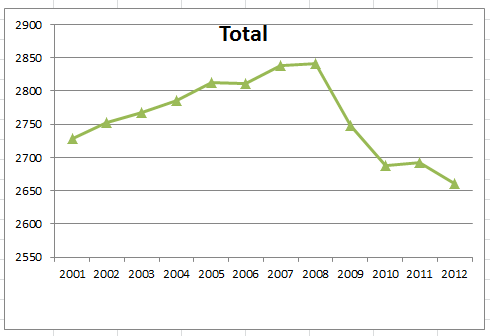
Fact number one – the number of academic staff has decreased, from 2,728 in 2001 to 2,660 in 2012. The number peaked at about 2,841 in Fall 2008, and has largely declined since then, as the Great Recession took its toll. CALS and Engineering appear to still be declining, with staff reductions near 10% in the past five years alone (704 to 654, and 306 to 280 respectively).  AAP has lost 14 positions in the same span, reducing academic staff from 69 to 55. Some schools, like the Hotel School and Law School, never really saw declines, while others such as HuMec and Arts & Sciences have started to rebound.

Faculty and Aca Staff

Let’s break down these numbers a little more, into faculty and academic professionals. Faculty numbers went from 1551 in 2001, to 1647 in Fall 2007 (its peak), to 1587 in Fall 2012. Academic staff went from 1,177 in 2001, to a peak of 1,219 in Fall 2005 (and a secondary peak of 1,208 in Fall 2008), and had decreased to 1,073 in Fall 2012. Let’s note that the student population has increased substantially since 2001, especially among the graduate student and professional student sub-groups.

Faculty Percentages

Overall, the faculty proportions haven’t changed too much. Slightly less assistant and full professors, and slightly more associate professors. It has been noted 47 percent of professors are over age 55, and 15 percent over age 65. Cornell had set a goal in Fall 2011 to bring in new blood and expand its faculty base by hiring 100 new faculty per year, but given these numbers, I’m doubtful that is occurring.

Aca Staff Percentages

With academic staff, the big decrease has been with those working in extension (Cornell Cooperative Extension). Some of these cuts were publicized, like the 17 staff that were laid off from ILR Extension in February 2009 (apparently, the Sun link no longer works since their website had to be rebuilt). Cornell Cooperative Extension comprises university outreach and research conducted as part of the university’s land-grant commitment to the state, mostly in agricultural concerns and community programs.

Aca Staff vs. Time

The drop in extension is illustrated further here. In 2001, it had 290 staff. In 2012, 0nly 213. The research staff went from 410 to 392 in the same span (note that there 454 researchers in fall 2008), and 126 to 110 librarian staff. Academic instruction staff increased from 351 to 358. Note that academic instruction staff does not include post-docs, as they are considered temporary employees of the university. Off-hand, given the salaries posted on sites like Glassdoor, I wonder if lower-cost lecturers and teaching associates are being hired in place of professors, and if the university has become more dependent on the cheap labor provided by grad students as their budget has tightened.



The Keyword Bar XX

2 11 2013

1. “pearl buck house ithaca” (10-27-2013)

That’s a bit of a tricky question. Pearl S. Buck, Nobel-winning author of “The Good Earth”, lived in Ithaca in 1924-1925 (she completed her M.A. at Cornell in 1925). Her first husband, John Lossing Buck, did a BS at Cornell in ag economics in 1914, and an MS in the same subject that was completed in 1925, and finally, a PhD in 1933. It would appear, based off a Cornell Sun article, that she once again lived in Ithaca from about summer 1932-1933. So most likely, one looking for the house she lived in would be looking for two different places in the Ithaca, the one from the mid-1920s when she was doing her degree, and the second in the early 1930s, when her increasingly-distant husband was completing his PhD. Not sure which time time this pamphlet refers to, but at least some of that time appears to have been spent in Forest Home.

2. “carl sagan’s secret tunnel” (10-27-2013)

One of the stories that enhances Carl Sagan’s mystique is that he somehow had a tunnel from his house to campus. That’s not feasible (there’s a gorge in the way), and perhaps some of its inspiration came from Ezra Cornell’s utility tunnel across the gorge from Sagan’s property at 900 Stewart Avenue. It seems he just preferred to you the back trails along the gorge to walk to his office and back.

3. “cornell prelims” (11-1-2013)

A word fairly unique in its use at the university, prelim is shorthand for “preliminary examination“, and in American usage, are normally applied as a synonym for the qualifying exam one takes to become a PhD candidate. The use of the term at Cornell, as a substitute to describe all non-midterm and final exams, dates back at least to the early 1900s.

4. “does cornell cals accept mostly ny state students?” (10-23-2013)

Cornell in general has about 29 to 30 percent of its freshman class arrive to its door from elsewhere in New York state. This SUNY 2013-2014 guidebook seems to peg CALS’s NYS enrollment proportion at 47 percent. I’ve had it understood that the difference in proportion was more because of the state tutition discount than it being “easier”, but it does look like the SAT scores in the contract schools in the 2013-2014 guidebook are lower than the university average. Speaking strictly from a numbers standpoint. I have no interest in humoring Ann Coulter’s wet dreams.

5. “where was zinck’s, ithaca, ny” (10-21-2013)

Zinck’s, or at least the Zinck’s referred to in “Give My Regards to Davy”, refers to “The Hotel Brunswick” lager beer saloon and restaurant that Theodore Zinck ran from about 1880 until his suicide in 1903. Zinck’s was located in the old Ithaca Hotel at 108-110 North Aurora Street; the building was torn down in the late 1960s, a victim of urban renewal.


Cornell Graduation Rates

25 10 2013

4-8-2013 231

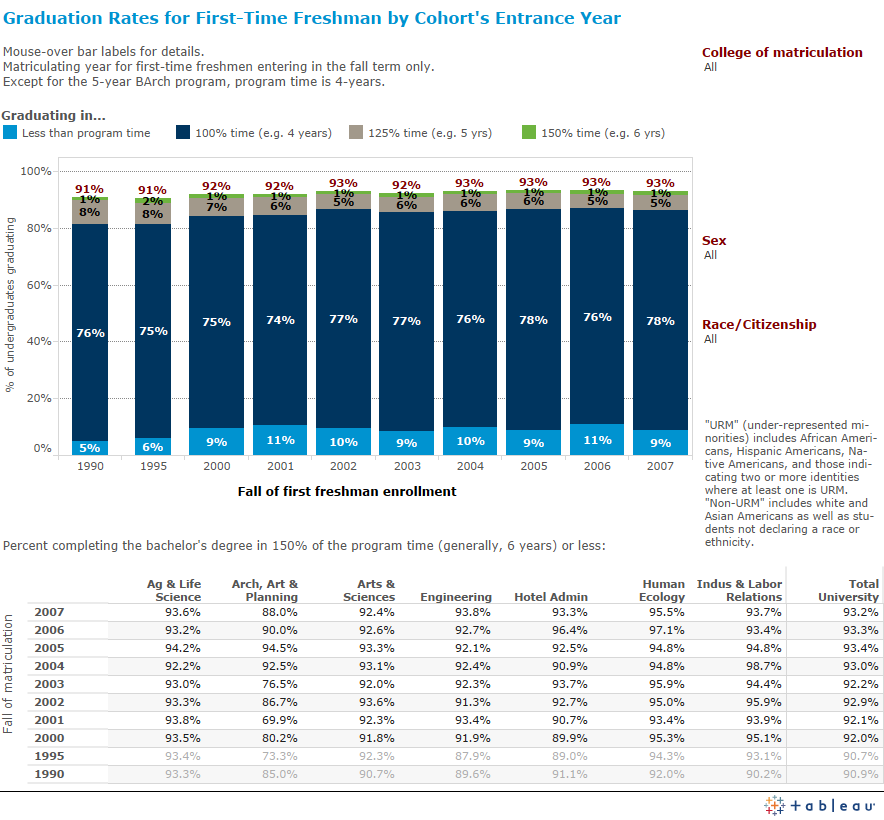
Graduation; perhaps the most important part of the Cornell experience. Facts are from the university factbook, as is the image below:

Freshman_grad_rate_trends

-For freshman who started in Fall 2007 (graduating 2011-2013), the overall university graduation rate (frosh who finish in six years or less) was 93.2%. Human Ecology set the standard at 95.5%, with most of the other schools clustering near the average, except for AAP, which polled at only 88%. Arguably, AAP’s number are more prone to skewing, since they’re the smallest college and it takes 5 years to complete architecture degrees; but the facts are what they are, AAP usually ranks below average, and is often the worst of the seven colleges for graduation rates.

-Over the decade, graduation rates jumped in the first half from 92 to 93.4%, but have dipped slightly since. The number still poll better than the 1990s, when graduation rates were just under 91%. The localized max is 98.7% for Fall 2004 ILR freshman, and the local min is the 69.9% for fall 2001 AAP freshmen. Compared to the 1990s, students seem to averaging a slightly quicker completion of their courses of study, with an increase in the less-than-4 year path, and a decrease in the percentage of super-seniors.

-Women consistently graduate at slightly higher rates than men. In 2007, 95% of women graduated within six years, vs. 91% of men. This is consistent across schools and in most years, though in some years the gap is as low as 1%, but the gap has trended slightly larger in the past few years.

-University-Recognized Minorities (URMs, referring to non-white and non-Asian students) graduate at slightly lower rates, 88% for those starting in fall 2007 (the value has been in the upper 80s for most of the past decade). URM males fare worse, at 85% for fall 2007’s freshman class. For African-American males, the rate has been as low as 75% in recent years.

-International student finish at rates not substantially different from the general student body, but they finish in less than 4 years at much higher rates – 20 to 30% of those freshmen will finish early. If I remember correctly (i.e. I can’t seem to find anything to back this up), certain countries, like Singapore, push their students to finish as quickly as possible.

-About 1 out of every 8 students will graduate from a college different than the one they were enrolled in as a freshman (ex. started in Arts and Sciences, finished in CALS). There’s no real trend over time, or for school transfers (evidence that AEM is trying to become more exclusive?)

-Transfer students graduate at rates virtually identical to those who started at Cornell as freshmen, with the exception of AAP, where they do not do as well. Once again, small incoming transfer numbers can skew this figure easily.

-About 3-4% drop out after freshman year. From there on, about 1-1.5% who finish their sophomore or junior year will not come back for the subsequent year of their matriculation.


A Bigger Vet School

10 10 2013

cropped-100_1794.jpg

I’ve only ever been in the vet school once, to deliver an invitation for a wine and cheese event to an alum of my fraternity house who worked as a researcher at the vet school.  When it came to getting photos, I would just take advantage of my Bradfield perch, take my photos, and that was that.

The vet school is not unlike the rest of the school in that it’s been built in spurts. The original vet school was in James Law Hall, where Ives Hall stands now (and even prior to that, it shared space in the north wing of Goldwin Smith Hall, the old dairy science building). The vet school moved further east with the construction of Schurman Hall in 1957, and expanded with the Vet Research Tower in 1974, the Vet Education Center and Vet Medical Center in 1993 and 1996, and the East Campus Research Facility and Vet Diagnostic Lab in 2006 and 2010 respectively.  Essentially, the vet school is like many human hospitals, a mish-mash of additions and new wings/buildings, incoherent and even incompatible. The completion of the the  VDL building left a large amount of vacant space in Schurman Hall that was difficult to repurpose, hence the approved plan – demolish 68,000 square feet of space, build 65,000 square feet of new space, and renovate 33,000 square feet of existing space, to be done in two phases with a combined cost of $63 million.

Looking east from Tower Avenue. Rendering property of Cornell.

Looking east from Tower Avenue. Rendering property of Cornell.

Given those stats, it seems like a misnomer to call it an expansion, but one of the effects of the reconstruction will be to increase the number of matriculating vet students in a year from 102 to 120 – and given Cornell’s #1 vet school ranking, they will not be lacking in applicants. Over four years, you have 72 more professional students – you’re welcome, Ithaca landlords. Among the details, the old auditorium will be torn down, and in its place comes the new Flower-Sprecher library, two new lecture halls, a new dining hall, large gathering spaces (i.e. yet another open atrium) offices, an expanded anatomy lab, and a green roof. The architects of this plan are New York-based Weiss/Mandfredi, who specialize in hypermodern glassy spaces.

Looking west from new courtyard. Rendering property of Cornell.

Looking west from new courtyard. Rendering property of Cornell.

As for the time frame, Phase I, which comprises the tear-down and new construction, will start in April 2014 and be completed in a 12-month time frame. Phase II, the renovation component, will commence at that time and proceed towards a tentative completion in October 2016. I will already be beyond my 5-year reunion, so that kinda freaks me out.

Straying a bit here, but I’ve heard from my vet school friends that the market isn’t absorbing new grads like it used to, and not at the salaries that it used to. A for-profit school planned for Buffalo was recently cancelled. But, I suppose for the #1 school, these are concerns that the college is reasonably shielded from. Adopting a dog in the next couple years is on my priorities list (if I can ever establish enough of a schedule that makes me feel like I’d have adequate time to love it), so in my totally uneducated opinion, more vets is fine by me.


Fast Facts: Cornell Enrollment Figures

20 09 2013

5-1-2012 140

Some insights via the University Factbook

– Cornell’s enrollment has grown markedly from 2002-2012, from 19,575 to 21,424 students.

totalstuenr

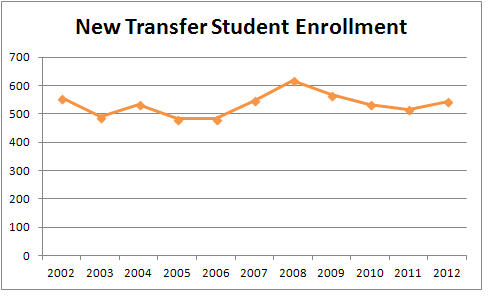
Which is not really the result of increases in undergrad transfers, which show no long-term trend (stays near 550, give or take a few percent).

transstuenr

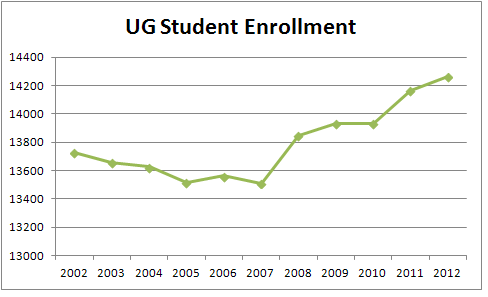
Although UG enrollment has increased 3.9% over the decade (from 13,725 in 2002 to 14,261 in Fall 2012). In effect, undergrads aren’t the major growth component here.

UGstuenr

Haha, of course not. Undergrads often require aid. And the proportion of the student population receiving aid has increased over the decade, from 48 to 57 percent:

ugstuaid

Worth noting, the primary jump, from 2007 to 2009 (46.73% to 56,49%) ties in pretty well with the enactment of Cornell then-new financial aid policy, and the economic nosedive of the late 2000s.

The growth comes from our workhorses – the grad students, many of whom have stipends and tuition waivers in return for their TA/RA work:

gradstuenr

…and our cashcows, the professional students like those pursuing law degrees and MBAs, and paying out for those degrees (Fall 2013 values $57,270/yr and $55,948/yr respectively). Yes, I’m aware many business pay for their employees to get MBAs, but the point is, someone’s ponying up the cash.

profstuenr

Grad students increased from 4288 to 5049 over 10 years (+17.75%) and professional students from 1562 to 2114 (+35.34%).

In tying in to the other theme of this blog, all those grad students and professional students have to be housed somewhere, and only a very small number can find space on campus. There you go Ithaca real estate developers, there’s another positive factor in your growing market. Assuming the 2.0 figure for the average number of unrelated people sharing a unit. you get 925 units. West Campus added no new beds, so I’m pretty sure the on-campus resident population from 2002-2012 was nearly static.


Cornell Drops a Spot and the World is Ending

10 09 2013

USN&WR drops Cornell from 15th to 16th and the entire Cornell-centric world becomes unglued.

“If we don’t get back to top 12 soon, I’m rescinding my diploma.”

“it was 12 like my sophomore year with Columbia at 10.
now it’s 16 and Columbia is at 4. Yay for Skorton!”

Not even in top 15.. Cornell is dilutinge ivy league brand.. Should apologize to rest of ivys…

Quick Trudy, grab the smelling salts, I fear a mass fainting spell is a-comin’.

Ignoring the fact that rankings are becoming a dime a dozen, and that USN&WR tweaked its ranking system, I’m going to focus on the historical standpoint of rankings. First off, a brief check of previous rankings of Cornell by USN&WR. As noted by the Chronicle, Cornell’s US News ranking generally fluctuated between 10th and 14th from 1989-2009. More specifically:

2014: 16th

2010, 2011, 2012, 2013: 15th

2009: 14th

2008: 13th

2007: 12th

2006: 13th

2002, 2003, 2004, 2005: 14th

2001: 10th

2000: 11th

1999: 6th

1998, 1997: 14th

1996: 13th

1995: 15th

1994: 10th

1993: 11th

1992: 12th

1991: 9th

1990: 11th

1989: 14th

1988: 11th

1983: 8th

Let me offer a visualization:

cu_usnwr

Cornell has only briefly flirted with rankings of 12th or higher in the past two decades. I’m going to go out on a limb here and say that in general, it’s less what Cornell is doing and the changes have more to do with the way the rankings are calculated. Noting the above commenters, and that Columbia was last ranked 10th in 2003, it’s essentially a group of knee-jerk reactions from not-so-young alumni.  With regards to the previous entry, we’ve seen that US News’s ranking has little bearing on the acceptance rates, application numbers, and applicant yields. I understand the prestige factor and concerns if this worsens, but unless your job is extraordinarily dependent on your alma mater’s current ranking by a single agency, I suggest toning down the hysterics.

It’s the same damn thing every time. Ranking drops, people from that school are up in arms, the school is decaying, students are worse these days, its the admin’s fault, don’t associate with me with that lowly school. Ranking goes up, people call it “the new/public/Southern/Western Ivy/Harvard/insert prestige item here” and croon about how smart they are, even if they went there twenty years ago when its rankings were lower.

It’s good to assess the school’s direction periodically, but with every annual reranking, some alums need a reality check more than anything else.


Fast Facts – Cornell Admissions

5 09 2013

7-26-2013 039

Well if this isn’t just one of the best one-stop shopping sites for Cornell facts. Five years ago, when this blog started, the “University Factbook” would best be described as a bunch of sparsely-populated webpages and a ramshackle set of links between them, more of an amateur endeavor than anything specific produced by the university. This is quite much awesome.

Since I feed off of Cornell/Cornelliana facts much like an addict looking for their next hit, I thought it was fascinating to consider enrollment trends and things of those numbers in context. Since the graphs start at 1980, I’ll start from there as well. Note that these figures cover undergraduate admissions only.

  • Looking at the number of applications and starting with the 17,007 in 1980, there’s a steady rise through most the 1980s, peaking in fall 1988 with 21,765 applications. From there, the numbers drop off to about 20,000 and stay close to that value until the fall of 2004, where a rapid ascension commences. Much of this can be explained by Cornell starting to accept the Common Application, where a check of the box equals another base application, making it much easier for the prospect to apply to 20 schools instead of a few.  Arts and Sciences and CALS follow the same general trend, while engineers never had much of a peak in the 80s, and AAP applications have dropped off since 2010. HumEc has stayed roughly constant since the late 1980s, the Hotel school shows the most wild swings, and ILR really took off in 2006, when some folks decided that being a lawyer was the path to easy riches. We also have the ones that don’t choose a school, which if I remember right, means an automatic rejection. Cornell shows at least 1,000 a year since 2006, and over 2,000 in 2008. Nice one, kids.
  • Looking at acceptances, Cornell started the ’80s with around 5500 acceptances per cycle, creeping past 6,000 as the decade progressed. For some reason, the numbers shot up in the 1990s to over 7,000 acceptances by 1993, and stayed near that number through 1998. After that, Cornell became more stringent, and acceptances dropped to 5,861 by 2001. Numbers have stayed in the 6,000 range since, with mini-peaks in the fall 2006 and 2008 classes, and little dips in the early 2000s and with the most recent classes.
  • The largest freshman classes? 2011, with 3356, followed by 1993(3286) and 2013(3282). The lows were all in the early 1980s, led by 1982(2785), and followed by 1980(2836) and 1981(2885). Cornell’s capacity has grown over the years, as the north campus townhouses were built in 1989, and CKB/Mews were opened in 2001. Notably, the last sub-3,000 class, in 1992(2959), seems to have precipitated the 1993 peak. No schools show any discernible trends, although Engineering’s numbers were up during the days of the 1990s tech boom.
  • The highest yields for the university (average 49.2%) were in 1984, 2000, 2001, and post-2010 (2013 is the highest at 53.4%). The lowest yields were 1992-97 and the mid 2000s. 1992 was the lowest at 44.4%. The university will have its work cut out for it as the echo boomers/millennials finish their collegiate years and schools compete over what may be smaller applicant pools.
  • HumEc shows the widest range in yield, with a low of 48% in 1983 to a high of 96% with the fall 2001 frosh class (the latest class is 67%). Schools with specialized focuses, like ILR and Hotel, seem to have the best yields, as Hotel pulls numbers consistently near 90%, and ILR does as well (albeit a little more inconsistently). CALS also pulls above average numbers, which may be in part to the in-state tuition benefit. Engineers are close to the university average (damn you MIT), while Arts has an average yield only in the upper 30s (there’s just so many liberal arts schools to compete with, not to mention the other Ivies…)
  • On average, women have a slightly higher yield than men, 49.9% vs. 48.4%. A few years, such as 2008, had a higher yield for men than women.


News Tidbits 8/27/13: Gannett Expansion Gets Greenlighted

27 08 2013

100_6620

With the donation of $5 million from the chair of trustees Robert Harrison ’76 to launch the fund raising aspect of the project, the Gannett expansion has now solidified into a concrete project in the planning stages. Initial plans call for an increase in the size of the building from 38,000 sq ft to 96,000 sq ft, and a targeted completion date for October 2017 (which means the vast majority of kids that just started at Cornell this week will never see the building completed while students at Ezra’s university). I imagine that, giving a year or so for construction, and an expected price tag of $55 million (one-third of which will be funded via donations), that a couple of years of fund raising is more than enough time for some deep-pocketed alumni to throw their cash into the kitty, and end up with a waiting room or doctor’s office named for them in return.  Gannett Health Center opened its doors in 1955 (named for Frank Gannett 1898, the mid-century media titan), and expanded in 1979.

Proposals to expand Gannett have been floating around since at least 2005, and shows up in Cornell’s 2008 master plan. At the time, the plan called for a 90,000-130,000 sq ft building, which means that the above firm proposal falls within those nascent specifications. HOLT architects did a 2007 design study proposing a 119,000 sq ft building. It’s nice to see this one come out of the hazy ether of vague proposals and become a formal proposal. The next question, of course, will be what the design of the structure will be. Given the university’s trend, my inclination is to expect another hypermodern box.

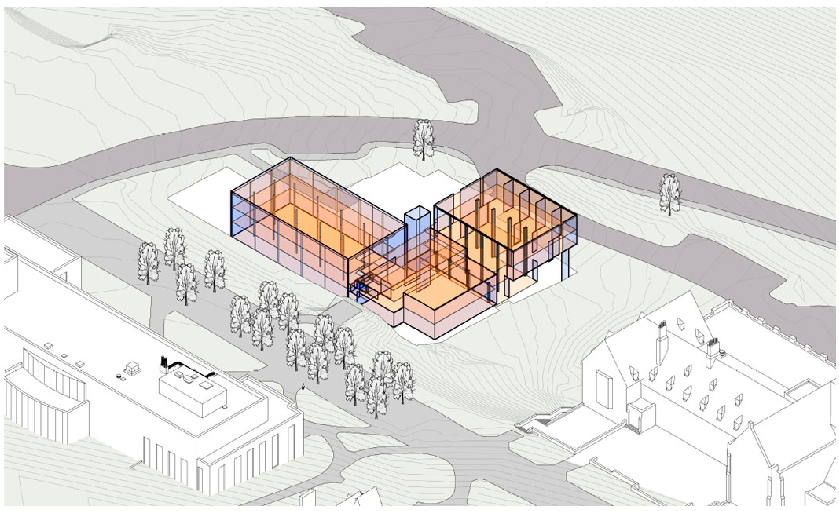
Update 8/28: Ithaca Builds’ Jason Henderson has kindly passed on a link from Chiang O’Brien, a local firm started in 2012 by some former employees of also Ithaca-based HOLT Architects. The two follow similar themes, simple forms but big on geometric detailing, and most of their designs could be described as revamped modern or hypermodern. Looking at their website, I see some massing diagrams of the current facility, but nothing yet for what’s planned.

gannett1


Cornell Likes Having Friends

30 06 2013

4-8-2013 233

The majority of buildings at Cornell are named for faculty, staff, and alumni with deep pockets. A few others just have generic titles. Occasionally, a building on campus is named for someone with no association with Cornell, except that they helped out the university (usually from a financial aspect). Some of buildings named for “Friends of Cornell”, as Alumni Affairs likes to call them, are detailed below.  One exception I make is that early on, some folks who were Cornell trustees (but had no association otherwise) have buildings named for them, such as Henry W. Sage, John McGraw and Hiram Sibley; but since they served Cornell in an official capacity, I’m excluding them here.

Morrill Hall (1868)  – Like many land-grant institutions, Cornell’s Morrill Hall is named for Justin Smith Morrill, author of the Morrill Act that allowed the sale of federal lands to raise funds for colleges focused on the agricultural and technical trades (some of the other schools include Purdue, Rutgers and MIT; Morrill is known best for this legislation, with his anti-Mormon work a distant second). Morrill had no official association with Cornell, although he did pay a visit to the university at least once, in 1883.

Morse Hall (1890), Franklin Hall (1883) and Lincoln Hall (1888) – In the Gilded Age, engineering and science buildings had the pleasure of being named for “great men” that contributed to the then-present condition of the university and STEM studies. Hence, Samuel Morse (inventor of the telegraph), Benjamin Franklin (politician, scientist, and all around bad-ass), and Abraham Lincoln (president who oversaw the passage of the Morrill Act). Morse Hall burned down, and Franklin Hall became Tjaden Hall (for prominent female architect Olive Tjaden ’25 ) in 1980.

Rockefeller Hall (1903) – Named and partially paid for by John D. Rockefeller, the wealthiest man in the world at the time (and, proportionately, believed to be the wealthiest man ever). Rockefeller has recently retired from Standard Oil and was just beginning his philanthropies, funding schools he believed to be practical. Rumor has it that he was so disappointed with the (then considered unattractive) appearance of Rockefeller Hall he vowed to never donate another cent to Cornell. Which hardly dampened his funding of institutions.

Fun fact, Walter Teagle, of Teagle Hall fame, was a vice president of Standard Oil a few decades later.

Baker Lab (1923) – Funded by George F. Baker, a sort of Warren Buffet of his time, and one of the wealthiest Americans on the early 20th century. Baker also provided much of the funding for the Harvard Business school, and made his way through the Ivy League with his donations, including Columbia’s Baker Field and Dartmouth’s Baker Library.

Mudd Hall (the west wing of Corson-Mudd Hall, 1982) – Named for Seeley G. Mudd, a prominent philanthropist. The foundation established with his fortune explicitly earmarks donations for the construction of academic buildings – the wikipedia list shows no less than 30 schools that have benefited from his funds. Otherwise, Dr. Mudd has no connection to Cornell.

Gates Hall (2013/14) – Not unlike Mudd Hall, Gates Hall is funded with a hefty donation from the Bill and Melinda Gates Foundation, the philanthropic org maintained by Warren Buffet and  Microsoft overlord Bill Gates.

100_7116


King-Shaw Hall

21 06 2013

101_0489

So, in doing research for a later entry, I was going through the list of facilities on Cornell’s website, and came across an unfamiliar name – King-Shaw Hall.  So I decided to check – the facilities website contains buildings that have long ago been torn down, such as Morse Hall.

To my uncomfortable surprise, the ILR Conference Center changed its name way back in October 2012. In my defense, this appears to have happened right around my first week on the job, so my mind was on other things. Secondly, if this was anything like the sudden change they made with the ILR Extension Building becoming Dolgen Hall in 2008, then I can’t be blamed too much, as that one almost flew under the radar while I was a still a student (had it not been for the lettering change outside the building, I would not have known).

According to the ILR press release, the building was renamed for Patricia and Ruben King-Shaw ’83, so two donors but not two separate donors as one might suspect (see Court-Kay-Bauer for an example of the latter). Ruben King-Shaw is the chairman of an equity firm, and according to Forbes, has an extended history serving in executive roles in healthcare administration, both public and private. For better or worse, one of his daughters currently attends Cornell; on the bright side, you can point to the building and say, with pride, it’s named for your family; on the other hand, it means every time you do well on something, or if you’re selected for a secret society, your peers will snidely whisper it’s because of the enormous amount of money your family donated to the university.  For the record, although the amount donated is undisclosed, it’s probably something similar or marginally more than the amount donated by John Dolgen, which was described as a “multimillion-dollar gift“.

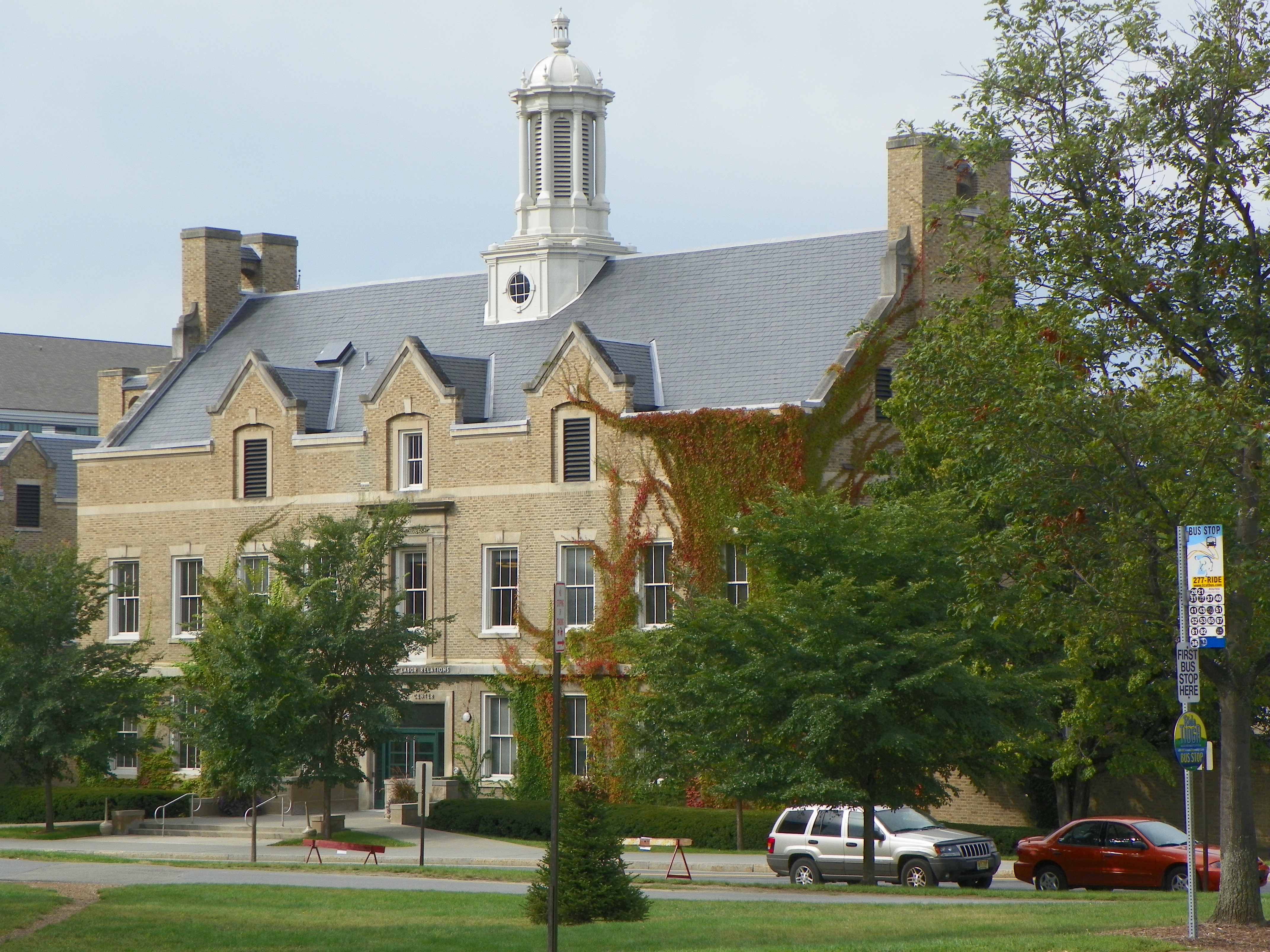
As to the building itself, The ILR Conference Center was built in 1911 as an expansion of the Vet School. ILR moved in during the late 1940s. As with Dolgen and the ILR Research Building on the south end of the complex, King-Shaw Hall underwent a significant renovation from 2002-2004, but because these buildings were designated landmarks, the exteriors were relatively unaltered. I suppose at this point, it won’t be long before ILR finds a donor for the Research Building, if someone feels the urge to part with some millions for nominal immortality.