Oh Great, I’m Becoming A Preservationist…

18 03 2011

So, looking at the planning board agenda for the city this month, most of the projects under review have already been covered in previous entries. But there appears to be a new entry, and it’s based on College Avenue. 140 College Avenue, to be exact. The owners, Po Family Realty, seek to add a 3800 sq ft, three-story apartment addition onto the south side of the building. Which, in most cases, wouldn’t be a tremendous deal.

Except 140 College Avenue is considered untouchable by the local preservationists, and I can’t blame them for that opinion either. As a matter of fact, I might even agree for once in a blue moon.

You see, 140 College Avenue is the John Snaith House. Although the name may not sound familiar, its appearance certainly will. It’s the red brick house on the corner of College and Cook Street with the wrought iron fence and mansard roof. It made an appearance on the recommended Collegetown structures for historical designation document released a couple years ago.According to the PDF, the house was built by and for John Snaith, a contractor, in 1874. He relocated to Albany in 1887, and the house was badly damaged and rebuilt following a structural fire in 1894.

The issue I have with this project isn’t so much the project itself, which I do think is a bit unnecessary consider the benefits of such a small project are small. It’s more to do with the fact that the Snaith House is a well-recognized historic building. I’m concerned that if it somehow got approved (which, considering one of the writers of the historic buildings document is also chairman of the Planning Board, I find unlikely), it would galvanize the local NIMBYs who would point to that project as an example of the dangers of development, and use it to try and dissuade later projects.

I’m still surprised the owners of 140 College Avenue would even propose this project. I don’t normally turn up my nose at development, especially in Collegetown, but this proposal stinks.


Construction News Tidbits, 12/18/10

18 12 2010

A few articles have popped up lately that merit a brief writeup.

The BJ’s Wholesale Club and 12 senior apartments planned for the grass lot next to the Shops at Ithaca Mall (behind the YMCA) hit a snag when the county industrial authority voted down a tax break for the residential portion of the project in a 4-3 vote. While this makes the project less likely, it is not entirely dead, and the town of Lansing still supports the project. However, it’s the  village of Lansing that demanded the residential component as a buffer between houses and shopping areas. Some involved with the project contend that the votes against were by Ithaca-centric legislators who’d rather see the potential sales tax dollars go to the city (i.e. build the store on a site in Ithaca City). BJ’s has no interest in any local site except the one currently proposed, so in conclusion everyone’s getting their panties up in a bunch, and the project is at the very least on hold in its current form.

Out in Dryden, a 144-unit apartment complex is being proposed. Called “Poet’s Landing” (perhaps as a nod to John Dryden, the British poet for whom the village/town is named), the project consists of a 72-unit senior living apartment building, 7 other buildings containing a total of 72 units, and a community center. 48 of the 72 non-senior units are proposed low-income housing, which has managed to rile up the locals with fears of higher crime rates and drugs (the project is across the street from Dryden High School). the project is by Conifer Realty, who also own the Linderman Creek complex over on West Hill.

Lastly, a little closer to Cornell, the Collegetown Terrace Project is waiting on three things – site plan approvals, approval of a zoning variance, and a “certificate of appropriateness” from the Landmarks committee, who are not doubt still seething after the city okayed demolition of Delano House in exchange for the restoration of another house on the property and some public signage displays of the site’s history. If the project can clear those final hurdles, a late spring or summer start for site prep is likely.


News Tidbits 9/25/10: Development Planned for 307 College Avenue

25 09 2010

This is slightly annoying. I was away from my computer yesterday and today as a result of my graduate work and then coming straight out to Ithaca, so I never bothered to read my Ithaca/Cornell newsfeed. So it’s bothersome that I found out about this relatively later than usual. Anyways, here’s the article from the Daily Sun:

http://cornellsun.com/section/news/content/2010/09/24/developer-seeks-approval-new-c-town-building

September 24, 2010
By Jeff Stein

A proposal to transform the middle of College Avenue hinges on developer Josh Lower’s ’05 controversial request for a Board of Zoning Appeals variance, which would exempt a building’s development from city parking laws.

Lower said his proposed development project at 307 College Avenue –– next to Jason’s Grocery & Deli –– would demolish the existing building and create more than 60 new apartment units. Lower also hopes to remake the area into a highly trafficked “pedestrian arcade,” filled with street-level storefronts that would connect College and Linden Avenues.

City officials are divided on whether the Board should grant Lower the variance. Under the city’s current parking ordinance, every two housing units built must be matched by the creation of one parking spot.

Lower said that building the parking spaces, which must be within 500 feet of the site, was “not practically or financially possible.”

“We’ve tried to meet the law but cannot,” Lower said.  “There’s just not enough space.”

Ithaca Councilmember Ellen McCollister (D-3rd Ward) expressed concern that there would be a lot of “spillover” for surrounding neighborhoods if the variance was given.

McCollister also said the variance would establish a dangerous precedent: “If you grant a variance to one property owner, how do you not grant [it] to any other property owner?”

If one developer is granted an exception, “all hell breaks loose,” as other developers would expect the same treatment. “We need to treat every developer consistently and equally,” McCollister said.

Lower said his plan would compensate for the lack of new parking spaces by providing his residents with a car-share membership and free bus passes as part of the lease.

“We’ll create a building that fosters … sustainable modes of transportation and encourages people to bike more, walk more,” Lower said. In reference to a proposed pedestrian walkway, Lower said, “We’re making privately-owned space accessible and usable for all.”

McCollister was not convinced. She called Lower’s replacement for parking spaces a “very ill-defined, nebulous proposal,” saying it was “not a real plan for how he is going to do it, in perpetuity, for every resident.”

Partly because there is “more supply in retail than there is demand” for Collegetown, McCollister is “not convinced the pedestrian arcade is as valuable an amenity as it’s being portrayed.”

Board of Zoning Appeals member James Marshall shared McCollister’s skepticism about Lower’s replacement plan in exchange for a variance, calling the lack of parking spaces in his proposal a “significant deficiency.”

“He’s proposed some measures that might encourage people to use public transportation or bicycles, but no one knows how successful he’ll be,” Marshall said.

Stephen Beer, chair of the Board of Zoning Appeals, said he worried that there was no provision for enforcing Lower’s suggested replacement for the parking spaces.

Lower responded that “it would be a requirement written in the lease.”

Eddie Rooker ’10 (D-4th Ward) said he and Svante Myrick ’09 (D-4th Ward) both supported the project.

Rooker said the development is “going to be beneficial to students and the city,” naming studies that “point to the fact that we need more housing in the city” given “pretty high pricing all over the city.”

Rooker said the project would fix the need for a “well-lit pedestrian walkway connecting College and Linden Avenue,” where “people now have to go between people’s yards when they’re not well-lit.”

Rooker said the proposal could make the area in front of 307 College Avenue a new hub for TCAT, shifting the center of Collegetown further south.  He said that TCAT wrote a letter to the city in support of the project.

Lower, who lives in the neighborhood, said that “we really looked at a lot of scenarios to try to do something else with the property,” but that nothing else was viable. He said that he is currently losing money on the property.

McCollister responded that one of the considerations for the Board of Zoning Appeals was that the variance request not be in response to a “self-imposed hardship.”

“I think he does have a financial hardship, but that’s because he paid too much for it … rather than some externality that created that financial hardship,” McCollister said.

McCollister added that the Board of Zoning Appeals should wait until a decision is made about an “in-lieu of parking fee” suggested in the 2009 Collegetown Urban Plan & Conceptual Design Guidelines. The proposal, which is currently being developed, would specify a fee below the cost of providing on-site parking that developers could pay the city in lieu of building parking spaces. The Collegetown plan says the fee could then be used to help the city fund alternative transportation modes.

“I can only base my plans on what is law today,” Lower responded.

Rooker agreed, saying, “We can’t constantly rely on what might be happening,” and that he “would rather see something like this than a one time donation to general fund” anyway.

Lower added that waiting for the law to pass could have a big impact on his finances, since “the building has to be done based on the academic year.”  “If the building is not ready to have [residents in it] before classes start, it sits empty for the rest of the year.”

If approved, his plan is to start construction in June 2011 and have the building ready for residents in the Fall of 2012.

***

So, the summary is this:The guy wants to build a medium-sized apartment building but doesn’t want to include parking. The issue lies with the possibility that residents would just park their vehicles on the streets and clog local roads, and finding viable options to keep that from happening. A zoning variance is required due to the lack of parking, and without it the project will not proceed.

A few extra details; the development would be a 60-unit building with a retail base. Guessing from the rendering and from the height limit there, it would be about five stories. The current building on the site used to be occupied by a drugstore, but the store closed in late 2006. With the exception of the space occupied by Ithaca Carshare, the retail portion has been empty since.

The argument on the parking issue is reasonable and legitimate. A lot of students maintain cars, and the overly entitled ones may still try and maintain a vehicle nearby, thus creating parking issues for the building’s neighbors. While the project would definitely add density and needed residential space to inner Collegetown (and definitely makes use of New Urbanist planning), the lack of parking is a major hurdle. Personally, I like the idea of the project, but unless he can make absolutely clear what he’s going to do to keep students from bringing vehicles to an area with no space for them, and be held to that “in perpetuity”, I would be leery of its approval.

The architect is a small local Ithaca firm founded about seven years ago, John Snyder Architects.  Looking at the website, it seems most of their work has been for educational facilities or interior spaces, and the style tends to be modernist with limited detailing, instead playing off of the geometric forms of the structure itself. I’m very curious to see the whole design of what would seem to be the firm’s first large residential building. At the very least, it least it won’t be another Sharma Architects proposal; a little variety does wonders.


The Keyword Bar XI

20 09 2010

…because I don’t feel like researching (Cornell related or work-related).

1. “new collegiate gothic” (9/19/10)

Okay, so this probably has little to do with Cornell, as Cornell hasn’t built in collegiate Gothic in over fifty years. Regarding that, I’d like to share a brief quote from Morris Bishop’s A History of Cornell:

“The Buildings and Grounds Committee recommended (September 19, 1950) that we wait no longer for donors of Gothic magnificence, but that we build structures that would pay their way. Said the chairman, John S. Parke ’23: “Engineering rather than architectural construction is advisable”. (597)

Of course, then we ended up with such “lovely” works as Olin Library and Olin Lab and Bradfield Hall.  I suppose the only way one could force a new Collegiate Gothic structure onto campus today would be as a stipulation of a very large donation (as in, one that pays for an entire new building without major additional funding from Cornell).

2. “ivory tower drinking society” (9/18/10)

This is a little murky. First off, it wouldn’t formally be called a drinking society  (the more likely term would be social society). As for the existence of such a group, googling “Ivory Tower Honor Society Cornell” pulls up a bunch of linkedin profiles of sorority women in  who were part of Cornell’s “Ivory Tower Honor Society” during the 1990s. So, if I had to take a guess, it was probably a tenuous organization that served more of a social purpose than anything honorary. But, I can’t say for sure.

3. ‘tompkins county public library roof” (9/17/10)

It has solar panels (that generate about 145 kilowatt-hours). Kinda funny considering Ithaca is one of the cloudiest cities in the country (206 days/year).The library opened in 2000 after moving from a location several blocks away; the site used to be home to a Woolworth’s department store.

4. “ithaca 103 dryden ave video store” (9/15/10)

I was wondering if this would come up. As covered recently by the Sun, the Collegetown Video store shut down after nearly twenty years of service. The store open in February 1991. The unique metal facade was designed by Cornell architecture students while the store was renovating the building for its grand opening. No plans for new tenants have been announced at this time.

5. “college confidential cornell biology” (9/4/2010)

I’m going to use this as a bit of a conversational launching point, actually. Since a lot of my information has to be pulled from the internet,  stumbling through message boards is inevitable. College Confidential is somewhat trustworthy, but the discussion focuses on more practical questions – “how easy is ASIAN 2571” and “chance me for admission plz!!!11”. There’s a couple of sites where people rate their experiences at Cornell, which lack details but are often good reads if you’re just looking to kill time. then of course, there’s the gossip site College ACB, which focuses on which frat is best, which freshman girl puts out the most and which sorority has the hottest pledge class. A whole lot of douchebaggery, but on rare occasion there’s a really interesting topic that offers frank insight — but finding those is like finding a diamond in a pile of crap. Use at your own discretion.


News Tidbits 7/22/10: Collegetown Terrace Goes Back to the Drawing Board (UPDATED)

22 07 2010

UPDATED: A sketch rendering of the new design has been released. Small, house-like apartments have designed along East State Street in place of buildings 2 and 4. Building 3 is still one continuous building, but the exterior breaks into subsections to minimize bulk and give the impression of multiple strcutures. The Delano House is still under consideration for preservation, but is more of a suggestion at this point (unless the preservation committee and the Common Council give it historic designation). I actually like it more than I did the original design. 

Also, Ithaca is getting a BJ’s Wholesale Club next to the Shops at Ithaca Mall, and a Tim Horton’s/Cold Stone Creamery is planned to be built near Buttermilk Falls. Which makes me wonder how mainstream Ithaca is going to become over the next few years. 

http://www.theithacajournal.com/article/20100721/NEWS01/7210425/City+reverses+on+Novarr+re-zoning  

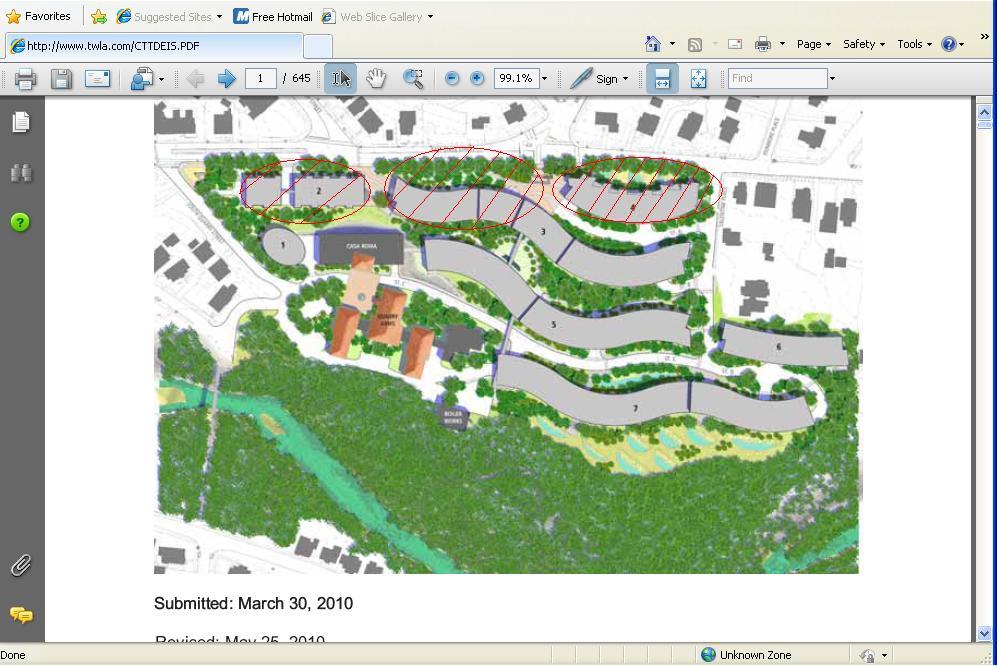
So, for those who might’ve been following the news over the past few months, it’s been no big secret that Novarr-Mackesey Group’s Collegetown Terrace project has been rather contentious, drawing crowds of angry neighbors to planning board meetings who were upset with the sheer size and scale of the project. In response, the planning board voted to promote rezoning (which is done by the city council) the part of the property along East State Street, which would heavily alter the project. Plus, it was recommended that historic designation be sought for the Delano House, a former nurses’ dorm. Of course, if these actions were taken, then Novarr’s lawyers would be having a field day filing a lawsuit against the city.  

Well, it seems as if that potential issue has been averted. Talks between the board and John Novarr have resulted in something of a compromise. In exchange for not rezoning the area, Novarr will submit a redesign that will allow thirteen separate structures on East State Street. This has been one of the most contentious aspects on the original design, that the three structures that were originally proposed made State Street feel like “a wall”, “prison” or “fortress”.  The original design schematics and proposal can be found here, in a 645-page PDF.  


Delano House, photo property of Novarr-Mackesey Properties


Therefore, buildings 2 and 4 will be completely redesigned as designated by the agreement. Building 3 will also be redesigned, but only the north half is affected. To what extent the plans will change regarding the landscape of the development and the other buildings is uncertain. Also, some of the Ithaca preservationists might still be trying to push for special designation for Delano House, which is at 113-115 Valentine Place. That space would be occupied by buildings 6 and 7, so I don’t see the issue being completely settled just yet. But at least the two sides are willing to compromise. Personally, while I like some of the aspects of the project, I’ve kinda felt indifferent due to the sheer size, and the design hasn’t exactly won over my heart (for the record, I still don’t dislike it as much as I dislike anything by Thom Mayne, so I feel no urge to go on a rant like I did with Gates Hall). But trying to make it a smooth transition and trying to at least appease the neighbors while increasing density – I consider that a step in the right direction.  


Collegetown Construction Project Watch: 309 Eddy Street

20 05 2010

So, reviewing monthly planning board agendas turned up a proposal for 309 Eddy Street in Collegetown set to be discussed this month. Unfortunately, I can never make it to the meetings and Ithaca is terrible at posting the minutes online. However, applying a little knowledge and logic, we can get a good idea of what is proposed for the site.

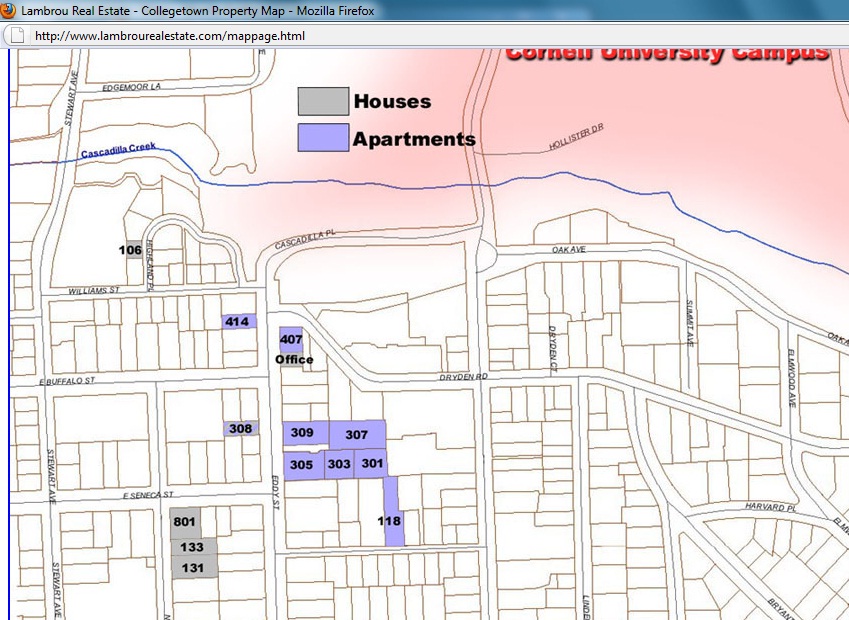
First, let’s go over the site itself. This is a little ways down from Dunbar’s on the east side of the street, next to Souvlaki House. The current building is a large student apartment house dating from about 1900:

The house sits the in the middle of a series of large apartment buildings – the Fontana Apts (327-407 Eddy), and the four buildings that make up the Collegetown Park Apts. (301 Eddy-307 Eddy). All of these buildings were built in a time period from the late 1980s to early 2000s (the last was about 2002). All properties, including the house, are owned by Lambrou Real Estate, one of the major players in the Collegetown rental market with a couple dozen properties in the area (not all properties are shown in the map below).

Lambrou Real Estate seems to have a figurative love affair with the local architecture firm Jagat Sharma, which has a very distinct style but its readily apparent in all their buildings (postmodernist with extensive brick work and subtle contrasts within the facade, but otherwise not really daring). All of Collegetown Park, as well as the Fontana Apts, was designed by Sharma & Associates. It would be logical to assume that a future Lambrou project would have Sharma as the architecture firm in charge.

From a zoning and massing perspective, a review of the Collegetown zoning (which I’m not even completely sure it it was ever changed according to the guidelines of the $150k clusterf*ck that was the Collegetown Vision Draft Plan)

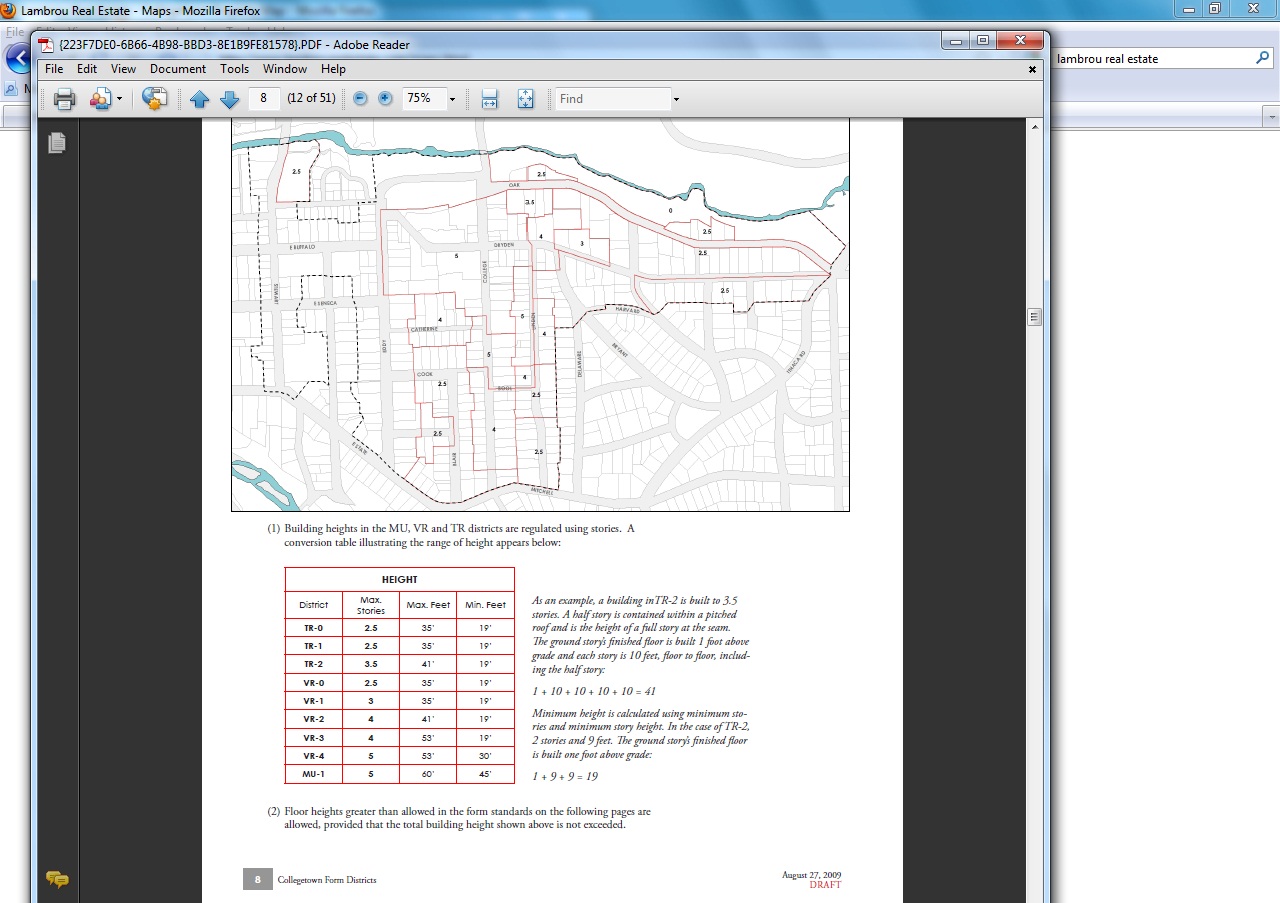
Assuming it is, the lot is zoned for a 4 or 5 story building with a maximum height of 60 feet, and at least 45 feet encouraged. Street-front commercial retail is virtually a must for approval.

So, here’s my verdict. Within the next few months, there will be a full proposal for a 4 to 5 story building pushing between 50 and 60 feet, with retail in its base and apartments on the upper floors. It will most likely be designed by Sharma Architects, and as I’m checking the Lambrou website and not seeing this place for rent next year (possibly because it has not been updated), this place could get final approvals and construction permit for fall of 2010 with construction lasting at least six months (if it does turn out to be rented, a construction start date of summer 2011 will be far more likely).

UPDATE 9/29/10: Now we have renderings:

Not a bad design. Fits in rather well with the immediate surroundings. A little more work on that street and it could become as popular as the 400 block of College Avenue.


Best Map of Collegetown Ever.

10 09 2009

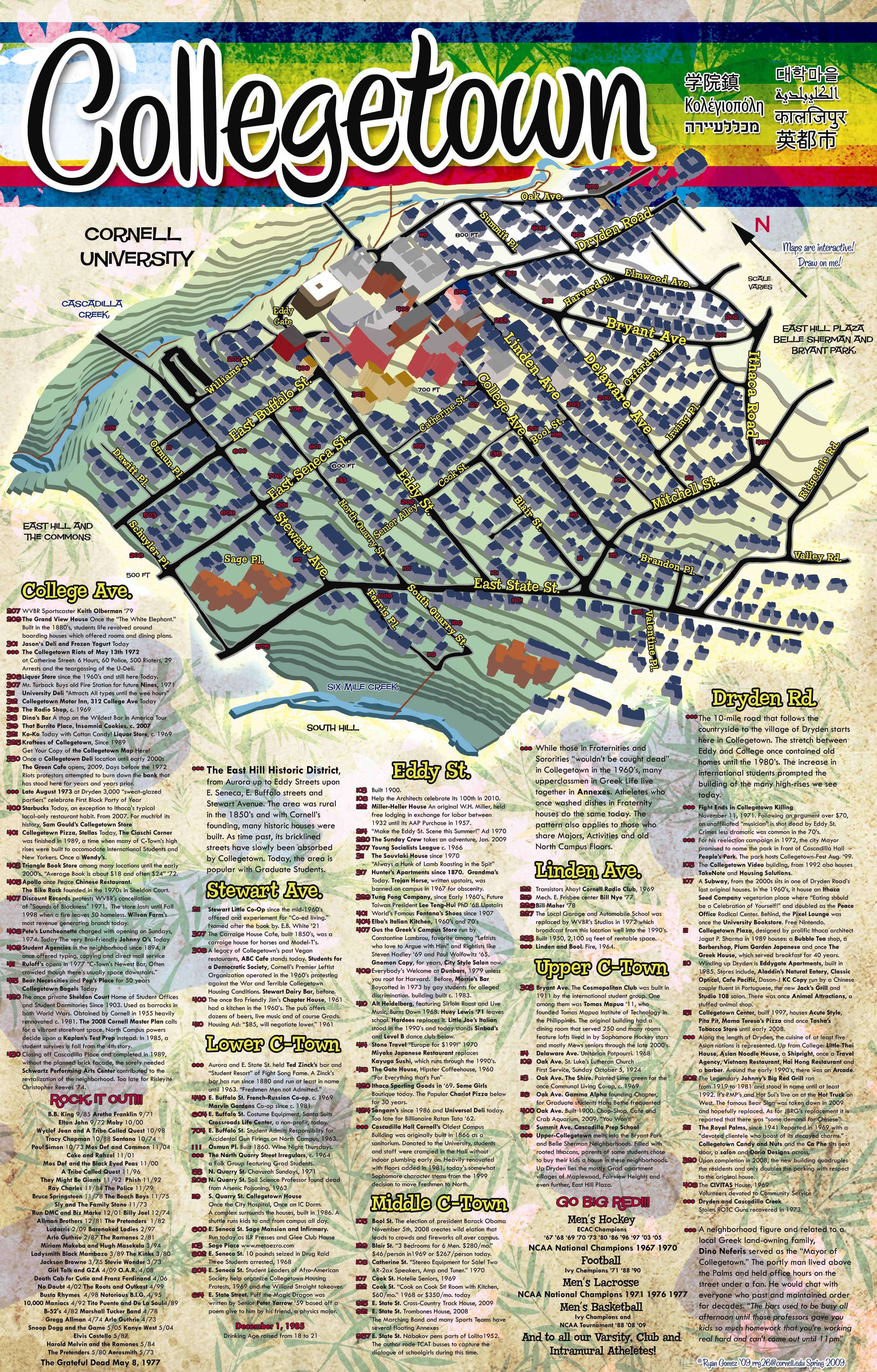
The map was a project of an alumnus, Ryan Gomez ’09. I dare say it’s one of the best maps I’ve ever seen of Collegetown, not only because it’s a visually appealing map, but also because it covers the history of many of the addresses in the neighborhood, not to mention worthy Cornelliana.

This map deserves a look:

http://www.metaezra.com/images/ctown_map.JPG

Mr. Gomez, you’ve earned my respect and admiration.


News Tidbits 8/27/09: Phase Two of Coal Yard Apartments Planned

28 08 2009

From the Ithaca Planning Board’s August agenda:

Coal Yard Apartments – Phase 2, 143 Maple Avenue, Steven & David Beer Owner/Applicant.

Declaration of Lead Agency, Public Hearing, Determination of Environmental Significance, Consideration of Preliminary & Final Approval. The applicant is proposing to construct an Energy Star-rated, 25 unit apartment building located between the existing coffee shop and the existing 10 unit apartment building that was constructed in 2007. The new building will have four residential stories built on top of a 16-space underground parking garage. The new building will have four 3 bedroom units, seven 2 bedroom units and fourteen 1 bedroom units and will have an elevator. The applicant anticipates that the majority of the bedrooms will be singly occupied. It will have a flat roof, and will include many of the design elements of the 10 unit building. Lower levels of the façade will be brick and upper levels will use similar fiber cement clapboard and solid board panels used on the 10 unit building. Colors will match or complement the existing building. The target market for the building will be graduate and profession students, professional academic staff and faculty, and seniors. The project is in the R3b Zoning District and will require a variance for height. This is a Type I Action under the City of Ithaca Environmental Quality Review Ordinance in accordance with §176-4 B (k) and an Unlisted Action under the State Environmental Quality Review Act and is subject to environmental review.

The property is part of the Beer Properties portfolio, which includes the Grandview House in central Collegetown. The trick here will be getting the height variance approvalas Ithacans are very protective of their sight lines. Here’s a picture of the 10-unit building taken from their website:


The apartments are aptly named, since this used to be the coal yard for the city of Ithaca back in the day [1]. Prior to discontinuation of passenger train traffic in 1963, the site was also home to the East Lehigh Valley Railroad Depot. The coffeeshop referenced in the city agenda is the “Queen of Tarts”, which sounds like a great name for a madam as well as being a cute pun.

The project falls outside of the Collegetown Vision area and would not be affected by any zoning changes as a result of the Collegetown plan.


[1]http://www.beerproperties.com/cya.html


News Tidbits 6/16:A Preservationist’s Trick

16 06 2009

I’m so glad she’s not running for re-election.

http://www.theithacajournal.com/article/20090616/NEWS01/906160334/1126/news/Some+owners+balk+at+historic+designation
100_1754

Some Collegetown property owners are calling the potential historic designations of their buildings unsafe, unfair and an attempt to stop development.

The city officials behind the list of historic resources in Collegetown say they’re trying to protect a legacy of beauty that will ultimately strengthen the city’s culture, economy and desirability as a tourist destination.

Planning Board Chairman John Schroeder and Common Council Alderwoman Mary Tomlan, D-3rd, have compiled a list of 31 “Collegetown Historic Resources Worthy of Detailed Research.” Both the 2007 Collegetown vision statement and the proposed Collegetown Urban Plan call for identifying historic resources in Collegetown.

The 31 resources, primarily buildings, are being studied this summer for a variety of historic recognitions, including potentially formal historic designation, which would prevent a property owner from tearing a building down and redeveloping it. Both the Ithaca Landmarks Preservation Commission and Common Council have to approve new historic designations.

Joe Leonardo, owner of the Royal Palm Tavern, said some of the identified properties could be worthy of historic designation, but the Royal Palm is not one of them.

Tomlan said the Royal Palm is historic in part because “it’s not like any other bar in Collegetown.”

“It’s a very distinctive facade with its round windows and with its distinctive entranceway,” Tomlan said. “And it has been so well kept up; I mean, they do such a good job of keeping it painted. It’s been an image on the Collegetown streetscape for many decades.”

Leonardo said he paints the facade so often because “every year the front of it falls off.”

“Why didn’t she (Tomlan) come to me and ask me what I thought? It’s going to decrease the value of my property because no one can develop on it if it becomes a historic landmark,” Leonardo said. “Is that my reward for keeping this business in the family for the past 70 years? They’re just anti-development, and it’s pretty transparent what they’re trying to do.

Historic recognition is a part of good planning, tourism and economic development, Schroeder argued.

“I’ve said throughout this that I strongly want and desire redevelopment of certain areas of Collegetown to happen,” he said, citing the 300 block of College Avenue as one he’d love to see redeveloped, and the east side of the 400 block as one that should be preserved.

“Appreciating historic resources is part of what makes a community a community,” Schroeder said. “It helps us understand our links to past generations, what they bequeathed to us. It helps link, especially in a college town, past generations of Cornellians, perhaps the parents of current students, to current generations and future generations of Cornellians and Ithacans. It’s part of what attracts tourists to a community. It’s part of what gives a unique sense of place, a special sense of character.”

Historic preservation is important, but so is providing an adequate supply of safe housing close to campus, argued property owner George Avramis. His building at 403 College Ave. is on the list of historic resources.

“(Having) older wood-frame buildings in that kind of densely populated area is, I think, a very dangerous approach to take,” he said.

The building next door, 407 College Ave., burned to the ground in 1998 when a fire that started in a first-floor restaurant spread quickly through the building, he said.

“Someday I would like to tear it (403 College Ave.) down and put up a nice, new, triple-A-fire-rated building, fully ADA handicap accessible, like 400 College Ave., the Starbucks building,” Avramis said.

Sarah Iams lives at 116 Oak Ave., which is cooperatively owned by the Gamma Alpha Graduate Scientific Association. Iams said her biggest concern with the possibility of a historic designation is the extra time and effort involved in getting city approval for maintenance issues.

Once a building is designated historic, any exterior maintenance or lot changes have to be approved by the Ithaca Landmarks Preservation Commission. Interior maintenance does not require approval.

“As a graduate student co- operative that maintains the property ourselves, processes that might seem like small administrative hassles for a typical landlord or homeowner are a strong barrier to our successful operation,” Iams said by e-mail.

Tomlan said she’s talking with city staff about setting up a public meeting in Collegetown sometime this summer for property owners and others to come learn about and provide input on the historic resources proposal.

Alderman Svante Myrick, D-4th, is the only student on Ithaca’s 10-member Common Council, and he’s been the most vocal proponent for redevelopment in Collegetown.

“I think some of the sites are absolutely worth historic preservation, mainly Cascadilla (Hall) and the (College Avenue) bridge,” Myrick said. “But I’m glad they’re doing more research on this because I’m not convinced that this is not a thinly veiled effort to stop development in the areas where the zoning’s going to change.”

Tomlan, an architectural historian, said she views the historic resources list “as a positive thing, not an obstructionist thing.”

“I would not want to see it as stopping development,” Tomlan said. “It is a recognition that our community is layered by its history and that our lives can be enriched by knowing and seeing pieces of that history. There’s nothing thinly veiled about it. It is a positive statement about the value of our aesthetic and cultural past.”

At 7 p.m. this Wednesday, Common Council’s Planning Committee will hear a report on the Collegetown Historic Resources list. They’re also scheduled for a public hearing and a vote on the Collegetown Urban Plan. The meeting is at City Hall, 108 E. Green St.

The most recent version of the Collegetown plan is at www. cityofithaca.org.

***

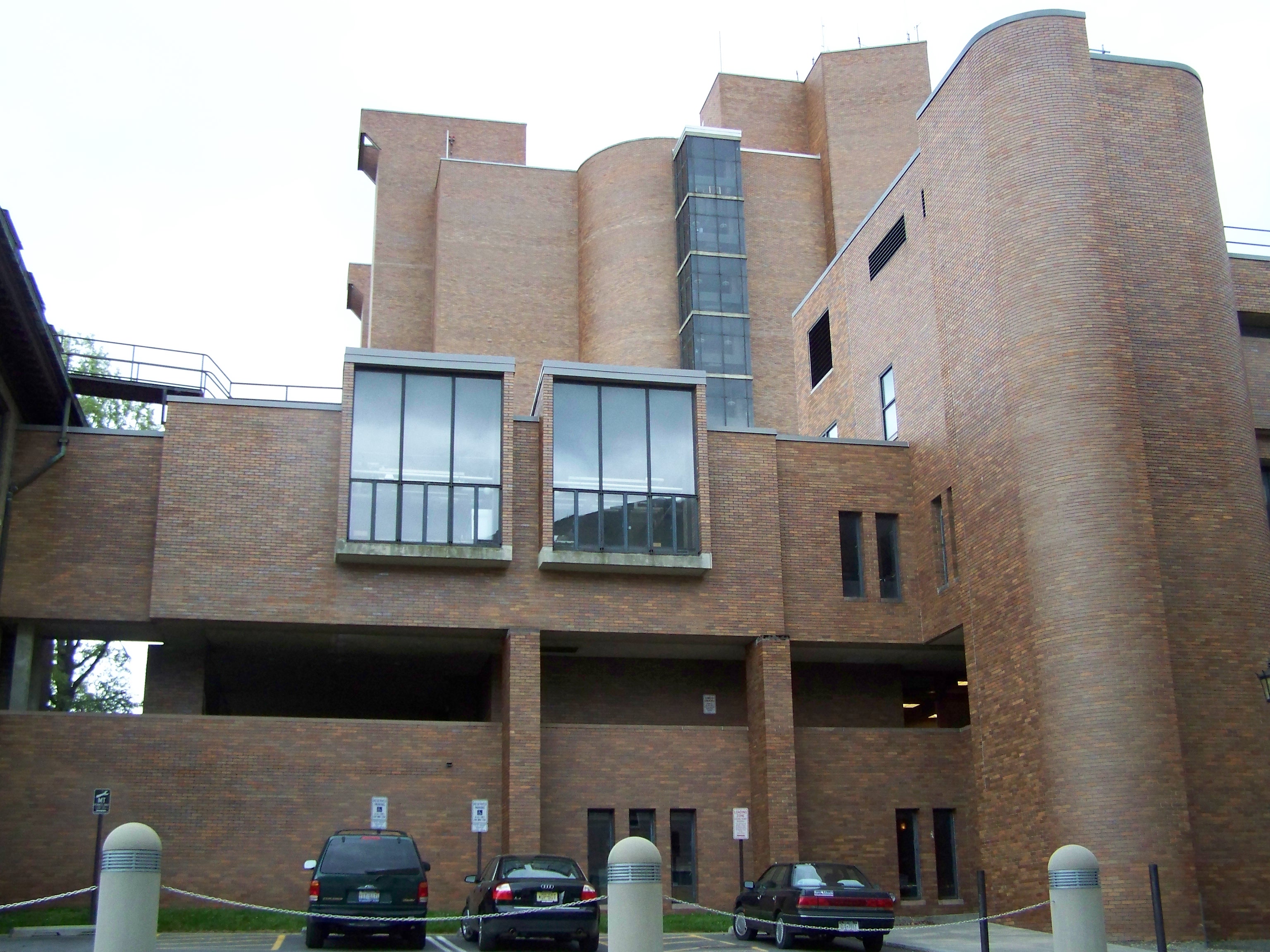
For the record, I want to say that I am not anti-preservation. I wholly agree with preserving Cascadilla Hall and the College Avenue Bridge, because of the historic and aesthetic qualities that they bring to the Collegetown area. That being said, the Palms is historic in the same way that a Ford Pinto is a classic car.

100_0649
A beauty it ain’t.

So, I decided to have some fun and look to see which designations I agreed with on the historic recommendation PDF. As much as I dislike Tomlan’s views, I give her a lot of credit to her and John Schroeder (who works for the Sun?) for digging up the history behind the structures she recommended for preservation.

If I didn’t write anything, it means I wholly agree with historic landmark status.
1. College Avenue Bridge
2. Grandview House (209 College Avenue)
3. Cosmopolitan Club (301 Bryant Avenue) –  This apartment house was the clubhouse for international students in the early years of Cornell, I wholly agree on its preservation, but maybe not on full designation, since that tends to make renovation difficult, and this building is severely worn down and could really use some work.
4. Royal Palms – Little historic value, apart from taking up a space. Extremely run down, possibly unsafe since it’s an old, large wooden structure, and a fire could be disastrous. Not only does it not deserve preservation, it deserves to be torn down.
5. A.D.White’s Eddy Gate – Derided in its own time for being an obstruction and for being ugly (see Bishop’s History of Cornell), this is already designated.
6. The Johnny’s Big Red Grill Sign – Already gone.
7. Cascadilla Hall
8. Sheldon Court
9. The Nines – What used to be the Collegetown fire station.
10. Snaith House (140 College)
11. Flagg House (210 Mitchell)
12. Cascadilla Prep (Wait Hall)
13, 14 ,15. 113, 116, 120 Oak Avenue. 113 is one of the few actual fraternity houses that existed in Collegetown (Alpha Chi Sigma, from 1920-1955, when they moved to north campus). Today, the house is rented mostly by members of one of the honors fraternities. 116 and 120 face the gorge, and 116 is home to the biology grad student honors co-op Gamma Alpha. However, I have to disagree with historic designation. The two houses next to gorge would be extremely difficult to redevelop, and designation would make renovation difficult.  As for 113, I would think it a shame to be torn down, but I wouldn’t argue against it.

16. The Larkin Building (403 College). Personally, I always considered this one part of the Ciaschi Block. Although Mr. Avramis argues that he wants to build a new building on the site, the current one fits in so well that he would have to go through raging hellfire to try and tear it down. My personal hope would be that he tear down the two-story brick s–tbox across the street where his offices are located.

17. Chacona Block (411-415 College Avenue) . Same case as above. I can imagine the preservationists would come out in droves if they tried to take this one down.

18-23. 103, 119, 121, 125, 127, 129 College Avenue. I can understand the historic value, but I fear that designation would harm the ability to renovate these structures. I would rather seen this handled such that if someone proposed something, that all due discretion is exercised.

24-27. 117, 119, 121, 123 Linden Avenue. Wholly against. My hometown, which built out in the 1920s and 1930s, is filled with these types of homes. They are of little historic value, and certainly not a “historic resource”. My inclination is to believe they selected these houses because there was recently a large property transaction in this area, so they’re trying to stop development here before it’s even proposed.

28. 120 Linden Avenue. At 140 years old, this may be the only house they have designated on this street that is worth giving landmark status.

29-32. They didn’t count the Big Red Grill Sign in the final total, so there were actually 32 desired landmark designations. The last four are trails and ruins, of little overall merit but of considerable aesthetic value.

So, I completely disagree with five designations. I feel that many of the buildings have historic merit, but that historic landmark status might be going too far. However, this is why we have planning boards, so that people can vote down projects is they stand to be detrimental to the neighborhood.


News Tidbits 5/20: More Info on the Collegetown Terrace Project

20 05 2009

http://www.theithacajournal.com/article/20090519/NEWS01/905190332/Collegetown+developer+plans+2011+opening&referrer=FRONTPAGECAROUSEL

The proposed Collegetown Terrace Apartments are scheduled to break ground in summer 2010, open in summer 2011 and house primarily graduate students.

On traffic and parking – a major concern for Collegetown residents – the project would provide more parking spaces than required by city zoning, as well as amenities intended to reduce car dependence, such as a shuttle to Cornell and Wegmans.

Ithaca developer John Novarr submitted his full review application report to the city’s Planning and Development Board last week, and he provided a copy to the Journal. Site plan review is scheduled to begin at the city’s Planning Board meeting at 6 p.m. May 26.

Ed Strong, a graduate student representative on the Cornell University Assembly, said graduate student housing is sorely needed and the apartments will be well-received among students.

While Cornell has recently added undergraduate housing on West Campus, on-campus graduate student housing is still inadequate, Strong said. The Maplewood complex is made of modular buildings that are already past their life expectancy, he said.

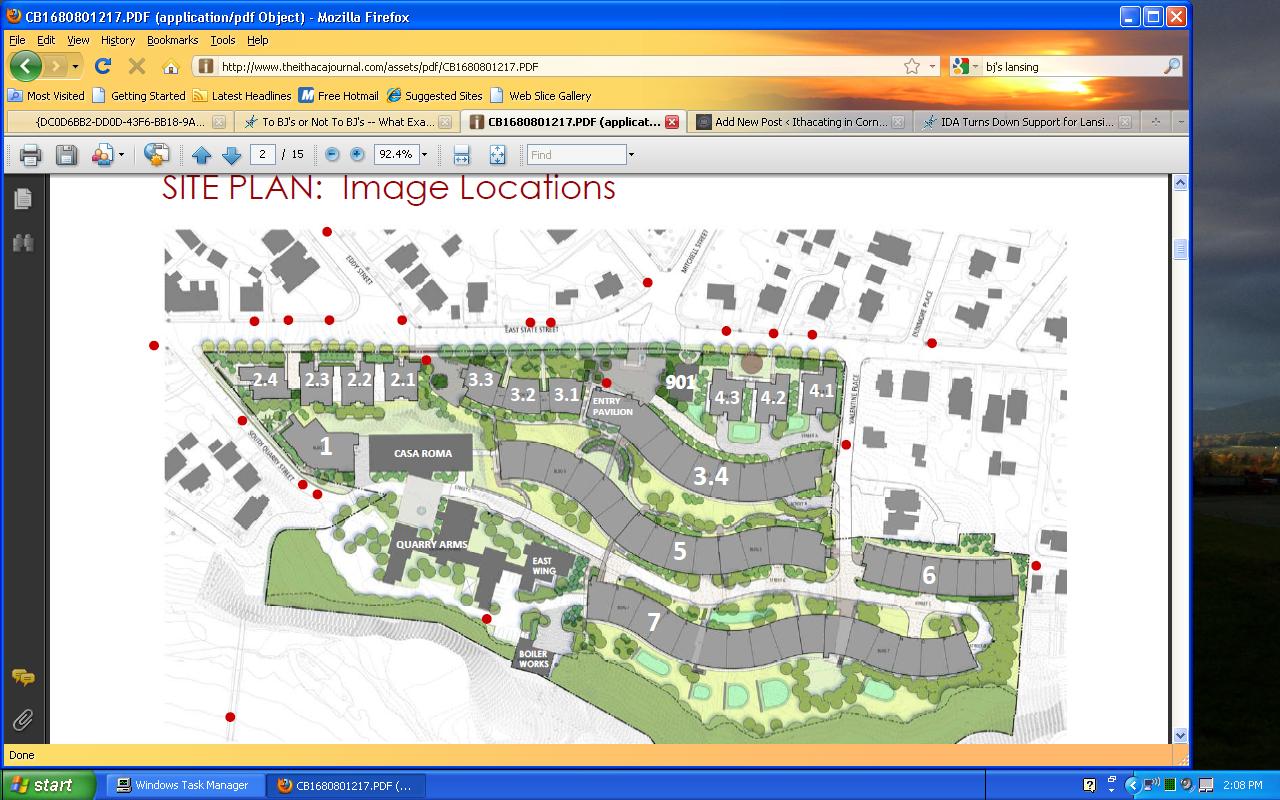
The Collegetown Terrace project calls for removing all but three buildings in the 16.4-acre area bounded by Quarry Street, East State Street, Valentine Place and Six Mile Creek. The historically designated Quarry Arms, Casa Roma and Boiler Works Apartments buildings would remain.

Seven buildings would be built on the site. The full site, including the three historic buildings, would contain 1,260 bedrooms and 860 parking spots.

The area currently contains 635 bedrooms and 430 spots.

On East State Street, plans call for four-story buildings that meet height restrictions imposed by city zoning.

As the topography slopes downhill toward Six Mile Creek, buildings are proposed to increase to five and then six stories, which would require a zoning variance.

Parking is housed in one or two stories underground and at ground level to minimize surface parking lots. In the initial presentation before the planning board, Novarr said his upper-floor apartments always rent out before ground-floor apartments, because students find them safer and more private.

Novarr plans to charge tenants separate rent for parking spaces and apartments, a measure intended to force people to consider the cost of having a car.

At the Casa Roma complex, parking is rolled into the rent.

Novarr told the planning board rent would be similar to the buildings to remain on-site.

They average between $1,500 and $1,800 for a two-bedroom apartment, according to listings available online.