End-of-Summer Construction Update, Part II

24 08 2012

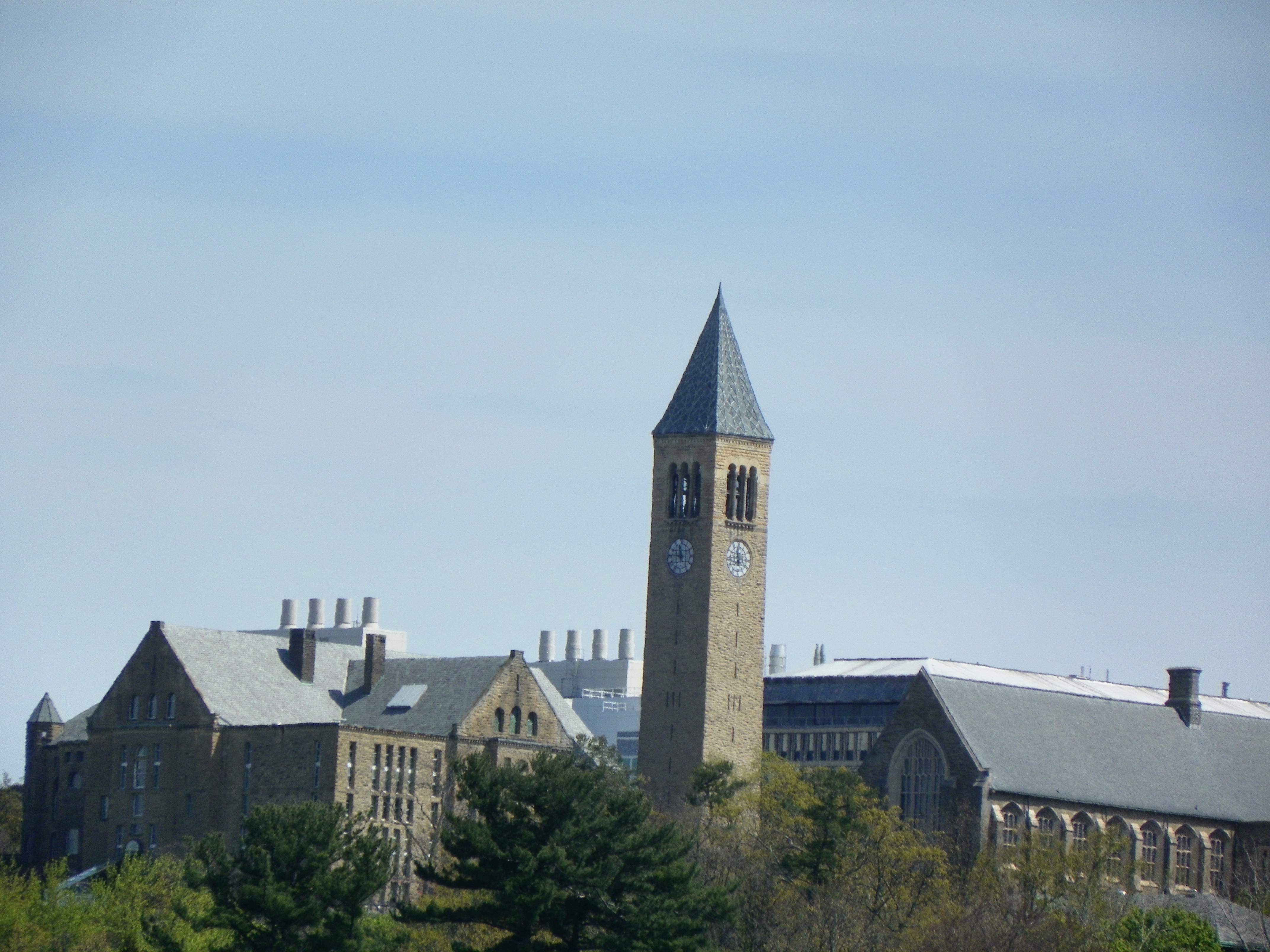
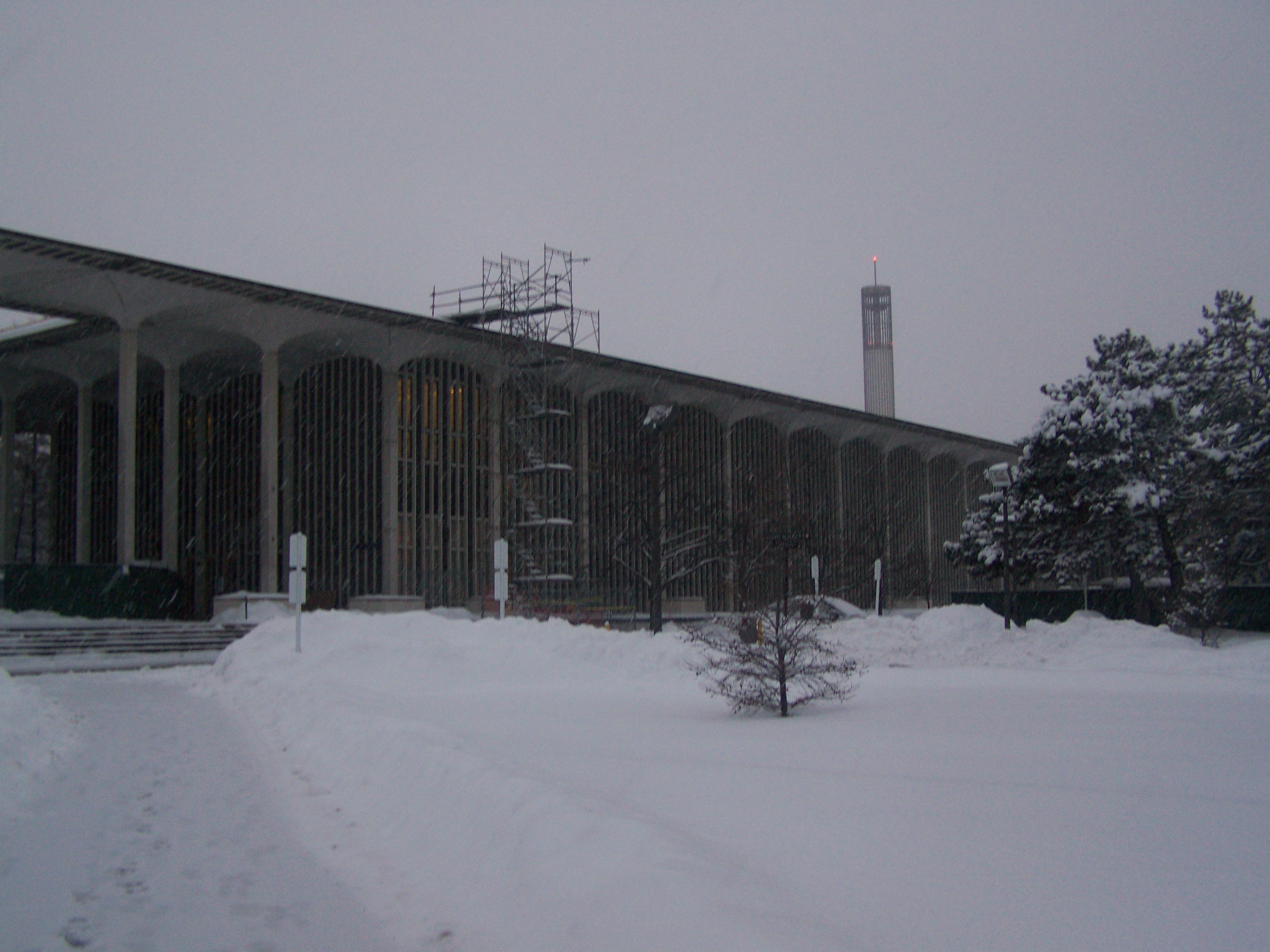
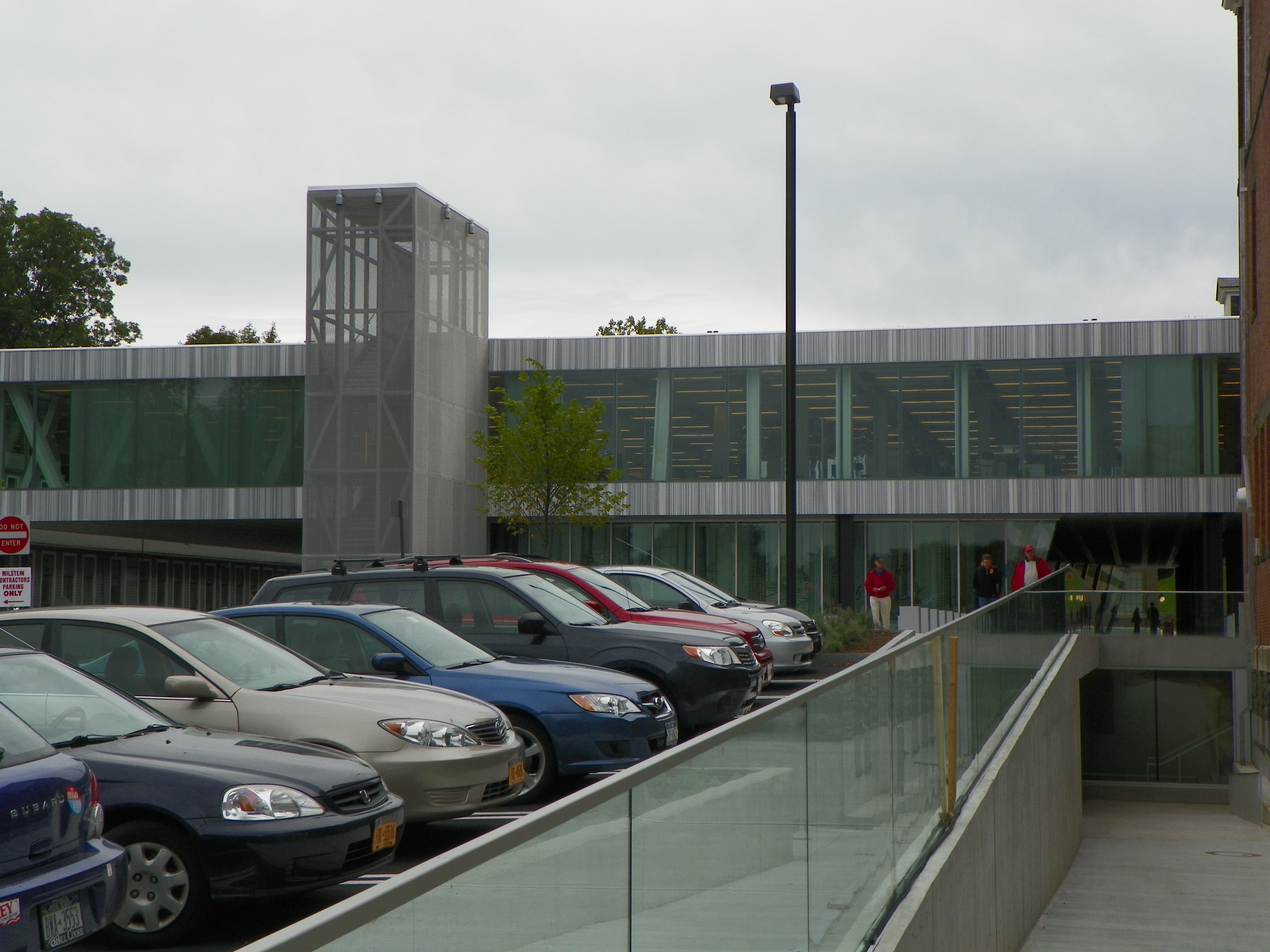
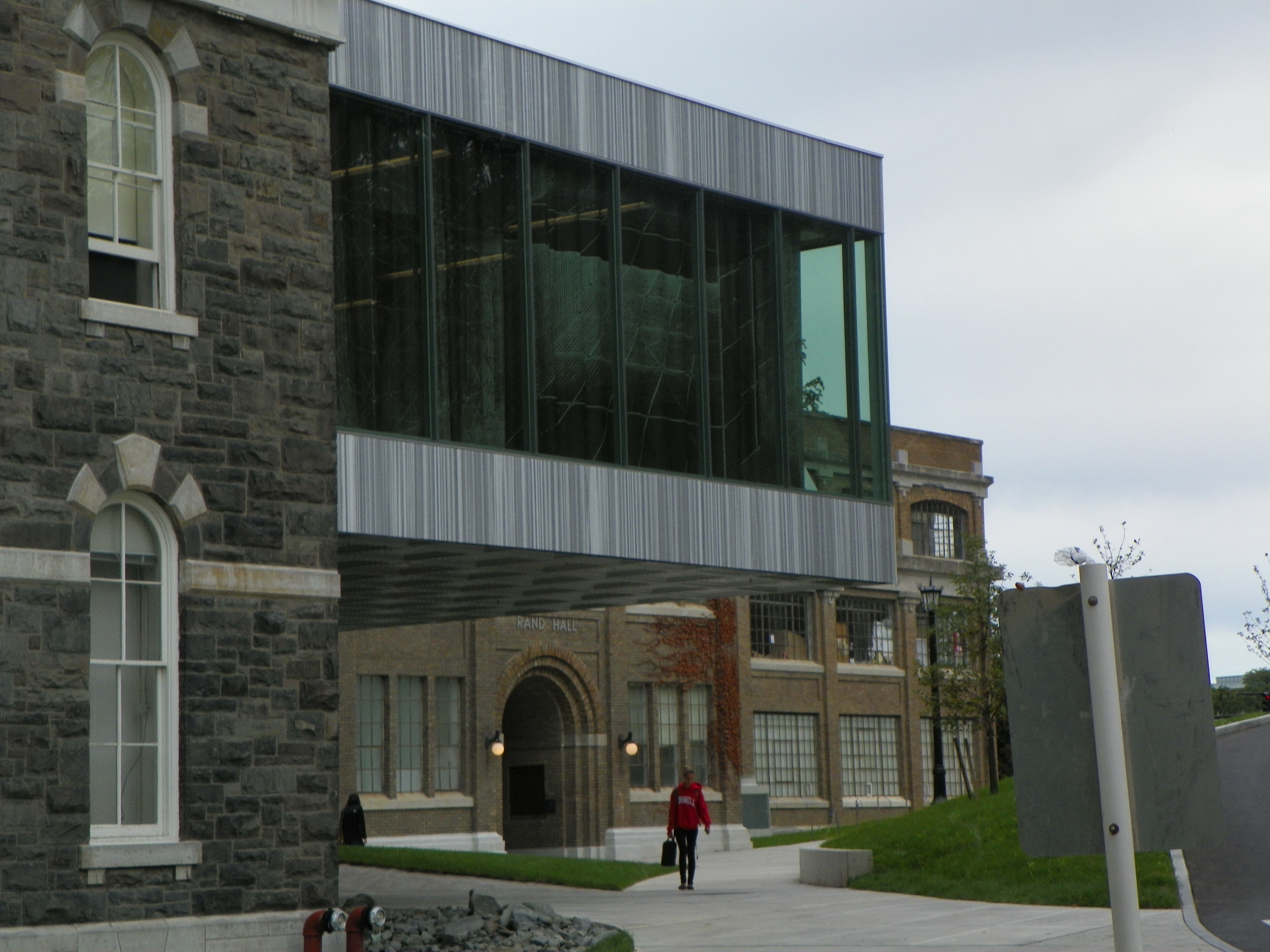
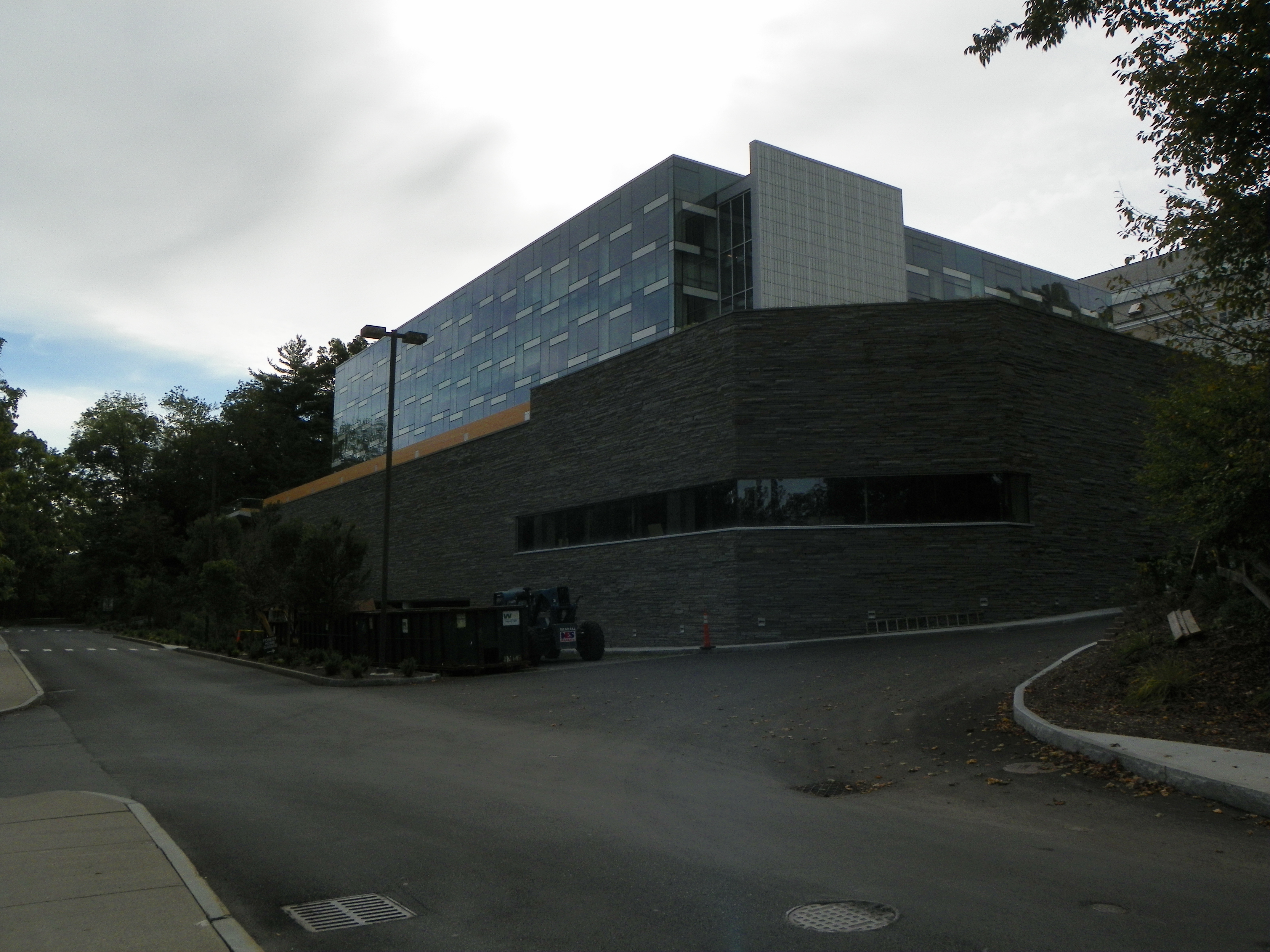
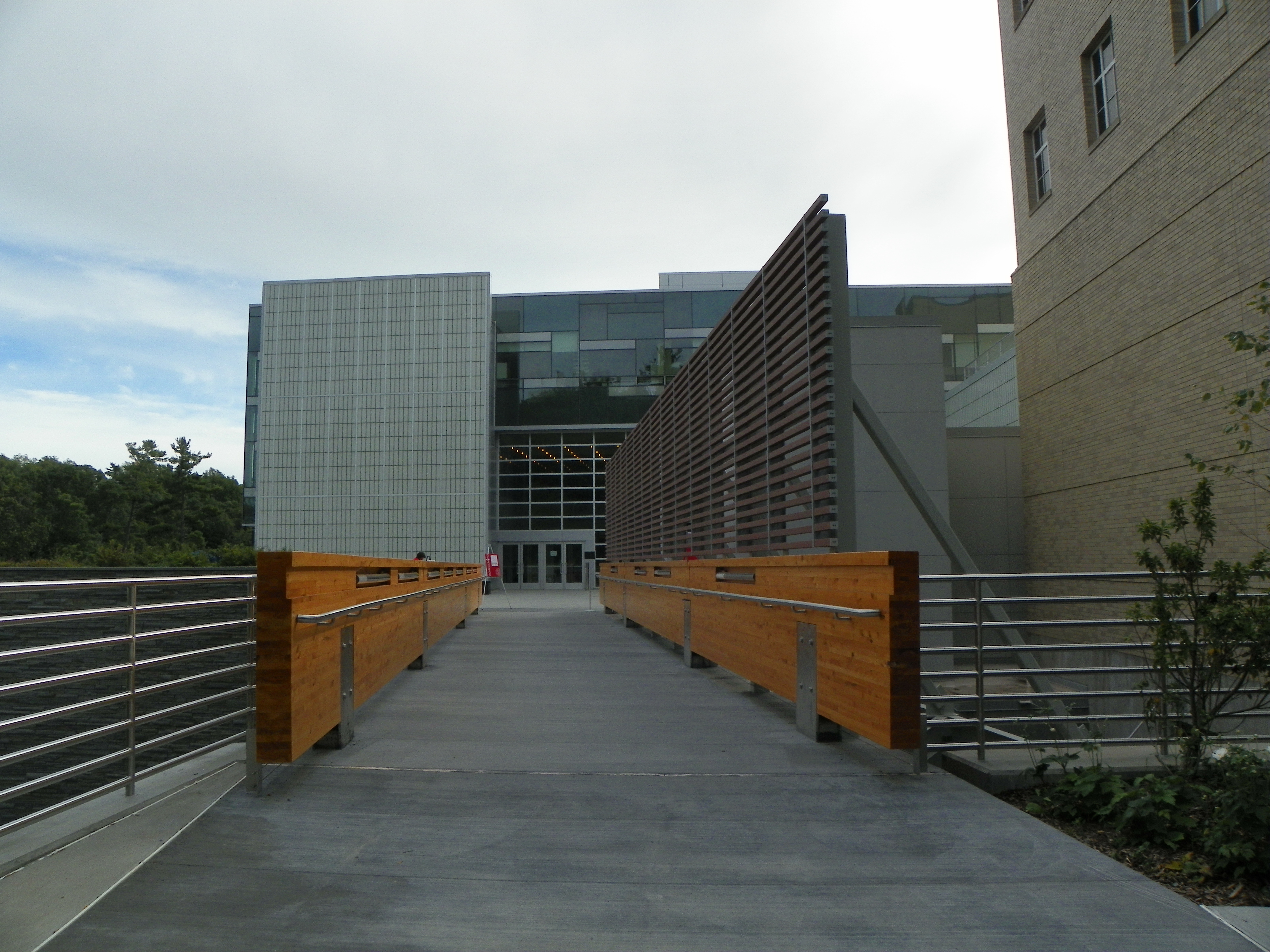
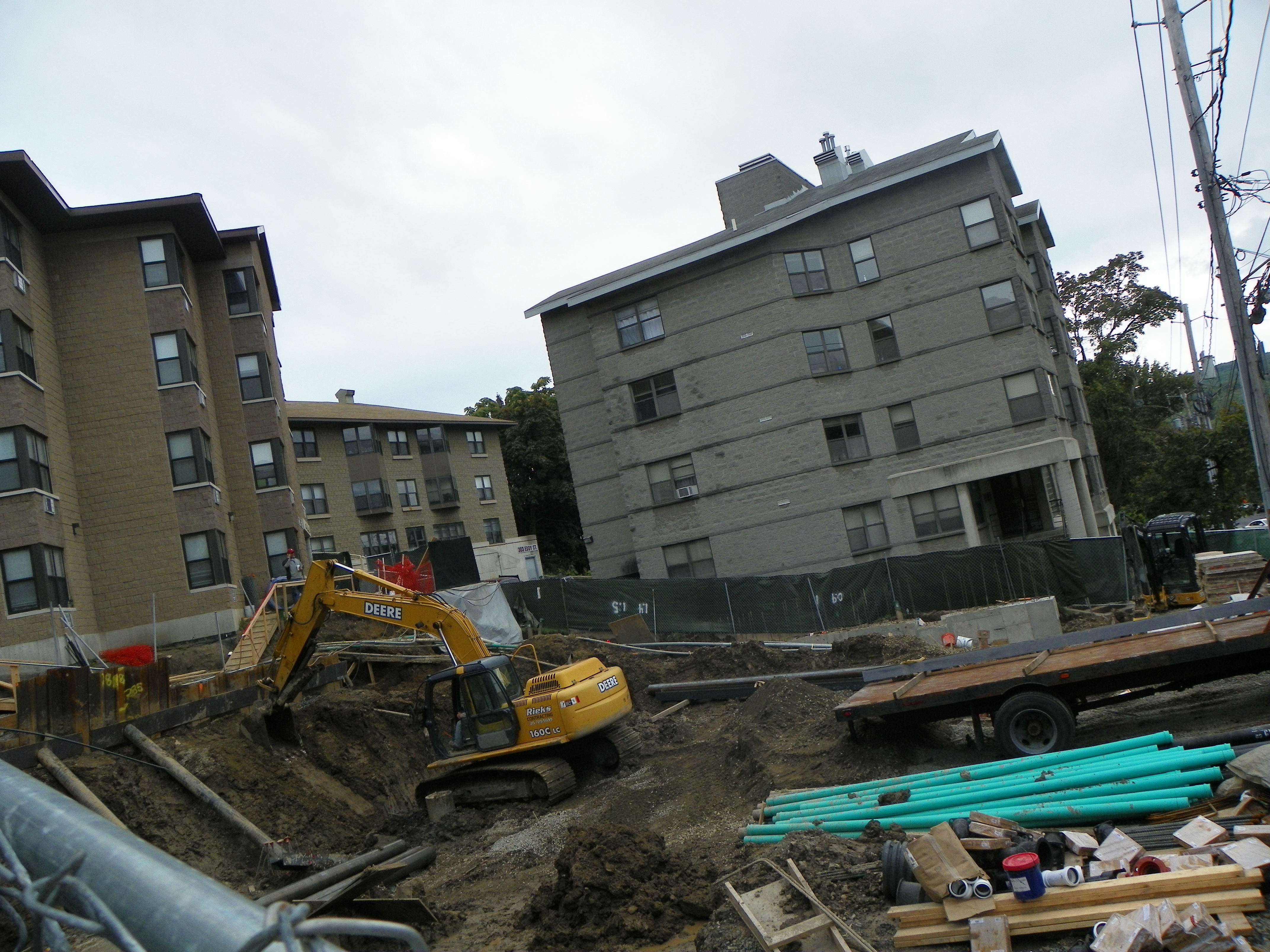
I felt a little more comfortable exploring the non-college part of Ithaca. For the most part. I bought an Ithaca Beer Company root beer at the downtown pharmacy, and because it came in a traditional beer bottle, I was concerned I’d be stopped by police for looking like I was violating open container laws. Rather than put up with that, I sat next to the ice cream counter and read the real estate section of the paper. The photos show would I did elsewhere.
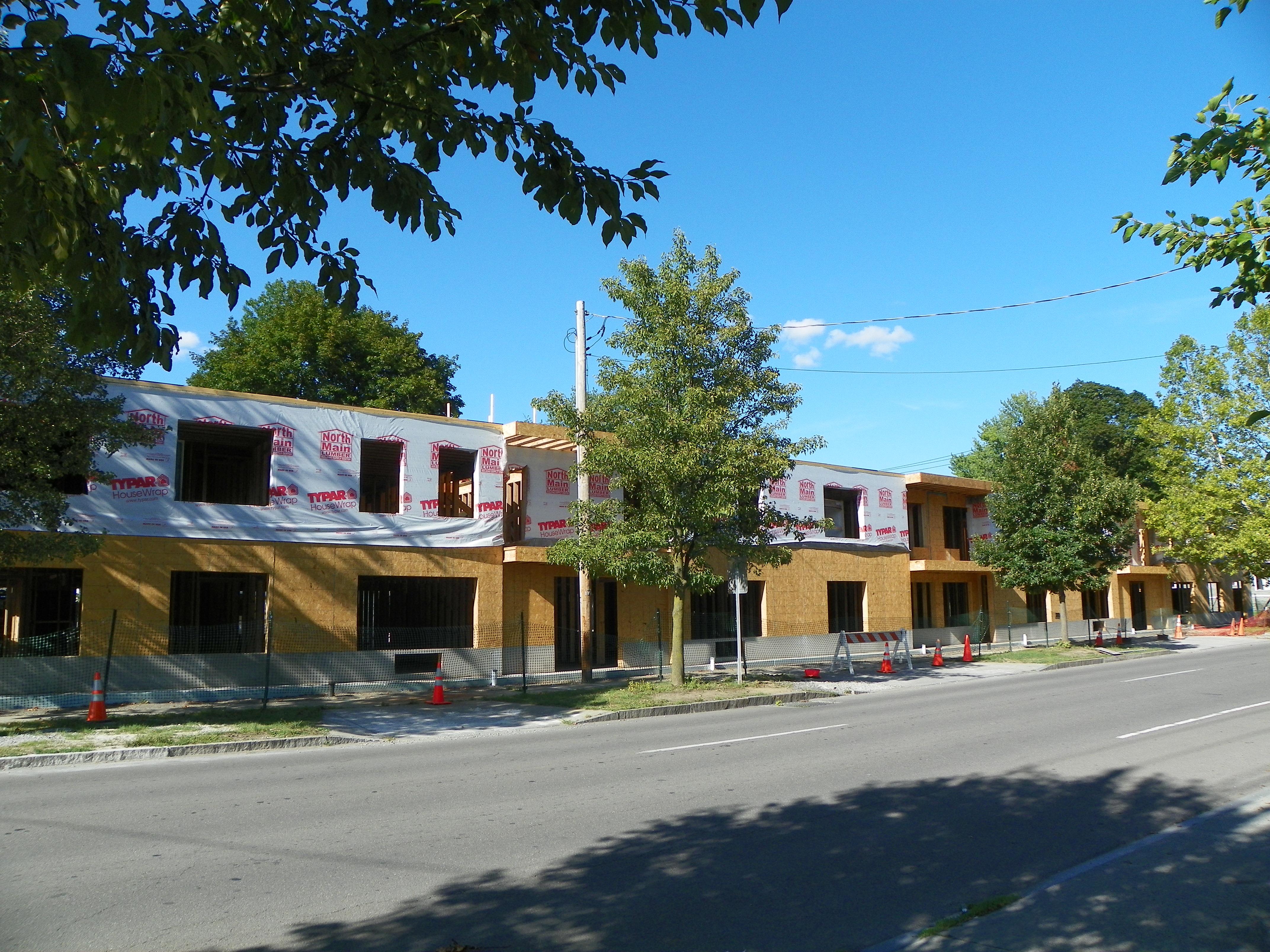
I felt bad because I’ve largely ignored this project. Not purposely; it’s out of my normal search range – on the 600 block of West Seneca, near 13. The site was previous home to a service station and four homes, all of which were in poor condition. The project beings 17 units into a part of the city that has traditionally been one of the most overlooked Ithacan neighborhoods.

The new Fairfield Inn down in big-box land has had its foundation laid, and will likely be finished sometime in the spring. The hotel was approved last fall, and to be honest, I had expected this one to be further along than it was. When complete, the hotel will over another 106 rooms to the 1,800 or so currently within the Ithaca metro. On another note, the city expects a chain restaurant to be built next to the Panera Bread strip of buildings, with construction beginning in the fall.
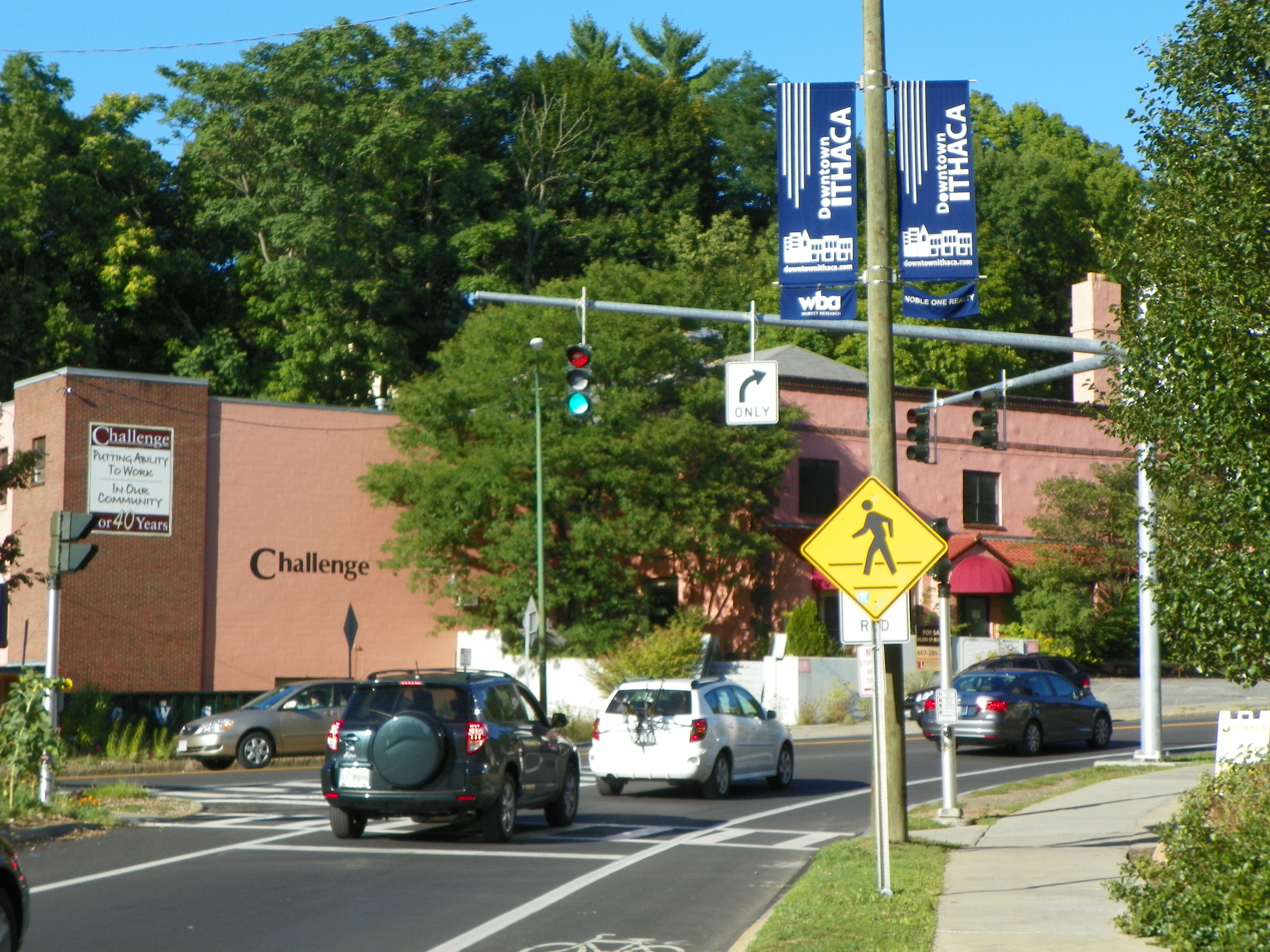
Likewise on the progress for the Seneca Way project. For all the trouble it went through, I would hope it at least sees the light of day. The project seeks to build 32 apartments and some commercial space in a five story building on the site of the former Challenge Industries building. As for the Hotel Ithaca, no news as of late, and likely still stuck in funding limbo, a sign of our poor economic times. UPDATE 8/29/12: Apparently the Hotel is being reconfigured, switching from luxury hotel operator Gemstone Resorts to the Marriott brand. The number of rooms will be raised to 159, and the design will be slightly modified at base level. The height should remain the same. Re-approvals are required, but are not expected to be difficult to obtain. Construction is slated to begin next March, with foundation work during the winter.

Almost the same story here, except these two actually have funding arranged. The Holiday Inn expansion site in the top photo, the Cayuga Green lofts below. The Holiday Inn project started prep in July for the tear-down of the lowrise portion, to make way for a new 9-story building and conference center (I believe it was made one floor shorter from the original 10 stories, and stretched slightly longer to compensate for the loss of that floor space). The Cayuga Green project may have prep underway, judging from the equipment, but needs to start by the end of the year regardless to keep the city lawyers at bay.

And finally, one project that has made substantial progress, the Breckenridge Place Apartments on the site of the Women’s Community Building. The project will bring 50 units into downtown when completed next year.

This was a b*tch to take photos of. Most of the perimeter of the lot was covered in a black opaque tarp, tied so sceurely I had to lay on the ground and reach under it to get a photo through the fence. The front side was a bit easier. Completion should be sometime in mid-2014, although it looks like most of the exterior glass curtain wall is installed – which would place the project ahead of schedule.
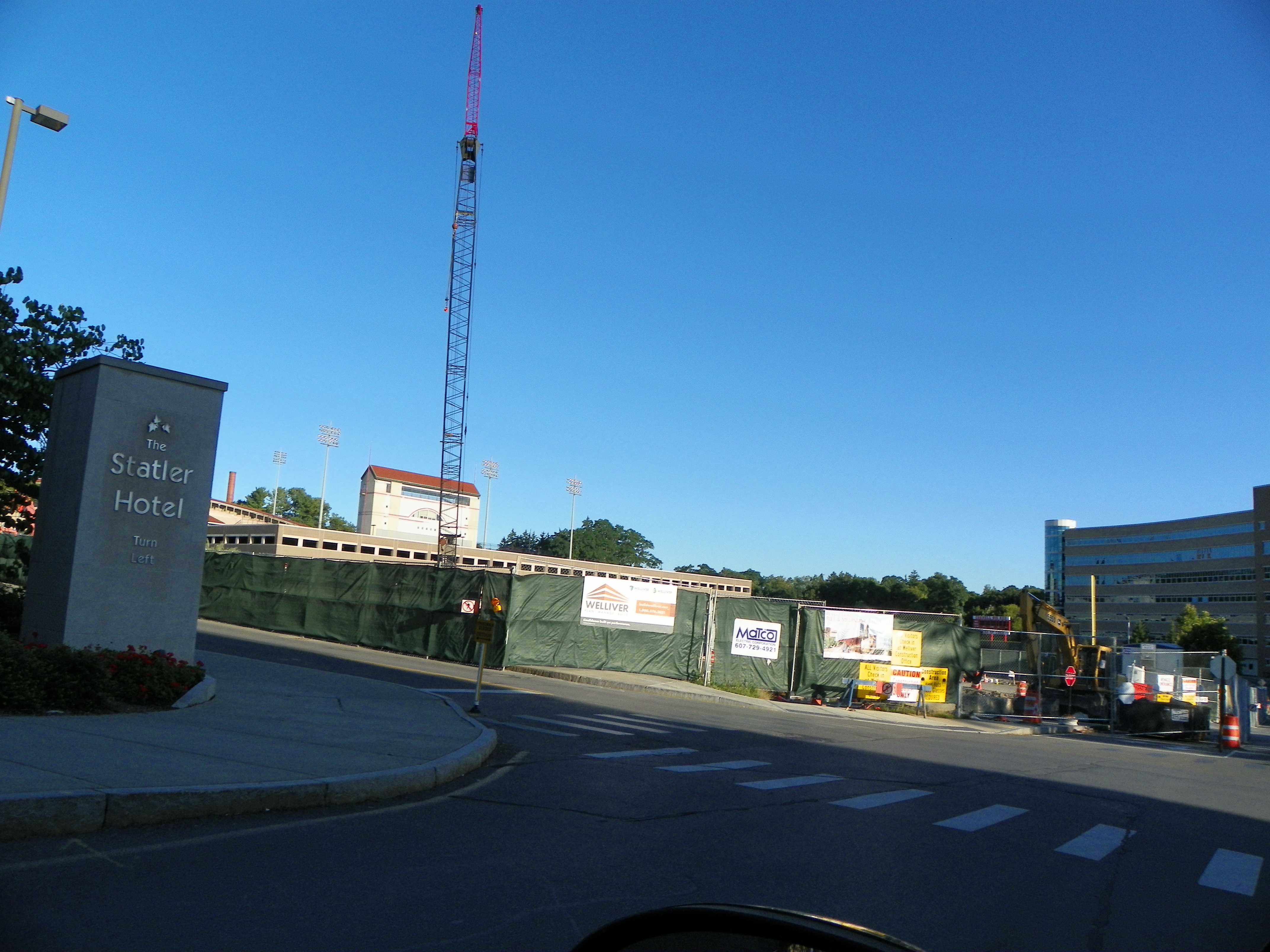
Do as I say, not as I do: never take photos and try to drive on a crowded campus at the same time. But, I was running late. Tarp and foundation work underway at Gates Hall. For the curious, I stopped by the site for the Big Red Marching Facility, and the site was still pristine – this makes sense, since site prep doesn’t start until next month.

Now that screen lags my typing by about thirty seconds, I’d better but the kibosh on uploading any more photos in this entry. However, I do have the good fortune of having one my best friends accept a research position at Cornell, so I now have a legitimate excuse to visit Ithaca periodically for the next couple of years.


Spring 2012 Construction Update – Cornell Edition

9 05 2012

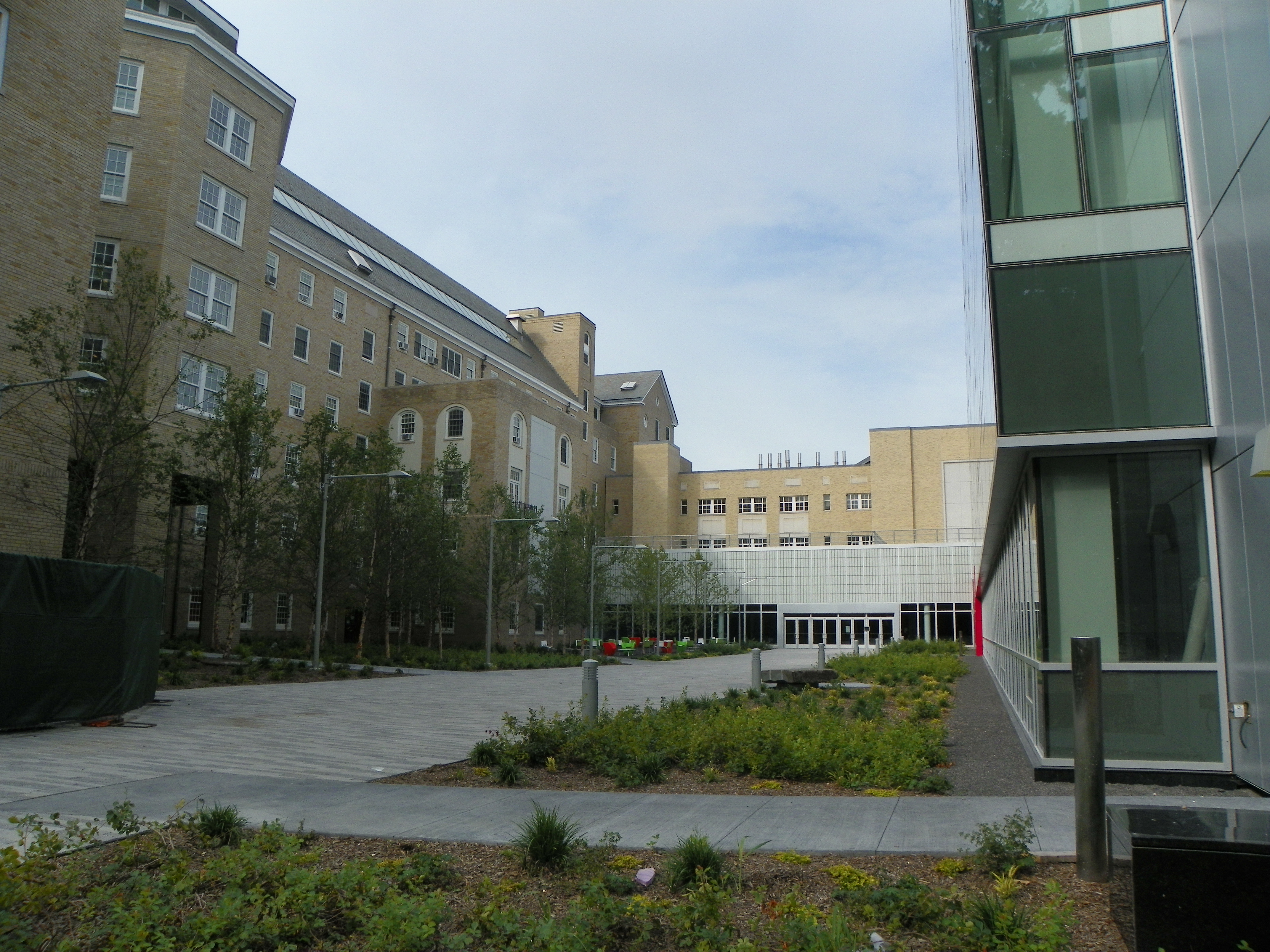
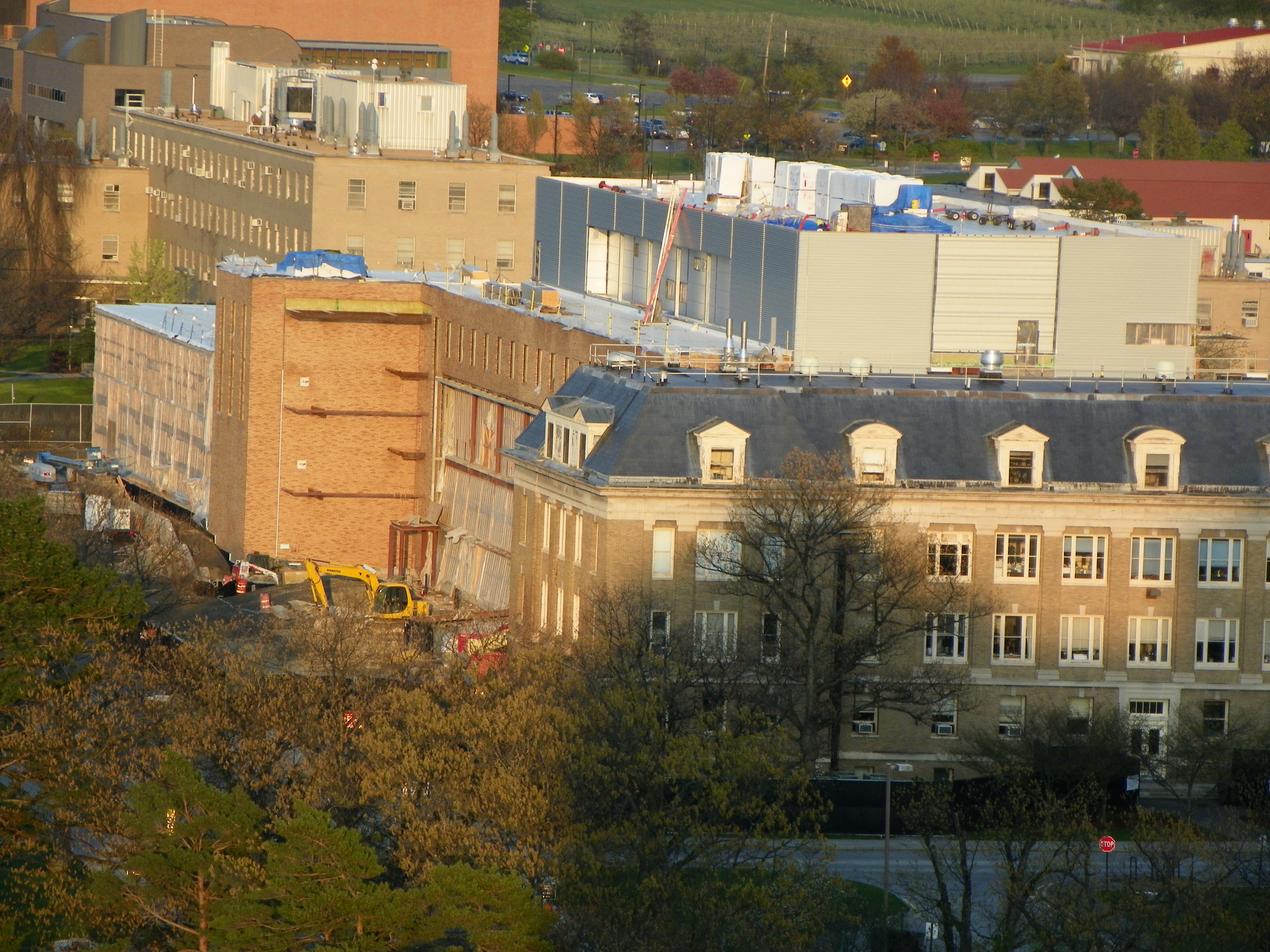
The new Food Sciences Building has completed a substantial amount of exterior work, although the glass facade has yet to be installed. The $105 million renovation is to be completely done in early 2014, with the new Dairy Bar sometime earlier than that.

Site prep is underway at Gates Hall (the new Computer Science building). The $60 million, 103,000 sq ft building is targeting a December 2013 completion date.

It’ll be a happy day when these plain beige boxes are removed. Unfortunately, the $51 million renovation of Warren Hall that necessitated their construction will not be complete until early 2015 (with the Dyson School portion complete by mid-2013 – and it annoys me to refer to the AEM Department as the Dyson School, as if the perceived pedigree was needed to remove themselves from the stigma of CALS).

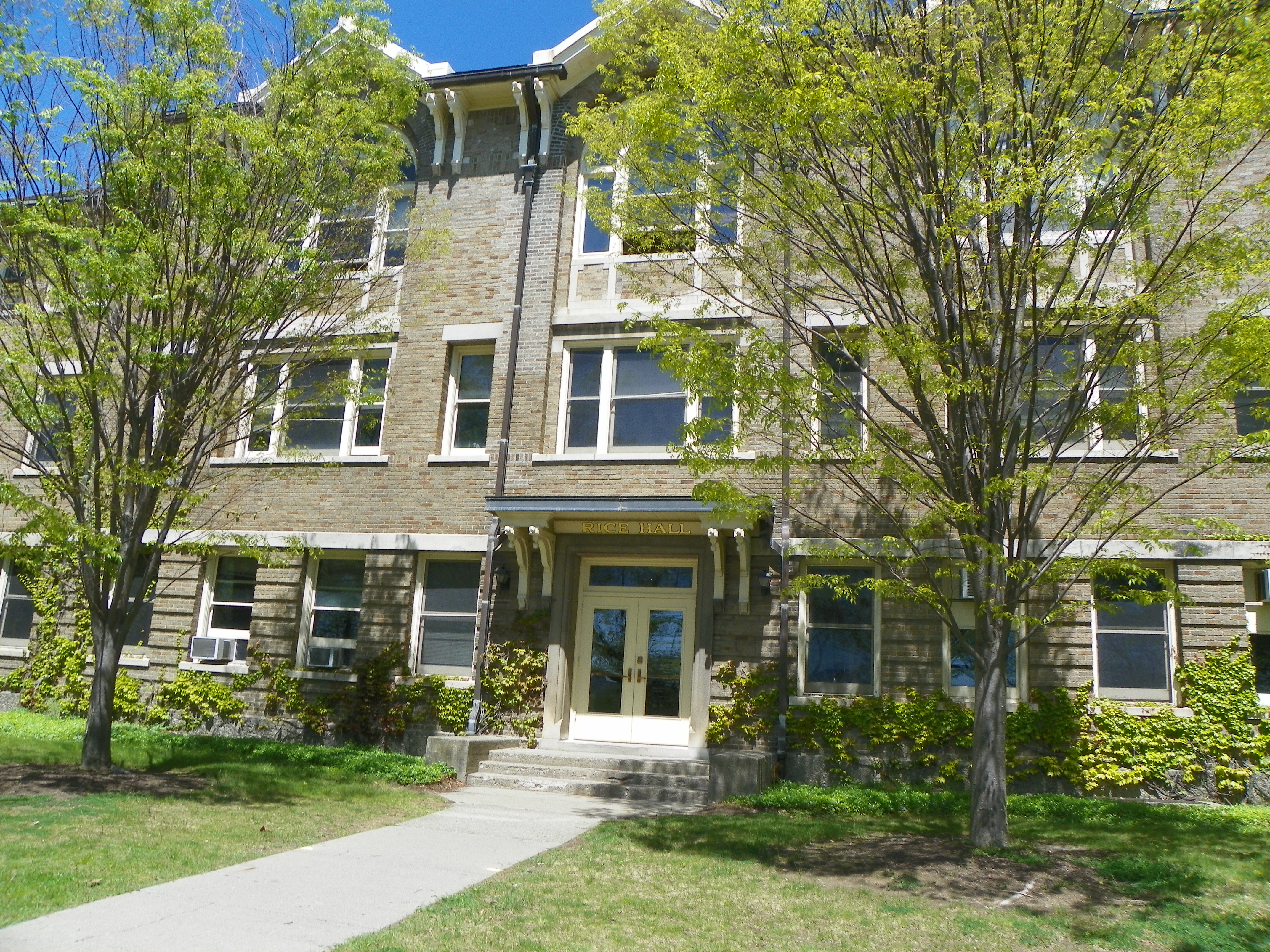
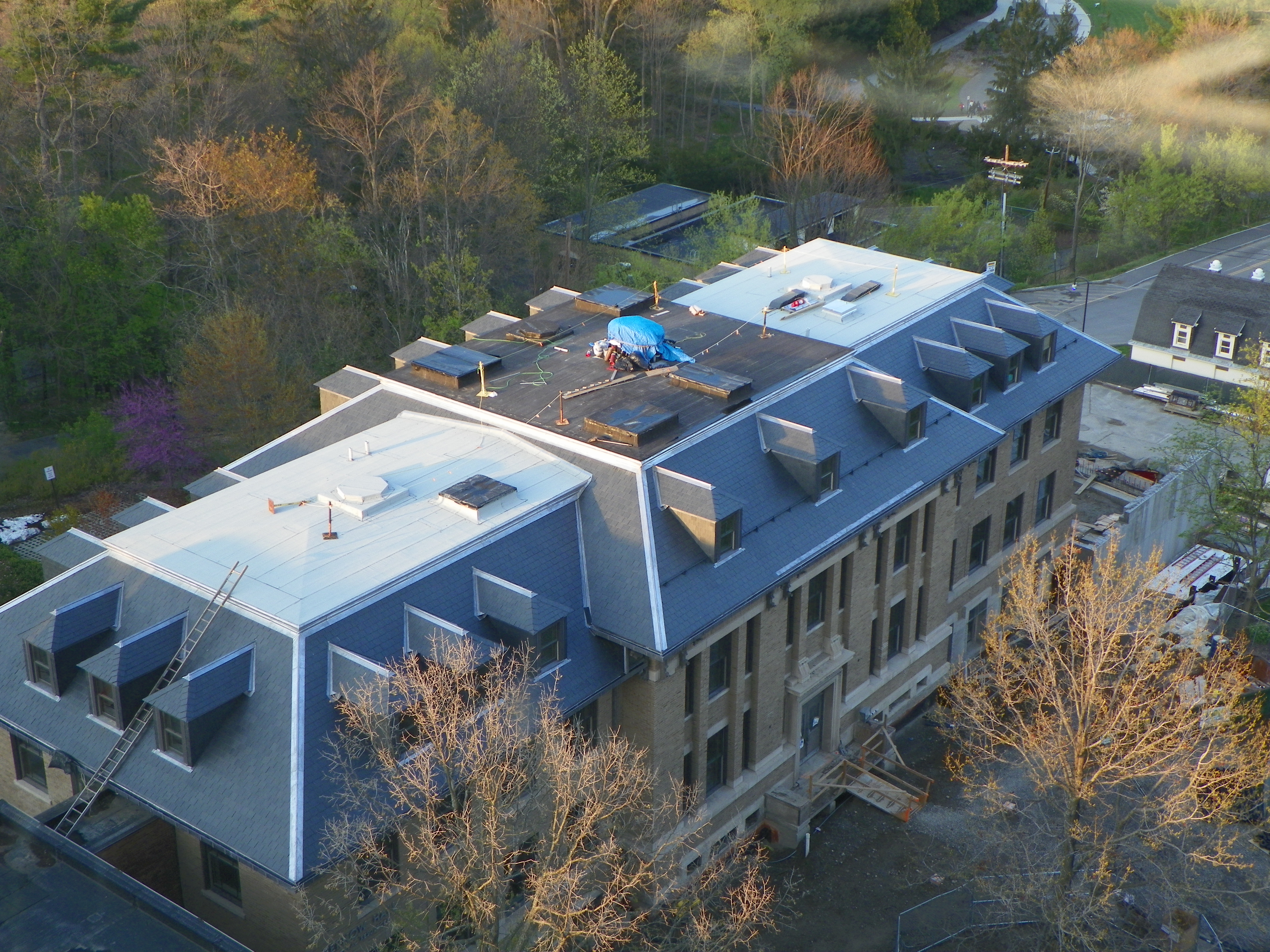
Not the most telling image, but Rice and Fernow Halls are currently in the middle of their renovations.

This Bradfield-based photo of Fernow shows the partially-subterranean classroom being built on the east side of the building.


The ILR School Almost Invaded Hoy Field

10 12 2011

As would be expected for any major university, Not every plan for a new buildng at Cornell came to fruition. Sometimes, it was because the plan didn’t have funds, or the demand for space had ebbed. With the original plans for Cornell’s Industrial and Labor Relations (ILR) school, it was all about the location.

The ILR school is quite young, having opened its doors on November 1, 1945. The original facilities were in temporary wooden lodging on Sage Green (the western and southern grounds next to Sage Hall, in the days before the loading dock/drive for the Cornell Store and the parking lot south of Sage Hall).  The school had originally been conceived a decade or so prior, and by 1944 the state gave Cornell its monetary blessing, foregoing counter-offers for a labor college at Syracuse University or Union College in Albany (Bishop, 568). On the other end, the president of Cornell at the time, Edmund Ezra Day, had to contend with unamused industrialists and farmers among its alumni who felt that such a school was unnecessary.

The state was proud of its newest educational creation (in the days prior to the massive proliferation of modernist/brutalist SUNY campuses), and drew up plans for permanent housing for the ILR school. The original plans were produced at a cost of $80,000 at the time, but never came close to construction due to some very angry Cornell alumni and students.

The issue wasn’t about the architecture (being the late 1940s, early modernism or stripped Collegiate Gothic were likely), but the location. The site for the new school was on Campus Road. To give you an idea of how the area looked at the time, here’s a map from a years later in 1954 (click the link for a larger version):

Phillips Hall and Teagle Hall were not yet built (both were completed in the early 1950s), so the area was really only Barton Hall and the athletic facilities. The Buildings and Grounds Committee at Cornell picked a site on Campus Road, where Phillips Hall was built a couple years later, but with a larger footprint that would’ve required the removal of Hoy Field (which is aligned directly south in this map – it was redone to face southwest about five years ago).

A tempest of outcries ensued. It was firmly believed that Hoy Field had been donated by the alumni to be used in perpetuity for athletic purposes. Suddenly, different alumni groups were protesting “The invasion of Hoy Field”, and the Association of Class Secretaries filed complaints and letters of concern with Cornell, along with written protests from 53 undergraduate student groups. President Day and the committee gave up on the plan.

The state was not pleased by the reception, and so the ILR school was kept in the dreary wooden temp buildings until the Vet School’s new Schurman Hall was built in the late 1950s, and ILR could move into what used to be the Vet School buildings at the corner of Tower and Garden Road. The rather pretty if utilitarian ca. 1896 James Law Hall was demolished to make way for Ives Hall. But, In the long run, the administration was rather glad it hadn’t built the ILR school on that plot of land, as it allowed the full build-out of the Engineering Quad.

Now, fast-forward to today, and consider the positioning of the soon-to-be Gates Hall, and the master plan’s removal of Hoy Field. I wonder if such an outcry would arise today, as it seems once again that the end of Hoy Field as we know it is drawing near.


All Ivies Make (Architectural) Mistakes

28 11 2011

Somewhere during my crappiest Thanksgiving ever, I was reading through the online Daily Sun and came across some comment where the individual suggested that Cornell has the worst architecture in the Ivy League. I spent a little while mulling over that critique – sure, some of our halls are quite ugly, but the worst Ivy?

Curious, I decided to look at some  of other schools. I don’t have some chip on my shoulder over the lack of “pretty” buildings at Cornell, and certainly “ugly” is a subjective term. But Cornell is not the only school that has designed buildings that have earned harsh rebukes from certain audiences.

Harvard people have been criticizing themselves for years. One of the first things that came up in my search was a polite criticism of the modern architecture that took over Harvard’s campus starting the late 1950s (the Quincy and Leverett Towers). The article was published in the Crimson, the Harvard student newspaper, in the early 1990s. If you really want to go in depth, someone wrote an entire book dedicated to reviewing Harvard’s architecture. Today, Harvard is putting up modern buildings such as a science buildinga new graduate housing complex, and Tata Hall (I’m still wondering if Cornell plans on naming a building for Ratan Tata ’59) The take away could be that Harvard, like Cornell, builds in the style of the times; but it would be worth noting that Harvard has buildings 130 years older than Cornell.

Down in New Haven, Yale is no stranger to “ugly” architecture either, with such structures as the Art and Architecture Building and the Beinecke Library to its credit. Their newest set of dorms are designed in a Collegiate Gothic style that has mass appeal, but they decided to demolish several historic buildings to build it.

Going down the list, I didn’t see one campus that was “unscathed”. Princeton, U Penn, Brown, Columbia, even Dartmouth, which lacks your usual Science and Engineering building culprits. It seems most of them entered the 60s and threw cohesion out the window for daring departures that have, for the most part, not aged well. Even now, many of these schools are still trying some avant-garde edginess to further their names.

Would I venture support or denial of the “ugliest Ivy” claim? I am forced to stay neutral. I’ve only been to four of their campuses, not to mention it’s a matter of opinion. But, considering some of the college campuses out there, I know things could be much worse:


The Keyword Bar XIV

5 11 2011

Honestly, I had not realized so much time had passed since my last entry, so I figured I’d cobble something together based off of my stalwart “Keyword Bar” entries.

1. “johnson boatyard ithaca zoning” (11-5-11)

Actually a fairly good question given the recent proposals for townhouses, and later additions, to the area in the the boatyard’s immediate vicinity. Conveniently, they city of Ithaca offers a zoning search tool based on address. The zoning in the 700 block of Willow Avenue is I-1 (light industrial), M-1 (a general clearing house for just about everything on a waterfront and up to 5 stories),  or P-1 (parks & rec) depending on the property.I am not aware if rezoning is required for the project, but it looks like that it will not be necessary if it falls into the marine zoning.

2. “gates hall expected date cornell” (11-5-11)

According to Cornell Facilities Services, tentative opening will be December 2013. When the official ceremony will be, probably sometime afterwards.

3. “cold stone creamery ithaca” (11-4-11)

Actually, this has come up no less than a dozen times in the past week or so. That actually worries me a little bit. I have fond memories of trips to Purity, even if I’d but ice cream for home, leave in my freezer six months, and then throw it out when it was badly freezer-burnt. But anyways, the new Cold Stone/Tim Horton’s  drive-thru is  in the southern part of the city near Buttermilk Falls (407 Elmira Road, to be specific). Not that I have a problem with Cold Stone itself, but I am a little cautious about the homogenization of Ithaca. I’d like to see the right combination between local flavor and well-known chains, but there’s not exactly a chart that says what the right combo is.

4. “cornell law school building renovations 50 million 2011” (11-4-11)

I’ve been lax about mentioning this one, but not without reason. Cornell is planning significant renovations to the Law School, with a gross addition of about 43,000 sq ft, which for comparison’s sake, is similar to the size of Milstein Hall. However, most of it appears to be in below-street-level additions, with the most notable changes being a new entrance onto College Avenue, and a pronounced addition in the courtyard. Also, construction won’t start until summer 2012, and will go through to December 2014, which is only a few months before my five-year reunion. So, it’s largely hidden and way down the line, but it is on the drawing board.

5. “ithaca november snow” (11-2-11)

It happens. Frequently. 5.9 inches worth, on average. The past ten years were, going back in time, 0.0″, 0.0″, 6.6″, 1.2″, 0.6″, 2.3″, 1.6″, 1.0″, 9.6″, and 0.0″.  So, it’s an average with a rather spread-out distribution.


The Goldwin Smith Hall Addition

21 10 2011

As a general rule, checking facebook while at work/in the office is a poor use of time. My excuse is that I’ll run some scripts that take a few minutes (or overnight in two cases) to process, thus giving me down time. Well, on the stalker-philic facebook news feed, a friend of mine who happens to work for the university mentioned that Skorton just made an announcement that a new humanities building would be constructed. Technically, this isn’t “new” news, it’s been in the early planning stages for four years, enough that I wrote a blog entry about it almost three years ago. At the time, the project was evaluated to be about 60,000 square feet (35,000 new) with a budget of $45.1 million, in three conjoined structures similar in massing to the original building.

Well, according to the project’s website, the square footage has stayed about the same (66,500 sq ft), but the design has evolved quite a ways. A large atrium will be the centerpiece of the structure, and it will also contain the largest auditorium on the Arts Quad. The building will have a large cafe, faculty offices and classrooms, and be the hub for several smaller Arts and Sciences departments (which ones are undetermined, the only one confirmed to move in is the Romance Studies Dept.). The project, which will be funded mostly through donations, is budgeted at $61 million, with a tentative construction start date of summer 2013 and a completion date of the end of 2015. The building is designed by Koetter, Kim & Associates, the same firm that was responsible for the Physical Sciences Building.

Well, I can’t say I’m particularly impressed. Seems like Cornell is in its next iteration of the “giant atrium for cross-pollination of ideas”, and the overall design, while not offensive by any means, is a rather plain, mostly glass box. Not exactly eliciting much of an impassioned response from this armchair critic.


Homecoming Construction Update

19 09 2011

I came. I saw. I took photos. Note that all the photos can be enlarged by clicking on the image.

Milstein Hall – The building so nice I visited it twice (and by nice, I mean it’s “nice”, but not “great”, and hard to believe it cost $55 million). During the second visit on Saturday evening, a group of about ten skateboarders converged on the white humps and concrete curves. I’m going to guess it will only be a matter of time before that gets banned if it hasn’t been already.

The Human Ecology Building. The woman at the info desk offered up a “scavenger hunt” assignment, but I was short on time.

The Food Science Building (Stocking Hall Addition/Reconstruction). From my favorite Bradfield perch.


Prefabs on the Ag Quad. Sad face.

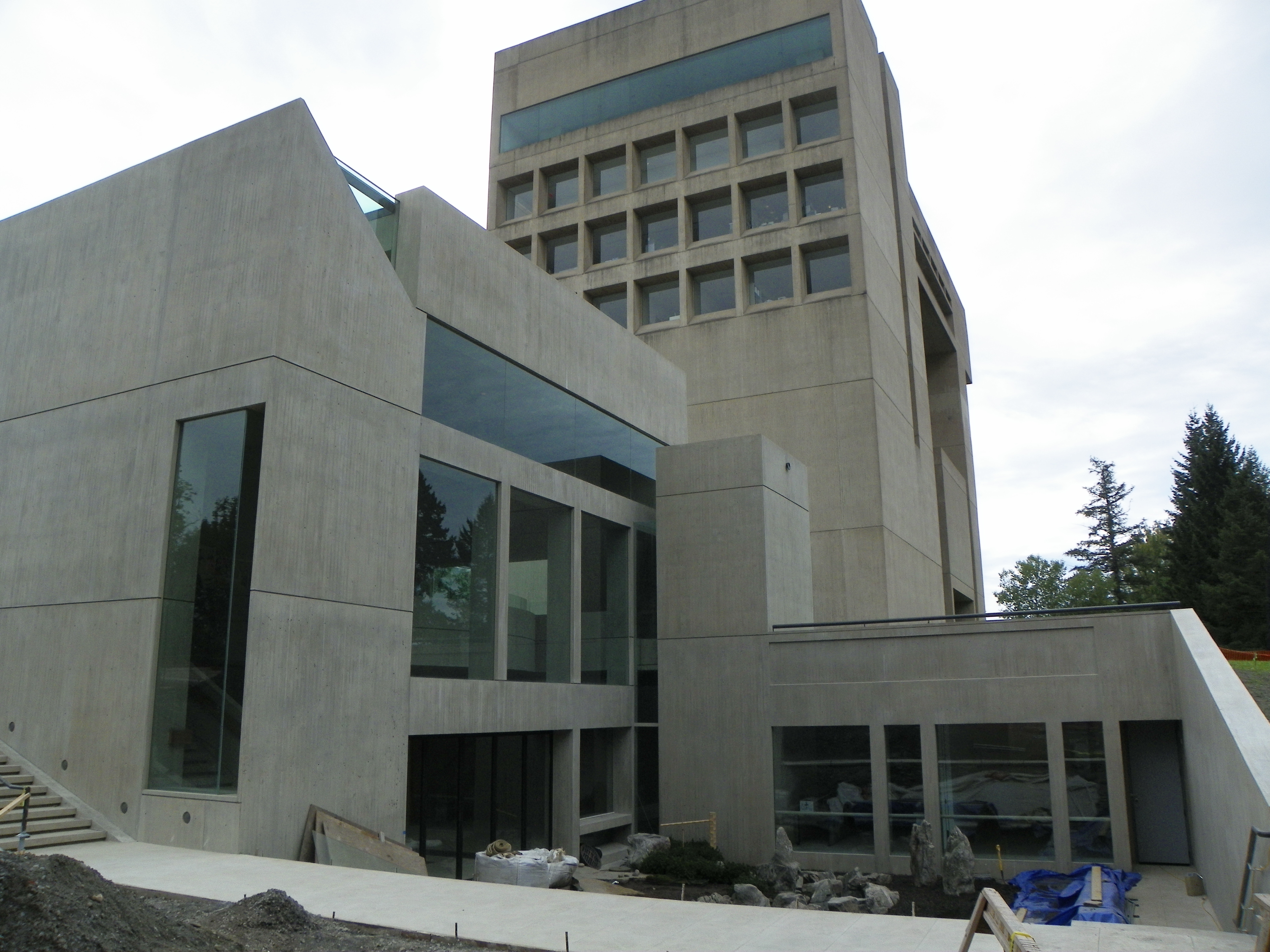
The Johnson Museum Addition

The Physical Sciences Building

309 Eddy Street. When they say “opening soon”, they mean next summer. I also have a photo of the Collegetown Terrace site from a distance, but I could see was a fenced-off area that was largely cleared out.


Exploring Milstein Hall

16 08 2011

So, fortunately for me, I’m not the only person out there who has an interest in Cornell construction projects. By good fortune, I happened to receive a series of emails from a newly minted Cornell graduate, “BB”, who took the time and opportunity to explore the nearly complete Milstein Hall and pass along some photos to this blog. For that I am thankful, as my trips to Ithaca have become fewer and further between. While I am glad for the photos, I’m still going to push the token disclaimers that I do not encourage or condone the exploration of unfinished buildings, due to a safety risk and legal concerns with trespassing. Also, while he is kind enough to share the photos here, they are his property, with all associated rights and privileges. I would encourage those that want to use his photos to contact him directly.

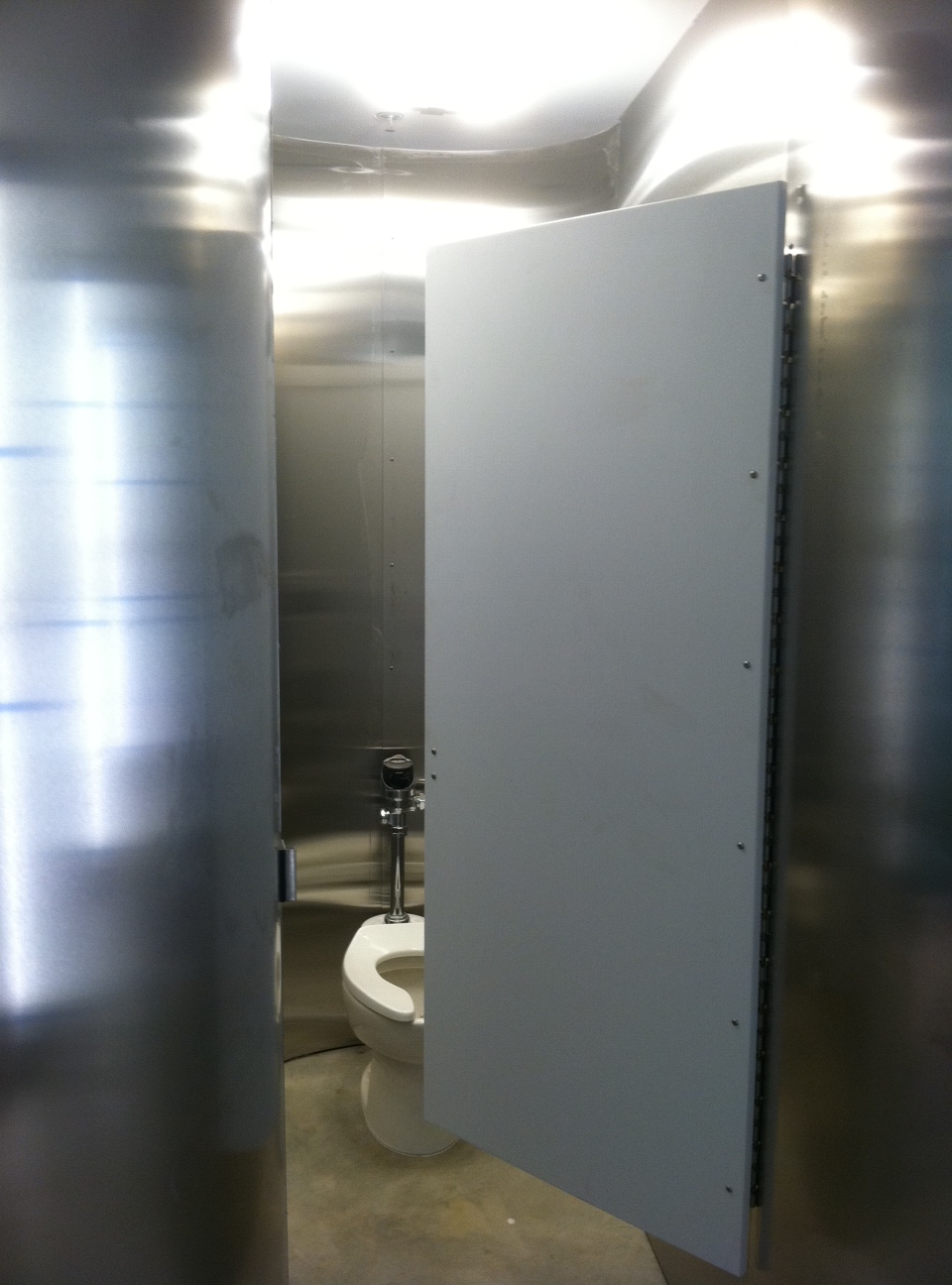
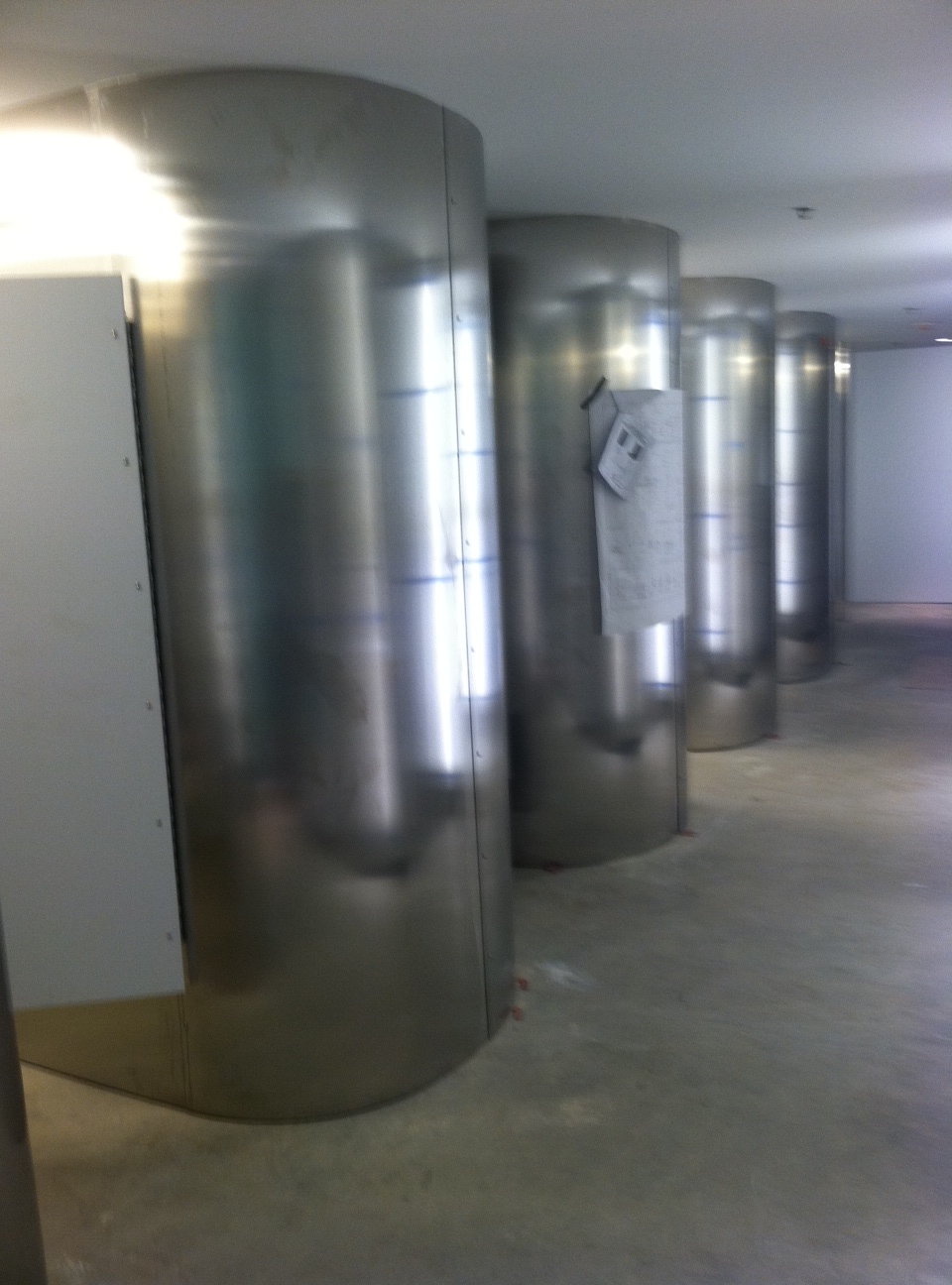
For those who wish they could answer nature’s call while on a spaceship…

They’re not even stalls. They’re more like bathroom pods.

I’m looking at this photo, and immediately, “The Imperial March” pops into my head.


Taking Care of Cornell’s Students’ Bodies

10 05 2011

After I wrote about the medical college, I felt inspired to write up a brief piece regarding the history of student health at Cornell. Understandably, the value of this entry to the practical person looking up health information is nil, but then, I would hope that if someone has health issues, they would be looking through health websites like Gannett’s instead of blogs.

Anyways, most Cornell students know that if they feel sick, or think they might be pregnant, or some combo thereof, that a trip to Gannett Health Center is in order. Back in Cornell nascent days, if you were sick, well…you were pretty much screwed. A student at Cornell a few years after its founding, if they were to become ill, could hope to be taken care of by their friends, roommates or professors, if they were lucky and had strong connections. Otherwise, you were S.O.L. If it was any consolation, so were all residents of the city of Ithaca, which wouldn’t get it’s first hospital for a few more years (the first hospital opened on Aurora Street sometime during the 1870s, and the second hospital was built off of Quarry Street in Lower Collegetown in 1910; that complex still stands today as the Quarry Arms apartments, which Collegetown Terrace will be built around). In 1870, the faculty senate voted to set aside rooms on campus for sick students (Bishop 176), and the first medical examiner, a sort of campus physician, was appointed in June 1877 (he held two job titles, the other being an assistant professor of mathematics). Jennie McGraw of Cornell Chimes fame put a bequest in her will of $15,000 for the construction of a student hospital on the grounds of Cornell, and this was increased to $40,000 before her death in 1891. However, thanks to the Great Will Case, Cornell never saw any of her money used towards a health facility.

The first building dedicated solely to student health was the Cornell Infirmary, which still stands as the Schuyler House dorm to the far southwest of main campus. The Sage Complex  initially consisted of only the east building, which was essentially a converted mansion built in 1880 as Henry Sage’s retirement home after he moved from Brooklyn to Ithaca (Bishop 211).  Upon his death in 1897, he asked that the building and land be donated to Cornell, which his sons Dean and William did with an additional $100,000 donation for maintenance (Bishop 333). They might not have done that if Sage had outlived his nemesis and fellow generous benefactor Willard Fiske. Both sons were furious that Fiske was interred in Sage Chapel in 1904 and abruptly stopped all involvement and donations to the university. William Sage actually had donated a building to Yale some years later. But, I digress. The original Cornell Infirmary had room for twenty patients, and the large addition on the west side was completed in 1912. What you received was bed, board, and modest nursing care and lab services. While a student of yesteryear might receive advice on hygiene or bad habits, actual diagnosis by physicians was a role the university refused to take on until around 1940. It was felt that the university should not be responsible for the clinical care of its students, only lend a hand in their treatment. Medical advising by Cornell staff was generally discouraged.

By the 1950s, it was felt that the Infirmary was inadequate, poorly located and outdated, so a new building was constructed on land that used to hold two faculty residences. This building was named for media mogul Frank Gannett 1898, who generously funded its construction. The Gannett Health Clinic opened its doors in 1955 and received an expansion to its west side in 1979, bringing it to 39,000 sq ft. The masterplan suggests a 90,000-130,000 sq ft structure to replace the current building on the current site sometime during the next several years.

I’m marginally jealous that Cornell’s health center is on campus. The one at my grad school is located a half mile away across a four-lane highway. What a nice way some colleges provide for their students.


News Tidbits 3/21/11: Gates Hall Design Released

21 03 2011

Just…ugh. This image comes from the Facilities Management website. The designs have been submitted to the university but are still being tweaked to fit the budget, or “value engineered” if you will.

I already described my intense dislike for Thom Mayne and his firm, Morphosis, in a previous post. As some folks may remember, Morphosis was selected about nine months ago to design the 100,000 sq ft Gates Hall (aka the new Computer and Information Science Building) on the site roughly where the Grumman Squash Courts are now. The angle of the rendering appears to be northeastward, with Barton Hall’s tower in the distance.

Some may like this kind of edgy, “organic” architecture. The only organic thing that pops into my mind is decay. Seriously, the bottom of the overhang on the west side reminds me of rotting deer carcasses my childhood neighbors would have laying around parts of their property (they were a bit odd, but they gave out stuffed animals on Halloween, which totally redeemed them in my ten-year old mind), with the ribs exposed and the flesh drying out and curling. If that imagery doesn’t prove my disdain, then nothing will.

This may float some people’s boat, but I’m willing to wager they’ll tend to be in the minority. For as edgy and advanced as it may seem, I can only imagine and feebly hope that the built product looks a little better than this, and that it ages well.