News Tidbits 5/9: Changing Elevations

9 05 2015

cinema_drive_1

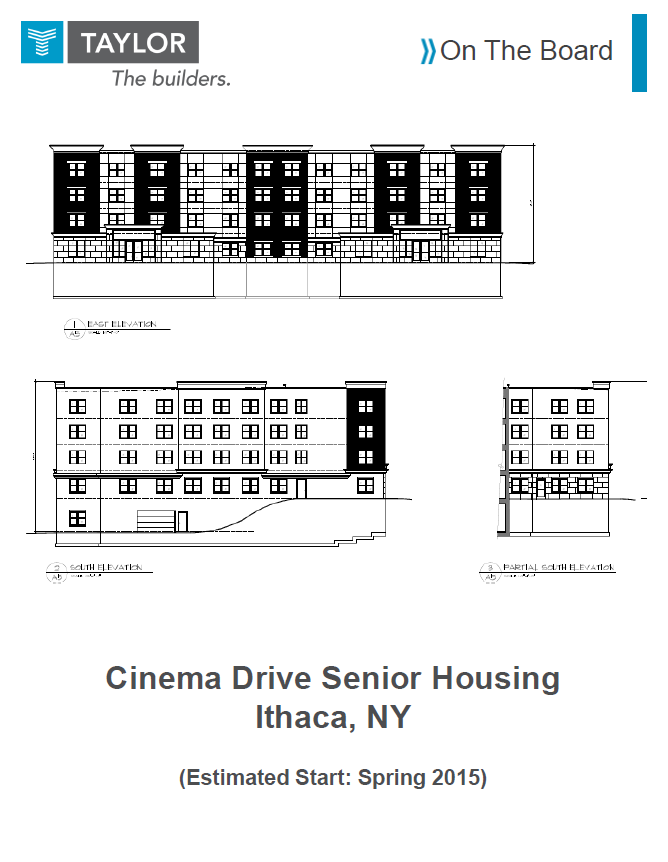
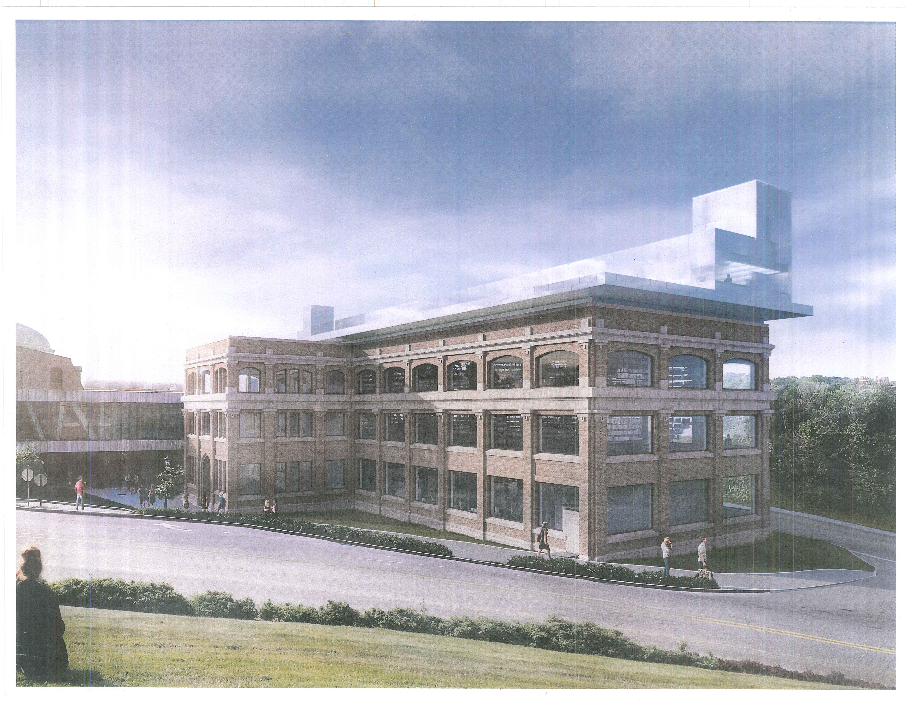
1. Looks like the CU Suites project is in fact the render shared by Taylor Contractors. Readers might remember these elevations from last week for a proposed “Cinema Drive Senior Housing”, but that the image didn’t match up with the proposal, a 3-story, 43,000 sq ft structure. According to the village of Lansing’s Board of Zoning Appeals agenda, the project is now a multi-story mixed-use building with a size of 87,515 square feet, which looks about right for the building proposed above. The project is seeking rear yard setback and height variances for not enough of a rear yard parking setback from the lot line, and for exceeding the maximum height allowed by zoning (which is 35 feet).

Doing some back of the envelope calculations, if one calls only the top three floors senior housing ((3/4.5) * 87515 = 58343) and uses the rough guidelines of 15% for circulation/utilities and 980 sq ft per unit, then one gets about 51 units, which makes this a pretty sizable project by local standards.

inhs_pride_v3_elevations_1 inhs_pride_v3_elevations_2

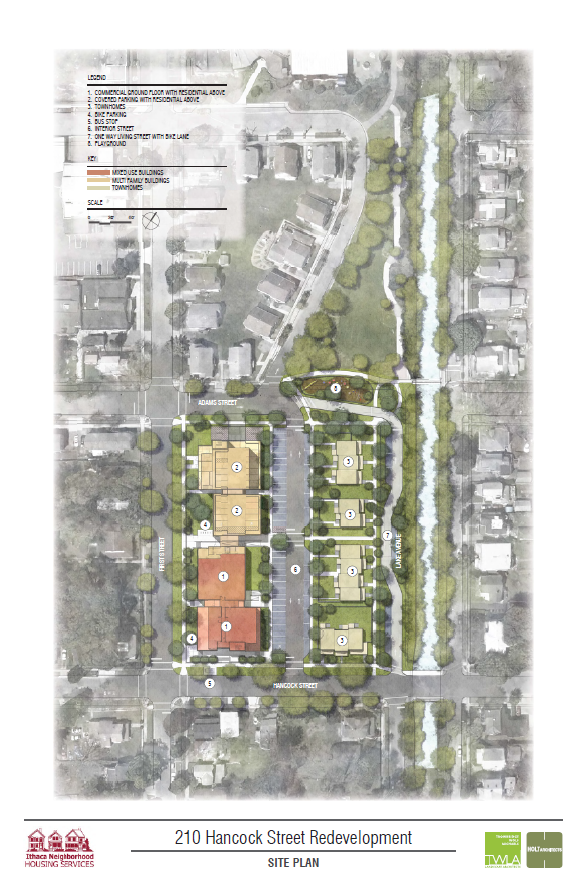
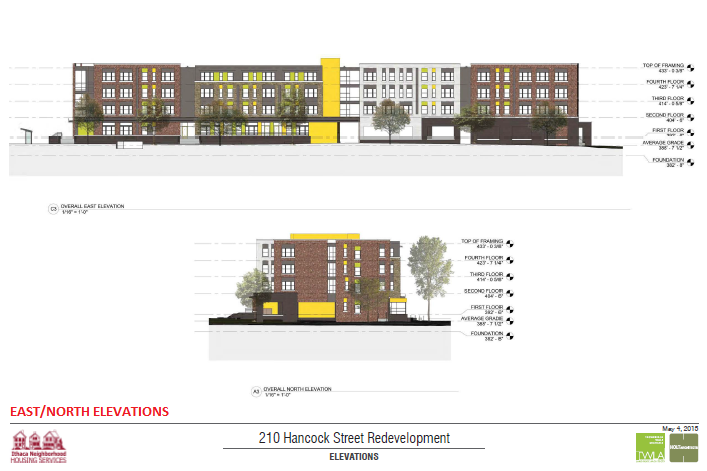
2. Now for a change or perspective – new perspectives of the 210 Hancock project, in the form of elevations found in higher resolution here. Now you can see what all of the buildings look like as a whole, rather than the simulated viewpoints previously shown. The elevations heights give the apartment building’s height at about 40 feet. Apart from some tweaks to the way the first-floor parking is screened, there haven’t been a whole lot of changes since the last planning board meeting. Note that the buildings are tucked in or pushed out and separated by “hyphen” connectors so they don’t present one continuous street wall. The design is by local firms TWLA and HOLT Architects.

Am I the only one who finds the lime green and goldenrod to be a bit..intense when compared to the other facade materials?

112_blair_v3_1 112_blair_v3_2

3. You want more new drawings? You get more new drawings! This batch represents the latest incarnation of the duplexes proposed for 112 Blair Street / 804 East State Street. Renders copied from here, project narrative here. Developer Demos / Johnny LLC (the Nestopoulos family) is still trying to have these ready in time for the Fall 2015 school year. Rather than continue seeking an area variance in zoning, the project is back down to two duplexes with three bedrooms and ~1,235 sq ft each (12 bedrooms total). After meeting with neighbors, it was decided to move back to surface building to reduce building height, and to add expansive front porches, which gives the otherwise bland duplexes a little character. Site Plan Review will take place this month.

clarebridgecrossings_1

4. Looks like there might be an expansion of senior care facilities in Ithaca town. The Ithaca Town Board is set to discuss changes next week to the Planned Development Zone (PDZ) for the Sterling Heights / Clare Bridge Cottage assisted living facilities, located on Bundy Road just north of the city-town line. Sterling House is a 48-unit assisted living facility, while Claire Bridge Cottage is a 32-unit facility specializing in memory care (Alzheimer’s and dementia). The new building, a 23,200 sq ft 32-unit facility to be called “Clare Bridge Crossings”, is designed to bridge the gap between the two – patients who might be in early stages of illness and experiencing mild symptoms, but otherwise still capable of some degree of personal independence.

The new building appears to be a one-story addition tucked between the other two structures, so it won’t be visible from the street. Along with the new building, there will be updates to parking, landscaping stormwater facilities, and the addition of a couple of courtyards between the buildings. The architect is PDC Midwest, a Wisconsin firm that specializes in memory care facilities.

Now, some readers might be saying, “who cares?”. There’s a couple of reasons to care. For one, this is important from a quality-of-life perspective. Picture a senior couple where one is reasonably healthy and the other has memory care needs. It means a lot to have a facility nearby that can care for their loved ones. Secondly, an expansion would bring with it a number of jobs to support the new residents – nurses, maintenance, kitchen staff and so forth. So there’s an economic benefit as well.

Full disclosure – my mother is a nurse who works for an assisted living program that includes clients with memory care concerns. So I’ve heard a thing or two about a thing or two.
east_hill_master_plan

5. On a parting note for the week, here’s a little more information on Cornell’s redevelopment plans for East Hill Plaza. According to Planning Committee minutes from the town of Ithaca, Cornell will be taking part in a multi-day design charrette hosted by form-based zoning proponents FormIthaca in early June. Form-based zoning in a very small nutshell is zoning that focuses on design elements rather than use. Cornell is interested because the plan will hopefully lead to a regulating plan for the “compact mixed-use” development Cornell hopes to build to build in that area. The plan could provide language for a new Planned Development Zone that would potentially allow Cornell to move forward with a housing/retail mix at East Hill Plaza.

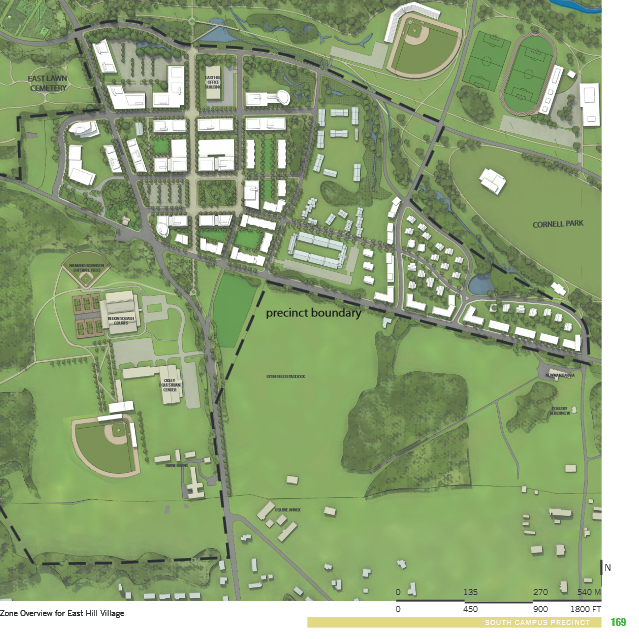
Cornell has sought to redevelop East Hill Plaza and surrounding parcels (most of which they already own) for several years. A vision for the plaza shows up in Cornell’s 2008 Master Plan (the so-called “East Hill Village” shown above), and given the need for housing in the area, East Hill Plaza would likely be one of the location where opposition would be less likely, given the the lack of homeowners nearby and the site’s proximity to Cornell.


The Cornell Fine Arts Library

6 05 2015

fine_arts_2

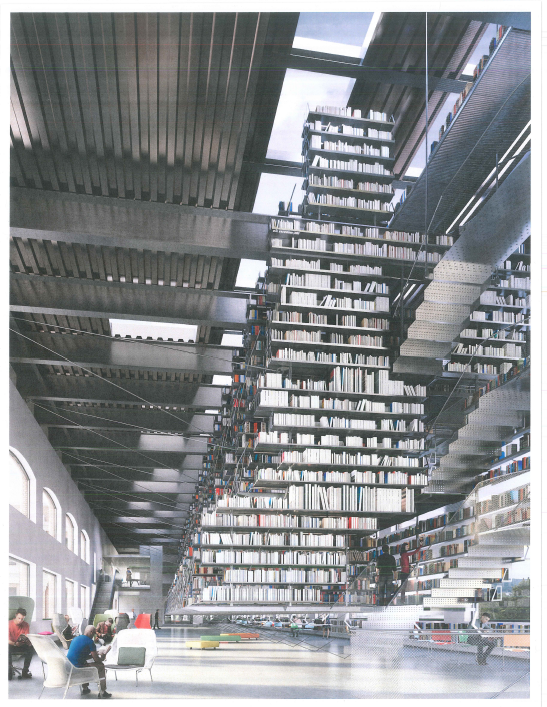
Here we go, renders of the Cornell Fine Arts Library, courtesy of the Ithaca Landmarks Preservation Council (ILPC) Agenda. Additional renders here, project narrative here. Apparently, the ILPC does get to review the addition, although looking at the agenda for the 14th, it doesn’t look like they’re making any decisions (and being just outside the Arts Quad Historic District, they may not be able to).

fine_arts_3

Quoting the front page of the narrative, “rather than acting as a physical symbol, it radiates activity and occupation”. The university wanted the new superstructure, which they’re calling a “lantern”, to be as visible as possible from campus entry points, and it is claimed that the addition will bring “distinction and excellence to the campus”.

fine_arts_4

The building will have two entrances, one public and one for AAP only. The interior will consist of four levels of mezzanine shelving for the Fine Arts Library’s collection, as well as interspersed work/study spaces. Floor-to-ceiling space will range from 48 feet on the north side of the reading room to 7.5 feet in some sections of the library stacks. Long, unobstructed hallways will run the length of Rand Hall. The large variation is meant to convey both grand spaces and “private engagement” with the books. The lantern will have a catwalk as well as working spaces.

fine_arts_5

The design replaces Rand’s multi-pane daylight-factory windows with single panes, removes the east stairwell, and is purposely designed to overhang above Rand, acting as a sort of canopy for rain and sunlight protection.

fine_arts_1

As previously covered, the architect is a Cornell alum, Vienna-based Wolfgang Tschapeller M.A. ’87. More of Tschapeller’s very avant-garde designs can be found at his website here. The project is being funded in part by a multi-million dollar donation from Cornell alumna, architect and UC-Berkeley professor Mui Ho ’62 B. Arch ’66. No construction time frame or total cost have been given at this time.

I’ll call a spade a spade. Rand Hall is getting an ugly hat. One that the rest of campus will be subjected to looking at for years to come.


Fast Facts: Ithaca College Enrollment Figures

5 05 2015

All facts come from Ithaca College’s Office of Institutional Research. All enrollment values are for the fall semester of a given year, i.e. 2001 means fall 2001.

I give what’s probably an unfair amount of attention to Cornell. Part of it is because that’s the campus I know. But Ithaca College has its impacts and influences on the local community as well. Today will take a look at Ithaca College’s enrollment over the years.

ic_enrollment_1

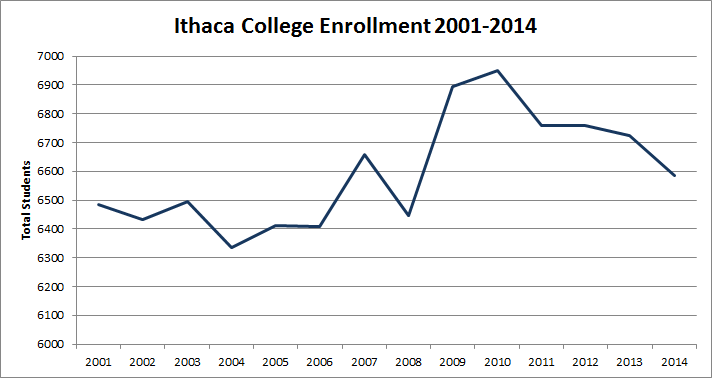
One thing that is clear looking at Ithaca College’s recent enrollment totals is that on the whole, there has only been a modest increase in enrollment in recent years. Enrollment was fairly flat during most of the 2000s, grew a few hundred students during the Great Recession, and has been dropping in recent years. You put a best fit line on this and you get a best-fit line of the equation (student population = 30.374(years out from 2001)+ 6368.5). But the best-fit line is by no means a good predictor in this case.

IC strives to be all residential college, and these fluxes have put a strain on its resources and ability to “run lean”. The college offered students $1500 incentives to live off-campus during fall 2005, as they were forced to convert lounges into dorms. The skyrocketing enrollment in 2009 forced the college to construct a temporary dorm at a cost of $2.5 million, and even offer a few incoming freshmen $10,000 to defer matriculation.

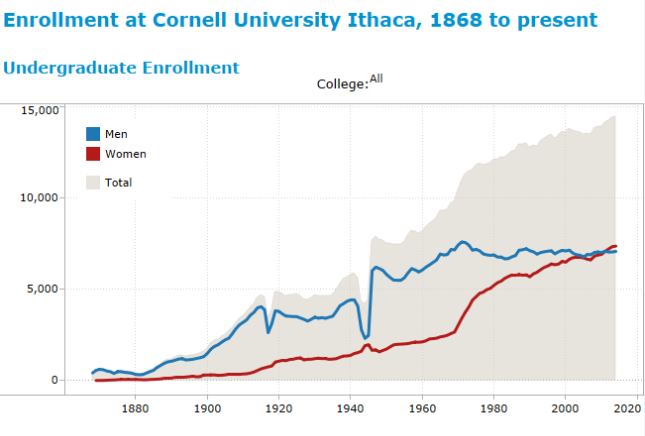
As a general observation of Ithaca’s housing issues, the spotlight can be shined directly on Cornell, whose enrollment has increased by nearly 2500 students since 2005. There hasn’t been much private housing built for IC students in recent years (perhaps a few dozen units), and barring the occasional over-enrolled year, there hasn’t been as much need for private student housing on South Hill.

ic_enrollment_2

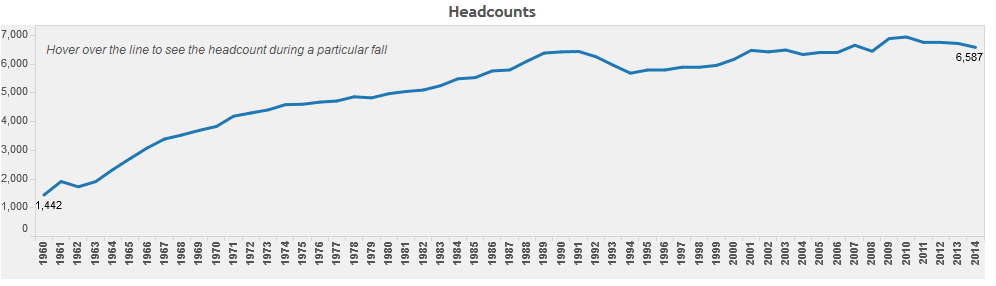
Recent trends noted, historically Ithaca College has grown by leaps and bounds. Apart from a small drop in enrollment when the school was moving into its new South Hill digs in the early 1960s, enrollment continued to swell all the up to about 1991. when it enrolled 6,443 students. Enrollment fell 12% to 5,688 in 1994, before slowly rising back up in the late 1990s and early 2000s.

ic_enrollment_3

Looking at graduate student enrollment, there was a substantial increase during the 2000s, climbing from 230 in 2004 to 507 in 2010. Since then, however, the number of grad students enrolled on South Hill has tapered down to 463.

ic_enrollment_4

One thing that has stayed fairly consistent over the past decade is the proportion of gender on the Ithaca College campus. The gender split is typically 42-44% male, 56-58% female, with this year having the highest female proportion in recent years, just like Cornell.


News Tidbits 5/2/15: Oh, The Anticipation

2 05 2015

1. Lansing village is trying to find a happy medium in its zoning. Specifically, commercial zoning. The village is looking to rezone a group of properties along Triphammer Road near the mall from Commercial Low Traffic to Commercial Medium Traffic, a new kind of zone for the village. According to an article in the Lansing Star, the zone would include “low traffic food and beverage establishments [that] might include sit-down restaurants with or without a bar where food is consumed on premises, which may include carry-out or similar service such as [a] bakery or café,” as well as senior living facilities and certain stores under 10,000 square feet in size.

Most of this has to do with two parcels specifically – a vacant strip of land on Oakcrest Road is slated for a dozen units of senior housing that was a stipulation of the BJ’s approval. The senior homes are part of the BJ’s Planned Development Area and not explicitly affected, but are rezoned on technicality. A vacant parcel on the corner of Triphammer and Hickory Hollow Roads next to Ciao Italian Restaurant has received a lot of attention from outside developers, for hotels, liquor stores and general retail, but the current commercial low traffic zoning allows for none of those (CLT reads as limited to office buildings and isolated small shops). The zoning is under review and any changes would only be enacted after a public hearing at a later date.


cinema_drive_1

2. Here’s a pleasant surprise: drawings for a project on Cinema Drive in Lansing. My guess is that this is the project planned by the Thaler family, aka “CU Suites”. The CU Suites proposal described a 3-story, 43,000 sq ft building; the one shown here is 4 stories. The CU Suites proposal is also likely to break ground soon, just as this project is planning. I’m not 100% certain the two are the same thing, but if this were another project on that short street, I’d be very surprised.

Strangely, the source of these drawings is the Cornerstone Library proposal. The selected building partner, Taylor General Contractors of Rochester, was using it as an example of work underway.

harolds_square_taylor

3. Then there’s another project Taylor General Contractors is involved in – Harold’s Square. Taylor has done some work for Harold’s Square developer David Lubin in the recent past, so this makes sense. Will it actually start in Fall 2015? Good question, but there’s been no word on if Lubin has closed on financing for his 11-story downtown project.

fine_arts_1

4. No sketch plans have been uploaded to the city’s website just yet, but initial renderings for the new Fine Arts Library in Rand Hall were presented at the Planning Board’s meeting last Tuesday, according to the Cornell Daily Sun. According to AAP Prof. Jon Ochshorn’s blog, Cornell’s been trying to keep the design plans of this project under tight control, which is fairly unusual for a school that often promotes new projects well in advance (Klarman, Gannett, Gates).

So far, the only public release has been an image of an interior staircase, a soaring, unsettling feature that can be found throughout the works of the project architect, Vienna-based Wolfgang Tschapeller ’87.

University architect Gilbert Delgado did his part to sell the project. From the Sun: “[We’re] resetting the clock on this very important building,” he said. “This is the presence that we’re looking for: noble, early 20th century industrial building that’s been repurposed to our higher use which will exhibit one of the world’s greatest book collections.”

Speaking for only myself, I have concerns with how this is being managed. Cornell had planned to demolish Rand in the early 2000s to make way for Milstein Hall (which went through three starchitects before shovels hit the ground), but alumni blowback caused them to renege on that plan. It’s clear that there’s a certain sort of attachment that AAP alums have towards their structural workhorse. My worry, with the lack of details so far, is that Cornell is stymieing the flow of information for ignoble purposes. Students and alumni won’t be able to object and petition against plans they don’t see and hear about until the figurative last second. Plus, AAP hasn’t had good luck with budgets for new buildings – Milstein’s cost more than doubled from $25 million to $55 million during its incubation, while it shrank in size. In a time of fiscal stress for the university, a dramatic, structurally complicated new library may not be prudent. I’m not against this project explicitly, but I do have reservations.

Regardless of my armchair criticism, when renders do finally show up, you’ll see copies hosted here soon after.

Cayuga-Meadows-Shot

5. According to the town of Ithaca’s 2014 Planning Board report, Conifer has secured funding for “Cayuga Meadows“, its approved 68-unit (sometimes given as 62, unsure which is accurate) affordable senior housing building planned for West Hill. With finances in order, the 3-story, 19,520 sq ft building, sited just south of the Overlook at West Hill apartment complex, will likely start construction this year. Per Ithaca Builds, approvals were granted in late 2013 after a years-long planning process that had Cornell involved early on.

Some other projects still gestating include an 18-lot single family subdivision off of Park Lane in Eastern Heights, and Cornell clarifying plans for a large mixed-use project at or near East Hill Plaza.