News Tidbits 7/30/16: The Unfortunate Surprise

30 07 2016

201_college_v5_1

201_college_site
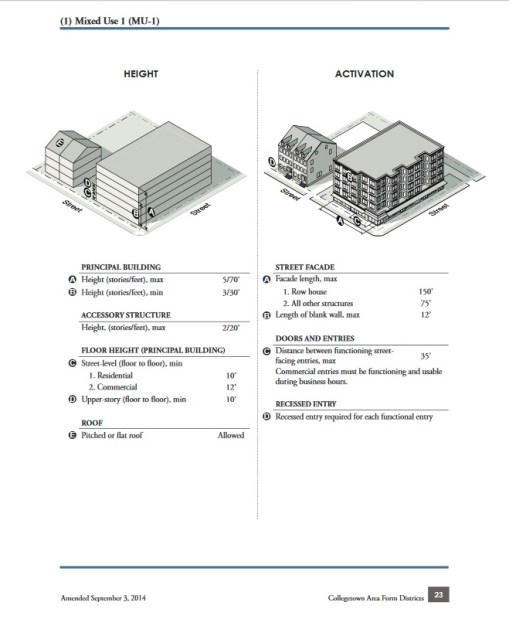
1. Pretty much everyone was caught off guard by the planning board’s decision to send 201 College Avenue to the Board of Zoning Appeals on a previously-undiscussed zoning technicality. The issue has to deal with facade height in connection to the length of a continuous wall – the argument being pushed by board member John Schroeder is that, since there are primary walls on College Avenue and Bool Street, the H-shaped proposal isn’t technically valid and the deep indentation actually has to be two separate buildings, one slightly shorter than the other since the site is on a slope. This was the subject of a prolonged and heated debate, since the code’s pretty ambiguous in that regard, and (as shown below) the design elements shown in the form district booklet demonstrate buildings with architectural indents/setbacks.

327_eddy_rev2_2

327_eddy_rev2_3

If recollection serves correctly, something similar came up in a previous discussion two years ago with 327 Eddy Street. The project fills the entirety of a sloped lot, but there was a hazy interpretation regarding one’s definition of floors and height where one could have called it 8 floors, so it had to be clarified and it became the average proposed height for cases with a sloped parcel. In this instance, there was one primary wall, on Eddy Street, which is why there’s just enough wiggle room left that a clarification request, however targeted it may be, is legally valid. The board agreed 4-3 to let the BZA issue a determination on 201 College, which could come anywhere from August 23rd to September 6th. That means a late September approval is maybe the best bet. That’s probably too late for an August 2017 opening, so whether or not the project would move forward (which could be immediately or in summer 2017 for a 2018 opening) if given approval is another question.
cafd_mu1

There is one other thing that is worrying from an impartiality standpoint. John Schroeder and Neil Golder served together as Collegetown’s Common Council reps in the 1990s. Although Schroeder’s not the biggest fan of Collegetown development, he hasn’t raised this much of a concern over other projects, and Neil has been very, very active in his outreach. There could be an argument that he should have recused himself from the decision-making process, or at least have formally acknowledged his longstanding professional relationship with the project’s primary opponent.

trebloc-future2-1-620x420

city_centre_site_options

2. Also from the Planning Board meeting, further discussion of the Trebloc project. Those following the IJ’s Nick Reynolds’ Twitter know that there was some talk about big changes with a lot of wonk talk, and this is what it has to do with. My thanks to my colleague Mike Smith for his notes.

Basically, Newman Development is floating a few different approaches to the site layout. One calls for a plaza area on State Street (the “accordion” approach”), one calls for green space (the “courtyard” approach), and the third actually breaks it up into two separate buildings. In these theoretical layouts, the square footage and number of units is kept roughly equal. All three also keep at least some emphasis on the corner facing the Commons, because that’s where the concentration of activity is, and that’s what’s going to appeal the most to first-floor retail/commercial tenants.

Each approach comes with pros and cons. The “accordion” approach opens up the sidewalk, but it opens away from the Commons (i.e. not appealing to pedestrians or retailers) and makes unit design tricky. The “courtyard” approach has public-ish green space, but it would be in unappealing, constant shadow – even if the building were just a few floors, the low angle of the sun in the cooler part of the year would keep light from reaching the courtyard. The two building approach offers an alley that could be interesting, but would likely not see much use since there’s very little activity towards that block of Green Street. Given the flaws in each, the inclination is to stay with the current “fish hook” shape, but the developers wanted to hear the planning board’s thought before committing to a layout.

Planning Board responses ran the gamut. A few members supported the State courtyard option, or stepping back the portion on State Street but building taller portions on Green if there’s a need to compensate (zoning’s 120 feet, so there’s perhaps two floors they could feasibly do that with, like an 11-story/9-story/7-story step down, without having to make a trip to the BZA and throwing additional, funding-jeopardizing uncertainty in there). One board member asked about a courtyard on the roof. The project will be pursuing tax abatements, with the hope that with those, density and smaller units, they can appeal to the middle of the rental market.
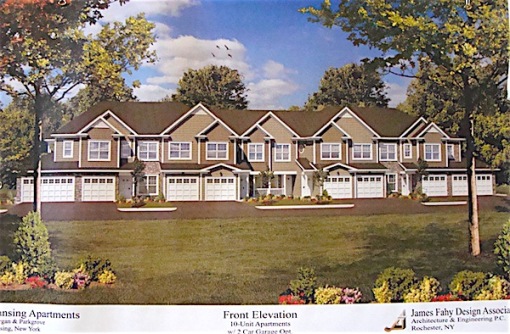
lansingapts600 lansingaptsmap600

3. Thanks to Dan Veaner over at the Lansing Star, here’s a render and a site plan for the proposed Lansing Apartments / Parkgrove Apartments project for Bomax Drive in the village. The 19.46-acre property is currently owned by Cornell and is zoned to be part of its office/tech park. James Fahy Design Associates of Rochester is doing the design for the proposed 14-building, 140 unit project, and Park Grove LLC of Rochester is the developer, in tandem with retired Cornell Real Estate director and Lansing resident Tom Livigne.

According to the Star, “1,000 square foot one-bedroom apartments are anticipated to rent in the $1,300 to $1,400 range,  1,350 to 1,400 square foot two-bedroom apartments at around $1,600 to $1,700, and three-bedroom apartments up to 1,400 square feet would rent between $1,800 and $1,900.” The village of Lansing has to approve a zoning change from business to high-density residential in order for the project to move forward.

It’s a very auto-centric, premium-middle market project. For an area concerned about affordability and trying to move towards walkability and traditional neighborhoods, this really doesn’t seem like the most appropriate plan. It’s nothing against Livigne and Park Grove LLC, but I’m very critical of these kind of projects for just those reasons.

amabel_v4_1

4. It’s been a while since it’s last been discussed, but the 31-unit Amabel Project by New Earth Living’s Sue Cosentini has been approved by the state attorney general to start marketing units. According to a December presentation, the net-zero homes will range from 1600-2100 SF and market in the $385,000-$425,000 range. While that is a rather high price range, some of that cost would be paid off via energy savings, which could be up to a few thousand dollars per year compared to comparably-sized and priced older homes on the market, and other possible savings exist with water recycling and low-maintenance exterior materials. So the sales pitch becomes something of acknowledging the high up-front costs, but explaining the long-term savings.


5. The first of two state funding grants to not this week. Cayuga Addiction Recovery Services (CARS) has received a $1 million grant for a new 25-bed adult residential facility. The new facility will be built on the Trumansburg campus, which if these notes are correct, is actually two facilities, and this new one will be built adjacent to a 60-bed facility on Mecklenburg Road, near the county line a couple miles to the southwest of Trumansburg. An undisclosed number of jobs are expected to be created.

Founded in a Cornell U. fraternity house in 1972, CARS provides treatment, counseling, skills training and support services to help clients overcome addictions and rebuild lives. The current facility was opened in 2004.

Image Courtesy of Lansing Star

Image Courtesy of Lansing Star

6. Also in state grants, Ithaca-Tompkins Regional Airport received $619,935 to build a flight academy building for the East Hill Flying Club. The new facility is expected to be built in the next 2 to 3 years. When the EHFC has moved in to their new digs, the existing hangar will be offered up to rent to other tenants. The new building will offer more instructional space, the ability to engage in training for twin-engine aircraft, and what the flying academy née club hopes will include state-of-the-art flying simulators.


News tidbits 6/26/16: The Odd Time Out

26 06 2016

trebloc-future2-1-620x420 trebloc-future

1. In what was ostensibly the biggest news of the week, Newman Development Group (NDG) of Vestal announced plans for the Trebloc site in downtown Ithaca. “City Centre” includes nine floors total, with roughly 250 apartments from studios to 2-bedrooms, about 10,000 SF (square feet) of retail space, 3,200 SF of amenities like a business center, and an underground garage of 70 spaces (the site is zoned CBD-120, which has no parking requirement). Readers might recall that Texas-based student housing developer Campus Advantage had proposed the State Street Triangle project, but their purchase option was not renewed by the owner of Trebloc.

Looking at their portfolio, Ithaca is NDG’s odd market out – most of their projects involve suburban retail centers and chain hotels, with shopping plazas from coast to coast. A smaller division, NDG Student Living, focuses on acquiring and building student housing, with their most recent projects in Binghamton and Oneonta. Ithaca seems to be the only metro where they’ve built general housing; earlier this decade, they worked with local businessman Bryan Warren on the Seneca Way mixed-use project on the east end of downtown.

The gut reaction to Newman as a developer is that, although they’re not very accustomed to urban mixed-use, there is one market where they do know what they’re doing, and that would be Ithaca’s.

Let’s just start right off the bat with one big difference between NDG and CA – the way the news was broken. CA was caught off-guard when the Journal’s David Hill broke the news of a 120-foot building a few days before the Planning Board meeting. NDG, working with local consultant Scott Whitham, emailed the same press release to each of the three major news organizations in Ithaca, which gave them the upper hand on the way information was delivered. The Times ran their copy first with almost no additional details, the Voice came a little later in the afternoon with more details such as unit total and retail space, and the Journal’s version came in the evening with even more details, such as the 70-space underground garage, and plans for the project to pursue CIITAP, the city’s property tax abatement program.

We’ll see what happens next week. The garage, not removing the turn lane, the general housing focus as opposed to students, and an initial design by Humphreys and Partners Architects that doesn’t repulse people are all cards that NDG holds that CA didn’t. But, there will still be sizable opposition. Playing your cards correctly is just as important to a winning hand as having them.

2. It looks like Gimme! Coffee is percolating something new out in Trumansburg. Through an LLC, the local coffee chain picked up 25-27 West Main Street for $350,000 on the 20th. The building is the former Independent Order of Odd Fellows Temple, a fraternal organization which established a chapter in Trumansburg in 1839, with ties to an older fraternal organization going further back to 1818. The 19th century temple is now about 1,700 SF of retail space, and 3 apartments totaling 3,300 SF on the upper floors; recent tenants have included Life’s So Sweet Chocolates and a barber shop.

Ithaca also had a location, first in downtown, and then on West Hill from the late 1920s. The older location was demolished to build the county library in the 1960s, while the West Hill location is a mix of uses today, one of which is the Museum of the Earth.

Gimme! has had a 1,200 SF shop at nearby 7 East Main Street since 2002, but they rent the space from Interlaken businessman Ben Guthrie. Logical guess here would be, they like Trumansburg, they wanted to buy a space and stay near where they are now, this opportunity came up down the street and they went for it. The sale price on 25-27 W Main is a substantial climb from the $288,000 it sold for in June 2010; I guess they call Trumansburg “little Ithaca” for a reason.

201_college_v5_1

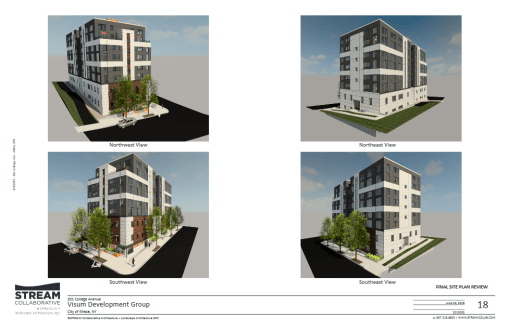
3. So, documents filed with the 201 College project this week were quite intriguing. First off, no action was taken at the zoning board meeting, but the developer of 201 College modified the project so that it no longer needs the setback variance or the entryways design variance. The planters were shrunk down in order to keep the sidewalk 12′ wide as requested by the Planning Board. Some additional 3-D drawings were also sent along, and site elevations and utilities plan here.

201_college_future

One of the images sent along was a “future context” file of potential nearby projects in the next couple of years. This document likely stems from the Planning Board debate of just what is likely to get developed in the vicinity over the next 5 years or so. There are four massings, merely following what zoning allows.

302-306 College Avenue – “Avenue 302”, by the Avramis family. Two buildings, one of six floors, one four, possibly in the 2017-2019 timeframe. Nothing formal has been discussed since the 2014 sketch plan, but the houses currently there are leased through May 2017.

215 College Avenue – A Novarr project. All that is publicly known at this stage is that Novarr wants to start construction in Summer 2017. Zoning allows 5 floors.

202 College Avenue – 202, 204, 206 and 210 College Avenue are all Novarr properties (there is no 208), as is the adjacent 118 Cook Street, which is not included in the massing outline. The College Avenue parcels allow 5 floors, 118 Cook 4. There hasn’t been any news with these properties lately.

119-125 College Avenue – three houses (there is no 123) owned by an Endicott-based landlord. I had to put out some inquiries on these houses, and there may be a sale in the works, although nothing’s on file with the county yet. These are CR-4, allowing 4 floors, but they could be tough to redevelop because these houses are seen as potentially historic resources.

Anyway, a vote on the project’s approvals is set for Tuesday. Neil Golder has created a group called “Save the Soul of Collegetown” to stage a rally in front of city hall that evening and try and halt the plans, but the last I checked on Facebook, three of the five people going were reporters.


amici house 1 county
4. Going more into briefs now, the Amici House funding plan for building a housing facility for 23 at-risk youth, and a second structure for five head-start classrooms and 42 students, was approved by the county this week. Once the sale is finalized, expect the official plans to be presented to city officials not long thereafter. Once those are approved, additional grant applications can be filed and hopefully, construction will be completed no later than 2018. According to the county’s press release, the Amici plan will create about 25 living wage jobs.

gannett5

5. Starting on the 27th, Gannett Health Services will begin to transition over to the new addition, while work begins on renovating the older wings of Cornell’s healthcare facility. This marks the rough completion of phase one, and the halfway point for the $55 million project. The Gannett webpage says the whole facility will be known as “Cornell Health” upon completion.

6. Back in November, Ithaca’s second ward saw a competitive election between candidates Ducson Nguyen and Sean Gannon. One of the big differences between the two was on development – Nguyen advocated for urban development in downtown, and Gannon thought there was too much building going on and it needed to be slowed down. Nguyen won by a hefty margin on election night.

A building loan agreement was inked next week to build a new duplex (two-unit semi-detached house) behind an existing property at 512-514 West Green Street. $330,000, Ithaca’s Carina Construction will be the contractor (expect a Simplex modular duplex). The property is bisected by zoning, with the rear falling into the State Street development corridor, so no parking is required for the new rear duplex. At a glance, it looks like a winning plan – it will be modest-sized, it’s in a walkable area, and it supplies much-needed housing. The Ciaschi family is developing the units.

The property also happens to be next door to Mr. Gannon. I’m sure he will be all kinds of amused.


News Tidbits 3/26/16: Big Plans and Small Town Intrigue

26 03 2016


201_college_1

1. Starting with with the new project of the week. In case it was missed, the write-up for the new 5-story apartment building proposed for 201 College Avenue can be found here. 201 College is being proposed by Todd Fox under his new development entity, Visum Development Group; Modern Living Rentals will continue to exist as a rental property management company. Excluding perhaps a small question with where the average grade is to determine the 70′ max height, is looks like the proposal fits the MU-1 zoning; and apart from a couple of the usual grumblings against students and/or density, there isn’t likely to be too much of an issue with the proposal. Noah Demarest of STREAM Collaborative is responsible for the design, which will make be faced with colored metal panels.

On a related note, the Journal broke this before the Voice, and it appears they may have used to the city’s Site Plan Review pre-application as a source. That’s not online for public viewing; someone would have had to give it to them. Which seems a bit dodgy, given one of the goals of the now-mandatory pre-application is to offer initial thoughts to make sure a project is palatable, and to avoid another public controversy like State Street Triangle.

312_spencer

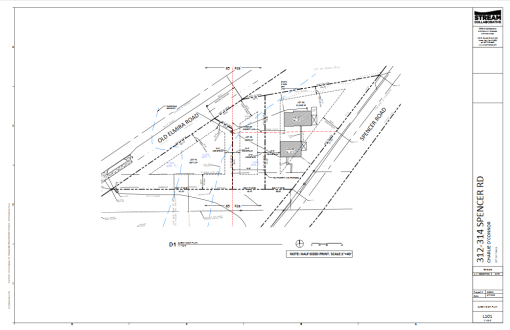
2. Meanwhile, the other partner in Modern Living Rentals, Charlie O’Connor, is pursuing a small project of his own on the other side of the city. O’Connor has submitted subdivision plans to merge two lots at 312 and 314 Spencer Road, and subdivide two legally-buildable lots from the merged property for a total of three, one of which will contain the existing houses. The new lots would be on vacant land behind the existing houses, which are currently owned by the Lucatellis (the same folks who ran Lucatelli’s next door). O’Connor would be purchasing the home and land pending approval of the subdivision. Each of the two new lots would then be developed into a 2-family home. Noah Demarest of STREAM Collaborative is handling the application. Drawings can be found here.

biggs_1

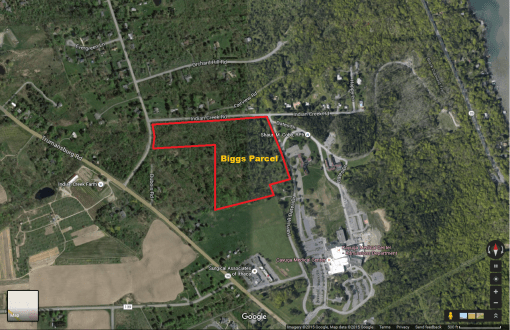
3. The Biggs Parcel will be put up for sale. As the county notes in its press release, the county administrator has been given permission to procure a realtor and market the property on the condition that any offers from the Indian Creek Neighborhood Association and/or the town of Ithaca be entertained (though not necessarily selected). The ICNA had offered some unknown amount for the property, which they have sought to keep undeveloped, but the offer was rejected. Previously, the site was the location of a proposed 58-unit affordable housing development, but the project was discontinued when more extensive wetlands were discovered on the property.

One of the big sticking points has been whether or not the 25.5 acres would be taxable – the county wants to sell to a private owner that will pay taxes, but proposals to preserve the land often dovetailed with plans to donate it to an organization like Finger Lakes Land Trust, which would render the property tax-exempt. The land had been valued at $340,000 before the discovery of the additional wetlands, and the reassessment value will become available on May 1st.

Realtors will apply to the county to list the parcel, and a realtor is expected to be chosen by the county by May 4th.


4. A large property in Trumansburg village noted for development potential has sold after being on the market for two and a half years. Local architect Claudia Brenner picked up the 19.27 acres in two adjacent parcels for $240,000 on the 22nd, about 25% off its original $300k asking price. 18.77 acres is registered to 46 South Street, the other 0.5 acres is a small L-shaped lot between 209 and 213 Pennsylvania Avenue. The previous owners used the property as cropland, and it had been in the same family since the 1940s.

In an email, Brenner said it’s too early to comment, but that future plans are being considered. The site has the village’s R-1 zoning, which allows home lots as small as 15,000 SF (~0.35 acres), and small scale multi-family residential and commercial services.

tfc_v2_1
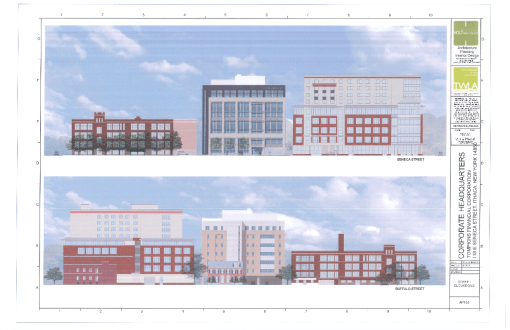
5. Talk about big delays. Tompkins Financial will be pushing their $26.5 million project back a whole year, according to an interview a Cornell Sun staffer conducted with JoAnn Cornish, the city’s planning director. The project was supposed to start this quarter and be completed in Q1 2017. Now it will be completed in Q1 2018.

summit_danby_1

6. A few months ago, the Summit Enterprise Center proposal in Danby was described in one of the weekly news roundups. Docs filed by STREAM Collaborative’s Noah Demarest on behalf of owner David Hall call for modifications of a Planned Development Zone for the property at 297-303 Gunderman Road. Danby’s PDZ is not unlike the city’s PUD and town of Ithaca’s PDZ, where the form and layout is regulated rather than the use. The original PDZ for the property dates from the mid-1990s.

Well, after months of vociferous debate, the project has officially gone into bureaucratic Hell, complete with political turmoil and accusations a-flyin’. My colleague Mike Smith has the full story on the Voice. Rather than rehash Mike’s detailed explanation, let’s just leave it at this – Summit probably isn’t moving forward anytime soon.