News Tidbits 7/29: Hotel Ithaca Gets Green Light; C’Town Terrace Not So Lucky

30 07 2009

In the city of Ithaca, when the only thing standing in the way of construction is a parking/bus stop issue, that means things are looking pretty good for construction in the near future. As for the Collegetown Terrace Project, the anticipated summer 2010 construction start may be more of a pipe dream than a reality.

http://www.theithacajournal.com/article/20090729/NEWS01/907290338/1126/news/Terrace+proposal+raises+historical+issues

ITHACA – Ithaca’s Planning Board has given preliminary approval to the Hotel Ithaca project and has begun the environmental review process for the Collegetown Terrace Apartments.

 At their Tuesday night meeting, planning board members approved a document that laid out concerns on issues such as traffic and historic resources related to the apartment project. 

 The proposal calls for demolishing all but three buildings in the 16.4-acre area bounded by Quarry and State streets, Valentine Place and Six Mile Creek and replacing them with seven buildings that would house approximately 1,270 people. The site currently houses about 635 people. 

 The three buildings that will remain are all within the East Hill Historic District. At Tuesday’s meeting, planning board members and city planning staff said there may be other buildings in the area that are not historically designated but that merit further research on their historic value during the environmental review process. 

Board member Tessa Rudan highlighted the former nurse’s residence, which “may be dedicated” to Finger Lakes native Jane A. Delano. Delano founded the American Red Cross nursing corps, led the entire nursing corps during World War I, and is buried in Arlington National Cemetery, Rudan said.

She also has been featured on a stamp in the African Republic of Mali because “she figured out the mosquito netting technique before there was scientific evidence to explain why it worked,” board Chairman John Schroeder said.

Members of the public will have the opportunity to weigh in on issues they think should be addressed in the project’s environmental impact statement at a meeting scheduled for 7:30 p.m. Thursday, Sept. 10, at City Hall, 108 E. Green St. The city planning department will also accept written statements on the project.

For Hotel Ithaca, the proposed $27 million hotel at the eastern edge of the Commons, the biggest outstanding issue is where to locate the bus stop, project architect Scott Whitham said.

While the hotel is under construction, the stop is scheduled to move around the corner to East State Street, near the Community School of Music and Arts. Hotel developers, the city and Tompkins Consolidated Area Transit officials have discussed the idea of moving the bus stop there permanently so that the stop and the hotel drop-off don’t interfere with each other.

The move would require eliminating two metered parking spots, which half a dozen merchants and property owners said Tuesday would spell disaster for their businesses. Property owner Donald Dickinson said he rents to four tenants on the block and two have said that if the new bus stop goes there, they’ll leave.

But keeping the bus stop on Aurora Street could result in hotel guests parking in the bus pull-off, Whitham said.

Schroeder said he wants to make sure the Hotel Ithaca doesn’t mimic the situation at the Hilton on Seneca, where the guest pull-off squeezes out the sidewalk.


Ithaca Really is 10 Square Miles Surrounded by Reality

14 07 2009

So, CNN released its annual “Best Places to Live” articles in its business section (Money Magazine, [1]). Normally, I don’t care much for the highly variable “Best Places” lists that appear in so many published reports, in many different variations, including best places for singles and best places for beer drinkers.

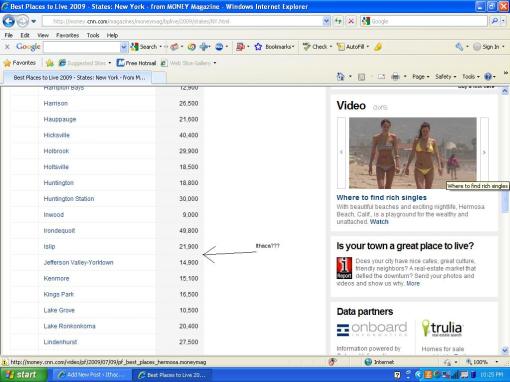
So, the decision making is one thing, and to each their own. But according to CNN Money, Ithaca apparently doesn’t exist. I first noticed this last year, but decided it was probably a glitch, and it would be recognized as the 30,000 person city that it is when they finally came around to updating their lists. But apparently, I was wrong.

http://money.cnn.com/magazines/moneymag/bplive/2009/top100/

Typing in Ithaca says the city doesn’t exist. Examining the list of New York State cities, the disappearance of Ithaca is quite conspicuous.

ithaca

I mean, it would be nice if CNN actually acknowledged Ithaca’s existence. I’m not saying it’s deserving of any awards, but hell, if they’re going to throw in Inwood, an ambiguous town that’s effectively part of NYC, you would think that a regionally distinct city of 30,000 would at least get a footnote in their list of towns and cities.

But, CNN be damned. Some people do think it exists after all, and even deserving of some recognition: http://www.visitithaca.com/Top-10s.html


News Tidbits 6/16:A Preservationist’s Trick

16 06 2009

I’m so glad she’s not running for re-election.

http://www.theithacajournal.com/article/20090616/NEWS01/906160334/1126/news/Some+owners+balk+at+historic+designation
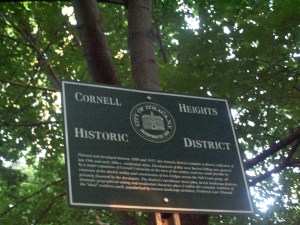
100_1754

Some Collegetown property owners are calling the potential historic designations of their buildings unsafe, unfair and an attempt to stop development.

The city officials behind the list of historic resources in Collegetown say they’re trying to protect a legacy of beauty that will ultimately strengthen the city’s culture, economy and desirability as a tourist destination.

Planning Board Chairman John Schroeder and Common Council Alderwoman Mary Tomlan, D-3rd, have compiled a list of 31 “Collegetown Historic Resources Worthy of Detailed Research.” Both the 2007 Collegetown vision statement and the proposed Collegetown Urban Plan call for identifying historic resources in Collegetown.

The 31 resources, primarily buildings, are being studied this summer for a variety of historic recognitions, including potentially formal historic designation, which would prevent a property owner from tearing a building down and redeveloping it. Both the Ithaca Landmarks Preservation Commission and Common Council have to approve new historic designations.

Joe Leonardo, owner of the Royal Palm Tavern, said some of the identified properties could be worthy of historic designation, but the Royal Palm is not one of them.

Tomlan said the Royal Palm is historic in part because “it’s not like any other bar in Collegetown.”

“It’s a very distinctive facade with its round windows and with its distinctive entranceway,” Tomlan said. “And it has been so well kept up; I mean, they do such a good job of keeping it painted. It’s been an image on the Collegetown streetscape for many decades.”

Leonardo said he paints the facade so often because “every year the front of it falls off.”

“Why didn’t she (Tomlan) come to me and ask me what I thought? It’s going to decrease the value of my property because no one can develop on it if it becomes a historic landmark,” Leonardo said. “Is that my reward for keeping this business in the family for the past 70 years? They’re just anti-development, and it’s pretty transparent what they’re trying to do.

Historic recognition is a part of good planning, tourism and economic development, Schroeder argued.

“I’ve said throughout this that I strongly want and desire redevelopment of certain areas of Collegetown to happen,” he said, citing the 300 block of College Avenue as one he’d love to see redeveloped, and the east side of the 400 block as one that should be preserved.

“Appreciating historic resources is part of what makes a community a community,” Schroeder said. “It helps us understand our links to past generations, what they bequeathed to us. It helps link, especially in a college town, past generations of Cornellians, perhaps the parents of current students, to current generations and future generations of Cornellians and Ithacans. It’s part of what attracts tourists to a community. It’s part of what gives a unique sense of place, a special sense of character.”

Historic preservation is important, but so is providing an adequate supply of safe housing close to campus, argued property owner George Avramis. His building at 403 College Ave. is on the list of historic resources.

“(Having) older wood-frame buildings in that kind of densely populated area is, I think, a very dangerous approach to take,” he said.

The building next door, 407 College Ave., burned to the ground in 1998 when a fire that started in a first-floor restaurant spread quickly through the building, he said.

“Someday I would like to tear it (403 College Ave.) down and put up a nice, new, triple-A-fire-rated building, fully ADA handicap accessible, like 400 College Ave., the Starbucks building,” Avramis said.

Sarah Iams lives at 116 Oak Ave., which is cooperatively owned by the Gamma Alpha Graduate Scientific Association. Iams said her biggest concern with the possibility of a historic designation is the extra time and effort involved in getting city approval for maintenance issues.

Once a building is designated historic, any exterior maintenance or lot changes have to be approved by the Ithaca Landmarks Preservation Commission. Interior maintenance does not require approval.

“As a graduate student co- operative that maintains the property ourselves, processes that might seem like small administrative hassles for a typical landlord or homeowner are a strong barrier to our successful operation,” Iams said by e-mail.

Tomlan said she’s talking with city staff about setting up a public meeting in Collegetown sometime this summer for property owners and others to come learn about and provide input on the historic resources proposal.

Alderman Svante Myrick, D-4th, is the only student on Ithaca’s 10-member Common Council, and he’s been the most vocal proponent for redevelopment in Collegetown.

“I think some of the sites are absolutely worth historic preservation, mainly Cascadilla (Hall) and the (College Avenue) bridge,” Myrick said. “But I’m glad they’re doing more research on this because I’m not convinced that this is not a thinly veiled effort to stop development in the areas where the zoning’s going to change.”

Tomlan, an architectural historian, said she views the historic resources list “as a positive thing, not an obstructionist thing.”

“I would not want to see it as stopping development,” Tomlan said. “It is a recognition that our community is layered by its history and that our lives can be enriched by knowing and seeing pieces of that history. There’s nothing thinly veiled about it. It is a positive statement about the value of our aesthetic and cultural past.”

At 7 p.m. this Wednesday, Common Council’s Planning Committee will hear a report on the Collegetown Historic Resources list. They’re also scheduled for a public hearing and a vote on the Collegetown Urban Plan. The meeting is at City Hall, 108 E. Green St.

The most recent version of the Collegetown plan is at www. cityofithaca.org.

***

For the record, I want to say that I am not anti-preservation. I wholly agree with preserving Cascadilla Hall and the College Avenue Bridge, because of the historic and aesthetic qualities that they bring to the Collegetown area. That being said, the Palms is historic in the same way that a Ford Pinto is a classic car.

100_0649
A beauty it ain’t.

So, I decided to have some fun and look to see which designations I agreed with on the historic recommendation PDF. As much as I dislike Tomlan’s views, I give her a lot of credit to her and John Schroeder (who works for the Sun?) for digging up the history behind the structures she recommended for preservation.

If I didn’t write anything, it means I wholly agree with historic landmark status.
1. College Avenue Bridge
2. Grandview House (209 College Avenue)
3. Cosmopolitan Club (301 Bryant Avenue) –  This apartment house was the clubhouse for international students in the early years of Cornell, I wholly agree on its preservation, but maybe not on full designation, since that tends to make renovation difficult, and this building is severely worn down and could really use some work.
4. Royal Palms – Little historic value, apart from taking up a space. Extremely run down, possibly unsafe since it’s an old, large wooden structure, and a fire could be disastrous. Not only does it not deserve preservation, it deserves to be torn down.
5. A.D.White’s Eddy Gate – Derided in its own time for being an obstruction and for being ugly (see Bishop’s History of Cornell), this is already designated.
6. The Johnny’s Big Red Grill Sign – Already gone.
7. Cascadilla Hall
8. Sheldon Court
9. The Nines – What used to be the Collegetown fire station.
10. Snaith House (140 College)
11. Flagg House (210 Mitchell)
12. Cascadilla Prep (Wait Hall)
13, 14 ,15. 113, 116, 120 Oak Avenue. 113 is one of the few actual fraternity houses that existed in Collegetown (Alpha Chi Sigma, from 1920-1955, when they moved to north campus). Today, the house is rented mostly by members of one of the honors fraternities. 116 and 120 face the gorge, and 116 is home to the biology grad student honors co-op Gamma Alpha. However, I have to disagree with historic designation. The two houses next to gorge would be extremely difficult to redevelop, and designation would make renovation difficult.  As for 113, I would think it a shame to be torn down, but I wouldn’t argue against it.

16. The Larkin Building (403 College). Personally, I always considered this one part of the Ciaschi Block. Although Mr. Avramis argues that he wants to build a new building on the site, the current one fits in so well that he would have to go through raging hellfire to try and tear it down. My personal hope would be that he tear down the two-story brick s–tbox across the street where his offices are located.

17. Chacona Block (411-415 College Avenue) . Same case as above. I can imagine the preservationists would come out in droves if they tried to take this one down.

18-23. 103, 119, 121, 125, 127, 129 College Avenue. I can understand the historic value, but I fear that designation would harm the ability to renovate these structures. I would rather seen this handled such that if someone proposed something, that all due discretion is exercised.

24-27. 117, 119, 121, 123 Linden Avenue. Wholly against. My hometown, which built out in the 1920s and 1930s, is filled with these types of homes. They are of little historic value, and certainly not a “historic resource”. My inclination is to believe they selected these houses because there was recently a large property transaction in this area, so they’re trying to stop development here before it’s even proposed.

28. 120 Linden Avenue. At 140 years old, this may be the only house they have designated on this street that is worth giving landmark status.

29-32. They didn’t count the Big Red Grill Sign in the final total, so there were actually 32 desired landmark designations. The last four are trails and ruins, of little overall merit but of considerable aesthetic value.

So, I completely disagree with five designations. I feel that many of the buildings have historic merit, but that historic landmark status might be going too far. However, this is why we have planning boards, so that people can vote down projects is they stand to be detrimental to the neighborhood.


News Tidbits 4/29: Massive New Development Slated for Collegetown

29 04 2009

This is a very large project for this area. The proposed location is in southwest Collegetown, an area currently occupied by mostly student houses, with a couple small apartment complexes already in the area.

***

http://www.theithacajournal.com/article/20090429/NEWS01/904290336/1126/NEWS

The Collegetown Terrace Apartment project would remove almost all buildings in the area bounded by Valentine Place, East State Street, Quarry Street and Six Mile Creek, and replace them with 1,100 new rental beds.

Developer John Novarr presented plans for the massive, 16-acre project at Tuesday night’s city Planning and Development Board meeting.

Quantcast

The historically designated Quarry Arms, Casa Roma and Boiler Works Apartments buildings would remain on the site, said Kathryn Wolf, principal with Trowbridge & Wolf. Every other building on the site would be removed, she said.

The area now houses 650 rental beds, and when completed, there would be 1,250 beds and 820 parking spaces, Novarr said.

Novarr explained his long history with East Hill, beginning with growing up in Collegetown, to his purchase of land from Ithaca College in 1982, to his decision in the last couple years to buy the last 14 properties in the site area.

Novarr said that by 2007, he had already purchased several properties on the 800 block of East State Street and planned to begin re-developing them into apartments when the city’s Collegetown moratorium went into effect.

The year-and-a-half moratorium forced him to think about long-term planning, resulting in the Collegetown Terrace Apartments concept, Novarr said.

The project will meet the four-story height limit required by zoning on East State Street, but the developer will seek height variances to allow taller buildings as the land slopes downward toward Six Mile Creek, Wolf said.

The project would “meet or exceed” existing parking requirements, she said.

Parking would be placed in one or two stories on the ground floor, with apartments above, based on drawings presented to the planning board.

Above-ground pedestrian walkways would connect some of the buildings.

The project will come before the Planning Board again in May.

***

The proposed location, with rough boundaries of the site in question.

ctown-terrace1

Trowbridge and Wolf is the firm responsible for the design of West Campus and the Health and Science building at IC, so they’re a fairly reputable choice [1].

In other news, the Ithaca Hotel is up to 124 rooms and 12 stories, according to the April 28, 2009 Planning Board minutes. Two outparcels are to be built near Uncle Wally on the flats (a drive thru restauant and another retail parcel, totaling 11,00 sq. ft and 17,000 sq ft), a 25,000 Maine’s warehouse to be built at the south edge of the city on Commercial Drive, and an eco-friendly three-dwelling development off of the 500 block of Aurora Street that is to be marketed as a co-op.

[1] http://www.twla.com/projects/education/


News Tidbits 1/8/09: Miracles Do Happen

8 01 2009

All I can say is, it’s about time.

http://www.theithacajournal.com/article/20090108/NEWS01/901080319/0/NEWSFRONT2

ITHACA – Cornell’s Milstein Hall project will benefit Cornell and the public while minimizing negative impacts, Ithaca’s Planning Board decided.

The Board voted unanimously Tuesday night to grant preliminary site plan approval to the $54 million project that includes a new, 59,000-square-foot building that will connect Rand and Sibley halls and stretch over University Avenue toward the Foundry.

A new Central Avenue Parking Garage will also provide 199 parking spaces on three levels, two of them underground.

The project has been delayed for at least five years with various designs and, most recently, a dispute between the university and the city’s Board of Public Works over the proposal to place part of the building over University Avenue.

After months of disagreement, the university decided to use a cantilever design rather than columns, which would have required an easement from the city. Separately, Cornell and the city later agreed that Cornell would pay to rebuild and maintain the badly deteriorated University Avenue in exchange for the city’s decision to give up its public right of way on the road.

The planning board has been reviewing an environmental impact statement on Milstein for the past two months and has heard comments from Ithacans and Art, Architecture and Planning faculty and students for and against the project.

Cornell and those in favor of the project have argued that the additional space is needed to maintain the Art, Architecture and Planning College’s accreditation and to programmatically connect the three buildings.

Planning Board Chairman John Schroeder said the existing conditions leave the Foundry disconnected and looking “like a maintenance building.” Milstein Hall would move the center of activity more toward the middle, better linking the buildings, he said.

Those against the project have argued that the very modern design of Milstein Hall will be jarring next to the historic Rand and Sibley halls.

Ithaca’s Landmarks Preservation Commission will review historic preservation concerns related to the project at their meeting at 7 p.m. Wednesday, Jan. 14 in City Hall, 108 E. Green St. The commission would have to grant a Certificate of Appropriateness for Milstein Hall to be built, Acting Planning Director JoAnn Cornish said by e-mail.

Cornell also needs final site plan approval from the Planning Board, which could come at its Jan. 27 meeting, Cornish said.

John Gutenberger, director of community relations at Cornell, said if the final approvals are granted, construction could start by early spring. Milstein Hall is not subject to the university’s construction pause, he said.

The project would be complete by December 2010, project manager Andrew Magre said.

***

In other news, the massive (by Ithaca standards) development called “Carrowmoor” continues to clear the political hurdles. From the town of Ithaca’s 1/6/09 minutes:

Consideration of designation of the Town of Ithaca Planning Board to act as Lead Agency, and the determination of a Positive Declaration of Environmental Significance for the proposed Carrowmoor development project located off Mecklenburg Road (NYS Route 79), north of Rachel Carson Way, Town of Ithaca Tax Parcel No. 27-1-14.2, Agricultural and Medium Density Residential Zones.  The proposal includes the development of 400 +/- residential condominium units, a community center complex, up to 36,000 square feet of neighborhood oriented commercial uses, up to 32 living units in an elderly residential building, a child care center, and other mixed-use development on 158 +/- acres.  The project will also include multiple new roads and walkways, open recreation areas, stormwater facilities, and community gardens.  Town of Ithaca actions also include consideration of adoption of a proposed local law to enact a Planned Development Zone in conjunction with the Carrowmoor proposal.  The Planning Board may also begin discussions of the draft scoping document for the Environmental Impact Statement (EIS).  John Rancich, Owner/ Applicant; Steven Bauman, Agent; Mary Russell, Attorney.”

Still some hurdles left though. The Planning Board must approve both the environmental review and site plan review before Carrowmoor could be built. The Town Board also has to pass a local law changing the zoning to allow for the project’s development.

***

No entries for the next week, as I’ll be mostly internet-less at a conference. For those of you planning to attend Rush Week, good luck and have fun.


9/7/08 News Tidbits: Alpha Omicron Pi to shut Cornell Chapter

6 09 2008

AoPi sisters confirmed Friday that their chapter will be closed as of the first of October, due to declining numbers within sorority rush. All current members will be moved to alumni status and allowed to live in the house until graduation. Once all current sisters have graduated, the intention is to reopen the house under a new set of women (this has been done with fraternities in the past. Pi Kappa Phi closed in 1986 and reopened in 1990, and Phi Kappa Tau closed in 1994 and reopened in 2000).

So, the news, while unfortunate, isn’t surprising to anyone familiar with the Cornell sororities. AOPi was typically derided and demeaned, and as a result of the nasty jokes associated with the house, women tended to avoid having it as a choice on their bids. Also consider that sorority rush turnout was lower than usual this past year, and you end up with a situation where the house can’t get enough women to make minimum member quotas. I feel really sorry for the current active membership of that sorority house.

This should really be a wake-up call to PanHel that something is amiss in the sorority system. Delta Phi Epsilon closed in 2003, as did Chi Omega. with Alpha Omicron Pi shutting down, this results in a net loss of two sororities in the past five years (PanHel selected Alpha Xi Delta to open on campus in 2004). With eleven left, is this really the system that they want? When some sororities have 140 women, and AOPi is closing with about 30 members left, as regulated as the system is for women you’d think the numbers could be a little more balanced.


News Tidbits 8/26/08

25 08 2008

So, perusing through the planning board meeting, this nifty little addition appeared for the city’s meeting Monday evening:

5. Site Plan Review
A. Site Plan Review, Delta Chi Fraternity Parking Lot Expansion, 102 The Knoll, Jagat P. Sharma,
Applicant for owner DCEF Cornell LLC. Lead Agency and Public Hearing. The applicant proposes to
expand the existing 10 car gravel parking lot along Barton Place to accommodate a total of 22 parking spaces. The proposed parking is one way, maintaining the current access and adding an egress point at the northern driveway on Barton Place. Proposed site work and improvements include removal of 2,700SF of trees, shrubs and vegetation, grading, new curbing at entrance and egress, relocation of guy wire, relocation of signage, landscaping, and installation of a masonry retaining wall approximately 4′ high and 80′ long along the northwest side of the parking area. Proposed surface of parking area is compacted gravel. This project received ILPC approval on 3-13-08. This is a Type 1 Action under both the City of Ithaca Environmental Quality Review Ordinance §176-4 B. (1) (h) [2] & [4] and an Unlisted Action under the State Environmental Quality Review Act and is subject to environmental review. (Materials sent previously)

~~~

Are you serious? Jagat Sharma, the architect of the project, has made his name by designing the apartment towers in Collegetown and some of the luxurious lakeside mansions in the Ithaca area. And Delta Chi hired his firm to design…a gravel parking lot expansion? I mean, couldn’t you get a standard construction company to just tear a base into the ground and lay the gravel without paying all the extra money for a bigger-name architectural firm to design it? If Delta Chi were building an addition, I could understand, but a gravel parking lot? Talk about money to burn.

I was wondering why there were construction permit signs going up over there with Sharma’s name listed as the architect. I honestly thought at first they were building a gatehouse or something. The other items for the meeting are nothing special; a house, roofwork on Eddygate, and a subdivision.

 EDIT 8/27: It’s a news tidbit, so I though I ‘d throw it in here.

http://cornellsun.com/node/31200

It’a a sun article talking about how Cornell gets bashed and we should give our detractors a f*ck off farewell. While I agree with the article’s sentiment wholeheartedly, I should point out one little fallacy- those pins with the “I’m the Hottest” crap were free. We gave them out as a promo to get you to buy random crap, and we still have a sh*t ton of them somewhere in our warehouse across town.