News Tidbits 8/5: Ithaca Gun Redevelopment in Financial Hell

6 08 2009

This is really funny, because I passed by the site when I arrived back into Ithaca last week, and thought it was curious that no work appeared to be underway even though it was weekday afternoon. However, I didn’t have the camera with me, so I didn’t bother taking photos of the site before I left for places further north.

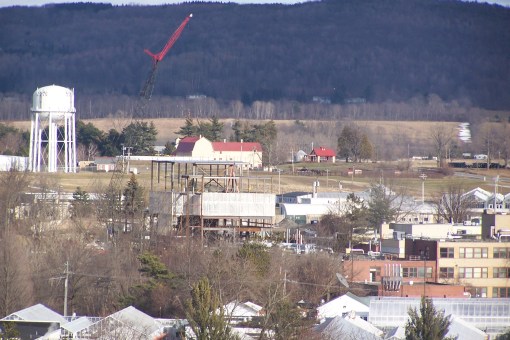
On the bright side, the blight that was the main building has been torn down; all that remains on the site currently are the debris/soil piles that need to be moved off-site, and of course the Ithaca Gun smokestack that is to be incorporated into a small pocket park when the property is fully redeveloped. So it could be worse.

One thing should be made clear; although there are cost overrruns with the cleanups of the site, the project to rebuild on the site isn’t cancelled. However, results may be late in coming, and may end up different from the initial plans.

http://www.theithacajournal.com/article/20090805/NEWS01/908050328&referrer=FRONTPAGECAROUSEL

The removal of demolition debris at Ithaca Gun has stopped because the development team apparently doesn’t have the money to pay its contractors.

A series of surprises, increased state oversight and community involvement has resulted in cost overruns totaling almost $1 million, according to a letter from property owner Wally Diehl, project engineer Pete Grevelding and developer Frost Travis sent to Mayor Carolyn Peterson on June 30.

The development team initially estimated demolition and cleanup would cost $1.46 million. They now estimate it will cost $2.3 million, according to the letter, which Peterson provided to the Journal on Tuesday.

The cash-flow situation apparently is so tight, the development team can’t afford to dispose of the remaining debris.

“I think there’s basically an issue of having the money in hand to pay people to do the work,” Peterson said. “My focus right now is not to have those piles sitting there.”

She submitted a resolution, which Common Council will consider tonight, asking that the $840,000 in state money intended for redevelopment go instead toward cleanup.

The city earned a $2.3 million state Restore NY grant to subsidize the developers’ project to clean up the site and redevelop it into 33 high-end condos and a public walkway to the Ithaca Falls overlook.

Appointment of a Community Advisory Group, a lengthy asbestos-removal process and “unanticipated environmental procedures, review and approvals” all led to cost overruns, according to the developers’ letter.

Peterson said it cost more than expected to preserve the smokestack and its foundation, deal with some potentially contaminated bricks, and more strictly monitor of the air at and near the site.

Before Travis’ 2007 proposal, Diehl twice proposed condo projects that would have covered cleanup costs without state help, but they were rejected by neighbors as too large. With no subsidy on the redevelopment side, the project “will require some creativity on the part of Travis & Travis and their architects,” the letter stated.

Peterson said she hadn’t heard any discussion about a bigger project or more condo units.

“Certainly, with working with the neighborhood, the preference was the proposed project. So I don’t know if there’s a proposal in mind, but I wouldn’t be entirely surprised if there needs to be some re-thinking,” she said.


News Tidbits 7/29: Hotel Ithaca Gets Green Light; C’Town Terrace Not So Lucky

30 07 2009

In the city of Ithaca, when the only thing standing in the way of construction is a parking/bus stop issue, that means things are looking pretty good for construction in the near future. As for the Collegetown Terrace Project, the anticipated summer 2010 construction start may be more of a pipe dream than a reality.

http://www.theithacajournal.com/article/20090729/NEWS01/907290338/1126/news/Terrace+proposal+raises+historical+issues

ITHACA – Ithaca’s Planning Board has given preliminary approval to the Hotel Ithaca project and has begun the environmental review process for the Collegetown Terrace Apartments.

 At their Tuesday night meeting, planning board members approved a document that laid out concerns on issues such as traffic and historic resources related to the apartment project. 

 The proposal calls for demolishing all but three buildings in the 16.4-acre area bounded by Quarry and State streets, Valentine Place and Six Mile Creek and replacing them with seven buildings that would house approximately 1,270 people. The site currently houses about 635 people. 

 The three buildings that will remain are all within the East Hill Historic District. At Tuesday’s meeting, planning board members and city planning staff said there may be other buildings in the area that are not historically designated but that merit further research on their historic value during the environmental review process. 

Board member Tessa Rudan highlighted the former nurse’s residence, which “may be dedicated” to Finger Lakes native Jane A. Delano. Delano founded the American Red Cross nursing corps, led the entire nursing corps during World War I, and is buried in Arlington National Cemetery, Rudan said.

She also has been featured on a stamp in the African Republic of Mali because “she figured out the mosquito netting technique before there was scientific evidence to explain why it worked,” board Chairman John Schroeder said.

Members of the public will have the opportunity to weigh in on issues they think should be addressed in the project’s environmental impact statement at a meeting scheduled for 7:30 p.m. Thursday, Sept. 10, at City Hall, 108 E. Green St. The city planning department will also accept written statements on the project.

For Hotel Ithaca, the proposed $27 million hotel at the eastern edge of the Commons, the biggest outstanding issue is where to locate the bus stop, project architect Scott Whitham said.

While the hotel is under construction, the stop is scheduled to move around the corner to East State Street, near the Community School of Music and Arts. Hotel developers, the city and Tompkins Consolidated Area Transit officials have discussed the idea of moving the bus stop there permanently so that the stop and the hotel drop-off don’t interfere with each other.

The move would require eliminating two metered parking spots, which half a dozen merchants and property owners said Tuesday would spell disaster for their businesses. Property owner Donald Dickinson said he rents to four tenants on the block and two have said that if the new bus stop goes there, they’ll leave.

But keeping the bus stop on Aurora Street could result in hotel guests parking in the bus pull-off, Whitham said.

Schroeder said he wants to make sure the Hotel Ithaca doesn’t mimic the situation at the Hilton on Seneca, where the guest pull-off squeezes out the sidewalk.


News Tidbits 6/16:A Preservationist’s Trick

16 06 2009

I’m so glad she’s not running for re-election.

http://www.theithacajournal.com/article/20090616/NEWS01/906160334/1126/news/Some+owners+balk+at+historic+designation
100_1754

Some Collegetown property owners are calling the potential historic designations of their buildings unsafe, unfair and an attempt to stop development.

The city officials behind the list of historic resources in Collegetown say they’re trying to protect a legacy of beauty that will ultimately strengthen the city’s culture, economy and desirability as a tourist destination.

Planning Board Chairman John Schroeder and Common Council Alderwoman Mary Tomlan, D-3rd, have compiled a list of 31 “Collegetown Historic Resources Worthy of Detailed Research.” Both the 2007 Collegetown vision statement and the proposed Collegetown Urban Plan call for identifying historic resources in Collegetown.

The 31 resources, primarily buildings, are being studied this summer for a variety of historic recognitions, including potentially formal historic designation, which would prevent a property owner from tearing a building down and redeveloping it. Both the Ithaca Landmarks Preservation Commission and Common Council have to approve new historic designations.

Joe Leonardo, owner of the Royal Palm Tavern, said some of the identified properties could be worthy of historic designation, but the Royal Palm is not one of them.

Tomlan said the Royal Palm is historic in part because “it’s not like any other bar in Collegetown.”

“It’s a very distinctive facade with its round windows and with its distinctive entranceway,” Tomlan said. “And it has been so well kept up; I mean, they do such a good job of keeping it painted. It’s been an image on the Collegetown streetscape for many decades.”

Leonardo said he paints the facade so often because “every year the front of it falls off.”

“Why didn’t she (Tomlan) come to me and ask me what I thought? It’s going to decrease the value of my property because no one can develop on it if it becomes a historic landmark,” Leonardo said. “Is that my reward for keeping this business in the family for the past 70 years? They’re just anti-development, and it’s pretty transparent what they’re trying to do.

Historic recognition is a part of good planning, tourism and economic development, Schroeder argued.

“I’ve said throughout this that I strongly want and desire redevelopment of certain areas of Collegetown to happen,” he said, citing the 300 block of College Avenue as one he’d love to see redeveloped, and the east side of the 400 block as one that should be preserved.

“Appreciating historic resources is part of what makes a community a community,” Schroeder said. “It helps us understand our links to past generations, what they bequeathed to us. It helps link, especially in a college town, past generations of Cornellians, perhaps the parents of current students, to current generations and future generations of Cornellians and Ithacans. It’s part of what attracts tourists to a community. It’s part of what gives a unique sense of place, a special sense of character.”

Historic preservation is important, but so is providing an adequate supply of safe housing close to campus, argued property owner George Avramis. His building at 403 College Ave. is on the list of historic resources.

“(Having) older wood-frame buildings in that kind of densely populated area is, I think, a very dangerous approach to take,” he said.

The building next door, 407 College Ave., burned to the ground in 1998 when a fire that started in a first-floor restaurant spread quickly through the building, he said.

“Someday I would like to tear it (403 College Ave.) down and put up a nice, new, triple-A-fire-rated building, fully ADA handicap accessible, like 400 College Ave., the Starbucks building,” Avramis said.

Sarah Iams lives at 116 Oak Ave., which is cooperatively owned by the Gamma Alpha Graduate Scientific Association. Iams said her biggest concern with the possibility of a historic designation is the extra time and effort involved in getting city approval for maintenance issues.

Once a building is designated historic, any exterior maintenance or lot changes have to be approved by the Ithaca Landmarks Preservation Commission. Interior maintenance does not require approval.

“As a graduate student co- operative that maintains the property ourselves, processes that might seem like small administrative hassles for a typical landlord or homeowner are a strong barrier to our successful operation,” Iams said by e-mail.

Tomlan said she’s talking with city staff about setting up a public meeting in Collegetown sometime this summer for property owners and others to come learn about and provide input on the historic resources proposal.

Alderman Svante Myrick, D-4th, is the only student on Ithaca’s 10-member Common Council, and he’s been the most vocal proponent for redevelopment in Collegetown.

“I think some of the sites are absolutely worth historic preservation, mainly Cascadilla (Hall) and the (College Avenue) bridge,” Myrick said. “But I’m glad they’re doing more research on this because I’m not convinced that this is not a thinly veiled effort to stop development in the areas where the zoning’s going to change.”

Tomlan, an architectural historian, said she views the historic resources list “as a positive thing, not an obstructionist thing.”

“I would not want to see it as stopping development,” Tomlan said. “It is a recognition that our community is layered by its history and that our lives can be enriched by knowing and seeing pieces of that history. There’s nothing thinly veiled about it. It is a positive statement about the value of our aesthetic and cultural past.”

At 7 p.m. this Wednesday, Common Council’s Planning Committee will hear a report on the Collegetown Historic Resources list. They’re also scheduled for a public hearing and a vote on the Collegetown Urban Plan. The meeting is at City Hall, 108 E. Green St.

The most recent version of the Collegetown plan is at www. cityofithaca.org.

***

For the record, I want to say that I am not anti-preservation. I wholly agree with preserving Cascadilla Hall and the College Avenue Bridge, because of the historic and aesthetic qualities that they bring to the Collegetown area. That being said, the Palms is historic in the same way that a Ford Pinto is a classic car.

100_0649
A beauty it ain’t.

So, I decided to have some fun and look to see which designations I agreed with on the historic recommendation PDF. As much as I dislike Tomlan’s views, I give her a lot of credit to her and John Schroeder (who works for the Sun?) for digging up the history behind the structures she recommended for preservation.

If I didn’t write anything, it means I wholly agree with historic landmark status.
1. College Avenue Bridge
2. Grandview House (209 College Avenue)
3. Cosmopolitan Club (301 Bryant Avenue) –  This apartment house was the clubhouse for international students in the early years of Cornell, I wholly agree on its preservation, but maybe not on full designation, since that tends to make renovation difficult, and this building is severely worn down and could really use some work.
4. Royal Palms – Little historic value, apart from taking up a space. Extremely run down, possibly unsafe since it’s an old, large wooden structure, and a fire could be disastrous. Not only does it not deserve preservation, it deserves to be torn down.
5. A.D.White’s Eddy Gate – Derided in its own time for being an obstruction and for being ugly (see Bishop’s History of Cornell), this is already designated.
6. The Johnny’s Big Red Grill Sign – Already gone.
7. Cascadilla Hall
8. Sheldon Court
9. The Nines – What used to be the Collegetown fire station.
10. Snaith House (140 College)
11. Flagg House (210 Mitchell)
12. Cascadilla Prep (Wait Hall)
13, 14 ,15. 113, 116, 120 Oak Avenue. 113 is one of the few actual fraternity houses that existed in Collegetown (Alpha Chi Sigma, from 1920-1955, when they moved to north campus). Today, the house is rented mostly by members of one of the honors fraternities. 116 and 120 face the gorge, and 116 is home to the biology grad student honors co-op Gamma Alpha. However, I have to disagree with historic designation. The two houses next to gorge would be extremely difficult to redevelop, and designation would make renovation difficult.  As for 113, I would think it a shame to be torn down, but I wouldn’t argue against it.

16. The Larkin Building (403 College). Personally, I always considered this one part of the Ciaschi Block. Although Mr. Avramis argues that he wants to build a new building on the site, the current one fits in so well that he would have to go through raging hellfire to try and tear it down. My personal hope would be that he tear down the two-story brick s–tbox across the street where his offices are located.

17. Chacona Block (411-415 College Avenue) . Same case as above. I can imagine the preservationists would come out in droves if they tried to take this one down.

18-23. 103, 119, 121, 125, 127, 129 College Avenue. I can understand the historic value, but I fear that designation would harm the ability to renovate these structures. I would rather seen this handled such that if someone proposed something, that all due discretion is exercised.

24-27. 117, 119, 121, 123 Linden Avenue. Wholly against. My hometown, which built out in the 1920s and 1930s, is filled with these types of homes. They are of little historic value, and certainly not a “historic resource”. My inclination is to believe they selected these houses because there was recently a large property transaction in this area, so they’re trying to stop development here before it’s even proposed.

28. 120 Linden Avenue. At 140 years old, this may be the only house they have designated on this street that is worth giving landmark status.

29-32. They didn’t count the Big Red Grill Sign in the final total, so there were actually 32 desired landmark designations. The last four are trails and ruins, of little overall merit but of considerable aesthetic value.

So, I completely disagree with five designations. I feel that many of the buildings have historic merit, but that historic landmark status might be going too far. However, this is why we have planning boards, so that people can vote down projects is they stand to be detrimental to the neighborhood.


News Tidbits 5/20: More Info on the Collegetown Terrace Project

20 05 2009

http://www.theithacajournal.com/article/20090519/NEWS01/905190332/Collegetown+developer+plans+2011+opening&referrer=FRONTPAGECAROUSEL

The proposed Collegetown Terrace Apartments are scheduled to break ground in summer 2010, open in summer 2011 and house primarily graduate students.

On traffic and parking – a major concern for Collegetown residents – the project would provide more parking spaces than required by city zoning, as well as amenities intended to reduce car dependence, such as a shuttle to Cornell and Wegmans.

Ithaca developer John Novarr submitted his full review application report to the city’s Planning and Development Board last week, and he provided a copy to the Journal. Site plan review is scheduled to begin at the city’s Planning Board meeting at 6 p.m. May 26.

Ed Strong, a graduate student representative on the Cornell University Assembly, said graduate student housing is sorely needed and the apartments will be well-received among students.

While Cornell has recently added undergraduate housing on West Campus, on-campus graduate student housing is still inadequate, Strong said. The Maplewood complex is made of modular buildings that are already past their life expectancy, he said.

The Collegetown Terrace project calls for removing all but three buildings in the 16.4-acre area bounded by Quarry Street, East State Street, Valentine Place and Six Mile Creek. The historically designated Quarry Arms, Casa Roma and Boiler Works Apartments buildings would remain.

Seven buildings would be built on the site. The full site, including the three historic buildings, would contain 1,260 bedrooms and 860 parking spots.

The area currently contains 635 bedrooms and 430 spots.

On East State Street, plans call for four-story buildings that meet height restrictions imposed by city zoning.

As the topography slopes downhill toward Six Mile Creek, buildings are proposed to increase to five and then six stories, which would require a zoning variance.

Parking is housed in one or two stories underground and at ground level to minimize surface parking lots. In the initial presentation before the planning board, Novarr said his upper-floor apartments always rent out before ground-floor apartments, because students find them safer and more private.

Novarr plans to charge tenants separate rent for parking spaces and apartments, a measure intended to force people to consider the cost of having a car.

At the Casa Roma complex, parking is rolled into the rent.

Novarr told the planning board rent would be similar to the buildings to remain on-site.

They average between $1,500 and $1,800 for a two-bedroom apartment, according to listings available online.


The Essentials of Campus II

14 05 2009

100_3846

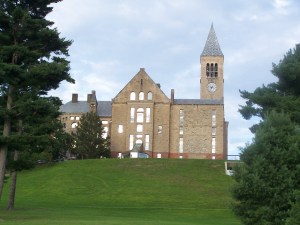
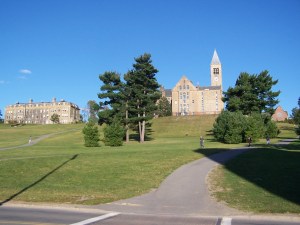
I knew that sooner or later, I would have to cover what is perhaps the most iconic building on campus. So here we are.

All citations, unless otherwise noted, are from Morris Bishop’s A History of Cornell (Cornell University Press, 1962).

Prior to renovation in the 1960s, the building was simply known as “The University Library”, even as other libraries were built across campus. It was Andrew Dickson White’s belief that “A large library is absolutely necessary to the efficiency of the various departments. Without it, our men of the highest ability will be frequently plodding into old circles and stumbling into old errors.” (77) The library was appropriated in September 1867 to the tune of $7,500 (175).  The amount was up to $20,000 by 1880 (213).

Daniel Willard Fiske was appointed the first librarian. He was also head of the university press and an instructor in German, Swedish and Icelandic. It was his belief (and rather progressive for the time) that the library should be a reference library, open to enhance both faculty studies and student interests. As a result, his goals was to obtain, by purchase or gift, extensive book collections, such as the library of Goldwin Smith (6,000 books), Charles Anthon (3400 books) and the like. A.D. White was also known for buying rare books on his overseas trips (both with his own funds and with university money). As a result, by 1873, there were 34,000 books and 8,000 pamphlets in the libe—a substantial figure for an American university. When it first opened, the library boasted that it was open longer than any other U.S. university — nine hours a day.  (108)

Fiske himself was easy to irritate and known for holding deep grudges from insults or perceived slights. Because the first university Vice-President William Russel was known for a gift of mockery, the two absolutely despised each other.  However Fiske was also very kind and generous; he was particularly fond of the Psi Upsilon fraternity men, and was once chastised by White for giving an inordinate portion of his salary to the chapter and its needy brothers (108). He also was chastised for offering a glass of ale to a student, to which he responded that the student interrupted him in his drinking time with a friend, and he felt obliged to offer a glass (108).

Since Fiske was in Egypt when the university opened in October 1868, the actual first librarian was a prominent local lawyer, Thomas Frederick “Teefy” Crane, of “Give My Regards to Davy” fame. Crane studied languages in his private time, and as a result he also was the German instructor at opening.  Crane enjoyed the experience enough that he himself went abroad, came back and switched places with another professor to become the instructor of French, Spanish and Italian in 1870. (109)

So, now we get to the “Great Will Case”. Jennie McGraw, aged 37, received a large inheritance after her father’s death in 1877. Already battling tuberculosis, a number of men offered to marry her, some of which were gold diggers I’m sure. One of the men who courted her was Willard Fiske. He wrote love poems to her, but he never showed them for fear of being called out as a gold digger. Anyways, as the rich and bored are wont to do, McGraw arranged to have a fabulous house built off of University Avenue, bordering Fall Creek, and then bought thousands of dollard of furnishing for it (224). In the meanwhile, both McGraw and Fiske went abroad to different parts of Europe in 1879. There is no record of contact in Europe between the two prior to April 1880. During this time however, Fiske used his influence on A.D. White to work over affairs back at Cornell. Locals assumes that because White was known to have lent Fiske money, and the two were close, that he and Sage were buttering him up so that if he and Jennie were to get hitched, that her fortune would be given someday to Cornell. (225).

In April 1880, Fiske went to Rome to join Jennie, now invalid and near death. The courtship between 48-year-old Fiske and the dying 40-year-old McGaw was short. They became engaged in Venice. Fiske announced it in a letter in May 1880 to A.D. White (along with a request for money). As one can imagine, some people looked upon Fiske’s behavior as mercenary. The two were married in Berlin on July 14, 1880 (226). At the time, Fiske signed a letter giving up his rights to Jennie’s property, under Prussian law.

The two spent the winter on the Nile, and then returned to Europe. By June 1881, the two were informed in Paris that Jennie had only a few weeks to live. Her dying wish was to pass on in Ithaca, so they made the trip back by September. I know, more than a few weeks, but whatever. She saw her mansion, newly built, and said (as she was propped up from her pillows) “it surpasses all my expectations”. It was the only time she ever saw the mansion, as she died September 30, 1881. When she died, Judge Boardman (of Boardman Hall) asked for the will. No one could find it, which would really suck for all parties because then they would have to use John McGraw’s will, and then the inheritance would go to John McGraw’s brother and his five kids since Jennie had no hubby or progeny.  Luckily, they found it in a secret pocket in a handbag that had been dumped off as junk in Fiske’s attic (227).

100_1769

The will stated that Fiske would get $300,000, $550,000 to her uncle and his kids, and $200,000 for a library at Cornell, $50,000 for McGraw Hall improvements, and $40,000 for a university hospital. The university also gained her land estate, including the mansion (valued at $600,000+), which A.D. White thought would be a dream home for an art gallery (227). Fiske, as custodian of the mansion, was to continue to occupy the house, and this raised issues. Namely, that he was known for being very needy financially; he offended Henry Sage by having parties in the room she died in no more than two months after her death; and Boardman simply didn’t like him, perhaps because of a rumor that Fiske suffered from marital indiscretions while in Europe. (228).

Here’s where the real fun begins. In May 1882, the state changed Cornell’s charter a little bit, but in one embedded section, it removed a portion detailing that the university couldn’t receive or hold personal property equal to or more than $3 million dollars. This was very convenient. In June 1883, Fiske was about to settle his affairs by going abroad, when an apprentice lawyer in Elmira told him of the change, and that state law said that a wife can’t leave more than half of her property to charity. As you might guess, the sh*t hit the fan. (228).

So, we have two lawsuits, one to break the will by Fiske on the grounds of Cornell’s underhanded actions, and then another one by Jennie’s cousins, out for more of the fortune. Fiske sailed for Europe, leaving a surrogate to handle things (Judge Marcus Lyon). White sailed after him to beg him to reconsider, but then Sage cabled White to tell him he was to make no offer to Fiske. Most of the Ithaca and Cornell crowd hated Fiske now anyway. After much media attention (like an OJ Simpson trial for the 1880s), in May 1886, the ruling was in favor of Cornell. White wanted to let Fiske save face by offering concessions; Sage would hear none of it. Fiske appealed the judgment, and it was overturned in August 1887, so Fiske won the suit, and the McGraws won theirs. So Cornell appealed to the Supreme Court (231). Meanwhile, the friendship between White and Boardman/Sage had deteriorated to animosity, although Sage made an offer to build a library himself if they failed to get the inheritance. All the while, Fiske was living in a luxurious Italian villa.

In May 1890, the Supreme Court ruled against the university. However, they did say that Cornell’s endowment could be used for any university purpose, which was a small consolation. in the end, Cornell paid $180,000 in legal fees to David Hill, the apprentice lawyer of Elmira, and $100,000 for the McGraws’ counsel. One of Jennie’s cousins bought the mansion for $35,000, much to White’s anger. The house was sold by the McGraws to Chi Psi fraternity in 1896. Its furniture was auctioned off, mostly purchased by the other McGraws. Fiske’s lawyer never took another case—it was rumored he drank himself to death during the celebration (232).  Henry Sage donated $500,000 for the library to be built, as was done in 1891. Willard Fiske returned to hobnobbing with the rich and famous, and book collecting. When he passed in 1904, he donated his library as well as his estate to the university. He also requested to be buried with his wife in the mortuary of Sage Chapel; when the university granted the request, the Sage family severed all ties to Cornell.  (232).

***

100_1950

Long-winded, isn’t it? Well, I’ll go on for a just a little while longer. I have to make up for some lost time.

The actual cost of the libe was $227,000, with room for 400,000 volumes (Cornell owned about a quarter if that at the time) (271).  When received ,the Fiske fund was used for salaries and upkeep, and later book expenses; the library was already overcrowded by 1906. The library expanded in 1936 with the construction of more stacks on the south and west wings. The Great Depression was quite hard on the libe, and the head librarian at the time, Dr. Otto Kinkeldey, frequently complained about the lack of space and funding.  A special library fund would be set up in 1941 (531).  The library was internally reorganized in the late 1940s (576), and the Cornell University archives were created about the same time (600).

The library was renamed for Harold Uris ’25 in 1962, since he donated significant amounts to its renovation. In 1982, the glassy west wing was added, adding 214 seats , and was paid for my the Uris Brothers Foundation [1]. The 173-ft tall Library Tower was renamed “McGraw Tower” for Jennie McGraw in 1962.

As for the Chimes and more details about the tower, we’ll save that for another entry. For the Clocktower Pumpkin, we’ll leave that to a wikipedia quote:

“On October 8, 1997 a pumpkin appeared atop the spire of McGraw Tower. Because of the danger involved in retrieving it, administrators decided to leave it until it rotted and fell off. However, the pumpkin rapidly dried out in the cold air and remained on the tower until it was removed with a crane on March 13, 1998 (it was planned that Provost Don M. Randel would remove it, but in a practice run the crane basket was blown by a gust of wind and knocked the pumpkin off). Some people had claimed that a real pumpkin could not stay up that long without rotting and that it must be artificial. However, subsequent morphological, chemical, and DNA analysis by both faculty members and undergraduates confirmed that it was indeed a pumpkin.

In April 2005, a disco ball was attached to the top of the tower. A crane was hired to remove the offending orb in an operation which cost the university approximately $20,000.” [2]

[1]http://www.cornell.edu/search/index.cfm?tab=facts&q=&id=767

[2]http://en.wikipedia.org/wiki/Cornell_Chimes


News Tidbits 4/29: Massive New Development Slated for Collegetown

29 04 2009

This is a very large project for this area. The proposed location is in southwest Collegetown, an area currently occupied by mostly student houses, with a couple small apartment complexes already in the area.

***

http://www.theithacajournal.com/article/20090429/NEWS01/904290336/1126/NEWS

The Collegetown Terrace Apartment project would remove almost all buildings in the area bounded by Valentine Place, East State Street, Quarry Street and Six Mile Creek, and replace them with 1,100 new rental beds.

Developer John Novarr presented plans for the massive, 16-acre project at Tuesday night’s city Planning and Development Board meeting.

Quantcast

The historically designated Quarry Arms, Casa Roma and Boiler Works Apartments buildings would remain on the site, said Kathryn Wolf, principal with Trowbridge & Wolf. Every other building on the site would be removed, she said.

The area now houses 650 rental beds, and when completed, there would be 1,250 beds and 820 parking spaces, Novarr said.

Novarr explained his long history with East Hill, beginning with growing up in Collegetown, to his purchase of land from Ithaca College in 1982, to his decision in the last couple years to buy the last 14 properties in the site area.

Novarr said that by 2007, he had already purchased several properties on the 800 block of East State Street and planned to begin re-developing them into apartments when the city’s Collegetown moratorium went into effect.

The year-and-a-half moratorium forced him to think about long-term planning, resulting in the Collegetown Terrace Apartments concept, Novarr said.

The project will meet the four-story height limit required by zoning on East State Street, but the developer will seek height variances to allow taller buildings as the land slopes downward toward Six Mile Creek, Wolf said.

The project would “meet or exceed” existing parking requirements, she said.

Parking would be placed in one or two stories on the ground floor, with apartments above, based on drawings presented to the planning board.

Above-ground pedestrian walkways would connect some of the buildings.

The project will come before the Planning Board again in May.

***

The proposed location, with rough boundaries of the site in question.

ctown-terrace1

Trowbridge and Wolf is the firm responsible for the design of West Campus and the Health and Science building at IC, so they’re a fairly reputable choice [1].

In other news, the Ithaca Hotel is up to 124 rooms and 12 stories, according to the April 28, 2009 Planning Board minutes. Two outparcels are to be built near Uncle Wally on the flats (a drive thru restauant and another retail parcel, totaling 11,00 sq. ft and 17,000 sq ft), a 25,000 Maine’s warehouse to be built at the south edge of the city on Commercial Drive, and an eco-friendly three-dwelling development off of the 500 block of Aurora Street that is to be marketed as a co-op.

[1] http://www.twla.com/projects/education/


The Planning Board’s Lack of Logic

20 03 2009

http://www.theithacajournal.com/article/20090319/NEWS01/903190358/1002

Goody Clancy’s suggested plan:

goody-clancy-plan

The recommendations from the planning board

ithaca-plan

Note the differences. There are many. It’s as if they looked at the $200,000 study, said “it’s nice, but-“, and went the opposite direction.

So, the planning board has not only not accepted Goody Clancy’s advice, it’s doing the reverse – it’s making zoning even more restrictive, and (as suggested) making parking tighter in Collegetown in favor of garages in the city. I’m sure they’re patting themselves on the back for “preserving the neighborhood”. In my opinion, considering the parking and discouragement of multi-unit buildings, this seems to be a not-too-subtle suggestion to students from permanent residents: we don’t want you here.

My suggestion to permanent Collegetown residents: too bad. As Cornell’s class sizes increase, where do you think they’ll move? North is well protected as a historic district (Cornell Heights – and Cayuga Heights has had restrictions in place for years). West is largely undevelopable due to topography and the cemetery. Living outside the close proximity of Cornell will lead to students bringing cars with them, resulting in more traffic congestion, which is (and should be) discouraged.  Students will therefore move to Collegetown, and I’m willing to bet that as opprotunities arise, landlords will buy up the owner-occupied properties and turn them into student occupied houses, since there will be more demand. This may pass for now, but in the long term, the anti-development crowd is going to dwindle down. There’s nothing Mary Tomlan and the planning board can do about that.


Ithaca Construction Isn’t Ending…Yet

3 03 2009

With all the doom and gloom associated with the current economic times (rightfully so), it’s easy to forget that there are still some projects in the pipeline outside of Cornell, but in the surrounding Ithaca area. Since it’s been a while since I chronicled those, let’s do a quick overview.

Lansing

Ithaca’s northern suburb has a number of different projects  planned. Currently going through the pipeline are the Lansing Commons project (~50 units) and the Cayuga Farms projects (~138 units). The projects are typical suburban development, consisting of single-family homes, townhouses, and a few apartment buildings and commerical office buildings. The buildout would be over a period of several years.

Ithaca (town)

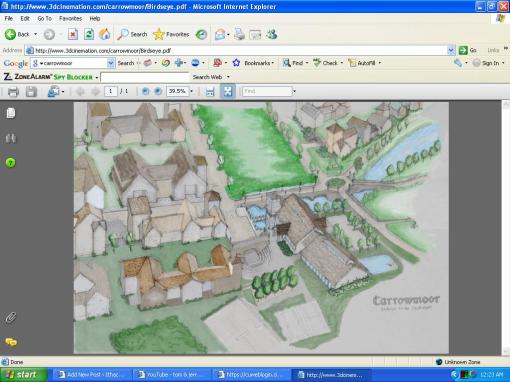
Apart from some minor subdivisions, an electrical substation and a wireless tower, the big project in the town of Ithaca is the Carrowmoor project [2].  The 400-unit project is an eco-friendly development of houses and a small village center of retail and office space. The residential units are a mix of single-family houses, townhouses and apartment buildings. The buildout is also over a period of several years. Building designs are meant to be a throwback to the days of Tudor England (for better of for worse [3 -The website for the development looks like it was built in 2000, and takes a long while to load]).

carrow1

Ithaca City

Two outparcels (small-box retail no doubt) are planned for the SW commerical district. One is in front of the Tops Plaza, the other is next to Wal-Mart. Renovation for the Hangar Theatre, finalized drfats for the Ithaca College Athletics Center, and construction for Urban Outfitters planned downtown location are also going through the board. The Hotel Ithaca is still underway- technically. The 10-story, 100 ft. building is currently being held up because the building has a nine-foot overhang over the Green Street Garage—meaning it’s in city air space, and has to go in front of the board to get approval for that air space [4]. A little bit ridiculous, perhaps, but that’s how it’s done. anyways, the preliminary design has been brought in front of the board, but no image is widely available as of yet.

Technically, the Southwest neighborhood plan is still active too, but that one might just as well be considered in hibernation given the economic situation.

Heck, since I’m writing this, I might as well include progress photos of some of the campus projects.

100_3181

Veterinary School Animal Health Diagnostic Center

100_3100

Physical Sciences Building

100_3102

MVR North expansion

100_3318

 Hotel School Expansion

[1]http://www.lansingstar.com/content/view/4601/66/

[2]http://www.ithaca.com/main.asp?SectionID=16&SubSectionID=83&ArticleID=8385

[3]http://www.3dcinemation.com/carrowmoor/index.html

[4]http://www.theithacajournal.com/article/20090220/NEWS01/902200317/1002


News Tidbits 2/15/09: The Collegetown Zoning Proposal

15 02 2009

http://cornellsun.com/section/news/content/2009/02/13/collegetown-neighborhood-council-details-building-plans

Collegetown Neighborhood Council Details Building Plans

It has been almost a year since consultants visited Collegetown to develop a vision for renewal and nearly six months since an entire book was compiled to lay out the plans that will bring make that vision a reality. Last night, the Collegetown Neighborhood Council devoted its bimonthly meeting to update the status of the Collegetown development plan.

The meeting had approximately 30 attendees. According to Mary Tomlan ’71 (D-3rd Ward), co-chair of the CNC, the meeting had a much larger turnout than usual, attesting to the interest on the development plan.

Tomlan introduced the meeting; she described the “wish to make Collegetown more lively, more diverse and more beautiful” and explained the complexity of the zoning plans. The proposed zoning includes requiring pitched roofs and side porches. Other proposed legislation includes reducing building heights from 40 ft to 35 ft, limiting the number of stories in a building from four to three and reducing the maximum percentage of lot coverage from 35 percent to 30 percent.

Leslie Chatterton, head of historic preservation and neighborhood planner, detailed the plan. She explained that a more diverse and a less cyclical population needed to be encouraged in order to attract more retailers. The plan is intended to significantly increase the density of central Collegetown while maintaining and restoring the residential feel of the outer Collegetown areas. It is also meant to improve the aesthetics of the area through the gradual lowering of buildings heights as one moves from central Collegetown towards the outer areas.

The building plan divides Collegetown into six areas. The center of Collegetown, which extends down to Catherine Street, is given the most attention. Building heights will be increased to 90 ft and there will now be a seven-story limit. It will also be mandatory that the ground floors of these buildings be used for retail, and it will be encouraged to make this central property and its rent the most expensive.

The second area in Collegetown discussed is called the Village Residential area. According to the plan, this area is supposed to adjoin townhouse styled homes with a four-story limit. Chatterton explained that this area is intended to attract graduate students, younger couples and new Cornell faculty, rather than undergraduate students.

The rest of Collegetown will be less dense and is meant to have a residential feel. Building heights will be limited to two-and-a-half stories and the structures of the houses are supposed to remain the same. However, Leslie Chatterton, historic preservation and neighborhood planner, also mentioned that many of these homes are rundown and need to be redeveloped for health and safety reasons.

Jennifer Dotson, a member of the neighborhood council and chair of the common council’s planning committee, spoke about the plan for the new transportation moratorium, which includes parking, busses and regular car traffic. The transportation subcommittee has not yet met, so few details are available.

Some developers at the meeting were unhappy with the plans. John Yengo, commercial manager of the Ithaca Renting Company, said that although he “support[s] growth and planning” he is frustrated by the length of time that the building rules are in limbo.

Sharon Marx, Property Manager of Ithaca Renting Company, agreed.

“It is very frustrating because developers can’t develop. The city has had a year and a half to do this and they still have not made their rules. In the meantime everyone’s hands are tied,” Marx said.

Yango explained that nobody wants to buy property because they are still waiting to see what the new rules will be.

Tessa Rudan ’89, a former Collegetown business owner who has lived in the area since 1967 said she did not trust the research of the hired consultants.

“It seems like they extrapolated a lot of data from all over the place and just applied it to Collegetown,” Rudan said.

Tomlan, however, seemed more optimistic.

“It has been a lot of work and I am hopeful that we will make Collegetown better than ever,” Tomlan said.

***

Well, considering the city and Cornell forked over $75,000 each, and Goody Clancy is a fairly reputable firm, I don’t think Ms. Rudan has to worry so much.

Now, for the sake if discussion, let’s consider the latest zoning guidelines derived from the plan (pulled from the city website [1]).

untitled

The zoning shown on the properties is for the maximum number of stories allowed on a proposed structure without having to request a zoning variance (which would give Mary Tomlan a heart attack cause a lot or red tape, possibly killing a project or dragging it out for years). The corresponding heights are given and explained in the red box below. Theoretically, the tallest building in Collegetown under the new guidelines would be either 7 stories OR 92 feet in gross height (this included any mechanical or decorative structures on the rooftop). This is relatively appropriate; commercial structures typically have 14/15 foot floor-to-ceiling heights per floor, and residential floors typically are around 10 feet (a 30-story condo tends to average around 290-320 feet, while a 30-story office building without decorative spires, etc. tends to be around 400-450 feet).

Approximately 24 properties fall into this highest category. Of these, roughly have are already developed into large structures. Since it doesn’t make a whole lot of sense to replace a five-story from the 1980s building with a six-story building, those properties are unlikely to be redeveloped in the near future (example properties: Eddygate Park, 402 College Avenue [Starbuck’s], Sheldon Court, the east block of 400 College Ave, Collegetown Plaza). Only a few instances of financially sound redevelopment could be proposed under the highest category (possible properties would be 404 College [M&T Bank], the old Kraftee’s building, the new Kraftee’s building, the Green Café [currently under construction on the corner], the liquor store, and perhaps the Korean restaurant). Keep in mind that beyond the fifth floor, a 12-foot setback is required before the building can continue adding floors.

Collegetown “canyon”? For about a 1,000 feet down the road, if you call seven stories a canyon.

The surrounding ~35 properties to this central core have a max height of 5 stories or 68 feet. Keep in mind, this is on the assumption that the building will be mixed use, meaning retail at the bottom (technically, office space counts towards mixed use too, but it seems odd to imagine office buildings in Ctown).

2

Most of the surrounding zones fall into the other two categories under the current zoning proposal: Village Residential (VR) and Traditional Residential (TR). OS is for open space, which considering the proximity to the gorges, someone would have to be out of their mind to build there anyway. Traditional residential represents single-family detached houses (in other words, no change to the current structures in those areas). These strcutues are expected to have porches and hipped roofs (I think I can hear the modernist architects crying from Rand Hall). Village Residential refers to townhouses, rowhouses, apartment buildings of comparable mass to rowhouses, and very large detached houses.

Notably, under these zoning laws, Cornell’s parking at the corner of Stewart Avenue and Williams Street would have to be VR- rowhouses or a lowrise (apartment style maybe?) dorm.

One more note: parking is largely reduced. The parking garage on Dryden might be expanded, but otherwise, it’s an at your own risk kinda thing. With higher density and more prominent mass transit to a denser living area, the need for cars tends to diminish anyway.

***

So, enough analysis. Here’s my opinion.

Tomlan graduated from Cornell in 1971. And she’s stuck in a Collegtown mindframe from 1971. When it was still largely a student slum of crappy tenement houses (like the ones on Linden, Cook and any other street close to the College/Dryden intersection). Development came. Demand came for luxury housing, and developers obliged.

Do I want to see Collegetown become a series of highrises? No. That was actually proposed in the late 1960s (which I mention elsewhere on this blog). but 90 feet is not going to end the world. It’s not going to make a whole lot of difference in a small, centralized area that’s largely developed anyway. Trying to preserve a bunch of dated, inefficient student slums by limiting developers’ ability to redevelop is not the way to go. I think the proposed plan is largely successful in fulfilling the needs of the area. The argument about mixed-demographics is off base; Cornell Heights, Bryant Park and later Cayuga Heights all developed thanks in part to the fact that many professors and staff prefer to live away from students, especially those with families. One group tends to prefer to get wasted at a bar on a Friday night, the other prefers to go out to a family restaurant and catch a movie. Students and permanent residents are inherently different in terms of schedules and needs from the ambient environment (ex. good schools, variety of shopping). Mixing the two will be like trying to mix oil and water, and it strikes me as a wasted effort. Families are not going to shop in Collegetown, that’s why we have Target at the mall and Wal-Mart down on the flats. The only place to two might mix is Fontana’s.

[1] http://www.ci.ithaca.ny.us/index.asp?Type=B_EV&SEC={36F5C077-C105-4305-8538-321DC13B1180}&DE={6998A392-D898-4BB1-B708-564C98F3F936}


News Tidbits 1/8/09: Miracles Do Happen

8 01 2009

All I can say is, it’s about time.

http://www.theithacajournal.com/article/20090108/NEWS01/901080319/0/NEWSFRONT2

ITHACA – Cornell’s Milstein Hall project will benefit Cornell and the public while minimizing negative impacts, Ithaca’s Planning Board decided.

The Board voted unanimously Tuesday night to grant preliminary site plan approval to the $54 million project that includes a new, 59,000-square-foot building that will connect Rand and Sibley halls and stretch over University Avenue toward the Foundry.

A new Central Avenue Parking Garage will also provide 199 parking spaces on three levels, two of them underground.

The project has been delayed for at least five years with various designs and, most recently, a dispute between the university and the city’s Board of Public Works over the proposal to place part of the building over University Avenue.

After months of disagreement, the university decided to use a cantilever design rather than columns, which would have required an easement from the city. Separately, Cornell and the city later agreed that Cornell would pay to rebuild and maintain the badly deteriorated University Avenue in exchange for the city’s decision to give up its public right of way on the road.

The planning board has been reviewing an environmental impact statement on Milstein for the past two months and has heard comments from Ithacans and Art, Architecture and Planning faculty and students for and against the project.

Cornell and those in favor of the project have argued that the additional space is needed to maintain the Art, Architecture and Planning College’s accreditation and to programmatically connect the three buildings.

Planning Board Chairman John Schroeder said the existing conditions leave the Foundry disconnected and looking “like a maintenance building.” Milstein Hall would move the center of activity more toward the middle, better linking the buildings, he said.

Those against the project have argued that the very modern design of Milstein Hall will be jarring next to the historic Rand and Sibley halls.

Ithaca’s Landmarks Preservation Commission will review historic preservation concerns related to the project at their meeting at 7 p.m. Wednesday, Jan. 14 in City Hall, 108 E. Green St. The commission would have to grant a Certificate of Appropriateness for Milstein Hall to be built, Acting Planning Director JoAnn Cornish said by e-mail.

Cornell also needs final site plan approval from the Planning Board, which could come at its Jan. 27 meeting, Cornish said.

John Gutenberger, director of community relations at Cornell, said if the final approvals are granted, construction could start by early spring. Milstein Hall is not subject to the university’s construction pause, he said.

The project would be complete by December 2010, project manager Andrew Magre said.

***

In other news, the massive (by Ithaca standards) development called “Carrowmoor” continues to clear the political hurdles. From the town of Ithaca’s 1/6/09 minutes:

Consideration of designation of the Town of Ithaca Planning Board to act as Lead Agency, and the determination of a Positive Declaration of Environmental Significance for the proposed Carrowmoor development project located off Mecklenburg Road (NYS Route 79), north of Rachel Carson Way, Town of Ithaca Tax Parcel No. 27-1-14.2, Agricultural and Medium Density Residential Zones.  The proposal includes the development of 400 +/- residential condominium units, a community center complex, up to 36,000 square feet of neighborhood oriented commercial uses, up to 32 living units in an elderly residential building, a child care center, and other mixed-use development on 158 +/- acres.  The project will also include multiple new roads and walkways, open recreation areas, stormwater facilities, and community gardens.  Town of Ithaca actions also include consideration of adoption of a proposed local law to enact a Planned Development Zone in conjunction with the Carrowmoor proposal.  The Planning Board may also begin discussions of the draft scoping document for the Environmental Impact Statement (EIS).  John Rancich, Owner/ Applicant; Steven Bauman, Agent; Mary Russell, Attorney.”

Still some hurdles left though. The Planning Board must approve both the environmental review and site plan review before Carrowmoor could be built. The Town Board also has to pass a local law changing the zoning to allow for the project’s development.

***

No entries for the next week, as I’ll be mostly internet-less at a conference. For those of you planning to attend Rush Week, good luck and have fun.