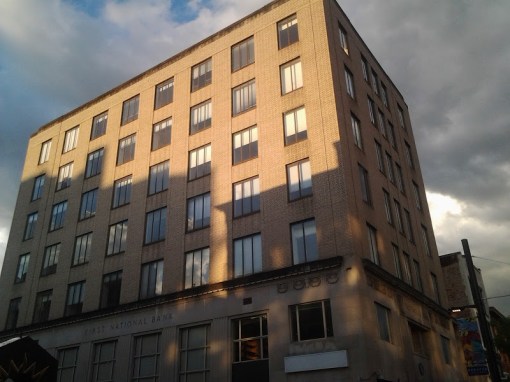
1. Some of you might remember that Chemung Canal Trust Company was embroiled in a legal battle with Ithaca Renting (Jason Fane) over the terms of their lease of 12,000 SF on the first floor of Bank Tower on the Commons. Welp, the courts have issued their decision, and it looks like Chemung Canal lost. The Elmira-based bank had to revise their quarterly earnings report after losing the dispute with their former landlord. The terms of the payout have yet to be determined, but Fane was seeking $4 million, which is in the same ballpark as the cost of Fane’s renovation of the top floors into 32 apartments. CCTC is still looking into an appeal.


2. It hasn’t been a secret that the price of real estate in Collegetown is getting enormously expensive. First John Novarr dropped $5.3 million on 215 College Avenue. Then Todd Fox forked over $2.65 million in June for 201 College Avenue. Now it’s Novarr’s turn again, handing over $4.75 million on the 2nd for 119, 121 and 125 College Avenue (or more specifically, an LLC filed to an address used by Novarr for his many LLCs). The three houses are collectively worth about $1.655 million, per the county assessor. Here’s a tip for readers – if you’re looking at a built property that’s recently sold, if it was purchased for more than double the existing tax assessment, the property was most likely sold based on its development potential. Less than that but still well above assessment, and it’s more likely major renovations/gentrification/Fall Creek/not being torn down.
Anyway, we already have an idea what’s planned – Novarr wants to do 50-60 units of faculty townhouses on the site, a 3-4 story, $10 million project.

3. The other big sale this week (using that term subjectively, since someone just paid $1.25 million for a Cayuga Heights mansion) was 1015 Dryden Road out in Varna. Modern Living Rentals (Todd Fox/Charlie O’Connor) has had this 5-unit rental property on the market for a little while now, initially for $650,000, then $599,000. The buyer “Finger Lakes Wrestling Club Inc.”, agreed to purchase the property on August 2nd for $555,000. MLR purchased the property for $425,000 in 2014. The wrestling club is listed as a non-profit serving youth training and competing in wrestling, and their plans for the property are unknown – the sale comes with plans for a pair of duplexes (4 units total), and the triplex designed by STREAM Collaborative shown above. I’ve heard of non-profits renting out real estate assets to fund their endeavors, so maybe that’s the plan.


4. A pair of housing newsbits. Per the ILPC, the former Paleontological Research Institute at 109 Dearborn is ready for its next phase of renovation into a rather swanky two-family residence. Background on the property from last August here. Long story short, it’s a gut renovation of a non-contributing structure of a historic district, the commission didn’t have much to say when it presented last year. This time around, the applicant wants to trade out the lower-level shingles for stucco, and the west entrance bump-out has been eliminated; anecdotal evidence says the ILPC won’t be excited, but it’s probably acceptable, since non-contributing buildings generally have an easier go with the commission.
A little further south on East Hill, local landlord Nick Lambrou wants to subdivide the large lot of 125 Eddy Street in order to build a new two-family residence. Jagat Sharma is the architect-of-record for the proposed 123 Eddy Street, which is a part of the East Hill Historic District and would have to go through ILPC approval. It will also need to pay a visit to the BZA because it’s proposed without parking (although the CPOZ was removed last year, an East Hill property still requires a parking space every 3 bedrooms) and will need a variance. Offhand, the Planning Board likely won’t be roped in on this one, since one-and-two family homes usually only need to be approved by planning department staff. Lambrou and Sharma are frequent contributors, and have faced the ILPC together before, for the reconstruction of 202 Eddy Street after it was destroyed by a fire in early 2014. The focus right now is just getting the subdivision approved, the ILPC presentation and vote will come at a later date.

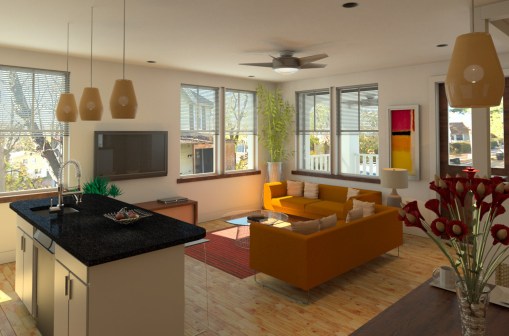
5. STREAM Collaborative sent out their bi-annual newsletter, and there are a couple of interesting pieces worth re-sharing. There were brief items about the “Urban Cottage” at 228 West Spencer, Tiny Timbers and 409 College Avenue, as well as some info about 215-221 West Spencer. STREAM writes that Ed Cope has broken ground on the STREAM-designed 12-unit, 26-bedroom condominium complex. This must have been fairly recent, as the hillside was undisturbed during a site check a couple weeks ago. Anecdotally, a condo project in Ithaca needs 50% pre-sales (i.e. 6 units) in order to secure a construction loan, but there isn’t any loan on file with the county yet, so I can’t say with any certainty what the funding arrangement looks like. On the fully revamped webpage are some nifty interior renders, including the image above. Anyone interested in the 1-3 bedroom condos can contact Ed Cope at PPM’s website here.
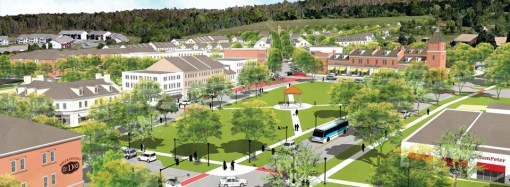
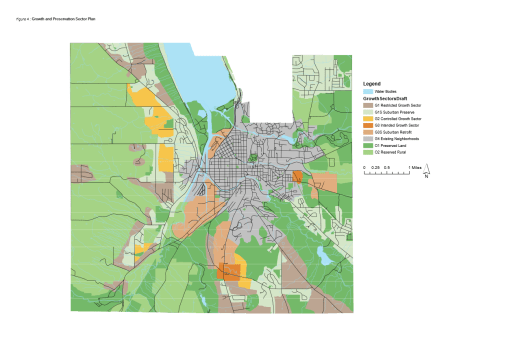
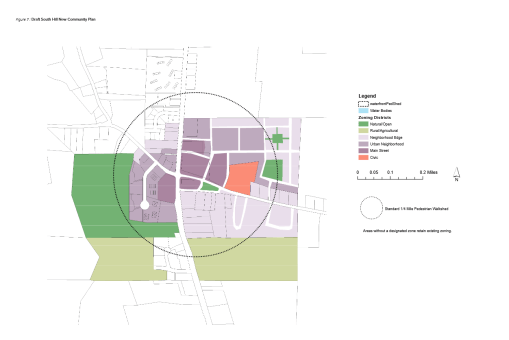
Also in the newsletter was an image from the latest set of Form Ithaca charrettes. “Buttermilk Village”, a working title for the South Hill neighborhood plan. The render above is looking northeast from the intersection of 96B and East King Road, with Ithaca College’s Circle Apartments to the upper left. Among the design features are a walkable town square, 2-4 story buildings, complete streets, and mixed uses with less dense residential further from the main roads. Some of the businesses like Sam Peter and Dolce Delight are in there to give that sense of familiarity. Most of this land is owned by Evan Monkemeyer, who’s still fuming from the College Crossings debacle. But rumor has it he’s working with another developer on a plan. It would be quite a feather in Form Ithaca’s cap if it looked something like this.

 Ithacating in Cornell Heights