A “Nobel” Accolade

4 10 2012

In the proverbial confidence-measuring that is academia, one of the things that colleges and universities like to throw out there is the breadth and depth of their Nobel laureates. The reasoning is simple enough; it’s a measurement of prestige, and the caliber of alumni and faculty.

Cornell lays claim to 41 such folks, according to a fall 2009 issue of the Cornell Chronicle, and according to wikpedia, that number has held steady. Within those 41, 3 are current faculty, 13 are alumni, and the other 25 are former faculty (moved, retired or otherwise). The last recipient was Jack Szostak Ph. D ’77, who won the Prize in Physiology/Medicine in 2009.

So let’s take a brief look at how Cornell stacks up against its peers: First, the top 20 schools, as compiled by U.S. News and World Report, since that tends to be the most commonly used ranking system:

Harvard
MIT
Yale
U. Chicago
Penn
Columbia
Stanford
Caltech
Princeton
U. Mich
Cornell
Johns Hopkins
Duke
UC Berkeley
Northwestern
UCLA
Brown
UW-Madison
Carnegie Mellon
NYU

Now their Nobel laureates:

Columbia 80 (or 97, depending on your definition)
U. Chicago 87
MIT 77
Stanford 54
Yale 49
UC Berkeley 47
Harvard 46
Cornell 41
NYU 36
Johns Hopkins 36
Princeton 35
Caltech 32
Penn 28
UW-Madison 19
U. Mich 19
Carnegie Mellon 18
UCLA 14
Duke 12
Northwestern 8
Brown 7

Interestingly, U. Illinois-Urbana-Champaign has 26, but doesn’t appear in the top schools list from USNWR. International students may be annoyed at me for leaving of non-U.S. schools, and granted, there’s a few that have similarly high rankings and accolades. Forgive my blatant nationalism for the moment.

This exercise proves to me, on a very general level, that universities with Nobel affiliates tend to be more prestigious. However, there are some obvious issues- schools with large research programs tend to have more laureates, and we haven’t even explored the Nobel laureates per capita at each institution (an exercise in futility, since I would also require historical enrollement figures I don’t feel like digging for at the moment).

But whatever floats your boat Cornell P.R., and keep your fingers crosses at the next Nobel award ceremony.



End-of-Summer Construction Update, Part II

24 08 2012

I felt a little more comfortable exploring the non-college part of Ithaca. For the most part. I bought an Ithaca Beer Company root beer at the downtown pharmacy, and because it came in a traditional beer bottle, I was concerned I’d be stopped by police for looking like I was violating open container laws. Rather than put up with that, I sat next to the ice cream counter and read the real estate section of the paper. The photos show would I did elsewhere.

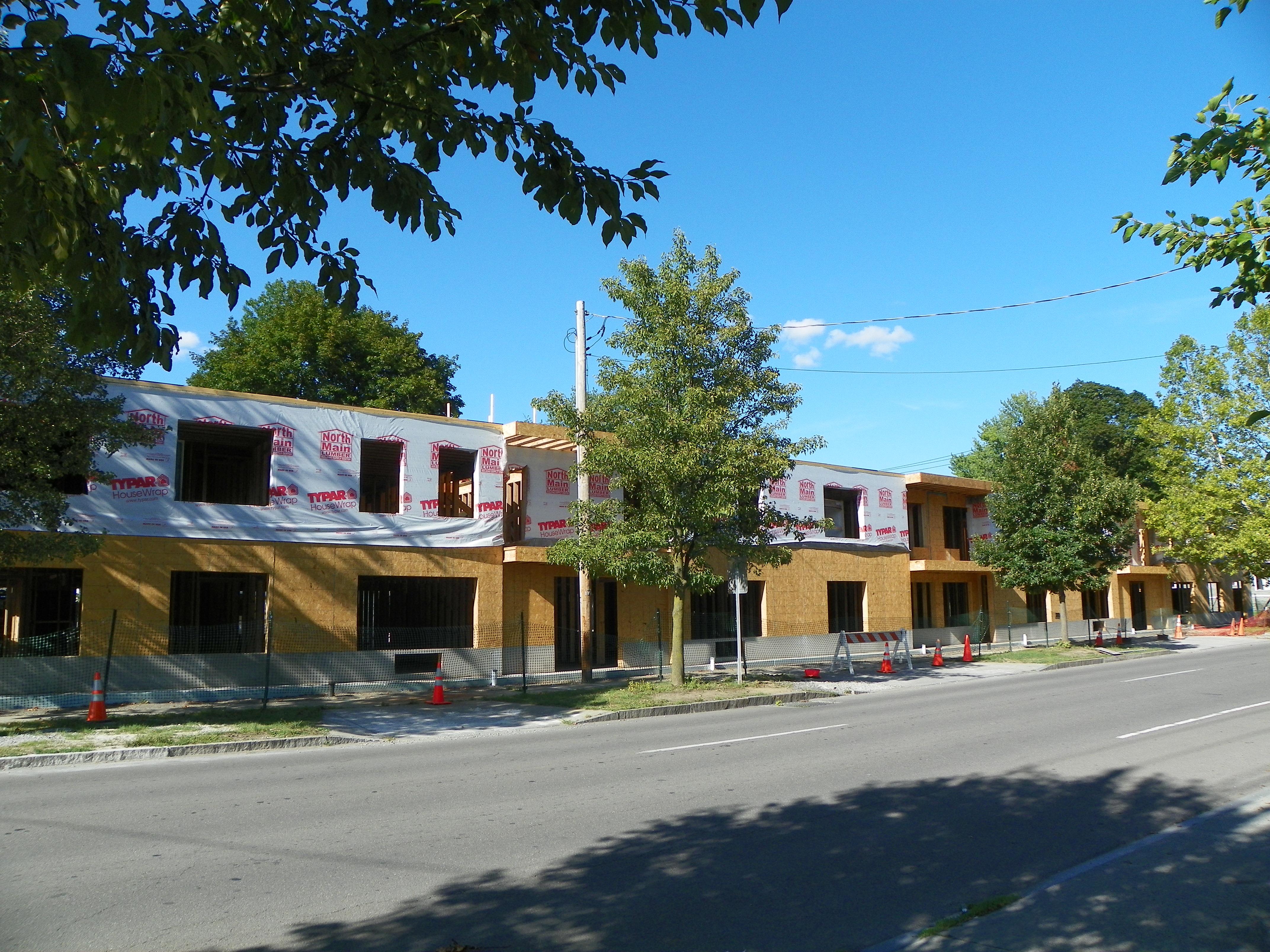
I felt bad because I’ve largely ignored this project. Not purposely; it’s out of my normal search range – on the 600 block of West Seneca, near 13. The site was previous home to a service station and four homes, all of which were in poor condition. The project beings 17 units into a part of the city that has traditionally been one of the most overlooked Ithacan neighborhoods.

The new Fairfield Inn down in big-box land has had its foundation laid, and will likely be finished sometime in the spring. The hotel was approved last fall, and to be honest, I had expected this one to be further along than it was. When complete, the hotel will over another 106 rooms to the 1,800 or so currently within the Ithaca metro. On another note, the city expects a chain restaurant to be built next to the Panera Bread strip of buildings, with construction beginning in the fall.

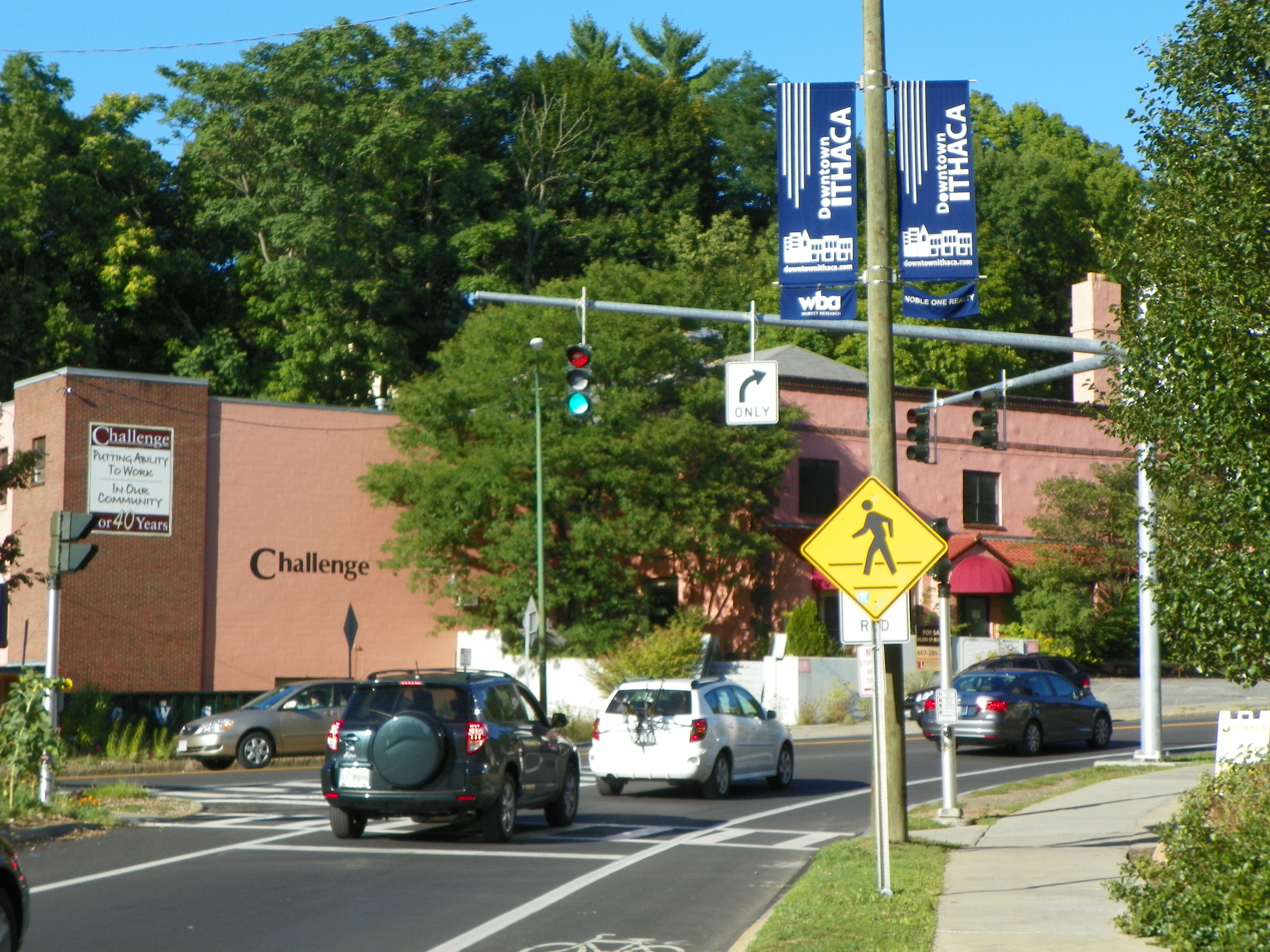
Likewise on the progress for the Seneca Way project. For all the trouble it went through, I would hope it at least sees the light of day. The project seeks to build 32 apartments and some commercial space in a five story building on the site of the former Challenge Industries building. As for the Hotel Ithaca, no news as of late, and likely still stuck in funding limbo, a sign of our poor economic times. UPDATE 8/29/12: Apparently the Hotel is being reconfigured, switching from luxury hotel operator Gemstone Resorts to the Marriott brand. The number of rooms will be raised to 159, and the design will be slightly modified at base level. The height should remain the same. Re-approvals are required, but are not expected to be difficult to obtain. Construction is slated to begin next March, with foundation work during the winter.

Almost the same story here, except these two actually have funding arranged. The Holiday Inn expansion site in the top photo, the Cayuga Green lofts below. The Holiday Inn project started prep in July for the tear-down of the lowrise portion, to make way for a new 9-story building and conference center (I believe it was made one floor shorter from the original 10 stories, and stretched slightly longer to compensate for the loss of that floor space). The Cayuga Green project may have prep underway, judging from the equipment, but needs to start by the end of the year regardless to keep the city lawyers at bay.

And finally, one project that has made substantial progress, the Breckenridge Place Apartments on the site of the Women’s Community Building. The project will bring 50 units into downtown when completed next year.

This was a b*tch to take photos of. Most of the perimeter of the lot was covered in a black opaque tarp, tied so sceurely I had to lay on the ground and reach under it to get a photo through the fence. The front side was a bit easier. Completion should be sometime in mid-2014, although it looks like most of the exterior glass curtain wall is installed – which would place the project ahead of schedule.

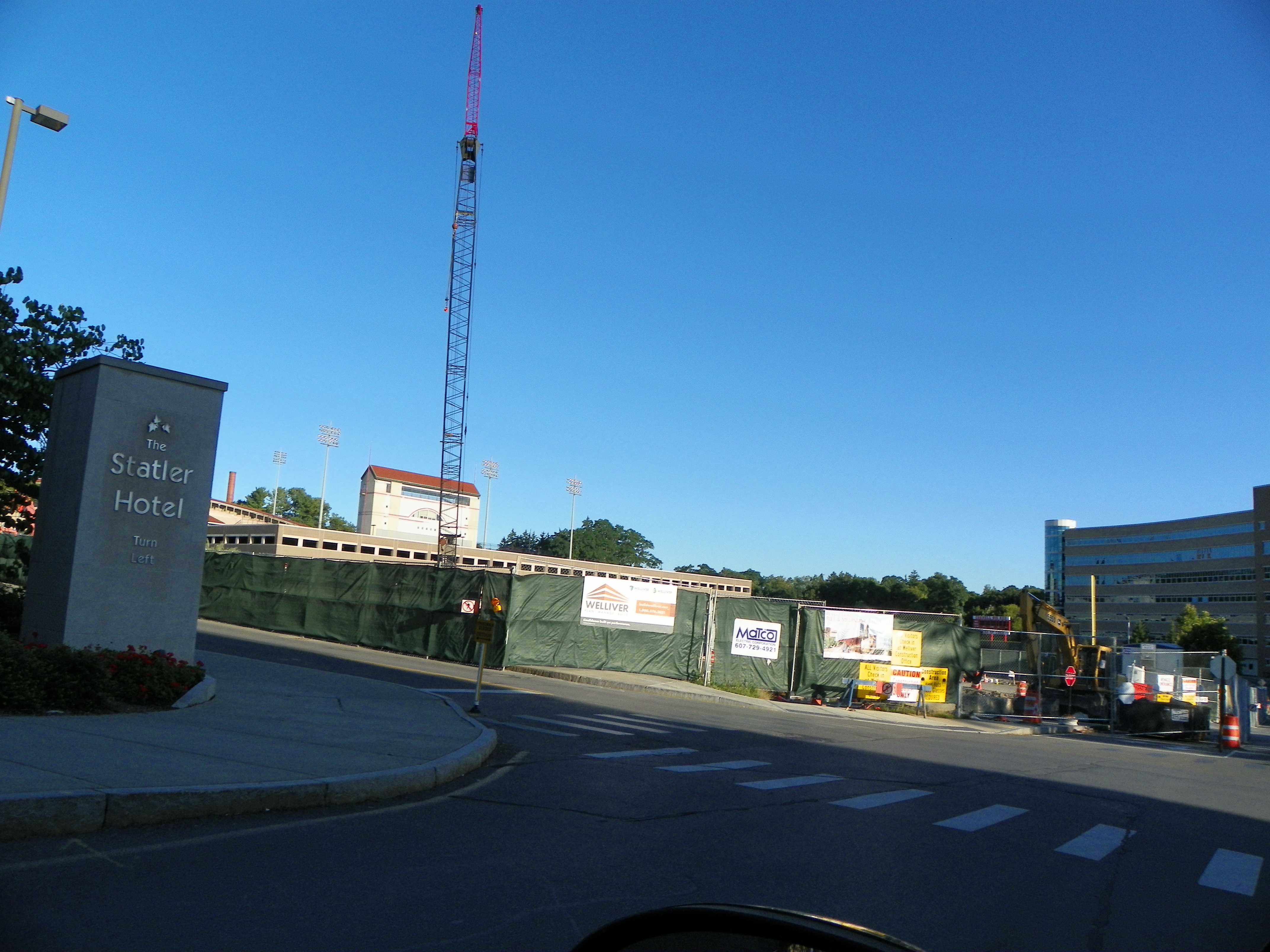
Do as I say, not as I do: never take photos and try to drive on a crowded campus at the same time. But, I was running late. Tarp and foundation work underway at Gates Hall. For the curious, I stopped by the site for the Big Red Marching Facility, and the site was still pristine – this makes sense, since site prep doesn’t start until next month.

Now that screen lags my typing by about thirty seconds, I’d better but the kibosh on uploading any more photos in this entry. However, I do have the good fortune of having one my best friends accept a research position at Cornell, so I now have a legitimate excuse to visit Ithaca periodically for the next couple of years.


The Keyword Bar XVII

26 07 2012

…because the planning board discussed projects I’ve covered ad nauseum and Cornell hasn’t caught my attention in the past week.

1. “how many students from cornell have jump to there deaths” (7-25-2012)

Death of grammar aside, this would not be an easy number to calculate, since a number of cases over the years have been questionable as to whether the fall was accidental or intentional, and whether an individual would be considered a student (ex. a case of a former student). That being said, it seemed from casual queries back during the 2010 suicides that for CU students who were believed to have committed suicides via gorge jumping, it is likely in the mid double-digits. This number does not reflect the number of suicides in the gorges (which is much higher, as they tend to be a magnet for those who want to go out in dramatic fashion), the number of gorge deaths (including accidental falls, the number is almost certainly in the few hundreds since Cornell opened) nor suicides that occur by other methods. From 2006 to 2010, there were three student gorge deaths by suicide, but a variety of other events (note – the hyperlink has one inaccuracy – William Jacobson was an IC student who drowned in a retention pond).

2. “eastman hall at ithaca named after” (7-25-2012)

Eastman Hall, an IC dorm, was built in 1962-1963. From what I can tell, many of these early buildings, built during IC’s rapid expansion on South Hill from 1959-1968, are named for older administrators or large donors (for instance,  Talcott Hall is likely tied to a student life administrator named “Mrs. Talcott” in news articles from the 1930s). Although there is no concrete evidence, Eastman Hall is likely named for George Eastman, founder of Eastman Kodak in Rochester, and a well-known philanthropist, especially of music schools. Although he passed away in the 1930s, it’s possible his company, or some foundation attached to his estate, made a donation; or it could be the manifestation of a donation from when Eastman was alive.

3. “chi gamma at cornell university sorority” (7-22-2012)

Their history seems rather unusual. Chi Gamma formed in 1956, after dissociating from its national (Sigma Kappa) because it did not wish to abide by the national’s racist membership policies. They lived at 150 Triphammer, and the sorority was active until at least 1963, when it merged with Chi Omega (both were small houses, so they decided to join forces as an attempt to hold their own in the increasingly meager sorority rushes of the ’60s). The house itself became home to the new and all-female Triphammer Co-op the following year, which became co-ed in the 1990s.

4. what is the address of the llenroc mansion (7-22-2012)

100 Cornell Avenue, Ithaca NY. There are only two houses on the street, the other I believe is a private residence.

5. ithaca “collegetown” fire 1998 (7-23-2012)

It might seem odd that in a stretch of century-old buildings, 407 College Avenue (the Apollo Chinese Restaurant building) was built in 2000 (as seen on its cornerstone). Well, the simple reason is that the old building, a wood-frame structure built in 1887, burnt down in October 1998, leaving 51 students homeless. The fire was believed to have started in the kitchen of a first-floor restaurant. Emergency housing and aid was provided by the Red Cross and Cornell. Since the site is prime Collegetown real estate, it was redeveloped into a six-story building and opened in August 2000.


Quotes of Cornell

12 07 2012

A few thoughts from prominent folks about the school Far Above Cayuga:

“The university of Mr. Cornell, a really noble monument of his munificence, yet seems to rest on a misconception of what culture truly is, and is to be calculated to produce miners, or engineers, or architects, not sweetness and light. -Matthew Arnold, Preface of Culture and Anarchy, 1869 (Bishop 177)

“Columbia cannot grow, or at any rate cannot grow rapidly…unless it shall, at least to some extent, modify its plan of instruction in a more or less distant imitation of Harvard or of Cornell University”. Columbia President Frederick Barnard, 1870.

“[Cornell Vice-President Albert] Russel is a man whose nonreligious convictions are very pronounced, giving the university an air of positive irreligion. The decadence of the students is positive testimony to the evil effects of free inquiry.” – Lyman Abbott, editor of the Christian Union, 1881 (Bishop 215)

“I see, or think I see evidence of a growing disposition to drift away from the original intentions of Mr. Cornell in the founding of a purely non-sectarian university…I look to you [A. D. White] to protect my investment in Cornell from the common enemy.” Cornell Trustee Hiram Sibley to A.D. White, 1888.

“The University was sadly in need of reorganization and refitting.” – Benjamin Ide Wheeler, in reference to Cornell in the mid-1880s, quoted in 1902. (Bishop 259)

“The graduate students are the crown of the University, and Cornell cannot afford to neglect them for the sake of any others…” – David Starr Jordan, 1888

“The cry of the horse leech is modest and attenuated beside the stupendous greed and the insatiable clamor of this favored institution.” – New York Press, Nov. 1892

“[Cornell was] better endowed than any institution in the land, yet never did anything.” U.S. Sec. of Agriculture James Wilson, 1904 (Bishop 366)

“There is no university in the country in which freedom of thought and of speech is more firmly entrenched in tradition and in policy.” – Prof Henry A. Sill to Carl Becker, 1917

“[Cornell students] are good because it is too much trouble to be bad.” Romeyn Berry, Alumni News, 1926

“No more do the better students chant their Alma Mater in a happy trance; they sing from the side of the mouth, with the air of cynical priests of old Egypt.” – Alumni News, 1931.

“Cornell is a center of revolutionary communistic activity.” – State Sen. John J. McNaboe, 1936

“CORNELL GOES BOLSHEVIST” – Headline, New York World-Telegram, 1944

“We must retain private initiative and management in certain important fields, and certainly some of it in higher education.” -Edmund Ezra Day, 1948.

“At a time when Cornell was becoming a multicultural place, the Board of Trustees has thrown a dart into our celebration.” – Prof. Kenneth McClane, on the decision or Trustees to not divest South African investments, 1989

“[My wish for Cornell] is that it will continue to thrive and reach new heights … welcoming men and women of every color and creed, whatever their social standing or pecuniary condition. – Ruth Bader Ginsburg, 2003

“I am grateful to Cornell. I have seen the good work you have done in every stage of life.” – Bill Clinton, 2004 Convocation speech.

“My memories are strong about this place; important. And the two times I have been here for sustained periods have always been extraordinary.” – Toni Morrison, 2009.

“I would venture to say that the students at [Bush staffer Monica] Goodling’s law school at Regent University are far more impressive than those at the Cornell agriculture school — the land-grant, non-Ivy League school Keith [Olbermann] attended.”-Political Pundit Ann Coulter, 2009

“I got an excellent education, and that’s all I got from it…If I had to do it over again, or I had known what Cornell had been like, I never would have gone there.” Political pundit Bill Maher ’78, in a 2012 podcast


News Tidbits 3/6/12: From Orthodox Greek to Christian

7 03 2012

…and by Orthodox Greek, I mean your normal Cornell Greek house. But I enjoy a little bit of word play.

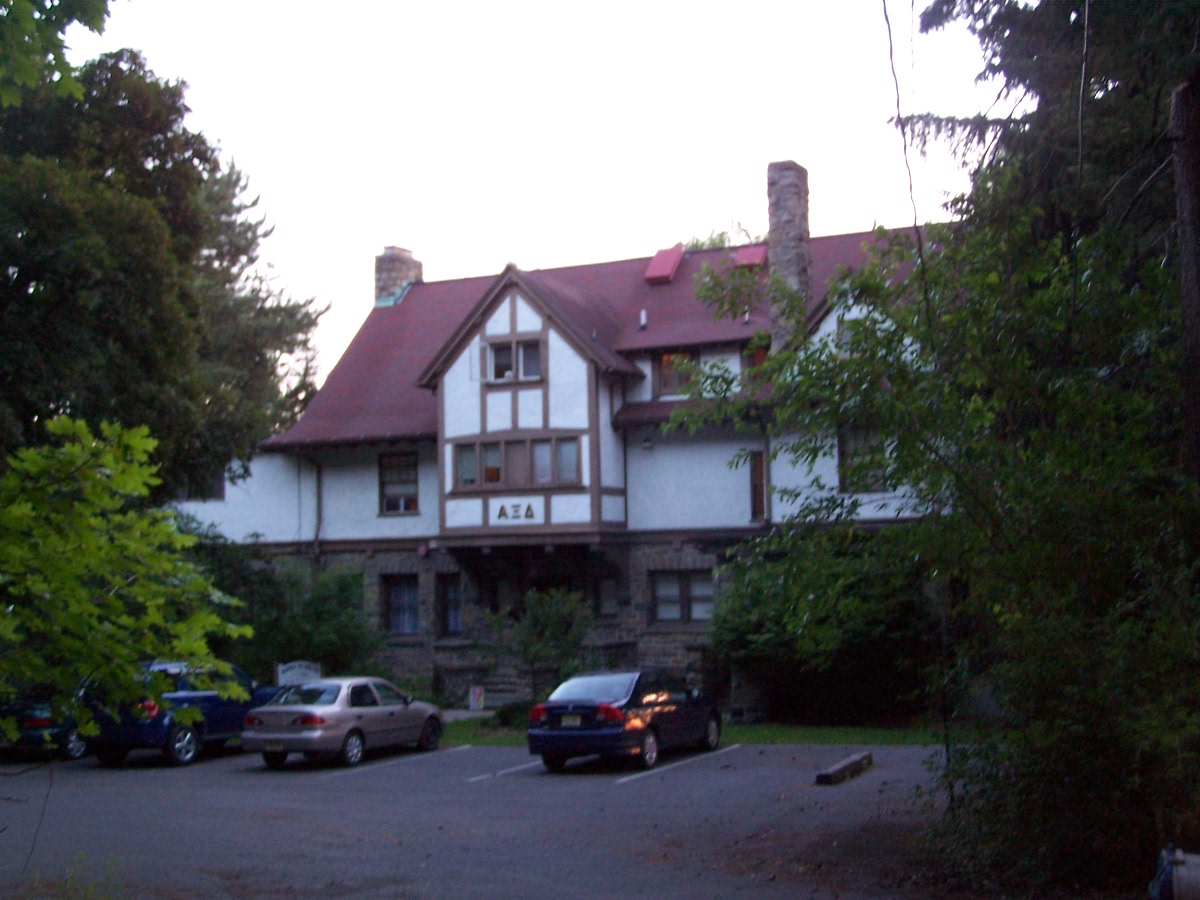
I had come across a piece in my Cornell feed about a Christian house at Cornell on The Knoll called “Chesterton House”. I thought it was unusual that I had never heard of it, but I wrote it off as being some low key residential organization, like many at Cornell are (for example, Telluride, the Co-Ops and a few of the professional fraternities). I noticed its location was 115 The Knoll, which failed to ring a bell – I thought it was a rowers’ house or home to some of the Big Red Band. I’ve been vaguely aware that there were five houses on the Knoll, so there was bound to be some non-Greek component.

Then I glanced at their website – it’s Alpha Xi Delta’s old house. The one I profiled a couple years ago.

According to their website, the house is named for Gilbert Keith Chesterton, an early 20th century writer and “defender of the Christian faith”. The house holds 15 and is all-male, with the female equivalent being Sophia House at 315 Thurston, the house with a stucco finish and the extremely high-pitched tile roof. Apparently that house is being rented, so it is not under the organization’s possession. Now, the house on the Knoll is owned by Delta Phi Epsilon sorority, the last I checked (for the record, they’ve owned it since 1962). So I’m going to venture that this is a fairly recent endeavor, and a big step for an organization that was established only 12 years ago. Although a relatively young organization, it’s certainly garnering its share of alumni support.

I for one welcome them to establish themselves as one of the many opportunities afforded to students at Cornell. In my mind, I see it as something similar to the Jewish Living Center on West Campus. My one encouragement is that they adopt a policy similar to the Jewish Living Center and encourage freshmen to live with the other freshmen. I’ll willingly admit that as the brother of a fire-and-brimstone evangelist, I’ve been wary of religious groups in general (one tends to be that way when your sibling tells you you’re going to hell at every Thanksgiving dinner, for being a secular  Christian). But it’s also addressing a niche group at Cornell and offering more for some individual’s Cornell experience.


The Rejuvenation of Gannett Health Center

28 02 2012

A while back, I mentioned that the plan for Gannett Health Center was to tear down the current structure and replace it on the same parcel of land with a new 90,000-130,000 sq ft building. While the project is still in the pipeline, a massing proposal suggests one rough idea of the future Gannett:

From HOLT Architects’ portofolio section comes this little nugget of information:

“…the 2007 HOLT Master Plan developed a comprehensive building space program for a 119,000 gsf replacement facility. Concept designs tested the full program fit on the existing central campus site and including substantial new parking requirements. Massing models, single and multi-phase construction sequencing, project costs, and schedules were outlined to assist the university with strategic planning.”

In other words, its a proposal for a new building, but it’s just one possible solution that may or may not be pursued by the university for the new Gannett. The proposal offers up a 119,000 sq ft 5-story (+1 more floor for mechanicals) structure whose massing suggests a curved face to maintain context with Campus Road to its southwest.

A couple of things stand out in the massing concepts. One, the ground textures were not updated to reflect the massing proposal. Two, the revised Hollister Hall can be seen at right (southeast). I’d be inclined to say that that would be based off of the master plan, but the master plan also calls for a demolition of the Cornell Store and Day Hall, which are not included in the imagery. It could be a saved time and effort on behalf of the company, or it could mean that the plans for Hollister are a little more solid than the other master plan suggestions. Either idea is plausible.

Since Gannett is currently only 39,000 sq ft, a building three times larger would leave an indelible impression on the intersection of Campus and College, arguably one of the most prominent on campus. Whether Cornell goes with this massing model, the tiered building in the master plan, or another design (not a hypermodern box, I can hope) remains to be seen in the university’s long-term plans.


News Tidbits 1/31/2012: The Big Red Bandhouse Will NOT Be Open This Summer

31 01 2012

Image Property of Cornell University

http://cornellsun.com/section/news/content/2012/01/31/new-building-big-red-band-will-open-summer

Dear Cornell Daily Sun – If a building starts construction in June 2012 with a tentative completion date of January 2013, in no feasible terms will the building be open by the summer of 2012.

Anyway, semantics aside, the design of the Big Red Bandhouse (or as I like to think of it, Fischell Hall) has been released. It’s a whole lot of Big Red Boring, but I suppose its purpose is more functional than aesthetic. It fits the general theme of ultramodern buildings that the university has more than happy to construct in the past several years.

Image Property of Cornell University

With the extra large front doors open, it kinda resembles a “Dust Buster” portable vacuum.The architects are the same folks responsible for the Plantations Welcome Center.

To allay the fears of the budget-conscious, the building is expected to be paid for entirely by private donations from Big Red Band alumni (in what I imagine will be a veritable inundation of pleas to their alumni to donate). The site is the current location of a small maintenance building (the Schoellkopf Garage), which will be removed and most likely rebuilt somewhere nearby.

I’m not a fan of the design (which should come as no surprise to frequent readers of this blog), but I figure this building was meant to be functional more than anyone else.


News tidbits 1/6/2012: If You Screwed Up Once, You Can Screw Up Again

6 01 2012

As time has gone on and I become more removed from my days at Cornell, this blog focuses less and less on student-specific events, such as Greek Life. But then, news articles like this pop up:

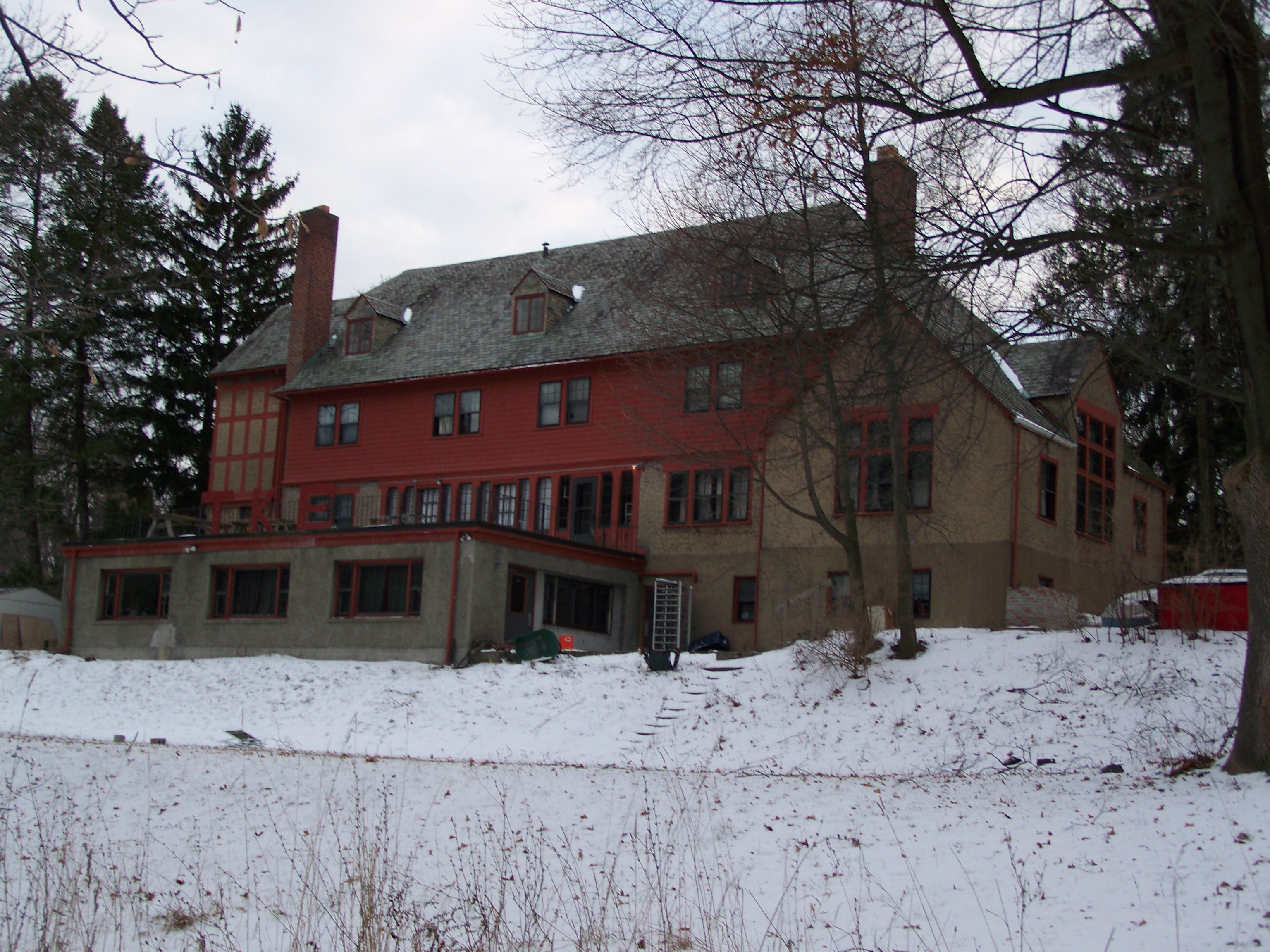
http://cornellsun.com/section/news/content/2012/01/06/after-hospitalization-tke-may-lose-recognition

After Hospitalization, TKE May Lose Recognition

January 6, 2012
By Jeff Stein

Cornell will revoke its recognition of Tau Kappa Epsilon following reports of an alcohol-related hospitalization of a freshman unless the fraternity succeeds in its appeal of the decision, according to multiple sources.

In a memo obtained by The Sun on Thursday, University administrators faulted TKE for reportedly failing to ensure the safety of a highly intoxicated individual — the same oversight that officials say led to the death of George Desdunes ’13 last spring. Sixteen former pledges of Sigma Alpha Epsilon, the fraternity in which Desdunes died, joined TKE a few months later.

The freshman, who had been consuming alcohol before attending TKE’s event, arrived at a recruitment dinner hosted by TKE at the China Buffet on Nov. 11. While it “remains unclear if he continued to consume alcohol at the dinner,” TKE did provide both beer and hard alcohol at the event, the report states.

But as early as September, the University had reason to believe “rumors that SAE has been operating through TKE,” according to the report, when administrators learned of plans for the “White Party” — an event “historically hosted by SAE [as a] social activity attracting hundreds of community members.”

“Out of great concern for the safety of attendees, considering that TKE would not be prepared to host a large event such as this, due to their inexperience, we placed the chapter on interim suspension,” the report states.

The memo then notes that, in a meeting with administrators, fraternity leadership agreed to cancel the event, terminate plans they had to “induct ‘little sisters’” and work with the TKE national organization toward building TKE “traditions that the community could support, as opposed to adopting SAE traditions.”

Despite these promises, “it became clear in that meeting that SAE’s former members, those who were fully initiated and have no affiliation with TKE, have significant influence on TKE as an organization,” the report states.

***

I read stories like this and I cringe. I’m a fairly avid supporter of Greek Life at Cornell. But stories like this make me rethink my stance. I understand that the person may or may not have consumed beverages at their recruitment dinner. Okay, innocent until proven guilty. But you’d think for a group of pledges that watched some of their pledgebrothers be indicted for killing someone, they’d use a little more precaution than “we’ll just drop him back off at his room and hope he’ll be fine”.

But that seems to merely be the straw that broke the camel’s back. The administration was bothered by how the chapter became SAE with a different set of letters. I couldn’t agree more. I am strongly bothered by the open flaunting of the SAE connection, and figuratively (maybe literally?) pissing on TKE’s original brotherhood and traditions (not that it wasn’t expected). I don’t know how much of the comments on the article to believe, but I don’t think they’re far from the mark. Calling yourself “Epsilon” because you feel the fraternity that took you in is so inferior you still have to tie it in to SAE (stating the obvious here, but it’s a nod to the fact that both Tau Kappa Epsilon and Sigma Alpha Epsilon share that letter). It just disgusts me. You’re not SAE. SAE of Cornell was doomed the moment George Desdunes died due to alcohol poisoning administered during a pledge kidnapping.

It’s sad. Sad that TKE was so desperate for social status and growth that they sold out everything their brotherhood was. Sad that SAE let someone die. Sad that one organization is gone completely and the other one is about to be kicked off campus. Sad that this reflects on the whole system, which is in a percarious enough position as it is.

What an ignominious way to go. I hope as a Greek alumnus that if my fraternity was ever in TKE’s position that they would just close instead of selling out.


The Loyal Opposition to the Tech Campus

19 12 2011
Image Property of Cornell University

Image Property of Cornell University

Congratulations to Cornell on winning the bid for the NYC Tech Campus.

However, to be honest, sometimes I feel like the only alum who doesn’t support the project.

By no means do I not want Cornell to succeed as an institution and give a strong education to those that earn entrance into the university. Plus, it seems unusual given my predilection for the development of physical facilities related to Cornell. It’s just…well, it has to do with Cornell’s identity.

Take Weill for example. Most Cornellians in Ithaca are vaguely aware of Weill’s existence. Certainly, the folks are aware of Cornell being based in Ithaca. But they both function independently. They’re separate institutions that just happen to be under the same Big Red umbrella. From a bureaucratic standpoint, that’s probably for the best. I expect something similar to shape up in the operation of the new Engineering Graduate Campus in New York City.

But some disparities between the two have been troubling. For instance, fund-raising in the “Far Above” campaign. As described in this Metaezra post from June 2010, the campaign was immensely successful for the medical school…but not for the main campus in Ithaca. One line has always stuck out in my mind:

“…so apparently wealthy New Yorkers care more about life-saving research and services than basic research and education a five hour drive from Manhattan.”

This has, in some sense, been my concern with the new campus in New York City. Yes, it will inspire entrepreneurship and innovation and all those other cute buzzwords they like to toss out in brochures. People are also free to donate their money as they choose (as it should be). But to what degree does this development of a new campus affect to the main campus in Ithaca? I’m concerned that so much attention will be paid to this new program that many of our alumni (of which 23% live in the NYC area) will donate to the school in their backyard rather than the one five hours away. By establishing another campus, I also worry that there will be less of a sense of a Cornellian – in my wildest imagination, I fear some future New York City campus alumni will self-segregate themselves – the “I’m a Cornell-New York Campus alum, I don’t associate with Cornell-Ithaca alumni and want nothing to do with THAT Cornell”. At least you can take classes in different undergraduate colleges. I see the mixing of Ithaca and New York activities as fairly rare events. Maybe Stanford was afraid of something similar happening, since the campuses would be 1000s of miles apart.

Maybe I’m being overprotective of the Ithaca campus, or this post will be written off as whining because I don’t like New York City or I don’t support Cornell’s global mission or whatever other reason that floats their boat. But I get nervous when the emphasis seems to be displaced from the campus that Ezra demanded be on his farm on the hills overlooking Cayuga. At the very least, I’m adding my voice to a silent minority that have concerns regarding the proposal.


A Nominal Nod to Cornell

18 12 2011

Whether or not one likes or dislikes Cornell and its environs, the university has been around long enough and produced enough graduates to have a fairly recognizable name as colleges and universities go. I happened to hear from a friend recently who had moved out to Colorado after graduation, and their experience in the Collegiate Peaks of Colorado. When I checked Wikipedia, I was dismayed to find that their were mountains named in those peaks named for Oxford, Harvard, Princeton, Yale and Columbia, but not Cornell. For what it’s worth, it appears they were named in the late 1860s and 1870s, when Cornell was still a fledgling school. But, I decided to do a google search for a “Mt. Cornell”.

While there wasn’t a “Mt. Cornell” anywhere in the world, there is a Cornell Peak named in honor of the university. The 9,750 ft. mountain is part of the San Jacinto Mountains in Southern California.  The mountain earned its name from a USGS topographer camping in the valley below with a geologist friend who was a graduate of Cornell, and remarked how the peak resembled McGraw Tower in appearance. Personally, I don’t see it, but the topographer named the mountain in honor of the university. Of much lesser note, there is a 3,860 ft. “Cornell Mountain” in the Catskills that is named for Thomas C. Cornell, a distant relative of Ezra.

Looking northward to a place even colder and less inviting than Ithaca in winter, on the west coast of Greenland there exists a “Cornell Glacier“. Similarly to the Collegiate Peaks, there is a collegiate set of glaciers in Alaska that Cornell was not a part of, the set consisting of the four aforementioned Ivies and Johns Hopkins.

On the more civilized end, the town of Cornell, Wisconsin (population 1467 as of the 2010 census) is named for Ezra and the university, due to its placement on the lands that the university once held as part of the Morrill land-grant in the late 19th century. The university has given this some light attention to this connection by writing an article referring to a blog written by a Cornell alum and his fact-finding adventures in the small community in northern cheesehead country. Apparently, the town was originally named Brunet Falls and is famous for having the only surviving pulpwood stacker, and like many other small towns with minor claims to fame, they make a festival out of it (considering my hometown’s claim to fame is the method a hose is laid on a fire engine, I have no right to be critical). Although it’s hard to tell whether communities named Cornell are named after Cornell U. or someone who happens that surname, at least two unincorporated communities are named for the school far above Cayuga, one in the U.P. of Michigan and one in Southern California north of Malibu (and a fair 100 miles from Cornell Peak). Cornell, Illinois and Cornell, Ontario are not related to the university.

Lest one try to limit themselves to the Earth, an asteroid was named in honor of Cornell in 1999 (8250 Cornell). I guess the next astronomical goal should be a large crater somewhere.

If it’s any consolation to the folks associated with Cornell College, they have a species of tropical fly named for their school.