Greetings from Sunny Ithaca

17 03 2009

Yes, it’s spring break. I’m working in Ithaca and studying for a GRE I have in a few days.  It’s warmer than usual and sunny. No, Ithaca does not miss you. Anyways…
100_3387

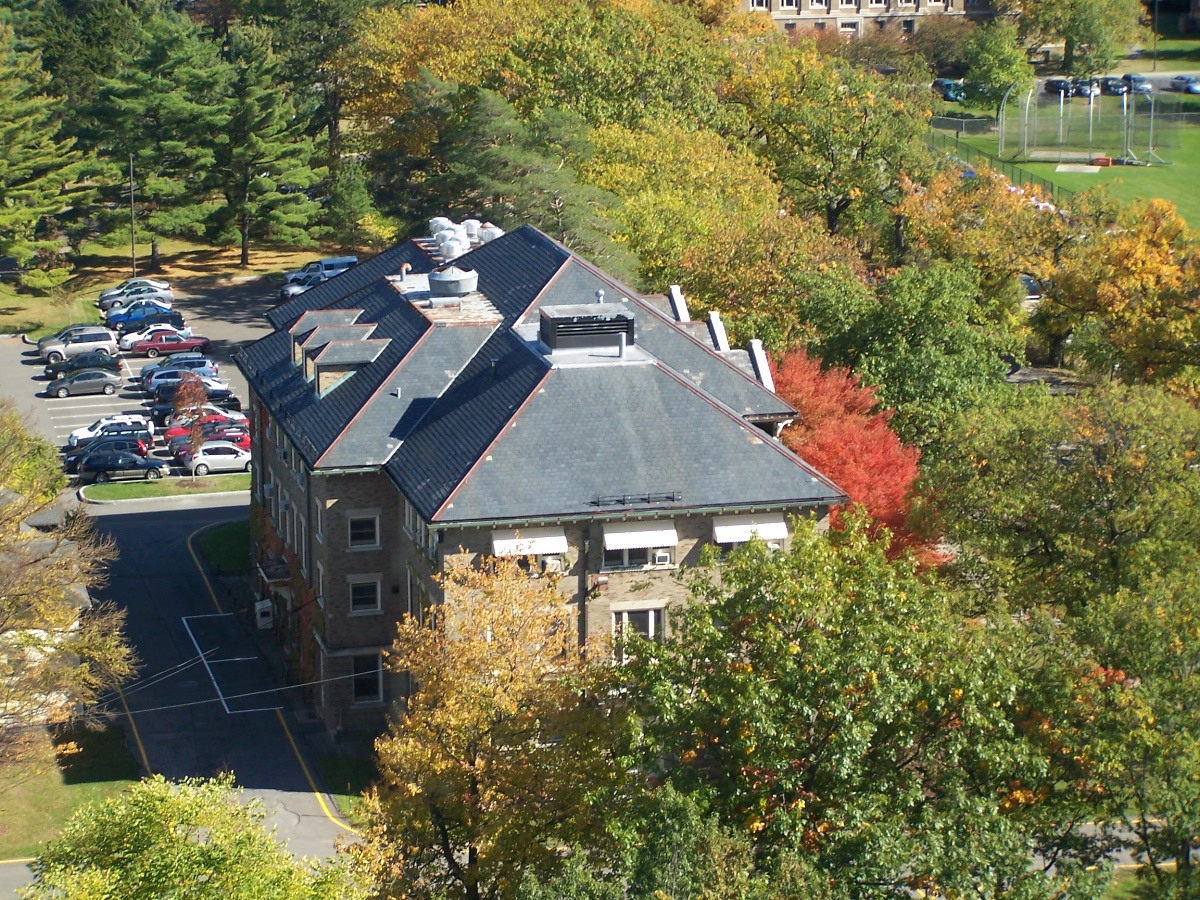
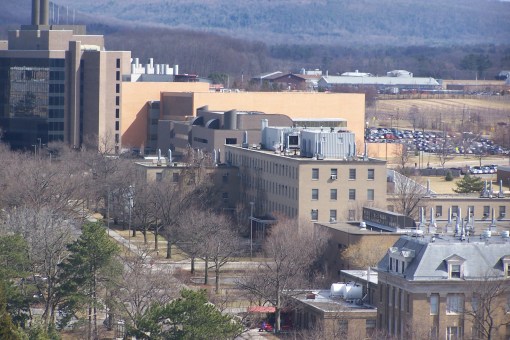
The building in the center of this image is Morrison Hall. Morrison, the home of the animal science major (pre-vet and non-pre-vet flavors) was built in 1961 [1]- hence the fact it’s a 133,000 sq. ft. characterless box (though I guess that’s better than the monstrosity next to it, the Boyce Thompson Institute).  The building was named for Frank B. Morrison, a professor and director of animal husbandry here at the university [2]. For the less recent alumni, the orange building in the back is the East Wing Addition to the Vet School that was completed in 2007. Yes, it has virtually, no windows. No one said Cornell’s modern architecture was known for its aesthetically pleasing qualities.

100_3414

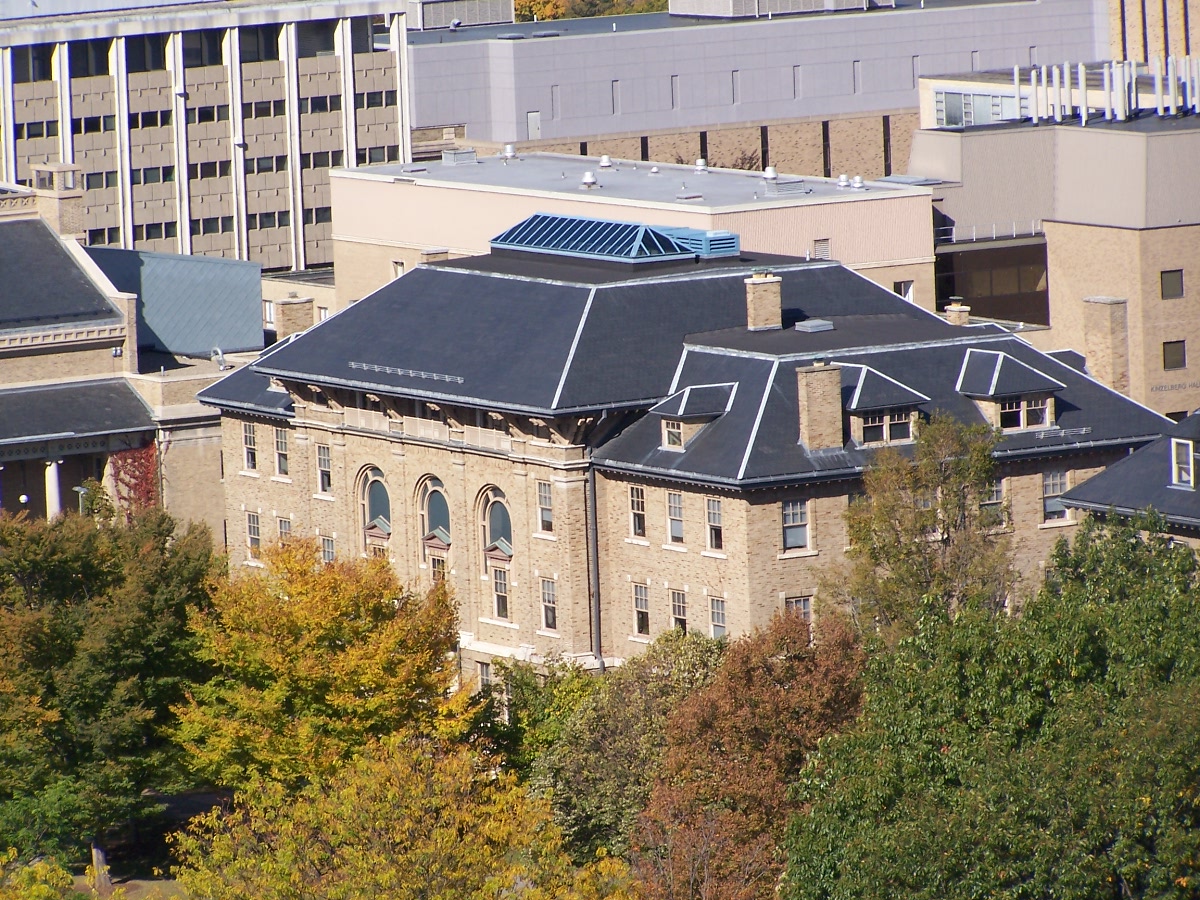
In contrast, as utilitarian as Baker was meant to be, it still retains some charm to it, probably from the classical columns and brickwork of the structure. According to Charles Wilcox [3], the initial designs for Baker were actually drawn up around 1910, which was six years before Morse Hall was destroyed in a fire. Funding for Baker came through in 1918, and during it construction the benefactor was anonymous. George Baker, a prominent New York banker who donated $1.5 million to its construction, only unveiled himself at the building’s dedication ( a similar experience occurred when Balch Hall was dedicated). The building had any number of problems from poorly maintained exhaust hoods to flooding in the basement to the ceiling being so low that chemical engineering could not fit in the building and so had to have a building of its own. Some of these problems were rectified when Baker was renovated in 1969, but others such as the flooding continue even into today.
100_3386

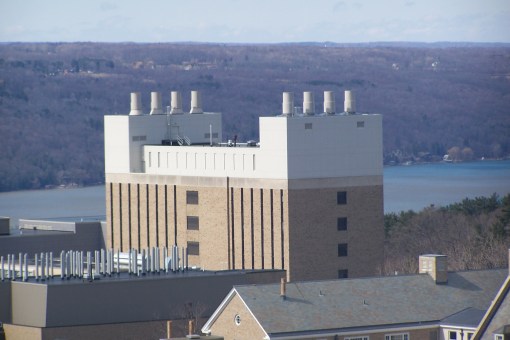
In the same category as Morrison (the category being random ugly crap we threw up in the ’60s) is the Spencer T. Olin Laboratory Tower.  I like this because there’s a nice detailed story concerning its construction floating around the internet [3]. The construction of the building was overseen by a Chem department honcho by the name of William Miller; he was less concerned about winning prizes in an architectural journal and more about the building performing its function properly. The nine-story, 64,000 square foot building was built in 1967, with the intention of being flexible in its use for the Chemistry department. The exhaust structures on the sides were built in the 1990s, making an unattractive building downright ugly. Two of the issues encountered during its instruction were an underground cave that actually caused a caisson (a base support column, if you will) to collapse (they believed an ancient underground river once ran through the site), and that the tarpaulins caught fire on the side of the building ( a tarpaulin is designed to allow construction in cold weather; like what you see on the new Vet building here).

100_31811

The last incident involving Olin is something that one would come to expect at Cornell. To quote Charles Wilcox’s paper:

“The decision to use an outside architect and to go for efficiency rather than beauty led to an amusing incident. The dedication of the new wing was held at the four-story interface between old Baker and the new wing. When President Perkins rose to give his speech, a group of students from the College of Architecture who had secretly gathered on the roof of the passageway unfurled a building-long banner that read MEDIOCRE and waved placards reading UGLY and VERY UGLY. The startled president stepped back to avoid being hit by weights at the bottom of the falling banner; although grazed he graciously laughed and responded: I question your judgment, but admire your logistics. It is not recorded what Bill Miller thought, but it is likely that he took secret pleasure in knowing that he had not wasted money on unproductive artistic features. ”

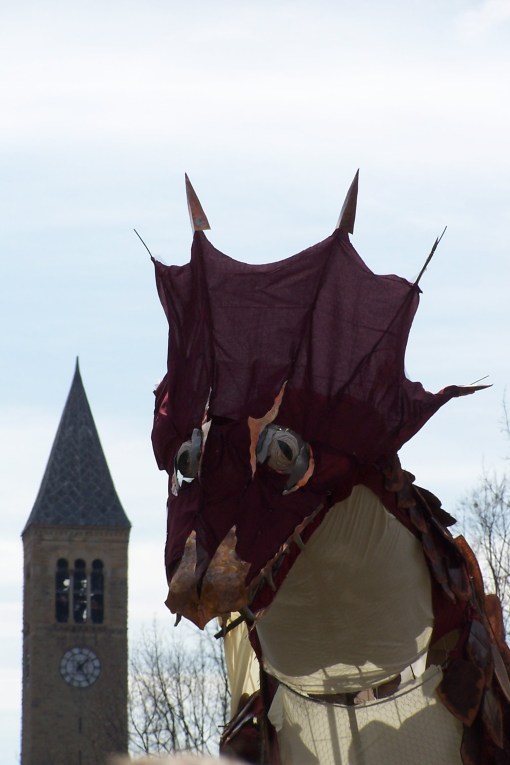
Oh architects! And we thought all you did was chain smoke, lock yourselves in Rand and burn dragons. Speaking of which,
100_34321

Me passing up photos on Dragon Day would’ve been like a pedophile passing a playground (though not nearly as perverse).
100_3396

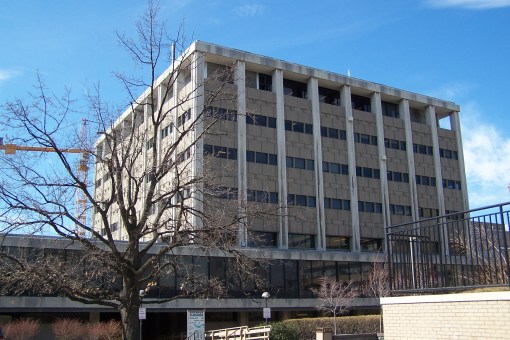
Continuing our tour of building that were only built out of necessity, we have to mention Clark Hall. The homes of AEP and vanilla Physics, this 84-foot tall box was completed in 1965, and was named for W. van Alan Clark 1909, an Avon perfume scientist who donated $3 million towards its $7.3 million price tag [4]. So equivalently, that would suggest the donor for the new physical sciences building would have to donate about $33 million to the reconciled cost of $81 million [5]. I’m all for tapping in to Ratan Tata’s fortune to cover it.

By the way, if we can handle the height of Clark, I see no reason why we can’t handle a much slimmer building of similar height in Collegetown. Just saying.

[1]http://jds.fass.org/cgi/reprint/44/10/3.pdf

[2]http://jas.fass.org/cgi/reprint/66/10/2696.pdf

[3]http://www.chem.cornell.edu/history/laboratories/STOlin.htm

[4]http://www.cornell.edu/search/index.cfm?tab=facts&q=&id=144

[5]http://www.fs.cornell.edu/fs/projects/


The Music Building in its Many Forms

24 02 2009

So, a little background story to this entry. One of the things that I’m in charge of for my fraternity is maintaining the alumni newsletter. So, I had to send snail mail and a typed letter to the publishing company. Much to my annoyance, the nearest computer lab to where I was at the time was in Lincoln Hall, the music building.

Well, I’ve never printed anything at Lincoln before, so when I selected printers, i accidentally sent it to 374 MTH instead of the MUSIC printer. I being off not-so-sound mind apparently managed to read that as 374 MUSIC, so I went up and began searching the third floor.

Then I found this display. Realizing its worthiness for writing materials, I grabbed my camera and took a few photos.

100_3185

100_3186

100_3188

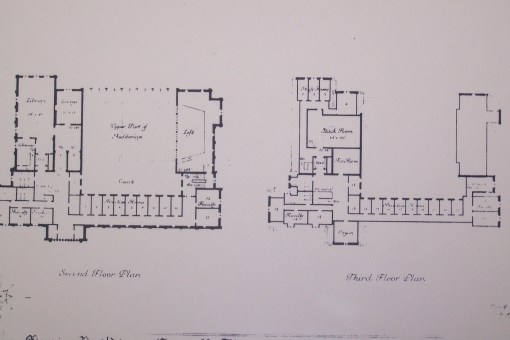
It seems the above pictorials date from ca. 1900, and were proposed designs for a combined Architecture and Fine Arts building. No word on where the building would have been built.

100_3190

100_3191

This Collegiate Gothic design was proposed in the late 1920s, and would have been where Gannett Health Center stand today. Alas, the plan never saw the light of day due to budget cuts brought on by the Great Depression.

100_3194

100_3196

100_3197

100_3198

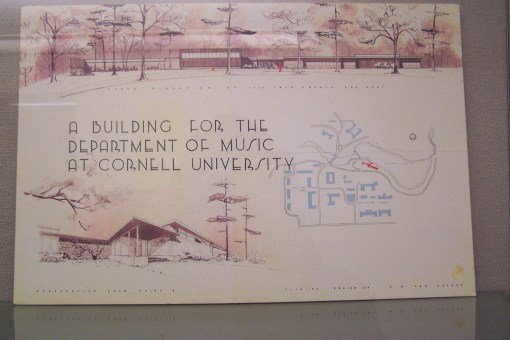
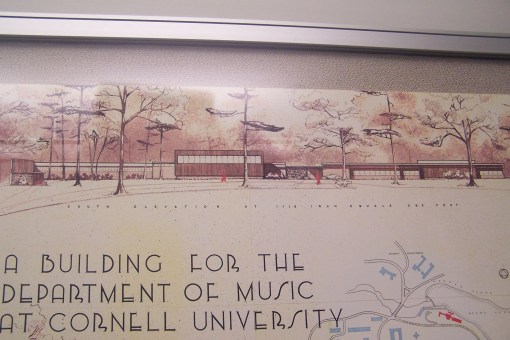
This modernist structure was proposed in 1950, and would’ve been built where Noyes Lodge stands today. Considering this school’s record of modern architecture, part of me is glad this never saw construction.


The Clark Hall Addition That Was Never Built

22 01 2009

So, I came across rather serendipitously while going through some archived photos. Luckily, since I carry my camera around with me everywhere, I was able to take a photo.

100_2770

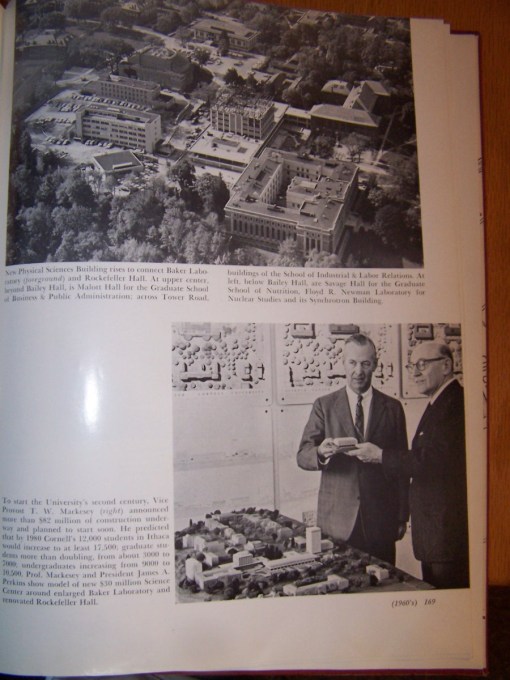
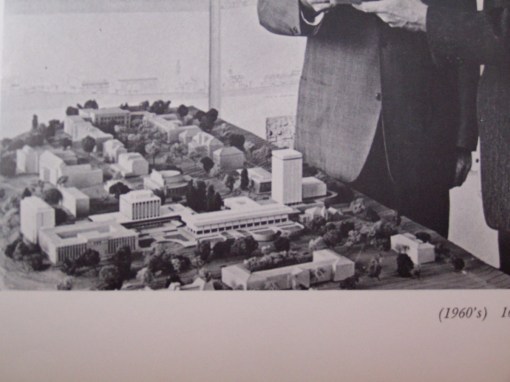
So, this comes from a revised edition of the 1954 Cornell Historical Photo book that I previously used in an entry, this being the 1965/66 update. This is clearly evident with the photo at the top, taken in approximately 1964 when Clark Hall was under construction.

Then we look at the bottom photo. And you notice there’s no Rockefeller. It’s replaced with some massive complex. My first thought was “what the f— is that! It’s f—–g massive!”.

100_2773

First, some chronological details. Since James Perkins is in the photo, and Clark Hall is completed, and this book was published in late 1965/early 1966, so we can assume this photo dates from about 1965. From the caption, we know this was a building proposal that would have been completed by 1980 (notably, the growth in numbers the caption cites stayed largely true to form- there were a little more than 17,000 students in 1980, but about 11,500-12,000 were undergraduate).

So, then we have the “renovated” Rockefeller—a massive low-rise building that by my guess was 180,000 or 200,000 square feet (for reference, Rockefeller is 125,000 gross sq ft [1]). There’s a large extrusion streetside, that I’m kinda imagining wasn’t too different from the west extrusion of Uris Libe that was built in the early 1980s. The low-rise largely conforms to Rockefeller’s footprint otherwise.

Then we have the massive tower right behind A.D. White’s house. We’ll call that “Rockefeller Annex”. This annex is massive- the model, when compared to surrounding buildings, suggests to me between 15-18 floors. The building has an odd rooftop with an indentation that was likely a balcony area. Design-wise, the building is strikingly similar to Lawrinson Hall, a highrise dorm that was built at nearby Syrcause University in 1965 [2].

Photo copyright of Syracuse University

However, the building at Cornell is a little different-facade wise, it seems to bear similarities to the model used for Olin Labs, which would be completed in 1967 and probably had only just finished with the final design. Think about it. An eighteen-story box with thin vertical windows like Olin Labs.Yes, that is a very horrific thought. It would be sacrilege to A.D.White’s house. Plus, the Big Red Barn would’ve been torn down to make way for the tower and its 3/4-story component to the southeast.By the way, behind Perkins and Provost Mackesey are some site plans. Which show three extensions from the renovated Rockefeller, but not much else for discussion.Conclusion: While we had some really bad architecture in the 60s and 70s, just be glad that not all of it was built. Be very glad.[1]http://www.fs.cornell.edu/fs/facinfo/fs_facilInfo.cfm?facil_cd=2014

[2]http://housingmealplans.syr.edu/facilityinformation.cfm?id=9


Cornell and Crime

30 12 2008

So, Cornell is an institution with a long and extensive history, and as with any institution of its size there’s been to be a few…unpleasant crimes associated with the school or its alumni. 

Oh, the prestigious alumni. For example, Michael Ross ’81. By any regard, Michael Ross was the typical Cornellian; actively involved on campus and reasonably intelligent. However, he also had an unpleasant side [1].

Michael Ross had serious mental issues. Rape fantasies. So intense that he started acting on them. His first rape and homicide (via strangulation) was that of a Cornell student, 25 year old Dzung Ngoc Tu, on May 12, 1981.  She was an agricultural economics (AEM) graduate student, who was apparently selected at random. It took a week to located her body at the bottom of Fall Creek Gorge, and while suicide was intially suspected, the Tompkins DA began to assert a case of foul play had occurred. However, there were no leads, and Ross did not admit to her slaying until he was arrested on seperate murder charges in 1984 (apparently he confessed during questioning by a police detective). According to news sources, Ross was never formally faced charges stemming from her death.

Michael Ross was responsible for the rape and murder of seven other young women in the 1980s.  He was executed in 2005, New England’s first execution in 45 years.

Going into another case, there’s the double murder of two Cornell freshmen back in December 1983 [3]. Okay, I’m a horrible person; I have told people this story just for the sake of scaring the crap out of the people who live in Lowrise 7, where it occurred.

What happened was that the crazy ex-boyfriend of one of the victims decided to come to Ithaca and “reason” with her. By that, I mean taking her, her roommate, and five others hostage. After a short time, the girl managed to convince her ex to let the others go, but he kept her and her roommate. He then shot them both and fled. The girl, Young H. Suh ’87, died immediately. Her roommate, Erin C. Nieswand ’87, died of her injuries shortly after bring airlifted to a hospital in Syracuse. As students notified police, the 26-year old killer attempted to flee the area, but was forced off the road at Rout 366, where he then shot himself in the head. He survived, and was sentenced to life in prison in October 1984 [4].

This last one for today goes off on a slightly different tangent. Some of you might be aware of the can of worms that was the CIA’s involvement with mind-altering drugs (like LSD) to see if they could be useful for government business. Well, that didn’t work too well, nor was it much appreciated when the American people found out from declassified documents in 1975 [6].

I order to set up funding for their projects, the CIA worked with various organizations to establish feeder programs that would make the research look legit. One of the primary distributors were two Cornell professors, Harold Wolff and Lawrence Hinkle. The initial programs set up for the CIA was in the 1950s and called “The Society for the Investigation of Human Ecology”. In 1961, it was reorganized as the “Human Ecology Fund” and operated primarily out of the Medical School. This ended by the late 1960s.

For the record, the Human Ecology school adapted the name “Human Ecology” in 1969 (during the time of the program’s operation, it was still the school of Home Economics, so there are no connections worth making between the two).

So we’ll wrap that up for today. For kicks, I’ll attach this lovely article attacking Cornell for its Qatari medical school (Qatar supports Hamas). It’s a little too-partisan for my tastes, but it just proves the point that not everyone from CU and not everything CU does is (or should be) considered “good”. 

http://www.renewamerica.us/columns/jweinstein/060421

Enjoy!

P.S. I suppose in keeping with the theme of this entry, I’ll update it to include the June 2009 murder of a Cornell researcher by her husband, a doctoral student in computer science [6]. It would appear he slit her throat and left her to die on a walking trail, and then set their apartment on fire, became involved in a high speed police chase and tried to slit his own throat to avoid arrest (which failed). Congrats to Blazej Kot, whose horrific homicidal tendencies  make him destined to join the rest of the historical skeletons in Cornell’s closet.


[1]http://crime.about.com/od/deathrow/p/michael_ross.htm

[2]http://cornellalumnimagazine.com/Archive/2005marapr/features/Feature2.html

[3]http://cornellsun.com/node/27009

[4]http://query.nytimes.com/gst/fullpage.html?res=9903E5D6123BF936A35753C1A962948260

[5]http://www.thejabberwock.org/wiki/index.php?title=MK-ULTRA_and_Academia_-_Part_3

[6]http://www.theithacajournal.com/article/20090608/NEWS/90608053/Homicide%2Bsuspect%2BKot%2Bout%2Bof%2Bhospital%2B%2Bheld%2Bin%2BPa.%2Bjail


A Little More Cornell History

10 11 2008

Photos obtained from the book “Cornell in Pictures: 1868-1954”, compiled by Charles V. P. Young 1899.

000_2313

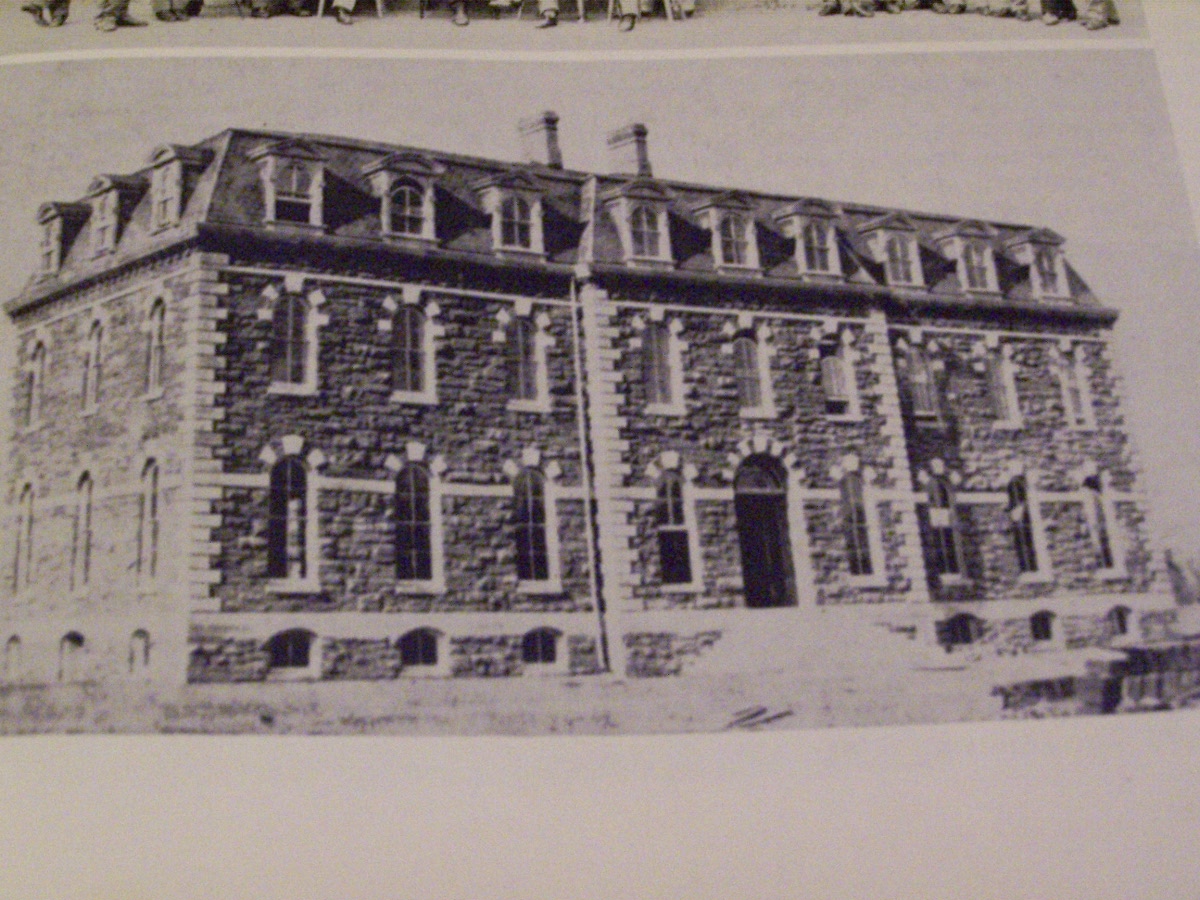
As mentioned previously, Sibley was constructed in three parts; the first, which is the West Wing of the current building, was built in 1870 and named for one of the original trustees of Cornell, Hiram Sibley. The East wind would be built in 1894,and the dome was constructed in 1902 [1]. Apart from stone Row, this was the first building that the University built that still stands today (the university did not build Cascadilla Hall).

000_2314

A map of campus, circa 1954. Some of the notable differences

I. Kappa Alpha Society’s house was where Snee Hall stands today. The house was torn down to facilitate construction of Hollister Hall in 1957-58, so KA moved to South Avenue. The Old Armory, built in 1892, was also torn down.

II. The road that was Central Avenue up until the 1990s cut between Franklin (Tjaden) and Sibley. Morse Hall would be torn down within a year of this map’s publication to make room for a parking lot, which would then be replaced by the Johnson Museum of Art that began nearly two decades later.

III. Boardman Hall is still there…in terms of aesthetics, I wish it was still there today too.

IV. ILR was located in temporary buildings (quonsets) on the Engineering Quad (which still had yet to fully develop). Law Hall, Moore Lab and the other smaller buildings where the ILR school stands today were the vet school buildings. Schurman Hall would come on line five years later, which facilitated the demolition of Law Hall in 1959, and for the construction of Ives Hall and Catherwood Library, which would be completed in 1962.

V. The Johnny Parson Club. More on that later.

VI. Alpha Xi Delta’s House is where the Prospects of Whitby co-op is located today. AXiD closed in 1964 and would be off campus for 40 years. Even the house they live in today is still own by Delta Phi Epsilon sorority (which closed the year before Alpha Xi Delta was brought back to campus). Chi Omega lived in the light purple house with the red tile roof on Wait Avenue, and would move to Phillips House (Sigma Alpha Mu’s current house) when that building was built on Sisson Place in 1956.

000_2315

A poor photo (my shaky hands, I regret) of the Statler Inn. Prior to the 150-room hotel built in 1986-87, the Statler Inn was the premier facility, with “modern classroom” and 36 rooms. Another hotel was located in the upper floors of Willard Straight Hall where the lofts are today, and those would play a prominent role in the takeover of Willard Straight in 1969.

000_2316

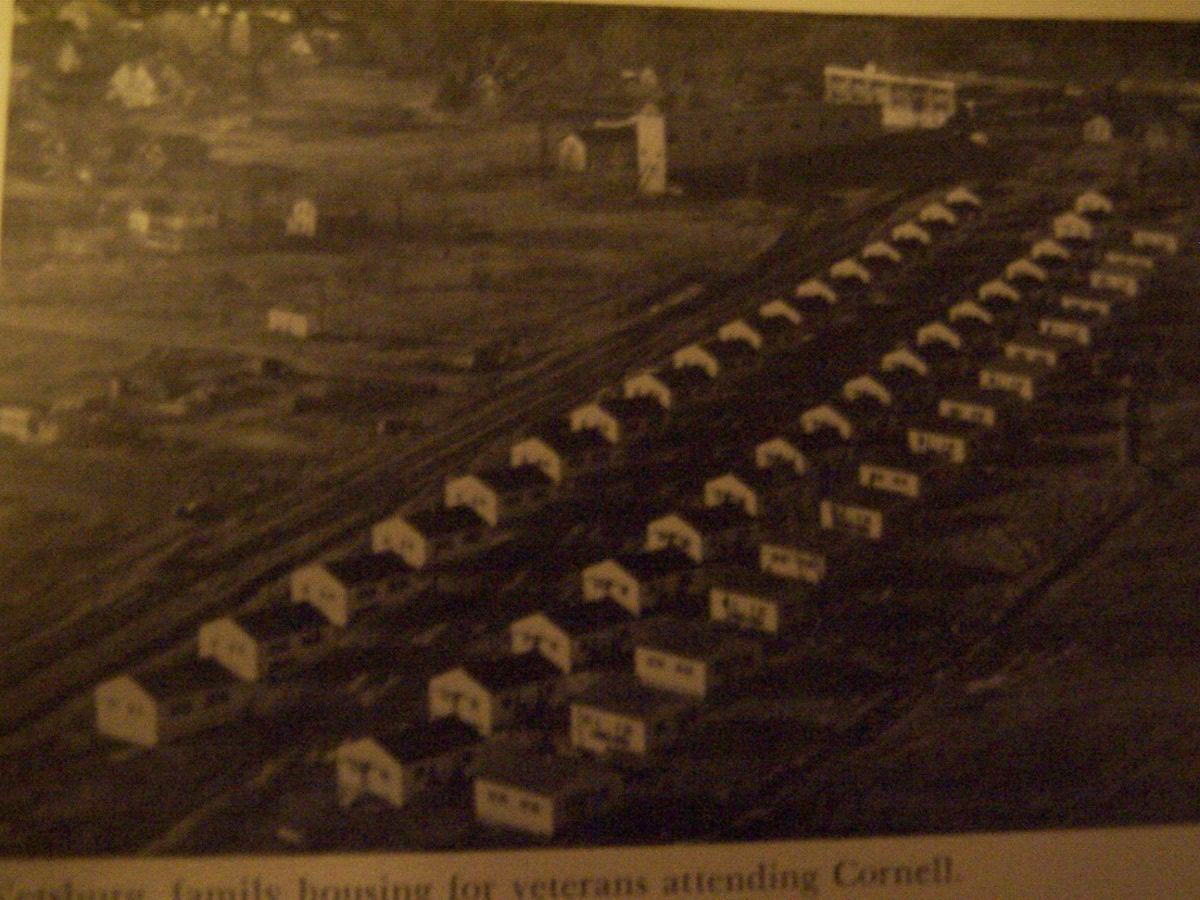
Prior to the Maplewood Apartments, veterans attending Cornell post-WWII had the option of living with their families in “Vetsburg”, on Maple Avenue.

000_2317

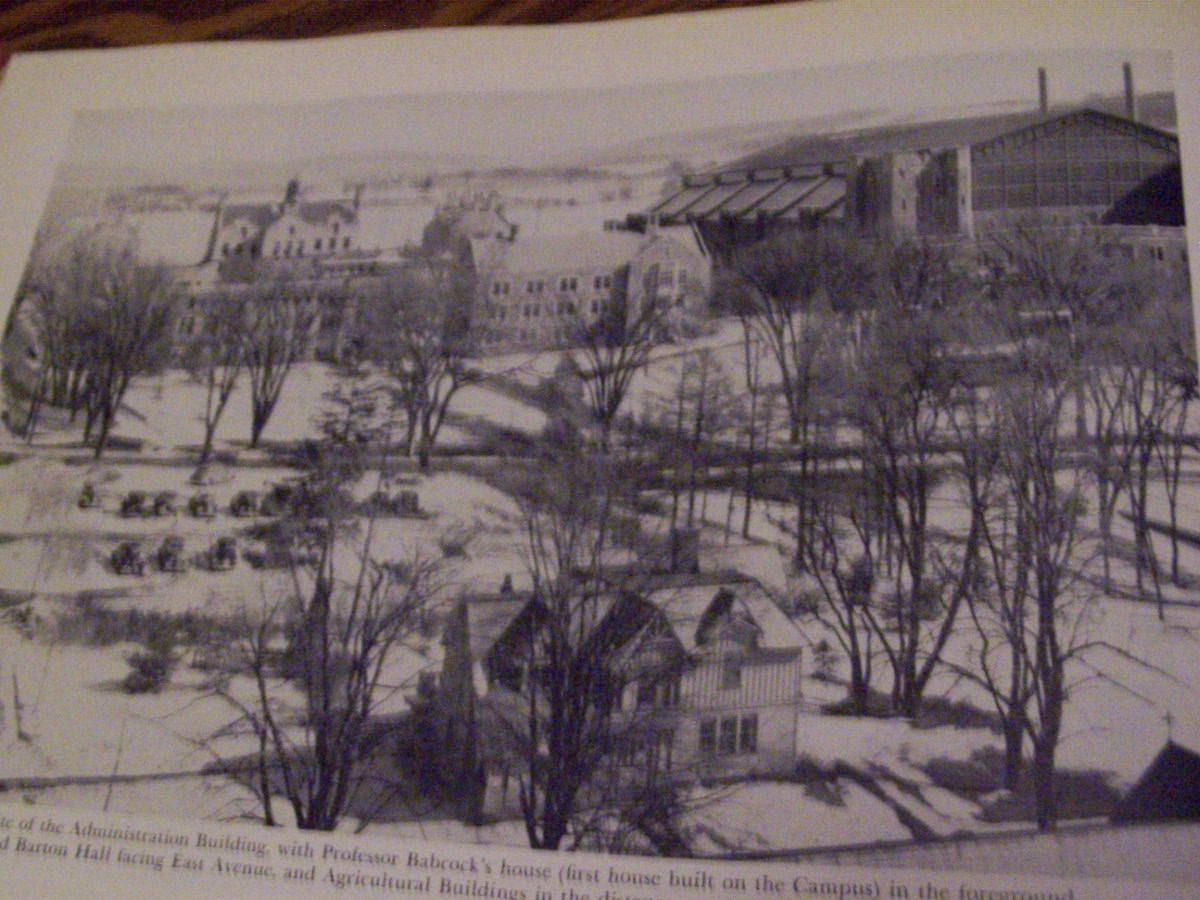
Back in the days before Day Hall, the lot was the site of a parking lot and the house of Professor Babcock, which was the first faculty house built on campus. Back in the day, it was common for houses to be on campus, where the Human Ecology school is today, where the Engineering Quad is today, and even on Central Campus. This was the last central campus house, and it was torn down to facilitate Day Hall’s construction (completed 1947) [2].

000_2318

To save my breath, I’m going to quote a DUE from August 23, 2007:

“The Johnny Parson Club was named after a mechanical drawing professor in the Engineering college from 1895 to 1938. It’s said that he was the one who established ice skating on Beebe Lake.  In addition, it was he who began the Cornell hockey tradition, by encouraging students to form a team.  In 1922, the University built a two-story facility where skaters could spend time, eat, drink, and warm up, naming it after Professor Parson.  However, in 1958, when skating events were moved to Lynah Rink, the University chose to take down the top two floors of the Club.  The remaining basement area was covered and is now used by Cornell Outdoor Education. [3]”

Rather nice place, from the looks of it. Tudoresque.

000_2319

Bacon Baseball Cage. The first Cornell mascot bear, Touchdown I, was housed here in 1915. [4] The building would be taken down for the addition of the press-box and more seats at Schoellkopf.

000_2320

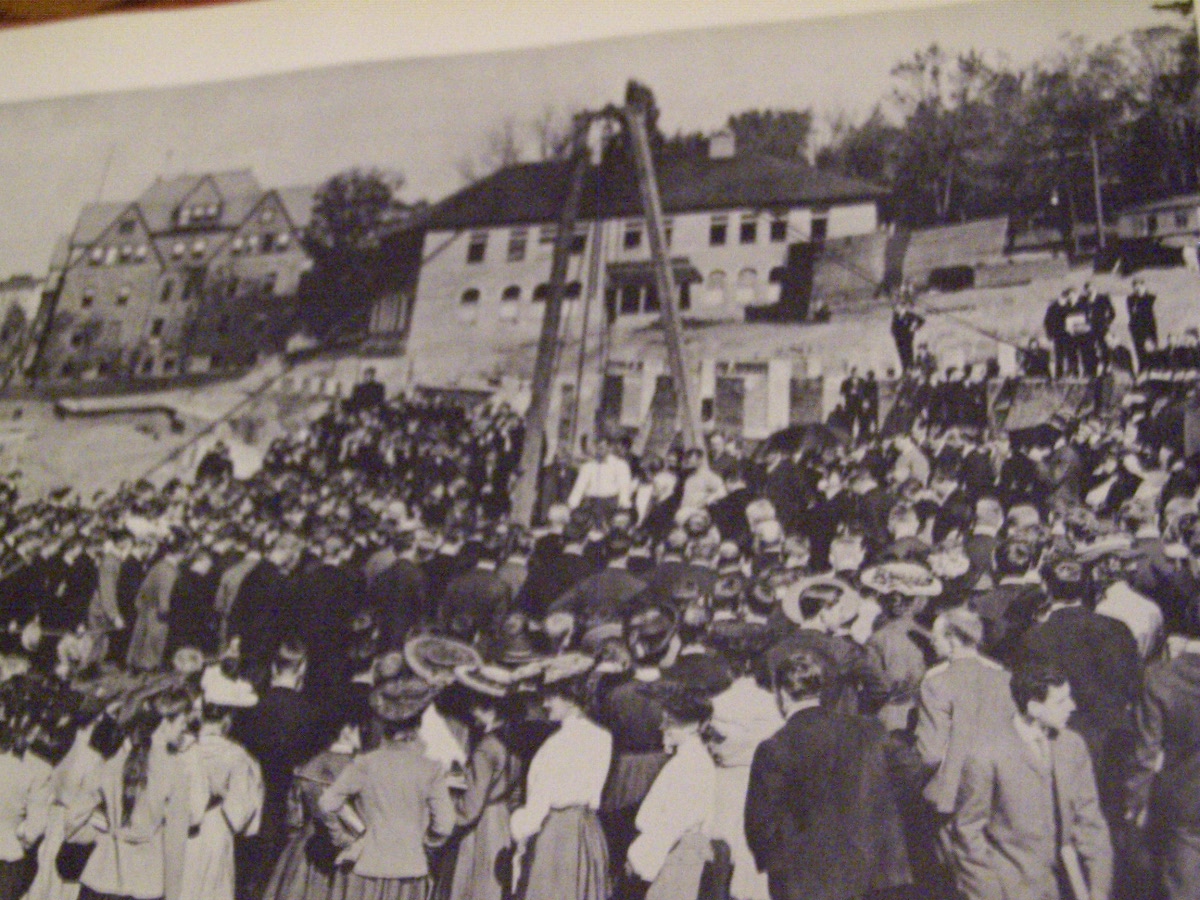
Laying the cornerstone for Goldwin Smith Hall in 1902. The building that is currently the north wing was constructed earlier on as the Dairy Science building.

000_2321

Law Hall, a couple small ag buildings, and the third observatory. It would be torn down for Barton Hall in 1915, and replaced with the observatory on north campus in 1924.

000_2322

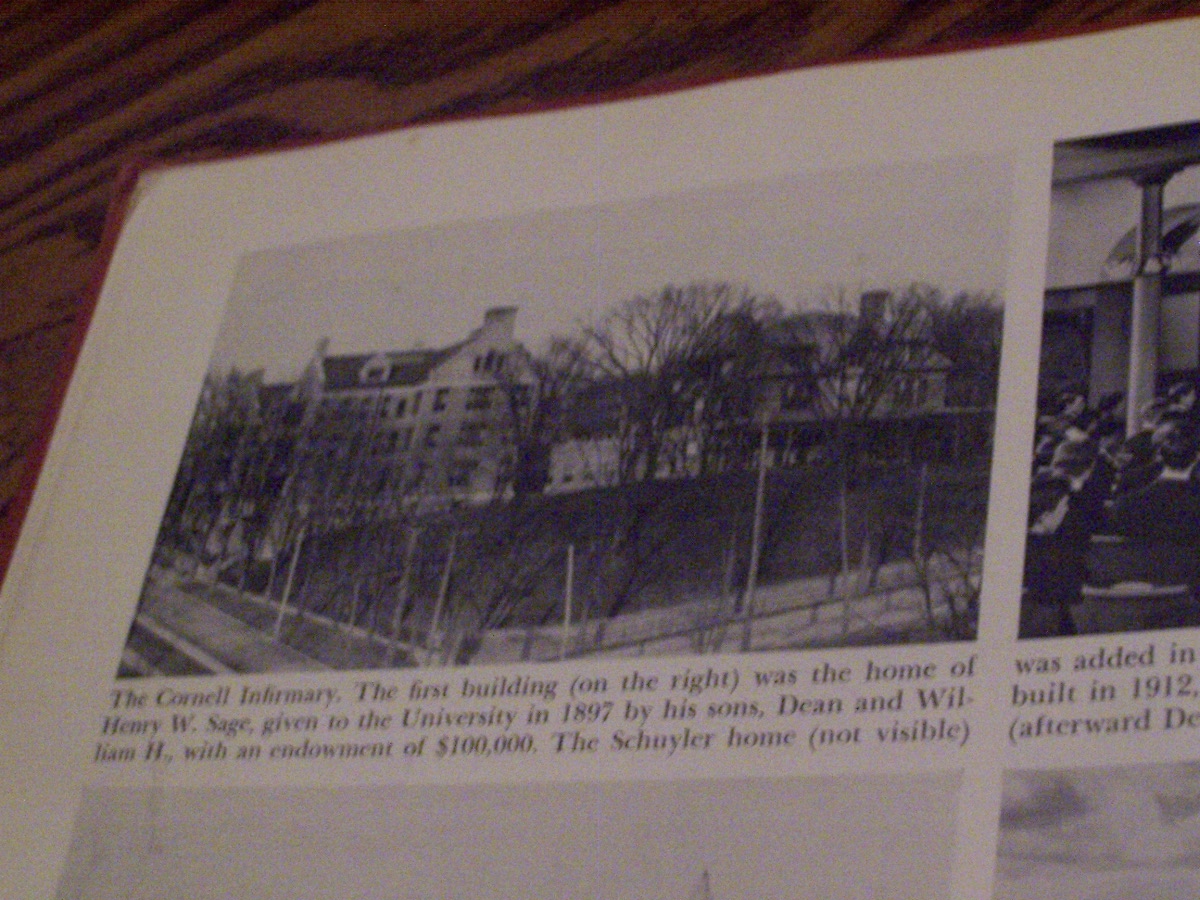
Schuyler House, the grad dormitory, used to be Cornell Infirmary. Next door is the Sage House. This was a time when students lived down the hill in fraternities or boarding houses, so it made sense to have the infirmary between the city and the college.

000_2327

Speaks for itself. Screw pumpkins on the clock tower, I’m going to go tear down the bridge into Collegetown.

000_2326

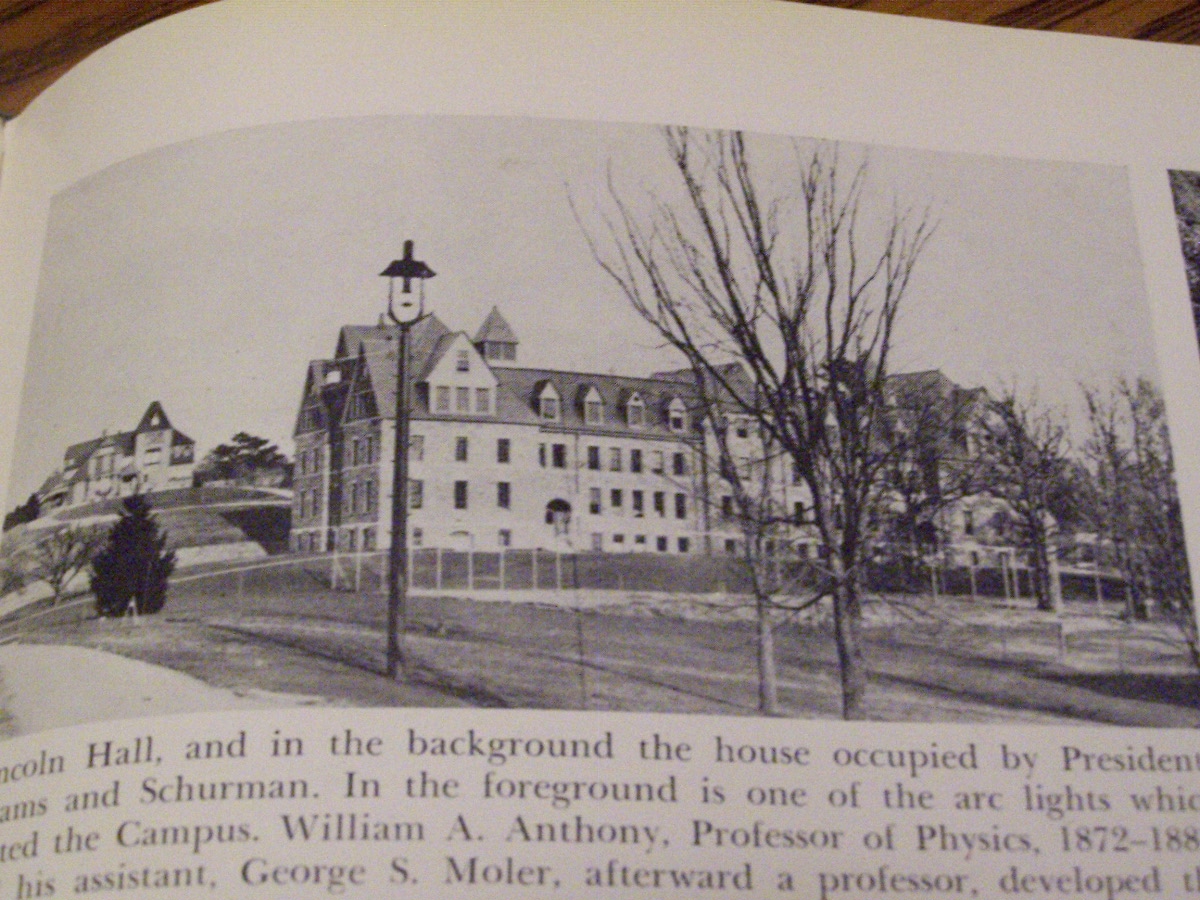
Fancy arc lighting. The house in the back was the stately home of Presidents Adams (1885-1892) and Schurman (1892-1920). It was torn down for Baker Lab shortly thereafter.

000_2325

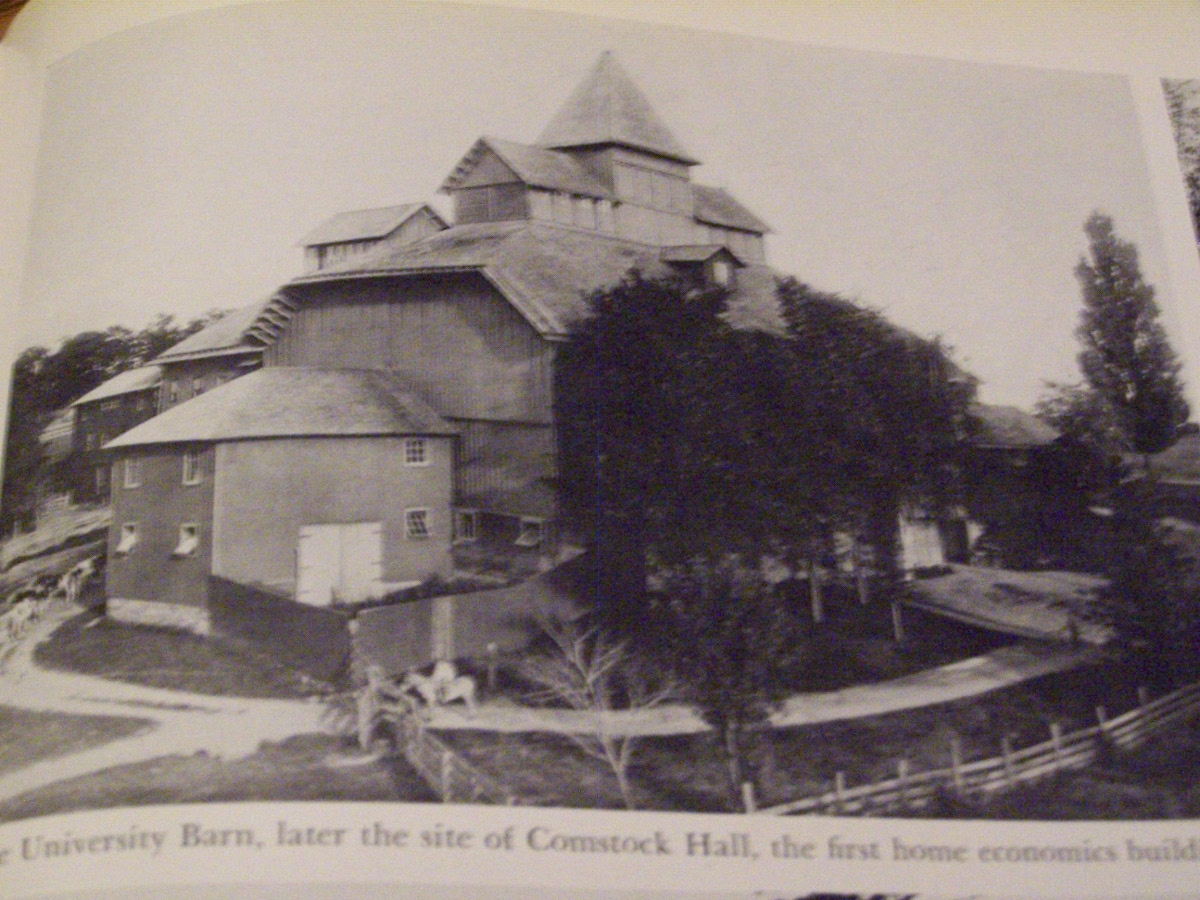
All the functions of a 1900s barn (where the CCC is today), all the appearance of a redneck’s idea of Count Dracula’s castle.

000_2323

Can we reconstruct this building as a dorm? Please? Hey, I know Morse Hall was burnt down by a fire and all in February 1916, but the design can be retrofitted with today’s safety standards. Really.

[1]http://www.cornell.edu/search/index.cfm?tab=facts&q=&id=651

[2]http://www.cornell.edu/search/index.cfm?tab=facts&q=day%20hall&id=239

[3]http://ezra.cornell.edu/posting.php?timestamp=1187848800

[4]http://cornellsun.com/node/17613


More Random Cornelliana

13 10 2008

Because you’ve probably never been in most of these buildings anyway.

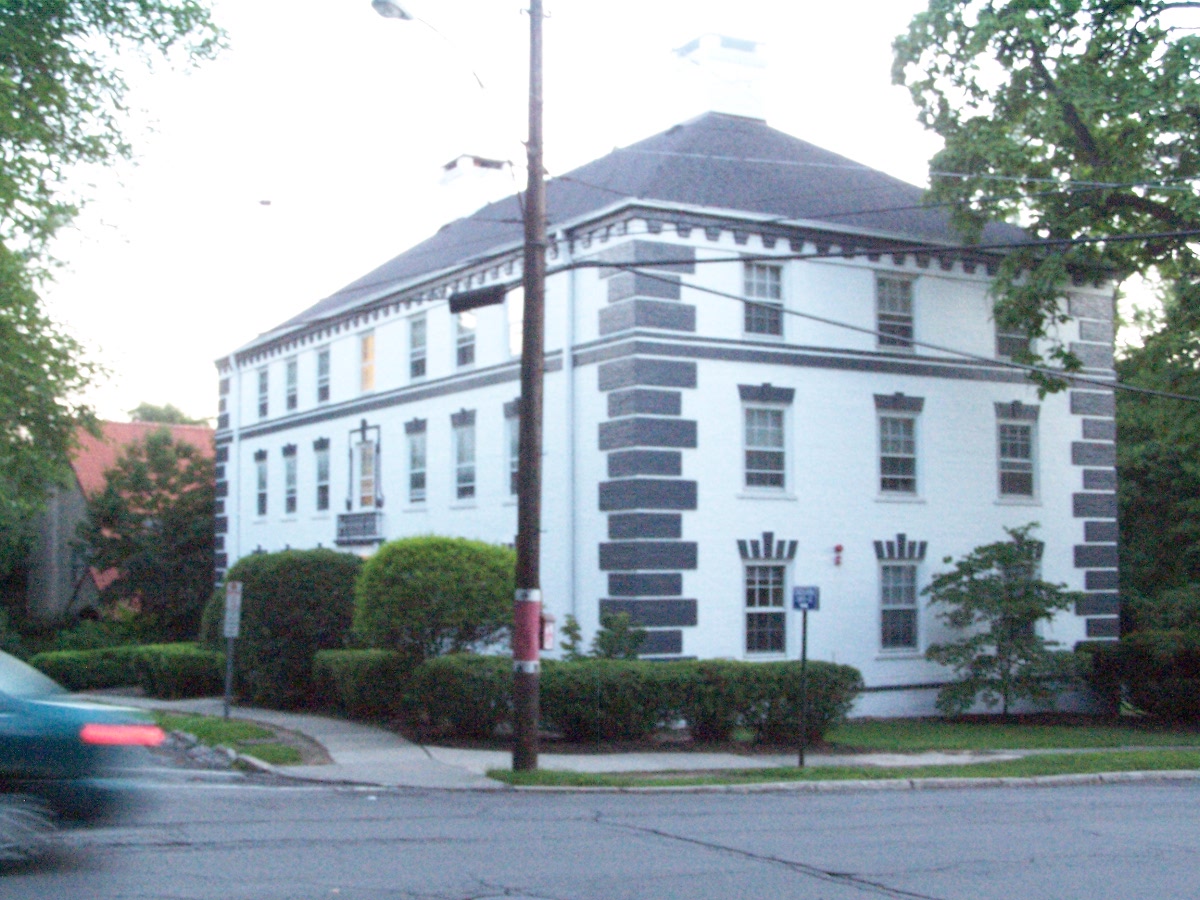
Rice Hall. The building on the left, obscured by the trees, is colloquially known as “Little Rice Hall”. Located on the National Register of Historic Places [1], Rice Hall was built in 1912 and designed by the architectural firm Green and Wicks [2]. Rice Hall was intended as a peripheral building to Stone, Roberts, East Roberts, Caldwell and Comstock Halls. The building is home to Cornell’s “Center for the Environment” (yet another academic think tank) and is a hodgepodge of SNES and Crop and Soil Sciences. The building is named for James E. Rice 1890 [5], who taught the first course in the country on Poultry Husbandry (the building was originally for poultry husbandry, which is likely why it’s such a clusterf*ck now).

Fernow Hall is another of Green and Wicks’ works, being constructed three years later in 1915 [3], and also sits on the National Register of Historic Places. For the record, all that means that it’s old and likable. It must not mean much for architectural merit, otherwise we’d still have Roberts, Stone and East Roberts. The building is primarily used by the Dept. of Natural Resources. The building was known as the Forestry Building from 1915 to 1922 [4], and was dedicated to Bernhard Fernow, Dean of the College of Forestry (a sort of predecessor to the natty rys dept., which failed only five years after its inception in 1898, because the state received threats that if Cornell would be spoiling summer cottage retreats in the ‘Dacks for commercial purposes, wealthy state residents would reside elsewhere).

The original Comstock Hall, now the Computing and Communications Center. The hall was built in 1912 and named for renowned entomologist John Henry Comstock 1874 [6], and originally housed entomology. In some twisted sense, the same firm that designed this building would design the later Comstock in 1985. After Cornell granted moving the name to the new building, the old Comstock was renovated into (C3), CIT’s Operations Unit, in the late 1980s. Prior to that, CIT was out in Langmuir Labs in the Office Park in Lansing, and before it left for Lansing in 1967, CIT’s main computer lab jumped between Rand and Phillips Halls [7].

A lot can change in 70 years. The original Comstock (formerly Academic II) was a corroboration between Green & Wicks, and the firm Hoffman, O’Brian, Levatich & Taub. The new Comstock was by the shorter “Levatich and Hoffman”. I think our tastes have gone downhill, ladies and gentlemen. Anyways, the new Comstock houses entomology and the little-used Entomology library (I just want to say that, as a CALS student, I’ve only ever met two entomology majors in my time at Cornell).

Corson-Mudd Hall (Corson is the east wing). Named for former university president Dale R. Corson and philanthropist Seeley G. Mudd (who has a crapload of buildings named for him on college campuses across the country [9], the building was completed in 1981 [8].

Technically, it’s possibly to get to nine seperate buildings through the tunnels and walkways of the AG Quad. Bradfield is connected to Emerson Hall (the lowrise portion), which is connected to Fernow Hall at one corner and to Plant Sciences from the second floor hallway. Through Plant Sciences, there are two ways to get into Mann Libe (ground, which involves being outside for ten seconds in the tunnel towards Manndible Cafe, and a less-used second-floor stairway). Mann is connected to Warren Hall. Plant Sci also has a connection to Weill Hall through its basement, and the tunnel runs underneath the street to the basement of Weill. The public use of this tunnel is not clearly stated, so try it at your own risk. Weill also connects to Corson-Mudd and Biotech through tunnels.

So, I’ve already told the story of the Roberts-Kennedy complex once before, but I’ll do a partial rehash. The building is named for Issac Roberts, an early professor, and 1970s CALS dean W. Keith Kennedy. Originally, Stone, Roberts and East Roberts stood on the site.

Roberts, Stone, East Roberts

L to R: Roberts, Stone, East Roberts

The three were built around 1906. While they were national registered historic buildings, Cornell rather covertly had the designation removed, in a move that angered many traditionalists. The buildings were imploded in 1988-89. The original proposal for Roberts-Kennedy Hall was a 10-story building where Kennedy stands. Well, that didn’t go over too well, so they essentially pushed it onto the side and made a “breezeway”. The two were completed in 1990. Trillium is technically a part of Kennedy Hall.


[1] http://en.wikipedia.org/wiki/Rice_Hall

[2]http://www.fs.cornell.edu/fs/facinfo/fs_facilInfo.cfm?facil_cd=1040

[3]http://www.fs.cornell.edu/fs/facinfo/fs_facilInfo.cfm?facil_cd=1029

[4]http://www.dnr.cornell.edu/mission/history/
[5]http://books.google.com/books?id=jUu9pDRhWjkC&pg=PA295&lpg=PA295&dq=%22rice+hall%22+cornell&source=web&ots=Mp_YbfQomX&sig=dQmUQ68KhXUqtys6MW5lwXXPF_s&hl=en&sa=X&oi=book_result&resnum=10&ct=result#PPA401,M1

[6http://www.agriculture.purdue.edu/agcomm/newscolumns/archives/OSL/2005/October/051027OSL.htm

[7]http://www.cit.cornell.edu/computer/history/timelines_locations.html

[8]http://www.fs.cornell.edu/fs/facinfo/fs_facilInfo.cfm?facil_cd=1019E

[9]http://en.wikipedia.org/wiki/Seeley_G._Mudd


The Story of the Vet School Incinerator

18 09 2008

So, I enjoy telling a good story as much as the next guy, and this one was actually the subject presented by my professor in an air pollution course I’m enrolled in. I might have been the only one taking notes on this, because it was meant to merely illustrate an argument, it’s historical, and an interesting piece of history worth sharing.

So, in the early 1990s, The Vet School over on the East Campus had a problem. A large number of carcasses were being generated daily. Dissections, disease studies, putting some of the farm animals to sleep, etc. So on any given day, thousands of pounds of carcasses were being produced, and they had to be disposed of.

Well, Cornell, for all the things it does have, does not have an incinerator for cremation on any of its properties. So they would have to ship the carcasses out in container trucks with hazard labels and send them to an incinerator elsewhere in the county, where they could be properly disposed. As you might imagine, this built up quite a hefty amount of fees over time. So Cornell began to explore their options to alleviate the problem.

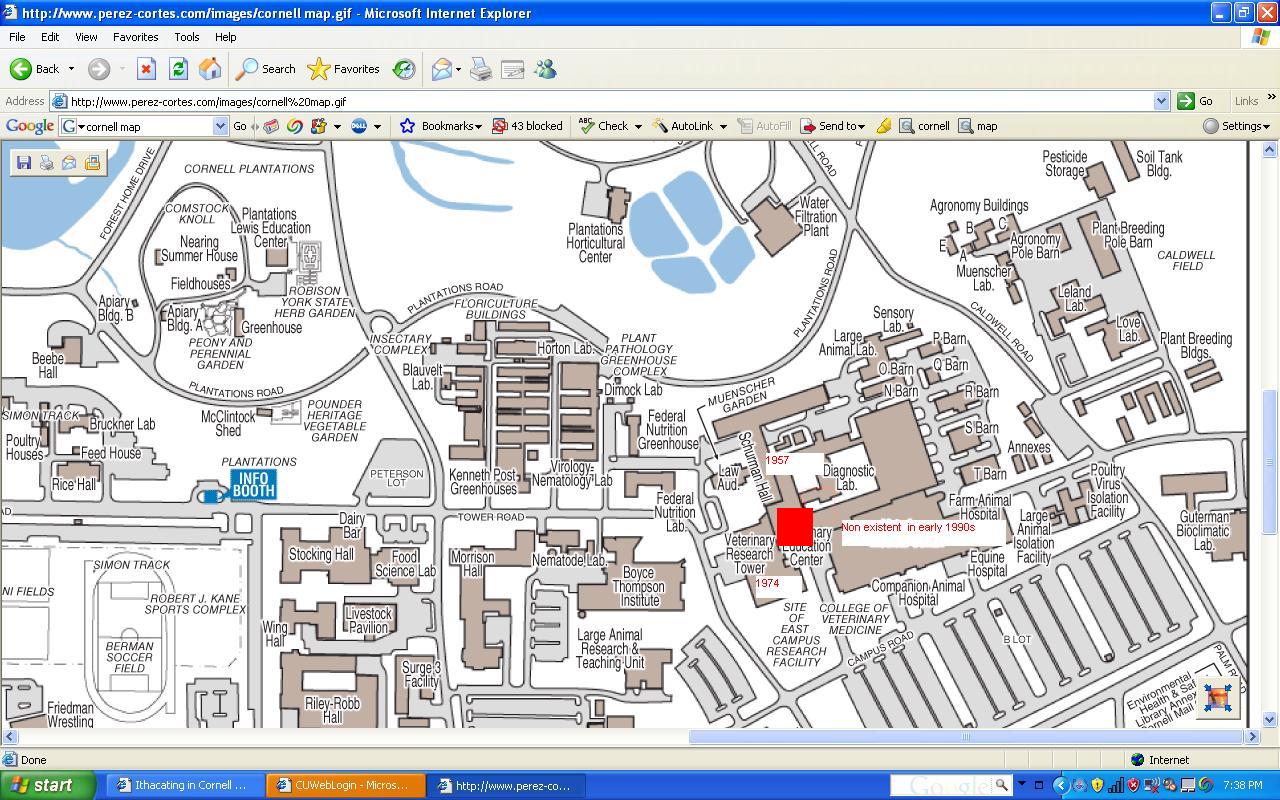
Well, the proposal that seems to work best was to build a waste disposal facility for the animal carcasses directly on the property. The site that was determined to be the best fit was just to the east of the Vet Research Tower. At this time, the Vet Hospital’s main building and the East Addition didn’t exist, so the complex was mostly barns, the tower, Schurman Hall and the scattered add-ons that comprised the property. The red square below was the approximate location for the project.

 The Vet Tower is a fairly large building, as it stands about 140 feet tall. So, in order to build the smokestack, the design had the smokestack stand about 180 feet tall, more than enough to clear the building.

Well, it went ahead in front of the town of Ithaca, and the residents of the neighboring hamlet of Forest Home had a fit. They’d be damned if they had to look at a giant smokestack from Cornell. So Cornell paid an engineering firm to survey the land from notable viewing radii to see if the structure would impose on the residents of Forest Home. Sure enough, if did, but only just barely. It was determined that if the design was shorter, it’d be okay.

So, Cornell proposed changing it to 160 feet. But, there was another issue with that. Bradfield Hall, just up the road, stands 167 feet tall. And the top floor has windows (ironically enough, the atmospheric science department is housed at the top).  So, that wasn’t going to fly unless Cornell did an air pollution study to prove it wouldn’t affect the occupants of Bradfield.

Well, here’s where we get into an issue. The company they hired, a New York-based engineering firm, decided that the air circulation patterns in Ithaca were the same as Syracuse. Syracuse built a power plant only a couple years earlier, so they decided to reuse the same data and apply it Ithaca. Essentially, they tried to swindle Cornell by selling them false data from another location.

Winds generally blow out of the west in Ithaca. However, in the situation where they would blow out of the east, as during some stormy days caused by east-coast lows, the pollution cloud was going to push over to Bradfield Hall and towards central campus. This pollution would have particulate matter that would drift down onto Tower Road and the Ag Quad. Well, no ones wants to be snowed on by cremated animal ash. Even worse, if it blew out of the northwest at a particularly strong clip, it was going to drift right over Forest Home. The increased height would have allowed it to carry farther away, but the new shorter height would cause particulates to fall a shorter diestance away, and they would be more concentrated, to unhealthy levels.

Well, the university didn’t know that at the time, so they bought the data. And it wasn’t until the final stages of the project that the mistake was realized (through an interdepartmental study independent of the project). The Town of Ithaca wouldn’t give final approval in light of the news. Well, Cornell was just a little upset, so they decided to bring a lawsuit onto the company for their actions, and Cornell had to scrap the 160-foot plan.

Well, due to the air ciruclation patterns and sight lines, a large smockstack just wouldn’t be suitable for their desired location. And Cornell was already set for a major expansion of the Vet School, so they scrapped the plan entirely. The Vet Education building, built in 1993, was the final incarnation of the incinerator project, in which there was no incinerator at all. And the large Vet Hospital would be built four years later, dooming any future proposal nearby.

So, some of you might be wondering about the heating plant, which is to the south. The smokestacks there are outfitted heavily with scrubbers, so the vast majority of the smoke is water vapor, and not nearly as toxic as the smoke from the vet school smokestack would have been.

~~~~

And in other news, House 5 has been deemed “Flora Rose House”, after a professor who was among the first to staff the school of Home Economics (Human Ecology).


Off-Topic: Q & A

23 08 2008

I’m taking it easy with this post, since I was directing cars on the Balch Lawn for a large portion of the day (welcome freshmen, to what could be the best four years of your life!). Occasionally in the search bar, someone types in a question. Let’s take a look at what people want to know.

1. “llenroc kicked off campus”

Ans: To my knowledge, this has not happened in recent history.

2. “dke secrets fraternity initiation 60’s”

Ans: If they were secrets, chances are that information isn’t going to be readily accessible, so how it would even be on the internet or in libe documents is beyond me. Many fraternities operate with some clandestine functions, but in my experience, it’s less in terms of cloak-and-dagger and more because it makes pledging and private functions all the more interesting. Case in point, the fraternity of Phi Kappa Psi advertises secrets concerning spatial geometry on its website [1].

3. “new restaurants ithaca”

Ans: Well, Bistro Fry in Collegetwon has been replaced with Jack’s Collegetown Grill. And a couple buildings down from the State Street Diner is a new restaurant called “Fine Line Bistro”. TBP opens up a new location on the Commons next month, and a second restaurant will be moving into what used to be the used bookstore on the Commons. Olivia’s has also permanently closed. Fair enough?

4. “sigma nu kicked off campus cornell”

Also, not in any recent history. What is up with people thinking so many fraternities have been kicked off campus?

5. “why people love cornell university”

Yes, this was an actual question. However, I don’t feel I can provide an adequate answer. This isn’t because I haven’t enjoyed my time here; I’ve found Cornell to be a rewarding and stimulating experience, if a little academically frustrating at times. But everyone has their own reasons for loving Cornell. And unless I could somehow compile all the answer together in one long list, than I really can’t provide a full answer to that question. We all have our own reasons for loving the institution that is Cornell.

6. ” cornell fraternity fall rush 2008″

Haven’t heard anything about it. Registration is linked from the OFSA (Office of Fraternity and Sorority Affairs) website. Traditionally, fewer fraternities participate in the fall rush, which is primarily transfer students along with a few curious upperclassmen. However, the fall rush has been decsribed as more intimate by some of its proponents, in the sense that you get to know rushees better. I’m sure if you send an e-mail to the OFSA or IFC folks, they’ll be able to fill you in on which houses are doing rush and any other details you should know. Oh, and there might be a promotional pamphlet going out for fall rush at some time soon.

7.””anna comstock hall” latino”

Well, yes, yes it is. Originally built in 1924 as a combination of faculty and graduate housing, Anna Comstock Hall was programmed as the Latino Living Center in the fall of 1994. This was after a peaceful occupation of Day Hall from November 19-22, 1993, where several events that strongly concerned members of the school’s Hispanic population caused them to stage a demonstration and a sit-in on the building to voice their concerns [2]. Day Hall is a frequent target for occupation anyway (do a google search on Redbud Woods for another example).

8. “ithaca college cornell tension”

Really? There must not be a whole lot of it. If anything, it’s because Cornell’s larger and in the Ivy League, so they tend to steal attention away from IC. But as for tension, there’s not much from what I’ve heard. But we also don’t mingle too often, with the exception for some muscial and theater groups, and Cornell staffers with ICTV.

9. “cascadilla dorm + asylum”

For the last time, NO. Casca was built for the original purpose of a water sanitarium, but never even functioned as such. Old Ezra was a major investor who took the building for his own uses when it appeared the sanitarium project would never get off the ground. That was back in 1866.

10.  “cornell living above ctb”

Dunno what that must be like. A little loud at times, I would guess. Anyone care to give a more accurate description from their own experience?

[1]http://www.phikappapsi-cornell.org/141-tour-mystery.asp

[2]http://cornellsun.com/node/26269


North by Northwest of Campus

12 08 2008

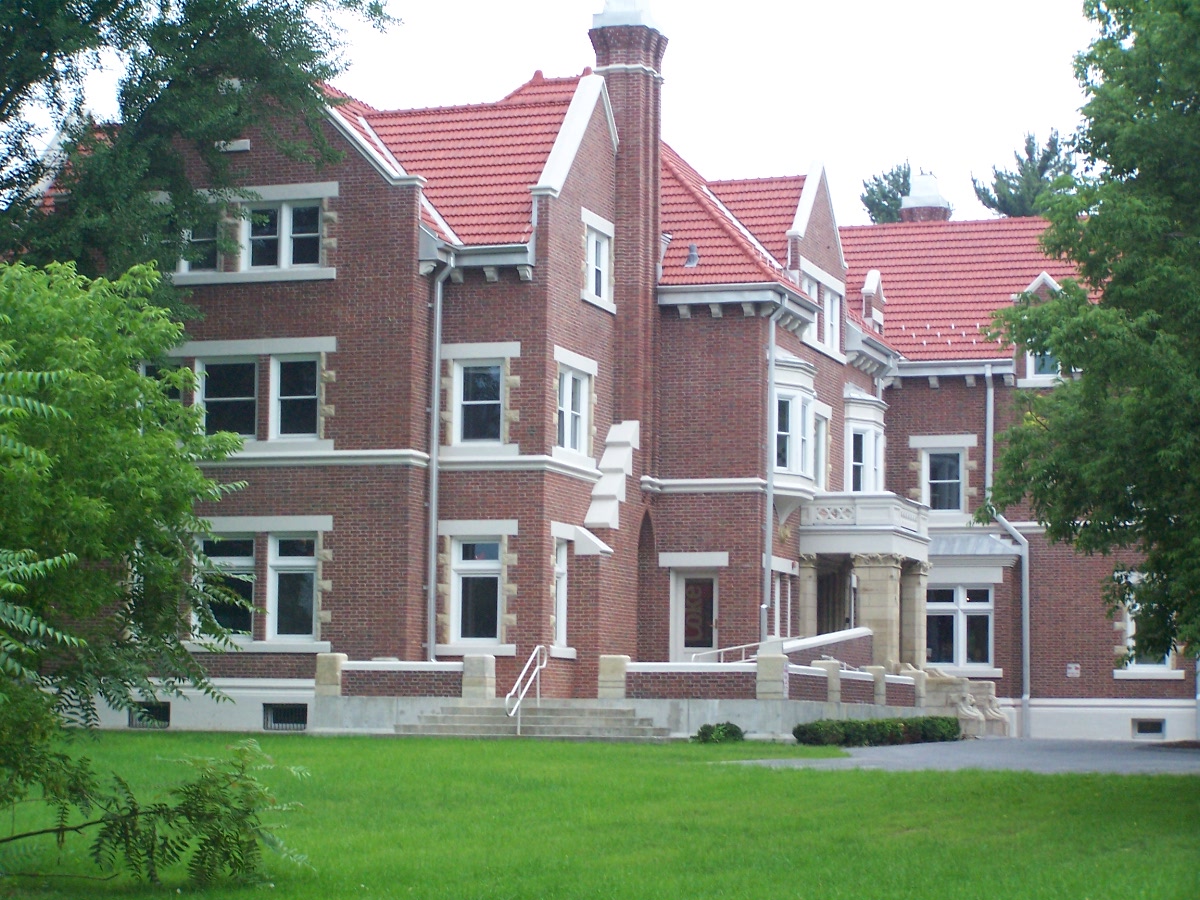
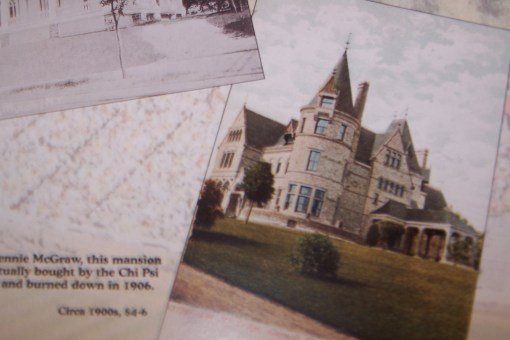
The house of the Chi Psi fraternity of Cornell University. Chi Psi has had a colorful if traumatic history in its century-plus long history here at Cornell. The Chapter at Cornell was founded in 1869. While they lived elsewhere, Jennie McGraw, the daughter of John McGraw, who was a wealthy lumber merchant and one of the first trustees of Cornell (for whom McGraw Hall is named) [1], fell in love with the first university librarian, Daniel Willard Fiske. She was old for loving at the time, pushing forty. She was also suffering from terminal tuberculosis. Regardless, she and Willard eloped and engaged in a whirlwind tour of Europe, while an opulent mansion was built on the edge of the gorge. She lived just long enough to see it with her own eyes, passing as they arrived home in 1881 [2]. Willard moved in, but his behavior was considered a little too exuberant for someone whose wife just died. Plus, due to some legal issues with Jennie’s will (which might make for a good entry another day), he and Cornell ended up on really bad terms, and he spent most of the rest of his life in Italy (on the bright side, he somewhat reconciled with Cornell in later years and donated his library upon his death in 1904 [3]).

That story is tangent to Chi Psi. Willard sold the opulent McGraw-Fiske mansion to the fraternity around 1881[4]. It was during the cold night of December 6th 1906 that the second deadliest campus tragedy in Cornell’s history occurred.

Sources tend to indicate it was caused by flammable polish being used on the floors. Others have gone as far to suggest that the house was cursed due to Jenny and Willard’s indiscretions. Regardless, the house caught fire. And in the days before real fire engines, any water to be used on the house (that wasn’t frozen) was a mere trickle. Of the twenty-six fraternity brothers living in the house, four died. When one of the exterior stone walls collapsed, it landed on volunteer firemen from the city of Ithaca, killing three of them. By the end of the night, the house was destroyed, and seven people were dead [5].

Photo Courtesy of "Greetings from Ithaca"

Photo Courtesy of “Greetings from Ithaca”

Through the tragedy, the fraternity persevered. They built the current house the following year (known as “The Lodge”), and have lived there since.

So, I took two photos partially to get a good idea of the shape and ornamentation of the house, but more because a woman in a towel came up from the gorge as I was taking photos…and I didn’t want to give the wrong idea. I ran south after a large guy appeared by her side, and she probably thinks I’m a creeper and pervert. I prefer photos of ornamental busts to women’s busts.

***

The Thurston Court Apartments is a 22-person university-owned apartment building with one and two-bedroom student apartments [6]. Primarily used for grad housing, in recent years the building has been opened up to undergrads as well. The building was built in 1932 (fun fact: the entire building was once painted white, including the ornamentation).

The house of Seal and Serpent fraternity, Cornell’s independent fraternity. The fraternity was founded in 1905, and the current house was built in 1929 in the Tudor Style [7]. In the past several years, the fraternity has suffered from a chronic shortage of interest; rumor mill says they only had three pledges last spring.

Maybe this has something to do with it:

“…Fraternities have a reason to fear such stereotyping. The Seal and Serpent society, a house which was primarily gay in the 1980s but now has just two gay brothers out of 16, has had some difficulty overcoming “the gay” label during rush…”

I s’pose this doesn’t help – I still hear this from a lot of people both in and out of the Greek community  (the quote is from a Nov. 2000 Sun article).  Going through this blog’s search bar history, there are over 200 hits for “gay fraternity”.  I’m willing to bet it’s not with good intention.


The house of Alpha Phi sorority. Alpha Phi Cornell was founded in 1889 with assistance from the Alpha Chapter at Syracuse University [8]. Originally based out of Sage College, they lived with Alpha Zeta for a year  and on their own in a couple different houses until they bought their current house from an Alpha Phi alum in 1921. The side wings were added in 1937, and a back wing (not pictured) was added in 1961. The chapter went under a reorganization sometime in the early 1990s due to low membership intake, but I’ve found nothing that indicates it ever closed. Currently, Alpha Phi has one of the highest sorority membership numbers at Cornell.

Hardly 500 feet away is the house of Kappa Kappa Gamma sorority. I know Kappa has been in the news lately; and it really sucks to be them right now (unless you like embarrassment over attention). The sorority’s Cornell (Psi) chapter was founded in 1883, and moved into the current house in 1921 [9]. The chapter was inactive from 1969 to 1977, a time period well-known for its anti-Greek sentiment.

Louie’s Lunch was founded in around 1918 by Louie Zounakos, who emigrated to NYC from Greece, and later moved up to Ithaca. The original Louie operated the truck up until 1955 [10]. The original truck was replaced in the late 1940s. The truck was then owned by the Machen family until 1997, and is now currently operated by Ron Beck. I do have a preference to one truck over the other, but I won’t say which.

100_3462

Photo courtesy of “Greetings from Ithaca”

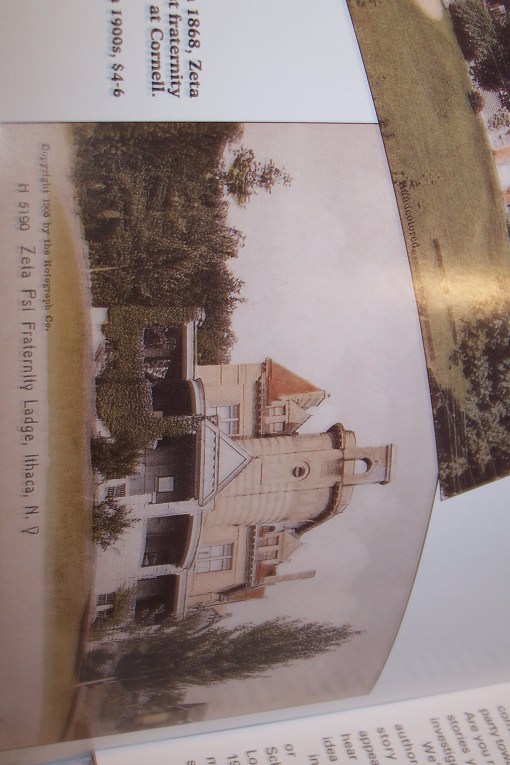
The house of Zeta Psi fraternity. The house, built in 1930, was originally that of Theta Xi. Zeta Psi, meanwhile, has the distinction of being the first fraternity founded by Cornell, even if it was decided by a coin flip (see the entry for Chi Phi). The chapter built a luxurious house in 1891 on the corner of Williams Street and Stewart Avenue, but moved out in the 1940s due to low numbers as brothers left to go fight in WWII. The original house burnt down in the late 1940s, and was replaced by a parking lot. In the meanwhile, Zeta Psi lived with Young Israel for a short while before moving into 660 Stewart Avenue in the late 1950s. A donation from a wealthy alumnus allowed them to buy the current house in 1972 [11].


[1]http://www.cornell.edu/search/index.cfm?tab=facts&q=&id=497

[2]http://en.wikipedia.org/wiki/Jennie_McGraw

[3]http://en.wikipedia.org/wiki/Daniel_Willard_Fiske

[4]http://www.adphicornell.org/adphicor/files/FraternityRow.pdf ***

***Page 10 has a picture of the McGraw estate in its heyday

[5]http://www.chipsi.org/news/6143/Cornell-Fire-Centenary.htm

[6]http://www.campuslife.cornell.edu/campuslife/housing/graduate/thurston-court-apartments.cfm

[7]http://www.sealandserpent.org/house.html#

[8]http://www.dos.cornell.edu/dos/greek/chapter_details.cfm?id=4679

[9]http://www.dos.cornell.edu/dos/greek/chapter_details.cfm?id=3280

[10]http://www.louieslunch.com/history.htm

[11]http://www.psiofzetapsi.org/History.html

[12]https://cornellsun.com/node/1720


News Tidbits- The Disappearing Suspension Bridge, and its Conflicting History

30 07 2008
It was during a snowstorm...in MARCH...

It was taken during a snowstorm...in MARCH...

Glancing at the Sun today, I was pleasantly surprised to see an article about the master plan written by columnist Munier Salem. The article diescusses a discrepency in the presence of the suspension bridge north of the Johnson Museum, that spans the Fall Creek Gorge from the base of the wooden staircase off University Avenue to Fall Creek Drive. In some massing renderings, the bridge doesn’t exist [1]. One of the focuses of Salem’s article was whether or not this was intentional.

My personal thought is that it was not intentional. A rough guess of foot traffic during the academic year is probably among a few thousand unique trips across the span per day, plus there’s a strong sense of establishment associated with that bridge- although the current one was built in 1960, there has been a bridge at the present site since 1913 [2].

The bridge is marked with its share of legends and lore. Most have heard the one where if someone refusing a kiss while crossing the bridge at midnight, that it will collapse into the gorge. Another, somewhat less popular legend, is that the 1913 bridge was designed by an engineering student as part of a final project in his senior year. However, when he turned it in and the professor reviewed it, the professor said that the design wasn’t structurally feasible, and failed the student. Dejected, the student jumped into the gorge for where the south end of the bridge connects to campus. His grieving family, being of considerable wealth, decided to take his design and make it a reality. Thus it was built to the young man’s decision, and it was stable. Thus, the student was vindicated.

However, these are only just legends; the original 1913 suspension bridge is mostly an embellishment of the real story (there was a low-slung one in the 1880s behind Risley, so take the concept of “original bridge” with a grain of salt). Edward Wyckoff 1889, a student at Cornell, is said to have designed the bridge as part of a project, but the professor failed him and Wyckoff withdrew from Cornell. Twenty-plus years later, he financed the construction of the bridge [4]; the bridge was built by a private company for the Cornell Heights Improvement Company, of which Wyckoff was a major financier of the company, so this seems plausible.

The 1960 bridge was designed by two professors. S.C. Hollister and William McGuire (yes, the same Hollister for whom Hollister Hall is named [3]). However, to conflict with this, article [4] suggests it was built in 1977. I’m pretty firm in that it was 1960, as an earlier DUE, from 1987, contradicts it and gives the 1960 date [5]. The current bridge sits about 138 ft. above the water level [2].

Anyways, Salem also noted the propsed bridge behind Eddy Gate; while I think it’s awesome (I lived in Casca for a year), I’ll save discussion for when I cover that in another Master Plan entry.


[1]http://cornellsun.com/node/30894

[2]http://www.alumni.cornell.edu/cu_facts/read_more.cfm?id=33

[3]http://www.cornell.edu/search/index.cfm?tab=facts&q=&id=382

[4]http://ezra.cornell.edu/posting.php?timestamp=1087880400 from June 2004

[5]http://ezra.cornell.edu/posting.php?timestamp=545716800 from April 1987