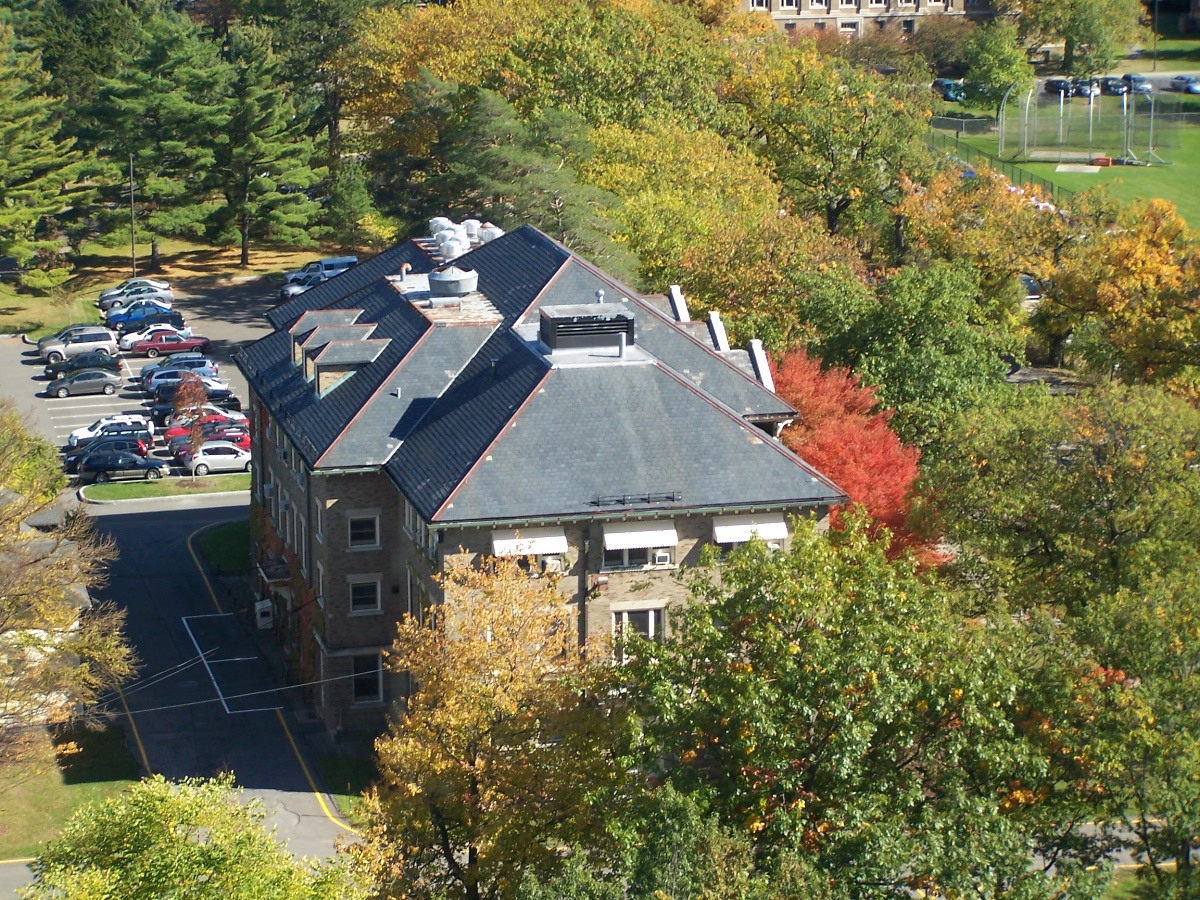
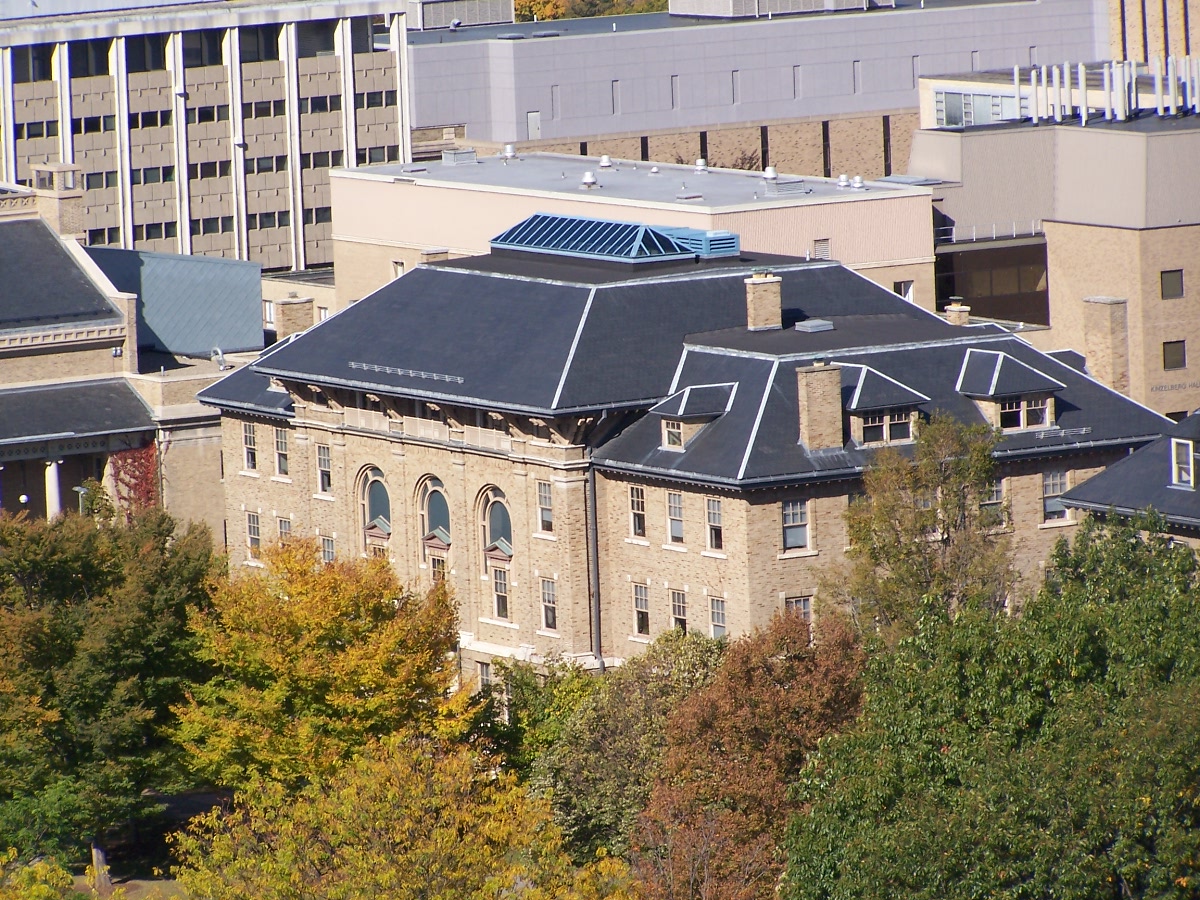
Buildings No One Really Cares About

17 01 2009

So, I had hardly any internet access while I was gone, but it would appear this blog had more than its fair share of hits this past week. It’s probably due to rush, and considering the content of ICH,  I’m not surprised.

But today we’ll just do another photo tour.

100_2496

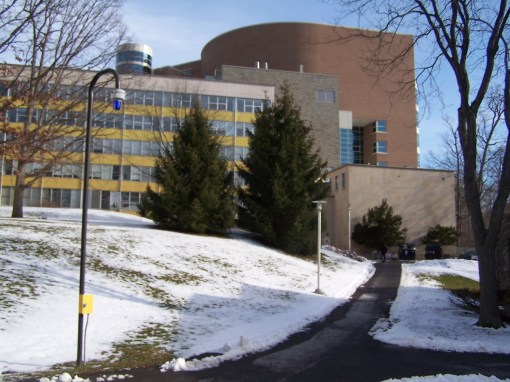
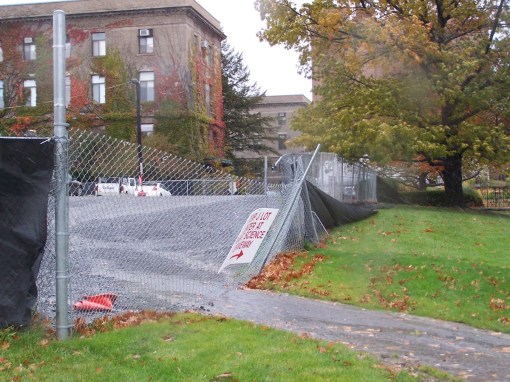
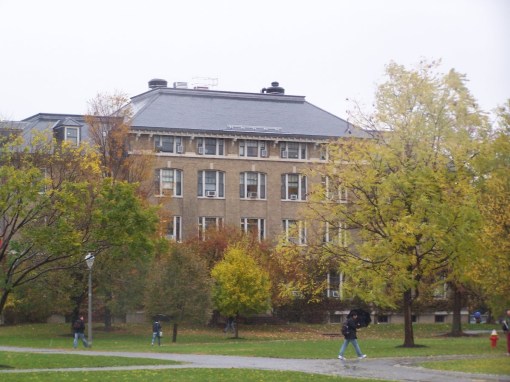
Since someone asked about it, I decided to make a trip out to Ward Labs on the southern edge of the campus and the engineering quad. Ward Labs, or more properly the Ward Center for Nuclear Sciences, was completed in 1963. At this time, nuclear engineering was experiencing great interest. But after Three Mile Island and Chernobyl, the nation experienced a serious decline in interest in nuclear studies, and the engineering school disbanded it’s Nuclear Science and Engineering program in 1995 [1].  On May 4, 2001, Cornell announced that it would decomission the TRIGA Mark II nuclear reactor inside the facility, due to underutilization and unwanted liability concerning the handling, use and transport of nuclear materials. The reactor was a 500 kilowatt facility used strictly for research and teaching. A dry irradiation facility that uses the radioactive Cobalt-60 was recommended to be maintained at the facility. The building still contained radioactive waste, so when 9/11 happened, road blocks were installed around the facility [2].

Then we fast forward to October 2008. There was a very interesting article written by Munier Salem for the Daily Sun highlighting the increased interest in building new facilties and a revived interest in the field as the energy crisis affected the nation, and how some view the decomissioning as a huge mistake.

Today, with the exception of some offices and little-used labs, the Ward Center is largely abandoned. The building is slated to be torn down under the master plan (assuming our endowment holds out).

100_2497

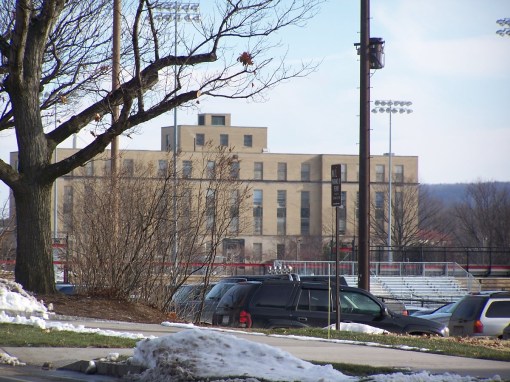
I felt that since I was there, I should take a photo of Grumman Hall too, if but just to say I have one.

100_2509

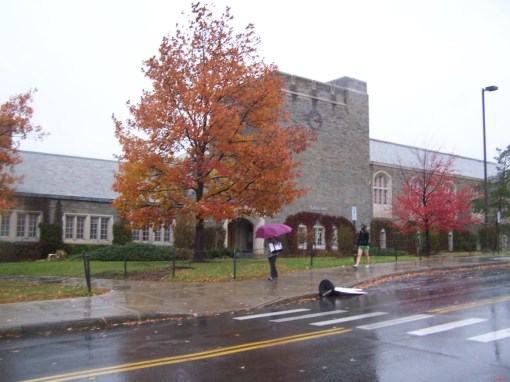
I make a big deal about Bradfield, but I never have really mentioned Emerson Hall. Emerson, the low-rise portion of the Bradfield complex, was also completed in 1968 and houses labs and offices for the department of Crop and Soil Sciences. The building is named for Rollins Emerson, who was the head of the Plant Breeding Department for a few decades in the first half of the 20th century.

100_2508

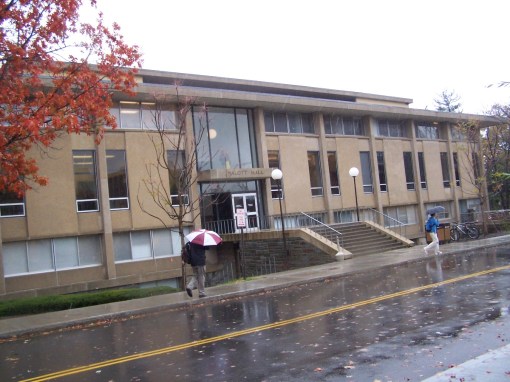
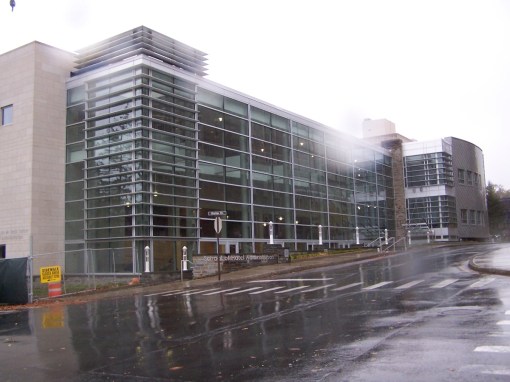
Riley-Robb Hall. This building was built in 1956 and is designed in the stripped classical style [4]. Very, very stripped. The emphasis with this building was on materials, primarily limestone, yellow brick, and marble. Two bas-relief limestone heads flank the entry stairs, the one on the north side being Ceres and the one on the south being Pomona. The building currently houses the Biological and Environmental Engineering program.

Also worth noting is the $6 million dollar renovation for the east wing set to be completed in March. This lab will focus on biofuels research [5].

***

100_2503

Bartels Hall, originally known as Alberding Field House, was completed  in 1990. The building houses the Lindseth Cimbing Wall (the alrgest indoor wall in the country, Cornell claims [6]), basketball courts, artificial turf practice areas and a 5,000 seat indoor sports facility. The building was renamed in 2000 as a thank-you for a $15 million donation from Hank and Nancy Bartels of the class of 1948.  Charles Alberding ’23 was a major benefactor of Cornell athletic programs, but the building was never formally named for him [7].

[1]  http://theuniversityfaculty.cornell.edu/forums/pdfs/Wardrelease.pdf

[2]http://cornellsun.com/node/33101

[3]http://www.genetics.org/cgi/content/full/169/4/1787

[4]http://www.fs.cornell.edu/fs/facinfo/fs_facilInfo.cfm?facil_cd=1062

[5]http://www.news.cornell.edu/stories/March08/biofuels.lab.lm.html

[6]http://www.cornell.edu/search/index.cfm?tab=facts&q=&id=313

[7]http://ezra.cornell.edu/posting.php?timestamp=944542800                        – see Question 11


News Tidbits 1/8/09: Miracles Do Happen

8 01 2009

All I can say is, it’s about time.

http://www.theithacajournal.com/article/20090108/NEWS01/901080319/0/NEWSFRONT2

ITHACA – Cornell’s Milstein Hall project will benefit Cornell and the public while minimizing negative impacts, Ithaca’s Planning Board decided.

The Board voted unanimously Tuesday night to grant preliminary site plan approval to the $54 million project that includes a new, 59,000-square-foot building that will connect Rand and Sibley halls and stretch over University Avenue toward the Foundry.

A new Central Avenue Parking Garage will also provide 199 parking spaces on three levels, two of them underground.

The project has been delayed for at least five years with various designs and, most recently, a dispute between the university and the city’s Board of Public Works over the proposal to place part of the building over University Avenue.

After months of disagreement, the university decided to use a cantilever design rather than columns, which would have required an easement from the city. Separately, Cornell and the city later agreed that Cornell would pay to rebuild and maintain the badly deteriorated University Avenue in exchange for the city’s decision to give up its public right of way on the road.

The planning board has been reviewing an environmental impact statement on Milstein for the past two months and has heard comments from Ithacans and Art, Architecture and Planning faculty and students for and against the project.

Cornell and those in favor of the project have argued that the additional space is needed to maintain the Art, Architecture and Planning College’s accreditation and to programmatically connect the three buildings.

Planning Board Chairman John Schroeder said the existing conditions leave the Foundry disconnected and looking “like a maintenance building.” Milstein Hall would move the center of activity more toward the middle, better linking the buildings, he said.

Those against the project have argued that the very modern design of Milstein Hall will be jarring next to the historic Rand and Sibley halls.

Ithaca’s Landmarks Preservation Commission will review historic preservation concerns related to the project at their meeting at 7 p.m. Wednesday, Jan. 14 in City Hall, 108 E. Green St. The commission would have to grant a Certificate of Appropriateness for Milstein Hall to be built, Acting Planning Director JoAnn Cornish said by e-mail.

Cornell also needs final site plan approval from the Planning Board, which could come at its Jan. 27 meeting, Cornish said.

John Gutenberger, director of community relations at Cornell, said if the final approvals are granted, construction could start by early spring. Milstein Hall is not subject to the university’s construction pause, he said.

The project would be complete by December 2010, project manager Andrew Magre said.

***

In other news, the massive (by Ithaca standards) development called “Carrowmoor” continues to clear the political hurdles. From the town of Ithaca’s 1/6/09 minutes:

Consideration of designation of the Town of Ithaca Planning Board to act as Lead Agency, and the determination of a Positive Declaration of Environmental Significance for the proposed Carrowmoor development project located off Mecklenburg Road (NYS Route 79), north of Rachel Carson Way, Town of Ithaca Tax Parcel No. 27-1-14.2, Agricultural and Medium Density Residential Zones.  The proposal includes the development of 400 +/- residential condominium units, a community center complex, up to 36,000 square feet of neighborhood oriented commercial uses, up to 32 living units in an elderly residential building, a child care center, and other mixed-use development on 158 +/- acres.  The project will also include multiple new roads and walkways, open recreation areas, stormwater facilities, and community gardens.  Town of Ithaca actions also include consideration of adoption of a proposed local law to enact a Planned Development Zone in conjunction with the Carrowmoor proposal.  The Planning Board may also begin discussions of the draft scoping document for the Environmental Impact Statement (EIS).  John Rancich, Owner/ Applicant; Steven Bauman, Agent; Mary Russell, Attorney.”

Still some hurdles left though. The Planning Board must approve both the environmental review and site plan review before Carrowmoor could be built. The Town Board also has to pass a local law changing the zoning to allow for the project’s development.

***

No entries for the next week, as I’ll be mostly internet-less at a conference. For those of you planning to attend Rush Week, good luck and have fun.


One Stormy Day on Campus, Continued

2 01 2009

Look at it this way; I’m not being paid to do this, and you don’t have to put up with a helicopter Mom asking twenty million questions about academics.

So, today I’m going through the engineering quad. Back in the day, the engineering buildings were Sibley, Franklin (Tjaden), Rand and Lincoln. By the early 1960s however, they had all shifted down to the present-day engineering quad.
100_2086

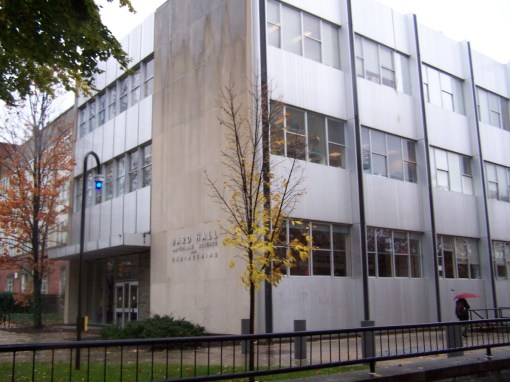
Bard Hall is one of the smaller inteconnected buildings that make up the engineering quad. The 50,000 sq. ft. building was completed in 1963 [1], 12 years after the construction of its neighbor Thurston Hall, but was designed by the same architects. Appropriately so, materials science is based out of this building, which is clad in brown Ithaca stone, limestone, glass, and aluminum. Bard Hall is named Francis Norwood Bard, Class of 1904  [2].
100_2087

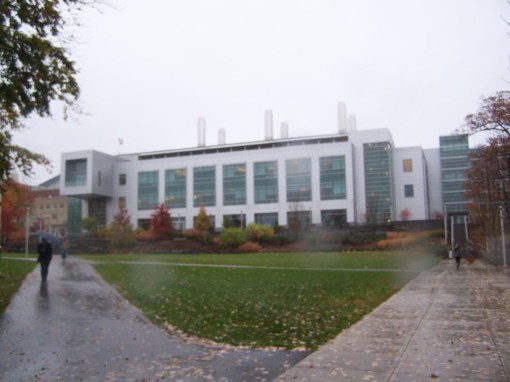
Don’t mind the rain spots. So, no review of the engineering quad would be complete unless I discussed Duffield Hall, the newest addition to the quad.

The plot of land that Duffield was built on was home ot some lanscaped quad space to the north, and the two-story white box that was the Knight Labs building to the south (the building was demolished and the labs were incorporated into Duffield).

Duffield Hall is named for Richard Duffield, Class of 1962. Duffield made his fortune by being the founder and president/CEO of the software company Peoplesoft [3]. The same Peoplesoft that screws everyone over for CoursEnroll.  
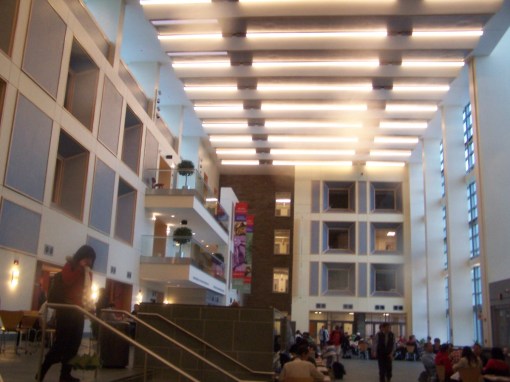
100_2093

The building began construction in 2001 and was officially opened in October 2004.  The building has a usable area of about 130,000 sq. ft [4] and cost about $58.5 million. The building houses a small a la carte dining facility (Mattin’s), a large atrium, and Knight Labs (named for Lester Knight ’29) with its Cornell NanoScale Facility (CNF). Sorry, no photos of the folks in clean suits.
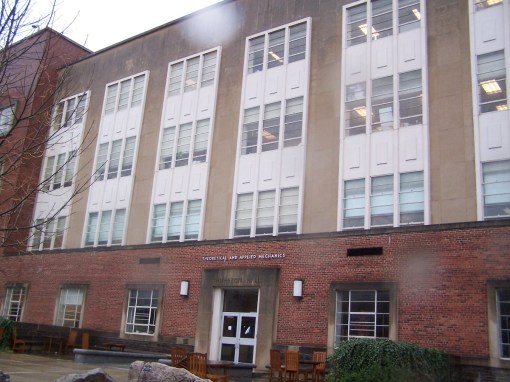
100_2088

Thurston Hall is the centerpiece of the engineering quad. The building, designed in the Art Moderne style, was completed in 1951 [5]. This building technically has less usable space than Bard, but it depends on where you draw the line between it and Kimball Hall to the east, which was built at the same time. The building is named for Robert Thurston, an early Cornell engineering professor.

As you can see, the outside says Theoretical and Applied Mechanics (TAM). Technically, this department was merged with the school of Mechanical and Aerospace Engineering, effective yesterday (how convenient for this entry) [6].
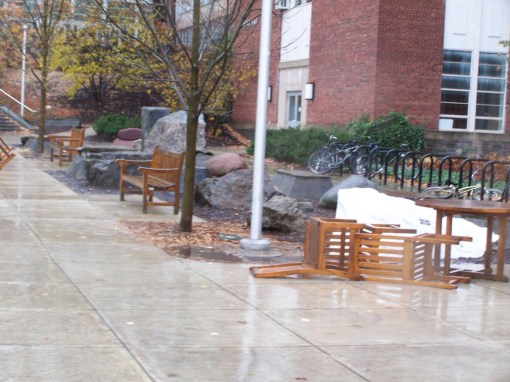
100_2089

It was really windy.  Mother Nature just decided to  crap on Ithaca that day.

100_2091

The completely unobtrusive Kimball Hall. Technically, Kimball is recognized as “the Eastern pavilion of Thurston Hall”. Also completed in 1951, the building is 30,000 sq. ft. and originally housed the geology department on its upper floors [7]. The building is possibly named for Henry Kimball, Class of 1911, who was a state supreme court justice [8].
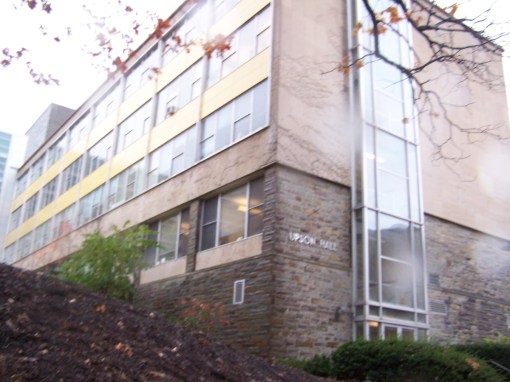
100_2092

Cornell’s 1950s Engineering Quad plan:

1. Design a completely boring structure. Because we’re overcrowded.

2. Find an alum willing to fork over enough cash to pay for it; slap their name on the building in return.

3. Repeat

Upson Hall is a 160,000 sq. ft building completed in 1956 [9]. Upson Hall is named for Maxwell Upson, Class of 1899, and a longtime Cornell trustee [8]. The building serves as the central hub for the Computer Science department. This building could otherwise be known for a 24-hour computer lab that up until recently was a filthy lie (that damn thing was never open at night back in 07′).
100_2095

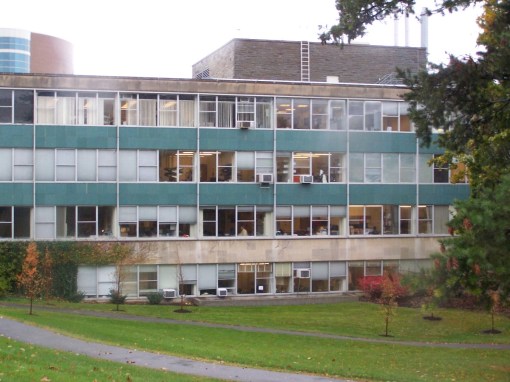
So, this is technically two buildings. The foreground box with the green window banding is part of Phillips Hall, a 100,000 sq. ft building built in 1955. The background structure (where the ladder is) is Grumman Hall, a 17,000 sq. ft building completed in 1957 [10]. Update: Or so I thought. It’s probably just another part of Phillips, but Grumman would be in the background if it was tall enough to be visible. Confusing, isn’t it?

Grumman is named for Leroy Grumman, Class of 1916 and founder of Grumman Aircraft (now Northrop Grumman [11]). Phillips Hall, named for Ellis Phillips 1895 [2], is home to the Electrical Engineering department, and Grumman houses some Aeronautics courses.
100_2099

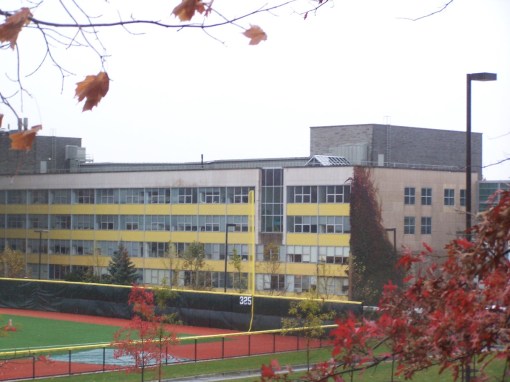
Update: Facilities calls this part of Upson. Apparently, the only way you can make a clear difference is the color of the window banding.   I s’pose it wouldn’t be as confusing if you’ve had classes here, but these are the only two of the main engineering quad that I’ve never had a course lecture or section.

(Thank Heaven.) 

UPDATE:

So, because I was using images and wordpress doesn’t allow imae attachments in comments, I figured it would just be easier to edit the original entry. As several readers (salem, Nagowski, and andrew) have noted, the physical seperations between Grumman, Upson and Phillips are very difficult to determine, since they are all interconnected. Consider the map below. 

up-gr-ph

The map would suggest that Grumman is the south wing of the complex, Upson is on the west, and Phillips on the north. However, going through the facilities websites, Phillips is listed as 100,000 sq ft (88,000 net), Upson as 160,000 sq ft (142,000 net), and Grumman is by far the smallest at only about 16,300 sq ft (14,500 net).

Back in the day, Grumman might have been much larger. Older images have suggested that there was a multi-story (~4 floors) box jutting out of the east side of the complex where Rhodes Hall stands today.

So, we then have the task of trying to determine what Cornell thinks are seperate building areas. Upson is undoubtedly the yellow banded building on the west (Upson Hall is clearly printed next to the staircase). However, it’s also the largest, yet its footprint (if we assume from the map) is seemingly small.

Here’s one issue: if you search Upson Hall on campus facilities, you get a photo virtually identical to my last photo, which I claim to be part of Phillips. http://www.fs.cornell.edu/fs/facinfo/fs_facilInfo.cfm?facil_cd=2045. Upson uses yellow trim, as does this wing of the complex. So, andrew is right on this one, it’s likely a part of Upson.

Phillips uses blue-green panels. Also, the corresponding facilities image is the north entrance next to Duffield. We could therefore say that Phillips is the foreground building in the image where I claim Phillips and part of Grumman are visible.

Courtesy of facilities, here’s their file photo of Grumman, which they describe as “A rectangular box with alternating horizontal bands of limestone panels, blue-green terracotta, and strip windows framed in aluminum.” :

The yellow banding of Upson is clearly visible, and Grumman is the building on the right, in the foreground of Rhodes. So, here’s a big question: at only 17,000 sq. ft, where does Grumman end and Upson begin? In the attached photos, I claim the background rooftop structure behind Phillips, with the ladder, is Grumman. However, it’s more likely another part of Phillips. Grumman is not in my images, and at such a small size, it’s not the easiest building to determine.

[1]http://www.fs.cornell.edu/fs/facinfo/fs_facilInfo.cfm?facil_cd=2070

[2]http://www.people.cornell.edu/pages/cre8/cudb/buildings.html

[3]http://www.duffield.cornell.edu/about.cfm

[4]http://www.fs.cornell.edu/fs/facinfo/fs_facilInfo.cfm?facil_cd=2000

[5]http://www.fs.cornell.edu/fs/facinfo/fs_facilInfo.cfm?facil_cd=2037T

[6]http://www.tam.cornell.edu/news/news-story.cfm?storyid=12537

[7]http://www.mssu.edu/seg-vm/bio_sidney_kaufman.html

[8]http://en.wikipedia.org/wiki/Sphinx_Head

[9]http://www.fs.cornell.edu/fs/facinfo/fs_facilInfo.cfm?facil_cd=2045

[10] http://www.fs.cornell.edu/fs/facinfo/fs_facilInfo.cfm?facil_cd=2043

http://www.fs.cornell.edu/fs/facinfo/fs_facilInfo.cfm?facil_cd=2039H

[11]http://en.wikipedia.org/wiki/Leroy_Grumman


One Stormy Day on Campus

15 12 2008

I’m not a holiday person. But I am halfway done with finals, which is reason enough to celebrate.

100_2109

Malott Hall, built in 1963, is named for Cornell’s sixth president, Deane Waldo Malott (1951-1963) [1]. The primary donor was William Carpenter ’10, but Carpenter Hall was built six years earlier, so apparently we went with the next best thing. The north building, pictured here, is classic 60’s architecture- notice the giant fishbowl lamps. Malott Hall originally housed the Johnson school until that moved to Sage in 1998; afterwards, the math department moved from White Hall to Malott. The rather Soviet looking north wing was part of a 1977 addition to the original structure. Malott is slated to be torn down under the Cornell Master Plan.

Old Deane Malott, who passed in 1996 at the ripe age of 98, was a conservative, even by 1950s standards. However, he is credited with significantly modernizing Cornell’s liberal arts programs, as well as overseeing a major construction period of the university’s history [2]. Prior to serving at Cornell, Malott was the president of the University of Kansas from 1939 to1951; as a result, they also have a Malott Hall (which houses their pharmacy school).

100_2107

It was a really blustery day.

For the record, this temp parking lot has only been here since the early 2000s, and the site is on the short list for development—after the economic crisis ends, of course. Originally suggested for a Bradfield-mass development (from Carol Kammen, author of Cornell Then and Now), the current master plan proposes a building of only one or two floors that offers general functions, like a visitor’s center.

 100_2106

 I never actually discussed Caldwell Hall in the previous Ag Quad entry. Caldwell was built with state money in 1913 [3]. Named for George Chapman Caldwell, an early professor of Agricultural Chemistry, the building housed soil sciences until it moved to Bradfield in 1969, and residual duties were picked up the entomology department in then-Comstock Hall. Today, Caldwell houses Cornell Abroad, the Cornell Institute of Public Affairs, and an LGBT resource center.

100_2104

Surprise! This went under the radar. In September, Cornell renamed this wing of the ILR Extension building in honor of Jonathan Dolgen ’66 [4]. So, we now have Dolgen Hall. Anyone want to take a guess at the price tag for this?

The building itself was built in 1911 [5], then part of the Vet School. ILR moved in during the late 1940s. The buildings underwent a significant renovation from 2002-2004, but because they were designated landmarks, the exteriors were relatively unaltered.

100_2102

Teagle Hall looks older than it is, in my opinion. The building opened as the men’s sports facility in 1954, and is named for Walter C. Teagle 1899. Apart from going co-ed, the building maintains much of its original use [6,7]. The building is faced with Llenroc and is designed to harmonize architecturally with neighboring Barton Hall. For those bold explorers out there, there is an underground tunnel connecting Barton and Teagle below Garden Avenue.

That’s a clock on the stone wall, by the way.


100_2094

100_20982

hotel-1

The Robert A. and Jan M. Beck Center  is a 35,000 sq. ft addition to the Hotel School that was completed in late 2004, at the cost of 16.2 million dollars [8]. The modern design is similar to the one currently being applied to the  south facade of the school (which is undergoing a 14,ooo sq. ft currently) [9]. Which make sense since both were designed by KSS Architects.

100_2097

Rhodes Hall was completed in 1990 as the Engineering and Theory Center building, and then rededicated to former president Frank Rhodes in 1995 [10]. The building is home to the Computing Theory Center, which housed at one time one of the most powerful supercomputers in the world. Today, I think it just barely cracks the top 500, but then again, pursuit of the most powerful supercomputer is a costly expenditure we probably shouldn’t be dabbling much with at the moment.

Rhodes Hall caused quite the complaint back in the day because of its size. Locals and some faculty/students complained that it overwhelmed the neighboring gorge and was too massive for the site. Not that the overbearing blank wall on the southwest side helps (but it is functional- that’s mechanical space ,and the supercomputer is on the other side of the wall, so they climate-controlled it a-la Bradfield, behind a windowless wall.


[1]http://www.cornell.edu/search/index.cfm?tab=facts&q=&id=487

[2]http://query.nytimes.com/gst/fullpage.html?res=9C05E3D6163AF930A2575AC0A960958260

[3]http://www.cornell.edu/search/index.cfm?tab=facts&q=&id=92

[4]http://www.ilr.cornell.edu/news/DolgenGift_2008.html

[5]http://www.news.cornell.edu/Chronicle/04/10.14.04/ILR_complex.html

[6]http://www.cornellbigred.com/sports/2007/7/30/TeagleHall.aspx

[7]http://www.fs.cornell.edu/fs/facinfo/fs_facilinfo.cfm?facil_cd=2611

[8]http://www.hotelschool.cornell.edu/about/facilities/beck/

[9]http://www.kssarchitects.com/content/project.php?type_id=33&project_id=238

[10]http://www.cornell.edu/search/index.cfm?tab=facts&q=&id=624

[11]http://ezra.cornell.edu/searched.php?search=theory%20center&question=&answer=&starttimestamp=&endtimestamp=&category_id=&offset=30&view=expanded

see:August 4, 1987


The Goldwin Smith Hall Addition

20 11 2008

Perhaps I’ll still have some construction tidbits to write about after all. So, up for review for the Ithaca Planning Board this month is a sketch review of the Goldwin Smith Addition. The “Goldwin Smith Annex” is a $45.1 million, 60,000 sq. ft addition in the back of the building [1], facing East Avenue, a la the Lincoln Hall addition in 1998. The GA Annex is set for a targeted completion date of Summer 2011, but given the current economic situation, we’ll see if that changes down the line. To quote the capital budget plan (first link):

“This project will design and build a new building adjacent to Goldwin Smith Hall to provide approximately
30,000 to 35,000 net square feet of new humanities and social science classroom and academic department space on the Arts Quad. The new space will address partially a chronic shortage of academic space that has characterized this area of campus and which has been exacerbated by recent and projected growth in faculty and programs in response to university initiatives. The current shortage of space has resulted in: (a) some faculty sharing offices or rotating among offices based on the pattern of temporary faculty leaves; (b) a lack of adequately sized classrooms and lecture halls; and (c) inadequate space for lecturers, graduate students, and staff.”

Where’d they get the 60,000 sq. ft figure from? My personal guess is renovated space in Goldwin Smith.  I’m not a fan of inconsistencies. However, the old budget plan indicates that an architects should have been selected in fall 2007.

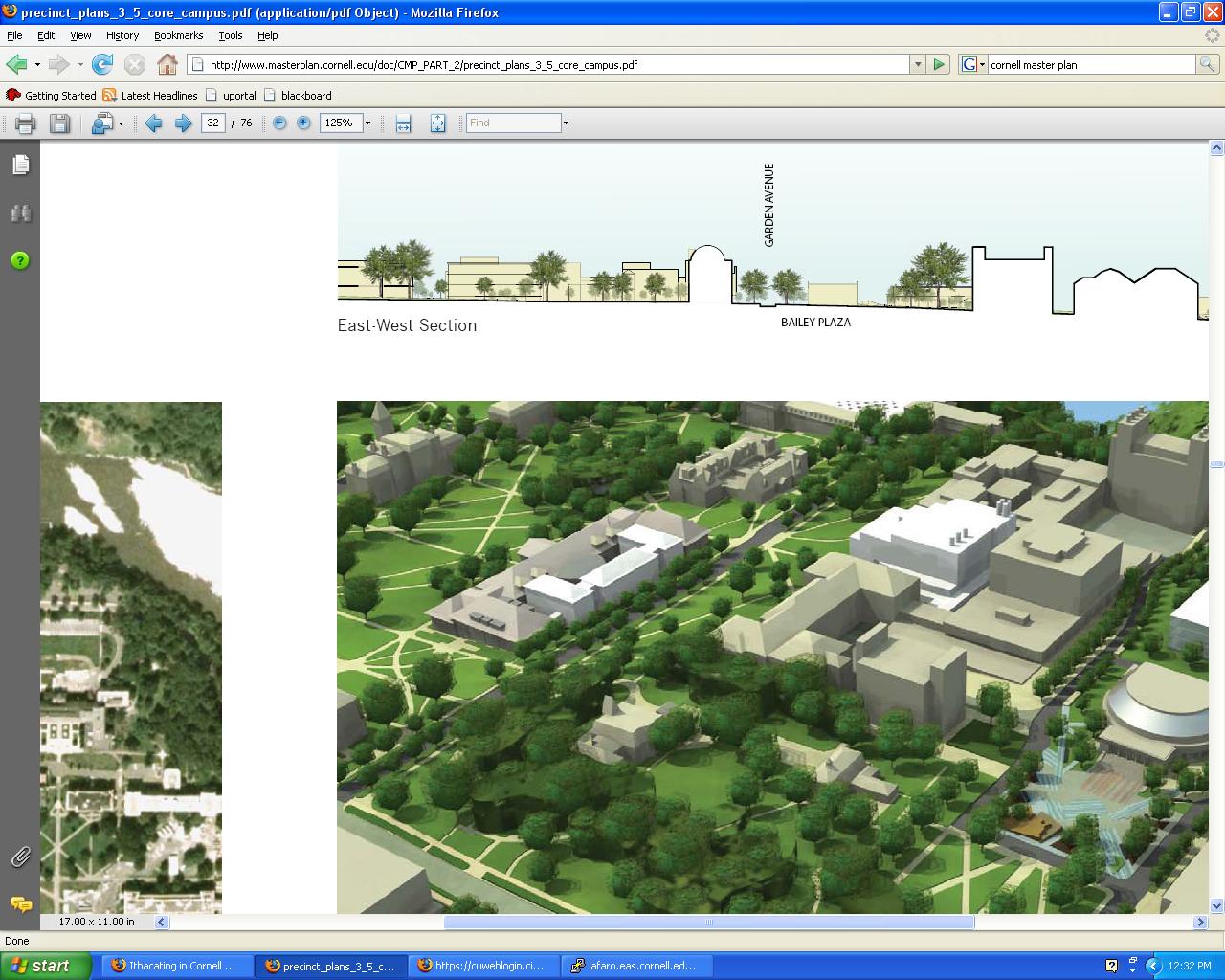
So, unfortunately, the sketch plan brings no mention of the architectural firm, which makes the task of getting a rough idea of the design a veritable hell. However, thanks to the master plan, we actually have an idea of the massing:

untitled

So, the rough massing concept seems to be three connected but otherwise independent structures, all of similar massing (and therefore roughly the same square footage). If we use the 60,000 sq. ft figure, except three two-and-a-half story buildings with footprints of about 7500 sq. ft each, which fits the area rather snugly. If it’s the 30-35,000 figure, we can except the footprint to be smaller, but the height massing will likely be about the same to maintain massing consistency with the main building.

In the meanwhile, I have requests filed in with the contact person for this project asking for any possible rendering or at least the architectural firm responsible, so I’ll come back to edit this post, hopefully in the not too distant future.

[1]http://dpb.cornell.edu/documents/1000383.pdf —page 54

[2]http://www.ci.ithaca.ny.us/vertical/Sites/%7B5DCEB23D-5BF8-4AFF-806D-68E7C14DEB0D%7D/uploads/%7BF4A05E59-733D-480A-A8C0-37224316CFF6%7D.PDF

“D. Sketch Plan, New Humanities Building, Cornell University (materials to be distributed at
meeting)”


More Random Cornelliana

13 10 2008

Because you’ve probably never been in most of these buildings anyway.

Rice Hall. The building on the left, obscured by the trees, is colloquially known as “Little Rice Hall”. Located on the National Register of Historic Places [1], Rice Hall was built in 1912 and designed by the architectural firm Green and Wicks [2]. Rice Hall was intended as a peripheral building to Stone, Roberts, East Roberts, Caldwell and Comstock Halls. The building is home to Cornell’s “Center for the Environment” (yet another academic think tank) and is a hodgepodge of SNES and Crop and Soil Sciences. The building is named for James E. Rice 1890 [5], who taught the first course in the country on Poultry Husbandry (the building was originally for poultry husbandry, which is likely why it’s such a clusterf*ck now).

Fernow Hall is another of Green and Wicks’ works, being constructed three years later in 1915 [3], and also sits on the National Register of Historic Places. For the record, all that means that it’s old and likable. It must not mean much for architectural merit, otherwise we’d still have Roberts, Stone and East Roberts. The building is primarily used by the Dept. of Natural Resources. The building was known as the Forestry Building from 1915 to 1922 [4], and was dedicated to Bernhard Fernow, Dean of the College of Forestry (a sort of predecessor to the natty rys dept., which failed only five years after its inception in 1898, because the state received threats that if Cornell would be spoiling summer cottage retreats in the ‘Dacks for commercial purposes, wealthy state residents would reside elsewhere).

The original Comstock Hall, now the Computing and Communications Center. The hall was built in 1912 and named for renowned entomologist John Henry Comstock 1874 [6], and originally housed entomology. In some twisted sense, the same firm that designed this building would design the later Comstock in 1985. After Cornell granted moving the name to the new building, the old Comstock was renovated into (C3), CIT’s Operations Unit, in the late 1980s. Prior to that, CIT was out in Langmuir Labs in the Office Park in Lansing, and before it left for Lansing in 1967, CIT’s main computer lab jumped between Rand and Phillips Halls [7].

A lot can change in 70 years. The original Comstock (formerly Academic II) was a corroboration between Green & Wicks, and the firm Hoffman, O’Brian, Levatich & Taub. The new Comstock was by the shorter “Levatich and Hoffman”. I think our tastes have gone downhill, ladies and gentlemen. Anyways, the new Comstock houses entomology and the little-used Entomology library (I just want to say that, as a CALS student, I’ve only ever met two entomology majors in my time at Cornell).

Corson-Mudd Hall (Corson is the east wing). Named for former university president Dale R. Corson and philanthropist Seeley G. Mudd (who has a crapload of buildings named for him on college campuses across the country [9], the building was completed in 1981 [8].

Technically, it’s possibly to get to nine seperate buildings through the tunnels and walkways of the AG Quad. Bradfield is connected to Emerson Hall (the lowrise portion), which is connected to Fernow Hall at one corner and to Plant Sciences from the second floor hallway. Through Plant Sciences, there are two ways to get into Mann Libe (ground, which involves being outside for ten seconds in the tunnel towards Manndible Cafe, and a less-used second-floor stairway). Mann is connected to Warren Hall. Plant Sci also has a connection to Weill Hall through its basement, and the tunnel runs underneath the street to the basement of Weill. The public use of this tunnel is not clearly stated, so try it at your own risk. Weill also connects to Corson-Mudd and Biotech through tunnels.

So, I’ve already told the story of the Roberts-Kennedy complex once before, but I’ll do a partial rehash. The building is named for Issac Roberts, an early professor, and 1970s CALS dean W. Keith Kennedy. Originally, Stone, Roberts and East Roberts stood on the site.

Roberts, Stone, East Roberts

L to R: Roberts, Stone, East Roberts

The three were built around 1906. While they were national registered historic buildings, Cornell rather covertly had the designation removed, in a move that angered many traditionalists. The buildings were imploded in 1988-89. The original proposal for Roberts-Kennedy Hall was a 10-story building where Kennedy stands. Well, that didn’t go over too well, so they essentially pushed it onto the side and made a “breezeway”. The two were completed in 1990. Trillium is technically a part of Kennedy Hall.


[1] http://en.wikipedia.org/wiki/Rice_Hall

[2]http://www.fs.cornell.edu/fs/facinfo/fs_facilInfo.cfm?facil_cd=1040

[3]http://www.fs.cornell.edu/fs/facinfo/fs_facilInfo.cfm?facil_cd=1029

[4]http://www.dnr.cornell.edu/mission/history/

[5]http://books.google.com/books?id=jUu9pDRhWjkC&pg=PA295&lpg=PA295&dq=%22rice+hall%22+cornell&source=web&ots=Mp_YbfQomX&sig=dQmUQ68KhXUqtys6MW5lwXXPF_s&hl=en&sa=X&oi=book_result&resnum=10&ct=result#PPA401,M1

[6http://www.agriculture.purdue.edu/agcomm/newscolumns/archives/OSL/2005/October/051027OSL.htm

[7]http://www.cit.cornell.edu/computer/history/timelines_locations.html

[8]http://www.fs.cornell.edu/fs/facinfo/fs_facilInfo.cfm?facil_cd=1019E

[9]http://en.wikipedia.org/wiki/Seeley_G._Mudd