Ithaca is Hot

21 07 2011

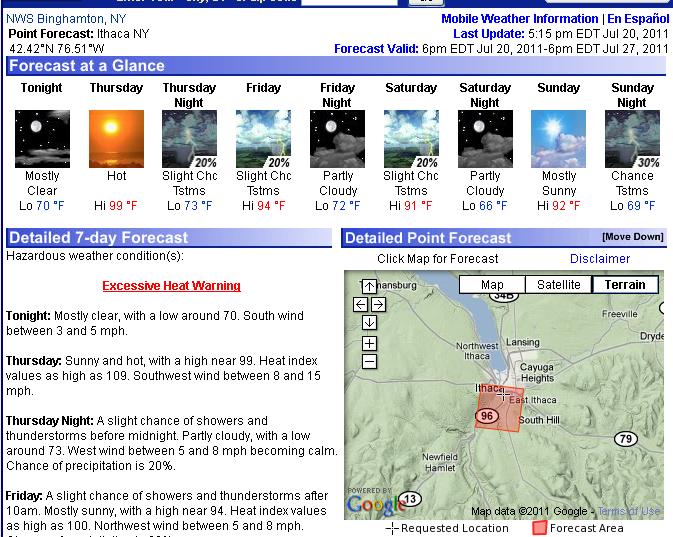
According to NWS Binghamton, the high temperature in Ithaca tomorrow is expected to be right around 99 degrees Fahrenheit (~37.2 C). Earlier model outputs suggested a high right around 102 F. Regardless, the heat index (an indication of how it actually feels, thanks to the effects of high humidity) will be right around 110. It’s not often that Ithaca flirts with the century mark when it comes to temperatures (since most students know Ithaca as a frigid windswept land, any heatwave of this magnitude should be nothing short of shocking).

Being curious, I decided to glance at the NRCC climate records to determine the last time Ithaca hit 100 degrees (non-heat index). Well, a cursory check of the last twenty years turned up squat. So, I expanded the search, and pulled all days from 1900 onward that had temperatures recorded at 100 degrees or greater at the Ithaca station. Here’s the result:

07/03/1911 101

07/04/1911 102

07/05/1911 100

08/22/1916 101

07/02/1931 102

09/12/1931 100

06/29/1933 102

07/08/1936 101

07/09/1936 103

07/10/1936 102

An almighty ten occurrences in 110 years of records. The last of which was over 75 years ago.

Expanding the threshold a little bit, I checked out the dates where the temperature reached 95 F or higher. There were 129 occurrences in 110 years, a little more than one a year (but, since heat waves tend to be longer-term events, they typically occur in spurts of a few days at a time). the last day above 95 was August 15th, 2002, when the temperature hit 96 at the Ithaca Game Farm weather station. Looking more closely, the dates break down fairly clearly – once in 2002, once in 2001, twice in 1995, once in 1990, once in 1988 (a grand 98 degrees, the highest in the past 50 years), once in 1966, twice in 1965, and a record 5 times in 1955 (the highest of which was 98). So in the past 50 years, Ithaca has broken 95 degrees only 9 times.

So, it will be a hot day, maybe even one for the record books. I’m sweating in my AC-lacking apartment as I write this a few hours east of Ithaca, and I will be very glad when a cold front moves through later this week.


News Tidbits 7/15/11: Hotel Ithaca Finally Ready for Construction?

15 07 2011

Image property of visitithaca.com

Doing my usual perusing of the city planning board pre-agenda (the “project review committee”) turned up this piece of information slated for discussion:

Minor Subdivision Approval, Two‐Lot Subdivision Pertaining to City of Ithaca Tax Parcels 70.‐4‐4.2, 70.‐4‐4.3, and 70.‐4‐4.4 , Jeffrey Rimland, Applicant for Ithaca Properties, LLC. The applicant is proposing to create two lots. The applicant will subdivide the existing 60,095 SF parcel currently containing the Rothschild Building and vacant land fronting East Green Street (represented as Parcels A and B‐2 on the accompanying plat or Tax Map Parcels 70.‐4‐4.2 and 70.‐4‐4.4) into two separate parcels. Parcel A will measure 53, 805 SF and retain the footprint of the existing Rothschild Building. Parcel B‐2 will be combined with the 2,140 SF Parcel B‐1 on the plat or 70.‐4‐4.3 (formerly surplus city land which was conveyed to the applicant) to make a 8,430 SF parcel which will front E. Aurora and Green Streets and will contain the proposed new hotel.

***

On the surface, it’s nothing special, just a lot subdivision. But more importantly, it’s consolidating the lot to be used for the Hotel Ithaca, which has been on hold since gaining approvals due to an inability to land financing in the recession-ravaged bank loan market (the development cost is expected to be around $27 million). The consolidation of the property suggests to me that the project may finally have procured funding to begin development of the 10-story, 140-room hotel. Or at least, one can hope.

The other bright piece of news is that it looks like Seneca Way, the 5-story building proposed for the former Challenge Industries site on the eastern edge of downtown, has received all necessary zoning variances through mitigation (moving two apartments from the north to the south side of the building, moving the fitness center from the top floor to the bottom floor, moving and resizing of the roof terrace, and lastly, a deed restriction that prevents any other building over 40 feet from being built within 70 feet of the northern property line). The last mitigation tactic seems a bit controversial to me, but most of the zoning in that area has a 40-ft. maximum as it is. I suppose if someone ever wanted to redevelop the insurance building on the corner though, it would suck for them. But at least this project is moving forward. I imagine with this under construction and the Collegetown Terrace project up the road, East State Street is going to see a lot of construction traffic for the next two years.


The Keyword Bar XII

8 07 2011

One of those entries where I respond to questions or queries in the search bar that brought people to this blog. Plus it’s summer and I don’t feel like delving into history today.

For the curious – the sculpture in front of Uris is called “Song of the Vowels”. The sculptor, Jacques Lipchitz, created seven copies back in 1931. Cornell’s was the fifth production, and the sculpture was acquired in 1962 by the Uris brothers on behalf of Cornell, and installed in June of that year. Princeton, UCLA, Stanford, the Kykuit Gardens and two European art museums own the other copies. “Song of the Vowels” was renovated and re-sited in 2007.

1. “why does cornell cals accept so many transfer students” (7-6-2011)

That’s actually a good question. This one kinda creates some tension in the CALS community, and certainly that animosity is not unfounded. In the past, I’ve heard people criticize transfers as not being “true Cornellians”, whatever they define that to be.

As a general rule, the contract colleges accept more transfer students than the endowed colleges. It’s actually part of the mission of the contract colleges to include transfer students into their programs, if the applicants meet standards. However, this does not hold true for endowed schools, and that is reflected in the fewer students that they accept as transfers.

Specifically regarding the ag school, CALS accepts more because of “transfer agreements” that serve as feeders into CALS programs. A number of SUNY-affiliated two-year schools fall into this category. Basically, a student studying full time with a 3.0 or higher in their coursework (including required classes that match up with their desired major at Cornell) are guaranteed admission. This tends to be most common in the agricultural programs – for example, a majority of students in the dairy science concentration of animal science are transfers from two-year schools such as SUNY Cobleskill and Alfred State. A few others, like Morrisville and Delhi, also send in a fair number of students. As the list in the link indicates, there’s 43 schools, mostly community colleges in New York, that have these agreements. Some of it is coordinated through programs such as “Pathways to Success”, a set of guidelines and counseling in place at some schools for students who want to transfer to Cornell. For the name-conscious AEM majors, it should be noted that biology, landscape architecture, and non-agribusiness AEM are exempt from this and fall under “competitive transfer” admissions. Also, if you don’t attend a partnered institution, then the transfer isn’t guaranteed either.

In my own major within CALS, I know that we had two transfers in the years from 2007-2011 (~3% of total). But in lean years where the yield from freshman admissions wasn’t so great, they were supplanted the following year with transfers. I think there’s at least eight in the 2012 and 2013 classes (~50% of total).

2. “cornell freshman population” (7-4-2011)

Varies a little bit from year to year due to yield. The goal number in the late 2000s was 3,050. The university usually over-enrolls (my guess is twofold –  it’s to make up for students who may not show up in the fall, and a few more accepting students makes the yield increase), so class size usually ends up somewhere in the 3100s. The trend over the years has been to increase freshman class size, which was about 2700 in the late 1980s.

3. “cornell safety school” (7-4-2011)

Meh. Do your graduate work at a large state school and you’ll realize how little weight that statement carries. The New York Times has a nice little piece about image-conscious students at Cornell from a few years back.

4. “how far is it from wegmans to maplewood apartments at cornell in ithaca” (7-1-2011)

I think Mapquest would’ve been more useful than a search bar for this question. But for the record, between 2.5 and 2.7 miles, depending on what part of the Maplewood Park Apt. complex you’re going to.

5. “construction project; bj’s ithaca; owner” (7-1-2011)

The project is being developed by Arrowhead Ventures of Syracuse, which is a division of Triax Development Coroporation. Triax is the company that owns the Ithaca Mall, and the BJ’s site is (rather conveniently) the property just northwest of the mall.


News Tidbits 6/28/11: The Lawsuit Everybody Expected

28 06 2011

So, the Cornell Sun (on its bare bones summer staff) has noted that the mother of George Desdunes ’13, the SAE brother who died in a hazing event this past February, is suing the national fraternity for $25 million. I’m no expert on legal matters, but I do know this has significant precedent with cases from other universities, and SAE has been slapped with three wrongful death lawsuits  in just the past five years. Most of the wrongful death cases were settled out of court for undisclosed amounts, although at least one, a case against a University of Texas chapter of SAE, was awarded $16.2 million (I’m not positive, but I believe it’s the fraternity’s insurance company that pays out, but the fraternity then finds it that much more difficult and expensive to have adequate coverage for their liabilities, which is necessary for recognition on many campuses. So although the fraternity doesn’t pay out directly, their finances still detrimentally impacted).

Now, here’s my question: is she bring a lawful death lawsuit against Cornell?

In a previous entry, I described how a similar incident had occurred at M.I.T. back in the late 1990s with the death of a pledge at their FIJI chapter. In that case, the Kreuger family held M.I.T. responsible for a lack of supervision of the fraternity that allowed the death to occur. Although a formal lawsuit against the school was never filed, MIT did pay out $6 million to the family, of which $1.25 million went to a memorial scholarship. In hazing-wrongful death lawsuits, it seems, at a casual glance, that while it’s common for the fraternities local chapters and national organizations to be sued, it unusual for the school to be sued, perhaps because its much more difficult to build a case. But, I would not hold out against the possibility that if the lawyers are zealous enough, they can use the lack of supervision against Cornell and receive a similar settlement.  For one thing, SAE lived in a university-owned property and the incident allegedly took place in the Townhouses on North Campus.

So, the obvious take-away from this news is that SAE is screwed and totally responsible for their members’ actions. But in the bigger picture, one does wonder if the plaintiffs are going to try and go after Cornell as well.


Three Years Later

18 06 2011

Wow. I can hardly believe that this blog has been going for three years now. Not bad for a Cornell/Ithaca history and construction blog. In keeping step with the previous two annual updates, here’s a brief rundown of the site statistics:

The total number of hits since this blog launched, and as of 3:45 PM today, is 163,019.  Altogether, that’s roughly 149 visits/day. Since the first year averaged 82 visits/day, and the second year 166 visits/day, the third year breaks down to about 199 visits/day. Not too shabby.  As or the monthly statistics:
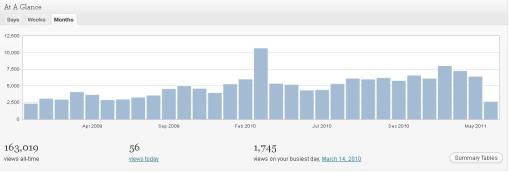
The highest monthly total for the past year was March, with 8,001 visits. In all of the past three years, March has been the month with the highest total. Considering the aberration in site traffic in March 2010 due to the bridge tragedies,  the relatively slower increase from 2010 to 2011 (versus 2009 to 2010) is actually more substantial than it seems, since no single event this year contributed to as large of a proportion of visitors to this blog.

Looking at the past year in review:

~In planning and development, Thom Mayne was selected to design Gates Hall, and when the initial design came out this past spring, I gave it a less-than-warm reception (and probably the only time I’ll ever refer to deer carcasses on this blog). THE CU ERL project (or as I like to think of it, Ezra’s giant tube) was approved, but won’t even start construction for two of three more years (I’ll be going back for my five-year reunion before the project is done). Milstein and the Johnson Museum addition made significant progress, as did the new food science building, and the Plantations welcome center, Physical Science Building and MVR’s north wing were completed. Bridge barrier designs from embattled architecture firm Office DA were proposed, but Cornell has opted to go with nets instead.

Looking towards the city and suburbs, the Collegetown Terrace went through a substantial redesign of its State Street buildings before finally getting phase I approval this past Spring. Since then, demolition and site prep are underway, and phase II finalization is just getting the planning board’s okay. 307 College Avenue was proposed and the Vine Street Cottages and 309 Eddy Street were approved. Development began on the third neighborhood of EcoVillage, and the BJ’s in Lansing barely earned approval due to a controversial tax abatement for a senior-housing project on the rear end of the lot. Lansing began construction on a new locally-owned supermarket, and the Poet’s Landing apartment complex was proposed in Dryden. IC finished its Athletic Center and began prep work to expand its Circle Apartments complex.

Too bad not all news was about progress. Ithaca Gun is a cleared site awaiting further development, which has been slow, if any at all. The Ithaca Hotel, Cayuga Green Condos, and INHS proposal are stalled due to lack of funding. The only substantial work completed downtown were the renovations of the Petrune and Plantations buildings on the Commons. At the very least, the Seneca Way project came forward to offer some hope for downtown redevelopment in the near-future.

~Greek Life went into a tailspin with the proposed, and then approved, plan to eliminate underage drinking from parties by banning freshman from attending fraternity events with alcohol, and making rush dry by 2013. Unfortunately for the system, all it takes is a couple of idiots to cause an alochol-induced fatality, and to make questionable choices while drunk at a public event, and the damage is done. While SAE earned itself a heave-ho from campus for the next 5 years, three other Greek orgs, the fraternities Phi Kappa Sigma and Alpha Phi Delta, and the sorority Phi Sigma Sigma, expressed intent to reestablish themselves on campus after a decades-long hiatus. Oh, and we got to watch Bob Saget be “initiated” into Seal & Serpent, much to the chagrin of image-conscious Greeks. Personally, I’d be more image-conscious of SAE’s pledges mass-migrating over to TKE even as four of their pledgebrothers were indicted. Real classy guys.

~The 2010 census showed that the city and county grew. Ithaca proper is busy mulling over its future with proposed Commons renovations, renovations of Stewart Park on the lakeshore, and a one-year moratorium on development for West Hill (excluding pre-approved projects). On the short-term, the county had to deal with tornado damage in Danby and arresting Cornell students with massive stashes of heroin.

Time passes, thing change. In comparison to last year, when I wrote this entry from a crappy sublet and with an uncertain grasp in grad school, I moved into a new place, changed advisers, worked my arse off, but feel much happier now than I did at this time last year. As I write this right now, I keep an eye on the clock, since I only just came back from visiting a friend I graduated with out in Amsterdam, and plan for a hiking trip in the Adirondacks tomorrow. The birds chirp outside my window and the sun plays off the leaves rustling in a light summer breeze.

Three years is a relatively large chunk of time for a blog to be active. But I enjoy writing because I think, or at least hope, that’s it useful to folks who are curious about the history of something at Cornell, or what’s under construction on campus or nearby. If I’ve been able to make someone a little more knowledgeable, than I see no issue with all the time I’ve poured into this blog over the years. As long as I have history and news to write about, I plan to keep this blog going for the foreseeable future. It gives me something to share with others, and it’s what makes me happy.



Being An Alumni Ambassador

8 06 2011

Since joining the ranks of sketchy alumni, I decided a while back that it wouldn’t hurt to do some volunteering through the Alumni Ambassadors program. One of the first things I discovered was that  meeting with prospective students poses an interesting juxtaposition. On my end (as well as any other alum), it’s a “been there, done that” frame of mind. For the prospective student, everything is new, and sometimes they have questions that we alumni assume everyone else knows the answer already, but it actually might not be so obvious.

I met with several students during the late winter in four different school districts near where I live. I was assigned students who were interested in majors similar to mine, and set up the meetings for either their local high school or a coffee shop nearby (and I don’t even like coffee, I just wanted a quiet and suitable location). Some took a more laid back approach, while others were dressed up as if they were a possible hire and I was the interviewer for a Fortune 500 company. For those over-prepared kids, it seemed that there was no way they were going to believe that I wasn’t there to reject them from Cornell. Even if I said I wasn’t there to judge their application. Repeatedly.

On one of my meetings, the student was running about twenty minutes late. Giving the benefit of the doubt, I decided to look around outside before I left. He had driven into another car while trying to pull into a diagonal parking space.

On another occasion, I was meeting with a student and I asked what interested her about CALS. Without missing a beat, she replied, “it’s easier to get into”. I think my jaw might’ve dropped a little bit before I stumbled out an “I’m sorry, what?” I think at that point, she must’ve realized she hit a sour note, and she gave a very measured reply of “it’s easier to get into the various research opportunities they have to offer.” Still soaking in the previous comment, I took a deep breath, and said that “there are indeed plenty of research opportunities. But for the record, the difference between acceptance rates is slight, and the average SAT scores only differ by a few points”. Which I learned from Metaezra. In retrospect, she probably didn’t know that that wasn’t the best response, and maybe I hold some resentment about those kinds of comments, so there was a real disconnect in that exchange.

One of the other awkward discussions that happened in over half of the meetings was about the party scene and Greek Life. I would ask if they had any questions about student life, and some chose to ask what the parties are like. One even asked about the availability of drugs. When I did the contact meetings, I always tried to answer in ways that I wouldn’t mind being quoted on. The last thing I wanted to do was make an ass of myself. So I gave the overly P.C. response of “Cornell’s size gives a wide variety of options for establishing a social environment. Greek Life is there for those who are interested.” The drug question was a bit uncomfortable; I gave an awkward, formal reply along the lines of “Cornell is large university, and you can make your own assumptions. But I’m disinclined to discuss it.” It was uncomfortable because it definitely straddles the perceived line of what is appropriate for discussion, but I still wanted to give a halfway-decent answer their question.

When I received the email notifying me of the final status of the students I met with, I was…uh, underwhelmed. All but one were rejected. That one was a guaranteed transfer. My office-mates started jokingly calling me the “Kiss of Death”. It was actually a little disheartening because some of those high schoolers were really quite accomplished and left me with a very good impression. But, after checking with a few other friends of mine who did the Alumni Ambassadors volunteering, I guess I was running par for the course. I never realized the kinds of students Cornell rejected, which was something that I think I had taken for granted and just written off while I was in Ithaca.

It had its ups and downs. I liked talking about Cornell (as if this blog wasn’t a clue). I got some satisfaction out of it, and I was able to do a little volunteering outside my grad school bubble. I think I’ll keep doing it, with some hope that maybe one of the future students I meet with will be accepted outright next spring.


News Tidbits 6/6/2011: Ithaca Is Getting Another Hotel

6 06 2011

…which depending on your stance, the addition could be a blessing or a curse. Planning board minutes from the last meeting indicate that a formal proposal is underway for a 4-story, $10-million dollar hotel to be built in Ithaca. If it was just that vague piece of news, everyone would smile, nod, and keep right on going.

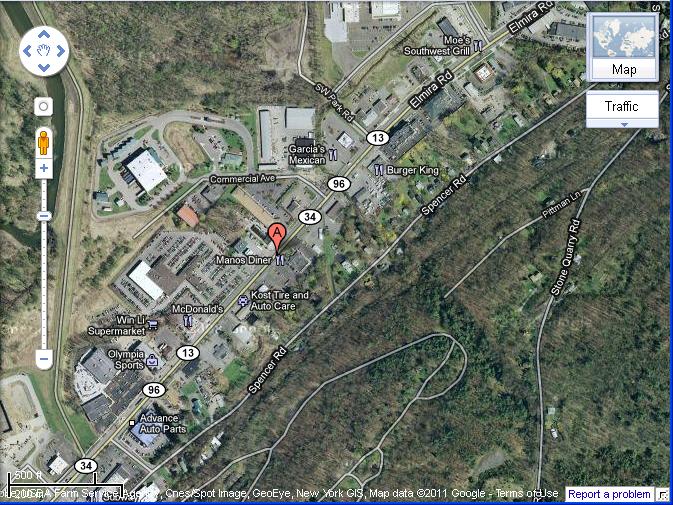
However, some of the recalcitrant locals may find some issues with the project. For one, it’s a Fairfield Inn, which is a national chain (more specifically, it’s Marriott’s budget brand). The proposal is also slated for construction on Meadow Street (Elmira Road), which is as close as the city of Ithaca has to suburbia. The proposal is targeted for a parcel of land between Elmira and Spencer Roads next to Manos Diner, which I’ve taken the liberty of copying from google maps and pasting below:

The location puts it in fairly close proximity to the Hampton Inn built about eight years ago. Also, a four-story building here would be one of the tallest in this part of the city. The minutes indicate that one of the planning board members asked why it couldn’t be built taller, to which the reply was it would need to be a masonry building, i.e. much more expensive. The project would require the demolition of one house at the corner of the property. UPDATE: and according to the Ithaca Journal’s 7/26 edition the redevelopment will also tear down Manos Diner. The planning board has stated this is incorrect, Manos is adjacent to the hotel and will not be demolished.

Since the developer says this will be among the very first of a new generation of Fairfield Inns, it’s hard to guess what the building may look like, as it may be a new corporate design scheme. The developer has already secured funding and is anticipating an opening in late 2012 if the approvals are earned quickly.

So, on the plus side, it adds density and provides a modest shot in the arm to the economic health of the community. Plus, the extra hotel rooms wouldn’t hurt around graduation time.


The Keyword Bar XI

27 05 2011

It’s been really slow news-wise, I’m been pouring my efforts into my work, and while I’m scratching my head for ideas, I might as well fall back on the tried-and-true method of answering or writing about peoples queries that bring them to this blog.

1. “can i join tke if i pledge sae” (5-13-2011)

I wonder if this was a Cornell student or someone from another school. Anyways, at Cornell, the answer was yes, under…extraordinary circumstances. Which I’ve already ranted about here.

2. “hotel brunswick” ithaca ny (5-14-2011)

A fun fact of the day – Theodore Zinck didn’t call his pub Zinck’s, as most of us might believe. Rather, he called his pub the “Lager Beer Saloon and Restaurant”, which was located in the Hotel Brunswick, which he also owned. The hotel and bar were discontinued after Zinck committed suicide in 1903. It was the pubs that came along after the Hotel Brunswick closed that were named Zinck’s, in honor of his service (and to try and conjure up good memories for visiting deep-pocketed alums).

3. “ithaca college a and e center tower” (5-15-2011)

I’m assuming this is the Ithaca athletics center that was being searched? At 174 feet (tallest tower in the county), it makes quite an impression. The below photo is from Cass Park (tower is in the upper left):

4. “cornell “university library” ‘arthur gibb” 1890 drawing” (5-17-2010)

It’s a fantastic monograph, but I’m not aware of any copies of it being online. However, while searching for it, I found this wonderful writeup about Uris Library by Matthew Stukus ’09. It gives a couple details I was previously unaware of, such as Cornell was going to have to pay Henry William Sage back for the library construction if it won the Great Will Case, and that contrary to previous haphazard planning, it took fifteen months for the site of Uris Library to be chosen. The writeup is only several pages, so it’s a brief but enjoyable read.

5. “ithaca coldest ever day” (5-19-2010)

People seem to have an odd fascination with this one; I’ve never seen a query for the warmest day in Ithaca, but I’ve answered the coldest day question previously. For those too lazy to click the link, the lowest low is -25 F, set once in January 1957, and once again in February 1961. This past winter’s coldest day, for comparison, was -15 F, on January 25th.

6. “did the ramones ever play at a cornell university party?” (5-20-2011)

Define “party”. They played at Barton Hall in February 1981. The Ramones came back to East Hill to play for Slope Day 1984 (where they ended up playing in Barton Hall once again because of bad weather). But as for private parties or fraternity parties, I’m not aware of any occasion offhand.

7. “experimental fantastic gothic death” (5-21-2011)

Um…nope. Not even going to think about answering this. But extra points for being really creepy.

8. “neighbors have rotting deer heads along property line” (5-22-2011)

Your neighbors are a lot worse than mine. I’m really sorry.

9. “is it difficult to grt into hughes hall cornell capacity” (5-24-2011)

That’s a really good question. To be honest, I thought Hughes Hall as a dorm was being closed and converted into academic use, but apparently its 48 rooms are still open for the upcoming academic year. Typically, about 25% of first-year law students live in Hughes. Your best bet is to call the Housing office and ask.

Hughes Hall is the product a million-dollar donation in 1956 from Myron Taylor LL. B. 1894, who was chair of the trustees for U.S. Steel Corp. The building, which was completed in 1963, was named for law professor Charles Evans Hughes, who was Myron Taylor’s favorite professor while he attended the law school. Prof. Hughes would go on to become governor of New York (1907-1910), U.S. Secretary of State (1921-1925) and Chief Justice of the Supreme Court (1930-1941).


An Exercise in Mapping, Part II

15 05 2011

Under Construction: The once-vacant Plantations Building on Ithaca Commons is being renovated into 8 apartments, a small amount of office space, and a large restaurant on the first floor of the 5-story building. The project is funded partially by community grant money and will be complete in about a month.

Approved: The 6-story, 52-unit apartment building proposed by INHS (1), the 7-story, 45-unit Cayuga Place condos (2), and the 10-story, 140-room Hotel Ithaca (3) are attempting to find financing in what is still a tight market for construction loans. The INHS building is dependent on state grant money that was not granted last year, and they are hoping to obtain financing in the next round of grants. The Cayuga Place condos has been looking for more unit sales and securing bank financing for almost four years at this point, and it might be time to move that to a stale proposal.

Proposed: The 6-story Challenge Industries redevelopment proposal, which has some office space and 32 units of housing. The project is currently trying to win over the neighbors and councils for zoning variances and approval down the line.

Stale/Dead: McGraw House, a senior living facility, was looking into a 25-50 unit expansion, and held several meetings to discuss proposals on the table, but this has all been tabled until a future time.

Examining the Ithaca College Area:

Note that I don’t use Bing Maps because I like them more, but because they are more up-to-date. For example, IC’s virtually complete Athletics Center is clearly visible on this aerial image.

Under Construction are Ithaca’s College’s Circle Apartments expansion (in the site prep stage; four current buildings (132 units) will be demo’d and nine more (280 units) will be added to the complex) and a 22-unit addition of senior housing (patio homes) to Longview.

Approved are the College Crossings retail center and INHS’s Holly Creek townhomes (11 units in first phase, I think 22 total). Off the map to the south and southwest are a couple of housing developments, Southwoods and Cleveland Estates, which are being developed lot-by-lot.

The proposed facility is the long-term expansion plans for the South Hill Business Campus, which would add 197,000 sq ft in three new buildings 3-4 stories in height. The campus currently has about 288,000 sq ft, of which about 84% is leased.

The stale proposal is an apartment building off of Bella Vista Drive that has been trying to market its units for the better part of five years. I am doubtful it will ever launch construction at this point.


Taking Care of Cornell’s Students’ Bodies

10 05 2011

After I wrote about the medical college, I felt inspired to write up a brief piece regarding the history of student health at Cornell. Understandably, the value of this entry to the practical person looking up health information is nil, but then, I would hope that if someone has health issues, they would be looking through health websites like Gannett’s instead of blogs.

Anyways, most Cornell students know that if they feel sick, or think they might be pregnant, or some combo thereof, that a trip to Gannett Health Center is in order. Back in Cornell nascent days, if you were sick, well…you were pretty much screwed. A student at Cornell a few years after its founding, if they were to become ill, could hope to be taken care of by their friends, roommates or professors, if they were lucky and had strong connections. Otherwise, you were S.O.L. If it was any consolation, so were all residents of the city of Ithaca, which wouldn’t get it’s first hospital for a few more years (the first hospital opened on Aurora Street sometime during the 1870s, and the second hospital was built off of Quarry Street in Lower Collegetown in 1910; that complex still stands today as the Quarry Arms apartments, which Collegetown Terrace will be built around). In 1870, the faculty senate voted to set aside rooms on campus for sick students (Bishop 176), and the first medical examiner, a sort of campus physician, was appointed in June 1877 (he held two job titles, the other being an assistant professor of mathematics). Jennie McGraw of Cornell Chimes fame put a bequest in her will of $15,000 for the construction of a student hospital on the grounds of Cornell, and this was increased to $40,000 before her death in 1891. However, thanks to the Great Will Case, Cornell never saw any of her money used towards a health facility.

The first building dedicated solely to student health was the Cornell Infirmary, which still stands as the Schuyler House dorm to the far southwest of main campus. The Sage Complex  initially consisted of only the east building, which was essentially a converted mansion built in 1880 as Henry Sage’s retirement home after he moved from Brooklyn to Ithaca (Bishop 211).  Upon his death in 1897, he asked that the building and land be donated to Cornell, which his sons Dean and William did with an additional $100,000 donation for maintenance (Bishop 333). They might not have done that if Sage had outlived his nemesis and fellow generous benefactor Willard Fiske. Both sons were furious that Fiske was interred in Sage Chapel in 1904 and abruptly stopped all involvement and donations to the university. William Sage actually had donated a building to Yale some years later. But, I digress. The original Cornell Infirmary had room for twenty patients, and the large addition on the west side was completed in 1912. What you received was bed, board, and modest nursing care and lab services. While a student of yesteryear might receive advice on hygiene or bad habits, actual diagnosis by physicians was a role the university refused to take on until around 1940. It was felt that the university should not be responsible for the clinical care of its students, only lend a hand in their treatment. Medical advising by Cornell staff was generally discouraged.

By the 1950s, it was felt that the Infirmary was inadequate, poorly located and outdated, so a new building was constructed on land that used to hold two faculty residences. This building was named for media mogul Frank Gannett 1898, who generously funded its construction. The Gannett Health Clinic opened its doors in 1955 and received an expansion to its west side in 1979, bringing it to 39,000 sq ft. The masterplan suggests a 90,000-130,000 sq ft structure to replace the current building on the current site sometime during the next several years.

I’m marginally jealous that Cornell’s health center is on campus. The one at my grad school is located a half mile away across a four-lane highway. What a nice way some colleges provide for their students.