An Ever-Expanding Ithaca Apartment Hunt

4 01 2013

11-24-2012 167

So, this post relies on a question originally posed by “Steve” on the welcome page:

I wonder if you can comment on the number of new apartments being built in Ithaca from a historical perspective? It seems like there are many coming online but I don’t have a long enough perspective.

As a matter of fact, I had obtained this info several months ago for reference, from a report given to the DIA by the Danter Company regarding the Ithaca housing market’s trends, needs and projections. But I had never made much use of that data until now. Even to the casual observer, there has been an uptick in construction around and about the Ithaca area as of late. As the metro has expanded a little over 5% (~5,500 people) in the past decade, some growth is to be expected. The Ithaca market (mostly defined as Ithaca city/town with some parts of Lansing) is believed to be capable of absorbing about 1,350 units over the next five years, 25% owner-occupied (most likely condos) and 75% rental units.

As of April 2011, there were 4,793 units in 75 developments (5 others with 270 units of subsidized housing are excluded from analysis). 49% of all those units are occupied by, no surprise, students at IC or Cornell. Borrowing a table from the report itself shows the number of multi-unit projects built within Ithaca proper, broken down into separate time periods.

danter1

So, adding up the 2000s gives 654 units 14 projects. This is a substantial increase from the 454 units built in the 1990s, but somewhat less than the 824 units in the 1980s, and less than half of the 1,604 units built in the 1970s. For the curious, the project built in 2009 was INHS’s Cedar Creek on the west side of the city. West Hill accounts for over half of the new multi-unit housing built in the 2000s, with Overlook at West Hill (128 units, 2006), Linderman Creek (128 units in 2 phases, 2000/2004) Cayuga View (24 units, 2005) and Conifer Village (70 units, 2008). Collegetown also makes up a small portion, with projects like 407 College (25 units, 2006) and Coal Yard Apartments Phase I (10 units, 2007).

Now, starting around the time this left off, there have been a number of major projects. Within the 2011-2016 time frame, here’s a sample of what’s completed/under construction/planned (I’m not going to link to each one for this entry, but the curious can make use of the search bar to pull up more info from other entries):

Collegetown Terrace (U/C; usually defined with “beds”; but in terms of units, the construction company in charge suggests 246 units, but that may just be one phase). EDIT – 610 units. That’s…a lot.

309 Eddy (completed, 24 units)

Coal Yard Apartment Phase II (completed, 25 units)

107 Cook (U/C, 4 units)

Breckinridge Place (U/C, 50 units)

Collegetown Crossing (in review, 60 units).

Thurston/Highland (in review, 36 units)

Seneca Way (U/C, 38 units)

619 West Seneca (U/C, 24 units)

Cayuga Green (approved, 39 units)

Fane Properties/ 100 E. Clinton (proposed, 36 units)

Harold Square (proposed, 60-70 units)

Cascadilla Landing (in review, 134 units)

Stone Quarry Apartments (in review, 35 units)

Conifer Phase II (72 units, senior housing, site prep)

Purity Ice Cream Redevelopment (proposed, 13-26 units)

Hawk’s Nest at Springwood (proposed, 50 units)

Cinema Drive (proposed, Lansing village south of 13, 39 units)

Lansing Reserve (proposed, on the north edge of what the Danter study calls “Ithaca” proper; 65 units)

College Crossings (U/C, 2 units)

So in the Ithaca area proper, in a span from 2011-2016, I’m estimating at least 1,415 units in 20 projects. This assumes the townhomes with the Vine Street Cottages and Holochuck Homes projects are not rentals (and not included in this tally), excludes the several hundred units of housing planned in the town of Lansing (town center, Village Solars, etc.). Also, Ithaca Gun and its 45 units are not being included until that project leaves limbo.

So to answer Steve’s question- Ithaca is running well above average, and is on a pace not seen since the 1970s. Quite the uptick indeed.


News Tidbits 3/16/2012: What Lies Ahead for Cook Street

16 03 2012

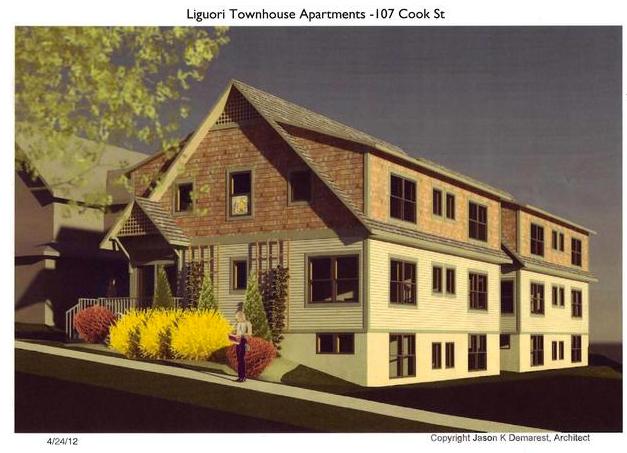
From Cornell Daily Sun. Image Updated 4/25/2012.

From the Ithaca City Planning Board:

Site Plan Review, Townhouse Apartments, 107 Cook St., Jason Demarest, Applicant for Owner, Dan Liguori. The applicant is proposing to construct two 2‐story townhouses with partially finished basement levels, four parking spaces, and asphalt‐paved access drive, walkways, and landscaping. The buildings are each 2,304 SF with 6,128 SF finished floor area, and contain two 3‐bedroom dwelling units, for a total of 4 new units with 12 new bedrooms. Proposed exterior finishes include brick, fiber cement board, cedar shakes, and stained wood lattice detailing. The project is in the R‐2b Zoning district. This is a Type I Action under the City of Ithaca Environmental Quality Review Ordinance and the State Environmental Quality Review Act (because the site is contiguous to a historic district) and is subject to environmental review.

If the address looks familiar, it should. The ca. 1912 house that stood on the property was engulfed in flames in May of last year, killing a Cornell student. One of the factors that was believed to have weighed in on the fire (which was accidental) was a confusing internal configuration due to subdivision of the original property from single-family into multiple tenants (there were eight units total, housing 13 students).

The first proposal for new development on the property was rejected for a couple of reasons – for not having a porch, and for having a mansard roof that wasn’t much of a mansard roof. The planning board has been fairly adamant that any new property on the street fits in with the current set of buildings. Well, that and fire safety. Old single-family houses that are subdivided are usually grandfathered from the sprinkler requirement as long as the alterations are strictly internal.  The new building would have to have a sprinkler system in order to be approved as a multi-tenant building.

So here we are on proposal two; townhouses, two units in each, 12 bedrooms, so two bedrooms less than the previous proposal and one less than the original building. Based off of description alone, with cedar shake and wood lattice detailing, it sounds like this structure is more in-line with the current style of buildings on Cook Street. I for one will be curious to see how it looks.

Arguably, from a purely financial standpoint, it would be a blunder to not redevelop the property – several new units close to Cornell would fetch a higher going price than neighboring houses, just for being newer and safer. Also, paying taxes on land as highly valued as Inner Collegetown’s probably dissuades the owner from sitting on the property. If one were planning on holding onto the parcel for the long-term, this could be a potentially lucrative setup for the small-scale owner/developer.

Taking a grander view, I wonder if projects like this could be a demonstration of what may lie ahead for some smaller Collegetown properties.  As large new developments open up (CTown Terrace, the Palms proposal, etc.), and assuming a static student population, the rates for older unrenovated buildings will go down and the owner’s revenue will take a hit. This will be further compounded on poorly-maintained properties; owners who suddenly have a building declared unfit by the city, and have to make costly repairs or rebuild (while being excoriated by local residents and officials).  Ii is possible that over the next decade or so, more projects that seek to build smaller but  student-specific properties will be proposed in the area. Quality of design and materials, of course, is up to the owner and requires the city’s approval. In summary, I see the redevelopment of 107 Cook as an illustration of what may lie ahead for Collegetown.


News Tidbits 3/6/12: From Orthodox Greek to Christian

7 03 2012

…and by Orthodox Greek, I mean your normal Cornell Greek house. But I enjoy a little bit of word play.

I had come across a piece in my Cornell feed about a Christian house at Cornell on The Knoll called “Chesterton House”. I thought it was unusual that I had never heard of it, but I wrote it off as being some low key residential organization, like many at Cornell are (for example, Telluride, the Co-Ops and a few of the professional fraternities). I noticed its location was 115 The Knoll, which failed to ring a bell – I thought it was a rowers’ house or home to some of the Big Red Band. I’ve been vaguely aware that there were five houses on the Knoll, so there was bound to be some non-Greek component.

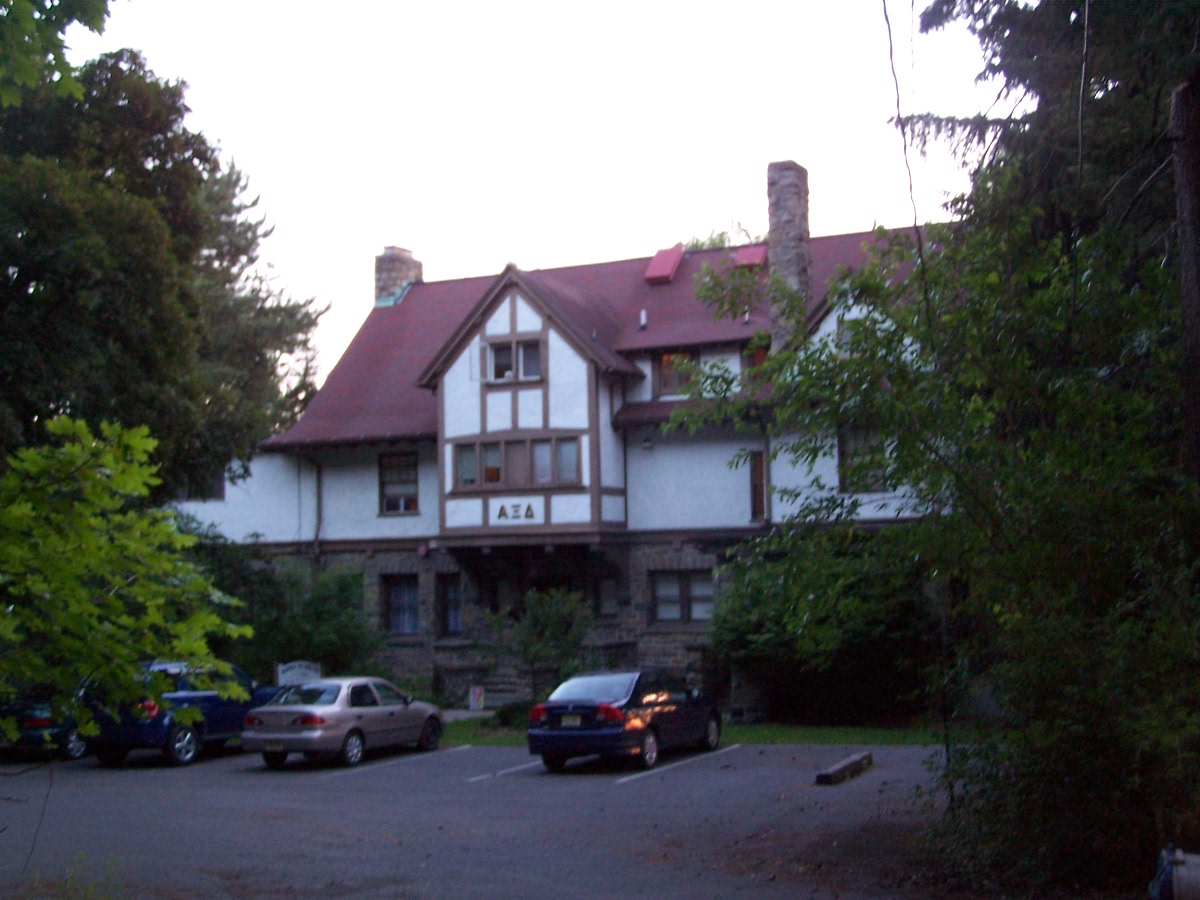
Then I glanced at their website – it’s Alpha Xi Delta’s old house. The one I profiled a couple years ago.

According to their website, the house is named for Gilbert Keith Chesterton, an early 20th century writer and “defender of the Christian faith”. The house holds 15 and is all-male, with the female equivalent being Sophia House at 315 Thurston, the house with a stucco finish and the extremely high-pitched tile roof. Apparently that house is being rented, so it is not under the organization’s possession. Now, the house on the Knoll is owned by Delta Phi Epsilon sorority, the last I checked (for the record, they’ve owned it since 1962). So I’m going to venture that this is a fairly recent endeavor, and a big step for an organization that was established only 12 years ago. Although a relatively young organization, it’s certainly garnering its share of alumni support.

I for one welcome them to establish themselves as one of the many opportunities afforded to students at Cornell. In my mind, I see it as something similar to the Jewish Living Center on West Campus. My one encouragement is that they adopt a policy similar to the Jewish Living Center and encourage freshmen to live with the other freshmen. I’ll willingly admit that as the brother of a fire-and-brimstone evangelist, I’ve been wary of religious groups in general (one tends to be that way when your sibling tells you you’re going to hell at every Thanksgiving dinner, for being a secular  Christian). But it’s also addressing a niche group at Cornell and offering more for some individual’s Cornell experience.


News Tidbits 8/22/11: Kappa Delta’s Swanky Renovation

22 08 2011

It would be nice to live in Ithaca, but since I don’t, I increasingly find about construction projects from word-of-mouth rather than investigating on my own. In correspondence with “BB” from the Milstein Hall entry, he briefly mentioned that he’d take some photos of KD’s renovation project.

It piqued my curiosity because that was the first time I had ever heard about it. My first thought was that it may not have been an immense piece of work because I hadn’t seen anything in the planning board minutes from the city. But, I decided to quickly check online to see if there was anything special about this construction project.

I barely recognized the house.

Here’s the before photo, from my own archives (dated July 16, 2008).

Here’s an after image from a construction blog on their website:

It’s a pitifully small photo, but I’ll rectify that when I take a photo at Homecoming. Note that the west wall (right side) visible in the before image is now the front entrance.

The most substantial change is the construction of a generous wrap-around porch from Sisson Place onto Triphammer Road. The construction itself isn’t expanding the structure much, about 800 sq. ft on the first floor (based off what my strained eyes can pull from the elevations image at top). But the exterior reclad with an emphasis on a traditional appearance does wonders for what was arguably one of the more rundown-looking sorority houses on campus, creating a more graceful, less bunker-like presence. According to the webpage, the renovation cost is around $400,000.

Regarding the comment on the webpage about Triphammer Road being the original entrance location, I don’t have any verification of that, but it is quite likely. KD moved to its current location around 1923 and underwent several renovations/expansions in the years since.

In terms of exterior alteration, this is probably one of the most substantial changes since Sigma Pi built a new house in the mid-1990s. I must admit that the final result looks impressive.


News Tidbits 9/8/10: The Kappa Sig Dorm

9 09 2010

Being interested in both the Greek System and in the university’s physical facilities, an article that details how Kappa Sigma’s house has been transformed into a small dorm is bound to catch my attention. Evwn better, it’s a very well-detailed article, and I found myself pleasantly surprised with the quality of work.

I guess being an alum just reminds me of how unaware of news I am now, as this was the first time I heard anything about this renovation and reopening. The reuse of the building as a dorm is actually the less surprising part. 112 Edgemoor and 14 South are former Greek houses that operate now as small dorms (Triangle, which closed in 1985, occupied 112 Edgemoor up to 1985 and Kappa Alpha lived in 14 South from 1957-1990). Cornell purchased the Kappa Sigma facility as part of the Cornell University Residential Plan of 1966. Reasonably, when Cornell owns a facility (as it does with at least 15 Greek houses, of which all but one (722 University Ave.) are fully occupied), it’s financially much more preferable to maintain the space as a working residential facility. This goes for private houses as well — the article mentions Pike is being rented out as a boarding house. This policy also has bearing on active chapters; boarding which is a popular option with residential fraternities with low membership numbers as a way to maintain the financial viability of a house. Interestingly enough, the university used Craigslist to advertise the spaces, and managed to fill all but one.

The article reports that the estimate for maintaining an empty fraternity house runs about $80,000 to $90,000 in a given year. The extremely general description for the expenditures is maitenence. More specifically, heating (pipes may burst in the winter if the facility isn’t adequately heated), insurance, security for a vacant facility, interior and exterior upkeep, and other utilities (which cost money to even have access to let alone use) come to mind.

I’m rather surprised at Cornell’s investment in renovating the facility. I dunno how much work had to be done, but if the Kappa Sigma alumni have already started the rechartering process, then it’s likely the university won’t be filling the facility for more than two years.  But, I don’t know much about the maitenence of university-owned Greek houses (my fraternal alma mater was privately owned by an alumni board). It just struck me as curious.


News Tidbits 8/1/09: Edelman Realty Puts Sorority House on the Market

2 08 2009

http://aedelman.com/search.php?mls=129820&startat=20&price1=&price2=&area=&elemsch=&school_district=&new=1&luxury=

Realtor Description:
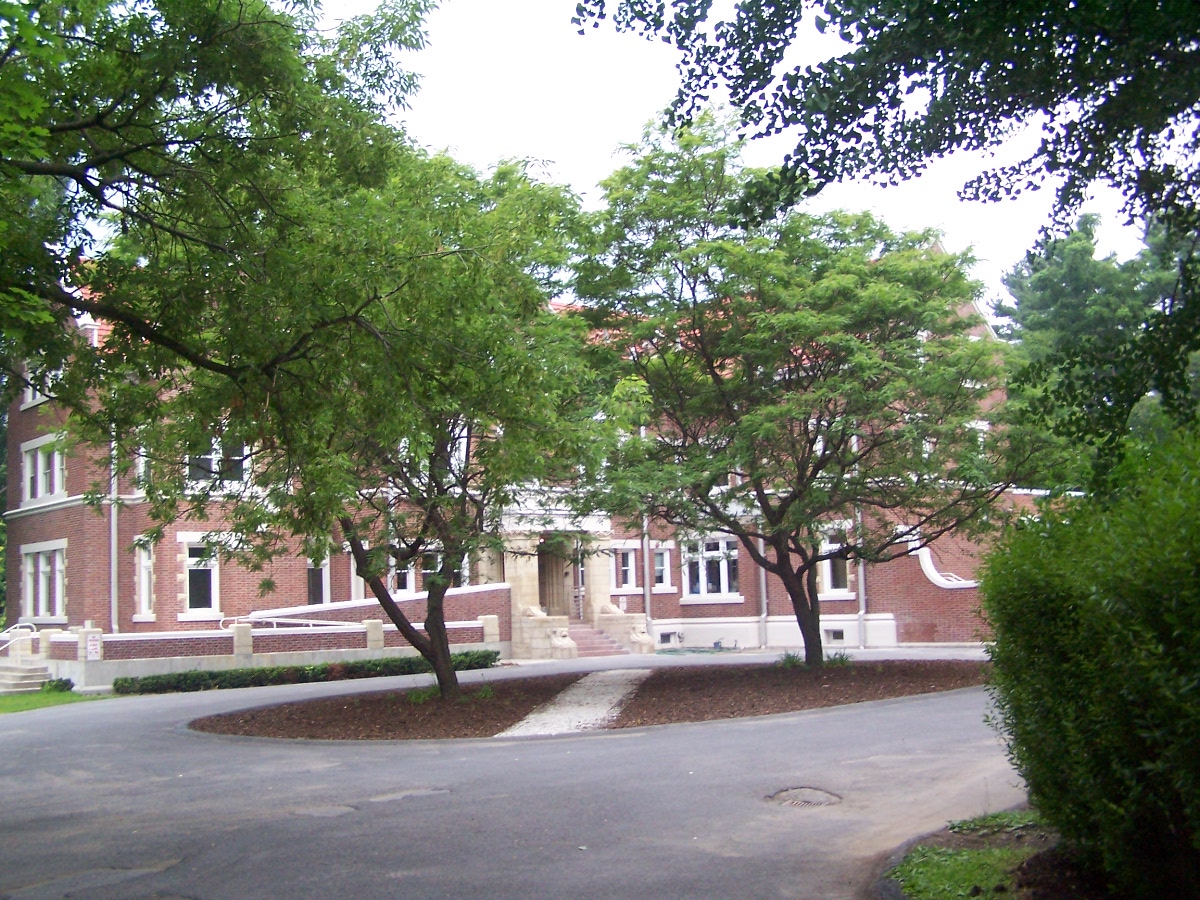
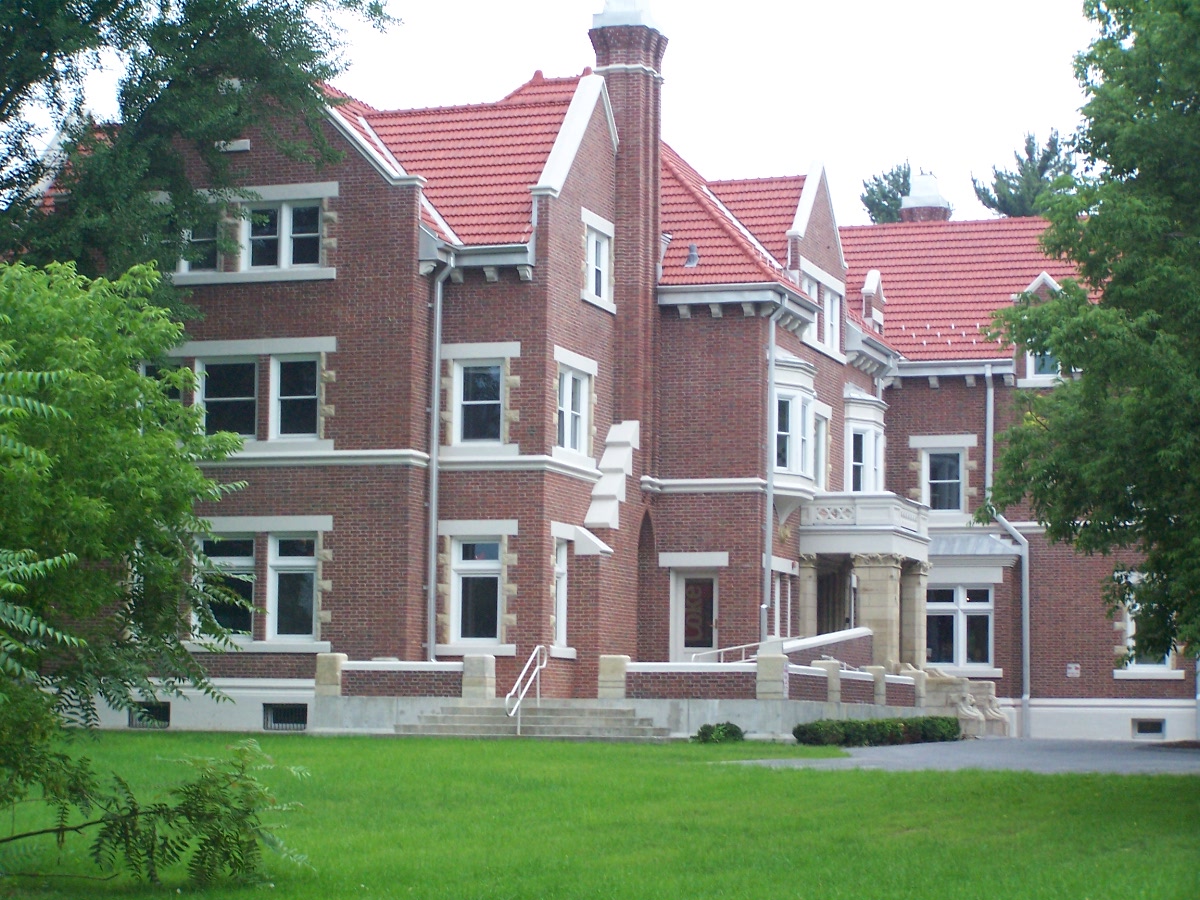
Own a piece of Cornell History. Delta Phi Epsilon Sorority is an arts & crafts style stone & stucco building on The Knoll. Built circa 1915 with up-to-date sprinkler, fire alarm & other safety systems. Compliant w/all inspection by the City and Fire Department. Living room, chapter room, paneled dining rm, commercial kitchen. 15 rooms for up to 25 occupants.There is an also a one bedroom two-story caretaker’s cottage with a separate driveway. Approximately 18 parking spaces+driveway to cottage.

The house’s list price is $795,000. Technically, the property has two units, the second being the small building in the second photo (both of these photos are from the listing).

100_1359

Personally, I think my photo is more flattering.


Exploring West Campus

15 08 2008

First off, let me say I do not support nor condone any illegal activity, especially for the purpose of information gathering. That being said, going into prohibited construction sites is a lot of fun if you’re careful where you step and you can avoid the workers leaving for the evening.

So, this started when a friend of mine who happened to figure out that I was the writer of this blog sent me a message asking if I could go through the new West Campus and take some photos. Knowing he wasn’t in Ithaca, I decided that I would be happy to oblige this time  (but I certainly won’t be making it a habit).

Token War Memorial shot.

First off, the War Memorial. These photos are actually from my fraternity photo tour last month. The War Memorial was constructed from 1926 to 1931. It honors the 264 Cornellians who were killed in action in World War I. However, it does not honor a 265th death, that of Hans Wagner 1912, who was killed in action while fighting for the Axis Powers [1].

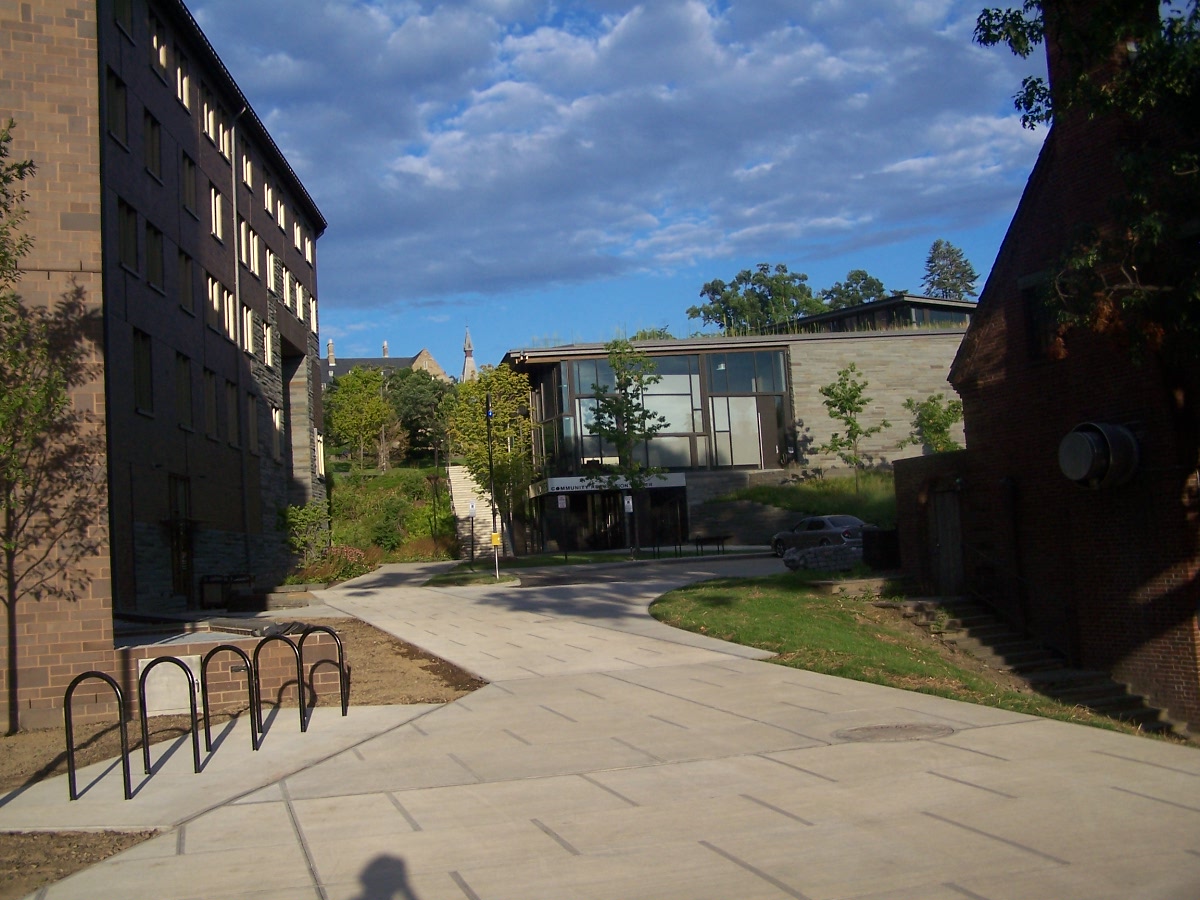
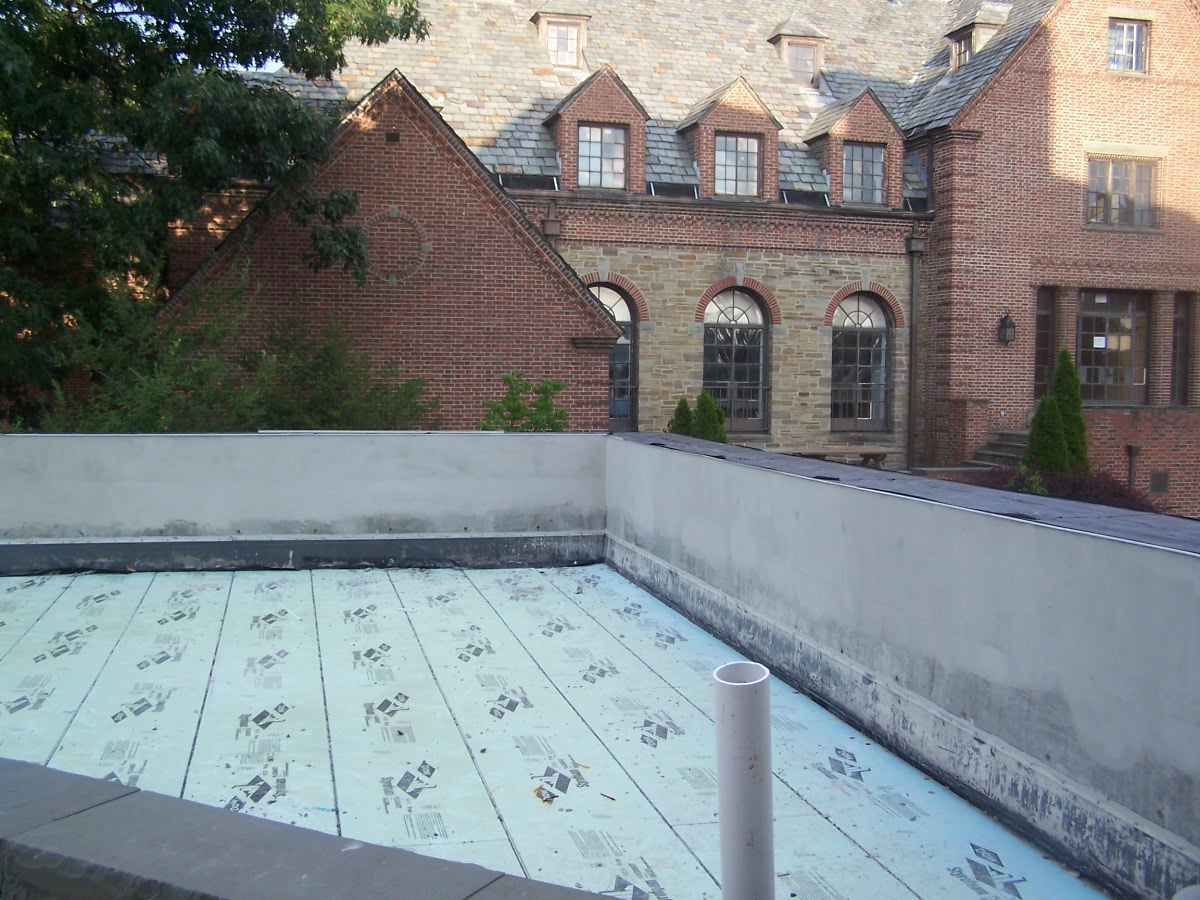
Noyes and Hans Bethe dining hall have grass roofs. Cornell, take note to not follow IC’s folly and set off fireworks right next to a building with a grass roof; it just might catch fire.

Any makeshift fence can be scaled. But why bother when there’s a narrow space between it and the wall?

Base of the War Memorial steps, being renovated.
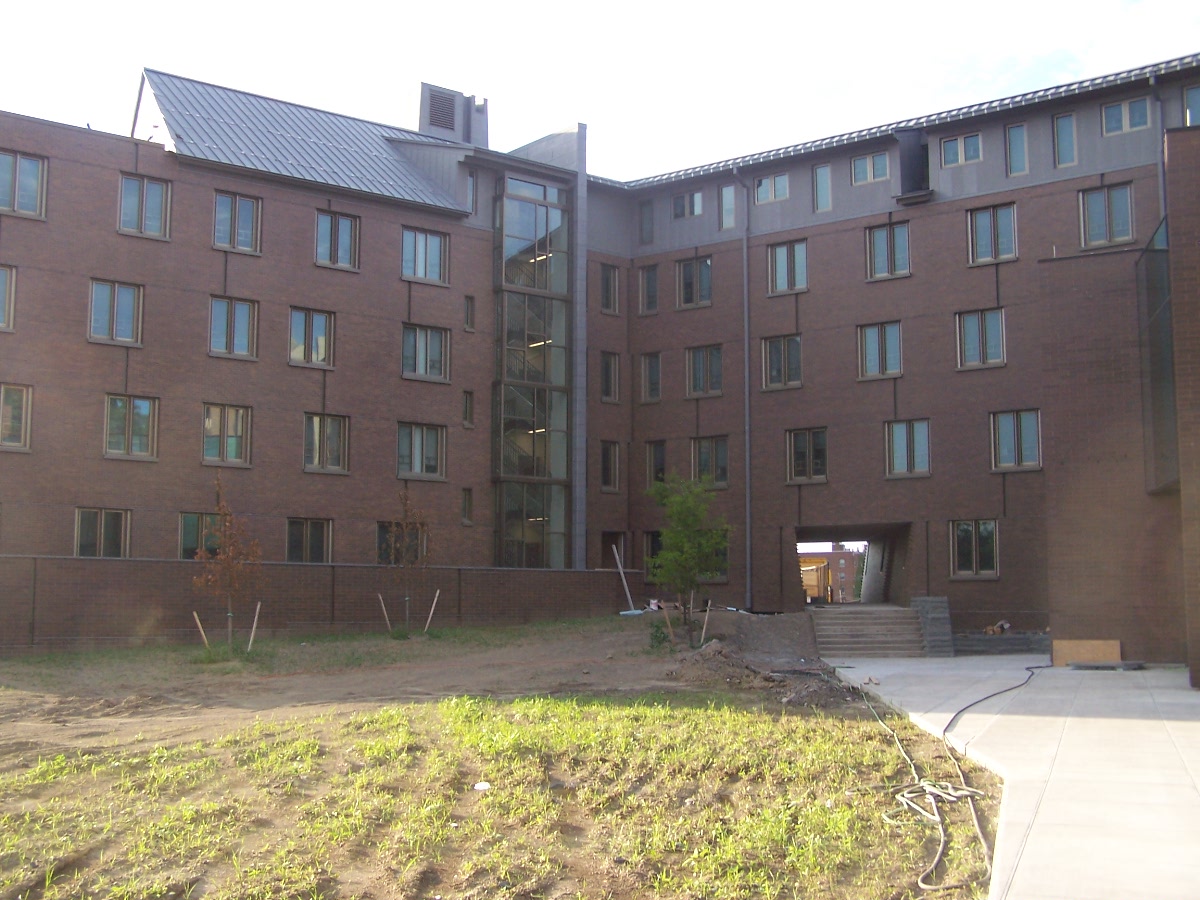
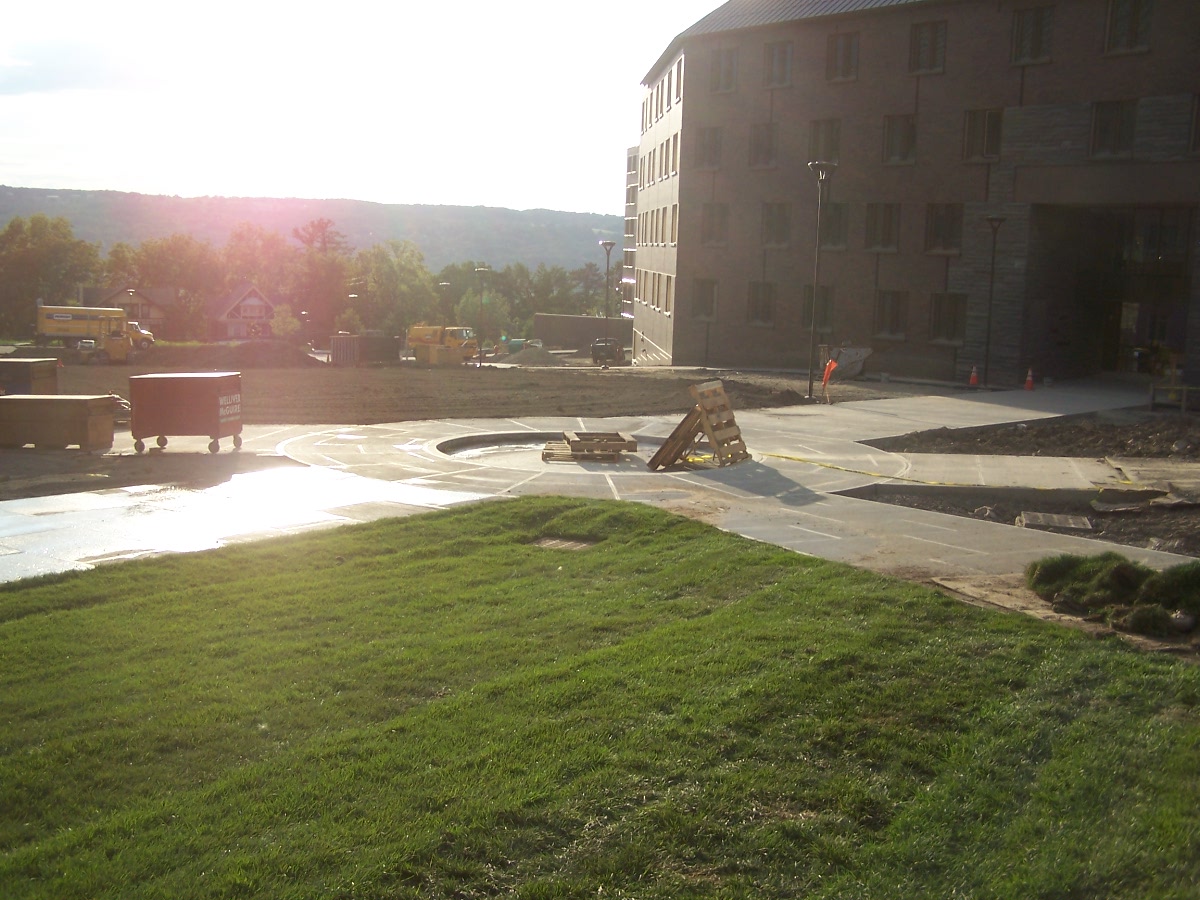
A new central plaza area between House 5 and Bethe.

House 5, south face

Don’t mind my shadow.

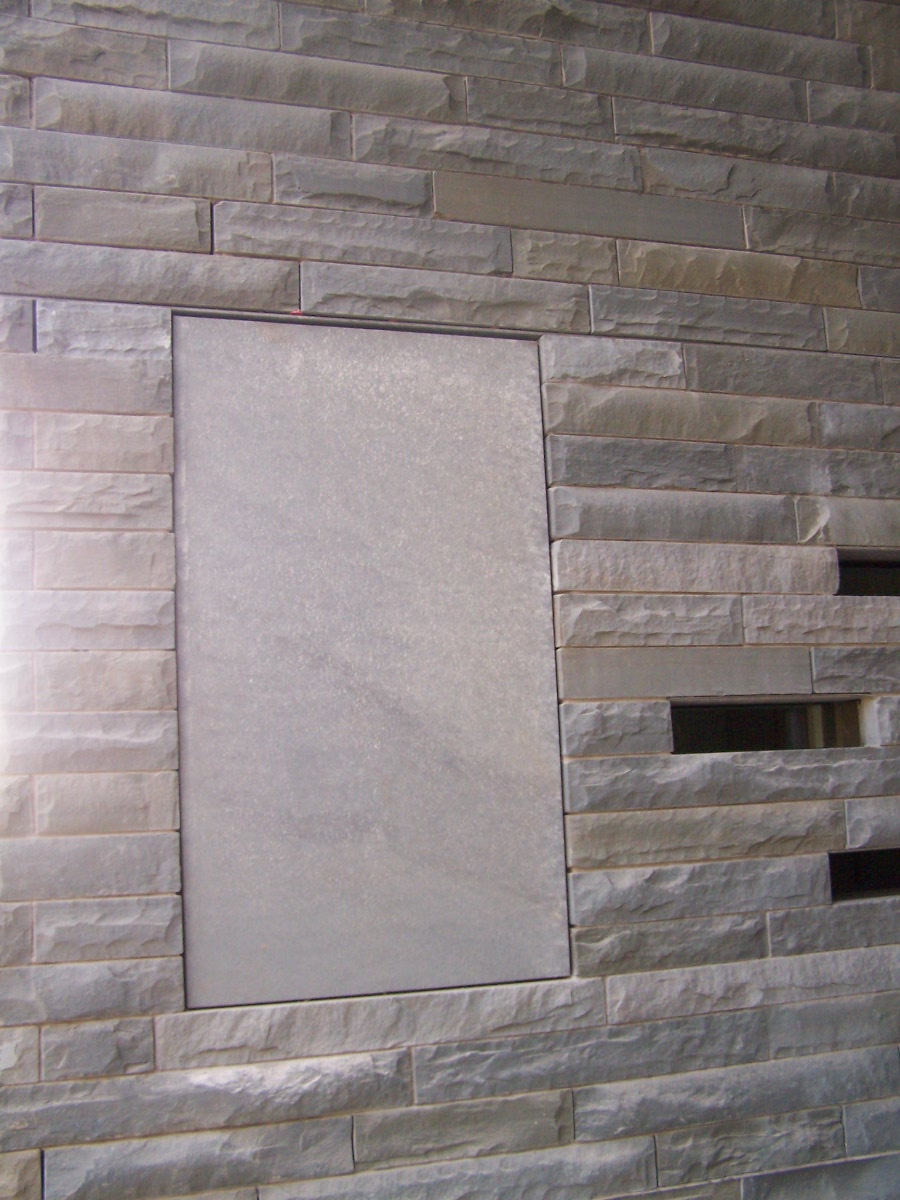
Curious horizontal window slits near the entrance of House 5.

Nameplate, unfinished for now.

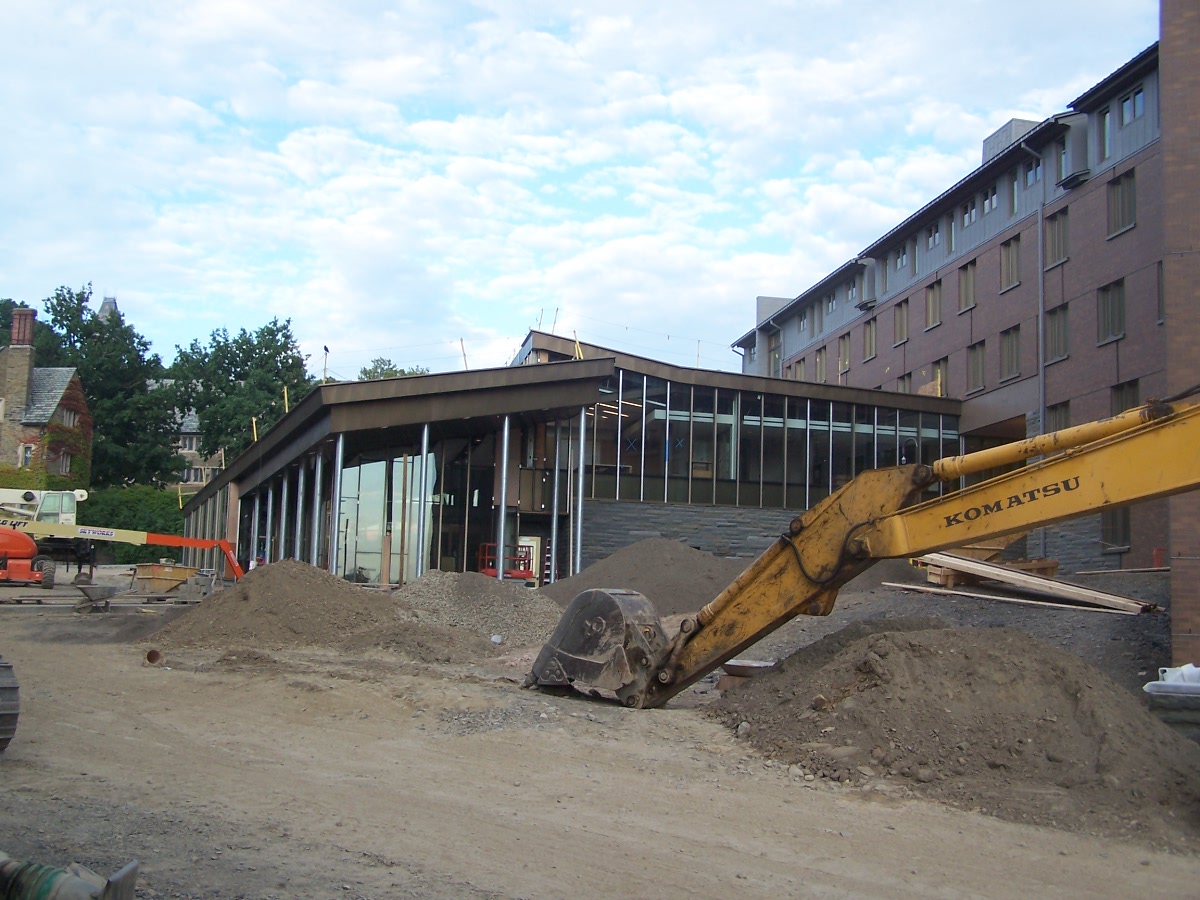
House 5 Dining area, NW corner

north face, house 5

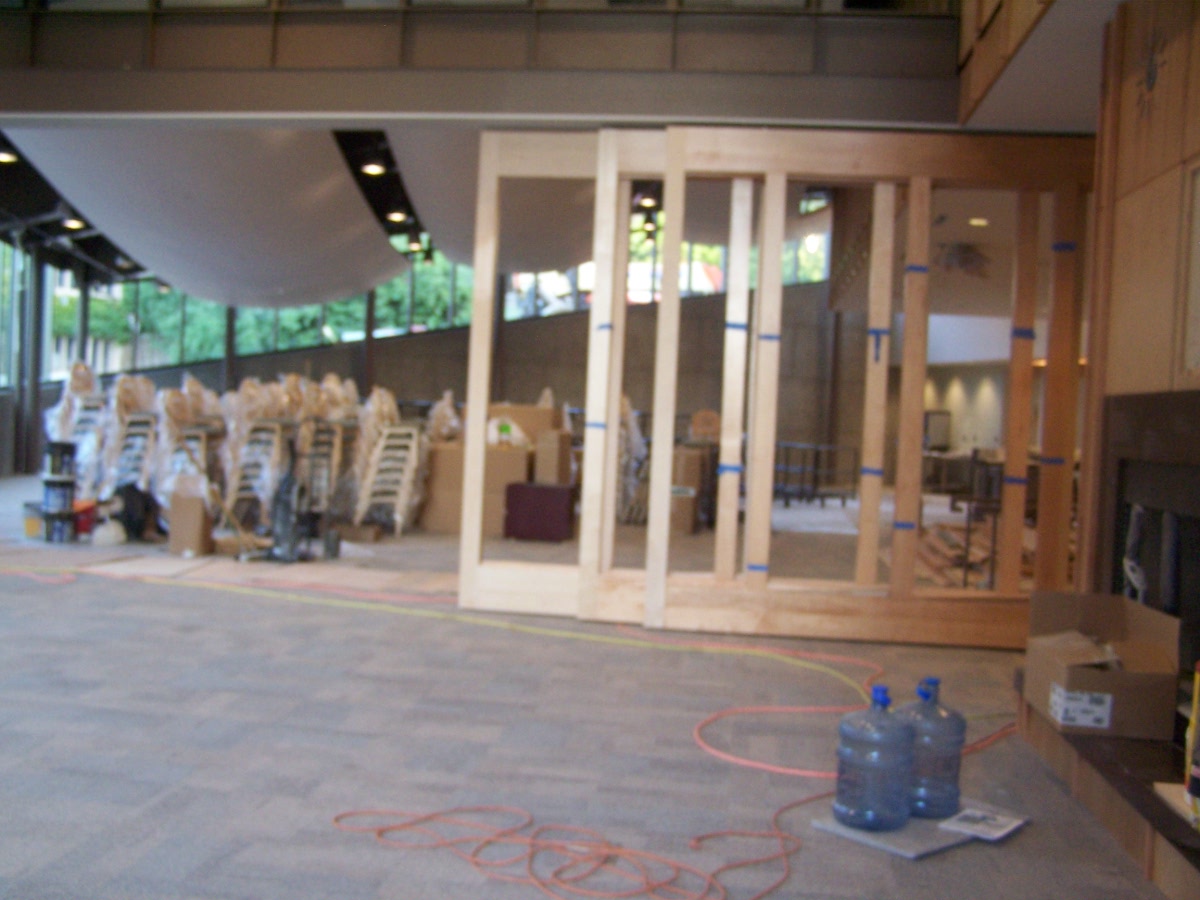
House 5 dining area interior, unfinished

Keeton House, north face

Noyes, from Keeton

A corner plaza next to Keeton. Psi Upsilon is in the back.

A plaza/planting area just outside of Keeton.

Keeton’s connective corridor.

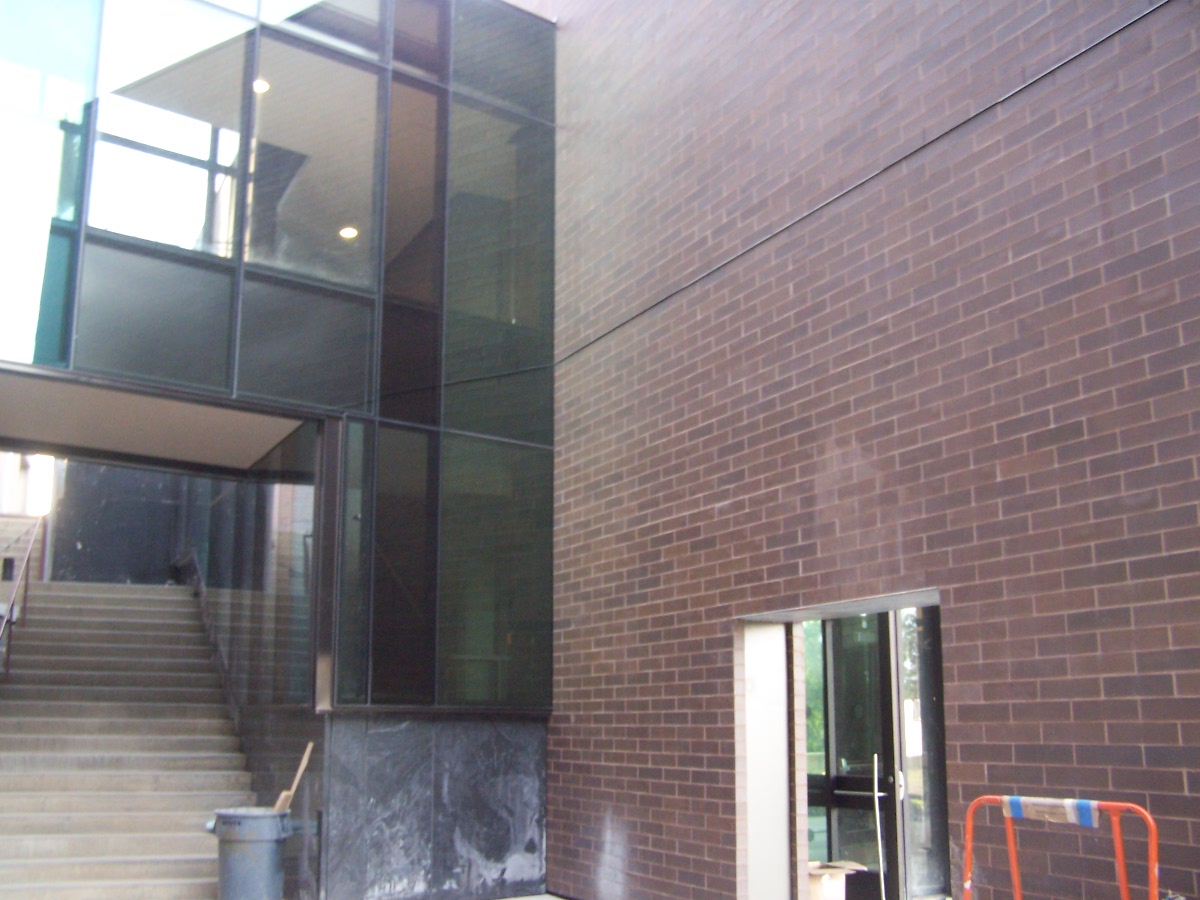
A staircase at Keeton that leads under the corridor.

A large blank wall next to the previously mentioned staircase.

Note the coloration of the glass in the connective corridor.

Keeton’s south wing. Notice how the top floor has a different window pattern and uses different materials.

An interesting if not aesthetically pleasing entrance area for Keeton’s north wing.

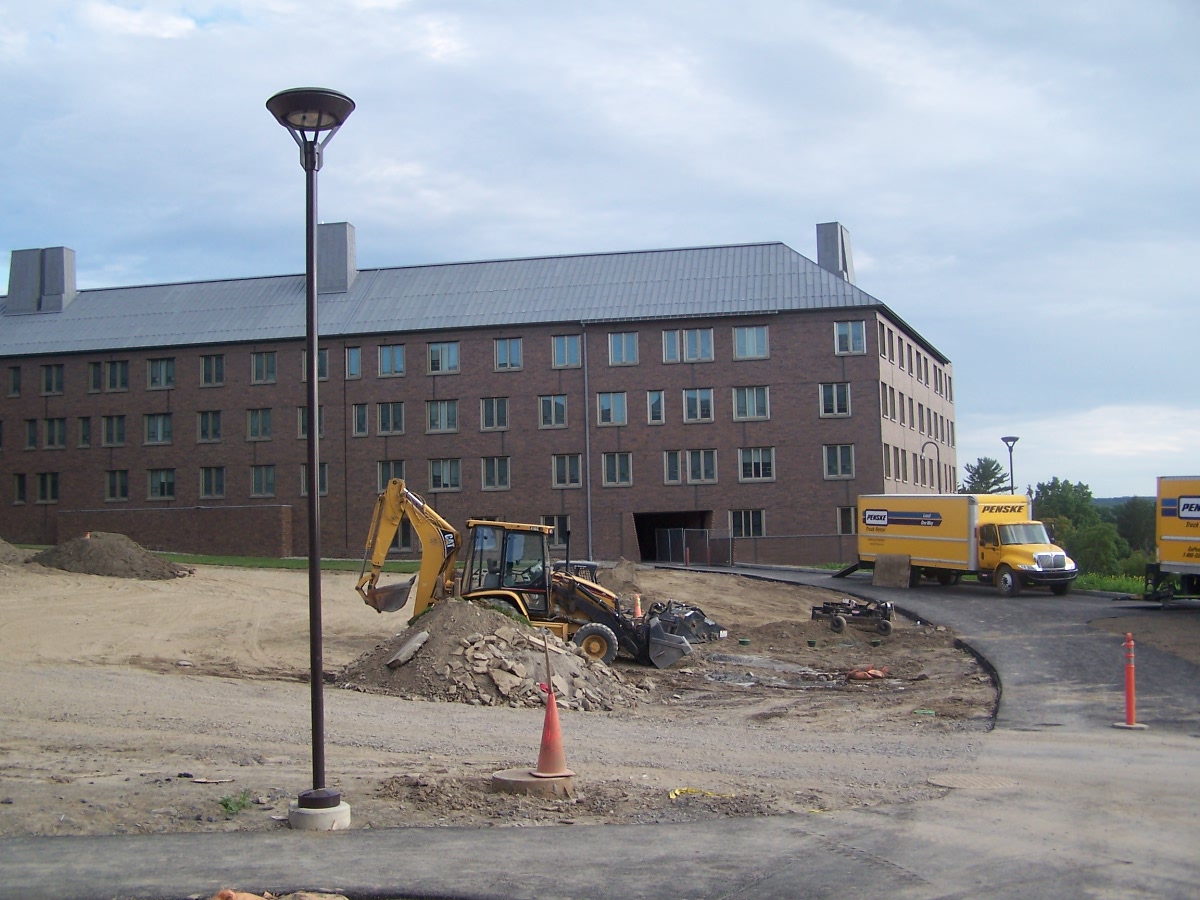
Had to hide from construction workers by hiding behind the board next to the Penske truck.

The unfinished nameplate for Keeton.

Keeton’s balcony.

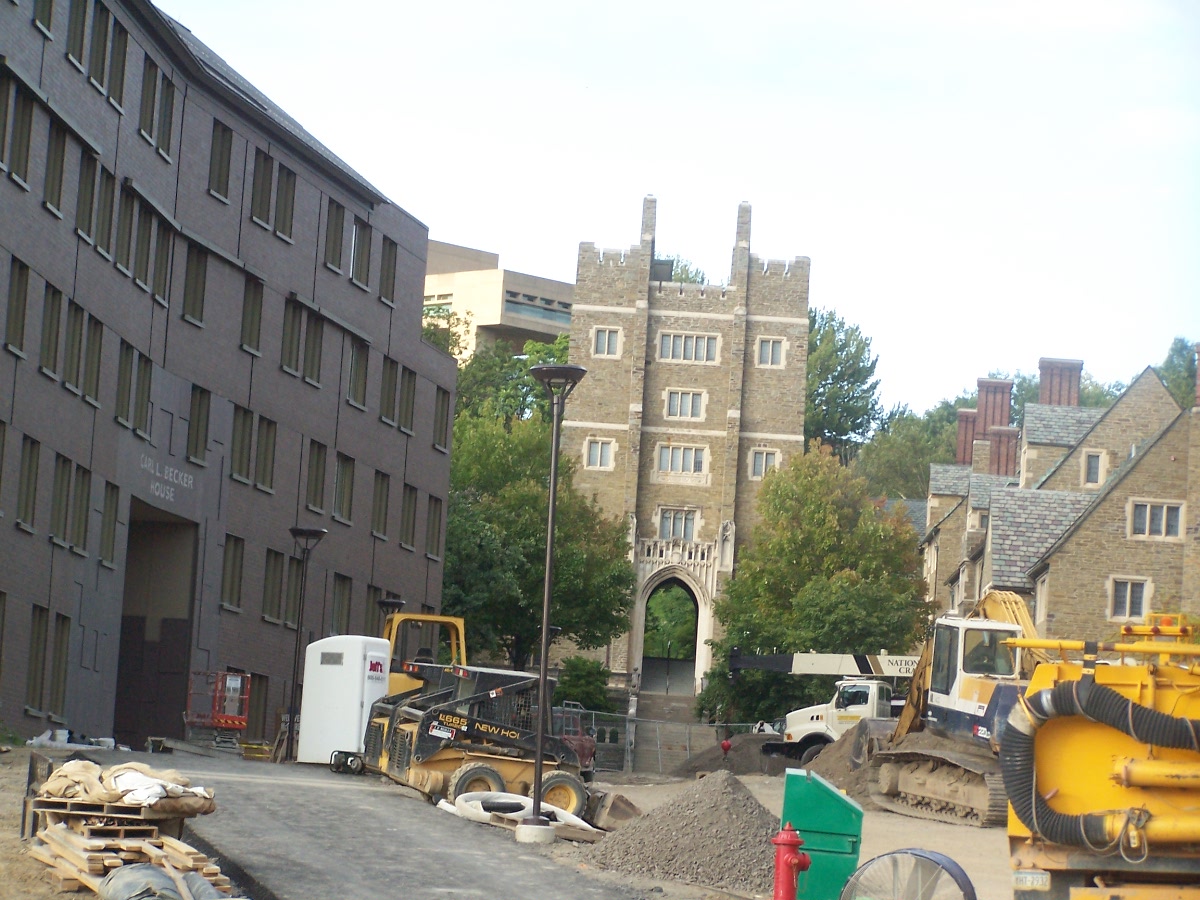
An architecturally interesting juxtaposition of Baker Tower, Becker House and the Johnson Museum.

Keeton’s lobby area

The dining area and an adjacent lounge in Keeton House.

A random hall of dorm rooms in Keeton.

***

Boldt Hall and Tower

ATO painted their house, it seems.

As for the photo request…consider it fulfilled.

[1]http://cornellsun.com/node/19107


North by Northwest of Campus

12 08 2008

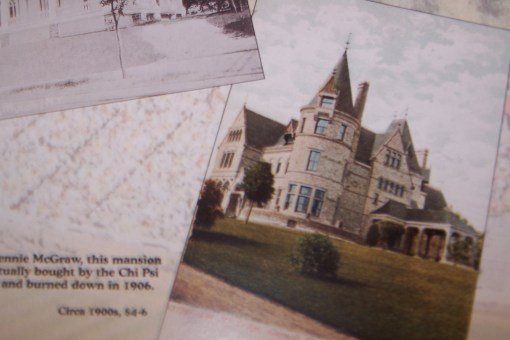
The house of the Chi Psi fraternity of Cornell University. Chi Psi has had a colorful if traumatic history in its century-plus long history here at Cornell. The Chapter at Cornell was founded in 1869. While they lived elsewhere, Jennie McGraw, the daughter of John McGraw, who was a wealthy lumber merchant and one of the first trustees of Cornell (for whom McGraw Hall is named) [1], fell in love with the first university librarian, Daniel Willard Fiske. She was old for loving at the time, pushing forty. She was also suffering from terminal tuberculosis. Regardless, she and Willard eloped and engaged in a whirlwind tour of Europe, while an opulent mansion was built on the edge of the gorge. She lived just long enough to see it with her own eyes, passing as they arrived home in 1881 [2]. Willard moved in, but his behavior was considered a little too exuberant for someone whose wife just died. Plus, due to some legal issues with Jennie’s will (which might make for a good entry another day), he and Cornell ended up on really bad terms, and he spent most of the rest of his life in Italy (on the bright side, he somewhat reconciled with Cornell in later years and donated his library upon his death in 1904 [3]).

That story is tangent to Chi Psi. Willard sold the opulent McGraw-Fiske mansion to the fraternity around 1881[4]. It was during the cold night of December 6th 1906 that the second deadliest campus tragedy in Cornell’s history occurred.

Sources tend to indicate it was caused by flammable polish being used on the floors. Others have gone as far to suggest that the house was cursed due to Jenny and Willard’s indiscretions. Regardless, the house caught fire. And in the days before real fire engines, any water to be used on the house (that wasn’t frozen) was a mere trickle. Of the twenty-six fraternity brothers living in the house, four died. When one of the exterior stone walls collapsed, it landed on volunteer firemen from the city of Ithaca, killing three of them. By the end of the night, the house was destroyed, and seven people were dead [5].

Photo Courtesy of "Greetings from Ithaca"

Photo Courtesy of “Greetings from Ithaca”

Through the tragedy, the fraternity persevered. They built the current house the following year (known as “The Lodge”), and have lived there since.

So, I took two photos partially to get a good idea of the shape and ornamentation of the house, but more because a woman in a towel came up from the gorge as I was taking photos…and I didn’t want to give the wrong idea. I ran south after a large guy appeared by her side, and she probably thinks I’m a creeper and pervert. I prefer photos of ornamental busts to women’s busts.

***

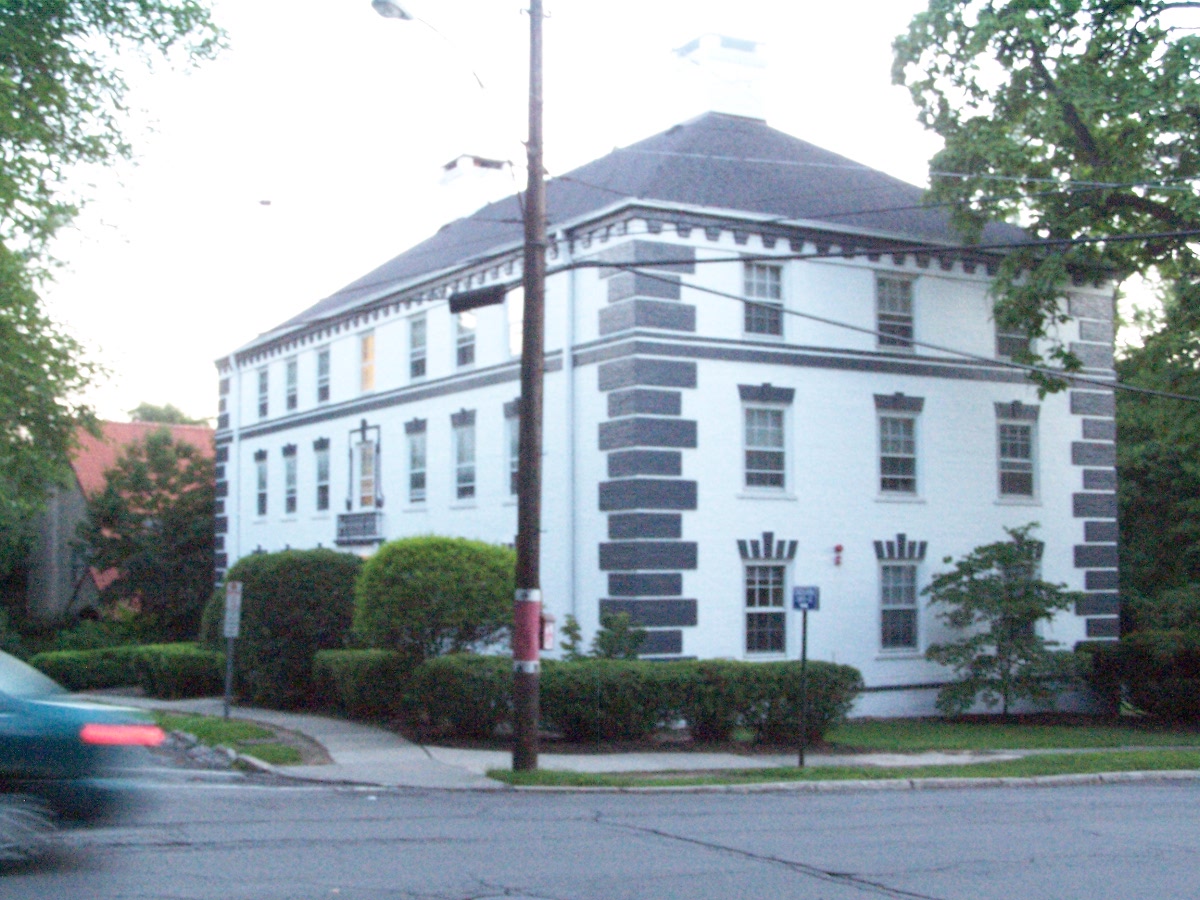
The Thurston Court Apartments is a 22-person university-owned apartment building with one and two-bedroom student apartments [6]. Primarily used for grad housing, in recent years the building has been opened up to undergrads as well. The building was built in 1932 (fun fact: the entire building was once painted white, including the ornamentation).

The house of Seal and Serpent fraternity, Cornell’s independent fraternity. The fraternity was founded in 1905, and the current house was built in 1929 in the Tudor Style [7]. In the past several years, the fraternity has suffered from a chronic shortage of interest; rumor mill says they only had three pledges last spring.

Maybe this has something to do with it:

“…Fraternities have a reason to fear such stereotyping. The Seal and Serpent society, a house which was primarily gay in the 1980s but now has just two gay brothers out of 16, has had some difficulty overcoming “the gay” label during rush…”

I s’pose this doesn’t help – I still hear this from a lot of people both in and out of the Greek community  (the quote is from a Nov. 2000 Sun article).  Going through this blog’s search bar history, there are over 200 hits for “gay fraternity”.  I’m willing to bet it’s not with good intention.


The house of Alpha Phi sorority. Alpha Phi Cornell was founded in 1889 with assistance from the Alpha Chapter at Syracuse University [8]. Originally based out of Sage College, they lived with Alpha Zeta for a year  and on their own in a couple different houses until they bought their current house from an Alpha Phi alum in 1921. The side wings were added in 1937, and a back wing (not pictured) was added in 1961. The chapter went under a reorganization sometime in the early 1990s due to low membership intake, but I’ve found nothing that indicates it ever closed. Currently, Alpha Phi has one of the highest sorority membership numbers at Cornell.

Hardly 500 feet away is the house of Kappa Kappa Gamma sorority. I know Kappa has been in the news lately; and it really sucks to be them right now (unless you like embarrassment over attention). The sorority’s Cornell (Psi) chapter was founded in 1883, and moved into the current house in 1921 [9]. The chapter was inactive from 1969 to 1977, a time period well-known for its anti-Greek sentiment.

Louie’s Lunch was founded in around 1918 by Louie Zounakos, who emigrated to NYC from Greece, and later moved up to Ithaca. The original Louie operated the truck up until 1955 [10]. The original truck was replaced in the late 1940s. The truck was then owned by the Machen family until 1997, and is now currently operated by Ron Beck. I do have a preference to one truck over the other, but I won’t say which.

100_3462

Photo courtesy of “Greetings from Ithaca”

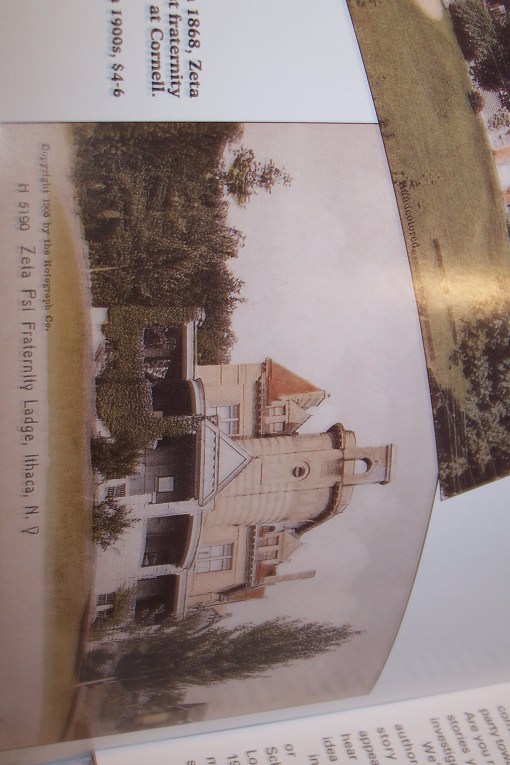
The house of Zeta Psi fraternity. The house, built in 1930, was originally that of Theta Xi. Zeta Psi, meanwhile, has the distinction of being the first fraternity founded by Cornell, even if it was decided by a coin flip (see the entry for Chi Phi). The chapter built a luxurious house in 1891 on the corner of Williams Street and Stewart Avenue, but moved out in the 1940s due to low numbers as brothers left to go fight in WWII. The original house burnt down in the late 1940s, and was replaced by a parking lot. In the meanwhile, Zeta Psi lived with Young Israel for a short while before moving into 660 Stewart Avenue in the late 1950s. A donation from a wealthy alumnus allowed them to buy the current house in 1972 [11].


[1]http://www.cornell.edu/search/index.cfm?tab=facts&q=&id=497

[2]http://en.wikipedia.org/wiki/Jennie_McGraw

[3]http://en.wikipedia.org/wiki/Daniel_Willard_Fiske

[4]http://www.adphicornell.org/adphicor/files/FraternityRow.pdf ***

***Page 10 has a picture of the McGraw estate in its heyday

[5]http://www.chipsi.org/news/6143/Cornell-Fire-Centenary.htm

[6]http://www.campuslife.cornell.edu/campuslife/housing/graduate/thurston-court-apartments.cfm

[7]http://www.sealandserpent.org/house.html#

[8]http://www.dos.cornell.edu/dos/greek/chapter_details.cfm?id=4679

[9]http://www.dos.cornell.edu/dos/greek/chapter_details.cfm?id=3280

[10]http://www.louieslunch.com/history.htm

[11]http://www.psiofzetapsi.org/History.html

[12]https://cornellsun.com/node/1720


Northwest of Campus

7 08 2008

The house of Sigma Alpha Epsilon fraternity. Sigma Alpha Epsilon is one of those fraternities that tends to come to mind when people want to typecast the Greek system at Cornell. It’s large (~80 men), and prestigious, and is the subject of so many dirty rumors (true or not) that it would make Lindsay Lohan blush. The house goes by the formal name “Hillcrest”, and was built in 1915 [1]. An addition was built in the early 1960s (on the left side of the photo). This is the fourth house of SAE and the second “Hillcrest”, the first having burnt down in a spectacular fire around 1911. SAE and Chi Psi have a standing rivalry.

Next door to SAE is Alpha Delta Phi, colloquially known as Alpha Delt. The fraternity was established in 1868, and was among the first to build a chapter house, which was constructed in 1878 [2]. As students moved to different areas of campus, Alpha Delt launched plans to construct a new building in the prairie house style (which you can see on their homepage). This house was built around 1903, but due to electrical malfunctions, burnt down in a spectacular fire in February 1929. A new house, built in the collegiate gothic style (the current house) was built in 1931.

Alpha Delt has always struck me as a more upscale version of SAE. But, they’re not above visual humor; like their parking lot for instance.

I wouldn’t be a good photographer if I didn’t get a photo of their super-sketchy windowless ritual building in front of the house.  Rumor mill says someone received third-degree burns in a ritual gone wrong two years ago at their initiation. Ah, so this is why fraternities like Delta Upsilon and Phi Kappa Tau were founded; to go against the cloak-and-dagger behaviors of other organizations.

***

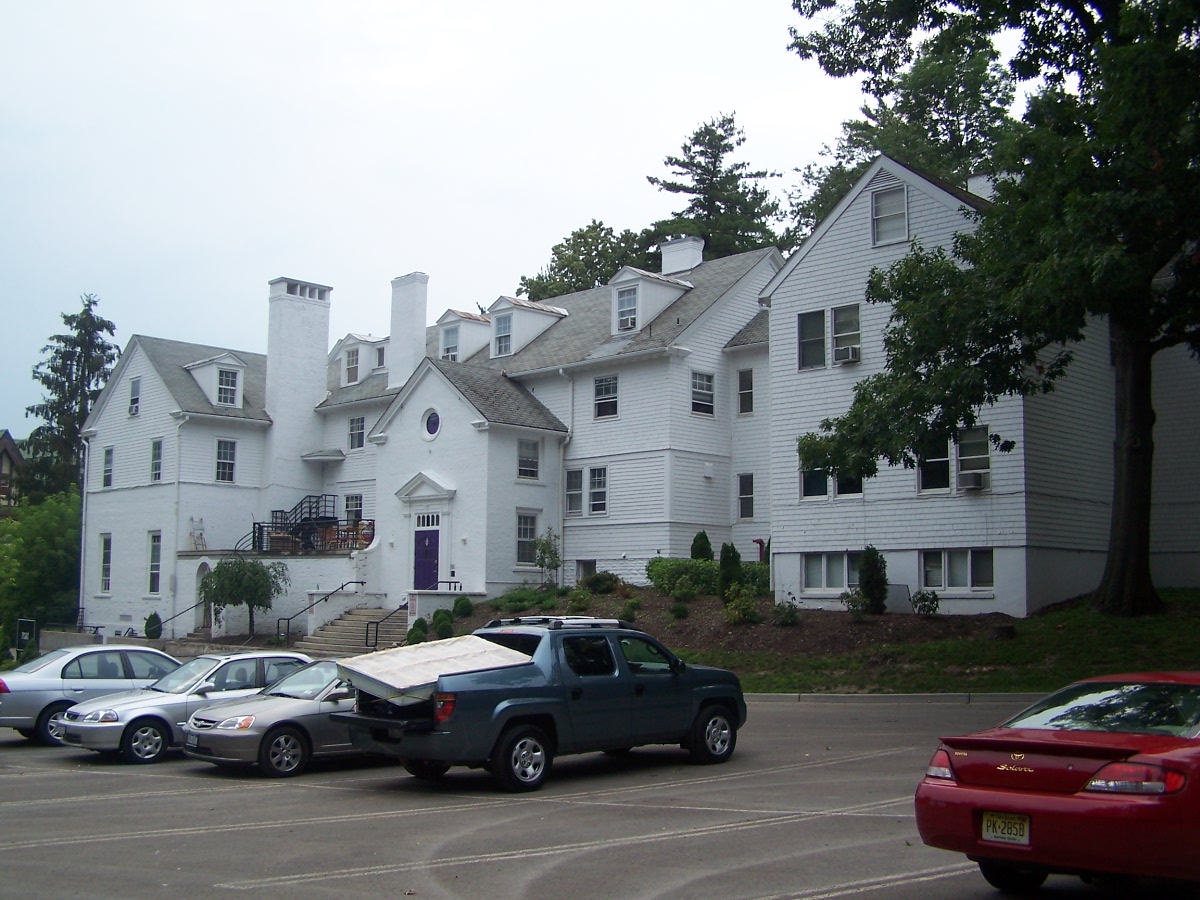
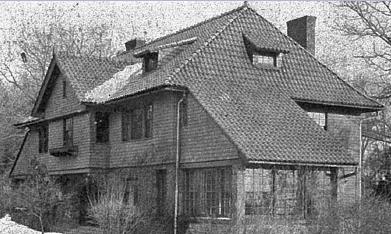
Although in a tightly packed area of high-profile houses, Phi Gamma Delta, or FIJI as it more commonly known, retains a distinct character. The house, known as “The Oaks”, is fairly nice-looking from the outside, especially since it was built around the 1900s. The original house, a private residence the fraternity bought,  looked like this before the extensive additions and modifications:

Throwing this disclaimer out there, I’m not a huge FIJI fan. The inside kinda scared me. That, and the Halloween party I went to there freshman year where some guy scantily-clad in leather was randomly hitting people in the crowd with a whip as he stood on a table. After the marks I received from that, I haven’t been inside since. Opinions aside, it’s a large house with a large membership.

One last thing…it rained shortly after I had taken the house photo. The mattress in the pickup was still there when I passed by a second time…and it was thoroughly soaked.

***

Mixed into the hodgepodge of frats is Watermargin, a co-op established in 1947 (co-ed since 1961/1968, the latter being the year it was formally approved[3]) by WWII verterans to promote undertanding and diversity in religion and race [94]. The name Watermargin comes from a Chinese Classical literary work, translated by Pearl Buck (All Men Are Brothers), in which fugitives fight the injustice of the Ming Dynasty at the water’s margin. Prior to 1947, the house served as a home for Phi Kappa Psi. The house was built in 1890 in the Colonial Revival style [5]. I’m still trying to determine what the house served as between 1912 and 1947.

Next door and contuinuing up University Avenue is Theta Delta Chi. They are colloquially known as “Thumpty”, or the much-maligned “Theta Drug”, supposedly because of the relative ease of obtaining drugs at the house. The house dates from the 1920s, making it one of the later constructions in the area. The running joke that I’m aware of suggests that its members are stoned all the time. Still, although they are the put of many jokes, they’ve managed to stay continuously active at Cornell since 1870, so they might as well take it in stride.

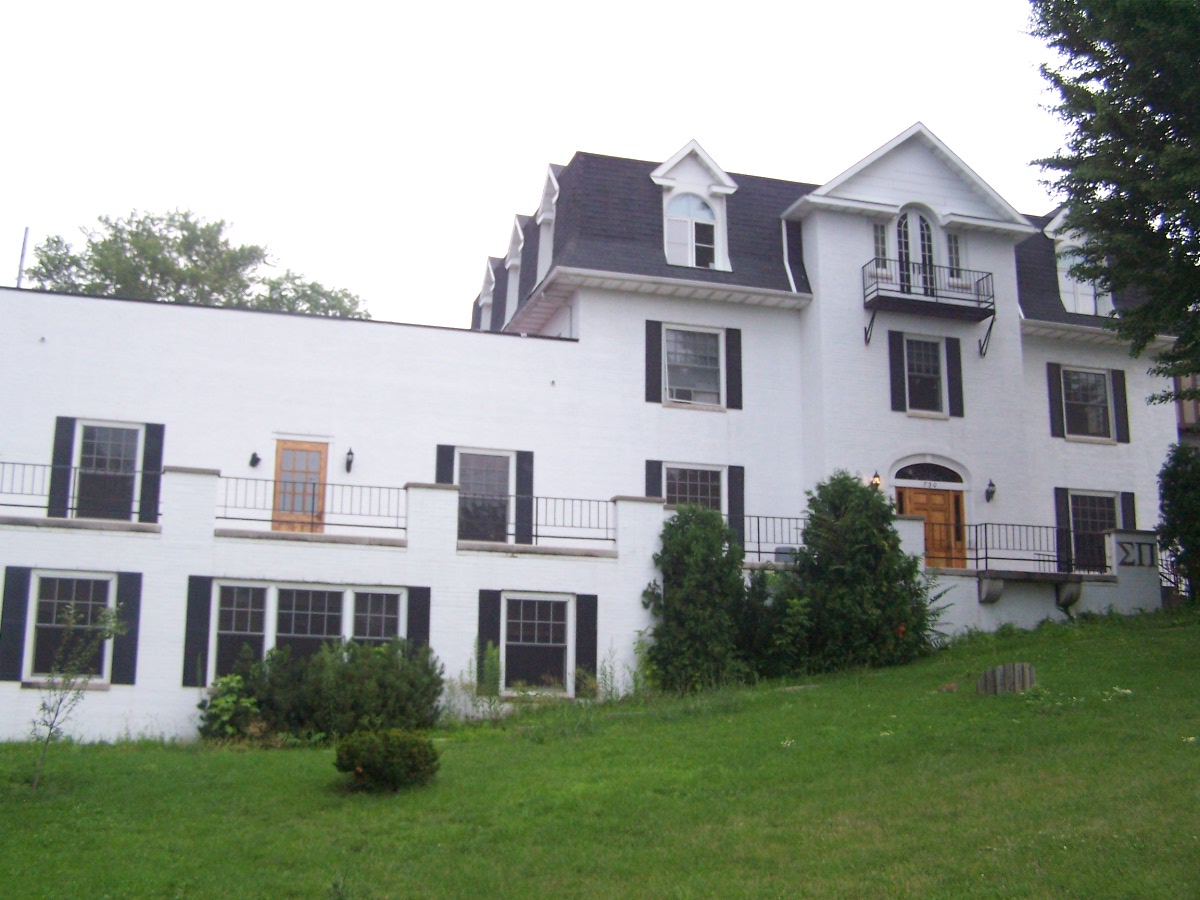
Sigma Pi is further up University Avenue. The original house on the property was built in 1870, burnt down in 1994, and a new, roughly-similar looking house, was designed by local architect Jagat Sharma and built in 1995 [6]. The fraternity was one of the largest at Cornell, until a nasty incident involving a Thanksgiving dinner gone wrong caused four freshmen to have to get their stomachs pumped[7], and Sig Pi losing recognition from the university (i.e. no pledge class). So, how about that fall rush…?

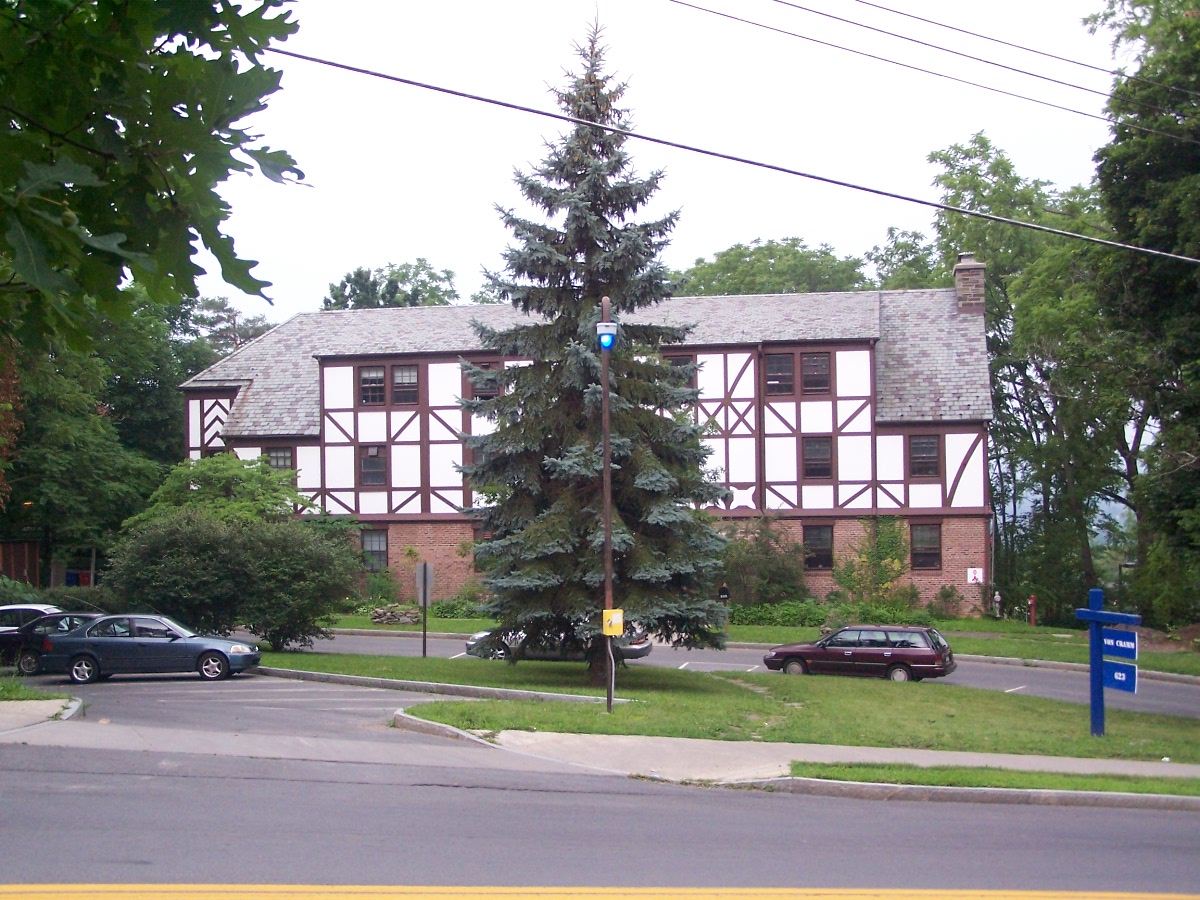
Going back the other way on University, we have Von Cramm Hall (I’ll hit Chi Psi at a later date). The co-op was founded in 1956 by an endowment from Thomas Gilchrist, in memory of his friend Baron Von Cramm. a Nazi German military officer who died trying to stop the Soviet retreat in 1941[8]. It is also the largest co-op, at 32 members. The house became open to women in the 1970s, and has a very strong leftist bent (Redbud Woods…). The house itself was built in 1955, standing on the property of one of the trio of homes owned by Robert Treman. The house, more of the textbook-style tudor, burned in 1944 [9].

Sigma Nu’s house is tucked way at the end of Willard Way. The house dates from about 1910. The house is one of the more obscure ones to try and locate, but it has fantastic views of the West Hill in the town of Ithaca. Sigma Nu Cornell, founded in 1901, is a fraternity with a strong athletic presence.

Missed it the first time, not the second time. Sigma Phi Epsilon’s house on McGraw Place. The house was built in 1965 [10], replacing their former house at 112 Edgemoor Lane. After Sig Ep was gone in 2004 (google it, rumor mill had a field day with that one), ATO occupied the house, and Delta Chi shared it with them when they were rechaptered in 2006-07.

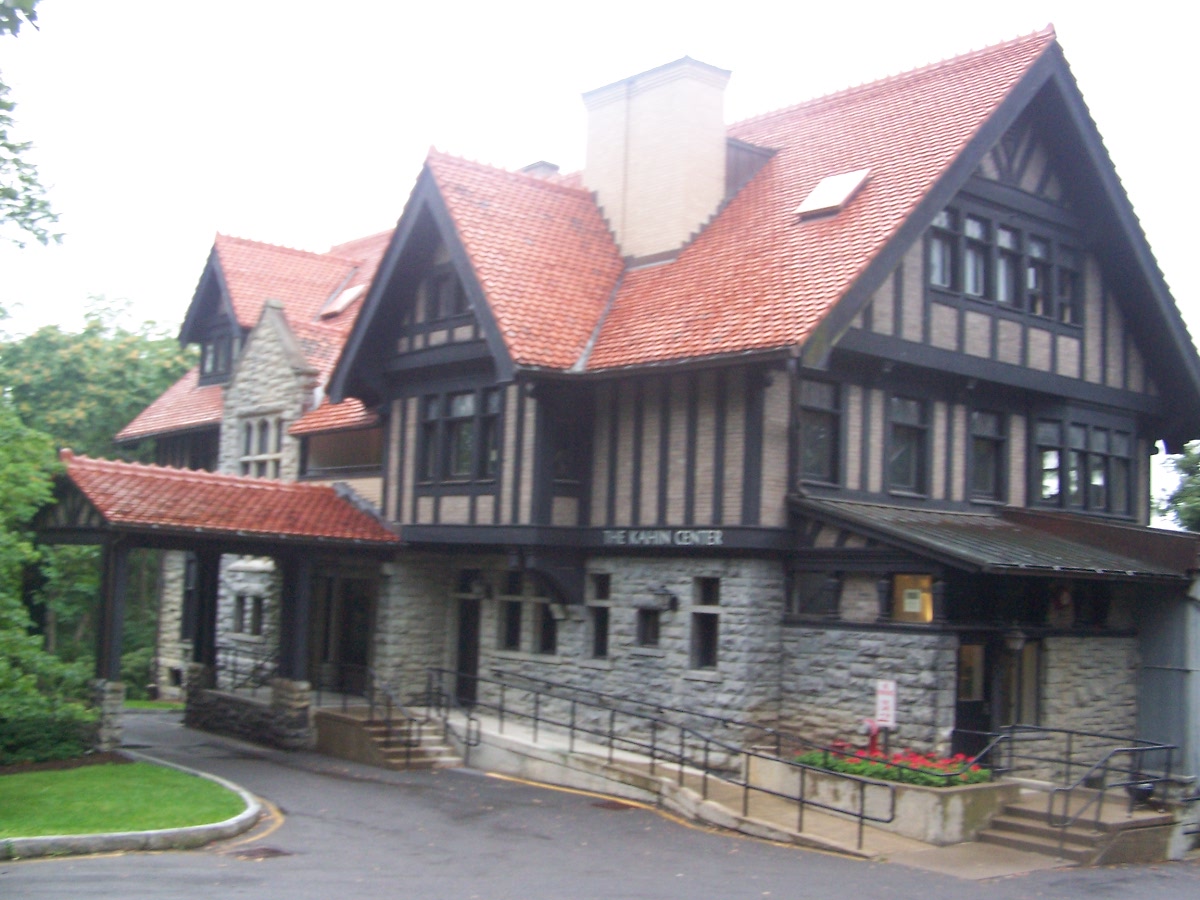
The Kahin Center is the second of the Treman trio. It was remodeled in 1945 as a lodge and as a communication arts center in 1970 [11]. It also mirrored the first house that burned in 1944.

The last of the trio is 660 Stewart Avenue, built about 1902 as the home of Elizabeth Treman and her husband Mynderse Van Cleef [11b]. The house of Zeta Psi for a few decades ending in 1969, the house is currently a 27-person co-op. Unlike most co-ops, this one does not have a meal plan [12].

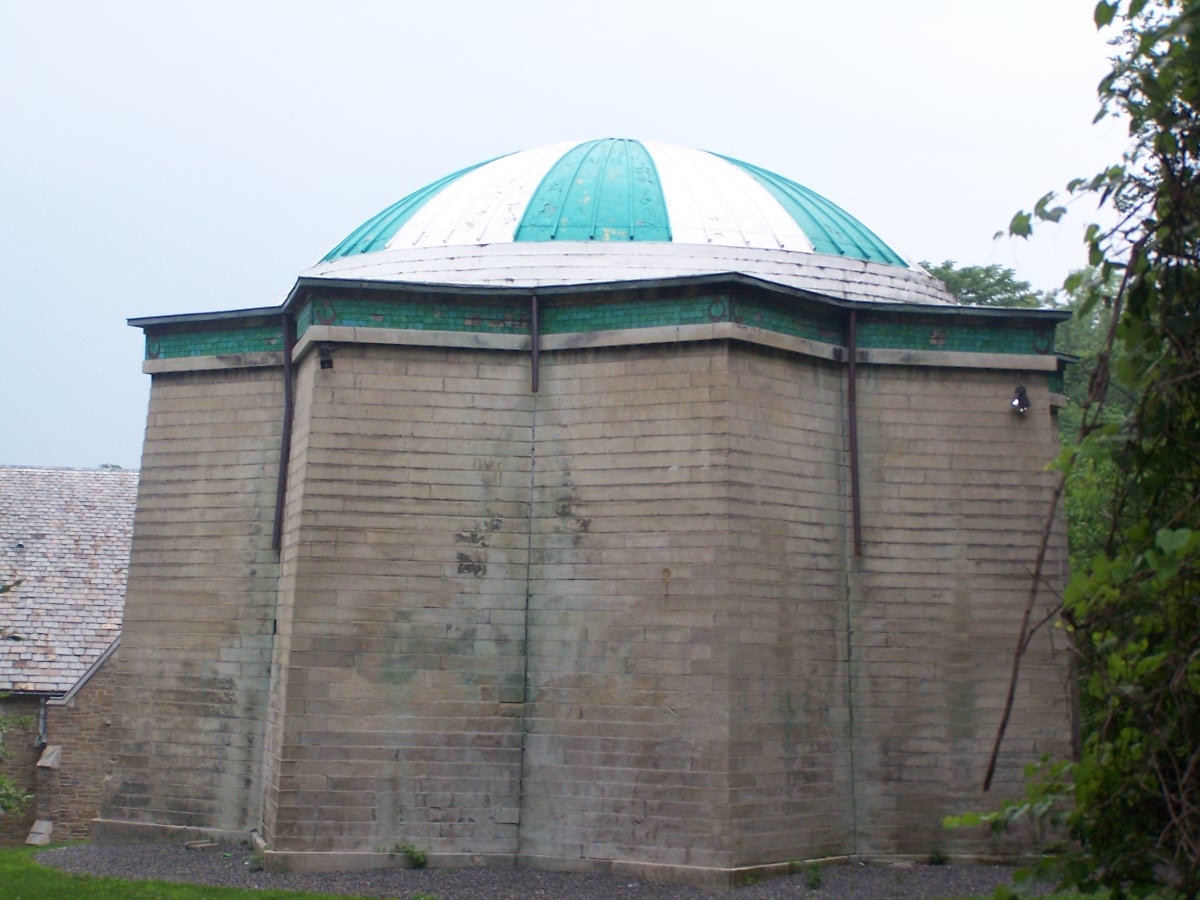
This was really cool, since it has polished wood and it provided shelter from a sudden rainstorm. “The Chapel for Prayer and Meditation”. And what a nice little chapel it is. On the outside was the posting for a service to Mahatma Gandhi on 9/11/07. And the other events that have happened on 9/11.

And it had a great view. And this is where I’ll leave off for now.

[1]http://www.sae-cornell.org/public6.asp

[2]http://www.adphicornell.org/public6.asp

[3]http://cornellsun.com/node/21924

[4]http://www.campuslife.cornell.edu/campuslife/housing/undergraduate/watermargin.cfm

[5]http://www.fs.cornell.edu/fs/facinfo/fs_facilInfo.cfm?facil_cd=4758

[6]http://sharma-arch.com/restoration.htm

[7]http://cornellsun.com/node/26714

[8]http://en.wikipedia.org/wiki/Von_Cramm_Coop

[9]http://www.fs.cornell.edu/fs/facinfo/fs_facilInfo.cfm?facil_cd=3121

[10] http://www.rso.cornell.edu/sigep/History.html

[11]http://www.fs.cornell.edu/fs/facinfo/fs_facilInfo.cfm?facil_cd=4736

[11b]http://cornellsun.com/node/24153

[12]http://www.campuslife.cornell.edu/campuslife/housing/undergraduate/660-stewart.cfm


Far West Campus, the First Photo Tour

31 07 2008

The house of Phi Kappa Psi fraternity. As previously covered, the house was this dreadful brutalist monstrosity constructed in 1964 when the fraternity moved from 312 Thurston Avenue [1]. The house was extensively renovated in the second half of the 1990s, gaining a more postmodern appearance that has earned it the nickname “The Gables”. Prior to 312 Thurston (now demolished), Phi Kappa Psi lived in the Watermargin house. It was among the first fraternities chaptered at Cornell, established in 1868.

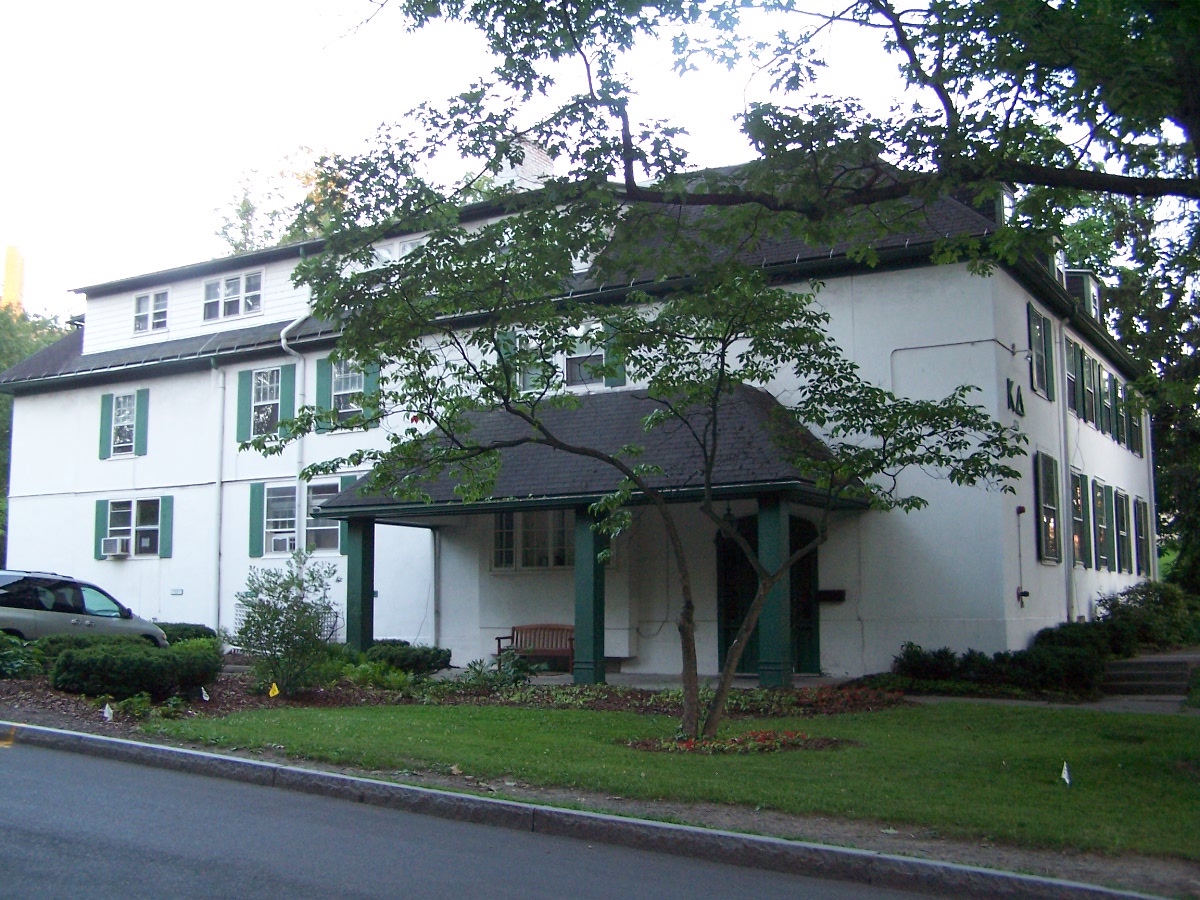
This house belongs to Kappa Alpha Theta sorority, currently the only sorority on West Campus. The house was built by Sigma Chi in the 19th century, who left it for Greystone Manor in 1923, and Theta Chi fraternity moved in. Bay the 1980s, Theta Chi had moved out of the house for a mansion on Ridgewood Road, and “Theta” moved in. Theta was dispelled from its national in 1965, but returned to campus in 1980 [1], and moved into this house during the 1980s.

Speaking of fraternities founded early in Cornell’s history, Chi Phi and north campus fraternity Zeta Psi were both founded on opening day 10/7/1868. The two flipped a coin to see who would be declared the first fraternity at Cornell. Well, Chi Phi still uses its early start in rush promos, but Zeta Psi is officially the first fraternity (Zeta Psi and Chi Phi have a rivalry to this day). Craigielea, their tudor-esque house, is well over a century old (1890, partiall rebuilt after a 1903 fire), and has continuously been in their posession. The house was designed by W. H. Miller of Uris Libe fame [2].

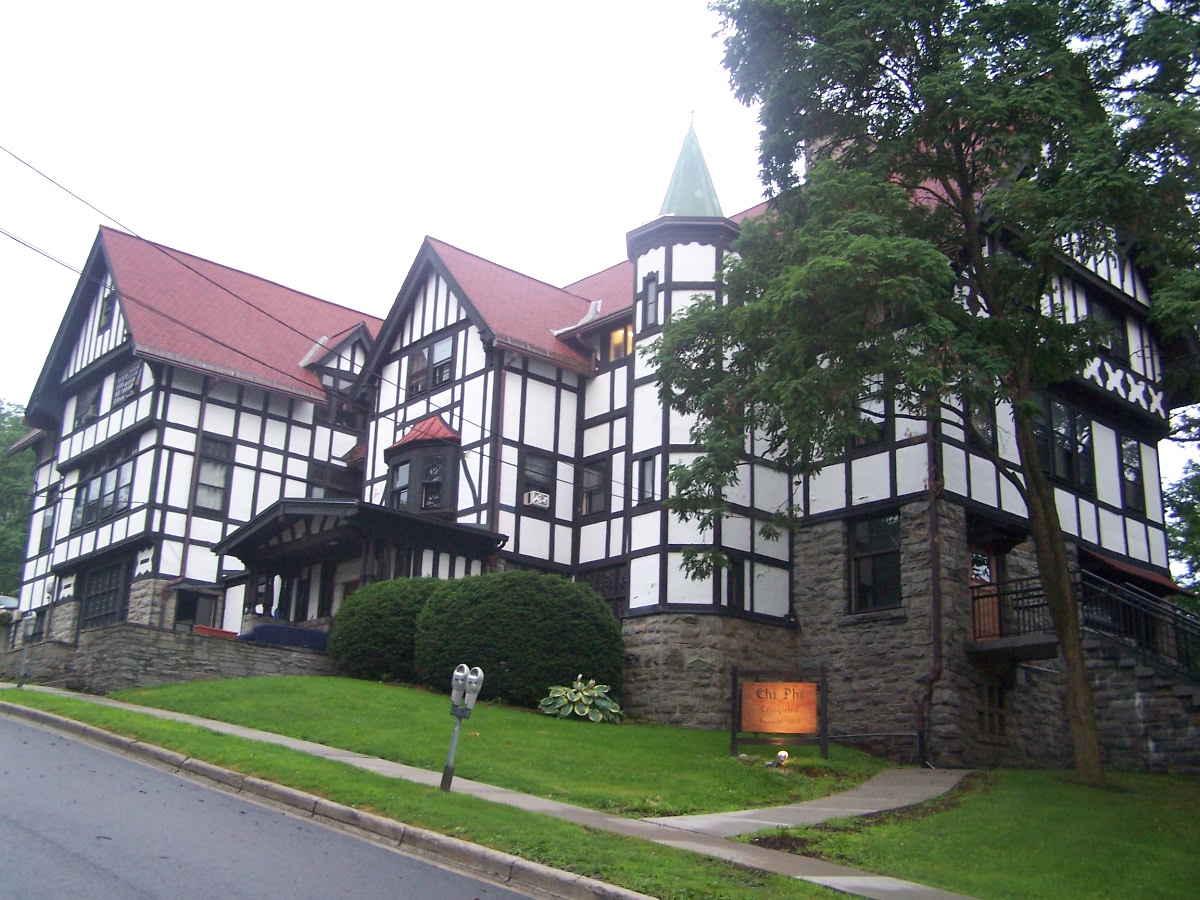
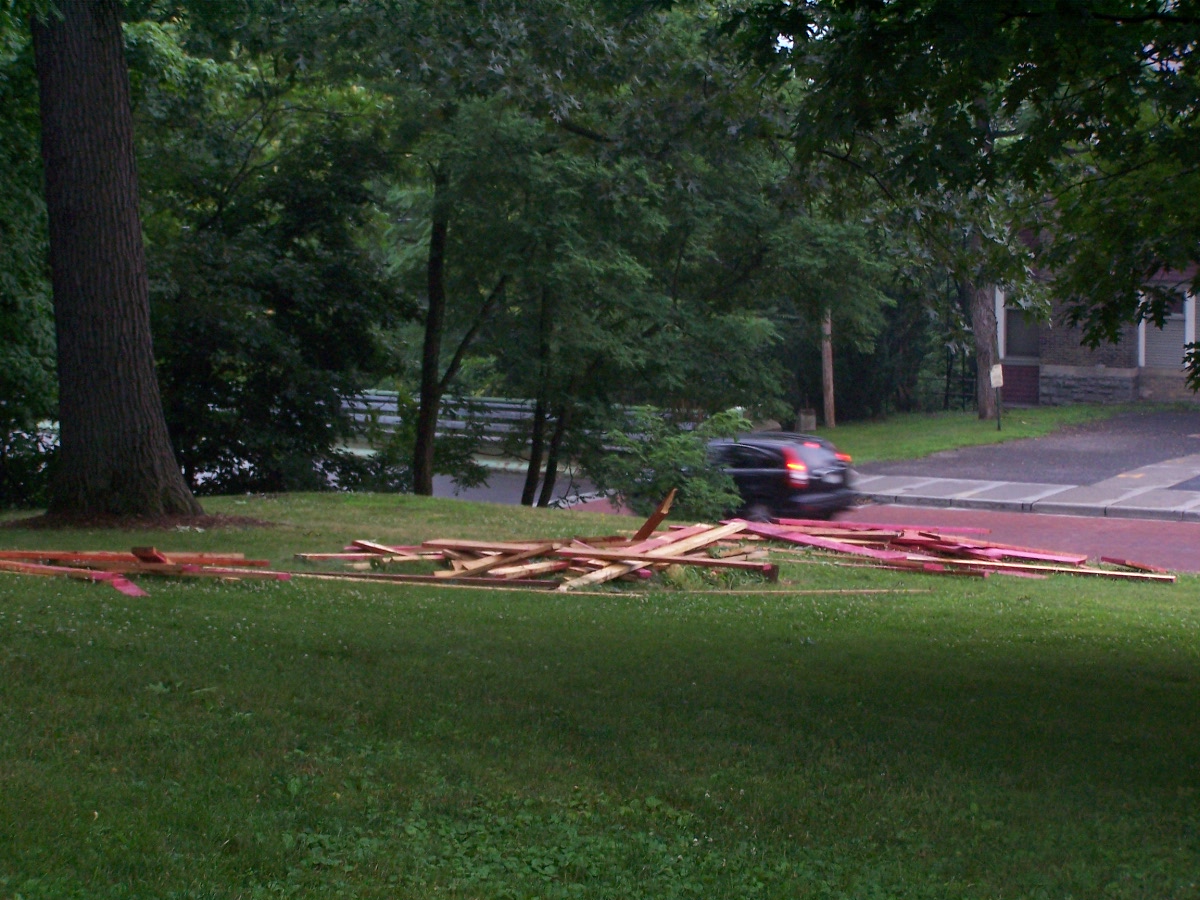
And this is what’s left of their (pledge?) project, bleachers that they built last April. Shame, really. I wonder if they did it or someone who hates Chi Phi did it.

Delta Kappa Epsilon (DEKE) fraternity house is a Romaneqaue Revival House built in 1893 by W.H. Miller [3]. The house is known as Gray Stone Castle, and sits on the National Register of Historic Places [4]. As amazing as the house is, the chapter hasn’t been doing all too recently; rumor mill says numbers were so low in recent years that actives had two rooms each.

112 Edgemoor Lane, a small campus dorm designed for about 20-25 occupants. As I explained in a previous entry, this house has a lot of significance to me personally. So, the house, built in the Colonial Revival style, was built in 1881. The house was home to Sigma Phi Epsilon up into the 1960s, when Sig Ep moved out and Triangle fraternity moved in. Previously, Triangle called a house at the junction of Campus Road and Stewart Avenue home, but the ca. 1839 farm house was torn down to make room for DTD’s new house [5]. After Triangle was deactivated by its national in 1985, the house was made into part of Cornell’s campus dorms.

Lambda Chi Alpha’s house also sits on Edgemoor Lane. Originally known as ISWZA [5], Lambda Chi was chaptered in 1913, and the house was purchased around 1918 (it was built in 1899). Lambda Chi is known for having a feud with its neighbor Chi Phi. The house also maintains a gazebo on the edge of the gorge, which was built in recent years.

The house of Pi Kappa Alpha fraternity. The house was occupied by Beta Theta Pi, who occupied the house until they moved in 1906. About a decade later when Pi Kappa Alpha colonized on campus, the chapter moved into this house. My slight personal issue was that they had a steep driveway in the back, and some jackass in a Jetta would try to do 0-60 every time he went down the hill. The whining engine gets quite annoying after a while.

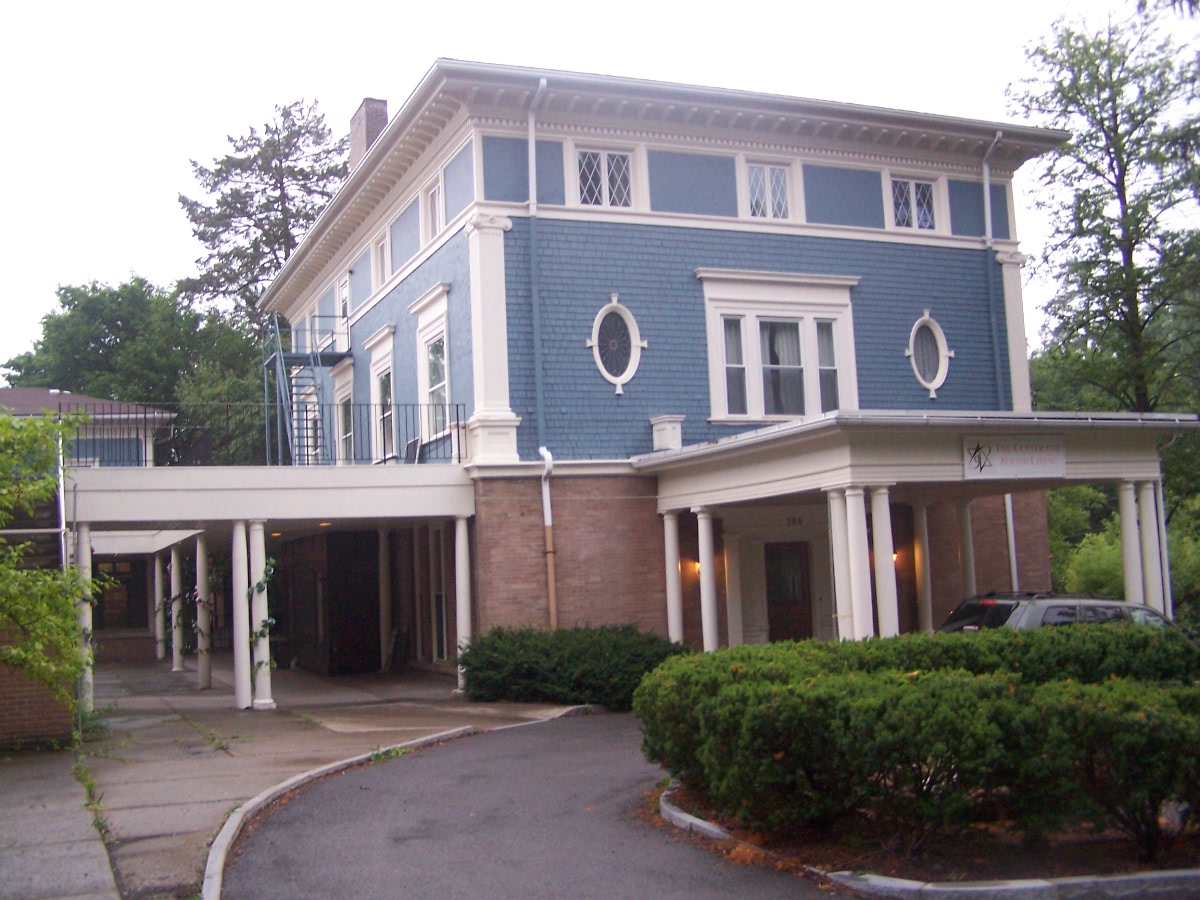
The Jewish Living Center. The house dates from the 1890s[6], with the kosher dining center to its south (not pictured) dating from the late 1980s. The center was known as Young Israel until the late 1990s. Judging from their website, the independent organization has had a contentious past with its relations to the University. The old fraternity house for Seal & Serpent (pre-1926) used to be next door, but it was demolished to make room for their parking lot.

[1]http://www.dos.cornell.edu/dos/greek/chapter_details.cfm?id=3278

[2]http://www.fs.cornell.edu/fs/facinfo/fs_facilInfo.cfm?facil_cd=4716

[3]http://www.fs.cornell.edu/fs/facinfo/fs_facilInfo.cfm?facil_cd=4719

[4]http://www.dke-cornell.org/public1.asp

[5]http://cdsun.library.cornell.edu/cgi-bin/cornell?a=d&d=CDS19650427.2.101.1#

[6]http://www.iswza.org/heritage

[7]http://www.cornellcjl.com/about/history.aspx