The Keyword Bar VI

7 09 2009
 100_1281

Yeah, I’ve been lax about updating lately. I have some things in queue, but I also have research going on, so things are a little hectic. Naturally I’m turning to my favorite cop-out of fielding responses to some of the search entries that have led people to the entries in this blog.

1. “alpha gamma cornell” (9/5/09)

This could be in reference to a fraternity or defunct sorority that the individual failed to incluse the whole name of, or it could be a reference to the research report “Hazed and Confused” by Adam Zwecker [1]. In Zwecker’s report of hazing within the Greek system of Cornell, he uses the psuedonym “Alpha Gamma (Phi)” in reference to a house that he was pledging that committed a series of hazing violations in flagrant disregard of system and campus policies. Rumor mill tends to associate the psuedonym with two or three different houses, and the actual house was reported to have been reorganized after the report to remove such dangerous activities.  I’ve heard the report used more than once as a reason why Cornell students avoid becoming part of the Greek system, which is unfortunate but I can definitely see the reasoning behind their decision.

2. “tke blackballed from lehigh” (9/4/09)

This one is interesting not because of who it deals with, but the term “blackballing”.  According to the fountain of information that is Wikipedia [2], blackballing is a rejection technique used in elections to decline membership in fraternities and gentlemen’s clubs. Typically, in Greek orgainzations, some method similar to blackballing or dinging is used to decline membership to potentially undesirable candidates. The name hails from the black balls used to signify opposition in elections in the fraternal orders of days long past.

Since the IFC at Cornell has made use in the recent past of an electronic system to keep in track of rushees visiting houses during Rush Week, and that the site includes the capability to record comments on these individuals submitted by houses, a person could be blackballed not just from a house, but from most/all Cornell fraternities if the comments are strongly negative. I imagine that would take an outstanding showing of stupidity.

3. “ithaca cornell share frat scene” (9/3/09)

I’m going to take this as a a question regarding whether Ithaca College and Cornell have uniform membership in greek houses. The answer is no for IFC and PanHel. Ithaca College banned Greek Life in 1980, and while there may be some underground groups, they operate separately from Cornell chapters. However, MGLC has found a way around this by creating “citywide chapters” which draw members from multiple colleges in the same geographic area. I’m aware of at least one MGLC sorority that has roughly half of its members from Cornell and half from Ithaca College. The legitimacy of these organizations with regards to Cornell’s greek affairs alone is debatable, but since most MGLC organizations are quite small, it probably doesn’t come up very often.

4. “three side dormitory cornell”  (8/30/09)

Donlon, but technically not correct, since it actually has six exterior sides. It’s just that the three curved sides are much more prominent.

100_1603 
Photo Courtesy of Cornell Facilities

Mary Donlon Hall was completed in 1961 as an all women’s dormitory, the last of the all women’s to be built on north campus before it went co-ed [3]. Mary Donlon Alger (class of 1915) was a prominent federal judge who served on the Board of Trustees for 29 years [4].

5.  “maximum building height town of ithaca”

Really depends on the zoning, but most residential zoning only allows a maximum height of 36 feet before a zoning variance is required. The two current projects beofre the board fall below that though; a 106-unit townhouse development by Holochuck Homes off of Route 96, and a 13-unit housing development called Cleveland Estates that will be south of Ithaca College off of Danby Road. The townhouse units might see some trouble because of traffic concerns and opposition to what the West Hill community feels would be an increase in crime if the housing is “affordable” (believe it or not, this is a leigitimate concern. The 128-unit Overlook at West Hill development has been plagued with what neighborhood residents feel are unreasonably high crime rates [5]). The town is looking into a moratorium on West Hill, which would effectively kill the proposal.

According to the West Hill Civic Association, this is the list of proposed and potentially developable properties that are under study:


1. Carrowmoor, 400 units, commercial space

2. Conifer (Linderman Builders), 100 more units (this is in addition to the 180 or so units already in place)

3. Holochuck Development, 106 units near hospital

4. Cornell Parcels, 33 acres off Trumansburg road

–Assisted care interested, 50 units of senior housing, (probably similar to Alterra)

–nothing formal before town

5. Land that can be developed, nothing set yet, Medical Center parcel

Tompkins County

6. Property off Bundy Rd. (67 acres)

7. Perry Farm (60 acres)

8.Kaderli Trade Inc. (100 acres)

9. Eco Village 3rd Neighborhood


***

[1]http://www.ilr.cornell.edu/smithers/docs/hazed_and_confused.pdf

[2]http://en.wikipedia.org/wiki/Blackballing

[3]http://www.fs.cornell.edu/fs/facinfo/fs_facilinfo.cfm?facil_cd=3026

[4]http://en.wikipedia.org/wiki/Mary_Donlon_Alger

[5]http://www.theithacajournal.com/apps/pbcs.dll/article?AID=/20090808/NEWS01/908080343


News Tidbits 8/27/09: Phase Two of Coal Yard Apartments Planned

28 08 2009

From the Ithaca Planning Board’s August agenda:

Coal Yard Apartments – Phase 2, 143 Maple Avenue, Steven & David Beer Owner/Applicant.

Declaration of Lead Agency, Public Hearing, Determination of Environmental Significance, Consideration of Preliminary & Final Approval. The applicant is proposing to construct an Energy Star-rated, 25 unit apartment building located between the existing coffee shop and the existing 10 unit apartment building that was constructed in 2007. The new building will have four residential stories built on top of a 16-space underground parking garage. The new building will have four 3 bedroom units, seven 2 bedroom units and fourteen 1 bedroom units and will have an elevator. The applicant anticipates that the majority of the bedrooms will be singly occupied. It will have a flat roof, and will include many of the design elements of the 10 unit building. Lower levels of the façade will be brick and upper levels will use similar fiber cement clapboard and solid board panels used on the 10 unit building. Colors will match or complement the existing building. The target market for the building will be graduate and profession students, professional academic staff and faculty, and seniors. The project is in the R3b Zoning District and will require a variance for height. This is a Type I Action under the City of Ithaca Environmental Quality Review Ordinance in accordance with §176-4 B (k) and an Unlisted Action under the State Environmental Quality Review Act and is subject to environmental review.

The property is part of the Beer Properties portfolio, which includes the Grandview House in central Collegetown. The trick here will be getting the height variance approvalas Ithacans are very protective of their sight lines. Here’s a picture of the 10-unit building taken from their website:


The apartments are aptly named, since this used to be the coal yard for the city of Ithaca back in the day [1]. Prior to discontinuation of passenger train traffic in 1963, the site was also home to the East Lehigh Valley Railroad Depot. The coffeeshop referenced in the city agenda is the “Queen of Tarts”, which sounds like a great name for a madam as well as being a cute pun.

The project falls outside of the Collegetown Vision area and would not be affected by any zoning changes as a result of the Collegetown plan.


[1]http://www.beerproperties.com/cya.html


News Tidbits 8/21/09: Dumb Frat Tricks

22 08 2009

100_1703

The house involved is Sigma Nu, off Willard Way near West Campus. Apparently, firefighters found a small pot-growing operation while investigating a busted water pipe. I would not be surprised if sanctions from their national or from the IFC are put in place against Sigma Nu as a result of this incident, as it is rather embarrassing for the Greek community (personally, I think it makes Sig Nu look like a bunch of dim bulbs).

ITHACA — A busted water pipe may lead to a drug bust after the discovery of a small marijuana-growing operation inside a Cornell University fraternity house.

The Sigma Nu house manager called firefighters about the broken water pipe on the second floor, Ithaca fire officials said. Firefighters contacted the Ithaca Police when they found the plants.

 Ithaca firefighters found a half-dozen marijuana plants Tuesday afternoon while investigating a broken water pipe at the Sigma Nu fraternity house on Willard Way, Ithaca Police officials said. Officers seized the plants and though they’ve identified a person of interest, they aren’t releasing his name. 

 Water was running through the ceiling, they explained, and in the process of assessing the damage, firefighters found the plants in a tin-foil lined closet, surrounded on all sides and angles by several high-intensity lights. 

Whoever was growing the plants will likely be charged with unlawful growing of cannabis, a misdemeanor, police said. Fire officials said the numerous electrical cords used to power the lights created a fire hazard.

The leaking pipe was part of the sprinkler system and had to be shut down for repairs, Ithaca Building Department officials said. Additional life and safety issues such as a defective smoke and fire detection system and missing exit signs were found, so they posted the house on Tuesday and told everyone to leave until the problems could be fixed, they added.

Bobby Quintal, a member of the fraternity’s executive committee and last year’s president, said the chapter housed members in local hotels and other campus fraternities donated space while contractors fixed the problems.

Friday evening, Ithaca Building Department officials said that the house would likely be safe and ready to be reoccupied later that night.

Quintal said he isn’t living at the house and has no knowledge of the marijuana found there, but that marijuana possession violates Sigma Nu fraternity rules. When rules are violated, the national chapter investigates and might sanction the local chapter, the fraternity member or both, depending on the outcome of their investigation.

http://www.theithacajournal.com/article/20090822/NEWS01/308220004/Busted-water-pipe-in-Cornell-frat-house-leads-to-marijuana-find&referrer=FRONTPAGECAROUSEL

//


News Tidbits 8/13/09: Ithaca’s Economy Gets a Dose of Reality

14 08 2009

Image property of Welch Construction Inc.

Well, the simplest way to put it is that the sh*t has hit the proverbial fan. Emerson Power Transmission, the company that owns the factory on South Hill, will be shutting its doors next year, putting 228 people out of work [1]. Not to mention the 200+ people they have laid off in the past year.

Name your reason. Energy costs. Cheaper alternatives from overseas factories. Losing a major customer as Magna Int’l shuts down its massive factory in Syracuse. An anti-business local political climate. Oppressive taxes due to an incompetent state government (which I agree with, but I digress). In the end, the jobs are still gone.

Yet, Ithaca continues to survive. A major setback for sure. But Ithaca has been through economic horror stories before.  Consider Smith-Corona.

Smith-Corona was once a large company based out of Cortland, which is 25 miles northeast of Ithaca. Founded in Syracuse in the 1880s, the once employed as many as 10,000 people [2].  Groton, a town just north of Ithaca, was home to a large Smith-Corona factory. They manufactured calculators and appliances, but their speciality was typewriters.

If you’re reading this blog entry right now, I think you can guess where this is going.

Well, with the rise of computers and pocket calculators, their business went belly up. They started to shut down their lines in the early 1980s, with the factory in Groton shutting down in 1983, with the loss of 400 jobs. At the time, 2,800 people were still employed in the factories in Cortland [3]. In 1992, they decided to eliminate 900 jobs from the area, moving them to Mexico [4]. That ended up being a waste too, as the company shut down the Mexican factories five years later. The company originally shifted the Groton jobs to Signapore, to a factory they owned there that had 1500 employees. That shut down a few years later. Today, there’s little left of Smith Corona. Maybe 100-150 employees at a “headquarters” in Cortland, working in consumer electronics services.

Well, life didn’t end in 1983 or 1992. The local communities have continued to survive, perhaps even reinvent themselves to some extent. The loss of jobs always hurts the community. But people get by. Some might move, embittered by the economic loss; others might find other gainful pursuits. Companies such as Advion and Incodema have grown and picked up some of the slack. The wine industry here has grown by leaps and bounds in the past twenty-five years. The area continues to evolve, although it may not always to everyone’s liking.

I’m not trying to diminish the importance of the loss of a major manufacturer. However, I’m trying to make a point that as long as there’s local business talent and people who are willing to take a risk and start new business ventures, then this area will continue to survive, perhaps even thrive in the long run.

[1]http://www.theithacajournal.com/apps/pbcs.dll/article?AID=/20090812/NEWS01/90812029

[2]http://findarticles.com/p/articles/mi_qa3718/is_199901/ai_n8834821/

[3]http://www.nytimes.com/1982/07/01/business/scm-will-close-plant-in-groton.html?scp=2&sq=groton%20smith%20corona&st=cse

[4]http://www.highbeam.com/doc/1G1-13286094.html


News Tidbits 8/5: Ithaca Gun Redevelopment in Financial Hell

6 08 2009

This is really funny, because I passed by the site when I arrived back into Ithaca last week, and thought it was curious that no work appeared to be underway even though it was weekday afternoon. However, I didn’t have the camera with me, so I didn’t bother taking photos of the site before I left for places further north.

On the bright side, the blight that was the main building has been torn down; all that remains on the site currently are the debris/soil piles that need to be moved off-site, and of course the Ithaca Gun smokestack that is to be incorporated into a small pocket park when the property is fully redeveloped. So it could be worse.

One thing should be made clear; although there are cost overrruns with the cleanups of the site, the project to rebuild on the site isn’t cancelled. However, results may be late in coming, and may end up different from the initial plans.

http://www.theithacajournal.com/article/20090805/NEWS01/908050328&referrer=FRONTPAGECAROUSEL

The removal of demolition debris at Ithaca Gun has stopped because the development team apparently doesn’t have the money to pay its contractors.

A series of surprises, increased state oversight and community involvement has resulted in cost overruns totaling almost $1 million, according to a letter from property owner Wally Diehl, project engineer Pete Grevelding and developer Frost Travis sent to Mayor Carolyn Peterson on June 30.

The development team initially estimated demolition and cleanup would cost $1.46 million. They now estimate it will cost $2.3 million, according to the letter, which Peterson provided to the Journal on Tuesday.

The cash-flow situation apparently is so tight, the development team can’t afford to dispose of the remaining debris.

“I think there’s basically an issue of having the money in hand to pay people to do the work,” Peterson said. “My focus right now is not to have those piles sitting there.”

She submitted a resolution, which Common Council will consider tonight, asking that the $840,000 in state money intended for redevelopment go instead toward cleanup.

The city earned a $2.3 million state Restore NY grant to subsidize the developers’ project to clean up the site and redevelop it into 33 high-end condos and a public walkway to the Ithaca Falls overlook.

Appointment of a Community Advisory Group, a lengthy asbestos-removal process and “unanticipated environmental procedures, review and approvals” all led to cost overruns, according to the developers’ letter.

Peterson said it cost more than expected to preserve the smokestack and its foundation, deal with some potentially contaminated bricks, and more strictly monitor of the air at and near the site.

Before Travis’ 2007 proposal, Diehl twice proposed condo projects that would have covered cleanup costs without state help, but they were rejected by neighbors as too large. With no subsidy on the redevelopment side, the project “will require some creativity on the part of Travis & Travis and their architects,” the letter stated.

Peterson said she hadn’t heard any discussion about a bigger project or more condo units.

“Certainly, with working with the neighborhood, the preference was the proposed project. So I don’t know if there’s a proposal in mind, but I wouldn’t be entirely surprised if there needs to be some re-thinking,” she said.


News Tidbits 8/1/09: Edelman Realty Puts Sorority House on the Market

2 08 2009

http://aedelman.com/search.php?mls=129820&startat=20&price1=&price2=&area=&elemsch=&school_district=&new=1&luxury=

Realtor Description:
Own a piece of Cornell History. Delta Phi Epsilon Sorority is an arts & crafts style stone & stucco building on The Knoll. Built circa 1915 with up-to-date sprinkler, fire alarm & other safety systems. Compliant w/all inspection by the City and Fire Department. Living room, chapter room, paneled dining rm, commercial kitchen. 15 rooms for up to 25 occupants.There is an also a one bedroom two-story caretaker’s cottage with a separate driveway. Approximately 18 parking spaces+driveway to cottage.

The house’s list price is $795,000. Technically, the property has two units, the second being the small building in the second photo (both of these photos are from the listing).

100_1359

Personally, I think my photo is more flattering.


News Tidbits 7/29: Hotel Ithaca Gets Green Light; C’Town Terrace Not So Lucky

30 07 2009

In the city of Ithaca, when the only thing standing in the way of construction is a parking/bus stop issue, that means things are looking pretty good for construction in the near future. As for the Collegetown Terrace Project, the anticipated summer 2010 construction start may be more of a pipe dream than a reality.

http://www.theithacajournal.com/article/20090729/NEWS01/907290338/1126/news/Terrace+proposal+raises+historical+issues

ITHACA – Ithaca’s Planning Board has given preliminary approval to the Hotel Ithaca project and has begun the environmental review process for the Collegetown Terrace Apartments.

 At their Tuesday night meeting, planning board members approved a document that laid out concerns on issues such as traffic and historic resources related to the apartment project. 

 The proposal calls for demolishing all but three buildings in the 16.4-acre area bounded by Quarry and State streets, Valentine Place and Six Mile Creek and replacing them with seven buildings that would house approximately 1,270 people. The site currently houses about 635 people. 

 The three buildings that will remain are all within the East Hill Historic District. At Tuesday’s meeting, planning board members and city planning staff said there may be other buildings in the area that are not historically designated but that merit further research on their historic value during the environmental review process. 

Board member Tessa Rudan highlighted the former nurse’s residence, which “may be dedicated” to Finger Lakes native Jane A. Delano. Delano founded the American Red Cross nursing corps, led the entire nursing corps during World War I, and is buried in Arlington National Cemetery, Rudan said.
She also has been featured on a stamp in the African Republic of Mali because “she figured out the mosquito netting technique before there was scientific evidence to explain why it worked,” board Chairman John Schroeder said.

Members of the public will have the opportunity to weigh in on issues they think should be addressed in the project’s environmental impact statement at a meeting scheduled for 7:30 p.m. Thursday, Sept. 10, at City Hall, 108 E. Green St. The city planning department will also accept written statements on the project.

For Hotel Ithaca, the proposed $27 million hotel at the eastern edge of the Commons, the biggest outstanding issue is where to locate the bus stop, project architect Scott Whitham said.

While the hotel is under construction, the stop is scheduled to move around the corner to East State Street, near the Community School of Music and Arts. Hotel developers, the city and Tompkins Consolidated Area Transit officials have discussed the idea of moving the bus stop there permanently so that the stop and the hotel drop-off don’t interfere with each other.

The move would require eliminating two metered parking spots, which half a dozen merchants and property owners said Tuesday would spell disaster for their businesses. Property owner Donald Dickinson said he rents to four tenants on the block and two have said that if the new bus stop goes there, they’ll leave.

But keeping the bus stop on Aurora Street could result in hotel guests parking in the bus pull-off, Whitham said.

Schroeder said he wants to make sure the Hotel Ithaca doesn’t mimic the situation at the Hilton on Seneca, where the guest pull-off squeezes out the sidewalk.


Devil’s in the Details: Fraternity GPAs

16 07 2009


Since this is one of the more clicked-upon data sets on this blog, I figured I would include the latest update: Fraternity House GPAs.

sp09acagreek


So, let’s see what we can pick out concretely from the data:

1. In the fall, Pi Kappa Phi had the highest average GPA, and Sigma Alpha Mu took the academic crown this past spring. 

2. Number of IFC members: 2220. Number of organizations in IFC: 42. Number of people per house: about 53 on average (52.8). The largest IFC house is Sigma Alpha Epsilon with 91 members, and the smallest is Sigma Chi Delta with 12 members. Perhaps unsurpringly, Sigma Alpha Epsilon also saw the largest increase from fall to spring, adding 27 members, and Lambda Chi Alpha (26) and Theta Delta Chi (25) also posted large membership gains (I had been hearing about Theta Delta Chi’s big success since February).

3. The recently reinstated Theta Xi and Kappa Alpha Society continue to eke out a small but notable presence beside larger houses. I hope they continue to thrive.

4. Statistically, the MGLC members have lower GPAs. The average MGLC GPA is about 2.993, and only one organization, Pi Delta Psi, is in the top half of the general fraternal body academic list. Historically black fraternities fare much worse, averaging about 2.73. This data is only readily apparent when pulled from the rest of the values.

Here’s some thoughts:

A. Considering the IFC’s big push for higher GPAs within houses (epsecially during pledging), one imagines that the drop in GPA during the spring will not be looked upon kindly when members reconvene in the fall.

B. The MGLC’s academics are lacking. An average of only 2.99? Only would be acceptable if they were all engineering students.

C. Assuming about 6850 male undergrads (assuming a school that’s half male and has 13,700 students in total), fraternity membership rate approximately stands at 33.99%. However, since two of the house are co-ed, we’ll assume that they’re half-and-half and take off accordingly (-33), reducing our percentage to 33.50%.


Ithaca Really is 10 Square Miles Surrounded by Reality

14 07 2009

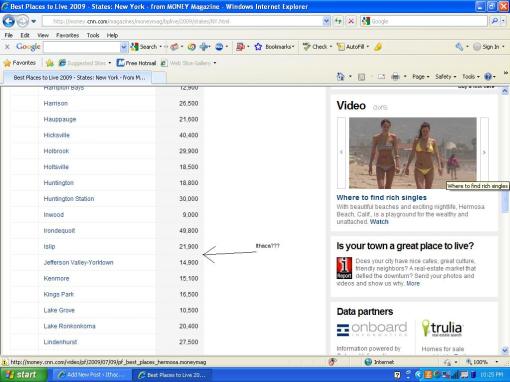
So, CNN released its annual “Best Places to Live” articles in its business section (Money Magazine, [1]). Normally, I don’t care much for the highly variable “Best Places” lists that appear in so many published reports, in many different variations, including best places for singles and best places for beer drinkers.

So, the decision making is one thing, and to each their own. But according to CNN Money, Ithaca apparently doesn’t exist. I first noticed this last year, but decided it was probably a glitch, and it would be recognized as the 30,000 person city that it is when they finally came around to updating their lists. But apparently, I was wrong.

http://money.cnn.com/magazines/moneymag/bplive/2009/top100/

Typing in Ithaca says the city doesn’t exist. Examining the list of New York State cities, the disappearance of Ithaca is quite conspicuous.

ithaca

I mean, it would be nice if CNN actually acknowledged Ithaca’s existence. I’m not saying it’s deserving of any awards, but hell, if they’re going to throw in Inwood, an ambiguous town that’s effectively part of NYC, you would think that a regionally distinct city of 30,000 would at least get a footnote in their list of towns and cities.

But, CNN be damned. Some people do think it exists after all, and even deserving of some recognition: http://www.visitithaca.com/Top-10s.html


News Tidbits 6/16:A Preservationist’s Trick

16 06 2009

I’m so glad she’s not running for re-election.

http://www.theithacajournal.com/article/20090616/NEWS01/906160334/1126/news/Some+owners+balk+at+historic+designation

100_1754

Some Collegetown property owners are calling the potential historic designations of their buildings unsafe, unfair and an attempt to stop development.

The city officials behind the list of historic resources in Collegetown say they’re trying to protect a legacy of beauty that will ultimately strengthen the city’s culture, economy and desirability as a tourist destination.

Planning Board Chairman John Schroeder and Common Council Alderwoman Mary Tomlan, D-3rd, have compiled a list of 31 “Collegetown Historic Resources Worthy of Detailed Research.” Both the 2007 Collegetown vision statement and the proposed Collegetown Urban Plan call for identifying historic resources in Collegetown.

The 31 resources, primarily buildings, are being studied this summer for a variety of historic recognitions, including potentially formal historic designation, which would prevent a property owner from tearing a building down and redeveloping it. Both the Ithaca Landmarks Preservation Commission and Common Council have to approve new historic designations.

Joe Leonardo, owner of the Royal Palm Tavern, said some of the identified properties could be worthy of historic designation, but the Royal Palm is not one of them.

Tomlan said the Royal Palm is historic in part because “it’s not like any other bar in Collegetown.”

“It’s a very distinctive facade with its round windows and with its distinctive entranceway,” Tomlan said. “And it has been so well kept up; I mean, they do such a good job of keeping it painted. It’s been an image on the Collegetown streetscape for many decades.”

Leonardo said he paints the facade so often because “every year the front of it falls off.”

“Why didn’t she (Tomlan) come to me and ask me what I thought? It’s going to decrease the value of my property because no one can develop on it if it becomes a historic landmark,” Leonardo said. “Is that my reward for keeping this business in the family for the past 70 years? They’re just anti-development, and it’s pretty transparent what they’re trying to do.

Historic recognition is a part of good planning, tourism and economic development, Schroeder argued.

“I’ve said throughout this that I strongly want and desire redevelopment of certain areas of Collegetown to happen,” he said, citing the 300 block of College Avenue as one he’d love to see redeveloped, and the east side of the 400 block as one that should be preserved.

“Appreciating historic resources is part of what makes a community a community,” Schroeder said. “It helps us understand our links to past generations, what they bequeathed to us. It helps link, especially in a college town, past generations of Cornellians, perhaps the parents of current students, to current generations and future generations of Cornellians and Ithacans. It’s part of what attracts tourists to a community. It’s part of what gives a unique sense of place, a special sense of character.”

Historic preservation is important, but so is providing an adequate supply of safe housing close to campus, argued property owner George Avramis. His building at 403 College Ave. is on the list of historic resources.

“(Having) older wood-frame buildings in that kind of densely populated area is, I think, a very dangerous approach to take,” he said.

The building next door, 407 College Ave., burned to the ground in 1998 when a fire that started in a first-floor restaurant spread quickly through the building, he said.

“Someday I would like to tear it (403 College Ave.) down and put up a nice, new, triple-A-fire-rated building, fully ADA handicap accessible, like 400 College Ave., the Starbucks building,” Avramis said.

Sarah Iams lives at 116 Oak Ave., which is cooperatively owned by the Gamma Alpha Graduate Scientific Association. Iams said her biggest concern with the possibility of a historic designation is the extra time and effort involved in getting city approval for maintenance issues.

Once a building is designated historic, any exterior maintenance or lot changes have to be approved by the Ithaca Landmarks Preservation Commission. Interior maintenance does not require approval.

“As a graduate student co- operative that maintains the property ourselves, processes that might seem like small administrative hassles for a typical landlord or homeowner are a strong barrier to our successful operation,” Iams said by e-mail.

Tomlan said she’s talking with city staff about setting up a public meeting in Collegetown sometime this summer for property owners and others to come learn about and provide input on the historic resources proposal.

Alderman Svante Myrick, D-4th, is the only student on Ithaca’s 10-member Common Council, and he’s been the most vocal proponent for redevelopment in Collegetown.

“I think some of the sites are absolutely worth historic preservation, mainly Cascadilla (Hall) and the (College Avenue) bridge,” Myrick said. “But I’m glad they’re doing more research on this because I’m not convinced that this is not a thinly veiled effort to stop development in the areas where the zoning’s going to change.”

Tomlan, an architectural historian, said she views the historic resources list “as a positive thing, not an obstructionist thing.”

“I would not want to see it as stopping development,” Tomlan said. “It is a recognition that our community is layered by its history and that our lives can be enriched by knowing and seeing pieces of that history. There’s nothing thinly veiled about it. It is a positive statement about the value of our aesthetic and cultural past.”

At 7 p.m. this Wednesday, Common Council’s Planning Committee will hear a report on the Collegetown Historic Resources list. They’re also scheduled for a public hearing and a vote on the Collegetown Urban Plan. The meeting is at City Hall, 108 E. Green St.

The most recent version of the Collegetown plan is at www. cityofithaca.org.

***

For the record, I want to say that I am not anti-preservation. I wholly agree with preserving Cascadilla Hall and the College Avenue Bridge, because of the historic and aesthetic qualities that they bring to the Collegetown area. That being said, the Palms is historic in the same way that a Ford Pinto is a classic car.

100_0649
A beauty it ain’t.

So, I decided to have some fun and look to see which designations I agreed with on the historic recommendation PDF. As much as I dislike Tomlan’s views, I give her a lot of credit to her and John Schroeder (who works for the Sun?) for digging up the history behind the structures she recommended for preservation.

If I didn’t write anything, it means I wholly agree with historic landmark status.
1. College Avenue Bridge
2. Grandview House (209 College Avenue)
3. Cosmopolitan Club (301 Bryant Avenue) –  This apartment house was the clubhouse for international students in the early years of Cornell, I wholly agree on its preservation, but maybe not on full designation, since that tends to make renovation difficult, and this building is severely worn down and could really use some work.
4. Royal Palms – Little historic value, apart from taking up a space. Extremely run down, possibly unsafe since it’s an old, large wooden structure, and a fire could be disastrous. Not only does it not deserve preservation, it deserves to be torn down.
5. A.D.White’s Eddy Gate – Derided in its own time for being an obstruction and for being ugly (see Bishop’s History of Cornell), this is already designated.
6. The Johnny’s Big Red Grill Sign – Already gone.
7. Cascadilla Hall
8. Sheldon Court
9. The Nines – What used to be the Collegetown fire station.
10. Snaith House (140 College)
11. Flagg House (210 Mitchell)
12. Cascadilla Prep (Wait Hall)
13, 14 ,15. 113, 116, 120 Oak Avenue. 113 is one of the few actual fraternity houses that existed in Collegetown (Alpha Chi Sigma, from 1920-1955, when they moved to north campus). Today, the house is rented mostly by members of one of the honors fraternities. 116 and 120 face the gorge, and 116 is home to the biology grad student honors co-op Gamma Alpha. However, I have to disagree with historic designation. The two houses next to gorge would be extremely difficult to redevelop, and designation would make renovation difficult.  As for 113, I would think it a shame to be torn down, but I wouldn’t argue against it.

16. The Larkin Building (403 College). Personally, I always considered this one part of the Ciaschi Block. Although Mr. Avramis argues that he wants to build a new building on the site, the current one fits in so well that he would have to go through raging hellfire to try and tear it down. My personal hope would be that he tear down the two-story brick s–tbox across the street where his offices are located.

17. Chacona Block (411-415 College Avenue) . Same case as above. I can imagine the preservationists would come out in droves if they tried to take this one down.

18-23. 103, 119, 121, 125, 127, 129 College Avenue. I can understand the historic value, but I fear that designation would harm the ability to renovate these structures. I would rather seen this handled such that if someone proposed something, that all due discretion is exercised.

24-27. 117, 119, 121, 123 Linden Avenue. Wholly against. My hometown, which built out in the 1920s and 1930s, is filled with these types of homes. They are of little historic value, and certainly not a “historic resource”. My inclination is to believe they selected these houses because there was recently a large property transaction in this area, so they’re trying to stop development here before it’s even proposed.

28. 120 Linden Avenue. At 140 years old, this may be the only house they have designated on this street that is worth giving landmark status.

29-32. They didn’t count the Big Red Grill Sign in the final total, so there were actually 32 desired landmark designations. The last four are trails and ruins, of little overall merit but of considerable aesthetic value.

So, I completely disagree with five designations. I feel that many of the buildings have historic merit, but that historic landmark status might be going too far. However, this is why we have planning boards, so that people can vote down projects is they stand to be detrimental to the neighborhood.