News Tidbits 4/8/11: Shopaholics Rejoice

8 04 2011

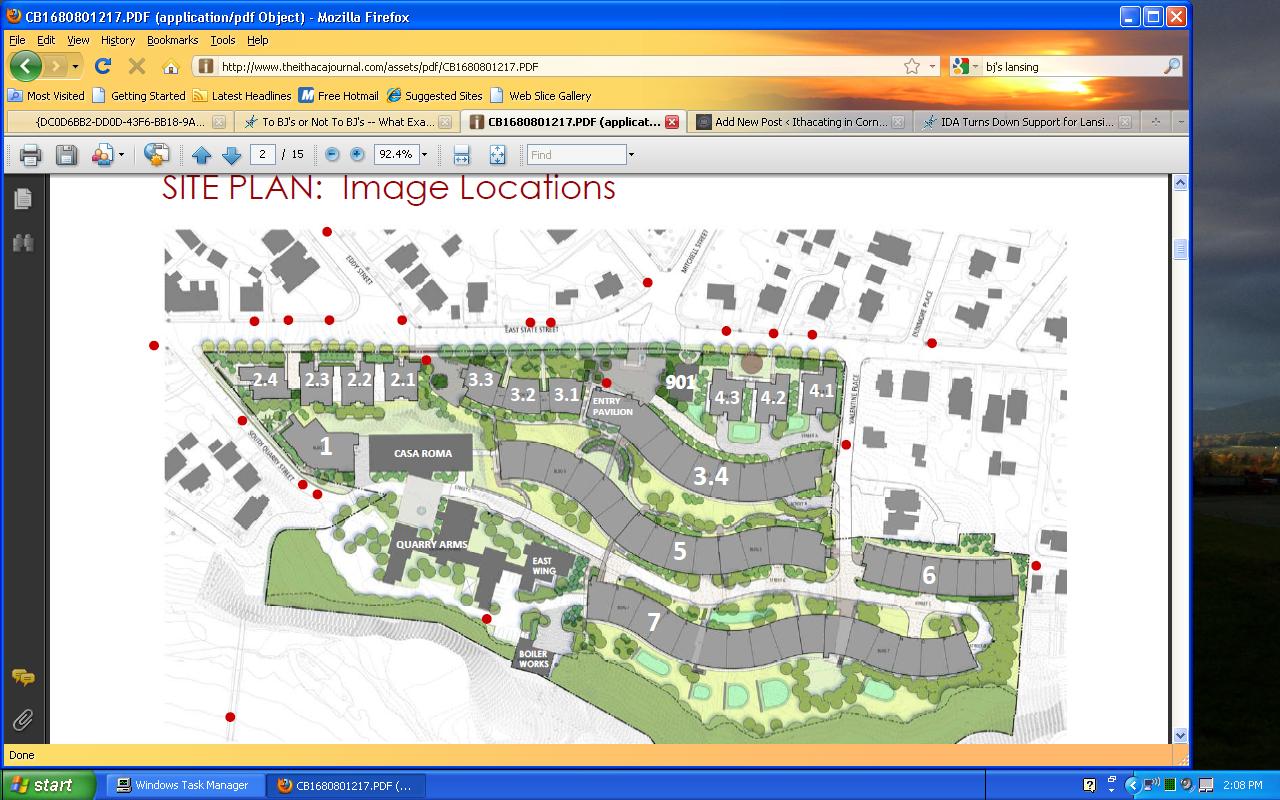
College Crossing Shopping Center - Image Property of Ithaca Estates Realty

I’ve been locked away in my office recently, so I haven’t had a whole lot of time to devote to anything but being an evil TA and doing research. But there have been a couple of Ithaca developments of note.

The Holochuck project (106 townhomes on West Hill) and the 82,000 sq ft. BJ’s Store next to the Ithaca Mall have both received approvals. Site work on the BJ’s could start as early next week. Neither project was without its drama, however – the BJ’s uses a tax abatement in order to finance the construction of 12 senior housing units, some wetland and a bird sanctuary on the west side of the lot, behind the future store. Since abatements are typically issued for industrial projects and not retail, there was some controversy about it setting a bad precedent. After playing with the construction materials to ask for a smaller abatement, the project finally received approval from the IDA, only to rejected by the school board initially, then accepted at a meeting a few days later. So, that was a mess. Regardless, the company plans on starting work on the approved project this Spring, with a fall opening.  As for the Holochuck project, the big issue there was traffic. By incorporating mandatory bus passes and some other traffic mitigation features, the project received preliminary approval, meaning it jumped the main hurdle. However, some residents have expressed anger and concern that the project and a 70-unit senior apartment building be allowed to move forward, even as the town is making steps towards a moratorium.

As for today’s Ithaca Journal – the College Crossings shopping center has been on the boards for at least five years. The only thing new about it is that it’s finally being marketed and that the developer hopes to start this spring, with a fall opening. For those on East Hill, the new shopping center will be of little use because it’s just south of Ithaca College, and well out of the way for most Cornellians.

So, it looks like there will be some work underway as Ithaca transitions into the warm half of the year. Nothing wrong with that.


The 2010 Census

25 03 2011

So, over the past few weeks, I’ve had an eye out for the new census figures for New York State. After hearing about Detroit’s massive 25% loss, I didn’t have high hopes for any part of upstate, what with the high taxes, poor weather and rampant government corruption.

I’m actually pleasantly surprised in some ways. Albany, Schenectady and Troy all grew, which is shocking because Schenectady and Troy haven’t seen population growth since WWII. Syracuse lost 1.5% to fall to about 145,000, but considering it was expected to have only 137,000 people, the smaller loss suggests that Syracuse may finally be “bottoming out”, barring unexpected circumstance. Syracuse’s county, Onondaga, was expected to lose 4,000 people this decade. It gained 10,000. Turning to the more pessimistic results, Rochester and Buffalo met expectations by dropping 4.2% and 10.7% respectively.

As for Tompkins County? Well, estimates initially suggested a population of about 101,779 (there were 96,501 residents in 2000). The official census tally says 101,564, slightly less than expected. Either way, the county added over 5,000 new residents over the past decade (which means more housing required, and new developments…and hopefully I’ll have plenty of things to write about in the future).

Ithaca city added 727 people and now stands at 30,014, an increase of 2.5%. Using the census’s words, the number of white people declined, while African-American/black was virtually flat. The gain was in Asian-Americans, and those who were of two or more races. Ithaca town stood at 19,930, a gain of 9.5%, or 1,732 people. According to census.gov the projection was for 20,200, so this explains most of the discrepancy between actual and projected county population figures. All towns in the county grew, ranging from 1.4% in Newfield to 12.8% in Caroline.

Based off of these figures, for the first time in over a century, Ithaca is bigger than Elmira (which dropped 5.6% to 29,200). The neighbors in Cortland grew 2.5% to 19,204. Actually, most of the growth in Cortland County occurred in communities on the Ithaca-Cortland Route 13 corridor. Looking south, Binghamton lost a grand total of 4 residents, to fall to 47,376 (Broome County’s growth was nearly flat).

Is it good news? Not necessarily. Natural rate of growth would suggest a population increase of 7% per decade. So people are still moving out, but it seems they are doing so in smaller numbers then they did in the 1970s-1990s. Which to a native upstater like myself, this gives some hope that there is a way to turn around the decline of parts of upstate, whether by decreasing taxes and government, new/expanded business ventures (hydrofracking, expanding tourism) or other options that may or may not be pursued. One can hope anyway.


Oh Great, I’m Becoming A Preservationist…

18 03 2011

So, looking at the planning board agenda for the city this month, most of the projects under review have already been covered in previous entries. But there appears to be a new entry, and it’s based on College Avenue. 140 College Avenue, to be exact. The owners, Po Family Realty, seek to add a 3800 sq ft, three-story apartment addition onto the south side of the building. Which, in most cases, wouldn’t be a tremendous deal.

Except 140 College Avenue is considered untouchable by the local preservationists, and I can’t blame them for that opinion either. As a matter of fact, I might even agree for once in a blue moon.

You see, 140 College Avenue is the John Snaith House. Although the name may not sound familiar, its appearance certainly will. It’s the red brick house on the corner of College and Cook Street with the wrought iron fence and mansard roof. It made an appearance on the recommended Collegetown structures for historical designation document released a couple years ago.According to the PDF, the house was built by and for John Snaith, a contractor, in 1874. He relocated to Albany in 1887, and the house was badly damaged and rebuilt following a structural fire in 1894.

The issue I have with this project isn’t so much the project itself, which I do think is a bit unnecessary consider the benefits of such a small project are small. It’s more to do with the fact that the Snaith House is a well-recognized historic building. I’m concerned that if it somehow got approved (which, considering one of the writers of the historic buildings document is also chairman of the Planning Board, I find unlikely), it would galvanize the local NIMBYs who would point to that project as an example of the dangers of development, and use it to try and dissuade later projects.

I’m still surprised the owners of 140 College Avenue would even propose this project. I don’t normally turn up my nose at development, especially in Collegetown, but this proposal stinks.


The Cornell University Airport

15 02 2011

It generally goes without saying that Cornell has had a dramatic impact on the way Ithaca and Tompkins County have developed over the past 150 years. In some respects, Cornell’s influence has been indirect – for example, the development of the Collegetown neighborhood to meet the desires of Cornell students, or the development of Cornell Heights and Cayuga Heights to provide faculty a leafy respite from their academic duties. In some ways, Cornell’s influence has been more direct, such as the Seneca Place building downtown or…owning the airport.

The first airport in the county was actually down where Cass Park is today. For those who live under an ivy-covered rock, Cass Park is just up Route 89 from the city, across the inlet from the Farmer’s Market:

The first airport (which the airport website claims was the second airport to be created within the state), which was called the Ithaca Municipal Airport, was built in 1912. It wasn’t much; a simple hangar and a rundown dirt strip were built initially, and the facilities were expanded somewhat by the Thomas “Aeroplane Factory” which was built next to the airport in 1914 (Turback 29). Three years later, the company merged with Morse Chain to become one of the largest employers in the county. Apart from the testing of military planes, and some leisure flights (the airport was the home base of aerial photographer and future airline pioneer Cecil Robinson), there wasn’t much in the way of air traffic.

By the 1940s, passenger planes began to catch on with (wealthy echelons of) the public, and it became clear that the municipal airport wasn’t going to cut it. For one, it was prone to fog banks from the lake and flooding – a major flood back in 1935 wiped out much of the airport. Space was inadequate, and as planes were growing in size and speed, expanding the facility was neigh near impossible because it abutted the city, the lake, and the slopes of West Hill. The farmland to the north of Cornell was recognized as the prime site for a future airport (Bishop 553), and the city of Ithaca was very interested in building a new airport on that land, but there was one very big and still relevant issue – getting taxpayers to cough over their hard-earned tax dollars to buy the land and build another airport outside of the city was nothing short of political suicide.

Enter Cornell.

Cornell, in trying to meet the needs of its elite faculty, alumni and connections, knew the importance of having a larger, modern airport. Although a bit financially strapped at the time, Cornell noticed the large number of lots being sold off to make the first suburban homesteads and sought to act before the land values could increase any further in that area. On September 9, 1944, the trustees authorized the university to seek options on the land, and within three months had obtained 1,146 acres of land at the price of about $202,000 (about $2.5 million today – a relative bargain). The purchase was strongly debated and led to some sharp criticisms of the Day administration during the 1940s (Bishop 560). The construction of the facility itself was wedged in with many of Cornell’s other post-war projects, but the need of a new airport was not nearly as acute as the need for veteran’s housing or new academic space. The airport was not completed until 1948,  and ownership was transferred to the county in 1956. In the meanwhile, there were two airports in Ithaca – the old rundown one downtown, and the new one on East Hill. The transfer of ownership may have been influenced by a shift in focus from Cornell’s aeronautical program in Ithaca to the Cornell Aeronautical Laboratory, which operated as a division of the university from the late 1940s to the early 1970s next to the Buffalo Airport (it was later spun off as a private enterprise called Calspan Labs that at last check operates as part of Veridian Corporation). CAL’s heyday was from about 1955-1965 — when Cornell decided that having its own airport 200 miles from its recently donated aeronautical lab wasn’t such a hot idea. But mostly, it was a matter of finance – their were issues with the local passenger airline’s use of the airport, severe enough that if one of their planes landed on Cornell’s property, the pilot would be arrested (Bishop 561). The first six months the Cornell airport was open it incurred a $103,000 loss. The University invested $300,000 to build up the property and was hardly getting any return out of it – the trustees voted to prohibit further funding to the airport in June 1949. Although relations with Robinson Airlines were patched up by 1952, the airport limped along in financial hell until Cornell finally had a decent opportunity to unload it onto Tompkins County.

The county airport has operated since, and was renovated and expanded in 1994. Robinson Airlines was renamed Mohawk Airlines in late 1952, moved to Utica six years later, and was absorbed by another company in the 1970s, which after several mergers and acquisitions, is now an ancestor of USAir. As for the old airport, it closed in the 1950s, but the main hangar was renovated in 1975 to house the  Hangar Theatre, which has seen several renovations and expansions since then.The rest of the property was absorbed into Cass Park in the 1960s.

I doubt Harvard ever owned its own airport.


The Urban “Renewal” of Ithaca

1 02 2011

So, the Cornell Alumni Magazine latest issue caught my attention. Its feature article, “Through a Glass, Darkly“, is a feature about visiting professor Mark Iwinski’s artistic work of superimposing photographic stills of Ithaca streetlife from decades past over the contemporary appearance of those locations today. Which, falling in line with my addiction to interest in local architecture in a historical context, was a worthy read.

The most obvious thought after reading it is that history has not been kind to Ithaca. It hasn’t been kind to the downtowns of many older cities and towns in the Northeast. From the late 1940s to the 1970s, “urban renewal” basically consisted of trying to suburbanize downtowns by tearing down underused structures, often pinning their hopes on one or two big projects. An example of its effects can be seen whenever you drive through I-81 in Syracuse –  in 1957, Syracuse’s primary African-American neighborhood (the 15th ward) was town down to make way for the interstate, which effectively cut off Syracuse University from downtown and contributed to the emptying out of that city.

Image property of syracuse.com

As the article mentioned, Ithaca fared better than its peers. First of all, in 1968, Route 13 was supposed to become a limited-access highway connection from Horseheads, through Ithaca and to I-81 in Cortland. However, the project lost state and local support, and the only portion completed was the three-mile section that leads north out of Ithaca to just past the Cornell Business Park in Lansing. So there weren’t large expressways bisecting the city.

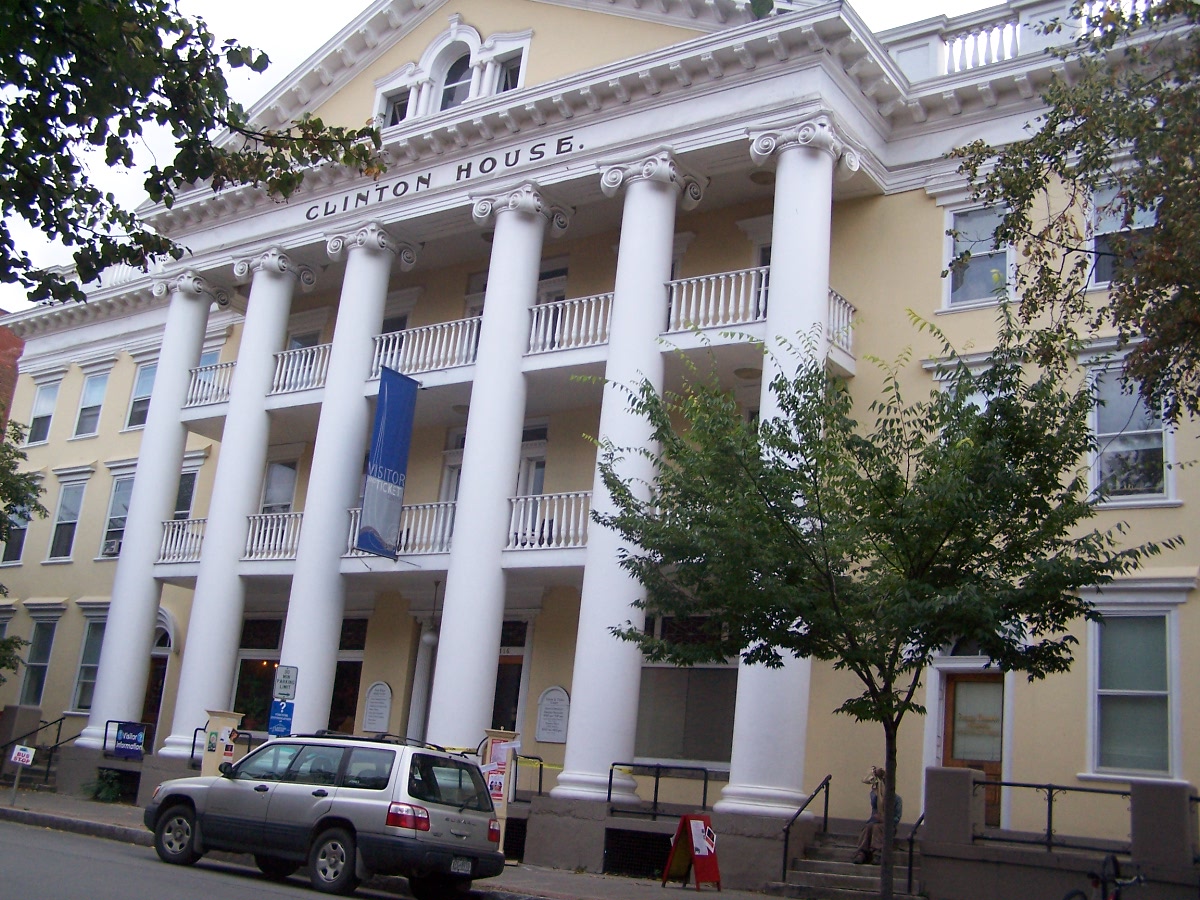
Secondly, although Ithaca was fairly rundown by the 1970s, the preservationist movement also started to gain momentum around that time by saving the Dewitt Mall (the old high school) and the Clinton House from demolition. In a way, it could be said that when the Cornell Public Library was torn down in 1959, and gas stations started replacing Victorian homes near downtown, that the Ithaca preservationist movement was really born. However, as the article shows, not every structure could be saved; the Colonial old city hall was torn down around 1970 to make room for the Seneca Street parking garage. The original Hotel Ithaca, which dated from 1871, was torn down 95 years later and eventually replaced by the Rothschild’s Building, which in an ironic twist of fate the building was vacated by its primary occupant because they complained it was too old and inefficient. The Rothschild’s Building is slated to be renovated into residential units.

So Ithaca has a relatively intact downtown thanks to early preservation efforts, and with further redevelopment and infill, the city has enjoyed a better aesthetic appearance than most of its regional peers. For the record, although I am strongly pro-development, I don’t think preservation is a bad thing. It has its merit and each case has to be considered in all its pros and cons on an individual basis.

On a final note, progressive and meticulous Cornell is by no means an innocent party. Back in the 1990s, the university and the town of Ithaca engaged in several contentious meetings because the university was seeking to expand north campus with the Residential Initiative in the late 1990s. The decision in itself wasn’t a problem, but the decision to tear down one of the oldest farmhouses in the county was. Eventually, a deal was worked out where the Cornell and the NPO Historic Ithaca would have the building, known as the Cradit-Moore house, trucked up Pleasant Grove Road .3 miles (in one piece no less) and built onto a new foundation. Cornell wrote off the moving cost and Historic Ithaca sold the house to a private owner to write off the costs of building a new foundation. In case you were wondering, this is how  “Cradit Farm Road” on North Campus received its name.

The article was a good read, I enjoyed it immensely. It reminds me that while we continue to develop new assets, we shouldn’t turn a blind eye and wantonly demolish what we already have. Otherwise, it might be as empty as the lots behind Dr. Iwanski’s photographic stills.


News Tidbits 1/16/2011: The Project Planned for Seneca Way

17 01 2011

(UPDATED) So, this is a project that has been under the radar but merits a closer look. The site plan review (first step in the approvals process) is due to go in front of the city of Ithaca’s planning board later this month. This project is set for initial review along with Josh Lower ’05’s controversial parking lot-lacking five six story mixed-use building planned for the current Ithaca Carshare building site in Collegetown (the former Kinney Drugs), and the continued review of Ithaca College’s new boathouse, which I don’t consider particularly newsworthy. Sorry IC.

What is interesting about this project isn’t so much who’s designing it (the popular local firm Trowbridge and Wolf, who also designed the West Campus House dorms and the Gateway Commons apartment building on East State Street), but its location. Most people haven’t heard of Seneca Way. That’s because the street barely exists. It’s a tiny stretch of road off of East State that flows into East Seneca Street (shown below). The project address is 140 Seneca Way, the north/east side of the street.

The lots facing Seneca Way are few. True Insurance, a parking lot and the former Challenge Industries Building on one side, and a parking lot on the other side. This area has been a designated target for desired future development for the past few years, so much so that several of the properties on the even-numbered side of the street were up for rezoning. That zoning was to change the site from four stories max to six stories, but was controversial because it might impact the redevelopment of the Argos Inn (right next door to the east side of Challenge Industries) and as one city councilman put it, “I’m not sure this proposal provides as graceful a transition between the core and the residential areas as one would wish”. The zoning failed to pass the Ithaca Common Council, so the maximum height allowed on the property is still 40 feet or four stories, whichever is shorter (which for residential structures, 9-10 feet is standard floor height anyway).

So, what might be there? Well, if the project wants to pass, it’ll likely have to incorporate base parking or compensate somewhere nearby (which would be expensive). There isn’t room for a larger parking lot, let alone spaces lost to new construction. Perhaps part of the project will involve demolition of the vacant Challenge Industries building. Since that’s an uncertainty, it’s difficult to speculate on the number of units (it also depends on what their intended square footage for a unit is). I would expect that being a “transitioning” set of parcels, the size would be three to four stories. Trowbridge and Wolf specialize in contemporary and rather angular designs, so if it’s anything like their previous work it’ll probably bear similarities be glassy and have a fair amount of exterior steelwork.

At this time, it’s just about waiting to see what they come up with for that area.

UPDATE 1/25/11: Okay, so here is the proposal: 63,400 sq ft mixed use building with 14 below-ground parking spaces, as well as 41 surface spaces. First floor commercial (one-third of which will be occupied by a branch of Warren Real Estate), 32 apartments, a fitness center and enclosed roof terrace. Will require demolition of former Challenge Industries building. At five stories, this project will require a zoning variance, as well as variances for setbacks and parking. So, excluding the height variance, my guess wasn’t too far off.

Also, 307 College Avenue will be six stories, not five. My mistake.


Construction News Tidbits, 12/18/10

18 12 2010

A few articles have popped up lately that merit a brief writeup.

The BJ’s Wholesale Club and 12 senior apartments planned for the grass lot next to the Shops at Ithaca Mall (behind the YMCA) hit a snag when the county industrial authority voted down a tax break for the residential portion of the project in a 4-3 vote. While this makes the project less likely, it is not entirely dead, and the town of Lansing still supports the project. However, it’s the  village of Lansing that demanded the residential component as a buffer between houses and shopping areas. Some involved with the project contend that the votes against were by Ithaca-centric legislators who’d rather see the potential sales tax dollars go to the city (i.e. build the store on a site in Ithaca City). BJ’s has no interest in any local site except the one currently proposed, so in conclusion everyone’s getting their panties up in a bunch, and the project is at the very least on hold in its current form.

Out in Dryden, a 144-unit apartment complex is being proposed. Called “Poet’s Landing” (perhaps as a nod to John Dryden, the British poet for whom the village/town is named), the project consists of a 72-unit senior living apartment building, 7 other buildings containing a total of 72 units, and a community center. 48 of the 72 non-senior units are proposed low-income housing, which has managed to rile up the locals with fears of higher crime rates and drugs (the project is across the street from Dryden High School). the project is by Conifer Realty, who also own the Linderman Creek complex over on West Hill.

Lastly, a little closer to Cornell, the Collegetown Terrace Project is waiting on three things – site plan approvals, approval of a zoning variance, and a “certificate of appropriateness” from the Landmarks committee, who are not doubt still seething after the city okayed demolition of Delano House in exchange for the restoration of another house on the property and some public signage displays of the site’s history. If the project can clear those final hurdles, a late spring or summer start for site prep is likely.


The (All Too Late) Ithaca Projects Update

24 11 2010

Since I have no life as a grad student, following progress in the Ithaca has been a little difficult. But, I figured it was time to do an updated brief list. Ithaca has made it through the recession largely unscathed (thankfully), thanks to the stable college-based economy, and various projects are in various planning and development stages throughout the area. For the purposes of this entry, I’m ignoring the projects going on at Cornell and IC.

First off, most of the larger projects are delayed. The Hotel Ithaca is waiting for a bank loan, but given the market that could take a good year or two before a loan is secured for the 10-story hotel.  In a similar boat, the 7-story Cayuga Green condos are delayed until sales pick up and financing is secured.  The six-story, 52-unit apartment building planned for the site of the Women’s Community Building is also delayed, having failed to get a grant from the state. It will be at least one year before financing is secured and construction can begin for that project.About the only going on in the heart of the city right now are the redevelopment of the Petrune Building and the starting phases of a renovation of the Ithaca Commons.

Land remediation and site prep is still underway for the Ithaca Gun condos, which are slowly (barely) progressing towards construction of what may now be either 33 units, or increased to 45 units of “market-rate” housing. On the 600 block of West Seneca Street, a 24-unit, 3-story apartment building has been approved and site prep is to begin in the near future.The Kitchen Theatre finished construction and moved into their new digs on West State Street.

Over in Collegetown, works continues on the 589-unit Collegetown Terrace proposal, which is still making its rounds after agreeing to preserve the Williams House on State Street in exchange for getting permission to demolish the old nurse’s dormitory (Delano House). Even if the project starts this summer, full build-out will take 22 months, so expect no earlier than a mid-2013 completion.  Over on Eddy Street, plans have been approved for a24-unit, 41-bedroom 5-story apartment building next to the Souvlaki House, and construction will begin next summer. A 5-story building on the 300 block of College Avenue remains in the proposal stages. Closer to East Hill, the 4-story Coal Yard Apartments expansion is in site prep, and the now-approved Vine Street Cottages project removed three homes from its plan, leaving 19 houses and 10 townhouse units for the parcel near Mitchell Street.

Down in big-box land, Walmart has finished their expansion into a Supercenter, and Tim Horton’s is seeking approval for a store on what is now a parking lot near Buttermilk Falls.The parcel where Olive Garden was proposed is once again up for grabs. Local rumor mill had it that the land was still contaminated (it was once the site of an auto repair shop, and gas and oil and other hazardous compounds might’ve seeped into the soil deeper than first thought).

Out in the West Hill area and the town, Ecovillage is in the home stretch for approval for their third 30-unit village (TREE), and 106 townhome units (Holochuck Homes site) are approved for Route 96 near the medical center. A couple of suburban subdivisions (the Goldenrod 30-unit division, and a 22-unit INHS project called Holly Creek) are planned/approved. 22 units of senior housing are to be built near Ithaca College, and it was confirmed that the 82-unit, rather terrifying and Soviet-looking Maple Hill Apartments on Maple Avenue will be demolished when the property is returned to Cornell in 2013. Cornell has long-term goals to redevelop the site into mixed use, according to its master plan.

Over in suburban Lansing, there’s some small housing developments and a new locally-owned supermarket planned, but the big thing out there is the proposal for an 82,000 sq ft BJ’s Wholesale Club next to the mall, with 12 units of senior housing and a bird sanctuary on adjacent property (basically because the project is seeking tax-exempt status and need to offer a community benefit to get the break). The 69-unit Woodland Park project doesn’t look like it will be approved anytime in the near future.

Hopefully I’ll have more and more substantial news to write about in the tidbits entries in the upcoming months. I need a distraction from my life. Especially when I grade exams and a student thinks it’s cute to bubble “C” 40 times (he received a 15%).


News Tidbits 9/25/10: Development Planned for 307 College Avenue

25 09 2010

This is slightly annoying. I was away from my computer yesterday and today as a result of my graduate work and then coming straight out to Ithaca, so I never bothered to read my Ithaca/Cornell newsfeed. So it’s bothersome that I found out about this relatively later than usual. Anyways, here’s the article from the Daily Sun:

http://cornellsun.com/section/news/content/2010/09/24/developer-seeks-approval-new-c-town-building

September 24, 2010
By Jeff Stein

A proposal to transform the middle of College Avenue hinges on developer Josh Lower’s ’05 controversial request for a Board of Zoning Appeals variance, which would exempt a building’s development from city parking laws.

Lower said his proposed development project at 307 College Avenue –– next to Jason’s Grocery & Deli –– would demolish the existing building and create more than 60 new apartment units. Lower also hopes to remake the area into a highly trafficked “pedestrian arcade,” filled with street-level storefronts that would connect College and Linden Avenues.

City officials are divided on whether the Board should grant Lower the variance. Under the city’s current parking ordinance, every two housing units built must be matched by the creation of one parking spot.

Lower said that building the parking spaces, which must be within 500 feet of the site, was “not practically or financially possible.”

“We’ve tried to meet the law but cannot,” Lower said.  “There’s just not enough space.”

Ithaca Councilmember Ellen McCollister (D-3rd Ward) expressed concern that there would be a lot of “spillover” for surrounding neighborhoods if the variance was given.

McCollister also said the variance would establish a dangerous precedent: “If you grant a variance to one property owner, how do you not grant [it] to any other property owner?”

If one developer is granted an exception, “all hell breaks loose,” as other developers would expect the same treatment. “We need to treat every developer consistently and equally,” McCollister said.

Lower said his plan would compensate for the lack of new parking spaces by providing his residents with a car-share membership and free bus passes as part of the lease.

“We’ll create a building that fosters … sustainable modes of transportation and encourages people to bike more, walk more,” Lower said. In reference to a proposed pedestrian walkway, Lower said, “We’re making privately-owned space accessible and usable for all.”

McCollister was not convinced. She called Lower’s replacement for parking spaces a “very ill-defined, nebulous proposal,” saying it was “not a real plan for how he is going to do it, in perpetuity, for every resident.”

Partly because there is “more supply in retail than there is demand” for Collegetown, McCollister is “not convinced the pedestrian arcade is as valuable an amenity as it’s being portrayed.”

Board of Zoning Appeals member James Marshall shared McCollister’s skepticism about Lower’s replacement plan in exchange for a variance, calling the lack of parking spaces in his proposal a “significant deficiency.”

“He’s proposed some measures that might encourage people to use public transportation or bicycles, but no one knows how successful he’ll be,” Marshall said.

Stephen Beer, chair of the Board of Zoning Appeals, said he worried that there was no provision for enforcing Lower’s suggested replacement for the parking spaces.

Lower responded that “it would be a requirement written in the lease.”

Eddie Rooker ’10 (D-4th Ward) said he and Svante Myrick ’09 (D-4th Ward) both supported the project.

Rooker said the development is “going to be beneficial to students and the city,” naming studies that “point to the fact that we need more housing in the city” given “pretty high pricing all over the city.”

Rooker said the project would fix the need for a “well-lit pedestrian walkway connecting College and Linden Avenue,” where “people now have to go between people’s yards when they’re not well-lit.”

Rooker said the proposal could make the area in front of 307 College Avenue a new hub for TCAT, shifting the center of Collegetown further south.  He said that TCAT wrote a letter to the city in support of the project.

Lower, who lives in the neighborhood, said that “we really looked at a lot of scenarios to try to do something else with the property,” but that nothing else was viable. He said that he is currently losing money on the property.

McCollister responded that one of the considerations for the Board of Zoning Appeals was that the variance request not be in response to a “self-imposed hardship.”

“I think he does have a financial hardship, but that’s because he paid too much for it … rather than some externality that created that financial hardship,” McCollister said.

McCollister added that the Board of Zoning Appeals should wait until a decision is made about an “in-lieu of parking fee” suggested in the 2009 Collegetown Urban Plan & Conceptual Design Guidelines. The proposal, which is currently being developed, would specify a fee below the cost of providing on-site parking that developers could pay the city in lieu of building parking spaces. The Collegetown plan says the fee could then be used to help the city fund alternative transportation modes.

“I can only base my plans on what is law today,” Lower responded.

Rooker agreed, saying, “We can’t constantly rely on what might be happening,” and that he “would rather see something like this than a one time donation to general fund” anyway.

Lower added that waiting for the law to pass could have a big impact on his finances, since “the building has to be done based on the academic year.”  “If the building is not ready to have [residents in it] before classes start, it sits empty for the rest of the year.”

If approved, his plan is to start construction in June 2011 and have the building ready for residents in the Fall of 2012.

***

So, the summary is this:The guy wants to build a medium-sized apartment building but doesn’t want to include parking. The issue lies with the possibility that residents would just park their vehicles on the streets and clog local roads, and finding viable options to keep that from happening. A zoning variance is required due to the lack of parking, and without it the project will not proceed.

A few extra details; the development would be a 60-unit building with a retail base. Guessing from the rendering and from the height limit there, it would be about five stories. The current building on the site used to be occupied by a drugstore, but the store closed in late 2006. With the exception of the space occupied by Ithaca Carshare, the retail portion has been empty since.

The argument on the parking issue is reasonable and legitimate. A lot of students maintain cars, and the overly entitled ones may still try and maintain a vehicle nearby, thus creating parking issues for the building’s neighbors. While the project would definitely add density and needed residential space to inner Collegetown (and definitely makes use of New Urbanist planning), the lack of parking is a major hurdle. Personally, I like the idea of the project, but unless he can make absolutely clear what he’s going to do to keep students from bringing vehicles to an area with no space for them, and be held to that “in perpetuity”, I would be leery of its approval.

The architect is a small local Ithaca firm founded about seven years ago, John Snyder Architects.  Looking at the website, it seems most of their work has been for educational facilities or interior spaces, and the style tends to be modernist with limited detailing, instead playing off of the geometric forms of the structure itself. I’m very curious to see the whole design of what would seem to be the firm’s first large residential building. At the very least, it least it won’t be another Sharma Architects proposal; a little variety does wonders.


News Tidbits 9/1/10: Firm Selected to Design Bridge Barriers

2 09 2010

According to the latest updates from the Cornell Chronicle, architect Nader Tehrani of the firm “Office da” has been selected to design the bridge barriers for six of the gorge bridges, effectively trying to put a prettier face on suicide prevention. Two public forums will be held during the design and proposed implementation process, with the final proposal to be ready no later than May 2011.

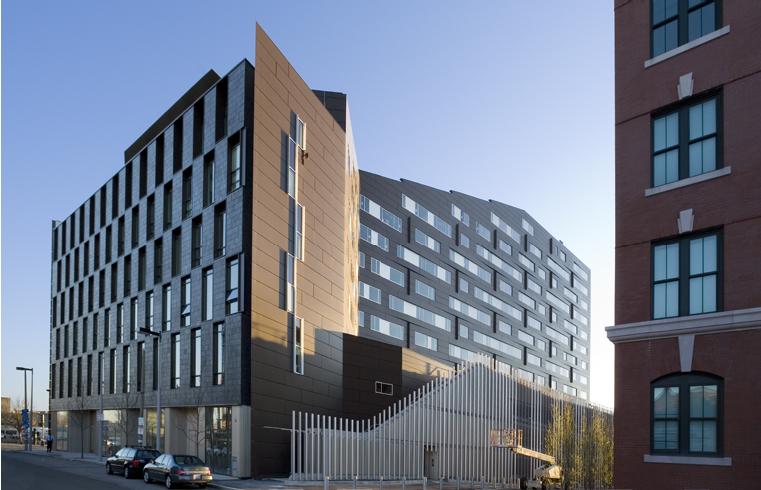
The firm, like many selected recently by the university for its projects, is known for edgy ultermodern architecture. Normally, as readers who tolerate me are aware by now, this would be the point where I go into a rant about how such architecture fails to fit in with the surrounding environment, often fails to live up to standards, etc etc. Well, for the record, here’s a sample of their previous work, the McAllen Building in Boston:

Photo Property of Office da (www.officeda.com)

But, I don’t have a reason to complain, for three reasons. For one, they’re designing bridge barriers, which tend to have less of an impact on their surroundings than buildings. For two, it has to be cleared by public forums in conjunction with the city of Ithaca and its residents, who won’t be so gung-ho for wild design features. To be honest, the train of thought in my mind is “can they really screw this up aesthetically? Not really. ” For three, nothing can be as bad the metal behemoths we were treated to last Spring, which gave the impression of being locked into a prison yard. When you’ve already hit the lowest lows in appearance, the only way to go is up.

I’m going to be  very interested to see what comes out of their studios in the coming months.