Five Years Later

18 06 2013

4-8-2013 226

Well, as promised earlier, today’s the big day, where Ithacating celebrates birthday #5. I’m pretty sure this falls into the realm of “old” blogs by this point, especially if I believe the kids over at Ezrahub. Thankfully, unlike them and Eliiott Back’s old Cornell Blog, even if Cornell disliked my use of their name, I refer to a place instead of the school itself. In keeping with tradition, here’s a rundown of this blog’s statistics:

total_5th_birfday

Since launch, which was about 7 PM on June 18, 2008, this blog has garnered 308,481 hits, as of 2:30 PM today. In previous years, the blog averaged 82, 166, 199 and 216 hits daily. This year, it plateaued in the fall and effectively plunged in the spring. The blog only averaged 182 hits per day in the past year. I have a couple of theories – as old posts become “outdated”, they disappear from the radar; as folks have switched to twitter and other platforms, the audience may not quite be there like it used to. I would be lying if I said it doesn’t make me concerned, but the summer numbers will help figure out part of the problem – if they’re comparable to last year, than I’m just not familiar to the Cornell crowd anymore.

In contrast to previous years, the highest month was January, with 8,019 hits. One of the things I didn’t see quite so much was the summer plunge, since Ithaca traffic tends to be less seasonal than Cornell traffic. Why things decreased so much in February, I still don’t know.

Looking at the year in review:

~In planning and development, Collegetown Terrace and the Vine Street Cottages are well underway. 107 Cook was completed, and Collegetown Crossing was postponed because the BZA did not work out that whole parking requirement issue, and it falls to the city to actually change the parking space requirement. The southern suburbia got Ithaca Beer’s new brewery, the Fairfield Inn is nearly complete, and a proposal for eco-friendly housing, while Ecovillage started its next expansion over on West Hill. Cornell proposed some new townhomes near Eastern Heights, and Cayuga Heights decided it wanted to have a walkable town center.

In pleasant contrast to last year, the city was brimming with construction, ongoing and proposed. Seneca Way is under construction, Breckenridge Place is marching towards completion, and new proposals abound, such as Harold’s Square, the new Hampton Inn, and 130 East Clinton. Even some traditionally less developed areas are getting in on the act, with the Purity Ice Cream proposal near West End. Planned Parenthood is underway, the Iacovelli project and Magnolia House are nearly complete, and the Hotel Ithaca and Holiday Inn sites are in hold-over, but with construction begin dates on paper. Even the Cayuga Place project seems to making an attempt at true site prep. Finally breaking down the numbers, it became clear Ithaca is in a residential building boom.

Looking at our colleges, IC has some renovations underway, and Cornell plods on with Gates Hall, the Big Red Bandhouse, and the Stocking Hall rebuild and renovation. Prep is just starting on the new humanities building, Klarman Hall, a long ways off from its 2015 completion. Perhaps most importantly to students, the bridge fences finally came down, and with it, the last strong reminders of a dark semester in Cornell’s history.

Thankfully for my gas tank, a website arose that focuses closely on Ithaca construction and development – the succinctly named Ithaca Builds.

-Looking at Cornelliana, this blog compared and contrasted Far Above Cayuga to our friends on University Hill, took a look at Ezra’s progeny, and a favorite Cornell hobby, comparing it against its peers, in this case for Nobel Prize recipients. In a goodbye to another college memory, Dear Uncle Ezra went on indefinite hiatus. In Greek life, Kappa Sigma and Pi Kappa Alpha reopened, while a bunch of chapters were suspended or shut down (just looking at the Ezrahub site for this writeup, it appears ATO is the latest case). The Greek system looks to have had a rough year. In more general topics, there was a discussion on that time Ithaca almost had a commercial nuclear power plant, a look at Carl Sagan, the Collegetown Creeper, census estimates, and some other things in between.

In my personal life, this past year will go down as the year of uncertainty. Gainfully employed in my field, but still trying to advance my career and clear hurdles as they come up. I’m hoping to fulfill that goal in the next few weeks with some ongoing opportunities.

Five years is a long time to be around. It’s clear this blog has had some stumbles. But I’m not ready to quit just yet. I still have too much interest in writing about Cornell and Ithaca to stop. We’ll see where things go from here.


Can a Polluted Past Have A Future?

21 02 2013
Image Property of Welch Construction Inc.

Image Property of Welch Construction Inc.

Real estate in Ithaca is fairly warm as markets go (I refuse to call it hot). But there are still some gaping issues in the metro market.  One of the biggest examples is one that can be seen from just about any southward vantage point above the lake lowlands – Emerson Power Transmission.

The property started as Morse Chain, which dates back to 1880 and began the manufacture of automobile chains in 1906.  Morse Chain was acquired by locally prominent BorgWarner in 1929, and the facility continued industrial production until BorgWarner built a new facility near the airport in 1983, selling the factory to Emerson Power Transmission. Throughout the 1960s and 1970s, several chemicals were used for “cutting oils”, removing oils from the manufactured automotive gears, shafts and chains at the tail end of the process. One of those was trichloroethylene, or TCE. TCE is a known carcinogen, and I’ll come back to this in a moment.

Unfortunately, the era of traditional manufacturing was fading in the Ithaca area. Emerson Power Transmission moved about 55 of its corporate senior staff to a suburban Cincinnati facility in 2007 (and I remember reading about it while a student at Cornell). The death knell came in August 2009, when Emerson announced it was closing up shop in Ithaca, putting 228 people out of work (the factory had over 500 people on site as recently as the mid-2000s, and had received tax incentives not long before closure). The closure was recent enough that this blog was already going, and the original entry is here.

At first glance, the property would appear to be potentially salable. It’s a large property in a well-populated and growing area with a substantial uptick in the real estate market. However, there’s one very, very big issue – the TCE contamination.

Although TCE use stopped by the late 1970s, the damage was done, and unknown quanities of it leaked into the groundwater and sewers. The site was declared contaminated by the state in 1988.

Since then, it’s been a series of long and contentious debates about who to hold responsible for what degree of clean-up. The city, the state DEC, and BorgWarner and Emerson had volleyed back and forth on who pays for what. 35 years after the chemical usage is stopped, yet nearby sewers have had to be replaced, soil tested constantly and excavated if contaminated, and groundwater / vapor testing in nearby properties. Essentially, a major environmental headache.

Although the brunt of the burden has fallen on government and Emerson to clean up (BorgWarner gets blame but seems to carry little if any of the cleanup cost), the site has been marketed for sale – $3.9 million for 94 acres plus structures (note that just the groundwater is contaminated, not the structures themselves – this isn’t Ithaca Gun). It was no surprise that with the remediation and continual testing, the site has been a tough sell.

All the more interesting, then, that the local chamber of commerce announced at a recent luncheon that someone is agreeing to purchase the property. Emerson’s in the final steps of reviewing the offer.  The property could be host to a variety of activities – the IJ article mentions a possible small business incubator like the one at the South Hill Business Campus (itself a former factory). Given the location, any number of industrial or commercial applications are possible, maybe even partial/total tear-down and redevelopment. The biggest obstacle apart from the lingering environmental concerns might be the fact that the property is split along the city and town of Ithaca, so both would have to accept any proposed redevelopment.  But still, any progress on the looming, decaying facility would be one of the surest signs of a “reinvention” of the area.


Klarman Hall

16 02 2013
Image Property of Cornell University

Image Property of Cornell University

The Humanities Building has a name – Klarman Hall. The building is named for Seth Klarman ’79, a prominent hedge fund manager and large-scale investor in pro-Israel organizations. Considering the construction cost  is at least $61 million, Klarman probably put up at least half of that amount.

A part of me wonders if there’s any cruel humor to be had in an investment banker with strongly pro-Israel views funding a humanities building where most of the students who will walk through those doors will hold an adopted dislike of him (due to his strongly capitalist tendencies, and Israel being an easy target for disdain given the conflict with Palestine). For what it’s worth, Mr. Klarman does keep a very low profile, and is considered fairly conservative as investors go.

Klarman Hall, which I have previously shrugged off as a token glass box, is set for a construction launch this summer, with completion in 2015. The building is planned to be LEED Platinum with low-energy everything and living roofs, and is designed by Koetter, Kim and Associates, a Boston firm founded by Cornell alumni.

In a twist any cynic would enjoy, it was discovered a few years ago that Goldwin Smith, the professor and namesake of the hall Klarman will be contiguous with, was a virulent anti-Semite.


When Things Don’t Work Out

17 01 2013

Frequent readers of this blog are aware that I cover two things – Cornell (its history and physical plant) and new projects and real estate development in the Ithaca area. Now, I’m not going to say I’m beating a dead horse with the former, but I would be lying if I didn’t say it hasn’t been easy coming up with new topics to write about, that aren’t widely available already (ex. the Willard Straight Takeover of 1969), or previous written in this blog.

Fortunately, Ithaca has been undergoing a veritable boom in construction. Just today, I checked the town of Ithaca planning board notes to find yet another multi-unit housing project proposed – “Hawk’s Nest at Springwood”, a 3-story, 50-unit building to be built at the Springwood Townhomes area just east of the intersection of 96B and King Road. The project will be marketed to the 55+ crowd.

hawks nest

This area has seen a cluster of (mostly suburban-style) development in the past few years, with the Holly Creek Townhomes, College Crossings, the Namgyal Monestery, The Country Inn and Suites, The College Circle Apartments (IC) expansion, and a number of private homes. Which, counting that all of the top of my head, gives 184 more beds at IC, and 74+ other housing units. Quite the little burst of activity south of IC.

So, considering the question in a previous entry about historical construction trends, this latest development pushes the private residential units number from 2011-2016 over the 1,000 mark, nothing to sneeze at when the total number of units in the entire metro is just under 42,000. In considering the planned developments north of Ithaca, and single-family homes, the number of units planned in those five years could very well be in the 2000+ range, a proportion highly unusual for upstate New York, and probably only comparable to the Albany metro, where a massive computer chip factory has been underway.

Now, time for the Debbie Downer – I have no expectation all these projects will come to fruition.

In the past, several projects have been downsized, modified, or cancelled. Take Ithaca Gun, a project constantly being re-evaluated due to rapidly increasing costs associated with the site cleanup. The project started off with 160 units, but neighbors complained. It was decreased to 80, then 33, than upped to 45. The final result seems to be a shot in the dark. Because of the uncertainty, I did not include it in the unit count.

Other projects, both current and old, were modified in the planning. The Trebloc Building downtown was originally supposed to be two floors (and I will personally donate a very nice bottle of Finger Lake wine to any developer who proposes to knock that abomination down and replace it with something more fitting). Cayuga Green, covered previously, has been redesigned four times. Collegetown Terrace has undergone at least one major revision and a couple minor ones.

Some projects never see the light of day. The McGraw House, an assisted living facility downtown, considered an expansion in 2009/2010. Then they shelved it. A 400-unit development was planned for West Hill (Carrowmoor), but this also appears to have gone stale.  Cornell’s West Campus was slated to be bedecked in Collegiate Gothic – killed by the Great Depression (among other Cornell proposals and plans that can be found using the search bar). Wal-Mart was once slated for Lansing. The most outlandish serious proposal goes toward a city-sponsored urban renewal plan proposed for Collegetown in 1968. The project would have tore down the heart of Collegetown, and in its place put up an eleven story office building, and 6 to 8 high-rise apartment towers (total 375 units), the tallest being 18 to 21 stories. It also would have included a 600-space parking garage and retail venues.

It’s sort of like “survival of the fittest”. The projects with the most stable funding, and the strongest proposals, tend to win out. Some projects are clearly underway, some go through revisions, some will remain pie-in-the-sky. I do, however, look forward to as many of these projects coming to fruition as possible.


A Fond Farewell to Dear Uncle Ezra

13 11 2012

It’s bittersweet. After 26 years of operation and over 20,000 responses, Dear Uncle Ezra, the “Dear Abby” of the Big Red, has gone on indefinite sabbatical. DUE was useful to this blog for its grab-bag of historical info, cited in these entries many times over the past few years. When first launched in the fall of 1986, DUE could be accessed from one of the two dozen computer sites, or few personal computers on campus.  Now in 2012, and thinking of blogs like this one and of internet culture, I suppose answers to many writers’ questions are just easier to find through google these days. But sometimes, it’s nice to just have someone hear you out, an impartial ear.

I wrote to Dear Uncle Ezra as a freshman. I don’t think the question will surprise most of the readers here.  A quick back-story on this, but my first few months at Cornell were a very trying time for me, since it was my first real experience away from home. And I guess that experience carries over somewhat to my current situation, as I moved to a new region for the first job in my post-grad school meteorology career. Having to build a new social network. Learning the ropes of my job. Not the easiest things in the world, when it seems tempting to settle into something else “easier” or closer to “home”.

From September 5, 2006:

Dear Uncle Ezra,
For years,
I’ve wanted to be a meteorologist, and I came to Cornell to study for that career. However, over the past year or so, I have had an equal if not greater interest in studying to be a history teacher at another university (it has a more focused program than Cornell’s, though I mean nothing against the school). I know that if I transfer, a lot of people will be dissappointed that I’m throwing away an “Ivy League education”. I feel confused and somewhat frustrated at being unable to make a decision, and I have to make it within the school year*. Could you weigh-in on the issue?

Dear Career-confused,

Glad to hear that you haven’t waited til the last minute and have the year to think this one through.  Choosing a career can be a very difficult process, but remember that it is a process and not just one single decision.

Fifty years ago, people in the United States got into the mind set that you chose a career (or even a company) and stayed there until retirement.  This is no longer true, as there is a lot of flexibility to combine interests into a “perfect” job, or to change positions or careers along the way as your expertise and needs change.  I myself, Ezra Cornell, was a carpenter, potter, farmer, public works engineer, communications entrepreneur, and then founder of this university.  But back to you.

In order for your direction to be the right one for you, you will need to continue engaging in the process of exploring your options.  One way to do that is to do research on what the two careers will be like.  Interview people in those positions to learn more about them.  Make an appointment with Cornell Career Services, 103 Barnes Hall, 5-5221.  They provide a wide range of services to help students reach decisions on majors and careers.  They could also help you find an internship or lead you through their career- information library, which might lead to greater clarity.

It might also help to talk to those people who think it would be a mistake to change schools: hear their thoughts and let them know your needs, goals and dreams.

Remember that it is your life and you must make the decision that is right for you after you weigh all of the information that you gather.

If you need a great sounding board along the way, feel free to contact EARS for free, confidential  and immediate counseling by phone or walk-in, 5-EARS or 211 Willard Straight Hall.

***

So I stayed the path in my career, doing my BS, my MS, and now at my first job (with what may be job number two coming up at a research facility a five hour flight away). My life is in flux, and it’s intimidating. Sometimes its good to have someone to sound off to. And for me personally, that’s what Dear Uncle Ezra was.


A “Nobel” Accolade

4 10 2012

In the proverbial confidence-measuring that is academia, one of the things that colleges and universities like to throw out there is the breadth and depth of their Nobel laureates. The reasoning is simple enough; it’s a measurement of prestige, and the caliber of alumni and faculty.

Cornell lays claim to 41 such folks, according to a fall 2009 issue of the Cornell Chronicle, and according to wikpedia, that number has held steady. Within those 41, 3 are current faculty, 13 are alumni, and the other 25 are former faculty (moved, retired or otherwise). The last recipient was Jack Szostak Ph. D ’77, who won the Prize in Physiology/Medicine in 2009.

So let’s take a brief look at how Cornell stacks up against its peers: First, the top 20 schools, as compiled by U.S. News and World Report, since that tends to be the most commonly used ranking system:

Harvard
MIT
Yale
U. Chicago
Penn
Columbia
Stanford
Caltech
Princeton
U. Mich
Cornell
Johns Hopkins
Duke
UC Berkeley
Northwestern
UCLA
Brown
UW-Madison
Carnegie Mellon
NYU

Now their Nobel laureates:

Columbia 80 (or 97, depending on your definition)
U. Chicago 87
MIT 77
Stanford 54
Yale 49
UC Berkeley 47
Harvard 46
Cornell 41
NYU 36
Johns Hopkins 36
Princeton 35
Caltech 32
Penn 28
UW-Madison 19
U. Mich 19
Carnegie Mellon 18
UCLA 14
Duke 12
Northwestern 8
Brown 7

Interestingly, U. Illinois-Urbana-Champaign has 26, but doesn’t appear in the top schools list from USNWR. International students may be annoyed at me for leaving of non-U.S. schools, and granted, there’s a few that have similarly high rankings and accolades. Forgive my blatant nationalism for the moment.

This exercise proves to me, on a very general level, that universities with Nobel affiliates tend to be more prestigious. However, there are some obvious issues- schools with large research programs tend to have more laureates, and we haven’t even explored the Nobel laureates per capita at each institution (an exercise in futility, since I would also require historical enrollement figures I don’t feel like digging for at the moment).

But whatever floats your boat Cornell P.R., and keep your fingers crosses at the next Nobel award ceremony.


The Descendants of Ezra

4 09 2012

The inspiration for this entry comes from a recent Sun article detailing the rescue of a woman from the gorge, in which the first responder was a Cornell student, and descendant of Ezra Cornell.

Some famous people, like William Shakespeare and Abraham Lincoln, have no living direct descendants. Ezra Cornell, who is at least famous to those who have spent four or more years in Ithaca, is quite the contrary.

Ezra Cornell had either nine or eleven children, which sounds prodigious until you realize that couples had as many children as possible back in the mid-19th century simply to ensure that nature and probability would allow at least a few of them to survive into adulthood. Indeed, four of Cornell’s children died before the age of 25. However, that leaves behinds seven children – three boys and four girls (or five children consisting of three boys and two girls, depending on which source is correct).

The most famous of Ezra’s direct descendants is likely his son Alonzo, who served as governor of New York from 1880 to 1882, and was married twice. The wikipedia article claims he had four boys. One of them, Charles Ezra Cornell (d. 1947), served as trustee and had three children of his own, of which at least one, William Cornell, survived to adulthood. So plenty of possibilities for descendants here.

Regarding Ezra’s other surviving children, Franklin Cornell, a banker, passed away in 1908, and at that time, three of his four children were still alive – one boy, Franklin Cornell, and two daughters, Ms. Dorothy Cornell and Mrs. Eunice Cornell Taylor.

Oliver Perry Cornell, the third son of Ezra, survived well into his mature years (d. 1911). He married and had at least one son.

As for the daughters, they tend to be less easy to track, since they take the names of their husbands. There was Mary Emily Cornell  and Emma Pettit Cornell Blair (d. 1914), of which I can be certain. A Dorothy and Emma Cornell also appear in one of the sources, but this could be a repeat, someone’s wife, or some other error (and this is why I would never wish to be a genealogist). Mary went to Vassar, passed away at the age of 87 in 1935 (making her the last of the first generation), and appears to have remained unmarried. But Emma did marry, and had three boys, Charles, Cornell, and Hamilton Blair.

So, given this illustration, it is likely that there are Cornell descendants sill kicking around today, many of whom still live near the Ithaca area. Among those, Ezra Cornell IV (class of 1970), and the kid from the Sun article, Thomas Ezra Cornell Collum ’14.

On a final note, in the early days of the university, direct descendants could attend free of charge. However, with the proliferation of descendants, this practice was discontinued beyond the fourth generation, by order of the Board of Trustees in 1932. The university notes that the last folks eligible were of college-age around sixty years ago. So even if you find out you’re a seventh-generation progeny of Ezra, it won’t help your pocketbook if you attend the Big Red. But I’m sure it would make a nice conversation piece.


Four Years Later

18 06 2012

My oh my. This blog turns four years ago today. I wanted to celebrate this port by comparing this blog to the average age of blogs, or the average number of posts for an active blog. Turns out neither piece of data is readily available. I’m going to go out on a limb and assume this blog has reached maturity, though I won’t go as far to say “old age”.  In keeping in tune with three previous three “birthday” updates, here’s some fun facts.

Since launching on the evening of June 18, 2008, this blog has received a grand total of 241,966 hits, as of 2:29 PM today. Breaking down the math, that’s about 166 hits/day. While the previous years averaged 82, 166 and 199 hits/day respectively, I’m happy to say that the blog came a little closer to the saturation point with an average total of just under 216 hits/day in the past year, and yes, I did remember it’s a leap year. Taking a cursory glance at the monthly statistics:

The highest month was once again March, with 8,247 hits, although the peak isn’t as pronounced as it was in previous years. Going year-to-year, the only month that was lower in 2011/12 versus 2010/11 was August, although June and July came fairly close. This is due to the Cornell-centric nature of the blog – once classes are out for the summer break, my hit tally plummets like a stone. Although, that’s been somewhat avoided this year, which I’ll guess is the result of the more Ithaca-area focus taken on in the past year, and is a bit more stable in terms of visitors to this site.

Looking at the past year in review:

~In planning and development,the biggest news is the construction of Collegetown Terrace the massive 1200-bed project south of Collegetown. Approvals were granted and phase one is underway, with an August opening for the first buildings. The Vine Street Cottages also began construction, replacement apartments were planned for 107 Cook, and 309 Eddy marched merrily towards completion, which should be in just a few short months.The Coal Yard apartments phase II was built, and Collegetown Crossing was proposed with the radical premise of no parking for residents, in a move that could make or break Collegetown. in suburbia, everyone got BJ’s in Lansing, and the holiest of holy casual dining restaurants came to big box land, a Chipotle.

Closer downtown, the Seneca Way project was approved and is now in site prep, and the new Fairfield Inn is under construction down in chain store country. The Argos Inn renovation moved towards completion and the Breckinridge Place project began construction, currently in the demo phase of the old Women’s Community building. Several smaller projects also began construction, such as the Iacovelli apartments on West Seneca and the Magnolia House women’s shelter. In the longer-term, the massive Cascadilla Landing project was proposed, and could potentially  redefine the city waterfront, and the new Holiday Inn tower/renovation will add a small conference center to the Gorge City.

Over at the colleges, Ithaca College built a boathouse and started its Circle Apartments expansion. Over on East Hill, Milstein Hall, MVR north, and the Johnson addition were completed, the food science building is well underway, Gates Hall is in foundation work, and the law school just launched their underground addition. The Big Red bandhouse is set to start shortly, and Kappa Delta renovated their home-away-from-home in what was probably the most significant Greek house renovation in more than a decade. Fundraising began for the new token glass box, also known as the Goldwin Smith Hall addition. More importantly, some bridge nets and barriers were approved, and their construction will hopefully bring to an end a dark chapter of Cornell’s history.

In the meanwhile, some projects still have yet to get off the ground. The Hotel Ithaca is still in some financing conundrum, as are the Cayuga Green Condos, which were given an extension on their cost-saving agreement with the city, given the poor lending climate. Ithaca Gun is undergoing yet more land remediation with no construction date in sight (honestly, it seems like the only way the land could have been more contaminated is if someone nuked it).

~Turning an eye towards Cornell matters, the least surprising lawsuit was launched when the mother of George Desdunes filed a wrongful death suit against SAE to the tune of $25 million. The bench trial wrapped up about a month ago, though I’ve yet to hear about a verdict. The number of bars near Cornell continued to shrink, but students can now drown their sorrows in frozen yogurt instead. When the Palms said they were closing up, a couple dozen of my fraternity’s young alumni offered to buy a table of some sentimental value to us if they were willing part with it. They asked for $1500 for a rotting wooden bench table. We laughed (we were thinking $500 max). They said they were serious and it was a starting bid. Needless to say, I have many happy memories of a table that hopefully no longer exists. Rumor has it a new apartment tower will rise where the Palms once drunkified multitudes of Cornellians.

~From a meteorological standpoint, the ITH toyed with 100-degree temps and had a collective anxiety attack about the impending arrival of Hurricane Irene, but was spared the brunt of the destructive tropical cyclone. However, this relief was short lived when the extratropical remnants of Tropical Storm Lee dumped 8.7″ in 24 hours at Binghamton, and flooded many local towns to the tune of $1 billion in damage, a number not seen since the horrific aftermath of Hurricane Agnes in 1972. It also resulted in one of the wettest years on record. Ithaca, while soaked and unnerved, was relatively unscathed.

Many things, many topics. In comparison to the past years, I now write this while firmly ensconced in alumnidom, my trips back further and further apart. At this point, I’m finishing grad school, and interviewing for positions in California and Texas. It was not exactly in my wishes to move as far out, as my northeastern blood may not be able to tolerate nice winters. But, that’s where the jobs are in my field at the moment. Ideally, I can make a triumphant return to the northeast someday.

I write not out of obligation, but out of genuine interest, which I think has been one of the attributes that has made this blog a reasonable success. I see the emails of those who follow comments and posts – they include other alumni and current students of course, but also prominent companies in Ithaca and some local government officials. Flattering, if a little disquieting for fear of botching up my facts. More importantly, I think it serves as an indicator of the usefulness of this blog, that people honestly come here searching out information, and many of them leave feeling a bit knowledgeable about Ithaca projects and stories, or Cornell history and construction projects. Or at least, I hope as much. It makes for great motivation in the months and years ahead.


This Old House

4 04 2012

In the years that I’ve written this blog, I have written many articles highlighting the history of the physical assets in the region, but as I’ve exhausted many of my sources, and my access to new sources has become more difficult post-graduation, I’ve tended to focus on new development in Ithaca and the colleges. I’m not saying that it’s necessarily a bad thing, but there are occasions where the acknowledgment of historical assets must be given its due.

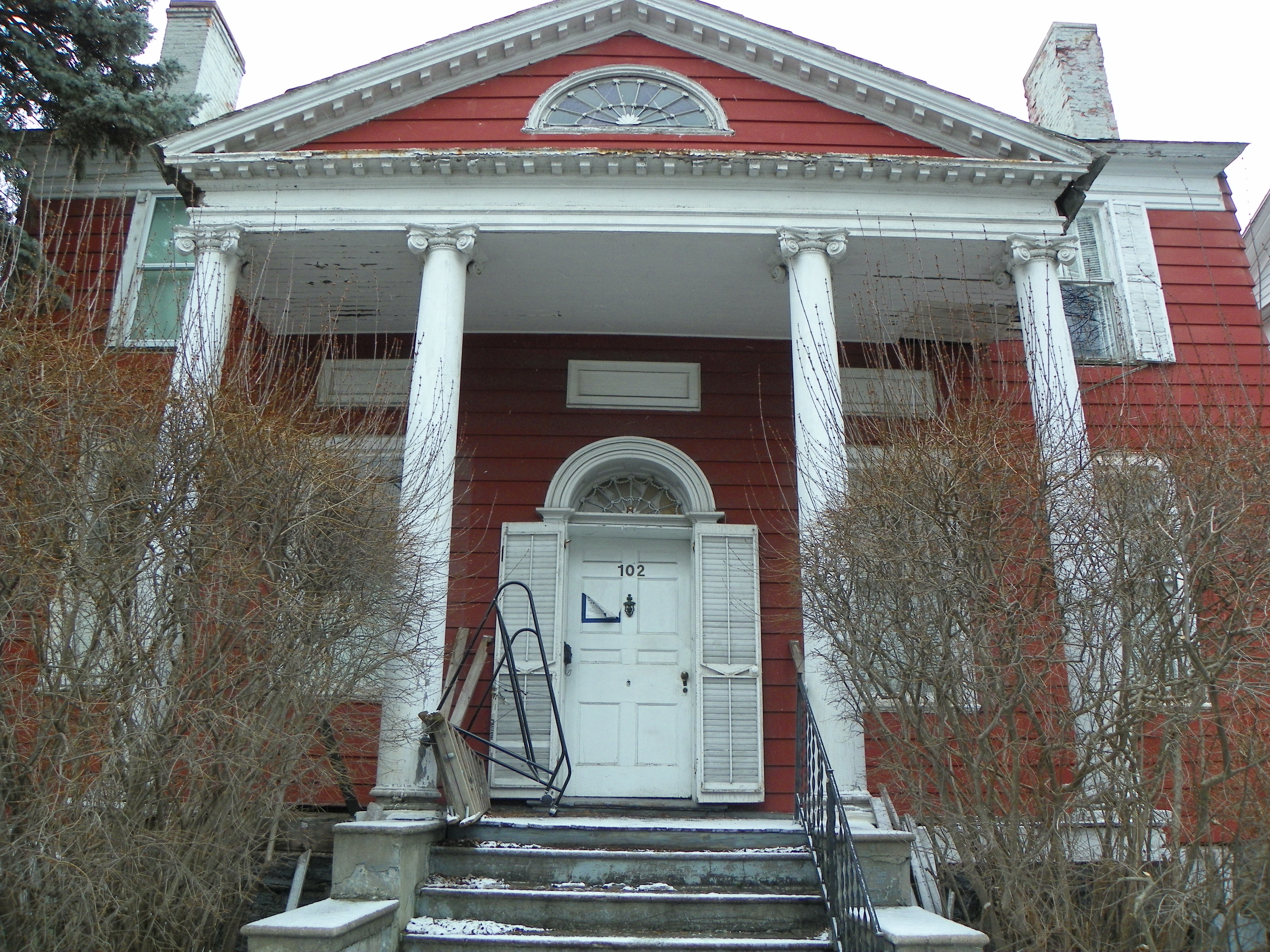
When I visited for my last photo tour back before New Year’s, I came across an aging Greek Revival house on the north end of downtown that was in a deplorable state. The red siding was tired, the Doric columns of the porch chipped with the paint worn off, the foundation crumbling and the windows damaged, with sills breaking off, and missing panes in some places. I resolved that before something happened to it (most likely the wrecking ball), I was determined to take a few photos and share the house before it becomes confined to the old yellowing photos of times long ago.

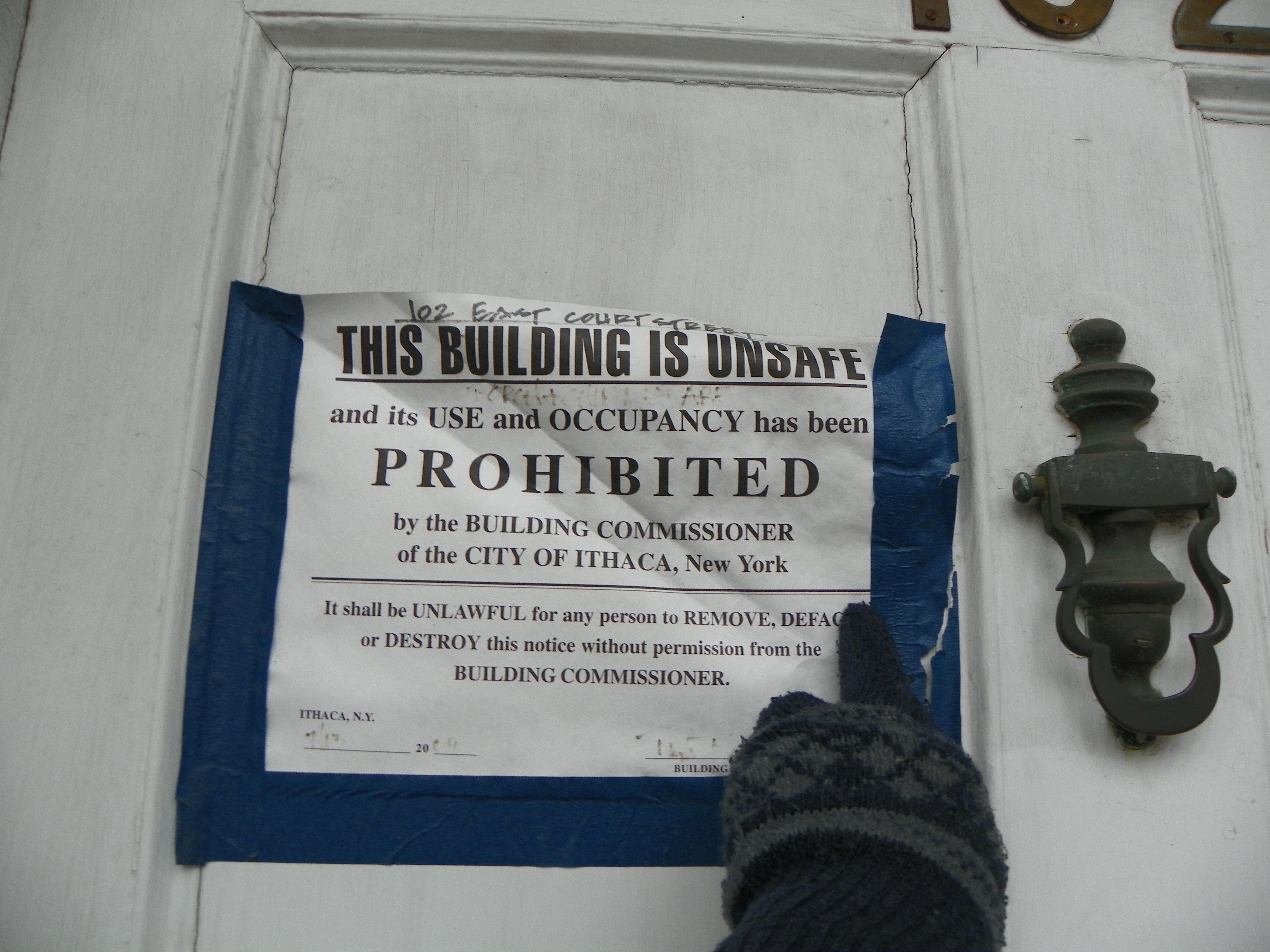
Officially, the house is 102 East Court Street. Historically, the house is the “Judd House“. The house was built in 1828 – the same year Ezra Cornell had arrived in the budding town of Ithaca, which has hardly twenty years old. An estimate establishes the house as having about 3,100 sq ft, 4 bedrooms and 1.5 bathrooms. Furthermore, the assessed value of the house is $190,000, although given its condition the land it sits on is probably worth more then the physical plant itself.

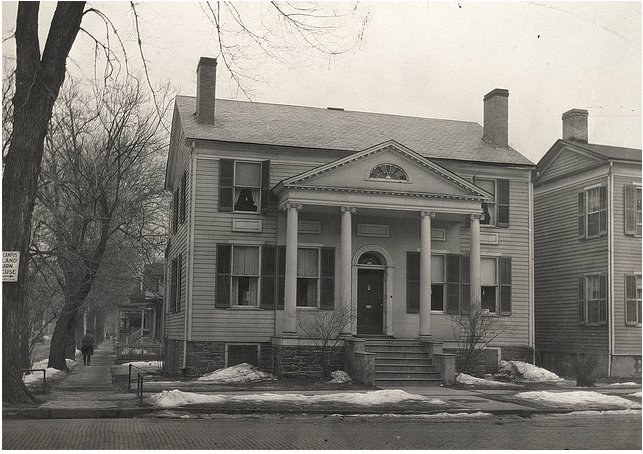
Property of Cornell University Library (A. D. White Collection)

A casual online search reveals a photo from Cornell’s A.D. White Collection, which shows the house in a much better state of affairs in what the vehicle to the left suggests is the 1920s. Furthering searching indicates the house was most likely designed by Ira Tillotson, the same architect for the Clinton House, which is a contemporary to this home. The once-stately residence was built for Capt. Charles Humphrey, a veteran of the War of 1812, on what was then the corner of Cayuga and Mill Street. The house and a long-removed barn were constructed for a cost of $2,105.56, which places the cost of construction likely somewhere in the upper six digits to $1 million-plus today. The name Judd House comes from long-time owners of the house in the 1900s, who apparently took great pains to keep the house in good shape. Sadly, that is not the case today.

In a perfect world, someone would come along and renovate and restore the venerable house to its former glory (perhaps INHS? A Cornell or IC faculty member with ambition)? It would be a shame to lose such an asset to Ithaca’s history. However, the decay is advanced and renovation would be expensive, or may not even be viable given the precarious state of the foundation, which is continually harmed by the freezes and thaws of the Ithacan year. As time creeps forward and winters take their toll, the long life of this home may be coming to end.


News Tidbits 3/6/12: From Orthodox Greek to Christian

7 03 2012

…and by Orthodox Greek, I mean your normal Cornell Greek house. But I enjoy a little bit of word play.

I had come across a piece in my Cornell feed about a Christian house at Cornell on The Knoll called “Chesterton House”. I thought it was unusual that I had never heard of it, but I wrote it off as being some low key residential organization, like many at Cornell are (for example, Telluride, the Co-Ops and a few of the professional fraternities). I noticed its location was 115 The Knoll, which failed to ring a bell – I thought it was a rowers’ house or home to some of the Big Red Band. I’ve been vaguely aware that there were five houses on the Knoll, so there was bound to be some non-Greek component.

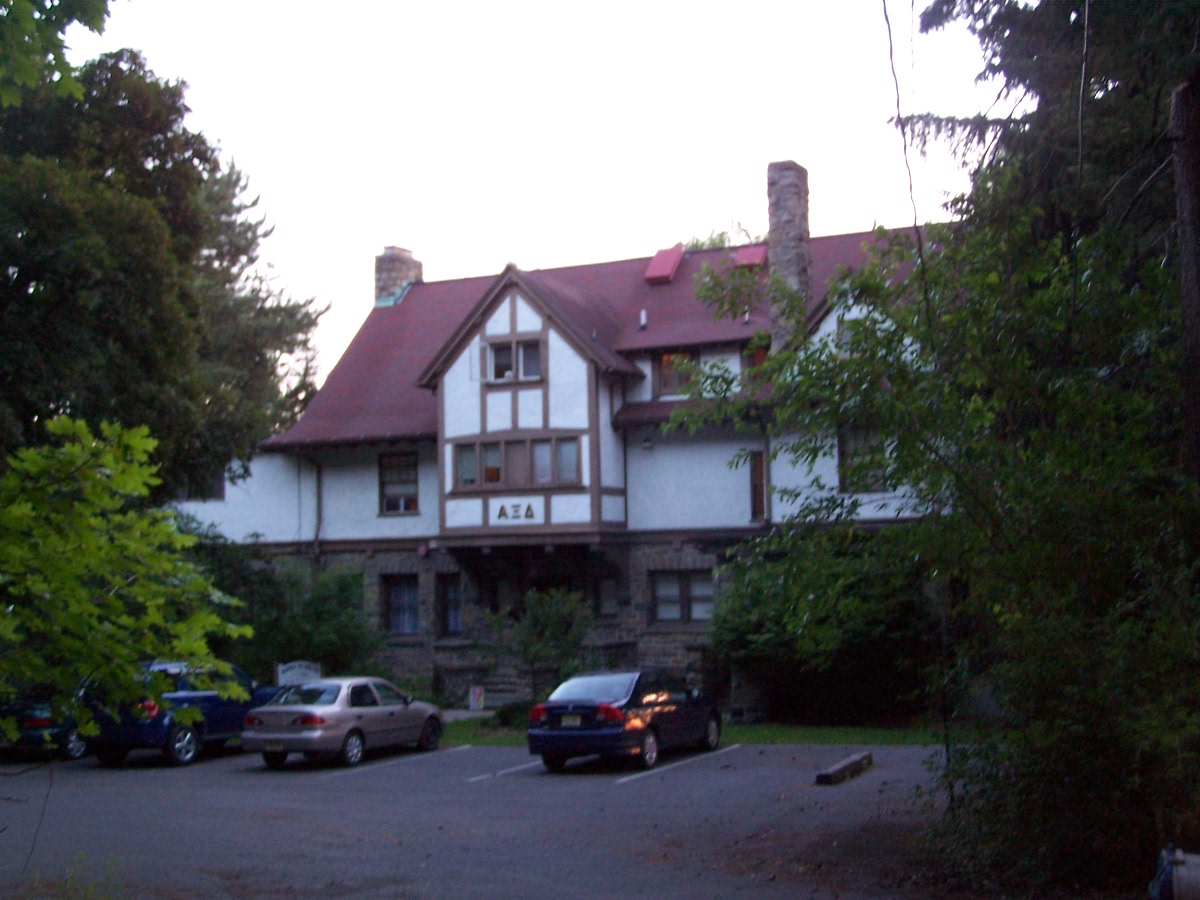
Then I glanced at their website – it’s Alpha Xi Delta’s old house. The one I profiled a couple years ago.

According to their website, the house is named for Gilbert Keith Chesterton, an early 20th century writer and “defender of the Christian faith”. The house holds 15 and is all-male, with the female equivalent being Sophia House at 315 Thurston, the house with a stucco finish and the extremely high-pitched tile roof. Apparently that house is being rented, so it is not under the organization’s possession. Now, the house on the Knoll is owned by Delta Phi Epsilon sorority, the last I checked (for the record, they’ve owned it since 1962). So I’m going to venture that this is a fairly recent endeavor, and a big step for an organization that was established only 12 years ago. Although a relatively young organization, it’s certainly garnering its share of alumni support.

I for one welcome them to establish themselves as one of the many opportunities afforded to students at Cornell. In my mind, I see it as something similar to the Jewish Living Center on West Campus. My one encouragement is that they adopt a policy similar to the Jewish Living Center and encourage freshmen to live with the other freshmen. I’ll willingly admit that as the brother of a fire-and-brimstone evangelist, I’ve been wary of religious groups in general (one tends to be that way when your sibling tells you you’re going to hell at every Thanksgiving dinner, for being a secular  Christian). But it’s also addressing a niche group at Cornell and offering more for some individual’s Cornell experience.