Canines at Cornell

25 11 2014

tydog2

During my four years at Cornell, dogs were something of a rarity. I knew a couple of grad students who had dogs, and a couple of fraternities with house dogs, and that was about it. A member of my chapter tried to push a proposal through our alumni Corporation Board to permit the adoption of a house dog, but the board declined, citing concerns about liability (and given the possibility of someone being bitten at a party or something, I didn’t disagree with their decision).

Before the 1950s, dogs were far more ubiquitous. For one, the Vet School was located where ILR is today, and then-president Mallott cited the incessant animal noises, including barking dogs, as one reason to move out of the A.D. White House at the start of the 1950s (Altschuler and Kramnick 36; I wager that the student riot in front of his house in 1958 reaffirmed his off-campus preferences). But even outside of the kennels and vet offices (dogs weren’t allowed in lecture halls in the vet school), dogs were accepted and even welcome on the quads, in academic buildings, libraries and even cafeterias. Some thought it was the result of an alumni donation with a stipulation to allow roaming digs free rein of the quads.

cornell_tripod_1959

But the hospitality towards canine companions was fading. In 1948, they were banned from the Willard Straight cafeteria, and the following year, the Cornell Sun waged a campaign to have rowdy rovers removed from campus Libraries. In 1953, Malott (what is with this man hating on dogs?) had Fido banned from the graduation ceremony. By December 1959, dogs were banned from all campus buildings aside from the Vet School. The reasons for banning dogs were fair enough; dog fights, interrupting a symposium on segregation, destroying books; but some students and faculty still mourned the disappearance of canines from the classroom. One misogynistic professor told the Sun in 1959 he “surveys the situation before each class and throws out any wild puppies. Dogs are like co-eds knitting. I’m willing to put up with them if they stay quiet. Who knows? Like the co-eds, they might learn something.”

A special focus of the anti-dog sentiment was on a 5-year old, three-legged husky named “Tripod”, who became a sort of quad-wandering unofficial campus mascot in the mid and late 1950s. “Tripod” had three legs as the result of a car accident in November 1953, from which “he hovered for many weeks between life and death“, and his back left leg was paralyzed and later had to be amputated. Officially, he was the house dog of Kappa Delta Rho (KDR) and named Chinook, but like many dogs, wandered campus at his whim. However, Tripod chased a cat to death and was reported to have snapped at students. Eyewitness reports to the Sun claim he was chasing the cat when it ran into the path of a patrolling campus police car, but the police report suggests he mangled the cat, which then crawled under the car. The Sun was not inclined to believe them. His former owner (Roger Burggraf ’56) claimed him, and once his army tour was completed in Spring 1959, said he would return the husky to Alaska. Tripod had a fraternity-hosted feast in his honor on October 17, 1958, and while it’s not stated whatever happened after he was picked up by his owner the next day, I hope that he lived out some happy days in the last frontier. His now 82-year old owner did return to Alaska, worked as a dog trainer, and was awarded Alaskan of the Year a few days ago, so I have every reason to be optimistic.

cornell_tripod_1958_2

The removal of dogs took a pause during the 1960s, when civil unrest was the forefront of concerns and soft-hearted professors didn’t care to raise a complaint to the occasional four-legged attendee. Dogs could still walk untethered on campus outside of buildings. But after a large ill-tempered dog bit four students during a chemistry exam in 1973, (AK 233), the university started enforcing a 1971 rule requiring all dogs on campus be leashed (although I don’t think a 1972 recommendation for mandatory dog registration was approved). Tompkins County followed suit in 1980.

Gone are the days of dogs frolicking free on Cornell’s campus. Legally, anyway.

tydog3

[1] Altschuler, Glenn C. and Issac Kramnick. Cornell: A History, 1940-2015. Ithaca: Cornell University Press, 2014. Print.




Fast Facts: Cornell Postgraduate Surveys

18 11 2014

Unlike the other posts in the “Fast Facts” series, this information comes from Cornell Postgraduate Surveys conducted by Cornell Career Services.

Let’s be frank. People generally don’t go to college these days for educational enlightenment. It’s all about the return on investment, and that holds true for a school like Cornell. Here’s a look at some of the stats, courtesy of Cornell’s postgraduate surveys. Big disclaimer here – the response rate to these surveys is 70-75%, and I’m going to go out on a limb and suggest that the kids who find themselves with some motivation or bragging rights are probably the ones most likely to respond. Who wants to tell Cornell they’re living in Mom and Dad’s basement?

With that disclaimer aside, here’s the cold hard cash stats. These charts leave off the class of 2014 because they have six months to submit info – until the end of the month, in other words.

cu_postgrad_1

Looking at the past several years, we can definitely see the influence of the 2008/2009 recession. “Other Endeavors” includes, travel, volunteer work, and actively seeking grad school/employment. This value has climbed by a third since 2008. The number of those attending grad school continues to drop from its recession high, while employed grads have rebounded. There’s a well-documented inverse relationship between the economy and grad school enrollment – people want to make that cash when the economy’s good, but they hunker down and work towards advanced degrees when the bear market is growling.

cu_postgrad_2

Of those pursuing graduate studies, the top three, which are consistently the top three, are Engineering (M.Eng), Law School and Medicine. Law school has taken a hit in recent year due in part to the law school bubble bursting. The return on investment just isn’t what it used to be.

cu_postgrad_3

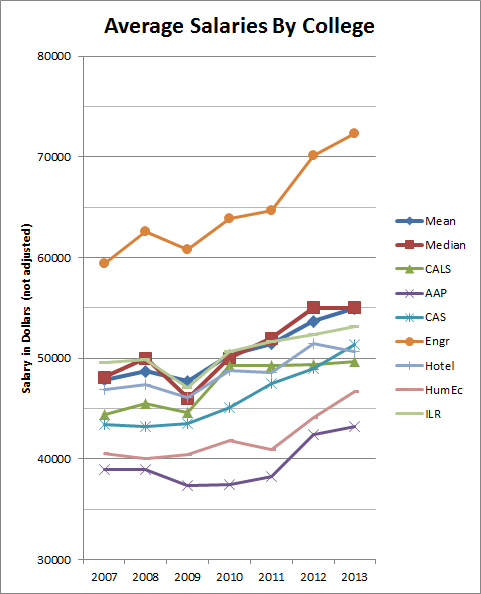
Now some real meat – mean and median salaries for the university as a whole, and for each college. Both mean and median are right around $55k, helped substantially by those engineering salaries. Electrical/Mechanical/Computer Engineering pays, kids, if you can survive the four-year blow to your self worth (looking at you, Diff Eq). AAP is well below the average, pulling just over $43k in 2013; but AAP students also respond to the survey in smaller numbers, often only 40-50%. That could be a good thing (unreported high salaries) or a bad thing (living in Mom’s basement and too embarrassed to respond).

cu_postgrad_4

Cornell breaks down respondents by the type of work they do. The big ones are financial services (I-Banking) and consulting (more financial work), which pull in 30% of the graduating class. In more recent years, “Technology”, your Google, Twitter and tech startup employees, has been booming, thanks to rapid growth and rapid rise in pay. If the last tech bubble burst in 2000/2001 was any indication, the number pursuing technology jobs will drop significantly when a market correction occurs.

cu_postgrad_5

But in the meanwhile, tech is at the top of the average salaries graph, followed by our friends in banking. Coming as no surprise, the graph shows working at a non-profit pays relatively poorly. There does seem to be a direct relationship between how boring/morally ambiguous a job is and how much one gets paid.

cu_postgrad_6

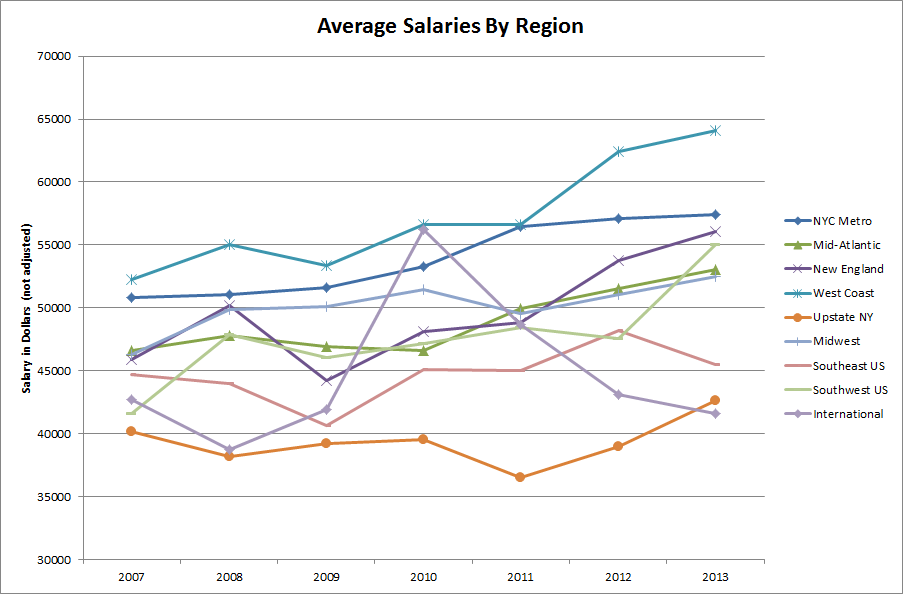
Lastly, average salaries by region. The West Coast (think Silicon Valley) leads the pack, followed by the always-expensive NYC Metro. Upstate New York is at the bottom, perhaps because 1) it’s a cheap place to live, and 2) the jobs in upstate don’t tend to be high-end finance or tech jobs; agriculture and education would be more likely. I can personally vouch for the West Coast being expensive; I was once offered a position in California that I estimated would incur an extra $20,000 in living expenses for things like rent, and the offered salary reflected that (I also discovered after they flew me out there for the interview/offer how much I would dislike the job, which threw me into a personal crisis…a fun story for another day).


Fast Facts: Cornell Students By Major

11 11 2014

As always, all data is taken from the Cornell University Factbook. Numbers used in this entry are for undergraduate enrollments.

Offhand, I can think of two mantras when it comes to first-tier higher education:
– Go into a STEM field.

– If you’re at a really good school for undergrad (Ivy plus), go for business.

The logic in both is fairly sound. STEM fields are in demand and pay well (and as someone in a STEM position, I say that with a very big asterisk). The other is that our most brilliant minds can get the most return on investment by going into financial services such as investment banking, where you work for for a couple years at a place like Goldman Sachs or JPMorgan, go back for a couple years of B-school, and find yourself making $250k at 32 as a vice president of some random business activity. The popularity of that easily earned, highly lucrative business degree is the reason why Cornell started offered a campus-wide minor in business; one-sixth of Cornell’s students go directly the financial sector, which is actually down a little bit from previous years.

There’s also a third mantra, much more negative than the first two: humanities doom you to unfulfilled jobs in coffee shops or years of fruitless grad school labor. Unfair certainly, but the academic stigma, also known as “what are you going to do with that degree?”, is strong for liberal arts majors.

I decided to take the numbers and see if there were any trends in enrollment in certain fields over the years. Below are Cornell’s enrollments from 2002-2013 by CIP, “Classification of Instruction Programs“, which is used by government entities to track enrollments by study.

cip_trend_1

Looking at this, it’s easy to pick out some winners and losers over the past decade. Social Services, English, Family and Consumer Sciences, and Architecture have notable drops. Biological and Biomedical Sciences, Engineering, Agriculture and Business have grown. Liberal Arts shows no strong trend. Computer Science shows an interesting parabolic shape, which can be attributed to the tech bubble bursting in the early 2000s, and taking a few years to recover before entering the current tech boom.

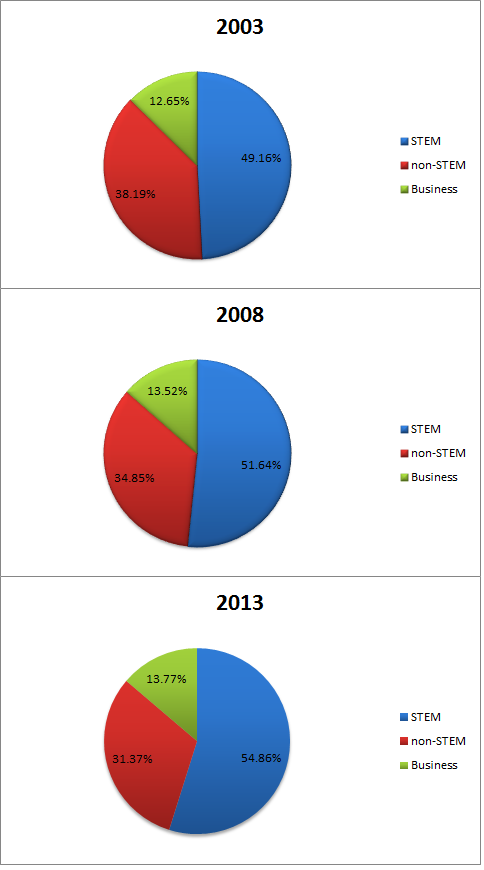
I’m going to take three years – 2003, 2008 and 2013, and split them into “STEM” and “non-STEM” for this next plot. The unknowns and multidisciplinary majors will be removed and I’m going to treat business separately. Non-STEM will be history, performing arts, social sciences, social services, psychology, philosophy, liberal arts, english, family and consumer science, foreign languages, education, personal services, communication, architecture, and area/cultural studies.  STEM will be physical sciences, nutritional science, math, biology, engineering, computer science, natural resources and agriculture. I’ve made an attempt to separate “hard” sciences from “soft” sciences, and I realize there’s plenty of room for debate which categories belong in STEM and non-STEM, but I’ll leave that out for now.

cip_trend_2

Over time, non-STEM is decreasing, while STEM and business are increase their share of the Cornell student population. It could be that there’s genuinely more interest in business and STEM, or Cornell students could simply be more pragmatic these days, choosing things that offer cold hard cash versus the educational enlightenment of the arts and humanities. Feel free to leave your comments.


Fast Facts: Cornell Students By NY County

4 11 2014

Unless otherwise noted, all source data comes from the Cornell University Factbook. For this, I’m only going to focus on the undergraduate population.

When I was a student at Cornell (oh, for those halcyon days of the late 2000s…yes, I am joking), there was a quip that 38% of the students come from New York State, but 90% of them are from New York City and its suburbs. An exaggeration, but the large presence of Westchester and Nassau and the like was forever a source of tension, if only a minor one. With access to Cornell’s enrollment figures, we can see by just how much downstaters dominate the student population.

For anyone from outside of New York, this post probably won’t be a whole lot of interest to you. But for the kids that want to play along at home, here’s a map of the counties of New York, all 62 of them.

map_ny

nys_cornell_county_fa14

nys_cornell_county_fa14_2

In what should be a surprise to absolutely no one, Nassau County on Long Island and Westchester County comprise the largest sources of Cornell undergrads – 654 and 607 students respectively. Given 14,453 undergrads in fall 2014, that means these two counties alone account for 8.72% of the UG population. NYS students number 4,602 of that 14,453, 31.84% of the student body. If we define downstate as Orange, Putnam, and everything south (the definition of where upstate and downstate divide is fraught with contention, so I’m going with a rough middle ground), then downstate comprises 2,971 of those 4,602 students, 64.56%, or just under two-thirds. Only one county has no representation at Cornell – Hamilton, which has only 4,773 residents (2013 estimate), the smallest population for any county in the state.

Now, I can already hear the commentary now – “BC, you misleading and ignorant a–hole, these numbers should be presented per capita.” Way ahead of you, irritable dear reader. I downloaded the 2013 county census estimates and decided to do a little data magic, looking at enrollment per 100,000 residents of a given county.

nys_cornell_county_fa14_3

Tompkins dominates, no surprise there. Westchester is next, showing that living in a county comprised of mostly affluent, tony suburbs with school districts to match is handy for getting into the Ivy Leagues. From there, we see it’s a mix of New York City’s affluent suburbs and counties close to Tompkins – though St. Lawrence, up by the Quebec border. is something of an anomaly.

One more thing I wanted to write up before concluding this post, which really only scrapes the tip of the iceberg. The percentage of NYS students continues to decrease as the enrollment increases, as shown below. In fall 2002, 38.93% of students came from NYS; in fall 2008, that number shrank to 33.85%; and by fall 2014, 31.84%. I have no idea if the state has any sort of minimum number or floor percentage that Cornell must adhere to, but if the trend continues, I could imagine some legislators pushing for one.

nys_cornell_county_fa14_3

In sum – the 38% value hasn’t been accurate since 2002, so that quip was outdated by the time I started my time at the Big Red. The 90% value is also a little high, but there’s definitely a large contingent of NYC suburbanites in the student population, and it doesn’t see, so large when broken down to per capita values.


Cornell Updates Upson Hall

31 10 2014

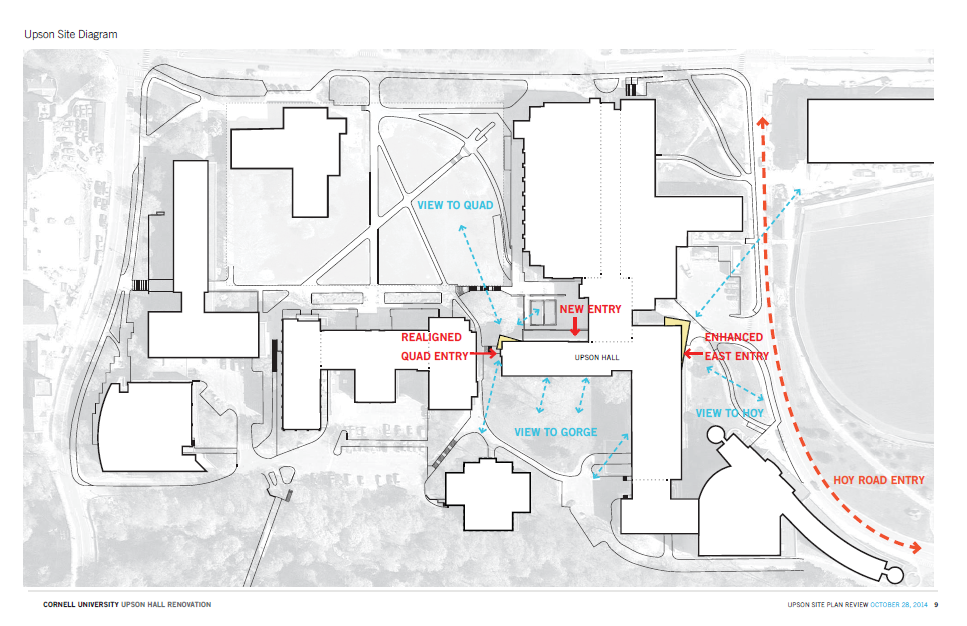
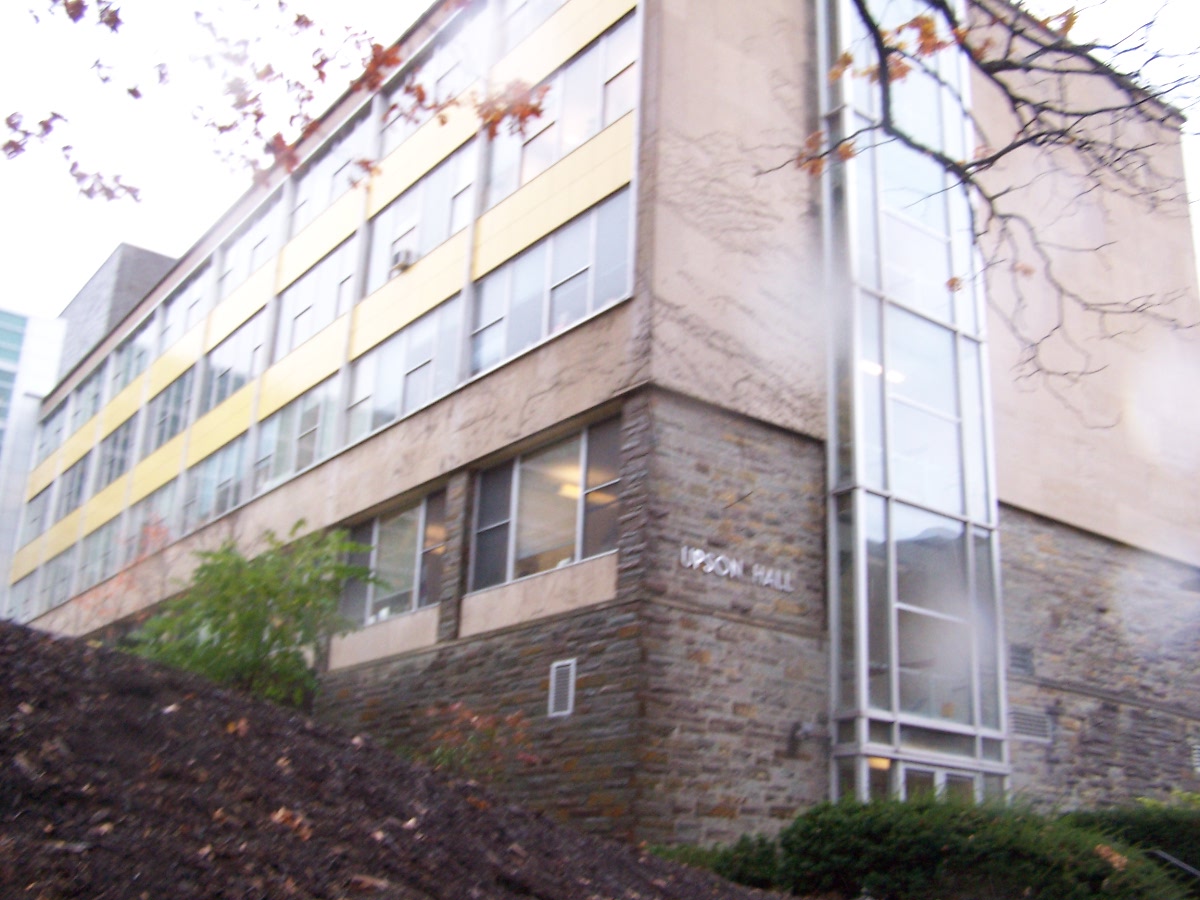
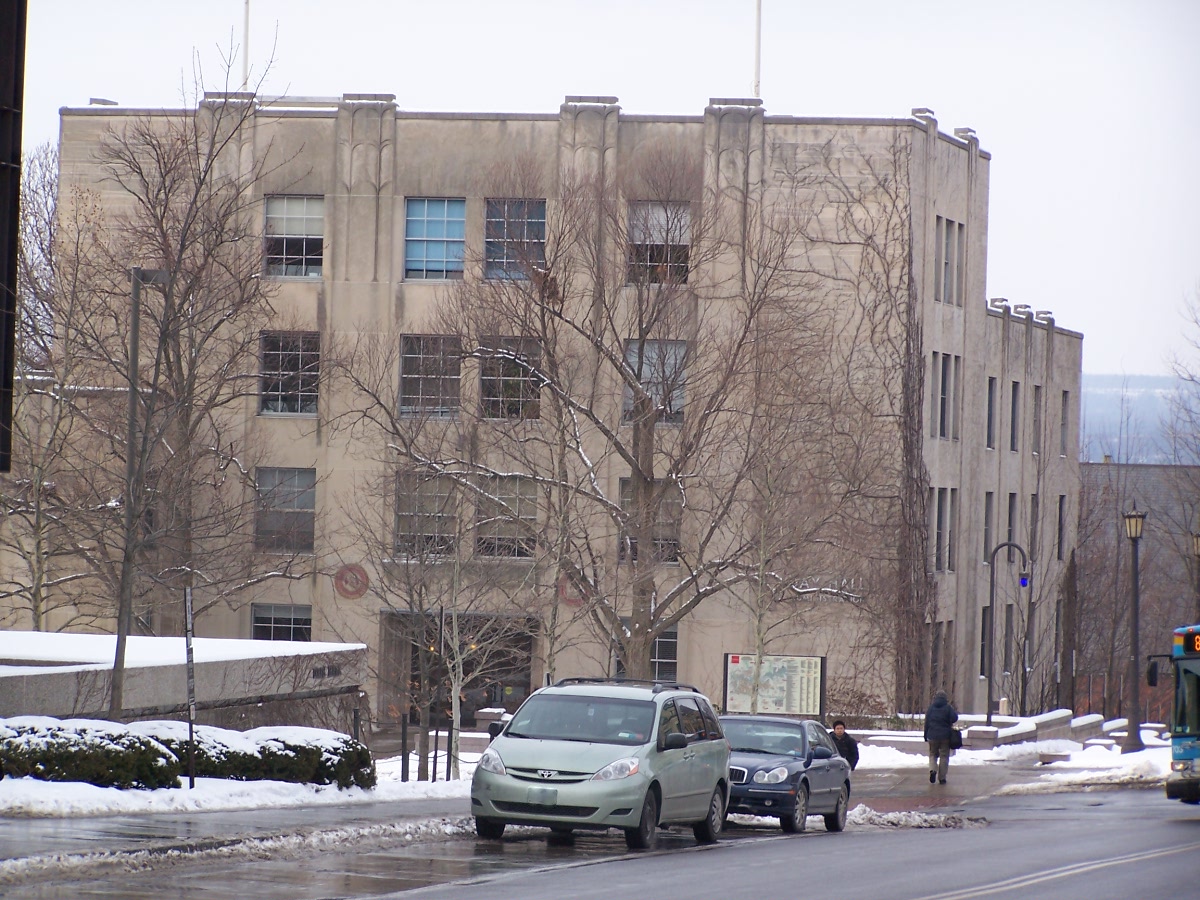
Fresh from the planning board’s first look, here are the renovations Cornell plans to do on Upson Hall. Upson Hall, named for long-time trustee and big donor Maxwell Upson 1899, was built in 1956, and is part of the interconnected octopus of buildings that makes up the eastern half of the engineering quad, connected directly with Grumman and Duffield (with which it shares walls), and Phillips and Rhodes. 5-story Upson occupies about 160,000 sq ft, of which 142,000 sq ft is usable space, which has most recently been occupied by the computer science and mechanical/aerospace engineering departments.

100_2099

The renovations to Upson are just one more step in many taken, or to be taken, to update and expand facilities Cornell’s engineering school. The plans have been underway since Duffield was built 10 years ago, and have evolved with the changing needs of the school. For instance, the original plan had Hollister and Carpenter Halls being demolished to make way for a larger building, which can be seen in the Cornell Master Plan of 2008. But, this plan was tabled as a result of the recession, and that individual proposal was never revived. Similarly, early Gates Hall plans had a building site just south of Thurston, facing the gorge. Currently, work is underway to renovate Kimball Hall, with a summer 2015 completion and $15 million price tag. There is also work planned for a new biomedical engineering building, design and construction TBD, but with a price tag of about $55 million (for comparison, Gates cost $60 million).

upson_1

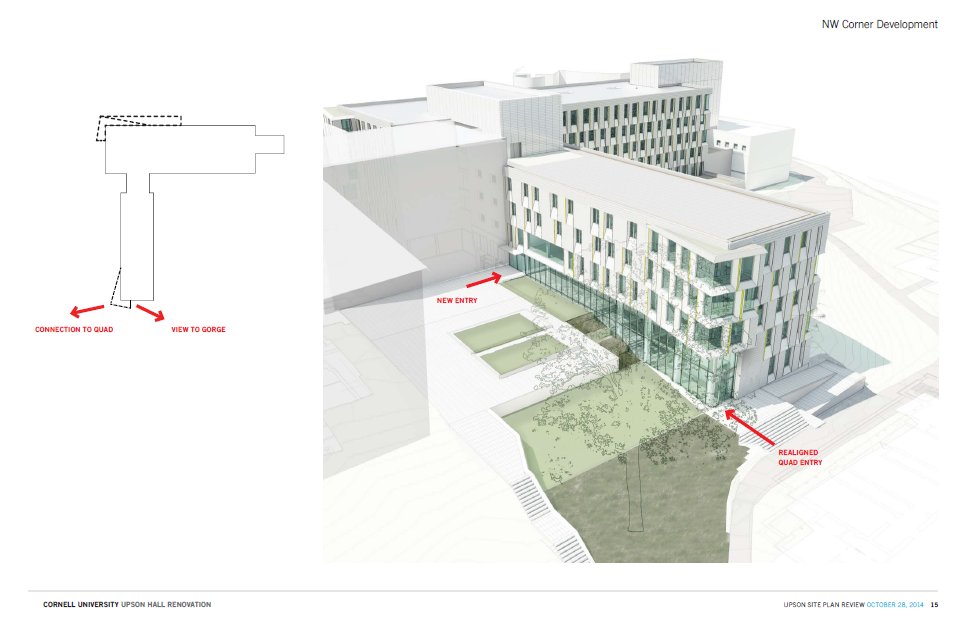
In the proposed $63 million renovation, Upson retains its current footprint, A new entry is established at the intersection with Duffield, and small bump-outs are built over the other two entryways. Better entries and landscaping are strongly emphasized in the proposal.

upson_2 upson_3

upson_4

The design is standard 2010s fare – whereas the current Upson is a box with bands of windows (“International Style”) much celebrated in the days of I Love Lucy and early seasons of Mad Men, the current is the metal-and-glass of all sorts of sizes and shapes. I expect it to age about as well (i.e. poorly). Coincidentally, the design of the building is by internationally-acclaimed firm Perkins + Will, who also designed the original Upson in the early 1950s.

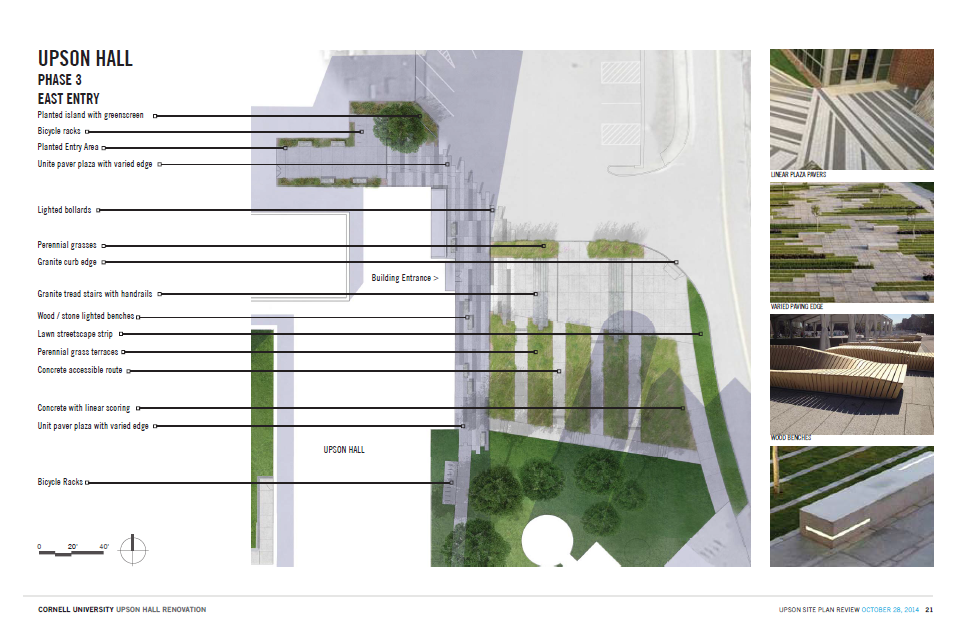
I feel the real draw here is the landscaping. The initial landscaping isn’t all that special, put the Phase III landscaping is a treat. Cornell is way too trendy when it comes to new buildings, but if it’s one thing the university excels at, it’s landscape architecture.

upson_land_1 upson_land_2


News Tidbits 10/25/14: It Seems Expensive Because It Is

25 10 2014

belle_sherman_townhouses_2

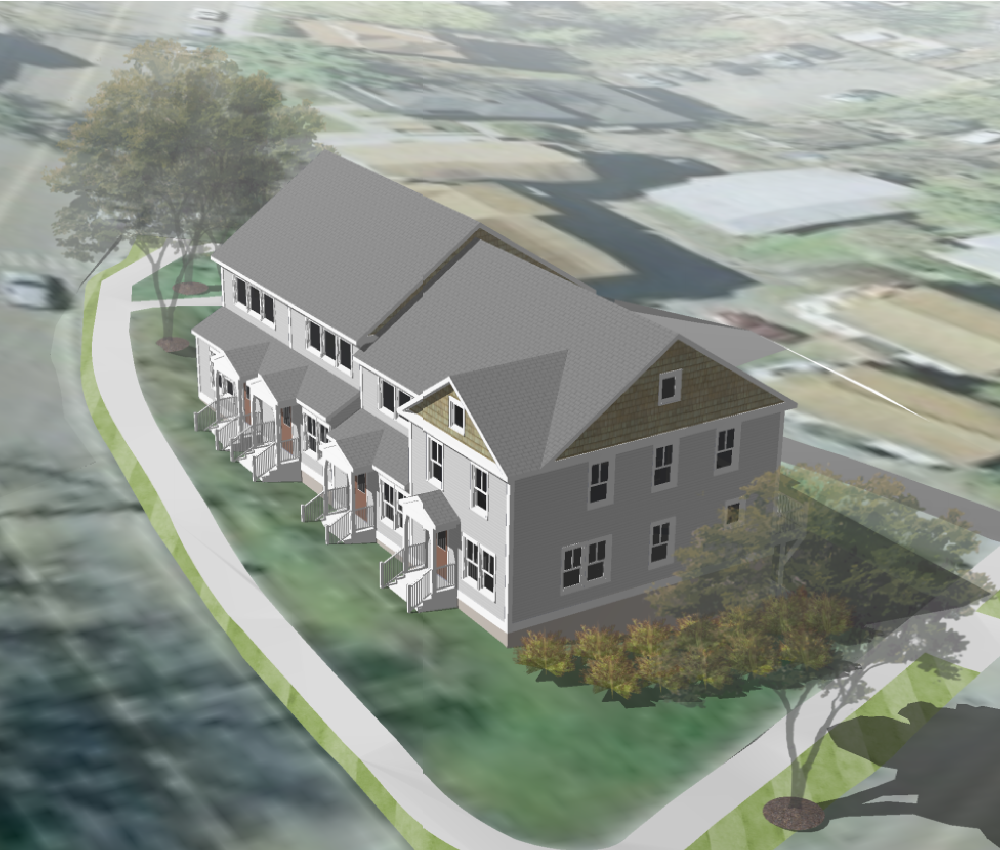
1. I always appreciate it when people respond to my emails. On a whim, I emailed the realtor in charge of the Belle Sherman Cottages to see which ones were underway with sales, and what the time frame was. She forwarded the request to the developer, Toby Millman of Agora Homes and Development LLC, who wrote back to say that as of the 17th, the front-loading garages on lots 25-29 (render above) were being marketed, and three of the five have been sold. They are planning for an April 2015 completion for those five, with the modules being set into place next year (some site prep work may occur this fall). The five townhomes with the back-loading garages are not being marketed just yet. Who knows, with most of the homes being sold and several under construction, the entire project could be complete by the end of 2015.

2. Oh geez. An Irish-themed Hooters is coming to Ithaca. According to the Post-Standard, Tilted Kilt, a “Celtic-themed sports pub”, is looking at a restaurant for Ithaca. The Syracuse location due to open next month will be 7,000 sq ft, I expect an Ithaca location would be similarly-sized. The chain already has a location in Watertown, and has plans for a Utica restaurant as well. Basically, any city over 30,000 roughly within an hour’s radius of Syracuse. Here’s the chain’s website, featuring a woman preparing to make out with a hamburger. I’m sure the fratty frat boys at Cornell are getting excited. Placing bets on whether they go for Lansing or southwest Ithaca.

carey_rev4_3

3. Per the IJ, The developers of the Carey Building expansion are asking for a tax abatement from the city via the CIITAP application. A primer on CIITAP applications can be found here at the Ithaca Voice; a number of projects in the city’s “density district” have used them in recent years as a way to offset high development costs in downtown and West End. Recently, Jason Fane made news for pursuing a tax abatement via CIITAP for his project on East Clinton Street. The standard abatement is 7 years, with 90% of the increased value being offset in the first year. In this case,the building was assessed in 2014 at $475,000. The new construction will cost $4.7 million according to the IJ, but it says $1.6 million in the city’s site plan application; that gives us assessed values in year one of $945,000 if the IJ is right, or $635,000 if the SPR is still accurate. The abatement tapers off through the latter six years. As with Fane, I suspect Travis Hyde Companies is pursuing an abatement simply because they can, they meet the qualifications so carpe diem. The wide difference in the IJ and SPR numbers could be an indication of rapidly rising project costs. Regardless of reasoning, this definitely isn’t going to do the developers any favors when it comes to community relations.

ctown_terr_phase3

4. Maybe the Novarr interview in the Voice will have run by the time this runs; maybe it won’t. Just in case, straight from the developer himself, Phase III/Building 7, with its 247 units, is planned for a late 2015 construction start, with completion in the summer of 2017. It’s a long construction period; it’s also a very big building.

ctown_crossing_rev2_1

5. From the Cornell Daily Sun, it’s expected that rents at Collegetown Crossing will be around $1,000, per month, per tenant. Students in Cornell’s Student Assembly aren’t exactly pleased, since that number far exceeds even what most Cornellians can afford (but don’t worry; with student population growth far outstripping supply, there’s enough demand for student rentals, even in the luxury segment, that this place will fill up to capacity as soon as it opens). Welcome to Ithaca’s severely under-supplied rental market; open your wallets wide, boys and girls.

It just occurred to me that since I wrote the enrollment column last year with 2012 numbers, I glanced at the 2014 numbers on the University Factbook. Now it’s 21,850, an increase of 426 students in 2 years, and in pace with the 2002-2012 period. 234 of that 426, 55%, were grad and professional students.

There are a number of factors for why it’s so expensive – land values in Collegetown are high, construction labor is expensive because Ithaca is off the beaten path, taxes are high, and the new Collegetown zoning doesn’t allow Lower to build out the rear portion as he initially intended, forcing him to keep the building’s rear flank at 4 floors instead of 6 (the zoning is also what allows him to build in the first place, since it removed the parking requirement).

Let me be clear. Unless something is done to reduce demand or increase supply, this will become the norm, and Cornell students of modest means will be placed in an increasingly precarious situation with the cost of housing. Just like the rest of Ithaca.

6. To wrap things up, here’s looking into the agenda of next week’s Planning Board meeting (and what will probably comprise my mid-week posts). Purity, The Canopy by Hilton, Chain Works, 114 Catherine, and the 15,700 sq ft retail building on the Wegmans pad site. Only the Wegmans parcel is up for final approval.

114_catherine_rev2_1

114 Catherine comes to the board with one major change – the front entrance was moved from the corner to the middle of the front facade. Still 17 bedrooms in 3 units.

As for new projects coming up for sketch plan, we technically have three. As much as I was looking forward to it, Ithaca Gun is not one of them, but I’ll keep my fingers crossed for next month.

402_s_cayuga_st_1

The first is 402 S. Cayuga Street. Eagle-eyed readers will recognize this as INHS’s 4-unit townhome project.

100_2092

The second is Cornell – Upson Hall renovations. Cornell stuff is easy enough to find, they publish veritable novels about projects once they’re cleared by the Board of Trustees. Upson renovations sound like they’re mostly internal work with a facade update. I’m more interested in the proposed biomedical building they have yet to roll out designs for. The Upson renovation is supposed to cost $63 million, so maybe there are additions involved; the new biomedical building, $55 million. The firms involved look to be LTL Architects, Perkins+Will, and Thornton-Tomasetti. In other words, modern glass and steel box, looking for LEED Gold. No renders yet, but I’ll post ’em when I see ’em.

101_4858

The last of the trio is yet another Collegetown project – 302-306 College Avenue, an address which consists of the three architectural stunners above. I’ve been patiently waiting for a proposal here (though to be honest, I’m kinda partial to 302, second from the left). John Schroeder from the Planning Board has wanted a proposal here for years. They sit in an MU-2 zone – 6 floors, 80′, no parking required. All three are owned by the Avramis family, Collegetown’s third-largest property owners. More interestingly, rumor has it that the buildings they own contingent to 302 College on Catherine Street, which are CR-4 zoning (no parking, 4 floors), are involved as well. So this could be a fairly substantial project. My money is on Sharma Arch being involved, since they are Avramis Real Estate’s usual architect-of-choice. I figured that the M&T Bank on the 400 block would get torn down first, but this is no big surprise, the Avramises have been fairly active in redeveloping their properties.


Cornell Provosts Climb the Ladder

21 10 2014

100_3080

It’s pretty clear the the president of Cornell is first in command of the university. However, being that Cornell is a university with tends of thousands of students, thousands of employees, and multiple campuses, it stands to good reason to have a chief academic officer of sorts, a general supervisor of college affairs while the president represents the university’s “public image” and acts as chief fund-raiser. In comes the provost, a position created in 1931 by the Board of Trustees to manage the university’s myriad affairs. The provost is a sort of COO while the president is CEO.

Many of Cornell’s provosts haven’t been content with being second in command, the latest example being Provost Kent Fuchs leaving to become president of the University of Florida. Fuchs (pronounced “fox”) has been in the provost position since 2009. His predecessor, Carolyn “Biddy” Martin, who left to take over as president of  the University of Wisconsin at Madison.

Let me run down the list of provosts since WWII and see what happened with each provost:

Arthur S. Adams (1946-1948): Bid adieu to Cornell when he was appointed president of the University of New Hampshire. He may not have liked UNH much, because he left in 1950 to head the American Council on Education, and from there on a number of other academic leading roles. He passed away in 1980.

Before someone calls me out for not including the provost in 1945, there was no serving provost from 1944-1946. Former Ag school dean Albert Mann (1931-1936) and former Packard Motors executive H. Wallace Peters (1936-1943) both retired after serving as provost.

Cornelis de Kiewiet (1948-1951): Departed when he was selected as president of the University of Rochester, a position that he served in from 1951-1961, from which he retired and spent the rest of his years working as a proponent of investing in higher education programs in Africa. A rather unattractive brutalist dorm at the UofR is named after him.

Forrest Hill (1952-1955): I should note that provosts under President Mallott seemed to have less power than more recent ones; Mallott enjoyed his authority, something that also led to the student riots of 1958. Hill left to head the Overseas Development for the Ford Foundation, and established rice-breeding institutes that increased yields substantially, and helped propel the “green revolution” of the mid-20th century. Forrest Hill retired to Ithaca in 1976 and passed away 12 years later.

Sanford Atwood (1955-1963): Left in 1963 to serve as president of the prestigious southern college Emory University, where he was president from 1963-1977 (and where has a building named in his honor). While at Emory, Atwood became best-known for standing behind a professor who declared a belief that “God is dead”, which didn’t go over very well at the traditionally Methodist institution. He retired from Emory and passed away in 2002.

Dale Corson (1963-1969): The only recent case of a provost becoming president, as a result of James Perkins’s resignation following the Willard Straight takeover. Corson, for whom Corson Hall is dedicated, served as Cornell’s leader from 1969-1977, and lived in Ithaca up to his passing in 2012 at the age of 97.

Robert A. Plane (1969-1973): Left Cornell to serve as president and CEO of Clarkson University, where he served from 1974-1985. After he retired from that position, he became a winemaker, and eventually came back to work for Cornell as head of the university’s Ag Experiment Station in Geneva from 1986-1990. After he retired again,  he served as president of Wells College from 1991-1995, though the college was still all-female at the time. He’s totally, completely retired now, and still kicking at the age of 87.

David Knapp (1974-1978): Left to become the president of the University of Massachusetts, where he served as president from 1978-1990, and retired from his professorial duties in 1993. It was Knapp who suggested changing the name of the College of Home Economics to the College of Human Ecology, while he was dean of the college.

W. Keith Kennedy (1978-1984): For whom Kennedy hall on the Ag Quad is named. He retired at the end of his term, but served on a number of Cornell committees and Ithaca-based foundations and boards for the rest of his life. Kennedy passed away in Ithaca in 2011 at the age of 92.

Robert Barker (1984-1991): Retired from Cornell in 1995, according to the Office of the Provost website, and moved to Washington State.

Malden “Mal” Nesheim (1989-1995): Note the overlap with Robert Barker; Barker served as “senior provost and COO”, the only time that position has ever existed, from 1989-1991. Nesheim became provost emeritus in 1995, and is a professor emeritus of the Nutritional Science department, taking part in various committees well into the 2000s.

Don Randel (1995-2000): Left in 2000 to become the president of the University of Chicago. Left U. Chicago in 2005 to take over as president of the Mellon Foundation. It appears he’s since retired.

Carolyn “Biddy” Martin (2000-2008): Left to take over of the University of wisconsin at Madison. Left that position in 2011 to become president of Amherst College, a small but prestigious liberal arts school in Massachusetts.
W. Kent Fuchs (2009-2014): Leaving to take over as president of the University of Florida.

So, since WWII and excluding Corson, 8 of the 12 provosts have gone on to serve other schools, and only 3 of 12 stayed with Cornell through retirement. The position is often a high-level stepping stone for administrators with grand aspirations. Not to say they don’t care about Cornell, not true at all; but there’s a good chance that Cornell won’t be throwing a retirement party for the next provost.


Riots in Collegetown

14 10 2014
ctown_riot_1972

Photo courtesy of the Cornell Daily Sun

Entry number five in the Collegetown history series.

***

There’s a lot to dislike about Collegetown. The litter, the students, the traffic, the students, the noise, the students. For as much value as it is to the city’s coffers, I’m willing to wager that a survey of 20 random Ithaca residents on the worst neighborhood in the city would turn up a near tie between Collegetown and specific sections of crime-plagued West Hill. To some, Collegetown could hardly be a worse place.

But it can; take for instance, student rioting.

Rioting could fall into two fairly broad categories – violent social commentary, or drunken idiocy. Syracuse can provide an example of the latter. Collegetown’s riot may be a little alcohol-infused (particularly the second one discussed here), but mostly they were the result of social unrest.

Today’s clock is rolling back to May 1972. That spring had been a long semester at Cornell. Carpenter Hall had been taken over a few weeks earlier, with students demanding that Cornell Aeronautical Lab stop government research (much of their research focused on defense and military concerns), that trustees with a hand in Gulf Oil force the company out of Portugal’s African colonies, and that the ROTC be permanently disbanded. The administration, then under President Dale Corson, said it was “prepared to talk and listen but not negotiate“. The protestors refused to budge, but stormed out to Day Hall when an injunction was about to be served.

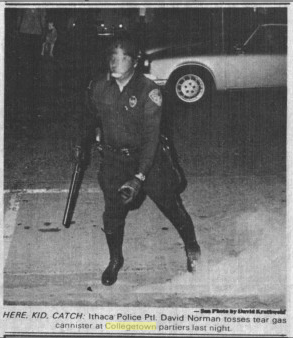
May 11 started just like any other anti-war rally, with 200-300 students protesting in front of Day Hall at around 10 PM. But when they decided to march to Collegetown, things spiraled out of control. Several students went to the First National Bank on the corner of College and Dryden (the corner where the failed Green Cafe is now), smashed the windows, and tried to set the bank on fire with homemade torches. IPD responded to the rioters with tear gas. Eight protesters were arrested and two policemen sustained injuries, one of which was a broken leg. The rioters, dressed in Halloween masks and being in a destructive sort of mood, retreated to campus, where they smashed the windows of the Campus Store and Day Hall, to the tune of “Day Hall must fall” chants. They marched on to Barton because of its ROTC affiliation, smashing several more windows while Cornell police watched in their riot gear, but did not intervene. By 1:15 AM, the rioters called it a night and dispersed. The damage to Collegetown was estimated to be thousands of dollars, which would be in the tens of thousands when adjusted to 2014 values.

ctown_riot_1972_2

Photo courtesy of the Cornell Daily Sun

Corson and his administration were none too amused, and vowed to prevent any recurrence with the help of the IPD. That vow would be tested two days later, at a student block party on College Avenue near its intersection with Catherine Street. The party had hundreds of attendees and had been well-publicized, but it lacked the necessary permits from the city (yes, even in the idyllic days of yore, there was red tape). Mayor Ed Conley, remembering the riots two days earlier, was not going to let it slide. The police were out by 6 PM and started to arrest students for minor infractions such as noise violations. The proverbial stick was poking the hornet’s nest, and Cornell’s provost tried to step in on the university’s behalf and offer up party space on campus. But students declined, and unrest began to boil over by 9:30 PM. The officers turned to tear gas to keep the street clear, which fomented the students and encouraged them to act out. Bottles, rocks and obscenities began to fly. Soon the battlefield had migrated up College Avenue, where IPD threw tear gas into buildings in an effort to gas out what they thought were unruly students taking refuge, but ending up gassing innocent bystanders as well. One store-owner accused the police of starting a fire with a canister thrown into his deli. The rioting continued to 2 AM, and resulted in 29 arrests, including 13 Cornell students. Accusations were thrown around about who started it and who did what damage, and a report some time afterward laid blame on the students, the IPD, the mayor and Cornell (so essentially, everyone was at fault). In retrospect, the May 13th episode was regarded as a giant mistake. The May 11th incident was still a flash point months afterward, a drug-infused example of organized crime per the district attorney and a witchhunt per the students.

Not to condone the drunken throngs losing their dinner on the sidewalk, but I suppose I’d rather put up with that than burning buildings and riot gear.


News Tidbits 10/10/14: Waiting For That Fall Slowdown

10 10 2014

707_East_seneca

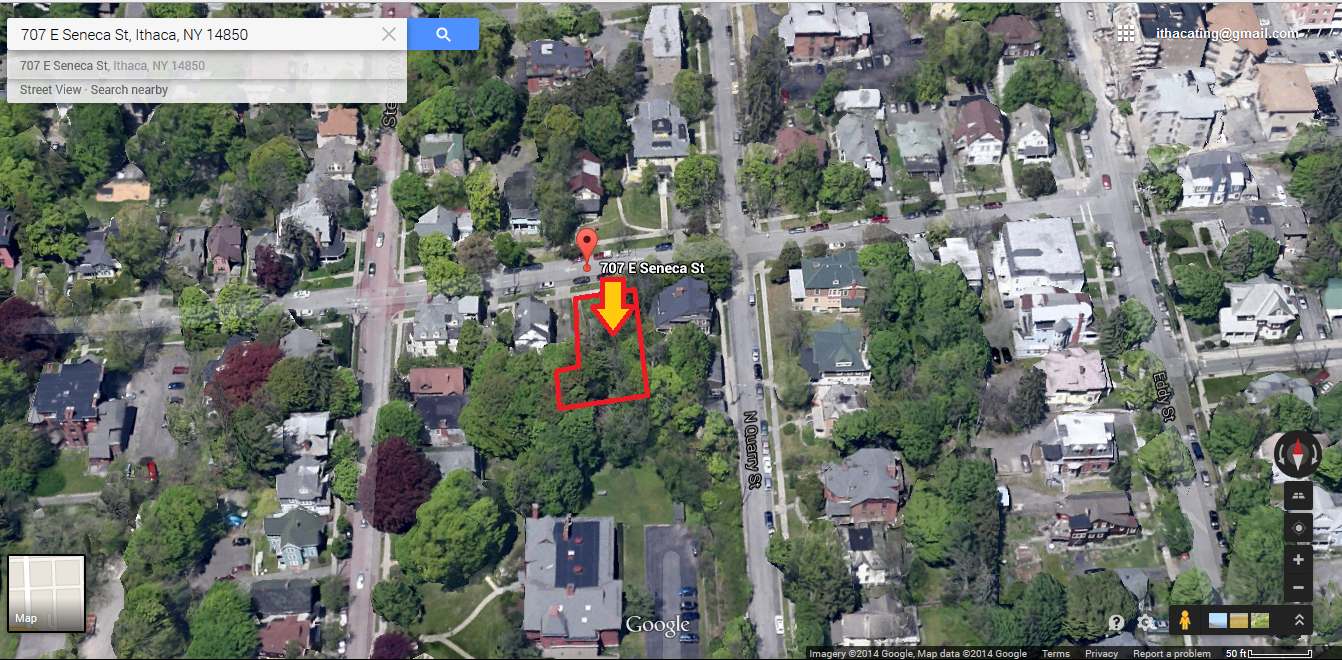
1. Well, this should be fun and exciting. 707 East Seneca, a vacated parcel that was put up for sale by the city, already has a potential development proposed. A sketch plan is due to head to the Ithaca Landmarks Preservation Council this month. It’s a small piece of real estate in a historic district, neither of those details beckons development opportunities. The property was offered for sale at $175k, which is $75k above assessed value, and is zoned to allow up to 4 housing units.

114_catherine_rev1_1

2. Some additional documentation about 114 Catherine. Cover letter here, Site plan Review drawings here, and Site Plan Review forms and documentation here. Apparently they were reusing the Dryden South SPR and forgot to update the numbers; Sharma has so many projects going they can’t keep in track. About the only difference from the old renders to these new ones is the addition of narrow windows into the brick face of the front facade, and some cute cut-and-paste vegetation. According to the docs, the new 3-unit, 17-bedroom building will cost about $500,000 to build, and has a timeline of January 2015 to July 2015 (for August move-in, presumably). This is a key detail – developer Nick Lambrou wants his project done before projects like Collegetown Crossing, 327 Eddy and others start major work; bigger demand for construction workers will drive the labor costs up, so he’s trying to get his project completed before that happens. Look at it as an appetizer before the main course arrives.

ithaca_beer_2

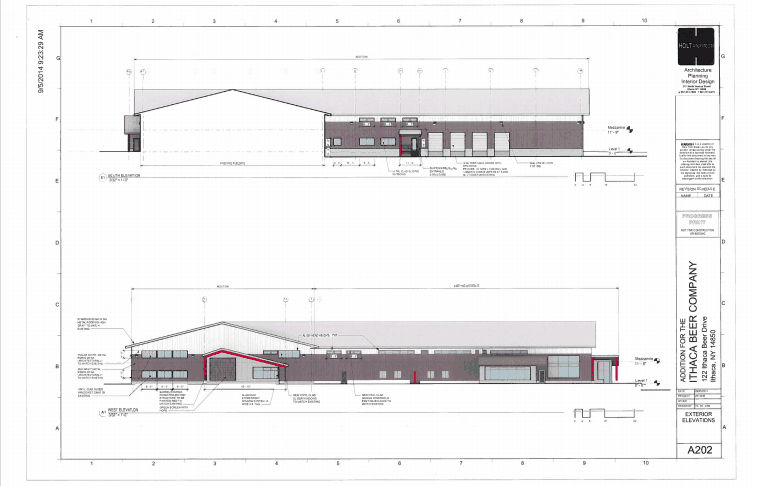
3. Next up, a few more details on Ithaca Beer Company, courtesy of its TCIDA application. Apparently, the construction on this project is supposed to start very soon – mid-November, for a May 2015 completion. A PDZ is very encompassing, and as close to carte blanche as town zoning gets. There’s not much the town needs to sign off on. And although winter construction is difficult, the foundation can be poured during the winter, given proper precautions. The cost of construction and new equipment will be approximately $7.2 million. The total cost of tax abatement requests (property, sales and mortgage) is about $350,000, most of that being in property tax. The addition is expected to create 22 new jobs (IBC currently employs 42), of which 18 look to be living wage. IBC has received tax incentives in the past and met or exceeded its obligations; I don’t see this application causing much fuss.

4. Normally, I don’t pay a whole lot of attention to Board of Public Works minutes; while important, public works aren’t exactly glamorous. But one thing caught my eye in the 9/22 minutes. It’s related to the Brindley Street bridge replacement, a one-lane bridge on a street you’d forget about if you weren’t explicitly looking for it. This line was included in the discussion of bridge options:

“Ben Weitzman has some very large plans for his parcel which is a very under
developed piece of property”

I think this is the Ben Weitsman of 132 Cherry Street? A branch of the Upstate Shredding metal scrapping company? I’m not sure if the plans are industrial or something else, there have been rumors of residential projects being considered in this area. It’s something to keep an eye on in the coming months.

grove2

5. From the Cornell Daily Sun, looks like Cornell “Sesquicentennial Commemorative Grove” is complete. That was surprisingly quick. The formal dedication will be the Friday before Cornell’s Homecoming.


Cornell’s Madam President

30 09 2014

101_4825

As announced over at the Ithaca Voice, Cornell’s 13th president will also be its first female leader. Univ. Southern California provost Helen Elizabeth Garrett has been selected to take over the helm from David Skorton starting in July 2015.

In keeping with a Cornell trend to have presidents who’ve spent time in flyover country, 51-year old Elizabeth “Beth” Garrett started her academic career in Oklahoma. According to her curriculum vitae, she received a BA in history from the University of Oklahoma in 1985, where she was active in student government and Chi Omega sorority, and she has a JD from the University of Virginia in 1988, where she was valedictorian.  Following law school, Garrett clerked for judge Stephen Williams on the U.S. Court of Appeals for the DC Circuit (1988-1989), and for U.S. Supreme Court Justice Thurgood Marshall (1989-1990). She also served as legislative director and tax and budget counsel in the early 1990s to retired Democratic U.S. senator David L. Boren (D-Oklahoma; back in a time when Oklahoma elected more Democrats). Since that time, she’s been firmly ensconced in academia. She has served as a visiting law professor at UVA, Harvard, Caltech, the Interdisciplinary Center Law School in Israel and Central European University in Budapest. She has served as a law professor at U. Chicago (1995-2003), where she was deputy dean for academic affairs from 1999-2001.  In 2003, she left for USC, where she would go on to serve as the vice provost for academic affairs (2005-2006) and then vice president for academic planning and budget (2006-2010). Garrett became provost, the second-in-command position for the university, in October 2010. Her tenure as USC provost has had its share of problems. It includes the failed merger of the Scripps Insitute with USC, and a series of high-profile crimes near the university where USC students were attacked.

As a lawyer, Garrett’s specialty is with government affairs and tax policy. In March 2009, she was nominated by Barack Obama to serve as assistant treasury secretary for tax policy, but withdrew that May for family reasons. It was suggested that she did not wish to put her family under the intense scrutiny that the vetting process required. She has been the target of the political right-wing’s fury in the past, for not doing enough to curtail a USC professor who used derogatory terms to describe Republicans.  Along with that nomination, her other government involvements includes serving on a number of government advisory panels and boards, include George W. Bush’s 2005 Panel on Federal Tax Reform,  and as the Commissioner of the California Fair Political Practices Commission since 2009. Like any other high-flying professional, she sits, or has sat on more advisory panels, had more professional memberships, and chaired more specialized committees and programs than you can shake a stick at. Her husband, USC law and philosophy professor Dr. Andrei Marmor, will be offered a position at Cornell.

A female lawyer with deep political and academic connections seems like a pretty safe choice for Cornell president. Although this will be her first time as a college president, she has strong enough credentials that, at a glance, her appointment appears to be a wise move.