Crazy-As-Hell Alumni Profiles: Erich Holt

17 08 2010

Cornell has somewhere around 245,000 alumni or so. It’s only fitting that an unfortunate few of our alumni err on the side of insanity. They might be acting as if they’re on crack, but most of their behavior can be attributed to them just being out of their damn minds.  This entry details one of our finer members of the batsh*t insane alumni club: Erich Holt, PhD 1914.

Erich Holt is one of several names he went by. He was born as Erich Muenter in Germany in 1871, but would adopt the aliases Frank Holt and/or Erich Holt later in his life. He moved to the U.S. and enrolled as a graduate student at Harvard (already famous for its whacko alums). In 1906 he was an instructor in German at Harvard College, living the life of a quiet and rather shabby looking married man.  His wife died mysteriously of arsenic poisoning, and Muenter felt the sudden compulsion to flee to Texas (a slight discrepancy here; Morris Bishop claims he fled to Mexico), later emerging under his aliases (which from what I’m finding, were pretty interchangeable). Holt launched into a brilliant scholarly career, doing four years of undergraduate work in only one year at the Fort Worth Polytechnic Institute before coming to Cornell to take on PhD work. Holt graduated in 1914 and took on a position as…a German instructor [1]. As you can see, he was really moving up in the world.

Well hell, if this was just about alumni who’ve killed their spouses, I could probably pull a dozen names easily. However, as those late night TV ads would say, “but wait, there’s more”.

1914 was not a great time to be a German guy living in the good ol’ U.S.A. For one, there was that whole war in Europe thing going on. Some folks weren’t too inclined to be polite towards folks who could be showing German sympathies. According to Morris Bishop, on campus alone there were rumors of tennis courts designed to serve as gun emplacements, and stories of bomb-making operations in faculty cellars (428). The professor of Latin tried to expel the professor of German (not Holt) from the “Town and Gown Club” because of German sympathies – namely, he read a New York daily that was published in German.

Well, Muenter/Holt was horrified by the war and all of the killing (not crazy). He decided that if he could stop all the munitions manufacturers, like J. P. Morgan, from selling to the Allies, he could single-handedly stop the war (kinda crazy). After realizing letters and arguments wouldn’t work, he decided to take action by bombing the Senate chambers of the U.S. Capitol (WTF crazy).

He designed a suitcase time bomb designed to work by letting acid eat through a cork, and took the next train to Washington D.C. His goal was to “wake the American people up to the damage which explosives like these were doing abroad”. Well, he went into the Capitol on July 2, 1915 at about 11:40 PM, and with bomb under arm, set it down in a reception room where it wouldn’t hurt anyone, went outside and waited for the explosion, running off to catch a train out of town when the bomb went off. The room was blown apart and a watchman was blown off his seat some distance away, but the story only merited a tiny blurb in the NY Times that attributed the explosion to “gasses”.

Step two in his grandiose plan was to take the train to Glen Cove, Long Island, home of industrial magnate J. P. Morgan Jr. Holt’s goal was to hold Mrs. Morgan and the Morgan kids hostage until J. P. agreed to stop sending munitions abroad. Well, after forcing his way into the house, J. P. stormed towards Holt and was given a warm Cornellian greeting by receiving two Big Red and bloody gunshot wounds to the groin as the British ambassador (Cecil Spring-Rice) and a butler subdued the German madman. This time, Holt earned himself the first three pages in the Times. While taken into custody, a grimmer part of his plan was revealed, as he planned to blow up several munition ships while they were at sea. It didn’t help that while he hadn’t plant any bombs yet, one munition ship (the “Minnehaha”) caught fire, and they thought it was one of his bombs,  and it returned to port in a panic.

Of course, the press had a field day with the story. While Morgan survived without major aftereffects (he lived another 28 years), Holt was exposed as Erich Muenter, the Harvard wife-killer. After trying to kill himself using by using the metal part of an eraser cap to try and cut an artery, he literally launched into a second attempt by climbing over the Mineola jail’s lattice bars and throwing himself head-down to the concrete floor 18 feet below. His second attempt turned out to be successful.

Word to the wise – you may not be the richest or most famous person to come out of Cornell, but things could be a lot worse. This is one alumni club that everyone should avoid joining.

[1] Bishop, Morris. History of Cornell. pp. 428-429


The Hat Clubs of Cornell

13 08 2010

Cornell has always been an institution known for its academics, which is perfectly fine. However, for many years, day-to-day life was a bit of a drag. A hundred years ago, one had few options – if you were rich and/or well-connected (as well as white and Christian), you enjoyed the exclusivity of Greek life; if you were independent, then your options were pretty limited, your social activities confined to the (even then) socially conservative Cornell U. Christian Association’s social rooms, or to the cheap and rather ungainly boarding houses of Collegetown and the city.

Around the early 1900s a movement began that was purely social in nature, vestigial in purpose but attention-grabbing in activity. Hat Clubs were formed by several different student groups. Hat Clubs only existed for one remarkable purpose; they instilled upon their members the right to wear a certain, funny-looking hat [Bishop 409]. Yes, life was that boring. On a deeper level, the clubs were designed to instill a sense of camaraderie among students and to allow friendships to be built among students who couldn’t afford or were excluded from other social societies.

Well, needless to say, campus leaders (read: rich white fraternity men) were not pleased. The presidents of fraternities and the editor of the Daily Sun publicly denounced the existence of these silly groups, and in 1913 they decided to take action against them by drumming up public disapproval and by trying to force them to disband.

It’s hard to try and compare this to today’s Cornell because the idea seems far-fetched. These clubs were nothing more than run of the mill clubs; they rarely maintained a permanent house or meeting place (dues were quite low as a result) and meetings were few and far between. Dinner banquets (often at a boarding house or cheap banquet hall) and social gatherings were their only real activities. Hat Clubs occupied a sort of hazy area vaguely similar to prominent clubs on campus today.

Well, thanks to the work of the well-connected, most of the clubs succumbed to bad P.R. and ceased to exist by the end of the decade. However, two survived. Originally, these two clubs were called Mummy and Nalanda. However, to avoid some of the bad publicity, they changed their names, to Beth L’Amed and Majura respectively. They managed to not only survive the decade, the went on to exist for another forty years.

A Cornell Alumni News from December 1936 provides a little background. Mummy was founded in 1900 by the freshman class (1903). Nalanda began with the following freshman class (1904), and the Class of 1906 had a new club (Stoic) that was quickly taken over and absorbed by Mummy. Mummy and Nalanda would alternate, with Mummy pulling students from classes with even years, and Nalanda from odd years. The two changed their names in 1911 (a discrepancy when compared to Morris Bishop’s account) after their hats were outlawed. According to the article, they were an active part of Junior Week and Spring Day (the predecessor to Slope Day), and did a reunion dinner at the Cornell Club in NYC every year on the Friday before Thanksgiving.

So what happened? Well, their social gatherings did them in. In December 1949, they did a joint initiation celebration for their new members and threw a big jamboree right before the Christmas holiday. Unfortunately, one partier, a Mech E. named Harry Melton, drank for more than he could handle. According to Time Magazine:

In about an hour, he had wolfed down more than a quart of Martinis. At that point he collapsed, was rushed to a hospital where he lay unconscious for 15 hours. For a while doctors feared for his life.

A quart of martinis in an hour? Holy crap. Personally, I can’t stand gin. The taste of gin is like running through a pine forest with your mouth open. But, to each their own.
Well, their actions cost them big time. The acting president of the university, Cornelius de Kiewiet, immediately suspended them. Pending a faculty review and denunciation by the Sun for their foolish activity that almost had fatal consequences, the president made the ban on the last two Hat Clubs permanent. To quote the Sun’s piece:

“Cornell’s doctrine of ‘freedom with responsibility’ had clearly been abused . . . The administration will not and should not allow us to kill ourselves . . .”

…and with that, the Hat Clubs were confined to the dustbin of history.


Cornell Students Party Too Much

13 06 2010

From the Cornell Era:

“Junior Ball week is getting rather overdone. What with the Sophomore Cotillion and the Glee Club concert and the Junior Promenade and numerous private and fraternity parties and the entertainment of guests, for a large number of students the entire week is consumed in pleasaure; more than one student cut all his university engagements last week. [1]”

The same argument could be made today, but the date of his editorial was February 11, 1893. The Cornell Era was a sort of predecessor to the Daily Sun. 

Some arguments never grow old.

[1] Morris Bishop, A History of Cornell, pp. 305.


The Alma Mater

4 06 2010

According to the greatness that is wikipedia, Alma Mater is Latin for “nourishing mother” — appropriate to its modern reference of being the institute of education where one receives their degree. I and perhaps 5,000 others joined the ranks (numbering 245,000 or so) of individuals who can call Cornell their alma mater. But it’s still strange to think that I’m an alumnus now.

So the experience of one class is different from another. If showcasing some of Cornell’s historical figures has proven anything, it’s that times change, as do the experiences change with time. Stuck in the Fast Lane delivered the message that although we are all Cornellians, no one has the same experience. If this blog has proven something, if anything, it merely emphasizes the point that Elie makes; although experiences vary, we all contribute some small amount to the long and finely woven Big Red tapestry.

A student in 1903 was subject to a typhoid epidemic that sickened over ten percent of the city and killed 29 Cornell students (about 1.5% of the school population — comparable to about 300 or so students today; and although directly caused by polluted water, some have indirectly linked the illness to Typhoid Mary Mellon). In contrast, a student in 1969 wondered if the campus would devolve into anarchy and violence, the tension culminating with the infamous Willard Straight Takeover in April of that year. A student this past year will probably remember the sheer number of tragedies that befell the Cornell community, especially the campus suicides. Perhaps on a lighter note, they’ll also remember it as the year the basketball team went to the Sweet Sixteen.

Point is, they’re all vastly different events, but they all still make up a part of Cornell history. As alumni, we’ve all lived through at least some part of that history as students, and hopefully many more years ahead as alumni.

Ca. 1990. Note the street traffic on the lower right, where Ho Plaza is today.

I have nothing that needs to be said about my experiences as a student. I made use of my four years. I felt like I contributed to Cornell’s history, not by writing about it, but my living it, breathing it, being a part of this institution and contributing in some small but personally meaningful way. That’s the most I could ever want.

Although my time at Cornell is over, this blog is not. It will operate in a reduced capacity, certainly. But history is still being made, new buildings are still being erected and new plans being conjured and proposed and maybe even approved and undertaken. History’s flaw and beauty is in its perpetuity. Life at Cornell isn’t ending because I graduated — it goes on for as long as Ezra’s and Andy’s institution remains Far Above Cayuga’s Waters.

That alone will provide me with the inspiration and the motivation to write for some time yet.


The Cornell Convention Center

29 04 2010

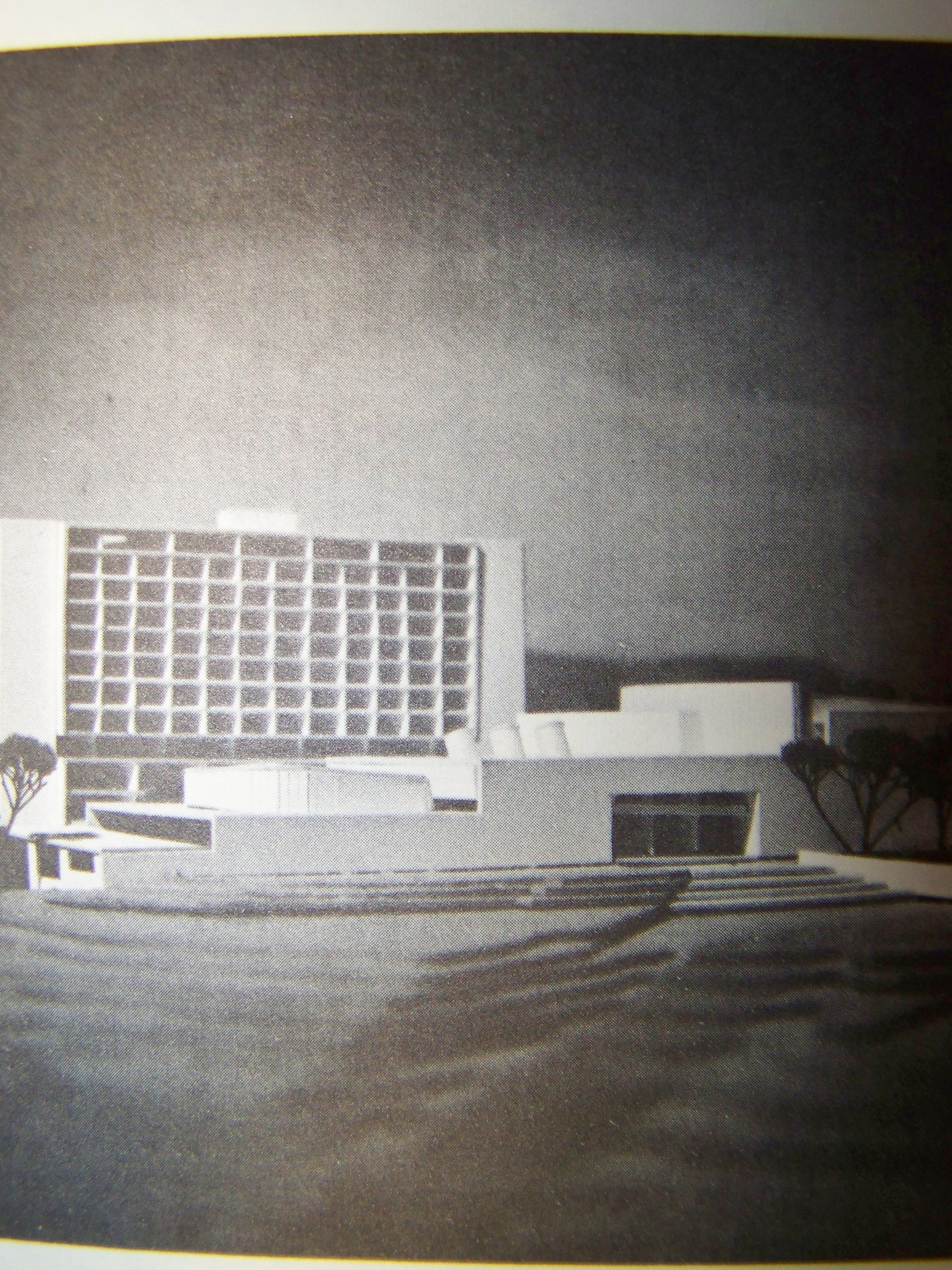
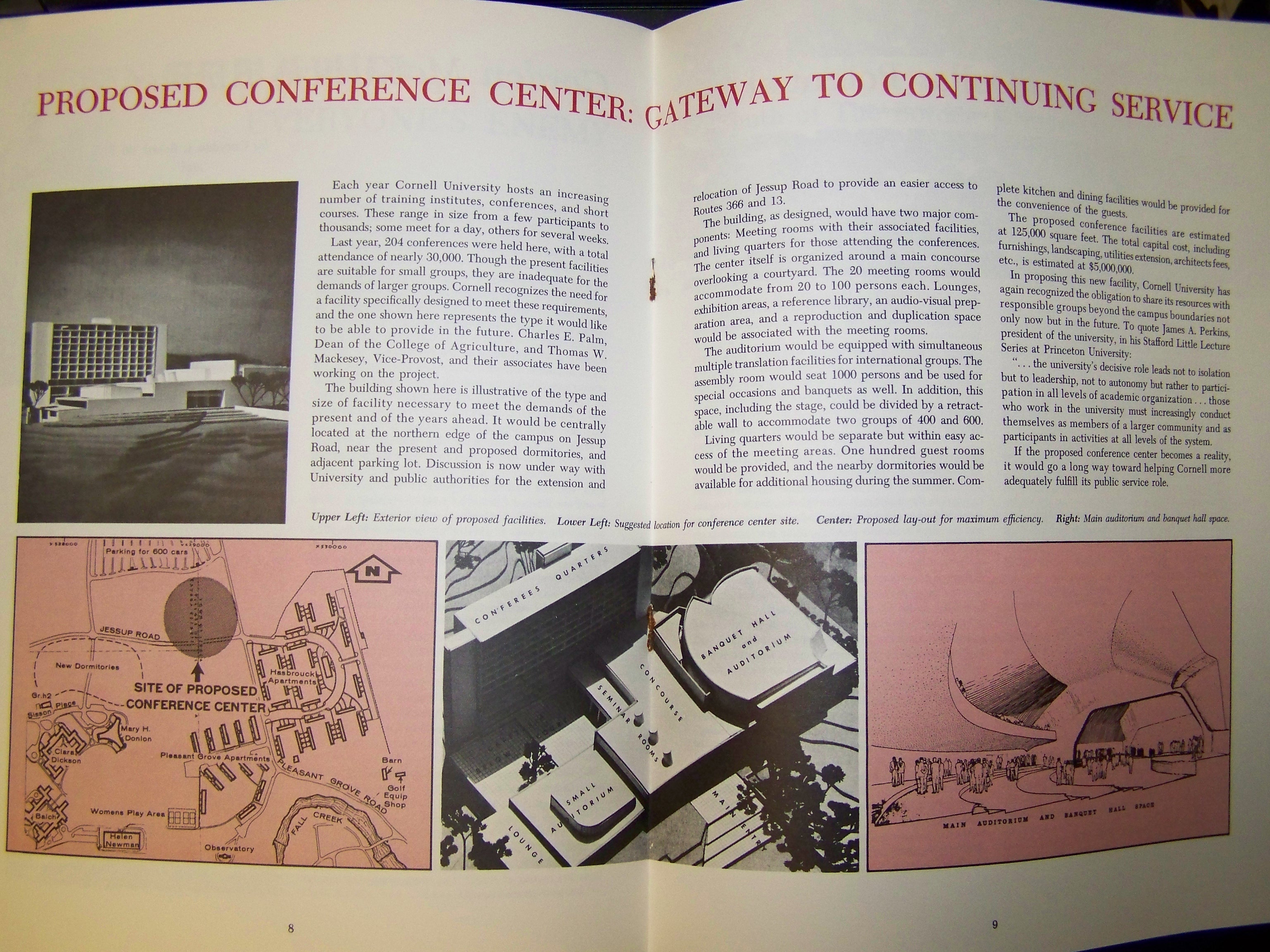
While doing research recently, I came across this an old article promoting the proposal for a campus convention center.

The images and article are from a November 1966 issue of the “Cornell Countryman”, which was a monthly magazine published by the old Agriculture school (now CALS).

The proposal (which was never approved), was located off of Jessup Road where the townhouses are located today. It called for a 125,000 sq ft facility complete with break-out rooms, a banquet facility and larger meeting spaces. The expected cost was around $5 million in 1966 dollars. The proposal also suggested the extension and rerouting of Jessup Road to either/or Rte 13 and 366.

In the article, it mentions proposed dorms nearby. This would be in reference to the highrises and lowrises, as well as RPU, which were built in the early and mid 1970s.


A Critique of Cornell’s Constructions

20 04 2010

For an architecture junkie like myself, Munier Salem’s column in the Sun today was a must-read. The article briefly went over the previous eras of architecture of Cornell’s campus, and then zeroes in on the Arts Quad and the perceived blight that Milstein Hall will bring to this part of campus.

Not that I disagree. Well before I started this blog I can remember a long discussion about campus architecture Munier and I had in Cascadilla Hall. Munier has never hidden an opinion that almost anything built after 1955 has been either par for the  course or an eyesore. That being said, the architecture of Cornell buildings could be said to be distinctly to the taste of the time period. As Munier pointed out, Romanesque and Collegiate Gothic dominated Cornell’s first 75 or so years, followed by the rapid rise of modernism, in part because it was now en vogue, in part because it was cheap. The U-Halls were the  sign of things to come (inversely, Teagle Hall could probably be considered the last of the Collegiate Gothic era, as both the U-Halls and Teagle were constructed in the early 1950s). They certainly weren’t attractive, but they weren’t ugly. They were  utilitarian, like the Old Stone Row, but with ninety years of technological advancement, design trends and expectations of medicority to fall back on.

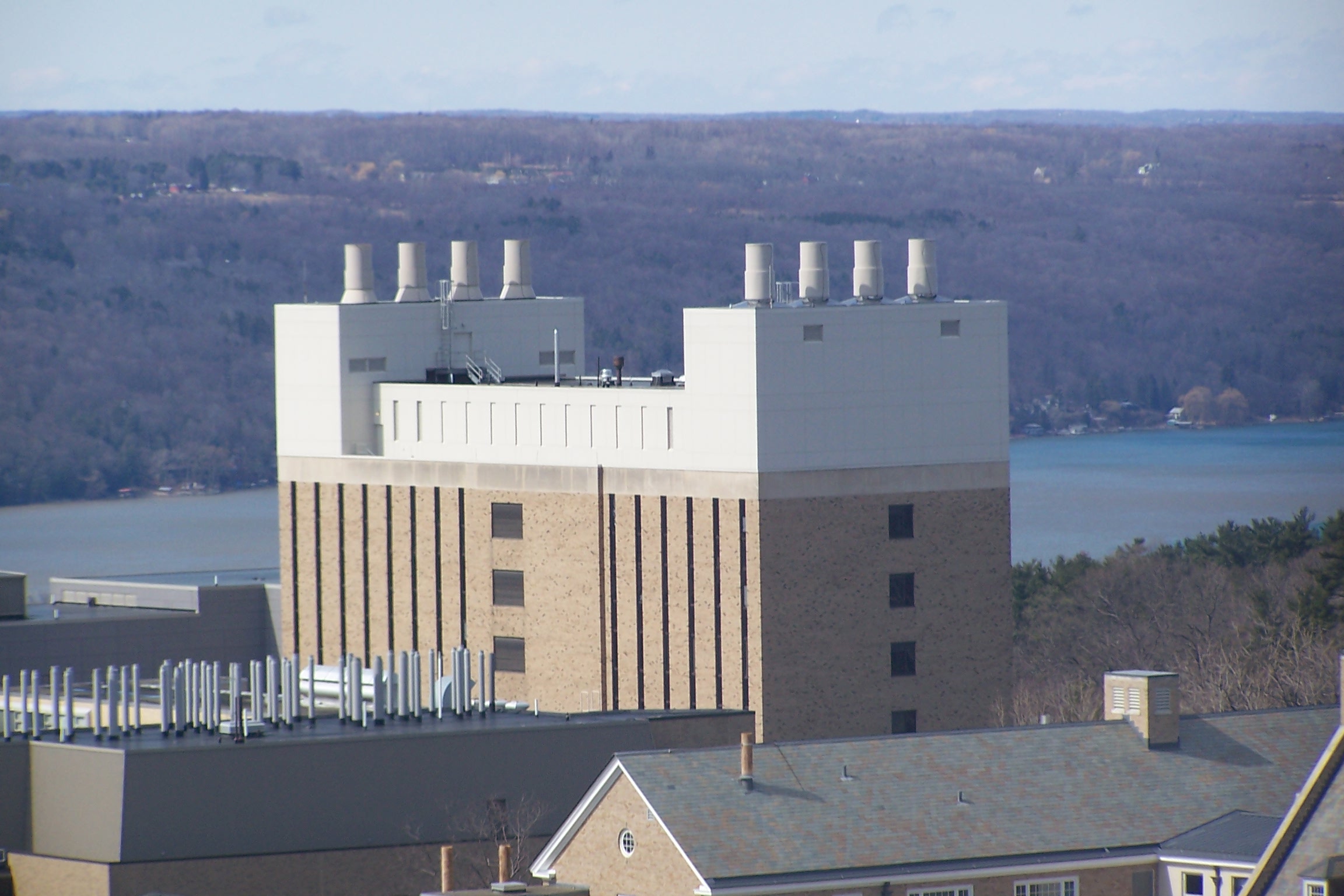
Don’t get me wrong, Old Noyes, seen on the left of this photo, was a brutalist piece of crap. But it wasn’t built until 1967. Olin Lab was famed for mediocrity (found elsewhere on this blog). Bradfield grows on you at best, and gives you cataracts at its worst. They were built to the style of the times and on tight budgets, ornamentation and “fine” taste be damned. Much of it has aged terribly, as dated as vinyl clothes.

Today, as Munier also pointed out, we live in the era of postmodernism, which at least attempts to blend the taste of older structures with newer engineering and materials.  Done right, this turns out to be typical “cake” architecture that, while not anything to write home about, also avoids being offensive. If done really well, such as Princeton’s new Whitman College, it can look as good as the old Gothic (although one could argue about craftsmanship).

However, that being said, we live in an era of “Starchitects”. where a name carries more weight than a building. I. M. Pei, Cesar Pelli, Robert A. M. Stern, Sir Norman Foster, Kenzo Tange, the A-list has at least a few dozen architects who could churn out steaming piles and yet because their name is attached to it, it wins renown. Here’s where Rem Koolhaas come into the picture. Designing a building for an architecture school carries with it the expectation of being edgy, avant-garde. So of course, to varying degrees of distaste we have had three edgy designs for Milstein Hall by Steven Holl, Barkow Leibinger and Associates, and Koolhaas. Koolhaas only wins in my book for being boring and unimpressive, versus downright ugly for the other two.

Is it a good practice to let Starchitects have free reign? Probably not. The name has power now, but who now remembers Gordon Bunshaft or Minoru Yamasaki? One designed Lever House in New York City, which hearalded the rise of glass boxes; the other designed the old World Trade Center in New York. It would seem the weight of a name decreases with time. Some people feel that the power of Gothic structures can do wonders for a school’s reputation.

I dunno if there’s any truth in that. But if it is, can we please hire this firm?


The Roof is On Fire (Literally)

24 02 2010

I can’t say anything in particular inspired this post, except my slight, ever-present fear of the interior of Bradfield catching fire. Technically, there was a small fire in Bradfield on the fourth floor a couple of years ago, but thankfully it was quickly brought under control. Which, compared to some of Cornell’s history, is very, very tame as fire events here go.

The most notable fire on University property is fittingly the most well known, the Cornell Heights Residential Club fire in April 1967. Cornell Heights, now known as Ecohouse (Hurlburt House), was bought by the university in 1963 (its former use being a motel) and was being used to house students in an experimental program that would allow them to complete a PhD in any department in six years (which, for anyone who knows  plans on or knows people pursuing doctorate study, six years from college freshman to PhD is a pretty sweet gig if one could keep up with the work). The program began to be housed in the building in 1966, so they hadn’t even been there one full year when the fire occurred. The PhD program had 43 students, three faculty-in-residence and a faculty-adviser-in-residence, and the second floor held twenty-four senior and graduate women, for a grand total of 71 occupants. The fire started at 4 AM, when most residents were sleeping or busy pulling all-nighters.

looks better from the outside, doesn't it?

Images property of Gendisasters.com

Well, the building was thoroughly modern by 1960s standards, which means that just about every piece of nondescript furniture inside was made of some toxic material that could be hazardous if ingested, inhaled, seen or most importantly in this case, burned. The fire caused a toxic smoke to be emitted from the plastic upholstery, suffocating the victims, and sending ten others to the hospital for smoke inhalation (52 others escaped unharmed). The lack of adequate fire exits, alarms and sprinklers, especially on the second floor, only exacerbated the situation. As a result of the tragedy, the university undertook a major overhaul of its fire safety standards.

The second deadliest fire wasn’t technically university property, but was associated with one of the fraternities. Chi Psi lived in a glorious mansion built for the insanely rich Jennie McGraw, and completed in 1881. Too bad the tuberculosis she had killed her just as she arrived back home to witness its completion. Well, the house was auctioned as part of the “Great Will Case”, bought by McGraw relatives who then sold off most of the furniture, and then sold the unoccupied house to Chi Psi in 1896.

The primary suspect in the fire of December 7, 1906 were oily rags in a broom closet and flammable varnish on the wood floors. Although the building was finished with stone, the wood-frame construction made the place into a hellish inferno. Most of the 26 brothers were trapped in the burning building, with some only escaping when the collapsing walls gave them opportunities (at least one man escaped by falling with the collapsing wall onto the snow below; others jumped three stories). Of the seven people who died, two fraternity brothers were killed when they failed to jump from the collapsing southwest tower, two more died when they ran back in to rescue others, and three volunteer firemen were killed when the north wall collapsed on top of them, and “slowly roasted to death” as a New York Times article of the day puts it.

Turning to less fatal events, the Chemistry Department suffers the dubious distinction of being the most fire-plagued program in the history of the university. First of all, their first building, the old Morse Hall, partially burned down in 1916. When Olin Lab was under construction in 1967, the exterior tarp caught fire while it was under construction, causing a wall of flame along the partially-completed building (luckily damage was minor). The building had another minor fire in 1999.

Now imagine a ten story wall of flames. You get the idea.

Tjaden Hall had a flat roof on its tower portion for about forty years because lightning set the original roof on fire in the 1950s and they had to remove it. Then you have minor fires in the dorms once every couple of years or so. Balch Hall had a minor fire in the fall of 2004, and one of the lowrises in the spring of 2006. I think Donlon Hall had a minor fire sometime in the past few years. Point is, they’re usually mild, little news-makers, enough to end up at the bottom of the front page of the Sun for a day, and life goes on.

Regarding the Greek end of things, things get a lot more interesting. A brief (non-exhaustive) list:

-A fire burnt down the lodge of Kappa Alpha in 1898.

-Delta Chi’s house burnt down in 1900.

-Delta Upsilon had fires in 1909, 1916, and 1919. The 1909 fire completely destroyed the house.

-Sigma Alpha Epsilon lost a house to fire in 1911.

-Alpha Delta Phi’s house burnt down in 1929.

-Alpha Epsilon Pi had a house burn to the ground in 1929.

-A wing of Zeta Beta Tau’s house was consumed by fire in 1939.

-Zeta Psi’s original house burnt down in the late 1940s.

-Kappa Sigma suffered significant fire damage in 1948.

-Tau Epsilon Phi lost the old wing of their house to a fire in 1961.

-Sigma Pi’s house was reduced to a burnt-out shell in 1994.

So historically speaking, fraternities are not the best places for fire safety. On the flip side, I’ve never heard of a Cornell sorority house burning down.


Random Ithacana

18 12 2009

So, pardon the extraordinarily long break. Finals and research brought much of my outside life to a screeching halt, so this blog had to take a backseat for a couple of weeks. Oddly enough, site statistics didn’t really go down a significant amount, which probably says something about the consistent use of the historical info on this blog.

Anyways, during my holiday shopping, I happened upon a new little book that I felt the need to add to my collection. The book, Surrounded by Reality: 101 Things You Didn’t Know About Ithaca, NY (But Are About to Find Out) by Michael Turback, is a nice little book detailing some of the history and sights of the area. Some of the book entries share the same information that has previously been shared on this blog, but there was some new information to be garnered from its pages.

A lot of the book focuses on Cornell. Things that a lot of Cornellians already knew about the founder and A.D. White, but also some more obscure details. For example, a real description of Zinck’s. Theodore Zinck ran the “Lager Beer Saloon and Restaurant” out of the Hotel Brunswick at 108-110 N. Aurora (just off the current-day Commons) starting in 1880. Contrary to modern day bar-hopping, Zincl, while described as being a fatherly and caring figure who treated his customers with “Prussian high-handedness”. Customers could be thrown out of his bar, however, for drunkenness, bawdy songs, or derogatory references to the German Kaiser. The first Zinck’s operated until about 1903. That year, a typhoid epidemic rages through the city and claimed 85 lives, including Theodore Zinck’s daughter. Despondent, he drowned himself, effectively shutting down Zinck’s first incarnation. The bar reopened under his name in 1906 (which would be incredibly tasteless if he wasn’t regarded so affectionately), and continued in operation in some form in different names and places up to about 1967. Although, with the coming of the new Hotel Ithaca, it appears we may continue the local tradition of naming revered watering holes after a suicidal barkeep.

Another detail that the book referenced was the freezing over of Cayuga Lake. Cayuga Lake is about 435 feet deep, so usually the massive heat storage of the water keeps the lake from completely freezing over during the winter. However, that isn’t to say it can’t happen. Since 1796, the lake has frozen over about ten times (1796, 1816, 1856, 1875, 1884, 1904, 1912, 1934, 1961 and 1979). Wells College, a small and formerly all-female school located further up the lakeshore in Aurora, has a school tradition where if the lake is discovered to be frozen over, classes are cancelled for the day (there is no such tradition for IC or Cornell). According to the book, during the 1875 freeze one athletic young woman at Wells decided to celebrate the day off by skating down the lake and back. Not too shabby, once you consider that the lake is just under 40 miles long.

One last one for the road; most Cornellians are well aware of the legend that if a virgin crosses the Arts Quad at midnight, Ezra and A.D. White will step off their pedestals and shake hands in the center of the quad. Wll, as it turns out, Ithaca College has their won virginity legend. Outside of Ithaca College’s Textor Hall stands a 10-foot high ball sculpture mounted over a small pool of water. Their campus legend states that if a virgin ever graduates from IC, the “Textor Ball” will fall off its pedestal and roll down South Hill. According to Wikipedia, Ithaca College has 49,570 alumni, and I’m willing to bet most of them are from after the school’s 1960s expansion and relocation.


The Dealings of the AEM Program

22 11 2009

For almost every day of the past semester, there has been something in the news about proposed budget cuts or streamlining of the university in the name of efficiency. The AEM (Applied Economics and Management) Program is probably the biggest target of the streamlining arguments, and not without good reason. Someone could effectively obtain a business major through AEM in CALS, PAM in Human Ecology, or by concentrating on a particular field within the Hotel School. The engineering school has a program set up with CALS where engineering students can minor in business through AEM.  Some aspiring entrepreneurs take classes at the Johnson as undergraduates. Point is, anyone whose interested in business (if at least because of the big financial rewards) can do so.

AEM hasn’t always been the fast track to I-banking as it is often seen today. The AEM of competing business fraternities, Wall Street ambitions and pre-MBAs is largely a recent phenomenon.The history of AEM shows how much of a radical departure the program has made in recent years, and thankfully a professor emeritus of the department recorded it in a written book about the history of the department that is available online in its entirety.

AEM started in CALS for good reason — it was first known as agricultural economics. The program has its earliest roots from around 1903, when Ag school dean Liberty H. Bailey hired Prof. Thomas Hunt, who taught the first courses on farm management. By 1907, Hunt left to become a dean of the Penn State Ag school and George Warren took over most of his duties, becoming a full professor of the Farm Crops and Farm Management Department by 1910 (the sister department at the time was Rural Economy). George Warren by and large shaped much of the early development of the program, hence Warren Hall’s dedication to him when it was built in the early 1930s. In 1919, the two sister majors were merged into one department to be called Agricultural Economics, as ordered by the Board of Trustees.

For the next several decades, Ag Economics was a major usually taken by farm kids who planned on going back to the farm or engaging in some other form of agricultural operations. By the 1970s, the program had begun to diversify somewhat, and by the 1980s the program offered a substantial number of courses that didn’t focus as much on the agriculture portion of ag economics (mostly these new offerings were in environmental and managerial economics — the managerial portion could be seen as a predecessor to today’s AEM). To reflect this, the department changed its name to Agricultural, Resource, and Managerial Economics (ARME) in 1993.

Unfortunately, the book ends off in early 2000, and a lot has changed in the past nine years. The program changed its name from ARME to AEM in 2000.  The undergraduate business program was accredited in January 2002. Doing this required a significant financial infusion on CALS’s part, one example being the hiring five key staff members that were required for full accreditation (for ratio purposes and course requirements needed for accreditation). Depending on the year, AEM has offered anywhere from six to ten concentrations, some ag based and some not. This is where the blurring has resulted from.

So, we have the kids who come straight from the farm and want to pursue agricultural objectives. That’s right in line with CALS’s objectives. But then you have the kids who are completely set on Wall Street and Wharton. the ones who scowl when you mention that CALS is state funded or poo-poo most of their intraschool brethren (I know that they’re not all like that, but all it takes is a few to set a bad example and garner a poor image). The department has definitely become more diverse, but some argue that it comes at the cost of diluting the mission of the school (of course, who am I criticize when CALS also includes atmospheric science [meteorology, which grew from crop and soil science], landscape architecture and and communication)?

Should AEM be streamlined? It would seem appropriate when you consider the variety of business programs Cornell offers. But to be frank, CALS does not give a damn what Cornell as a whole thinks when it comes to AEM. CALS invested heavily in the program in the late 1990s and early 2000s to get it accredited and propel it into the top ten in recent years. Why would they let someone deprive them of lucrative business majors (who become lucrative alumni) after they worked some hard to lure them into the program? This is more of a problem than people seem to realize. Unfortunately for me, my adviser rants about AEM’s high-and-mighty attitude roughly twice a week, so I won’t be seeing an end of those complaints anytime soon.


A Blind Eye to Sports

8 11 2009

As anyone who doesn’t live under an Ithacan rock knows, Cornell had its much-publicized and anticipated match against Harvard on the ice of Lynah Rink last night. Much to Cornell’s delight, the Big Red skated to an impressive victory over the Crimson, with a final score of 6-3.

I feel like I’m one of a handful of undergrads on this campus who really doesn’t give a damn.

Not that I don’t have respect for athletes at Cornell. I give them by full respect. It’s just that I have never followed sports, with the slight exception of cross country and track back in junior high and high school because I was on the team (and let’s be honest, they’re just not the same when it comes to skill or competitive spirit). I’m content to sit back and watch everyone else get excited, because I’m just disinterested in Cornell sports. I’m never sat all the way through a Cornell game in any sport.

So, unsurprisingly I never mention sports on this blog, unless there’s historical worth to mentioning it. Which I can briefly do now.

Back in the day of the university founding years, the big sport for students to follow was crew, aka rowing. A.D. White was a member of a rowing club during his own collegiate years at Yale (Bishop 33). The first boating clubs formed in 1871, and a regatta was held the following spring (if you could call it that). The first big victory came at Saratoga in 1875, much to the joy of the school and the town (story goes that A.D. White broke into McGraw Hall Tower and rang the chimes himself). Baseball and football were vague diversions, not even intercollegiate until 1874 (Bishop 134). Cornell actually had its own rules of football that no one cared about, so the university didn’t take a substantial interest in football until about 1886. The Cornell Atheltic Association formed in 1889 (296). The first athletic area, built in the same year, was off campus on what is now the site of Ithaca High School, and was called Percy Field after the donor’s son, who was at the time a student athlete at Cornell. Hockey was recognized in 1900, basketball a year later. Lacrosse started up in 1885, but was  like clothing fashions among students, coming back into and going out of style every few years.

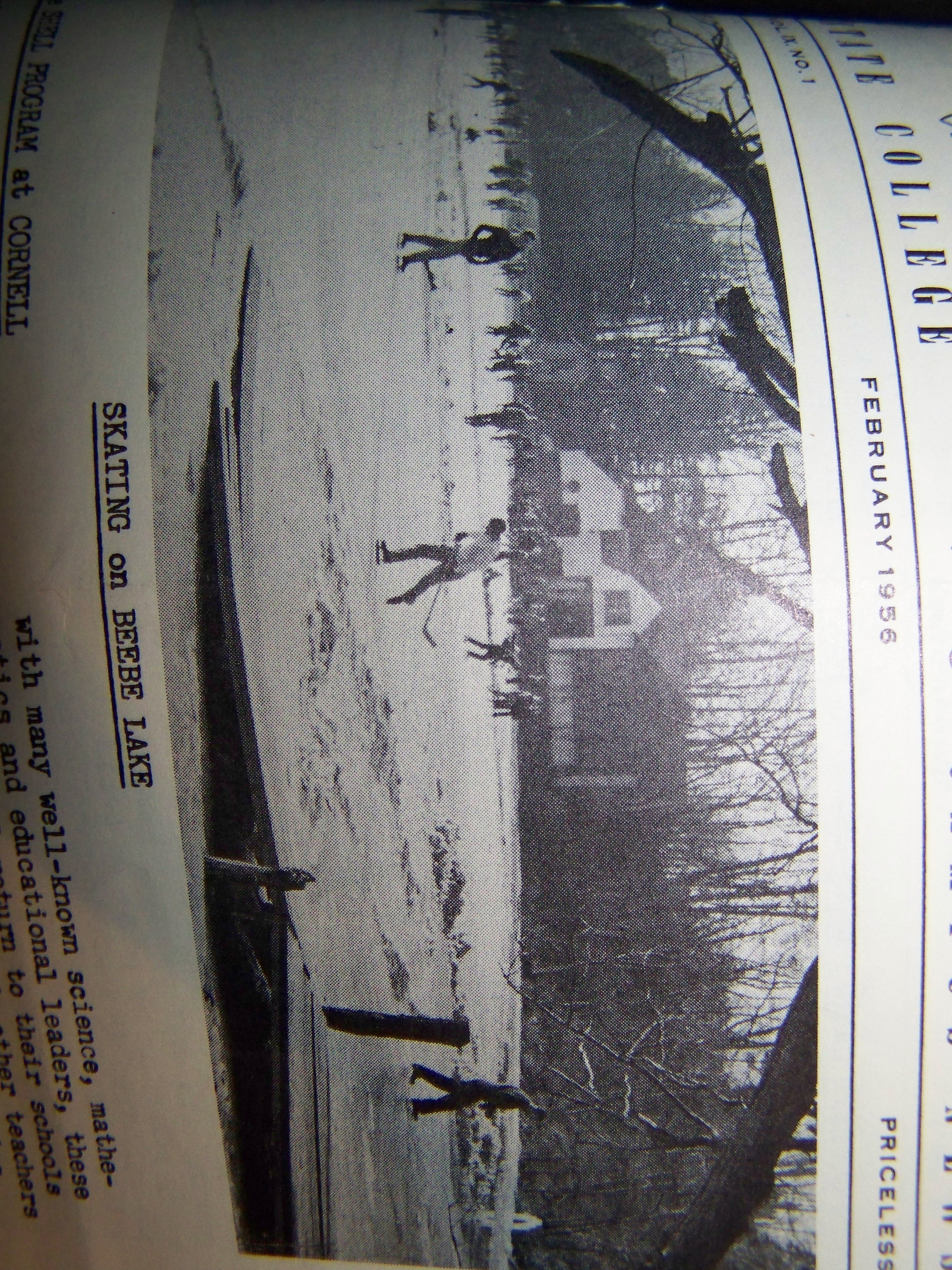
Hockey was originally played on Beebe Lake. The idea of bringing it to Cornell came from a professor of engineering named Johnny Parson. Hecne, the establishment of the Johnny Parson Club. When the lake began to melt, the team would use the Ithaca city ice rink. The team won what might be its first intercollegiate championship in 1911 (417).

So, Bishop’s history of Cornell only mentions hockey twice, and was published in 1962, suggesting the sport was still on the periphery of athletics at that time. That was also the same year that underdog Cornell outplayed perennial powerhouse Harvard. Things started to get more interesting when the Harvard/Cornell hockey rivalry started to heat up in 1973 with Harvard’s tossing off a chicken at Cornell goalie Dave Elenbaas, as a knock against the Ag School (of course, nowadays we can depend on our alumni to knock the ag school). So Cornell students responded later that month by throwing fish onto the rink. As the decade wore on and Harvard’s program weakened, the Big Red wasn’t content to let things slide, so the rivalry has been intensified since the incident.

So that’s why Cornell-Harvard tickets can be so expensive, and why this one game is as close as Cornell gets to the storied rivalries of Big Ten schools. Some of us are more into it than others though.