News tidbits 6/16/14: Modifications, Design Tweaks, Same Thing

16 06 2014

I figured I’d just bundle these projects together, since they all have minor tweaks or new details that should be noted, but wouldn’t need their own entries. 400 Spencer Street (Stone Quarry Apartments), 307 College Avenue (Collegetown Crossing) and 205 Dryden Road (Dryden South).

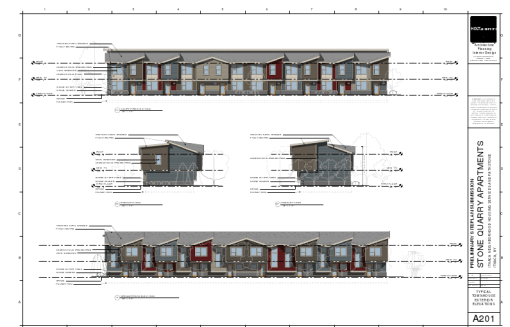
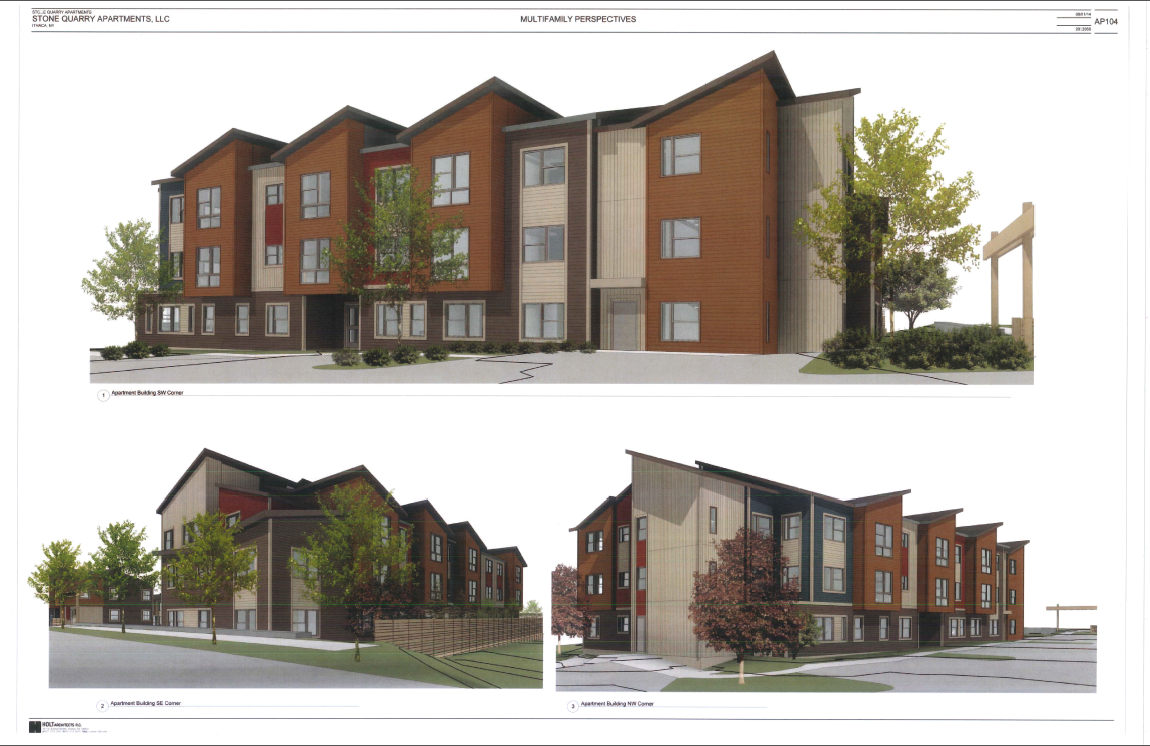
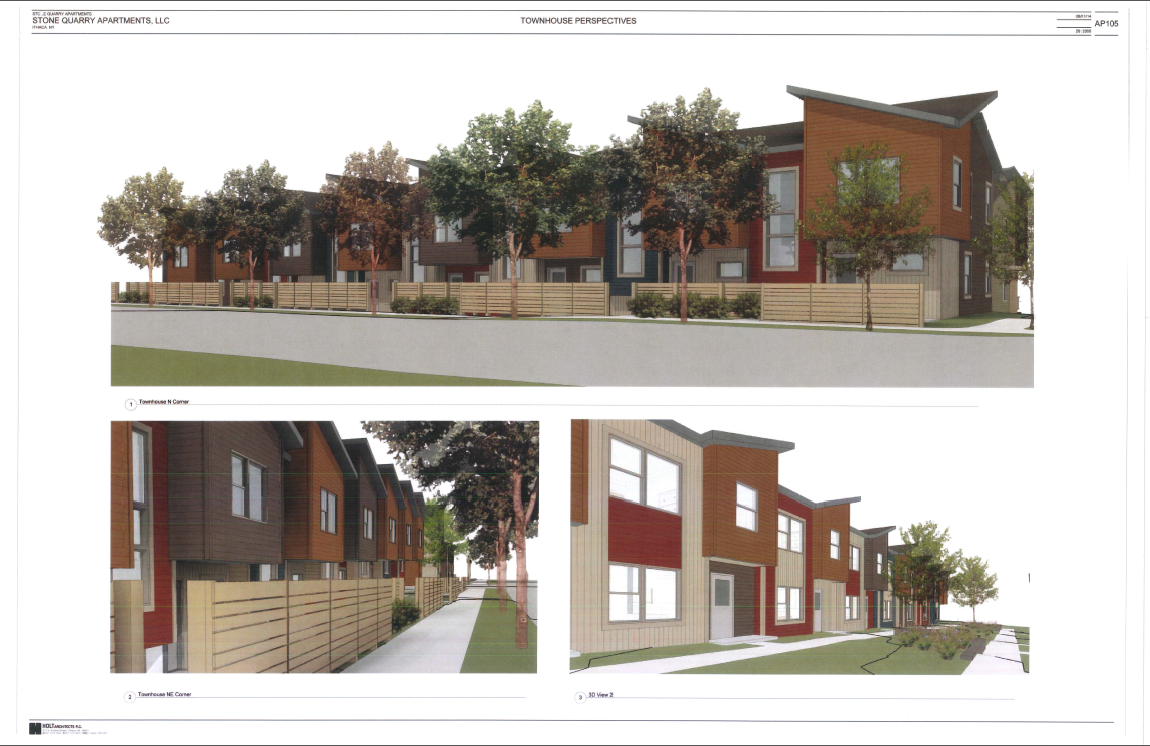
First, the Stone Quarry Apartments. Letter documenting updates here, exterior materials and playground design here, revised drawings here. With six different siding colors planned, this 35-unit complex is going to be very colorful. Since the renders last month, the 19-unit apartment building shows only minor changes, and the townhouses (2 sets of 8) have been reoriented to avoid that awkward break in the middle of the units that looked like a broken eave.

inhs_stone_quarry_rev_3

inhs_stone_quarry_rev_4

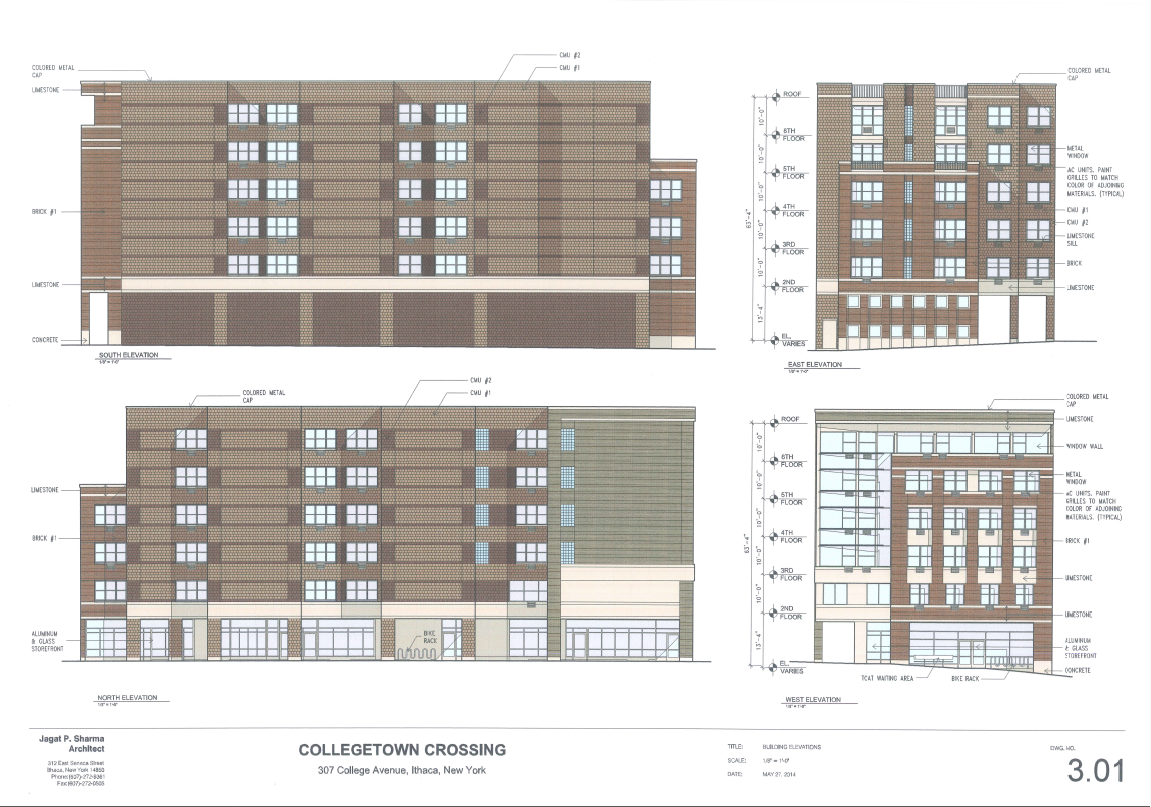
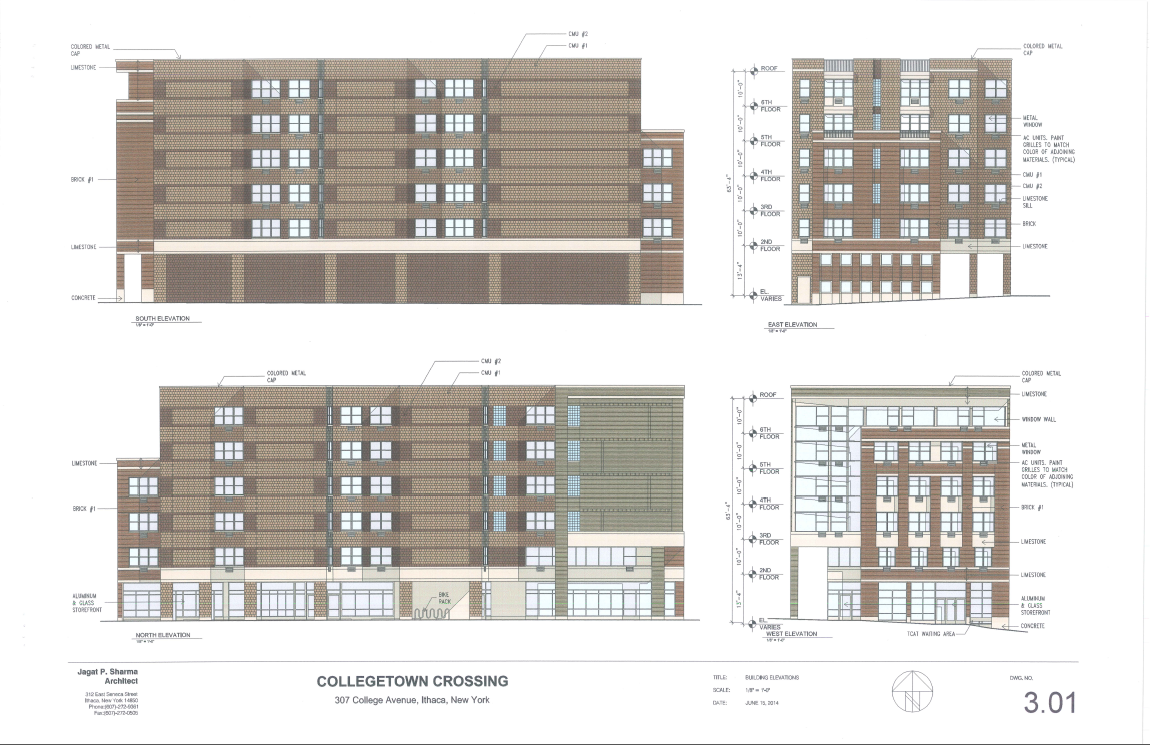
As for Collegetown Crossing, the number of units and rooms has been tweaked again, to 46 units (from 43) and 96 bedrooms (from 98). Full Environmental Assessment Form (FEAF) here, Site Plan Review (SPR) cover letter here, application here, drawings here.  The cost of construction will be $5 million, and go from February 2015 to August 2016. The drawings look nearly the same, some slight changes in the massing and more windows on the second floor’s northwest face.

ctown_crossing_rev_2

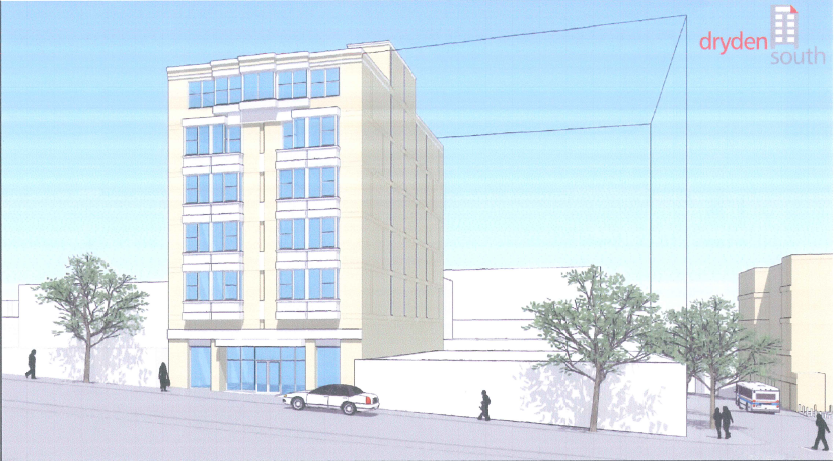
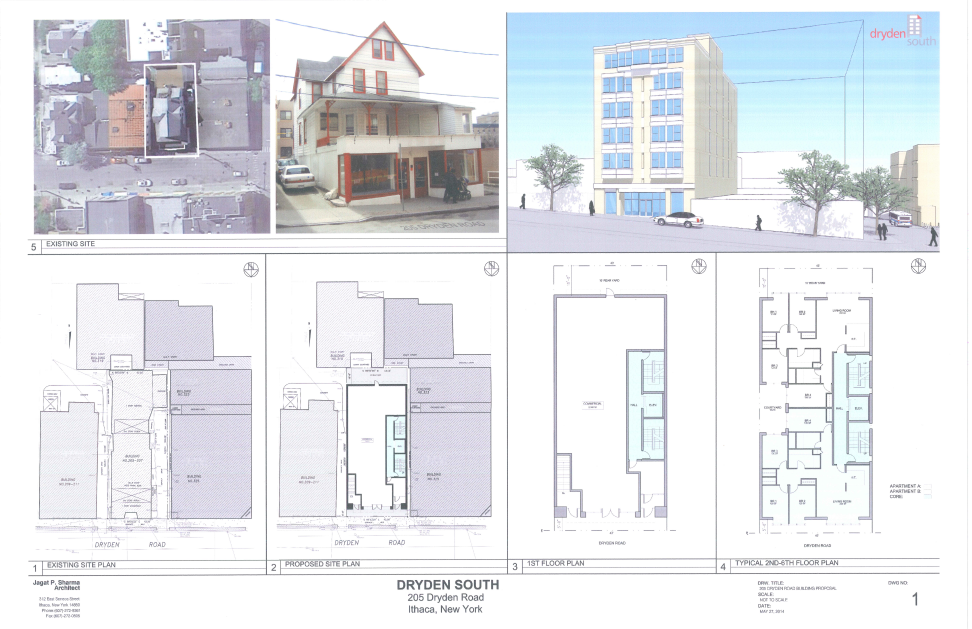
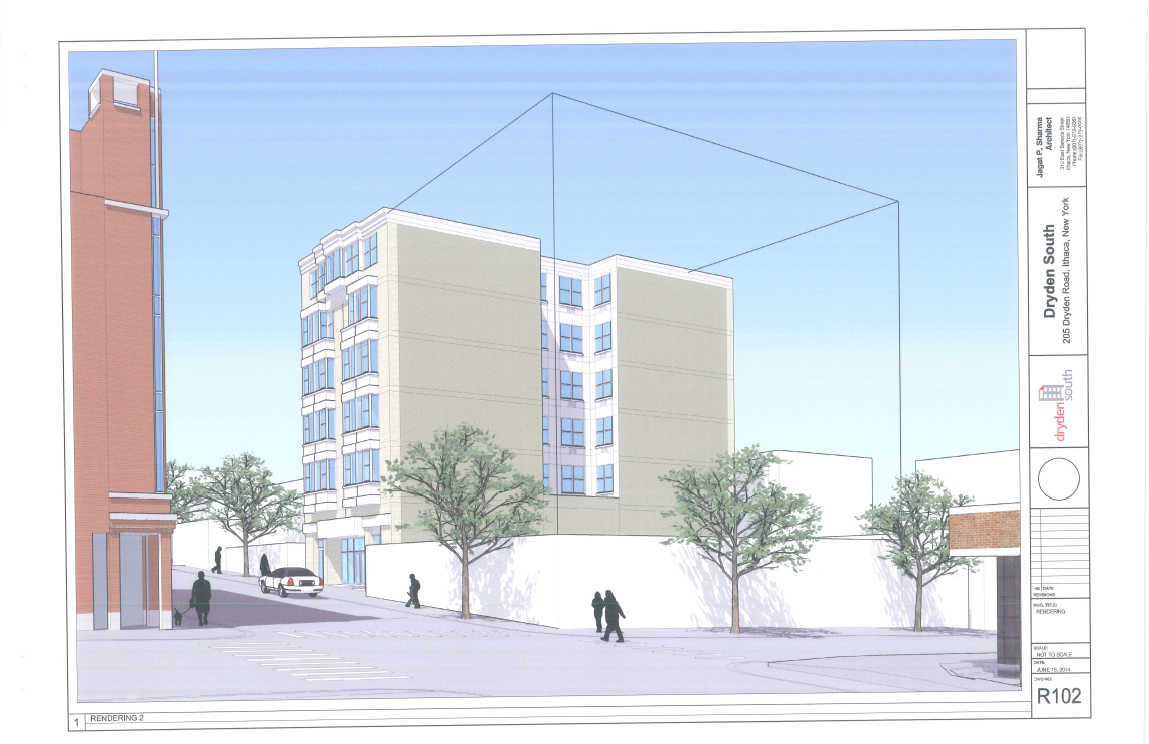
Lastly, 205 Dryden. The prison slit windows are gone from the west face, replaced with a cutout for windows on each floor. The slit windows remain on the east face. FEAF here, SPR cover letter here, application here, drawings here. Oddly enough, this one is also budgeting $5 million, and a Feb 2015 to August 2016 construction period. Being that they’re both by the same architect, I wonder if that’s correct, or if someone was just a little too liberal with the copy-and-paste. The building will be 65’0″, and have retail on the first floor and 10 4-bedroom units on the upper five floors.

dryden_south_rev_1

dryden_south_rev_2


News Tidbits 6/12/14: Predisposed to Being Opposed

13 06 2014

Some things are worth mentioning, but not necessarily worth their own post. So here we go…

troy_rd_2

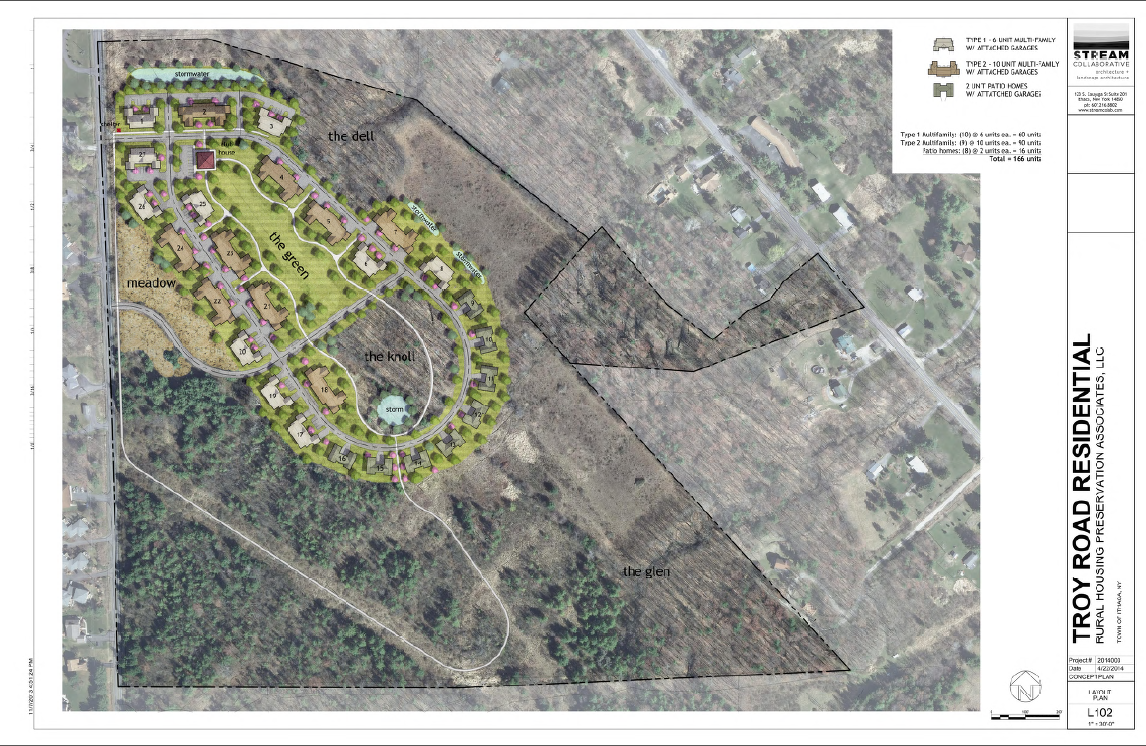
1. The rather suburban Troy Road development has begun the long road to obtaining construction approval, prodding the town of Ithaca to grant a planned development zone, or PDZ, so they can have leeway on the layout and variety of housing on the property. The proposed development has whittled itself down from 216 to 166 units, and gone are the 26 lots for the single-family homes (leaving 90 apartments, 60 town homes, and 16 patio homes; the developer indicates the apartments will be 1 and 2-bedroom and shooting for the middle-income bracket ($1,000/month), and the patio homes will be geared towards seniors). As with virtually every other project proposed in recent memory, this one has its share of opposition, for which the town board has some sharp words (the current zoning is actually worse, it allows for a sprawl-tastic 154 units spread out over the entire property). The 166 units would be clustered on 22 acres, just under one-third of the space. The developer (Rural Housing Preservation Associates) submitted a detailed market and traffic study to the town, and seems to be trying its darnedest to gain that PDZ. However, that requires 6 town board members to say yes, and only 4 felt so inclined at the June 9th meeting. Look for this one to continue to evolve over the summer.

tudor_rd_1

2. Normally, I could care less about a single house. Looking at the map above, it seems the surveyor of this East Ithaca lot had a liquid lunch. The owners of 209 Tudor, who own the inaccessible lot, want to adjust the lot line so that both have a similar amount of road frontage, with the intent of selling off the extra lot for the construction of a new home.

As things would have it, the neighbors were vociferously opposed. It was claimed that it would negatively impact the character of the neighborhood. The lot is surrounded by houses on adjacent lots. Sigh. Since the complaints were more building issues than zoning issues, the ZBA approved the lot revision. The new lot is for sale for $55k.

202_eddy

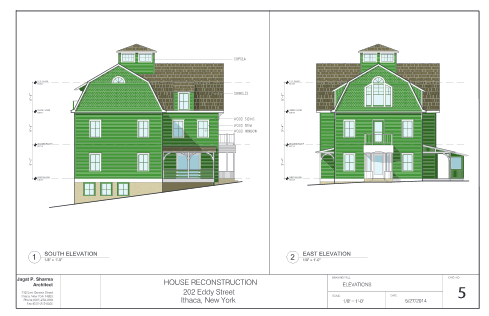
3. Some readers might recall a house burning in Collegetown back in March. 202 Eddy’s destruction left 12 students homeless, and a historic structure in ruins. The developer vowed to rebuild, and according to these documents filed with the city’s ILPC, he looks to make good on his vow. An entrance door will be repositioned, the emergency stairs will be gone, and a chimney will not be rebuilt, but otherwise, its a near-replica to the original. The architect-of-record is Jagat Sharma, who has previous experience from the reconstruction of Sigma Pi’s house when it burnt down in 1995. The ILPC has to approve this, so there could be some tweaks; but I doubt they’ll be significant.

gannett5

4. There are 13 different PDFs detailing the Gannett expansion and the construction phases on the city’s website. I don’t even want to go through it all. In a nutshell – 22,400 sq ft of renovated current space, and 73,600 sq ft of new space. 175 construction jobs, and Gannett expects to add 40 new permanent jobs, mostly physicians, counselors, and related personnel. Projected construction cost will be $25.5 million, and go from March 2015 to October 2017.

5. Has 7 Ridgewood really been through six different designs? Holy Christmas.


In the Long Run: The Chain Works District

8 06 2014

chain_works_4

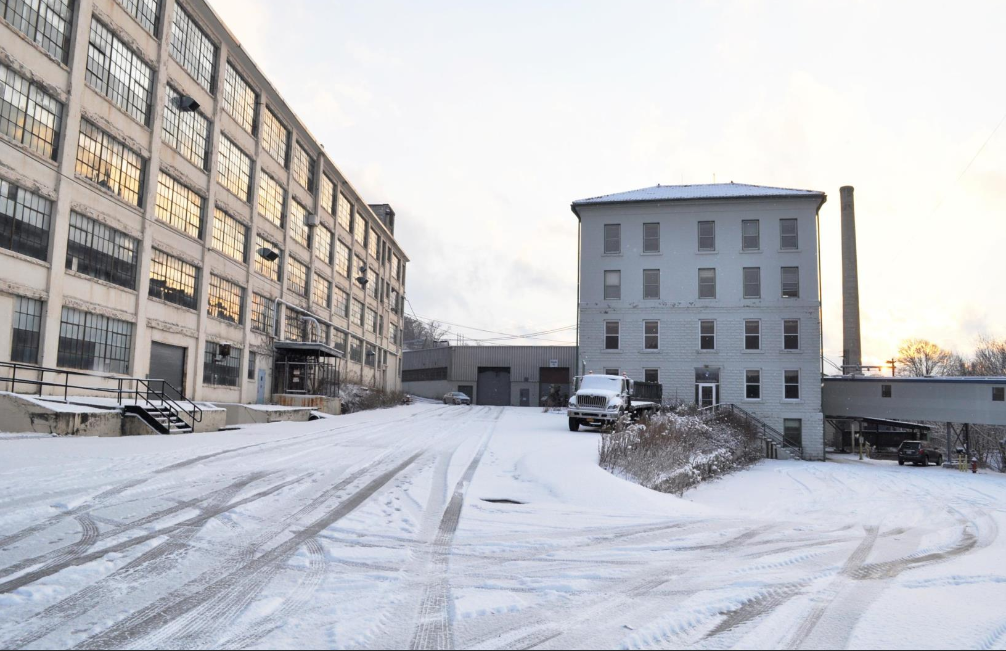
This blog is due to celebrate its sixth anniversary in about a week (which will gets its own post, per tradition). This means that it’s seen, and written about a lot. When this blog, started, Emerson Power Transmission was still in business in Ithaca. But, it was already on its way out; in April 2007, the headquarters shifted from Ithaca to suburban Cincinnati, taking about 55 jobs with it. At the time, about 400 people were still employed at their South Hill facility.

That wasn’t to last long. I dunno, maybe it was bound to happen – Emerson ended up bleeding 25,000 jobs worldwide during the recession, nearly 20% of its workforce. But for the 228 employees who were at the Ithaca facility in August 2009, it was no less unpleasant when the closure was announced. The last folks closed up shop in 2011, but the facility’s polluted legacy lives on.

It was about 16 months ago when it was announced that the property, which has been for sale for $3.9 million, found a buyer. A lot of things were hush-hush, but it was seen as auspicious.

Fast forward a year – we have a name and a firm – David Lubin, the developer of the Harold’s Square mixed-use tower approved for downtown, and his LLC, the amusingly named “UnChained Properties”. A cadre of architecture, planning and environmental firms are also involved. Lubin et al. is currently asking the town to make the 95-acre parcel a PDZ, Planned Development Zone (likewise, they’re requesting the city make their portion its zoning equivalent, PUD, for Planned Urban Development), which is fairly generous in its uses and form (i.e. conveneient for mixed-use projects). Both city and town portions are zoned industrial. The development firm received money (forfeited by Emerson for failing to meet their IDA tax incentives) to conduct a feasibility study for reanalysis of the site.

The redeveloped property would be a mixed-use neighborhood called the “Chain Works District“. A lot of big numbers are being tossed around. 800,000 sq ft of redeveloped space. $100 million invested. 1,000 permanent jobs on site. 10 to 15 years for build-out. By any Ithaca-centric measurement, this is a huge undertaking. UnChained Properties hosted a public meeting in April (attended by Jason at IB), with a second planned during this summer. A copy of the April presentation can be found here.

10 to 15 years seems like a long time. It is. But the current Emerson site is a hodge-podge of decades of random additions.

chain_works_1

Not all of these additions will be making their way into the final product. Most of the post-war additions will be removed, save for a section on the southwest side that will be reserved as a future manufacturing facility.

chain_works_2

The site calls for office space, artists studios, workshops, a healthy dose of residential loft-style units, and a generous smattering of open-spaces in the form of courtyards and terraces, created by the removal of some of the newer factory additions. The Gateway Trail will run through the site, and it will host some amenities, like event/concert space and a cafe. According to the details submitted to the town, the developer is shooting for LEED certification as the phases are built-out.

chain_works_3

Perhaps just as interesting is that they aren’t solely seeking to build within the perimeter of the old factory spaces. The submission to the town shows multiple sites considered for new construction, with “T4” and “T5” PDZ zoning that would allow for 4-story and 6-story mixed use structures respectively.

Does seem all very pie-in-the-sky-ish? Perhaps. It’s a lot of big dreams and it’s going to take a lot of time, money and manpower to make it come to fruition. But I’ll be interested in watching it all evolve as it slowly moves towards reality.

Photo property of UnChained Properties LLC

Photo property of UnChained Properties LLC


News Tidbits 6/6/14: 115 The Knoll Finally Sells

6 06 2014
Photo courtesy of LoopNet

Photo courtesy of LoopNet

This house continues to fascinate me, given its highly changeable occupancy and ownership. Back in January, I noted that the house was up for sale for $1.35 million. In the same time frame, one of the recent occupants, campus Christian group Chesterton House, launched a $1,000,000 capital campaign to buy two Greek houses for use as men and women’s housing (the women’s housing is called Sophia House).

Looks like that capital campaign was successful – according to the finalized property sales just published, the LLC that owns 115 The Knoll sold the property to Chesterton House’s LLC on May 22nd for $1.15 million. In other words, Chesterton House now owns the house, and intends to operate it as their men’s residence. The operator of the selling LLC made a killing on the sale; while it’s down from the $1.35 million originally requested, it’s still a heck of a lot more than the $700,000 it sold for in January 2010. Looks like the rough ownership is Delta Phi Epsilon sorority pre-2010, O’Connor Apts. 2010-2014, and now Chesterton House.

This will probably wrap up my writing on this property for a while, but I doubt it will be the last I write about Chesterton House: they’re still looking for another “Greek-style” house to purchase and become the permanent home of the women’s Christian center.


The Carey Building Reaches Upward

5 06 2014

4-13-2014 079

Another development piece to get everyone through the work week, although this is an update to a known project, rather than a totally new work. That doesn’t make it any less interesting though, because it’s quite a stretch, literally and technically.

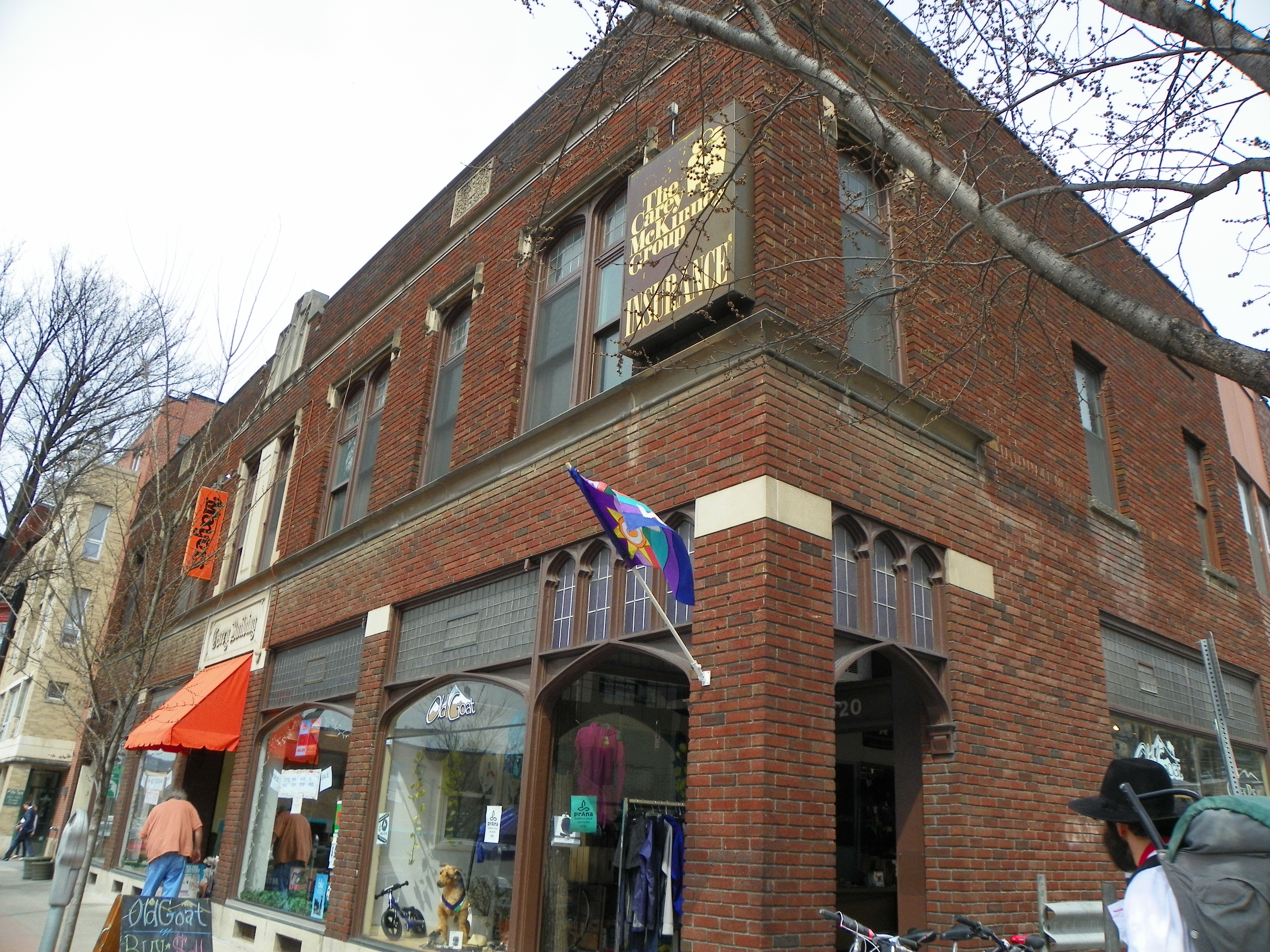
The focus of this post is on the Carey Building, which was previously covered on this blog here, and in exhaustive, soup-to-nuts renovation details over at IB. For this port, drawings are here, FEAF (environmental assessment form) here,

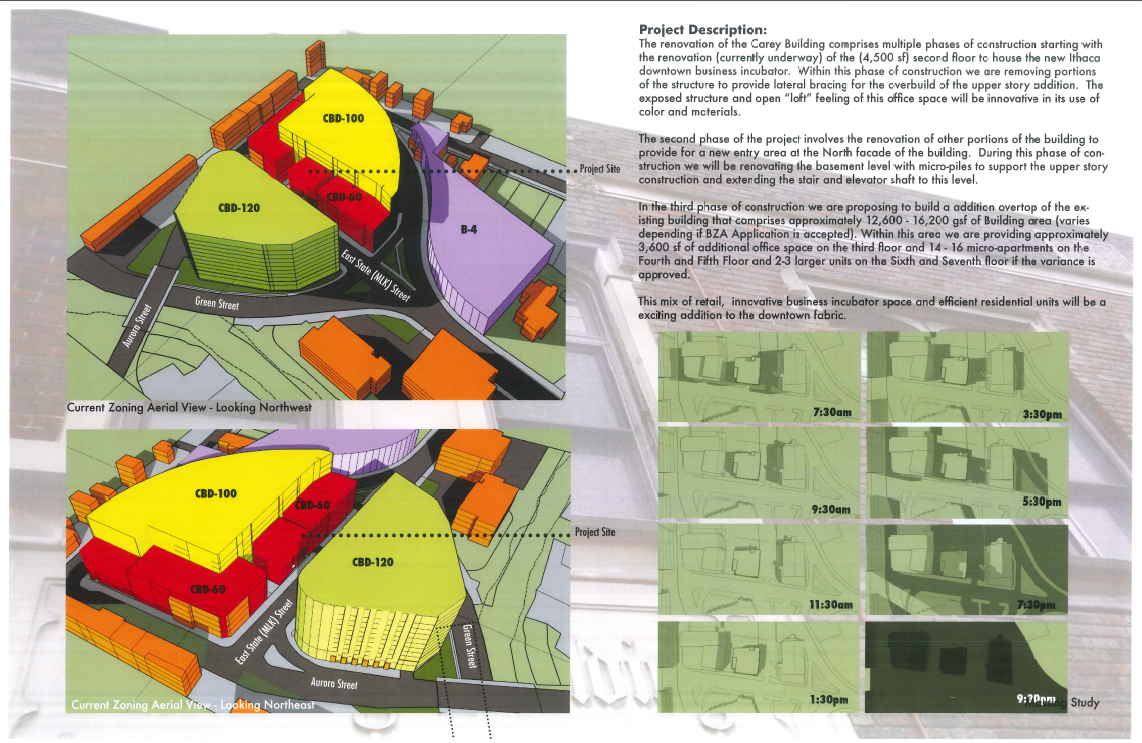
Now we have some real meat to work with, it appears the details of the project are malleable, pending zoning. The Carey Building is in a zoning that allows a max 60′ – no doubt something that their neighbors in the parcel surrounding them, the proposed Hampton Inn downtown, are happy about (the Hampton’s max height in zoning is 100′) – note the boxes below are for illustrative purposes only.

carey_rev_1

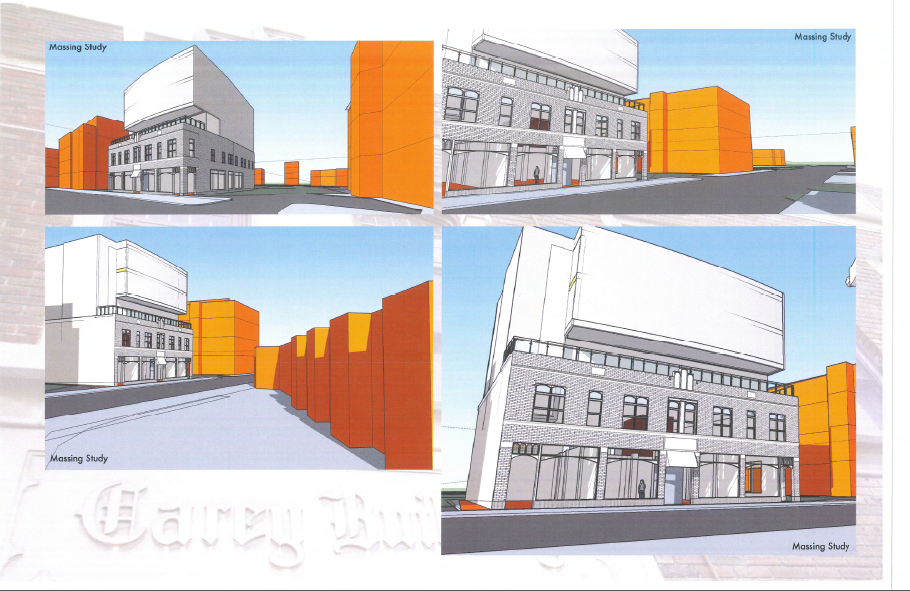
Well, the developer of the Carey Building, local firm Travis Hyde Properties, would like to appeal to the zoning board regarding that whole 60′ height limit. they would like to add on another two floors, to make for a 7-story, 85′ structure (78′ if not counting the stair tower). The render below is billed as a massing study, which I can only hope given the incredible dullness of those windowless flanks. To build floors 3-5 (12,600 sq ft total), the developer does not need a variance, and originally (as seen in the previous post), there was no plan to exceed the height limit and approach the city for a variance. Floor 3 will hold 3,600 sq ft of office space, and 4-5 will hold 14-16 micro-apartments. The extra 3,600 sq ft that would be built if the variance is approved for floors 6 and 7 would house 2 or 3 larger apartments.

carey_rev_2

This kinda makes for an unusual situation given the large hotel proposed right next door. The logistics will almost certainly be a complicated affair if both of these proceed in overlapping time-frames. My inner realist expects that Lighthouse Hotels will not be amused by this vertical air-grab. We’ll see what happens as the current $1.6 million renovation of the second floor is completed this July.

carey_rev_3


Infill on Inlet Island: 323 Taughannock Boulevard

4 06 2014

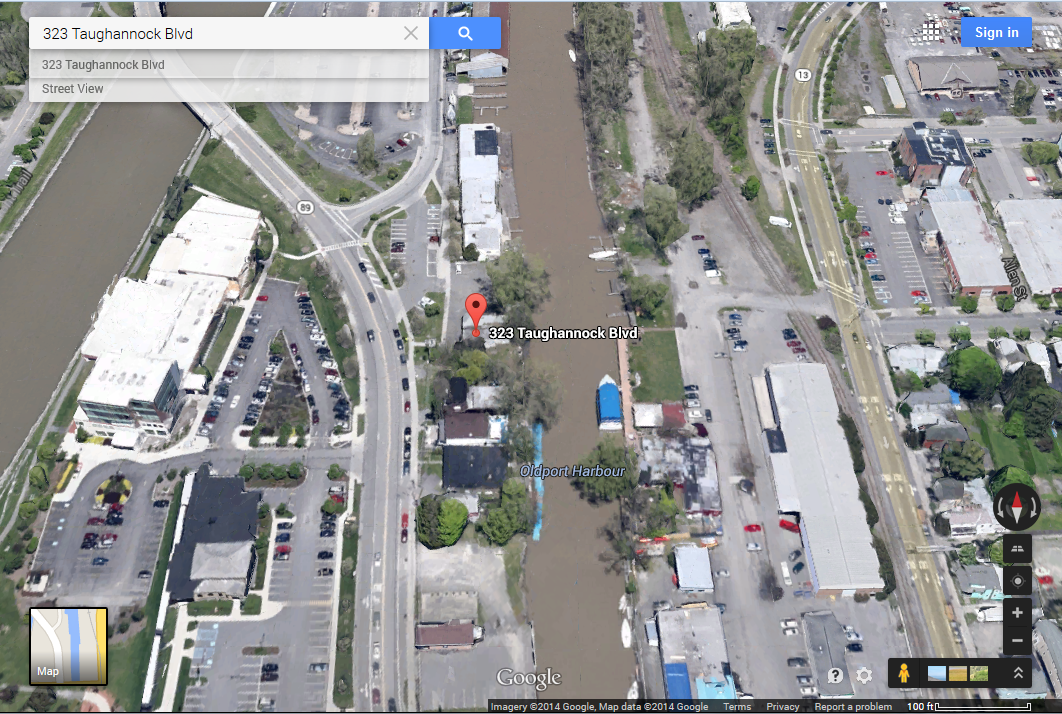
I will keep this short and sweet, because I’m serving on a trial jury this week, so that and staying on top of my normal work obligations is keeping me very tight with my time. The project is called 323 Taughannock Boulevard, application details here. The current 323 Taughannock is a nondescript one story dive bar, across the street from Island Fitness on Inlet Island.

323taughannock_1

The project owner is “Rampart Real LLC”, and the architect of record is local firm STREAM Collaborative (Noah Demarest). Rampart Real LLC appears to have bought the property in May 2011. The man behind the LLC is local developer Steve Flash, who in 2007 sought to build a five-story condo/hotel on Inlet Island, and was shot down. Given that the purchase happened well after the hotel was mothballed, I assume this parcel is not the site of the proposed condo/hotel from seven years ago. There have been concerns in the past several years with preserving the waterfront while encouraging development, which led to a substantial debate on waterfront zoning. Revised zoning for a denser waterfront was passed in fall 2011, much to the chagrin of some local councilmembers. I believe this is the first substantial proposal on Inlet Island since that zoning revision.

323taughannock_3

The project in question is a 4-story (50′ height), 23,000 sq ft, $3.5 million project that proposes ground floor office space and 20 units of housing (not sure if apt or condo) on the upper levels. There would be 18 covered parking spaces, and the developer proposed modifications to neighboring city-owned property to improve vehicle circulation and the waterfront promenade. From the looks of it, it’s hardly fair to call it mixed use, I see only a couple hundred sq ft of office space on the first floor, next to the ground-level parking lot underneath the residential units.

323taughannock_2

The project will be going up for site plan review in the July/August time-frame, with construction anticipated to start in January 2015, and to be completed by August 2015.

323taughannock_4


“Dryden South” Proposed for Collegetown

28 05 2014

dryden_south_2

Being that is a completely new project, I decided that rather than include this as an update in the previous planning board entry, I’d give it’s own blog post.

The site in question is 205/207 Dryden – what my Cornell contemporaries know as the old Kraftee’s building, and what the newest graduates know as the new Kraftee’s building. Kraftee’s is one of the local private college department stores, and opened its second location in Ithaca in December 2002 (the first store opened in Herkimer in 1989, moved to Oswego in 1990, and is still open today). Owner Pat Kraft bought 205 Dryden in 2004, and in January 2008, moved its store to the old convenience store next door (325 College Avenue, now the home of PopShop). In fall 2011, Kraftee’s moved back into the Dryden Avenue space after 325 College was sold to John Novarr, and he decided to not renew Kraft’s lease.

This I find very interesting. There are 5 parcels on the south side of the 200 block of Dryden Road in Collegetown; 4 are owned by Novarr’s company. Kraftee’s was the fifth. According to the rumor mill, Novarr’s Dry-Lin LLC may have made an offer to buy the property from Kraft; had they succeeded, they would have had the opportunity to consolidate their parcels and control an entire block in the heart of Collegetown, and build a potentially massive project. But, for whatever reason, no deal was made.

Turning back to the building proposed, what we have is a mixed-use structure designed by local firm Sharma Architects, 6 stories tall. “Dryden South”, as the building is called, would have about 2400 sq ft of retail space on the first floor, and the upper five floors would have 10 units of student apartments with a total of 40 bedrooms. The sketch plan only consists of the page below, but the pdf is here.

dryden_south

To be honest, the design is par for the course for Jagat Sharma et al., lots of brick with a little visual interest on the street-facing side. Not unlike any of the dozens of midrises they’ve thrown up in the NYC boroughs over the past few years. Personally, I despise the prison-slit windows proposed for the west facade, but it’s also an acknowledgement that the developer fully expects Novarr to propose something of his own for that corner in due course. We’ll see how this evolves as it moves forward to the planning board.


2013 Census Estimates, Part II: Everybody Shares the Wealth

24 05 2014

5-1-2012 136

For the data geeks out there…the 2013 census estimates. A few highlights:

  • No city, village or town in Tompkins County is estimated to have lost population from 2012-2013, or 2010-2013.
  • Ithaca city had an estimated gain of +180 since 2012. The current estimated population is 30,515, 1.67% higher than the 2010 census value of 30,014.
  • Ithaca city is growing faster than Ithaca town, but the pace is uneven. Ithaca town was thought to have lost population from 2010-2011, but gained a greater percentage than Ithaca city this past year.
  • The village of Dryden exploded 8.7% in the past year alone, thanks to the opening of Poet’s Landing. For the decade so far, it’s increased 10.16% to 2,082.
  • More realistically, the second fastest grower is the town of Danby, from 3329 to 3462, or 4% in three years. Decadal extrapolation estimates 13.32% over the period (pop. ~3772 in 2020)
  • The slowest growing community is Freeville, with 0.77% growth from 2010-2013 (520 to 524). Second slowest is the town of Caroline at 0.94% (3282 to 3313). The county average is 2.02% for 2010-2013.

Entity 2010 REAL / 2010 EST / 2011 EST / 2012 EST / 2013 EST / GAIN, 2010-2013 /  DECADAL EXTRAP.

Tompkins County New York 101564 101588 101847 102713 103617 2053 2.02% 6.74%

Cayuga Heights village New York 3729 3729 3733 3756 3776 47 1.26% 4.20%

Dryden village New York 1890 1891 1897 1916 2082 192 10.16% 33.86%

Freeville village New York 520 520 520 523 524 4 0.77% 2.56%

Groton village New York 2363 2369 2371 2389 2408 45 1.90% 6.35%

Ithaca city New York 30014 30014 30167 30335 30515 501 1.67% 5.56%

Lansing village New York 3529 3529 3555 3597 3616 87 2.47% 8.22%

Trumansburg village New York 1797 1797 1809 1819 1832 35 1.95% 6.49%

Balance of Tompkins County New York 57722 57739 57795 58378 58864 1142 1.98% 6.59%

Caroline town New York 3282 3288 3280 3302 3313 31 0.94% 3.15%

Danby town New York 3329 3330 3364 3424 3462 133 4.00% 13.32%

Dryden town New York 14435 14436 14477 14617 14852 417 2.89% 9.63%

Dryden village New York 1890 1891 1897 1916 2082 192 10.16% 33.86%

Freeville village New York 520 520 520 523 524 4 0.77% 2.56%

Balance of Dryden town New York 12025 12025 12060 12178 12246 221 1.84% 6.13%

Enfield town New York 3512 3512 3534 3572 3586 74 2.11% 7.02%

Groton town New York 5950 5973 5985 6027 6091 141 2.37% 7.90%

Groton village New York 2363 2369 2371 2389 2408 45 1.90% 6.35%

Balance of Groton town New York 3587 3604 3614 3638 3683 96 2.68% 8.92%

Ithaca city New York 30014 30014 30167 30335 30515 501 1.67% 5.56%

Ithaca town New York 19930 19930 19836 19958 20132 202 1.01% 3.38%

Cayuga Heights village New York 3729 3729 3733 3756 3776 47 1.26% 4.20%

Balance of Ithaca town New York 16201 16201 16103 16202 16356 155 0.96% 3.19%

Lansing town New York 11033 11027 11082 11256 11362 329 2.98% 9.94%

Lansing village New York 3529 3529 3555 3597 3616 87 2.47% 8.22%

Balance of Lansing town New York 7504 7498 7527 7659 7746 242 3.22% 10.75%

Newfield town New York 5179 5178 5193 5235 5263 84 1.62% 5.41%

Ulysses town New York 4900 4900 4929 4987 5041 141 2.88% 9.59%

Trumansburg village New York 1797 1797 1809 1819 1832 35 1.95% 6.49%


Suddenly There’s A Lot of News At Once

22 05 2014

Latest planning board agenda is online and there’s a lot — and I mean a lot — that will be discussed. I’m going to be updating this post as more information comes online, so this first draft is a sort of “here’s what we know” going into the meeting.

A. No surprise, the Ridgewood student housing project (the address has been updated from 1 Ridgewood to 7 Ridgewood) is up for discussion once again. The project needs a “certificate of appropriateness” from the Ithaca Landmarks Preservation Council (ILPC) since it’s in the Cornell Heights historic neighborhood, and things are not looking all that auspicious, given the recent report from the Ithaca Journal. The planning board would likely give approval with stipulations if the ILPC approves the plan, but that’s a very big “if” at this point.

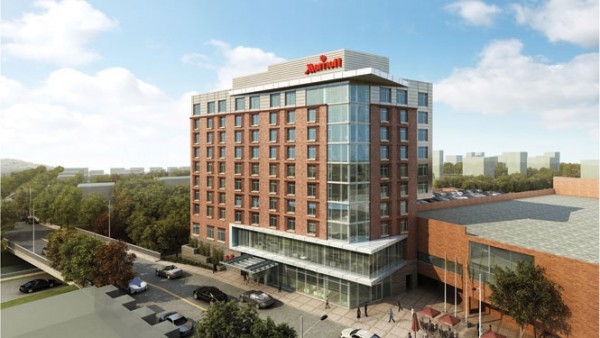
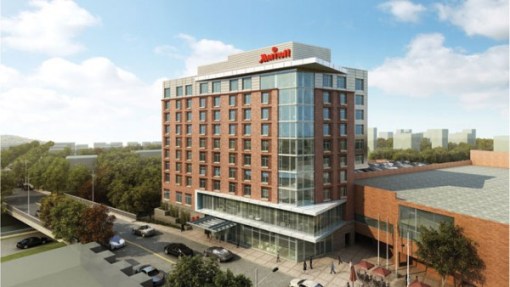
B. The downtown Ithaca Marriott. This site is the triangular parking lot next to the Commons at Aurora Street, and has been covered in detail both here and at IB. The history here goes back five years, back when it was going to be called the “Hotel Ithaca” (now the name for the former Holiday Inn). This one has been stalled since the fall due to financing issues, but that has been taken care of in the past couple of weeks and they want to start construction ASAP. They have several changes that need to be reviewed since they have completed “value engineering” (a phrase I fear, since it’s the pretty way to see they cut back on material costs and design features), so we’ll see what this will look like. The current proposal’s rendering, at 10 floors and about 160 rooms, is below.
Ith_Marriott


4-8-2013 335

C. Likewise, the Stone Quarry project was also approved a while back in the fall of 2012, but only now managed to secure funding. Here’s the previous discussion here, and here’s details from IB. The project, slated for a parcel on Spencer Road where Ithaca Taxi Dispatch keeps a parking lot, will bring 35 units of INHS-run affordable housing. This one is also up for re-approval for value engineering reasons, and looks to start construction early this fall.
stonequarry2

stonequarry1

D. 140 College aka the John Snaith House addition, discussed earlier this week here.

E. “205 Dryden Road, Student Housing, Jagat Sharma – Sketch Plan” — Now here’s something new. 205 Dryden is the Kraftee’s Building. Jagat Sharma is a prolific local architecture firm, responsible for many of the larger apartment buildings in Collegetown. I can’t seem to find the owner from the tax records, which indicate the current owner has been the owner since 2004. Jagat Sharma tends to be a favorite architect for Ithaca Renting/Jason Fane, and Lambrou Real Estate, but neither of them seem to own the parcel from what I can tell (it’s possible one of them does, but the upstairs units are not rented).  Novarr-Mackesey owns three parcels next door, but I don’t see anything on their website either. Regardless, this falls in a Collegetown MU-2 zone, 4-6 stories, and 45-80′ in height. Whatever is proposed here is going to be pretty big, comparable to Josh Lower’s Collegetown Crossing project.

Edit: Jason at IB tells me it’s owned by Pat Kraft, the guy that runs Kraftee’s.

8-21-2012 113

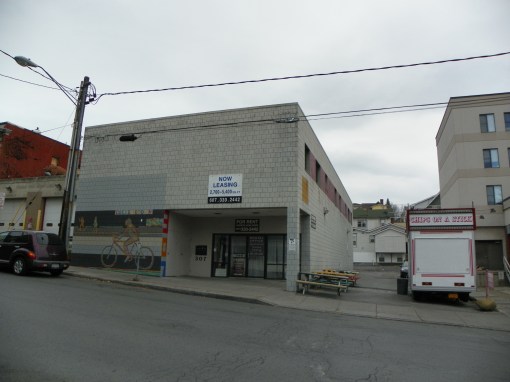
F. Speaking of which, 307 College, aka Collegetown Crossing, has a new sketch up for review as well. With the new zoning guidelines, the current version isn’t doable because it impedes on the lot to its east. So this version will have a 9% smaller footprint at least, but parking will no longer be an issue. For the record, here’s the site, and the old design.
11-24-2012 161


G. “Downtown Hampton Inn Hotel, Scott Whitham – Sketch Plan” – Another re-do of sorts. This one appeared in its original form in December 2012. The original proposal, proposed by Neil Patel (his family members are the ones developing the hotels off 13) was for a 6 story, 92-room, $16 million hotel that would have demolished the Carey Building, and the original design was by Jagat Sharma. Scott Whitham is another local architect, so given the revised space constraints and the new architect-of-record, the design of this will be something completely different.  Although hopefully it doesn’t involve tearing down buildings the developer doesn’t own.

H. 314-320 E. State Street, the Carey Building addition – discussed earlier this week here.

***

In sum, there’s a lot of stuff going on all at once. I’ll update as it all plays out, and documents and renders become available.

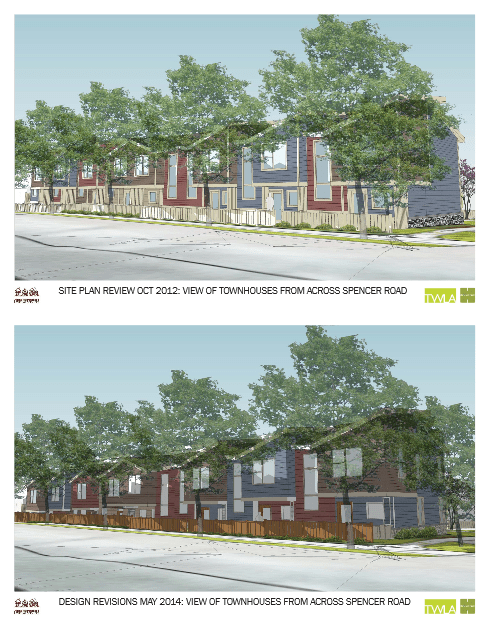
UPDATE 1: The new design of the Stone Quarry apartments:
inhs_stone_quarry_rev_1 inhs_stone_quarry_rev_2

Due to concerns with how the soil will settle on site, the walkways and elevations of the buildings have been altered. Each townhouse now steps 8 inches going north to south, which makes the middle ones look a little misshapen. The soil issue also forced a re-do of the ends of the apartment building, since it couldn’t be graded as originally planned. On the cost-cutting end, balconies have been replaced with windows, the south facade of the apartment building was tweaked, some of the trim has been removed or down-valued on the Spencer Road side of the townhomes, and a few more windows punched in on the sides of the townhome end units. there’s a few tweaks to the site plan as well, which can be found at the link above.

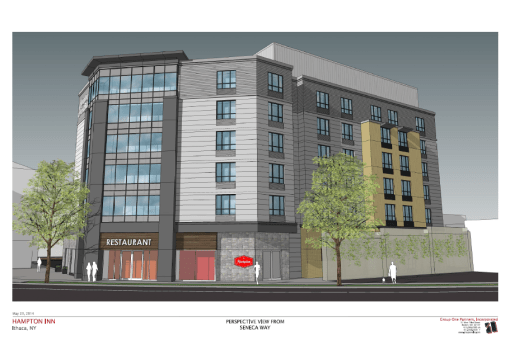
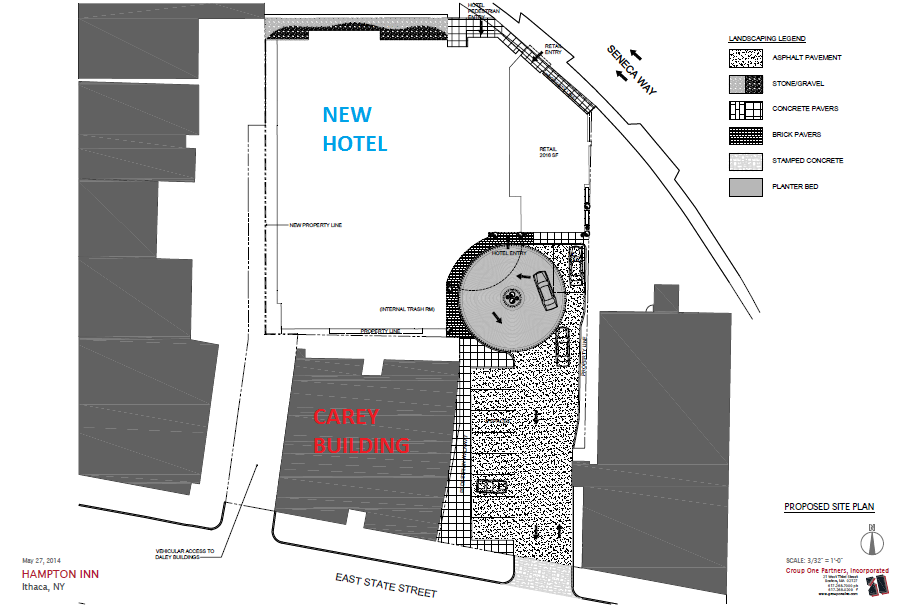
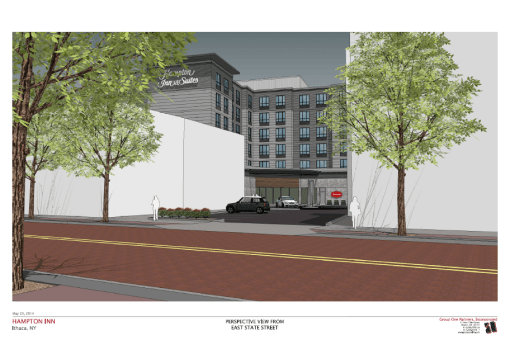
UPDATE 2: Here’s the proposed Hampton Inn, details here. The new hotel would be built on the parking lot behind the Carey Building.  The proposal calls for six floors, 120 rooms, and 2,000 sq ft of retail/restaurant space, with only about 9 parking spaces on site. The entranceway would be via a driveway between the Carey Building and the Eagles Buildling, which I imagine being a bit of a logisitical nightmare at the moment, given that the Carey Building has its own renovations underway and additions planned.
hampton_new_3
hampton_new_1

hampton_new_2


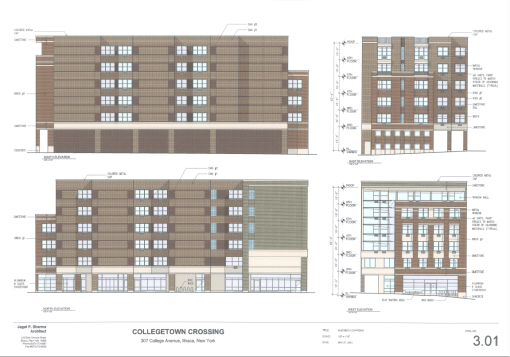
 UPDATE 3: Up next, revisions to 307 College Avenue, Josh Lower’s Collegetown Crossing project. Nothing fundamentally different here, but the design has definitely been tweaked. Full details here. The revision reduced the number of apartments to 43, with 98 bedrooms (previous was 103). There would be five retail spaces on the ground level of the six-story, 63’4″ structure. The size and scale of this revision fit comfortably within the rules of the new Collegetown MU-2 zoning of the parcel.
ctown_crossing_rev_1

UPDATE 4 (6/5/14): The updated design of the Marriott has been released, and will have its own special planning board meeting on June 10th. Apart from updated Marriott signage and some materials tweaks, this one has virtually the same design as the original, which has me breathing a sigh of relief. Perhaps this one will start construction in July after all.

Mixing Old With New

20 05 2014

4-13-2014 079

After something of a dry spell, a couple of projects are due to come forward in the next few weeks, both involving similar concepts – additions to existing structures.
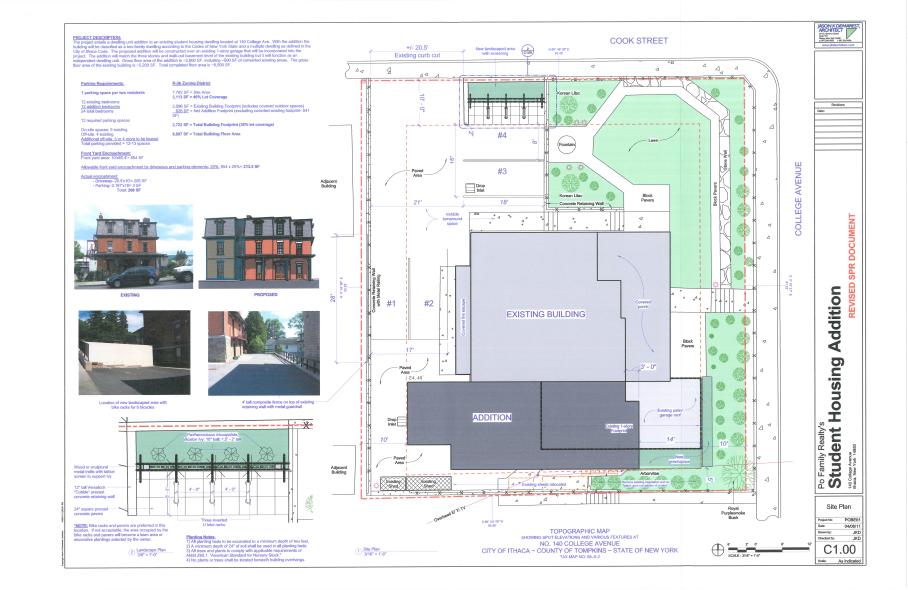
First, 140 College Avenue. Site plan here, details of the revision here and here. This actually isn’t the first time this one has come up to bat, having made its rounds in the news a little over three years ago (token disclaimer: I wasn’t a fan of it then, and my mind hasn’t changed). 140 College, better known in historic circles as the John Snaith House, has been targeted for a one-unit, 12 bedroom, 3,800 sq ft addition by its owners, the Po Family Realty. The addition, by local architect Jason Demarest, would be built on the south side of the building, separated by a glass partition. The Po family has already run the gauntlet with the planning board, since the Snaith House is a local landmark. Their plan was approved, but given the zoning, it required 6 spaces, for a total of 12 parking spaces for the whole building. Apparently, this made the project less workable, and it’s been on hold since. The developer is using the recent changes to Collegetown zoning as an impetus to change the terms of the project’s approval, reducing the number of parking spaces for the building to a total of 4. The project as proposed eliminates 2 of the 6 parking spaces on site, so only 4 would be left. Originally, 8 spaces had been secured off-site (4 on site + 8 off site = 12), but the lease on those will expire before this project is complete, as construction is tentatively slated to start late next month, and they are unable to renew those leases. Rather than renting new off-site spaces, the developer just wants to keep the total at 4. In exchange, they will provide bike racks, and all tenants membership in Ithaca Carshare. Before the zoning change, this would have been a tough sell, but it stands a good chance of approval going forward.

snaith_1

Project number two, on the other hand, is new to the boards. This one targets the Carey Building, which has been in the news quite a bit as of late as the new Ithaca/Cornell/IC/TC3 business incubator is being built on the second floor, set to open this summer (more details on the renovation process can be found over at Ithaca Builds). A third floor addition has been in the works, projected for a 2015 completion. Well, there has also been discussion of a little more expansion beyond that, and that became clear with this document sent to the city this week. Local developer Travis-Hyde Properties proposes an additional 3,600 sq ft of office space on the third floor, and two more floors above that with 14 micro-apartments. This is within current zoning and no variance will be needed. Micro-apartments are a rather new phenomenon, but have significant potential in urbanized areas, especially cities like Ithaca where their lower square footage (think 400-500 sq ft) permits a lower monthly rent, which can hopefully make a small dent in the affordable housing issue the region is struggling with.

There’s no official render, but we have a massing study that gives a pretty good idea of the proportions of the vertical addition:

carey_1

Given that Travis-Hyde looks to be partnering with local firm John Snyder Architects on this one, expect something modern, with generous amounts of glass. I generally am not a fan of building additions, but I’ll reserve judgement until actual renders come out for this one. At the very least, this will be better than that hotel proposal from the Patel family a couple years ago that proposed tearing the Carey Building down. the only take-away from that stale proposal is that if you want to make enemies in the business community, go ahead and propose projects for land you don’t own, and the owners have no intention of selling.

12-29-2011 076