A “Nobel” Accolade

4 10 2012

In the proverbial confidence-measuring that is academia, one of the things that colleges and universities like to throw out there is the breadth and depth of their Nobel laureates. The reasoning is simple enough; it’s a measurement of prestige, and the caliber of alumni and faculty.

Cornell lays claim to 41 such folks, according to a fall 2009 issue of the Cornell Chronicle, and according to wikpedia, that number has held steady. Within those 41, 3 are current faculty, 13 are alumni, and the other 25 are former faculty (moved, retired or otherwise). The last recipient was Jack Szostak Ph. D ’77, who won the Prize in Physiology/Medicine in 2009.

So let’s take a brief look at how Cornell stacks up against its peers: First, the top 20 schools, as compiled by U.S. News and World Report, since that tends to be the most commonly used ranking system:

Harvard
MIT
Yale
U. Chicago
Penn
Columbia
Stanford
Caltech
Princeton
U. Mich
Cornell
Johns Hopkins
Duke
UC Berkeley
Northwestern
UCLA
Brown
UW-Madison
Carnegie Mellon
NYU

Now their Nobel laureates:

Columbia 80 (or 97, depending on your definition)
U. Chicago 87
MIT 77
Stanford 54
Yale 49
UC Berkeley 47
Harvard 46
Cornell 41
NYU 36
Johns Hopkins 36
Princeton 35
Caltech 32
Penn 28
UW-Madison 19
U. Mich 19
Carnegie Mellon 18
UCLA 14
Duke 12
Northwestern 8
Brown 7

Interestingly, U. Illinois-Urbana-Champaign has 26, but doesn’t appear in the top schools list from USNWR. International students may be annoyed at me for leaving of non-U.S. schools, and granted, there’s a few that have similarly high rankings and accolades. Forgive my blatant nationalism for the moment.

This exercise proves to me, on a very general level, that universities with Nobel affiliates tend to be more prestigious. However, there are some obvious issues- schools with large research programs tend to have more laureates, and we haven’t even explored the Nobel laureates per capita at each institution (an exercise in futility, since I would also require historical enrollement figures I don’t feel like digging for at the moment).

But whatever floats your boat Cornell P.R., and keep your fingers crosses at the next Nobel award ceremony.


The Descendants of Ezra

4 09 2012

The inspiration for this entry comes from a recent Sun article detailing the rescue of a woman from the gorge, in which the first responder was a Cornell student, and descendant of Ezra Cornell.

Some famous people, like William Shakespeare and Abraham Lincoln, have no living direct descendants. Ezra Cornell, who is at least famous to those who have spent four or more years in Ithaca, is quite the contrary.

Ezra Cornell had either nine or eleven children, which sounds prodigious until you realize that couples had as many children as possible back in the mid-19th century simply to ensure that nature and probability would allow at least a few of them to survive into adulthood. Indeed, four of Cornell’s children died before the age of 25. However, that leaves behinds seven children – three boys and four girls (or five children consisting of three boys and two girls, depending on which source is correct).

The most famous of Ezra’s direct descendants is likely his son Alonzo, who served as governor of New York from 1880 to 1882, and was married twice. The wikipedia article claims he had four boys. One of them, Charles Ezra Cornell (d. 1947), served as trustee and had three children of his own, of which at least one, William Cornell, survived to adulthood. So plenty of possibilities for descendants here.

Regarding Ezra’s other surviving children, Franklin Cornell, a banker, passed away in 1908, and at that time, three of his four children were still alive – one boy, Franklin Cornell, and two daughters, Ms. Dorothy Cornell and Mrs. Eunice Cornell Taylor.

Oliver Perry Cornell, the third son of Ezra, survived well into his mature years (d. 1911). He married and had at least one son.

As for the daughters, they tend to be less easy to track, since they take the names of their husbands. There was Mary Emily Cornell  and Emma Pettit Cornell Blair (d. 1914), of which I can be certain. A Dorothy and Emma Cornell also appear in one of the sources, but this could be a repeat, someone’s wife, or some other error (and this is why I would never wish to be a genealogist). Mary went to Vassar, passed away at the age of 87 in 1935 (making her the last of the first generation), and appears to have remained unmarried. But Emma did marry, and had three boys, Charles, Cornell, and Hamilton Blair.

So, given this illustration, it is likely that there are Cornell descendants sill kicking around today, many of whom still live near the Ithaca area. Among those, Ezra Cornell IV (class of 1970), and the kid from the Sun article, Thomas Ezra Cornell Collum ’14.

On a final note, in the early days of the university, direct descendants could attend free of charge. However, with the proliferation of descendants, this practice was discontinued beyond the fourth generation, by order of the Board of Trustees in 1932. The university notes that the last folks eligible were of college-age around sixty years ago. So even if you find out you’re a seventh-generation progeny of Ezra, it won’t help your pocketbook if you attend the Big Red. But I’m sure it would make a nice conversation piece.


Four Years Later

18 06 2012

My oh my. This blog turns four years ago today. I wanted to celebrate this port by comparing this blog to the average age of blogs, or the average number of posts for an active blog. Turns out neither piece of data is readily available. I’m going to go out on a limb and assume this blog has reached maturity, though I won’t go as far to say “old age”.  In keeping in tune with three previous three “birthday” updates, here’s some fun facts.

Since launching on the evening of June 18, 2008, this blog has received a grand total of 241,966 hits, as of 2:29 PM today. Breaking down the math, that’s about 166 hits/day. While the previous years averaged 82, 166 and 199 hits/day respectively, I’m happy to say that the blog came a little closer to the saturation point with an average total of just under 216 hits/day in the past year, and yes, I did remember it’s a leap year. Taking a cursory glance at the monthly statistics:
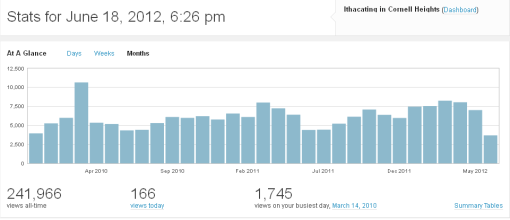
The highest month was once again March, with 8,247 hits, although the peak isn’t as pronounced as it was in previous years. Going year-to-year, the only month that was lower in 2011/12 versus 2010/11 was August, although June and July came fairly close. This is due to the Cornell-centric nature of the blog – once classes are out for the summer break, my hit tally plummets like a stone. Although, that’s been somewhat avoided this year, which I’ll guess is the result of the more Ithaca-area focus taken on in the past year, and is a bit more stable in terms of visitors to this site.

Looking at the past year in review:

~In planning and development,the biggest news is the construction of Collegetown Terrace the massive 1200-bed project south of Collegetown. Approvals were granted and phase one is underway, with an August opening for the first buildings. The Vine Street Cottages also began construction, replacement apartments were planned for 107 Cook, and 309 Eddy marched merrily towards completion, which should be in just a few short months.The Coal Yard apartments phase II was built, and Collegetown Crossing was proposed with the radical premise of no parking for residents, in a move that could make or break Collegetown. in suburbia, everyone got BJ’s in Lansing, and the holiest of holy casual dining restaurants came to big box land, a Chipotle.

Closer downtown, the Seneca Way project was approved and is now in site prep, and the new Fairfield Inn is under construction down in chain store country. The Argos Inn renovation moved towards completion and the Breckinridge Place project began construction, currently in the demo phase of the old Women’s Community building. Several smaller projects also began construction, such as the Iacovelli apartments on West Seneca and the Magnolia House women’s shelter. In the longer-term, the massive Cascadilla Landing project was proposed, and could potentially  redefine the city waterfront, and the new Holiday Inn tower/renovation will add a small conference center to the Gorge City.

Over at the colleges, Ithaca College built a boathouse and started its Circle Apartments expansion. Over on East Hill, Milstein Hall, MVR north, and the Johnson addition were completed, the food science building is well underway, Gates Hall is in foundation work, and the law school just launched their underground addition. The Big Red bandhouse is set to start shortly, and Kappa Delta renovated their home-away-from-home in what was probably the most significant Greek house renovation in more than a decade. Fundraising began for the new token glass box, also known as the Goldwin Smith Hall addition. More importantly, some bridge nets and barriers were approved, and their construction will hopefully bring to an end a dark chapter of Cornell’s history.

In the meanwhile, some projects still have yet to get off the ground. The Hotel Ithaca is still in some financing conundrum, as are the Cayuga Green Condos, which were given an extension on their cost-saving agreement with the city, given the poor lending climate. Ithaca Gun is undergoing yet more land remediation with no construction date in sight (honestly, it seems like the only way the land could have been more contaminated is if someone nuked it).

~Turning an eye towards Cornell matters, the least surprising lawsuit was launched when the mother of George Desdunes filed a wrongful death suit against SAE to the tune of $25 million. The bench trial wrapped up about a month ago, though I’ve yet to hear about a verdict. The number of bars near Cornell continued to shrink, but students can now drown their sorrows in frozen yogurt instead. When the Palms said they were closing up, a couple dozen of my fraternity’s young alumni offered to buy a table of some sentimental value to us if they were willing part with it. They asked for $1500 for a rotting wooden bench table. We laughed (we were thinking $500 max). They said they were serious and it was a starting bid. Needless to say, I have many happy memories of a table that hopefully no longer exists. Rumor has it a new apartment tower will rise where the Palms once drunkified multitudes of Cornellians.

~From a meteorological standpoint, the ITH toyed with 100-degree temps and had a collective anxiety attack about the impending arrival of Hurricane Irene, but was spared the brunt of the destructive tropical cyclone. However, this relief was short lived when the extratropical remnants of Tropical Storm Lee dumped 8.7″ in 24 hours at Binghamton, and flooded many local towns to the tune of $1 billion in damage, a number not seen since the horrific aftermath of Hurricane Agnes in 1972. It also resulted in one of the wettest years on record. Ithaca, while soaked and unnerved, was relatively unscathed.

Many things, many topics. In comparison to the past years, I now write this while firmly ensconced in alumnidom, my trips back further and further apart. At this point, I’m finishing grad school, and interviewing for positions in California and Texas. It was not exactly in my wishes to move as far out, as my northeastern blood may not be able to tolerate nice winters. But, that’s where the jobs are in my field at the moment. Ideally, I can make a triumphant return to the northeast someday.

I write not out of obligation, but out of genuine interest, which I think has been one of the attributes that has made this blog a reasonable success. I see the emails of those who follow comments and posts – they include other alumni and current students of course, but also prominent companies in Ithaca and some local government officials. Flattering, if a little disquieting for fear of botching up my facts. More importantly, I think it serves as an indicator of the usefulness of this blog, that people honestly come here searching out information, and many of them leave feeling a bit knowledgeable about Ithaca projects and stories, or Cornell history and construction projects. Or at least, I hope as much. It makes for great motivation in the months and years ahead.


This Old House

4 04 2012

In the years that I’ve written this blog, I have written many articles highlighting the history of the physical assets in the region, but as I’ve exhausted many of my sources, and my access to new sources has become more difficult post-graduation, I’ve tended to focus on new development in Ithaca and the colleges. I’m not saying that it’s necessarily a bad thing, but there are occasions where the acknowledgment of historical assets must be given its due.

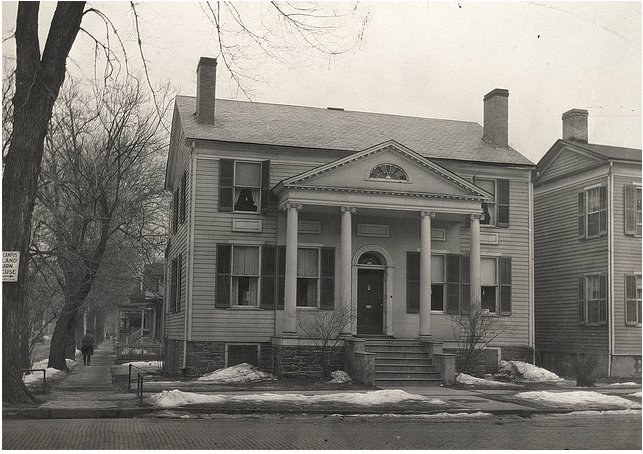
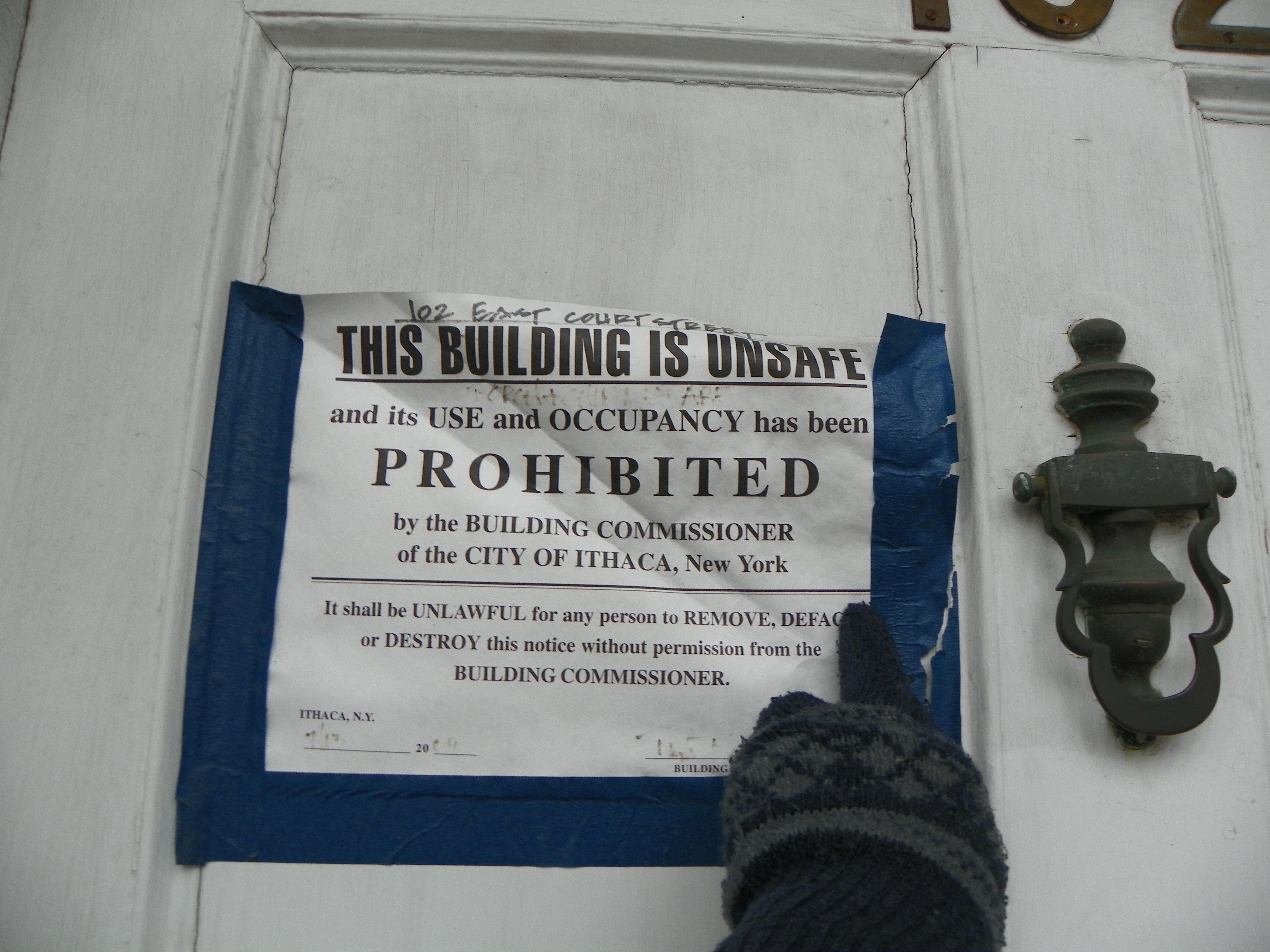
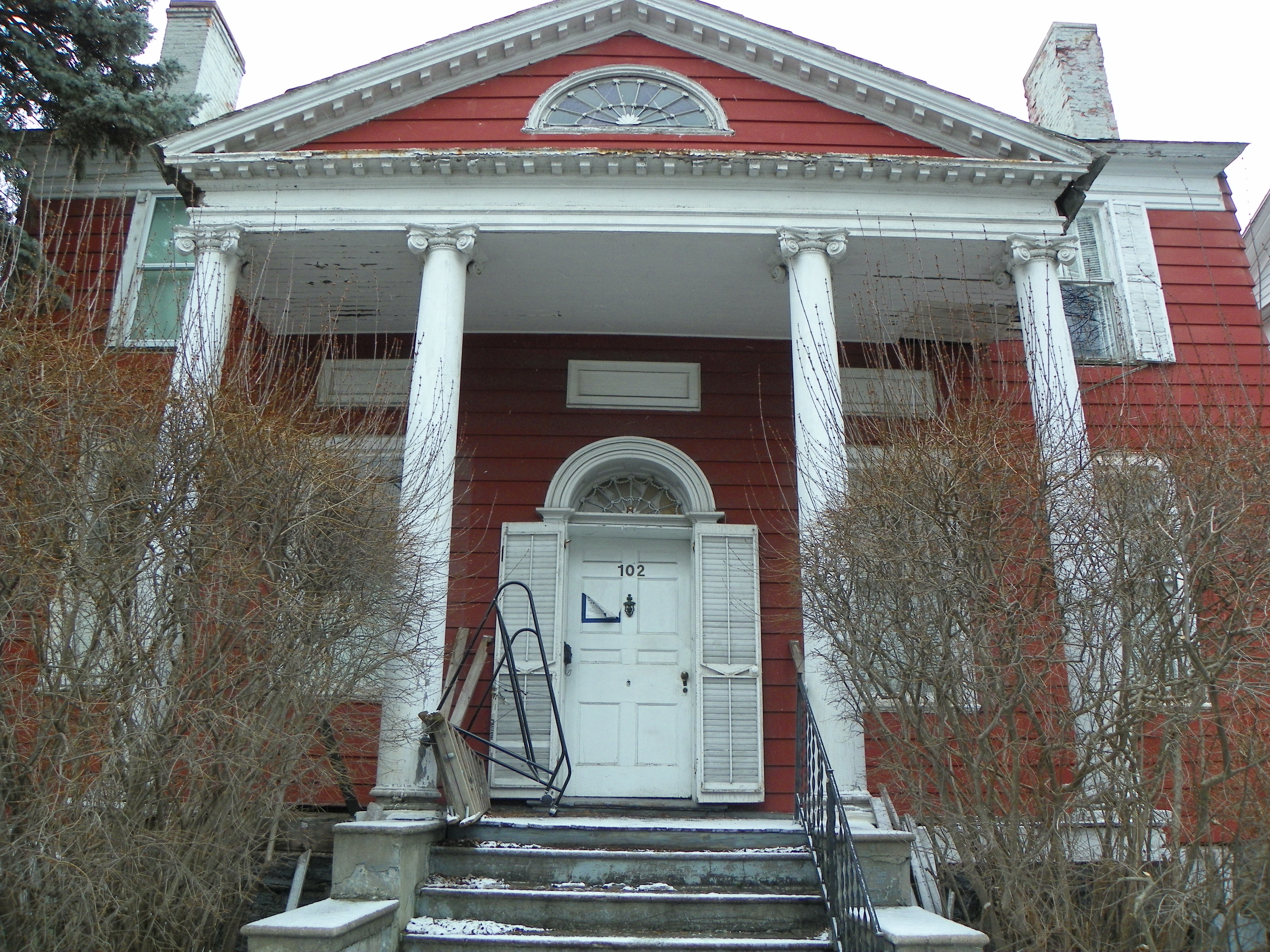
When I visited for my last photo tour back before New Year’s, I came across an aging Greek Revival house on the north end of downtown that was in a deplorable state. The red siding was tired, the Doric columns of the porch chipped with the paint worn off, the foundation crumbling and the windows damaged, with sills breaking off, and missing panes in some places. I resolved that before something happened to it (most likely the wrecking ball), I was determined to take a few photos and share the house before it becomes confined to the old yellowing photos of times long ago.

Officially, the house is 102 East Court Street. Historically, the house is the “Judd House“. The house was built in 1828 – the same year Ezra Cornell had arrived in the budding town of Ithaca, which has hardly twenty years old. An estimate establishes the house as having about 3,100 sq ft, 4 bedrooms and 1.5 bathrooms. Furthermore, the assessed value of the house is $190,000, although given its condition the land it sits on is probably worth more then the physical plant itself.

Property of Cornell University Library (A. D. White Collection)

A casual online search reveals a photo from Cornell’s A.D. White Collection, which shows the house in a much better state of affairs in what the vehicle to the left suggests is the 1920s. Furthering searching indicates the house was most likely designed by Ira Tillotson, the same architect for the Clinton House, which is a contemporary to this home. The once-stately residence was built for Capt. Charles Humphrey, a veteran of the War of 1812, on what was then the corner of Cayuga and Mill Street. The house and a long-removed barn were constructed for a cost of $2,105.56, which places the cost of construction likely somewhere in the upper six digits to $1 million-plus today. The name Judd House comes from long-time owners of the house in the 1900s, who apparently took great pains to keep the house in good shape. Sadly, that is not the case today.

In a perfect world, someone would come along and renovate and restore the venerable house to its former glory (perhaps INHS? A Cornell or IC faculty member with ambition)? It would be a shame to lose such an asset to Ithaca’s history. However, the decay is advanced and renovation would be expensive, or may not even be viable given the precarious state of the foundation, which is continually harmed by the freezes and thaws of the Ithacan year. As time creeps forward and winters take their toll, the long life of this home may be coming to end.


A Nominal Nod to Cornell

18 12 2011

Whether or not one likes or dislikes Cornell and its environs, the university has been around long enough and produced enough graduates to have a fairly recognizable name as colleges and universities go. I happened to hear from a friend recently who had moved out to Colorado after graduation, and their experience in the Collegiate Peaks of Colorado. When I checked Wikipedia, I was dismayed to find that their were mountains named in those peaks named for Oxford, Harvard, Princeton, Yale and Columbia, but not Cornell. For what it’s worth, it appears they were named in the late 1860s and 1870s, when Cornell was still a fledgling school. But, I decided to do a google search for a “Mt. Cornell”.

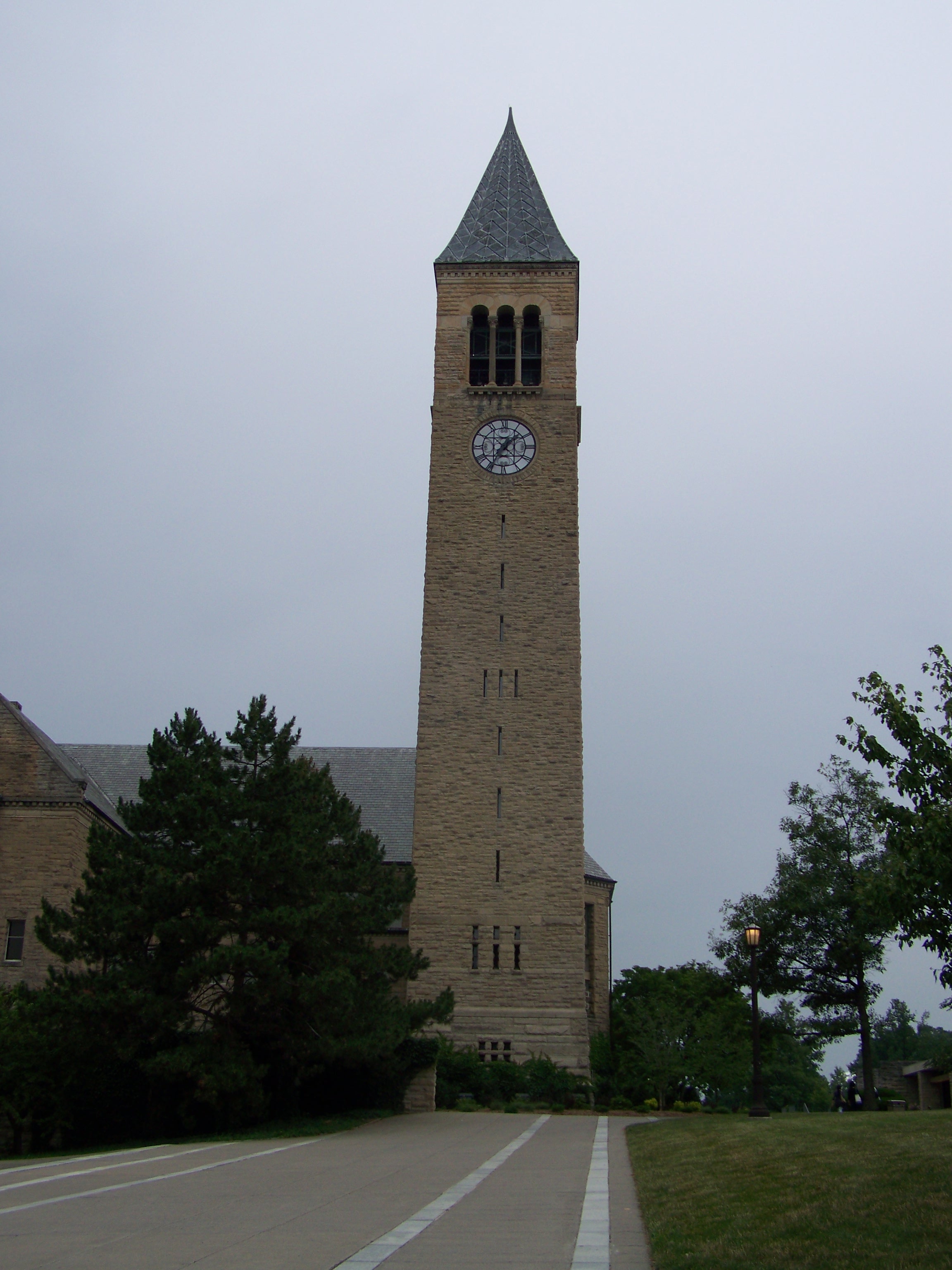
While there wasn’t a “Mt. Cornell” anywhere in the world, there is a Cornell Peak named in honor of the university. The 9,750 ft. mountain is part of the San Jacinto Mountains in Southern California.  The mountain earned its name from a USGS topographer camping in the valley below with a geologist friend who was a graduate of Cornell, and remarked how the peak resembled McGraw Tower in appearance. Personally, I don’t see it, but the topographer named the mountain in honor of the university. Of much lesser note, there is a 3,860 ft. “Cornell Mountain” in the Catskills that is named for Thomas C. Cornell, a distant relative of Ezra.

Looking northward to a place even colder and less inviting than Ithaca in winter, on the west coast of Greenland there exists a “Cornell Glacier“. Similarly to the Collegiate Peaks, there is a collegiate set of glaciers in Alaska that Cornell was not a part of, the set consisting of the four aforementioned Ivies and Johns Hopkins.

On the more civilized end, the town of Cornell, Wisconsin (population 1467 as of the 2010 census) is named for Ezra and the university, due to its placement on the lands that the university once held as part of the Morrill land-grant in the late 19th century. The university has given this some light attention to this connection by writing an article referring to a blog written by a Cornell alum and his fact-finding adventures in the small community in northern cheesehead country. Apparently, the town was originally named Brunet Falls and is famous for having the only surviving pulpwood stacker, and like many other small towns with minor claims to fame, they make a festival out of it (considering my hometown’s claim to fame is the method a hose is laid on a fire engine, I have no right to be critical). Although it’s hard to tell whether communities named Cornell are named after Cornell U. or someone who happens that surname, at least two unincorporated communities are named for the school far above Cayuga, one in the U.P. of Michigan and one in Southern California north of Malibu (and a fair 100 miles from Cornell Peak). Cornell, Illinois and Cornell, Ontario are not related to the university.

Lest one try to limit themselves to the Earth, an asteroid was named in honor of Cornell in 1999 (8250 Cornell). I guess the next astronomical goal should be a large crater somewhere.

If it’s any consolation to the folks associated with Cornell College, they have a species of tropical fly named for their school.


Ithaca is Hot

21 07 2011

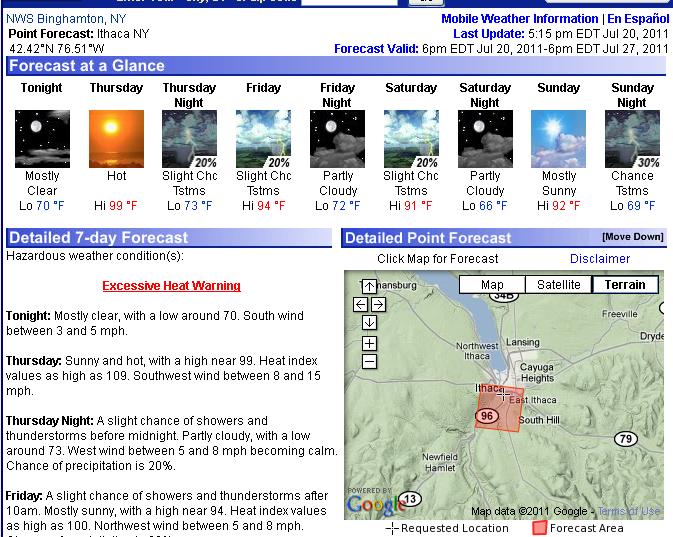
According to NWS Binghamton, the high temperature in Ithaca tomorrow is expected to be right around 99 degrees Fahrenheit (~37.2 C). Earlier model outputs suggested a high right around 102 F. Regardless, the heat index (an indication of how it actually feels, thanks to the effects of high humidity) will be right around 110. It’s not often that Ithaca flirts with the century mark when it comes to temperatures (since most students know Ithaca as a frigid windswept land, any heatwave of this magnitude should be nothing short of shocking).

Being curious, I decided to glance at the NRCC climate records to determine the last time Ithaca hit 100 degrees (non-heat index). Well, a cursory check of the last twenty years turned up squat. So, I expanded the search, and pulled all days from 1900 onward that had temperatures recorded at 100 degrees or greater at the Ithaca station. Here’s the result:

07/03/1911 101

07/04/1911 102

07/05/1911 100

08/22/1916 101

07/02/1931 102

09/12/1931 100

06/29/1933 102

07/08/1936 101

07/09/1936 103

07/10/1936 102

An almighty ten occurrences in 110 years of records. The last of which was over 75 years ago.

Expanding the threshold a little bit, I checked out the dates where the temperature reached 95 F or higher. There were 129 occurrences in 110 years, a little more than one a year (but, since heat waves tend to be longer-term events, they typically occur in spurts of a few days at a time). the last day above 95 was August 15th, 2002, when the temperature hit 96 at the Ithaca Game Farm weather station. Looking more closely, the dates break down fairly clearly – once in 2002, once in 2001, twice in 1995, once in 1990, once in 1988 (a grand 98 degrees, the highest in the past 50 years), once in 1966, twice in 1965, and a record 5 times in 1955 (the highest of which was 98). So in the past 50 years, Ithaca has broken 95 degrees only 9 times.

So, it will be a hot day, maybe even one for the record books. I’m sweating in my AC-lacking apartment as I write this a few hours east of Ithaca, and I will be very glad when a cold front moves through later this week.


The Cornell Store

23 02 2011

So, this entry is a little different from the norm because normally, I cite several outside sources to try and put together something coherent enough to pass as a blog entry. But this post is a little different, because most of it will be anecdotal. I worked at the store from the start of my third week of Cornell up to the Wednesday of senior week, including full time for at least one summer. So I learned a lot about the place (plus, I think I was the highest paid student employee by the time I left, so my wallet was happy). Plus, one of my favorite things to do on break was to smuggle a book about some random Cornelliana upstairs to the breakroom, so in a way, my job encouraged this blog.

Obviously, I’ve graduated and moved on. Rule of thumb was (probably still is), if you want to keep your job, don’t write anything about the store. Hence, I made the store conspicuously absent from my posts, even when I was sorely, terribly tempted to do otherwise. Which played out quite fortuitously on one occasion.

So, over at Fast Lane, Elie Bilmes, for all of his wonderful posts, managed to rub me the wrong way when he posted an entry casting suspicion about the store’s $100 gift card giveaway. It hit a sour note because over the years we had repeatedly been accused and verbally attacked by customers who thought we were stealing their information and tracking them, such that a couple of my coworkers were driven to tears. We actually had a professor taken from the store by CUPD in my first year because he struck an employee who he thought was stealing his identity by swiping his ID card.  Anyways, the $100 gift card giveaway wasn’t fake. We kept a list of the winners (a book of sheets containing name, ID#, student/faculty/staff, date won, claimed, and the cashier who made the sale [cashiers get $5 bonuses if one of their customers wins – an incentive for them to ask for the ID card]) in the back of store services, the department I worked in. I thought of posting something, but I knew I wasn’t willing to take that risk of getting in trouble with my employer. Seeing the questions still on the entry, I’ll address them now – no, you technically don’t have to buy something to enter your ID, but the ID has to be swiped in to say you were in the store that day (online orders don’t count). But we would think you’re a really big dork if you just came in for the sake of getting your card swiped. There was a winner every day the store was open, and for a while we did publish the winners on large tablet sheets which were placed on the structural columns. I guess no one noticed.

Anyways, it happened to be a couple of days after the post when I was working on a Saturday, and who should come up to the counter but Elie Bilmes. I think, for the record, this is the only time I ever met Elie, and I didn’t even introduce myself. I rang him up and then told him that I saw his entry, and I could show him the proof that we have winners. He politely declined. But I went to the back anyway, pulled out the clipboard of sheets and, from across the service area, offered him a closer look if he thought it was fake. Shortly after, the update was posted to the entry. Anyways, if I still worked there, admitting I did that could possibly have been enough to get me fired for a breach of privacy or something. Not a risk I was willing to take, so I’m only sharing it now. Sorry Elie, I wasn’t trying to be an ass, but I probably came across that way.

Which, I’ll admit that near the end of my four years, I wasn’t very lovable. I was very capable, no denying that. But I learned that the more I was paid, the bigger the amount of BS that seemed to come my way. And as my older coworkers graduated, the younger ones looked to me as the next step in the hierarchy. Especially on weekends, when we had no full timers. I think my tipping one was the occasion an architect berated me for not having Rockite in stock and calling me cheap hired help, not even realizing I was a student too. The damnedest thing about that was that there was an architect who used to come in, buy over a hundred pounds of Rockite, and sell it over at Rand for a profit. Yes, the architects had a black market.  I couldn’t decline selling Rockite because someone was “buying too much”.

The store had about $21,200,000 in total revenue in 2008. I remember this on a stakeholder packet that had been printed up sometime early in my senior year. However, after expenditures, our profit was an almighty $200,000, roughly. The store was majority-owned by CBS – Cornell Business Services, so profits went into university operations. We made virtually no profit selling textbooks. What money we did make came from novelty item sales – clothing, candies, mugs and the like. The store had about 40 full time staff, plus a few more at the warehouse on Palm Road, and about 50 part-time students interspersed through the departments. Some students worked only 7 or 8 hours, others like myself fell more towards the upper end of 13-15. The Statler Hotel gift shop and Sage print shop generated a grand total of 2.5 jobs, and the gift shop operated at a loss. It was only kept open because the hotel needed it for its three-star classification. I didn’t mind covering the Statler. Even though I had to wear shirt and tie, it was so slow I could do homework there. Plus I got to meet Robert and Helen Appel, namesakes of Appel Commons.

While I worked there, Cornell stopped doing long-term maintenance on some of the mechanicals because they planned to close the store down within the next five to seven years and demolish the structure, which of course caught my interest. The store mulled over moving to a space in Collegetown or to a location halfway between the Arts Quad and the Vet School, a proposal that as a far as I know is still on the table, albeit mothballed due to the Great Recession. Still, I don’t expect the current ca.1970, 33,000 sq ft structure to be around way too much longer (only about 22,000 sq ft is selling space). Which is a win for aesthetics, but it will be a loss for my nostalgia and for many of my memories. I used to joke that working at the store kept my sanity and reminded me why I was in college. But given some of the more frustrating times, there was a little more truth to that than I let on.


The Medical School

10 10 2010

The position of Cornell’s Medical School within the greater institution is a bit awkward. For the most part, unless one is associated with something in the medical field, or lives in the New York City area, we’re liable to forget it exists; it is, after all, located in Manhattan, on the Upper East Side. However, this isn’t to say the school isn’t a valuable asset of the university; it’s just really disconnected from many of Cornell’s affairs. With 400+ doctors-to-be and over 1,000 academic staff, the medical branch of our university manages to exert a significant influence.

Historically, the med school operated out of both Ithaca and New York City. The New York City portion was established in 1898 as Cornell University Medical College, and included women as well as men. The Ithaca branch operated out of Stimson Hall and paralled the first two years of the NYC branch, but was closed in 1938 due to declining enrollment. Ithaca was always seen as too small of an environment to allow for adequate medical training. Until its closing, the Department of Surgery was based out of Cornell proper and was originally led by Dr. Lewis Stimson, for whom Stimson Hall is named. Back in the days of its opening, one did not have to have previous college education to begin medical school; Johns Hopkins and Harvard first mandated prior education in 1907, and Cornell followed suit the following year. The results were disastrous at first, with the standard class size of 70 dropping to 3 for the entering class in 1908, and from 35 to 11 in Ithaca. Total enrollment went from 320 in 1907/08 to 118 in 1911/12, and finally back up to the low 300s by the early 1920s (Bishop 385).

Through some negotiating with George Baker, a governor and wealthy benefactor of New York Hospital, an affiliation agreement was arranged between the medical school and the hospital in 1913, and in June 1927 the two became formally intertwined as New York Hospital Cornell Medical Center (this included a nursing school run by the hospital that then came under Cornell’s academic umbrella starting in 1942). George Baker is also the same guy who’s name adorns Baker Tower and Baker Lab on the Ithaca campus. Although the hospital and college were part of the same complex, they were largely autonomous and ran under their own supervisory groups. Realizing the financial power of a large medical institution, “The Society of the Lying-In Hospital of the City of New York”, essentially an ob/gyn clinic, joined the complex in 1928, and the Manhattan Maternity and Dispensary joined the complex in 1929 and became the pediatric unit. A children’s hospital would join the mix in 1934, and the three institutions formally merged into the New York Hospital in 1947. The iconic art deco tower (Baker Tower) of the medical school opened in September 1932 (patients were first received at the hospital at 10 AM on the 1st, and medical students began classes there on September 26th).

Image property of WCMC archives.

The Graduate School of Medical Sciences was established in 1952, and the NY-Cornell nursing school closed its doors in 1979. In 1997, the large building that defines the eastern portion of the complex, the Greenberg Pavilion, was opened, and New York Hospital merged with Presbyterian Hospital the same year (which has an affiliation with Columbia University; the two still maintain separate facilities, so it’s basically one giant unholy mass of conglomeration). The medical school was renamed for major donor and Citigroup billionaire Sanford Weill and his wife in 1998, becoming the Joan and Sanford I. Weill Medical College of Cornell University, or Weill Cornell Medical School (WCMC) for short. The college has been home to the first eye bank in the United States (1944), the first kidney transplant (1963) and MRI Machine (1983) in the New York area. In the meanwhile, a new 15-story $650 million 330,000 sq ft building is underway. You can tell how much I care about New York City by the number of times I’ve referenced it on this blog. Which I think is once…if ever.

WCMC Qatar was established in 2002 by Cornell and the Qatar Foundation, and began instruction in 2004. For those who are unsure, Qatar is a small, wealthy Middle Eastern country slightly more conservative than Dubai in the UAE, and just as rich. The Qatari royal family has invested through the Qatar Foundation a vast sum of money into its “Education City” complex, with one of those facilities being Cornell’s Qatari medical school (WCMC-Q). Other schools invested in Education City include Carnegie Mellon, Georgetown and Northwestern. Cornell was its second affiliation, after Virginia Commonwealth University four years earlier. WCMC also has an affiliation with the Bugando Medical College in Tanzania that began in 2007.

WCMC-Q in Doha. Image from Wikipedia.


Crazy-As-Hell Alumni Profiles: Erich Holt

17 08 2010

Cornell has somewhere around 245,000 alumni or so. It’s only fitting that an unfortunate few of our alumni err on the side of insanity. They might be acting as if they’re on crack, but most of their behavior can be attributed to them just being out of their damn minds.  This entry details one of our finer members of the batsh*t insane alumni club: Erich Holt, PhD 1914.

Erich Holt is one of several names he went by. He was born as Erich Muenter in Germany in 1871, but would adopt the aliases Frank Holt and/or Erich Holt later in his life. He moved to the U.S. and enrolled as a graduate student at Harvard (already famous for its whacko alums). In 1906 he was an instructor in German at Harvard College, living the life of a quiet and rather shabby looking married man.  His wife died mysteriously of arsenic poisoning, and Muenter felt the sudden compulsion to flee to Texas (a slight discrepancy here; Morris Bishop claims he fled to Mexico), later emerging under his aliases (which from what I’m finding, were pretty interchangeable). Holt launched into a brilliant scholarly career, doing four years of undergraduate work in only one year at the Fort Worth Polytechnic Institute before coming to Cornell to take on PhD work. Holt graduated in 1914 and took on a position as…a German instructor [1]. As you can see, he was really moving up in the world.

Well hell, if this was just about alumni who’ve killed their spouses, I could probably pull a dozen names easily. However, as those late night TV ads would say, “but wait, there’s more”.

1914 was not a great time to be a German guy living in the good ol’ U.S.A. For one, there was that whole war in Europe thing going on. Some folks weren’t too inclined to be polite towards folks who could be showing German sympathies. According to Morris Bishop, on campus alone there were rumors of tennis courts designed to serve as gun emplacements, and stories of bomb-making operations in faculty cellars (428). The professor of Latin tried to expel the professor of German (not Holt) from the “Town and Gown Club” because of German sympathies – namely, he read a New York daily that was published in German.

Well, Muenter/Holt was horrified by the war and all of the killing (not crazy). He decided that if he could stop all the munitions manufacturers, like J. P. Morgan, from selling to the Allies, he could single-handedly stop the war (kinda crazy). After realizing letters and arguments wouldn’t work, he decided to take action by bombing the Senate chambers of the U.S. Capitol (WTF crazy).

He designed a suitcase time bomb designed to work by letting acid eat through a cork, and took the next train to Washington D.C. His goal was to “wake the American people up to the damage which explosives like these were doing abroad”. Well, he went into the Capitol on July 2, 1915 at about 11:40 PM, and with bomb under arm, set it down in a reception room where it wouldn’t hurt anyone, went outside and waited for the explosion, running off to catch a train out of town when the bomb went off. The room was blown apart and a watchman was blown off his seat some distance away, but the story only merited a tiny blurb in the NY Times that attributed the explosion to “gasses”.

Step two in his grandiose plan was to take the train to Glen Cove, Long Island, home of industrial magnate J. P. Morgan Jr. Holt’s goal was to hold Mrs. Morgan and the Morgan kids hostage until J. P. agreed to stop sending munitions abroad. Well, after forcing his way into the house, J. P. stormed towards Holt and was given a warm Cornellian greeting by receiving two Big Red and bloody gunshot wounds to the groin as the British ambassador (Cecil Spring-Rice) and a butler subdued the German madman. This time, Holt earned himself the first three pages in the Times. While taken into custody, a grimmer part of his plan was revealed, as he planned to blow up several munition ships while they were at sea. It didn’t help that while he hadn’t plant any bombs yet, one munition ship (the “Minnehaha”) caught fire, and they thought it was one of his bombs,  and it returned to port in a panic.

Of course, the press had a field day with the story. While Morgan survived without major aftereffects (he lived another 28 years), Holt was exposed as Erich Muenter, the Harvard wife-killer. After trying to kill himself using by using the metal part of an eraser cap to try and cut an artery, he literally launched into a second attempt by climbing over the Mineola jail’s lattice bars and throwing himself head-down to the concrete floor 18 feet below. His second attempt turned out to be successful.

Word to the wise – you may not be the richest or most famous person to come out of Cornell, but things could be a lot worse. This is one alumni club that everyone should avoid joining.

[1] Bishop, Morris. History of Cornell. pp. 428-429


Hazing at Cornell: A Tradition?

12 08 2010

So, I’m sure there a couple of pro-Greek readers who are already feeling a little twinge of concern regarding the title of this article. I have little interest in pursuing current events regarding hazing (except for News Tidbits entries). I’ve graduated, and unless I get an email on my fraternity’s alumni listserve that says they’ve been suspended or kicked off campus (heaven forbid), I’m not going to pay attention to the half-hearted attempts of the current Tri-Council to police its affiliated chapters. More importantly, hazing is not just limited to the Greek system; campus clubs and intercollegiate sports teams have been guilty of hazing practices as well. According to Cornell’s anti-hazing website, the definition of hazing is very vague, and just about anything that causes physical or mental discomfort is hazing. In that vein, a pledge quiz or an extra lap for the new track team distance runners could conceivably be hazing. However, most people have a pretty good idea where the line is crossed between hazing and non-hazing.

Historically speaking though, Cornell’s tradition of hazing in its more recognizable forms goes back virtually to the founding of the university (and on a larger scale, back to the times of ancient Greece). The first hazing death at Cornell (and the first Greek hazing death in the country) would occur in October 1873, only eight years after the university’s founding.

Mortimer N. Leggett was a member of the class of 1877, a freshman who had arrived on campus only a month prior. He was well off, the son of General M. D. Leggett, the U.S. Commissioner of Internal Revenue. He wrote home nearly every day and spoke very highly of Cornell and its students. He received an offer to join the Kappa Alpha Society (up until the middle of the 20th century, freshman could join fraternities as soon as they arrived on campus), which he regarded highly for its abstinence from strong drinks and prohibition of foul language among members. Well, one night in early October, Leggett was blindfolded and transported into the countryside, and told to find his way home. After some time wandering, two sophomores of the society met up with him, removed his blindfold, and they began to walk back in what they thought was the right direction. Tragically, as they were unfamiliar with the topography, all three stumbled off a gorge cliff near modern day Giles Street in Ithaca, and fell into Six Mile Creek below. Mortimer Leggett succumbed to the injuries sustained in the fall, and the two sophomores were seriously injured. While obviously upset over the incident, General Leggett concluded no real hazing had taken place, just some “hocus-pocus” that went horribly wrong. He later accepted honorary membership into the fraternity [Bishop 132].

Twenty years later, another death from a hazing prank occurred. This one requires a bit of a background explanation. Up until about the late 1930s, the sophomore class always battled the freshman class as a rite of passage. Basically, the two classes were to beat the living crap out of each other as a way to attain/maintain dominance. Formally known as rushes, the brawls were so bad in some years that the Ithaca police had to break it up, akin to a massive riot.

Well, after the frosh won a sporting event in early 1894, the sophomores devised a scheme to pay them back. While the frosh were attending a formal dinner at the Masonic Temple in downtown Ithaca, several sophomores drilled a hole into the floor above the party, inserted a tube and attached it to a chlorine generator [Nuwer 105] . However, they misdrilled, and instead of pumping gas into the banquet hall, the chlorine was pumped into the kitchen, near a stove. It was suspected the the chlorine chemically reacted with small amounts of carbon monoxide to produce phosgene, a compound made famous as a chemical weapon during WWI (basically, it destroys the body’s ability to carry oxygen from the lungs and into red blood cells, leading to choking fits and suffocation). The freshmen began to have coughing fits and breathing difficulties and promptly evacuated the premises. It wasn’t until about 3 AM that the body of cook Henrietta Jackson was discovered in the kitchen. Cornell turned the matter over to police, but the police nor private detectives not a hefty reward from faculty could draw out the culprits of the crime. In the Book Wrongs of Passage by Hank Nuwer, at least two other hazing deaths occurred in the late 1800s, but these are not explained in detail.

Notably, these are just some of the higher-profile cases. Times change, and there haven’t been fatalities at C.U., but hazing continues in its dangerous forms.

Fast forward a century. Prior to the late 1990s, the house at 409 Elmwood Avenue in Collegetown was the house of Alpha Phi Alpha, a very-well respected, historically African-American fraternity. In the fall of 1994, an Alpha pledge named Sylvester Lloyd was beaten so badly that he needed skin grafts to repair the damage and blood transfusions to limit infection. The fraternity lost recognition and Cornell attempted to sell the house (based off later university maps, it seems they were successful, as it’s not listed as a campus property). Lloyd sued the fraternity and Cornell for several million dollars, but the case against Cornell was dismissed (can’t seem to find how much he got from the fraternity; but his linkedin profile is one of the first things that comes up in google). The fraternity closed, reopened and struggled from about 2003-2006, and closed only to restart again about two years ago. It’s a messy history and their hazing incident is a big reason why.

Then of course, there’s the expose Adam Zwecker wrote, “Hazed and Confused”, which was published in Spring 2004. The house involved has its identity kept a secret, but it seems folks have a pretty good idea who it is. I’d discuss this work more, but I’ve already profiled it in previous entries; it’s a really good read if you have a half hour of time to read through it all.

Hazing continues today; several organizations have been punished (I use that term lightly) for hazing in the past few years, the latest being Alpha Delt’s “Ivygate Affair” (fun fact – I edited the article on that incident because one pledge’s father would not leave me alone until I did). It’s not right and it’s hardly justifiable, but it still happens and it will continue to happen. Even if we had no Greek system, hazing would still exist on campus. Even if you took away the sports teams, and the service frats and the clubs, it would still exist. Sadly, I think the university can try its damndest to control it, but it will never go away completely. But it doesn’t hurt for the university to try to do what it can to protect the students’ well being.