News Tidbits 1/23/2016: A Doozy of A Week Ahead

23 01 2016

1. Over in the town of Ithaca, an update is being considered for the Rodeway Inn budget motel at 654 Elmira Road. Previously, the motel had been approved for renovations that would expand the size of the 25 existing units and provide 2 new inside corner units, along with the associated landscape and site improvements. This proposal was originally approved by the town in December 2013, but then the project never went forward, partially because the Maguire group was looking at buying the property and tearing it down to make way for their artisanal car dealerships and headquarters. With the Maguire’s plan filed away in the circular drawer, the owners of the Rodeway Inn have decided to reconsider the renovation project.

rodeway_1
Along with the room expansion, the new plan also calls for renovating an existing on-site residence into a new office by building an 1146 SF addition, while the existing motel office is renovated into a community room to serve travelers. Variances for side-yard setbacks granted for the previous proposal must also be re-approved, since zoning variances in the town of Ithaca are only valid if construction starts within 18 months of being granted (in other words, the variance expired last June).

Pennsylvania-based HEX 9 Architects is in charge of design, and JAMNA Hospitality is the developer.

chapteR_house_reconst_v4_2

chapteR_house_reconst_v4_1

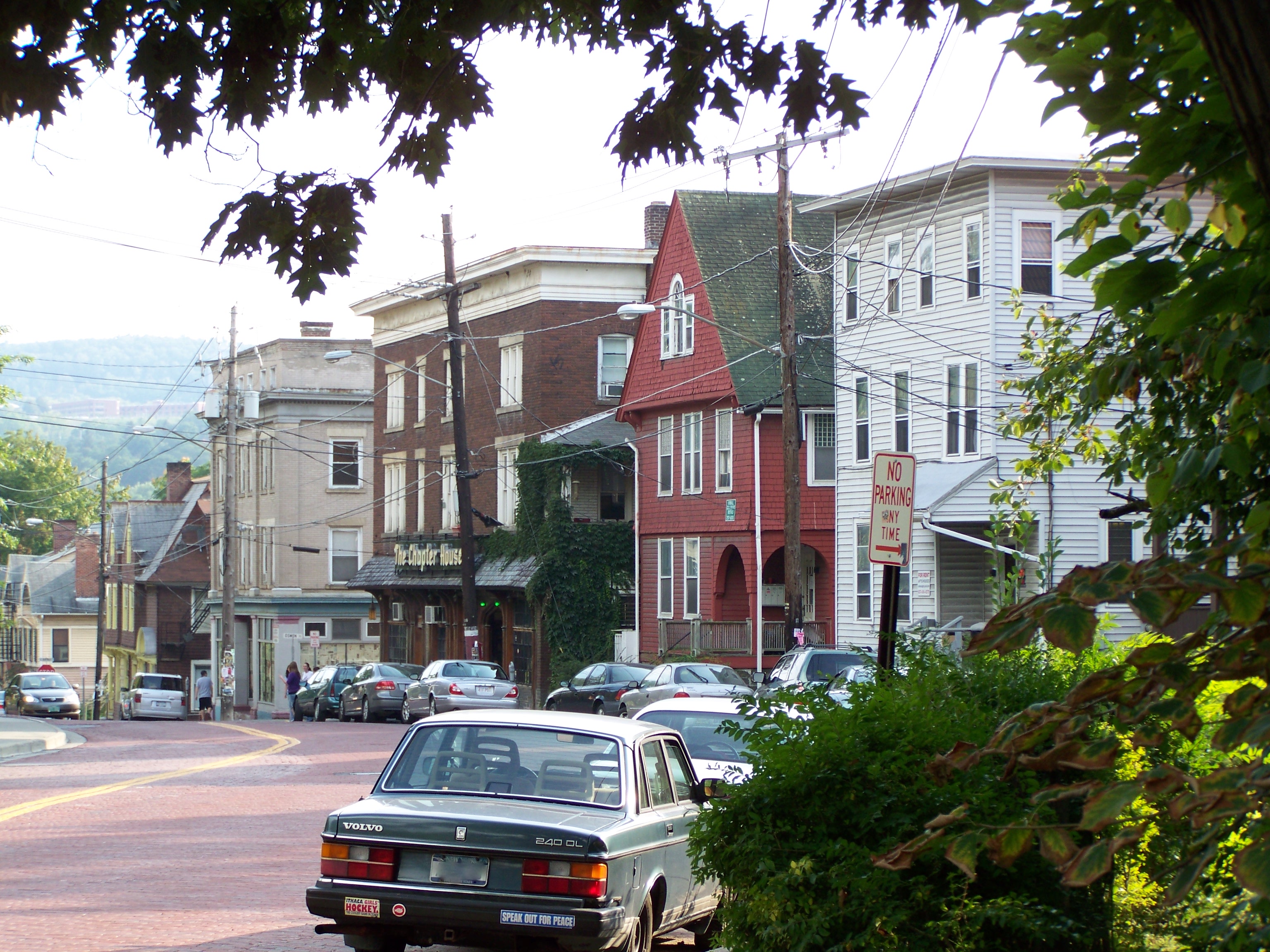
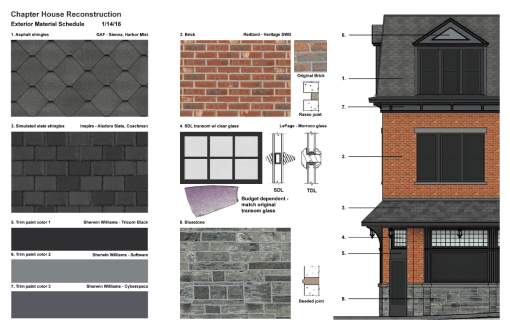
2. From the city of Ithaca Landmarks Preservation Council agenda next Tuesday, the latest iteration of the design plans for the Chapter House replacement and its neighbor at 406 Stewart Avenue. The Chapter House looks to be in the last stages of ILPC approval, while the apartment house next door is still in the early design review stage.

Looking at the Chapter house, the zinc roofing tiles have been replaced with asphalt, and two more paint colors will be included on the trim, which has gone from white to dark grey and black. The ILPC is doing what they do best, going over projects with a very fine toothed comb and debating every detail. Meanwhile, the current iteration of 406 Stewart Avenue calls for a 4-story apartment building with design features very similar to the previous 3-story building. That project still has some debates ahead of it, so we’ll see what happens moving forward.

Also on the agenda, discussion with the Planning Board about the DeWitt House/Old Library redevelopment, an update on repairs to 102 East Court Street, and some type of work being done at 210 Stewart Avenue (could be anything from paint color and shingle choices to major work; if it merits a post it’ll be included in a future update).
323taughannock_rev2_1

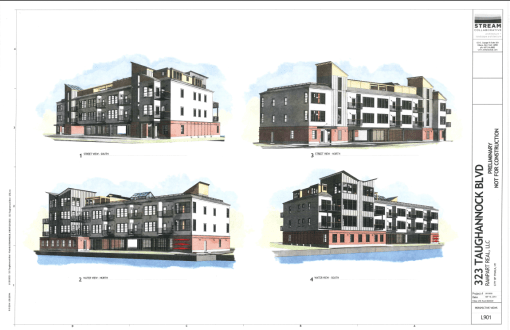
3. The Times’ Josh Brokaw wrote a nice summary of developments down at the Ithaca Waterfront, although I wish it hadn’t run when it did (re: HOLT update). Thanks to Josh, we have an idea of what’s going on with the approved but as-yet unbuilt 21-unit 323 Taughannock apartment project:

There was an “unexpected issue” that came up, Flash said, with the project, and so they must take “a sharper look at the engineering” to make the costs work.

I’m going to take a slightly educated guess – the soils were even crappier than anticipated. The high water table and easily-compacted soil in the West End and Waterfront pretty much mandate that multi-story projects have deep, expensive foundations to support the weight of structures. A soil issue was one of the problems that delayed the Lofts @ Six Mile project, and the reason why it’s built tall and narrow; also, since the Bloomfield/Schon has to pay for that deep foundation, it’s one of the reasons why the Lofts are so expensive. From the sounds of the Times article, balancing the deep foundation with adequate parking for the parcel is an issue. I’ll keep my fingers crossed, this project could be a real asset to that area.

Also, pretty sure that Cascadilla Landing still isn’t happening, and the Times has realized that. Anyway, it’s a good piece, and I’m not going to steal all of Josh’s thunder or his Myrick quotes, so spare two minutes and have a read through.

ith_big_plan_map_v2

4. For my moderate griping about timing with Josh’s Inlet Island development piece, I could note that this quote in the IURA Governance Commitee Agenda from city Planning and Economic Development Director JoAnn Cornish ties my article and his together:

“Cornish reported that the Planning and Economic Development Committee identified the Waterfront Neighborhood Plan as the Phase 2 plan of the Comprehensive Plan it would like to move forward with. Funding has been allocated for it. The plan would most likely be a hybrid Waterfront/West End neighborhood plan, in anticipation of significant development interest in that part of the city.”

In good news, affordable housing grants were thankfully saved in the federal budget, meaning that there will be a similar amount heading to NYS in 2016 as in 2015, and those funds would be available to future Ithaca projects should they jump through all the application hoops and be deemed worthy by Albany. The IURA is looking to smooth over any possible shortfalls by offering itself as a housing strategy consultant for the Waterfront/West End and Southside Phase II plans, and in the longer term, sales of parcels at the end of Cherry Street, at 410-426 Taughannock Boulevard, and Fire Station No. 9.

Also, the Argos Inn and Bandwagon Brewery/Restaurant have paid off their IURA loans. Proof that, although there have been failures (Finger Lakes Wine Center), the IURA can properly vet projects and be successful in its mission.

20160109_131947 20160109_132008

20160109_131909

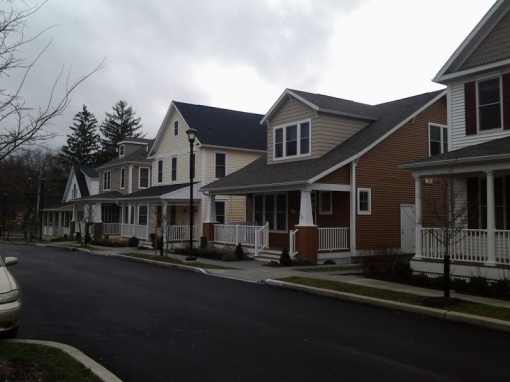
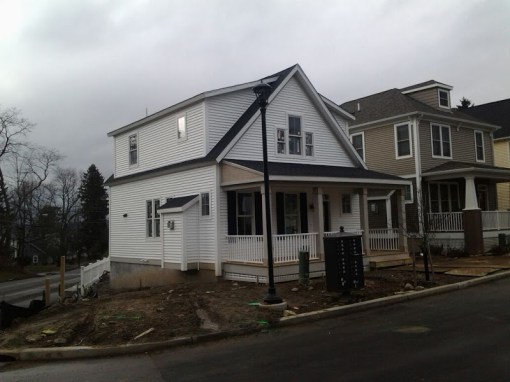
5. House of the week. 102 Walnut Street, town of Ithaca. the last of Agora Home LLC’s Belle Sherman Cottages is nearly complete, possibly to go on the market as a spec house. The house is a little small than its neighbors since the lot is smaller, but the unique design gives the street some extra diversity. Apart from landscaping, paving and some finish work (on the exterior trim at least, although being a Simplex modular means the inside is probably finishing up as well), the house is just about finished. Nice work Carina Construction.

6. Last but certainly not least, the Planning Board agenda for next Tuesday. It’s a big one.

I. Agenda Review
II. Public Comments
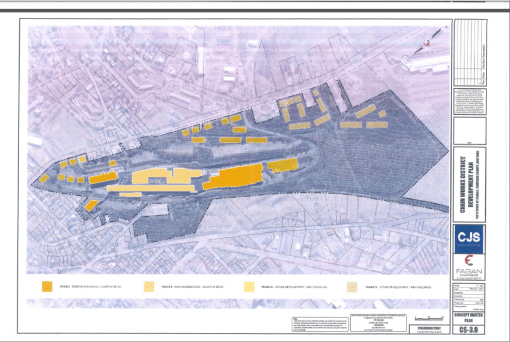
III. Special Order of Business – Chain Works District Redevelopment Project – Presentation of Draft Generic Envrionment Impact Statement (DGEIS) and Scheduling.
chain_works_rev1_1

It’s finally moving forward. The Chain Works District, which was last presented at a meeting in November 2014, is finally ready to discuss parts of its environmental review and timelines. Per the agenda, “The project is a mixed‐use development consisting of four primary phases: (1) the redevelopment of four existing buildings (21, 24, 33, & 34); (2) the repurposing of the remaining existing buildings; (3) potential future development within areas of the remainder of the site adjacent to the existing buildings/parking areas; and (4) future developments within remaining areas of the site.” This will merit its own piece, but in the interest of time, Ithaca Builds offers a great summary of the previous steps and the proposal itself.

IV. Subdivision Review – 101-107 Morris Avenue. Declaration of Lead agency, Public Hearing, Declaration of Environmental Significance and Recommendation to the Board of Zoning Appeals (BZA). This subdivision proposed to reconfigure a pair of vacant North Side lots to allow a duplex to be built by Habitat for Humanity. The two 1400 SF units would be sold to families with modest incomes. There’s a letter of support and the Board has already drafted a recommendation to the BZA giving their thumbs-up.

V. Site Plan Review

A. Cayuga Green Phase II (Lofts @ Six Mile Creek). The applicant proposes to omit a green screen on the parking garage. A letter from the developer asserts that the wall will be adequately masked by trees.
canopy_hampton_rev8_comparo

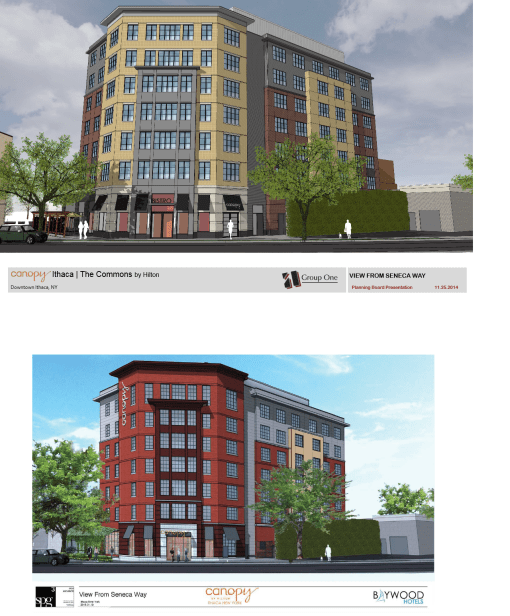
B. Hilton Canopy Hotel – Project Update, addressing conditions of Site Plan Approval and Requested Changes. Developer Neil Patel (and represented by Scott Whitham) requests to increase the number of hotel rooms from 123 to 131, and increase building size from 74,475 to 77,884 SF. Height would remain the same. Once again, this is something that could be the subject of its own post, but will have to keep it brief for the moment.

state_st_triangle_v6_1

C. State Street Triangle – Project update, no decisions planned. 9 stories, 96′, 180 units, 452 bedrooms, 12,300 SF ground-floor retail, including space for Ithaca Bakery and CTB. See Thursday night’s Voice article for more info. Smaller, shorter, and maybe palatable.

D. 424 Dryden, parking lot rearrangement, Declaration of Lead Agency

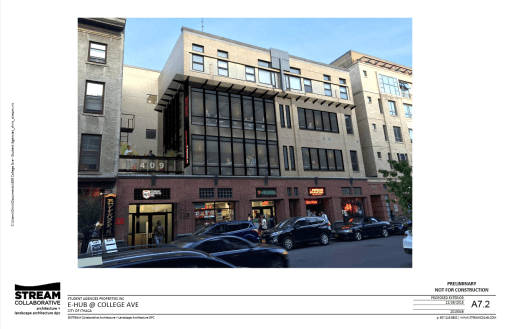
E. E-Hub, 409 College Avenue, renovations. While technically it doesn’t require review, Student Agencies and STREAM are asking for thoughtful feedback.

F. Sketch Plan – Elmira Savings Bank, Route 13. Pretty sure this is the one tied up in that PR disaster. WEDZ-1a Zoning allows up to 90% lot coverage, 5 floors and 65′, but given previous statements, the short-term work might just have to do with renovations of the former Pancho Villa restaurant, maybe a drive thru lane or other major exterior work. We’ll see. Background reading on the parcels themselves here.

G. Sketch Plan – Cherry Artspace. Developer: Performance Premises LLC/Samuel Buggeln. Cherry Artspace, a theater company, is located at (where else?) 102 Cherry Street on the city’s southwest side. The building was purchased in August 2015 for $240,000, it had previously housed Renovus Energy before the solar panel company decided to move out to more spacious digs in Ulysses. The theater company, directed by Sam Buggeln (pronounced “bug-ellen”), wishes to renovate the ca. 1980, 1,154 SF building into dedicated performing arts space.

VI. Zoning appeal recs for the Habitat duplex

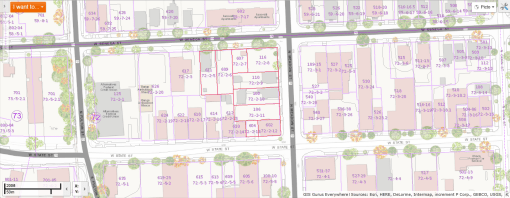
VII. Planning Board Resolution to the BPW regarding Seneca Street Streetscape work, Cascadilla Street Railing Options, and potential rezoning of a section East State Street/MLK Blvd. from B-4 to the more restrictive and residential-focused R-3a. Glancing at the zoning map, only the north side of the 400 Block is B-4, so the downzoning is probably intended for the houses on the corner of E. State and Schuyler, 420 and 422-24 E.State/MLK, and 108 Schuyler Place.

travis_hude_libe_libe_v3

Also worth noting, the Travis Hyde Old Library project will be discussed separately with the ILPC. That meeting is at 6 PM at City Hall. The Planning Board meeting at City Hall starts at 6:45 PM.



News tidbits 1/16/2016: The Not-So-Best Laid Plans

16 01 2016

elmira_savings_1

1. It isn’t exactly a shock that Elmira Savings Bank is pursuing plans for the $1.7 million in properties it just acquired on the west 100 block of Meadow Street between West State and West Seneca Streets. That being said, sending out 30-day eviction notices wasn’t a very good idea from a public relations standpoint.

Technically, it’s all above the law – the three tenants affected were on month-to-month leases, according to Nick Reynolds over at the Journal, and one had an expired lease and was in the process of relocating. The bank wasn’t interested in renting out the properties and decided to clear them out. That is plausible, if a little brusque – even if they had put forth a proposal for something at the next Planning Board meeting, approval would take months, in which case they could eased the tenants out of the current property. But instead, they ended up with a petition that, while mostly reading like a speech from the Politburo, does make the valid point that this was conducted poorly. Then it hit the airwaves, and the bank has gone into major damage control mode, giving the tenants until the end of March and reimbursing them $1,000 for the trouble.

Looking at some of the comments on the Voice, there is a lot of outcry against gentrification, but there’s not a whole lot the city can do to prevent that – even if Elmira Savings Bank didn’t build a thing and sold the buildings to someone else, the rapidly rising property values around the city would push the renters out, albeit more subtly, and the city can’t make a law that says someone can’t move in. Plus, as seen during the 210 Hancock, Stone Quarry and Cayuga Ridge debates, there’s a lot of pushback locally against affordable housing. Arguably the best solution going forward is to work an inclusionary zoning ordinance into law so that when Elmira Savings Bank does decide to build (and it’s more of a when than an if), that a few of the units be made available to those on more modest incomes.

Just to touch on that real quick, according to the Journal, the old Pancho Villa building at 602 West State Street will become a bank branch for ESB in the short-term, and plans are being considered for a mixed-use project at some point down the line (two months, two years, who knows). The zoning is WEDZ-1a, allowing for a five story, 65′ building, but there might be tweaks to that depending on the inclusionary zoning ordinance.

tmpud_waterfront_1

2. Keeping a focus on the west side of the city, the Planning and Economic Development Committee voted to circulate a proposal for a “Temporary Mandatory Planned Urban Development” (TM-PUD) over the waterfront. The reason for this is one part proactive, and one part reactive.

What the TM-PUD does is, for an 18-month period starting the day of Common Council approval, it gives the Common Council the right to oversee and if necessary vote down projects that it thinks will not be appropriate for the waterfront. The study area is currently a mix of zones: Waterfront (WF-1, WF-2), Southwest Mixed-Use (SW-2), Park (P-1) and Industrial (I-1). When the Comprehensive Plan was passed in 2015, it promoted a more walkable, dense, mixed-use waterfront. Therefore, some of the zones are outdated.

The city’s planning department is still in the process of drawing up specifics for how to implement the Comprehensive Plan’s walkable urban waterfront, but in the meanwhile, some of the zones don’t match up with the direction the city wishes to proceed. Take, for example, the industrial space on Cherry Street and Carpenter Circle. By zoning, residential uses aren’t allowed, although the city would like to see mixed-uses with condos and apartments in their vicinity. The planning department needs time to figure out the what and where on zoning so that those uses can be proposed without a developer spending extra months in front of the Planning Board and BZA, which can drive up costs and make construction financing more uncertain.

So that’s the proactive, benign part – the city needs time to plan out the zoning laws for the dense waterfront they want. Now comes the reactive, cynical part.

It’s a not-so-secret secret at this point that the Maguires are looking hard at Carpenter Circle for their car dealership headquarters and multiple sales outlets. Since Carpenter Business Park is zoned industrial, and Ithaca city zoning allows commercial uses in industrial space so long as they’re two floors, there’s a good chance they could build dealerships without the need of the BZA, and it would be an uncomfortable position for the planning board to have to debate a project that is totally legal but is something the city and much of the community doesn’t really want. So as a way to stall for time, the city’s pursuing this TM-PUD and giving the Common Council the authority to shoot down any unwelcome plans should they arise.

For comparison’s sake, there’s a similar scenario that is playing out in Ithaca town. The College Crossings project on South Hill was welcomed under the zoning and previous iterations had been approved, but after the town passed its 2014 Comprehensive Plan and attended the Form Ithaca charettes last summer, the planning board realized that a shopping center with a couple apartments above and in the middle of a large parking lot wasn’t something they really wanted anymore. While the project has been withdrawn, the process and debate has created a lot of discomfort, confusion and uncertainty, which is rather problematic given the area’s housing shortage. The town hopes to have some form-based zoning code ready this year.

So, looking back to the city, the occupants of 108 E. Green Street want things that are still illegal in much of the study area, but they don’t want a full-on moratorium because some spots like the Waterfront zones actually do accommodate what the city and many of its constituents want. The TM-PUD is an attempt to stave off the legal but undesirable projects until the revised West End zoning can go into effect.

Worth pointing out, at the meeting the boundary was changed to midway through the Meadow Street and Fulton Street blocks, rather than along Fulton Street. It may or may not affect Elmira Savings Bank’s parcels as mentioned above, but those long-term plans are in alignment with the city’s, so probably not.

south-hill-area

3. On a related note, the town is holding workshop sessions for those interested in designing a ped-friendly, mixed-use community for South Hill. The meetings are planned for 6:30 p.m. to 8 p.m. Jan. 26 to 28 at the Country Inn and Suites hotel at 1100 Danby Road in Ithaca. An open office has also been scheduled for 12 p.m. to 1 p.m. Jan. 27. Form Ithaca will be in attendance at the sessions to help formulate the form-based character code proposed for the neighborhood.

815_s_aurora_4 815_s_aurora_1

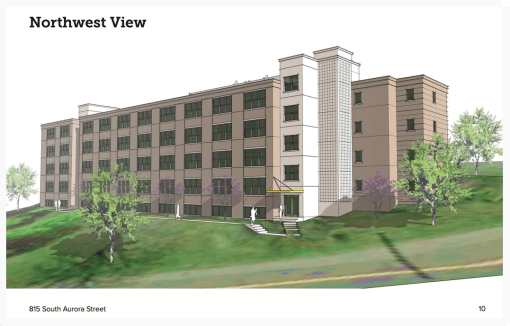
4. A revision to the cellphone tower law has taken one step closer to becoming reality. The city’s Planning and Economic Development Committee voted 4-1 to circulate a revised law that would reduce the size of the tower’s fall zone, where construction of any structures is prohibited. A revision to the current city law, which is twice the height of a tower, could potentially allow the 87-unit 815 South Aurora apartment project to proceed with planning board reviews and other BZA variances if necessary. Developers Todd Fox and Charlie O’Connor of local company Modern Living Rentals have been pushing for a fall zone radius of 180 feet for the 170-foot tall tower, rather than the 340 feet as the current law mandates.

From the discussion, it sounds like the concern has less to do with this parcel, and more to do with the possibility of cell phone companies pursuing towers on open land in the northern part of the city where spotty reception has to be weighed against the aesthetics of the lake shore. Anyway, we’ll be hearing more about possible changes to this law in a month, but for back reading, here’s the Voice article from a few months back.

5. In quick news, CBORD’s move to the South Hill Business Campus looks like a go. A $2.45 million construction loan was extended on the 8th by Tompkins Trust Company. CBORD, a software company founded in Ithaca in 1975, will move 245 employees into 41,000 square feet of freshly renovated SHBC space from the Cornell Business Park later this year. The project, which totals $3.7 million, was granted $296,000 worth of sales tax abatements.
409_college_avenue

ehub_1

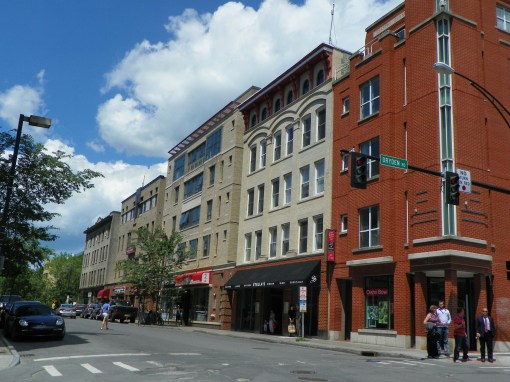
6. From the city’s Project Review Agenda next Tuesday, plans for a facadectomy of the 1980s Student Agencies Building at 409 College Avenue. Student Agencies, in collaboration with Cornell, plans on dropping $183k on the facade work, as well as the $2.8 million or so for the interior renovations of the second and third floors for the new eHub business incubator space. Prolific local architecture firm STREAM Collaborative is in charge of the design work, including the 9,660 SF of interior space. The work would go from January to April (the loan is already approved and most of the work is interior).

6-29-2014 163

If I may play armchair architecture critic, which I have no credentials to do, I think the patio area is great, but I’m opposed to the brise-soleil, the wing like feature that serves as a sunscreen. I feel like that its location above the third floor throws off the rhythm of the block, by being lower than the cornices on adjacent structures. It might be fine over the glass curtain wall alone, but as is it feels a little out-of-place. Just one blogger’s opinion.

20160109_135258 20160109_135338


228_w_spencer_1

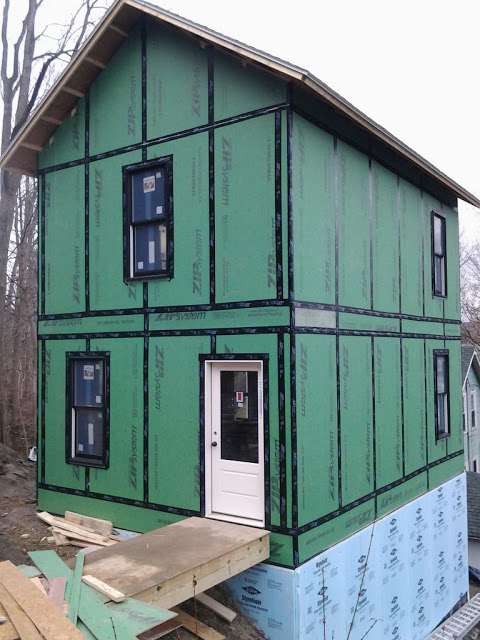
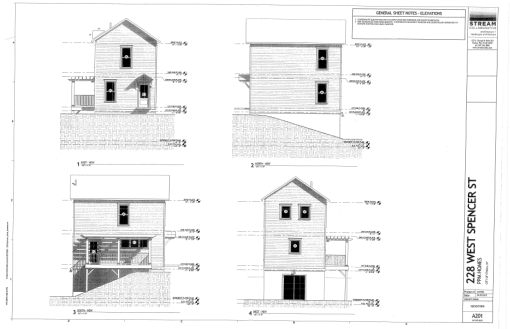
7. House of the week. 228 West Spencer Street in the city of Ithaca. Zero energy new construction, 2-bedrooms, on a rather difficult site. In the above photos from last weekend, the house has been framed and sheathed with Huber ZIP System plywood panels, the roof has been shingled, and doors and windoes have been fitted. The blue material on the concrete basement wall is Dow Styrofoam Tongue and Groove Insulation which protects against moisture and helps keep the heat loss to a minimum. The house should blend in nicely with its neighbors.

Ed Cope of PPM Homes is the developer, and Noah Demarest of STREAM Collaborative is the architect.