The Cornell Stories

18 01 2013

cornell_postcards_1933

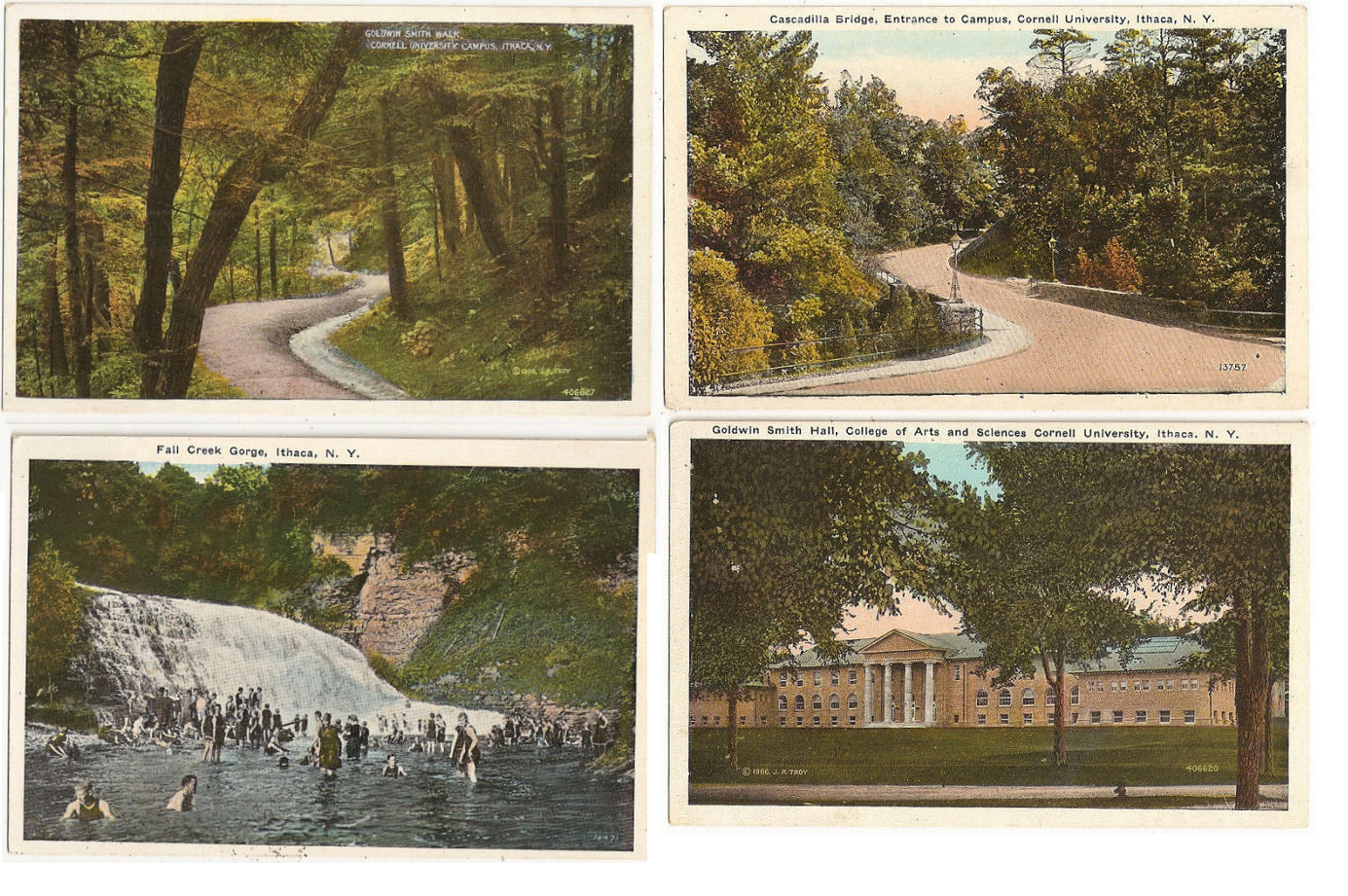
Back in the day, before the internet, TV and even radio, the best way to indulge one’s interest was by the printed word. Novels,  serials and newspaper articles were much more valued. It was also around a hundred or so years ago, when the idea of college went from the dank halls of seminaries and obscure studies of little practical worth, to a sort of idyllic playground of stories and mischief, casting collegiate life into a much more positive light.

During this time, several publications focusing on the wonders of college life were produced. Perhaps the best known are the Frank Merriwell serials, and his exploits at Yale. There were several other works of various quality produced around the same time.

Here, I offer The Cornell Stories (1898), written by James Gardner Sanderson, Class of 1896. The stories are light-hearted and fictional, but the setting and the descriptions conjure up images of a simpler, slower time, the Ithaca of a century ago.

Here’s my recommendation – make a cup of hot chocolate, settle into your favorite chair or couch with a blanket, and enjoy a good read.


A Fond Farewell to Dear Uncle Ezra

13 11 2012

It’s bittersweet. After 26 years of operation and over 20,000 responses, Dear Uncle Ezra, the “Dear Abby” of the Big Red, has gone on indefinite sabbatical. DUE was useful to this blog for its grab-bag of historical info, cited in these entries many times over the past few years. When first launched in the fall of 1986, DUE could be accessed from one of the two dozen computer sites, or few personal computers on campus.  Now in 2012, and thinking of blogs like this one and of internet culture, I suppose answers to many writers’ questions are just easier to find through google these days. But sometimes, it’s nice to just have someone hear you out, an impartial ear.

I wrote to Dear Uncle Ezra as a freshman. I don’t think the question will surprise most of the readers here.  A quick back-story on this, but my first few months at Cornell were a very trying time for me, since it was my first real experience away from home. And I guess that experience carries over somewhat to my current situation, as I moved to a new region for the first job in my post-grad school meteorology career. Having to build a new social network. Learning the ropes of my job. Not the easiest things in the world, when it seems tempting to settle into something else “easier” or closer to “home”.

From September 5, 2006:

Dear Uncle Ezra,
For years,
I’ve wanted to be a meteorologist, and I came to Cornell to study for that career. However, over the past year or so, I have had an equal if not greater interest in studying to be a history teacher at another university (it has a more focused program than Cornell’s, though I mean nothing against the school). I know that if I transfer, a lot of people will be dissappointed that I’m throwing away an “Ivy League education”. I feel confused and somewhat frustrated at being unable to make a decision, and I have to make it within the school year*. Could you weigh-in on the issue?

Dear Career-confused,

Glad to hear that you haven’t waited til the last minute and have the year to think this one through.  Choosing a career can be a very difficult process, but remember that it is a process and not just one single decision.

Fifty years ago, people in the United States got into the mind set that you chose a career (or even a company) and stayed there until retirement.  This is no longer true, as there is a lot of flexibility to combine interests into a “perfect” job, or to change positions or careers along the way as your expertise and needs change.  I myself, Ezra Cornell, was a carpenter, potter, farmer, public works engineer, communications entrepreneur, and then founder of this university.  But back to you.

In order for your direction to be the right one for you, you will need to continue engaging in the process of exploring your options.  One way to do that is to do research on what the two careers will be like.  Interview people in those positions to learn more about them.  Make an appointment with Cornell Career Services, 103 Barnes Hall, 5-5221.  They provide a wide range of services to help students reach decisions on majors and careers.  They could also help you find an internship or lead you through their career- information library, which might lead to greater clarity.

It might also help to talk to those people who think it would be a mistake to change schools: hear their thoughts and let them know your needs, goals and dreams.

Remember that it is your life and you must make the decision that is right for you after you weigh all of the information that you gather.

If you need a great sounding board along the way, feel free to contact EARS for free, confidential  and immediate counseling by phone or walk-in, 5-EARS or 211 Willard Straight Hall.

***

So I stayed the path in my career, doing my BS, my MS, and now at my first job (with what may be job number two coming up at a research facility a five hour flight away). My life is in flux, and it’s intimidating. Sometimes its good to have someone to sound off to. And for me personally, that’s what Dear Uncle Ezra was.


A “Nobel” Accolade

4 10 2012

In the proverbial confidence-measuring that is academia, one of the things that colleges and universities like to throw out there is the breadth and depth of their Nobel laureates. The reasoning is simple enough; it’s a measurement of prestige, and the caliber of alumni and faculty.

Cornell lays claim to 41 such folks, according to a fall 2009 issue of the Cornell Chronicle, and according to wikpedia, that number has held steady. Within those 41, 3 are current faculty, 13 are alumni, and the other 25 are former faculty (moved, retired or otherwise). The last recipient was Jack Szostak Ph. D ’77, who won the Prize in Physiology/Medicine in 2009.

So let’s take a brief look at how Cornell stacks up against its peers: First, the top 20 schools, as compiled by U.S. News and World Report, since that tends to be the most commonly used ranking system:

Harvard
MIT
Yale
U. Chicago
Penn
Columbia
Stanford
Caltech
Princeton
U. Mich
Cornell
Johns Hopkins
Duke
UC Berkeley
Northwestern
UCLA
Brown
UW-Madison
Carnegie Mellon
NYU

Now their Nobel laureates:

Columbia 80 (or 97, depending on your definition)
U. Chicago 87
MIT 77
Stanford 54
Yale 49
UC Berkeley 47
Harvard 46
Cornell 41
NYU 36
Johns Hopkins 36
Princeton 35
Caltech 32
Penn 28
UW-Madison 19
U. Mich 19
Carnegie Mellon 18
UCLA 14
Duke 12
Northwestern 8
Brown 7

Interestingly, U. Illinois-Urbana-Champaign has 26, but doesn’t appear in the top schools list from USNWR. International students may be annoyed at me for leaving of non-U.S. schools, and granted, there’s a few that have similarly high rankings and accolades. Forgive my blatant nationalism for the moment.

This exercise proves to me, on a very general level, that universities with Nobel affiliates tend to be more prestigious. However, there are some obvious issues- schools with large research programs tend to have more laureates, and we haven’t even explored the Nobel laureates per capita at each institution (an exercise in futility, since I would also require historical enrollement figures I don’t feel like digging for at the moment).

But whatever floats your boat Cornell P.R., and keep your fingers crosses at the next Nobel award ceremony.


The Freshman Beanie

11 06 2012

Distinguishing between the years of students of Cornell can be rather difficult after about the first month of the academic year.  Unless it’s orientation, Greek rush, or some other telling factor, you can take a glance at some random person crossing the quad and have no idea whether or not they’re a freshman, a junior, or perhaps even a young grad student (whereas for older grad students, they might be mistaken for professors). However, it’s not like anyone worries about that; except in the case of love and relationships (senior to senior: you’re dating a freshman? Robbing the cradle much?), someone’s year usually doesn’t merit much attention. Well, things were a bit different back in the day.

In the days of yore, it was traditional for freshman males at Cornell (known as “pikers”, like those referenced in “Give My Regards to Davy”) to wear a rather peculiar-looking felt cap called a “Beanie”, which was like a snow hat (wikipedia directs the query to “tuque”, a word I’ve never used in my life), red in color with a grey button on the top. Examples can be seen in the below photo, which dates from a 1919 Cornell football game.

Image Courtesy of Wikipedia.

The Beanie was part of the mandatory rules for freshmen, and they were required to wear it in public until the spring, when all the freshmen burned their caps in a ceremonial bonfire. This was a kinda cutesy little sentimental event meant to instill class camaraderie and make warm fuzzies, when the sophomores weren’t trying to kick the crap out of freshmen in the occasional class battles.

The cap rule, along with other rules such as not walking on the grass and not wearing any high school or prep school emblems, tended to be strictly enforced, and with harsh consequences. Violators were liable to have their heads shaved or go for a quick dunk into Beebe Lake.

Of special note regarding the beanies is the case of Frederick Morelli, a freshman originally of the class of 1924, who absolutely refused to wear his beanie. After numerous dunkings and warnings from his peers (including a double dunking into a public fountain and the lake, with a placard hung on his neck saying “Moral: wear a frosh cap”), Morelli ended up being pursued by a mob of angry upperclassmen, and had to be saved by the president of the university to avoid serious injury. The Sun actually condoned the mob’s behavior. But George Lincoln Burr, the most senior faculty member at the university at the time, threatened resignation over the manifestation of “lynch law” on the campus. Fred Morelli withdrew from the university, but returned a couple years later and graduated in the class of 1926. Perhaps his penchant of pushing his bounds played into his undoing; after graduation, he became a gangster and nightclub owner, and was gunned down outside of his club in Utica in 1947. Fun fact: the city of Utica was run by the Mafia and its associates for decades, up through the early 1990s.

The caps faded out, as did the class battles, as a result of the changing demographics post-WWII. Frankly, after killing men in trenches, and now married with children, most vets who came in under the G.I. Bill as freshmen could not give two salts for collegiate antics. When the sophomores made an attempt to enforce the rules in 1949 by shaving the heads of three frosh, the enraged students brought their grievances before the mostly G.I.-composed Student Council, who promptly banned enforcement of the practice. The beanie remained voluntary up to the early 1960s, when it faded out completely.

So nowadays, students can feel completely to engage with members of the other classes. Unless it involves doing a walk of shame to Collegetown from a freshman dorm. That would be awkward.


The Strange Case of Edward H. Rulloff

21 02 2012

Image Property of Rulloff's Restaurant, Ithaca NY

In some way, shape or form, most Cornellians are familiar with the Rulloff name. If you’ve ever lingered in Collegetown, you’re aware of Rulloff’s restaurant and bar over on College Avenue. If you’re a real campus adventurer, you might even be aware of Edward Rulloff’s brain, stored in preservatives over in Uris Hall. But, apart from the piece of news that he was a convicted murderer and noted linguist, not much else is shared. So this entry is to shine a little more light on the murderous man of many talents.

Edward H. Rulloff (officially John Edward Howard Rulofson) was born around 1820 to Rulof Rulofson, a second-generation American who had the unfortunate luck of being a loyalist living in New Jersey during the Revolutionary War. Unsurprisingly, he left for New Brunswick, where he was granted land and became, of all things, justice of the peace. Some articles suggest that Edward developed his talents as a result of an incident where his younger brother Rulof was critically injured due to  a beating from a school teacher (it took young Rulof several weeks to recover; the teacher begged for forgiveness, which was apparently given, and the brother became a prosperous lumber merchant in northern Pennsylvania).

Edward was, as an adult, described as a serious and studious individual, professorial, even grandfatherly. He was devoted to his research, often spending several hours a day researching and writing, in spartan accommodations – the life of a hard-nosed academic.  He went by numerous names and aliases – Edouard Leurio, Edward Rulofson, and his preferred name, Edward Rulloff. Edward Rulloff considered himself a self-taught but well-respected philologist – that is, a person who studies language formation.

Edward Rulloff’s research was that he believed there was “method” in the incongruities of the world’s languages (a sort of “key” for decoding languages). This pursuit was dubious at best; his theories were but one of dozens, with most of the others tying into “superior” and “inferior” languages and overt racism.  Besides the philology, Rulloff was a self-trained physician, an inventor, and a self-proclaimed expert on phrenology (a debunked science suggesting that bumps on the human skull were indicative of certain behaviors and character traits). However, he had never gained much wealth, which he wrote off to “misfortunes”, as he opined during his many forays into self-pity. He hoped to build his name on his manuscript, Method in the Formation of Language, and gain the wealth and respect he craved.

But there was more to Edward Ruloff than his elderly professor persona; as a young man, he served two years for embezzlement. Arriving in Dryden in the 1840s, he was arrested for several burglaries and robberies between 1845 and 1871, and was accused of beating his wife Harriet and their young daughter to death (it was alleged their bodies were dumped into Cayuga Lake; although never proven, he served ten years, possibly because the jury believed an innocent man does not flee to Chicago and then lure his brother-in-law out west on a wild goose chase), as well as poisoning his sister-in-law and niece. Although Rulloff was in and out of jail (and broke out of the Tompkins County jail at least once, only to be apprehended in Ohio after being recognized by an old prison-mate), he avoided real punishment due to a lack of evidence in his crimes.

Eventually, his luck ran out. After murdering a store clerk in Binghamton, Rulloff was sentenced to death by hanging. He was caught because he left behind his shoes fleeing the scene, and missing his left big toe, the lack of a left toe indent in those shoes made for an easy identifier of their owner.  His was the last public hanging in New York State, on May 18th, 1871. It is claimed his last words were  “Hurry it up! I want to be in hell in time for dinner.” His brain was collected by Cornell professor Burt Wilder, who declared it the largest he had ever examined.

As it would seem, Rulloff’s vicious behavior seem to have run in the family. His youngest brother, a notable 19th century photographer named William Rulofson, was known to have a vicious temper himself. William had ten kids from two wives, of which one of them, Charles, murdered his half-sister. The boy was nine years old.

…and to leave this entry off, here’s an excerpt from Rulloff’s Restauant’s biography of Edward Rulloff:

“Unrepentant to the end, Rulloff proclaimed in his final interview, published in the Ithaca Daily Leader the week before his death, ‘…you cannot kill an unquiet spirit, and I know that my impending death will not mean the end of Rulloff. In the dead of night, walking along Cayuga Street, you will sense my presence. When you wake to a sudden chill, I will be in the room. And when you find yourself alone at the lake shore, gazing at gray Cayuga, know that I was cut short and your ancestors killed me.‘”

Sweet dreams.


Where Have All the Drinkers Gone?

13 01 2012

I had first seen rumors of this on facebook, but it was only verified by the Sun sometime last night: The Royal Palm Tavern, or rather, “The Palms”, is closing, after 70ish years of service to the inebriated community (I’ve seen opening dates ranging from the late 1930s to 1944; the Sun went with 1941). The Palms closing next month will mark the third Collegetown bar closing in less than year, following in the footsteps of Dino’s and Johnny O’s.

I think most older readers of this blog have some memory attached to one or more these places. The Alumni Magazine did a nice piece about drinking-holes of yesteryear just back in November, complete with the line “the Royal Palm Tavern—still open, despite recent rumors to the contrary—has served a steady stream of students since the Thirties.” To some extent, I worry with the closure of multiple bars and the restrictions on fraternity parties are only furthering the move to drinking in the rundown houses of Collegetown, arguably a more dangerous environment than the aforementioned options. Let’s be honest, if a third of the drinking establishments in Collegetown have closed, and traffic was pretty high on many nights as it was, the traffic that would go elsewhere might just get frustrated with the lines and crowding and just drink at a private party. For the record, Johnny O’s closed after legal issues and their landlord opted for another tenant, and Dino’s was not allowed to renew their lease. The Palms is closing because of financial issues, and the owners are retiring.

As much as I could pursue an entry just on drinking culture/concerns, I’d rather stick to what I do best – Ithaca history and development. First, the Palms’ property, at 209 Dryden Road,  is not for sale, it has already been sold.

That is, unsurprisingly, a prime, prime piece of property to tap into the more expensive segment of the Collegetown market. Now, being such a prime property carries a hefty price tag, so the developers would have to be fairly deep-pocketed, and in fact they are; it’s the firm Novarr-Mackesey, the same developers of the massive Collegetown Terrace project. The rumor mill has been cranking out the possibility of a mid-rise or high-rise apartment building on the site of the Palms. Unfortunately, at this early stage, it’s hard to say what the proposal will look like.

However, there are two certainties – they’re going to have one hell of a time tearing the Palms down, and if it goes over 60 feet (or over 6 stories, whichever comes first), then it’ll be even more difficult because they’ll need a height variance (B-2b zoning says building should be 6 stories or less, and no more than 60′ feet from base to roof). The zoning could be pliable depending on any fringe benefits for the city or any public enhancements (for example, offering public meeting space). The building was built around the early 1920s, and has operated as a restaurant/bar for virtually all of its life, and is seen as a potential historic landmark. Notably, some of the members of the Planning board also put together the historic buildings document. If Novarr-Mackesey wants to build anything, I see this being a prolonged battle, especially if it needs to go up to the Zoning Board of Appeals, where more objections can be raised.

Honestly, I hope to see something, because if buildings appear totally vacant like this, giving a poor impression to visitors and potential students, that is unacceptable:

Update: The Palms and two neighboring buildings on Dryden were sold last year toan LLC associated with Novarr-Mackesey for $3.75 million, well over their assessed value. In the Cornell Sun, Novarr claims there are no set plans for the location yet, but there will probably be a housing component. Considering his work with Collegetown Terrace, which will not be finished until 2014, it could be a couple years before financing and plans are lined up for the site’s redevelopment – leaving that part of the street rather blighted in the short term.


A Nominal Nod to Cornell

18 12 2011

Whether or not one likes or dislikes Cornell and its environs, the university has been around long enough and produced enough graduates to have a fairly recognizable name as colleges and universities go. I happened to hear from a friend recently who had moved out to Colorado after graduation, and their experience in the Collegiate Peaks of Colorado. When I checked Wikipedia, I was dismayed to find that their were mountains named in those peaks named for Oxford, Harvard, Princeton, Yale and Columbia, but not Cornell. For what it’s worth, it appears they were named in the late 1860s and 1870s, when Cornell was still a fledgling school. But, I decided to do a google search for a “Mt. Cornell”.

While there wasn’t a “Mt. Cornell” anywhere in the world, there is a Cornell Peak named in honor of the university. The 9,750 ft. mountain is part of the San Jacinto Mountains in Southern California.  The mountain earned its name from a USGS topographer camping in the valley below with a geologist friend who was a graduate of Cornell, and remarked how the peak resembled McGraw Tower in appearance. Personally, I don’t see it, but the topographer named the mountain in honor of the university. Of much lesser note, there is a 3,860 ft. “Cornell Mountain” in the Catskills that is named for Thomas C. Cornell, a distant relative of Ezra.

Looking northward to a place even colder and less inviting than Ithaca in winter, on the west coast of Greenland there exists a “Cornell Glacier“. Similarly to the Collegiate Peaks, there is a collegiate set of glaciers in Alaska that Cornell was not a part of, the set consisting of the four aforementioned Ivies and Johns Hopkins.

On the more civilized end, the town of Cornell, Wisconsin (population 1467 as of the 2010 census) is named for Ezra and the university, due to its placement on the lands that the university once held as part of the Morrill land-grant in the late 19th century. The university has given this some light attention to this connection by writing an article referring to a blog written by a Cornell alum and his fact-finding adventures in the small community in northern cheesehead country. Apparently, the town was originally named Brunet Falls and is famous for having the only surviving pulpwood stacker, and like many other small towns with minor claims to fame, they make a festival out of it (considering my hometown’s claim to fame is the method a hose is laid on a fire engine, I have no right to be critical). Although it’s hard to tell whether communities named Cornell are named after Cornell U. or someone who happens that surname, at least two unincorporated communities are named for the school far above Cayuga, one in the U.P. of Michigan and one in Southern California north of Malibu (and a fair 100 miles from Cornell Peak). Cornell, Illinois and Cornell, Ontario are not related to the university.

Lest one try to limit themselves to the Earth, an asteroid was named in honor of Cornell in 1999 (8250 Cornell). I guess the next astronomical goal should be a large crater somewhere.

If it’s any consolation to the folks associated with Cornell College, they have a species of tropical fly named for their school.


The ILR School Almost Invaded Hoy Field

10 12 2011

As would be expected for any major university, Not every plan for a new buildng at Cornell came to fruition. Sometimes, it was because the plan didn’t have funds, or the demand for space had ebbed. With the original plans for Cornell’s Industrial and Labor Relations (ILR) school, it was all about the location.

The ILR school is quite young, having opened its doors on November 1, 1945. The original facilities were in temporary wooden lodging on Sage Green (the western and southern grounds next to Sage Hall, in the days before the loading dock/drive for the Cornell Store and the parking lot south of Sage Hall).  The school had originally been conceived a decade or so prior, and by 1944 the state gave Cornell its monetary blessing, foregoing counter-offers for a labor college at Syracuse University or Union College in Albany (Bishop, 568). On the other end, the president of Cornell at the time, Edmund Ezra Day, had to contend with unamused industrialists and farmers among its alumni who felt that such a school was unnecessary.

The state was proud of its newest educational creation (in the days prior to the massive proliferation of modernist/brutalist SUNY campuses), and drew up plans for permanent housing for the ILR school. The original plans were produced at a cost of $80,000 at the time, but never came close to construction due to some very angry Cornell alumni and students.

The issue wasn’t about the architecture (being the late 1940s, early modernism or stripped Collegiate Gothic were likely), but the location. The site for the new school was on Campus Road. To give you an idea of how the area looked at the time, here’s a map from a years later in 1954 (click the link for a larger version):

Phillips Hall and Teagle Hall were not yet built (both were completed in the early 1950s), so the area was really only Barton Hall and the athletic facilities. The Buildings and Grounds Committee at Cornell picked a site on Campus Road, where Phillips Hall was built a couple years later, but with a larger footprint that would’ve required the removal of Hoy Field (which is aligned directly south in this map – it was redone to face southwest about five years ago).

A tempest of outcries ensued. It was firmly believed that Hoy Field had been donated by the alumni to be used in perpetuity for athletic purposes. Suddenly, different alumni groups were protesting “The invasion of Hoy Field”, and the Association of Class Secretaries filed complaints and letters of concern with Cornell, along with written protests from 53 undergraduate student groups. President Day and the committee gave up on the plan.

The state was not pleased by the reception, and so the ILR school was kept in the dreary wooden temp buildings until the Vet School’s new Schurman Hall was built in the late 1950s, and ILR could move into what used to be the Vet School buildings at the corner of Tower and Garden Road. The rather pretty if utilitarian ca. 1896 James Law Hall was demolished to make way for Ives Hall. But, In the long run, the administration was rather glad it hadn’t built the ILR school on that plot of land, as it allowed the full build-out of the Engineering Quad.

Now, fast-forward to today, and consider the positioning of the soon-to-be Gates Hall, and the master plan’s removal of Hoy Field. I wonder if such an outcry would arise today, as it seems once again that the end of Hoy Field as we know it is drawing near.


The Keyword Bar XI

27 05 2011

It’s been really slow news-wise, I’m been pouring my efforts into my work, and while I’m scratching my head for ideas, I might as well fall back on the tried-and-true method of answering or writing about peoples queries that bring them to this blog.

1. “can i join tke if i pledge sae” (5-13-2011)

I wonder if this was a Cornell student or someone from another school. Anyways, at Cornell, the answer was yes, under…extraordinary circumstances. Which I’ve already ranted about here.

2. “hotel brunswick” ithaca ny (5-14-2011)

A fun fact of the day – Theodore Zinck didn’t call his pub Zinck’s, as most of us might believe. Rather, he called his pub the “Lager Beer Saloon and Restaurant”, which was located in the Hotel Brunswick, which he also owned. The hotel and bar were discontinued after Zinck committed suicide in 1903. It was the pubs that came along after the Hotel Brunswick closed that were named Zinck’s, in honor of his service (and to try and conjure up good memories for visiting deep-pocketed alums).

3. “ithaca college a and e center tower” (5-15-2011)

I’m assuming this is the Ithaca athletics center that was being searched? At 174 feet (tallest tower in the county), it makes quite an impression. The below photo is from Cass Park (tower is in the upper left):

4. “cornell “university library” ‘arthur gibb” 1890 drawing” (5-17-2010)

It’s a fantastic monograph, but I’m not aware of any copies of it being online. However, while searching for it, I found this wonderful writeup about Uris Library by Matthew Stukus ’09. It gives a couple details I was previously unaware of, such as Cornell was going to have to pay Henry William Sage back for the library construction if it won the Great Will Case, and that contrary to previous haphazard planning, it took fifteen months for the site of Uris Library to be chosen. The writeup is only several pages, so it’s a brief but enjoyable read.

5. “ithaca coldest ever day” (5-19-2010)

People seem to have an odd fascination with this one; I’ve never seen a query for the warmest day in Ithaca, but I’ve answered the coldest day question previously. For those too lazy to click the link, the lowest low is -25 F, set once in January 1957, and once again in February 1961. This past winter’s coldest day, for comparison, was -15 F, on January 25th.

6. “did the ramones ever play at a cornell university party?” (5-20-2011)

Define “party”. They played at Barton Hall in February 1981. The Ramones came back to East Hill to play for Slope Day 1984 (where they ended up playing in Barton Hall once again because of bad weather). But as for private parties or fraternity parties, I’m not aware of any occasion offhand.

7. “experimental fantastic gothic death” (5-21-2011)

Um…nope. Not even going to think about answering this. But extra points for being really creepy.

8. “neighbors have rotting deer heads along property line” (5-22-2011)

Your neighbors are a lot worse than mine. I’m really sorry.

9. “is it difficult to grt into hughes hall cornell capacity” (5-24-2011)

That’s a really good question. To be honest, I thought Hughes Hall as a dorm was being closed and converted into academic use, but apparently its 48 rooms are still open for the upcoming academic year. Typically, about 25% of first-year law students live in Hughes. Your best bet is to call the Housing office and ask.

Hughes Hall is the product a million-dollar donation in 1956 from Myron Taylor LL. B. 1894, who was chair of the trustees for U.S. Steel Corp. The building, which was completed in 1963, was named for law professor Charles Evans Hughes, who was Myron Taylor’s favorite professor while he attended the law school. Prof. Hughes would go on to become governor of New York (1907-1910), U.S. Secretary of State (1921-1925) and Chief Justice of the Supreme Court (1930-1941).


Taking Care of Cornell’s Students’ Bodies

10 05 2011

After I wrote about the medical college, I felt inspired to write up a brief piece regarding the history of student health at Cornell. Understandably, the value of this entry to the practical person looking up health information is nil, but then, I would hope that if someone has health issues, they would be looking through health websites like Gannett’s instead of blogs.

Anyways, most Cornell students know that if they feel sick, or think they might be pregnant, or some combo thereof, that a trip to Gannett Health Center is in order. Back in Cornell nascent days, if you were sick, well…you were pretty much screwed. A student at Cornell a few years after its founding, if they were to become ill, could hope to be taken care of by their friends, roommates or professors, if they were lucky and had strong connections. Otherwise, you were S.O.L. If it was any consolation, so were all residents of the city of Ithaca, which wouldn’t get it’s first hospital for a few more years (the first hospital opened on Aurora Street sometime during the 1870s, and the second hospital was built off of Quarry Street in Lower Collegetown in 1910; that complex still stands today as the Quarry Arms apartments, which Collegetown Terrace will be built around). In 1870, the faculty senate voted to set aside rooms on campus for sick students (Bishop 176), and the first medical examiner, a sort of campus physician, was appointed in June 1877 (he held two job titles, the other being an assistant professor of mathematics). Jennie McGraw of Cornell Chimes fame put a bequest in her will of $15,000 for the construction of a student hospital on the grounds of Cornell, and this was increased to $40,000 before her death in 1891. However, thanks to the Great Will Case, Cornell never saw any of her money used towards a health facility.

The first building dedicated solely to student health was the Cornell Infirmary, which still stands as the Schuyler House dorm to the far southwest of main campus. The Sage Complex  initially consisted of only the east building, which was essentially a converted mansion built in 1880 as Henry Sage’s retirement home after he moved from Brooklyn to Ithaca (Bishop 211).  Upon his death in 1897, he asked that the building and land be donated to Cornell, which his sons Dean and William did with an additional $100,000 donation for maintenance (Bishop 333). They might not have done that if Sage had outlived his nemesis and fellow generous benefactor Willard Fiske. Both sons were furious that Fiske was interred in Sage Chapel in 1904 and abruptly stopped all involvement and donations to the university. William Sage actually had donated a building to Yale some years later. But, I digress. The original Cornell Infirmary had room for twenty patients, and the large addition on the west side was completed in 1912. What you received was bed, board, and modest nursing care and lab services. While a student of yesteryear might receive advice on hygiene or bad habits, actual diagnosis by physicians was a role the university refused to take on until around 1940. It was felt that the university should not be responsible for the clinical care of its students, only lend a hand in their treatment. Medical advising by Cornell staff was generally discouraged.

By the 1950s, it was felt that the Infirmary was inadequate, poorly located and outdated, so a new building was constructed on land that used to hold two faculty residences. This building was named for media mogul Frank Gannett 1898, who generously funded its construction. The Gannett Health Clinic opened its doors in 1955 and received an expansion to its west side in 1979, bringing it to 39,000 sq ft. The masterplan suggests a 90,000-130,000 sq ft structure to replace the current building on the current site sometime during the next several years.

I’m marginally jealous that Cornell’s health center is on campus. The one at my grad school is located a half mile away across a four-lane highway. What a nice way some colleges provide for their students.