News Tidbits 1/16/2011: The Project Planned for Seneca Way

17 01 2011

(UPDATED) So, this is a project that has been under the radar but merits a closer look. The site plan review (first step in the approvals process) is due to go in front of the city of Ithaca’s planning board later this month. This project is set for initial review along with Josh Lower ’05’s controversial parking lot-lacking five six story mixed-use building planned for the current Ithaca Carshare building site in Collegetown (the former Kinney Drugs), and the continued review of Ithaca College’s new boathouse, which I don’t consider particularly newsworthy. Sorry IC.

What is interesting about this project isn’t so much who’s designing it (the popular local firm Trowbridge and Wolf, who also designed the West Campus House dorms and the Gateway Commons apartment building on East State Street), but its location. Most people haven’t heard of Seneca Way. That’s because the street barely exists. It’s a tiny stretch of road off of East State that flows into East Seneca Street (shown below). The project address is 140 Seneca Way, the north/east side of the street.

The lots facing Seneca Way are few. True Insurance, a parking lot and the former Challenge Industries Building on one side, and a parking lot on the other side. This area has been a designated target for desired future development for the past few years, so much so that several of the properties on the even-numbered side of the street were up for rezoning. That zoning was to change the site from four stories max to six stories, but was controversial because it might impact the redevelopment of the Argos Inn (right next door to the east side of Challenge Industries) and as one city councilman put it, “I’m not sure this proposal provides as graceful a transition between the core and the residential areas as one would wish”. The zoning failed to pass the Ithaca Common Council, so the maximum height allowed on the property is still 40 feet or four stories, whichever is shorter (which for residential structures, 9-10 feet is standard floor height anyway).

So, what might be there? Well, if the project wants to pass, it’ll likely have to incorporate base parking or compensate somewhere nearby (which would be expensive). There isn’t room for a larger parking lot, let alone spaces lost to new construction. Perhaps part of the project will involve demolition of the vacant Challenge Industries building. Since that’s an uncertainty, it’s difficult to speculate on the number of units (it also depends on what their intended square footage for a unit is). I would expect that being a “transitioning” set of parcels, the size would be three to four stories. Trowbridge and Wolf specialize in contemporary and rather angular designs, so if it’s anything like their previous work it’ll probably bear similarities be glassy and have a fair amount of exterior steelwork.

At this time, it’s just about waiting to see what they come up with for that area.

UPDATE 1/25/11: Okay, so here is the proposal: 63,400 sq ft mixed use building with 14 below-ground parking spaces, as well as 41 surface spaces. First floor commercial (one-third of which will be occupied by a branch of Warren Real Estate), 32 apartments, a fitness center and enclosed roof terrace. Will require demolition of former Challenge Industries building. At five stories, this project will require a zoning variance, as well as variances for setbacks and parking. So, excluding the height variance, my guess wasn’t too far off.

Also, 307 College Avenue will be six stories, not five. My mistake.


News Tidbits 9/1/10: Firm Selected to Design Bridge Barriers

2 09 2010

According to the latest updates from the Cornell Chronicle, architect Nader Tehrani of the firm “Office da” has been selected to design the bridge barriers for six of the gorge bridges, effectively trying to put a prettier face on suicide prevention. Two public forums will be held during the design and proposed implementation process, with the final proposal to be ready no later than May 2011.

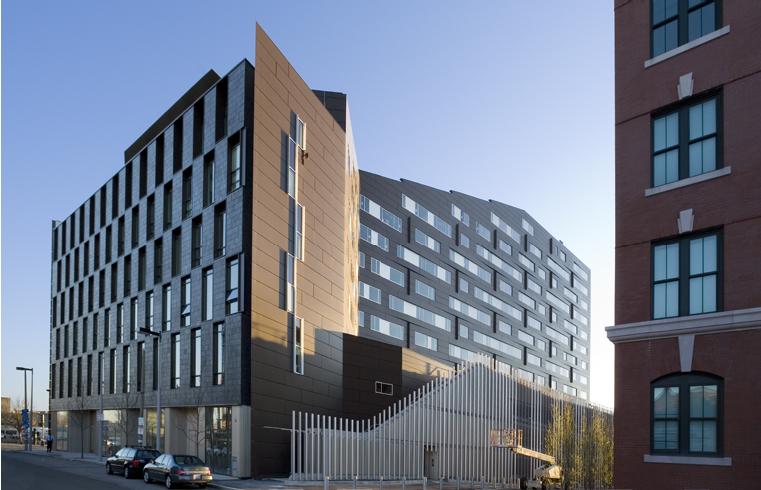
The firm, like many selected recently by the university for its projects, is known for edgy ultermodern architecture. Normally, as readers who tolerate me are aware by now, this would be the point where I go into a rant about how such architecture fails to fit in with the surrounding environment, often fails to live up to standards, etc etc. Well, for the record, here’s a sample of their previous work, the McAllen Building in Boston:

Photo Property of Office da (www.officeda.com)

But, I don’t have a reason to complain, for three reasons. For one, they’re designing bridge barriers, which tend to have less of an impact on their surroundings than buildings. For two, it has to be cleared by public forums in conjunction with the city of Ithaca and its residents, who won’t be so gung-ho for wild design features. To be honest, the train of thought in my mind is “can they really screw this up aesthetically? Not really. ” For three, nothing can be as bad the metal behemoths we were treated to last Spring, which gave the impression of being locked into a prison yard. When you’ve already hit the lowest lows in appearance, the only way to go is up.

I’m going to be  very interested to see what comes out of their studios in the coming months.


Whatever Happened to the CU ERL Project? (UPDATED)

14 07 2010

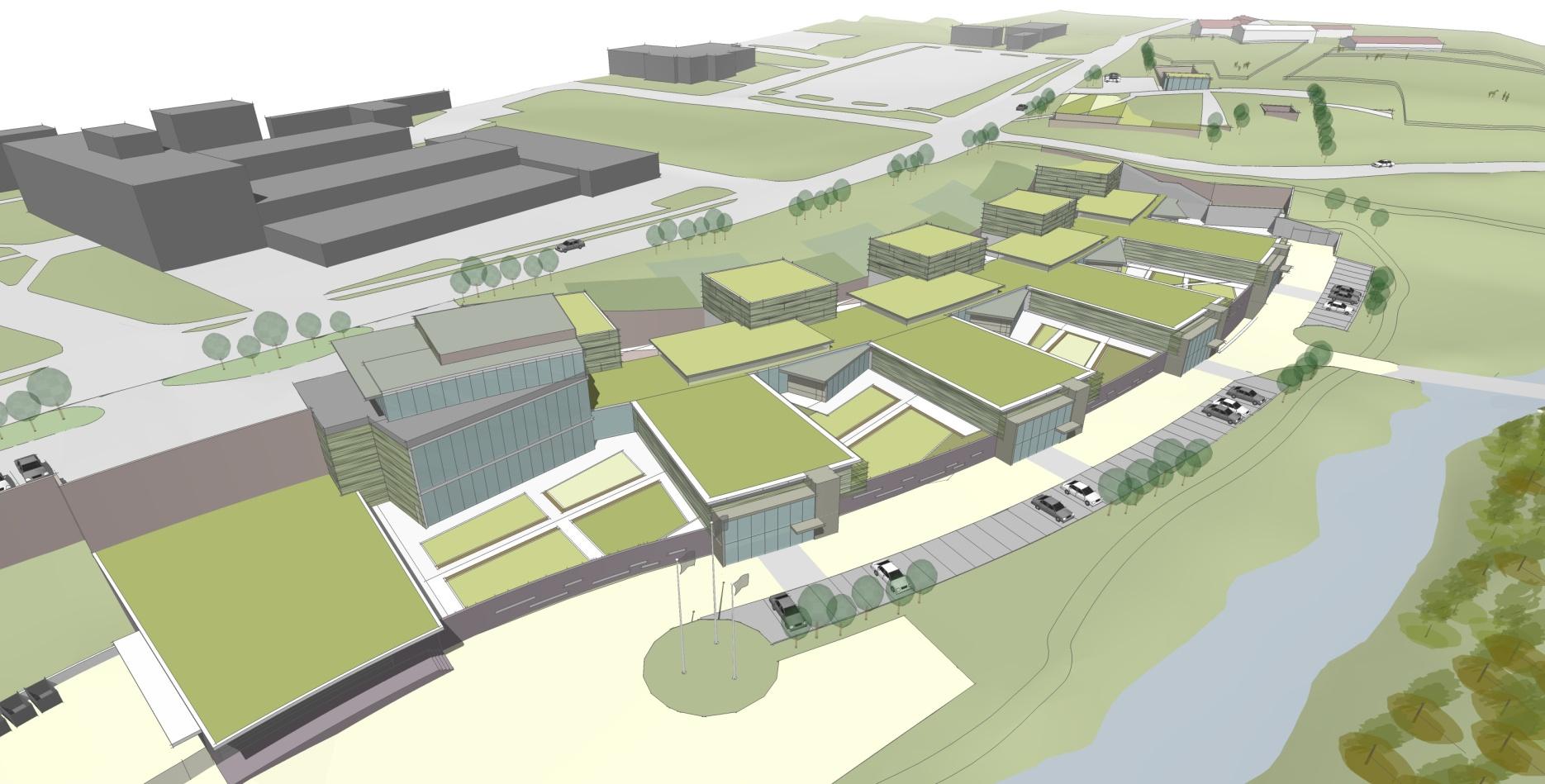
Renderings have been released through the Ithaca Journal’s website:


For reference, Riley-Robb Hall is in the upper level. This rendering is looking to the northeast. The cryogenic facility is to the upper right. More renderings can be found in the document attached to the main article.

***

About two years ago, I wrote an entry discussing the proposal of the Cornell University Energy Recovery Linac (ERL) X-Ray machine and how it was sechduled to start operation in 2011. Well, things kinda stalled when the Great Recession reared its ugly head far above Cayuga. In between compiling at my work computer, I decided to look at the the town of Ithaca’s latest planning board agenda. Lo and behold, it appears the project is back on. From the agenda:

Consideration of a revised sketch plan for the proposed Cornell University Energy Recovery Linac (ERL) project located north of the Pine Tree Road and Dryden Road (NYS Route 366) intersection, Town of Ithaca Tax Parcel No.’s 63-1-8.2, 63-1-2.2, 63-1-12, 63-1-3.1 and 63-1-3.3, Low Density Residential Zone. The proposal involves construction of an underground accelerator tunnel (14-foot diameter and +/- 1 km long), a cryogenic facility, and an extension to the existing Wilson Laboratory (+/- 185,000 gross square feet of building space). The project will also involve new stormwater facilities, parking, outdoor lighting, and landscaping. The Planning Board may also discuss the draft scoping document for the Environmental Impact Statement.

Now, long story short, the project consists of a massive extension to the Wilson Synchrotron and a large addition to the Wilson Lab, illustrated in the diagram (which I am virtually certain sure was designed by Munier Salem, as it shares similarities to his previous works and it’s part of an article he wrote for the Daily Sun back in the fall of 2008):

The article also goes into much greater detail about how it’s supposed to work; much more detail than I am going to go into here. Economically speaking, the project has considerable potential for the region: the University and project affiliates estimate over 200 jobs would be created and the facility would bring nearly a billion dollars in economic contribution in the five years of construction and ten years of operation. It’s certainly much better than the alternative, which would be the Synchrotron unit shutting down and taking away 200 jobs.

So, it’s good to see things are moving forward once again. Let’s hope that things can stay on track from here on out.


Collegetown Construction Project Watch: 309 Eddy Street

20 05 2010

So, reviewing monthly planning board agendas turned up a proposal for 309 Eddy Street in Collegetown set to be discussed this month. Unfortunately, I can never make it to the meetings and Ithaca is terrible at posting the minutes online. However, applying a little knowledge and logic, we can get a good idea of what is proposed for the site.

First, let’s go over the site itself. This is a little ways down from Dunbar’s on the east side of the street, next to Souvlaki House. The current building is a large student apartment house dating from about 1900:

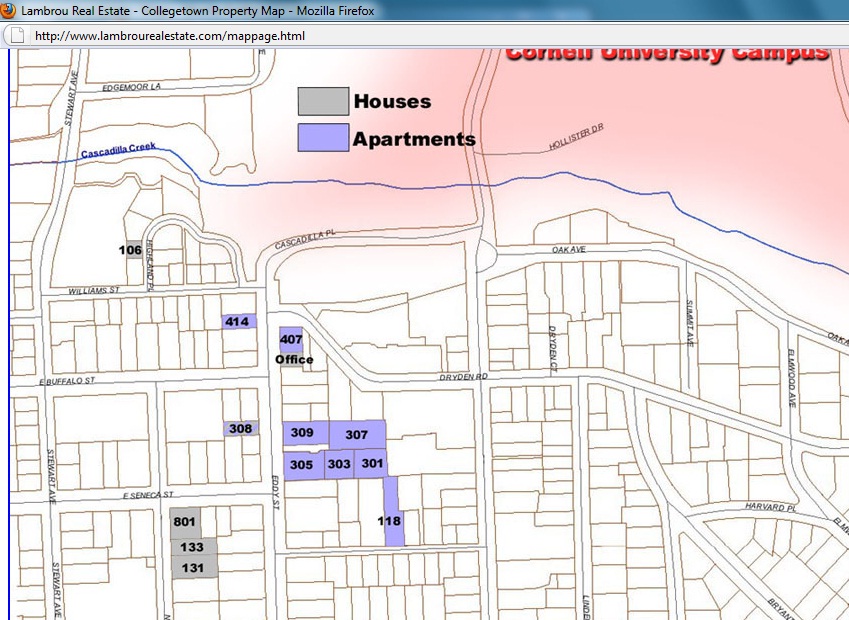
The house sits the in the middle of a series of large apartment buildings – the Fontana Apts (327-407 Eddy), and the four buildings that make up the Collegetown Park Apts. (301 Eddy-307 Eddy). All of these buildings were built in a time period from the late 1980s to early 2000s (the last was about 2002). All properties, including the house, are owned by Lambrou Real Estate, one of the major players in the Collegetown rental market with a couple dozen properties in the area (not all properties are shown in the map below).

Lambrou Real Estate seems to have a figurative love affair with the local architecture firm Jagat Sharma, which has a very distinct style but its readily apparent in all their buildings (postmodernist with extensive brick work and subtle contrasts within the facade, but otherwise not really daring). All of Collegetown Park, as well as the Fontana Apts, was designed by Sharma & Associates. It would be logical to assume that a future Lambrou project would have Sharma as the architecture firm in charge.

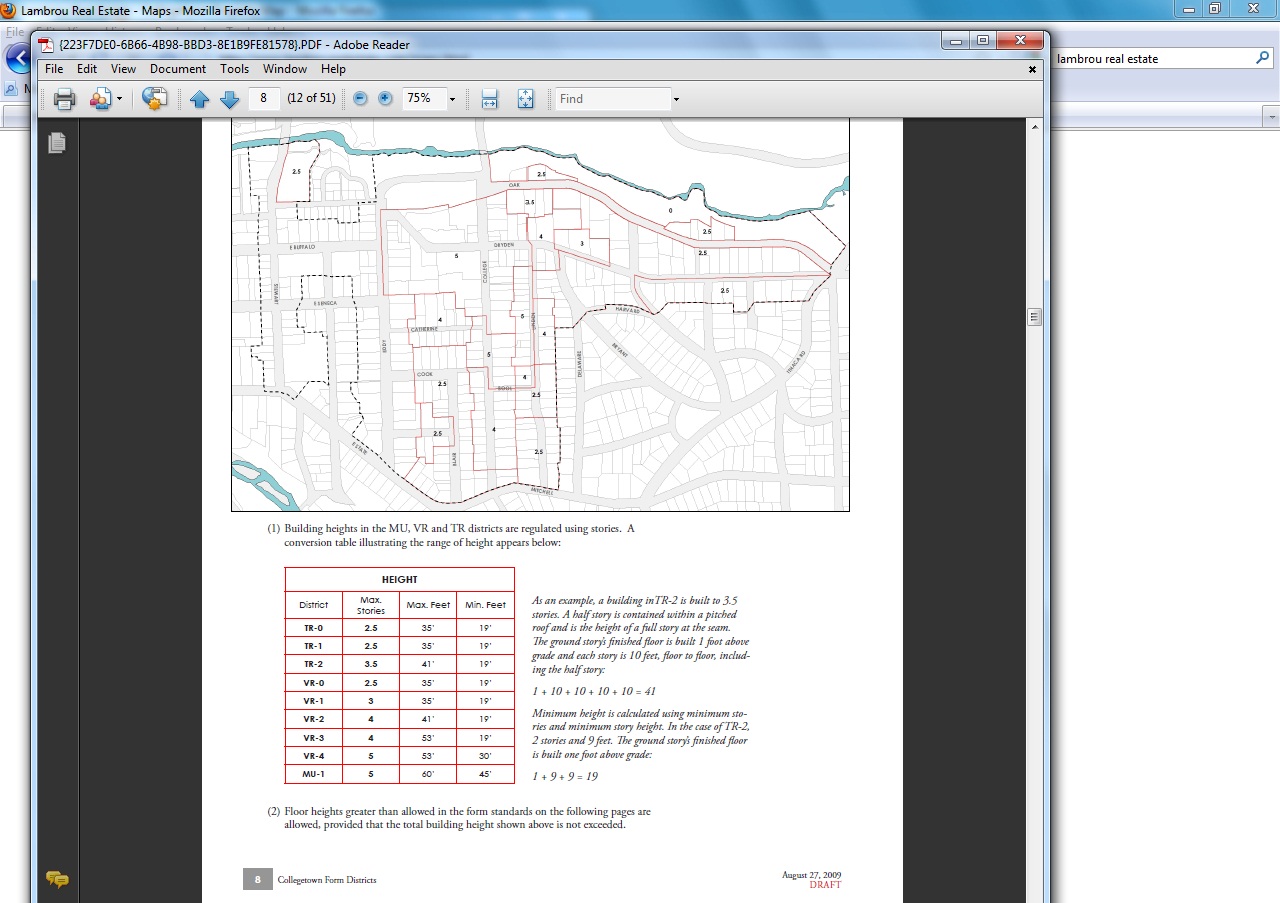
From a zoning and massing perspective, a review of the Collegetown zoning (which I’m not even completely sure it it was ever changed according to the guidelines of the $150k clusterf*ck that was the Collegetown Vision Draft Plan)

Assuming it is, the lot is zoned for a 4 or 5 story building with a maximum height of 60 feet, and at least 45 feet encouraged. Street-front commercial retail is virtually a must for approval.

So, here’s my verdict. Within the next few months, there will be a full proposal for a 4 to 5 story building pushing between 50 and 60 feet, with retail in its base and apartments on the upper floors. It will most likely be designed by Sharma Architects, and as I’m checking the Lambrou website and not seeing this place for rent next year (possibly because it has not been updated), this place could get final approvals and construction permit for fall of 2010 with construction lasting at least six months (if it does turn out to be rented, a construction start date of summer 2011 will be far more likely).

UPDATE 9/29/10: Now we have renderings:

Not a bad design. Fits in rather well with the immediate surroundings. A little more work on that street and it could become as popular as the 400 block of College Avenue.


A Preview of Future Construction Projects

14 05 2010

A look at Cornell’s Capital Plan is a good source for the vague beginnings of any large-scale construction projects to occur down the Cornell pipeline in the next four to five years. Looking at the projects approves or under way, most have already been covered by this blog in previous entries (the ones that aren’t just renovations anyway — Warren Hall’s going to be virtually gutted over the next few years, but there will be no extensive changes to its exterior appearance). I know that Weill Cornell (WCMC) is about to start on a new 14-story, $650 million biomedical building down in the city, but I’ve always preferred to focus on the Ithaca area (because honestly, most Ithaca-based Cornellians could care less about the facilities in Geneva or New York City).

Projects seeking approval for FY (Fiscal Year) 2010 are clearly underway. The initial steel frame just went up for Milstein and the Statler’s rooms are being renovated. The Johnson Museum expansion is well underway (still in the giant hole in the ground stage, which makes sense since it’s mostly an underground expansion) and the Plantations Welcome Center is currently starting to undergo external facade work now that the frame and much of the insulation have been applied. Under the projects for future consideration section, the Olin Library improvements are in the pipeline as are the feasibility studies for the Cornell Rowing Center Renovation and Expansion and the Central Avenue Parking Garage (renders included below).

Central Ave. Parking Garage Proposal

Perhaps the most intriguing projects are the deferred major projects. Granted, they’re deferred, but they’ll likely come back online once budget conditions improve. One of these major projects is a $183 million engineering building. This could quite possibly be the one shown on the Cornell Master Plan that replaces Hollister and Carpenter Halls, especially since the master plan indicates the project is underway in some form.

However, the only probably with that theory is that there’s three buildings, all in the planning stages, in the vicinity of the engineering quad. Based off of old press releases, Site 2 as numbered in the image (the smallest circle) is almost certainly Gates Hall, which is described as a $65 million dollar project in the capital plan (makes sense; smaller building = lower cost). So, the question is, is the approved project number 1 or number 3? I doubt it’s both because then they would have to be filed separately since they are separate structures.

Another project of question is the East Hill Data Center, a $100 million project. Unfortunately, there are no rendering anywhere, and it’s impossible to use the master plan to figure out which building this might be, as the master plan totally redevelops this area, so this one is anyone’s guess.

The University Health Building and the Helen Newman expansion have been bandied about for some time. The new health building will have roughly the same footprint as the current structure, but maybe a floor taller. Helen Newman has been awaiting an expansion that will add a second pool and additional exercise space, but the original price tag was $15 million, instead of the $30 million listed in the capital plan. One wonders whether this is due to rising costs or more ambitious plans.

Hughes Hall and Myron Taylor Hall (the Law School) are due for $28 million in expansion and upgrades. If it’s anything like what is suggested in the master plan, it’s a modern-looking (i.e. clashes with everything around it) building with alot of below-grade parking. However, I have yet to see any true renderings for this project.

Last on the deferred list is an addition to the 4th floor of Phillips Hall, worth almost $6 million. Don’t expect this to be more than a few thousand square feet at most.

Well, my time at Cornell may be almost complete, but it seems like the construction will never be. It’s okay, I could always use another excuse to come back when I’m an alumnus.


News Tidbits 9/19/09: Stocking Hall’s Long Awaited Reconstruction is Approved — Dairy Plant to Shut Down

19 09 2009

The Dairy Bar as we know it will soon be no more. According to Cornell, the new Stocking Hall will start construction next September. The $105 million project will last approximately four years (meaning that no current student will see it through to its full fruition while an undergrad…probably not even the kids in the class of 2014). The project calls for tearing down the east portion of the building and building a new glass-fronted modernist four-story structure. The older portion of the building (the part that actually looks attractive) will be refurbished. In the meanwhile, the Dairy Bar will temporarily be moved to Trillium while construction is in progress.

The project was originally slated to begin this year, but was pushed back amid concerns with state budget cuts (i.e. lass money allocated to CALS programs) and adequate funding for the project.

MINOR UPDATE: I think this is the first time I ever heard the project come up in a fraternity meeting, but it was announced at the end of the meeting with the same tone one would expect to hear that Christmas has been cancelled until 2014. I have underestimated people’s love of the Dairy Bar. I also did not account for the fact that Cornell is laying off all Cornell Dairy employees.

***

http://www.news.cornell.edu/stories/Sept09/StockingHall.html

CALS plans major renovation of Stocking Hall

With $105 million from the State University Construction Fund, Cornell’s College of Agriculture and Life Sciences (CALS) will build a new four-story building to replace Stocking Hall’s “runway” and refurbish Stocking Hall, starting September 2010, to give the Department of Food Science and the landmark Cornell Dairy Bar state-of-the art homes.

The innovative design — including a glass-fronted Dairy Bar and dairy plant and ground-floor laboratories for wine production and sensory studies of food — will invite the public to learn more about food and dairy processing. From an observational balcony above the Dairy Plant, visitors will have a bird’s-eye view as Cornell ice cream, milk, pudding and yogurt move from processing to pasteurization to packaging.

The four-year project calls for demolishing and rebuilding the middle “runway” portion of Stocking Hall, the Dairy Bar and dairy plant along Tower Road with the new four-story building; the Stocking Hall “tower” on Wing Drive will be refurbished. The more modern Food Science Lab, at Tower and Judd Falls roads, will operate as a food processing research facility while reconstruction occurs.

Stocking Hall, which dates to 1923, will be outfitted with new laboratories for the study of connections between foods and human health, food safety, and food and biomaterial processing. Other highlights include a campus teaching winery and crush pad for viticulture and enology students, and modern classrooms and networked meeting spaces.

“The Stocking Hall renovation project presents a timely opportunity for Cornell’s nationally top-ranked food science program to provide the campus and Ithaca communities with a better understanding of how food moves from the field to the marketplace,” said Kathryn Boor, food science chair. “Citizens around the globe are increasingly interested in where their food comes from and how it is handled, processed and marketed.”

Boor said the overhaul would improve research and extension directed at dairy and food processors, and expand training for inspectors from the New York Department of Agriculture and Markets, as well as state-authorized certified milk inspectors. A modernized facility will also allow CALS to compete for more food safety, quality and processing research funds from federal and state agencies and private companies.

“Because our program conducts research and outreach aimed at improving dairy product quality and safety and wine quality, this renovation project will directly contribute to improving the viability of the New York dairy and wine industries, which are typified by family-owned and -operated businesses,” Boor said.

The Dairy Plant’s ice cream freezer, outdated tanks and pasteurization equipment will be replaced with computer-controlled machinery capable of transmitting data directly from the floor of the plant to the Web for access by employees, researchers and students.

“The redesign of Stocking Hall will make our day-to-day operations more efficient, allowing us more time and resources to focus on our core mission of supporting teaching, research and extension,” said Jason Huck, general manager of the Dairy Plant.

Next summer, the Cornell Dairy Bar will move to a temporary scooping station in Kennedy Hall’s Trillium Express to make way for construction. Once the first phase of construction is complete in 2013, the iconic Dairy Bar will reopen in Stocking Hall with a revived look and an expanded menu and seating.

Each year, the dairy processes 1.5 million pounds of raw milk from cows at the Cornell Dairy Teaching and Research Center in Harford, N.Y. It produces 140,000 gallons of milk, 20,000 gallons of ice cream, and 4,000 gallons of yogurt and pudding annually. About 80 percent of these products are featured at Cornell Dining locations, while the remainder is distributed to Cornell group houses and departments.

***

Dear Food Science Faculty, Staff and Students,

With the Stocking Hall renovation project entering the last third of the design phase, and with project time lines becoming firm, we are beginning to prepare for ground-breaking for our new building, now less than 12 months away.

The fact is that the current Dairy Bar and Dairy Plant stand in the direct path of a wrecking ball.  In September 2010, the building in which these operations reside will be razed to make room for a new, state-of-the-art Food Science building. The finished renovation project will reveal a new dairy research and manufacturing facility as well as a new food service facility that will serve Cornell Dairy ice cream and more.
Together with CALS senior leadership, the Food Science Department has developed plans for continuing our core teaching, research and outreach programs during the renovation period.  As you know, the Dairy Operations is an integral component of our Food Science program, contributing to undergraduate and graduate instruction in food science; to basic and applied dairy foods research; to public service through extension programs; and as a designated training facility for New York State Certified Milk Inspectors, the New York State Department of Agriculture and Market Inspectors, and the dairy industry.  In addition, the Cornell Dairy supports many other academic programs (including many College of Engineering courses) and serves as an icon to much of the Cornell community, old and new, in Ithaca and beyond.

Due to budgetary constraints, it is not feasible nor practical to construct an interim dairy manufacturing plant or Dairy Bar during the renovation period. Therefore, we are facing at least 3-4 years from the time when demolition starts until we have a new dairy plant and food service operation up and running.  Specifically, as of June 18th, 2010, the Dairy Bar in Stocking Hall will close its doors and the Dairy Plant in Stocking Hall will eliminate its manufacturing operations.  The staff positions associated with these operations will also end, and those holding these positions will be laid off.

Although it is more than 9 months until the Dairy Bar and Dairy Plant activities will be directly affected by the renovation project, it is our intent to openly communicate the future direction of the Dairy Operations to our entire team and to the community. Our goal is to provide our staff with appropriate resources and support. The Department and CALS Human Resources will assist our staff through this difficult transition.

As our department embarks on a challenging period of change and uncertainty in the face of hope for a better future, our vision is to provide long-term sustainability to our dairy foods research and outreach program within CALS.  We believe that we’re moving in that direction, but it will come at considerable cost to our team.  We appreciate your assistance in helping us to support our staff and our program through this challenging and emotionally difficult period.
Please do not hesitate to let me, Matt Stratton or Jason Huck know if you have any questions about our situation.

Sincerely,

~~~


News Tibits 9/18/09: New Six-Story Apt. Building Proposed

18 09 2009
  Proposed Building on Left, DeWitt Mall on Right
 

ecproject ithaca

100_1607

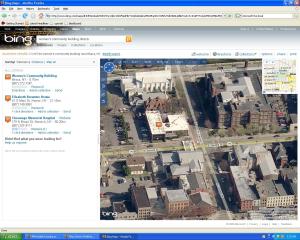
The site is on the corner of Seneca and Cayuga Streets, currently the 1960s era Women’s Community Building. The six-story building is to hold 50 units of affordable apartment housing. As proposed, the building would require a zoning appeal, but local officials seem receptive to the project.

http://www.theithacajournal.com/article/20090917/NEWS01/909170385&referrer=FRONTPAGECAROUSEL

ITHACA — Ithaca Neighborhood Housing Services has proposed a plan to demolish the Women’s Community Building and replace it with a six-story, affordable housing apartment complex, with community meeting space on the bottom floor.

Plans were first presented to Common Council’s planning committee Wednesday night.

The move would require the city to change zoning on the lot. Current zoning allows four stories and requires one off-street parking space per unit.

INHS is asking that the lot be changed to match the zoning on the other three corners — the Clinton House, the Masonic Temple and the DeWitt Mall — which allows six stories and requires no off-street parking.

Planning committee members were supportive of the change, saying it would help the city meet goals for downtown density and affordable housing. They also urged INHS to maintain the community meeting space currently provided in the Women’s Community Building.

INHS Executive Director Paul Mazzarella said it’s certainly the organization’s intention to keep the space, but that financing and other issues may make it difficult.

One of the reasons the property’s current owner, the City Federation of Women’s Organizations of Ithaca, has agreed to sell is because they make so little money renting the meeting space, he said.

“They’re empty probably 90 percent of the time,” he said. “Quite honestly, it costs money to build and maintain that space.”

If built as proposed, the property would come back onto the tax rolls, based on a state formula for affordable housing complexes, Mazzarella said. The entire property is currently tax exempt.

As proposed, INHS would build 25 one-bedroom and 25 two-bedroom units, with rents ranging from $300 to $1,000 per month.

City Planning Director JoAnn Cornish said the zoning change “makes sense” and Alderman Dan Cogan, D-5th, said the proposed project is “ideal.”

Though parking wouldn’t be required under the proposed zoning, Mazzarella said INHS plans to build 15 spaces on site.

Planning Committee Chairwoman Jennifer Dotson, I-1st, supported the zoning change and encouraged INHS to create green space rather than on-site parking.

To meet state funding deadlines, Common Council would have to approve the zoning change, and the city Planning Board would have to grant site plan approval, before next February, Mazzarella said.

The planning committee agreed to circulate a memo with more information on the project, and address the issue again next month.


News Tidbits 9/14: Old People and Hippies Like Ithaca

15 09 2009
100_2009

Conifer Village

Two little planning tidbits of note. One is that a company that specializes in senior citizen housing complexs is scouting sites in the town of Ithaca near the Cayuga Medical Center [1]. The company is currently beginning work on a $10 million, 120-unit complex in Horseheads, which is effectively suburban Elmira (yes, people actually live in Elmira, and it’s a lot like Ithaca, just without the prosperity and colleges). The parcels the company is checking out aren’t too far from one senior citizens’ facility already located on West Hill, a 36-bed facility known as Alterra [2]. None of the company’s facilities are subsidized, so it’s unlikely to be different if an Ithaca location was constructed. This comes on the heels of the Conifer Village senior housing, which was also built on West Hill (72 units, completed last year). In the same vein, McGraw House in downtown Ithaca is planning a 25-50 unit expansion, and is currently in the development stages [3].

So yeah. Old people like Ithaca. I think it’s part of a trend of retirees moving to college towns to enjoy a “higher quality of life” and increased educational and cultural venues that are often associated with such communities. The New York Times did a story on it not too long ago [4].

In other news, Ecovillage is planning its third community, TREE. This goes with the previous two facilities in that area, SONG and FROG. The 30-unit addition, with a new “education facility”, has a tentative construction start in 2010, and for completion in early 2011 [5]. Ecovillage currently has 60 units at its West Hill location; White Hawk, another ecovillage, has plans for 30 total units over the next few years at its Danby location (for the record, Danby is a town just south of Ithaca). Hippies like Ithaca too. But, I s’pose that’s not really news.

[1] http://www.theithacajournal.com/article/20090914/NEWS01/909140356/New+senior-housing+center+may+be+coming+to+Ithaca

[2] http://www.health.state.ny.us/facilities/adult_care/county/tompkins.htm

[3] http://www.mcgrawhouse.org/expansion-project/

[4] http://www.nytimes.com/ref/realestate/greathomes/GH-Retire.html

[5]http://tree.ecovillageithaca.org/


News Tidbits 8/27/09: Phase Two of Coal Yard Apartments Planned

28 08 2009

From the Ithaca Planning Board’s August agenda:

Coal Yard Apartments – Phase 2, 143 Maple Avenue, Steven & David Beer Owner/Applicant.

Declaration of Lead Agency, Public Hearing, Determination of Environmental Significance, Consideration of Preliminary & Final Approval. The applicant is proposing to construct an Energy Star-rated, 25 unit apartment building located between the existing coffee shop and the existing 10 unit apartment building that was constructed in 2007. The new building will have four residential stories built on top of a 16-space underground parking garage. The new building will have four 3 bedroom units, seven 2 bedroom units and fourteen 1 bedroom units and will have an elevator. The applicant anticipates that the majority of the bedrooms will be singly occupied. It will have a flat roof, and will include many of the design elements of the 10 unit building. Lower levels of the façade will be brick and upper levels will use similar fiber cement clapboard and solid board panels used on the 10 unit building. Colors will match or complement the existing building. The target market for the building will be graduate and profession students, professional academic staff and faculty, and seniors. The project is in the R3b Zoning District and will require a variance for height. This is a Type I Action under the City of Ithaca Environmental Quality Review Ordinance in accordance with §176-4 B (k) and an Unlisted Action under the State Environmental Quality Review Act and is subject to environmental review.

The property is part of the Beer Properties portfolio, which includes the Grandview House in central Collegetown. The trick here will be getting the height variance approvalas Ithacans are very protective of their sight lines. Here’s a picture of the 10-unit building taken from their website:


The apartments are aptly named, since this used to be the coal yard for the city of Ithaca back in the day [1]. Prior to discontinuation of passenger train traffic in 1963, the site was also home to the East Lehigh Valley Railroad Depot. The coffeeshop referenced in the city agenda is the “Queen of Tarts”, which sounds like a great name for a madam as well as being a cute pun.

The project falls outside of the Collegetown Vision area and would not be affected by any zoning changes as a result of the Collegetown plan.


[1]http://www.beerproperties.com/cya.html


News Tidbits 7/29: Hotel Ithaca Gets Green Light; C’Town Terrace Not So Lucky

30 07 2009

In the city of Ithaca, when the only thing standing in the way of construction is a parking/bus stop issue, that means things are looking pretty good for construction in the near future. As for the Collegetown Terrace Project, the anticipated summer 2010 construction start may be more of a pipe dream than a reality.

http://www.theithacajournal.com/article/20090729/NEWS01/907290338/1126/news/Terrace+proposal+raises+historical+issues

ITHACA – Ithaca’s Planning Board has given preliminary approval to the Hotel Ithaca project and has begun the environmental review process for the Collegetown Terrace Apartments.

 At their Tuesday night meeting, planning board members approved a document that laid out concerns on issues such as traffic and historic resources related to the apartment project. 

 The proposal calls for demolishing all but three buildings in the 16.4-acre area bounded by Quarry and State streets, Valentine Place and Six Mile Creek and replacing them with seven buildings that would house approximately 1,270 people. The site currently houses about 635 people. 

 The three buildings that will remain are all within the East Hill Historic District. At Tuesday’s meeting, planning board members and city planning staff said there may be other buildings in the area that are not historically designated but that merit further research on their historic value during the environmental review process. 

Board member Tessa Rudan highlighted the former nurse’s residence, which “may be dedicated” to Finger Lakes native Jane A. Delano. Delano founded the American Red Cross nursing corps, led the entire nursing corps during World War I, and is buried in Arlington National Cemetery, Rudan said.

She also has been featured on a stamp in the African Republic of Mali because “she figured out the mosquito netting technique before there was scientific evidence to explain why it worked,” board Chairman John Schroeder said.

Members of the public will have the opportunity to weigh in on issues they think should be addressed in the project’s environmental impact statement at a meeting scheduled for 7:30 p.m. Thursday, Sept. 10, at City Hall, 108 E. Green St. The city planning department will also accept written statements on the project.

For Hotel Ithaca, the proposed $27 million hotel at the eastern edge of the Commons, the biggest outstanding issue is where to locate the bus stop, project architect Scott Whitham said.

While the hotel is under construction, the stop is scheduled to move around the corner to East State Street, near the Community School of Music and Arts. Hotel developers, the city and Tompkins Consolidated Area Transit officials have discussed the idea of moving the bus stop there permanently so that the stop and the hotel drop-off don’t interfere with each other.

The move would require eliminating two metered parking spots, which half a dozen merchants and property owners said Tuesday would spell disaster for their businesses. Property owner Donald Dickinson said he rents to four tenants on the block and two have said that if the new bus stop goes there, they’ll leave.

But keeping the bus stop on Aurora Street could result in hotel guests parking in the bus pull-off, Whitham said.

Schroeder said he wants to make sure the Hotel Ithaca doesn’t mimic the situation at the Hilton on Seneca, where the guest pull-off squeezes out the sidewalk.