All Ivies Make (Architectural) Mistakes

28 11 2011

Somewhere during my crappiest Thanksgiving ever, I was reading through the online Daily Sun and came across some comment where the individual suggested that Cornell has the worst architecture in the Ivy League. I spent a little while mulling over that critique – sure, some of our halls are quite ugly, but the worst Ivy?

Curious, I decided to look at some  of other schools. I don’t have some chip on my shoulder over the lack of “pretty” buildings at Cornell, and certainly “ugly” is a subjective term. But Cornell is not the only school that has designed buildings that have earned harsh rebukes from certain audiences.

Harvard people have been criticizing themselves for years. One of the first things that came up in my search was a polite criticism of the modern architecture that took over Harvard’s campus starting the late 1950s (the Quincy and Leverett Towers). The article was published in the Crimson, the Harvard student newspaper, in the early 1990s. If you really want to go in depth, someone wrote an entire book dedicated to reviewing Harvard’s architecture. Today, Harvard is putting up modern buildings such as a science buildinga new graduate housing complex, and Tata Hall (I’m still wondering if Cornell plans on naming a building for Ratan Tata ’59) The take away could be that Harvard, like Cornell, builds in the style of the times; but it would be worth noting that Harvard has buildings 130 years older than Cornell.

Down in New Haven, Yale is no stranger to “ugly” architecture either, with such structures as the Art and Architecture Building and the Beinecke Library to its credit. Their newest set of dorms are designed in a Collegiate Gothic style that has mass appeal, but they decided to demolish several historic buildings to build it.

Going down the list, I didn’t see one campus that was “unscathed”. Princeton, U Penn, Brown, Columbia, even Dartmouth, which lacks your usual Science and Engineering building culprits. It seems most of them entered the 60s and threw cohesion out the window for daring departures that have, for the most part, not aged well. Even now, many of these schools are still trying some avant-garde edginess to further their names.

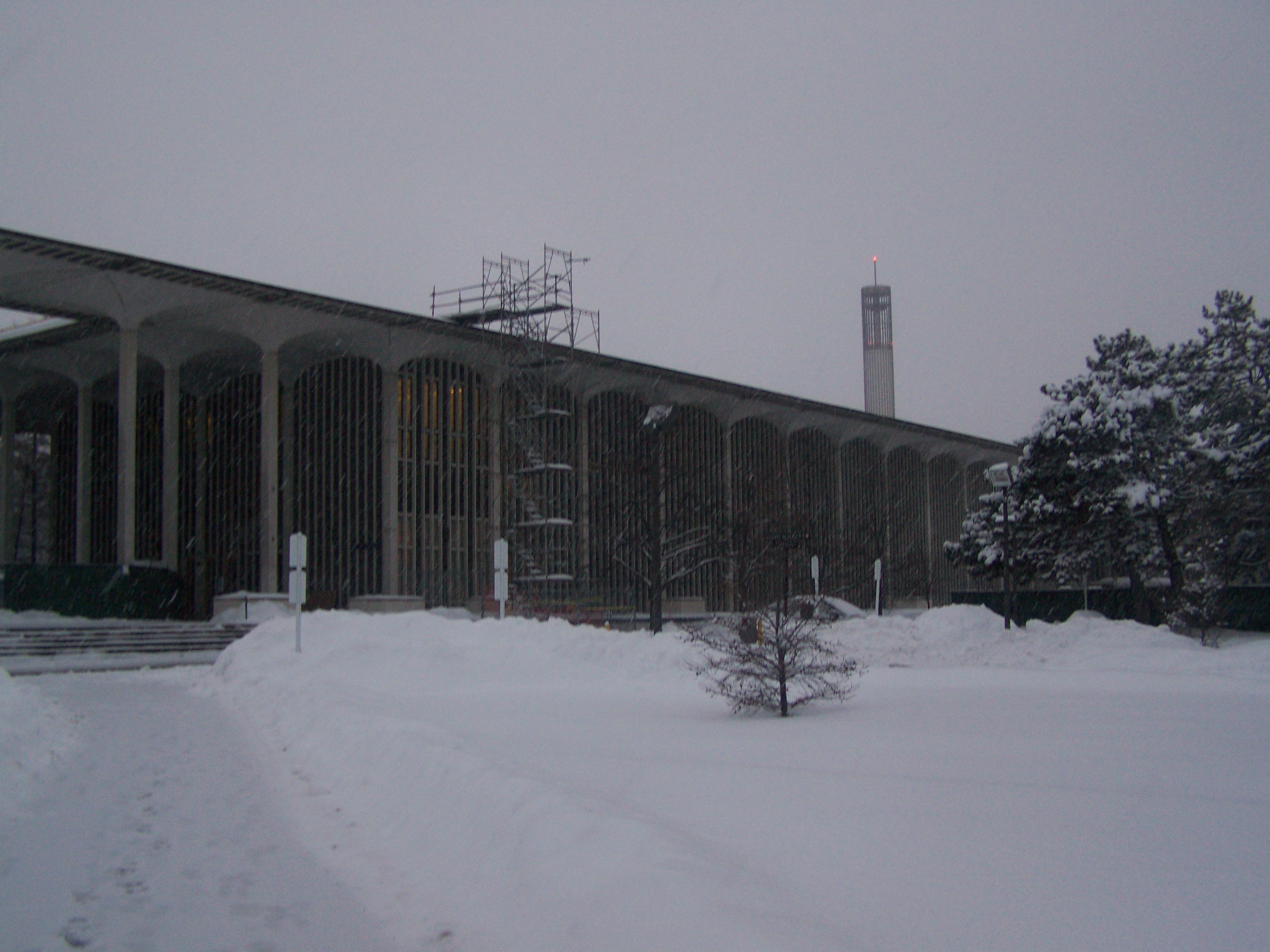
Would I venture support or denial of the “ugliest Ivy” claim? I am forced to stay neutral. I’ve only been to four of their campuses, not to mention it’s a matter of opinion. But, considering some of the college campuses out there, I know things could be much worse:


News Tidbits 11/16/2011: Cayuga Green II Gets a Revival (and a Revision)

16 11 2011

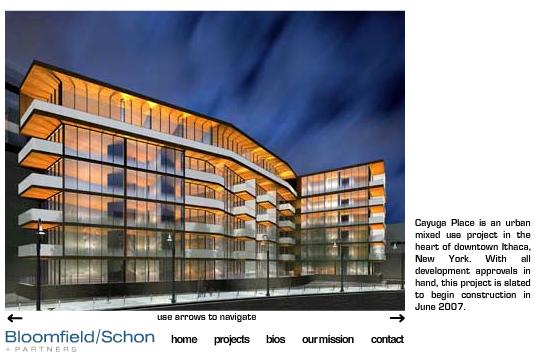
In terms of Ithaca-area development, I consider myself an optimist. But Cayuga Green’s second phase was one of those projects I had written off as left for dead. For a quick background, Cayuga Green is the formal name for the mixed-use project that has been underway on Green Street in downtown Ithaca for about ten years. The project, proposed for a piece of land that was then-used for a large parking ramp/lot, was aimed to revitalize that section of downtown, but was not without controversy due to its use of property tax abatements by developers Bloomfield & Schon. The first phase includes the new Cinemapolis (one of the results of the controversy was to switch from a new multiplex to a new space for Cinemapolis), the redone parking garage, a creekwalk, and the Cayuga Place Apartments, where the new TCAT stop is.  The first phase was completed a couple years ago.

By a fair account, the project has had mixed success. What has been built is doing quite well. Gimme! Coffee, Palmer Pharmacy and Urban Outfitters filled the new commercial space (all of which were new, not companies that moved space), and the apartments had a low vacancy rate. Cinemapolis has adjusted to its new space and the street is rejuvenated. The project spurred nearby development, including Gateway Commons and the Hotel Ithaca project. The caveat comes from the second phase, which was supposed to start in mid 2007. The financial market started to tank, and this phase had never gained financing, government or private. The space it was intended for, behind the city’s new parking garage, was left empty.

It would seem that is about to change. Thanks to a tip from from frequent visitor and favorite old fart “Ex-Ithacan”, the project is going in front of the Planning and Economic Development Board. The revision is for a six-month extension on the site (construction was supposed to start by 12/31/2011, even after a previous delay),  The amendment notes the project seeks no tax abatements, but must go to the Common Council at the end of the month for final approval.

Also notably, the project is revised. The original proposal looked like this (image from developer’s website):

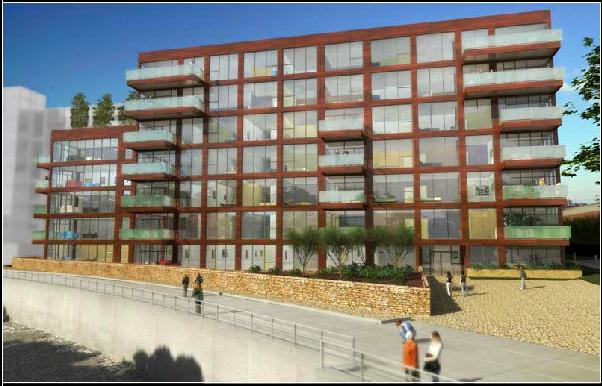
Which was revised to this:

and now looks like…this (from the agenda):

The newest incarnation is 6 stories, 35 units of condos, and 8,500 square feet of office space, of which about 5,000 feet is reserved for the Park Foundation, a local non-profit. No new environmental review is required, which should save time in the approvals process, and that will be handy since final approval and building permit will have to be issued by June 30, 2012.


Beauty in the Eye of the Beholder

10 11 2011

So, this is a question that I often wonder about when I play the role of armchair architecture critic. Cornell has pontificated that “each new building should reflect the spirit of Cornell as a pioneering institution and should represent an awareness of its time and place”. Back in the day, that was symbolized by A. D. White’s passionate desire to develop the campus into a New Yorker’s version of Oxford, hence his well-documented derision of red-brick buildings such as Morse Hall and Lincoln Hall, as these were very un-Oxford-esque. Lincoln Hall was built while White was overseas as the U.S. ambassador to Germany (effectively, they sneaked it in when he wasn’t looking), and it’s been said that White smiled when he first heard Morse Hall was destroyed by fire back in 1916. I’m guessing he never counted his own house, but maybe he considered that to be tucked away from the main campus, which it was back in the early days.

Cornell’s architectural preference has evolved with the times. By the 1920s, the fashion was Collegiate Gothic, as seen in buildings like Willard Straight. By the 1950s and 1960s, function was deemed more important than form, and we eneded up with buildings like Clark Hall, and Hollister et al. on the Engineering Quad. Today’s buzz is about “Starchitects” like Rem Koolhaas (Milstein Hall), Richard Meier (Weill Hall) and Thom Mayne (Gates Hall), who designed ultramodern structures that are meant to represent Cornell’s forward-thinking.

My question lies in what is interpreted as forward-thinking. It seems college campuses these days follow two rather discordant trains of thought – one of the modern or ultramodern designs as we have seen lately at Cornell (I was tempted to call them avant-garde, but I don’t think they’re radical enough to merit the term), and then a second line of thinking that delves into the Neoclassical and Gothic themes that conjure images of the romantic colleges of our grandparents’ youth.

Take for instance Princeton and their new Whitman Residential College, or Notre Dame’s new Eck law school building:

Image Property of Notre Dame University

Granted, comparing the new STEM buildings to Dorms and Social Science buildings is a bit like apples to oranges. But what are the pros and cons for the new Houses on West Campus? Were we better off with new and contemporary, or should we have revived the original 1920s era plan and constructed new Gothics?

The original West Campus Plan. Image Courtesy of Wikipedia

Any casual reader of this blog probably recognizes that I fall more into the traditionalist point of view. I guess my concern lies with the aesthetically pleasing value of a campus. Cornell has some tremendously wonderful natural spaces both in the confines of the main campus and surrounding it (the many gorges and waterfalls throughout the area assure that much). The built environment can either enhance that or detract from it, and I’d venture at Cornell it’s been hit-or-miss over the years.  I wonder though, if the increasing traditionalism of some of our peer institutions gives them a recruiting advantage for top students. I think the West Campus structures are quality constructions, but they don’t quite garner the same level of fondness as the arches and turrets Collegiate Gothic.

So I’m going to go out on a limb and throw the question out there for debate. What role does architectural style play in prospective students’ decision-making? Is Cornell being bold and progressive in its current architectural plans, or are we foregoing traditional architectural styles at a detriment to the physical appeal of the university? I’m really curious to hear others’ take on this, so please leave a comment if you’d like to contribute your opinion.

P.S. I don’t want to downplay the importance of interior design, which is important from a livability angle. But I am more interested to hear about opinions about building exteriors, since they often set the first impression.


The Keyword Bar XIV

5 11 2011

Honestly, I had not realized so much time had passed since my last entry, so I figured I’d cobble something together based off of my stalwart “Keyword Bar” entries.

1. “johnson boatyard ithaca zoning” (11-5-11)

Actually a fairly good question given the recent proposals for townhouses, and later additions, to the area in the the boatyard’s immediate vicinity. Conveniently, they city of Ithaca offers a zoning search tool based on address. The zoning in the 700 block of Willow Avenue is I-1 (light industrial), M-1 (a general clearing house for just about everything on a waterfront and up to 5 stories),  or P-1 (parks & rec) depending on the property.I am not aware if rezoning is required for the project, but it looks like that it will not be necessary if it falls into the marine zoning.

2. “gates hall expected date cornell” (11-5-11)

According to Cornell Facilities Services, tentative opening will be December 2013. When the official ceremony will be, probably sometime afterwards.

3. “cold stone creamery ithaca” (11-4-11)

Actually, this has come up no less than a dozen times in the past week or so. That actually worries me a little bit. I have fond memories of trips to Purity, even if I’d but ice cream for home, leave in my freezer six months, and then throw it out when it was badly freezer-burnt. But anyways, the new Cold Stone/Tim Horton’s  drive-thru is  in the southern part of the city near Buttermilk Falls (407 Elmira Road, to be specific). Not that I have a problem with Cold Stone itself, but I am a little cautious about the homogenization of Ithaca. I’d like to see the right combination between local flavor and well-known chains, but there’s not exactly a chart that says what the right combo is.

4. “cornell law school building renovations 50 million 2011” (11-4-11)

I’ve been lax about mentioning this one, but not without reason. Cornell is planning significant renovations to the Law School, with a gross addition of about 43,000 sq ft, which for comparison’s sake, is similar to the size of Milstein Hall. However, most of it appears to be in below-street-level additions, with the most notable changes being a new entrance onto College Avenue, and a pronounced addition in the courtyard. Also, construction won’t start until summer 2012, and will go through to December 2014, which is only a few months before my five-year reunion. So, it’s largely hidden and way down the line, but it is on the drawing board.

5. “ithaca november snow” (11-2-11)

It happens. Frequently. 5.9 inches worth, on average. The past ten years were, going back in time, 0.0″, 0.0″, 6.6″, 1.2″, 0.6″, 2.3″, 1.6″, 1.0″, 9.6″, and 0.0″.  So, it’s an average with a rather spread-out distribution.


News Tidbits 10/26/2011: I Can Barely Keep Up With All These Proposals

26 10 2011

When I started writing about construction projects, it seemed like they were relatively unreported by different news sources. Now it seems like I can’t avoid seeing an Ithaca Journal or Cornell Sun article detailing some construction project. I dunno if that’s because someone decided that construction is suddenly more noteworthy or if I’m just relatively more observant on these sort of things now that I live outside the area, and information is harder to retrieve. Lately, another reason might be that there’s been a ton of new projects coming down the pipeline.

In the latest Ithaca Times, it has been noted that Fairfield Inn project down in big box land, and the Seneca Way project, have both met their final approvals, which means sites can be cleared and construction can start hopefully in the near future. While that should be no problem for the hotel, the funding concerns with Seneca Way may cause some delays with that project, and it will be a waiting game to see when site prep begins and construction starts. Personally, I’m hoping to avoid a repeat of Ithaca Gun.

Image Courtesy of Cornell Daily Sun

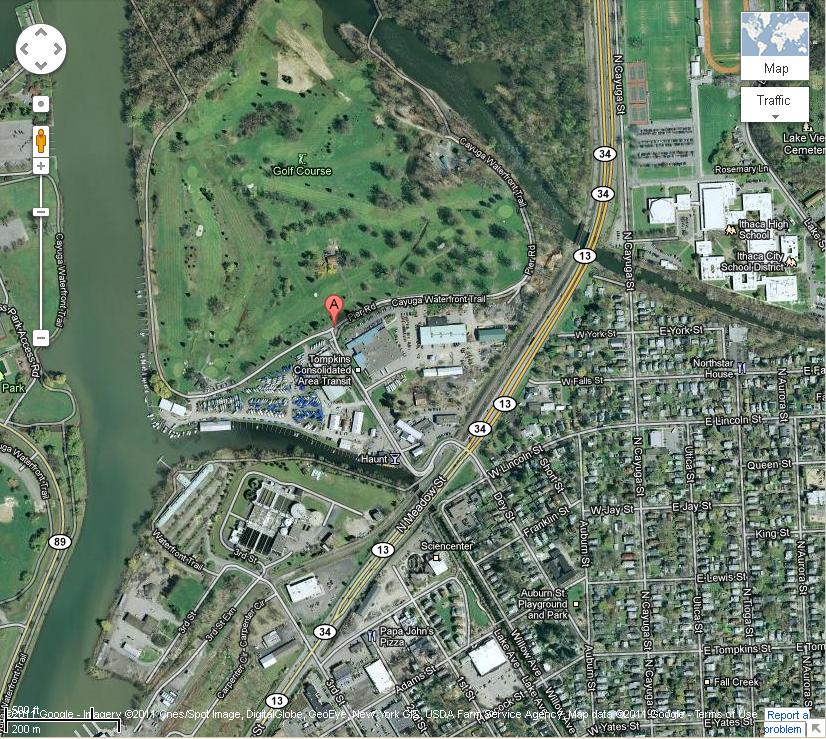
As for new projects, a new sketch plan was proposed, informally referred to as the “Johnson’s Boatyard Housing Project”. The project is sited for Willow Avenue, which lies to the northwest of Fall Creek, on a parcel of land jutting out past Route 13 and across the inlet from Cass Park (so, right next to the city golf course). Apart from the boatyard, there are several light industrial and commercial properties, as well as some undeveloped space. Since the project is planned to be adjacent to Willow Avenue, I suspect it is within the already developed area.

Map Courtesy of Google Maps

The sketch proposal suggests three phases of development.  The first phase, to start next year, will build about 20 townhouses. The second and third phases will be multistory (2-4 floor) mixed use buildings (retail on bottom, apartments on top) built near or along Willow Avenue. Market conditions will decide the final scale and timeline for those phases.

Last but not least, and this falls more into the rumor mill, but Tompkins County is planning a Center of Government building in downtown to place all of its administrative services under one roof. The possibilities range from a new building on the site of the now-vacant old county library, or renovating and adding on more floors to adding 2 or three floors to the Board of Elections Building on Buffalo Street. The final decision will be made within the next several months.

So, quite a bit of news in the past month. The approval of the Breckinridge Project (52 apts, 6 floors), the approval of the Seneca Way Project (32 units + retail, 5 floors), the approval of the Vine Street Cottages project (29 units), the Holiday Inn expansion (9 floors), the approval of the Fairfield Inn project (4 floors), the announcement of the new Humanities Building (66,500 sq ft) and new information on Gates Hall (101,000 sq ft), the announcement of the Johnson Boatyard Project (20+ units)…just a lot of stuff lately. Which certainly isn’t a bad thing.


The Goldwin Smith Hall Addition

21 10 2011

As a general rule, checking facebook while at work/in the office is a poor use of time. My excuse is that I’ll run some scripts that take a few minutes (or overnight in two cases) to process, thus giving me down time. Well, on the stalker-philic facebook news feed, a friend of mine who happens to work for the university mentioned that Skorton just made an announcement that a new humanities building would be constructed. Technically, this isn’t “new” news, it’s been in the early planning stages for four years, enough that I wrote a blog entry about it almost three years ago. At the time, the project was evaluated to be about 60,000 square feet (35,000 new) with a budget of $45.1 million, in three conjoined structures similar in massing to the original building.

Well, according to the project’s website, the square footage has stayed about the same (66,500 sq ft), but the design has evolved quite a ways. A large atrium will be the centerpiece of the structure, and it will also contain the largest auditorium on the Arts Quad. The building will have a large cafe, faculty offices and classrooms, and be the hub for several smaller Arts and Sciences departments (which ones are undetermined, the only one confirmed to move in is the Romance Studies Dept.). The project, which will be funded mostly through donations, is budgeted at $61 million, with a tentative construction start date of summer 2013 and a completion date of the end of 2015. The building is designed by Koetter, Kim & Associates, the same firm that was responsible for the Physical Sciences Building.

Well, I can’t say I’m particularly impressed. Seems like Cornell is in its next iteration of the “giant atrium for cross-pollination of ideas”, and the overall design, while not offensive by any means, is a rather plain, mostly glass box. Not exactly eliciting much of an impassioned response from this armchair critic.


News Tidbits 10/12/2011: Hotels, Houses and Apartments (Oh My)

12 10 2011

Lots of news tidbits today.

So, I can’t believe I missed this piece of news on Friday, but it was my department picnic, so I wasn’t exactly around my computer much. In hotel news, the Cornell Sun and the Ithaca Journal are reporting that the Holiday Inn downtown is seeking a nine-story expansion, with the goal of starting construction in November of 2012. The Sun article notes “The expansion, if approved, will replace some of the hotel’s existing structures“, with a tripling of conference/meeting space and in increase in rooms from 182 to 195. A two-story ballroom and entertainment area would also be a part of the plan, to be built on the north side of the hotel. As an added benefit, the addition would create 20 to 25 new jobs.

Looking at the layout, the “Executive Tower” of the hotel is surrounded by two-story wings, which would be demolished as part of the redevelopment. The new nine-story tower will be built on the Clinton Street side of the property (south side). The ten-story tower that presently resides on the property was built in 1984, while the rest of the property, originally built as a Ramada Inn, dates from 1972. The Holiday Inn was last renovated in 2004. The project seems to be within current zoning, which is CBD-100, so the nine story addition will be equal to or less than 100 feet in total height.

***

Image Property of Agora Homes LLC

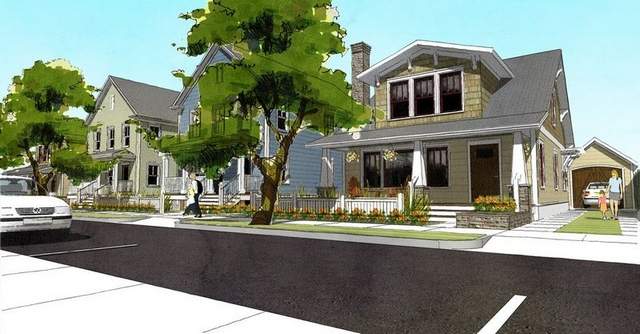
In other news, the houses and townhomes associated with the Vine Street Cottages project are officially a go. The site has been graded, utilities are being installed and they’re paving the private road through the property (which doesn’t quite make sense to me, since they’re going for a traditional-style neighborhood, but I digress).  The first model house will be complete by the Spring, and the other units will be built as interest demands. The final build-out plans 19 homes and 10 townhouse units. Prices will be in the mid-300,000s for homes and mid-200,000s for townhomes (for the record, the average house in Ithaca is worth about $191,000).

***

Lastly, the Seneca Way mixed-use project has received preliminary approval after receiving zoning variances. Final approval is expected shortly, and the project is expected to begin construction in late spring 2012, with construction lasting nine months. The original financing for the project has fallen through in the year it took to modify and approve the project, but the developer is looking to secure alternative financing. Whether or not they’ll have the resources to start construction as expected seems to be up in the air.  The five-story building seeks to have a parking garage at street level, commercial space on the floor above, and 32 high-end apartments on the upper floors. The building met with angry opposition from neighbors over its height and massing. The take-away here seems to be to tread carefully when proposing new buildings next to historic areas with well-heeled owners.

***

Lastly, for those who don’t read the comment section on blogs, “cornellnz” posted a link of the revised Gates Hall design:

The “deer carcass” structure I criticized seems to be gone, which is an improvement. Those giant pinnacles by the front entrance, however, make me think of “The Aggro Crag” from the Nickelodeon Guts TV show. I’m not sure whether or not to call that an improvement.


News Tidbits 10/04/2011: Breckenridge Place Clears the Funding Gap:

4 10 2011

From the Ithaca Journal:

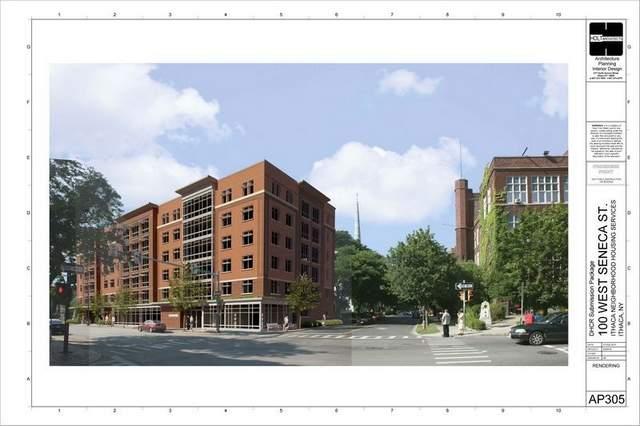
“Ithaca Neighborhood Housing Services and not-for-profit housing developer PathStone Corporation have received enough commitments for funding needed to build the $14.5 million Breckenridge Place in downtown Ithaca.

Breckenridge Place is planned for where the Women’s Community Building is now, at the northwest corner of Seneca and Cayuga streets, and would consist of 52 one- and two-bedroom apartments in a six-story building.”

Some readers might recall that this building was placed on hold after the initial round of state grants passed them over for funding last year. Now that the funding gap has been cleared, the project should have a relatively steady path to construction and completion (one can hope). The building is still the design of Ithaca-based HOLT Architects, though from the rendering in the paper, it appears to have undergone a revision. The site of the building is currently occupied by the Women’s community Building (shown below).

So, it looks like the development of downtown Ithaca is starting off the autumn season on a strong note this year.


News Tidbits 9/30/2011: A Big Red Bandhouse

30 09 2011

At my time at Cornell, I was fortunate enough to have friends in the Big Red Band, and I could listen to all their stories/drunk antics when I was at work (I left with the impression that the Big Red Band was basically like an extra-large fraternity with talent). I never really cared to pay much attention to the Bandies because it was never where my interest lied; I didn’t follow CU Athletics, and a big school at Cornell could afford to let people diverge into their separate interests, and for me it lay elsewhere. But, I can imagine a few certain alumni that I know must be celebrating right now.

According to the monthly alumni newsletter, the Big Red Band is about to get a facility of their own. Thanks to some large finacial contributions from band alumni David and Sarah Fischell (Fischell Hall? I think so!), the initial funding/planning is underway for a multi-million dollar band facility that will be located behind the Schoellkopf Crescent.

If I had to venture a guess on the exact siting, I would say somewhere on the parking lot, or close to the substation.  The upcoming expansion of Wilson Lab will prevent any other new structure from being built west of that facility.

As for the architecture firm, the name is familiar to Cornell – Baird Sampson Neuert, out of Toronto. They previously designed the Nevin Welcome Center in the the Plantations, and I’m sure whatever they design for the Bandhouse will only further the firm’s commitment to modern/ultramodern, geometric structures. The structure, though still in the design stage, it expected to have 6,400 sq ft and be at least three stories tall. The height is necessary due to sound pressures created by hundreds of musical instruments created at once, so a large volume is needed to spread out the force. Groundbreaking is expected to occur next year, with completion in Spring 2013, and dedication at the 2013 Homecoming, where the Big Red Band alumni group hopes to gather 500 muscially-inclined alumni for the event.


A Llenroc of His Own

28 09 2011

Image property of luxist.com

So, I suppose this entry is “off-topic” in that it’s outside of my usual body of work, but I could group this with my “Crazy Alumni Profiles” entries.

A few minutes’ northwest of Albany is a little hamlet called Rexford. Located in the suburban town of Clifton Park, Rexford has a fire station, a yacht club, and not a whole lot else. If you’re approaching from the southeast, you’ll notice something else facing the Mohawk River – a wrought-iron gate to a huge-ass mansion. A mansion called Llenroc.

According to the Albany Times Union, it has a helipad, fifteen fireplaces, an indoor swimming pool shaped like a sailboat, and gilded 24-karat gold ceilings. It sits on 12 acres on the Mohawk River, and was built for a price “rumored to be around $32.5 million.” The house was built in 1992 by insurance magnate Albert Lawrence. Lawrence was a “devoted Cornell alum” who modeled his house after Willard Straight Hall, and had the exterior laid with Llenroc stone. Of course, to top it all off, he had the estate christened “Llenroc”, just like the name we’ve given to Ezra’s old estate/current Delta Phi frternity house.

The story of the house is not a happy one, however. Lawrence filed for bankruptcy protection in 1997, after his Schenectady-based company collapsed. He lost his mansion to foreclosure, but he and his wife were still allowed to live in the house until it was sold off, and they ran it as a (massive) bed and breakfast inn.  However, his dirty dealings from his insurance days earned him a 20-year prison sentence in 2000, and he passed away in jail two years later. The house was bought in 2003 by a commodities trader for a mere $1.4 million, who then tried to sell it again four years later for $12.9 million. Unfortunately, the demand for mega-houses in the Albany area is rather slim, especially with the Knolls Atomic Power Lab just across the river in plain view. A hotelier named Mathai Kolath George offered to buy the estate, but he and his son were killed in a plane crash before any deal was finalized. Kolath supposedly planned to try and sell the house for $30 million. A limited liability company (with the dubious name of Power Angels LLC) bought the mansion for $1.9 million in late 2009. The house has remained out of the news since.

I think that funding scholarships would have been better, but to each their own.