The Keyword Bar XVII

26 07 2012

…because the planning board discussed projects I’ve covered ad nauseum and Cornell hasn’t caught my attention in the past week.

1. “how many students from cornell have jump to there deaths” (7-25-2012)

Death of grammar aside, this would not be an easy number to calculate, since a number of cases over the years have been questionable as to whether the fall was accidental or intentional, and whether an individual would be considered a student (ex. a case of a former student). That being said, it seemed from casual queries back during the 2010 suicides that for CU students who were believed to have committed suicides via gorge jumping, it is likely in the mid double-digits. This number does not reflect the number of suicides in the gorges (which is much higher, as they tend to be a magnet for those who want to go out in dramatic fashion), the number of gorge deaths (including accidental falls, the number is almost certainly in the few hundreds since Cornell opened) nor suicides that occur by other methods. From 2006 to 2010, there were three student gorge deaths by suicide, but a variety of other events (note – the hyperlink has one inaccuracy – William Jacobson was an IC student who drowned in a retention pond).

2. “eastman hall at ithaca named after” (7-25-2012)

Eastman Hall, an IC dorm, was built in 1962-1963. From what I can tell, many of these early buildings, built during IC’s rapid expansion on South Hill from 1959-1968, are named for older administrators or large donors (for instance,  Talcott Hall is likely tied to a student life administrator named “Mrs. Talcott” in news articles from the 1930s). Although there is no concrete evidence, Eastman Hall is likely named for George Eastman, founder of Eastman Kodak in Rochester, and a well-known philanthropist, especially of music schools. Although he passed away in the 1930s, it’s possible his company, or some foundation attached to his estate, made a donation; or it could be the manifestation of a donation from when Eastman was alive.

3. “chi gamma at cornell university sorority” (7-22-2012)

Their history seems rather unusual. Chi Gamma formed in 1956, after dissociating from its national (Sigma Kappa) because it did not wish to abide by the national’s racist membership policies. They lived at 150 Triphammer, and the sorority was active until at least 1963, when it merged with Chi Omega (both were small houses, so they decided to join forces as an attempt to hold their own in the increasingly meager sorority rushes of the ’60s). The house itself became home to the new and all-female Triphammer Co-op the following year, which became co-ed in the 1990s.

4. what is the address of the llenroc mansion (7-22-2012)

100 Cornell Avenue, Ithaca NY. There are only two houses on the street, the other I believe is a private residence.

5. ithaca “collegetown” fire 1998 (7-23-2012)

It might seem odd that in a stretch of century-old buildings, 407 College Avenue (the Apollo Chinese Restaurant building) was built in 2000 (as seen on its cornerstone). Well, the simple reason is that the old building, a wood-frame structure built in 1887, burnt down in October 1998, leaving 51 students homeless. The fire was believed to have started in the kitchen of a first-floor restaurant. Emergency housing and aid was provided by the Red Cross and Cornell. Since the site is prime Collegetown real estate, it was redeveloped into a six-story building and opened in August 2000.


Cayuga Green II (Cayuga Place) Goes Downscale

18 07 2012

ED. Please note the correction posted on August 11th.

Another incarnation of the Cayuga Green Condos has been proposed. First, the IJ article (for those without subscription, the Ithaca Indy provides another summary here). Now, first off, I would like to chastise the IJ for using an old image of the project – an image pulled from Bloomfield & Schon’s website of the modified third incarnation, which I include for reference below.

This is not the current proposal.

This is not the current proposal.

Notice that this has six floors. The revised version has four. This version also had 8000 sq ft of commercial space and 35 residential units. The revised proposal (which was only available in two thumbnail links, one of which was broken) has the same commercial space and 39 units, but less space overall – from 47,400 sq ft to 42,600. According to the IJ, development costs have been estimated to be about $8.5 million for this phase of the project.

I’m not even going to nice here. The design proposed does nothing good for the architectural pride of the development company. It’s essentially a glass box, with a little concrete filler. Boring, but okay. Even if it doesn’t have balconies, or even any shape to it apart from being a big glass box (heck, the earlier design the IJ tried to mislead people with is light-years ahead of this proposal). My issue is that it doesn’t even obscure the parking garage next to it, which overwhelms the proposed structure. It’s like they said, “hey, people will pay anything to live in Ithaca, so let’s try and squeeze as many as we can into as plain of a structure as possible” (I digress, this is the mantra of many low-brow developers, but I expected better from Bloomfield & Schon). Now, the last I checked, this was marketed as a luxury project. Nothing says luxury like being dominated by a parking garage next door. It’s just…mind boggling, in terms of planning and action. Cost of development aside, I’m having trouble imagining the developer getting these modifications past the planning board.

But, they kinda have to. In order for the developers to avoid issues with special resolutions from the city, the project needed to have financing and approval secured (i.e. construction starting) by June 30 – almost a month ago. So they’re already in hot water, and apparently, someone decided to water down the design, because I guess if you’re going to get on the bad side of city government, you might as well go for the gold. The prospects for development of this building are looking rather dim.

What a way to enjoy my morning – watching the IJ wrongfully mislead people with the incorrect design, and seeing the undersized box proposed. It’s mornings like this that I feel like I need to start drinking coffee.


Quotes of Cornell

12 07 2012

A few thoughts from prominent folks about the school Far Above Cayuga:

“The university of Mr. Cornell, a really noble monument of his munificence, yet seems to rest on a misconception of what culture truly is, and is to be calculated to produce miners, or engineers, or architects, not sweetness and light. -Matthew Arnold, Preface of Culture and Anarchy, 1869 (Bishop 177)

“Columbia cannot grow, or at any rate cannot grow rapidly…unless it shall, at least to some extent, modify its plan of instruction in a more or less distant imitation of Harvard or of Cornell University”. Columbia President Frederick Barnard, 1870.

“[Cornell Vice-President Albert] Russel is a man whose nonreligious convictions are very pronounced, giving the university an air of positive irreligion. The decadence of the students is positive testimony to the evil effects of free inquiry.” – Lyman Abbott, editor of the Christian Union, 1881 (Bishop 215)

“I see, or think I see evidence of a growing disposition to drift away from the original intentions of Mr. Cornell in the founding of a purely non-sectarian university…I look to you [A. D. White] to protect my investment in Cornell from the common enemy.” Cornell Trustee Hiram Sibley to A.D. White, 1888.

“The University was sadly in need of reorganization and refitting.” – Benjamin Ide Wheeler, in reference to Cornell in the mid-1880s, quoted in 1902. (Bishop 259)

“The graduate students are the crown of the University, and Cornell cannot afford to neglect them for the sake of any others…” – David Starr Jordan, 1888

“The cry of the horse leech is modest and attenuated beside the stupendous greed and the insatiable clamor of this favored institution.” – New York Press, Nov. 1892

“[Cornell was] better endowed than any institution in the land, yet never did anything.” U.S. Sec. of Agriculture James Wilson, 1904 (Bishop 366)

“There is no university in the country in which freedom of thought and of speech is more firmly entrenched in tradition and in policy.” – Prof Henry A. Sill to Carl Becker, 1917

“[Cornell students] are good because it is too much trouble to be bad.” Romeyn Berry, Alumni News, 1926

“No more do the better students chant their Alma Mater in a happy trance; they sing from the side of the mouth, with the air of cynical priests of old Egypt.” – Alumni News, 1931.

“Cornell is a center of revolutionary communistic activity.” – State Sen. John J. McNaboe, 1936

“CORNELL GOES BOLSHEVIST” – Headline, New York World-Telegram, 1944

“We must retain private initiative and management in certain important fields, and certainly some of it in higher education.” -Edmund Ezra Day, 1948.

“At a time when Cornell was becoming a multicultural place, the Board of Trustees has thrown a dart into our celebration.” – Prof. Kenneth McClane, on the decision or Trustees to not divest South African investments, 1989

“[My wish for Cornell] is that it will continue to thrive and reach new heights … welcoming men and women of every color and creed, whatever their social standing or pecuniary condition. – Ruth Bader Ginsburg, 2003

“I am grateful to Cornell. I have seen the good work you have done in every stage of life.” – Bill Clinton, 2004 Convocation speech.

“My memories are strong about this place; important. And the two times I have been here for sustained periods have always been extraordinary.” – Toni Morrison, 2009.

“I would venture to say that the students at [Bush staffer Monica] Goodling’s law school at Regent University are far more impressive than those at the Cornell agriculture school — the land-grant, non-Ivy League school Keith [Olbermann] attended.”-Political Pundit Ann Coulter, 2009

“I got an excellent education, and that’s all I got from it…If I had to do it over again, or I had known what Cornell had been like, I never would have gone there.” Political pundit Bill Maher ’78, in a 2012 podcast


Why Syracuse and Cornell Would Ever Be Mentioned in the Same Sentence

3 07 2012

I have a certain fondness for the Orange. I grew up in the Syracuse sphere of influence, where because of the lack of national sports franchises in the region (a few hardy souls follow the Buffalo Bills, who went 0-4 in a row in the Super Bowl in the 1990s; having not been to the playoffs in over a decade, beings a Bills fan requires grief therapy), the Syracuse Orangemen/Orangewomen, now using the extra PC term of Syracuse Orange, were the teams to follow, especially in football and basketball. When I was growing up in my hometown not too long ago, it was generally expected that if you were reasonably talented, you went to SU. And a couple dozen of my high school classmates did just that. I was the only one in my year that went to the Big Red, 50 miles southwest of University Hill.

In my mind, I often draw parallels to Cornell and Syracuse. They were both established in the Reconstruction Era – Cornell in 1865, and Syracuse in 1870. Both are large institutions – the combined student enrollment for Cornell is 20,939, and Syracuse is 20,407. In terms of the prestige factor, both are well-regarded, although Cornell, with its Ivy League gilding, is usually considered the more respected of the two. US News & World report ranks Cornell in a tie with Brown for 15th (roughly constant for the past few years), and Syracuse 62nd (a drop of about 12 spots since I started college in 2006). That all being said, if Syracuse had had what I wanted to study, and it was better ranked in that field than Cornell, I would’ve gone to Syracuse, lack of ivy notwithstanding.

The two are physically close, superficially similar, and their history is intertwined, which is what I want to touch on with this entry. Collegiate snobbery aside, Cornellians and Syracusans undoubtedly owe a fair amount of their history to each other.

First of all, Syracusans can thank Ezra Cornell (or curse him, perhaps) for being located where they are today. Andrew Dickson White and Ezra Cornell were state senators in the early 1860s, when the Morrill Land-Grant Colleges Act was passed; Cornell represented the Ithaca area, and White was elected out of the city of Syracuse. While they both united under the common goal of establish one strong university with those land sale proceeds, they differed on location. White wanted Syracuse to be home to the new school, and for the college to be seated on what is now University Hill. He believed that Syracuse, a burgeoning transportation hub, would make it easier to recruit faculty, and that the city would serve the university better. However, Ezra Cornell strongly disagreed; he detested Syracuse as a den of sin, citing an incident where he was twice-robbed of his wages as a young man while working in the city. Old Uncle Ezra offered up his farm in Ithaca if White agreed to keep the school out of Syracuse. White relented, and in following fashion, named the school after its biggest benefactor. On a final note, while Ezra gave $500,000 (1865 dollars) and his property to his fledgling institution, he gave $25,000 (1865 dollars) to those who supported a Syracuse school, so they would support the bill establishing the Ithaca school. In turn, this money was used to assist moving Genesee College from Lima, New York, to Syracuse, and helped SU to be established.

In many ways, the relationship between Cornell and Syracuse could be described as antagonistic. Cornell had the first school of forestry in the state, from 1898 to 1903. At that point, Bernhard Fernow had ticked off enough Adirondack land owners and wealthy vacationers that the governor vetoed funding for the school, which led to the Board of Trustees shutting it down. However, several years later, under the influence of Syracuse trustee Louis Marshall, a new forestry college was established in Syracuse, semi-associated with SU (SUNY ESF, in 1911). Rather than completely give in, Cornell continued a much smaller forestry college within the agriculture school, which annoyed the bean counters in Albany enough that they officially made SUNY ESF the primary forestry school in the 1930s, relegating Cornell to only “farm forestry“. In exchange, Syracuse had to drop all ambition of its own College of Agriculture. Today, the forestry department at Cornell is known as the Department of Natural Resources.

Competition for state money has always been a sticking point for Cornell and Syracuse. While Cornell lost the battle for the forestry school, Syracuse lost the battle for the ILR school (Industrial and Labor Relations) while it was being conceived in the late 1930s. Post WWII, academic competition between the two schools has given way as they diverged in their interests; the primary contests between the two institutions these days involve sports, where Syracuse usually has the upper hand.

So, as much as students at the two schools may taunt and jeer at each other, both institutions have played a crucial role in helping to develop the other. However, given my orange and red sympathies, I will forever be unwelcome at SU vs. Cornell games for the rest of my life.


Ithaca’s Economic Mystery

25 06 2012

Image

One of the sections I tend to read in online news are local/state job reports, since they tend to be a bellwether for economic growth, and by extension new development projects that get featured in this blog. One of the things that has been of some curiosity to me in the past couple months is how poorly Ithaca’s economy appear to be doing. According to the NYS Labor Department, the state has seen about 2% in private sector jobs over the past 12 months – about 134,000. Not great, but not bad for a state that has been bogged down in economic doldrums since Gerald Ford was in office. As one would expect, some metros do better (Kingston, Utica-Rome) and two show remarkable decreases of -3.6% and -5.6%. These would be Elmira and Ithaca respectively.

Now, perhaps its just me, but if the economic shrank 6%in one year in a county of Tompkin’s size, you’d hear about it (and no, I don’t think there’s some vast political conspiracy by some partisan group to hide the figures). 3,200 jobs lost is something that can’t seem to occur unless there was very large company closing, something that would’ve been alluded to in the Ithaca Journal. As far as I know, Borg-Warner is still operating, and Cornell laid off at most a small fraction of 3,200 in the past year. There haven’t been huge decreases in sales of “essential” goods, not has help wanted advertising changed dramatically (assuming the monthly reports of Elias Kacapyr are correct, anyway). So for the longest time, I had been wondering what the heck was going on in Tompkins County.

Well, it would seem that I wasn’t the only one wondering about this. The local county development agency accuses the Board of Labor Statistics of undercounting jobs, a problem they state has been an issue in the recent past. As much as the cynic within me is tempted to see as someone just trying to downplay the number, I’m inclined to believe that they’re right, because the rest of the numbers don’t show the drastic changes such a sharp drop would entail. One would expect a large drop in help wanted advertising, a reduction in building permits, and a decrease in sales, especially luxury goods. While these all have had ups and downs, none of these have changed to a degree that would support such a steep job loss. So, it doesn’t pass the logic test (unless one argues there much more commuting to the 4,400 jobs added in Binghamton and Syracuse).

Of course, any job loss is a bad thing. But I wonder where in the world the Bureau of Labor Statistics is getting these numbers.


Four Years Later

18 06 2012

My oh my. This blog turns four years ago today. I wanted to celebrate this port by comparing this blog to the average age of blogs, or the average number of posts for an active blog. Turns out neither piece of data is readily available. I’m going to go out on a limb and assume this blog has reached maturity, though I won’t go as far to say “old age”.  In keeping in tune with three previous three “birthday” updates, here’s some fun facts.

Since launching on the evening of June 18, 2008, this blog has received a grand total of 241,966 hits, as of 2:29 PM today. Breaking down the math, that’s about 166 hits/day. While the previous years averaged 82, 166 and 199 hits/day respectively, I’m happy to say that the blog came a little closer to the saturation point with an average total of just under 216 hits/day in the past year, and yes, I did remember it’s a leap year. Taking a cursory glance at the monthly statistics:
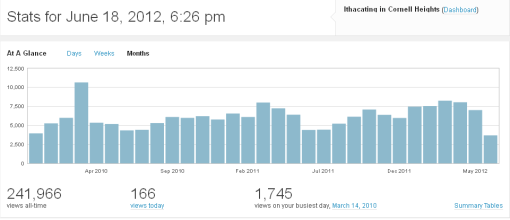
The highest month was once again March, with 8,247 hits, although the peak isn’t as pronounced as it was in previous years. Going year-to-year, the only month that was lower in 2011/12 versus 2010/11 was August, although June and July came fairly close. This is due to the Cornell-centric nature of the blog – once classes are out for the summer break, my hit tally plummets like a stone. Although, that’s been somewhat avoided this year, which I’ll guess is the result of the more Ithaca-area focus taken on in the past year, and is a bit more stable in terms of visitors to this site.

Looking at the past year in review:

~In planning and development,the biggest news is the construction of Collegetown Terrace the massive 1200-bed project south of Collegetown. Approvals were granted and phase one is underway, with an August opening for the first buildings. The Vine Street Cottages also began construction, replacement apartments were planned for 107 Cook, and 309 Eddy marched merrily towards completion, which should be in just a few short months.The Coal Yard apartments phase II was built, and Collegetown Crossing was proposed with the radical premise of no parking for residents, in a move that could make or break Collegetown. in suburbia, everyone got BJ’s in Lansing, and the holiest of holy casual dining restaurants came to big box land, a Chipotle.

Closer downtown, the Seneca Way project was approved and is now in site prep, and the new Fairfield Inn is under construction down in chain store country. The Argos Inn renovation moved towards completion and the Breckinridge Place project began construction, currently in the demo phase of the old Women’s Community building. Several smaller projects also began construction, such as the Iacovelli apartments on West Seneca and the Magnolia House women’s shelter. In the longer-term, the massive Cascadilla Landing project was proposed, and could potentially  redefine the city waterfront, and the new Holiday Inn tower/renovation will add a small conference center to the Gorge City.

Over at the colleges, Ithaca College built a boathouse and started its Circle Apartments expansion. Over on East Hill, Milstein Hall, MVR north, and the Johnson addition were completed, the food science building is well underway, Gates Hall is in foundation work, and the law school just launched their underground addition. The Big Red bandhouse is set to start shortly, and Kappa Delta renovated their home-away-from-home in what was probably the most significant Greek house renovation in more than a decade. Fundraising began for the new token glass box, also known as the Goldwin Smith Hall addition. More importantly, some bridge nets and barriers were approved, and their construction will hopefully bring to an end a dark chapter of Cornell’s history.

In the meanwhile, some projects still have yet to get off the ground. The Hotel Ithaca is still in some financing conundrum, as are the Cayuga Green Condos, which were given an extension on their cost-saving agreement with the city, given the poor lending climate. Ithaca Gun is undergoing yet more land remediation with no construction date in sight (honestly, it seems like the only way the land could have been more contaminated is if someone nuked it).

~Turning an eye towards Cornell matters, the least surprising lawsuit was launched when the mother of George Desdunes filed a wrongful death suit against SAE to the tune of $25 million. The bench trial wrapped up about a month ago, though I’ve yet to hear about a verdict. The number of bars near Cornell continued to shrink, but students can now drown their sorrows in frozen yogurt instead. When the Palms said they were closing up, a couple dozen of my fraternity’s young alumni offered to buy a table of some sentimental value to us if they were willing part with it. They asked for $1500 for a rotting wooden bench table. We laughed (we were thinking $500 max). They said they were serious and it was a starting bid. Needless to say, I have many happy memories of a table that hopefully no longer exists. Rumor has it a new apartment tower will rise where the Palms once drunkified multitudes of Cornellians.

~From a meteorological standpoint, the ITH toyed with 100-degree temps and had a collective anxiety attack about the impending arrival of Hurricane Irene, but was spared the brunt of the destructive tropical cyclone. However, this relief was short lived when the extratropical remnants of Tropical Storm Lee dumped 8.7″ in 24 hours at Binghamton, and flooded many local towns to the tune of $1 billion in damage, a number not seen since the horrific aftermath of Hurricane Agnes in 1972. It also resulted in one of the wettest years on record. Ithaca, while soaked and unnerved, was relatively unscathed.

Many things, many topics. In comparison to the past years, I now write this while firmly ensconced in alumnidom, my trips back further and further apart. At this point, I’m finishing grad school, and interviewing for positions in California and Texas. It was not exactly in my wishes to move as far out, as my northeastern blood may not be able to tolerate nice winters. But, that’s where the jobs are in my field at the moment. Ideally, I can make a triumphant return to the northeast someday.

I write not out of obligation, but out of genuine interest, which I think has been one of the attributes that has made this blog a reasonable success. I see the emails of those who follow comments and posts – they include other alumni and current students of course, but also prominent companies in Ithaca and some local government officials. Flattering, if a little disquieting for fear of botching up my facts. More importantly, I think it serves as an indicator of the usefulness of this blog, that people honestly come here searching out information, and many of them leave feeling a bit knowledgeable about Ithaca projects and stories, or Cornell history and construction projects. Or at least, I hope as much. It makes for great motivation in the months and years ahead.


News Tidbits 6/13/12: “Cascadilla Landing” Makes Its Debut

13 06 2012

For those who pay any attention to Ithaca’s physical plant, news has been floated around for a while of a proposed waterfront project next to the city golf course, which in reference, was referred to as the “Johnson Boatyard Development”, after the boatyard located on the current property.

Well, in the fee-to-see Ithaca Journal this morning, renderings were shown for the proposed “Cascadilla Landing” project, which is the official name of the development. More renderings are included within a PDF from John Snyder Architects hosted on the IJ website.

I would love to share some of the images, but now that content is pay-to-play, that puts me in a much more difficult position. It was one thing to share an image up from a free online paper. But now that content is not free, the legal waters have become a bit dicier. I will say this much: click the links, visitors have a limited number of article hits before content is no longer displayed. After that, there are several other ways to get around the content wall (or you can pay). If I see them hosted (i.e. not linked) on a “free” content website, I’ll include them here. But until then…yeah. It’s unfortunate.

Following the PDF, the project has 185 units – 6 in duplexs, 11 townhomes, 168 apartments. The mid-rise apartment buildings are furthest east, with the townhomes in the middle, and three three-story duplex buildings built around the traffic circle that completes the west end of the project. Phase 1 has two buildings of 82 and 44 units respectively, in three 5-story apartment buildings, two of which are connected by a skybridge. Construction would start on Phase I in Spring 2013. The main street appears to double as an internal promenade.

As for the design, John Snyder Architects opted for angular and ultramodern. The duplexs have gable roofs and wood trim, and bear superficial similarities to the buildings going up at the 900 block portion of Collegetown Terrace. The apartment buildings are an angular pastiche of windows of all shapes and sizes and random balconies and overhangs closer to the waterfront, and a bit more orderly further into the property. The colors as shown are rather muted whites and greys. No one will ever call it pretty, but it certainly stands out from the traditional built environment. The townhome designs are not really shown, they’re likely still in the initial design process.

Ithaca’s economy hasn’t been something to be too excited about lately, but this project shows there must still be some demand to live in the City of Gorges.

EDIT 7/18/12: The city has published the images. As a result, I’m including them below:


The Freshman Beanie

11 06 2012

Distinguishing between the years of students of Cornell can be rather difficult after about the first month of the academic year.  Unless it’s orientation, Greek rush, or some other telling factor, you can take a glance at some random person crossing the quad and have no idea whether or not they’re a freshman, a junior, or perhaps even a young grad student (whereas for older grad students, they might be mistaken for professors). However, it’s not like anyone worries about that; except in the case of love and relationships (senior to senior: you’re dating a freshman? Robbing the cradle much?), someone’s year usually doesn’t merit much attention. Well, things were a bit different back in the day.

In the days of yore, it was traditional for freshman males at Cornell (known as “pikers”, like those referenced in “Give My Regards to Davy”) to wear a rather peculiar-looking felt cap called a “Beanie”, which was like a snow hat (wikipedia directs the query to “tuque”, a word I’ve never used in my life), red in color with a grey button on the top. Examples can be seen in the below photo, which dates from a 1919 Cornell football game.

Image Courtesy of Wikipedia.

The Beanie was part of the mandatory rules for freshmen, and they were required to wear it in public until the spring, when all the freshmen burned their caps in a ceremonial bonfire. This was a kinda cutesy little sentimental event meant to instill class camaraderie and make warm fuzzies, when the sophomores weren’t trying to kick the crap out of freshmen in the occasional class battles.

The cap rule, along with other rules such as not walking on the grass and not wearing any high school or prep school emblems, tended to be strictly enforced, and with harsh consequences. Violators were liable to have their heads shaved or go for a quick dunk into Beebe Lake.

Of special note regarding the beanies is the case of Frederick Morelli, a freshman originally of the class of 1924, who absolutely refused to wear his beanie. After numerous dunkings and warnings from his peers (including a double dunking into a public fountain and the lake, with a placard hung on his neck saying “Moral: wear a frosh cap”), Morelli ended up being pursued by a mob of angry upperclassmen, and had to be saved by the president of the university to avoid serious injury. The Sun actually condoned the mob’s behavior. But George Lincoln Burr, the most senior faculty member at the university at the time, threatened resignation over the manifestation of “lynch law” on the campus. Fred Morelli withdrew from the university, but returned a couple years later and graduated in the class of 1926. Perhaps his penchant of pushing his bounds played into his undoing; after graduation, he became a gangster and nightclub owner, and was gunned down outside of his club in Utica in 1947. Fun fact: the city of Utica was run by the Mafia and its associates for decades, up through the early 1990s.

The caps faded out, as did the class battles, as a result of the changing demographics post-WWII. Frankly, after killing men in trenches, and now married with children, most vets who came in under the G.I. Bill as freshmen could not give two salts for collegiate antics. When the sophomores made an attempt to enforce the rules in 1949 by shaving the heads of three frosh, the enraged students brought their grievances before the mostly G.I.-composed Student Council, who promptly banned enforcement of the practice. The beanie remained voluntary up to the early 1960s, when it faded out completely.

So nowadays, students can feel completely to engage with members of the other classes. Unless it involves doing a walk of shame to Collegetown from a freshman dorm. That would be awkward.


News Tidbits 5/31/2012: New Apartments Squeezed Onto Thurston Avenue

1 06 2012

So, I’ve been waiting for this piece of news for a while, but it took a little bit of sleuthing to come up with details about a proposed project for Thurston Avenue. First, the location:

The location is a parcel next to the Rabco (Highland House) Apartments on the corner of Highland Road and Thurston Avenue. To give you a better sense of locale, its the woody, slightly hilly piece of land across Thurston from Seal & Serpent, and across Highland from Alpha Zeta. A highly trafficked area, the property was once home to the Wyckoff Mansion, which became the home of Phi Kappa Psi from 1915-1964. The Wyckoff property was torn down to make way for the Rabco Apartments, which were finished in 1966. This portion of the parcel has never been developed. I actually used to walk by here almost every day, but never felt the urge to get photos of a stand of trees and rocks.

The proposal is as follows: three buildings, clustered, four stories in height (est. height ~40 feet, within zoning regulation). 36 units and 88 beds, making it one of the densest properties north of campus. 40 parking spaces are proposed, but the planning board has expressed the desire to share space with the excess western parking lot on the Rabco property, and that will probably be a stipulation for approval. Time-wise, since this is the sketch plan, and given the size and location, don’t expect construction for several months (although they want city approval by late July – which is highly unlikely), and expect a year more before it is complete. The project lies within a contextually-sensitive area, the Cornell Heights Historic District, and its design will probably be much more scrutinized as a result. It may also be rather historicist, because I can’t anyone is going to approve a “modernist” or “contemporary” design in the heart of a historic district, even in a city that likes svelte modern boxes.

On another piece of news, the Johnson Boatyard project has realigned its entrance to be on Willow Avenue rather than Pier Road (not a big changed, it just means its moved from the north end to the east end of the property), and the number of duplexes has been decreased from eleven to six. The project still has townhomes [warning: Ithaca Journal link], which now vary from 1-2 stories in height. A small retail portion might be included in the first phase. After all the news about the original proposal, this first phase is a bit…underwhelming.


The Keyword Bar XVI

24 05 2012

1. “chi omega” “cornell university” closed -“alpha chi omega” (5-23-2012)

Yes, and no. Chi Omega was active at Cornell from 1917 – 1963, and then again from 1987-2003, when low membership caused it national to shut its doors. The house at 10 Sisson Place is now occupied by Sigma Alpha Mu. In contrast, Alpha Chi Omega, which was established at Cornell in 1984, it still active on campus.

2. “cornell store summer employment” (5-16-2012)

If four years ‘experience is any indicator, they’ve already filled up. A bare-bones student staff of five or six stays on during the summer along with the full time staff, and most of those are current student employees (the year I worked through the summer, we all were). In sum, you can check, but don’t hold your breath.

3. “johnson boatyard ithaca” (5-16-2012)

If this is in any reference to the big mixed-use project underway for the boatyard site, then I have good news – they are making progress and gave an update to the city planning board just last night. As soon as those minutes areuploaded, I hope to include them in my next “news tidbits” entry. These entries will be pulled directly from the minutes,  since the Ithaca Journal, in a responsible but unfortunate move, now charges for article access beyond a nominal number of articles (renewed each month). Also on the docket – a redevelopment project for apartments on Thurston Avenue.

4. “location of former ithaca hotel, hotel leonardo aurora st, ithaca”

Going back in time, the Hotel Leonardo was located at 105 N. Aurora Street – at least, back in 1965. The address today pops up a location in front of Sushi O Sake (which is 107 N. Aurora). A search indicates that section of Aurora was known as the “Casey Block“, which was built around 1904 (the Wanzer (corner) Block was built the following year), but the stretch was renovated and substantially rebuilt in the 1990s. The Casey Block could be the building that Viva Cantina is now in, or it could have been in the 1990s renovation (the architects refer the original building as “burned out“) that now sits at 107 N. Aurora.

5. “vine street cottages ithaca ny how much are townhouses”

I’ll just link to this previous entry, in an effort to limit unnecessary visits to the Ithaca Journal pages.  Mid-200,000s expected. Definitely not a place to buy for your child- student. 10 to choose from, four styles.

6. “new townhome proposal for route 96 ithaca”

That would be the Holochuck Homes project. The plan is for 106 townhomes, one or two-stories, clustered together near the road. Final approvals were granted last month. This is about the only image I could find of them, from a now-inaccessable article in the Elmira Star-Gazette:

7. “new apartments 600 W. Seneca street ithaca” (5-11-2012)

Okay, I maybe dropped the ball on this one. Back in the summer 2010, a 24-unit, 3-story apartment building was proposed for the northwest corner of Seneca and Meadow Streets by Iacovelli Properties. It only recently started construction, and I know there’s a billboard standing on the property, and it shows the design of the new building(s).  I know this because I saw it the last time I was in Ithaca I passed the property, but I was driving and did not have my camera in hand (a blessing to all other drivers on the road), I was unable to get a photo. If someone does gets a photo of the project and wants to email that in, I would be delighted.