Warren Real Estate Tries to Sell a Frat House

4 03 2009

This was oddly funny to me. The house in question is 210 Thurston Avenue, covered in an entry last July.

http://www.warrenhomes.com/index.cfm?action=detailed_listing&mls=128574&menu=0

Photo Property of Warren Real Estate

“Walk to Cornell University from this 22 bedroom group house. The house is legal for up to 33 people. This s a unique opportunity to own a wonderful investment property. There are 6 full bathrooms (2 master suites), a commercial style kitchen, and parking for up to 15 cars. Over 7,000 square feet of living space on first & second floors. The full basement has a paved concrete foundation and significant additional living space featuring a rec. room and a dining area.”

Now here’s the history they skipped over. This house was built around 1900. The first fraternity to inhabit its halls was Delta Sigma Phi, which closed in WWII and never reopened. Alpha Omicron Pi made use of this house for a short while, and Sigma Alpha Mu moved in for 1947/1948. Sigma Alpha Mu maintained the property until they moved to Sisson Place in 2004. After that, the house became known as Phi Delta Theta’s annex (which, for being the dry house on campus, the real estate website’s photo of a large beer pong table in their annex does nothing for P.R.).

Like, really guys? Next time, throw a sheet over the table, it won’t be so blatantly obvious. Like the beer cans wedged between the second floor balconies.

Even better, it would appear that not only is this house for sale, but Theta Xi’s moving in [2]. From a Craigslist excerpt:

“Theta Xi Fraternity is moving into the old Phi Delta Theta annex at 210 Thurston Ave. for the 09/10 school year. We will have around 10 brothers in the house and need around 10 boarders. The cost will be 100,000 for 20 people for a 10-month lease, which is 500 a person. ”

For the curious, this 7,044 square ft. house has an asking price of $950,000. Maybe Theta Xi has some rich alumni they could appeal to.

Looks like the times are a changin’.

[1]http://www.sammybeta.com/history.php

[2]http://ithaca.craigslist.org/roo/1017046808.html


Ithaca Construction Isn’t Ending…Yet

3 03 2009

With all the doom and gloom associated with the current economic times (rightfully so), it’s easy to forget that there are still some projects in the pipeline outside of Cornell, but in the surrounding Ithaca area. Since it’s been a while since I chronicled those, let’s do a quick overview.

Lansing

Ithaca’s northern suburb has a number of different projects  planned. Currently going through the pipeline are the Lansing Commons project (~50 units) and the Cayuga Farms projects (~138 units). The projects are typical suburban development, consisting of single-family homes, townhouses, and a few apartment buildings and commerical office buildings. The buildout would be over a period of several years.

Ithaca (town)

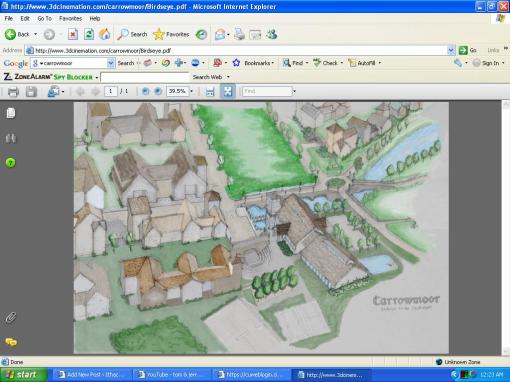
Apart from some minor subdivisions, an electrical substation and a wireless tower, the big project in the town of Ithaca is the Carrowmoor project [2].  The 400-unit project is an eco-friendly development of houses and a small village center of retail and office space. The residential units are a mix of single-family houses, townhouses and apartment buildings. The buildout is also over a period of several years. Building designs are meant to be a throwback to the days of Tudor England (for better of for worse [3 -The website for the development looks like it was built in 2000, and takes a long while to load]).

carrow1

Ithaca City

Two outparcels (small-box retail no doubt) are planned for the SW commerical district. One is in front of the Tops Plaza, the other is next to Wal-Mart. Renovation for the Hangar Theatre, finalized drfats for the Ithaca College Athletics Center, and construction for Urban Outfitters planned downtown location are also going through the board. The Hotel Ithaca is still underway- technically. The 10-story, 100 ft. building is currently being held up because the building has a nine-foot overhang over the Green Street Garage—meaning it’s in city air space, and has to go in front of the board to get approval for that air space [4]. A little bit ridiculous, perhaps, but that’s how it’s done. anyways, the preliminary design has been brought in front of the board, but no image is widely available as of yet.

Technically, the Southwest neighborhood plan is still active too, but that one might just as well be considered in hibernation given the economic situation.

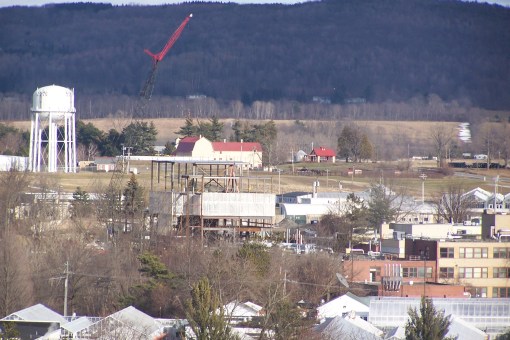
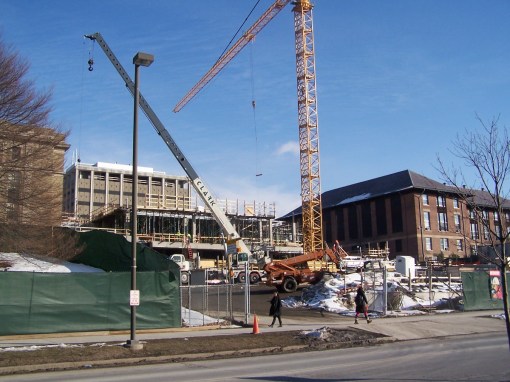
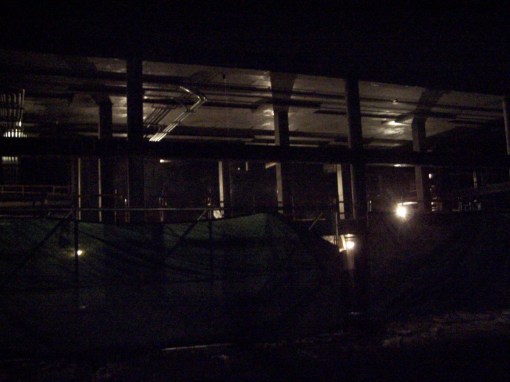
Heck, since I’m writing this, I might as well include progress photos of some of the campus projects.

100_3181

Veterinary School Animal Health Diagnostic Center

100_3100

Physical Sciences Building

100_3102

MVR North expansion

100_3318

 Hotel School Expansion

[1]http://www.lansingstar.com/content/view/4601/66/

[2]http://www.ithaca.com/main.asp?SectionID=16&SubSectionID=83&ArticleID=8385

[3]http://www.3dcinemation.com/carrowmoor/index.html

[4]http://www.theithacajournal.com/article/20090220/NEWS01/902200317/1002


The Music Building in its Many Forms

24 02 2009

So, a little background story to this entry. One of the things that I’m in charge of for my fraternity is maintaining the alumni newsletter. So, I had to send snail mail and a typed letter to the publishing company. Much to my annoyance, the nearest computer lab to where I was at the time was in Lincoln Hall, the music building.

Well, I’ve never printed anything at Lincoln before, so when I selected printers, i accidentally sent it to 374 MTH instead of the MUSIC printer. I being off not-so-sound mind apparently managed to read that as 374 MUSIC, so I went up and began searching the third floor.

Then I found this display. Realizing its worthiness for writing materials, I grabbed my camera and took a few photos.

100_3185

100_3186

100_3188

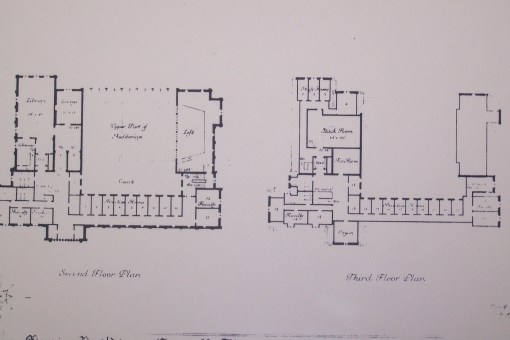
It seems the above pictorials date from ca. 1900, and were proposed designs for a combined Architecture and Fine Arts building. No word on where the building would have been built.

100_3190

100_3191

This Collegiate Gothic design was proposed in the late 1920s, and would have been where Gannett Health Center stand today. Alas, the plan never saw the light of day due to budget cuts brought on by the Great Depression.

100_3194

100_3196

100_3197

100_3198

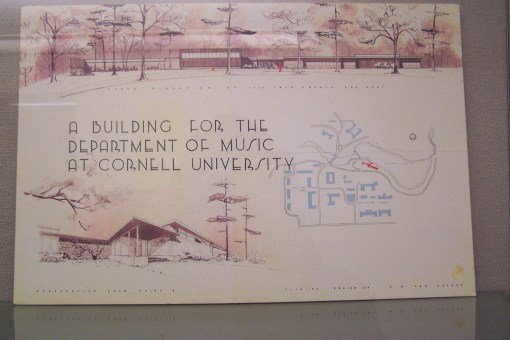
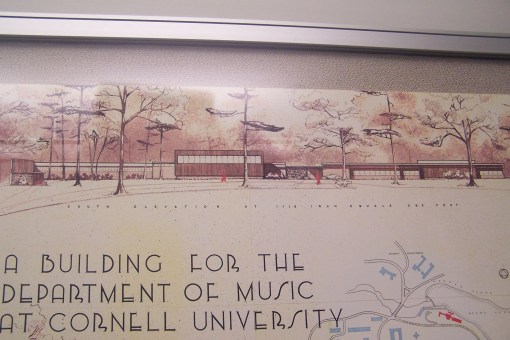
This modernist structure was proposed in 1950, and would’ve been built where Noyes Lodge stands today. Considering this school’s record of modern architecture, part of me is glad this never saw construction.


News Tidbits 2/15/09: The Collegetown Zoning Proposal

15 02 2009

http://cornellsun.com/section/news/content/2009/02/13/collegetown-neighborhood-council-details-building-plans

Collegetown Neighborhood Council Details Building Plans

It has been almost a year since consultants visited Collegetown to develop a vision for renewal and nearly six months since an entire book was compiled to lay out the plans that will bring make that vision a reality. Last night, the Collegetown Neighborhood Council devoted its bimonthly meeting to update the status of the Collegetown development plan.

The meeting had approximately 30 attendees. According to Mary Tomlan ’71 (D-3rd Ward), co-chair of the CNC, the meeting had a much larger turnout than usual, attesting to the interest on the development plan.

Tomlan introduced the meeting; she described the “wish to make Collegetown more lively, more diverse and more beautiful” and explained the complexity of the zoning plans. The proposed zoning includes requiring pitched roofs and side porches. Other proposed legislation includes reducing building heights from 40 ft to 35 ft, limiting the number of stories in a building from four to three and reducing the maximum percentage of lot coverage from 35 percent to 30 percent.

Leslie Chatterton, head of historic preservation and neighborhood planner, detailed the plan. She explained that a more diverse and a less cyclical population needed to be encouraged in order to attract more retailers. The plan is intended to significantly increase the density of central Collegetown while maintaining and restoring the residential feel of the outer Collegetown areas. It is also meant to improve the aesthetics of the area through the gradual lowering of buildings heights as one moves from central Collegetown towards the outer areas.

The building plan divides Collegetown into six areas. The center of Collegetown, which extends down to Catherine Street, is given the most attention. Building heights will be increased to 90 ft and there will now be a seven-story limit. It will also be mandatory that the ground floors of these buildings be used for retail, and it will be encouraged to make this central property and its rent the most expensive.

The second area in Collegetown discussed is called the Village Residential area. According to the plan, this area is supposed to adjoin townhouse styled homes with a four-story limit. Chatterton explained that this area is intended to attract graduate students, younger couples and new Cornell faculty, rather than undergraduate students.

The rest of Collegetown will be less dense and is meant to have a residential feel. Building heights will be limited to two-and-a-half stories and the structures of the houses are supposed to remain the same. However, Leslie Chatterton, historic preservation and neighborhood planner, also mentioned that many of these homes are rundown and need to be redeveloped for health and safety reasons.

Jennifer Dotson, a member of the neighborhood council and chair of the common council’s planning committee, spoke about the plan for the new transportation moratorium, which includes parking, busses and regular car traffic. The transportation subcommittee has not yet met, so few details are available.

Some developers at the meeting were unhappy with the plans. John Yengo, commercial manager of the Ithaca Renting Company, said that although he “support[s] growth and planning” he is frustrated by the length of time that the building rules are in limbo.

Sharon Marx, Property Manager of Ithaca Renting Company, agreed.

“It is very frustrating because developers can’t develop. The city has had a year and a half to do this and they still have not made their rules. In the meantime everyone’s hands are tied,” Marx said.

Yango explained that nobody wants to buy property because they are still waiting to see what the new rules will be.

Tessa Rudan ’89, a former Collegetown business owner who has lived in the area since 1967 said she did not trust the research of the hired consultants.

“It seems like they extrapolated a lot of data from all over the place and just applied it to Collegetown,” Rudan said.

Tomlan, however, seemed more optimistic.

“It has been a lot of work and I am hopeful that we will make Collegetown better than ever,” Tomlan said.

***

Well, considering the city and Cornell forked over $75,000 each, and Goody Clancy is a fairly reputable firm, I don’t think Ms. Rudan has to worry so much.

Now, for the sake if discussion, let’s consider the latest zoning guidelines derived from the plan (pulled from the city website [1]).

untitled

The zoning shown on the properties is for the maximum number of stories allowed on a proposed structure without having to request a zoning variance (which would give Mary Tomlan a heart attack cause a lot or red tape, possibly killing a project or dragging it out for years). The corresponding heights are given and explained in the red box below. Theoretically, the tallest building in Collegetown under the new guidelines would be either 7 stories OR 92 feet in gross height (this included any mechanical or decorative structures on the rooftop). This is relatively appropriate; commercial structures typically have 14/15 foot floor-to-ceiling heights per floor, and residential floors typically are around 10 feet (a 30-story condo tends to average around 290-320 feet, while a 30-story office building without decorative spires, etc. tends to be around 400-450 feet).

Approximately 24 properties fall into this highest category. Of these, roughly have are already developed into large structures. Since it doesn’t make a whole lot of sense to replace a five-story from the 1980s building with a six-story building, those properties are unlikely to be redeveloped in the near future (example properties: Eddygate Park, 402 College Avenue [Starbuck’s], Sheldon Court, the east block of 400 College Ave, Collegetown Plaza). Only a few instances of financially sound redevelopment could be proposed under the highest category (possible properties would be 404 College [M&T Bank], the old Kraftee’s building, the new Kraftee’s building, the Green Café [currently under construction on the corner], the liquor store, and perhaps the Korean restaurant). Keep in mind that beyond the fifth floor, a 12-foot setback is required before the building can continue adding floors.

Collegetown “canyon”? For about a 1,000 feet down the road, if you call seven stories a canyon.

The surrounding ~35 properties to this central core have a max height of 5 stories or 68 feet. Keep in mind, this is on the assumption that the building will be mixed use, meaning retail at the bottom (technically, office space counts towards mixed use too, but it seems odd to imagine office buildings in Ctown).

2

Most of the surrounding zones fall into the other two categories under the current zoning proposal: Village Residential (VR) and Traditional Residential (TR). OS is for open space, which considering the proximity to the gorges, someone would have to be out of their mind to build there anyway. Traditional residential represents single-family detached houses (in other words, no change to the current structures in those areas). These strcutues are expected to have porches and hipped roofs (I think I can hear the modernist architects crying from Rand Hall). Village Residential refers to townhouses, rowhouses, apartment buildings of comparable mass to rowhouses, and very large detached houses.

Notably, under these zoning laws, Cornell’s parking at the corner of Stewart Avenue and Williams Street would have to be VR- rowhouses or a lowrise (apartment style maybe?) dorm.

One more note: parking is largely reduced. The parking garage on Dryden might be expanded, but otherwise, it’s an at your own risk kinda thing. With higher density and more prominent mass transit to a denser living area, the need for cars tends to diminish anyway.

***

So, enough analysis. Here’s my opinion.

Tomlan graduated from Cornell in 1971. And she’s stuck in a Collegtown mindframe from 1971. When it was still largely a student slum of crappy tenement houses (like the ones on Linden, Cook and any other street close to the College/Dryden intersection). Development came. Demand came for luxury housing, and developers obliged.

Do I want to see Collegetown become a series of highrises? No. That was actually proposed in the late 1960s (which I mention elsewhere on this blog). but 90 feet is not going to end the world. It’s not going to make a whole lot of difference in a small, centralized area that’s largely developed anyway. Trying to preserve a bunch of dated, inefficient student slums by limiting developers’ ability to redevelop is not the way to go. I think the proposed plan is largely successful in fulfilling the needs of the area. The argument about mixed-demographics is off base; Cornell Heights, Bryant Park and later Cayuga Heights all developed thanks in part to the fact that many professors and staff prefer to live away from students, especially those with families. One group tends to prefer to get wasted at a bar on a Friday night, the other prefers to go out to a family restaurant and catch a movie. Students and permanent residents are inherently different in terms of schedules and needs from the ambient environment (ex. good schools, variety of shopping). Mixing the two will be like trying to mix oil and water, and it strikes me as a wasted effort. Families are not going to shop in Collegetown, that’s why we have Target at the mall and Wal-Mart down on the flats. The only place to two might mix is Fontana’s.

[1] http://www.ci.ithaca.ny.us/index.asp?Type=B_EV&SEC={36F5C077-C105-4305-8538-321DC13B1180}&DE={6998A392-D898-4BB1-B708-564C98F3F936}


Miracles Do NOT Happen…

12 02 2009

http://www.theithacajournal.com/article/20090211/NEWS01/902110328/1002#pluckcomments

So, let’s start with the article:

http://www.theithacajournal.com/article/20090211/NEWS01/902110328/1002#pluckcomments

“A group of Cornell professors is urging the university to hold off on construction of Milstein Hall, citing concern about the economic recession and the building’s environmental footprint.

In response, a group of Cornell architecture faculty is urging the university to move forward, saying the new building is needed to keep its top-ranked department accredited.

The ultimate decision on whether to go forward with Milstein Hall lies with University President David Skorton, and he has not yet made that decision, Cornell spokesman Simeon Moss said Tuesday.

Skorton announced a university-wide construction “pause” in October. The pause extends through the end of the fiscal year in June.

“Basically all projects that don’t have a shovel in the ground are subject to the pause, and the president and the executive vice president are reviewing those projects,” Moss said. On whether Cornell will move forward with Milstein Hall, Moss said, “That decision by the president hasn’t been made yet.”

Throughout its city approval process, Cornell officials repeatedly said that Milstein Hall is not subject to the construction pause.

On Monday Mark Cruvellier, chair of the Department of Architecture, sent The Journal a joint statement in favor of Milstein.

“This is a building that is urgently needed by the Department in order to maintain our accreditations as a professional school of architecture,” reads the statement signed by 13 architecture professors. “The building permit is in hand, bids have been reconciled, and it is, in today’s parlance, shovel-ready. Given the current low cost of materials and competitive bidding situation, to delay construction of Milstein Hall yet again will only add to its cost.”

Cruvellier could not be reached for comment Tuesday.

Milstein Hall has spent 10 years in the design and approval process, including two years gaining approvals from a variety of city boards. The city’s planning board and landmarks preservation commission have both signed off on the project.

Milstein Hall is proposed as a modern, glass structure that will physically connect with Rand and Sibley halls and stretch across University Avenue toward the Foundry. Another cantilevered extension would extend out into the arts quad.

A group of at least 25 Cornell faculty and alumni have petitioned the university to halt construction of Milstein, using The Cornell Daily Sun, other media and, today, the university’s faculty senate, government professor Elizabeth Sanders said.

Those opposed include an architecture professor, Jonathan Ochshorn, and music professor Martin Hatch, who has spoken against Milstein before a variety of city boards over the last two years.

Sanders contrasted the process and design for Milstein with Ithaca College’s new Park Center.

The Park Center received the highest rating possible from the U.S. Green Building Council, a LEED Platinum, and cost $19 million, according to the Ithaca College Web site.

“And we’re going to spend $60 (million) and get less space and much lower sustainability and a lot of offensive aspects?” Sanders said. “If Ithaca College can do this, why can’t Cornell do this?”

Andrew Magre, project manager for Milstein Hall and the Central Avenue Parking Garage, said last month the total project cost would be approximately $54 million.

Milstein Hall would be roughly 50,000 square feet, according to information presented to Ithaca’s planning board, and will include studio, gallery, meeting and exhibition space, and a 275-seat auditorium. The parking garage will include two underground levels and one surface level for a total of 199 parking spaces.”

***

Let’s consider the Park Center for a moment.

Photo by Granger Macy

Photo by Granger Macy

The Park Center was a $19 million dollar project to build a 38,800 sq ft building [1] on the Ithaca College campus that was completed in early 2008 (it’s also the building that caught fire during the fourth of July celebrations).

So, let’s consider some key differences between the Park Center and Milstein Hall.

-Milstein is cantilvered and is connected to two structures that are a century old (Rand Hall) and ~110 years old (East Sibley). Park Center isn’t. The area was home to a green space that bordered a parking lot (and oddly enough, was not a suggested building site on the Ithaca College master plan [2], and to the contrary seems to throw off the master plan by cutting off the proposed green avenue through the main campus).

-Milstein had to go through red tape hell after Paul Milstein’s original $10 million donation in 2000. Park Center was launched with a major donation from Dorothy Park in 2002 [1]. The cost has gone from somewhere in the 20 million dollar range when first proposed to $40 million from a couple of years ago to about $54 million today. I wonder if that total includes the $2 million Cornell paid for University Avenue so they could actually build the damn building.

-Milstein incorporates a parking garage, auditorium, and bus stop. Park Center has a large atrium, but otherwise it’s mostly offices and smaller lacture spaces [1]. Park Center is LEED platinum (highest ranking), and Milstein is gold (second highest ranking).

My issue is that the comparison does an unfair presentation of facts. If we were to plop Milstein out on the alumni fields or near the vet school, I bet it would be a lot of cheaper too. Park Center didn’t have the red tape issues or ambient environment issues that Milstein Hall has to deal with.

My other issue is that some people are finding fault with the modern design. Let’s not start that crap again. In my own opinion. this is probably the least offensive design of the three that have been planned, if but just because it spares Rand from the wrecking ball. I’ll admit I’m no fan of it, but it’s less jarring than the previous two proposals. For one thing, architecture schools have a habit of wanting to be on the cutting edge of design (makes sense, considering building design is much of their field). Plus, the design is going to be different, because if people want to preserve Rand and Sibley the building has to build up or out. Being on the Arts Quad, I’m willing to wager some passionate people would rather burn the construction site down than let it build up.

As much as this site is a Cornell construction monitor, and as I much as I actually like seeing new projects go forward, I’m really torn opinion-wise. Yes, I’d like to see the the architecture build-out so it can have more (badly-needed) space. However, with operations cuts across the board, I don’t see a good reason this should be spared. My concern, however, is that prices will continue to skyrocket, costs will be prohibitive and the project will have to go back to the drawing board again, and AAP will have a crisis due to its trip through red tape hell.

[1] http://www.ithaca.edu/news/release.php?id=2501
[2]http://www.ithaca.edu/masterplan/reports/sept_2002_content_pages.pdf


“#731”: This Post Went Without A Title for Four Years

4 02 2009

I guess if Cornell is going to put off all non-current construction until at least June 30 (see Skorton e-mail), I’d better go back to campus touring.

100_2500

The Biotechnology building. So bland we didn’t even bother to give it a real name (or Cornell just hasn’t seen the right dollar amount—one of the two).  The 150,000 sq. ft building was completed in 1986 (which might just as well be the height of modern-design blandness) by the firm Davis and Brody [1].  I guess when comparing this to Comstock Hall, which was also built in the mid-1980s, this is a mild improvement. The building, as the name suggests, focuses on biotechnology research, such as genetics and molecular biology. The building’s use is strictly research, housing 36 faculty, 50 post-docs, and about 100 graduate students [2]. Along with its primary use, the building houses a small dining facility and the Keller reading room.

100_2505

When it was first completed in 1931 [1], the Plant Science building was the largest single dedicated to plant research in the world (its about 170,000 gross sq ft [4]. The building was designed by Sullivan Jones in the Beaux-Arts style, but I’d venture a guess that it’s a stripped Beaux-Arts style, because the ornamentation is quite restrained, and since it was finished at the start of the depression (the building did stay true to the initial design). Plant science serves as the home to the plant science and horticulture departments [3]. The building itself isn’t particularly attractive, but the Minns Garden on the south side is the showpiece of the grounds. The garden is named for former professor Lua Minns, who used it in the 1920s as a practice ground for her students to do hands-on gardening work [5]. However, the original plot of land was where Bailey Plaza and Malott Hall stand today.

Courtesy of the Cornell Chronicle

In case you’re wondering, the building between the garden and Bailey Hall is Liberty Hyde Bailey’s model rural schoolhouse, which was built in 1907 and probably lasted until demolition for Malott around 1960 [6].

100_3075

Stimson Hall was completed in 1902 and designed by locally-renowned architect William Henry Miller [7]. While funded by Dean Sage (son of trustee Henry Sage for whom the Hall and Chapel are named), the building is named for Lewis Stimson, who was instrumental in the establishment of the Cornell Medical School. From 1902 to 1908, the medical school resided in Stimson Hall, but afterward it was relocated to New York City, where it still continues to exist today as Weill Cornell Medical Center. It should also be noted that part of the building was a morgue at this time.

Stimson was designed with the intention of a second identical building facing south to be built were Day Hall currently stands; but for whatever reason it was never built, so the south side looks a little incomplete, with a terrace that faces out into a parking lot today (the area between the two buildings was to function as a courtyard).

Today, Stimson Hall serves as the home of the Biological Sciences department, and the university Ombudsman (a person appointed by Day Hall to handle and address citizen complaints, according to Wikipedia [8]). When Kroch was built, Stimson was planned to be renovated into a library, but due to budget constraints, that was never undertaken. The tunnel between Kroch and Stimson was built to serve that purpose, but now it is only open for public use one day of the year—Slope Day [11].

100_3080

Speaking of Day Hall, we might as well briefly discuss it. To no one’s surprise, Day Hall houses most of the upper administration offices; for example, Skorton’s office is on the 3rd floor. The building was designed by Frederick Ackerman in a stripped classical style and completed in 1947 [9] (offhand, I believe Ackerman also designed the Psi Upsilon and Sigma Phi fraternity houses fifteen years earlier). The building was dedicated shortly after completion to Edmund Ezra Day, Cornell’s fifth president (1937-1949). Before renovation, the building provided sleeping and bathing facilities on the third, fourth and fifth floors for faculty.

For another fun tidbit of history, Day Hall was taken over in a non-violent protest for three days in November 1993 [10].  The takeover stemmed from protests from Latino students over a combination of incidents and complaints with the university, including the vandalizing of a large art installation by a Latino artist, and lack of minority representation within Cornell faculty.

And for the last time, there is no tunnel that leads from Day Hall to the Cornell Store.

[1]http://www.people.cornell.edu/pages/cre8/cudb/buildings.html

[2]http://www.mbg.cornell.edu/cals/mbg/resources/index.cfm

[3]http://hort.cals.cornell.edu/cals/hort/about/plant_sci_bldg.cfm

[4]http://www.fs.cornell.edu/fs/facinfo/fs_facilInfo.cfm?facil_cd=1022

[5]http://www.cornell.edu/tours/tidbit_template310d.html

[6]http://ecommons.library.cornell.edu/bitstream/1813/3171/36/009_36.pdf

[7]http://www.cornell.edu/search/index.cfm?tab=facts&q=&id=693

[8]http://en.wikipedia.org/wiki/Ombudsman

[9]http://www.cornell.edu/search/index.cfm?tab=facts&q=&id=239

[10]http://cornellsun.com/node/26269

[11]http://ezra.cornell.edu/searched.php -3/16/2004


The Clark Hall Addition That Was Never Built

22 01 2009

So, I came across rather serendipitously while going through some archived photos. Luckily, since I carry my camera around with me everywhere, I was able to take a photo.

100_2770

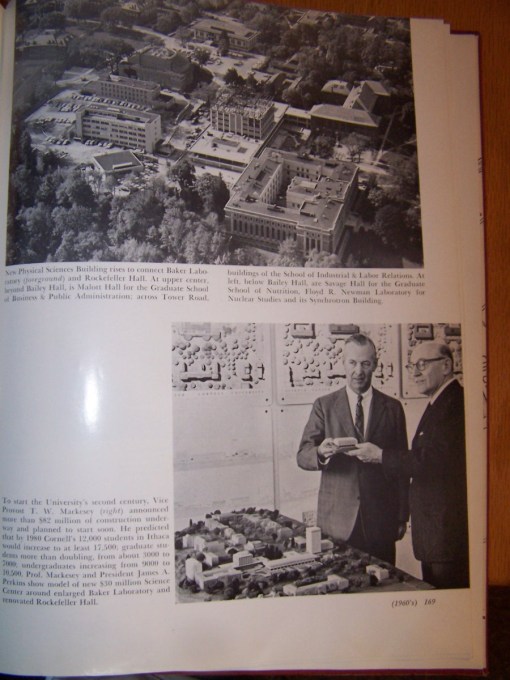
So, this comes from a revised edition of the 1954 Cornell Historical Photo book that I previously used in an entry, this being the 1965/66 update. This is clearly evident with the photo at the top, taken in approximately 1964 when Clark Hall was under construction.

Then we look at the bottom photo. And you notice there’s no Rockefeller. It’s replaced with some massive complex. My first thought was “what the f— is that! It’s f—–g massive!”.

100_2773

First, some chronological details. Since James Perkins is in the photo, and Clark Hall is completed, and this book was published in late 1965/early 1966, so we can assume this photo dates from about 1965. From the caption, we know this was a building proposal that would have been completed by 1980 (notably, the growth in numbers the caption cites stayed largely true to form- there were a little more than 17,000 students in 1980, but about 11,500-12,000 were undergraduate).

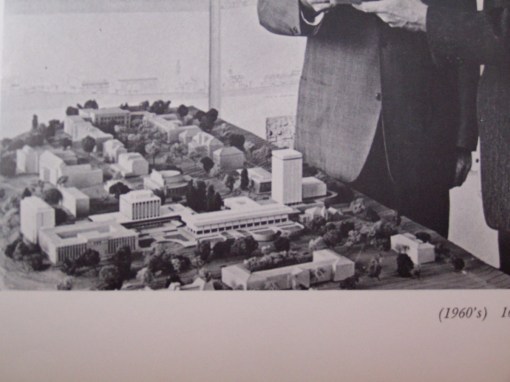
So, then we have the “renovated” Rockefeller—a massive low-rise building that by my guess was 180,000 or 200,000 square feet (for reference, Rockefeller is 125,000 gross sq ft [1]). There’s a large extrusion streetside, that I’m kinda imagining wasn’t too different from the west extrusion of Uris Libe that was built in the early 1980s. The low-rise largely conforms to Rockefeller’s footprint otherwise.

Then we have the massive tower right behind A.D. White’s house. We’ll call that “Rockefeller Annex”. This annex is massive- the model, when compared to surrounding buildings, suggests to me between 15-18 floors. The building has an odd rooftop with an indentation that was likely a balcony area. Design-wise, the building is strikingly similar to Lawrinson Hall, a highrise dorm that was built at nearby Syrcause University in 1965 [2].

Photo copyright of Syracuse University

However, the building at Cornell is a little different-facade wise, it seems to bear similarities to the model used for Olin Labs, which would be completed in 1967 and probably had only just finished with the final design. Think about it. An eighteen-story box with thin vertical windows like Olin Labs.Yes, that is a very horrific thought. It would be sacrilege to A.D.White’s house. Plus, the Big Red Barn would’ve been torn down to make way for the tower and its 3/4-story component to the southeast.By the way, behind Perkins and Provost Mackesey are some site plans. Which show three extensions from the renovated Rockefeller, but not much else for discussion.Conclusion: While we had some really bad architecture in the 60s and 70s, just be glad that not all of it was built. Be very glad.[1]http://www.fs.cornell.edu/fs/facinfo/fs_facilInfo.cfm?facil_cd=2014

[2]http://housingmealplans.syr.edu/facilityinformation.cfm?id=9


Buildings No One Really Cares About

17 01 2009

So, I had hardly any internet access while I was gone, but it would appear this blog had more than its fair share of hits this past week. It’s probably due to rush, and considering the content of ICH,  I’m not surprised.

But today we’ll just do another photo tour.

100_2496

Since someone asked about it, I decided to make a trip out to Ward Labs on the southern edge of the campus and the engineering quad. Ward Labs, or more properly the Ward Center for Nuclear Sciences, was completed in 1963. At this time, nuclear engineering was experiencing great interest. But after Three Mile Island and Chernobyl, the nation experienced a serious decline in interest in nuclear studies, and the engineering school disbanded it’s Nuclear Science and Engineering program in 1995 [1].  On May 4, 2001, Cornell announced that it would decomission the TRIGA Mark II nuclear reactor inside the facility, due to underutilization and unwanted liability concerning the handling, use and transport of nuclear materials. The reactor was a 500 kilowatt facility used strictly for research and teaching. A dry irradiation facility that uses the radioactive Cobalt-60 was recommended to be maintained at the facility. The building still contained radioactive waste, so when 9/11 happened, road blocks were installed around the facility [2].

Then we fast forward to October 2008. There was a very interesting article written by Munier Salem for the Daily Sun highlighting the increased interest in building new facilties and a revived interest in the field as the energy crisis affected the nation, and how some view the decomissioning as a huge mistake.

Today, with the exception of some offices and little-used labs, the Ward Center is largely abandoned. The building is slated to be torn down under the master plan (assuming our endowment holds out).

100_2497

I felt that since I was there, I should take a photo of Grumman Hall too, if but just to say I have one.

100_2509

I make a big deal about Bradfield, but I never have really mentioned Emerson Hall. Emerson, the low-rise portion of the Bradfield complex, was also completed in 1968 and houses labs and offices for the department of Crop and Soil Sciences. The building is named for Rollins Emerson, who was the head of the Plant Breeding Department for a few decades in the first half of the 20th century.

100_2508

Riley-Robb Hall. This building was built in 1956 and is designed in the stripped classical style [4]. Very, very stripped. The emphasis with this building was on materials, primarily limestone, yellow brick, and marble. Two bas-relief limestone heads flank the entry stairs, the one on the north side being Ceres and the one on the south being Pomona. The building currently houses the Biological and Environmental Engineering program.

Also worth noting is the $6 million dollar renovation for the east wing set to be completed in March. This lab will focus on biofuels research [5].

***

100_2503

Bartels Hall, originally known as Alberding Field House, was completed  in 1990. The building houses the Lindseth Cimbing Wall (the alrgest indoor wall in the country, Cornell claims [6]), basketball courts, artificial turf practice areas and a 5,000 seat indoor sports facility. The building was renamed in 2000 as a thank-you for a $15 million donation from Hank and Nancy Bartels of the class of 1948.  Charles Alberding ’23 was a major benefactor of Cornell athletic programs, but the building was never formally named for him [7].

[1]  http://theuniversityfaculty.cornell.edu/forums/pdfs/Wardrelease.pdf

[2]http://cornellsun.com/node/33101

[3]http://www.genetics.org/cgi/content/full/169/4/1787

[4]http://www.fs.cornell.edu/fs/facinfo/fs_facilInfo.cfm?facil_cd=1062

[5]http://www.news.cornell.edu/stories/March08/biofuels.lab.lm.html

[6]http://www.cornell.edu/search/index.cfm?tab=facts&q=&id=313

[7]http://ezra.cornell.edu/posting.php?timestamp=944542800                        – see Question 11


News Tidbits 1/8/09: Miracles Do Happen

8 01 2009

All I can say is, it’s about time.

http://www.theithacajournal.com/article/20090108/NEWS01/901080319/0/NEWSFRONT2

ITHACA – Cornell’s Milstein Hall project will benefit Cornell and the public while minimizing negative impacts, Ithaca’s Planning Board decided.

The Board voted unanimously Tuesday night to grant preliminary site plan approval to the $54 million project that includes a new, 59,000-square-foot building that will connect Rand and Sibley halls and stretch over University Avenue toward the Foundry.

A new Central Avenue Parking Garage will also provide 199 parking spaces on three levels, two of them underground.

The project has been delayed for at least five years with various designs and, most recently, a dispute between the university and the city’s Board of Public Works over the proposal to place part of the building over University Avenue.

After months of disagreement, the university decided to use a cantilever design rather than columns, which would have required an easement from the city. Separately, Cornell and the city later agreed that Cornell would pay to rebuild and maintain the badly deteriorated University Avenue in exchange for the city’s decision to give up its public right of way on the road.

The planning board has been reviewing an environmental impact statement on Milstein for the past two months and has heard comments from Ithacans and Art, Architecture and Planning faculty and students for and against the project.

Cornell and those in favor of the project have argued that the additional space is needed to maintain the Art, Architecture and Planning College’s accreditation and to programmatically connect the three buildings.

Planning Board Chairman John Schroeder said the existing conditions leave the Foundry disconnected and looking “like a maintenance building.” Milstein Hall would move the center of activity more toward the middle, better linking the buildings, he said.

Those against the project have argued that the very modern design of Milstein Hall will be jarring next to the historic Rand and Sibley halls.

Ithaca’s Landmarks Preservation Commission will review historic preservation concerns related to the project at their meeting at 7 p.m. Wednesday, Jan. 14 in City Hall, 108 E. Green St. The commission would have to grant a Certificate of Appropriateness for Milstein Hall to be built, Acting Planning Director JoAnn Cornish said by e-mail.

Cornell also needs final site plan approval from the Planning Board, which could come at its Jan. 27 meeting, Cornish said.

John Gutenberger, director of community relations at Cornell, said if the final approvals are granted, construction could start by early spring. Milstein Hall is not subject to the university’s construction pause, he said.

The project would be complete by December 2010, project manager Andrew Magre said.

***

In other news, the massive (by Ithaca standards) development called “Carrowmoor” continues to clear the political hurdles. From the town of Ithaca’s 1/6/09 minutes:

Consideration of designation of the Town of Ithaca Planning Board to act as Lead Agency, and the determination of a Positive Declaration of Environmental Significance for the proposed Carrowmoor development project located off Mecklenburg Road (NYS Route 79), north of Rachel Carson Way, Town of Ithaca Tax Parcel No. 27-1-14.2, Agricultural and Medium Density Residential Zones.  The proposal includes the development of 400 +/- residential condominium units, a community center complex, up to 36,000 square feet of neighborhood oriented commercial uses, up to 32 living units in an elderly residential building, a child care center, and other mixed-use development on 158 +/- acres.  The project will also include multiple new roads and walkways, open recreation areas, stormwater facilities, and community gardens.  Town of Ithaca actions also include consideration of adoption of a proposed local law to enact a Planned Development Zone in conjunction with the Carrowmoor proposal.  The Planning Board may also begin discussions of the draft scoping document for the Environmental Impact Statement (EIS).  John Rancich, Owner/ Applicant; Steven Bauman, Agent; Mary Russell, Attorney.”

Still some hurdles left though. The Planning Board must approve both the environmental review and site plan review before Carrowmoor could be built. The Town Board also has to pass a local law changing the zoning to allow for the project’s development.

***

No entries for the next week, as I’ll be mostly internet-less at a conference. For those of you planning to attend Rush Week, good luck and have fun.


One Stormy Day on Campus, Continued

2 01 2009

Look at it this way; I’m not being paid to do this, and you don’t have to put up with a helicopter Mom asking twenty million questions about academics.

So, today I’m going through the engineering quad. Back in the day, the engineering buildings were Sibley, Franklin (Tjaden), Rand and Lincoln. By the early 1960s however, they had all shifted down to the present-day engineering quad.
100_2086

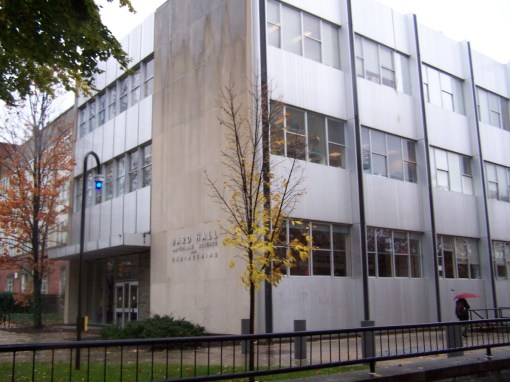
Bard Hall is one of the smaller inteconnected buildings that make up the engineering quad. The 50,000 sq. ft. building was completed in 1963 [1], 12 years after the construction of its neighbor Thurston Hall, but was designed by the same architects. Appropriately so, materials science is based out of this building, which is clad in brown Ithaca stone, limestone, glass, and aluminum. Bard Hall is named Francis Norwood Bard, Class of 1904  [2].
100_2087

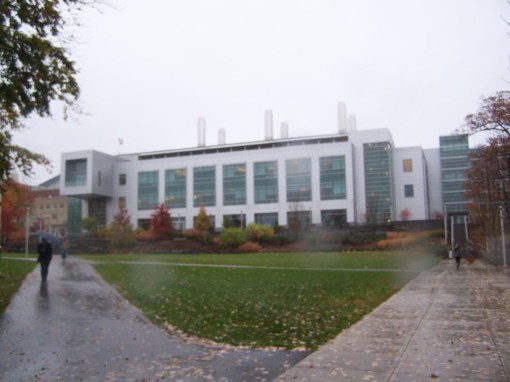
Don’t mind the rain spots. So, no review of the engineering quad would be complete unless I discussed Duffield Hall, the newest addition to the quad.

The plot of land that Duffield was built on was home ot some lanscaped quad space to the north, and the two-story white box that was the Knight Labs building to the south (the building was demolished and the labs were incorporated into Duffield).

Duffield Hall is named for Richard Duffield, Class of 1962. Duffield made his fortune by being the founder and president/CEO of the software company Peoplesoft [3]. The same Peoplesoft that screws everyone over for CoursEnroll.  
100_2093

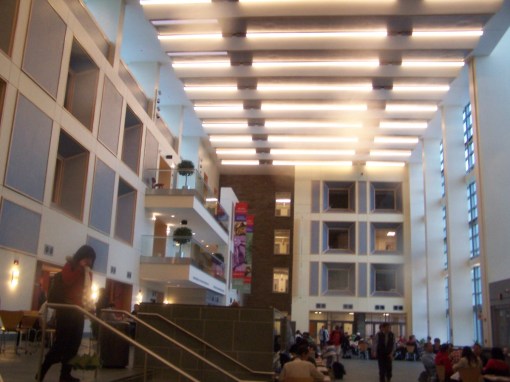
The building began construction in 2001 and was officially opened in October 2004.  The building has a usable area of about 130,000 sq. ft [4] and cost about $58.5 million. The building houses a small a la carte dining facility (Mattin’s), a large atrium, and Knight Labs (named for Lester Knight ’29) with its Cornell NanoScale Facility (CNF). Sorry, no photos of the folks in clean suits.
100_2088

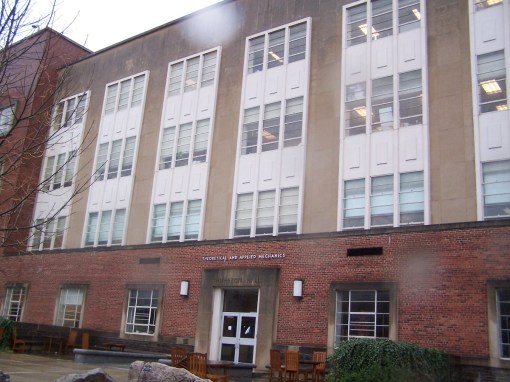
Thurston Hall is the centerpiece of the engineering quad. The building, designed in the Art Moderne style, was completed in 1951 [5]. This building technically has less usable space than Bard, but it depends on where you draw the line between it and Kimball Hall to the east, which was built at the same time. The building is named for Robert Thurston, an early Cornell engineering professor.

As you can see, the outside says Theoretical and Applied Mechanics (TAM). Technically, this department was merged with the school of Mechanical and Aerospace Engineering, effective yesterday (how convenient for this entry) [6].
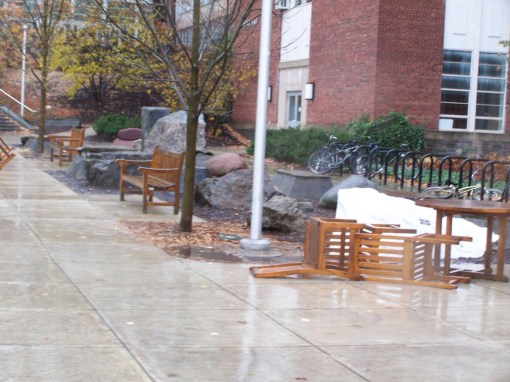
100_2089

It was really windy.  Mother Nature just decided to  crap on Ithaca that day.

100_2091

The completely unobtrusive Kimball Hall. Technically, Kimball is recognized as “the Eastern pavilion of Thurston Hall”. Also completed in 1951, the building is 30,000 sq. ft. and originally housed the geology department on its upper floors [7]. The building is possibly named for Henry Kimball, Class of 1911, who was a state supreme court justice [8].
100_2092

Cornell’s 1950s Engineering Quad plan:

1. Design a completely boring structure. Because we’re overcrowded.

2. Find an alum willing to fork over enough cash to pay for it; slap their name on the building in return.

3. Repeat

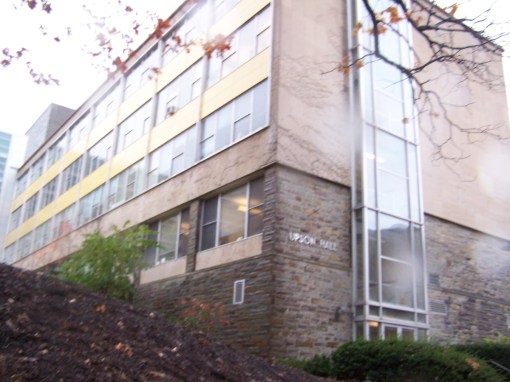
Upson Hall is a 160,000 sq. ft building completed in 1956 [9]. Upson Hall is named for Maxwell Upson, Class of 1899, and a longtime Cornell trustee [8]. The building serves as the central hub for the Computer Science department. This building could otherwise be known for a 24-hour computer lab that up until recently was a filthy lie (that damn thing was never open at night back in 07′).
100_2095

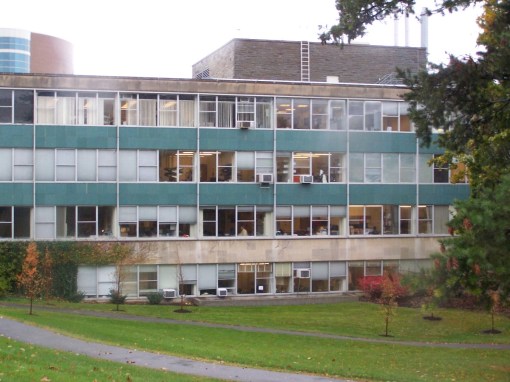
So, this is technically two buildings. The foreground box with the green window banding is part of Phillips Hall, a 100,000 sq. ft building built in 1955. The background structure (where the ladder is) is Grumman Hall, a 17,000 sq. ft building completed in 1957 [10]. Update: Or so I thought. It’s probably just another part of Phillips, but Grumman would be in the background if it was tall enough to be visible. Confusing, isn’t it?

Grumman is named for Leroy Grumman, Class of 1916 and founder of Grumman Aircraft (now Northrop Grumman [11]). Phillips Hall, named for Ellis Phillips 1895 [2], is home to the Electrical Engineering department, and Grumman houses some Aeronautics courses.
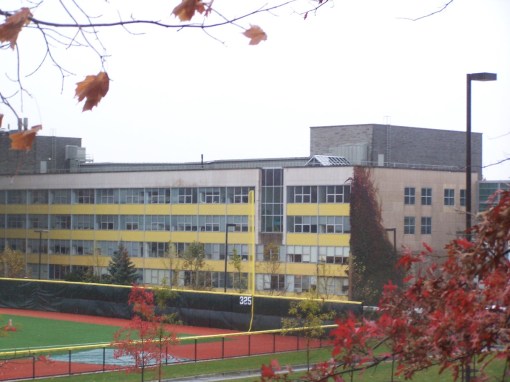
100_2099

Update: Facilities calls this part of Upson. Apparently, the only way you can make a clear difference is the color of the window banding.   I s’pose it wouldn’t be as confusing if you’ve had classes here, but these are the only two of the main engineering quad that I’ve never had a course lecture or section.

(Thank Heaven.) 

UPDATE:

So, because I was using images and wordpress doesn’t allow imae attachments in comments, I figured it would just be easier to edit the original entry. As several readers (salem, Nagowski, and andrew) have noted, the physical seperations between Grumman, Upson and Phillips are very difficult to determine, since they are all interconnected. Consider the map below. 

up-gr-ph

The map would suggest that Grumman is the south wing of the complex, Upson is on the west, and Phillips on the north. However, going through the facilities websites, Phillips is listed as 100,000 sq ft (88,000 net), Upson as 160,000 sq ft (142,000 net), and Grumman is by far the smallest at only about 16,300 sq ft (14,500 net).

Back in the day, Grumman might have been much larger. Older images have suggested that there was a multi-story (~4 floors) box jutting out of the east side of the complex where Rhodes Hall stands today.

So, we then have the task of trying to determine what Cornell thinks are seperate building areas. Upson is undoubtedly the yellow banded building on the west (Upson Hall is clearly printed next to the staircase). However, it’s also the largest, yet its footprint (if we assume from the map) is seemingly small.

Here’s one issue: if you search Upson Hall on campus facilities, you get a photo virtually identical to my last photo, which I claim to be part of Phillips. http://www.fs.cornell.edu/fs/facinfo/fs_facilInfo.cfm?facil_cd=2045. Upson uses yellow trim, as does this wing of the complex. So, andrew is right on this one, it’s likely a part of Upson.

Phillips uses blue-green panels. Also, the corresponding facilities image is the north entrance next to Duffield. We could therefore say that Phillips is the foreground building in the image where I claim Phillips and part of Grumman are visible.

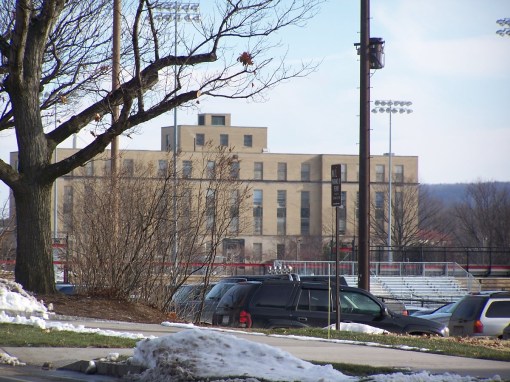
Courtesy of facilities, here’s their file photo of Grumman, which they describe as “A rectangular box with alternating horizontal bands of limestone panels, blue-green terracotta, and strip windows framed in aluminum.” :

The yellow banding of Upson is clearly visible, and Grumman is the building on the right, in the foreground of Rhodes. So, here’s a big question: at only 17,000 sq. ft, where does Grumman end and Upson begin? In the attached photos, I claim the background rooftop structure behind Phillips, with the ladder, is Grumman. However, it’s more likely another part of Phillips. Grumman is not in my images, and at such a small size, it’s not the easiest building to determine.
[1]http://www.fs.cornell.edu/fs/facinfo/fs_facilInfo.cfm?facil_cd=2070

[2]http://www.people.cornell.edu/pages/cre8/cudb/buildings.html

[3]http://www.duffield.cornell.edu/about.cfm

[4]http://www.fs.cornell.edu/fs/facinfo/fs_facilInfo.cfm?facil_cd=2000

[5]http://www.fs.cornell.edu/fs/facinfo/fs_facilInfo.cfm?facil_cd=2037T

[6]http://www.tam.cornell.edu/news/news-story.cfm?storyid=12537

[7]http://www.mssu.edu/seg-vm/bio_sidney_kaufman.html

[8]http://en.wikipedia.org/wiki/Sphinx_Head

[9]http://www.fs.cornell.edu/fs/facinfo/fs_facilInfo.cfm?facil_cd=2045

[10] http://www.fs.cornell.edu/fs/facinfo/fs_facilInfo.cfm?facil_cd=2043

http://www.fs.cornell.edu/fs/facinfo/fs_facilInfo.cfm?facil_cd=2039H

[11]http://en.wikipedia.org/wiki/Leroy_Grumman