Kappa Sigma Closes its Doors

6 05 2010

…and the Greek sh*tshow continues.
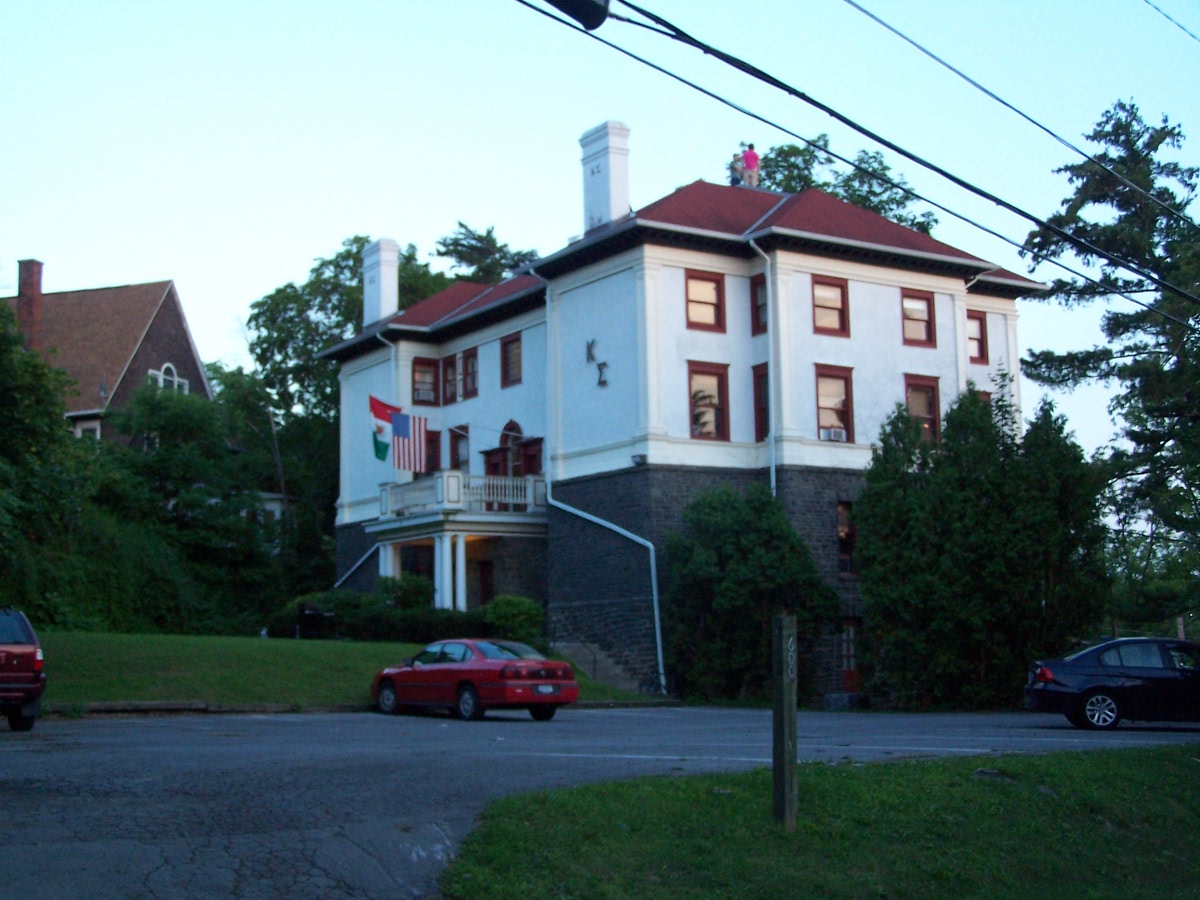
Kappa Sigma fraternity will be shut down at the end of the academic year by their national governing body, according to Associate Dean of Students for Fraternity and Sorority Affairs Travis Apgar. He added that the chapter would cease to be recognized by the University. The fraternity will be closed after violating sanctions that were imposed on them by their national organization just over a year and a half ago.

Apgar said that approximately a year and a half ago, Kappa Sigma was found in violation of their national organization’s “risk management policy” and were told that they could no longer host events with alcohol, among other sanctions. When they violated this order sometime afterward, their national organization placed them under a “trusteeship,” which required them to have any events approved by a regional manager from the national organization, according to Apgar.

Apgar said that the fraternity, however, violated this sanction too. He said that a couple of weeks ago, Kappa Sigma hosted a party with alcohol without alerting their regional manager or registering it with the Interfraternity Council — in violation of both their national’s sanctions and IFC regulations. When the Office of Fraternity and Sorority Affairs found out, they alerted the chapter’s national, who decided to shut them down.

While leaders in the chapter do not dispute these facts, they did express disappointment at how their national governing body found out about the incident.

At their most recent party, a fire alarm went off and the fire department came to investigate. Rather than allow the OFSA to learn about the incident themselves, the fraternity came forward and told the OFSA. Kappa Sigma President Eduardo Garcia ’11 said that he was assured by Assistant Dean of Students Kara Miller that the OFSA would not alert the national governing body about the party unless a judicial hearing was held.

Though no hearing was ever scheduled, Garcia received an e-mail shortly after from the chapter’s national governing body that they would be closed down.

“We were blindsided,” Garcia said. “The OFSA didn’t even have the decency to send us an e-mail telling us that they were planning on alerting national.”

Apgar, however, denied that the agreement ever took place, adding, “It was not something I was ever aware of.” Miller could not be reached for comment.

In any case, the fraternity will likely remain closed for at least the next few years, though Apgar said that he believed the fraternity would be back, just “not in the immediate future.”

“This chapter has been around for many years and there are a lot of people who have put a lot of time and money into it, I think it will eventually be back,” he stated.

***

This one came almost out of the blue. I began to suspect something was up when I began to see facebook statuses yesterday from Kappa Sigs I know expressing sympathy for the chapter (my first thought was that there was a casuality of some sort). But this…Kappa Sigma was to my knowledge a fairly well-respected, low-key chapter. I don’t think anyone would’ve seen this coming.

Speaking as someone from a chapter whose national and local always seemed to have had strained relations, I am strongly sympathetic towards the Kappa Sigs sudden shutdown, but it doesn’t seem it came without its warnings. The decision to throw a party when you could be shut down for doing so is incredibly irresponsible. But I’m also appalled by the OFSA though. While Travis Apgar is head of the office, Kara Miller is usually the primary contact for houses. For her to give her word and for Apgar to notify the national either means there was horrific miscommunication or someone just got the shaft. Whatever the case, this has been handled poorly and is a big breach of trust between chapters and the OFSA. I wonder if they did it anyway as a show of force to prove that they could put the hammer down on unruly chapters. Regardless, poor display of authority, and poor decision-making on Kappa Sigma’s part.
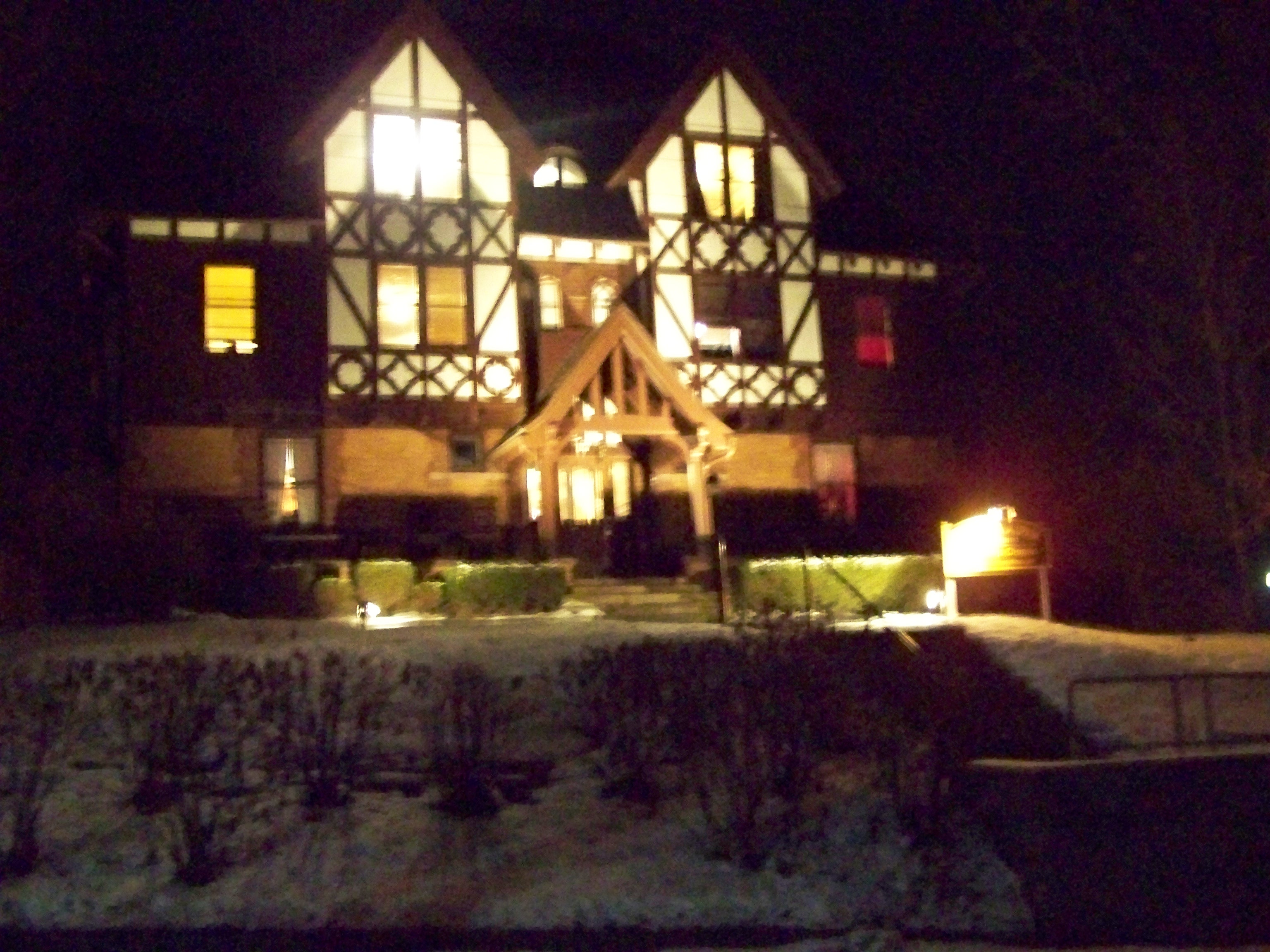


Unsurprising News: Pike To Be Shut Down

2 05 2010

As many expected, Pi Kappa Alpha will be shut down by the university. After an undetermined length of time, they will be able to reapply for recognition by the university. Considering they have a very expansive and influential alumni organization, expect that to take only a year minimum, until the last current members are graduated at the latest (which would be summer 2012). Still, sucks to be associated with Pike right now.

Then again, it isn’t a good idea to be associated with Alpha Delt right now either. Especially in an age where “tips” can get you a page on the Huffington Post for hazing pledges. I doubt Alpha Delt will receive much of a punishment though. When your alumni include John Dyson ’65 (for whom a number of scholarship and part of Mann Library are named), Kent Hubbell ’67 (Dean of Students), and Knight A. Kiplinger ’69, you’re pretty well assured that punishment will be a figurative slap on the wrist.


Cornell’s Unfortunate Year Continues

18 02 2010

Cornell sadly rings in the semester with the death of freshman economics major Bradley Ginsburg, whose body was found in the gorge yesterday morning. his untimely death marks the tenth such occurence among undergrads this year.


Finals-Induced Hiatus

7 12 2009

Sorry folks, I’m currently caught in a flood of research and finals. New entries will be coming in after a few more days.


News Tidbits 8/27/09: Phase Two of Coal Yard Apartments Planned

28 08 2009

From the Ithaca Planning Board’s August agenda:

Coal Yard Apartments – Phase 2, 143 Maple Avenue, Steven & David Beer Owner/Applicant.

Declaration of Lead Agency, Public Hearing, Determination of Environmental Significance, Consideration of Preliminary & Final Approval. The applicant is proposing to construct an Energy Star-rated, 25 unit apartment building located between the existing coffee shop and the existing 10 unit apartment building that was constructed in 2007. The new building will have four residential stories built on top of a 16-space underground parking garage. The new building will have four 3 bedroom units, seven 2 bedroom units and fourteen 1 bedroom units and will have an elevator. The applicant anticipates that the majority of the bedrooms will be singly occupied. It will have a flat roof, and will include many of the design elements of the 10 unit building. Lower levels of the façade will be brick and upper levels will use similar fiber cement clapboard and solid board panels used on the 10 unit building. Colors will match or complement the existing building. The target market for the building will be graduate and profession students, professional academic staff and faculty, and seniors. The project is in the R3b Zoning District and will require a variance for height. This is a Type I Action under the City of Ithaca Environmental Quality Review Ordinance in accordance with §176-4 B (k) and an Unlisted Action under the State Environmental Quality Review Act and is subject to environmental review.

The property is part of the Beer Properties portfolio, which includes the Grandview House in central Collegetown. The trick here will be getting the height variance approvalas Ithacans are very protective of their sight lines. Here’s a picture of the 10-unit building taken from their website:


The apartments are aptly named, since this used to be the coal yard for the city of Ithaca back in the day [1]. Prior to discontinuation of passenger train traffic in 1963, the site was also home to the East Lehigh Valley Railroad Depot. The coffeeshop referenced in the city agenda is the “Queen of Tarts”, which sounds like a great name for a madam as well as being a cute pun.

The project falls outside of the Collegetown Vision area and would not be affected by any zoning changes as a result of the Collegetown plan.


[1]http://www.beerproperties.com/cya.html


News Tidbits 4/16/09: Little Ithaca Grows Up

17 04 2009

Looks like Ithaca’s downtown area is seeing some long awaited expansion.

http://www.theithacajournal.com/article/20090416/NEWS01/904160358&referrer=FRONTPAGECAROUSEL

Major downtown construction projects are slated to move forward this year, a sign of Ithaca’s relative resilience in troubled economic times, city officials say.

The Hotel Ithaca project at the eastern end of The Commons should break ground this fall, and construction is scheduled to start by summer on the Cayuga Green condominiums between the Cayuga garage and Six Mile Creek, Downtown Ithaca Alliance Executive Director Gary Ferguson said.

This summer should also see the completion and opening of the new Cinemapolis in the ground-floor of the Green Street garage and Urban Outfitters on the ground-floor of the Cayuga Green apartment complex.

Hotel and condos

The $30 million, 100-room Hotel Ithaca project this month received city approval for zoning variances, and Common Council approval to jut several feet over the top of the Green Street garage. It’s scheduled to come for site plan review to the Planning and Development Board April 28.

The $12 million, 7-story Cayuga Green luxury apartment/condo project is the last piece of the years-long Cayuga Green downtown development. It already has needed approvals.

Ferguson said when he talks with fellow economic development planners around the state, “they’re just green with envy.”

“One, we’ve been planning them for some time so it’s not like these are just popping out of the ground. But secondly, while the economy’s been rough, this still is a very strong economy relative to other parts of the state, other parts of the country,” he said. “I think this malaise, if you will, is worse in a lot of other places and actually makes Ithaca look even more attractive to people.”

Bankers still seem to have faith in Ithaca, said Phyllisa DeSarno, deputy director for economic development for the city. This is evidenced by the fact that Cayuga Green developer Ken Schon has retained his financial backing.

“We were all crossing our fingers . . . because so many developers are losing their funding and banks are not going with projects,” she said. “But he said it does not look like that’s going to be his issue. He is moving ahead.”

The Hotel Ithaca was proposed to go up to the limit of 85 feet allowed by zoning, but the project developer received approval to go up an additional 21 feet, in order to enclose the building’s heating, ventilation and air conditioning systems. Under the city’s zoning, that kind of equipment is never considered part of a building’s height.

“This was a very, very major coup, really,” DeSarno said. “We were so thrilled that this happened because it sets a bar now I think for other developers, other builders to do something about mechanicals, which are really such a blight. When you’re coming off any of the hills, coming down from Ithaca College or Cornell (University), it’s going to be so much more aesthetically nice to have that screening there.”

The rooftop enclosure will also include meeting and conference space “to offset the cost of the structure,” according to information provided to the city’s Board of Zoning Appeals.

Openings

Construction continues on the future homes of Cinemapolis and Urban Outfitters on either side of Green Street.

Cinemapolis is scheduled to open in late May, potentially in conjunction with Ithaca Festival, said Lynne Cohen, one of the executive directors of Seventh Art, which oversees Cinemapolis.

Construction is scheduled to be complete in about a week, then all that will be left is to paint and install seating, projection equipment and refreshment equipment, Cohen said.

“With a little imagination, you can see what the theater’s going to look like,” she said.

Compared to the existing Cinemapolis theaters in Center Ithaca and at Fall Creek Pictures, the new location will have “fewer seats but better allocated,” Cohen said.

Cinemapolis’ contract at Fall Creek Pictures runs through the end of this year, but Seventh Art has not yet decided whether they’ll continue showing films there once the new location opens, said Rich Szanyi, Cohen’s husband and another Seventh Art executive director.

Tsvi Bokaer, founder of Fall Creek Pictures, could not be reached for comment.

Urban Outfitters, which will occupy the eastern half of the ground floor under the Cayuga Green apartments, is on schedule to open July 2, project architect David Levy said by email.

“Now obviously Urban Outfitters will be a big draw and all of the neighbors around Urban Outfitters, including The Commons, will benefit from them being here,” DeSarno said.

Ithaca will be the second Upstate New York location for college-age focused Urban Outfitters. The other is in Buffalo.

Tompkins Consolidated Area Transit also plans to rent space on the ground floor of the apartments, and Schon is in discussion with two local small businesses about filling the remaining area, DeSarno said.

“Obviously there are cuts throughout our city and the county in our businesses and in our employers,” she said. “But we certainly, like Bob Sweet from National Development Council always says to me, ‘(Ithaca is) an oasis amongst a muck and mire.’ ”

The Hotel Ithaca was proposed to go up to the limit of 85 feet allowed by zoning, but the project developer received approval to go up an additional 21 feet, in order to enclose the building’s heating, ventilation and air conditioning systems. Under the city’s zoning, that kind of equipment is never considered part of a building’s height.

“This was a very, very major coup, really,” DeSarno said. “We were so thrilled that this happened because it sets a bar now I think for other developers, other builders to do something about mechanicals, which are really such a blight. When you’re coming off any of the hills, coming down from Ithaca College or Cornell (University), it’s going to be so much more aesthetically nice to have that screening there.”

The rooftop enclosure will also include meeting and conference space “to offset the cost of the structure,” according to information provided to the city’s Board of Zoning Appeals.

~~~

For the record:

commons

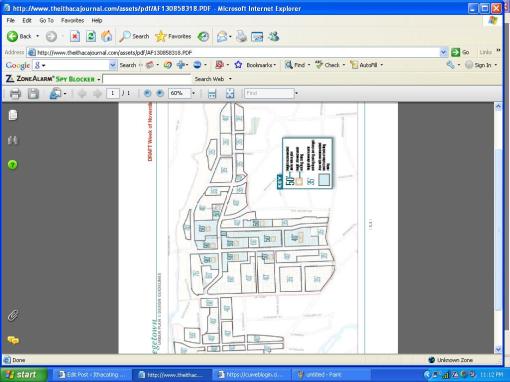
Red box is part of the Hotel Ithaca site, green box is the Cayuga Green Condos site. Cayuga Green Apts, shown as under construction in this map, are where Cinemapolis and Urban Outfitters are going to be located. As Mr. Nagowski noted, Cinemapolis will be in the garage side of the construction area. Urban Outfitters is on the first floor of the apartment building.

Hotel Ithaca proposal:

http://www.gemstoneresorts.com/Properties.aspx

Cayuga Condos

http://www.josegarciadesign.com/images/cayuga-condo00.jpg

For reference, the height of Seneca Place is 121 feet, according to Emporis. The new apartment building on Green Street is 60 feet.


The Planning Board’s Lack of Logic

20 03 2009

http://www.theithacajournal.com/article/20090319/NEWS01/903190358/1002

Goody Clancy’s suggested plan:

goody-clancy-plan

The recommendations from the planning board

ithaca-plan

Note the differences. There are many. It’s as if they looked at the $200,000 study, said “it’s nice, but-“, and went the opposite direction.

So, the planning board has not only not accepted Goody Clancy’s advice, it’s doing the reverse – it’s making zoning even more restrictive, and (as suggested) making parking tighter in Collegetown in favor of garages in the city. I’m sure they’re patting themselves on the back for “preserving the neighborhood”. In my opinion, considering the parking and discouragement of multi-unit buildings, this seems to be a not-too-subtle suggestion to students from permanent residents: we don’t want you here.

My suggestion to permanent Collegetown residents: too bad. As Cornell’s class sizes increase, where do you think they’ll move? North is well protected as a historic district (Cornell Heights – and Cayuga Heights has had restrictions in place for years). West is largely undevelopable due to topography and the cemetery. Living outside the close proximity of Cornell will lead to students bringing cars with them, resulting in more traffic congestion, which is (and should be) discouraged.  Students will therefore move to Collegetown, and I’m willing to bet that as opprotunities arise, landlords will buy up the owner-occupied properties and turn them into student occupied houses, since there will be more demand. This may pass for now, but in the long term, the anti-development crowd is going to dwindle down. There’s nothing Mary Tomlan and the planning board can do about that.


One Stormy Day on Campus, Part II

19 12 2008

I’m snowed in in little Ithaca right now, so I might just as well kill some time.100_2080

The story of Barnes Hsll is a rather interesting one.  The architect, William Henry Miller (of Uris Libe Fame) produced two designs- a gothic design, and a Romanesque Revival design [1]. Although the Gothic design fits in better with Sage Hall and Chapel, the Romaneque design was considered more up-to-date, and was completed in 1888. The building is named for Alfred Smith Barnes, a publisher and (at the time) a Cornell trustee [2]

One goal of the building’s construction was to do away with Cornell’s image as a heathen school, being the first building in the nation specifically built for a college Christian association (in this case, the CUCA, Cornell U. Christian Association). The building also functioned as the first student union on campus, and he Cornell Store, then a co-op, was based out of its basement.

When it was first constructed, many believed that Barnes Hall was cursed. This was due to a series of unfortunate coincidences. Alfred Barnes passed in 1888, as the building was nearing completion. So did his daughter…and the superintending architect (not Miller)…and the contractor…the gas contractor…and the gentleman who did the stone carving died of consumption before it was completed (Bishop, “History of Cornell”, pg. 269). The “evil omens” ceased as the building was completed.

100_2072

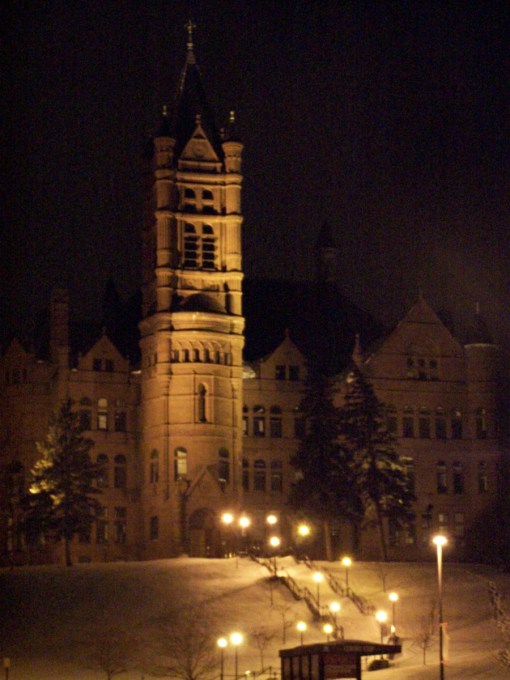
McGraw Hall, the most prominent of the Old Stone Row. McGraw relatively utilitarian design comes from the tastes of old Ezra Cornell himself; he believed in function over form, so he wasn’t one to worry about ornamentation. The building was designed by Archimedes N. Russell, a prominent architect out of Syracuse (Russell designed one of Syracuse University’s most prominent buildings, Crouse College, which I happen to have a picture of).

12-21-07-014

McGraw Hall faces the wrong direction due to Cornell’s ever changing master plans. Frederick Law Olmsted (who also designed Central Park), designed the first master plan, with the general theme to be a “grand terrace” ovelooking Cayuga Lake. As plans changed over the years, the grand terrace was dropped, but the nod to Olmsted’s master plan is obvious with McGraw Hall [3]. 

McGraw Hall was the first new building to completed, with construction completed in 1872 [4]. The tower at the top originally housed the chimes until they were moved to the clock tower in 1891. The building is named for John McGraw, a wealthy lumber merchant and original trustee.

To quote the university’s website, “It is said that John McGraw and Henry Sage were so appalled at the exhausted look of A.D. White and Ezra Cornell at the opening ceremonies that they committed themselves to the University’s cause on the spot. [4]” The stone used in the original stone row was quarried from the base of Libe Slope.

Today, the building is home to the Anthropology, Archaeology and History Department, as well as the Knight writing institute. It was in this building that I had my “History of Cornell” class.

100_2082

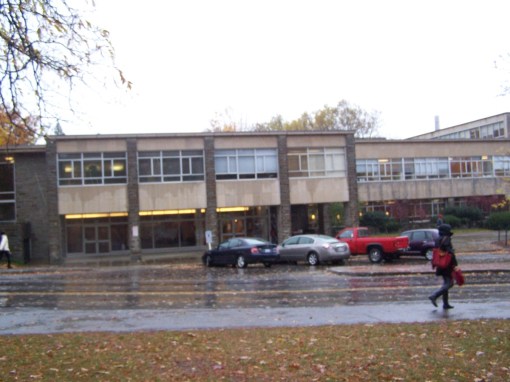
Carpenter Library is the primary library for the Engineering school. The building was named for William Carpenter 1910, who made a $1 million donation towards its construction (which cost $946,662, meaning Cornell had money left over in some sense) [5]. Carpenter Library was completed in 1957, partially renovated in 2002, and is slated to be demolished under the current Cornell master plan.

Personally, if I donated money for two buildings on campus, and both of them were set to be demolished, my spirit would be pretty pissed.

100_2083

Anabel Taylor Hall is the second half of the Taylor complex. Completed in 1953 (shortly after the death of Anabel Stuart Taylor herself), the building was the long intended partner to the main structure, hence its relatively dated Collegiate Gothic design for the time. The tower on the right side is a memorial to those Cornellians who lost their lived fighting in World War II. Today, the building serves as the primary religious facility for campus (CURW the successor of CUCA, is besed out of Anabel Taylor Hall).

100_2085

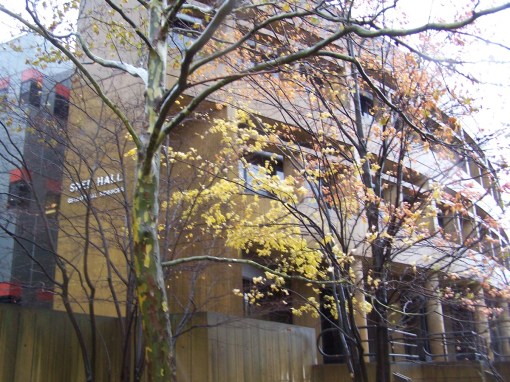
Snee Hall is home to the geological sciences department. The building was completed in 1984 and is named for William Snee ’24, an entrepeneur in the oil and gas industry [7]. At a glance, the lare atrium and overly 80s design reminds me of  chain hotels in northern New Jersey, but the building does have some nice assets. A seismic vault for recorded earthquake data is stored below ground level.  Also, if you ever happen to find yourself in Snee, be sure to check out the very large hydrologic sedimentation and erosion display (essentially, a stream-and-silt machine). The building also houses the Heasley Mineralogy Museum [8].


[1]http://www.fs.cornell.edu/fs/facinfo/fs_facilInfo.cfm?facil_cd=2009

[2]http://www.cornell.edu/search/index.cfm?tab=facts&q=&id=53

[3]http://en.wikipedia.org/wiki/Cornell_West_Campus

[4]http://www.cornell.edu/search/index.cfm?tab=facts&q=&id=497

[5]http://www.cornell.edu/search/index.cfm?tab=facts&q=&id=109

[6]http://www.fs.cornell.edu/fs/facinfo/fs_facilinfo.cfm?facil_cd=2038

[7]http://www.cornell.edu/search/index.cfm?tab=facts&q=&id=665

[8]https://cornellsun.com/node/9051


Everyone Loves Historical Throwbacks

2 10 2008

So, if you haven’t been living under a rock in the past year, there are plans for a 9-story, 102-room hotel just off the commons, to be designed by Scott Whitham of Thomas Group Architects in conjunction with Ithaca Properties LLC / Rimland Associates. Well, it looks like they have a hotel operator in Gemstone Hotels & Resorts, a boutique hotel operator based out of Utah [1]:

Hotel Ithaca

Hotel Ithaca, currently in final planning and approval, is expected to open in 2011. The property will be a nine-story, full-service boutique hotel at the intersection of State and Aurora Streets. The hotel will feature 125 luxury rooms and suites and 2,000 square feet of flexible meeting space. The hotel will be built on the same site as the original Hotel Ithaca. In addition, the hotel will be the home of the original Zinck’s Bar, a cherished icon of the city’s past.

“We welcome the opportunity to be involved with the first luxury boutique hotel in the Ithaca area,” said Thomas Prins. “Because the city is also home to the world renowned Cornell Hotel School, we are very excited to set a new standard in concept and operations and set an example for students and the many hotelier alumni who visit the school.”

I have no clue where they had the idea it was a 125-room hotel. Everything I’ve read has stated 102 rooms.

That being said, since the last Zinck’s closed over forty years ago, the only things most of us modern Cornellians know about it is from “Give My Regards to Davy” [/We’ll all have drinks at Theodore Zinck’s/]. Cornell’s alumni associations make use of the Zinck’s nostalgia in its alumni events:

“Theodore Zinck was a saloonkeeper in Ithaca, and his pub, the Hotel Brunswick, was a popular gathering place for Cornellians in the 1890s. After his death in 1903, several bars using his name continued to provide a haven for students. When the last Zinck’s closed in the mid-1960s, celebrating the spirit of Zinck’s became a favorite Thursday night Collegetown tradition for undergraduates. It wasn’t long afterward that Cornellians began to continue the tradition in their hometowns. This year, alumni will celebrate this uniquely Cornell event in more than 90 cities around the world. So wherever you are, remember your days at Cornell on October 16. [2]”

Currently, the University uses “the Spirit of Zinck’s night” as a way to promote alumni involvement (e.g. solicit donations). With the historical name being reused at a drinking establishment once again, it looks like they might be able to celebrate at Zinck’s a couple of years from now.

[1]http://www.wishtv.com/Global/story.asp?S=9097563&nav=menu35_8

[2] http://www.alumni.cornell.edu/zincks/index.cfm


News Tidbits 8/15- CU ERL Project

15 08 2008

So, I’m writing this as I’m sitting at a desk within the hotel; granted, I’m on the job, but it would help if I had more than one customer every forty-five minutes. It’s a bit of a running joke among Cornell Store employees that the Statler requires a dress shirt, tie and a really long book. Luckily, one of the few benefits to working the Statler Hotel gift shop over the main store is that we actually are permitted to browse the internet (with discretion).

So, doing as I often love to, I was perusing the planning board notes for the August 19, 2008 meeting of the Town of Ithaca planning board. And lo and behold, look what pops up:

8:00 P.M.        

Consideration of a sketch plan for the proposed Cornell University Energy Recovery Linac (ERL) project located north of the Pine Tree Road and Dryden Road (NYS Route 366) intersection, Town of Ithaca Tax Parcel No.’s 63-1-8.2, 63-1-2.2, 63-1-12, 63-1-3.1 and 63-1-3.3, Low Density Residential Zone.  The proposal involves construction of an underground accelerator tunnel (14-foot diameter and 2 km long), a cryogenic facility and associated electric substation (+/- 15,000 square foot footprint), and an extension to the existing Wilson Laboratory (+/- 185,000 gross square feet of building space).  The project will also involve new stormwater facilities, parking, outdoor lighting, and landscaping.  Cornell University, Owner; Steve Beyers, P.E., Engineering Services Leader, Agent.

The other agenda items aren’t notable (a radio tower, continued discussion about the IC Athletic Complex, and the continued use of an equestrian facility).

So, the construction of 200,000 sq. ft of physical plant, a cryogenic facility and an accelerator tunnel require a bit of investigation.

The first thing I came across is this week-old Cornell Chronicle item. The particle accelerator has a planned timeframe of construction that would allow for the beginning of operations in 2011 [2].

Rather than try and explain the operations of the particle accelerator itself, I’m just going to quote the article (I’m excusing myself on the grounds that I study thermodynamics, not quantum physics).

The ERL would accelerate electrons to nearly the speed of light in a linear accelerator (linac) made of two straight tubes, each about 330 meters (0.2 miles) long, then feed them into the Cornell Electron Storage Ring, Hoffstaetter said. After a single rotation around the ring, the electrons would return to the linac, where their energy would be recovered and used to accelerate the next batch of electrons.

Meanwhile, at various points around the ring, the Cornell High Energy Synchrotron Source would use the electrons to produce ultra-bright, ultra-fast pulsing X-ray beams capable of imaging structures just a few atoms wide, and whose oscillations would be resolved with sub-picosecond resolution (less than a millionth of one millionth of a second). [2]”

On another note, the building is visible in the master plan diagrams, as the large expansion that exists to the east of the current Wilson Lab structure:

So, our physical plant will continue to expand for some time yet.

[1]http://www.town.ithaca.ny.us/

[2]http://www.news.cornell.edu/stories/Aug08/ovp.forum.erl.html