Being an Alum

4 12 2010

So, letting go of undergrad is hard. But being an alumni doesn’t mean that everything simply ends.

While visiting a friend up in Vermont this past summer, she mentioned over lunch how she volunteered in the local alumni network there, of meeting with accepted students and going to alumni events and so on. Feeling a bit nostalgic (and realizing that I don’t want grad school to complete dominate my life, although it’s coming real close), I found myself signing up to be a part of the local chapter of CAAAN. CAAAN is the “Cornell Alumni Admissions Ambassador Network”, which is divided up into about 300 chapters and 8000 volunteers who take on the opportunity of evaluating applied prospective students.  I figured that I could spare enough time to meet with high schoolers and answer questions they might have about CU, as well as pose a few queries to them for their “evaluation”. To be honest, I remember my meeting being uncomfortable because I was meeting them at the restaurant I worked at in high school, and since they arrived twenty minutes early, I seated them without realizing it was the alum I was supposed to meet with. When they looked at my nametag and asked me if I would be ready to talk about Cornell with them in a few minutes, I promptly excused myself and proceeded to have a royal flip out in the dishroom.  Luckily for me, I told my boss ahead of time about the planned meeting, so she took over the register and let me off a few minutes early.

It’s probably a bit peculiar since if someone asked me what I thought of Cornell while I was there, I would have had some lovely comments worth sharing (though not in front of children). Yet here I am, volunteering to meet with fresh and enthusiastic high schoolers and to try and promote a good image of Cornell. Hopefully.

Being new to the whole thing, I attended a meeting at a local hotel that the local alumni association was doing as an orientation for CAAAN.  The first thing that struck me when I walked into the room was the realization that I was easily the youngest person there. There were about 15 people, almost all of whom were middle-aged (40 and up) professionals, and as I sorta stopped in the doorway, the local chapter head looked at me and said “[Y]ou must be the new guy. I recognize everyone else here.”

What followed was a passing out of “current facts of Cornell” and some admissions and evaluation guidelines. It became quickly apparent that being the young guy had an advantage. They spent several minutes asking me to describe recent changes on campus and how the new financial aid plan was working and random questions about if some aspect of Cornell has changed in the past 10/20/30 years. For once, this blog proved to be useful on a personal level. I also managed to make several of them feel extremely old when describing the new West Campus houses.

It was different. It felt a little strange, but it felt right at the same time. I may be getting older, but I’m still quite young as alumni go.


The Blessing and Curse of Anonymity: CollegeACB

20 11 2010

It seems increasingly common these days to read editorials and columns in the Daily Sun that reference the extremely controversial website CollegeACB (Anonymous Confession Board). That and the alcoholic energy drink Four Loko seem to be the two things that dominate the collegiate news articles this semester (personally, all the news I hear about the drink just makes me more tempted to try it, but I don’t find myself at convenience stores often enough to remember to do so). Reading through the threads on the CollegeACB Cornell page is like a lesson in everything that is “wrong” with people; the website is well-known for its tirades that seem to know no ethical bounds, which include posts that are racist, anti-Semitic, sexist, classist, fetishist and all sorts of other comments that play up the darker side of human character.

I think most people who are on the internet these days have seen something like this before. Before CollegeACB, it was Juicy Campus, before the internet people made use of public spaces; I think there was a stump that used to be near Olin Libe on the Arts Quad in the late 60s and early 70s that was used extensively for spray-painted or paper-posted anonymous messages. Anonymity gives people the guise of security; their comments can hardly be traced to them unless they write something that clearly indicates it was them, or someone sees them typing and posting onto a forum. The sex columnists (the people may change, but the pattern is familiar) go by initials or self-created nicknames so as to avoid the coming up on the radar of potential employers and put up an extra barrier to protect against unwanted attention. Sure, a lot of folks might have a pretty good idea who the writer is, but unless it can be concretely proven, they can feel somewhat secure.

CollegeACB is a site that I can despise, and in some perverse sense, understand at the same time. I think ad hominem attacks on certain individuals is wrong, but censoring those opinions isn’t exactly the right thing to do either, since people value the concept of “personal freedom” so much. It’s a moral gray area to me; I would never do it myself, but I wouldn’t necessarily take away people’s ability to do it for a site that advertises anonymity as its big asset (I am being a bit hypocritical here; I have prevented a couple offensive comments, both of which were personal attacks because I mocked the now-cancelled Ithaca Olive Garden, from being published here on the blog; I initially okayed them, but I wasn’t comfortable leaving them on the blog and deleted them within hours).

Yet, sometimes that anonymity is what it takes for someone to take their guard down and see what they really think. People at Cornell are just as capable of being racist and homophobic and sexist as anyone else, and while those posts are offensive, and some of them are just grotesque attempts at grabbing attention, I can’t help but think there’s at least an ounce of someone’s personal beliefs in there. Objectionable as those posts may be, they demonstrate that Cornell is not a perfect world, and a lot of the tension that gets swept under the rug publicly will rear its ignorant head if given the opportunity.

In a previous post, I compared finding useful information on that site to finding a diamond in a pile of crap. Occasionally, the guise of anonymity can be helpful, and an honest, valuable opinion that would otherwise been kept silent is voiced. But you never know how much truth there is in a post, so the “diamonds” might just turn out to be pebbles of glass. I think a statement and a little research can go a long way in proving a comment right, but that’s not always possible.

I guess the topic really sticks out to me because of Ithacating in Cornell Heights. This blog is written semi-anonymously, in that although I’ve never written my name once, there’s enough information out there that I write as if the posts had by name on the top of each entry…which defeats the purpose of anonymity. My major reasons for continuing it like this are partly because of routine and partly because I prefer what I write to be dissociated from me.

The posts that make up the site are unpleasant, certainly. But I think it’s more a reflection of the people writing anonymously than the existence of the site itself. Maybe people just hold themselves to a low standard. Maybe I’m holding people, myself included, to a low standard because although I don’t condone it, I accept it.  My view is pessimist because I don’t expect people to hold themselves to higher standards, which that website proves every inflammatory day.

I’m too much of a curmudgeon to put a smiley face on this and write how we should behave better. It would be nice, perhaps, but I think it would be unrealistic as well.


On Grad School-Induced Hiatus

4 11 2010

I’ll have new posts ready sometime in the near future.


The Keyword Bar X

19 10 2010

“what was the first residential building at cornell” (10-13-10)

Technically speaking, the first residential building was Cascadilla, which was re-appropriated by  Ezra Cornell to serve as a dormitory for students and faculty when the school first opened its doors in October 1868. White and Morrill Halls served as both residential and classroom facilities, but I suppose by a strict interpretation of the question, those would be mixed use. The first residential building for women was Sage College in 1875, and the first building built explicitly to be an all-male dorm was Baker Tower on West Campus, in 1914 (A.D. White was a strong advocate of housing male students in fraternities or boarding houses, to encourage independence— hence the tardiness of new dorms for men).

“ithaca beer company” (10-11-10)

One of the minor caveats I have with the area in which I moved to post-graduation is that there’s no Ithaca Beer distributor. Trust me, I looked it up, and the nearest one is in Utica (or the Catskills, I haven’t checked that closely). It would be a nice little nostalgia trip to be out at the bar with my fellow grad students and order an Apricot Wheat, but it’s not possible here. This is why I need to quench my inner lush and stock up the next time I visit. Also, it seems I’m not be the only one who enjoys their beers – they’re expanding the brewery and adding a restaurant.

“president’s house ithaca college” (10-10-10)

Rather peculiar for an all-residential college, but Ithaca College’s president lives off campus on Fountain Place. Fountain Place borders Cascadilla Glen and is between Collegetown and downtown. It also only has three houses on the street, all of which are really expensive looking.

“small frat house at cornell” (10-7-10)

Depends on the meaning of small; I think in terms of number that goes to Sigma Chi Delta, a very small co-ed fraternity on Heights Court (OFSA reported they had 11 members in the Spring of 2009; their website records 15 as of Fall 2010). In terms of size, I honestly don’t know, but would venture an educated guess at Sigma Chi Delta.

I actually was at this house a few times. One of my housemates dated a girl who was president of this house, and even though they broke up, I was still friends with the ex, and since they were just down the street from my apartment, it was never much trouble to go over and say hello once in a great while. Nice folks.

“beer pong table designs” (10-6-10)

They’re never classy and only useful for a few years. By then, you’ve ever grown out of it or the table is wearing out. But I have seen some pretty nice tables over the years. I always had a soft spot for beer pong tables with inlaid beer caps. So in August of 2009, I refinished a standard table in my fraternity’s living room with beer caps.

It’s a pain in the ass. Getting enough caps is difficult because hardly anyone wants to be “that” guy running around collecting caps at a party. I guesstimate that I used about 1500 caps. For the finish, I used a combo of resin and epoxy that cost about $90. Basically, I had to mix the two together in a large bucket with a broomstick, and pour it down on the (edge-sealed) table in 1/8” layers, with about 8 hours for each layer to dry. It took about three days. Oh, and if you don’t glue the caps down, you risk them floating up and away while pouring — never fun. Popping the air bubbles that rise up isn’t a great time either. Eventually, the table was done, (I did it in the fraternity’s letters with an unpatterned border) and it came out really well. The last time I visited, it was still there and in relatively good shape after a year’s worth of food and drink spills. It made me happy. It’s a small source of pride, in its own, perverse way.


The Keyword Bar XI

20 09 2010

…because I don’t feel like researching (Cornell related or work-related).

1. “new collegiate gothic” (9/19/10)

Okay, so this probably has little to do with Cornell, as Cornell hasn’t built in collegiate Gothic in over fifty years. Regarding that, I’d like to share a brief quote from Morris Bishop’s A History of Cornell:

“The Buildings and Grounds Committee recommended (September 19, 1950) that we wait no longer for donors of Gothic magnificence, but that we build structures that would pay their way. Said the chairman, John S. Parke ’23: “Engineering rather than architectural construction is advisable”. (597)

Of course, then we ended up with such “lovely” works as Olin Library and Olin Lab and Bradfield Hall.  I suppose the only way one could force a new Collegiate Gothic structure onto campus today would be as a stipulation of a very large donation (as in, one that pays for an entire new building without major additional funding from Cornell).

2. “ivory tower drinking society” (9/18/10)

This is a little murky. First off, it wouldn’t formally be called a drinking society  (the more likely term would be social society). As for the existence of such a group, googling “Ivory Tower Honor Society Cornell” pulls up a bunch of linkedin profiles of sorority women in  who were part of Cornell’s “Ivory Tower Honor Society” during the 1990s. So, if I had to take a guess, it was probably a tenuous organization that served more of a social purpose than anything honorary. But, I can’t say for sure.

3. ‘tompkins county public library roof” (9/17/10)

It has solar panels (that generate about 145 kilowatt-hours). Kinda funny considering Ithaca is one of the cloudiest cities in the country (206 days/year).The library opened in 2000 after moving from a location several blocks away; the site used to be home to a Woolworth’s department store.

4. “ithaca 103 dryden ave video store” (9/15/10)

I was wondering if this would come up. As covered recently by the Sun, the Collegetown Video store shut down after nearly twenty years of service. The store open in February 1991. The unique metal facade was designed by Cornell architecture students while the store was renovating the building for its grand opening. No plans for new tenants have been announced at this time.

5. “college confidential cornell biology” (9/4/2010)

I’m going to use this as a bit of a conversational launching point, actually. Since a lot of my information has to be pulled from the internet,  stumbling through message boards is inevitable. College Confidential is somewhat trustworthy, but the discussion focuses on more practical questions – “how easy is ASIAN 2571” and “chance me for admission plz!!!11”. There’s a couple of sites where people rate their experiences at Cornell, which lack details but are often good reads if you’re just looking to kill time. then of course, there’s the gossip site College ACB, which focuses on which frat is best, which freshman girl puts out the most and which sorority has the hottest pledge class. A whole lot of douchebaggery, but on rare occasion there’s a really interesting topic that offers frank insight — but finding those is like finding a diamond in a pile of crap. Use at your own discretion.


The Keyword Bar VIII

2 07 2010

Don’t mind me, I’ve just been plodding away in a lab with mounds of satellite data and computer code. In the meanwhile, I decided to do another keyword bar update. In what could be described as a “math fail”, I somehow managed to go from VI to V in the past two keyword bar entries; apparently 6 is the new 4. I make blunders quite a bit in writing up entries; there’s probably not a single entry of decent length where there isn’t a typo or grammatical error. Most importantly, though, is that the subject material remains as accurate as possible. So, without further ado…

1. ” ‘quill and dagger’ spring 2002″ (7/1/10)

The best bet to finding who was in their Spring ’02 tapping class would be to find the archived version of the Daily Sun papers from that semester and digging through them. Sucks, but that’s the only “legal” way of going about it. The graduation paper from that May would list who graduated from Q&D in 2002, so if you can’t find it in the normal paper, the graduation issue from 2003 (because Spring classes are generally comprised of juniors) might also be useful.

2. “apartments above urban outfitters ithaca” (6/31/10)

Yup, about 68 of them. Kinda funny, the story behind those. If you google the same phrase as the user who came to this site, one of the first articles you come across is Jason Fane’s editorial that Cayuga Green will fail. The article was written while the apartment building was still in the proposal phases, in November of 2005. He said, in short: 1)There is no demand for nicer housing, 2)parking is too far, contributing to 3)no retail will want to locate there and the project will fail. Note that this is coming from the same guy who owns upwards of a thousand units of housing in the Ithaca area, including most of the larger buildings in Collegetown (Jason Fane is the owner of the Ithaca Renting Company). More importantly, note that this is a man who had just renovated and opened an 85-unit apartment building (the Cityview, which opened in 2004) right across the creek from the site. This is a man who had every reason to want the project to fail, because it could take away potential renters.

Not everything went to plan for the Cayuga Green project. The cinema was reduced to a five-screen and Cinemapolis signed in to the project, thus avoiding a movie theater glut in the area. The bus stop helps with retail, but there’s always been a bus stop near the site so that’s a moot point. The Palmer Pharmacy, the Gimme! Coffee shop, and Urban Outfitters, which is considered a huge score for a project in any city let alone Ithaca — were not supposed to happen, according to Jason Fane. Also, Gateway Commons just down the street is a luxury apartment building that was built in 2006/07. That should have failed as well if we follow Fane’s logic, but as far as I know it’s doing just fine. So here’s hoping he feels just a little burned by his own words right now. The condos have yet to start construction due to the recession market, but I’m keeping my fingers crossed they’ll start sometime in the near future.

3.  how to grow ivy frat house (6/30/10)

Speaking as someone who grew up in a house that has a large amount of ivy on and around it (not really as charming as you might think since my family lives in a little ranch house), it really just grows well enough in . The older the leaves the darker they usually are. Trellises of some sort along the wall definitely help it climb but they are not necessary. It’s a low-maitenence plants that in warm, moist conditions (like a summer in the northeast) grows like a weed. A climbing weed.

4. “ithaca record cold” (6/30/2010)

This one has been covered before, but it seems a bit buried within google. The record low in Ithaca is -25 F (-32 C), set twice — Jan. 16 1957, and February 2, 1961. Record cold varies; the lowest July temperature, for instance, was a brisk 38 F, set on July 8, 1963. The last of the coldest colds for a month was set in March 1993 (-17 F, on the 19th and during the epic blizzard of 1993) and the last of the warmest warms was 69 F on December 7, 1998.  Note this is not the same as average warmth; but just google the “northeast regional climate center” for more information.

5. ” cornell cals reputation” (6/29/10)

For most of its (24?) programs, it’s among the top ten in the country. For a few, such as atmospheric science, plant science and entomology, it’s in the top three. That’s from the Gourman Report, which is published by the Princeton Review. So academically it’s well respected.

Within Cornell, CALS tends to be downcast for being a bit more state school and a bit less cosmopolitan than the other colleges. But then, every school has their negative stereotypes (we all know about engineers hiding themselves away or how easy the hotel school is).

6. “oliver s. schaufelberger cause of death”

…*edited*…

…Without meaning disrespect, I never wrote about how a student and three members of her family were killed in a car accident at the beginning of June, but that’s because it was a busy time period and I didn’t want to draw more attention to this blog for being a “list of death”, as one email put it.

EDIT: Someone asked that I take down the links and information that suggested a probable answer to the search query. I am only removing the statement out of politeness. But frankly, just because it’s no longer on this blog doesn’t make it any less plausible.

7. “gates hall 2012” (6-29-2010)

As a starting date maybe. Certainly not for completion. The reason for this is that a 70,000 sq ft building whose design hasn’t even been finalized, let alone approved by the city, would take, arguably, 12 to 18 months minimum (site prep is needed, and it’s a specialized building with sophisticated high tech components, so construction wouldn’t move all that fast). There’s nothing on the city’s planning board agenda that suggests this has come up to the board, and the building would take at least three months to get approvals. It won’t be starting anytime soon, so there’s unlikely to be completion by 2012. A start date during that year, however, is quite possible.


The Alma Mater

4 06 2010

According to the greatness that is wikipedia, Alma Mater is Latin for “nourishing mother” — appropriate to its modern reference of being the institute of education where one receives their degree. I and perhaps 5,000 others joined the ranks (numbering 245,000 or so) of individuals who can call Cornell their alma mater. But it’s still strange to think that I’m an alumnus now.

So the experience of one class is different from another. If showcasing some of Cornell’s historical figures has proven anything, it’s that times change, as do the experiences change with time. Stuck in the Fast Lane delivered the message that although we are all Cornellians, no one has the same experience. If this blog has proven something, if anything, it merely emphasizes the point that Elie makes; although experiences vary, we all contribute some small amount to the long and finely woven Big Red tapestry.

A student in 1903 was subject to a typhoid epidemic that sickened over ten percent of the city and killed 29 Cornell students (about 1.5% of the school population — comparable to about 300 or so students today; and although directly caused by polluted water, some have indirectly linked the illness to Typhoid Mary Mellon). In contrast, a student in 1969 wondered if the campus would devolve into anarchy and violence, the tension culminating with the infamous Willard Straight Takeover in April of that year. A student this past year will probably remember the sheer number of tragedies that befell the Cornell community, especially the campus suicides. Perhaps on a lighter note, they’ll also remember it as the year the basketball team went to the Sweet Sixteen.

Point is, they’re all vastly different events, but they all still make up a part of Cornell history. As alumni, we’ve all lived through at least some part of that history as students, and hopefully many more years ahead as alumni.

Ca. 1990. Note the street traffic on the lower right, where Ho Plaza is today.

I have nothing that needs to be said about my experiences as a student. I made use of my four years. I felt like I contributed to Cornell’s history, not by writing about it, but my living it, breathing it, being a part of this institution and contributing in some small but personally meaningful way. That’s the most I could ever want.

Although my time at Cornell is over, this blog is not. It will operate in a reduced capacity, certainly. But history is still being made, new buildings are still being erected and new plans being conjured and proposed and maybe even approved and undertaken. History’s flaw and beauty is in its perpetuity. Life at Cornell isn’t ending because I graduated — it goes on for as long as Ezra’s and Andy’s institution remains Far Above Cayuga’s Waters.

That alone will provide me with the inspiration and the motivation to write for some time yet.


Munier’s Blog Review

14 05 2010

To be perfectly honest, I was sincerely flattered when he first emailed me asking if we could meet and do an interview for the article. I’ve actually known Munier since freshman year so it really wasn’t awkward at all. Munier very quickly noted that I was the person who wrote this blog, and posted it on my facebook page (which I very promptly deleted). That was maybe a month or so after I started writing.

One of the first things Munier asked was if I wanted to include my name. It’s kinda peculiar, I suppose. I don’t really discuss the blog in person, and I’ve learned the hard way that what you write can bring a lot of negative attention if it comes across the wrong way. I said no thanks. Munier then pointed out the bald truth – most people who read the blog are aware that I’m the one who writes it. My response was that I preferred that it was implicitly acknowledged.

Regarding the whole Slope Media thing, I really don’t take them seriously. The one thing I’ll always remember about Slope Media is this one egocentric article I read in their magazine a year or so ago. It was about all the tools at Cornell. Namely, the collar-popping, board-short wearing tools. Then I noticed the author’s name, a guy who I worked with in labs during freshman year. He was from a Greek house notorious for fitting the very stereotype he was mocking. He acts exactly as those he criticizes. It remains the biggest case of personal hypocrisy I’ve been during my time at Cornell.

Going back to Munier’s review, it’s given a new-found appreciation for the word “sumptuous”. The damnedest thing is, when that was published I was paranoid of one of my friends coming up to me and make a big deal out of it, which I would’ve hated. I managed to avoid that, and it gets even better. On Slope Day, one of the freshmen in my fraternity started drunkenly talking to one of our fraternity brothers who is a senior in CALS (a pledgebrother of mine in AEM), and he was absolutely convinced that this guy wrote the blog. I’m standing five feet away, coughing into my drink in surprise.  Some wonders never cease.

Lastly comes the subject of continuing this blog after graduation. Munier brought it up, and it’s not the first time this has crossed my mind. I think that some of the things I write about are never-ending, like the construction. However, comments on campus news will be curtailed considerably. I’ll be in grad school and my concerns will lie elsewhere. So, I think this blog will keep running, but on a decreased capacity. For how long exactly, I don’t know. I’ll quit when I feel like it.


You’re Full of Theses

20 04 2010

I’m shamelessly borrowing the idea of thesis discussion from Elie Bilmes over at Fast Lane. It’s impressive that he put as much work as he has into his government honors thesis. I figured I could write a little from my end on doing an atmospheric science thesis.

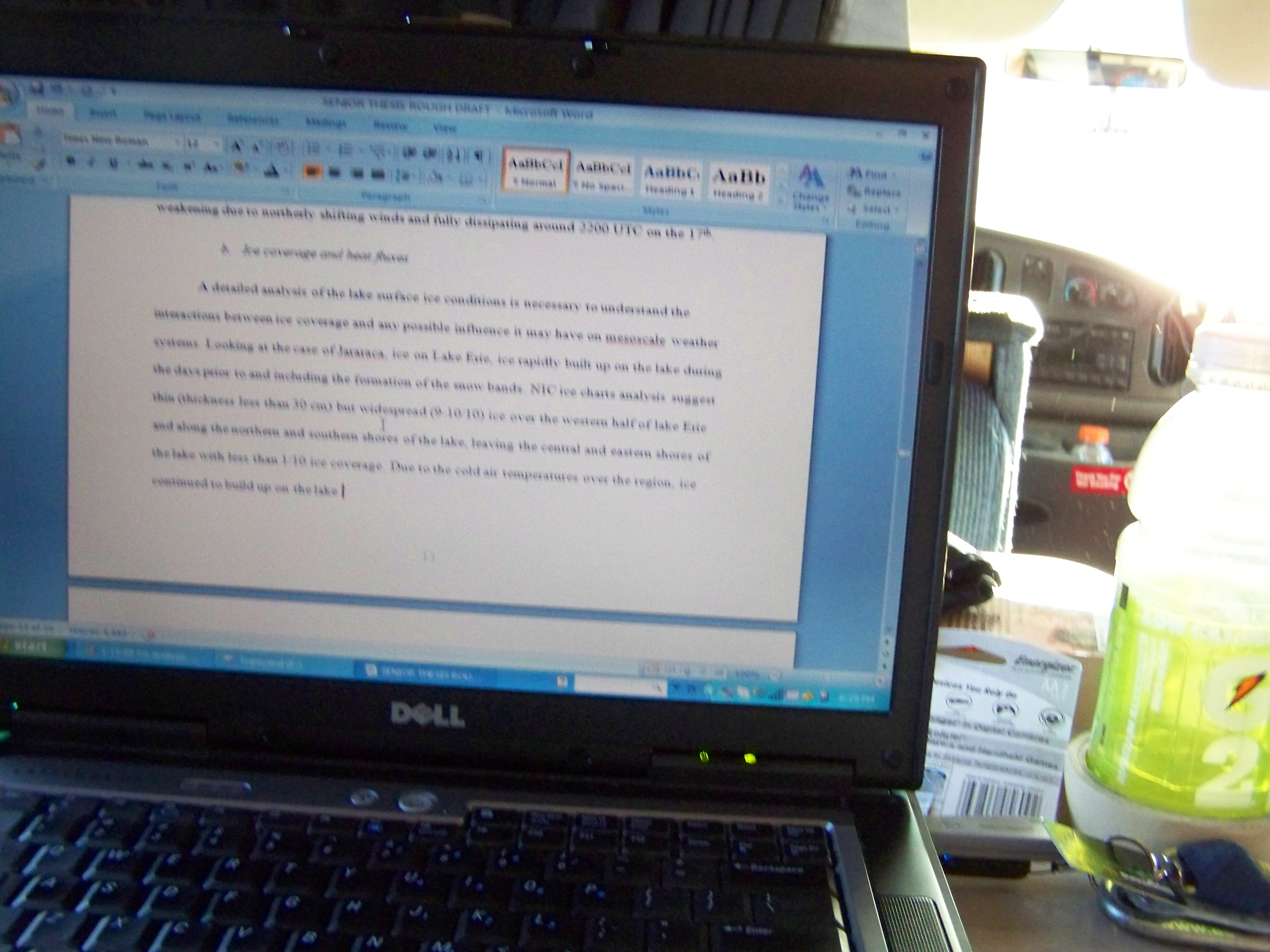
The nature of the two works are entirely different. In comparing with friends of mine that have done theses in CAS, it’s nearly impossible to relate, except that a lot of work and research went into both. I started work on my thesis last August and only began formal writing at the start of March. I made it easier on myself by keeping an electronic log of progress, and my research adviser and I met for “progress reports” every week on Tuesday at 2 PM for months on end (and Heaven help me if I had nothing new to share). I came back early from Christmas because winter break and security access afforded me great deals of time to conduct research. My spring break involved many hours of churning out page after page of writing, computer outputs and mathematical analyses of heat transfer through lake ice. In retrospect, I probably should’ve used LaTEX.

In the end, it came out to 50 pages. That’s on the large side for a technical thesis. 20 figures with an average of two subfigures each, 31 citations, and 50 pages. It sounds pitiful when compared to an Arts and Sciences production. Yet, they’re expected to be eloquent, elucidate their ideas and produce theses that could very well be works of literary art. My work is direct, with little said beyond the point. A diagram is analyzed, discussed; a matlab graphical output is viewed for trends and diurnal effects.

I dunno to what extent Elie’s work will be used beyond satisfactory completion of his honors requirements. Maybe it will be cited and referenced in future works. As for mine, I presented it at a conference this past weekend, and the faculty and researchers in attendance held my work in high regard. Well, almost all of them. One professor from another upstate school complimented my work and asked me about my grad school plans. I explained I was being funded to do work in climatology. He became very disappointed, saying it was a shame my work was going to go to waste. What a charming way to conclude my research.

It’s amazing how the ideals are the same (independent thought and research) between schools and their theses, and yet the works churned out by their students can be so different in character. But, that is the nature of different fields of study.


The Keyword Bar VII

7 04 2010

It’s actually been a while since I have one of the keyword entries. Part of it has been because I’m been busy with grad school and trying to figure out where I want to spend the next few years of my life. The decision gets easier when half the schools that accept you tell you they have can’t give a funding offer, but I guess that’s how it goes. The rest of my life is sapped away by my now-completed thesis and trying the visit the schools that won’t force me to pay out-of-pocket. Anyways…

1. “ithaca craigslist” (4-6-10)

Okay, so not exactly a query as much as it was a link. Someone posted something on Craigslist about downtown Ithaca construction projects,  and they linked here, which led a few readers here. Pretty harmless compared to some of the things you find on Craigslist (i.e. disturbing fetishes). The only time I myself have ever used Criaglist was when my housemates and I bought a bunk bed so two people could share the largest bedroom. Guy drove the bed frame out from Cortland in the bed of a pickup truck with no extra charge.

2. “what are coed greek houses called” (4-4-10)

Fraternities. Actually, some sororities, such as Kappa Alpha Theta, are also technically fraternities by name. In a nutshell, not all fraternities are all male, but all sororities are all female. Some overstep the confusion by calling themselves “societies” or by vaguely referring to themselves as “organizations”.

3. “eleusis water view” (4-5-10)

Probably not. Eleusis was based out of a house at 313 Wait Avenue. The number of houses already in the area by the 1910s, combined with at least some sporadic tress (the area was relatively barren compared to today) would’ve meant that with maybe the slight exception of the rooftop offering hindered views of Beebe Lake pre-Balch Hall, there were no water views from Eleusis.

4. “highest wind speed ever reported buffalo” (4-3-10)

According to the 2009 World Almanac, the highest wind speed is 91 MPH, but in a typical year the highest wind speed is normally around 50 MPH.

5. “physical sciences building cornell” (4-2-10)

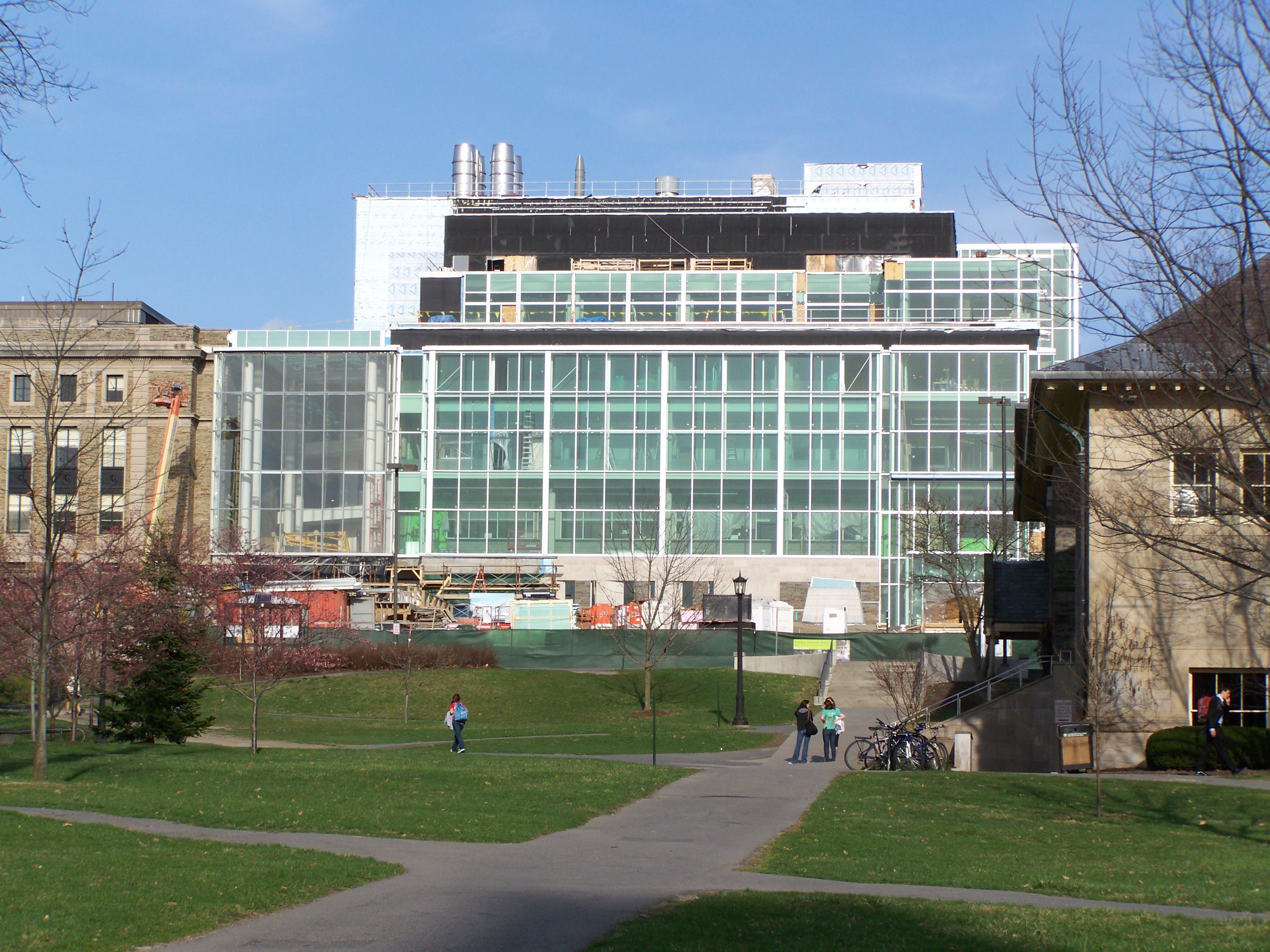
Coming along nicely. Seems to be on time for its October dedication.

6. “green cafe ithaca shutdown” (4-1-10)

Kinda funny how that turned out. It took them well over a year to renovate the old bank building on the SW corner of College and Dryden, and they were only open for a year. I went there on a date once. It was nothing special, although food-by-the-pound was an interesting take on dining out. I s’pose that one of the reasons they applied for a liquor license a few months back was to try and drum up business, but it didn’t work as well as hoped.

7. “aem vs engineering cornell” (4-1-10)

About as similar as chalk is to cheese. One is difficult, frustrating and has a low average GPA. The other isn’t. ORIE (Operations Reserach and Information Engineering) is sometimes described as a blend of the two.

8. “sage chapel hours” (4-2-10)

To be honest, I’m not sure. I want to say it opens at 8 AM and is closed by 8 PM, but I’m not positive. Perhaps someone who reads this blog has the answer to that question.