News Tidbits 9/12/2012: Reading Between the Lines

12 09 2012

I tend to look forward to the middle of the month, mostly because the new agendas are released for the Project Review Committee associated with the Ithaca Planning Board (and the first official news of new projects). Apart from this debatable unhealthy interest, I’ll sometimes check out the Planning and Economic Development Committee, not because it’s as interesting to me, but mostly because I’m trying to avoid another Cayuga Green screw-up from ever happening again. So, in engaging in my monthly routine, I looked to find that while nothing was posted yet for the planning board (meh, I can wait), a curious piece of news was embedded in the PEDC’s agenda.

There’s a note from the economic development planner asking for a brief revision in the description of waterfront zones. Waterfront zones are stated as five floors maximum, and in another section states a maximum height of 63 feet. She asks for it to be stated such that the building may be 63 feet max, or five floors. I like to imagine her busting out a magnifying glass for this trick.

 
Now, associated with this incredibly uninteresting detail is an interesting piece of news – the clarification was proposed because a property owner wishes to build a waterfront-zoned building within the 63′ height limit, but with more than five floors. Now, I double checked Cascadilla Landing, and the proposal calls for 5 floors maximum. So, unless something major changed, it’s not that project. This appears to be a new project, for a six-story building on/near the waterfront.

A couple of details can be gathered from this type of proposal. The project is likely six floors because 10′ is fairly standard for a residential development – anything less is rarely seen, due to material insulation/layering between floors, and some desire on the developer’s part  to have decent floor-to-ceiling space. Commercial entities generally have larger space requirements for equipment and space, along the lines of 12′-15′ per floor. So if I were a betting man, I’d wager a six story building, near the waterfront, all residential on the upper floors (the ground floor may have another use – perhaps a retail space with 12′ ceiling, for example). So in sum, I think the proposal for another large building on Ithaca’s waterfront may be in the works, and the densification of Ithaca’s waterfront continues.


News Tidbits 8/17/2012: The Tax Argument

17 08 2012

I held off on this entry for a few days. Not because I was particularly low on time, but because I was waiting for the latest planning board project review minutes to come out, to see if there was anything newsworthy (and pretty much everything on there was minor, or I’ve already covered it, so…nope, nothing newsworthy). So I’m going to take a closer look at an article recently posted by the Ithaca Journal.

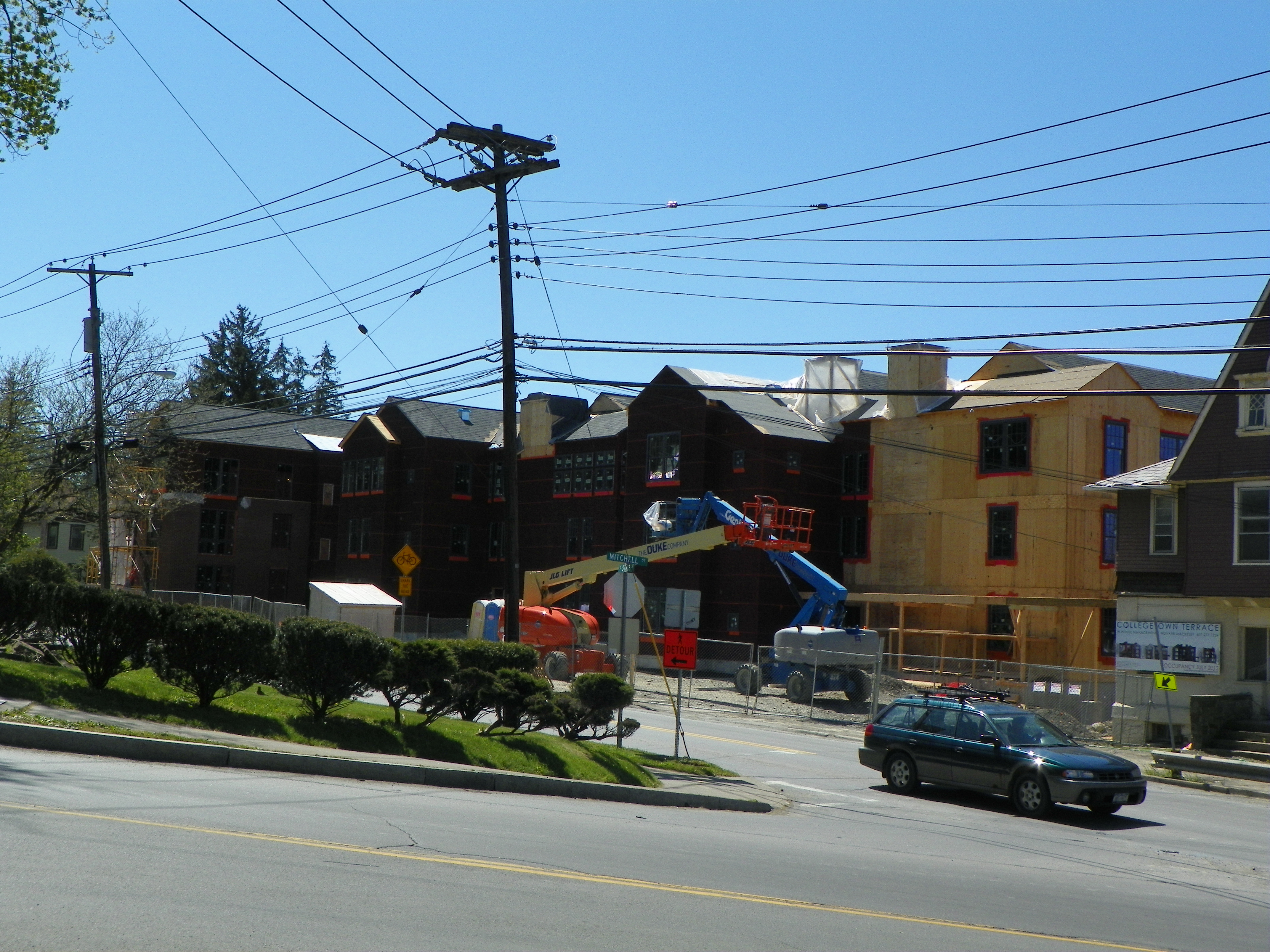
It was noted that the Collegetown Terrace (aka the giant hard hat-bedecked property south of State Street between Quarry and Valentine) is quite the tax revenue generator for the county. Now, here’s some of their numbers: The initial properties on the land, small apartment buildings and single-family homes (~29 total), were valued at $19,143,000, which would (by my calculation) generate taxes of around $700,000 per year. Just under half of that would go to the school district, with a little more than one-third (~35%) going to the city coffers, and the rest to the county. The partially-built property, as it was assessed in March, was assessed at $526,800, according to the IJ, with a property value of $14,430,000.

Now let’s keep in mind two things. The property wasn’t even finished, and finished properties garner much more in taxes; and the property is being developed in three phases, with the currently assessed phase counting for just 18 percent of that.

It would be hard for me to say what the value of the finished property is, so let’s conservatively go for 20% greater than the current value, for the sake of this exercise. That gives $17.32 million. Now let’s apply that to the developed project, 100% complete: ([100/18] * 17.316=) $96.2 million. Five times its former value before the property was sold. If taxes are kept the same, that would be a tax bill of about $3.5 million. And for the city, an extra $1 million in cash would go a long way, since the annual revenue is about $61.5 million. An extra million is equivalent to the amount Cornell pays annually in its PILOT agreement with the city.

It would not be out of place to think, “oh, but with the slow rate of growth, this is just cannibalizing other local properties”. To some extent, yes. But these are properties that have a very captive market, namely, 20,000+ Cornell students. The landlords that will be hurting the most will be those with properties furthest from campus, of which a good chunk of that hinterland lies outside city limits, in the neighboring town of Ithaca, or Lansing. In my mind, the biggest concern will be if this project pulls grad and professional students away from downtown and Fall Creek, but I imagine the effect will be minor, all things considered (most notably, because if apartments in this place are going for $1,000+ per month, then that $600 one bedroom in Fall Creek is still going to appeal to a lot of folks with tighter purse strings).

In conclusion, I think that if a developer approaches the city regarding new student housing in the Collegetown area, they’ll have a powerful card in there hand – the tax argument. I’ll be curious to see if Novarr-Mackesey mentions it when they release their proposal for the Palms property and its neighbors along the 200 block of Dryden Road.


News Tidbits 8/1/2012: Because I Let Small Projects Go Under the Radar

1 08 2012

It would be wrong for me to play off the projects that I write about as being all that is going on in and around the city of Ithaca. Generally, I write about the major projects. I don’t do little projects, or I gloss over steps in major projects, mostly in an effort to maintain reader interest. However, like with many things, there’s a grey area – a project of merit, of moderate impact, that is not major enough for its own entry, but would benefit from a brief mentioning. I decided to group a few of those here.

Image Courtesy of Ithaca Times

The Ithaca Motion Picture Museum – A project in the planning stages, intended as a major renovation and addition to the old Wharton Studios building in Stewart Park, which is currently a low-use maintenance facility. The circa-1890s building is but a shell of its former glory, but a local NPO seeks to invest $3.5 million into its renovation. Fundraising is ongoing, but it will be a while before any new work breaks ground.

The town of Ithaca seeks to redevelop a parcel on West Hill into an Ecovillage type of housing development. The 25.5 acres, associated with the vacant Biggs facility near Indian Creek Road, is to be sold or leased to a private developer for a ~70-unit, mixed-use property with emphasis on green living and sustainability. The preferred area of development is closer to the Medical Center, leaving a large tree buffer on Indian Creek Road itself. The proposal runs with the assumption that a developer will actually want to agree with the town’s stipulations, although residential demand has been strong enough in recent years that it just might happen.  Bids are due in October, with a starting bid of a cool $500,000.

Property of New Earth Living LLC

On the topic of green living, four new housing units are being developed as a “pocket neighborhood” on the corner of N. Aurora and Marshall Streets (three blocks north of the William Henry Miller Inn). Three new structures will be built (a revision in design dropped the number of units from five to four), and a current house will be refurbished. The project, called the “Aurora Dwelling Circle” (an oddly befitting name for an Ithaca project) and to be built by Cosentini Construction, has been virtually approved for construction as of the last planning board meeting.

Last not, for those who like big-box strip malls – the old Cayuga Mall across 13 from the Marketplace and across Triphammer from the Shoppes @ Ithaca Mall is being renovated. The old P&C space will be converted to spaces for an Agway, Jo-Ann Fabrics and Party City, which is a whole lot of non-news since I suspect the first two are just relocating from their current Ithaca-area stores.


Cayuga Green II (Cayuga Place) Goes Downscale

18 07 2012

ED. Please note the correction posted on August 11th.

Another incarnation of the Cayuga Green Condos has been proposed. First, the IJ article (for those without subscription, the Ithaca Indy provides another summary here). Now, first off, I would like to chastise the IJ for using an old image of the project – an image pulled from Bloomfield & Schon’s website of the modified third incarnation, which I include for reference below.

This is not the current proposal.

This is not the current proposal.

Notice that this has six floors. The revised version has four. This version also had 8000 sq ft of commercial space and 35 residential units. The revised proposal (which was only available in two thumbnail links, one of which was broken) has the same commercial space and 39 units, but less space overall – from 47,400 sq ft to 42,600. According to the IJ, development costs have been estimated to be about $8.5 million for this phase of the project.

I’m not even going to nice here. The design proposed does nothing good for the architectural pride of the development company. It’s essentially a glass box, with a little concrete filler. Boring, but okay. Even if it doesn’t have balconies, or even any shape to it apart from being a big glass box (heck, the earlier design the IJ tried to mislead people with is light-years ahead of this proposal). My issue is that it doesn’t even obscure the parking garage next to it, which overwhelms the proposed structure. It’s like they said, “hey, people will pay anything to live in Ithaca, so let’s try and squeeze as many as we can into as plain of a structure as possible” (I digress, this is the mantra of many low-brow developers, but I expected better from Bloomfield & Schon). Now, the last I checked, this was marketed as a luxury project. Nothing says luxury like being dominated by a parking garage next door. It’s just…mind boggling, in terms of planning and action. Cost of development aside, I’m having trouble imagining the developer getting these modifications past the planning board.

But, they kinda have to. In order for the developers to avoid issues with special resolutions from the city, the project needed to have financing and approval secured (i.e. construction starting) by June 30 – almost a month ago. So they’re already in hot water, and apparently, someone decided to water down the design, because I guess if you’re going to get on the bad side of city government, you might as well go for the gold. The prospects for development of this building are looking rather dim.

What a way to enjoy my morning – watching the IJ wrongfully mislead people with the incorrect design, and seeing the undersized box proposed. It’s mornings like this that I feel like I need to start drinking coffee.


News Tidbits 6/13/12: “Cascadilla Landing” Makes Its Debut

13 06 2012

For those who pay any attention to Ithaca’s physical plant, news has been floated around for a while of a proposed waterfront project next to the city golf course, which in reference, was referred to as the “Johnson Boatyard Development”, after the boatyard located on the current property.

Well, in the fee-to-see Ithaca Journal this morning, renderings were shown for the proposed “Cascadilla Landing” project, which is the official name of the development. More renderings are included within a PDF from John Snyder Architects hosted on the IJ website.

I would love to share some of the images, but now that content is pay-to-play, that puts me in a much more difficult position. It was one thing to share an image up from a free online paper. But now that content is not free, the legal waters have become a bit dicier. I will say this much: click the links, visitors have a limited number of article hits before content is no longer displayed. After that, there are several other ways to get around the content wall (or you can pay). If I see them hosted (i.e. not linked) on a “free” content website, I’ll include them here. But until then…yeah. It’s unfortunate.

Following the PDF, the project has 185 units – 6 in duplexs, 11 townhomes, 168 apartments. The mid-rise apartment buildings are furthest east, with the townhomes in the middle, and three three-story duplex buildings built around the traffic circle that completes the west end of the project. Phase 1 has two buildings of 82 and 44 units respectively, in three 5-story apartment buildings, two of which are connected by a skybridge. Construction would start on Phase I in Spring 2013. The main street appears to double as an internal promenade.

As for the design, John Snyder Architects opted for angular and ultramodern. The duplexs have gable roofs and wood trim, and bear superficial similarities to the buildings going up at the 900 block portion of Collegetown Terrace. The apartment buildings are an angular pastiche of windows of all shapes and sizes and random balconies and overhangs closer to the waterfront, and a bit more orderly further into the property. The colors as shown are rather muted whites and greys. No one will ever call it pretty, but it certainly stands out from the traditional built environment. The townhome designs are not really shown, they’re likely still in the initial design process.

Ithaca’s economy hasn’t been something to be too excited about lately, but this project shows there must still be some demand to live in the City of Gorges.

EDIT 7/18/12: The city has published the images. As a result, I’m including them below:


News Tidbits 5/31/2012: New Apartments Squeezed Onto Thurston Avenue

1 06 2012

So, I’ve been waiting for this piece of news for a while, but it took a little bit of sleuthing to come up with details about a proposed project for Thurston Avenue. First, the location:

The location is a parcel next to the Rabco (Highland House) Apartments on the corner of Highland Road and Thurston Avenue. To give you a better sense of locale, its the woody, slightly hilly piece of land across Thurston from Seal & Serpent, and across Highland from Alpha Zeta. A highly trafficked area, the property was once home to the Wyckoff Mansion, which became the home of Phi Kappa Psi from 1915-1964. The Wyckoff property was torn down to make way for the Rabco Apartments, which were finished in 1966. This portion of the parcel has never been developed. I actually used to walk by here almost every day, but never felt the urge to get photos of a stand of trees and rocks.

The proposal is as follows: three buildings, clustered, four stories in height (est. height ~40 feet, within zoning regulation). 36 units and 88 beds, making it one of the densest properties north of campus. 40 parking spaces are proposed, but the planning board has expressed the desire to share space with the excess western parking lot on the Rabco property, and that will probably be a stipulation for approval. Time-wise, since this is the sketch plan, and given the size and location, don’t expect construction for several months (although they want city approval by late July – which is highly unlikely), and expect a year more before it is complete. The project lies within a contextually-sensitive area, the Cornell Heights Historic District, and its design will probably be much more scrutinized as a result. It may also be rather historicist, because I can’t anyone is going to approve a “modernist” or “contemporary” design in the heart of a historic district, even in a city that likes svelte modern boxes.

On another piece of news, the Johnson Boatyard project has realigned its entrance to be on Willow Avenue rather than Pier Road (not a big changed, it just means its moved from the north end to the east end of the property), and the number of duplexes has been decreased from eleven to six. The project still has townhomes [warning: Ithaca Journal link], which now vary from 1-2 stories in height. A small retail portion might be included in the first phase. After all the news about the original proposal, this first phase is a bit…underwhelming.


Cornell and Crime II: Here There Be Guns

15 05 2012

If you want to have a spirited debate on campus, open the floor for a discussion for the provision of guns on university grounds. Stating the obvious here, but student-owned guns are prohibited on campus, and have been for over a century (CUPD officers are issued Glock semi-automatics, an effect of the Willard Straight Hall takeover back in 1969). Few things seem to do a better job of getting someone’s blood to boil, and not without due reason. I thought of looking at this because of this recent little piece from the Sun about a student being robbed at gunpoint in North Campus, and the ensuing “we should be allowed to have guns/are you crazy no we shouldn’t have guns” comment queue.

I mulled this over in my head a little while, thinking that this usually gets tied into some “good old days” argument about back when everyone could have guns and everyone was safer (and there was much less crime, everyone was good-looking, all the kids were above-average, and whatever else those rose-tinted glasses show). I decided to look at the Sun archives for some historical perspective.

One of the first things returned in the search was an article from 1930 – before the vast majority of us were even alive – detailing a series of armed robberies and the murder of a gas station attendant leading to a possible rise in gun permit applications (the only requirement be that you are a law-abiding citizen of “good character”). So much for those good old days. For what it’s worth, the CUPD was formed the following year, with a whopping two patrolmen on horseback, and no guns during day shifts (today, Cornell has six times as many students, and about 45 officers).

As for the case of responsible students, it’s not always easy determining which are and which aren’t – as these cases demonstrate. You have (in order) the hard-partying student, the student claiming self-defense, and the self-inflicted fatal gunshot wound (thought to be accidental, but could have been otherwise). In imagining a world where guns were okay on campus, I can see a clear case for pulling the gun rights of the first, a lawsuit waiting to happen with the second (the gun owner claimed he shot at someone who was leaving racist notes under his door), and another lawsuit waiting to happen with the third, if the family gets on the “my child’s university didn’t do enough to prevent this” train. There would be time, money, and a bevy of other issues involved.

On the other hand, as this Sun editorial from 1981 illustrates, there are some valuable reasons one can have for owning a gun, such as women protecting themselves against rapists, and it’s important to note that most gun owners are responsible, law-abiding citizens. From here we can get into a range of arguments, all of which are easily blown out of proportion. The passion people put into the guns argument is second perhaps only to abortion, especially with regards to the intransigence of its debaters.

So I didn’t write this entry to start up a gun control debate; that’s what news websites are for. The purpose of this entry is to show that there was no “golden era” for either party – no period where guns, or the lack thereof, made us so much safer. There will always be crime, there will always be grey cases in the argument of who is and isn’t irresponsible, and for the foreseeable future, there will be a gun control argument.


News Tidbits 4/12/12: Ithaca Plots to Get Rid of its Lots

13 04 2012

Image

So, Ithaca has a lot of things going for it…and some things that aren’t. One of the unfortunate aspects of being a small city with a large university and a medium-sized college is that a lot of the local land is owned by said institutions, making it tax exempt. In fact, the proportion of tax exempt parcels in the city is right around 60.82 percent, 83.1 percent of which is owned by Cornell. So, this often results in a tight budget situation (Cornell, to its credit, has a Payment In Lieu Of Taxes (PILOT) agreement that pays the city $1.1 million annually, or about 4.5% of the tax value of its holdings; Ithaca College, at last check, pays jack squat). As one might imagine, this is a huge source of controversy, more than enough to merit discussion in a future entry. Anyway, this year, like many, Ithaca is looking at a deficit, to the tune of $3 million. To alleviate some of this burden, the city hopes to sell some of its unused property (at least $120,000 worth) to put it back on the tax roll and hope that someone redevelops it, for further benefit to the community and the city’s bottom line. This entry takes a look at the properties.

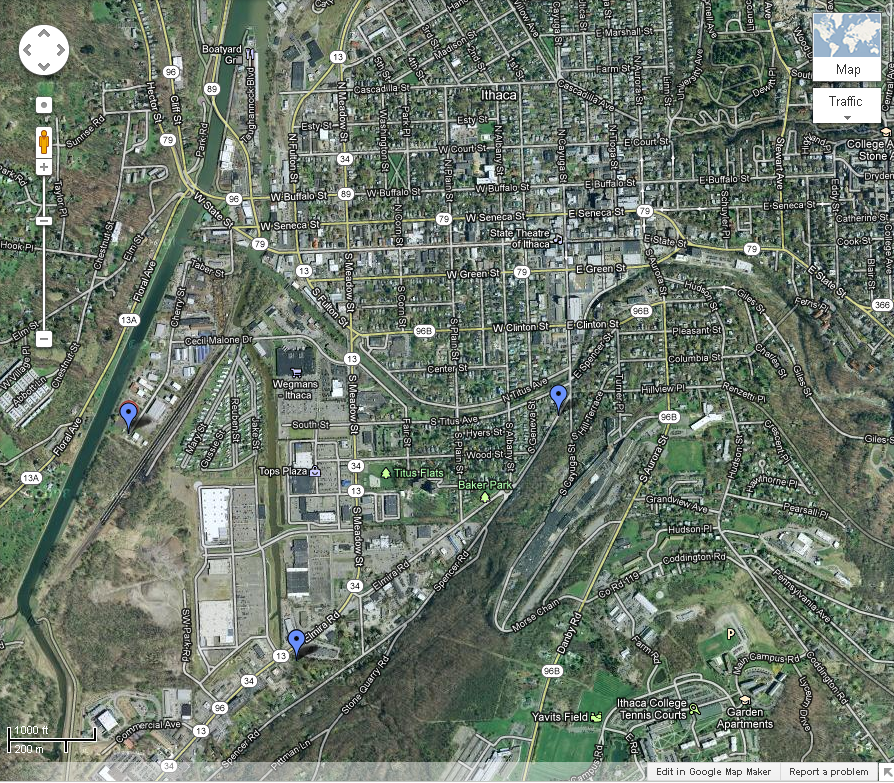
First off, the process on how to get rid of the properties has been, for lack of a better word, a clusterf**k. Two parcels have been cleared for sale, since there are no major environmental issues – 213-15 Spencer Street, and 321 Elmira Road.

Image

213-15 Spencer Street is a 0.47 acre property with a value of $124,000. The property is planned to be transferred to the Ithaca Urban Renewal Agency (IURA), which then sells the property for some value to an interested buyer, which in this case looks to be INHS, the local real estate development NPO. In sum, probably going to be developed for an INHS house.

321 Elmira Road is a 0.40 acre property with an assessed value of $189,000, probably because it’s in the middle of the rapidly developing big-box chain district in the southwestern part of the city. The sale of this property will be done via auction with sale to the highest bidder. At 0.40 acres (17,400 sq ft, not including zoning restrictions), don’t expect development here to me more than a small chain store of some variety…if anything at all, given drainage issues on the site.

Cherry Street parcel 100.-2-1.2 (i.e. 300 block). Is an 8.25 acre property in an industrial park with an assessed value of $825,000. This property is tied up in red tape due to some wetland on the south side of the property, but once those 2.25 acres have been subdivided off, the other 6 acres will be given to IURA, to be sold to an entity that will provide “commercial development”, if it gets redeveloped at all (some are calling for no sale due to the sensitive nature of the neighboring wetlands).

Given the tax rate, if all three were sold and assessed at current value (saying Cherry Street’s 6 acres are $600,000 for the sake of argument), you’d get about $32,000 in property tax, not to mention the one-time revenue of the sale itself. All in all, these sales aren’t really anything special, but it will be interesting to see what gets proposed for the Elmira Road and Cherry Street properties if the sales are ever completed.


News Tidbits 3/16/2012: What Lies Ahead for Cook Street

16 03 2012

From Cornell Daily Sun. Image Updated 4/25/2012.

From the Ithaca City Planning Board:

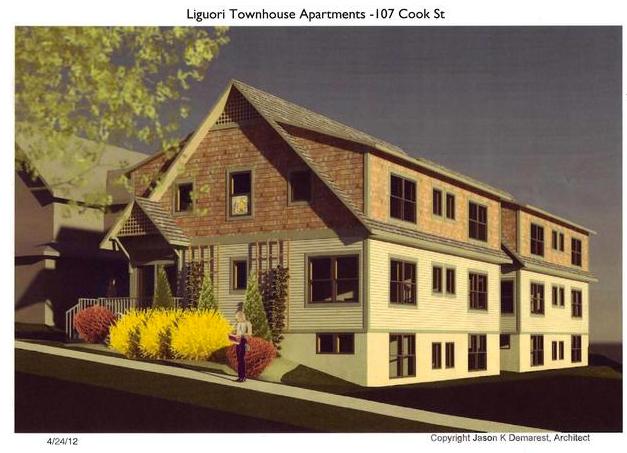
Site Plan Review, Townhouse Apartments, 107 Cook St., Jason Demarest, Applicant for Owner, Dan Liguori. The applicant is proposing to construct two 2‐story townhouses with partially finished basement levels, four parking spaces, and asphalt‐paved access drive, walkways, and landscaping. The buildings are each 2,304 SF with 6,128 SF finished floor area, and contain two 3‐bedroom dwelling units, for a total of 4 new units with 12 new bedrooms. Proposed exterior finishes include brick, fiber cement board, cedar shakes, and stained wood lattice detailing. The project is in the R‐2b Zoning district. This is a Type I Action under the City of Ithaca Environmental Quality Review Ordinance and the State Environmental Quality Review Act (because the site is contiguous to a historic district) and is subject to environmental review.

If the address looks familiar, it should. The ca. 1912 house that stood on the property was engulfed in flames in May of last year, killing a Cornell student. One of the factors that was believed to have weighed in on the fire (which was accidental) was a confusing internal configuration due to subdivision of the original property from single-family into multiple tenants (there were eight units total, housing 13 students).

The first proposal for new development on the property was rejected for a couple of reasons – for not having a porch, and for having a mansard roof that wasn’t much of a mansard roof. The planning board has been fairly adamant that any new property on the street fits in with the current set of buildings. Well, that and fire safety. Old single-family houses that are subdivided are usually grandfathered from the sprinkler requirement as long as the alterations are strictly internal.  The new building would have to have a sprinkler system in order to be approved as a multi-tenant building.

So here we are on proposal two; townhouses, two units in each, 12 bedrooms, so two bedrooms less than the previous proposal and one less than the original building. Based off of description alone, with cedar shake and wood lattice detailing, it sounds like this structure is more in-line with the current style of buildings on Cook Street. I for one will be curious to see how it looks.

Arguably, from a purely financial standpoint, it would be a blunder to not redevelop the property – several new units close to Cornell would fetch a higher going price than neighboring houses, just for being newer and safer. Also, paying taxes on land as highly valued as Inner Collegetown’s probably dissuades the owner from sitting on the property. If one were planning on holding onto the parcel for the long-term, this could be a potentially lucrative setup for the small-scale owner/developer.

Taking a grander view, I wonder if projects like this could be a demonstration of what may lie ahead for some smaller Collegetown properties.  As large new developments open up (CTown Terrace, the Palms proposal, etc.), and assuming a static student population, the rates for older unrenovated buildings will go down and the owner’s revenue will take a hit. This will be further compounded on poorly-maintained properties; owners who suddenly have a building declared unfit by the city, and have to make costly repairs or rebuild (while being excoriated by local residents and officials).  Ii is possible that over the next decade or so, more projects that seek to build smaller but  student-specific properties will be proposed in the area. Quality of design and materials, of course, is up to the owner and requires the city’s approval. In summary, I see the redevelopment of 107 Cook as an illustration of what may lie ahead for Collegetown.


News Tidbits 3/6/12: From Orthodox Greek to Christian

7 03 2012

…and by Orthodox Greek, I mean your normal Cornell Greek house. But I enjoy a little bit of word play.

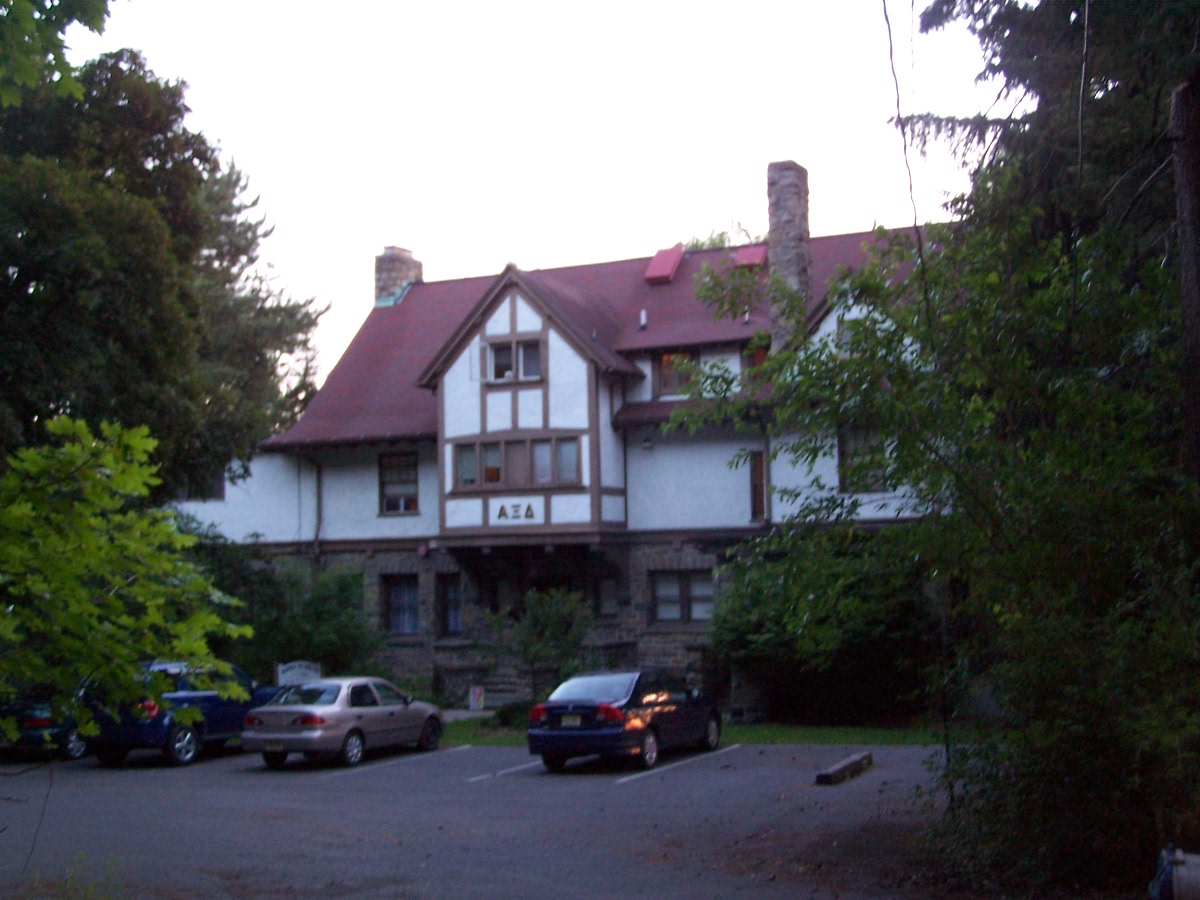
I had come across a piece in my Cornell feed about a Christian house at Cornell on The Knoll called “Chesterton House”. I thought it was unusual that I had never heard of it, but I wrote it off as being some low key residential organization, like many at Cornell are (for example, Telluride, the Co-Ops and a few of the professional fraternities). I noticed its location was 115 The Knoll, which failed to ring a bell – I thought it was a rowers’ house or home to some of the Big Red Band. I’ve been vaguely aware that there were five houses on the Knoll, so there was bound to be some non-Greek component.

Then I glanced at their website – it’s Alpha Xi Delta’s old house. The one I profiled a couple years ago.

According to their website, the house is named for Gilbert Keith Chesterton, an early 20th century writer and “defender of the Christian faith”. The house holds 15 and is all-male, with the female equivalent being Sophia House at 315 Thurston, the house with a stucco finish and the extremely high-pitched tile roof. Apparently that house is being rented, so it is not under the organization’s possession. Now, the house on the Knoll is owned by Delta Phi Epsilon sorority, the last I checked (for the record, they’ve owned it since 1962). So I’m going to venture that this is a fairly recent endeavor, and a big step for an organization that was established only 12 years ago. Although a relatively young organization, it’s certainly garnering its share of alumni support.

I for one welcome them to establish themselves as one of the many opportunities afforded to students at Cornell. In my mind, I see it as something similar to the Jewish Living Center on West Campus. My one encouragement is that they adopt a policy similar to the Jewish Living Center and encourage freshmen to live with the other freshmen. I’ll willingly admit that as the brother of a fire-and-brimstone evangelist, I’ve been wary of religious groups in general (one tends to be that way when your sibling tells you you’re going to hell at every Thanksgiving dinner, for being a secular  Christian). But it’s also addressing a niche group at Cornell and offering more for some individual’s Cornell experience.