Random Ithacana

18 12 2009

So, pardon the extraordinarily long break. Finals and research brought much of my outside life to a screeching halt, so this blog had to take a backseat for a couple of weeks. Oddly enough, site statistics didn’t really go down a significant amount, which probably says something about the consistent use of the historical info on this blog.

Anyways, during my holiday shopping, I happened upon a new little book that I felt the need to add to my collection. The book, Surrounded by Reality: 101 Things You Didn’t Know About Ithaca, NY (But Are About to Find Out) by Michael Turback, is a nice little book detailing some of the history and sights of the area. Some of the book entries share the same information that has previously been shared on this blog, but there was some new information to be garnered from its pages.

A lot of the book focuses on Cornell. Things that a lot of Cornellians already knew about the founder and A.D. White, but also some more obscure details. For example, a real description of Zinck’s. Theodore Zinck ran the “Lager Beer Saloon and Restaurant” out of the Hotel Brunswick at 108-110 N. Aurora (just off the current-day Commons) starting in 1880. Contrary to modern day bar-hopping, Zincl, while described as being a fatherly and caring figure who treated his customers with “Prussian high-handedness”. Customers could be thrown out of his bar, however, for drunkenness, bawdy songs, or derogatory references to the German Kaiser. The first Zinck’s operated until about 1903. That year, a typhoid epidemic rages through the city and claimed 85 lives, including Theodore Zinck’s daughter. Despondent, he drowned himself, effectively shutting down Zinck’s first incarnation. The bar reopened under his name in 1906 (which would be incredibly tasteless if he wasn’t regarded so affectionately), and continued in operation in some form in different names and places up to about 1967. Although, with the coming of the new Hotel Ithaca, it appears we may continue the local tradition of naming revered watering holes after a suicidal barkeep.

Another detail that the book referenced was the freezing over of Cayuga Lake. Cayuga Lake is about 435 feet deep, so usually the massive heat storage of the water keeps the lake from completely freezing over during the winter. However, that isn’t to say it can’t happen. Since 1796, the lake has frozen over about ten times (1796, 1816, 1856, 1875, 1884, 1904, 1912, 1934, 1961 and 1979). Wells College, a small and formerly all-female school located further up the lakeshore in Aurora, has a school tradition where if the lake is discovered to be frozen over, classes are cancelled for the day (there is no such tradition for IC or Cornell). According to the book, during the 1875 freeze one athletic young woman at Wells decided to celebrate the day off by skating down the lake and back. Not too shabby, once you consider that the lake is just under 40 miles long.

One last one for the road; most Cornellians are well aware of the legend that if a virgin crosses the Arts Quad at midnight, Ezra and A.D. White will step off their pedestals and shake hands in the center of the quad. Wll, as it turns out, Ithaca College has their won virginity legend. Outside of Ithaca College’s Textor Hall stands a 10-foot high ball sculpture mounted over a small pool of water. Their campus legend states that if a virgin ever graduates from IC, the “Textor Ball” will fall off its pedestal and roll down South Hill. According to Wikipedia, Ithaca College has 49,570 alumni, and I’m willing to bet most of them are from after the school’s 1960s expansion and relocation.
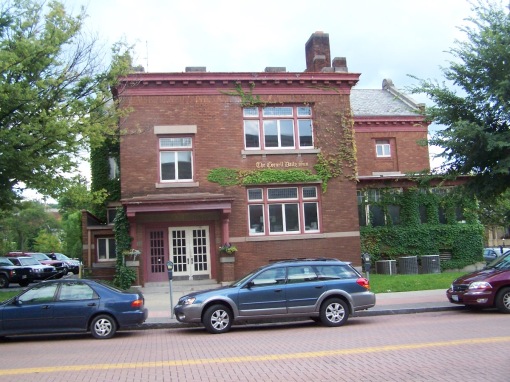


The Cornell Daily Sun

21 10 2009

100_1899


So, I first thought about writing an entry on the Sun because of fortuitous circumstances. I happen to write in some small capacity for the Sun, but with the exception of one person (to my knowledge; most everyone else couldn’t care less), no one at the Sun knows that I write this blog. Occasionally, someone will ask “when was Mann Library built?” or “when is Milstein Hall supposed to finish construction”, and it’s really tempting to put in my two cents, but  for the most part I focus on my work and leave when I’m done.

Regarding the Sun itself, the newspaper is based out of the former Elks Lodge building on the 100 block of West State Street, a block west of the Commons. The building itself dates from 1916, and the Sun renovated the building and moved into the 7,000 sq. ft. building during 2003 (prior to that, thsun rented space around the corner on Cayuga Street). The Sun is totally independent of the university, which is great because the school paper of the university I worked at this summer was nothing more than a mouthpiece for the administration and its cultish president, but I digress. The original Cornell newspaper was The Cornell Era, which was founded in 1868 and named as such because it marked the beginning of a great new era. Much to the Era’s chagrin, the Sun appeared on September 16, 1880, in the format of a four-page pamphlet-sized newspaper (Bishop 206).  The Era eventually became more of a literary magazine and shut down permanently in the late 1940s. The Sun has operated continuously since its founding.

The building itself is an interesting place ot visit. The main work area on the first floor has private offices, and a general work areas for contributors and writers filled with newspapers and article drafts from previous days. The upstairs has a spacious and stately wood-trimmed great room, which I suspect was probably used as a cermeonial/banquet room back when it was the Elks Lodge. I’ve never felt compelled to take photos inside the building, mostly because of the stares I would probably get.

Bishop, Morris. A History of Cornell. New York, New York: Cornell University Press, 1962. ISBN 0-8014-0036-8


However, No One Said Anything About October

14 10 2009

100_1699

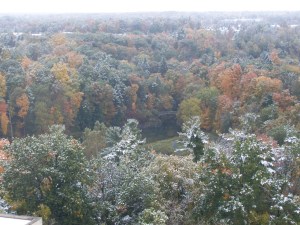
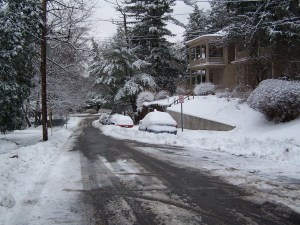
So, yeah, it’s been cold. Unpleasantly cold. Coldest October in years cold. But what makes me really uncomfortable is the thought of snow is October. While snow in October usually has no impact on the upcoming winter, it still serves as a psychological bitchslap to most of the students, and to many of the local who are accustomed to waiting until November to see the first notable snowfalls.

Then we have this message from the Ithaca Journal:

Storm coming to Twin Tiers could bring snow

There’s a couple of very scary things associated with that message. For one, we still have leaves on the trees. Trees don’t stand up very well if they have both a fair amount of snow and foliage on them at the same time. There was a very nasty snowstorm that hit Buffalo a couple of years back that brought the city to its knees in October because it dumped  two feet of snow, and all the trees basically snapped under the weight. As I recall, some places were without power for two weeks, and the storm damages were estimated between $150 and $200 million.

Fear factor aside, the possibility of snow in Ithaca in October is a lot more uncommon than it used to be. Climatologically speaking, Ithaca averages about .4 inches of snow in October. In reality, we’ve only received measurable snow once this decade, and that was .3 inches on October 30, 2008. Prior to that, we have to go back to October 31, 1993, which received 3.7 inches, and .1 inches on October 29, 1990. That’s it for the past twenty years (to be fair, October 22-23, 1988 received 6.5 inches of snow). I took the time to check the following winter after 1993 and 1988; 1989 was about 3 degrees above normal; 1994 was one of the coldest winters reported in several decades. Yeah, I still have fingers crossed for El Niño.

Point is, we’ve rarely seen October snows. Especially before the 20th. You have to go back to 1974 to find a pre October 20th snowfall day on file.

So, Ithaca is in a valley, which makes it a kinda crappy place for snowfall because they tend to be slightly warmer, and it doesn’t experience an upslope effect like Cornell’s campus does. Unfortunately, the Ithaca weather station used by the NRCC is on Game Farm Road, which is off of Route 366 as you’re heading out towards Dryden.It’s about 1000 ft. in elevation, and the snow line so far is predicted to be about 2000 ft, and that is subject to change.

I’m really not interested in seeing snow this month. But it’s not like any of us have a say in what the weather does.

EDIT: So Ithaca recorded 1.6 inches, setting a record for the earliest snow over 1” in over 120 years of data. Other parts of the county received as much as 3”. Northern PA recorded as much as 8”, and widespread power outages and minor damages were reported.


Expecting A Warm Winter

4 10 2009

100_2434

Global warming completely aside, I think it might be worth noting that Ithaca can expect a warm winter for 2009-2010. This is because we’re in the middle of an El Nino year.

For those living under a rock, El Nino (or as meteorologists know it, the el Nino Southern Oscillation, often reduced to ENSO) is the much publicized periodic change in atmospheric and oceanic conditions highlighted by the shift of the eastern Pacific Ocean water temperatures to much warmer than usual conditions (typically most apparent off the coast of Peru). The effects on the Atlantic will lag somewhat behind the Pacific.

Well, El Nino conditions started to kick in during this past summer, around June. One effect that El Nino years (as they tend to last 12 to 18 months) have is that the Northeast is much warmer than usual during the winter. To illustrate this, I pulled the data for the last few El Nino years (Winter 06-07, Winter 02-03, Winter 97-98, and Winter 94-95, Winter 91-92) from the Northeast Regional Climate Center.

Month/Year Anomaly

Dec 2006 +8.0 F

Jan 2007 +5.6 F

Feb 2007 – 7.1 F

Dec 2002 -2.2 F

Jan 2003 -5.6 F

Feb 2003 -3.0 F

Dec 1997 +2.3 F

Jan 1998 +8.4 F

Feb 1998 +7.8 F

Dec 1994 +4.4 F

Jan 1995 +7.1 F

Feb 1995 -2.7 F

Dec 1991 +2.0 F

Jan 1992 +3.0 F

Feb 1992 +2.0 F

Data from pre-1995 is only available to those with research accounts. Thankfully, my senior thesis research has allowed me this perk. Anyways,  4 of the past 5 El Nino seemed to follow the typical pattern, and 2002-2003 did not. To be perfectly honest, that year is still under study as no one can really seem to explain what happened. A prevailing theory for a while was that it was another osciallation (the Pacific Decadal Oscillation) having an impact on El Nino, but that theory developed a big hole in it after a fairly typical 2006-2007 El Nino year. It takes 20-30 years for the PDO to change phases, so 2006-2007 should have been much the same, but it wasn’t.

Keep in mind this is all relative. Five degrees above normal during the coldest time of the year (late January) means a high of 35 and a low of 19. So don’t get too comfortable.


News Tibits 9/18/09: New Six-Story Apt. Building Proposed

18 09 2009
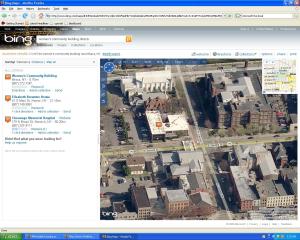
  Proposed Building on Left, DeWitt Mall on Right
 

ecproject ithaca

100_1607

The site is on the corner of Seneca and Cayuga Streets, currently the 1960s era Women’s Community Building. The six-story building is to hold 50 units of affordable apartment housing. As proposed, the building would require a zoning appeal, but local officials seem receptive to the project.

http://www.theithacajournal.com/article/20090917/NEWS01/909170385&referrer=FRONTPAGECAROUSEL

ITHACA — Ithaca Neighborhood Housing Services has proposed a plan to demolish the Women’s Community Building and replace it with a six-story, affordable housing apartment complex, with community meeting space on the bottom floor.

Plans were first presented to Common Council’s planning committee Wednesday night.

The move would require the city to change zoning on the lot. Current zoning allows four stories and requires one off-street parking space per unit.

INHS is asking that the lot be changed to match the zoning on the other three corners — the Clinton House, the Masonic Temple and the DeWitt Mall — which allows six stories and requires no off-street parking.

Planning committee members were supportive of the change, saying it would help the city meet goals for downtown density and affordable housing. They also urged INHS to maintain the community meeting space currently provided in the Women’s Community Building.

INHS Executive Director Paul Mazzarella said it’s certainly the organization’s intention to keep the space, but that financing and other issues may make it difficult.

One of the reasons the property’s current owner, the City Federation of Women’s Organizations of Ithaca, has agreed to sell is because they make so little money renting the meeting space, he said.

“They’re empty probably 90 percent of the time,” he said. “Quite honestly, it costs money to build and maintain that space.”

If built as proposed, the property would come back onto the tax rolls, based on a state formula for affordable housing complexes, Mazzarella said. The entire property is currently tax exempt.

As proposed, INHS would build 25 one-bedroom and 25 two-bedroom units, with rents ranging from $300 to $1,000 per month.

City Planning Director JoAnn Cornish said the zoning change “makes sense” and Alderman Dan Cogan, D-5th, said the proposed project is “ideal.”

Though parking wouldn’t be required under the proposed zoning, Mazzarella said INHS plans to build 15 spaces on site.

Planning Committee Chairwoman Jennifer Dotson, I-1st, supported the zoning change and encouraged INHS to create green space rather than on-site parking.

To meet state funding deadlines, Common Council would have to approve the zoning change, and the city Planning Board would have to grant site plan approval, before next February, Mazzarella said.

The planning committee agreed to circulate a memo with more information on the project, and address the issue again next month.


News Tidbits 9/14: Old People and Hippies Like Ithaca

15 09 2009
100_2009

Conifer Village

Two little planning tidbits of note. One is that a company that specializes in senior citizen housing complexs is scouting sites in the town of Ithaca near the Cayuga Medical Center [1]. The company is currently beginning work on a $10 million, 120-unit complex in Horseheads, which is effectively suburban Elmira (yes, people actually live in Elmira, and it’s a lot like Ithaca, just without the prosperity and colleges). The parcels the company is checking out aren’t too far from one senior citizens’ facility already located on West Hill, a 36-bed facility known as Alterra [2]. None of the company’s facilities are subsidized, so it’s unlikely to be different if an Ithaca location was constructed. This comes on the heels of the Conifer Village senior housing, which was also built on West Hill (72 units, completed last year). In the same vein, McGraw House in downtown Ithaca is planning a 25-50 unit expansion, and is currently in the development stages [3].

So yeah. Old people like Ithaca. I think it’s part of a trend of retirees moving to college towns to enjoy a “higher quality of life” and increased educational and cultural venues that are often associated with such communities. The New York Times did a story on it not too long ago [4].

In other news, Ecovillage is planning its third community, TREE. This goes with the previous two facilities in that area, SONG and FROG. The 30-unit addition, with a new “education facility”, has a tentative construction start in 2010, and for completion in early 2011 [5]. Ecovillage currently has 60 units at its West Hill location; White Hawk, another ecovillage, has plans for 30 total units over the next few years at its Danby location (for the record, Danby is a town just south of Ithaca). Hippies like Ithaca too. But, I s’pose that’s not really news.

[1] http://www.theithacajournal.com/article/20090914/NEWS01/909140356/New+senior-housing+center+may+be+coming+to+Ithaca

[2] http://www.health.state.ny.us/facilities/adult_care/county/tompkins.htm

[3] http://www.mcgrawhouse.org/expansion-project/

[4] http://www.nytimes.com/ref/realestate/greathomes/GH-Retire.html

[5]http://tree.ecovillageithaca.org/


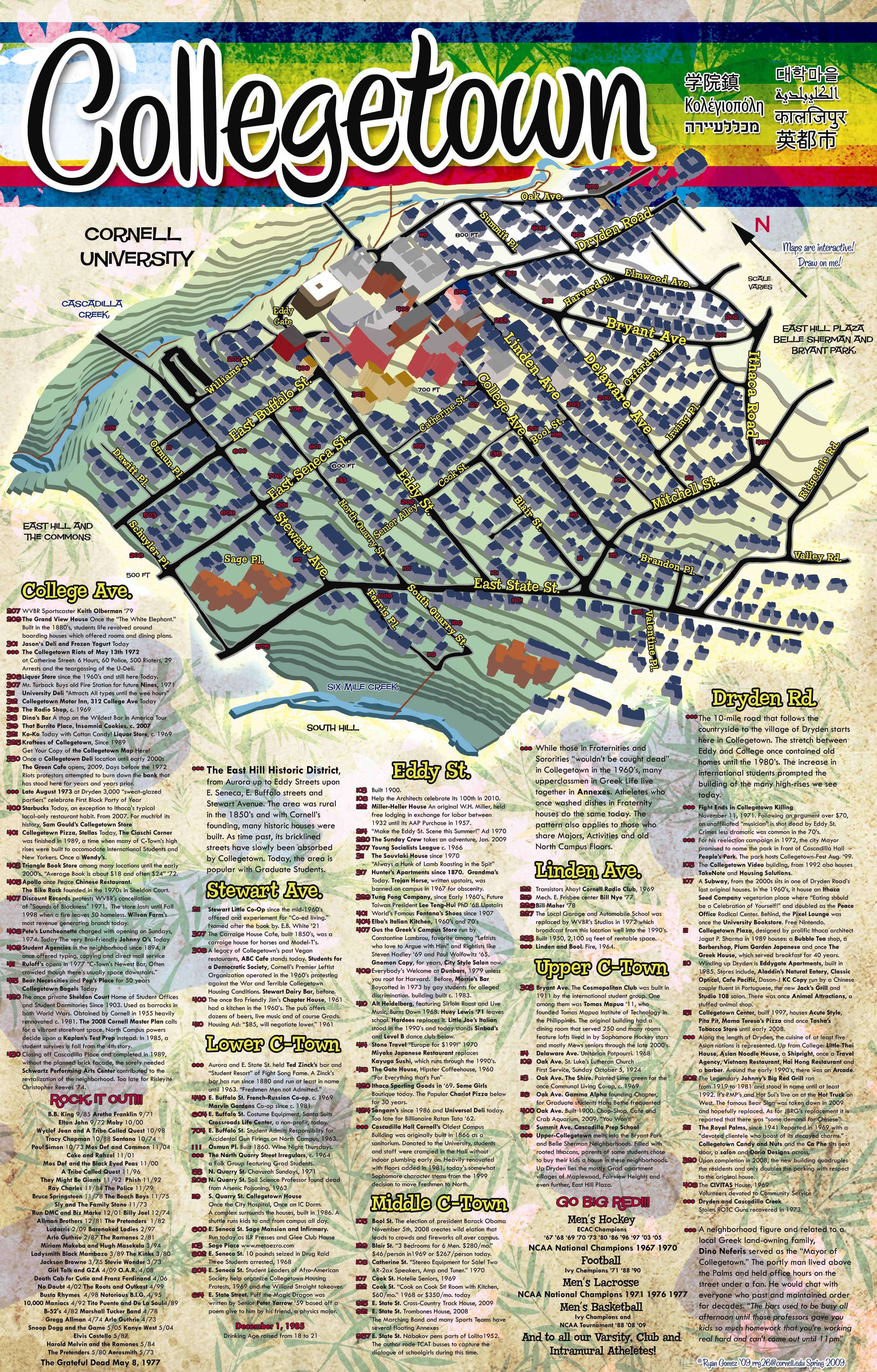
Best Map of Collegetown Ever.

10 09 2009

The map was a project of an alumnus, Ryan Gomez ’09. I dare say it’s one of the best maps I’ve ever seen of Collegetown, not only because it’s a visually appealing map, but also because it covers the history of many of the addresses in the neighborhood, not to mention worthy Cornelliana.

This map deserves a look:

http://www.metaezra.com/images/ctown_map.JPG

Mr. Gomez, you’ve earned my respect and admiration.


The Keyword Bar VI

7 09 2009
 100_1281

Yeah, I’ve been lax about updating lately. I have some things in queue, but I also have research going on, so things are a little hectic. Naturally I’m turning to my favorite cop-out of fielding responses to some of the search entries that have led people to the entries in this blog.

1. “alpha gamma cornell” (9/5/09)

This could be in reference to a fraternity or defunct sorority that the individual failed to incluse the whole name of, or it could be a reference to the research report “Hazed and Confused” by Adam Zwecker [1]. In Zwecker’s report of hazing within the Greek system of Cornell, he uses the psuedonym “Alpha Gamma (Phi)” in reference to a house that he was pledging that committed a series of hazing violations in flagrant disregard of system and campus policies. Rumor mill tends to associate the psuedonym with two or three different houses, and the actual house was reported to have been reorganized after the report to remove such dangerous activities.  I’ve heard the report used more than once as a reason why Cornell students avoid becoming part of the Greek system, which is unfortunate but I can definitely see the reasoning behind their decision.

2. “tke blackballed from lehigh” (9/4/09)

This one is interesting not because of who it deals with, but the term “blackballing”.  According to the fountain of information that is Wikipedia [2], blackballing is a rejection technique used in elections to decline membership in fraternities and gentlemen’s clubs. Typically, in Greek orgainzations, some method similar to blackballing or dinging is used to decline membership to potentially undesirable candidates. The name hails from the black balls used to signify opposition in elections in the fraternal orders of days long past.

Since the IFC at Cornell has made use in the recent past of an electronic system to keep in track of rushees visiting houses during Rush Week, and that the site includes the capability to record comments on these individuals submitted by houses, a person could be blackballed not just from a house, but from most/all Cornell fraternities if the comments are strongly negative. I imagine that would take an outstanding showing of stupidity.

3. “ithaca cornell share frat scene” (9/3/09)

I’m going to take this as a a question regarding whether Ithaca College and Cornell have uniform membership in greek houses. The answer is no for IFC and PanHel. Ithaca College banned Greek Life in 1980, and while there may be some underground groups, they operate separately from Cornell chapters. However, MGLC has found a way around this by creating “citywide chapters” which draw members from multiple colleges in the same geographic area. I’m aware of at least one MGLC sorority that has roughly half of its members from Cornell and half from Ithaca College. The legitimacy of these organizations with regards to Cornell’s greek affairs alone is debatable, but since most MGLC organizations are quite small, it probably doesn’t come up very often.

4. “three side dormitory cornell”  (8/30/09)

Donlon, but technically not correct, since it actually has six exterior sides. It’s just that the three curved sides are much more prominent.

100_1603 
Photo Courtesy of Cornell Facilities

Mary Donlon Hall was completed in 1961 as an all women’s dormitory, the last of the all women’s to be built on north campus before it went co-ed [3]. Mary Donlon Alger (class of 1915) was a prominent federal judge who served on the Board of Trustees for 29 years [4].

5.  “maximum building height town of ithaca”

Really depends on the zoning, but most residential zoning only allows a maximum height of 36 feet before a zoning variance is required. The two current projects beofre the board fall below that though; a 106-unit townhouse development by Holochuck Homes off of Route 96, and a 13-unit housing development called Cleveland Estates that will be south of Ithaca College off of Danby Road. The townhouse units might see some trouble because of traffic concerns and opposition to what the West Hill community feels would be an increase in crime if the housing is “affordable” (believe it or not, this is a leigitimate concern. The 128-unit Overlook at West Hill development has been plagued with what neighborhood residents feel are unreasonably high crime rates [5]). The town is looking into a moratorium on West Hill, which would effectively kill the proposal.

According to the West Hill Civic Association, this is the list of proposed and potentially developable properties that are under study:


1. Carrowmoor, 400 units, commercial space

2. Conifer (Linderman Builders), 100 more units (this is in addition to the 180 or so units already in place)

3. Holochuck Development, 106 units near hospital

4. Cornell Parcels, 33 acres off Trumansburg road

–Assisted care interested, 50 units of senior housing, (probably similar to Alterra)

–nothing formal before town

5. Land that can be developed, nothing set yet, Medical Center parcel

Tompkins County

6. Property off Bundy Rd. (67 acres)

7. Perry Farm (60 acres)

8.Kaderli Trade Inc. (100 acres)

9. Eco Village 3rd Neighborhood


***

[1]http://www.ilr.cornell.edu/smithers/docs/hazed_and_confused.pdf

[2]http://en.wikipedia.org/wiki/Blackballing

[3]http://www.fs.cornell.edu/fs/facinfo/fs_facilinfo.cfm?facil_cd=3026

[4]http://en.wikipedia.org/wiki/Mary_Donlon_Alger

[5]http://www.theithacajournal.com/apps/pbcs.dll/article?AID=/20090808/NEWS01/908080343


News Tidbits 8/27/09: Phase Two of Coal Yard Apartments Planned

28 08 2009

From the Ithaca Planning Board’s August agenda:

Coal Yard Apartments – Phase 2, 143 Maple Avenue, Steven & David Beer Owner/Applicant.

Declaration of Lead Agency, Public Hearing, Determination of Environmental Significance, Consideration of Preliminary & Final Approval. The applicant is proposing to construct an Energy Star-rated, 25 unit apartment building located between the existing coffee shop and the existing 10 unit apartment building that was constructed in 2007. The new building will have four residential stories built on top of a 16-space underground parking garage. The new building will have four 3 bedroom units, seven 2 bedroom units and fourteen 1 bedroom units and will have an elevator. The applicant anticipates that the majority of the bedrooms will be singly occupied. It will have a flat roof, and will include many of the design elements of the 10 unit building. Lower levels of the façade will be brick and upper levels will use similar fiber cement clapboard and solid board panels used on the 10 unit building. Colors will match or complement the existing building. The target market for the building will be graduate and profession students, professional academic staff and faculty, and seniors. The project is in the R3b Zoning District and will require a variance for height. This is a Type I Action under the City of Ithaca Environmental Quality Review Ordinance in accordance with §176-4 B (k) and an Unlisted Action under the State Environmental Quality Review Act and is subject to environmental review.

The property is part of the Beer Properties portfolio, which includes the Grandview House in central Collegetown. The trick here will be getting the height variance approvalas Ithacans are very protective of their sight lines. Here’s a picture of the 10-unit building taken from their website:


The apartments are aptly named, since this used to be the coal yard for the city of Ithaca back in the day [1]. Prior to discontinuation of passenger train traffic in 1963, the site was also home to the East Lehigh Valley Railroad Depot. The coffeeshop referenced in the city agenda is the “Queen of Tarts”, which sounds like a great name for a madam as well as being a cute pun.

The project falls outside of the Collegetown Vision area and would not be affected by any zoning changes as a result of the Collegetown plan.


[1]http://www.beerproperties.com/cya.html


News Tidbits 8/21/09: Dumb Frat Tricks

22 08 2009

100_1703

The house involved is Sigma Nu, off Willard Way near West Campus. Apparently, firefighters found a small pot-growing operation while investigating a busted water pipe. I would not be surprised if sanctions from their national or from the IFC are put in place against Sigma Nu as a result of this incident, as it is rather embarrassing for the Greek community (personally, I think it makes Sig Nu look like a bunch of dim bulbs).

ITHACA — A busted water pipe may lead to a drug bust after the discovery of a small marijuana-growing operation inside a Cornell University fraternity house.

The Sigma Nu house manager called firefighters about the broken water pipe on the second floor, Ithaca fire officials said. Firefighters contacted the Ithaca Police when they found the plants.

 Ithaca firefighters found a half-dozen marijuana plants Tuesday afternoon while investigating a broken water pipe at the Sigma Nu fraternity house on Willard Way, Ithaca Police officials said. Officers seized the plants and though they’ve identified a person of interest, they aren’t releasing his name. 

 Water was running through the ceiling, they explained, and in the process of assessing the damage, firefighters found the plants in a tin-foil lined closet, surrounded on all sides and angles by several high-intensity lights. 

Whoever was growing the plants will likely be charged with unlawful growing of cannabis, a misdemeanor, police said. Fire officials said the numerous electrical cords used to power the lights created a fire hazard.

The leaking pipe was part of the sprinkler system and had to be shut down for repairs, Ithaca Building Department officials said. Additional life and safety issues such as a defective smoke and fire detection system and missing exit signs were found, so they posted the house on Tuesday and told everyone to leave until the problems could be fixed, they added.

Bobby Quintal, a member of the fraternity’s executive committee and last year’s president, said the chapter housed members in local hotels and other campus fraternities donated space while contractors fixed the problems.

Friday evening, Ithaca Building Department officials said that the house would likely be safe and ready to be reoccupied later that night.

Quintal said he isn’t living at the house and has no knowledge of the marijuana found there, but that marijuana possession violates Sigma Nu fraternity rules. When rules are violated, the national chapter investigates and might sanction the local chapter, the fraternity member or both, depending on the outcome of their investigation.

http://www.theithacajournal.com/article/20090822/NEWS01/308220004/Busted-water-pipe-in-Cornell-frat-house-leads-to-marijuana-find&referrer=FRONTPAGECAROUSEL

//