The Urban “Renewal” of Ithaca

1 02 2011

So, the Cornell Alumni Magazine latest issue caught my attention. Its feature article, “Through a Glass, Darkly“, is a feature about visiting professor Mark Iwinski’s artistic work of superimposing photographic stills of Ithaca streetlife from decades past over the contemporary appearance of those locations today. Which, falling in line with my addiction to interest in local architecture in a historical context, was a worthy read.

The most obvious thought after reading it is that history has not been kind to Ithaca. It hasn’t been kind to the downtowns of many older cities and towns in the Northeast. From the late 1940s to the 1970s, “urban renewal” basically consisted of trying to suburbanize downtowns by tearing down underused structures, often pinning their hopes on one or two big projects. An example of its effects can be seen whenever you drive through I-81 in Syracuse –  in 1957, Syracuse’s primary African-American neighborhood (the 15th ward) was town down to make way for the interstate, which effectively cut off Syracuse University from downtown and contributed to the emptying out of that city.

Image property of syracuse.com

As the article mentioned, Ithaca fared better than its peers. First of all, in 1968, Route 13 was supposed to become a limited-access highway connection from Horseheads, through Ithaca and to I-81 in Cortland. However, the project lost state and local support, and the only portion completed was the three-mile section that leads north out of Ithaca to just past the Cornell Business Park in Lansing. So there weren’t large expressways bisecting the city.

Secondly, although Ithaca was fairly rundown by the 1970s, the preservationist movement also started to gain momentum around that time by saving the Dewitt Mall (the old high school) and the Clinton House from demolition. In a way, it could be said that when the Cornell Public Library was torn down in 1959, and gas stations started replacing Victorian homes near downtown, that the Ithaca preservationist movement was really born. However, as the article shows, not every structure could be saved; the Colonial old city hall was torn down around 1970 to make room for the Seneca Street parking garage. The original Hotel Ithaca, which dated from 1871, was torn down 95 years later and eventually replaced by the Rothschild’s Building, which in an ironic twist of fate the building was vacated by its primary occupant because they complained it was too old and inefficient. The Rothschild’s Building is slated to be renovated into residential units.

So Ithaca has a relatively intact downtown thanks to early preservation efforts, and with further redevelopment and infill, the city has enjoyed a better aesthetic appearance than most of its regional peers. For the record, although I am strongly pro-development, I don’t think preservation is a bad thing. It has its merit and each case has to be considered in all its pros and cons on an individual basis.

On a final note, progressive and meticulous Cornell is by no means an innocent party. Back in the 1990s, the university and the town of Ithaca engaged in several contentious meetings because the university was seeking to expand north campus with the Residential Initiative in the late 1990s. The decision in itself wasn’t a problem, but the decision to tear down one of the oldest farmhouses in the county was. Eventually, a deal was worked out where the Cornell and the NPO Historic Ithaca would have the building, known as the Cradit-Moore house, trucked up Pleasant Grove Road .3 miles (in one piece no less) and built onto a new foundation. Cornell wrote off the moving cost and Historic Ithaca sold the house to a private owner to write off the costs of building a new foundation. In case you were wondering, this is how  “Cradit Farm Road” on North Campus received its name.

The article was a good read, I enjoyed it immensely. It reminds me that while we continue to develop new assets, we shouldn’t turn a blind eye and wantonly demolish what we already have. Otherwise, it might be as empty as the lots behind Dr. Iwanski’s photographic stills.


Cornell’s History, All Drugged Up

11 01 2011

So, the latest news tidbit about a Cornell student being caught with $150,000 of heroin has made the news cycles and attracted some undesriable attention toward the university. Which kinda inspired me to look at it in a historical context. It’s what I do.

It’s college. Drugs exist. Some are easier to get a hold of than others. Some are gateway drugs, others are only used by a hardcore group of students. Once in a while, the drug debate comes up in a campus context. The Cornell Daily Sun ran an article about Cornell’s drug culture about two years ago. In the article, it was noted in a 2005 anonymous Gannett survey of students, that of 1,969 respondents, 41% admitted some form of drug or alcohol use in the past 30 days, with 19.8% reporting marijuana use and 4% reporting other drug use.

(with that in mind, considering the university’s undergad pop of about 13, 800, that would suggest 550 users of other drugs, which could include cocaine, LSD and the aforementioned heroin. If [an overly-generous] 50 percent were heroin users, that gives us about 275 students. Which if the street value is correctly reported, than the student was carrying $545 worth of heroin for each user. In conclusion, with that much heroin, I wouldn’t be surprised if she was supplying the entire county).

A similar set of data from 2003 suggests 8 percent of respondents admitted Ritalin/Adderall use without a prescription, and less than 3 percent partook in white lines. Another link on Gannett’s site looks at drug use in 2000, and the rates were largely the same as in following studies (except for hard drugs – those fell a little bit). The article notes that affluent students and students in Greek Life show slightly higher usage rates. Looking at Gannett’s site, if we throw in the more prevalent drugs, tobacco use as defined as at least once in the past 30 days has gone from 21 to 16 percent from fall 2000 to fall 2005. Alcohol use defined as once in the past 30 days has hovered around 75 percent and remained fairly steady through the three studies.

So that’s handy and all, but it’s a smallish sample size compared to the entire student population, and it depends on people answering truthfully. So the numbers could be seen as dubious. Regardless, it’s obvious that students partake in drug use.

***

Now to look at things in a historical context. Drug use was around well before the university. But in 1865 in little Ithaca, the drugs of choice were generally the alcoholic or tobacco variety. The big drugs in the 19th century were alcohol, tobacco, and to a lesser extent opiates and (in later years,) cocaine. Marijuana was seen as a medicinal drug, not a recreational one (that changed after around 1910). Marijuana use at Cornell was minor prior to the 1960s, which is when it caught on with middle-class whites – i.e. most of Cornell’s student population. It is stayed relatively popular since, even after drug laws became tougher in the mid-1980s. As for the opiates, they would see occasional use throughout the next 100+ years, as opium in the late 1800s, morphine and heroin in later years. Heroin received its first notoriety among students when it caught on with the Beatnik culture of the 1950s.  With the increase of purity (strength) of heroin in the 1980s and 1990s, demand, and addiction, grew. Although, going by Gannett’s survey, usage dropped off somewhat at Cornell after 2000. Tobacco saw steady and common use by all branches of the university’s stakeholders since Cornell’s founding, and became so prevalent that in the early 1960s a person could smoke anywhere but inside Sage Chapel. But, needless to say, that’s not the case anymore.

If Cornell follows national trends, it would be safe to say that cocaine use peaked in the early 1980s, with maybe some sporadic crack use after its introduction around 1985. I would be willing to suspect that the “glamor” of powdered coke was preferable to perceived “ghetto” qualities of its freebase equivalent.

Regarding LSD, Cornellians probably first experienced the drug in the early 1960s. Well, willingly anyway. Two Cornell Medical School professors were part of a government project in the 1950s and 1960s to administer LSD and other hallucinogenic drugs on unwilling participants. It was initially hoped by the military that it could be used like a truth serum, and later studies checked it out for therapeutic qualities on mentally-deficient patients. The drug peaked in the late 1960s and saw another slight rise in the late 1990s, but otherwise has seen a general decline.

Now back to our preferred chemical companion – alcohol. The first students of Cornell would’ve usually consumed beer (liquor was as it is now – expensive) down at one of the saloons in town, and there was no standard policy against drinking (Bishop 210). “Give My Regards to Davy” celebrates this aspect of student life (although I should note that highballs are mixed drinks – scotch and soda water). A Cornell Era report from around 1890 suggests that a couple saloons was enough to serve all students, and drunkenness was uncommon. In the 1910s, drinking was common, but seen as a way to celebrate athletic victories, but drunkenness on campus was seen as grounds for dismissal (Bishop 407-408). Prohibition was a major thorn in the side of students and bar owners, but they found ways around the law – Theta Delta Chi had a speakeasy built into their house when it was built in 1926.  A Cornell Sun article from March 4, 1937 reports that drinking at colleges was on the rise after Prohibition, but that public drunkenness was abhorred. The report was “Students…admire the man who can drink like a gentleman” (pg. 3). It seems that a celebrated culture of binge drinking took off around 1980 – the “Animal House” influence, perhaps. Although underage drinking was supposed to be curtailed by the increase of the drinking age from 18 to 21 in December 1985, that has largely proven untrue.

People age, drug preferences change, but students are timeless.


Crazy-As-Hell Alumni Profiles: Erich Holt

17 08 2010

Cornell has somewhere around 245,000 alumni or so. It’s only fitting that an unfortunate few of our alumni err on the side of insanity. They might be acting as if they’re on crack, but most of their behavior can be attributed to them just being out of their damn minds.  This entry details one of our finer members of the batsh*t insane alumni club: Erich Holt, PhD 1914.

Erich Holt is one of several names he went by. He was born as Erich Muenter in Germany in 1871, but would adopt the aliases Frank Holt and/or Erich Holt later in his life. He moved to the U.S. and enrolled as a graduate student at Harvard (already famous for its whacko alums). In 1906 he was an instructor in German at Harvard College, living the life of a quiet and rather shabby looking married man.  His wife died mysteriously of arsenic poisoning, and Muenter felt the sudden compulsion to flee to Texas (a slight discrepancy here; Morris Bishop claims he fled to Mexico), later emerging under his aliases (which from what I’m finding, were pretty interchangeable). Holt launched into a brilliant scholarly career, doing four years of undergraduate work in only one year at the Fort Worth Polytechnic Institute before coming to Cornell to take on PhD work. Holt graduated in 1914 and took on a position as…a German instructor [1]. As you can see, he was really moving up in the world.

Well hell, if this was just about alumni who’ve killed their spouses, I could probably pull a dozen names easily. However, as those late night TV ads would say, “but wait, there’s more”.

1914 was not a great time to be a German guy living in the good ol’ U.S.A. For one, there was that whole war in Europe thing going on. Some folks weren’t too inclined to be polite towards folks who could be showing German sympathies. According to Morris Bishop, on campus alone there were rumors of tennis courts designed to serve as gun emplacements, and stories of bomb-making operations in faculty cellars (428). The professor of Latin tried to expel the professor of German (not Holt) from the “Town and Gown Club” because of German sympathies – namely, he read a New York daily that was published in German.

Well, Muenter/Holt was horrified by the war and all of the killing (not crazy). He decided that if he could stop all the munitions manufacturers, like J. P. Morgan, from selling to the Allies, he could single-handedly stop the war (kinda crazy). After realizing letters and arguments wouldn’t work, he decided to take action by bombing the Senate chambers of the U.S. Capitol (WTF crazy).

He designed a suitcase time bomb designed to work by letting acid eat through a cork, and took the next train to Washington D.C. His goal was to “wake the American people up to the damage which explosives like these were doing abroad”. Well, he went into the Capitol on July 2, 1915 at about 11:40 PM, and with bomb under arm, set it down in a reception room where it wouldn’t hurt anyone, went outside and waited for the explosion, running off to catch a train out of town when the bomb went off. The room was blown apart and a watchman was blown off his seat some distance away, but the story only merited a tiny blurb in the NY Times that attributed the explosion to “gasses”.

Step two in his grandiose plan was to take the train to Glen Cove, Long Island, home of industrial magnate J. P. Morgan Jr. Holt’s goal was to hold Mrs. Morgan and the Morgan kids hostage until J. P. agreed to stop sending munitions abroad. Well, after forcing his way into the house, J. P. stormed towards Holt and was given a warm Cornellian greeting by receiving two Big Red and bloody gunshot wounds to the groin as the British ambassador (Cecil Spring-Rice) and a butler subdued the German madman. This time, Holt earned himself the first three pages in the Times. While taken into custody, a grimmer part of his plan was revealed, as he planned to blow up several munition ships while they were at sea. It didn’t help that while he hadn’t plant any bombs yet, one munition ship (the “Minnehaha”) caught fire, and they thought it was one of his bombs,  and it returned to port in a panic.

Of course, the press had a field day with the story. While Morgan survived without major aftereffects (he lived another 28 years), Holt was exposed as Erich Muenter, the Harvard wife-killer. After trying to kill himself using by using the metal part of an eraser cap to try and cut an artery, he literally launched into a second attempt by climbing over the Mineola jail’s lattice bars and throwing himself head-down to the concrete floor 18 feet below. His second attempt turned out to be successful.

Word to the wise – you may not be the richest or most famous person to come out of Cornell, but things could be a lot worse. This is one alumni club that everyone should avoid joining.

[1] Bishop, Morris. History of Cornell. pp. 428-429


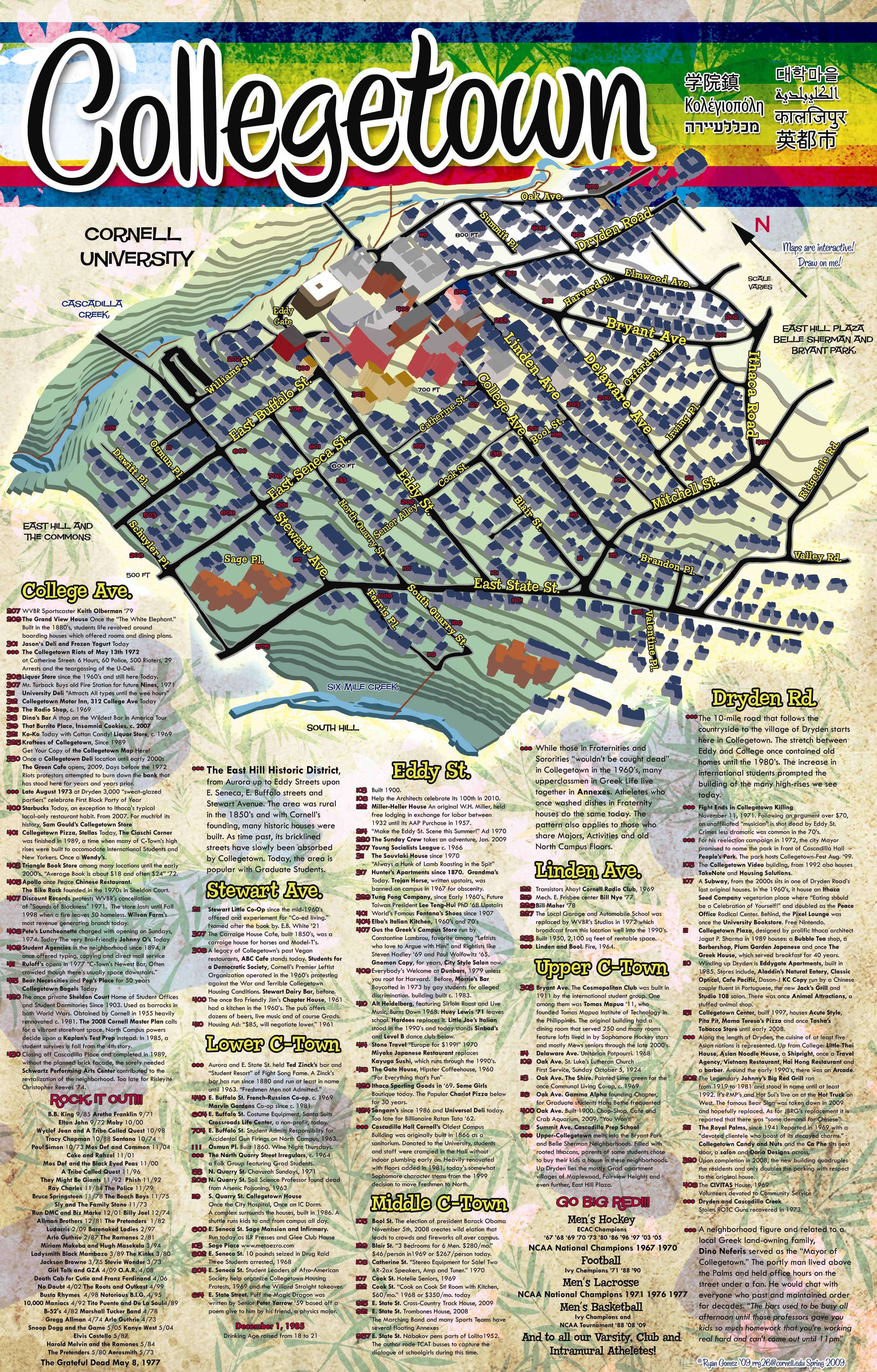
Best Map of Collegetown Ever.

10 09 2009

The map was a project of an alumnus, Ryan Gomez ’09. I dare say it’s one of the best maps I’ve ever seen of Collegetown, not only because it’s a visually appealing map, but also because it covers the history of many of the addresses in the neighborhood, not to mention worthy Cornelliana.

This map deserves a look:

http://www.metaezra.com/images/ctown_map.JPG

Mr. Gomez, you’ve earned my respect and admiration.


News Tidbits 8/13/09: Ithaca’s Economy Gets a Dose of Reality

14 08 2009

Image property of Welch Construction Inc.

Well, the simplest way to put it is that the sh*t has hit the proverbial fan. Emerson Power Transmission, the company that owns the factory on South Hill, will be shutting its doors next year, putting 228 people out of work [1]. Not to mention the 200+ people they have laid off in the past year.

Name your reason. Energy costs. Cheaper alternatives from overseas factories. Losing a major customer as Magna Int’l shuts down its massive factory in Syracuse. An anti-business local political climate. Oppressive taxes due to an incompetent state government (which I agree with, but I digress). In the end, the jobs are still gone.

Yet, Ithaca continues to survive. A major setback for sure. But Ithaca has been through economic horror stories before.  Consider Smith-Corona.

Smith-Corona was once a large company based out of Cortland, which is 25 miles northeast of Ithaca. Founded in Syracuse in the 1880s, the once employed as many as 10,000 people [2].  Groton, a town just north of Ithaca, was home to a large Smith-Corona factory. They manufactured calculators and appliances, but their speciality was typewriters.

If you’re reading this blog entry right now, I think you can guess where this is going.

Well, with the rise of computers and pocket calculators, their business went belly up. They started to shut down their lines in the early 1980s, with the factory in Groton shutting down in 1983, with the loss of 400 jobs. At the time, 2,800 people were still employed in the factories in Cortland [3]. In 1992, they decided to eliminate 900 jobs from the area, moving them to Mexico [4]. That ended up being a waste too, as the company shut down the Mexican factories five years later. The company originally shifted the Groton jobs to Signapore, to a factory they owned there that had 1500 employees. That shut down a few years later. Today, there’s little left of Smith Corona. Maybe 100-150 employees at a “headquarters” in Cortland, working in consumer electronics services.

Well, life didn’t end in 1983 or 1992. The local communities have continued to survive, perhaps even reinvent themselves to some extent. The loss of jobs always hurts the community. But people get by. Some might move, embittered by the economic loss; others might find other gainful pursuits. Companies such as Advion and Incodema have grown and picked up some of the slack. The wine industry here has grown by leaps and bounds in the past twenty-five years. The area continues to evolve, although it may not always to everyone’s liking.

I’m not trying to diminish the importance of the loss of a major manufacturer. However, I’m trying to make a point that as long as there’s local business talent and people who are willing to take a risk and start new business ventures, then this area will continue to survive, perhaps even thrive in the long run.

[1]http://www.theithacajournal.com/apps/pbcs.dll/article?AID=/20090812/NEWS01/90812029

[2]http://findarticles.com/p/articles/mi_qa3718/is_199901/ai_n8834821/

[3]http://www.nytimes.com/1982/07/01/business/scm-will-close-plant-in-groton.html?scp=2&sq=groton%20smith%20corona&st=cse

[4]http://www.highbeam.com/doc/1G1-13286094.html


The Essentials of Campus II

14 05 2009

100_3846

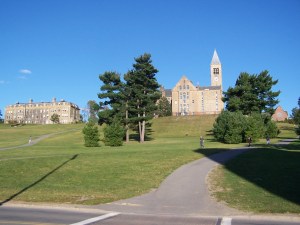
I knew that sooner or later, I would have to cover what is perhaps the most iconic building on campus. So here we are.

All citations, unless otherwise noted, are from Morris Bishop’s A History of Cornell (Cornell University Press, 1962).

Prior to renovation in the 1960s, the building was simply known as “The University Library”, even as other libraries were built across campus. It was Andrew Dickson White’s belief that “A large library is absolutely necessary to the efficiency of the various departments. Without it, our men of the highest ability will be frequently plodding into old circles and stumbling into old errors.” (77) The library was appropriated in September 1867 to the tune of $7,500 (175).  The amount was up to $20,000 by 1880 (213).

Daniel Willard Fiske was appointed the first librarian. He was also head of the university press and an instructor in German, Swedish and Icelandic. It was his belief (and rather progressive for the time) that the library should be a reference library, open to enhance both faculty studies and student interests. As a result, his goals was to obtain, by purchase or gift, extensive book collections, such as the library of Goldwin Smith (6,000 books), Charles Anthon (3400 books) and the like. A.D. White was also known for buying rare books on his overseas trips (both with his own funds and with university money). As a result, by 1873, there were 34,000 books and 8,000 pamphlets in the libe—a substantial figure for an American university. When it first opened, the library boasted that it was open longer than any other U.S. university — nine hours a day.  (108)

Fiske himself was easy to irritate and known for holding deep grudges from insults or perceived slights. Because the first university Vice-President William Russel was known for a gift of mockery, the two absolutely despised each other.  However Fiske was also very kind and generous; he was particularly fond of the Psi Upsilon fraternity men, and was once chastised by White for giving an inordinate portion of his salary to the chapter and its needy brothers (108). He also was chastised for offering a glass of ale to a student, to which he responded that the student interrupted him in his drinking time with a friend, and he felt obliged to offer a glass (108).

Since Fiske was in Egypt when the university opened in October 1868, the actual first librarian was a prominent local lawyer, Thomas Frederick “Teefy” Crane, of “Give My Regards to Davy” fame. Crane studied languages in his private time, and as a result he also was the German instructor at opening.  Crane enjoyed the experience enough that he himself went abroad, came back and switched places with another professor to become the instructor of French, Spanish and Italian in 1870. (109)

So, now we get to the “Great Will Case”. Jennie McGraw, aged 37, received a large inheritance after her father’s death in 1877. Already battling tuberculosis, a number of men offered to marry her, some of which were gold diggers I’m sure. One of the men who courted her was Willard Fiske. He wrote love poems to her, but he never showed them for fear of being called out as a gold digger. Anyways, as the rich and bored are wont to do, McGraw arranged to have a fabulous house built off of University Avenue, bordering Fall Creek, and then bought thousands of dollard of furnishing for it (224). In the meanwhile, both McGraw and Fiske went abroad to different parts of Europe in 1879. There is no record of contact in Europe between the two prior to April 1880. During this time however, Fiske used his influence on A.D. White to work over affairs back at Cornell. Locals assumes that because White was known to have lent Fiske money, and the two were close, that he and Sage were buttering him up so that if he and Jennie were to get hitched, that her fortune would be given someday to Cornell. (225).

In April 1880, Fiske went to Rome to join Jennie, now invalid and near death. The courtship between 48-year-old Fiske and the dying 40-year-old McGaw was short. They became engaged in Venice. Fiske announced it in a letter in May 1880 to A.D. White (along with a request for money). As one can imagine, some people looked upon Fiske’s behavior as mercenary. The two were married in Berlin on July 14, 1880 (226). At the time, Fiske signed a letter giving up his rights to Jennie’s property, under Prussian law.

The two spent the winter on the Nile, and then returned to Europe. By June 1881, the two were informed in Paris that Jennie had only a few weeks to live. Her dying wish was to pass on in Ithaca, so they made the trip back by September. I know, more than a few weeks, but whatever. She saw her mansion, newly built, and said (as she was propped up from her pillows) “it surpasses all my expectations”. It was the only time she ever saw the mansion, as she died September 30, 1881. When she died, Judge Boardman (of Boardman Hall) asked for the will. No one could find it, which would really suck for all parties because then they would have to use John McGraw’s will, and then the inheritance would go to John McGraw’s brother and his five kids since Jennie had no hubby or progeny.  Luckily, they found it in a secret pocket in a handbag that had been dumped off as junk in Fiske’s attic (227).
100_1769

The will stated that Fiske would get $300,000, $550,000 to her uncle and his kids, and $200,000 for a library at Cornell, $50,000 for McGraw Hall improvements, and $40,000 for a university hospital. The university also gained her land estate, including the mansion (valued at $600,000+), which A.D. White thought would be a dream home for an art gallery (227). Fiske, as custodian of the mansion, was to continue to occupy the house, and this raised issues. Namely, that he was known for being very needy financially; he offended Henry Sage by having parties in the room she died in no more than two months after her death; and Boardman simply didn’t like him, perhaps because of a rumor that Fiske suffered from marital indiscretions while in Europe. (228).

Here’s where the real fun begins. In May 1882, the state changed Cornell’s charter a little bit, but in one embedded section, it removed a portion detailing that the university couldn’t receive or hold personal property equal to or more than $3 million dollars. This was very convenient. In June 1883, Fiske was about to settle his affairs by going abroad, when an apprentice lawyer in Elmira told him of the change, and that state law said that a wife can’t leave more than half of her property to charity. As you might guess, the sh*t hit the fan. (228).

So, we have two lawsuits, one to break the will by Fiske on the grounds of Cornell’s underhanded actions, and then another one by Jennie’s cousins, out for more of the fortune. Fiske sailed for Europe, leaving a surrogate to handle things (Judge Marcus Lyon). White sailed after him to beg him to reconsider, but then Sage cabled White to tell him he was to make no offer to Fiske. Most of the Ithaca and Cornell crowd hated Fiske now anyway. After much media attention (like an OJ Simpson trial for the 1880s), in May 1886, the ruling was in favor of Cornell. White wanted to let Fiske save face by offering concessions; Sage would hear none of it. Fiske appealed the judgment, and it was overturned in August 1887, so Fiske won the suit, and the McGraws won theirs. So Cornell appealed to the Supreme Court (231). Meanwhile, the friendship between White and Boardman/Sage had deteriorated to animosity, although Sage made an offer to build a library himself if they failed to get the inheritance. All the while, Fiske was living in a luxurious Italian villa.

In May 1890, the Supreme Court ruled against the university. However, they did say that Cornell’s endowment could be used for any university purpose, which was a small consolation. in the end, Cornell paid $180,000 in legal fees to David Hill, the apprentice lawyer of Elmira, and $100,000 for the McGraws’ counsel. One of Jennie’s cousins bought the mansion for $35,000, much to White’s anger. The house was sold by the McGraws to Chi Psi fraternity in 1896. Its furniture was auctioned off, mostly purchased by the other McGraws. Fiske’s lawyer never took another case—it was rumored he drank himself to death during the celebration (232).  Henry Sage donated $500,000 for the library to be built, as was done in 1891. Willard Fiske returned to hobnobbing with the rich and famous, and book collecting. When he passed in 1904, he donated his library as well as his estate to the university. He also requested to be buried with his wife in the mortuary of Sage Chapel; when the university granted the request, the Sage family severed all ties to Cornell.  (232).

***
100_1950

Long-winded, isn’t it? Well, I’ll go on for a just a little while longer. I have to make up for some lost time.

The actual cost of the libe was $227,000, with room for 400,000 volumes (Cornell owned about a quarter if that at the time) (271).  When received ,the Fiske fund was used for salaries and upkeep, and later book expenses; the library was already overcrowded by 1906. The library expanded in 1936 with the construction of more stacks on the south and west wings. The Great Depression was quite hard on the libe, and the head librarian at the time, Dr. Otto Kinkeldey, frequently complained about the lack of space and funding.  A special library fund would be set up in 1941 (531).  The library was internally reorganized in the late 1940s (576), and the Cornell University archives were created about the same time (600).

The library was renamed for Harold Uris ’25 in 1962, since he donated significant amounts to its renovation. In 1982, the glassy west wing was added, adding 214 seats , and was paid for my the Uris Brothers Foundation [1]. The 173-ft tall Library Tower was renamed “McGraw Tower” for Jennie McGraw in 1962.

As for the Chimes and more details about the tower, we’ll save that for another entry. For the Clocktower Pumpkin, we’ll leave that to a wikipedia quote:

“On October 8, 1997 a pumpkin appeared atop the spire of McGraw Tower. Because of the danger involved in retrieving it, administrators decided to leave it until it rotted and fell off. However, the pumpkin rapidly dried out in the cold air and remained on the tower until it was removed with a crane on March 13, 1998 (it was planned that Provost Don M. Randel would remove it, but in a practice run the crane basket was blown by a gust of wind and knocked the pumpkin off). Some people had claimed that a real pumpkin could not stay up that long without rotting and that it must be artificial. However, subsequent morphological, chemical, and DNA analysis by both faculty members and undergraduates confirmed that it was indeed a pumpkin.

In April 2005, a disco ball was attached to the top of the tower. A crane was hired to remove the offending orb in an operation which cost the university approximately $20,000.” [2]

[1]http://www.cornell.edu/search/index.cfm?tab=facts&q=&id=767

[2]http://en.wikipedia.org/wiki/Cornell_Chimes


Finals Special: Slope Day and Beirut

7 05 2009

So, my original intention was to get an entry up last night, but considering I had just finished a particularly difficult class that actually had a manageable final, and I received an offer to play the aforementioned game, I decided to indulge (and discovered that chili and beer should never be in my stomach at the same time, but anyways…). Somehow during the game, my mind wandered and started wondering who exactly game up with beirut, also known as beer pong (also known as water pong, for those who prefer alternative beverages). For this, Wikipedia is incredibly useful.

I found the article to be an entertaining read.

This is the listing of skills required:
“Aiming, taunting, and alcohol tolerance”

As for the origin, the game apparently originated from Dartmouth fraternities in the 1950s and 1960s (considering their unofficial mascot is Keggy the Keg, this is no surprise). The original version of the game used actually paddles, as if a regular ping pong (table tennis) game, where one was supposed to swat the balls across the table “court” and into the opposing team’s cups. The name beirut was adopted in some regions during the 1980s (a time period that some history buffs might recognize as part of the Lebanese civil war where the capital of Beirut was largely destroyed, although I fail to see the connection between shooting down cups of booze and the widespread destruction of a city [2]).

Now, granted, I’m slow with the entries lately, but that’s largely because of my finals. As a result, I’m running a little late on this brief Slope Day piece, but things are better late than never.

As we all know, Slope Day is held annually on the last day of classes [3] for the academic year. Slope Day seems to have originated from the Navy Ball, an evening of song and dance that was first celebrated around 1890. Navy Ball, which was held to raise money for CU Athletics, was held in October (on the day before a major regatta on the lake) up until about 1901. Attendance at classes was so poor that day in May 1901 that the university decided to cancel classes and declared a holiday, known as “Spring Day”. Spring Day was held for about next fifty or so years, often with a theme (for example, 1928’s theme was “A Roman Holiday”, which might have been as close to a toga party as they came back in the day). However, with the campus unrest from 1960-1978, celebrations of Spring Day ceased [4].

From 1979-1985, Cornell University sponsored “Springfest” on the slope. The initial celebration consisted of catered food, catered booze, and live entertainment on the slope. This was within the laws of the time, because the drinking age in the state of New York wouldn’t be raised to 21 until December 1985. The 1986 Springfest was held in a fenced-in area on North Campus (I imagine where the Court-Appel-Rawlings Field areas is), which caused quite a protest from the student population, who wanted to maintain their right to get sloshed on the slope. It was about this time that the term “Slope Day” came into popular use. 1987’s Slope Day had entertainment in the form of Robert Cray, but by 1988 Slope Day was once again an unofficial event.

Through the 1990s, the university refused to acknowledge Slope Day, except that kegs were banned from Libe Slope in 1990. SlopeFest, an alcohol-free carnival on West Campus, was launched in 1999 (moved to Ho Plaza in 2004). In 2001, the amount and type of alcohol students could have on the slope was limited. In 2003, Slope Day took on its current form of a fenced-in slope, highly regulated alcohol catering, and live entertainment.

With regards to the performance, the following is a quote from the wikipedia page, and verified on the Slope Day Cornell history page:

Friday, May 6, 1977: Commander Cody & His Lost Planet Airmen (Held on Libe Slope)
Sunday, May 8,1977: The Grateful Dead (in Barton Hall)This concert was separate from the Slope Day[3]
May 1984: The Ramones, Harold Melvin & the Blue Notes (Held in Barton Hall due to inclement weather)
May 1987 Robert Cray
May 5, 2000: Pilfers
May 4, 2001: Stroke 9
May 3, 2002: Nada Surf
May 2, 2003: Rusted Root, Fat Joe
May 7, 2004: Kanye West, O.A.R., Dilated Peoples, Matt Nathanson (did not play)
May 6, 2005: Snoop Dogg, The Game, The Starting Line
May 5, 2006: Ben Folds, Talib Kweli, Acceptance
May 4, 2007: T.I., TV on the Radio, Catch 22
May 2, 2008: Ted Leo and the Pharmacists, Gym Class Heroes, Hot Hot Heat
May 1, 2009: Pussycat Dolls[4], Asher Roth[5], and The Apples in Stereo

So, Slope Day as current students know it is a fairly recent event in Cornell history. Hopefully, in some way or form, it will also continue to be enjoyed by future students at Slope Days to come.

[1]http://en.wikipedia.org/wiki/Beer_pong
[2]http://en.wikipedia.org/wiki/Lebanese_Civil_War
[3]http://en.wikipedia.org/wiki/Slope_Day
[4]http://slopeday.cornell.edu/history.php


Cornell and Crime

30 12 2008

So, Cornell is an institution with a long and extensive history, and as with any institution of its size there’s been to be a few…unpleasant crimes associated with the school or its alumni. 

Oh, the prestigious alumni. For example, Michael Ross ’81. By any regard, Michael Ross was the typical Cornellian; actively involved on campus and reasonably intelligent. However, he also had an unpleasant side [1].

Michael Ross had serious mental issues. Rape fantasies. So intense that he started acting on them. His first rape and homicide (via strangulation) was that of a Cornell student, 25 year old Dzung Ngoc Tu, on May 12, 1981.  She was an agricultural economics (AEM) graduate student, who was apparently selected at random. It took a week to located her body at the bottom of Fall Creek Gorge, and while suicide was intially suspected, the Tompkins DA began to assert a case of foul play had occurred. However, there were no leads, and Ross did not admit to her slaying until he was arrested on seperate murder charges in 1984 (apparently he confessed during questioning by a police detective). According to news sources, Ross was never formally faced charges stemming from her death.

Michael Ross was responsible for the rape and murder of seven other young women in the 1980s.  He was executed in 2005, New England’s first execution in 45 years.

Going into another case, there’s the double murder of two Cornell freshmen back in December 1983 [3]. Okay, I’m a horrible person; I have told people this story just for the sake of scaring the crap out of the people who live in Lowrise 7, where it occurred.

What happened was that the crazy ex-boyfriend of one of the victims decided to come to Ithaca and “reason” with her. By that, I mean taking her, her roommate, and five others hostage. After a short time, the girl managed to convince her ex to let the others go, but he kept her and her roommate. He then shot them both and fled. The girl, Young H. Suh ’87, died immediately. Her roommate, Erin C. Nieswand ’87, died of her injuries shortly after bring airlifted to a hospital in Syracuse. As students notified police, the 26-year old killer attempted to flee the area, but was forced off the road at Rout 366, where he then shot himself in the head. He survived, and was sentenced to life in prison in October 1984 [4].

This last one for today goes off on a slightly different tangent. Some of you might be aware of the can of worms that was the CIA’s involvement with mind-altering drugs (like LSD) to see if they could be useful for government business. Well, that didn’t work too well, nor was it much appreciated when the American people found out from declassified documents in 1975 [6].

I order to set up funding for their projects, the CIA worked with various organizations to establish feeder programs that would make the research look legit. One of the primary distributors were two Cornell professors, Harold Wolff and Lawrence Hinkle. The initial programs set up for the CIA was in the 1950s and called “The Society for the Investigation of Human Ecology”. In 1961, it was reorganized as the “Human Ecology Fund” and operated primarily out of the Medical School. This ended by the late 1960s.

For the record, the Human Ecology school adapted the name “Human Ecology” in 1969 (during the time of the program’s operation, it was still the school of Home Economics, so there are no connections worth making between the two).

So we’ll wrap that up for today. For kicks, I’ll attach this lovely article attacking Cornell for its Qatari medical school (Qatar supports Hamas). It’s a little too-partisan for my tastes, but it just proves the point that not everyone from CU and not everything CU does is (or should be) considered “good”. 

http://www.renewamerica.us/columns/jweinstein/060421

Enjoy!

P.S. I suppose in keeping with the theme of this entry, I’ll update it to include the June 2009 murder of a Cornell researcher by her husband, a doctoral student in computer science [6]. It would appear he slit her throat and left her to die on a walking trail, and then set their apartment on fire, became involved in a high speed police chase and tried to slit his own throat to avoid arrest (which failed). Congrats to Blazej Kot, whose horrific homicidal tendencies  make him destined to join the rest of the historical skeletons in Cornell’s closet.


[1]http://crime.about.com/od/deathrow/p/michael_ross.htm

[2]http://cornellalumnimagazine.com/Archive/2005marapr/features/Feature2.html

[3]http://cornellsun.com/node/27009

[4]http://query.nytimes.com/gst/fullpage.html?res=9903E5D6123BF936A35753C1A962948260

[5]http://www.thejabberwock.org/wiki/index.php?title=MK-ULTRA_and_Academia_-_Part_3

[6]http://www.theithacajournal.com/article/20090608/NEWS/90608053/Homicide%2Bsuspect%2BKot%2Bout%2Bof%2Bhospital%2B%2Bheld%2Bin%2BPa.%2Bjail


Cornell’s Morbid History

29 07 2008

This is not a very fun topic to talk about, and I completely understand if someone is uncomfortable reading it. I am by no means offended if anyone chooses not to read this entry.


So today, I was at work when one of my supervisors opened up discussion about some of the students she has had as employees over the past twenty years. She originally worked with the hotel before transferring to store operations a couple of years ago. two particularly tragic moments sttod out in her mind; one was the death of a student after they were hit by a TCAT bus, and the other was a case where two students who had been using drugs at a party jumped from the Statler right around Hotel Ezra Cornell.

So, I decided to do a little side research into Cornell’s darker, morbid history. The first incident my supervisor recalled was the death of junior Michelle Evans after she was struck and killed by a TCAT on Dragon Day in March 2000 [1]. The driver of the bus was D.U.I. and strayed from the street. The Evans family would later sue TCAT and Cornell and was awarded a settlement of $3 million, which has been used to set up a memorial scholarship in her name.

The other incident I have yet to find any inforamation on. She said it was unlikely I’d find much anyway, since the whole thing was kept as quiet as possible (how you do that with two students jumping to their death must be quite a feat).

Cornell is no stranger to death in the student population. One of the more famous cases is the death of lacrosse player Mario St. George Boiardi, a senior who was struck in the chest with a ball while playing defesneman during a game versus Binghamton. He collapsed on the field, and although attempts were made to revive him, Boiardi was prononuced dead at Cayuga Medical Center at 6:44 P.M. on March 17, 2004 [2]. My supervisor was still at the hotel when the family arrived in Ithaca, and she described Mrs. Boiardi as “blotto”, as she had to carried by two people, since she was moaning in grief and wandering aimlessly through the lobby when they came for their son. She further described that Mrs. Boiardi seemed “all cried out, like she ran out of tears.”

Other times, an individual feels that should take their own life. Cornell is one of the few institutions that keeps a relatively accurate track of suicide, probably because of our infamous, and rather unfair, reputation; records indicate that it averages 4.3 per 100,000 student years, or about .82 deaths a year (assuming 19,000 students at Cornell; this does not distinguish between grad and undergrad) [3]. This is below the national average, which stands at about 7.5 per 100,000 student years. But as contradictory as things like to be, this DUE letter says it is 1.56 per 100,000 [12].

As for jumping from the gorge, a popular jab at our institution:

1- Takehiro Hara, a law student from Tokyo, accidentally fell into the gorge around December 3, 1999. His body was recovered two days later. His death was ruled accidental, with the cause being asphyxiation by drowning. [1]

2- Dan Pirfo, a freshman from Washington D.C, disappeared during the night of April 24, 2005. His body was located on May 10 at the base of Ithaca Falls. [4]

3- Junior Keith O’Donnell died on September 13, 2007, after suffering head injuries sustained in a fall after falling 30 feet into Cascadilla Gorge near the Glen Walk on the 8th of the month. [5] Curiously, a later sun article reports this as a drowning death [6].

4- The drowning death of graduate student Aravind Lakshamanan on August 14, 2006, the third that month. A 28 year old visitor, Navin Parthasarathy of California, and a local man in his 60s also lost their lives in the gorge that same month, although the latter has been disputed as to whether or not it was a suicide. [6, 7]

5- Most recently, the death of Douglas Lowe ’11, who drowned June 12, 2008 after being caught in the strong current of the Fall Creek Gorge. [6]

Most of the recent gorge deaths don’t appear to be suicides, but tragic accidental deaths.

Another cause of death are fire-related injuries/ailments, such as the death of fifth-year art student Ian Alberta on May, 13 2006. Alberta was killed when his apartment caught fire as the result of smoking materials not being put out properly, according to news reports [13]. I walk past that house every day on my way to work; it cost $50,000 to reapir damages, but someone fixed it up. With the exception of the awkward shingle patches on the roof, you’d never know anything had happened here.

And sometimes, and this is what would really, really suck, is that you just up and die. That’s pretty much what happened to a 25 year old grad student in his lab in April 2003. He just collapsed at 10 P.M. on April 1, and died the following morning in the hospital[8]. Or the death of Scott Paavola, a sophomore in engineering, who died Oct. 15, 2002, of a medical condition associated with an enlarged heart. Yet, he was perfectly healthy otherwise, a swimmer for Cornell and a brother at Phi Kappa Psi [11].

I’m not even making a decent attempt to chronicle earlier deaths. The gorge death of Danny Sastrowardoyo ’87, who died May 30, 1986 [7]. The beating death of junior Todd M. Crane on October 5, 1989 [9]. The curious death of Terrence Quinn ’93, who was found dead and upside-down in Psi Upsilon’s chimney on Janurary 15, 1993 [10]. He wasn’t even a member of that house, and no one knows exactly how he got there; but he died of “positional asphyxia”, meaning the way his neck was bent slowly cut off his air supply, suffocating him.

Even after this entry was initially written, I have  come back to include the deaths of Matthew Lanzing ’09 [14] and Nicolas Kau ’12 [15] (it would appear that Kau died over vacation, falling from a ninth story window [16]). The swine flu scare resulted in hundreds being sick, and at least one student who died from complications related to the H1N1 virus, Warren J. Schor ’11, an AEM student who was a member of ZBT.

In a school of 19,000+ students, bad things are going to happen as a matter of probability and reality. We accept these risks as we live life at Cornell day-to-day. It’s tragic, and it’s still a (sad) part of our history as an institution.

***

Holy crap, if it bleeds, it leads…a lot:

[1]http://ezra.cornell.edu/posting.php?timestamp=953787600

[2]http://www.news.cornell.edu/releases/March04/BoiardiLacrosse.bpf.html

[3]http://www-tech.mit.edu/V120/N6/comp6.6n.html

[4]http://www.news.cornell.edu/stories/May05/Daniel.Pirfo.release.html

[5]http://www.news.cornell.edu/stories/Sept07/ODonnell.death.html

[6]http://cornellsun.com/section/news/content/2008/06/13/cornell-student-dies-fall-creek-gorge

[7]http://www.theithacajournal.com/apps/pbcs.dll/article?AID=/20080613/NEWS01/806130361

[8]http://www.news.cornell.edu/releases/April03/Student.death.lab.lgk.html

[9]http://query.nytimes.com/gst/fullpage.html?res=950DE7DB143CF934A25751C1A96F948260

[10]http://media.www.dailypennsylvanian.com/media/storage/paper882/news/1993/01/26/Resources/Ivory.Towers.Cornell.Student.Dies.In.Frat.House.Chimney-2189239.shtml

[11]http://www.news.cornell.edu/releases/Oct02/Paavola.death.medical.lgk.html

[12]http://ezra.cornell.edu/searched.php?search=death&question=&answer=&starttimestamp=&endtimestamp=&category_id=&offset=10&view=expanded

[13]http://www.news.cornell.edu/stories/May06/fire.fatal.dea.html

[14]

[15]http://cornellsun.com/section/news/content/2009/01/26/students-honor-kau-%E2%80%9912-sage-chapel

[16]http://ultraspike.blogspot.com/


Random Photo Tours, 7/6 Edition

6 07 2008

So, I decided to do a little photo tour in my spare time.  Just imagine it to be like a bus tour, without the bus and the annoying woman in front of you with the oversized sun glasses.

This house, 210 Thurston Avenue, served as Sigma Alpha Mu’s house from 1947-2004.  Today, the house serves as Phi Delta Theta’s annex. Phi Delta Theta, nationally known as a dry social fraternity, operates their chapter house as a dry house, and the annex as….well, not a dry house.

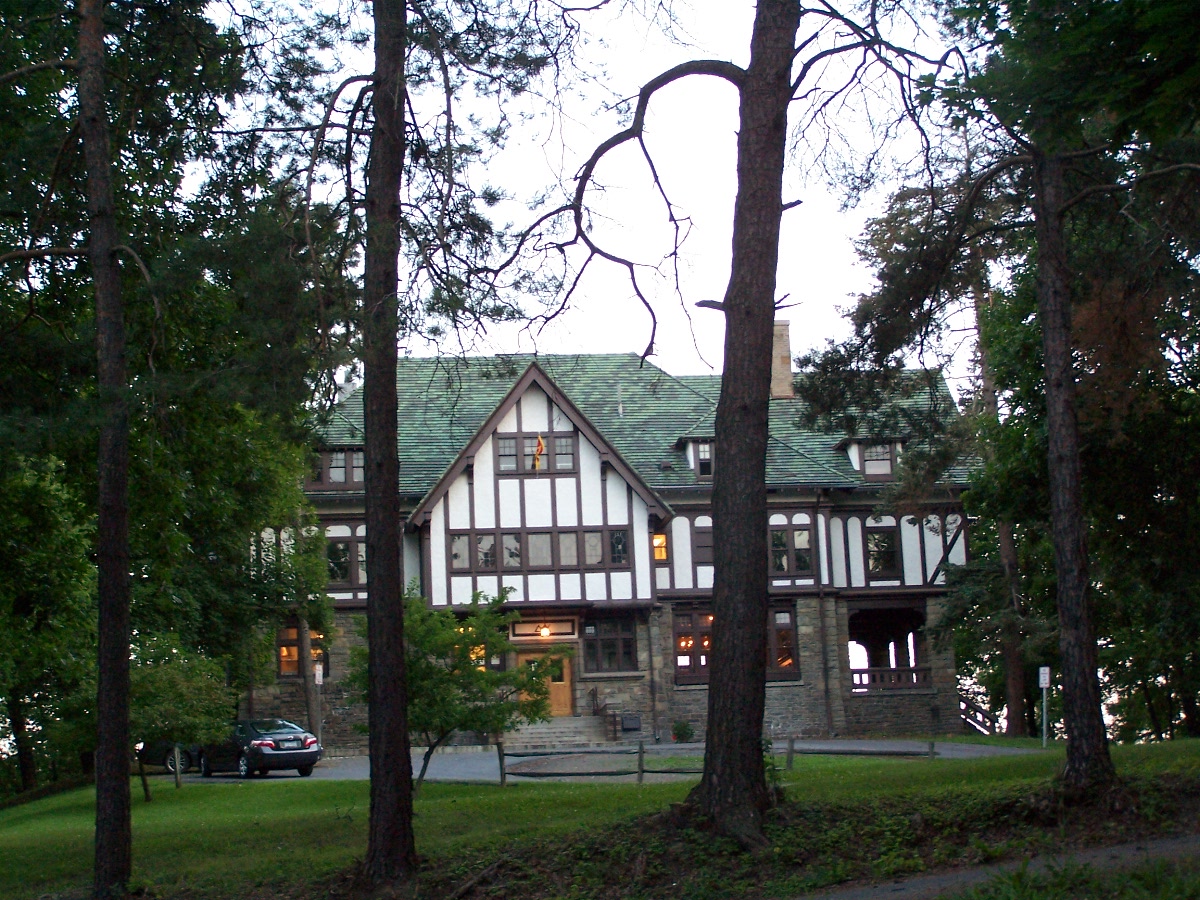
The house of Kappa Sigma fraternity [1]. The house was built by a German nationalist who fled at the onset of WWI. The house was then bought by Claude Smith, the president of the Ithaca Gun Company, and remained his residence until 1937. Sigma Alpha Mu occupied this house in the 1940s, and by 1952, the house has been sold to Kappa Sigma.

The house of Alpha Epsilon Pi. this house was built in 1957 [2]. With the except of reorganization periods, such as 2004, the house has been continuously occupied by AEPi.

The Delta Chi Fraternity house on The Knoll. Originally founded as a law fraternity at Cornell in 1890, Delta Chi’s house was built in 1914 [3], and extensively renovated in the past two years. the fraternity did not become open for all men to pursue membership until 1922. The Cornell chapter was reactivated in 2004, and lived in Sigma Phi Epsilon’s house and AOPi’s old house for the interim of renovation. Sig Ep reorgainzed around the same time, so the logistics of two fraternities in one house undoubtedly led to a couple of issues.

Tha Alpha Zeta Fraternity House [4]. Alpha Zeta is one of the two ag-based fraternities (membership is virtually all from CALS), the other being Alpha Gamma Rho. Alpha Zeta is nearly unique in that it is co-ed. The originally house was built in the 1880s, but torn down in 1991. The portion on the right was built in the 1950s as an addition to the old house; the portion on the left, built in 1992-93, is on the old house’s footprint.

Phi Kappa Tau Fraternity house, also on The Knoll. The house was originally built in 1901 for John Tanner, a Cornell mathematics professor. The house was sold to Phi Kappa Tau in 1910, when it was still a local fraternity, named Bhandu [5]. The local fraternity marged with another to form Phi Delta Sigma during WWI, and became a chapter of PKT in 1930. The fraternity closed for several years in the 1990s, during which it was rented to the Big Red Band. It was recolonized in 2000.

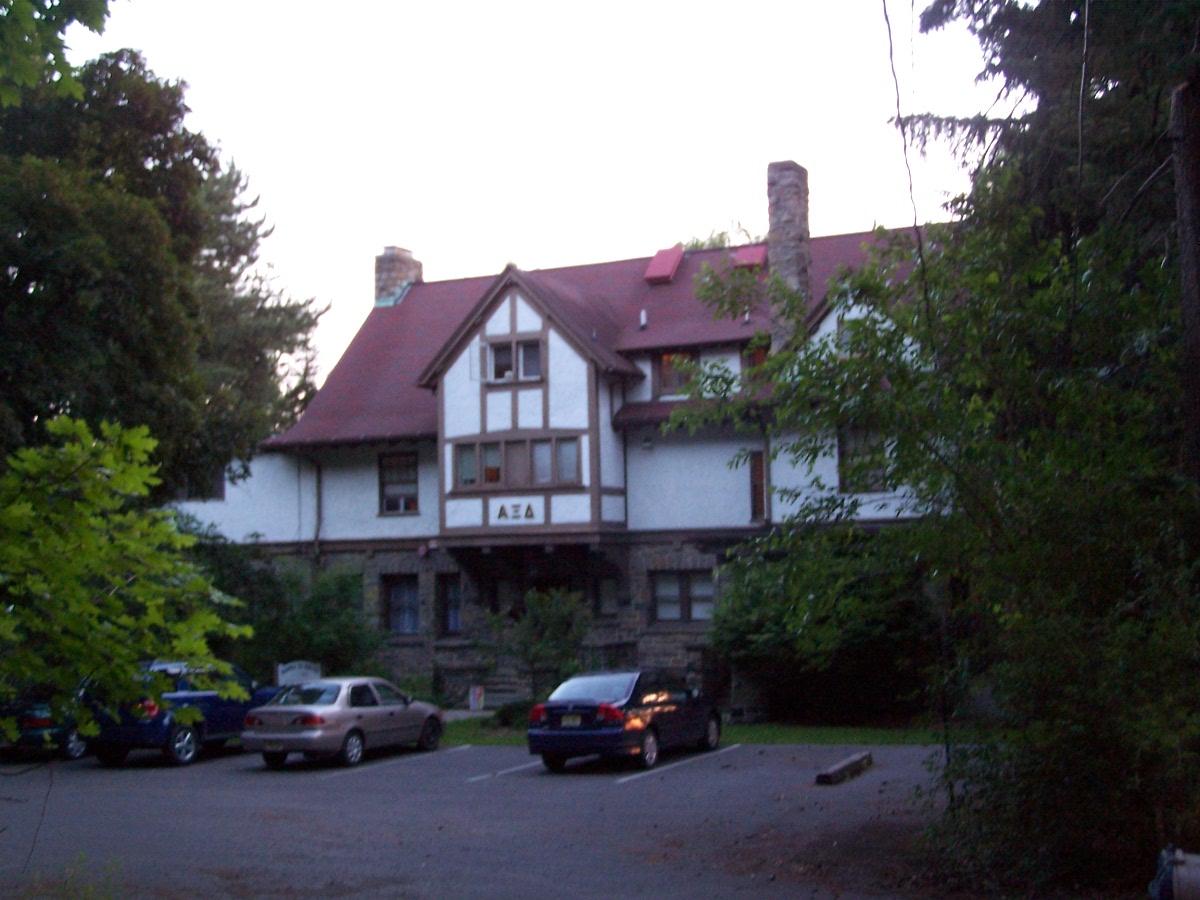
Alpha Xi Delta sorority house. AZD Cornell was rechartered in 2004 after a forty-year hiatus. It was selected from several bidding national sororities to replace the spot vacated bt the closure of two sororities in the early 2000s- Delta Phi Epsilon and Chi Omega. As a matter of fact, this used to be Delta Phi Epsilon’s house. (Chi Omega’s is now Sigma alpha Mu’s current house).


[1]http://www.dos.cornell.edu/dos/greek/chapter_details.cfm?id=3252

[2] http://www.aepibeta.org/FoundingTo1983.html

[3]http://www.cudx.com/cms/index.php?option=com_content&task=view&id=13&Itemid=28

[4]http://www.alphazeta-cornell.org/public2.asp

[5]http://www.cornellpkt.com/spage.php?id=1163279207&mainID=1159743751