A Blind Eye to Sports

8 11 2009

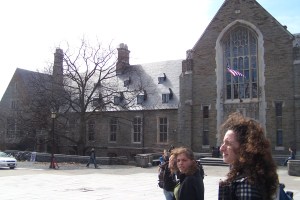
As anyone who doesn’t live under an Ithacan rock knows, Cornell had its much-publicized and anticipated match against Harvard on the ice of Lynah Rink last night. Much to Cornell’s delight, the Big Red skated to an impressive victory over the Crimson, with a final score of 6-3.

I feel like I’m one of a handful of undergrads on this campus who really doesn’t give a damn.

Not that I don’t have respect for athletes at Cornell. I give them by full respect. It’s just that I have never followed sports, with the slight exception of cross country and track back in junior high and high school because I was on the team (and let’s be honest, they’re just not the same when it comes to skill or competitive spirit). I’m content to sit back and watch everyone else get excited, because I’m just disinterested in Cornell sports. I’m never sat all the way through a Cornell game in any sport.

So, unsurprisingly I never mention sports on this blog, unless there’s historical worth to mentioning it. Which I can briefly do now.

Back in the day of the university founding years, the big sport for students to follow was crew, aka rowing. A.D. White was a member of a rowing club during his own collegiate years at Yale (Bishop 33). The first boating clubs formed in 1871, and a regatta was held the following spring (if you could call it that). The first big victory came at Saratoga in 1875, much to the joy of the school and the town (story goes that A.D. White broke into McGraw Hall Tower and rang the chimes himself). Baseball and football were vague diversions, not even intercollegiate until 1874 (Bishop 134). Cornell actually had its own rules of football that no one cared about, so the university didn’t take a substantial interest in football until about 1886. The Cornell Atheltic Association formed in 1889 (296). The first athletic area, built in the same year, was off campus on what is now the site of Ithaca High School, and was called Percy Field after the donor’s son, who was at the time a student athlete at Cornell. Hockey was recognized in 1900, basketball a year later. Lacrosse started up in 1885, but was  like clothing fashions among students, coming back into and going out of style every few years.

Hockey was originally played on Beebe Lake. The idea of bringing it to Cornell came from a professor of engineering named Johnny Parson. Hecne, the establishment of the Johnny Parson Club. When the lake began to melt, the team would use the Ithaca city ice rink. The team won what might be its first intercollegiate championship in 1911 (417).

So, Bishop’s history of Cornell only mentions hockey twice, and was published in 1962, suggesting the sport was still on the periphery of athletics at that time. That was also the same year that underdog Cornell outplayed perennial powerhouse Harvard. Things started to get more interesting when the Harvard/Cornell hockey rivalry started to heat up in 1973 with Harvard’s tossing off a chicken at Cornell goalie Dave Elenbaas, as a knock against the Ag School (of course, nowadays we can depend on our alumni to knock the ag school). So Cornell students responded later that month by throwing fish onto the rink. As the decade wore on and Harvard’s program weakened, the Big Red wasn’t content to let things slide, so the rivalry has been intensified since the incident.

So that’s why Cornell-Harvard tickets can be so expensive, and why this one game is as close as Cornell gets to the storied rivalries of Big Ten schools. Some of us are more into it than others though.  


The Cornell Daily Sun

21 10 2009

100_1899


So, I first thought about writing an entry on the Sun because of fortuitous circumstances. I happen to write in some small capacity for the Sun, but with the exception of one person (to my knowledge; most everyone else couldn’t care less), no one at the Sun knows that I write this blog. Occasionally, someone will ask “when was Mann Library built?” or “when is Milstein Hall supposed to finish construction”, and it’s really tempting to put in my two cents, but  for the most part I focus on my work and leave when I’m done.

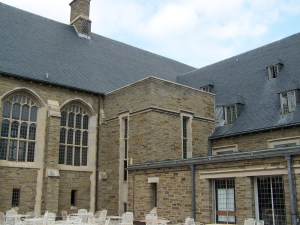
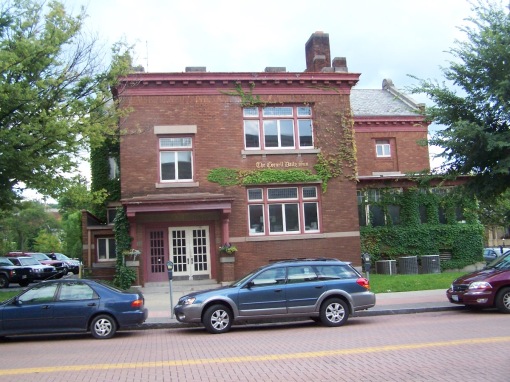
Regarding the Sun itself, the newspaper is based out of the former Elks Lodge building on the 100 block of West State Street, a block west of the Commons. The building itself dates from 1916, and the Sun renovated the building and moved into the 7,000 sq. ft. building during 2003 (prior to that, thsun rented space around the corner on Cayuga Street). The Sun is totally independent of the university, which is great because the school paper of the university I worked at this summer was nothing more than a mouthpiece for the administration and its cultish president, but I digress. The original Cornell newspaper was The Cornell Era, which was founded in 1868 and named as such because it marked the beginning of a great new era. Much to the Era’s chagrin, the Sun appeared on September 16, 1880, in the format of a four-page pamphlet-sized newspaper (Bishop 206).  The Era eventually became more of a literary magazine and shut down permanently in the late 1940s. The Sun has operated continuously since its founding.

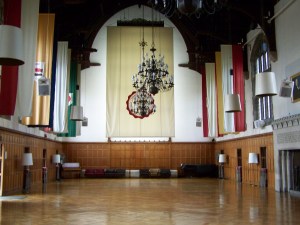
The building itself is an interesting place ot visit. The main work area on the first floor has private offices, and a general work areas for contributors and writers filled with newspapers and article drafts from previous days. The upstairs has a spacious and stately wood-trimmed great room, which I suspect was probably used as a cermeonial/banquet room back when it was the Elks Lodge. I’ve never felt compelled to take photos inside the building, mostly because of the stares I would probably get.

Bishop, Morris. A History of Cornell. New York, New York: Cornell University Press, 1962. ISBN 0-8014-0036-8


Expecting A Warm Winter

4 10 2009

100_2434

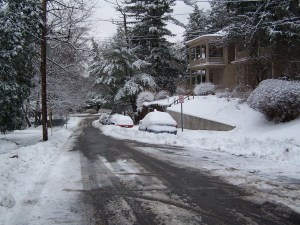
Global warming completely aside, I think it might be worth noting that Ithaca can expect a warm winter for 2009-2010. This is because we’re in the middle of an El Nino year.

For those living under a rock, El Nino (or as meteorologists know it, the el Nino Southern Oscillation, often reduced to ENSO) is the much publicized periodic change in atmospheric and oceanic conditions highlighted by the shift of the eastern Pacific Ocean water temperatures to much warmer than usual conditions (typically most apparent off the coast of Peru). The effects on the Atlantic will lag somewhat behind the Pacific.

Well, El Nino conditions started to kick in during this past summer, around June. One effect that El Nino years (as they tend to last 12 to 18 months) have is that the Northeast is much warmer than usual during the winter. To illustrate this, I pulled the data for the last few El Nino years (Winter 06-07, Winter 02-03, Winter 97-98, and Winter 94-95, Winter 91-92) from the Northeast Regional Climate Center.

Month/Year Anomaly

Dec 2006 +8.0 F

Jan 2007 +5.6 F

Feb 2007 – 7.1 F

Dec 2002 -2.2 F

Jan 2003 -5.6 F

Feb 2003 -3.0 F

Dec 1997 +2.3 F

Jan 1998 +8.4 F

Feb 1998 +7.8 F

Dec 1994 +4.4 F

Jan 1995 +7.1 F

Feb 1995 -2.7 F

Dec 1991 +2.0 F

Jan 1992 +3.0 F

Feb 1992 +2.0 F

Data from pre-1995 is only available to those with research accounts. Thankfully, my senior thesis research has allowed me this perk. Anyways,  4 of the past 5 El Nino seemed to follow the typical pattern, and 2002-2003 did not. To be perfectly honest, that year is still under study as no one can really seem to explain what happened. A prevailing theory for a while was that it was another osciallation (the Pacific Decadal Oscillation) having an impact on El Nino, but that theory developed a big hole in it after a fairly typical 2006-2007 El Nino year. It takes 20-30 years for the PDO to change phases, so 2006-2007 should have been much the same, but it wasn’t.

Keep in mind this is all relative. Five degrees above normal during the coldest time of the year (late January) means a high of 35 and a low of 19. So don’t get too comfortable.


Essentials of Campus III: Willard Straight Hall

1 10 2009

100_1464

It’ a a blessing and a curse to have posted mostly news tidbits lately. It saves time for me while it still is pertinent to the general focus of this blog, but posting them feels relatively unsatisfying, especially when I’m comparing them to some of my history entries, like the “Essentials of Campus” entries. I have been planning to do Willard Straight in an entry since about May; the trick was finding the time and resources to do it right. For one, I didn’t have enough photos of the Straight, so I decided to go on a little photo tour of the inside of the building. Secondly, I had debated to what extent I would cover the Willard Straight takeover back in spring 1969. I came to the conclusion that I’ll provide links and brief description of that piece of history, but since there are entire books dedicated to it (which thanks to the wonders of Google, much of Donald A. Down’s meticulously detailed book concerning the crisis can be read online), I decided to not spend too much time on it for the time being.

 100_1459

So, let’s start with the man. Willard Dickerman Straight, originally an orphan from Oswego, NY, was a member of the class of 1901 (Bishop 455). During his time at Cornell, he was an editor for the Cornell Widow, which was a popular campus humor magazine at that time, and he was one of the students responsible for organizing Spring Day, which would evolve into Slope Day in later decades. He was also a member of Delta Tau Delta and the Sphinx Head Honor Society. After graduation, he worked in the Chinese customs service (a time when the Qing Dynasty still ruled in China and Anti-Western sentiment ran high) and rose rapidly in his field to become the head of the State Department’s Far Eastern Affairs. He married Dorothy Payne Whitney, member of the incredibly WASPy and wealthy Whitney family.  Willard Straight passed away from complications due to Spanish Flu strain pneumonia on December 1, 1918, while waiting for the Americans to arrive in Paris to negotiate WWI peace treaties. His will asked his wife to do “such thing or things for Cornell University as she may think most fitting and useful to make the same a more human place.” While I have little idea what “make the same” means, it was part of his will to use his money to enhance the quality of life at Cornell. Generally, that was the sentiment he held during his life too; he was one of the financiers for Schoellkopf Field.

Digressing here, but Striaght had three kids: A chairman for Rolls-Royce, an actress, and a KGB spy. None of them went to Cornell.

100_1457

Thing was, back in the day, fraternities were the entire social scene at Cornell. If you weren’t a member of a house, you didn’t exist. There were few clubs, and intercollegiate sports were a diversion for precious few. In that time, if you were an independent student, you probably lived in a crappy tenement in Collegetown of further down East Hill and you led a miserable existence hating the weather and not enjoying the collegiate experience. One can see where Willard Straight was coming from when he said that the place needed to become a little more human.

100_3402

Well, Mrs. Straight didn’t know what to use the money on, so she kinda sat on it for a few years figuring out what would be the best way to fulfill her late husband’s wishes. Enter Leonard K. Elmhirst ’21. A charming englishman and president of the Cornell Cosmopolitan Club (the club [in the sense that coops and frats are clubs] for international students at the time), and when he discovered that his club was $80,000 short of funds (which is like $830,000 in today’s terms; one has to wonder how the hell you get so far in the hole without someone catching it).  Like any proactive student, he went on down to NYC to plead with alumni for money. One of those who pitched his plea to was widow Straight. Well, she was taken by his image of barren student life at Cornell, so she paid off the debt for the club, resolved to donate the money to better student life, and married Mr. Elmhirst. Now that’s a package deal if I ever saw one. Mrs. Elmhirst became a citizen of the crown in 1938, and passed away in December . Considering what happened the following spring, that may have been for the best.

100_1460100_1454

Through consultation with President Farrand, Mrs. Elmhirst came up with the idea of a student union, which was an increasingly popular idea in those days, conjuring images of the schools of Europe while also improving the quality of student life. William Adams Delano drew up the plans and they were presented to the trustees in June 1922 (Bishop 456). The plans called for meeting halls, banquet halls, dance halls, a library, formal dining rooms and a cafeteria, a thatre, guest bedrooms, dorms, campus offices, game rooms, all in one grand Collegiate Gothic package built with the finest craftsmanship and llenroc bluestone. Ezra Winter painted the murals in the grand hall, meant to illustrate Striaght’s life and career (this is why you can see Manchus above the door of the reading room today). The building opened November 25,1925, though to comparatively low-key fanfare (though perhaps I may be comparing this to the dancers dressed up as scientists dancing in the atrium to “Weill Thing” when they dedicating Weill Hall). Mrs. Straight, now Elmhirst, was the first to dine in the cafeteria and the first person to stay in the hotel that existed on the upper floors. The hotel remained on the upper floors until it was closed as a result of the April 1969 crisis. At one time, the building was also home to WVBR, a barbershop, a store to buy your booze, and people actually utilized the different entrances for men and women instead of just walking to the doors that are closest.

100_1461

So…about that crisis. If I sum it up in a paragraph, that would be doing the event, the actions leading up to it, and those involved a great injustice, and as I mentioned, there are far better resources for reading up on the takeover of the Straight than this blog entry. On April 19, 1969, a series of events with regards to racial discrimination on campus led to a takeover of the student union during Parent’s Weekend. All guests and staff were forced out of the building, and several African-American studies held up in the building as other students groups tried to remove them by force, leading some of the students participating in the takeover to smuggle guns into building. After negotiating with the university vice-president, the students left the building, guns in hand, immortalized by a now famous Pulitzer-Prise winning photo by Steve Starr. The event was a public relations disaster for the university, and led President James Perkins to resign his position with disgrace. The event also led to the formation of the Africana Studies and Research Center, and Ujamaa three years later.

100_1456

Today, the Straight is home to the Ivy Room and Oakenshield’s dining facilities, the Cornell Cinema (which replaced the theatre after 1988), the browsing library, lounge areas, various student office and mailboxes for campus orgs, the Dean of Students and Office of Fraternity and Sorority Affairs. The new Asian Student Center has also been set up in the building until the budget allows for them to move to 14 South Ave.

100_1458

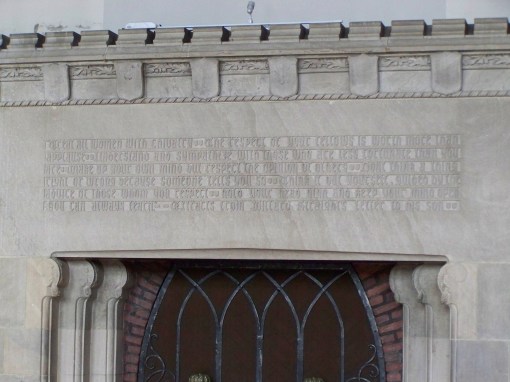
EDIT: So WordPress hates large photos. It says “Treat all women with chivalry** The respect of your fellows is worth more than applause** Understand and sympathise with those who are less fortunate than you are ** Make up your own mind but respect the opinions of others ** Don’t think a thing right or wrong just because someone tells you so ** Think it out yourself, guided by the advice of those whome you respect ** Hold your head high and your mind open, you can always learn ** Extracts from Willard Straight’s letter to his son


[1]http://74.125.113.132/search?q=cache:u79OrjoFVGkJ:en.wikipedia.org/wiki/Willard_Straight_Hall+willard+straight+hall&cd=1&hl=en&ct=clnk&gl=us


News Tidbits 9/19/09: Stocking Hall’s Long Awaited Reconstruction is Approved — Dairy Plant to Shut Down

19 09 2009

The Dairy Bar as we know it will soon be no more. According to Cornell, the new Stocking Hall will start construction next September. The $105 million project will last approximately four years (meaning that no current student will see it through to its full fruition while an undergrad…probably not even the kids in the class of 2014). The project calls for tearing down the east portion of the building and building a new glass-fronted modernist four-story structure. The older portion of the building (the part that actually looks attractive) will be refurbished. In the meanwhile, the Dairy Bar will temporarily be moved to Trillium while construction is in progress.

The project was originally slated to begin this year, but was pushed back amid concerns with state budget cuts (i.e. lass money allocated to CALS programs) and adequate funding for the project.

MINOR UPDATE: I think this is the first time I ever heard the project come up in a fraternity meeting, but it was announced at the end of the meeting with the same tone one would expect to hear that Christmas has been cancelled until 2014. I have underestimated people’s love of the Dairy Bar. I also did not account for the fact that Cornell is laying off all Cornell Dairy employees.

***

http://www.news.cornell.edu/stories/Sept09/StockingHall.html

CALS plans major renovation of Stocking Hall

With $105 million from the State University Construction Fund, Cornell’s College of Agriculture and Life Sciences (CALS) will build a new four-story building to replace Stocking Hall’s “runway” and refurbish Stocking Hall, starting September 2010, to give the Department of Food Science and the landmark Cornell Dairy Bar state-of-the art homes.

The innovative design — including a glass-fronted Dairy Bar and dairy plant and ground-floor laboratories for wine production and sensory studies of food — will invite the public to learn more about food and dairy processing. From an observational balcony above the Dairy Plant, visitors will have a bird’s-eye view as Cornell ice cream, milk, pudding and yogurt move from processing to pasteurization to packaging.

The four-year project calls for demolishing and rebuilding the middle “runway” portion of Stocking Hall, the Dairy Bar and dairy plant along Tower Road with the new four-story building; the Stocking Hall “tower” on Wing Drive will be refurbished. The more modern Food Science Lab, at Tower and Judd Falls roads, will operate as a food processing research facility while reconstruction occurs.

Stocking Hall, which dates to 1923, will be outfitted with new laboratories for the study of connections between foods and human health, food safety, and food and biomaterial processing. Other highlights include a campus teaching winery and crush pad for viticulture and enology students, and modern classrooms and networked meeting spaces.

“The Stocking Hall renovation project presents a timely opportunity for Cornell’s nationally top-ranked food science program to provide the campus and Ithaca communities with a better understanding of how food moves from the field to the marketplace,” said Kathryn Boor, food science chair. “Citizens around the globe are increasingly interested in where their food comes from and how it is handled, processed and marketed.”

Boor said the overhaul would improve research and extension directed at dairy and food processors, and expand training for inspectors from the New York Department of Agriculture and Markets, as well as state-authorized certified milk inspectors. A modernized facility will also allow CALS to compete for more food safety, quality and processing research funds from federal and state agencies and private companies.

“Because our program conducts research and outreach aimed at improving dairy product quality and safety and wine quality, this renovation project will directly contribute to improving the viability of the New York dairy and wine industries, which are typified by family-owned and -operated businesses,” Boor said.

The Dairy Plant’s ice cream freezer, outdated tanks and pasteurization equipment will be replaced with computer-controlled machinery capable of transmitting data directly from the floor of the plant to the Web for access by employees, researchers and students.

“The redesign of Stocking Hall will make our day-to-day operations more efficient, allowing us more time and resources to focus on our core mission of supporting teaching, research and extension,” said Jason Huck, general manager of the Dairy Plant.

Next summer, the Cornell Dairy Bar will move to a temporary scooping station in Kennedy Hall’s Trillium Express to make way for construction. Once the first phase of construction is complete in 2013, the iconic Dairy Bar will reopen in Stocking Hall with a revived look and an expanded menu and seating.

Each year, the dairy processes 1.5 million pounds of raw milk from cows at the Cornell Dairy Teaching and Research Center in Harford, N.Y. It produces 140,000 gallons of milk, 20,000 gallons of ice cream, and 4,000 gallons of yogurt and pudding annually. About 80 percent of these products are featured at Cornell Dining locations, while the remainder is distributed to Cornell group houses and departments.

***

Dear Food Science Faculty, Staff and Students,

With the Stocking Hall renovation project entering the last third of the design phase, and with project time lines becoming firm, we are beginning to prepare for ground-breaking for our new building, now less than 12 months away.

The fact is that the current Dairy Bar and Dairy Plant stand in the direct path of a wrecking ball.  In September 2010, the building in which these operations reside will be razed to make room for a new, state-of-the-art Food Science building. The finished renovation project will reveal a new dairy research and manufacturing facility as well as a new food service facility that will serve Cornell Dairy ice cream and more.
Together with CALS senior leadership, the Food Science Department has developed plans for continuing our core teaching, research and outreach programs during the renovation period.  As you know, the Dairy Operations is an integral component of our Food Science program, contributing to undergraduate and graduate instruction in food science; to basic and applied dairy foods research; to public service through extension programs; and as a designated training facility for New York State Certified Milk Inspectors, the New York State Department of Agriculture and Market Inspectors, and the dairy industry.  In addition, the Cornell Dairy supports many other academic programs (including many College of Engineering courses) and serves as an icon to much of the Cornell community, old and new, in Ithaca and beyond.

Due to budgetary constraints, it is not feasible nor practical to construct an interim dairy manufacturing plant or Dairy Bar during the renovation period. Therefore, we are facing at least 3-4 years from the time when demolition starts until we have a new dairy plant and food service operation up and running.  Specifically, as of June 18th, 2010, the Dairy Bar in Stocking Hall will close its doors and the Dairy Plant in Stocking Hall will eliminate its manufacturing operations.  The staff positions associated with these operations will also end, and those holding these positions will be laid off.

Although it is more than 9 months until the Dairy Bar and Dairy Plant activities will be directly affected by the renovation project, it is our intent to openly communicate the future direction of the Dairy Operations to our entire team and to the community. Our goal is to provide our staff with appropriate resources and support. The Department and CALS Human Resources will assist our staff through this difficult transition.

As our department embarks on a challenging period of change and uncertainty in the face of hope for a better future, our vision is to provide long-term sustainability to our dairy foods research and outreach program within CALS.  We believe that we’re moving in that direction, but it will come at considerable cost to our team.  We appreciate your assistance in helping us to support our staff and our program through this challenging and emotionally difficult period.
Please do not hesitate to let me, Matt Stratton or Jason Huck know if you have any questions about our situation.

Sincerely,

~~~


The Keyword Bar VI

7 09 2009
 100_1281

Yeah, I’ve been lax about updating lately. I have some things in queue, but I also have research going on, so things are a little hectic. Naturally I’m turning to my favorite cop-out of fielding responses to some of the search entries that have led people to the entries in this blog.

1. “alpha gamma cornell” (9/5/09)

This could be in reference to a fraternity or defunct sorority that the individual failed to incluse the whole name of, or it could be a reference to the research report “Hazed and Confused” by Adam Zwecker [1]. In Zwecker’s report of hazing within the Greek system of Cornell, he uses the psuedonym “Alpha Gamma (Phi)” in reference to a house that he was pledging that committed a series of hazing violations in flagrant disregard of system and campus policies. Rumor mill tends to associate the psuedonym with two or three different houses, and the actual house was reported to have been reorganized after the report to remove such dangerous activities.  I’ve heard the report used more than once as a reason why Cornell students avoid becoming part of the Greek system, which is unfortunate but I can definitely see the reasoning behind their decision.

2. “tke blackballed from lehigh” (9/4/09)

This one is interesting not because of who it deals with, but the term “blackballing”.  According to the fountain of information that is Wikipedia [2], blackballing is a rejection technique used in elections to decline membership in fraternities and gentlemen’s clubs. Typically, in Greek orgainzations, some method similar to blackballing or dinging is used to decline membership to potentially undesirable candidates. The name hails from the black balls used to signify opposition in elections in the fraternal orders of days long past.

Since the IFC at Cornell has made use in the recent past of an electronic system to keep in track of rushees visiting houses during Rush Week, and that the site includes the capability to record comments on these individuals submitted by houses, a person could be blackballed not just from a house, but from most/all Cornell fraternities if the comments are strongly negative. I imagine that would take an outstanding showing of stupidity.

3. “ithaca cornell share frat scene” (9/3/09)

I’m going to take this as a a question regarding whether Ithaca College and Cornell have uniform membership in greek houses. The answer is no for IFC and PanHel. Ithaca College banned Greek Life in 1980, and while there may be some underground groups, they operate separately from Cornell chapters. However, MGLC has found a way around this by creating “citywide chapters” which draw members from multiple colleges in the same geographic area. I’m aware of at least one MGLC sorority that has roughly half of its members from Cornell and half from Ithaca College. The legitimacy of these organizations with regards to Cornell’s greek affairs alone is debatable, but since most MGLC organizations are quite small, it probably doesn’t come up very often.

4. “three side dormitory cornell”  (8/30/09)

Donlon, but technically not correct, since it actually has six exterior sides. It’s just that the three curved sides are much more prominent.

100_1603 
Photo Courtesy of Cornell Facilities

Mary Donlon Hall was completed in 1961 as an all women’s dormitory, the last of the all women’s to be built on north campus before it went co-ed [3]. Mary Donlon Alger (class of 1915) was a prominent federal judge who served on the Board of Trustees for 29 years [4].

5.  “maximum building height town of ithaca”

Really depends on the zoning, but most residential zoning only allows a maximum height of 36 feet before a zoning variance is required. The two current projects beofre the board fall below that though; a 106-unit townhouse development by Holochuck Homes off of Route 96, and a 13-unit housing development called Cleveland Estates that will be south of Ithaca College off of Danby Road. The townhouse units might see some trouble because of traffic concerns and opposition to what the West Hill community feels would be an increase in crime if the housing is “affordable” (believe it or not, this is a leigitimate concern. The 128-unit Overlook at West Hill development has been plagued with what neighborhood residents feel are unreasonably high crime rates [5]). The town is looking into a moratorium on West Hill, which would effectively kill the proposal.

According to the West Hill Civic Association, this is the list of proposed and potentially developable properties that are under study:


1. Carrowmoor, 400 units, commercial space

2. Conifer (Linderman Builders), 100 more units (this is in addition to the 180 or so units already in place)

3. Holochuck Development, 106 units near hospital

4. Cornell Parcels, 33 acres off Trumansburg road

–Assisted care interested, 50 units of senior housing, (probably similar to Alterra)

–nothing formal before town

5. Land that can be developed, nothing set yet, Medical Center parcel

Tompkins County

6. Property off Bundy Rd. (67 acres)

7. Perry Farm (60 acres)

8.Kaderli Trade Inc. (100 acres)

9. Eco Village 3rd Neighborhood


***

[1]http://www.ilr.cornell.edu/smithers/docs/hazed_and_confused.pdf

[2]http://en.wikipedia.org/wiki/Blackballing

[3]http://www.fs.cornell.edu/fs/facinfo/fs_facilinfo.cfm?facil_cd=3026

[4]http://en.wikipedia.org/wiki/Mary_Donlon_Alger

[5]http://www.theithacajournal.com/apps/pbcs.dll/article?AID=/20090808/NEWS01/908080343


News Tidbits 8/21/09: Dumb Frat Tricks

22 08 2009

100_1703

The house involved is Sigma Nu, off Willard Way near West Campus. Apparently, firefighters found a small pot-growing operation while investigating a busted water pipe. I would not be surprised if sanctions from their national or from the IFC are put in place against Sigma Nu as a result of this incident, as it is rather embarrassing for the Greek community (personally, I think it makes Sig Nu look like a bunch of dim bulbs).

ITHACA — A busted water pipe may lead to a drug bust after the discovery of a small marijuana-growing operation inside a Cornell University fraternity house.

The Sigma Nu house manager called firefighters about the broken water pipe on the second floor, Ithaca fire officials said. Firefighters contacted the Ithaca Police when they found the plants.

 Ithaca firefighters found a half-dozen marijuana plants Tuesday afternoon while investigating a broken water pipe at the Sigma Nu fraternity house on Willard Way, Ithaca Police officials said. Officers seized the plants and though they’ve identified a person of interest, they aren’t releasing his name. 

 Water was running through the ceiling, they explained, and in the process of assessing the damage, firefighters found the plants in a tin-foil lined closet, surrounded on all sides and angles by several high-intensity lights. 

Whoever was growing the plants will likely be charged with unlawful growing of cannabis, a misdemeanor, police said. Fire officials said the numerous electrical cords used to power the lights created a fire hazard.

The leaking pipe was part of the sprinkler system and had to be shut down for repairs, Ithaca Building Department officials said. Additional life and safety issues such as a defective smoke and fire detection system and missing exit signs were found, so they posted the house on Tuesday and told everyone to leave until the problems could be fixed, they added.

Bobby Quintal, a member of the fraternity’s executive committee and last year’s president, said the chapter housed members in local hotels and other campus fraternities donated space while contractors fixed the problems.

Friday evening, Ithaca Building Department officials said that the house would likely be safe and ready to be reoccupied later that night.

Quintal said he isn’t living at the house and has no knowledge of the marijuana found there, but that marijuana possession violates Sigma Nu fraternity rules. When rules are violated, the national chapter investigates and might sanction the local chapter, the fraternity member or both, depending on the outcome of their investigation.

http://www.theithacajournal.com/article/20090822/NEWS01/308220004/Busted-water-pipe-in-Cornell-frat-house-leads-to-marijuana-find&referrer=FRONTPAGECAROUSEL

//


Cornell Criticism

12 08 2009

100_3851


What inspired this post were the none-too-charming rankings released recently by Forbes on their “Best Colleges” list [1]. The article itself wasn’t the trigger, but the comments, however…

Where’s Cornell? Where it belongs, behind a lot of small LAC’s where teaching undergrads is actually a priority.”

“…another thing I considered: Cornell has one of the highest suicide rates of all colleges/universities in the U.S. actually, at one point, it was the highest…”

(not true according to the New York Times, but that’s beating a dead horse…)

Now, I could really care less about overall school rankings. Cornell is one of top-rated schools in my field of study, so that’s about the only ranking I ever cared to know. But, there’s a little bit of dark humor to be found in the lengths that people will go to criticize other institutions.

Cornell, of course, is not new to criticism.  The school was maligned in its early years for being co-ed, for not having a religious affiliation, and for some faculty that ran dangerously awry from the norms of the time (one of which included a professor that was an atheist, which in the religiously driven nineteenth century was truly shocking and tabloid worthy). Even today, remarks of “SUNY Ithaca” and “the safety school of the Ivies” still manage to bother some of our thinner-skinned students and alumni. Read Ivygate’s comment section for examples [2].

In the early 1940s, there was “The Dilling Affair”. A student by the name of Kirkpatrick Dilling was brought before the Student Conduct committee and put on parole for engaging in stunts such as blowing dormitory fuses and filling ceiling lights with water. Well, his parents were extreme right-wingers who were convinced that their son was put on parole due to the committee’s underlying communism. Mrs. Dilling came to Ithaca, launched her own investigation, and published a scathering magazine report detailing how the reds has infiltrated the institution from President E. E. Day down. (Bishop, 568)

Sometimes, Cornellians are their own worst enemies. Consider the little feud between Ann Coulter and Keith Olbermann earlier this year. For anyone who wasn’t living under a rock, Metaezra has the full story [3], so I’ll take the liberty of abridging the drama. Coulter, a bastion of invective conservatism, made the remark that liberal mouthpiece Keith Olbermann didn’t go to the same Cornell, but rather state school Cornell (CALS). Most of us who went to Cornell, while aware of the difference (and that the only significant differences between them are source of funding and in-state tuition), but also know that criticism is about as bad an idea as sticking a knife in an electrical socket. But, Olbermann responded back by showing off his diploma on air and bragging about his Cornell degree, Coulter just had to respond back, and the catfight resulting in nothing more than embarassing just about everyone else who ever went to school far above Cayuga’s waters. 

Here’s some of my favorites – building criticisms, as recorded from respondents in the Cornell Alumni News:

Sibley Dome – “the breast of campus”

Rockefeller Hall – “public grammar school No .16”

Baker Lab – “A U.S. Post Office Conferred by a Republican administration”

Olin Hall – “might suit a department of alchemy better than chemical engineering”

…and that was before the sixties and seventies rolled around. The aesthetic critics must be rolling in their graves.

I s’pose Cornellians are their own worst enemies. To quote one more commenter from Forbes:

Wow! A lot of references to Cornell in these comments! As a Cornell graduate, I see that “complex” is still there for many Cornellians.

[1]http://www.forbes.com/lists/2009/94/colleges-09_Americas-Best-Colleges_Rank.html

[2]http://www.ivygateblog.com/2009/03/cornell-fan-admits-cornell-does-not-belong-in-the-ivy-league/#comments

[3]http://www.metaezra.com/archive/2009/03/ann_coulter_is_an_idiot.shtml


News Tidbits 8/1/09: Edelman Realty Puts Sorority House on the Market

2 08 2009

http://aedelman.com/search.php?mls=129820&startat=20&price1=&price2=&area=&elemsch=&school_district=&new=1&luxury=

Realtor Description:
Own a piece of Cornell History. Delta Phi Epsilon Sorority is an arts & crafts style stone & stucco building on The Knoll. Built circa 1915 with up-to-date sprinkler, fire alarm & other safety systems. Compliant w/all inspection by the City and Fire Department. Living room, chapter room, paneled dining rm, commercial kitchen. 15 rooms for up to 25 occupants.There is an also a one bedroom two-story caretaker’s cottage with a separate driveway. Approximately 18 parking spaces+driveway to cottage.

The house’s list price is $795,000. Technically, the property has two units, the second being the small building in the second photo (both of these photos are from the listing).

100_1359

Personally, I think my photo is more flattering.


Devil’s in the Details: Fraternity GPAs

16 07 2009


Since this is one of the more clicked-upon data sets on this blog, I figured I would include the latest update: Fraternity House GPAs.

sp09acagreek


So, let’s see what we can pick out concretely from the data:

1. In the fall, Pi Kappa Phi had the highest average GPA, and Sigma Alpha Mu took the academic crown this past spring. 

2. Number of IFC members: 2220. Number of organizations in IFC: 42. Number of people per house: about 53 on average (52.8). The largest IFC house is Sigma Alpha Epsilon with 91 members, and the smallest is Sigma Chi Delta with 12 members. Perhaps unsurpringly, Sigma Alpha Epsilon also saw the largest increase from fall to spring, adding 27 members, and Lambda Chi Alpha (26) and Theta Delta Chi (25) also posted large membership gains (I had been hearing about Theta Delta Chi’s big success since February).

3. The recently reinstated Theta Xi and Kappa Alpha Society continue to eke out a small but notable presence beside larger houses. I hope they continue to thrive.

4. Statistically, the MGLC members have lower GPAs. The average MGLC GPA is about 2.993, and only one organization, Pi Delta Psi, is in the top half of the general fraternal body academic list. Historically black fraternities fare much worse, averaging about 2.73. This data is only readily apparent when pulled from the rest of the values.

Here’s some thoughts:

A. Considering the IFC’s big push for higher GPAs within houses (epsecially during pledging), one imagines that the drop in GPA during the spring will not be looked upon kindly when members reconvene in the fall.

B. The MGLC’s academics are lacking. An average of only 2.99? Only would be acceptable if they were all engineering students.

C. Assuming about 6850 male undergrads (assuming a school that’s half male and has 13,700 students in total), fraternity membership rate approximately stands at 33.99%. However, since two of the house are co-ed, we’ll assume that they’re half-and-half and take off accordingly (-33), reducing our percentage to 33.50%.