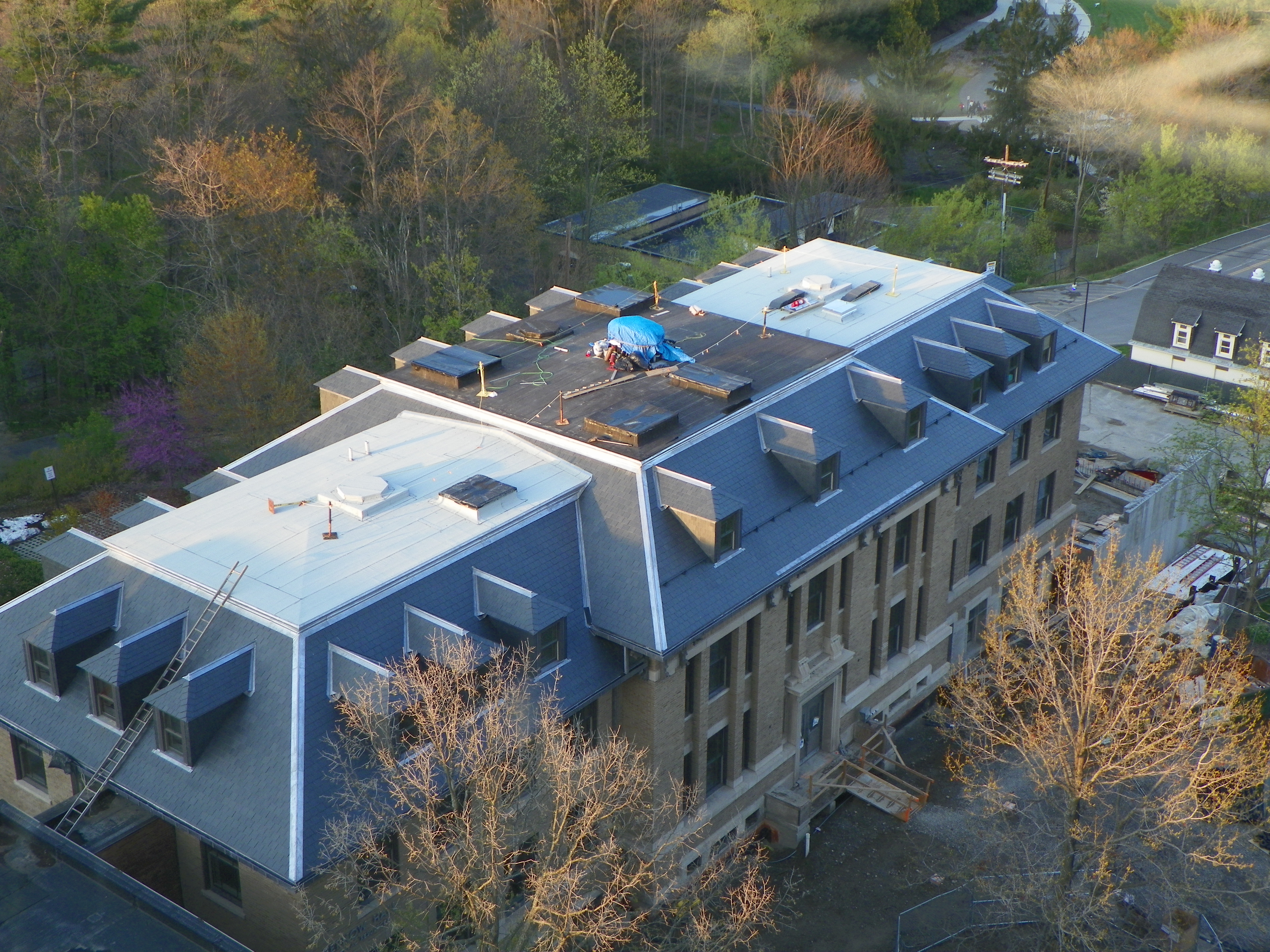
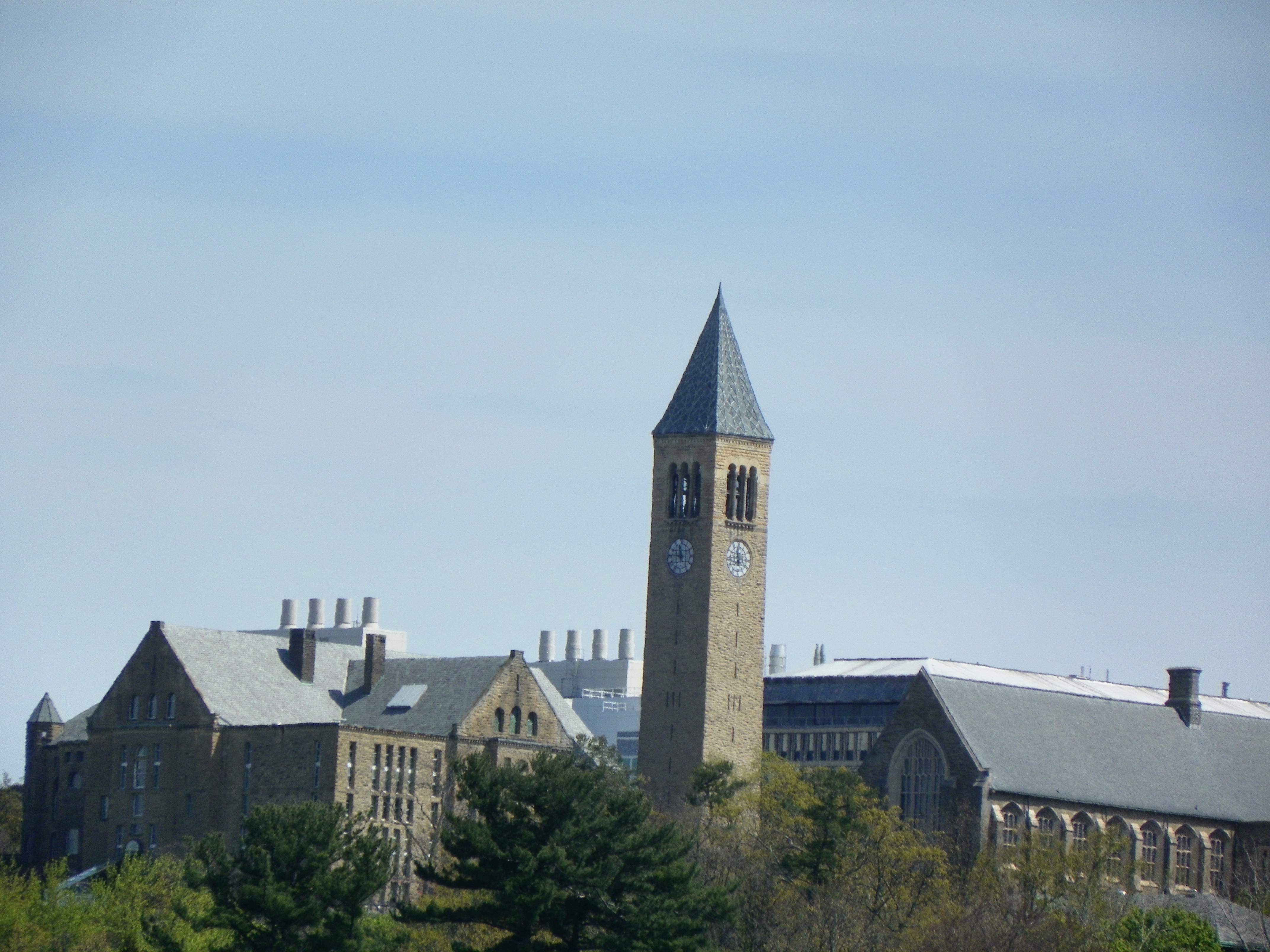
End-of-Summer Construction Update, Part I

22 08 2012

I had the fortune this past weekend of being near Ithaca to attend a wedding. Deciding to kill two birds with one stone, I figured it was also a good opportunity to take photos of Ithaca’s ongoing construction. So I made the drive over and tackled as much as I could in three hours, all the while avoiding students, as if my aging is a contagious disease (mentally, this involved my brain screaming “Don’t look at me! I’m old! I was once like you, now I do quaint 20-something-year-old person things!”). Awkwardness aside, I was fairly successful in my photo tour.

The Belle Sherman Cottages project continues its prep work on the east side of on the edge of the city. The model house is complete and the roads have been laid. Despite the rather high prices, a casual inspection shows that at least two of the lots have been sold. In keeping with the theme of traditional streets, the street has been named “Walnut Street”, which is an interesting choice, since walnut trees can only grow in the moderated climate of the lake shore in these parts (same goes for peaches).

Phase II of the Coal Yard Apartments is complete. This phase brings to market 25 units, and ~40 beds.
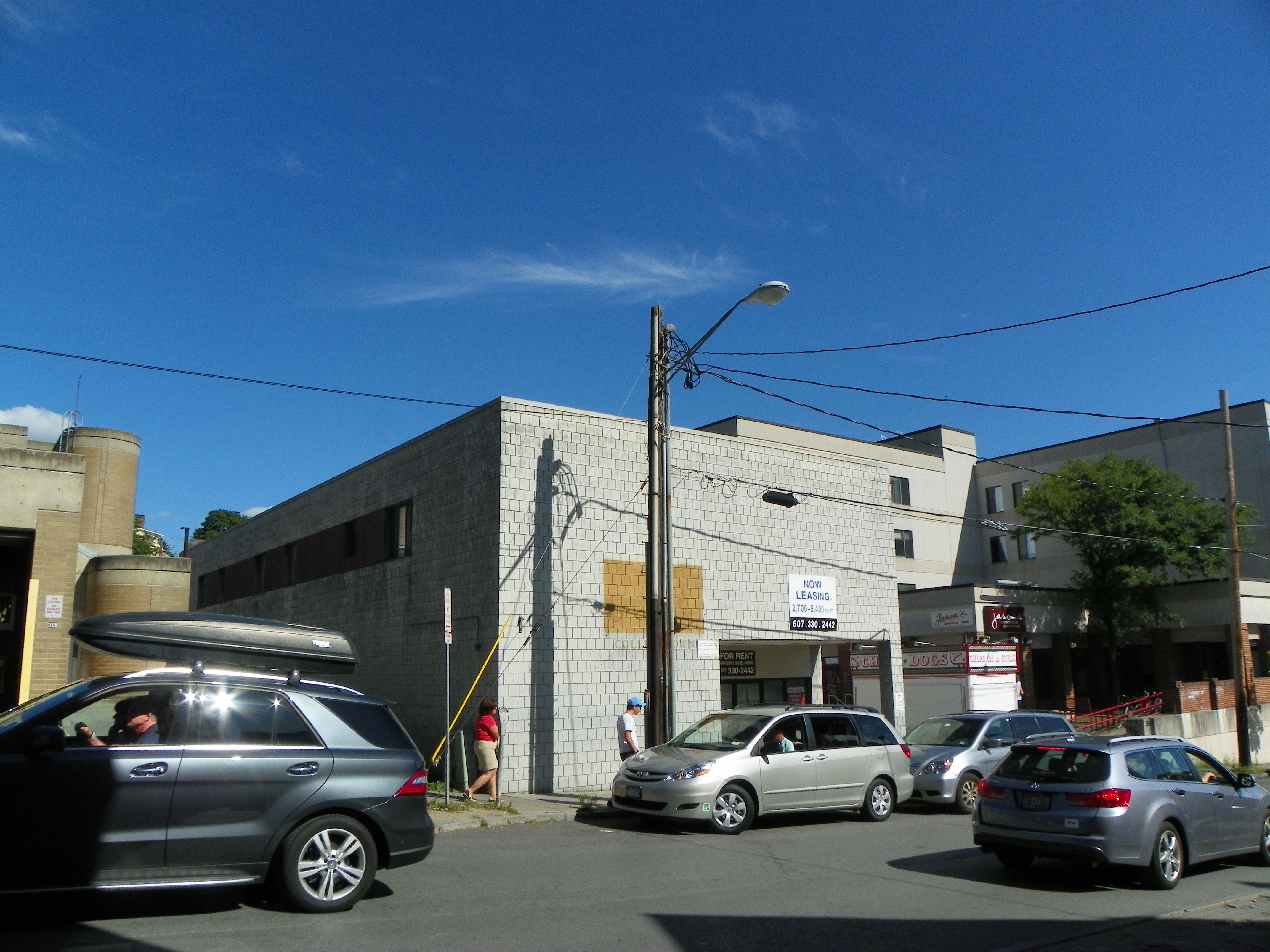
Josh Lower’s Project (Collegetown Crossing) is tied up in red tape as it seeks a very generous parking variance. Meanwhile, the current building sits underutilized, and somewhat barren. Rather disturbingly, this was a trend around much of Collegetown, with many old storefronts, such as Mama T’s and CTP, having closed their doors. It gave the entire area a derelict, ghetto quality. Not to mention some of the houses and their treatment, which I’ll cover in a future entry.

The townhouses at 107 Cook have had their framework completed. As you might recall, 107 Cook was the site of a deadly house fire in May of 2011.

On a brighter note, 309 Eddy is complete. The building replaces a 3-story apartment house, and has 24 units with 41 beds. The building is tall enough to make an impact on the Collegetown skyline as seen from other parts of the city.

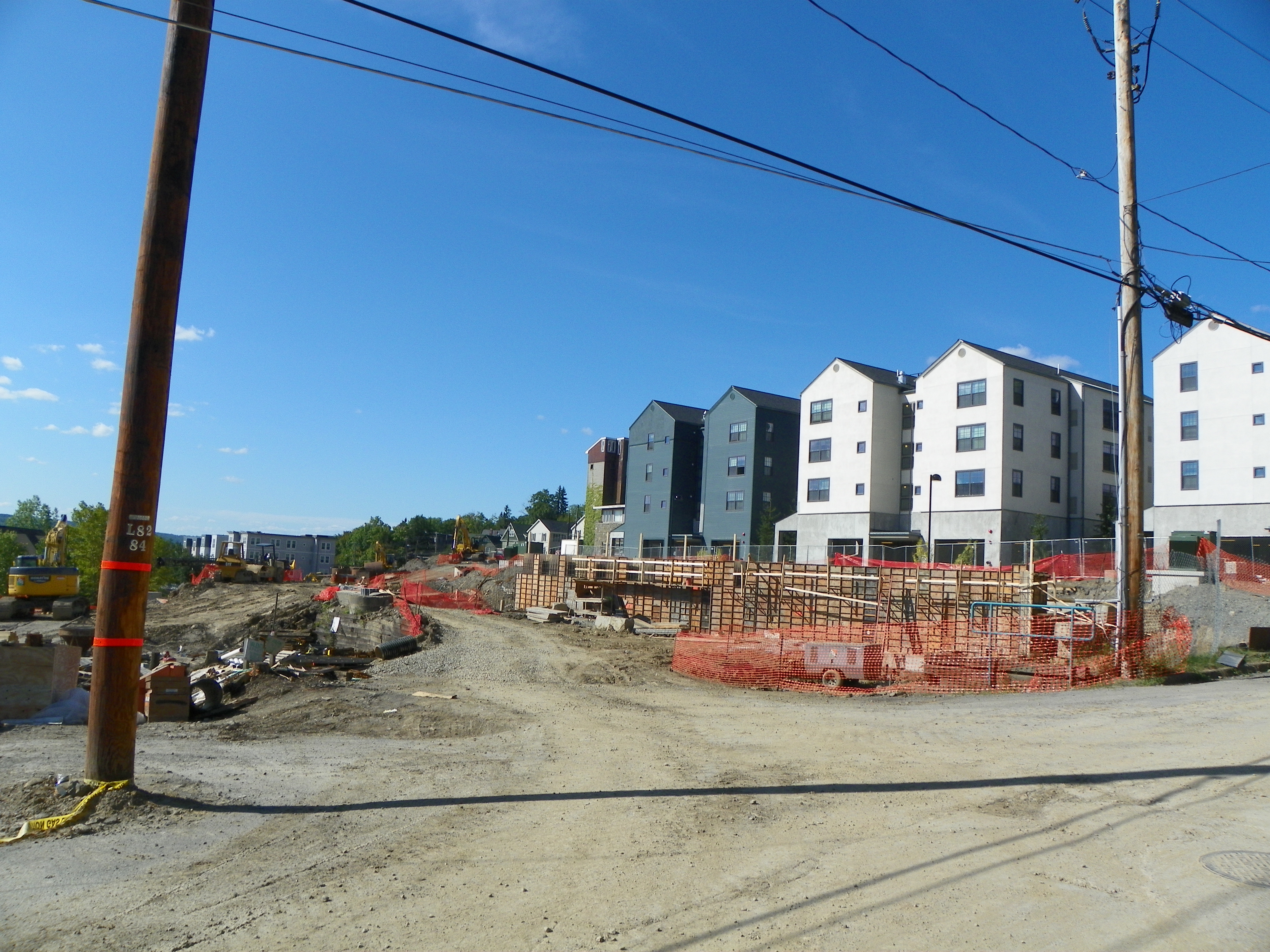
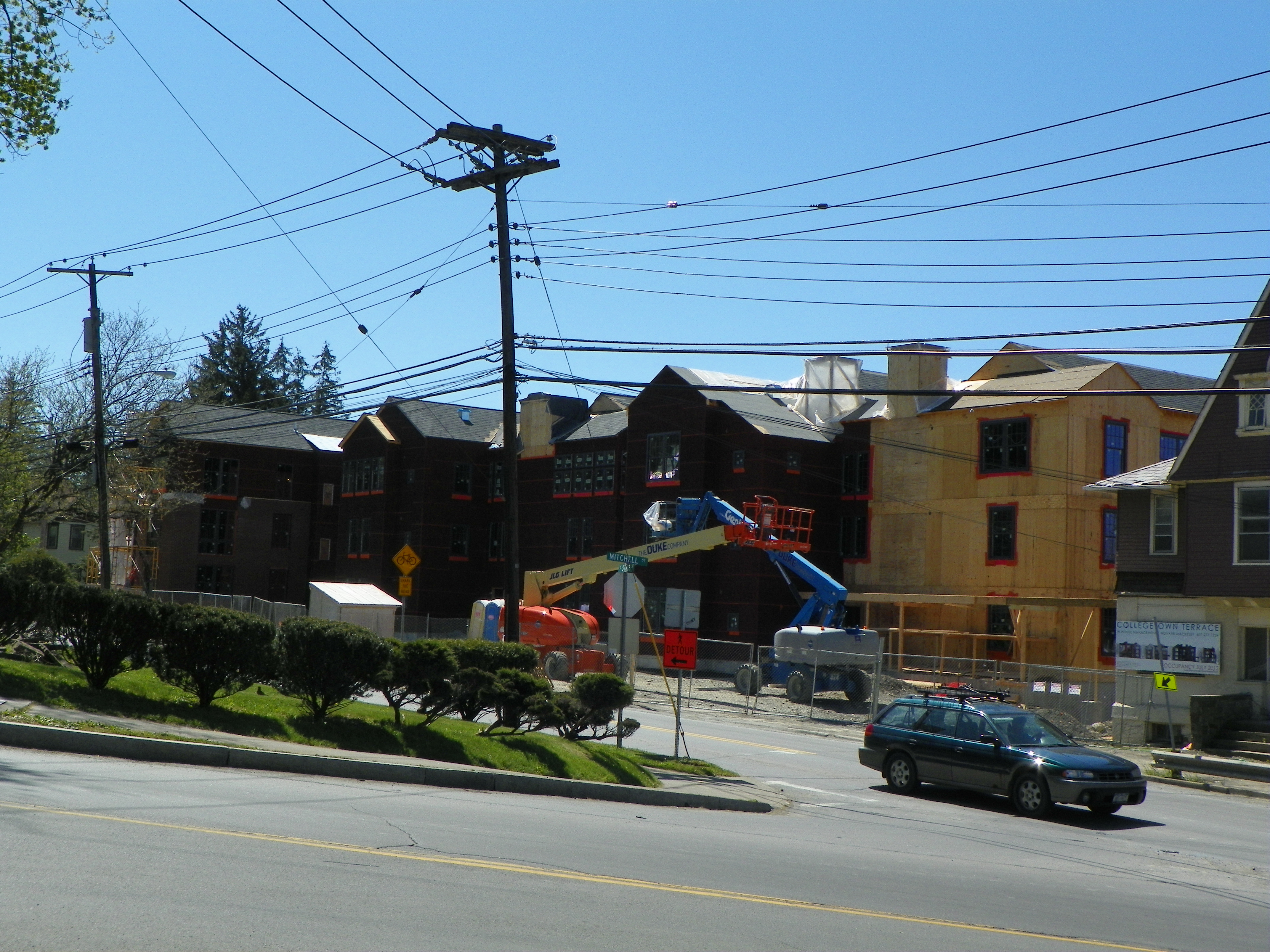
…and this image is a clue that Ithaca and the electrical authorities that be should consider burying the power lines under the street. Seriously.

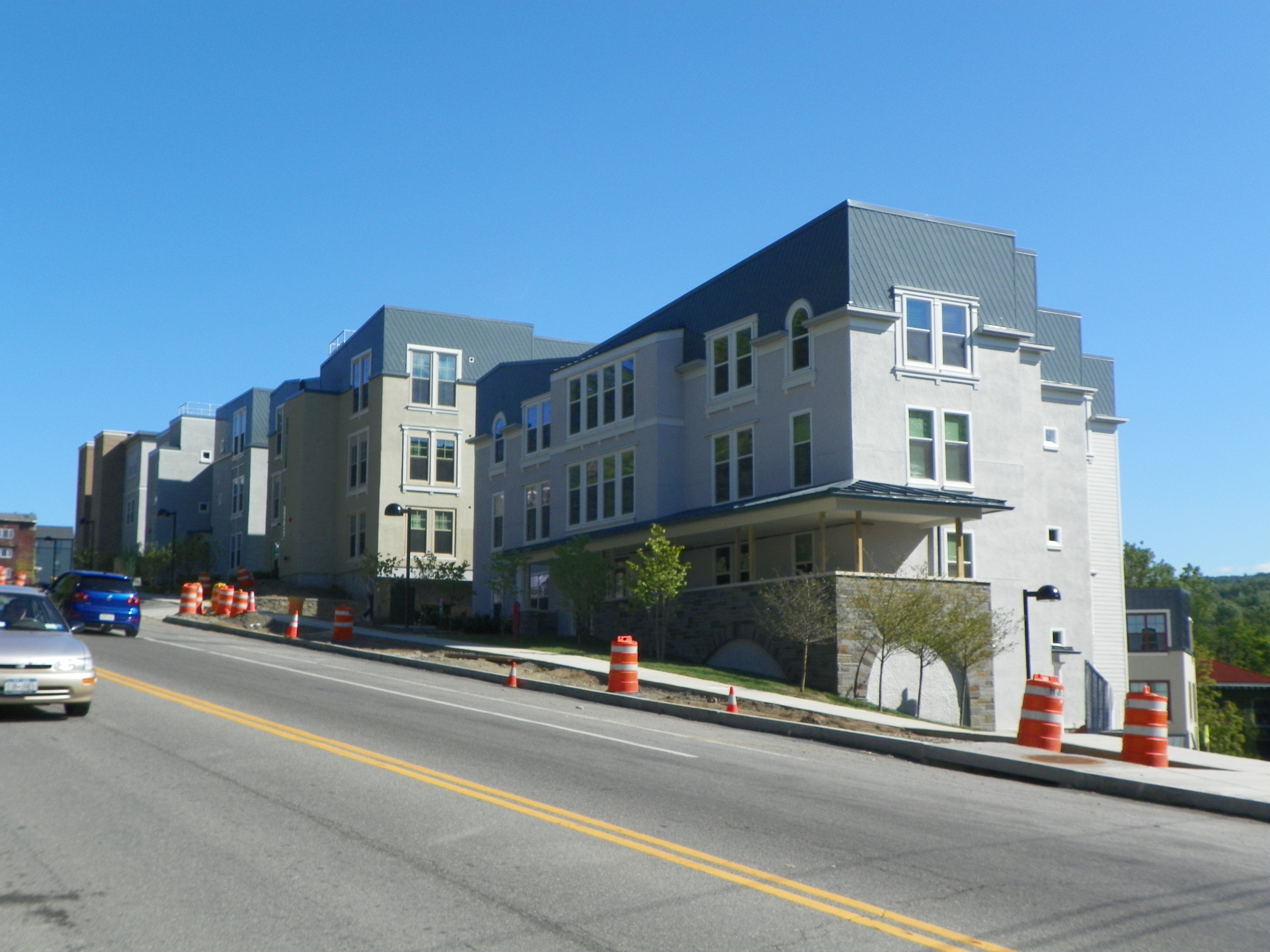
The massive Collegetown Terrace project by Novarr-Mackesey. In Phase I, which was just completed, eight buildings were built (seven on East State, one on N. Quarry). This amounts to about 1/5th of the projects intended 1250 or so bedrooms. Parking is generally under the building on concrete stilts, which is bad in earthquake regions, but I suppose it works for seismically-inactive Ithaca. Some of the current buildings, such as the Delano House and the Valentine Apartments, are still standing and rented, waiting to be torn down in a later phase (III, I imagine). The Williams House is not yet renovated, serving as the site office while building continues. By my guess, building “3” from the development plans is Phase II, and is one of the long wavy buildings, specifically the one that sits closest to East State. Phase II is underway for a completion next summer, with phase III (the final phase) being completed in the summer of 2014. I suspect at that time, we’ll be hearing significant news about whatever N-M has proposed for all the properties they bought on the Palms block of Dryden Avenue – I expect something substantial, a la Collegetown Plaza.

Redevelopment of this mostly derelict and empty block would be a blessing at this point.

So, trying to break up my update into manageable chunks here (since the tech format here isn’t keen on photo-laden posts), I’ll post the rest of Ithaca and Cornell’s Campus later in the week.

News Tidbits 8/17/2012: The Tax Argument

17 08 2012

I held off on this entry for a few days. Not because I was particularly low on time, but because I was waiting for the latest planning board project review minutes to come out, to see if there was anything newsworthy (and pretty much everything on there was minor, or I’ve already covered it, so…nope, nothing newsworthy). So I’m going to take a closer look at an article recently posted by the Ithaca Journal.

It was noted that the Collegetown Terrace (aka the giant hard hat-bedecked property south of State Street between Quarry and Valentine) is quite the tax revenue generator for the county. Now, here’s some of their numbers: The initial properties on the land, small apartment buildings and single-family homes (~29 total), were valued at $19,143,000, which would (by my calculation) generate taxes of around $700,000 per year. Just under half of that would go to the school district, with a little more than one-third (~35%) going to the city coffers, and the rest to the county. The partially-built property, as it was assessed in March, was assessed at $526,800, according to the IJ, with a property value of $14,430,000.

Now let’s keep in mind two things. The property wasn’t even finished, and finished properties garner much more in taxes; and the property is being developed in three phases, with the currently assessed phase counting for just 18 percent of that.

It would be hard for me to say what the value of the finished property is, so let’s conservatively go for 20% greater than the current value, for the sake of this exercise. That gives $17.32 million. Now let’s apply that to the developed project, 100% complete: ([100/18] * 17.316=) $96.2 million. Five times its former value before the property was sold. If taxes are kept the same, that would be a tax bill of about $3.5 million. And for the city, an extra $1 million in cash would go a long way, since the annual revenue is about $61.5 million. An extra million is equivalent to the amount Cornell pays annually in its PILOT agreement with the city.

It would not be out of place to think, “oh, but with the slow rate of growth, this is just cannibalizing other local properties”. To some extent, yes. But these are properties that have a very captive market, namely, 20,000+ Cornell students. The landlords that will be hurting the most will be those with properties furthest from campus, of which a good chunk of that hinterland lies outside city limits, in the neighboring town of Ithaca, or Lansing. In my mind, the biggest concern will be if this project pulls grad and professional students away from downtown and Fall Creek, but I imagine the effect will be minor, all things considered (most notably, because if apartments in this place are going for $1,000+ per month, then that $600 one bedroom in Fall Creek is still going to appeal to a lot of folks with tighter purse strings).

In conclusion, I think that if a developer approaches the city regarding new student housing in the Collegetown area, they’ll have a powerful card in there hand – the tax argument. I’ll be curious to see if Novarr-Mackesey mentions it when they release their proposal for the Palms property and its neighbors along the 200 block of Dryden Road.


Because When I Screw Up, I Go For the Gold

11 08 2012

A little while back, I vented about how the Cayuga Place Condos appeared to be a plain glass box. Based off all the data I had in front of me, it appeared that it was. The (small) images from the IJ gave the impression of one unbroken facade.

Well, I was casually glancing at the city website this afternoon, looking at the city’s IURA minutes out of curiosity, and I realized I made a tremendous mistake. One that merits its own new entry, it was that impressive of a screw up.

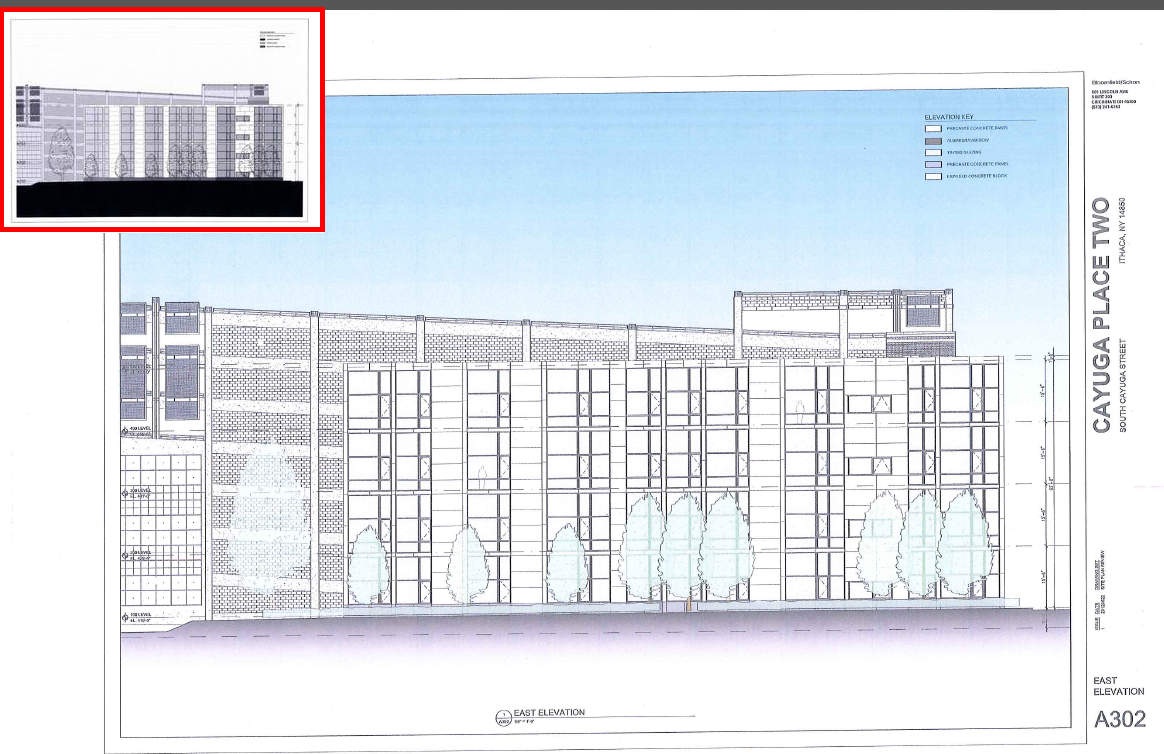
To illustrate my failure, I include the image from the IJ, plus the image from the IURA agenda (posted July 26th, 8 days after my rant):

Note that when you blow up the image to full size, that is the the native resolution of the IJ file in the upper left. 300×206 pixels. The side profile image that was also used in the news article is the elevation looking south – as it happens to be, the thick side of the building.

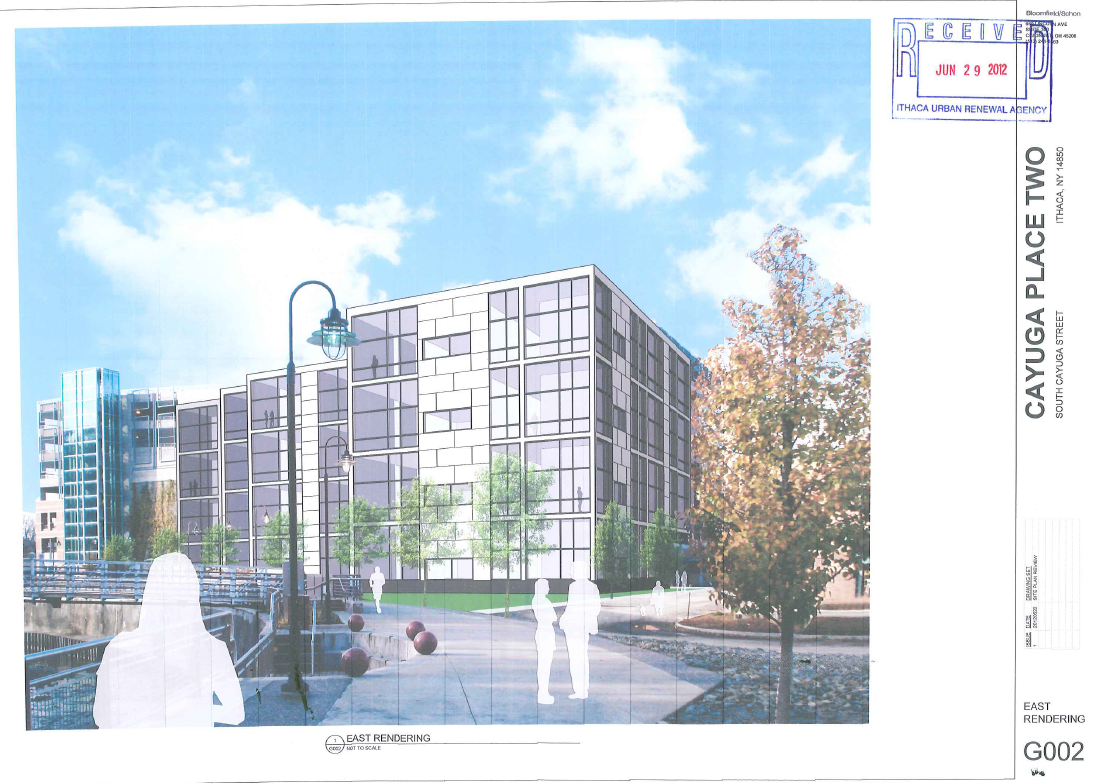
So, imagine my surprise and embarrassment when I see this:

This is not so different from the third incarnation as I thought it was. In my defense, given the images used in the article, I was mislead. Had I checked the city documents between July 26th and today, I would’ve caught the error sooner. As a result of my oversight, some of my criticisms about it being a featureless glass box, and the developer taking the cheap way out, were unmerited. It remains shorter than the previous version, so the parking garage looming over it remains an issue. But otherwise, it’s not tremendously different, or worse. My apologies to anyone who was mislead. So excuse me while I go and eat some crow.

For what it’s worth, the project has been approved for extension and is on its way to final site approval. With funding now in hand, the project may start construction sometime in the late fall.


From Suburbia, A Town Center

6 08 2012
Image Property of HOLT Architects

Image Property of HOLT Architects

Just about any reasonably-sized city in America has its suburban hinterlands – in Ithaca’s case, this is dominated by the town of Ithaca, and to a lesser extent, the towns/villages of Dryden and Lansing. Now, it would be wrong of me to address these communities like they were dominated by cul-de-sacs and power centers, since the village of Dryden, and some small hamlets, were around well before suburbanization – but they do make up a sizable proportion of developed real estate. So when those communities take steps to establish dense, walkable clusters of development, I tend to be impressed (because being satellite communities, I hold them to a lower standard).

In the town of Lansing’s case, its plans are pretty big – the town recently bought 156 acres of land to lift deed restrictions the state had placed on its development. The goal is to develop this land into a sort of “Town Center” – and not at all like the similarly named shopping mall near Syracuse.

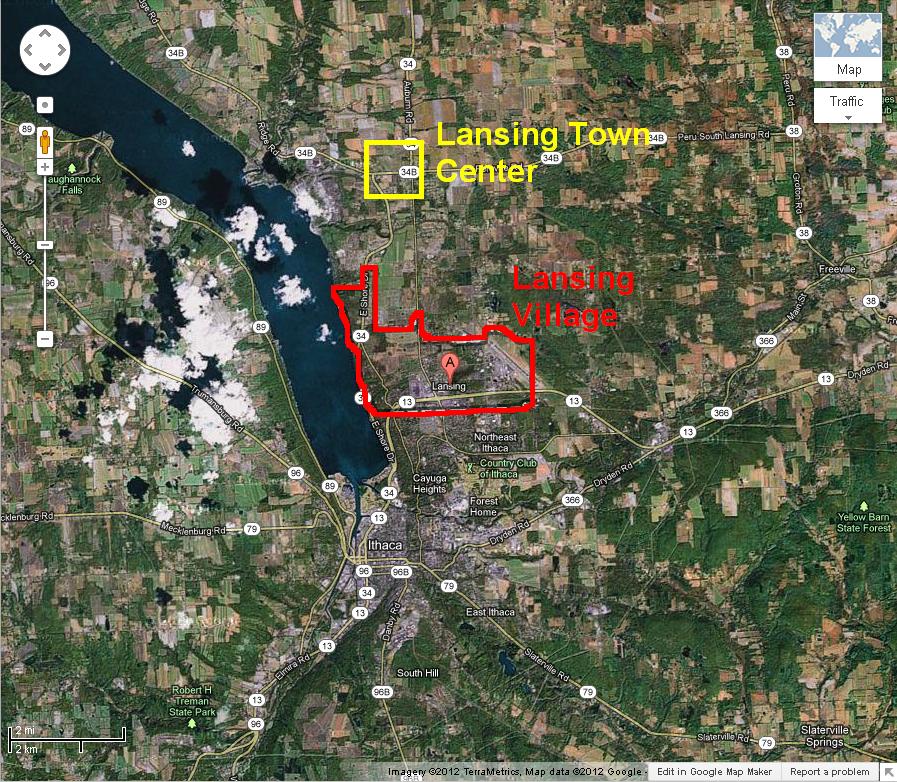
Lansing is unusual in that it never has really had a dense core, unlike Dryden (the town of Ithaca can’t be reasonably compared since it surrounds the city). The village was founded in 1974, and only includes the area from the airport west through the mall area and down to the lakeshore.

For the town center project (covered in great detail by the Lansing Star), the overarching design was created by Ithaca-based HOLT Architects, with landscaping by (also Ithaca-based) Trowbridge & Wolf. It consists of consolidated parking lots, pedestrian walks, bike paths, street beautification, and interactive landscaping (stone seating areas, etc). The area is subdivided into a large housing component, a small retail/professional area, and a business/tech complex (it would seem to me a little more interspersion of uses would be better, but I’m not a stakeholder here). So, rather than being a standard suburban build-out, an effort is being made to develop a pedestrian-friendly core.

Apparently, developers are quite interested in accessing the property. Two of the largest potential stakeholders are NRP Group and Calamar. The companies are willing to cover a large portion of the project’s road construction costs. NRP even took the step of flying Lansing officials to projects near Cleveland and Buffalo to showcase their work. Both companies are proposing senior housing complexes, one “affordable” (NRP) and one market-rate (Calamar). At least two other developments are currently proposed. The full build-out of the town center is expected to have 350,000 industrial/commercial sq feet, and 420 residential units.

There are a couple major hurdles to construction at this time – the more minor one being zoning, the more major issue being the construction of a sewer through southern Lansing. High-density housing doesn’t go well with septic tanks (nor is it permitted by the town code anyway), so the construction of a sewer to serve that area is required, and the proposal for construction is currently being refined before it is put out to vote.

The project has the potential to be a game changer – the town is on the verge of a large increase in development, with another 400+ units planned in the next several years in clustered developments outside of the town center project. As most of these will be suburban in nature, or at least vehicle-oriented, one might pessimistically look at the town center as a drop in the bucket for smart planning. But it’s certainly a step in the right direction on the way to establishing a genuine community center.


News Tidbits 8/1/2012: Because I Let Small Projects Go Under the Radar

1 08 2012

It would be wrong for me to play off the projects that I write about as being all that is going on in and around the city of Ithaca. Generally, I write about the major projects. I don’t do little projects, or I gloss over steps in major projects, mostly in an effort to maintain reader interest. However, like with many things, there’s a grey area – a project of merit, of moderate impact, that is not major enough for its own entry, but would benefit from a brief mentioning. I decided to group a few of those here.

Image Courtesy of Ithaca Times

The Ithaca Motion Picture Museum – A project in the planning stages, intended as a major renovation and addition to the old Wharton Studios building in Stewart Park, which is currently a low-use maintenance facility. The circa-1890s building is but a shell of its former glory, but a local NPO seeks to invest $3.5 million into its renovation. Fundraising is ongoing, but it will be a while before any new work breaks ground.

The town of Ithaca seeks to redevelop a parcel on West Hill into an Ecovillage type of housing development. The 25.5 acres, associated with the vacant Biggs facility near Indian Creek Road, is to be sold or leased to a private developer for a ~70-unit, mixed-use property with emphasis on green living and sustainability. The preferred area of development is closer to the Medical Center, leaving a large tree buffer on Indian Creek Road itself. The proposal runs with the assumption that a developer will actually want to agree with the town’s stipulations, although residential demand has been strong enough in recent years that it just might happen.  Bids are due in October, with a starting bid of a cool $500,000.

Property of New Earth Living LLC

On the topic of green living, four new housing units are being developed as a “pocket neighborhood” on the corner of N. Aurora and Marshall Streets (three blocks north of the William Henry Miller Inn). Three new structures will be built (a revision in design dropped the number of units from five to four), and a current house will be refurbished. The project, called the “Aurora Dwelling Circle” (an oddly befitting name for an Ithaca project) and to be built by Cosentini Construction, has been virtually approved for construction as of the last planning board meeting.

Last not, for those who like big-box strip malls – the old Cayuga Mall across 13 from the Marketplace and across Triphammer from the Shoppes @ Ithaca Mall is being renovated. The old P&C space will be converted to spaces for an Agway, Jo-Ann Fabrics and Party City, which is a whole lot of non-news since I suspect the first two are just relocating from their current Ithaca-area stores.


Cayuga Green II (Cayuga Place) Goes Downscale

18 07 2012

ED. Please note the correction posted on August 11th.

Another incarnation of the Cayuga Green Condos has been proposed. First, the IJ article (for those without subscription, the Ithaca Indy provides another summary here). Now, first off, I would like to chastise the IJ for using an old image of the project – an image pulled from Bloomfield & Schon’s website of the modified third incarnation, which I include for reference below.

This is not the current proposal.

This is not the current proposal.

Notice that this has six floors. The revised version has four. This version also had 8000 sq ft of commercial space and 35 residential units. The revised proposal (which was only available in two thumbnail links, one of which was broken) has the same commercial space and 39 units, but less space overall – from 47,400 sq ft to 42,600. According to the IJ, development costs have been estimated to be about $8.5 million for this phase of the project.

I’m not even going to nice here. The design proposed does nothing good for the architectural pride of the development company. It’s essentially a glass box, with a little concrete filler. Boring, but okay. Even if it doesn’t have balconies, or even any shape to it apart from being a big glass box (heck, the earlier design the IJ tried to mislead people with is light-years ahead of this proposal). My issue is that it doesn’t even obscure the parking garage next to it, which overwhelms the proposed structure. It’s like they said, “hey, people will pay anything to live in Ithaca, so let’s try and squeeze as many as we can into as plain of a structure as possible” (I digress, this is the mantra of many low-brow developers, but I expected better from Bloomfield & Schon). Now, the last I checked, this was marketed as a luxury project. Nothing says luxury like being dominated by a parking garage next door. It’s just…mind boggling, in terms of planning and action. Cost of development aside, I’m having trouble imagining the developer getting these modifications past the planning board.

But, they kinda have to. In order for the developers to avoid issues with special resolutions from the city, the project needed to have financing and approval secured (i.e. construction starting) by June 30 – almost a month ago. So they’re already in hot water, and apparently, someone decided to water down the design, because I guess if you’re going to get on the bad side of city government, you might as well go for the gold. The prospects for development of this building are looking rather dim.

What a way to enjoy my morning – watching the IJ wrongfully mislead people with the incorrect design, and seeing the undersized box proposed. It’s mornings like this that I feel like I need to start drinking coffee.


News Tidbits 6/13/12: “Cascadilla Landing” Makes Its Debut

13 06 2012

For those who pay any attention to Ithaca’s physical plant, news has been floated around for a while of a proposed waterfront project next to the city golf course, which in reference, was referred to as the “Johnson Boatyard Development”, after the boatyard located on the current property.

Well, in the fee-to-see Ithaca Journal this morning, renderings were shown for the proposed “Cascadilla Landing” project, which is the official name of the development. More renderings are included within a PDF from John Snyder Architects hosted on the IJ website.

I would love to share some of the images, but now that content is pay-to-play, that puts me in a much more difficult position. It was one thing to share an image up from a free online paper. But now that content is not free, the legal waters have become a bit dicier. I will say this much: click the links, visitors have a limited number of article hits before content is no longer displayed. After that, there are several other ways to get around the content wall (or you can pay). If I see them hosted (i.e. not linked) on a “free” content website, I’ll include them here. But until then…yeah. It’s unfortunate.

Following the PDF, the project has 185 units – 6 in duplexs, 11 townhomes, 168 apartments. The mid-rise apartment buildings are furthest east, with the townhomes in the middle, and three three-story duplex buildings built around the traffic circle that completes the west end of the project. Phase 1 has two buildings of 82 and 44 units respectively, in three 5-story apartment buildings, two of which are connected by a skybridge. Construction would start on Phase I in Spring 2013. The main street appears to double as an internal promenade.

As for the design, John Snyder Architects opted for angular and ultramodern. The duplexs have gable roofs and wood trim, and bear superficial similarities to the buildings going up at the 900 block portion of Collegetown Terrace. The apartment buildings are an angular pastiche of windows of all shapes and sizes and random balconies and overhangs closer to the waterfront, and a bit more orderly further into the property. The colors as shown are rather muted whites and greys. No one will ever call it pretty, but it certainly stands out from the traditional built environment. The townhome designs are not really shown, they’re likely still in the initial design process.

Ithaca’s economy hasn’t been something to be too excited about lately, but this project shows there must still be some demand to live in the City of Gorges.

EDIT 7/18/12: The city has published the images. As a result, I’m including them below:


News Tidbits 5/31/2012: New Apartments Squeezed Onto Thurston Avenue

1 06 2012

So, I’ve been waiting for this piece of news for a while, but it took a little bit of sleuthing to come up with details about a proposed project for Thurston Avenue. First, the location:

The location is a parcel next to the Rabco (Highland House) Apartments on the corner of Highland Road and Thurston Avenue. To give you a better sense of locale, its the woody, slightly hilly piece of land across Thurston from Seal & Serpent, and across Highland from Alpha Zeta. A highly trafficked area, the property was once home to the Wyckoff Mansion, which became the home of Phi Kappa Psi from 1915-1964. The Wyckoff property was torn down to make way for the Rabco Apartments, which were finished in 1966. This portion of the parcel has never been developed. I actually used to walk by here almost every day, but never felt the urge to get photos of a stand of trees and rocks.

The proposal is as follows: three buildings, clustered, four stories in height (est. height ~40 feet, within zoning regulation). 36 units and 88 beds, making it one of the densest properties north of campus. 40 parking spaces are proposed, but the planning board has expressed the desire to share space with the excess western parking lot on the Rabco property, and that will probably be a stipulation for approval. Time-wise, since this is the sketch plan, and given the size and location, don’t expect construction for several months (although they want city approval by late July – which is highly unlikely), and expect a year more before it is complete. The project lies within a contextually-sensitive area, the Cornell Heights Historic District, and its design will probably be much more scrutinized as a result. It may also be rather historicist, because I can’t anyone is going to approve a “modernist” or “contemporary” design in the heart of a historic district, even in a city that likes svelte modern boxes.

On another piece of news, the Johnson Boatyard project has realigned its entrance to be on Willow Avenue rather than Pier Road (not a big changed, it just means its moved from the north end to the east end of the property), and the number of duplexes has been decreased from eleven to six. The project still has townhomes [warning: Ithaca Journal link], which now vary from 1-2 stories in height. A small retail portion might be included in the first phase. After all the news about the original proposal, this first phase is a bit…underwhelming.


The Keyword Bar XVI

24 05 2012

1. “chi omega” “cornell university” closed -“alpha chi omega” (5-23-2012)

Yes, and no. Chi Omega was active at Cornell from 1917 – 1963, and then again from 1987-2003, when low membership caused it national to shut its doors. The house at 10 Sisson Place is now occupied by Sigma Alpha Mu. In contrast, Alpha Chi Omega, which was established at Cornell in 1984, it still active on campus.

2. “cornell store summer employment” (5-16-2012)

If four years ‘experience is any indicator, they’ve already filled up. A bare-bones student staff of five or six stays on during the summer along with the full time staff, and most of those are current student employees (the year I worked through the summer, we all were). In sum, you can check, but don’t hold your breath.

3. “johnson boatyard ithaca” (5-16-2012)

If this is in any reference to the big mixed-use project underway for the boatyard site, then I have good news – they are making progress and gave an update to the city planning board just last night. As soon as those minutes areuploaded, I hope to include them in my next “news tidbits” entry. These entries will be pulled directly from the minutes,  since the Ithaca Journal, in a responsible but unfortunate move, now charges for article access beyond a nominal number of articles (renewed each month). Also on the docket – a redevelopment project for apartments on Thurston Avenue.

4. “location of former ithaca hotel, hotel leonardo aurora st, ithaca”

Going back in time, the Hotel Leonardo was located at 105 N. Aurora Street – at least, back in 1965. The address today pops up a location in front of Sushi O Sake (which is 107 N. Aurora). A search indicates that section of Aurora was known as the “Casey Block“, which was built around 1904 (the Wanzer (corner) Block was built the following year), but the stretch was renovated and substantially rebuilt in the 1990s. The Casey Block could be the building that Viva Cantina is now in, or it could have been in the 1990s renovation (the architects refer the original building as “burned out“) that now sits at 107 N. Aurora.

5. “vine street cottages ithaca ny how much are townhouses”

I’ll just link to this previous entry, in an effort to limit unnecessary visits to the Ithaca Journal pages.  Mid-200,000s expected. Definitely not a place to buy for your child- student. 10 to choose from, four styles.

6. “new townhome proposal for route 96 ithaca”

That would be the Holochuck Homes project. The plan is for 106 townhomes, one or two-stories, clustered together near the road. Final approvals were granted last month. This is about the only image I could find of them, from a now-inaccessable article in the Elmira Star-Gazette:

7. “new apartments 600 W. Seneca street ithaca” (5-11-2012)

Okay, I maybe dropped the ball on this one. Back in the summer 2010, a 24-unit, 3-story apartment building was proposed for the northwest corner of Seneca and Meadow Streets by Iacovelli Properties. It only recently started construction, and I know there’s a billboard standing on the property, and it shows the design of the new building(s).  I know this because I saw it the last time I was in Ithaca I passed the property, but I was driving and did not have my camera in hand (a blessing to all other drivers on the road), I was unable to get a photo. If someone does gets a photo of the project and wants to email that in, I would be delighted.


Spring 2012 Construction Update – Cornell Edition

9 05 2012

The new Food Sciences Building has completed a substantial amount of exterior work, although the glass facade has yet to be installed. The $105 million renovation is to be completely done in early 2014, with the new Dairy Bar sometime earlier than that.

Site prep is underway at Gates Hall (the new Computer Science building). The $60 million, 103,000 sq ft building is targeting a December 2013 completion date.

It’ll be a happy day when these plain beige boxes are removed. Unfortunately, the $51 million renovation of Warren Hall that necessitated their construction will not be complete until early 2015 (with the Dyson School portion complete by mid-2013 – and it annoys me to refer to the AEM Department as the Dyson School, as if the perceived pedigree was needed to remove themselves from the stigma of CALS).

Not the most telling image, but Rice and Fernow Halls are currently in the middle of their renovations.

This Bradfield-based photo of Fernow shows the partially-subterranean classroom being built on the east side of the building.