News Tidbits 5/6/14: INHS Wants “Woonerfs”

6 05 2014

greenways2

I have to be honest, up to last night, I had no freaking clue what a woonerf was. It sounds like a children’s made-up word (ex. thingamigjig or doohickey; my brother used “pedewa”). But apparently, it’s a legit urban planning concept. Woonerf is Dutch for “living yard”, and is a type of “living street” where equal priority is given to cars, bicyclists, and pedestrians (the speed limit is no more than about 10-12 mph). They’ve seen substantial implementation in Western Europe since their introduction in the 1970s. The more I read about them, the more I get the impression that it’s a curious blend of a thoroughfare and a courtyard, or Ithaca Commons with vehicle traffic.

Image Courtesy of localmile.org

Image Courtesy of localmile.org

I’m not inclined to look up new words without a purpose, and the reason this time around comes courtesy of the planning board of the town of Ithaca, with the following project up for review at the meeting on May 20th:

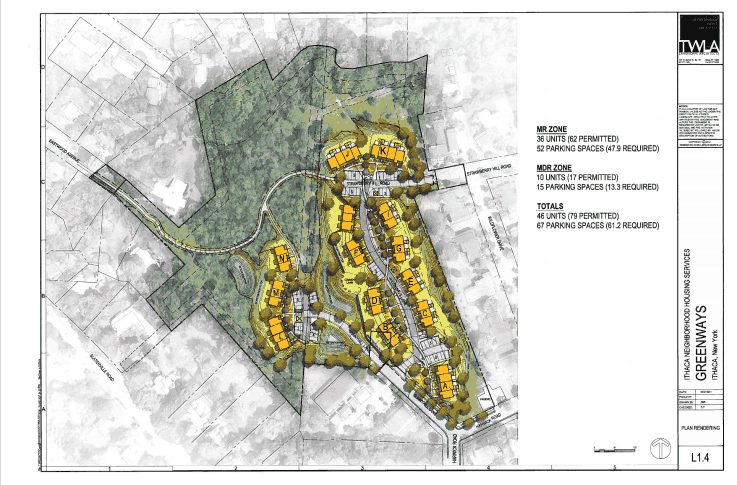
Consideration of a sketch plan for the proposed Greenways project located off Sunnyhill Lane and Strawberry Hill Road, Town of Ithaca, Tax Parcel No.’s 60-1-34.2 and 60.1-1-46.22, Medium Density Residential (MDR) and Multiple Residence Zones (MR). The proposal involves the development of 46 townhouse units west of Eastwood Commons, fronting woonerf-style roads that will connect Sunnyhill Lane and Strawberry Hill Road.The project will also include new parking areas, open space, recreation areas, trails, walkways, landscaping, outdoor lighting, and stormwater facilities. Cornell University, Owner; Ithaca Neighborhood Housing Services, Applicant; Peter Trowbridge, Trowbridge Wolf Michaels Landscape Architects, Agent.

Regular readers will recognize the name Greenways because I’ve latched onto this project and followed it with interest since first proposed about 18 months ago (one could argue I’ve beaten a dead horse here). The project was originally proposed with 67 units, but then dropped to 46 by the time updated specs were submitted in February. The site is still the same, seeking to use woonerfs to connect Sunnyhill Drive and Strawberry Hill Circle. Note that google is not correct here, the street labels are all botched up. An accurate map with the parcels outlined (copied from the county tax map) is included in the lede for this post. Given a preferred completion in October 2015, and that this project consists of 46 units of townhouse-style housing, it makes sense that it would be seeking planning board approvals now.
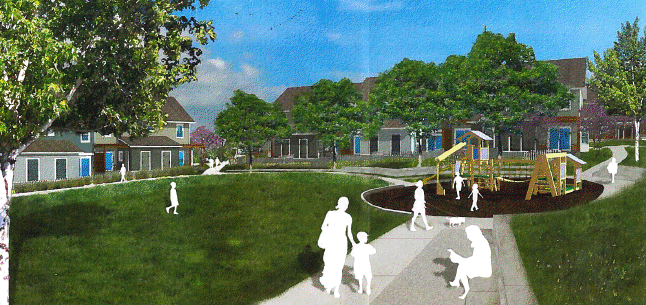
Image property of Greenways at Eastwood Commons

Image property of Greenways at Eastwood Commons

So make way for the woonerfs, I suppose.

EDIT 5/15: Now we have renders and site plans. It looks like the project will be built in three phases, and access to “Greenways Lane” will be primarily through Strawberry Hill Toad and Sunnyhill Lane. The “woonerfs” seem rather gimmicky in this context.
gways_rev_1

gways_rev_2

gways_rev_3


Ithaca’s Big Plan

29 04 2014

1-2-2014 313

I realize that the city’s comprehensive plan might seem a bit abstract. So let’s break it down into Q and A.

1. What is a comprehensive plan? Is this just more government bureaucracy?

Kinda? A comprehensive plan is the overarching theme for a city and its neighborhoods.  It’s not as specific as zoning is, but it helps determine what zoning should be, given the city’s concerns, desires and goals. So yeah, it’s more documentation, but it’s also allowing the community to determine the “forest” to be created by its “trees”. The plan helps to decide whether a project is appropriate for an area, because the planning board and zoning board will understand the desires for a given location. Used effectively, it may actually save time and mental energy in the long run by establishing a basic framework (i.e. developers will know that the chances of building a massive apartment building in Fall Creek are pretty low).
2. Why does the city need a new comprehensive plan?

The old one dates from 1971. A time when computers were the size of rooms, green was just a color and not a cute term for ecologically sensitive, and the Brady Bunch epitomized the way many wanted to live, in a posh contemporary in the suburbs with a Plymouth Satellite wagon in the garage. Times, and Ithaca itself, have changed. The plan has been amended in bits and pieces, but given its age, it needs a big overhaul, such that a new plan would be the easier option at this point.

3. Just how do they plan on making this plan?

In two parts: Phase I involves the preparation of a city-wide plan that identifies a vision and future goals for the community, and Phase II will include the creation of individual neighborhood or thematic plans, based on Phase I’s results. Committees, focus groups, surveys, meetings with community members, the whole years-long shebang. The current state of affairs can be found located here, and the current planning issues (using community input) is here. A 277-page PDF discussing environmental issues and goals for the plan is here. A draft of the plan, a mere 16 pages, can be viewed here.

4. Sum up the issues for me. I didn’t come here for long PDFs.

Parking’s a b*tch, and people want more walkable neighborhoods. Ithaca is expensive and only getting worse. The Jungle. Development pressures are threatening Ithaca’s historic structures, but the development process is too onerous for most folks to even bother with trying, vacant lot or otherwise. More jobs that aren’t colleges or retail. Protect the gorges and other local, natural amenities.

5. Okay, so what does the community want? What are the big changes?

Under consideration, we have a bunch of overarching themes. Here’s a map:

ith_big_plan_map

Ithaca loves itself some compact, mixed-use developments. If it fits that criterion and it also fits the area, the city wants it. Surface parking lots (231 acres) and vacant parcels (194) comprise just under 10% of the land in the city, and a number of these are what the city hopes to be appealing to developers (if the RFEI for the county library is any clue, the interest is there). Many of the currently developed parcels should be protected – homes in Cornell Heights, Belle Sherman and Fall Creek, for examples. The red spans above are what the city sees as areas for new, dense development – underutilized parcels downtown and on West State, the large swath of big-box land in the southwest, and the frequently-flooding land to the west of big-box land (the city hopes to fix that with dredged soils to raise the land).  Some accommodation for local commercial spaces is created with the “Neighborhood Mixed-Use” land use option. The final plan linked above notes the challenges with each neighborhood, and the desired changes moving forward.

The asterisks denote focus areas, areas the city wants sees significant and unique development opprotunities. There are four – Emerson (which is now in the earliest stages of redevelopment),  the flood-prone/retail-heavy southwest part of the city, the large undeveloped swaths of West Hill, and the Waterfront/Inlet Island. All are seen as very underutilized – all present unique opportunities to significantly expand housing and commercial options, if a developer is willing to fight the adverse factors and work with the city.

6. So are we going to see anything develop out of this?

Explicitly, no. This doesn’t dictate massing of new structures, or curb cuts and sidewalk widths. But it says where Ithaca wants growth to be focused, and where it would be more amenable to playing nice with anyone who comes forward with a plan in those areas.

7. Can I have a say?

Well, the public workshops are this evening, as I write this. But if you can’t/couldn’t attend, feel free to answer the online survey, or email the city planner with your thoughts and concerns.


The Six Contenders for the Old Library

22 04 2014

libe_0414

Most people are aware that the old Tompkins County library is about to be left completely vacant. As covered by Ithaca Builds last fall, the county issued a Request For Expressions of Interest (RFEI), inviting developers to cast their lures and offer proposals, and the plan perceived as best would garner its developer the ability to buy the old library and build on the parcel. The county expressed preference for proposals that were eco-friendly and would create senior housing, so the proposals play to that preference. In a long if thorough process, the County Planning Advisory Board will make a preliminary review, recommend its choices to the legislature, and the legislature will select the finalists, who will be asked to submit more thorough proposals of their initial entries, detailing info such as project financing. The county makes it final selection in November, with sale of the parcel to the winning developer in March 2015.

This is exciting, it’s like watching competitors at an Olympic event.  All proposals can be found at the county website here, individual links are included with each shot below. Feel free to voice your opinion on your favorite proposal in the comments.

1. DPI Consultants

DPI Is a private developer operating out of Rochester. Their group has some previous local involvement, converting the old county jail to offices in the early 1990s, and they were involved with the Johnson Museum addition a few years back.  Their plan calls for 76 condos and 8 apartments in 2 5-story buildings (max buildable height for the parcel is 50 feet, for the record). The condos would be mid-to-upper tier for pricing, and the project would have underground “automated parking”.  This proposal is the only one that does not have a focus on seniors.

dpi_libe_0414

2. Franklin Properties

Franklin Properties of Syracuse has teamed with a group of local firms (STREAM Collaborative and Taitem Engineering, among others) to propose a 68,000 sq ft “wellness center” for the library site, which they call the “Cayuga Community Education Center”. The first two floors would have a cafe and medical offices for doctors and non-profits, with three floors (32 units) of senior housing on top. The building would incorporate solar panels and is aiming for a 2017 opening if selected. The proposal seems to be the only one that reuses the original library, and already has some letters of support from local businesses.
franklin_libe_0414

3. Integrated Acquisition and Development

IAD proposes a LEED-certified, 115,500 sq ft, four-story structure they call “Library Square”, with 90 apartments, conference rooms, a library and fitness center space. The project suggests a late 2016 completion. Parking is behind the L-shaped primary structure. IAD has been involved in the Ithaca area previously, being the owner of several properties in Lansing (Warrenwood, the medical offices of Trimhammer), and the lead developer of several of the office buildings in Cornell’s office park near the airport.

iad_libe_0414

4. INHS (Ithaca Neighborhood Housing Services)

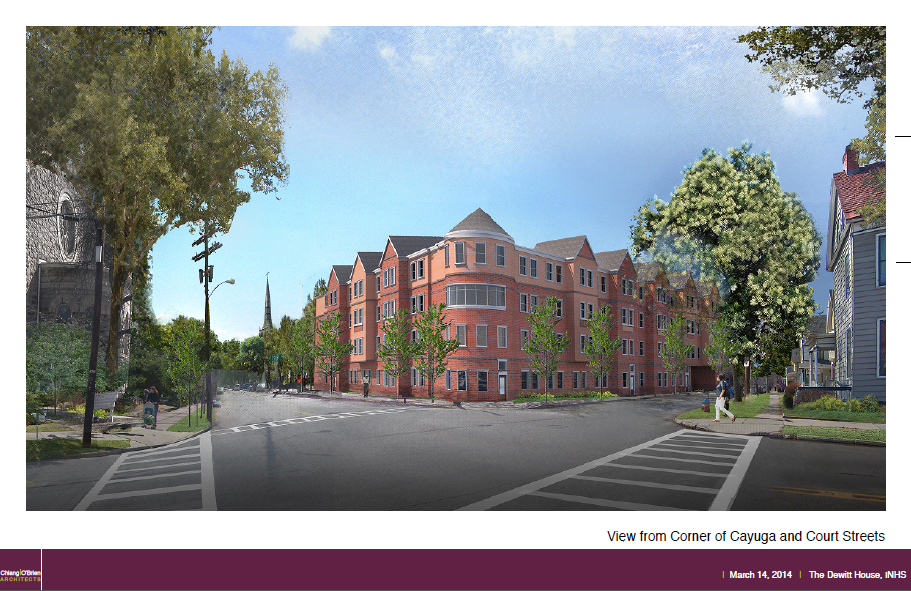
Locally prolific non-profit INHS comes up to bat again, this time proposing a project for the library site. Their proposal, called “DeWitt House”, calls for a 4-story, 60,000-80,000 sq ft building with 60 to 70 units of affordable housing, not specifically geared to seniors. The selling feature is an internal courtyard, along with community space and 6,000-8,000 feet of commercial space for rent. This one also has underground parking. The time frame for this one seems to be the latest, with completion in the 1st quarter of 2018.

inhs_libe_0414

5. Rochester Cornerstone Group / Cayuga Housing Development

Cornerstone is a Rochester based non-profit housing developer. CHD is directed by the same people as the Ithaca Housing Authority, who operate Titus Towers. The proposal consists of 70-80 units of affordable senior housing, in a 4-story 54′ structure (i.e. it would need a zoning variance). The building would have covered ground-level parking and some surface parking. Full occupancy would be in late 2016. Token snark here, but next time, ask the architects not to use the glare tool in your renderings. Building roofs are not shiny.

roccorner_libe_0414

6. Travis Hyde

Ithaca based private developer Travis Hyde submitted the last proposal on this list. Travis Hyde is involved with the renovations of the Carey Building, the construction of Gateway Commons, and further back, Eddygate in Collegetown. Travis Hyde teamed up (once again) with Ithaca-based HOLT Arechitects for their proposal, which is probably the one that discusses architectural context the most out of the six. The 4-story 90,000 sq ft building would have 48 apartments with office and community space at street level. While it discusses providing senior housing, it doesn’t appear to be explicitly senior housing. Parking would be minimal, on the western edge of the site, with mass transit/municipal parking garage incentives being explored. Spring 2017 is the suggested completion date.
travhyde_libe_0414

May the best project win.


Ithaca’s Economic Mystery (Again)

18 04 2014

4-13-2014 078

I don’t consider myself an optimist. Maybe that’s the result of growing up in upstate New York, or working in a field that suffered its share of setbacks due to the recession. I don’t like the term pessimist either, preferring to go with the more socially acceptable term “realist”.

But this IJ article citing the state Labor numbers doesn’t make one damned bit of sense. I’m not even talking about the fact that they threw Ithaca into two separate employment regions (Ithaca and Binghamton, and Ithaca and Syracuse). to quote a section of the article:

“In the Ithaca region, financial activities, trade, transportation and utilities, and leisure and hospitality each added 100 jobs.

The education-and-health-services sector lost 1,300 jobs from March 2013 to March 2014. That sector’s employment was 38,300 this March.”

Doesn’t it seem just a little unusual that the area lost 1,000 jobs? Recalling the headcount numbers for Cornell that were shared last month, the difference in employee headcounts on East Hill over the period of November 2012-November 2013 is a loss of about 50. Ithaca College’s headcount reports 1,822 employees,  about 12 less than the previous year. So those are both from the fall, and the state counts health and education are grouped together, but if we’re talking about 1,000 jobs, and it’s not Cornell or IC that caused it, then who did? I don’t recall any news of a huge layoff in Tompkins County.

The state regional breakdown PDF says the number of jobs went from 70,900 to 69,900 in the region (IJ says 60,900 to 59,900…someone in their office needs to double-check their numbers, because the 2011 average jobs number was 66,194).  The state description of their methodology says they use a time-series regression model and a sampling of 18,000 establishments statewide to determine jobs data. I’m wondering if this is all a quirk in the sampling, given that Ithaca is a small market (and small sample size in turn).

Maybe Ithaca’s economy really is in the crapper. But honestly, it’s not the first time the state has given overly-negative assessments, and the county agencies have to do damage control. But do we really have to go through this every other year?


College Towns As Retirement Communities

5 04 2014

100_2009

Growing up in upstate New York, retiring and moving to south Florida was considered a rite of passage. You worked for forty years, you retired with your company or government pension, you moved to a gated condo community in Florida, and then you complained about how much worse everything is these days and how terrible drivers are in Florida for the rest of your days.

I imagine that still tends to be a big draw (considering the New York to Florida population pipeline is the largest in interstate migration), but an increasingly-popular alternative in recent years has been to retire to college towns, enough that mainstream publications like USA Today and the New York Times have devoted articles to the topic.  it’s usually ascribed to some combination of a modest cost of living with expansive cultural and recreational amenities. Without having any numbers directly in front of me, I imagine Ithaca in a sort of second-tier in this category, if only because of the climate, which is a little cooler and snowier than the most popular college town retirement destinations. Still, I’ve been thinking about this topic a little bit because a number of the projects in the Ithaca area are targeted towards the retirement crowd. The individual trigger for this article was a Lansing Star article discussing review of a ~$17 million, 110-unit senior apartment building proposed for the forever-discussed Lansing Town Center development. The more I think about it, the more I realized a number of local projects, both recently built and proposed, are explicitly geared towards the 55+ age group:
Hawk’s Nest at Springwood (50 units)

Cayuga Meadows (62 units)

Longview Patio Homes (22 units)

Conifer Village at Ithaca (72 units)

The Kendal at Ithaca expansion (24 apartments and 13 “skilled care” units)

-The Old Tompkins County library site (likely)

Some of the news stories focus on collegiate affinity (i.e. living near the old alma mater) and offerings at the universities as a draw for retirees. To that end, Cornell offers summer courses for seniors and the local community college allows residents over 60 to audit courses (I don’t see anything described for IC). Those offerings along with the open lectures and Ithaca’s fairly active community engagement seem to provide some draw for those in their later years. I find college students and retirees an odd mix (even if they live in different neighborhoods for the most part), but if it works, I have nothing against it.


2013 Census Estimates: Say Hi to the New Neighbors

30 03 2014

7-26-2013 067

Every late March, the U.S. census releases their new population estimates for counties. So, I causally checked in to see how the Tompkins County numbers were doing. The county typically shows a modest addition of a few hundred each year – from 2010 to 2012, the estimated addition was 990 residents, from 101,564 to 102,554, which if carried out evenly, it would be an expected 4.9% increase for the decade (and roughly on par with the 5.2% in the 2000s).

I was a little taken aback when I saw the numbers for this year. For one thing, somewhere along the way, they revised 2012’s number up to 102,713. For another thing, this year’s number is a relative spike in the trajectory – 103,617.  In addition of 904 from the revised 2012 figure, and 1,063 from the original 2012 estimate. So, the change from 2012 to 2013 is about as much or more than the gain of the previous two years. Using the 2013 figure and extrapolating the three years’ estimates out to the end of the decade, the county would be projected to grow 6.74% to about 108,400 residents in the year 2020.

In many states, this would not seem an overly impressive figure. But it is worth noting that this is economically-depressed upstate New York. Last year, the only counties that were growing faster than Tompkins (as a percentage) were Jefferson County (Watertown, with the economic engine of Fort Drum) and Saratoga County (Saratoga Springs, with the massive Global Foundries computer chip plant in suburban Malta).  With the 2013 figures, Tompkins County moves into the second-place slot, behind Jefferson County (I note that the population estimates gave Jefferson a population decrease this year; the army base up there is expected to see a loss of 1500 to 2000 soldiers as it loses a brigade over the next few years, as part of army cutbacks). I’m also leaving out downstate counties/boroughs – Kings County/Brooklyn Borough is projected to have added 88,000 people for 3.5% growth since 2010. Almost all of Tompkins’s population, in three years. New York City gains ever-more reason to view it and its boroughs as the center of the world. On the other end of the scale, Schoharie (sko-hair-ee) County has the biggest estimated percent loss, at -2.8%. Schoharie is a rural county just west of Albany; it suffered a major hit from Hurricane Irene.

Echoing my comments from last year, estimates should be used with caution, as they don’t always reflect the true population. From the housing units perspective, using the number of 2.29 residents per unit estimated for 2008-2012, one gets justification for about 395 more units of housing for the past year, or about 897 units since 2010. I’m cautious about using these number as much more than curiosities, but they’re intriguing, and seem to bode well for the health of this county. Even when the jobs numbers aren’t.


Two Sides to an Argument

18 03 2014

ridgewoodapts_v2_2

I generally try to stay on the sidelines when it comes to promoting or opposing for Ithaca projects. I’m not about to get involved in favor of the West Falls Street proposal, the Stone Quarry proposal, or Cayuga Meadows, or any other local project that neighboring residents want shot down. NIMBYism (NIMBY is short for “not in my backyard” , a reference to when people accept a community has a need for a project but they oppose it in their neighborhood) is ever-present, just about every project in the city and town has had some degree of opposition (the only exception I can think of offhand is the convention center/hotel planned for downtown). My own opposition arises when I feel a proposal threatens something of historic value. Regardless, the planning board is good at staying neutral. I may not always agree with the planning board, but I generally respect their judgement.

I’m going to make an exception to my non-partisan stance for 1 Ridgewood, thanks to Walter Hang.

As much as it bothers me to do it, to explain my issues, it is best if I provide a link to the petition and its partially-labelled map of square footages.  A large chunk of those appear to be people who have little or no connection to Ithaca. Token disclaimer: I’m not for or against his fracking work, my concern is focused squarely on this project. In an attempt to keep this project from being railroaded, I decided to examine the petition’s arguments.

chhd1

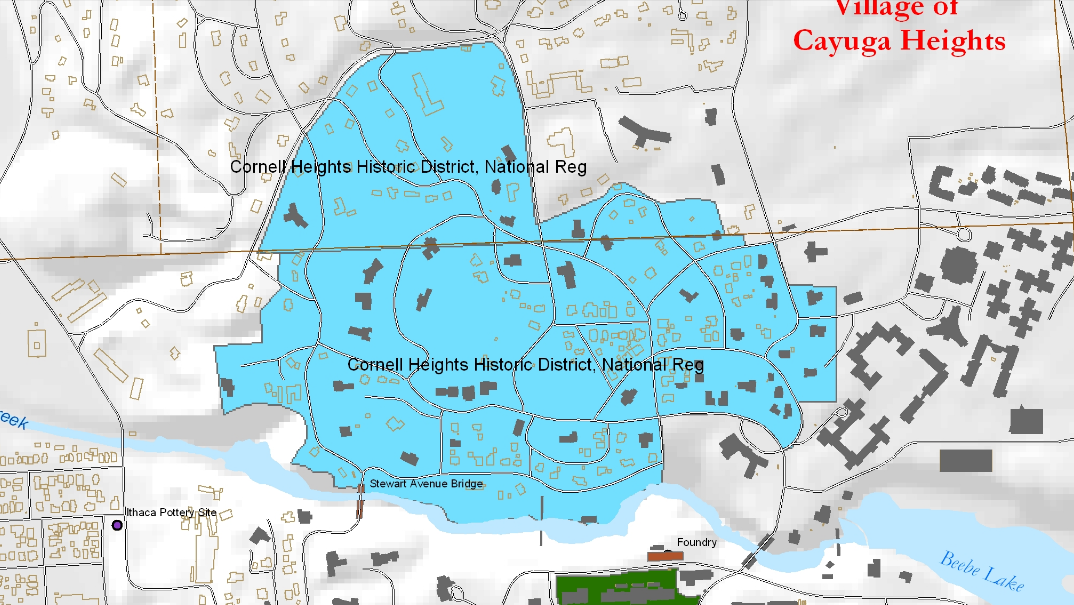
Here’s the area Mr. Hang wants his moratorium, Cornell Heights, split between the city and Cayuga Heights. For the record, the dark grey represents Cornell-affiliated properties, mostly GLOs and a few Co-Ops in the CHHD. Looking at the city section specifically:
chhd2

The red X is the Ridgewood apartment parcel, for three buildings between 5578, 5710 and 6662 square feet, with mostly below-grade parking. One of my issues is that some of Mr. Hang’s assertions are misleading. For example:

Due to recent development, the Historic District is clearly transitioning from its original turn-of-the-20th century “residential park” to a densely developed area that bears little resemblance to the community that warranted special historic district protection approximately 25 years ago.”

It’s hardly changed. There have been two three projects built since 1989. A single-family home at 116 Dearborn Place that was built in 2005, the Tudor house of the Bridges Cornell nursing home was built in 2005, and the new apartments currently going up on Thurston. If you want to push the envelope, Alpha Zeta (214 Thurston) replaced half of its original structure in 1992-1993 when it was renovated. A couple buildings (Kappa Delta, and 111 Heights Court) have received renovations, which were approved by the Ithaca Landmarks Preservation Council (ILPC).


Approval is being sought for an apartment complex proposed for 1 Ridgewood Road. Three buildings would be built on the largest undeveloped property in Cornell Heights, a spectacular forested setting enjoyed by hundreds of local residents who walk along and through it each day.

The proposed buildings would dwarf nearby structures. Figure One illustrates that the buildings would be 300% larger than the adjoining structure on Highland Avenue and at least 200% larger than all the immediately surrounding structures.

Out of a total of more than 200 structures in the Cornell Heights Historic District, only six are bigger than all three proposed buildings. Those six were built before the Historic District designation.

What’s not being told about that “spectacular forested property” is the abandoned swimming pool or dilapidated poolhouse. Also, as seen in at Mr. Hang’s map, the project is shifted to the west (left side) of the parcel, where many its nearby neighbors tend to be larger, ranging from 3000-8600 square feet (Westbourne to the north is a contiguous complex with 10,800 sq ft of space). To call this “dwarfing” is to take it out of its full context.

It concerns me that a petition with emotionally-charged language, gathering signatures from people that are not stakeholders in the Ithaca community, is being pushed by someone who has a history of aggressive tactics. It bothers me that an underutilized parcel with great public transit access in a highly populated area is going to have its zoning changed after the developer has been sensitive to planning board concerns and returned with a proposal within current regulations, which sets a terrible precedent for the community and opens up the possibility of legal action against the city. Lastly, in a period where Cornell continues its enrollment growth, I’m worried that if projects like this will be prohibited, it will only encourage more rental conversations of existing housing, more subpar housing situations, higher rents and increased sprawl.


ATO and Campus Living Are Awkward Partners

13 03 2014

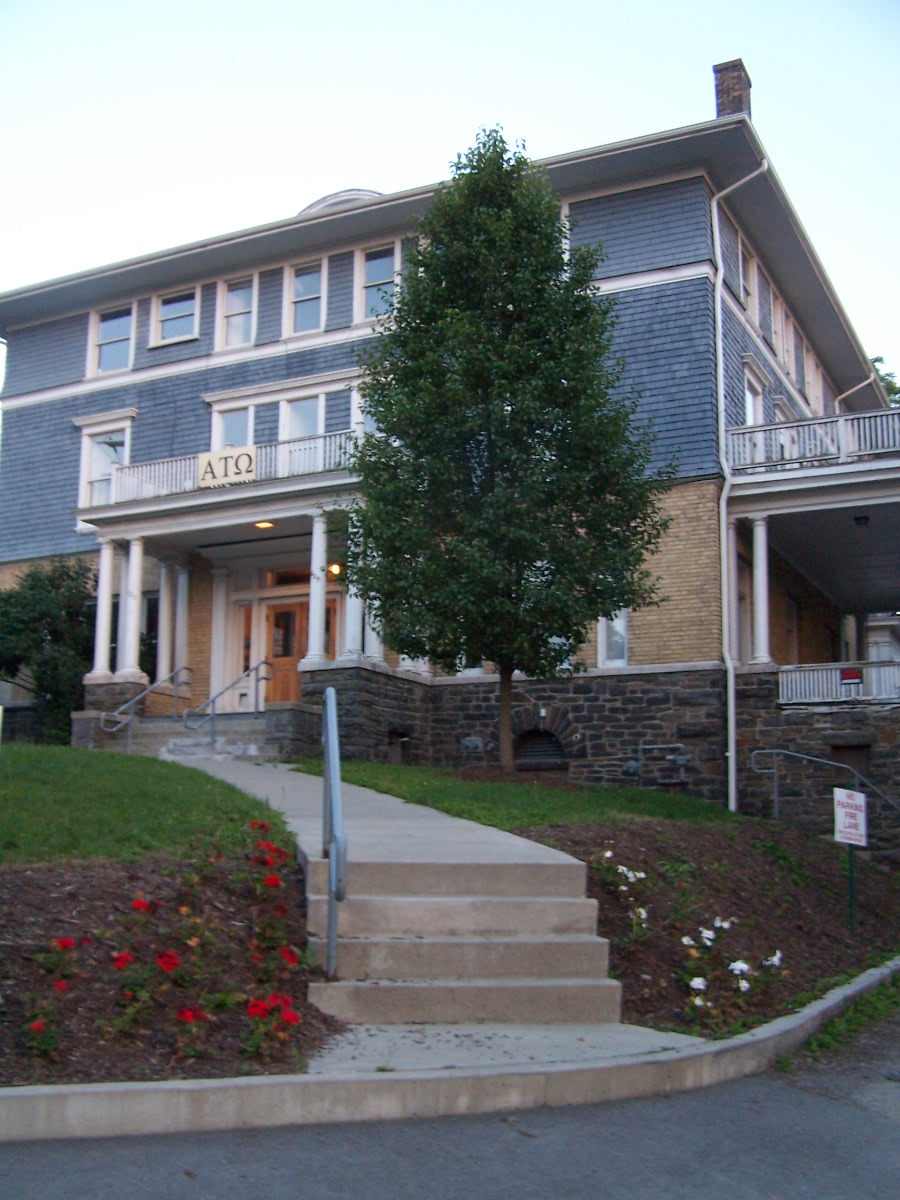
When this blog started, I think Alpha Tau Omega (henceforth ATO) was the first renovation in progress that I had ever taken note of, in mid-summer 2008. Here was a before pic, which dates from July 3rd, 2008.

100_1368

Here’s an after pic, which dates from August 15th, 2008.
100_18091

The house had had structural issues that were fixed before this blog started, and the external renovations were finishing up when the first photo was taken. I assume the repaint was all that was left to do.

ATO was one of two fraternities that closed in the summer of 2013, the other being Zeta Beta Tau (ZBT). In both cases, the closing was called for by their nationals, who were displeased with the quality and conduct of their Cornell chapters. This article notes that ATO’s alumni group hoped to rent the house to graduate students while they wait for the chapter’s return (generally, that means that all the once-current members have graduated). ZBT is targeting a return in 2014/2015. The process isn’t new, Kappa Sigma did the same thing from 2010 to 2012. I’ll even go as far as to suggest that someday, another couple years from now, Sigma Alpha Epsilon will make a return to Cornell, though Hillcrest is being used as a dorm in the meanwhile (I dunno if they’ll ever be back in 122 McGraw, which is owned by Cornell; I tried checking Kappa Sig’s house for reference, and couldn’t find anything. But I do see that they liked my photo so much it’s on the front page of their website, guy standing on the roof and all).

100_1167

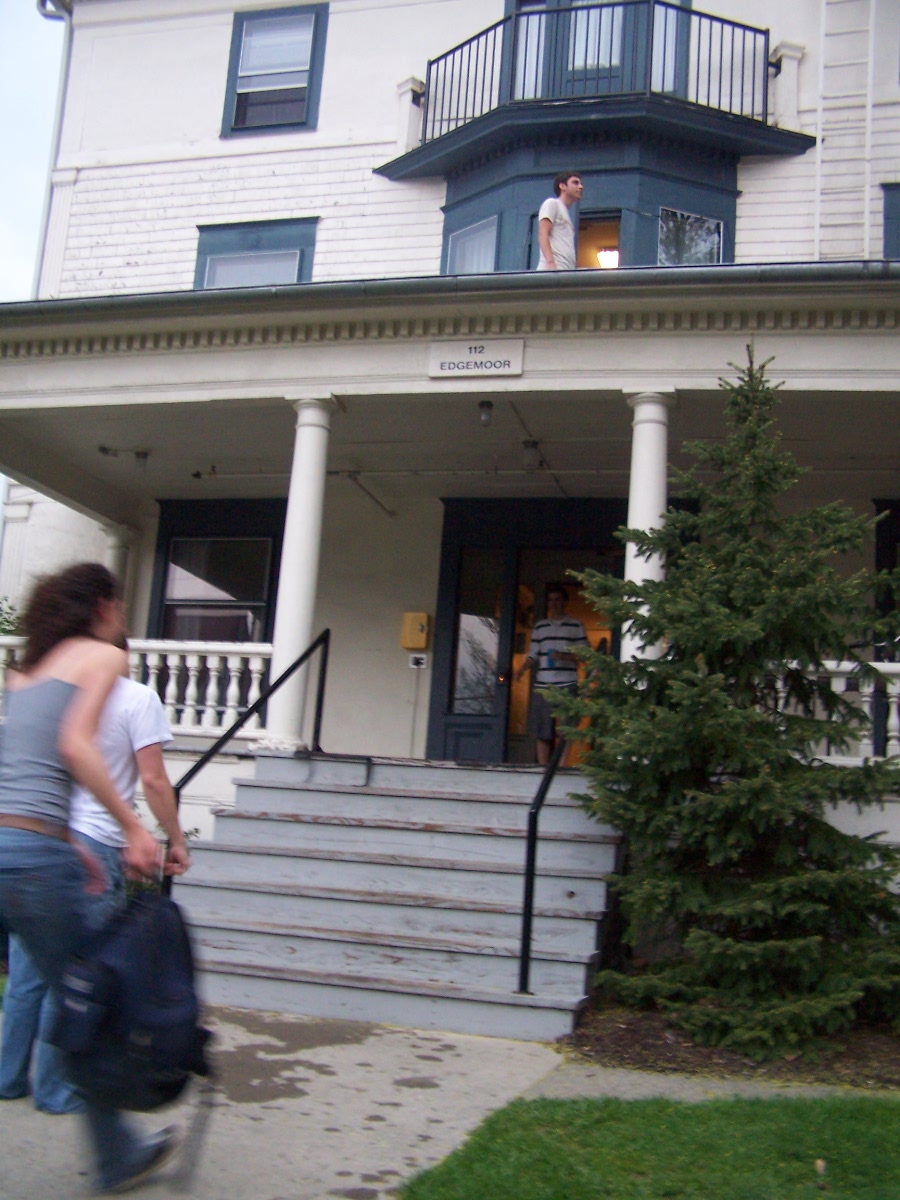
Anyway, reading the Cornell is leasing the house for the upcoming year is no big surprise. In fact, it brings back memories of my friends in 112 Edgemoor. Edgemoor was a fraternity house until 1985, when Triangle closed. Being purchased by Cornell some time earlier, it became a small dorm. The fact that most of my meteo friends even ended up in Edgemoor is kinda my fault. A bunch of my meteorology classmates wanted to go in together on a suite on West Campus. When I found out I would have to be on a Cornell meal plan, I balked; I wanted to be on my fraternity’s meal plan for dinners and manage my own (cheaper) lunches. When I caused that suite plan to fall through, a lot of them went into Edgemoor, and a couple others gravitated towards that group and moved in as well. I think meteorologists and their friends made up about half of Edgemoor’s residents, and there were about 21 at the time. I spent more time there than my own dorm (and Cascadilla and Edgemoor were close to each other at least). It was a nice house, but from my own observation, almost everyone else in Edgemoor saw it as just a place to sleep.  For the student in the article that hopes for more intimate social connections, I would set the expectations low but hope for the best. For the record, I don’t have high opinions of ATO either. Some years back, ATO thought it was a good idea to take my freshman roommate to Kuma Charmers as a rush activity. He came back with bruises on his legs from what he described as the worst lap dance ever. My roommate ended up joining a different house. Furthermore, I went there once to meet him after one of their events, and the inside of the house was in shambles, with a giant pile of wood furniture tossed helter-skelter in a corner, and broken glass everywhere. So someone describing the house as a health hazard is no surprise either.

I think that unless people already have connections to their housemates, that the intimacy of non-specialized small group housing is overrated; upperclassmen have generally built their social networks and have their coteries. I don’t imagine Cornell’s thrilled to have to clean house, nor ATO to have it occupied by someone that’s not an active membership. But this is better than an empty house, the cleanup is appreciated, and I suppose that at least a couple dozen fewer people won’t have to do the manic search for off-campus housing.


Progress in Collegetown?

9 03 2014

cafd3

Given the chance to look back at high-value projects over the past 30 years, one would find that, until the past several years, the list would be dominated by projects in Collegetown. Reasons abound- quoting developers, students “are looking for quality“, while increasing land values (comparable to downtown Los Angeles) have persuaded property owners to upgrade their stock and maximize their returns. The city has in general promoted Collegetown redevelopment since its slummier days, with relaxed policies in the 1980s and a couple of brief moratoriums allowing for reassessment (ex. the moratorium of 1999/2000, when the newly-built 312 College Avenue rubbed some locals the wrong way).

As of late, though, development in the Collegetown area has tapered down. There have been a couple projects over the past several years: 309 Eddy was completed in 2012, and 320 Dryden in 2008. If you want to stretch it, you can add 107 Cook, but that has less bedrooms than the building that burnt down. The big glaring omission here is Collegetown Terrace, but that is being built just outside of what is traditionally considered Collegetown.

A big factor in all of this has been the uncertainty in Collegetown’s zoning. Since about 2008, Collegetown’s zoning has been in flux. The city and Cornell paid about $200k for an urban planning company (Goody Clancy) to design a plan, which came out in 2009. The  project freaked out some residents and local politicians, who saw it as too dense and too much, period. Then the planning board went and took it in the opposite direction, proposing zoning that would force smaller buildings and reduced density. I made a b*tchy little rant when that happened. Since the old images can’t be blown up (I had an issue with that for a while back in 2009 or so), the numbers for the Goody Clancy plan can be seen better here on page 161. I’ve been unable to find another copy of the first revision, not that it specially matters since the plan was accepted, repealed in 2011 after a potential lawsuit from landowners, and has been revised seemingly a dozen times since, debating everything from the necessity of porches in certain zones, to the tremendous fight over maximum heights on the intersection of College and Dryden (90′ in the GC plan, 60′ for first revision, now 80′), to parking and encouraging townhouses. After much back and forth, something is now finally in place.

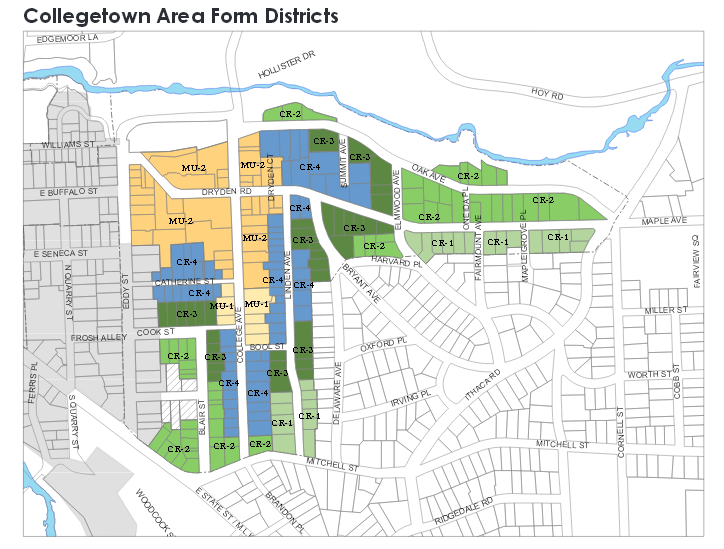
The final version is the Collegetown Area Form Districts guideline, the implemented form of the plan. The key thing with the is plan is the form-based zoning; traditional zoning focuses on regulating use and overarching parameters (lot size, density), form-based zoning scrutinizes design. Form-based zoning has been popular in new urbanism for encouraging walkable, mixed-use communities, an early example being Florida’s Seaside community.

cafd1

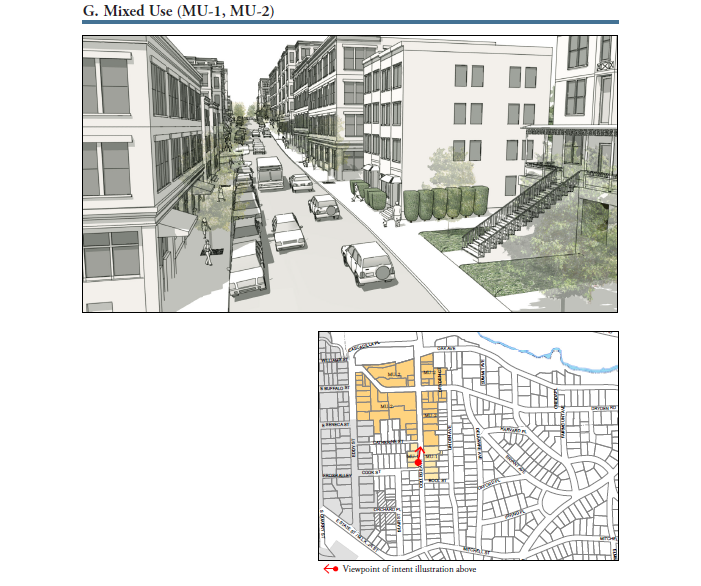
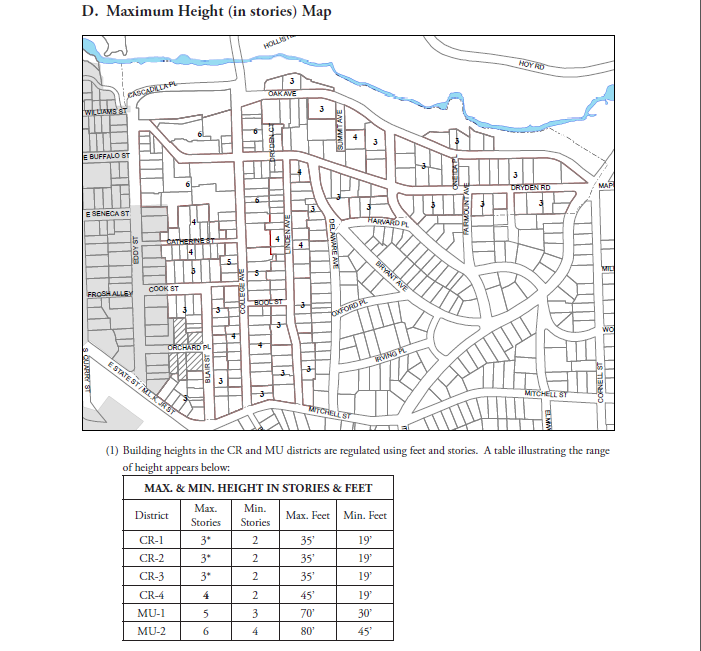
The plan has six zone types, each with its own tweak on the design guidelines. CR-1 to CR-4 are increasingly denser forms of “Collegetown Residential”, MU-1 and MU-2 are mixed use, with active street engagement through ground floor commercial or public uses.

cafd2

Compared to the Goody Clancy plan, the Dryden/College core isn’t as dense, but the floor count and maximum heights are even higher than suggested in some spots, for instance College at Bool Streets. But the primary focus of the plan is on the design of buildings. CR-1 and CR-2 will be large house forms with pitched roofs, CR-3 for 2-3 unit large homes/duplexes. CR-4 accommodates large houses, townhomes, and small-to-medium size apartment buildings. MU-1 welcomes medium-sized mixed use structures, while MU-2 is for the largest mixed-use buildings, up to 6 floors and 80 feet in height (think 403 College for example). Worth noting, most of Collegetown Crossing falls into MU-2, but the back end edges into a CR-4 Linden Avenue property also owned by developer Josh Lower. Since CR-4 is residential only, the difference would force him to make a redesign to reduce the building’s footprint, but at least parking will no longer be a concern. This December 2013 article says that required off-street parking was removed from CR-4 and the MUs, but I still see it listed in the guidelines as “required off-street parking” under accessory uses. Hopefully it’s just my paranoia; the IJ also said the parking reqs were also waived for the MUs when the plan was adopted.

The Sun, the IJ and other articles note the “strong support” for the plan. I can only hope, after six years and hundreds of thousands of dollars and countless meetings, that the city will have something to show for its efforts. Housing is only getting tighter in Collegetown, and developers are simply looking outside the core for their projects, so to have some guideline in place will hopefully spur some investment into Collegetown’s poorly-maintained and underutilized properties.


A Revised, Resized Plan For Ridgewood

13 02 2014

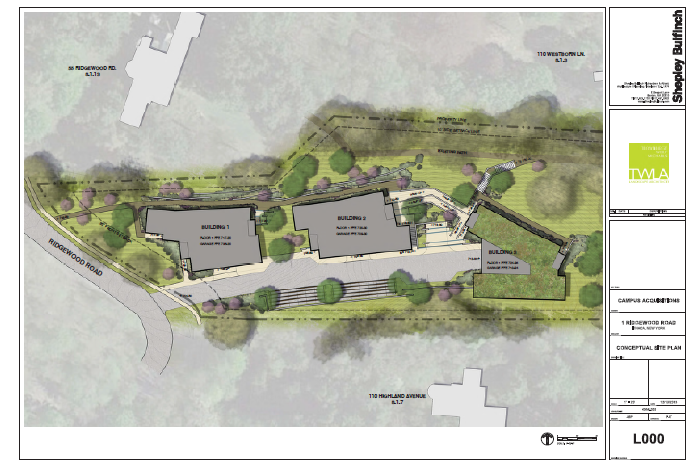
Things are getting a little complex with the development planned at 1 Ridgewood, a Cornell Heights parcel squished between Ridgewood and Highland Avenues. First, the revised plans for the smaller project. While the original plan had 64 units in one large building, this proposal has shrunk it down to 45 in three buildings. Notably, even with the size change, the overall design is not all too different, materials and massing look to be the same as before. One floor has been removed, giving three floors over an underground parking garage (a small surface lot would also be built on the property).

ridgewoodapts_v2_1

The focus is now more on the western side of the property facing Ridgewood, with less attention given to the Highland Avenue side of the property in this updated plan. Since the tendency with student-focused projects is to count the bedrooms, the 45 units contain 114 bedrooms for occupancy.

ridgewoodapts_v2_2

One of the complicating factors in this project is the zoning change proposed for the property. Currently, it’s R-U, which is less restrictive than the R-3aa they are proposing to rezone the parcel to. At its best, it’s an attempt to mitigate increasing developer interest in the historic district; at its worst, its a heavy-handed attempt to stunt development. For the record, this and the Thurston Avenue Apartments project seem to be (have been?) the only two underutilized parcels in the affected area. The revised 1 Ridgewood project PDF goes out of its way to note that this project just barely meets the R-3aa requirements, so even with the zoning change, no variance would be required. This is important, because some neighbors are fiercely opposed to any development of the parcel whatsoever. They would be able to shut the project down much easier if it were seeking a variance, but since it doesn’t, it gets a lot harder. We’ll see what happens as this makes it through the bureaucratic rounds.

EDIT: Ha ha, silly me to think they might let this one go. The Common Council is voting on additional restrictions to the R-3aa zone that would effectively kill this project. The proposed language adds a special amendment for historic districts such as Cornell Heights that says that any new building can’t have a footprint more than 120% of the average footprint of the historic structures on a block. Cornell Heights historic structures are mostly mansions in the 1,500-2,000 sq ft footprint range, which these exceed. This amendment seems to be explicitly targeted to keep this project from happening.