One Stormy Day on Campus, Continued

2 01 2009

Look at it this way; I’m not being paid to do this, and you don’t have to put up with a helicopter Mom asking twenty million questions about academics.

So, today I’m going through the engineering quad. Back in the day, the engineering buildings were Sibley, Franklin (Tjaden), Rand and Lincoln. By the early 1960s however, they had all shifted down to the present-day engineering quad.
100_2086

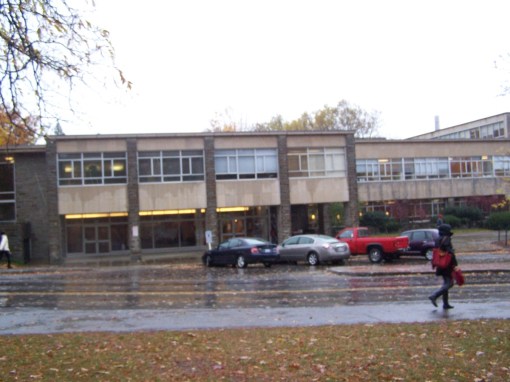
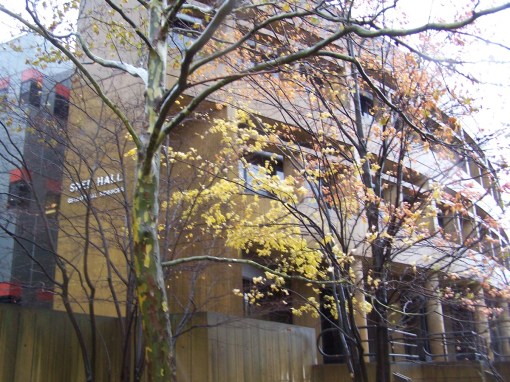
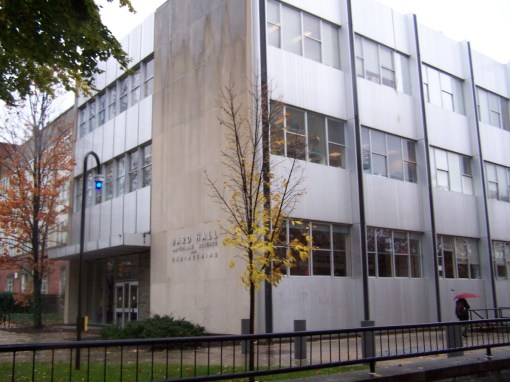
Bard Hall is one of the smaller inteconnected buildings that make up the engineering quad. The 50,000 sq. ft. building was completed in 1963 [1], 12 years after the construction of its neighbor Thurston Hall, but was designed by the same architects. Appropriately so, materials science is based out of this building, which is clad in brown Ithaca stone, limestone, glass, and aluminum. Bard Hall is named Francis Norwood Bard, Class of 1904  [2].
100_2087

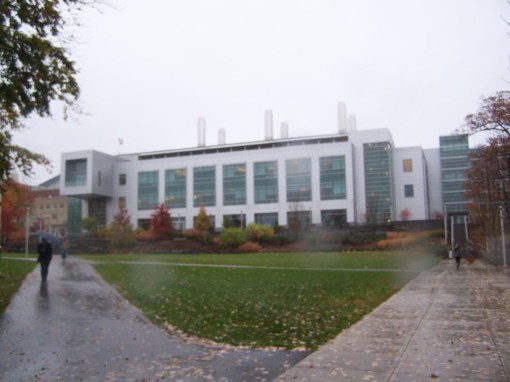
Don’t mind the rain spots. So, no review of the engineering quad would be complete unless I discussed Duffield Hall, the newest addition to the quad.

The plot of land that Duffield was built on was home ot some lanscaped quad space to the north, and the two-story white box that was the Knight Labs building to the south (the building was demolished and the labs were incorporated into Duffield).

Duffield Hall is named for Richard Duffield, Class of 1962. Duffield made his fortune by being the founder and president/CEO of the software company Peoplesoft [3]. The same Peoplesoft that screws everyone over for CoursEnroll.  
100_2093

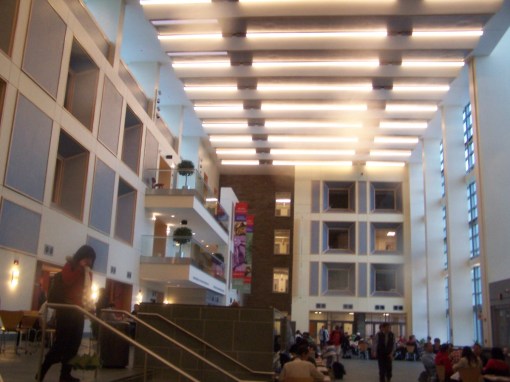
The building began construction in 2001 and was officially opened in October 2004.  The building has a usable area of about 130,000 sq. ft [4] and cost about $58.5 million. The building houses a small a la carte dining facility (Mattin’s), a large atrium, and Knight Labs (named for Lester Knight ’29) with its Cornell NanoScale Facility (CNF). Sorry, no photos of the folks in clean suits.
100_2088

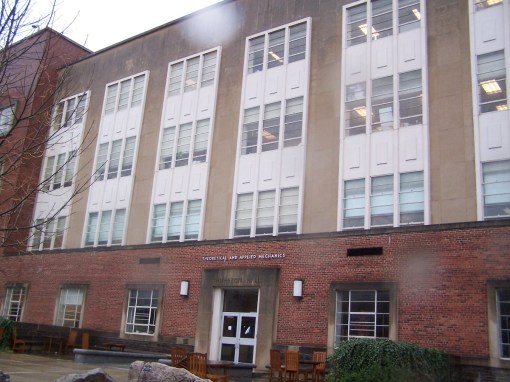
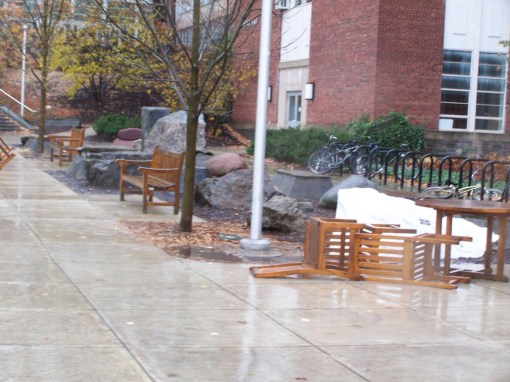
Thurston Hall is the centerpiece of the engineering quad. The building, designed in the Art Moderne style, was completed in 1951 [5]. This building technically has less usable space than Bard, but it depends on where you draw the line between it and Kimball Hall to the east, which was built at the same time. The building is named for Robert Thurston, an early Cornell engineering professor.

As you can see, the outside says Theoretical and Applied Mechanics (TAM). Technically, this department was merged with the school of Mechanical and Aerospace Engineering, effective yesterday (how convenient for this entry) [6].
100_2089

It was really windy.  Mother Nature just decided to  crap on Ithaca that day.

100_2091

The completely unobtrusive Kimball Hall. Technically, Kimball is recognized as “the Eastern pavilion of Thurston Hall”. Also completed in 1951, the building is 30,000 sq. ft. and originally housed the geology department on its upper floors [7]. The building is possibly named for Henry Kimball, Class of 1911, who was a state supreme court justice [8].
100_2092

Cornell’s 1950s Engineering Quad plan:

1. Design a completely boring structure. Because we’re overcrowded.

2. Find an alum willing to fork over enough cash to pay for it; slap their name on the building in return.

3. Repeat

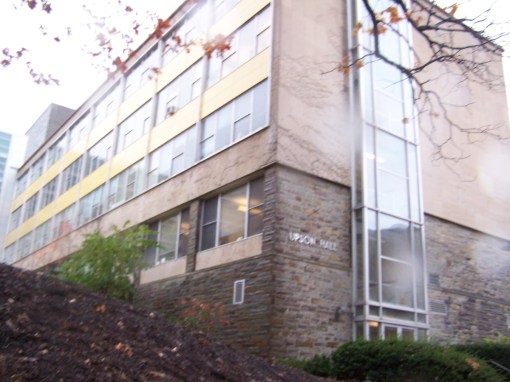
Upson Hall is a 160,000 sq. ft building completed in 1956 [9]. Upson Hall is named for Maxwell Upson, Class of 1899, and a longtime Cornell trustee [8]. The building serves as the central hub for the Computer Science department. This building could otherwise be known for a 24-hour computer lab that up until recently was a filthy lie (that damn thing was never open at night back in 07′).
100_2095

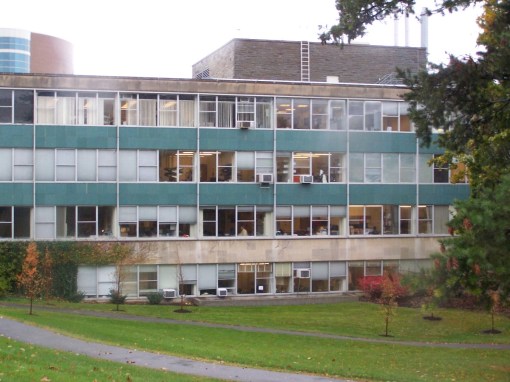
So, this is technically two buildings. The foreground box with the green window banding is part of Phillips Hall, a 100,000 sq. ft building built in 1955. The background structure (where the ladder is) is Grumman Hall, a 17,000 sq. ft building completed in 1957 [10]. Update: Or so I thought. It’s probably just another part of Phillips, but Grumman would be in the background if it was tall enough to be visible. Confusing, isn’t it?

Grumman is named for Leroy Grumman, Class of 1916 and founder of Grumman Aircraft (now Northrop Grumman [11]). Phillips Hall, named for Ellis Phillips 1895 [2], is home to the Electrical Engineering department, and Grumman houses some Aeronautics courses.
100_2099

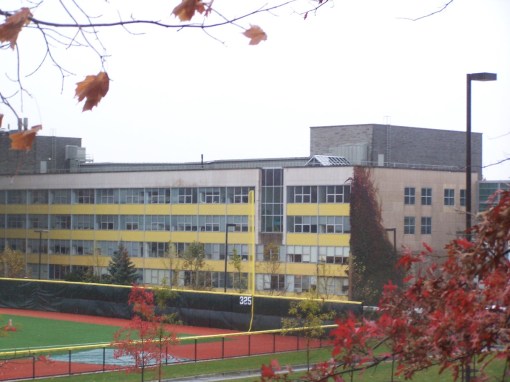
Update: Facilities calls this part of Upson. Apparently, the only way you can make a clear difference is the color of the window banding.   I s’pose it wouldn’t be as confusing if you’ve had classes here, but these are the only two of the main engineering quad that I’ve never had a course lecture or section.

(Thank Heaven.) 

UPDATE:

So, because I was using images and wordpress doesn’t allow imae attachments in comments, I figured it would just be easier to edit the original entry. As several readers (salem, Nagowski, and andrew) have noted, the physical seperations between Grumman, Upson and Phillips are very difficult to determine, since they are all interconnected. Consider the map below. 

up-gr-ph

The map would suggest that Grumman is the south wing of the complex, Upson is on the west, and Phillips on the north. However, going through the facilities websites, Phillips is listed as 100,000 sq ft (88,000 net), Upson as 160,000 sq ft (142,000 net), and Grumman is by far the smallest at only about 16,300 sq ft (14,500 net).

Back in the day, Grumman might have been much larger. Older images have suggested that there was a multi-story (~4 floors) box jutting out of the east side of the complex where Rhodes Hall stands today.

So, we then have the task of trying to determine what Cornell thinks are seperate building areas. Upson is undoubtedly the yellow banded building on the west (Upson Hall is clearly printed next to the staircase). However, it’s also the largest, yet its footprint (if we assume from the map) is seemingly small.

Here’s one issue: if you search Upson Hall on campus facilities, you get a photo virtually identical to my last photo, which I claim to be part of Phillips. http://www.fs.cornell.edu/fs/facinfo/fs_facilInfo.cfm?facil_cd=2045. Upson uses yellow trim, as does this wing of the complex. So, andrew is right on this one, it’s likely a part of Upson.

Phillips uses blue-green panels. Also, the corresponding facilities image is the north entrance next to Duffield. We could therefore say that Phillips is the foreground building in the image where I claim Phillips and part of Grumman are visible.

Courtesy of facilities, here’s their file photo of Grumman, which they describe as “A rectangular box with alternating horizontal bands of limestone panels, blue-green terracotta, and strip windows framed in aluminum.” :

The yellow banding of Upson is clearly visible, and Grumman is the building on the right, in the foreground of Rhodes. So, here’s a big question: at only 17,000 sq. ft, where does Grumman end and Upson begin? In the attached photos, I claim the background rooftop structure behind Phillips, with the ladder, is Grumman. However, it’s more likely another part of Phillips. Grumman is not in my images, and at such a small size, it’s not the easiest building to determine.

[1]http://www.fs.cornell.edu/fs/facinfo/fs_facilInfo.cfm?facil_cd=2070

[2]http://www.people.cornell.edu/pages/cre8/cudb/buildings.html

[3]http://www.duffield.cornell.edu/about.cfm

[4]http://www.fs.cornell.edu/fs/facinfo/fs_facilInfo.cfm?facil_cd=2000

[5]http://www.fs.cornell.edu/fs/facinfo/fs_facilInfo.cfm?facil_cd=2037T

[6]http://www.tam.cornell.edu/news/news-story.cfm?storyid=12537

[7]http://www.mssu.edu/seg-vm/bio_sidney_kaufman.html

[8]http://en.wikipedia.org/wiki/Sphinx_Head

[9]http://www.fs.cornell.edu/fs/facinfo/fs_facilInfo.cfm?facil_cd=2045

[10] http://www.fs.cornell.edu/fs/facinfo/fs_facilInfo.cfm?facil_cd=2043

http://www.fs.cornell.edu/fs/facinfo/fs_facilInfo.cfm?facil_cd=2039H

[11]http://en.wikipedia.org/wiki/Leroy_Grumman


Cornell and Crime

30 12 2008

So, Cornell is an institution with a long and extensive history, and as with any institution of its size there’s been to be a few…unpleasant crimes associated with the school or its alumni. 

Oh, the prestigious alumni. For example, Michael Ross ’81. By any regard, Michael Ross was the typical Cornellian; actively involved on campus and reasonably intelligent. However, he also had an unpleasant side [1].

Michael Ross had serious mental issues. Rape fantasies. So intense that he started acting on them. His first rape and homicide (via strangulation) was that of a Cornell student, 25 year old Dzung Ngoc Tu, on May 12, 1981.  She was an agricultural economics (AEM) graduate student, who was apparently selected at random. It took a week to located her body at the bottom of Fall Creek Gorge, and while suicide was intially suspected, the Tompkins DA began to assert a case of foul play had occurred. However, there were no leads, and Ross did not admit to her slaying until he was arrested on seperate murder charges in 1984 (apparently he confessed during questioning by a police detective). According to news sources, Ross was never formally faced charges stemming from her death.

Michael Ross was responsible for the rape and murder of seven other young women in the 1980s.  He was executed in 2005, New England’s first execution in 45 years.

Going into another case, there’s the double murder of two Cornell freshmen back in December 1983 [3]. Okay, I’m a horrible person; I have told people this story just for the sake of scaring the crap out of the people who live in Lowrise 7, where it occurred.

What happened was that the crazy ex-boyfriend of one of the victims decided to come to Ithaca and “reason” with her. By that, I mean taking her, her roommate, and five others hostage. After a short time, the girl managed to convince her ex to let the others go, but he kept her and her roommate. He then shot them both and fled. The girl, Young H. Suh ’87, died immediately. Her roommate, Erin C. Nieswand ’87, died of her injuries shortly after bring airlifted to a hospital in Syracuse. As students notified police, the 26-year old killer attempted to flee the area, but was forced off the road at Rout 366, where he then shot himself in the head. He survived, and was sentenced to life in prison in October 1984 [4].

This last one for today goes off on a slightly different tangent. Some of you might be aware of the can of worms that was the CIA’s involvement with mind-altering drugs (like LSD) to see if they could be useful for government business. Well, that didn’t work too well, nor was it much appreciated when the American people found out from declassified documents in 1975 [6].

I order to set up funding for their projects, the CIA worked with various organizations to establish feeder programs that would make the research look legit. One of the primary distributors were two Cornell professors, Harold Wolff and Lawrence Hinkle. The initial programs set up for the CIA was in the 1950s and called “The Society for the Investigation of Human Ecology”. In 1961, it was reorganized as the “Human Ecology Fund” and operated primarily out of the Medical School. This ended by the late 1960s.

For the record, the Human Ecology school adapted the name “Human Ecology” in 1969 (during the time of the program’s operation, it was still the school of Home Economics, so there are no connections worth making between the two).

So we’ll wrap that up for today. For kicks, I’ll attach this lovely article attacking Cornell for its Qatari medical school (Qatar supports Hamas). It’s a little too-partisan for my tastes, but it just proves the point that not everyone from CU and not everything CU does is (or should be) considered “good”. 

http://www.renewamerica.us/columns/jweinstein/060421

Enjoy!

P.S. I suppose in keeping with the theme of this entry, I’ll update it to include the June 2009 murder of a Cornell researcher by her husband, a doctoral student in computer science [6]. It would appear he slit her throat and left her to die on a walking trail, and then set their apartment on fire, became involved in a high speed police chase and tried to slit his own throat to avoid arrest (which failed). Congrats to Blazej Kot, whose horrific homicidal tendencies  make him destined to join the rest of the historical skeletons in Cornell’s closet.


[1]http://crime.about.com/od/deathrow/p/michael_ross.htm

[2]http://cornellalumnimagazine.com/Archive/2005marapr/features/Feature2.html

[3]http://cornellsun.com/node/27009

[4]http://query.nytimes.com/gst/fullpage.html?res=9903E5D6123BF936A35753C1A962948260

[5]http://www.thejabberwock.org/wiki/index.php?title=MK-ULTRA_and_Academia_-_Part_3

[6]http://www.theithacajournal.com/article/20090608/NEWS/90608053/Homicide%2Bsuspect%2BKot%2Bout%2Bof%2Bhospital%2B%2Bheld%2Bin%2BPa.%2Bjail


Fraternities You’ll (Probably) Never Visit

22 12 2008

So, Cornell is a campus that has had firm roots in Greek Life (one of the reasons why it is a frequent topic of discussion in this blog). Occasionally, you’ll look at an older campus map or even the current edition and notice some Greek houses you’ve never even heard of.

During the summer, I made an effort to write an overview all the IFC chapters (which I think was a successful endeavor). However, I also mentioned Omega Tau Sigma, mainly because I liked their house (I’m a sucker for tile roofs).

100_1364

As I cited previously, Omega Tau Sigma is a professional fraternity for veterniary students, with the house essentially functioning as a co-op.

A second example of this would be Gamma Alpha of Cornell. This was one of the two random Greek houses in Collegetown, with Gamma Alpha located at 116 Oak Avenue. Gamma Alpha is a professional fraternity for biological science graduate students [1]. I’m afraid I don’t have a picture of this one on me, but the house dates from the late 1800s.

The other Greek organization listed in Collegetown is Alpha Psi. Located at 410 Elmwood Avenue, I’ve had a damned hard time trying to locate any information about this organization, but it would appear that they are another professional veterinary fraternity that was founded at Cornell in 1907 [2].

Then, of course, we have fraternities that have long since left Cornell. I decided to explore part of this by using the 1928 Cornell Map, since my previous “where are they now” dates from about 1970, so I’m approximately covering the span between the two . Here’s the link to the 1928 map if you care to follow along:  http://reading.cornell.edu/reading_project_06/gatsby/cpa1.htm

Sigma Kappa Sorority (150 Triphammer) – discussed in an earlier entry, but long story short, closed in the mid 1950s, operated as Chi Gamma for a short while and eventually became the Triphammer Coop.

Eleusis (313 Wait) – Also covered in a previous entry. Local fraternity that would become part of Theta Kappa Nu in 1934/35, and merged with Lambda Chi Alpha in 1939.

Theta Kappa Phi (201 Heights Court) – The initials were tongue-in-cheek for “The Catholic Fraternity”. Founded at Lehigh in 1919, the Cornell chapter was established sometime in the 1920s. The Cornell chapter had closed by the time the national merged with Phi Kappa (another Catholic fraternity) in 1959 to become Phi Theta Kappa, which still operates on college campuses today [3].

Scorpion (105 Westbourne Lane) – Established in 1914 at Cornell [4], moved to Westbourne Lane in 1927. After the original Tau Kappa Epsilon closed due to the depression in 1936, Scorpion became the replacement Tau Kappa Epsilon chapter in 1940.

Delta Zeta (200 Highland Avenue) – This sorority still exists today with 158 chapters [5]. They were established at Cornell in 1908, and held an annual convention here about a decade later [6]. Delta Zeta closed in 1932, one of several organizations that shut its door during the Great Depression.

Rho Psi (212 Fall Creek Drive) – Established in 1916 as a Chinese fraternity. Closed in 1931. Article suggests Cornell’s Alpha chapter might have been the only one with a house. No chapter exists anywhere today. [7]

Delta Sigma Phi (210 Thurston Avenue) – The Theta chapter of Cornell was installed in 1907 [8]. The chapter went inactive during World War II. Their national still thrives today (notably, during its time at Cornell, the national fraternity wrote a Christian-only clause, thus formally excluding Jewish students. The policy would not be repealed until the 1950s).

Omicron Alpha Tau (934 Stewart Avenue) – According to Marianne Sanua, author of “Going Greek: Jewish College Fraternities in the United States”, Omega Alpha Tau was founded in 1912 at Cornell and was known as “the most Jewish” of fraternities, strictly maintaining a Kosher kitchen. The fraternity closed amid financial troubles in 1934. (Sanua, pg. 79)

Phi Delta Sigma (The Knoll) – A local fraternity that became a chapter of Phi Kappa Tau in 1930. Their Corporation Board is still called Phi Delta Sigma.

Sigma Phi Sigma (103 McGraw Place) – A local fraternity founded in 1910 that merged with Scorpion TKE in 1941 [4].

Sigma Upsilon (636 Stewart Avenue) – The most I can find suggests it was a literary honors fraternity [9]. However, according to Cornellians from that time period (1927, 1931, 1933, 1934), it was an independent fraternity founded in 1915, and closed permanently around 1933.

Phi Alpha (1953-1960), Phi Epsilon Pi (1911-1970) and Kappa Nu (1951-1963). Jewish fraternities that closed as a result of mergers. (Sanua 320).

Theta Alpha (618 Stewart Avenue) – Existed at Cornell from 1910 to the 1930s. A fraternity which had four chapters, including Alpha at Syracuse and Beta at Cornell (according to Baird’s Manual of 1920, pg. 374, and the 1927 Cornellian).  No chapter exists anywhere today.

Zodiac (515 Stewart) – A local fraternity established in 1904. According to ATO’s website, after an unsuccessful run with another national, the fraternity merged with Alpha Tau Omega in 1936 [10].

Phi Sigma Delta (102 Edgemoor Lane) – When Delta Sigma Phi began to “blackball” Jewish rushees, the disenchanted decided to get even by starting a rival fraternity for only Jewish men (note that their initials are Delta Sigma Phi’s only backwards). Cornell’s chapter was founded in 1912. The organization lasted until the mid-1950s, and in some sense evolved into Young Israel, now the Center for Jewish Living [11].

Beta Psi (505 Dryden Road) – Established in 1920. Apparently was a social fraternity, though no students in CAS. Closed by late 1934. Had four other chapters. This fraternity no longer exists.

Phi Delta Mu (301 Eddy Street) – Founded in 1925 as the Zeta chapter.  Alpha chapter of this Jewish social fraternity was at the City College of New York. There were eight other chapters before this one closed around 1934. It would appear this fraternity no longer exists today.

Iota Alpha Pi – A historically Jewish sorority that founded its Cornell “Beta Delta” Chapter in 1966. After the dismantling of Christian-only clauses in larger sororities, the chapter saw a rapid decline of its fortunes and the national, as well as the chapter, ceased to exist after 1971 [13]. The sorority was originally founded as J.A.P. (fanning the flames of Jewish girl stereotypes for years to come), but changed to Greek lettering shortly after its founding.

[1]http://en.wikipedia.org/wiki/Gamma_Alpha

[2]http://www.vet.cornell.edu/public/registrar/Handbook/new%20Student%20Life%2061%20update.indd.pdf  (page 6-14)

[3]http://en.wikipedia.org/wiki/Phi_Kappa_Theta

[4]http://www.lgbtrc.cornell.edu/dos/greek/chapter_details.cfm?id=3272

[5]http://www.deltazeta.org/Content/NavigationMenu/AboutDeltaZeta/History/default.htm

[6]http://www.sigmadeltatau.com/history.html

[7]http://en.wikipedia.org/wiki/Rho_Psi

[8]http://www.deltasig.org/about/history/timeline

[9]http://library.davidson.edu/archives/ency/honfrat.asp#su

[10]https://www.atocornell.org/public1.asp

[11]http://www.cornellcjl.com/about/history.aspx

[12]http://www.drexel.edu/studentlife/fsl/forms/history.pdf

[13]http://en.wikipedia.org/wiki/Iota_Alpha_Pi


One Stormy Day on Campus, Part II

19 12 2008

I’m snowed in in little Ithaca right now, so I might just as well kill some time.100_2080

The story of Barnes Hsll is a rather interesting one.  The architect, William Henry Miller (of Uris Libe Fame) produced two designs- a gothic design, and a Romanesque Revival design [1]. Although the Gothic design fits in better with Sage Hall and Chapel, the Romaneque design was considered more up-to-date, and was completed in 1888. The building is named for Alfred Smith Barnes, a publisher and (at the time) a Cornell trustee [2]

One goal of the building’s construction was to do away with Cornell’s image as a heathen school, being the first building in the nation specifically built for a college Christian association (in this case, the CUCA, Cornell U. Christian Association). The building also functioned as the first student union on campus, and he Cornell Store, then a co-op, was based out of its basement.

When it was first constructed, many believed that Barnes Hall was cursed. This was due to a series of unfortunate coincidences. Alfred Barnes passed in 1888, as the building was nearing completion. So did his daughter…and the superintending architect (not Miller)…and the contractor…the gas contractor…and the gentleman who did the stone carving died of consumption before it was completed (Bishop, “History of Cornell”, pg. 269). The “evil omens” ceased as the building was completed.

100_2072

McGraw Hall, the most prominent of the Old Stone Row. McGraw relatively utilitarian design comes from the tastes of old Ezra Cornell himself; he believed in function over form, so he wasn’t one to worry about ornamentation. The building was designed by Archimedes N. Russell, a prominent architect out of Syracuse (Russell designed one of Syracuse University’s most prominent buildings, Crouse College, which I happen to have a picture of).

12-21-07-014

McGraw Hall faces the wrong direction due to Cornell’s ever changing master plans. Frederick Law Olmsted (who also designed Central Park), designed the first master plan, with the general theme to be a “grand terrace” ovelooking Cayuga Lake. As plans changed over the years, the grand terrace was dropped, but the nod to Olmsted’s master plan is obvious with McGraw Hall [3]. 

McGraw Hall was the first new building to completed, with construction completed in 1872 [4]. The tower at the top originally housed the chimes until they were moved to the clock tower in 1891. The building is named for John McGraw, a wealthy lumber merchant and original trustee.

To quote the university’s website, “It is said that John McGraw and Henry Sage were so appalled at the exhausted look of A.D. White and Ezra Cornell at the opening ceremonies that they committed themselves to the University’s cause on the spot. [4]” The stone used in the original stone row was quarried from the base of Libe Slope.

Today, the building is home to the Anthropology, Archaeology and History Department, as well as the Knight writing institute. It was in this building that I had my “History of Cornell” class.

100_2082

Carpenter Library is the primary library for the Engineering school. The building was named for William Carpenter 1910, who made a $1 million donation towards its construction (which cost $946,662, meaning Cornell had money left over in some sense) [5]. Carpenter Library was completed in 1957, partially renovated in 2002, and is slated to be demolished under the current Cornell master plan.

Personally, if I donated money for two buildings on campus, and both of them were set to be demolished, my spirit would be pretty pissed.

100_2083

Anabel Taylor Hall is the second half of the Taylor complex. Completed in 1953 (shortly after the death of Anabel Stuart Taylor herself), the building was the long intended partner to the main structure, hence its relatively dated Collegiate Gothic design for the time. The tower on the right side is a memorial to those Cornellians who lost their lived fighting in World War II. Today, the building serves as the primary religious facility for campus (CURW the successor of CUCA, is besed out of Anabel Taylor Hall).

100_2085

Snee Hall is home to the geological sciences department. The building was completed in 1984 and is named for William Snee ’24, an entrepeneur in the oil and gas industry [7]. At a glance, the lare atrium and overly 80s design reminds me of  chain hotels in northern New Jersey, but the building does have some nice assets. A seismic vault for recorded earthquake data is stored below ground level.  Also, if you ever happen to find yourself in Snee, be sure to check out the very large hydrologic sedimentation and erosion display (essentially, a stream-and-silt machine). The building also houses the Heasley Mineralogy Museum [8].


[1]http://www.fs.cornell.edu/fs/facinfo/fs_facilInfo.cfm?facil_cd=2009

[2]http://www.cornell.edu/search/index.cfm?tab=facts&q=&id=53

[3]http://en.wikipedia.org/wiki/Cornell_West_Campus

[4]http://www.cornell.edu/search/index.cfm?tab=facts&q=&id=497

[5]http://www.cornell.edu/search/index.cfm?tab=facts&q=&id=109

[6]http://www.fs.cornell.edu/fs/facinfo/fs_facilinfo.cfm?facil_cd=2038

[7]http://www.cornell.edu/search/index.cfm?tab=facts&q=&id=665

[8]https://cornellsun.com/node/9051


The Issues of Sigma Pi and Panhel

14 12 2008

100_1700

So, I really find this issue to be the rough equivalent of a powderkeg in the Greek System at the present time.

I find it odd that the Ivygate blog [3] would attempt to cover it, though. Judging from the number of “insightful” (“inciteful” might be more fitting) comments, it’s just as much of a powder-keg as I expected it to be.

It is well known that they were booted from the IFC last year for an incident stemming from a Thanksgiving Feast gone horribly wrong that resulted in two freshman requiring life-sustaining medical treatment for alcohol poisoning [1]. Dumb, dumb mistake by Sigma Pi. It cost them their pledge class for 2008 and forced them to undergo an evaluation from their national and their own alumni organization. Looking at the OFSA annual reports, Sigma Pi had 87 members in the spring of 2007 and 64 that fall. They were at that point the largest house in the system.

So, being completely nosy, I talked with the only Sigma Pi brother I know about how the reorganization process is going and the mood was one of “don’t ask about it, it’s been bad enough”. Their national did a review of the house, as did their alumni, removing those that they felt didn’t contribute to the betterment of the house.

Let’s do some quick math. There were 64 in the fall. No pledge class. One can say that close or slightly more than one third of the house in the fall were seniors. So, that would be about 21 or 22. We’ll go with 22, since I don’t have any numbers to officially break it down. That leaves 44 who would still be here this fall.

But, they have 29. Seems the reviews conducted by the local and national were worth the effort in that respect.

So, on the 4th, they were up for review, and the IFC voted to make them associate members (not a full member, but they still have voting privileges). However, their rush will have to be dry. I wish them the best of luck with that.

The debate seems to stem from the feeling that they were let back too soon, and they haven’t had enough time to reform. I can definitely see where that comes from, and I do wonder perhaps if the intentions of those who voted for a dry rush for the Sig Pis wasn’t so much out of showing diligence to safety measures as it was those houses were afraid that Sig Pi would rise up and take away potential pledges. However, I had a project meeting that evening, so the substitute rep for my house went in my place. It’s hard to open a meeting I never went to up for discussion.

***

Meanwhile, the Panhellenic Association (the governing council of sororities), which in this blog I have been a critic of, has reported its lowest registration turnout in recent history, sparking a series of pro-sorority articles in the Sun (though, I suppose that wasn’t as interesting as the back-and-forth caused by a former sorority girl who wrote an article intensely critical of the sorority culture).

My reaction: “Oh, really? No sh*t. Can’t say I’m surprised.”

Maybe it’s a cultural thing. Maybe it’s just a simple statistical anomaly. Whatever the case, with AOPi closed, this spells trouble for the other sorority houses, especially the one that will fall into AOPi’s place as the least respected house. Which most of us have a pretty good who that will be, but to spare myself form the resultant bitching from the sisters who might run across this blog, we’ll leave them unmentioned.

But this won’t just affect that house. If numbers are low, fewer girls will be interested in each house in general. And their numbers will suffer as well.

So, lucky for me, I happen to have friends in both of the co-ed fraternities- Sigma Chi Delta and Alpha Zeta. One of them made this joke to me: “We always have trouble getting guys, but there’s always a lot of girls who come to the house. During rush week, we could open the door at any given time, and there’s always a girl there who says she’s interested in our house.” I do believe off-hand that both of these houses have more females than male members.

In another example, consider the co-ops. Most are co-ed (sans Wari—and Wait Ave. just went coed). Glancing through the list of members on their sites, though, most would appear to have more female members than male members.

My thought is that Panhel is just not doing something right somewhere. Maybe it is a cultural thing; sorority girls are stereotyped as being shallow, bubbly/bitchy, and easy; not exactly good for P.R. Perhaps they just simply don’t draw women like they used to. But I guess they’d better step up the effort, or we’ll be seeing more chapters close or shrink in the near future.

[1] http://cornellsun.com/node/26714
[2] http://cornellsun.com/section/news/content/2008/12/04/ifc-votes-re-recognize-sigma-pi-fraternity-house-will-be-required-ha
[3]http://www.ivygateblog.com/2008/12/sigma-pi-bros-promise-fewer-near-deaths-are-allowed-to-officially-return-to-campus/


Where Frat Houses Go To Die

29 11 2008

Okay, maybe not so much. Reasonably so, Cornell has seen many fraternities in its day, and while many still remain on campus, they often move during their tenure at the university. Other organizations have come and gone with the times. Well, the fraternity and its symbols may be gone to all but their alumni and the old yearbooks, but the houses…what happens to them?

It really depends on luck and the general mood of the times. The most common fate for Cornell fraternity houses is demolition, whether it be for a parking lot, an apartment building, or for a physical expansion of the campus. The Rabco Apartments (the rather worn-down brick buildings on the 300 block of Thurston) sit on the site of what was Phi Kappa Psi’s house. DTD’s old house is now a parking lot, as is Zeta Psi’s first house at Cornell (granted, it burnt down in a fire in the late 1940s). Kappa Alpha Society’s Victorian masterpiece was torn down for Hollister Hall in 1957.

100_1718

This view used to be blocked by DTD’s old house. But now it’s a very nice parking lot.

Rather than continue on that depressing tangent, some houses are fortunate enough to find a new life. Some are for university functions. Pi Lambda Phi, having closed in the 1970s, is now the Undergraduate Admissions office. Triangle’s house (pre-1985) is the dorm 112 Edgemoor, and 14 South was home to Kappa Alpha Society (they moved here right before the demo and remained until they closed in 1990). TriDelt’s house prior to 1965 is now the Alumni House on North Campus.Image courtesy of Cornell Facilities website (www.fs.cornell.edu).

14 South was AOPi's house from about 1992 to 2006. In 2012, it became the home of Phi Sigma Sigma.

Some are converted into private residences. The Westbourne Apartments in Cornell Heights are the product of a conversion of Beta Sigma Rho’s fraternity house (they closed in 1972). 210 Thurston, now a private annex house, was the home to Sigma Alpha Mu for decades. On the 300 block of Wait Avenue, the light purple stucco house with the tile roof has been home to two sororities and one fraternity (Eleusis fraternity in the 1920s [1], Chi Omega prior to 1953, and Phi Sigma Sigma from 1954 to 1969).100_2440

Having your house turned into a co-op is another popular option. Examples include-Watermargin: a former house of Phi Kappa Psi).Prospects of Whitby: former house of Alpha Xi DeltaTriphammer Co-Op: Former house of Sigma Kappa and Chi Gamma sororities.660 Wait Avenue co-op: former house of Zeta PsiHowever, The best reuses are the most awkward ones. Like when another fraternity or sorority resides in your old house. Here’s ten examples of that:Theta Xi: Zeta Psi alumni bought the property after Theta Xi closed in 1971. Then Zeta Psi sold themselves to Cornell for a $1 in the 1990s to avoid paying property taxes. Now Theta Xi wants their house back, and their pulling Cornell’s strings. I love real estate drama, especially when I get it first hand from the Zeta Psi brothers.Phi Sigma Epsilon: After they merged with Phi Sigma Kappa in 1985, the Cornell house was closed. Alpha Chi Omega sorority moved in some time afterwards.Beta Theta Pi: Their house prior to “Castle on the Rock” is now Pi Kappa Alpha’s house. Granted, this was prior to 1906, and Pika moved in around 1917, so this is a very old example.Phi Kappa Sigma: “Greentrees”, their house up until 1990, became the house of Pi Kappa Phi within a year of the Skulls’ closing. Delta Phi Epsilon: This sorority founded their Cornell chapter in 1962, and closed for a few years in the early 90s before closing completely in 2003 [2]. They still own 115 the Knoll, which is Alpha Xi Delta’s current house. I’d like to point out the irony that AXiD closed in 1964, right after DPhiE arrived, and they reopened in 2004, right after DphiE closed. Rumor mill likes to circulate that DPhiE is waiting for the right moment to reactivate Cornell chapter, which is a source of angst for AXiD sisters living in the house.Alpha Epsilon Pi: Their house was occupied by Sigma Alpha Mu as a “second house” during the 70s’.Pi Beta Phi: Prior to their current houses’ construction in 1956, they lived where Alpha Chi Sigma professional chemistry fraternity resides today.Theta Chi, or Tau Delta Phi: AOPi’s closing on Ridgewood is nothing new for that house. Theta Chi lived there when they closed in 1999, after living there for around twenty years. Also, the chapter was home ot the fraternity Tau Delta Phi until that chapter closed in 1969.Chi Omega: This sorority, which reopened in 1987 and closed again in 2003, lived in Phillips House on Sisson Place. Current students will be more familiar with this place as the location of Sigma Alpha Mu’s house.Kappa Alpha Theta: Tridelt moved from the Alumni House to Theta’s original house in 1965. It wasn’t even a year after Theta disaffiliated after having issues with their national.Last but not least: this house, former home of Alpha Chi Rho (defunct), Pi Kappa Phi and Lambda Upsilon Lambda, is still up in the air for renovation:100_1370

Anyone have any news on any plans for the building and possible redevelopment?[1]http://www.edgemoor.org/heritage/history/eleusis.html[2]http://www.rso.cornell.edu/DPhiE/DRhistory.html


The Goldwin Smith Hall Addition

20 11 2008

Perhaps I’ll still have some construction tidbits to write about after all. So, up for review for the Ithaca Planning Board this month is a sketch review of the Goldwin Smith Addition. The “Goldwin Smith Annex” is a $45.1 million, 60,000 sq. ft addition in the back of the building [1], facing East Avenue, a la the Lincoln Hall addition in 1998. The GA Annex is set for a targeted completion date of Summer 2011, but given the current economic situation, we’ll see if that changes down the line. To quote the capital budget plan (first link):

“This project will design and build a new building adjacent to Goldwin Smith Hall to provide approximately
30,000 to 35,000 net square feet of new humanities and social science classroom and academic department space on the Arts Quad. The new space will address partially a chronic shortage of academic space that has characterized this area of campus and which has been exacerbated by recent and projected growth in faculty and programs in response to university initiatives. The current shortage of space has resulted in: (a) some faculty sharing offices or rotating among offices based on the pattern of temporary faculty leaves; (b) a lack of adequately sized classrooms and lecture halls; and (c) inadequate space for lecturers, graduate students, and staff.”

Where’d they get the 60,000 sq. ft figure from? My personal guess is renovated space in Goldwin Smith.  I’m not a fan of inconsistencies. However, the old budget plan indicates that an architects should have been selected in fall 2007.

So, unfortunately, the sketch plan brings no mention of the architectural firm, which makes the task of getting a rough idea of the design a veritable hell. However, thanks to the master plan, we actually have an idea of the massing:

untitled

So, the rough massing concept seems to be three connected but otherwise independent structures, all of similar massing (and therefore roughly the same square footage). If we use the 60,000 sq. ft figure, except three two-and-a-half story buildings with footprints of about 7500 sq. ft each, which fits the area rather snugly. If it’s the 30-35,000 figure, we can except the footprint to be smaller, but the height massing will likely be about the same to maintain massing consistency with the main building.

In the meanwhile, I have requests filed in with the contact person for this project asking for any possible rendering or at least the architectural firm responsible, so I’ll come back to edit this post, hopefully in the not too distant future.

[1]http://dpb.cornell.edu/documents/1000383.pdf —page 54

[2]http://www.ci.ithaca.ny.us/vertical/Sites/%7B5DCEB23D-5BF8-4AFF-806D-68E7C14DEB0D%7D/uploads/%7BF4A05E59-733D-480A-A8C0-37224316CFF6%7D.PDF

“D. Sketch Plan, New Humanities Building, Cornell University (materials to be distributed at
meeting)”


Number Judging

13 11 2008

I should really make it a point not to go to IFC elections. To maintain impartiality, I will not use the names of any candidates or any fraternities directly in this blog. That won’t stop the curious from going and looking them up, but that’s no concern of mine.

One of the positions I thought could be easier to determine if ones’ vote was the more appropriate choice is for the IFC’s recruitment position. The logic here is that looking at a fraternity’s membership intake over the past four semesters is a strong indicator of their abilities to recruit, what brought these individuals in and what they’ve been doing since then (in this case, one candidate is a junior, and although I can’t find anything on the other candidate’s fraternity website or on facebook, I would at least hope that he’s a junior. Otherwise, we all just made a terrible mistake, because a sophomore is in no way qualified for such a position).

So of course, the new OFSA report has been released [1] (yay!). As for the candidates, well say the first is from fraternity X, and the second from fraternity Y. Here’s their membership numbers:

Fall ’06, Spr ’07, Fall ’07, Spr ’08

X: 18, 37, 32, 45

Y: 40, 63, 44, 59

I’m inclined to think that fraternity X must have tried something new that was successful. I’m inclined to think Fraternity Y did roughly the same program both years, and it didn’t pay off as well last year. (Please don’t bother posting the “smaller number, better quality pledge” argument. We’ve all been around the block enough times to know that with the number of bids fraternities “bestow”, it becomes a game of chance with other houses and therefore that argument is a load of bullshit). We elected Y. Granted, you can’t exactly pull this information up in the middle of the meeting, and you don’t find out the candidates until the meeting in many cases. I s’pose what helped me make my choice is that Y wants to retry the failed “Meet for Greeks” program that I criticized in a previous entry. In a sense, this is looking back on the decision to see if it was a good one. For the system, it’s increasingly apparent that it wasn’t.

But hey, what do I know? I’m just letting statistics play a role in my judgment.

[1]http://www.lgbtrc.cornell.edu/dos/cms/greek/upload/OFSA-AR08-final.pdf


A Little More Cornell History

10 11 2008

Photos obtained from the book “Cornell in Pictures: 1868-1954”, compiled by Charles V. P. Young 1899.

000_2313

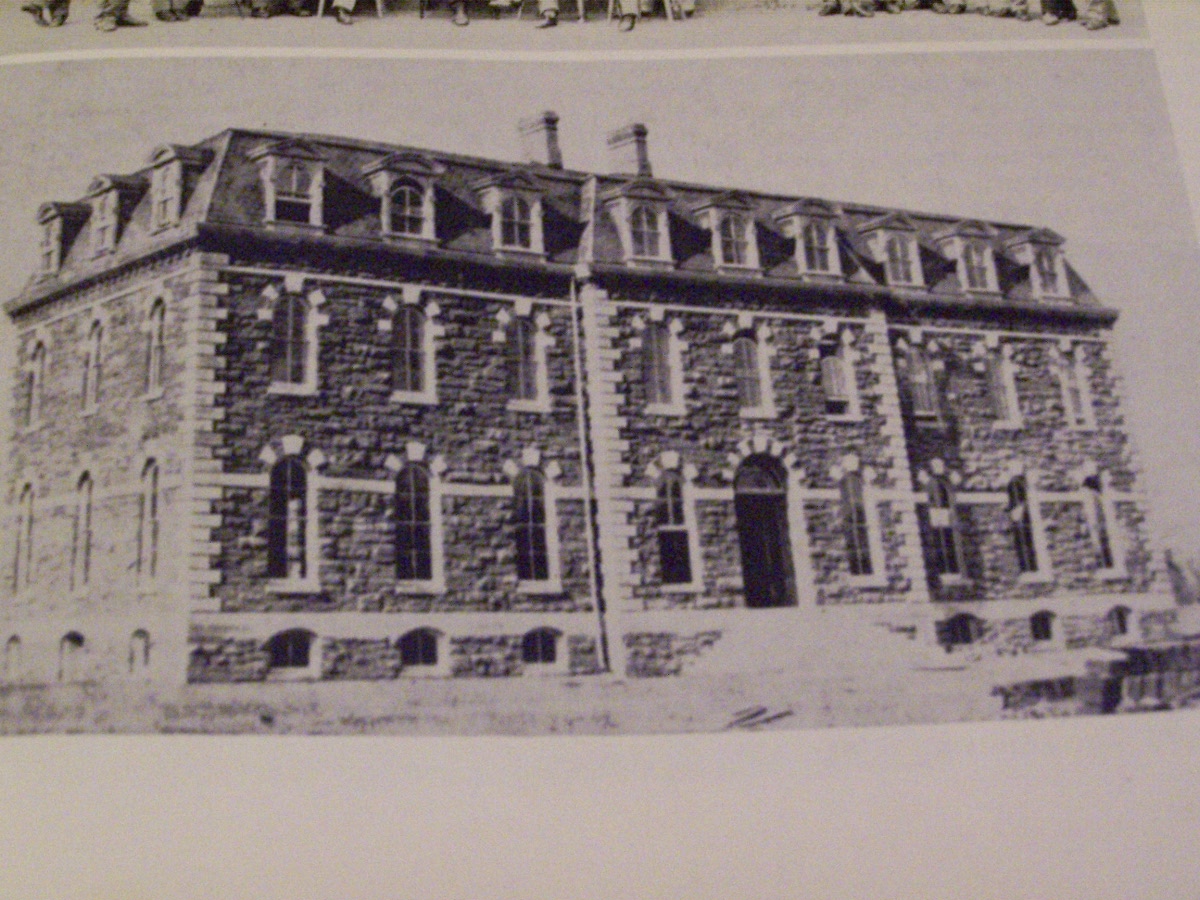
As mentioned previously, Sibley was constructed in three parts; the first, which is the West Wing of the current building, was built in 1870 and named for one of the original trustees of Cornell, Hiram Sibley. The East wind would be built in 1894,and the dome was constructed in 1902 [1]. Apart from stone Row, this was the first building that the University built that still stands today (the university did not build Cascadilla Hall).

000_2314

A map of campus, circa 1954. Some of the notable differences

I. Kappa Alpha Society’s house was where Snee Hall stands today. The house was torn down to facilitate construction of Hollister Hall in 1957-58, so KA moved to South Avenue. The Old Armory, built in 1892, was also torn down.

II. The road that was Central Avenue up until the 1990s cut between Franklin (Tjaden) and Sibley. Morse Hall would be torn down within a year of this map’s publication to make room for a parking lot, which would then be replaced by the Johnson Museum of Art that began nearly two decades later.

III. Boardman Hall is still there…in terms of aesthetics, I wish it was still there today too.

IV. ILR was located in temporary buildings (quonsets) on the Engineering Quad (which still had yet to fully develop). Law Hall, Moore Lab and the other smaller buildings where the ILR school stands today were the vet school buildings. Schurman Hall would come on line five years later, which facilitated the demolition of Law Hall in 1959, and for the construction of Ives Hall and Catherwood Library, which would be completed in 1962.

V. The Johnny Parson Club. More on that later.

VI. Alpha Xi Delta’s House is where the Prospects of Whitby co-op is located today. AXiD closed in 1964 and would be off campus for 40 years. Even the house they live in today is still own by Delta Phi Epsilon sorority (which closed the year before Alpha Xi Delta was brought back to campus). Chi Omega lived in the light purple house with the red tile roof on Wait Avenue, and would move to Phillips House (Sigma Alpha Mu’s current house) when that building was built on Sisson Place in 1956.

000_2315

A poor photo (my shaky hands, I regret) of the Statler Inn. Prior to the 150-room hotel built in 1986-87, the Statler Inn was the premier facility, with “modern classroom” and 36 rooms. Another hotel was located in the upper floors of Willard Straight Hall where the lofts are today, and those would play a prominent role in the takeover of Willard Straight in 1969.

000_2316

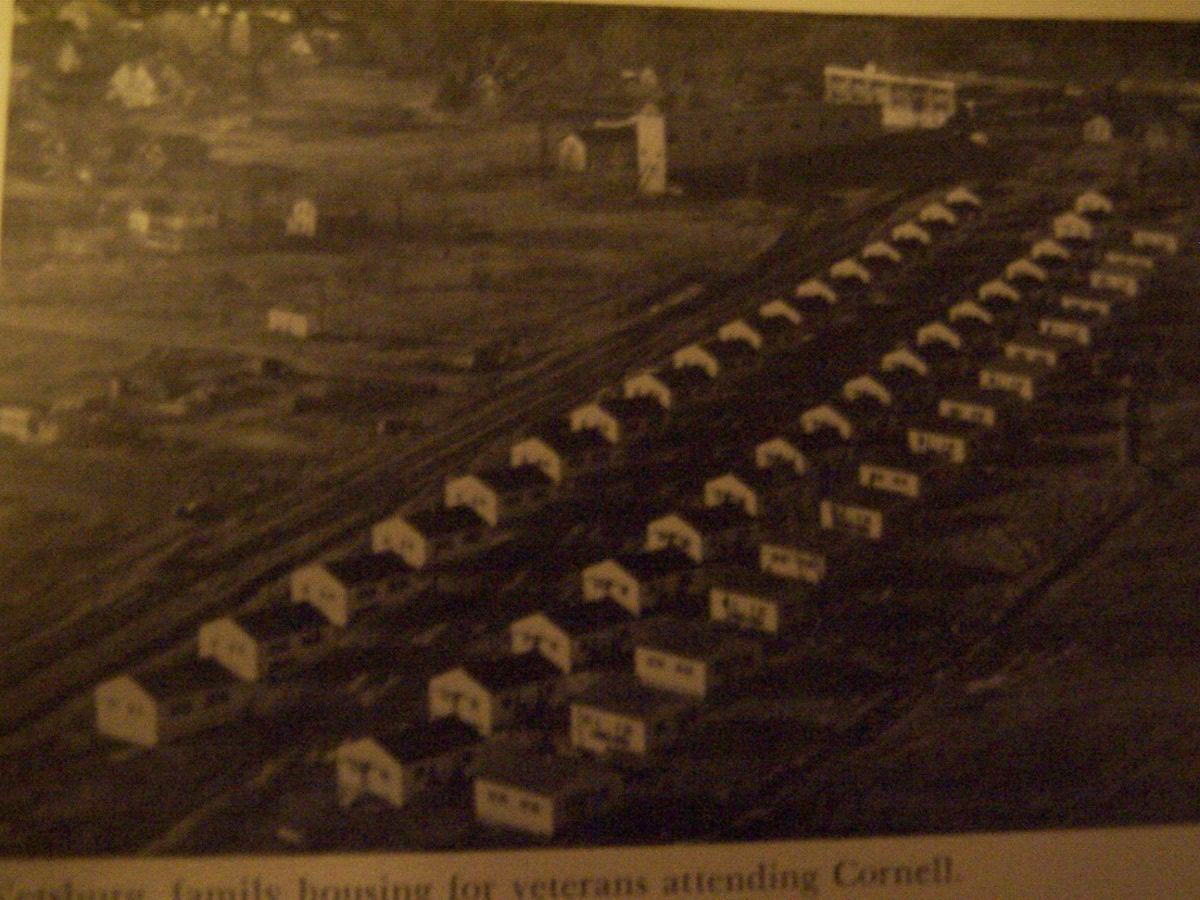
Prior to the Maplewood Apartments, veterans attending Cornell post-WWII had the option of living with their families in “Vetsburg”, on Maple Avenue.

000_2317

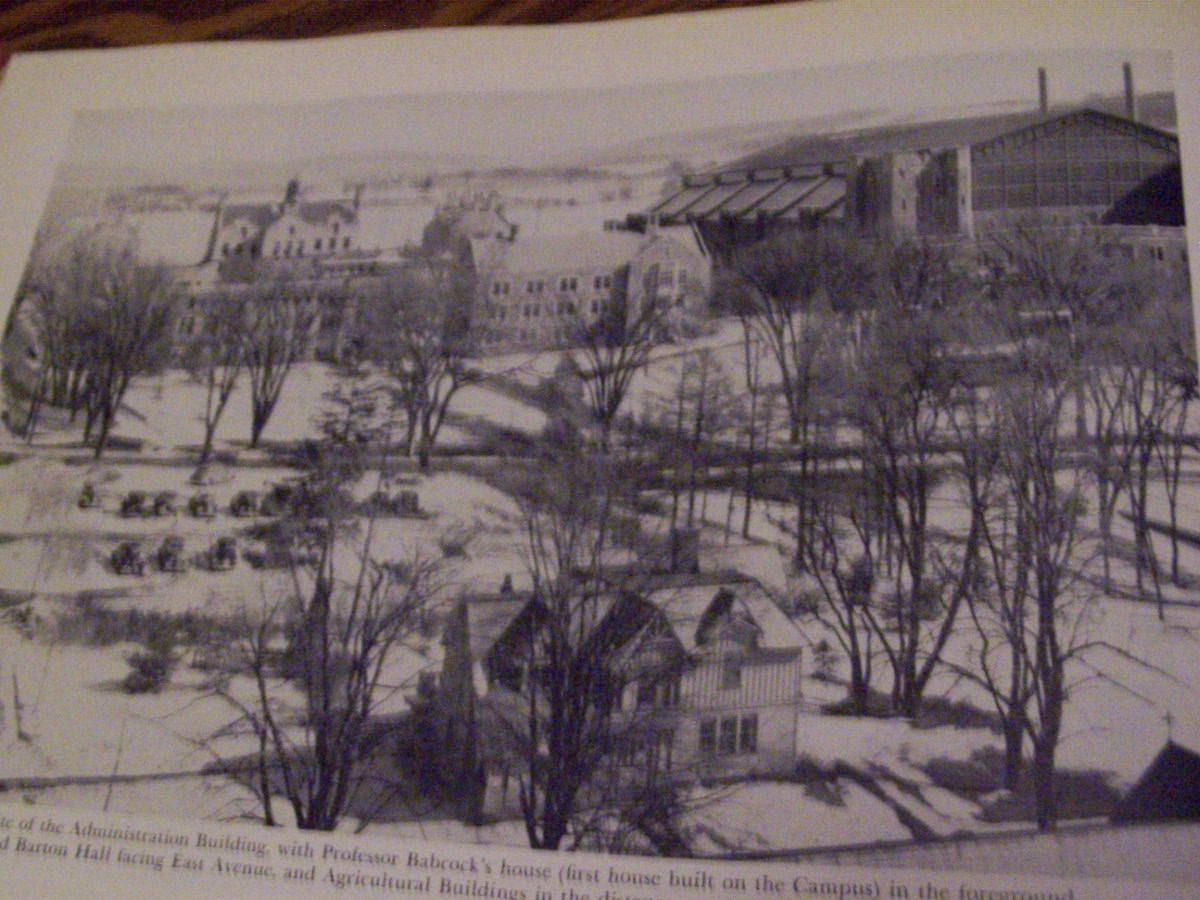
Back in the days before Day Hall, the lot was the site of a parking lot and the house of Professor Babcock, which was the first faculty house built on campus. Back in the day, it was common for houses to be on campus, where the Human Ecology school is today, where the Engineering Quad is today, and even on Central Campus. This was the last central campus house, and it was torn down to facilitate Day Hall’s construction (completed 1947) [2].

000_2318

To save my breath, I’m going to quote a DUE from August 23, 2007:

“The Johnny Parson Club was named after a mechanical drawing professor in the Engineering college from 1895 to 1938. It’s said that he was the one who established ice skating on Beebe Lake.  In addition, it was he who began the Cornell hockey tradition, by encouraging students to form a team.  In 1922, the University built a two-story facility where skaters could spend time, eat, drink, and warm up, naming it after Professor Parson.  However, in 1958, when skating events were moved to Lynah Rink, the University chose to take down the top two floors of the Club.  The remaining basement area was covered and is now used by Cornell Outdoor Education. [3]”

Rather nice place, from the looks of it. Tudoresque.

000_2319

Bacon Baseball Cage. The first Cornell mascot bear, Touchdown I, was housed here in 1915. [4] The building would be taken down for the addition of the press-box and more seats at Schoellkopf.

000_2320

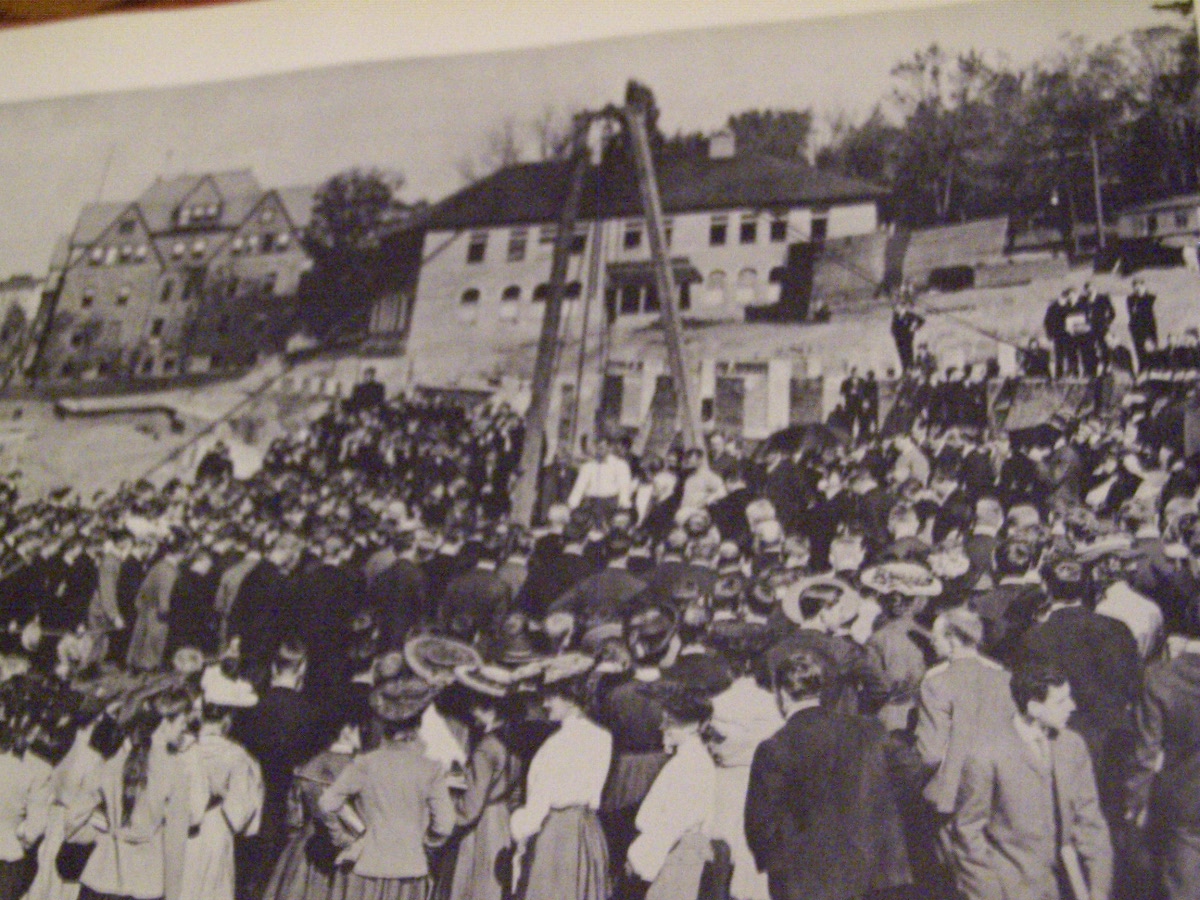
Laying the cornerstone for Goldwin Smith Hall in 1902. The building that is currently the north wing was constructed earlier on as the Dairy Science building.

000_2321

Law Hall, a couple small ag buildings, and the third observatory. It would be torn down for Barton Hall in 1915, and replaced with the observatory on north campus in 1924.

000_2322

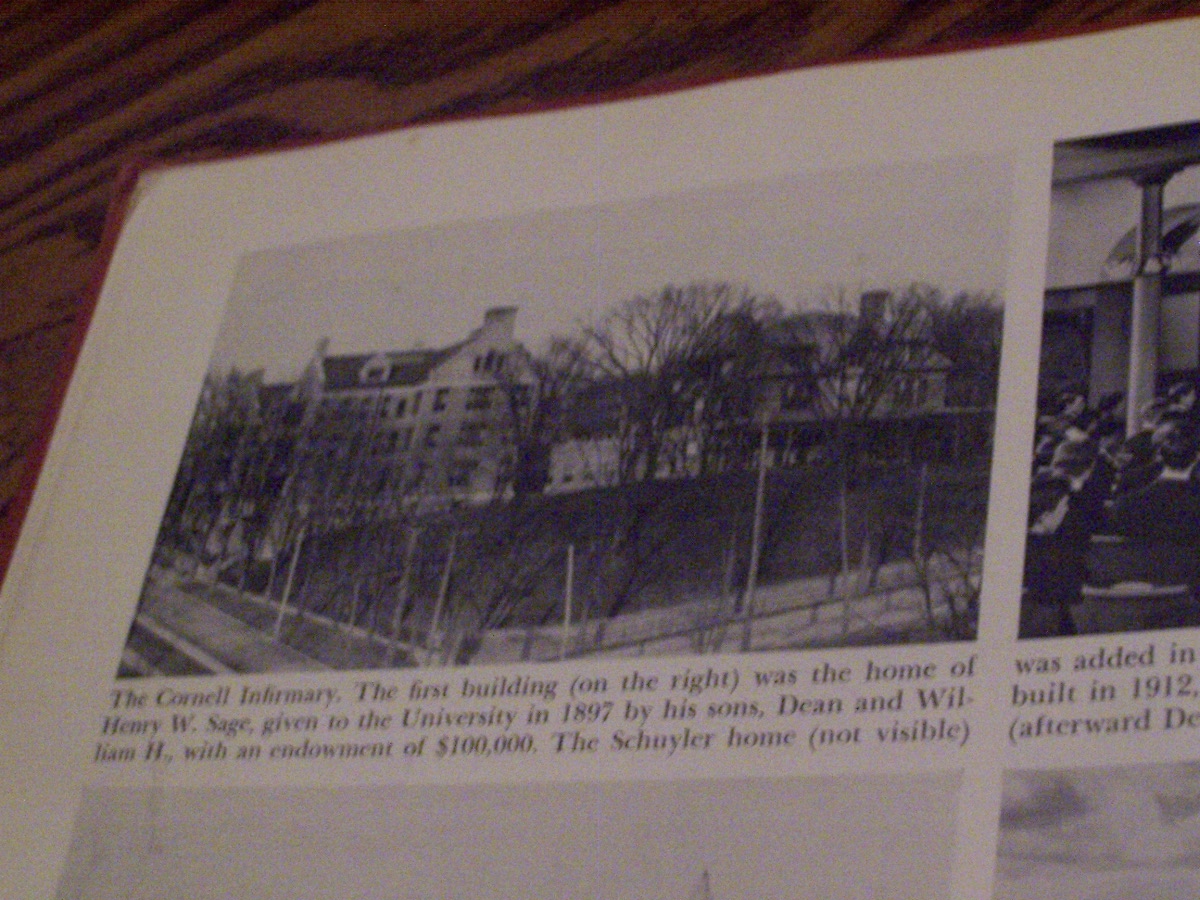
Schuyler House, the grad dormitory, used to be Cornell Infirmary. Next door is the Sage House. This was a time when students lived down the hill in fraternities or boarding houses, so it made sense to have the infirmary between the city and the college.

000_2327

Speaks for itself. Screw pumpkins on the clock tower, I’m going to go tear down the bridge into Collegetown.

000_2326

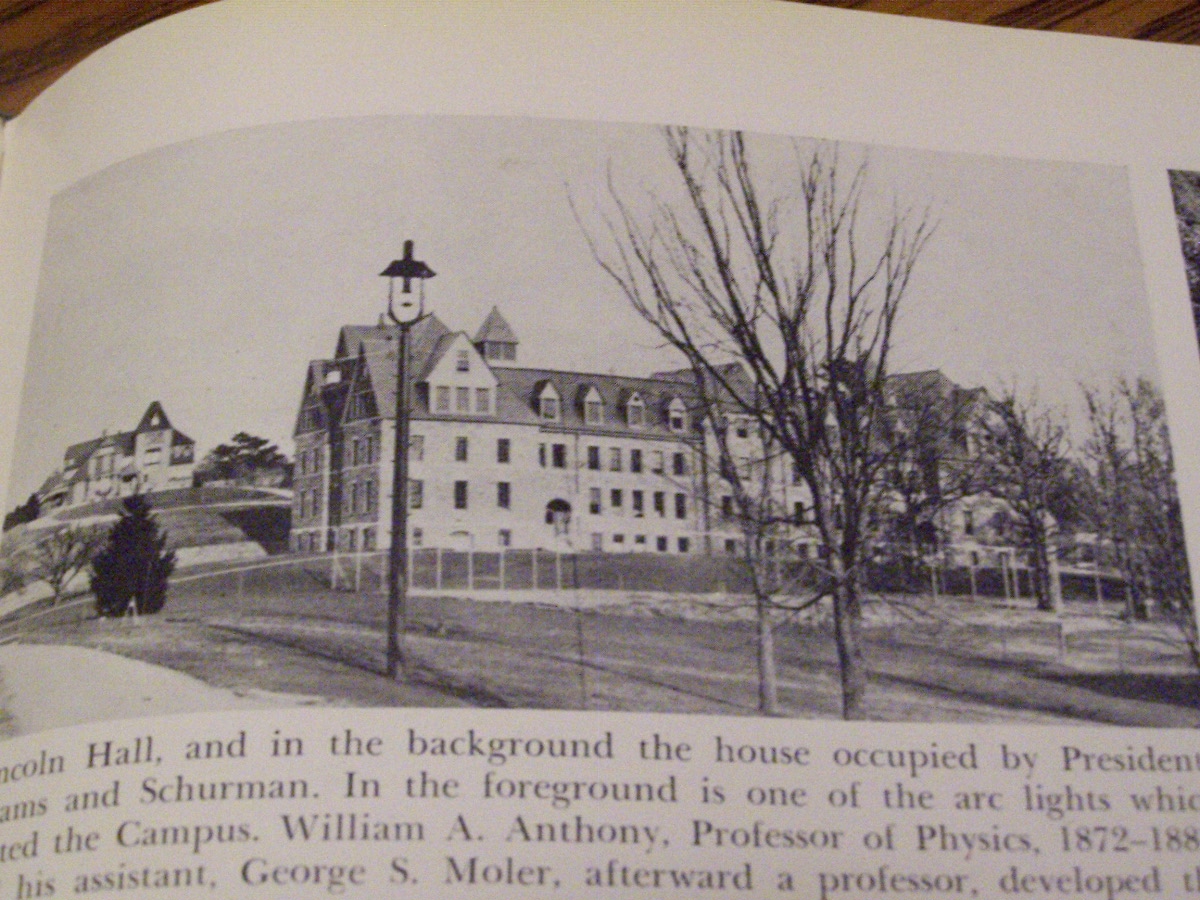
Fancy arc lighting. The house in the back was the stately home of Presidents Adams (1885-1892) and Schurman (1892-1920). It was torn down for Baker Lab shortly thereafter.

000_2325

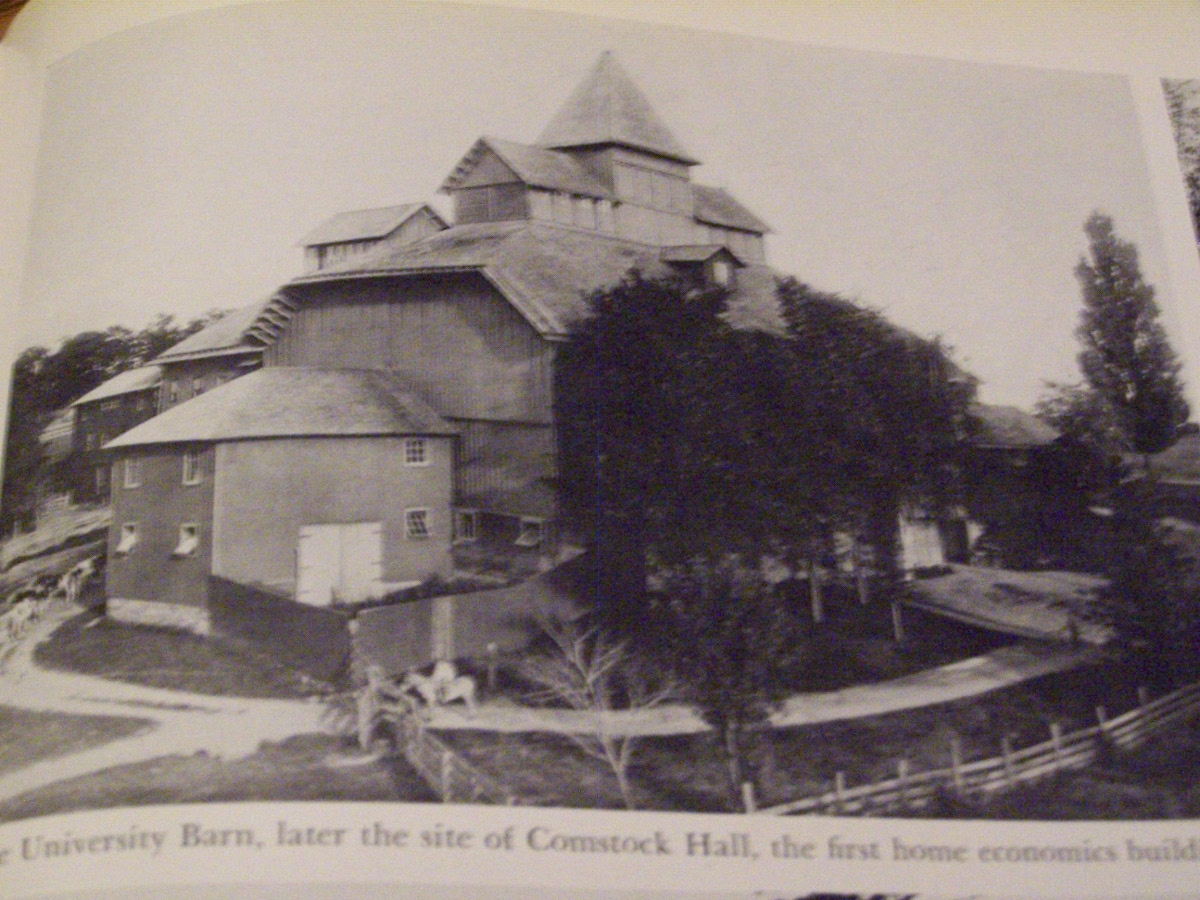
All the functions of a 1900s barn (where the CCC is today), all the appearance of a redneck’s idea of Count Dracula’s castle.

000_2323

Can we reconstruct this building as a dorm? Please? Hey, I know Morse Hall was burnt down by a fire and all in February 1916, but the design can be retrofitted with today’s safety standards. Really.

[1]http://www.cornell.edu/search/index.cfm?tab=facts&q=&id=651

[2]http://www.cornell.edu/search/index.cfm?tab=facts&q=day%20hall&id=239

[3]http://ezra.cornell.edu/posting.php?timestamp=1187848800

[4]http://cornellsun.com/node/17613


(Bad) Sign of the Times

30 10 2008

This is going to take away a fairly large amount of my writing material…

http://www.theithacajournal.com/article/20081030/NEWS01/81030012

Cornell announces hiring pause, construction moratorium
Moves in response to state budget news
October 30, 2008

 Cornell University is taking steps to prepare for blows to the budget, including a pause in hiring, a 90-day construction moratorium, and a university-wide review of all operations, Vice President for Communications Tommy Bruce said today.

The “pause” in hiring means no external applicants will be appointed to any open positions, according to a statement released by the university.

This is intended to provide slots for any employees who may be “dislocated in the near term” by funding cuts, and to find, through attrition, any positions that can be eliminated to minimize the need to lay off staff in the future.

Though a private university, Cornell operates four schools on the Ithaca campus established by the state and that receive public operating and construction funding. It is also New York’s land-grant institution and operates agricultural experiment stations in Ithaca and Geneva. Gov. David Paterson announced earlier in the week that the state faces a $1.5 billion budget gap for the current fiscal year and $12.5 billion for the fiscal year that starts April 1. About a fifth of state revenues are tied to the New York City financial industry.

Bruce emphasized that there will be no across-the-board cuts or layoffs, saying, “We have been having to deal with very real cuts coming from the state, and what we’re dealing with is loss of revenue in the wake of the Wall Street situation. What this means going forward is that we may be facing a situation in terms of reduced personnel. What we have to do at this point, not knowing the full impact of the current economic situation, is taking the precautionary step of pulling back on posting open positions and hiring externally.”

The hiring pause will be in effect until March 31 and applies only to non-professorial positions.

The 90-day construction pause will halt progress on any development project on which construction has not already started or which does not have a contract commitment on it.

Physical infrastructure, information technology capital investment, and local transportation and housing projects are included in the moratorium. Bruce said there will be a review of all projects to determine how to proceed most efficiently.

The university-wide review of operations will help the administration pinpoint areas that can be streamlined and where costs can be contained.

Bruce offered an example from his office, which produces more than 1,000 publications a year. These publications can be produced electronically, he said, saving the cost of paper and publication.

An electronic suggestion box has been set up at www.cuinfo.cornell.edu for members of the Cornell community to offer ideas.

~~~

City of Ithaca’s doing the same thing. The state’s severe defecits as a result of the crisis on Wall Street are finally hitting home…and it’s hitting hard.

http://www.theithacajournal.com/article/20081030/NEWS01/810300321

My question is which projects that are not underway have a contract commitment. I suspect Milstein is largely safe, but the addition to the Johnson Museum is likely shelved.