Better Late Than Never: 2009 OFSA Report Released

7 01 2010

It only took them until New Year’s to get it up on their website. What’s that, like six months since the numbers and data were finalized?

The PDF:

http://dos.cornell.edu/cms/greek/upload/OFSA_AnnualReport_0809.pdf

The cover is vaguely charming. I can see my fraternity’s pin on the cover. I also remember that our alumni board president didn’t know that the pins were for reunion, so we ended up putting them in storage for a while before giving them out to interested members.

Basic stats: Not a whole lot of change. Same number of chapters (AOPi closed and Alpha Phi Alpha reestablished itself). Roughly the same percentage of greek undergrads (more on that in a moment). Less community service hours, but about $6K more raised in philanthropies, but honestly no one really cares about that except when it comes time to say good (or bad, comparatively) things about the greek community.

Digging a little deeper into the IFC numbers, it looks like the percentage of Cornell male undergrads in fraternities has increased to 33.15% from 31.68%. Gross numbers, that’s about 143 more members (the total male undergrad population, Greek and non-Greek, increased by 126). Yet, the number of undergrad freshman males stayed nearly constant (up by 9), so the vast majority of the gains seem to be from upperclassmen who chose to pledge later in their college careers, and transfer students. Which is great, in my opinion; one of my best friends in my house chose to pledge as a sophomore, but I wouldn’t think of him any differently than someone that I pledged with as a freshman.

Sorority membership increased to 23.60% from 23.17%. Sororities had 78 more members in 2008-09 over the past year, but the total undergraduate female population increased by 190 students (including 120 more freshman women vs. the previous year). Average members per chapter from 73 to 81, but that’s because Panhel lost AOPi, so there were more ladies to go around.

As a guy, I think I lack the ability to understanding the dealings of Panhel. The idea of being in a chapter of 130 members isn’t too appealing, and I’ve definitely seen cases of girls in the same house not even remembering each other’s names. Whatever floats their boat, I guess.

Just stating this for the record, I write about OFSA figures and Greek life out of my own interest. No figures or statements in this blog are made with the purpose of influencing anyone towards a certain house.  This blog is only good for photos of the houses and for little history tidbits about the chapters. The only way you can figure the character of a fraternity is by visiting them and using solid judgment.


This Isn’t Your Father’s Fraternity

29 12 2009

So, with Rush Week coming up, I figured it was about time that I did another Cornell Greek System related article.

So, a fair number of guys who come back for rush week do so on their parent’s urging. Which seems a bit funny, considering the stereotypes and all, but it’s likely that the parents who are pro-Greek were in a fraternity or sorority themselves. Sometimes, someone’s father might try to prod them towards the house that they were a member of back in the day.

Well, fraternities are rather preculiar in that the character of a house can change completely in about three years, as members graduate and new brothers are initiated.  So, your father’s fratenity, while it may have been a “small nerdy house in 1970-something” or “a big jock house back in the ’80s”, may be something completely different today.

For this entry, I decided to compare the membership numbers of houses. For one thing, numbers are solid; character is subjective. Secondly, I’m only doing fraternities; sororities tend to be somewhat less elastic with numbers, especially since they operate with a quota system that sets the number of pledges a sorority may have.

The first number is the active membership number from the Spring 2009 semester for Cornell fraternities. The second number is for Spring 2005, selected merely to illustrate the dynamics of change (or lack thereof).  The last number is from Spring 1983, selected because it is a legitimate date that token rushee X’s dad might’ve graduated from college, but also because  it was easy for me to get a hold of the figures (on paper, so no links unfortunately).

A few details: Membership percentages in Greek houses in 2009 was 33.15% of the total undergrad male population, with 47 members on average (50 chapters fell under the “fraternity” designation, but that includes MGLCs – accounting for their typically small number, the reduction is to 42 chapters, then the IFC average is about 54 members). No offense meant to the MGLC folks, but I have no 1983 data for those chapters, so they are excluded.

For 2005, there were 40 IFC chapters, and an average of about 47 members per house (fraternity membership was 28.75%).

For 1983, there were 50 IFC chapters, and an average in the low 50s.The chapters that existed in 1983 that don’t today are

Phi Alpha Omega, a small collegetown-based fraternity started around 1982 and gone by 1986.

Triangle, down to eleven members. Their national would shut them down by 1985.

Theta Delta Chi, which closed in 1999 (to their credit, they have one failed recolonization attempt, from 2003). They failed to submit information in time to be included in the 1983 publication I’m using.

Phi Kappa Sigma, which closed in 1990. They had 35 members in 1983.

Phi Sigma Epsilon, which merged on the national level with Phi Sigma Kappa in 1985, closing the Cornell chapter. It had 73 members in 1983.

Chapter /Spring 2009/Spring 2005/Spring 1983

Acacia 39/29/33

Acacia was on the brink of closing in the late 1990s, when membership dwindled. It seems to have recovered well enough.

Alpha Delta Phi 57/69/56

Alpha Epsilon Pi 35/NA/NA

So, here’s the problem. The first time AEPi closed was in 1984. The second time was in 2005. Way to screw up by stats guys. I looked up their 2004 data; its membership number recorded 29 brothers.

Alpha Gamma Rho 52/63/86

Alpha Sigma Phi 51/56/71

Alpha Tau Omega 75/61/63

Alpha Zeta 55/24/53

Alpha Zeta almost closed in the mid 2000s, so that makes it upward climb more impressive. The 1983 value may be off, since this co-ed fraternity only recognized women on an honorary level at the time, so they were left off the roster. The other two values are combined co-ed.

Beta Theta Pi 30/51/49

Beta is in the midst of reorganizing, hence the low 2009 figure.

Chi Phi 73/72/ 56

Chi Psi 53/47/84

Just…ouch.

Delta Chi 82/27/65

Delta Chi closed and reopened in 2004,  hence the low 2005 figure.

Delta Kappa Epsilon 46/45/68

Delta Phi (Llenroc) 64/41/57

Delta Tau Delta 40/27/56

Delta Upsilon 66/50/60

Kappa Alpha 17/NA/39

Kappa Alpha closed in 1990 and reopened in 2007.

Kappa Delta Rho 39/34/47

Kappa Sigma 71/42/87

Lambda Chi Alpha 67/58/69

Phi Delta Theta 47/54/70

Phi Delt reorganized in 2000, when it threw out the then-current membership and started fresh as a dry fraternity.

Phi Gamma Delta (FIJI) 84/53/93

Phi Kappa Psi 72/61/87

Phi Kappa Tau 56/51/34

Closed in 1994, reopened in 2000.

Phi Sigma Kappa 51/56/65

Pi Kappa Alpha 61/56/102.

Wow. I never knew Pika was once the largest house on campus.

Pi Kappa Phi 65/48/25

Closed in 1986, reopened 1990.

Psi Upsilon 37/57/NA

Psi Upsilon was closed from 1981 to 1985. They also reorganized in 2008.

Seal & Serpent 17/20/35

What happened here was a slaughter of their reputation. That was covered in a previous entry.

Sigma Alpha Epsilon 91/89/35

On the other end of the scale, the rise of SAE is impressive. Who would’ve guessed they were such a small house back in the day?

Sigma Alpha Mu 70/52/21

Sigma Alpha Mu was rechartered in 1983/84.

Sigma Chi 67/61/79

Sigma Chi Delta 12/8/14

An item worth noting- the vast majority (80%+) of Sigma Chi Delta’s membership in the 1980s was of east Asian ethnic groups.

Sigma Nu 55/61/72

Sigma Phi 58/47/45

Sigma Phi Epsilon 51/52/50

Not as stable as it looks. Reorganized in spring 2006, closed for the fall, reopened in 2007.

Sigma Pi 39/83/94

Reorganized in 2008.

Tau Epsilon Phi 59/11/30

TEP must be doing something right.

Tau Kappa Epsilon 31/34/44

Theta Delta Chi 63/40/69

Theta Xi 23/NA/NA

Theta Xi was closed in 1970 and didn’t recolonize until 2008.

Zeta Beta Tau 43/51/NA

They didn’t submit in time for their 1983 data to be published.

Zeta Psi 53/29/43

So in conclusion, although your dad may regal you with stories of his fraternity days, don’t expect to have the same experience if you pledge his old house.


Random Ithacana

18 12 2009

So, pardon the extraordinarily long break. Finals and research brought much of my outside life to a screeching halt, so this blog had to take a backseat for a couple of weeks. Oddly enough, site statistics didn’t really go down a significant amount, which probably says something about the consistent use of the historical info on this blog.

Anyways, during my holiday shopping, I happened upon a new little book that I felt the need to add to my collection. The book, Surrounded by Reality: 101 Things You Didn’t Know About Ithaca, NY (But Are About to Find Out) by Michael Turback, is a nice little book detailing some of the history and sights of the area. Some of the book entries share the same information that has previously been shared on this blog, but there was some new information to be garnered from its pages.

A lot of the book focuses on Cornell. Things that a lot of Cornellians already knew about the founder and A.D. White, but also some more obscure details. For example, a real description of Zinck’s. Theodore Zinck ran the “Lager Beer Saloon and Restaurant” out of the Hotel Brunswick at 108-110 N. Aurora (just off the current-day Commons) starting in 1880. Contrary to modern day bar-hopping, Zincl, while described as being a fatherly and caring figure who treated his customers with “Prussian high-handedness”. Customers could be thrown out of his bar, however, for drunkenness, bawdy songs, or derogatory references to the German Kaiser. The first Zinck’s operated until about 1903. That year, a typhoid epidemic rages through the city and claimed 85 lives, including Theodore Zinck’s daughter. Despondent, he drowned himself, effectively shutting down Zinck’s first incarnation. The bar reopened under his name in 1906 (which would be incredibly tasteless if he wasn’t regarded so affectionately), and continued in operation in some form in different names and places up to about 1967. Although, with the coming of the new Hotel Ithaca, it appears we may continue the local tradition of naming revered watering holes after a suicidal barkeep.

Another detail that the book referenced was the freezing over of Cayuga Lake. Cayuga Lake is about 435 feet deep, so usually the massive heat storage of the water keeps the lake from completely freezing over during the winter. However, that isn’t to say it can’t happen. Since 1796, the lake has frozen over about ten times (1796, 1816, 1856, 1875, 1884, 1904, 1912, 1934, 1961 and 1979). Wells College, a small and formerly all-female school located further up the lakeshore in Aurora, has a school tradition where if the lake is discovered to be frozen over, classes are cancelled for the day (there is no such tradition for IC or Cornell). According to the book, during the 1875 freeze one athletic young woman at Wells decided to celebrate the day off by skating down the lake and back. Not too shabby, once you consider that the lake is just under 40 miles long.

One last one for the road; most Cornellians are well aware of the legend that if a virgin crosses the Arts Quad at midnight, Ezra and A.D. White will step off their pedestals and shake hands in the center of the quad. Wll, as it turns out, Ithaca College has their won virginity legend. Outside of Ithaca College’s Textor Hall stands a 10-foot high ball sculpture mounted over a small pool of water. Their campus legend states that if a virgin ever graduates from IC, the “Textor Ball” will fall off its pedestal and roll down South Hill. According to Wikipedia, Ithaca College has 49,570 alumni, and I’m willing to bet most of them are from after the school’s 1960s expansion and relocation.


A Blind Eye to Sports

8 11 2009

As anyone who doesn’t live under an Ithacan rock knows, Cornell had its much-publicized and anticipated match against Harvard on the ice of Lynah Rink last night. Much to Cornell’s delight, the Big Red skated to an impressive victory over the Crimson, with a final score of 6-3.

I feel like I’m one of a handful of undergrads on this campus who really doesn’t give a damn.

Not that I don’t have respect for athletes at Cornell. I give them by full respect. It’s just that I have never followed sports, with the slight exception of cross country and track back in junior high and high school because I was on the team (and let’s be honest, they’re just not the same when it comes to skill or competitive spirit). I’m content to sit back and watch everyone else get excited, because I’m just disinterested in Cornell sports. I’m never sat all the way through a Cornell game in any sport.

So, unsurprisingly I never mention sports on this blog, unless there’s historical worth to mentioning it. Which I can briefly do now.

Back in the day of the university founding years, the big sport for students to follow was crew, aka rowing. A.D. White was a member of a rowing club during his own collegiate years at Yale (Bishop 33). The first boating clubs formed in 1871, and a regatta was held the following spring (if you could call it that). The first big victory came at Saratoga in 1875, much to the joy of the school and the town (story goes that A.D. White broke into McGraw Hall Tower and rang the chimes himself). Baseball and football were vague diversions, not even intercollegiate until 1874 (Bishop 134). Cornell actually had its own rules of football that no one cared about, so the university didn’t take a substantial interest in football until about 1886. The Cornell Atheltic Association formed in 1889 (296). The first athletic area, built in the same year, was off campus on what is now the site of Ithaca High School, and was called Percy Field after the donor’s son, who was at the time a student athlete at Cornell. Hockey was recognized in 1900, basketball a year later. Lacrosse started up in 1885, but was  like clothing fashions among students, coming back into and going out of style every few years.

Hockey was originally played on Beebe Lake. The idea of bringing it to Cornell came from a professor of engineering named Johnny Parson. Hecne, the establishment of the Johnny Parson Club. When the lake began to melt, the team would use the Ithaca city ice rink. The team won what might be its first intercollegiate championship in 1911 (417).

So, Bishop’s history of Cornell only mentions hockey twice, and was published in 1962, suggesting the sport was still on the periphery of athletics at that time. That was also the same year that underdog Cornell outplayed perennial powerhouse Harvard. Things started to get more interesting when the Harvard/Cornell hockey rivalry started to heat up in 1973 with Harvard’s tossing off a chicken at Cornell goalie Dave Elenbaas, as a knock against the Ag School (of course, nowadays we can depend on our alumni to knock the ag school). So Cornell students responded later that month by throwing fish onto the rink. As the decade wore on and Harvard’s program weakened, the Big Red wasn’t content to let things slide, so the rivalry has been intensified since the incident.

So that’s why Cornell-Harvard tickets can be so expensive, and why this one game is as close as Cornell gets to the storied rivalries of Big Ten schools. Some of us are more into it than others though.  


The Cornell Daily Sun

21 10 2009

100_1899


So, I first thought about writing an entry on the Sun because of fortuitous circumstances. I happen to write in some small capacity for the Sun, but with the exception of one person (to my knowledge; most everyone else couldn’t care less), no one at the Sun knows that I write this blog. Occasionally, someone will ask “when was Mann Library built?” or “when is Milstein Hall supposed to finish construction”, and it’s really tempting to put in my two cents, but  for the most part I focus on my work and leave when I’m done.

Regarding the Sun itself, the newspaper is based out of the former Elks Lodge building on the 100 block of West State Street, a block west of the Commons. The building itself dates from 1916, and the Sun renovated the building and moved into the 7,000 sq. ft. building during 2003 (prior to that, thsun rented space around the corner on Cayuga Street). The Sun is totally independent of the university, which is great because the school paper of the university I worked at this summer was nothing more than a mouthpiece for the administration and its cultish president, but I digress. The original Cornell newspaper was The Cornell Era, which was founded in 1868 and named as such because it marked the beginning of a great new era. Much to the Era’s chagrin, the Sun appeared on September 16, 1880, in the format of a four-page pamphlet-sized newspaper (Bishop 206).  The Era eventually became more of a literary magazine and shut down permanently in the late 1940s. The Sun has operated continuously since its founding.

The building itself is an interesting place ot visit. The main work area on the first floor has private offices, and a general work areas for contributors and writers filled with newspapers and article drafts from previous days. The upstairs has a spacious and stately wood-trimmed great room, which I suspect was probably used as a cermeonial/banquet room back when it was the Elks Lodge. I’ve never felt compelled to take photos inside the building, mostly because of the stares I would probably get.

Bishop, Morris. A History of Cornell. New York, New York: Cornell University Press, 1962. ISBN 0-8014-0036-8


Expecting A Warm Winter

4 10 2009

100_2434

Global warming completely aside, I think it might be worth noting that Ithaca can expect a warm winter for 2009-2010. This is because we’re in the middle of an El Nino year.

For those living under a rock, El Nino (or as meteorologists know it, the el Nino Southern Oscillation, often reduced to ENSO) is the much publicized periodic change in atmospheric and oceanic conditions highlighted by the shift of the eastern Pacific Ocean water temperatures to much warmer than usual conditions (typically most apparent off the coast of Peru). The effects on the Atlantic will lag somewhat behind the Pacific.

Well, El Nino conditions started to kick in during this past summer, around June. One effect that El Nino years (as they tend to last 12 to 18 months) have is that the Northeast is much warmer than usual during the winter. To illustrate this, I pulled the data for the last few El Nino years (Winter 06-07, Winter 02-03, Winter 97-98, and Winter 94-95, Winter 91-92) from the Northeast Regional Climate Center.

Month/Year Anomaly

Dec 2006 +8.0 F

Jan 2007 +5.6 F

Feb 2007 – 7.1 F

Dec 2002 -2.2 F

Jan 2003 -5.6 F

Feb 2003 -3.0 F

Dec 1997 +2.3 F

Jan 1998 +8.4 F

Feb 1998 +7.8 F

Dec 1994 +4.4 F

Jan 1995 +7.1 F

Feb 1995 -2.7 F

Dec 1991 +2.0 F

Jan 1992 +3.0 F

Feb 1992 +2.0 F

Data from pre-1995 is only available to those with research accounts. Thankfully, my senior thesis research has allowed me this perk. Anyways,  4 of the past 5 El Nino seemed to follow the typical pattern, and 2002-2003 did not. To be perfectly honest, that year is still under study as no one can really seem to explain what happened. A prevailing theory for a while was that it was another osciallation (the Pacific Decadal Oscillation) having an impact on El Nino, but that theory developed a big hole in it after a fairly typical 2006-2007 El Nino year. It takes 20-30 years for the PDO to change phases, so 2006-2007 should have been much the same, but it wasn’t.

Keep in mind this is all relative. Five degrees above normal during the coldest time of the year (late January) means a high of 35 and a low of 19. So don’t get too comfortable.


News Tidbits 9/19/09: Stocking Hall’s Long Awaited Reconstruction is Approved — Dairy Plant to Shut Down

19 09 2009

The Dairy Bar as we know it will soon be no more. According to Cornell, the new Stocking Hall will start construction next September. The $105 million project will last approximately four years (meaning that no current student will see it through to its full fruition while an undergrad…probably not even the kids in the class of 2014). The project calls for tearing down the east portion of the building and building a new glass-fronted modernist four-story structure. The older portion of the building (the part that actually looks attractive) will be refurbished. In the meanwhile, the Dairy Bar will temporarily be moved to Trillium while construction is in progress.

The project was originally slated to begin this year, but was pushed back amid concerns with state budget cuts (i.e. lass money allocated to CALS programs) and adequate funding for the project.

MINOR UPDATE: I think this is the first time I ever heard the project come up in a fraternity meeting, but it was announced at the end of the meeting with the same tone one would expect to hear that Christmas has been cancelled until 2014. I have underestimated people’s love of the Dairy Bar. I also did not account for the fact that Cornell is laying off all Cornell Dairy employees.

***

http://www.news.cornell.edu/stories/Sept09/StockingHall.html

CALS plans major renovation of Stocking Hall

With $105 million from the State University Construction Fund, Cornell’s College of Agriculture and Life Sciences (CALS) will build a new four-story building to replace Stocking Hall’s “runway” and refurbish Stocking Hall, starting September 2010, to give the Department of Food Science and the landmark Cornell Dairy Bar state-of-the art homes.

The innovative design — including a glass-fronted Dairy Bar and dairy plant and ground-floor laboratories for wine production and sensory studies of food — will invite the public to learn more about food and dairy processing. From an observational balcony above the Dairy Plant, visitors will have a bird’s-eye view as Cornell ice cream, milk, pudding and yogurt move from processing to pasteurization to packaging.

The four-year project calls for demolishing and rebuilding the middle “runway” portion of Stocking Hall, the Dairy Bar and dairy plant along Tower Road with the new four-story building; the Stocking Hall “tower” on Wing Drive will be refurbished. The more modern Food Science Lab, at Tower and Judd Falls roads, will operate as a food processing research facility while reconstruction occurs.

Stocking Hall, which dates to 1923, will be outfitted with new laboratories for the study of connections between foods and human health, food safety, and food and biomaterial processing. Other highlights include a campus teaching winery and crush pad for viticulture and enology students, and modern classrooms and networked meeting spaces.

“The Stocking Hall renovation project presents a timely opportunity for Cornell’s nationally top-ranked food science program to provide the campus and Ithaca communities with a better understanding of how food moves from the field to the marketplace,” said Kathryn Boor, food science chair. “Citizens around the globe are increasingly interested in where their food comes from and how it is handled, processed and marketed.”

Boor said the overhaul would improve research and extension directed at dairy and food processors, and expand training for inspectors from the New York Department of Agriculture and Markets, as well as state-authorized certified milk inspectors. A modernized facility will also allow CALS to compete for more food safety, quality and processing research funds from federal and state agencies and private companies.

“Because our program conducts research and outreach aimed at improving dairy product quality and safety and wine quality, this renovation project will directly contribute to improving the viability of the New York dairy and wine industries, which are typified by family-owned and -operated businesses,” Boor said.

The Dairy Plant’s ice cream freezer, outdated tanks and pasteurization equipment will be replaced with computer-controlled machinery capable of transmitting data directly from the floor of the plant to the Web for access by employees, researchers and students.

“The redesign of Stocking Hall will make our day-to-day operations more efficient, allowing us more time and resources to focus on our core mission of supporting teaching, research and extension,” said Jason Huck, general manager of the Dairy Plant.

Next summer, the Cornell Dairy Bar will move to a temporary scooping station in Kennedy Hall’s Trillium Express to make way for construction. Once the first phase of construction is complete in 2013, the iconic Dairy Bar will reopen in Stocking Hall with a revived look and an expanded menu and seating.

Each year, the dairy processes 1.5 million pounds of raw milk from cows at the Cornell Dairy Teaching and Research Center in Harford, N.Y. It produces 140,000 gallons of milk, 20,000 gallons of ice cream, and 4,000 gallons of yogurt and pudding annually. About 80 percent of these products are featured at Cornell Dining locations, while the remainder is distributed to Cornell group houses and departments.

***

Dear Food Science Faculty, Staff and Students,

With the Stocking Hall renovation project entering the last third of the design phase, and with project time lines becoming firm, we are beginning to prepare for ground-breaking for our new building, now less than 12 months away.

The fact is that the current Dairy Bar and Dairy Plant stand in the direct path of a wrecking ball.  In September 2010, the building in which these operations reside will be razed to make room for a new, state-of-the-art Food Science building. The finished renovation project will reveal a new dairy research and manufacturing facility as well as a new food service facility that will serve Cornell Dairy ice cream and more.
Together with CALS senior leadership, the Food Science Department has developed plans for continuing our core teaching, research and outreach programs during the renovation period.  As you know, the Dairy Operations is an integral component of our Food Science program, contributing to undergraduate and graduate instruction in food science; to basic and applied dairy foods research; to public service through extension programs; and as a designated training facility for New York State Certified Milk Inspectors, the New York State Department of Agriculture and Market Inspectors, and the dairy industry.  In addition, the Cornell Dairy supports many other academic programs (including many College of Engineering courses) and serves as an icon to much of the Cornell community, old and new, in Ithaca and beyond.

Due to budgetary constraints, it is not feasible nor practical to construct an interim dairy manufacturing plant or Dairy Bar during the renovation period. Therefore, we are facing at least 3-4 years from the time when demolition starts until we have a new dairy plant and food service operation up and running.  Specifically, as of June 18th, 2010, the Dairy Bar in Stocking Hall will close its doors and the Dairy Plant in Stocking Hall will eliminate its manufacturing operations.  The staff positions associated with these operations will also end, and those holding these positions will be laid off.

Although it is more than 9 months until the Dairy Bar and Dairy Plant activities will be directly affected by the renovation project, it is our intent to openly communicate the future direction of the Dairy Operations to our entire team and to the community. Our goal is to provide our staff with appropriate resources and support. The Department and CALS Human Resources will assist our staff through this difficult transition.

As our department embarks on a challenging period of change and uncertainty in the face of hope for a better future, our vision is to provide long-term sustainability to our dairy foods research and outreach program within CALS.  We believe that we’re moving in that direction, but it will come at considerable cost to our team.  We appreciate your assistance in helping us to support our staff and our program through this challenging and emotionally difficult period.
Please do not hesitate to let me, Matt Stratton or Jason Huck know if you have any questions about our situation.

Sincerely,

~~~


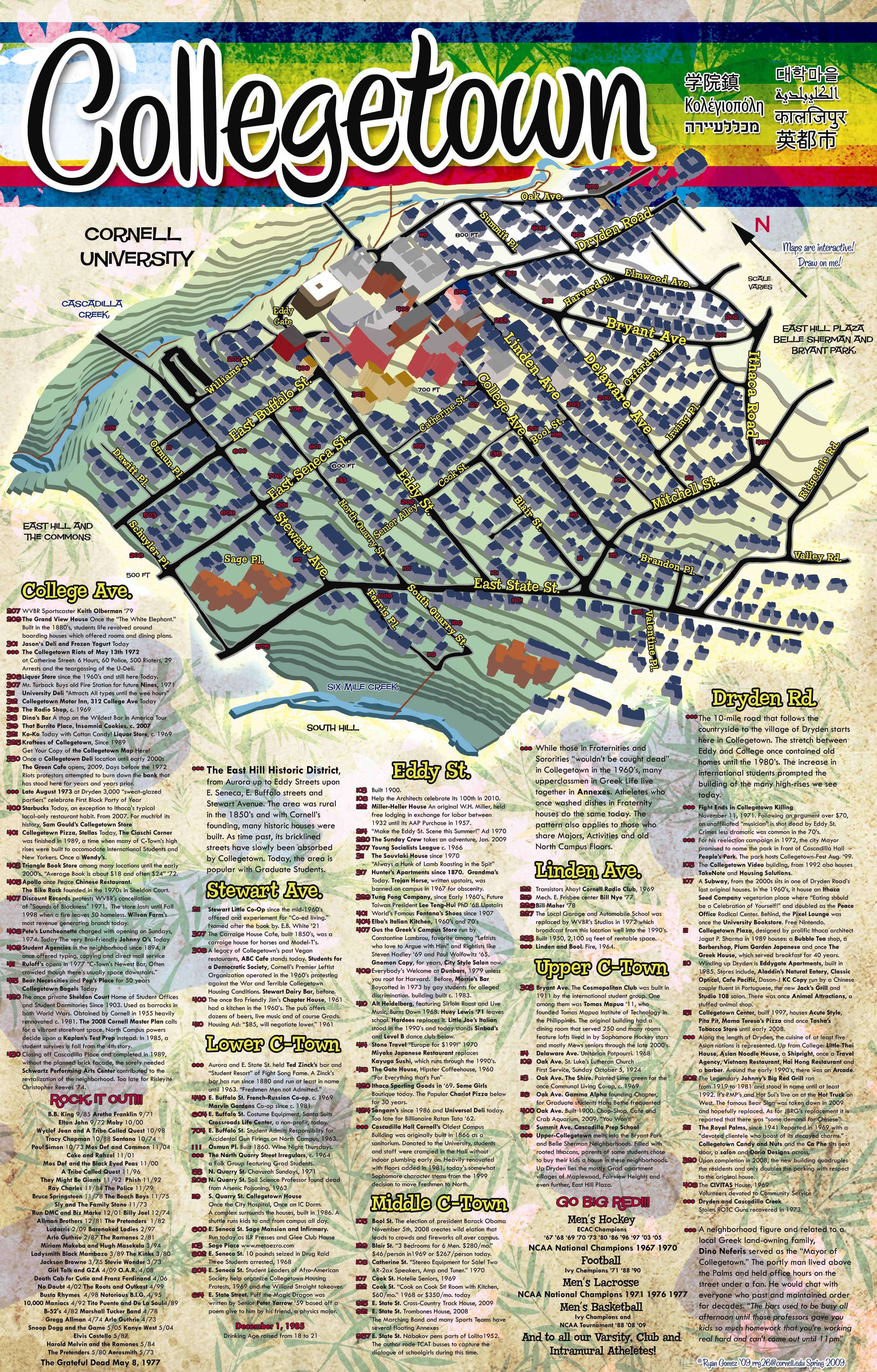
Best Map of Collegetown Ever.

10 09 2009

The map was a project of an alumnus, Ryan Gomez ’09. I dare say it’s one of the best maps I’ve ever seen of Collegetown, not only because it’s a visually appealing map, but also because it covers the history of many of the addresses in the neighborhood, not to mention worthy Cornelliana.

This map deserves a look:

http://www.metaezra.com/images/ctown_map.JPG

Mr. Gomez, you’ve earned my respect and admiration.


News Tidbits 8/21/09: Dumb Frat Tricks

22 08 2009

100_1703

The house involved is Sigma Nu, off Willard Way near West Campus. Apparently, firefighters found a small pot-growing operation while investigating a busted water pipe. I would not be surprised if sanctions from their national or from the IFC are put in place against Sigma Nu as a result of this incident, as it is rather embarrassing for the Greek community (personally, I think it makes Sig Nu look like a bunch of dim bulbs).

ITHACA — A busted water pipe may lead to a drug bust after the discovery of a small marijuana-growing operation inside a Cornell University fraternity house.

The Sigma Nu house manager called firefighters about the broken water pipe on the second floor, Ithaca fire officials said. Firefighters contacted the Ithaca Police when they found the plants.

 Ithaca firefighters found a half-dozen marijuana plants Tuesday afternoon while investigating a broken water pipe at the Sigma Nu fraternity house on Willard Way, Ithaca Police officials said. Officers seized the plants and though they’ve identified a person of interest, they aren’t releasing his name. 

 Water was running through the ceiling, they explained, and in the process of assessing the damage, firefighters found the plants in a tin-foil lined closet, surrounded on all sides and angles by several high-intensity lights. 

Whoever was growing the plants will likely be charged with unlawful growing of cannabis, a misdemeanor, police said. Fire officials said the numerous electrical cords used to power the lights created a fire hazard.

The leaking pipe was part of the sprinkler system and had to be shut down for repairs, Ithaca Building Department officials said. Additional life and safety issues such as a defective smoke and fire detection system and missing exit signs were found, so they posted the house on Tuesday and told everyone to leave until the problems could be fixed, they added.

Bobby Quintal, a member of the fraternity’s executive committee and last year’s president, said the chapter housed members in local hotels and other campus fraternities donated space while contractors fixed the problems.

Friday evening, Ithaca Building Department officials said that the house would likely be safe and ready to be reoccupied later that night.

Quintal said he isn’t living at the house and has no knowledge of the marijuana found there, but that marijuana possession violates Sigma Nu fraternity rules. When rules are violated, the national chapter investigates and might sanction the local chapter, the fraternity member or both, depending on the outcome of their investigation.

http://www.theithacajournal.com/article/20090822/NEWS01/308220004/Busted-water-pipe-in-Cornell-frat-house-leads-to-marijuana-find&referrer=FRONTPAGECAROUSEL

//


Cornell Criticism

12 08 2009

100_3851


What inspired this post were the none-too-charming rankings released recently by Forbes on their “Best Colleges” list [1]. The article itself wasn’t the trigger, but the comments, however…

Where’s Cornell? Where it belongs, behind a lot of small LAC’s where teaching undergrads is actually a priority.”

“…another thing I considered: Cornell has one of the highest suicide rates of all colleges/universities in the U.S. actually, at one point, it was the highest…”

(not true according to the New York Times, but that’s beating a dead horse…)

Now, I could really care less about overall school rankings. Cornell is one of top-rated schools in my field of study, so that’s about the only ranking I ever cared to know. But, there’s a little bit of dark humor to be found in the lengths that people will go to criticize other institutions.

Cornell, of course, is not new to criticism.  The school was maligned in its early years for being co-ed, for not having a religious affiliation, and for some faculty that ran dangerously awry from the norms of the time (one of which included a professor that was an atheist, which in the religiously driven nineteenth century was truly shocking and tabloid worthy). Even today, remarks of “SUNY Ithaca” and “the safety school of the Ivies” still manage to bother some of our thinner-skinned students and alumni. Read Ivygate’s comment section for examples [2].

In the early 1940s, there was “The Dilling Affair”. A student by the name of Kirkpatrick Dilling was brought before the Student Conduct committee and put on parole for engaging in stunts such as blowing dormitory fuses and filling ceiling lights with water. Well, his parents were extreme right-wingers who were convinced that their son was put on parole due to the committee’s underlying communism. Mrs. Dilling came to Ithaca, launched her own investigation, and published a scathering magazine report detailing how the reds has infiltrated the institution from President E. E. Day down. (Bishop, 568)

Sometimes, Cornellians are their own worst enemies. Consider the little feud between Ann Coulter and Keith Olbermann earlier this year. For anyone who wasn’t living under a rock, Metaezra has the full story [3], so I’ll take the liberty of abridging the drama. Coulter, a bastion of invective conservatism, made the remark that liberal mouthpiece Keith Olbermann didn’t go to the same Cornell, but rather state school Cornell (CALS). Most of us who went to Cornell, while aware of the difference (and that the only significant differences between them are source of funding and in-state tuition), but also know that criticism is about as bad an idea as sticking a knife in an electrical socket. But, Olbermann responded back by showing off his diploma on air and bragging about his Cornell degree, Coulter just had to respond back, and the catfight resulting in nothing more than embarassing just about everyone else who ever went to school far above Cayuga’s waters. 

Here’s some of my favorites – building criticisms, as recorded from respondents in the Cornell Alumni News:

Sibley Dome – “the breast of campus”

Rockefeller Hall – “public grammar school No .16”

Baker Lab – “A U.S. Post Office Conferred by a Republican administration”

Olin Hall – “might suit a department of alchemy better than chemical engineering”

…and that was before the sixties and seventies rolled around. The aesthetic critics must be rolling in their graves.

I s’pose Cornellians are their own worst enemies. To quote one more commenter from Forbes:

Wow! A lot of references to Cornell in these comments! As a Cornell graduate, I see that “complex” is still there for many Cornellians.

[1]http://www.forbes.com/lists/2009/94/colleges-09_Americas-Best-Colleges_Rank.html

[2]http://www.ivygateblog.com/2009/03/cornell-fan-admits-cornell-does-not-belong-in-the-ivy-league/#comments

[3]http://www.metaezra.com/archive/2009/03/ann_coulter_is_an_idiot.shtml