When The Mayor of Ithaca Stood Up To Cornell

23 04 2012

So, this entry is a little delayed because I was at a conference doing what scientists do best, which is trying to explain their research and justify the grants that pay for it. Since my research (and by extension, my paycheck) takes priority, things got a little pushed back with the blog updates.

Anyway, I made a reference in the previous entry to how Cornell is both a blessing and curse for Ithaca; the blessing being the attention, the jobs and the steady economy, the curse is that Cornell pays a pittance towards the real value of their property in the city (as in, 4.5% of the assessed value). This is covered by the PILOT (Payment In Lieu Of Taxes) agreement. But how that agreement originally came to be is much more interesting as the situation it stems from.

Turn the clocks back about eighteen years to 1994. At the time, the mayor of Ithaca was avowed socialist Ben Nichols, who was a retired professor of electrical engineering from Cornell (he had also completed most of his education at Cornell).  Perhaps that makes this story all the more interesting; a David vs. Goliath, if Goliath had been supporting David’s career for forty years. Ben Nichols was first elected in 1989, and then again in 1991 and 1993 (two-year terms; these were increased to four-year terms shortly before he lost his fourth run for mayor in 1995).

In late fall of 1994, Ben Nichols, recognizing the dire situation of Ithaca’s budget, demanded for Cornell to pay a higher share for its use of city fire services and police patrols. Specifically, he wanted Cornell to pay an annual fee of $2.5 million, which he thought was adequate to cover dorms, fraternity houses, and the campus store, as they were not purely academic buildings. At the time, Cornell paid about $143,000 (this started around 1967, as a way to cover fire services and a PILOT for the ICSD), and perhaps in politer terms, Cornell told him to take a hike. What followed was a battle with jobs and laws as weapons.

After the rebuff, Mayor Nichols decided to fight back by denying Cornell construction permits, using a normally-unenforced zoning rule regarding the amount of parking spaces needed for a facility – Cornell had about 1/10th what was required for an enterprise of its size, a gross deficit of just under 9,000 spaces. So, no construction could be undertaken, nor renovations, unless those parking spaces were built. Mayor Nichols said that he had many meetings and pleasant conversations with the university, but no results.

To quote:

“Most universities say that they legally are not required to do this, and so the position that we took is, `OK, if you stick to every legal right that you have, we’ll do the same,” Nichols said. “And things like building permits and zoning law, we will adhere to every fine line of the law.’ ”

Cornell, of course, fought back using the hundreds of construction workers and tradesmen who suddenly found themselves without work; that May, they protested in front of city hall, demanding a lift of the ban. Furthermore, Cornell said they would consider paying only after the permits were granted. After the protest, Mayor Nichols relented, saying that the lifting of the ban had nothing to do with the protests, and everything to do with the belief that a discussion on an appropriate payment plan would take place at a “much more accelerated pace“.

In the interest of epilogues, eventually a revised and compromised PILOT agreement was hammered out later that year, which increased Cornell’s commitment (albeit still meager compared to assessed value). this was revised to be tied to inflation (Consumer Price Index) in 2003, and increased outright to a minimum contribution of least $1 million annually.

A Cornell supporter might look down on the mayor of the city for being petulant, but I am personally impressed that a Cornellian/faculty member stood up against the metaphorical 800-pound gorilla. Even if there is hardly a snowball’s chance in Hades I’d ever support a socialist candidate.

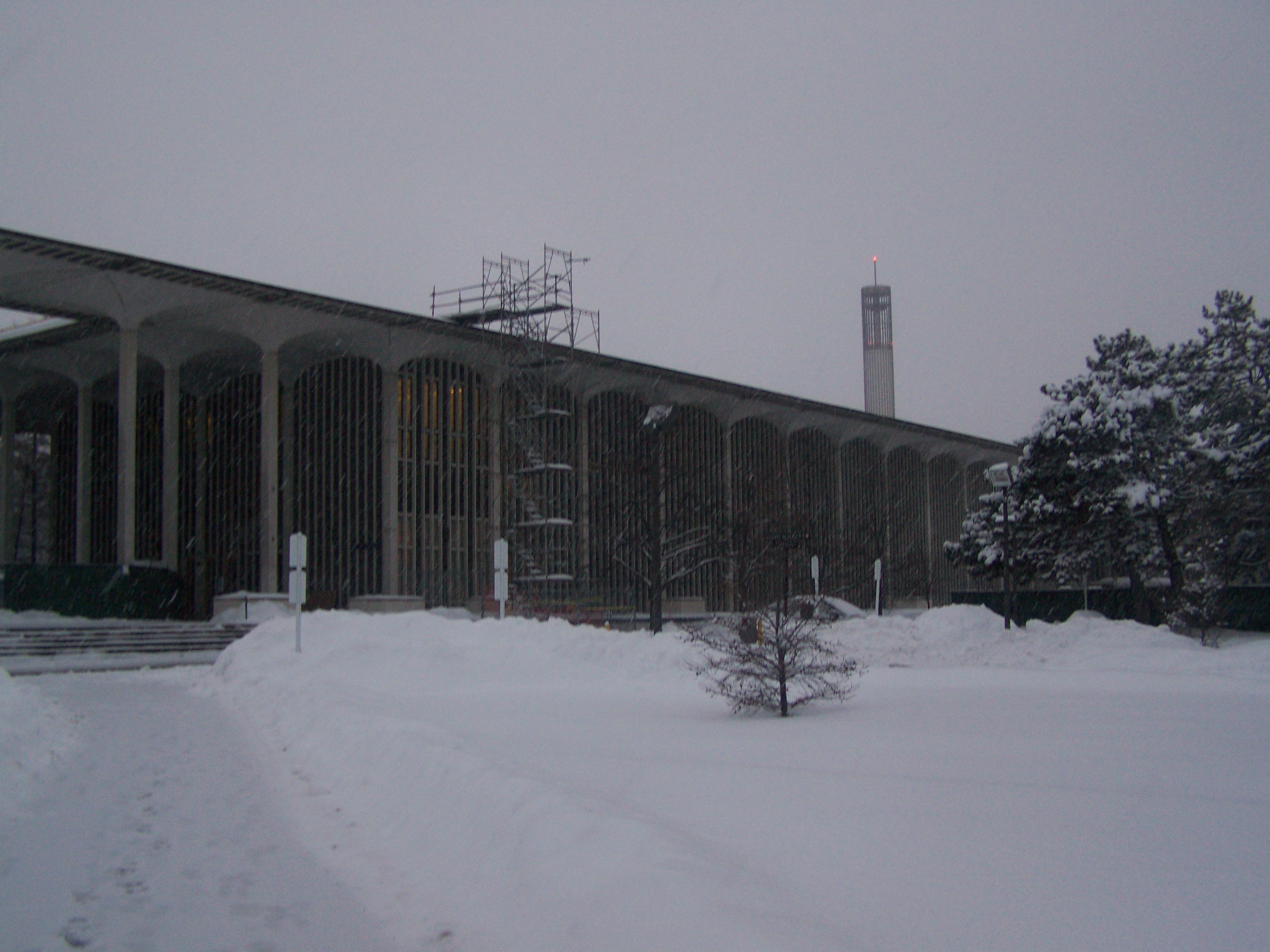


All Ivies Make (Architectural) Mistakes

28 11 2011

Somewhere during my crappiest Thanksgiving ever, I was reading through the online Daily Sun and came across some comment where the individual suggested that Cornell has the worst architecture in the Ivy League. I spent a little while mulling over that critique – sure, some of our halls are quite ugly, but the worst Ivy?

Curious, I decided to look at some  of other schools. I don’t have some chip on my shoulder over the lack of “pretty” buildings at Cornell, and certainly “ugly” is a subjective term. But Cornell is not the only school that has designed buildings that have earned harsh rebukes from certain audiences.

Harvard people have been criticizing themselves for years. One of the first things that came up in my search was a polite criticism of the modern architecture that took over Harvard’s campus starting the late 1950s (the Quincy and Leverett Towers). The article was published in the Crimson, the Harvard student newspaper, in the early 1990s. If you really want to go in depth, someone wrote an entire book dedicated to reviewing Harvard’s architecture. Today, Harvard is putting up modern buildings such as a science buildinga new graduate housing complex, and Tata Hall (I’m still wondering if Cornell plans on naming a building for Ratan Tata ’59) The take away could be that Harvard, like Cornell, builds in the style of the times; but it would be worth noting that Harvard has buildings 130 years older than Cornell.

Down in New Haven, Yale is no stranger to “ugly” architecture either, with such structures as the Art and Architecture Building and the Beinecke Library to its credit. Their newest set of dorms are designed in a Collegiate Gothic style that has mass appeal, but they decided to demolish several historic buildings to build it.

Going down the list, I didn’t see one campus that was “unscathed”. Princeton, U Penn, Brown, Columbia, even Dartmouth, which lacks your usual Science and Engineering building culprits. It seems most of them entered the 60s and threw cohesion out the window for daring departures that have, for the most part, not aged well. Even now, many of these schools are still trying some avant-garde edginess to further their names.

Would I venture support or denial of the “ugliest Ivy” claim? I am forced to stay neutral. I’ve only been to four of their campuses, not to mention it’s a matter of opinion. But, considering some of the college campuses out there, I know things could be much worse:


Beauty in the Eye of the Beholder

10 11 2011

So, this is a question that I often wonder about when I play the role of armchair architecture critic. Cornell has pontificated that “each new building should reflect the spirit of Cornell as a pioneering institution and should represent an awareness of its time and place”. Back in the day, that was symbolized by A. D. White’s passionate desire to develop the campus into a New Yorker’s version of Oxford, hence his well-documented derision of red-brick buildings such as Morse Hall and Lincoln Hall, as these were very un-Oxford-esque. Lincoln Hall was built while White was overseas as the U.S. ambassador to Germany (effectively, they sneaked it in when he wasn’t looking), and it’s been said that White smiled when he first heard Morse Hall was destroyed by fire back in 1916. I’m guessing he never counted his own house, but maybe he considered that to be tucked away from the main campus, which it was back in the early days.

Cornell’s architectural preference has evolved with the times. By the 1920s, the fashion was Collegiate Gothic, as seen in buildings like Willard Straight. By the 1950s and 1960s, function was deemed more important than form, and we eneded up with buildings like Clark Hall, and Hollister et al. on the Engineering Quad. Today’s buzz is about “Starchitects” like Rem Koolhaas (Milstein Hall), Richard Meier (Weill Hall) and Thom Mayne (Gates Hall), who designed ultramodern structures that are meant to represent Cornell’s forward-thinking.

My question lies in what is interpreted as forward-thinking. It seems college campuses these days follow two rather discordant trains of thought – one of the modern or ultramodern designs as we have seen lately at Cornell (I was tempted to call them avant-garde, but I don’t think they’re radical enough to merit the term), and then a second line of thinking that delves into the Neoclassical and Gothic themes that conjure images of the romantic colleges of our grandparents’ youth.

Take for instance Princeton and their new Whitman Residential College, or Notre Dame’s new Eck law school building:

Image Property of Notre Dame University

Granted, comparing the new STEM buildings to Dorms and Social Science buildings is a bit like apples to oranges. But what are the pros and cons for the new Houses on West Campus? Were we better off with new and contemporary, or should we have revived the original 1920s era plan and constructed new Gothics?

The original West Campus Plan. Image Courtesy of Wikipedia

Any casual reader of this blog probably recognizes that I fall more into the traditionalist point of view. I guess my concern lies with the aesthetically pleasing value of a campus. Cornell has some tremendously wonderful natural spaces both in the confines of the main campus and surrounding it (the many gorges and waterfalls throughout the area assure that much). The built environment can either enhance that or detract from it, and I’d venture at Cornell it’s been hit-or-miss over the years.  I wonder though, if the increasing traditionalism of some of our peer institutions gives them a recruiting advantage for top students. I think the West Campus structures are quality constructions, but they don’t quite garner the same level of fondness as the arches and turrets Collegiate Gothic.

So I’m going to go out on a limb and throw the question out there for debate. What role does architectural style play in prospective students’ decision-making? Is Cornell being bold and progressive in its current architectural plans, or are we foregoing traditional architectural styles at a detriment to the physical appeal of the university? I’m really curious to hear others’ take on this, so please leave a comment if you’d like to contribute your opinion.

P.S. I don’t want to downplay the importance of interior design, which is important from a livability angle. But I am more interested to hear about opinions about building exteriors, since they often set the first impression.


The Goldwin Smith Hall Addition

21 10 2011

As a general rule, checking facebook while at work/in the office is a poor use of time. My excuse is that I’ll run some scripts that take a few minutes (or overnight in two cases) to process, thus giving me down time. Well, on the stalker-philic facebook news feed, a friend of mine who happens to work for the university mentioned that Skorton just made an announcement that a new humanities building would be constructed. Technically, this isn’t “new” news, it’s been in the early planning stages for four years, enough that I wrote a blog entry about it almost three years ago. At the time, the project was evaluated to be about 60,000 square feet (35,000 new) with a budget of $45.1 million, in three conjoined structures similar in massing to the original building.

Well, according to the project’s website, the square footage has stayed about the same (66,500 sq ft), but the design has evolved quite a ways. A large atrium will be the centerpiece of the structure, and it will also contain the largest auditorium on the Arts Quad. The building will have a large cafe, faculty offices and classrooms, and be the hub for several smaller Arts and Sciences departments (which ones are undetermined, the only one confirmed to move in is the Romance Studies Dept.). The project, which will be funded mostly through donations, is budgeted at $61 million, with a tentative construction start date of summer 2013 and a completion date of the end of 2015. The building is designed by Koetter, Kim & Associates, the same firm that was responsible for the Physical Sciences Building.

Well, I can’t say I’m particularly impressed. Seems like Cornell is in its next iteration of the “giant atrium for cross-pollination of ideas”, and the overall design, while not offensive by any means, is a rather plain, mostly glass box. Not exactly eliciting much of an impassioned response from this armchair critic.


Cornell’s Geneva Campus

6 08 2011

So, when we think of Cornell’s campus, most people think of Ithaca. Occasionally, someone also might mention the medical school down in New York City. But in the ag school, asking the right person, might result in an unexpected response – Geneva, New York. Geneva is a small city of about 13,000 located about 50 NNW of Ithaca, on the northern end of Seneca Lake, and although most folks could not care less about the community, it does have some importance for the university thanks to the presence of the Geneva Lab.

The formal name of the Geneva campus is the “New York State Agricultural Experiment Station“, often referred to as the Geneva Lab for short. It also started off as a rival to Cornell, at least when it came to research grants. The Geneva Lab was started in June 1880 thanks to state funding, although Cornell had sought the funding from the state (Bishop 223). The lab started off with a staff of seven scientists. After the Hatch Act provided further funding for agricultural experiment stations in 1887, the competition created between the two created tense relations throughout the turn of the century. To is credit, Cornell had their own experiment station since 1879, but it sorely lacked funding (keep in mind this was during a time when the ag school had an almighty 50 students, give or take a few each year). Thanks to increased state and federal funding with the second Morrill Act, state appropriations, and the Smith-Hughes Bill, money became easier to obtain, and relations had improved enough by WWI that Cornell professors routinely exchanged with researchers at Geneva for various ag-related projects (Bishop 440).
By 1923, the state authorized the Geneva research station to be placed under Cornell’s control. At this point, the two were basically working together on most everything and trying to avoid redundancies in administration, so by 1920 they were already informally affiliated. The Geneva station had a staff of 55 and hundreds of acres would benefit the ag school’s research, while taking advantage of Cornell connection, including the Cooperative Extension program.

More funding started coming Cornell and Geneva’s way with the Purnell Act in 1925, which led to Cornell-owned ag research facilities in the Hudson Valley and on Long Island, near Riverhead (Bishop 477).  The Geneva facility’s research shifted from helping farmers produce good crops, to making better products, such as making pears disease-resistant, new apple varieties, and working with Birdseye Foods on better quick-freezing techniques for vegetables. By 1940, the researchers at Geneva were made faculty in the ag college.lastly, animal-related research was shifted over to the Ithaca campus at the end of WWII, leaving the Geneva lab to strictly plant-based work.

Today, the Geneva campus comprises 20 buildings (623,000 sq ft), 870 acres, and about 300 faculty, staff and grad students. Most of the work done these days is the development of improved food safety and storage techniques and genetic enhancement of crops to create more productive or tolerant varieties. The four programs shared between the two campuses (which were merged as a post-recession cost-cutting measure last year) are Entomology, Food Science, Horticulture and Plant Pathology.

In summary, Cornell has a large presence in upstate New York, and it’s not just in Ithaca. So, maybe the proposal for the new school on Roosevelt Island in NYC isn’t all that unusual for Ezra’s research university.


Munier’s Grading Guide

29 07 2011

Let’s face it – the majority of students as Cornell are driven by their GPAs. For grad school, for their first job, or whatever their immediate postgraduate endeavor. Sure, they may not mean everything, but GPAs are important enough that many people are dedicated to getting as close to a 4.3 as possible.

However, as anyone who’s been at Cornell for a while can recognize, grades are not distributed evenly, especially between majors. Sure, you could work hard and maybe pull a B+ in a course where the average is a B, but few people would turn down the opportunity to pad their transcript with an easy A. Well, Cornell recognizes this, and has begun to print the median grades for that class, as well as the grades a student has in a course, on their transcript, starting with the class of 2012.

It helps to get an idea where certain median grades lie. For a while, Cornell printed median grades and posted them online. Well, that only fueled the culture of “easy A classes”, so they stopped. Enter Munier Salem ’10’s cleverly-done guide to median grades. Using the fall 2009 median grade report, Munier put together an interactive infographic describing the distribution of grades in a given department (ASTRO, ASIAN, PHYS, and so on).

Now, I could’ve summarized it, but Ivygate already did that. So, I’m going to try a different tack.

I’m a CALS alum. So my interest is in CALS departments (regardless of whether or not they’re shared between schools – I’m looking at you BIO). Using the infographic, I pulled the percentages for different grades in a given CALS department and assigned a value to the grade itself – a 10 is an A+, a 9 is an A, 8 is an A-, and so on. The results in the graphic are actually given in a bar graph, but this method will break it down to just one mean value for simplicity. In example, say EXMPL has four courses – one with an A average, one with an A- and two B’s. (.25 * 9) + (.25 * 8 ) + (.5 * 6) = 7.25, just above a B+ average. Note that this doesn’t take the number of credits a course is worth into account, and in the infographic only a few larger majors are broken down by the course number of the class. Lastly, the quality of students can vary somewhat between majors (the dairy science concentration in Animal Science comes to mind). In conclusion, my grade exercise is more for show than for anything of real value.

AEM: 8.08

ANSC (animal science): 7.83

BEE (bio engineering): 7.57

BIO (standard biology): 7.13

BSOC (bio & society): 7.01

COMM: 8.05

CSS (crop& soil sci): 7.33

DSOC (dev. sociology): 7.66

EAS (earth&atmos sci): 7.34

EDUC (which is being phased out): 7.54

ENTOM (entomology, i.e. bugs): 8.15

FDSC (food sci): 7.70

HORT (horticulture): 8.01

INFO (info sci): 7.72

LA (landscape architecture): 7.89

NS (nutri sci): 8.06

NTRES (natural resources, a.k.a. natty res): 7.88

PLPA (plant pathology): 7.34

Now, this doesn’t take different majors into account, who may take courses from a few different departments. But if we do place any value in this, it’s that it’s good to be an AEM or entomology major, and that you might want to avoid biology & society courses (refuting my own belief that using the word “society” in any course meant it was an easy class).


The Keyword Bar XII

8 07 2011

One of those entries where I respond to questions or queries in the search bar that brought people to this blog. Plus it’s summer and I don’t feel like delving into history today.

For the curious – the sculpture in front of Uris is called “Song of the Vowels”. The sculptor, Jacques Lipchitz, created seven copies back in 1931. Cornell’s was the fifth production, and the sculpture was acquired in 1962 by the Uris brothers on behalf of Cornell, and installed in June of that year. Princeton, UCLA, Stanford, the Kykuit Gardens and two European art museums own the other copies. “Song of the Vowels” was renovated and re-sited in 2007.

1. “why does cornell cals accept so many transfer students” (7-6-2011)

That’s actually a good question. This one kinda creates some tension in the CALS community, and certainly that animosity is not unfounded. In the past, I’ve heard people criticize transfers as not being “true Cornellians”, whatever they define that to be.

As a general rule, the contract colleges accept more transfer students than the endowed colleges. It’s actually part of the mission of the contract colleges to include transfer students into their programs, if the applicants meet standards. However, this does not hold true for endowed schools, and that is reflected in the fewer students that they accept as transfers.

Specifically regarding the ag school, CALS accepts more because of “transfer agreements” that serve as feeders into CALS programs. A number of SUNY-affiliated two-year schools fall into this category. Basically, a student studying full time with a 3.0 or higher in their coursework (including required classes that match up with their desired major at Cornell) are guaranteed admission. This tends to be most common in the agricultural programs – for example, a majority of students in the dairy science concentration of animal science are transfers from two-year schools such as SUNY Cobleskill and Alfred State. A few others, like Morrisville and Delhi, also send in a fair number of students. As the list in the link indicates, there’s 43 schools, mostly community colleges in New York, that have these agreements. Some of it is coordinated through programs such as “Pathways to Success”, a set of guidelines and counseling in place at some schools for students who want to transfer to Cornell. For the name-conscious AEM majors, it should be noted that biology, landscape architecture, and non-agribusiness AEM are exempt from this and fall under “competitive transfer” admissions. Also, if you don’t attend a partnered institution, then the transfer isn’t guaranteed either.

In my own major within CALS, I know that we had two transfers in the years from 2007-2011 (~3% of total). But in lean years where the yield from freshman admissions wasn’t so great, they were supplanted the following year with transfers. I think there’s at least eight in the 2012 and 2013 classes (~50% of total).

2. “cornell freshman population” (7-4-2011)

Varies a little bit from year to year due to yield. The goal number in the late 2000s was 3,050. The university usually over-enrolls (my guess is twofold –  it’s to make up for students who may not show up in the fall, and a few more accepting students makes the yield increase), so class size usually ends up somewhere in the 3100s. The trend over the years has been to increase freshman class size, which was about 2700 in the late 1980s.

3. “cornell safety school” (7-4-2011)

Meh. Do your graduate work at a large state school and you’ll realize how little weight that statement carries. The New York Times has a nice little piece about image-conscious students at Cornell from a few years back.

4. “how far is it from wegmans to maplewood apartments at cornell in ithaca” (7-1-2011)

I think Mapquest would’ve been more useful than a search bar for this question. But for the record, between 2.5 and 2.7 miles, depending on what part of the Maplewood Park Apt. complex you’re going to.

5. “construction project; bj’s ithaca; owner” (7-1-2011)

The project is being developed by Arrowhead Ventures of Syracuse, which is a division of Triax Development Coroporation. Triax is the company that owns the Ithaca Mall, and the BJ’s site is (rather conveniently) the property just northwest of the mall.


Taking Care of Cornell’s Students’ Bodies

10 05 2011

After I wrote about the medical college, I felt inspired to write up a brief piece regarding the history of student health at Cornell. Understandably, the value of this entry to the practical person looking up health information is nil, but then, I would hope that if someone has health issues, they would be looking through health websites like Gannett’s instead of blogs.

Anyways, most Cornell students know that if they feel sick, or think they might be pregnant, or some combo thereof, that a trip to Gannett Health Center is in order. Back in Cornell nascent days, if you were sick, well…you were pretty much screwed. A student at Cornell a few years after its founding, if they were to become ill, could hope to be taken care of by their friends, roommates or professors, if they were lucky and had strong connections. Otherwise, you were S.O.L. If it was any consolation, so were all residents of the city of Ithaca, which wouldn’t get it’s first hospital for a few more years (the first hospital opened on Aurora Street sometime during the 1870s, and the second hospital was built off of Quarry Street in Lower Collegetown in 1910; that complex still stands today as the Quarry Arms apartments, which Collegetown Terrace will be built around). In 1870, the faculty senate voted to set aside rooms on campus for sick students (Bishop 176), and the first medical examiner, a sort of campus physician, was appointed in June 1877 (he held two job titles, the other being an assistant professor of mathematics). Jennie McGraw of Cornell Chimes fame put a bequest in her will of $15,000 for the construction of a student hospital on the grounds of Cornell, and this was increased to $40,000 before her death in 1891. However, thanks to the Great Will Case, Cornell never saw any of her money used towards a health facility.

The first building dedicated solely to student health was the Cornell Infirmary, which still stands as the Schuyler House dorm to the far southwest of main campus. The Sage Complex  initially consisted of only the east building, which was essentially a converted mansion built in 1880 as Henry Sage’s retirement home after he moved from Brooklyn to Ithaca (Bishop 211).  Upon his death in 1897, he asked that the building and land be donated to Cornell, which his sons Dean and William did with an additional $100,000 donation for maintenance (Bishop 333). They might not have done that if Sage had outlived his nemesis and fellow generous benefactor Willard Fiske. Both sons were furious that Fiske was interred in Sage Chapel in 1904 and abruptly stopped all involvement and donations to the university. William Sage actually had donated a building to Yale some years later. But, I digress. The original Cornell Infirmary had room for twenty patients, and the large addition on the west side was completed in 1912. What you received was bed, board, and modest nursing care and lab services. While a student of yesteryear might receive advice on hygiene or bad habits, actual diagnosis by physicians was a role the university refused to take on until around 1940. It was felt that the university should not be responsible for the clinical care of its students, only lend a hand in their treatment. Medical advising by Cornell staff was generally discouraged.

By the 1950s, it was felt that the Infirmary was inadequate, poorly located and outdated, so a new building was constructed on land that used to hold two faculty residences. This building was named for media mogul Frank Gannett 1898, who generously funded its construction. The Gannett Health Clinic opened its doors in 1955 and received an expansion to its west side in 1979, bringing it to 39,000 sq ft. The masterplan suggests a 90,000-130,000 sq ft structure to replace the current building on the current site sometime during the next several years.

I’m marginally jealous that Cornell’s health center is on campus. The one at my grad school is located a half mile away across a four-lane highway. What a nice way some colleges provide for their students.


How the Mighty Have Fallen

19 03 2011

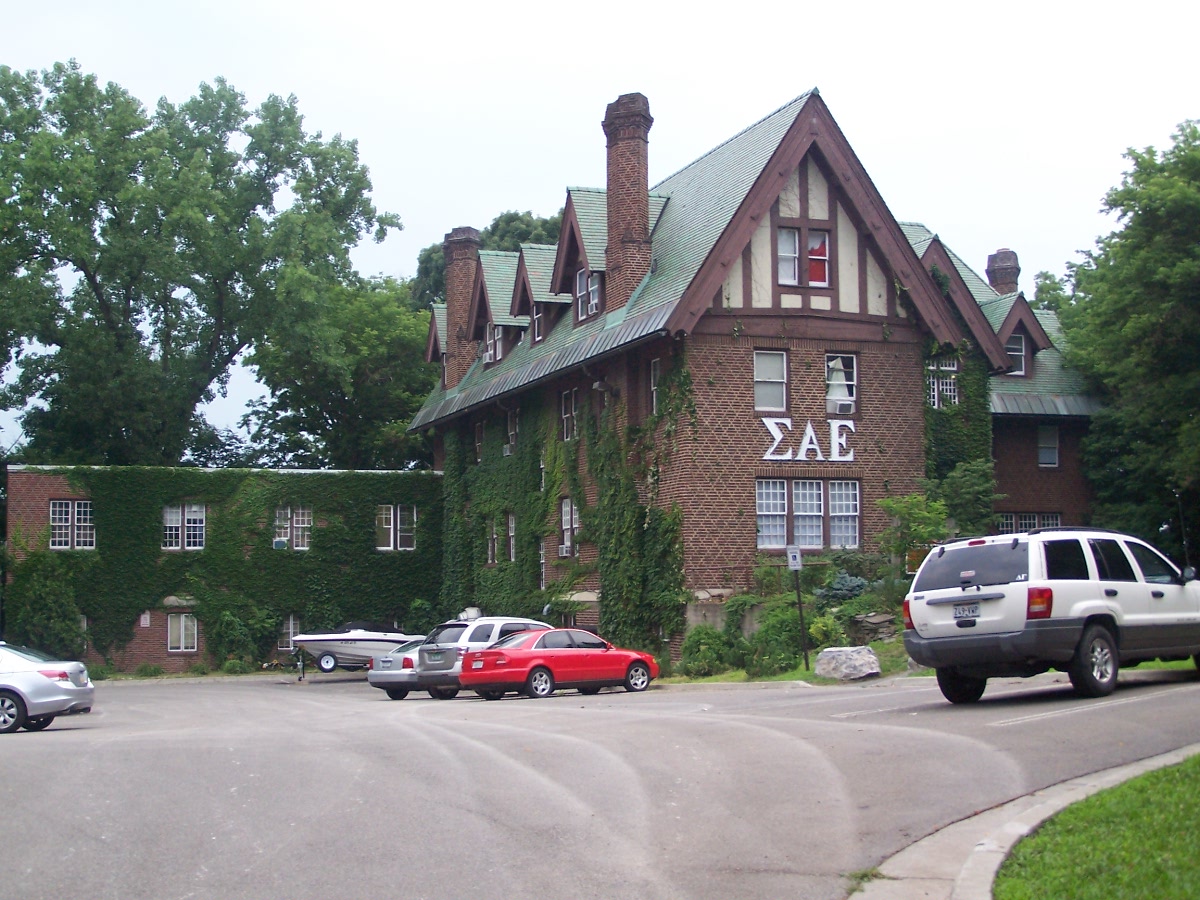
So it’s official. Sigma Alpha Epsilon, up until now the second largest chapter in the Greek system, is being booted from campus for a period of five years. All members must vacate the university-owned facility by the end of the month. I think the following passage is the most disturbing:

“At this time, the information provided to the university indicates that George Desdunes, 19, was provided alcohol while in the care of certain members and associate members of the Sigma Alpha Epsilon fraternity, and became incapacitated. Even though the members and associate members recognized the condition Desdunes was in, they failed to call for medical care. He subsequently died.”

Let’s be honest. Associate members = pledges in this case. Also, just about anyone who’s been in a fraternity can vouch they knew “that” guy who got really, really drunk one time at a frat party or a mixer, so they gave him some water, a bucket just in case, and laid him on a couch to sleep it off (or maybe that was just in my experience). But this time, either members failed to recognize the severity of the situation – tragic but not impossible – or they realized the extent of the situation and did nothing. Which I really, sincerely hope wasn’t the case, especially since a number of criminal charges are likely in the upcoming weeks.

It’s hard to imagine a system without SAE occupying its lofty Hillcrest estate. But, there is a habit in recent years of the largest, most visible houses being shut down for one reason or another. Pi Kappa Alpha was one of the largest chapters in the system back in the 1980s and 1990s, their recognition was suspended after an incident a couple years ago sent three rushees to the hospital. Before In the mid 2000s, the largest chapter was Sigma Pi, which was suspended and forced to reorganize in 2007 after they sent Thanksgiving attendees to the hopsital with alcohol poisoning. It seems that the largest houses are more apt at screwing up.

It’s difficult to picture Cornell’s Greek Life without one of its prominent members. But under the circumstances, I would’ve been even more surprised if they had been allowed to continue on campus.


The Death Knell of Greek Life?

2 03 2011

In some sense, I’ve learned to dread days where I see the number of hits to this blog skyrocket, namely because days with extraordinarily high hits can be correlated unfortunately well with the untimely death of a student at the university. So it was with some hesitancy that I glanced at the Sun’s website this weekend.

The news is unnerving and tragic. A student is dead. Secondly, the Tompkins County sheriff has gone on the record to say that the death was likely alcohol-related. The student, George Desdunes, was a member of Sigma Alpha Epsilon fraternity, and was found unresponsive at the fraternity house on Friday morning. At this point, it was yet to be established to what extent the fraternity is responsible in his untimely death, but SAE has been suspended temporarily.

When I first heard the news, I kept hoping that the fraternity wouldn’t be responsible. SAE is considered to be one of the most visible Greek houses on Cornell’s campus. It has one of the largest memberships of any fraternity at Cornell and holds a fairly strong presence in Greek affairs, and to some extent campus affairs (a number of their members and recent alumni, such as Svante Myrick ’09 and Eddie Rooker ’10, hold prominent positions in and around the university and surrounding city). So if SAE was responsible for the death of one of its members, the effects would be profound and far-reaching through all parts of the system.

Given the problems of the system and the recent reforms forced onto it by the university, I am honestly wondering whether or not it is a sign of the end of the system. the first thing that comes to mind was Ithaca College’s ban of Greek life after the death of Joseph Parella in 1980, during a fraternity pledge event in which he was hazed. But, it’s not easy to compare the two systems. For one, Ithaca College’s fraternities were generally housed in dorms (in comparison, Cornell owns  about one-third the Greek houses), and for two, their system represented a much smaller proportion of their student body than Cornell’s does.

I suppose the usual arguments will come out – the biggest donors to the school are Greek, they can’t touch private houses, and so forth. The problem is, if SAE is found responsible, their role in the death of a student would be a very powerful and legitimate reason to favor de-recognition of Greek life. Addressing argument number two, while many chapters own their own property and would not be immediately affected, they lose the protection that the university gives — i.e. every party thrown is a target for local and campus police to bust underage drinkers. So the system wouldn’t be “shut down” per se, but it could easily be crippled.

Perhaps a better comparison would be a case from MIT that occurred about 15 years ago. On September 26, 1997, a pledge of FIJI at MIT died after a pledge event due to alcohol poisoning.  MIT is, like Cornell, a prestigious institution with substantial Greek Life – at MIT, it comprises about 42% the student body. There had been signs Greek Life had been getting out of control prior to the death of Scott Krueger. As a result of the event, RAs were put in fraternity houses, mandatory CPR training was established, all freshmen were required to live in dorms, MIT paid a $6 million settlement to the family due to negligence in preventing the event from occurring, the fraternity was shut down (and has never come back), and several of the former FIJI members were convicted of criminal offenses. It forever changed the way MIT dealt with its fraternities. But they still have a large, influential system.

But comparisons only offer ideas, not results. So what will happen with Cornell’s system? A good question.  But not one that can be answered just yet, while Cornell students mourn the loss of one of their own.