Cornell’s History, All Drugged Up

11 01 2011

So, the latest news tidbit about a Cornell student being caught with $150,000 of heroin has made the news cycles and attracted some undesriable attention toward the university. Which kinda inspired me to look at it in a historical context. It’s what I do.

It’s college. Drugs exist. Some are easier to get a hold of than others. Some are gateway drugs, others are only used by a hardcore group of students. Once in a while, the drug debate comes up in a campus context. The Cornell Daily Sun ran an article about Cornell’s drug culture about two years ago. In the article, it was noted in a 2005 anonymous Gannett survey of students, that of 1,969 respondents, 41% admitted some form of drug or alcohol use in the past 30 days, with 19.8% reporting marijuana use and 4% reporting other drug use.

(with that in mind, considering the university’s undergad pop of about 13, 800, that would suggest 550 users of other drugs, which could include cocaine, LSD and the aforementioned heroin. If [an overly-generous] 50 percent were heroin users, that gives us about 275 students. Which if the street value is correctly reported, than the student was carrying $545 worth of heroin for each user. In conclusion, with that much heroin, I wouldn’t be surprised if she was supplying the entire county).

A similar set of data from 2003 suggests 8 percent of respondents admitted Ritalin/Adderall use without a prescription, and less than 3 percent partook in white lines. Another link on Gannett’s site looks at drug use in 2000, and the rates were largely the same as in following studies (except for hard drugs – those fell a little bit). The article notes that affluent students and students in Greek Life show slightly higher usage rates. Looking at Gannett’s site, if we throw in the more prevalent drugs, tobacco use as defined as at least once in the past 30 days has gone from 21 to 16 percent from fall 2000 to fall 2005. Alcohol use defined as once in the past 30 days has hovered around 75 percent and remained fairly steady through the three studies.

So that’s handy and all, but it’s a smallish sample size compared to the entire student population, and it depends on people answering truthfully. So the numbers could be seen as dubious. Regardless, it’s obvious that students partake in drug use.

***

Now to look at things in a historical context. Drug use was around well before the university. But in 1865 in little Ithaca, the drugs of choice were generally the alcoholic or tobacco variety. The big drugs in the 19th century were alcohol, tobacco, and to a lesser extent opiates and (in later years,) cocaine. Marijuana was seen as a medicinal drug, not a recreational one (that changed after around 1910). Marijuana use at Cornell was minor prior to the 1960s, which is when it caught on with middle-class whites – i.e. most of Cornell’s student population. It is stayed relatively popular since, even after drug laws became tougher in the mid-1980s. As for the opiates, they would see occasional use throughout the next 100+ years, as opium in the late 1800s, morphine and heroin in later years. Heroin received its first notoriety among students when it caught on with the Beatnik culture of the 1950s.  With the increase of purity (strength) of heroin in the 1980s and 1990s, demand, and addiction, grew. Although, going by Gannett’s survey, usage dropped off somewhat at Cornell after 2000. Tobacco saw steady and common use by all branches of the university’s stakeholders since Cornell’s founding, and became so prevalent that in the early 1960s a person could smoke anywhere but inside Sage Chapel. But, needless to say, that’s not the case anymore.

If Cornell follows national trends, it would be safe to say that cocaine use peaked in the early 1980s, with maybe some sporadic crack use after its introduction around 1985. I would be willing to suspect that the “glamor” of powdered coke was preferable to perceived “ghetto” qualities of its freebase equivalent.

Regarding LSD, Cornellians probably first experienced the drug in the early 1960s. Well, willingly anyway. Two Cornell Medical School professors were part of a government project in the 1950s and 1960s to administer LSD and other hallucinogenic drugs on unwilling participants. It was initially hoped by the military that it could be used like a truth serum, and later studies checked it out for therapeutic qualities on mentally-deficient patients. The drug peaked in the late 1960s and saw another slight rise in the late 1990s, but otherwise has seen a general decline.

Now back to our preferred chemical companion – alcohol. The first students of Cornell would’ve usually consumed beer (liquor was as it is now – expensive) down at one of the saloons in town, and there was no standard policy against drinking (Bishop 210). “Give My Regards to Davy” celebrates this aspect of student life (although I should note that highballs are mixed drinks – scotch and soda water). A Cornell Era report from around 1890 suggests that a couple saloons was enough to serve all students, and drunkenness was uncommon. In the 1910s, drinking was common, but seen as a way to celebrate athletic victories, but drunkenness on campus was seen as grounds for dismissal (Bishop 407-408). Prohibition was a major thorn in the side of students and bar owners, but they found ways around the law – Theta Delta Chi had a speakeasy built into their house when it was built in 1926.  A Cornell Sun article from March 4, 1937 reports that drinking at colleges was on the rise after Prohibition, but that public drunkenness was abhorred. The report was “Students…admire the man who can drink like a gentleman” (pg. 3). It seems that a celebrated culture of binge drinking took off around 1980 – the “Animal House” influence, perhaps. Although underage drinking was supposed to be curtailed by the increase of the drinking age from 18 to 21 in December 1985, that has largely proven untrue.

People age, drug preferences change, but students are timeless.


The Hat Clubs of Cornell

13 08 2010

Cornell has always been an institution known for its academics, which is perfectly fine. However, for many years, day-to-day life was a bit of a drag. A hundred years ago, one had few options – if you were rich and/or well-connected (as well as white and Christian), you enjoyed the exclusivity of Greek life; if you were independent, then your options were pretty limited, your social activities confined to the (even then) socially conservative Cornell U. Christian Association’s social rooms, or to the cheap and rather ungainly boarding houses of Collegetown and the city.

Around the early 1900s a movement began that was purely social in nature, vestigial in purpose but attention-grabbing in activity. Hat Clubs were formed by several different student groups. Hat Clubs only existed for one remarkable purpose; they instilled upon their members the right to wear a certain, funny-looking hat [Bishop 409]. Yes, life was that boring. On a deeper level, the clubs were designed to instill a sense of camaraderie among students and to allow friendships to be built among students who couldn’t afford or were excluded from other social societies.

Well, needless to say, campus leaders (read: rich white fraternity men) were not pleased. The presidents of fraternities and the editor of the Daily Sun publicly denounced the existence of these silly groups, and in 1913 they decided to take action against them by drumming up public disapproval and by trying to force them to disband.

It’s hard to try and compare this to today’s Cornell because the idea seems far-fetched. These clubs were nothing more than run of the mill clubs; they rarely maintained a permanent house or meeting place (dues were quite low as a result) and meetings were few and far between. Dinner banquets (often at a boarding house or cheap banquet hall) and social gatherings were their only real activities. Hat Clubs occupied a sort of hazy area vaguely similar to prominent clubs on campus today.

Well, thanks to the work of the well-connected, most of the clubs succumbed to bad P.R. and ceased to exist by the end of the decade. However, two survived. Originally, these two clubs were called Mummy and Nalanda. However, to avoid some of the bad publicity, they changed their names, to Beth L’Amed and Majura respectively. They managed to not only survive the decade, the went on to exist for another forty years.

A Cornell Alumni News from December 1936 provides a little background. Mummy was founded in 1900 by the freshman class (1903). Nalanda began with the following freshman class (1904), and the Class of 1906 had a new club (Stoic) that was quickly taken over and absorbed by Mummy. Mummy and Nalanda would alternate, with Mummy pulling students from classes with even years, and Nalanda from odd years. The two changed their names in 1911 (a discrepancy when compared to Morris Bishop’s account) after their hats were outlawed. According to the article, they were an active part of Junior Week and Spring Day (the predecessor to Slope Day), and did a reunion dinner at the Cornell Club in NYC every year on the Friday before Thanksgiving.

So what happened? Well, their social gatherings did them in. In December 1949, they did a joint initiation celebration for their new members and threw a big jamboree right before the Christmas holiday. Unfortunately, one partier, a Mech E. named Harry Melton, drank for more than he could handle. According to Time Magazine:

In about an hour, he had wolfed down more than a quart of Martinis. At that point he collapsed, was rushed to a hospital where he lay unconscious for 15 hours. For a while doctors feared for his life.

A quart of martinis in an hour? Holy crap. Personally, I can’t stand gin. The taste of gin is like running through a pine forest with your mouth open. But, to each their own.
Well, their actions cost them big time. The acting president of the university, Cornelius de Kiewiet, immediately suspended them. Pending a faculty review and denunciation by the Sun for their foolish activity that almost had fatal consequences, the president made the ban on the last two Hat Clubs permanent. To quote the Sun’s piece:

“Cornell’s doctrine of ‘freedom with responsibility’ had clearly been abused . . . The administration will not and should not allow us to kill ourselves . . .”

…and with that, the Hat Clubs were confined to the dustbin of history.


The Alma Mater

4 06 2010

According to the greatness that is wikipedia, Alma Mater is Latin for “nourishing mother” — appropriate to its modern reference of being the institute of education where one receives their degree. I and perhaps 5,000 others joined the ranks (numbering 245,000 or so) of individuals who can call Cornell their alma mater. But it’s still strange to think that I’m an alumnus now.

So the experience of one class is different from another. If showcasing some of Cornell’s historical figures has proven anything, it’s that times change, as do the experiences change with time. Stuck in the Fast Lane delivered the message that although we are all Cornellians, no one has the same experience. If this blog has proven something, if anything, it merely emphasizes the point that Elie makes; although experiences vary, we all contribute some small amount to the long and finely woven Big Red tapestry.

A student in 1903 was subject to a typhoid epidemic that sickened over ten percent of the city and killed 29 Cornell students (about 1.5% of the school population — comparable to about 300 or so students today; and although directly caused by polluted water, some have indirectly linked the illness to Typhoid Mary Mellon). In contrast, a student in 1969 wondered if the campus would devolve into anarchy and violence, the tension culminating with the infamous Willard Straight Takeover in April of that year. A student this past year will probably remember the sheer number of tragedies that befell the Cornell community, especially the campus suicides. Perhaps on a lighter note, they’ll also remember it as the year the basketball team went to the Sweet Sixteen.

Point is, they’re all vastly different events, but they all still make up a part of Cornell history. As alumni, we’ve all lived through at least some part of that history as students, and hopefully many more years ahead as alumni.

Ca. 1990. Note the street traffic on the lower right, where Ho Plaza is today.

I have nothing that needs to be said about my experiences as a student. I made use of my four years. I felt like I contributed to Cornell’s history, not by writing about it, but my living it, breathing it, being a part of this institution and contributing in some small but personally meaningful way. That’s the most I could ever want.

Although my time at Cornell is over, this blog is not. It will operate in a reduced capacity, certainly. But history is still being made, new buildings are still being erected and new plans being conjured and proposed and maybe even approved and undertaken. History’s flaw and beauty is in its perpetuity. Life at Cornell isn’t ending because I graduated — it goes on for as long as Ezra’s and Andy’s institution remains Far Above Cayuga’s Waters.

That alone will provide me with the inspiration and the motivation to write for some time yet.


The Roof is On Fire (Literally)

24 02 2010

I can’t say anything in particular inspired this post, except my slight, ever-present fear of the interior of Bradfield catching fire. Technically, there was a small fire in Bradfield on the fourth floor a couple of years ago, but thankfully it was quickly brought under control. Which, compared to some of Cornell’s history, is very, very tame as fire events here go.

The most notable fire on University property is fittingly the most well known, the Cornell Heights Residential Club fire in April 1967. Cornell Heights, now known as Ecohouse (Hurlburt House), was bought by the university in 1963 (its former use being a motel) and was being used to house students in an experimental program that would allow them to complete a PhD in any department in six years (which, for anyone who knows  plans on or knows people pursuing doctorate study, six years from college freshman to PhD is a pretty sweet gig if one could keep up with the work). The program began to be housed in the building in 1966, so they hadn’t even been there one full year when the fire occurred. The PhD program had 43 students, three faculty-in-residence and a faculty-adviser-in-residence, and the second floor held twenty-four senior and graduate women, for a grand total of 71 occupants. The fire started at 4 AM, when most residents were sleeping or busy pulling all-nighters.

looks better from the outside, doesn't it?

Images property of Gendisasters.com

Well, the building was thoroughly modern by 1960s standards, which means that just about every piece of nondescript furniture inside was made of some toxic material that could be hazardous if ingested, inhaled, seen or most importantly in this case, burned. The fire caused a toxic smoke to be emitted from the plastic upholstery, suffocating the victims, and sending ten others to the hospital for smoke inhalation (52 others escaped unharmed). The lack of adequate fire exits, alarms and sprinklers, especially on the second floor, only exacerbated the situation. As a result of the tragedy, the university undertook a major overhaul of its fire safety standards.

The second deadliest fire wasn’t technically university property, but was associated with one of the fraternities. Chi Psi lived in a glorious mansion built for the insanely rich Jennie McGraw, and completed in 1881. Too bad the tuberculosis she had killed her just as she arrived back home to witness its completion. Well, the house was auctioned as part of the “Great Will Case”, bought by McGraw relatives who then sold off most of the furniture, and then sold the unoccupied house to Chi Psi in 1896.

The primary suspect in the fire of December 7, 1906 were oily rags in a broom closet and flammable varnish on the wood floors. Although the building was finished with stone, the wood-frame construction made the place into a hellish inferno. Most of the 26 brothers were trapped in the burning building, with some only escaping when the collapsing walls gave them opportunities (at least one man escaped by falling with the collapsing wall onto the snow below; others jumped three stories). Of the seven people who died, two fraternity brothers were killed when they failed to jump from the collapsing southwest tower, two more died when they ran back in to rescue others, and three volunteer firemen were killed when the north wall collapsed on top of them, and “slowly roasted to death” as a New York Times article of the day puts it.

Turning to less fatal events, the Chemistry Department suffers the dubious distinction of being the most fire-plagued program in the history of the university. First of all, their first building, the old Morse Hall, partially burned down in 1916. When Olin Lab was under construction in 1967, the exterior tarp caught fire while it was under construction, causing a wall of flame along the partially-completed building (luckily damage was minor). The building had another minor fire in 1999.

Now imagine a ten story wall of flames. You get the idea.

Tjaden Hall had a flat roof on its tower portion for about forty years because lightning set the original roof on fire in the 1950s and they had to remove it. Then you have minor fires in the dorms once every couple of years or so. Balch Hall had a minor fire in the fall of 2004, and one of the lowrises in the spring of 2006. I think Donlon Hall had a minor fire sometime in the past few years. Point is, they’re usually mild, little news-makers, enough to end up at the bottom of the front page of the Sun for a day, and life goes on.

Regarding the Greek end of things, things get a lot more interesting. A brief (non-exhaustive) list:

-A fire burnt down the lodge of Kappa Alpha in 1898.

-Delta Chi’s house burnt down in 1900.

-Delta Upsilon had fires in 1909, 1916, and 1919. The 1909 fire completely destroyed the house.

-Sigma Alpha Epsilon lost a house to fire in 1911.

-Alpha Delta Phi’s house burnt down in 1929.

-Alpha Epsilon Pi had a house burn to the ground in 1929.

-A wing of Zeta Beta Tau’s house was consumed by fire in 1939.

-Zeta Psi’s original house burnt down in the late 1940s.

-Kappa Sigma suffered significant fire damage in 1948.

-Tau Epsilon Phi lost the old wing of their house to a fire in 1961.

-Sigma Pi’s house was reduced to a burnt-out shell in 1994.

So historically speaking, fraternities are not the best places for fire safety. On the flip side, I’ve never heard of a Cornell sorority house burning down.


A Blind Eye to Sports

8 11 2009

As anyone who doesn’t live under an Ithacan rock knows, Cornell had its much-publicized and anticipated match against Harvard on the ice of Lynah Rink last night. Much to Cornell’s delight, the Big Red skated to an impressive victory over the Crimson, with a final score of 6-3.

I feel like I’m one of a handful of undergrads on this campus who really doesn’t give a damn.

Not that I don’t have respect for athletes at Cornell. I give them by full respect. It’s just that I have never followed sports, with the slight exception of cross country and track back in junior high and high school because I was on the team (and let’s be honest, they’re just not the same when it comes to skill or competitive spirit). I’m content to sit back and watch everyone else get excited, because I’m just disinterested in Cornell sports. I’m never sat all the way through a Cornell game in any sport.

So, unsurprisingly I never mention sports on this blog, unless there’s historical worth to mentioning it. Which I can briefly do now.

Back in the day of the university founding years, the big sport for students to follow was crew, aka rowing. A.D. White was a member of a rowing club during his own collegiate years at Yale (Bishop 33). The first boating clubs formed in 1871, and a regatta was held the following spring (if you could call it that). The first big victory came at Saratoga in 1875, much to the joy of the school and the town (story goes that A.D. White broke into McGraw Hall Tower and rang the chimes himself). Baseball and football were vague diversions, not even intercollegiate until 1874 (Bishop 134). Cornell actually had its own rules of football that no one cared about, so the university didn’t take a substantial interest in football until about 1886. The Cornell Atheltic Association formed in 1889 (296). The first athletic area, built in the same year, was off campus on what is now the site of Ithaca High School, and was called Percy Field after the donor’s son, who was at the time a student athlete at Cornell. Hockey was recognized in 1900, basketball a year later. Lacrosse started up in 1885, but was  like clothing fashions among students, coming back into and going out of style every few years.

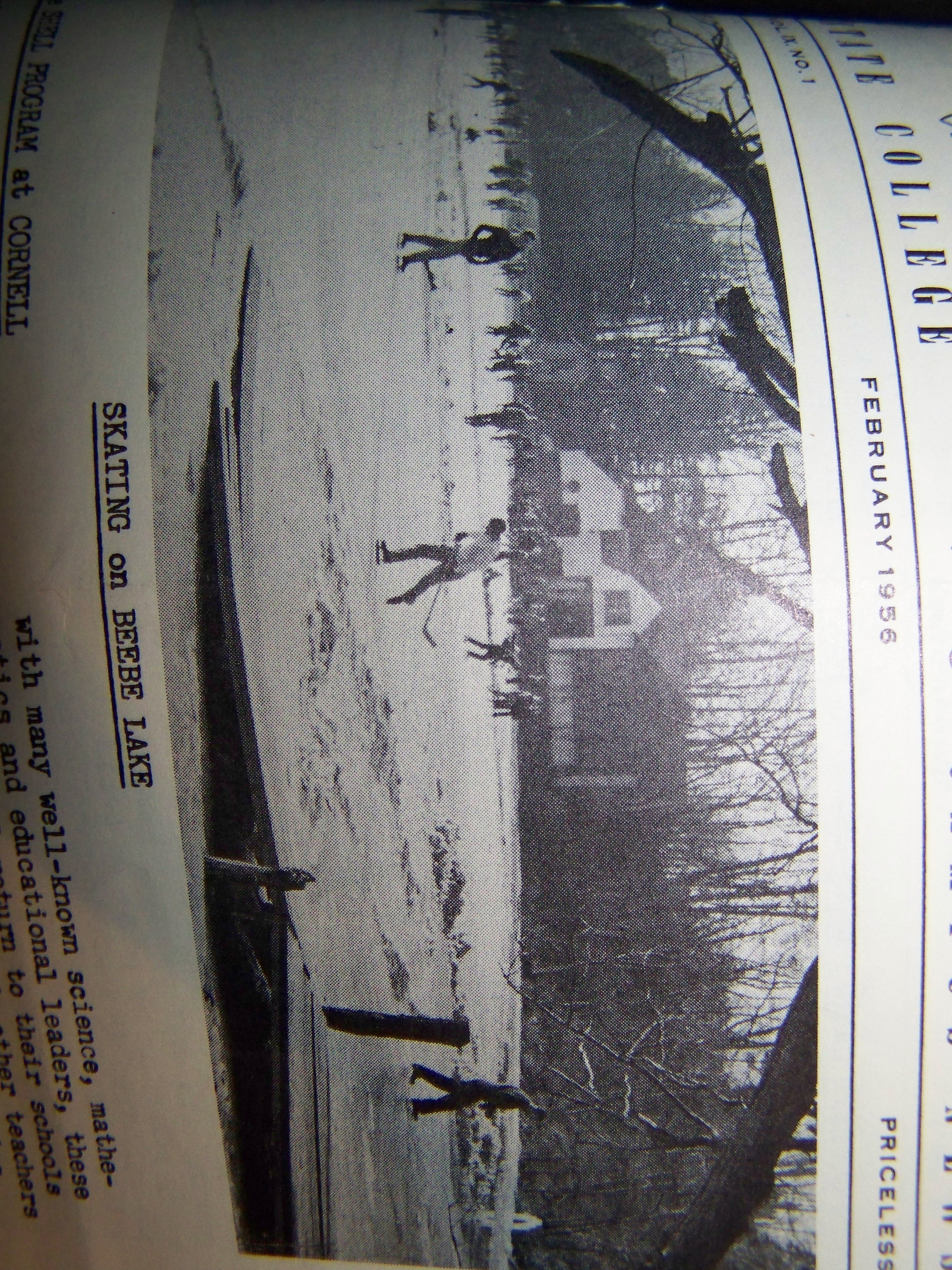
Hockey was originally played on Beebe Lake. The idea of bringing it to Cornell came from a professor of engineering named Johnny Parson. Hecne, the establishment of the Johnny Parson Club. When the lake began to melt, the team would use the Ithaca city ice rink. The team won what might be its first intercollegiate championship in 1911 (417).

So, Bishop’s history of Cornell only mentions hockey twice, and was published in 1962, suggesting the sport was still on the periphery of athletics at that time. That was also the same year that underdog Cornell outplayed perennial powerhouse Harvard. Things started to get more interesting when the Harvard/Cornell hockey rivalry started to heat up in 1973 with Harvard’s tossing off a chicken at Cornell goalie Dave Elenbaas, as a knock against the Ag School (of course, nowadays we can depend on our alumni to knock the ag school). So Cornell students responded later that month by throwing fish onto the rink. As the decade wore on and Harvard’s program weakened, the Big Red wasn’t content to let things slide, so the rivalry has been intensified since the incident.

So that’s why Cornell-Harvard tickets can be so expensive, and why this one game is as close as Cornell gets to the storied rivalries of Big Ten schools. Some of us are more into it than others though.  


Essentials of Campus III: Willard Straight Hall

1 10 2009

100_1464

It’ a a blessing and a curse to have posted mostly news tidbits lately. It saves time for me while it still is pertinent to the general focus of this blog, but posting them feels relatively unsatisfying, especially when I’m comparing them to some of my history entries, like the “Essentials of Campus” entries. I have been planning to do Willard Straight in an entry since about May; the trick was finding the time and resources to do it right. For one, I didn’t have enough photos of the Straight, so I decided to go on a little photo tour of the inside of the building. Secondly, I had debated to what extent I would cover the Willard Straight takeover back in spring 1969. I came to the conclusion that I’ll provide links and brief description of that piece of history, but since there are entire books dedicated to it (which thanks to the wonders of Google, much of Donald A. Down’s meticulously detailed book concerning the crisis can be read online), I decided to not spend too much time on it for the time being.

 100_1459

So, let’s start with the man. Willard Dickerman Straight, originally an orphan from Oswego, NY, was a member of the class of 1901 (Bishop 455). During his time at Cornell, he was an editor for the Cornell Widow, which was a popular campus humor magazine at that time, and he was one of the students responsible for organizing Spring Day, which would evolve into Slope Day in later decades. He was also a member of Delta Tau Delta and the Sphinx Head Honor Society. After graduation, he worked in the Chinese customs service (a time when the Qing Dynasty still ruled in China and Anti-Western sentiment ran high) and rose rapidly in his field to become the head of the State Department’s Far Eastern Affairs. He married Dorothy Payne Whitney, member of the incredibly WASPy and wealthy Whitney family.  Willard Straight passed away from complications due to Spanish Flu strain pneumonia on December 1, 1918, while waiting for the Americans to arrive in Paris to negotiate WWI peace treaties. His will asked his wife to do “such thing or things for Cornell University as she may think most fitting and useful to make the same a more human place.” While I have little idea what “make the same” means, it was part of his will to use his money to enhance the quality of life at Cornell. Generally, that was the sentiment he held during his life too; he was one of the financiers for Schoellkopf Field.

Digressing here, but Striaght had three kids: A chairman for Rolls-Royce, an actress, and a KGB spy. None of them went to Cornell.

100_1457

Thing was, back in the day, fraternities were the entire social scene at Cornell. If you weren’t a member of a house, you didn’t exist. There were few clubs, and intercollegiate sports were a diversion for precious few. In that time, if you were an independent student, you probably lived in a crappy tenement in Collegetown of further down East Hill and you led a miserable existence hating the weather and not enjoying the collegiate experience. One can see where Willard Straight was coming from when he said that the place needed to become a little more human.

100_3402

Well, Mrs. Straight didn’t know what to use the money on, so she kinda sat on it for a few years figuring out what would be the best way to fulfill her late husband’s wishes. Enter Leonard K. Elmhirst ’21. A charming englishman and president of the Cornell Cosmopolitan Club (the club [in the sense that coops and frats are clubs] for international students at the time), and when he discovered that his club was $80,000 short of funds (which is like $830,000 in today’s terms; one has to wonder how the hell you get so far in the hole without someone catching it).  Like any proactive student, he went on down to NYC to plead with alumni for money. One of those who pitched his plea to was widow Straight. Well, she was taken by his image of barren student life at Cornell, so she paid off the debt for the club, resolved to donate the money to better student life, and married Mr. Elmhirst. Now that’s a package deal if I ever saw one. Mrs. Elmhirst became a citizen of the crown in 1938, and passed away in December . Considering what happened the following spring, that may have been for the best.

100_1460100_1454

Through consultation with President Farrand, Mrs. Elmhirst came up with the idea of a student union, which was an increasingly popular idea in those days, conjuring images of the schools of Europe while also improving the quality of student life. William Adams Delano drew up the plans and they were presented to the trustees in June 1922 (Bishop 456). The plans called for meeting halls, banquet halls, dance halls, a library, formal dining rooms and a cafeteria, a thatre, guest bedrooms, dorms, campus offices, game rooms, all in one grand Collegiate Gothic package built with the finest craftsmanship and llenroc bluestone. Ezra Winter painted the murals in the grand hall, meant to illustrate Striaght’s life and career (this is why you can see Manchus above the door of the reading room today). The building opened November 25,1925, though to comparatively low-key fanfare (though perhaps I may be comparing this to the dancers dressed up as scientists dancing in the atrium to “Weill Thing” when they dedicating Weill Hall). Mrs. Straight, now Elmhirst, was the first to dine in the cafeteria and the first person to stay in the hotel that existed on the upper floors. The hotel remained on the upper floors until it was closed as a result of the April 1969 crisis. At one time, the building was also home to WVBR, a barbershop, a store to buy your booze, and people actually utilized the different entrances for men and women instead of just walking to the doors that are closest.

100_1461

So…about that crisis. If I sum it up in a paragraph, that would be doing the event, the actions leading up to it, and those involved a great injustice, and as I mentioned, there are far better resources for reading up on the takeover of the Straight than this blog entry. On April 19, 1969, a series of events with regards to racial discrimination on campus led to a takeover of the student union during Parent’s Weekend. All guests and staff were forced out of the building, and several African-American studies held up in the building as other students groups tried to remove them by force, leading some of the students participating in the takeover to smuggle guns into building. After negotiating with the university vice-president, the students left the building, guns in hand, immortalized by a now famous Pulitzer-Prise winning photo by Steve Starr. The event was a public relations disaster for the university, and led President James Perkins to resign his position with disgrace. The event also led to the formation of the Africana Studies and Research Center, and Ujamaa three years later.

100_1456

Today, the Straight is home to the Ivy Room and Oakenshield’s dining facilities, the Cornell Cinema (which replaced the theatre after 1988), the browsing library, lounge areas, various student office and mailboxes for campus orgs, the Dean of Students and Office of Fraternity and Sorority Affairs. The new Asian Student Center has also been set up in the building until the budget allows for them to move to 14 South Ave.

100_1458

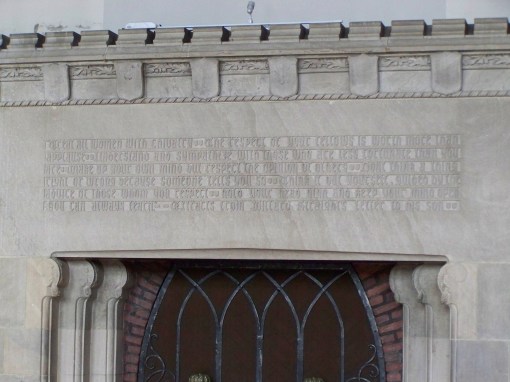
EDIT: So WordPress hates large photos. It says “Treat all women with chivalry** The respect of your fellows is worth more than applause** Understand and sympathise with those who are less fortunate than you are ** Make up your own mind but respect the opinions of others ** Don’t think a thing right or wrong just because someone tells you so ** Think it out yourself, guided by the advice of those whome you respect ** Hold your head high and your mind open, you can always learn ** Extracts from Willard Straight’s letter to his son


[1]http://74.125.113.132/search?q=cache:u79OrjoFVGkJ:en.wikipedia.org/wiki/Willard_Straight_Hall+willard+straight+hall&cd=1&hl=en&ct=clnk&gl=us


Cornell Criticism

12 08 2009

100_3851


What inspired this post were the none-too-charming rankings released recently by Forbes on their “Best Colleges” list [1]. The article itself wasn’t the trigger, but the comments, however…

Where’s Cornell? Where it belongs, behind a lot of small LAC’s where teaching undergrads is actually a priority.”

“…another thing I considered: Cornell has one of the highest suicide rates of all colleges/universities in the U.S. actually, at one point, it was the highest…”

(not true according to the New York Times, but that’s beating a dead horse…)

Now, I could really care less about overall school rankings. Cornell is one of top-rated schools in my field of study, so that’s about the only ranking I ever cared to know. But, there’s a little bit of dark humor to be found in the lengths that people will go to criticize other institutions.

Cornell, of course, is not new to criticism.  The school was maligned in its early years for being co-ed, for not having a religious affiliation, and for some faculty that ran dangerously awry from the norms of the time (one of which included a professor that was an atheist, which in the religiously driven nineteenth century was truly shocking and tabloid worthy). Even today, remarks of “SUNY Ithaca” and “the safety school of the Ivies” still manage to bother some of our thinner-skinned students and alumni. Read Ivygate’s comment section for examples [2].

In the early 1940s, there was “The Dilling Affair”. A student by the name of Kirkpatrick Dilling was brought before the Student Conduct committee and put on parole for engaging in stunts such as blowing dormitory fuses and filling ceiling lights with water. Well, his parents were extreme right-wingers who were convinced that their son was put on parole due to the committee’s underlying communism. Mrs. Dilling came to Ithaca, launched her own investigation, and published a scathering magazine report detailing how the reds has infiltrated the institution from President E. E. Day down. (Bishop, 568)

Sometimes, Cornellians are their own worst enemies. Consider the little feud between Ann Coulter and Keith Olbermann earlier this year. For anyone who wasn’t living under a rock, Metaezra has the full story [3], so I’ll take the liberty of abridging the drama. Coulter, a bastion of invective conservatism, made the remark that liberal mouthpiece Keith Olbermann didn’t go to the same Cornell, but rather state school Cornell (CALS). Most of us who went to Cornell, while aware of the difference (and that the only significant differences between them are source of funding and in-state tuition), but also know that criticism is about as bad an idea as sticking a knife in an electrical socket. But, Olbermann responded back by showing off his diploma on air and bragging about his Cornell degree, Coulter just had to respond back, and the catfight resulting in nothing more than embarassing just about everyone else who ever went to school far above Cayuga’s waters. 

Here’s some of my favorites – building criticisms, as recorded from respondents in the Cornell Alumni News:

Sibley Dome – “the breast of campus”

Rockefeller Hall – “public grammar school No .16”

Baker Lab – “A U.S. Post Office Conferred by a Republican administration”

Olin Hall – “might suit a department of alchemy better than chemical engineering”

…and that was before the sixties and seventies rolled around. The aesthetic critics must be rolling in their graves.

I s’pose Cornellians are their own worst enemies. To quote one more commenter from Forbes:

Wow! A lot of references to Cornell in these comments! As a Cornell graduate, I see that “complex” is still there for many Cornellians.

[1]http://www.forbes.com/lists/2009/94/colleges-09_Americas-Best-Colleges_Rank.html

[2]http://www.ivygateblog.com/2009/03/cornell-fan-admits-cornell-does-not-belong-in-the-ivy-league/#comments

[3]http://www.metaezra.com/archive/2009/03/ann_coulter_is_an_idiot.shtml


Cornell’s Founding Fathers: Andrew Dickson White

29 06 2009
100_2070
Continuing the Founding Fathers entries, we’ll stop at the other man who helped the university go from a pipe dream to a stone and mortar reality, the illustrious Andrew Dickson White. Once again, the primary source is Bishop’s History of Cornell, with the page numbers in parentheses.

In terms of upbringing and character, White was quite much Cornell’s opposite. White was born in 1832 in Homer, which is also in Cortland County (30). The family moved to Syracuse when he was seven, and his father was a prominent banker. He rejected his Episcopalian upbringing, so his father tried to rectify that by sending him to a church school, Geneva College (now Hobart and William Smith), where he was a sophomore at the age of 16. Since the school was esssentially a bunch of drunken partiers (31), he left after one year (try to imagine studying for an exam while your classmates had barricaded themselves in a room and were attacking the president’s house. It was really that bad).  Although, I find it odd that the entire college had 37 students, and he still joined a fraternity (Sigma Phi). Frats were different animals in those days. Anyways, his father wanted him to go back, but when he showed up, he promptly left school and hid with a former teacher of his while he studied up for Yale’s entrance exams. At this point, old Horace White was furious, and said he would’ve rather received news of his son’s death. Well, A.D. passed the exams with flying colors, and entered Yale as a sophomore, spending a few happy years there, being a member of Skull and Bones and Alpha Sigma Phi (which was a class society back then, before it became a social fraternity — although, he was a tremendous asset to both fraternities as they established themselves at Cornell). After graduation, he hung out in Europe for a couple years, attending German and French schools and becoming all worldly and multifaceted. He arrived back in New Haven in 1856, where he obtained an M.A. and almost became professor, were it not for his anti-church sentiment. He was accepted as a professor at the progressive University of Michigan in 1857 (35), and married Mary Outwater of Syracuse that same year (38). After Horace White died (leaving him $300,000, an astonishing sum in 1860) and the Civil War broke out, White took a long leave of absence and came back to Syracuse in 1862 (41). Being politically inoffensive yet well known in Syracuse, he was nominated for and elected to the State Senate in 1863, hardly 31 years old. Here he met Ezra Cornell.

Skipping the university and focusing on White, he served as university president from 1866 to 1885. During and after that time, he served as ambassador to Germany, minister to Russia, and comissioner to Santo Domingo in the Dominican Republic. He was suggested for the Republican presidential nomination in 1884, and for vice-president in 1900. White passed away in November 1918 at the age of 86.

A.D. White’s oddities are so quirky to provide juicy details to any biography about him.

-For one, he was quite short, about 5 feet 5 inches. He was really sensitive about his height, and likely wore elevator shoes (he never admitted it) (43).

-White loved the ideals behind a great university, loved designing buildings and promoting Cornell qualities in print and in speeches—but he hated running the day-to-day affairs. Such work bored him. For a guy know to be excitable, nervous and emotional, routine affairs were not in line with his interests.

-He often dreamed of being an architect or journalist (his architectural designs were based off of  his adored Oxford, which he would’ve made sweet love to in a hypotheical world). He felt that red brick made a building look cheap, hence his distaste for Lincoln and Morse. This is why they were built when he was abroad. [5]

-He only really considered three men his social equals – Goldwin Smith, Willard Fiske, and W.C. Russel (the vice-president of Cornell in the 1870s and 1880s) (45). He hated to be overshadowed and outdone (47), and while he was a sucker for flattery, he would dwell on criticism for days at a time.

-He was known for being very high-minded. One student publication (47) in the 1870s referred to him as “Andy Deity White”. Friends and accquaintances would mockingly refer to him as “You Majesty” and “Saint Andrew”. This high-mindedness was probably why he hated pranks.

-His wife hated Ithaca. Prior to 1874, he used to go up to Syracuse on the weekends. In those days, that involved a steamer on the lake during the warmer season, or in winter a buggy trip to Cortland to catch a train. This was no fun in the CNY blizzards. (100)

-He threatened to resign many times: in 1870, 1871, 1872, 1873, 1879 and 1883. Even when he didn’t resign, he was abroad so often that trustees and staff were begging for him to come back and actually do this job (200).

-Although he was an avid rower at Yale, he never watched Cornell sports matches. He never saw a football, baseball or basketball game (he considered football barbaric), and only saw a Cornell crew race five years after he left the presidency (48).

-He loved animals. He expelled a student in the 1880s for killing a chipmunk with a cane (49). He would allow squirrels to run through his library, even when they chewed on his books.

-His commisioner job in Santo Domingo was because he had to decide whether or not the U.S. should annex the Dominican Republic and make it into a “refuge for colored people” (103). We’re going to assume that his progressive nature, and the fact that the Dominican Rep, was never made into a second Liberia, to mean that he recommended a “no”.

-White’s ultimate grudge came from where he felt he wasn’t given enough credit. When Charles Adams took over as president, he gave an 86-minute inaugural speech, of which 12 were dedicated to White. He was gravely offended because he felt his work was ignored (he expected Adams, a former student of his at Michigan, to glorify him). (258)

-A.D. White met Leo Tolstoy while working in Russia. Tolstoy shared his fascination with Mormonism with White, who then also became fascinated, and amassed a collection of Mormon literature second only to that of LDS and Brigham Young U. itself. This was possible beause the Mormon faith was founded near Rochester, hardly an hour drive from Ithaca, so he raided local collections. [2,3]

 He was a great man, of course. But White would’ve been the old guy to tell lone, rambling stories that would put people to sleep, full of his own pomp and circumstance and still trying to share his ideals with anyone who had two ears and half a heart to pay attention. He was rather needy and attention seeking, and begrudged those whom he felt didn’t give him proper credit.

Our founders are only human.

[1]http://www.cornell.edu/president/history_bio_white.cfm

[2]http://www.absoluteastronomy.com/topics/Andrew_Dickson_White

[3]http://en.wikipedia.org/wiki/Life_of_Joseph_Smith,_Jr._from_1827_to_1830

[4]http://www.fullbooks.com/Autobiography-of-Andrew-Dickson-White1.html

[5]http://www.chem.cornell.edu/history/laboratories/Morse.htm


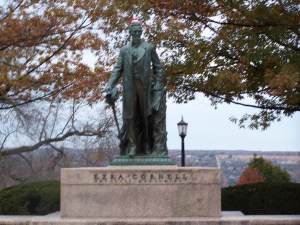
Cornell’s Founding Fathers: Ezra Cornell

27 06 2009


100_2075

So, one of the comments received recently on this blog suggested I write an article on an individual. I thought about it, and then  decided against it. I’m limited in what I can say, as I’m sure people have both good and bad opinions of this person, as they would anybody. I write about Cornell and groups that comprise it, but with the extraordinary exception of Mary Tomlan ’71, I generally limit myself in comments on individuals.

However, I decided to take the idea and run with it in another direction, by revealing a little of the history of the founders who shaped much of the university in its formative years. This entry will cover Dear old Ezra Cornell himself. Any citations within the entry will refer to Morris Bishop’s History of Cornell unless otherwise noted.

A lot of Cornellians know bits and pieces about the founders of Cornell. Dear old Ezra himself, born in 1807 in downstate New York to a quaker family (Bishop 8), moving to the Cortland County town of DeRuyter at 12, and then to the boomtown of Ithaca in 1828. According to Bishop, he was a tall, gaunt gentleman, disinclined to show emotion or to talk more than necessary. He married Mary Ann Wood in 1831 (12). Initially, Ezra made his living operating a flouring mill for Col. Jeremiah Beebe (flouring mills would ground up gypsum to be used in fertilizer). After the Panic of 1837 (akin to today’s economic crisis, only craploads worse), he lost his job and tried his hand at several ventures, including selling plows in Maine and Georgia, which failed (15). When he went back on another trip to Maine in 1843, he lucked out, and an accquaintance asked him to design a machine to lay telegraph lines. Being a self-taught mechanic, he built it, received a contract to lay the wire, became convinced it was bad method, and read up on electricity, coming to the conclusion that overhead wires were best (16).

As a builder of wires, he made his fortune, and by 1849 had laid one-third of telegraph wires operating in the U.S. (17). Since he took his payment in stock, when Western Union bought him out around 1855, he was a made man. He went back to Ithaca, bought the land where CU sits today, and ran a model farm. He became president of the NYS Agricultural Society, and used some of his money to donate a library to Ithaca City (which was built at the SE corner of Seneca and Tioga it was demolished in 1960 as part of urban renewal. It was turned into a parking lot). He was the oldest member of the State Senate when he was elected in 1863 (persumably in the days before they had political gridlocks that accomplished nothing but gave everyone a mighty headache). It was here that he met A.D. White, when he was getting a bill of incorporation for the library (White, as the head of the Literature committee, had to approve the bill). I’ll be covering Andrew Dickson White in an entry in not too near future.

So anyways, the basic facts are great and all, but Ezra also had his oddities and faults. These are the facts Cornell probably doesn’t share so much. Can’t blame them-

~Ezra was extremely self-righteous, which led to him being scorned by most of the Ithaca community. He was also extremely forgetful with regards to his debts, and his family’s needs (Bishop 13). People did not trust him, especially with money. For many years, his wife and kids had to live off her father thanks to his lack of provisions.

~He was apparently quite tactless as well. Col. Beebe, and later Samuel Morse (of Morse code fame) would have a hard time dealing with his demeanor. Beebe called him “coarse and impudent” (13), and Morse referred to him as “the plague” (17).

~Carl Becker just out-and-out called him a bad businessman. The fact that he managed to make a fortune in the telegraph industry was astounding to even his own family and friends. He beat competitors by “starving them out”, even if it meant keeping himself in the poorhouse. (18)

~Family and friends did not pronounce his last name Cor-nell. They pronounced it Corn’ll. His own pronounciation of his name changed sometime in the late 1840s or early 1850s. (19)

~Cornell hated Syracuse. He referred to as “that Gomorrah” (11) after he was cheated out of some wages when he was young. Kinda funny that A.D. White represented Syracuse in the State Senate. When White proposed using a large hill to the south of Syracuse, Cornell threatened to withdraw from the proposal unless the university was moved to Ithaca, which he had hopes of becoming a major city. Well, it didn’t, and the proposed hill was where Syracuse University established itself in 1870.

~Cornell’s vision of the campus was that of an industrial campus, egalitarian in nature. Namely, anyone could work their way through school, in the chair factory and shoe factory he proposed to set up on campus (126),like a trade school. One could not have been farther from the classical college educations of that time, or from A.D. White’s vision of CU.

~Perhaps tying to Cornell’s unorthodox nature, a Rochester newspaper concocted a story in October 1869 that Cornell sought to make a huge personal profit out the university (183). Doesn’t sound too different from the stories you find in editorials in the Ithaca Journal about how Cornell ruins the city. It came up again in 1873, when a Schuyler County legislator accused Cornell of defrauding the Morrill Act in order to make a $22 million profit, which resulting in a formal state invesitgation (it cleared Cornell in April 1874[186]).

~Cornell loved to invest in railroads as much as he did his own university. His desire to make Ithaca a major city resulted in a constant investment in new railroads in and around the area, such as the Elmira-Ithaca-Cortland route and a proposed route to Auburn. He invested so much that White and Cornell’s attorney thought he might go bankrupt if something were to happen, like the Panic of 1873. Uncle Ezra lost a lot on those failed railroads (187).

~In what I can only describe as completely creepy, Ezra had nine kids [1], and sadly, one of them, Charles Carroll Cornell, died at the age of 4 in 1837. So Two years later, his wife had another son. They named him Charles Carroll Cornell. This child died at two years of age, so at least he never had to realize the utter sketchiness associated with named after one of your dead older brothers.

Long story short, Cornell could be stereotyped as the rather crotchety old man who would scare small children at a glance and launch into stories of “when I was your age” to be shared with the students.

http://en.wikipedia.org/wiki/Ezra_Cornell

http://rmc.library.cornell.edu/Ezra-exhibit/time/ECfa.timeline.html

[1]http://www.nndb.com/people/456/000135051/


The Essentials of Campus, Part I

10 04 2009

I decided to do a blog piece on some of the more important assets to our campus because I was working on a project yesterday and discovered that I had no entry that really discussed Bailey Hall. I figured I might fix that now.

100_2110

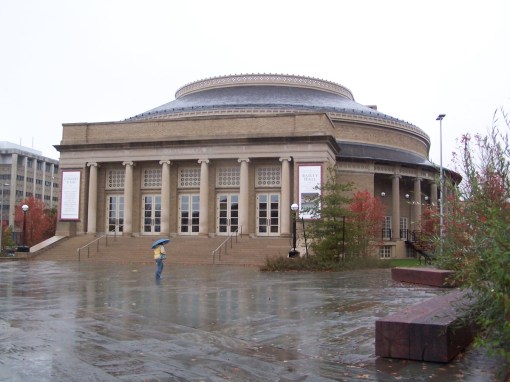
Liberty Hyde Bailey Hall. The building was designed by Edward M. Green, Class of 1878 [1]. The building was first opened in June 1913 and intended for use by state college students, and for Farmer’s Week gatherings. It’s namesake, L.H. Bailey (1856-1954) was the first dean of the College of Agriculture at Cornell [2].

One if the original centerpieces of the building was a luxurious organ that was paid for largely by Andrew Carnegie, the industrialist [1]. The organ was mostly a gift for A.D. White’s 80th birthday in 1912.

One story from Bishop’s work concerning the history of the building might strike a note with some passionate politicos today. Back during WWI, an Austrian violinist named Fritz Kreisler played at Bailey. Unfortunately for him, the citizens of Ithaca weren’t as willing as the university to let him play a performance:

“The Hill prided itself on its broad-mindedness, its humanity above all nations and nationalisms. Fritz Kreisler, the Austrian violinist (who had played in Bailey Hall in October 1917, before an enthusiastic capacity audience), was again invited for a concert on 11 December 1919. But downtown a fervid patriotism reigned. The American Legion had condemned in national convention the appearance of any German or Austrian performer. Ithaca’s Mayor called on all patriotic citizens to stay away from the concert. Nevertheless Bailey Hall was packed, the front seats being conspicuously occupied by the football team. In mid-concert about eighty hoodlums, as the Sun termed them, cut the lighting circuit and tried to invade the hall. The students rose and fought. A large band returning from a basketball game took the invaders in the rear. Kreisler, unperturbed, played on in the din of the Battle of Bailey Hall. President Schurman took his stand beside the performer. A volunteer leaped to the stage with a flashlight for the accompanist. The invaders were magnificantly repelled, to the strains of Viotti’s Concerto in A minor. No tumult since Nero’s time has had such a fine violin accompaniment.” (433-34) [1 , 2]

The building has also had some other uses apart from an auditorium. Plant pathology was taught in the basement in the 1920s [2]. A CFCU branch used to be located in the back of the building. Today, since it’s the only academic building that has the size to host it, Prof. Maas’s PSYCH 101 is taught within its vast walls.

As originally configured, Bailey seated 1,948 people. However, as a result of wider seats and handicap access was installed during the renovation, that number shrank to 1,324 [3].

The plaza was installed only about a year and a half ago, a nice complement to the building. Originally, the Minns Garden was up here, and then that was replaced with a full parking lot towards the mid 20th century.

100_3405

100_20811

Yes, both photos are mine…taken about five months apart. That tells you how hesitant I was to write up the history of Sage Hall. For this, much of the information will be pulled from Bishop’s history of Cornell, with page citations in parentheses.

The best place to start, of course, is at the beginning. The building was originally known as Sage College, and it was an all women’s dorm. The building was the architectural pride of campus when it was completed in 1875 (98), designed by Charles Babcock, an architecture professor at Cornell. Prior to that, campus was the Old Stone Row, Casca and West Sibley; gray stone buildings that, while imposing, were utilitarian; Goldwin Smith once remarked “nothing can redeem them but dynamite”.  The proposal for the building came while A.D. White was debating whether or not to accept a government post in Greece; the plan for Sage to endow this grandiose structure led him to reconsider (103).

The original endowment by Sage was in the amount of $250,000. The building’s design allowed for all the living needs of 150 to 200 lady students (148). Originally, the Botany and Horticulture department were to be housed here as well, since they were a subject that was “so suitable for young ladies”. The proposal for Sage was formally launched on February 13, 1872. Also that fall, sixteen women applied to Cornell, and our first female graduate, Emma S. Eastman, graduated in June 1873 (she married a classmate and went on to become a famous suffrage lecturer). By 1874, there were 37 women.

Meanwhile, in May 1873, the cornerstone was laid for Sage College by Mrs. Sage. The cornerstone is particularly interesting because of a commotion caused during Sage’s renovation in 1997. Workers were renovating near the cornerstone when they discovered  a heavy metal box with letter placed inside it, bearing Ezra Cornell’s opinion on the status and future of coeducation [4]. Naturally, this discovery, while somehwat expected, raised quite a commotion on the campus, because no one had ever read the letter except Ezra Cornell himself. The full text of the letter can be found in the link. Long story short, he supported women’s education.  Cornell had never shared his opinions about educating women before he passed away in 1874, so no one ever knew how he particularly felt until that letter was opened 124 years later.

To quote Morris Bishop (who wrote his book in 1962): “When at length the day of Sage College is done, may some historian remember these words and rescue the tin box from the demolishers!” (149)

Sage opened in 1875 to about 30 female occupants. The building rented out to fifty male boarders its first year, who often ate with the women, striing up trouble in the process (the Sage College manager makes special note of the extremely demanding gentlemen boarders from Psi Upsilon). Between 60 and 70 women live there for each year for the rest of the decade (208), and dropped back down to 30 by the early 1880s (246). Sage closed its doors to visitors at 10 PM, and flirtatious dances were highly frowned upon. The first panty raid took place in 1878, when men broke into the Sage laundry, snatched the ladies’ underclothing and threw it from the steeple of nearby Sage Chapel (209).

By 1881, the decline in numbers at the ladies’ dorm had caused Sage to doubt whether it should continue to exist. In letters to A.D, White, he floated the idea of turning it into an art museum, libary, or engineering building (247). Fortunately for women, Sage was completely full by 1891 (300), and women were no longer required to live in Sage. Many of our sororities, such as Delta Gamma and Kappa Alpha Theta, had their starts in Sage College.

Alas, by the mid 1990s the building had worn down with time. The last dorm residents (co-ed since the 1930s) moved out in 1995, and the building was given to the Johnson School for renovation in 1996. The renovation and addition was desinged by Alan Chimacoff, a Cornell alumnus [5]. The $38 million renovation was completed in August 1998.

Today, The Johnson Graduate School of Management resides in the building, with an atrium, class space, meeting areas, and Sphinx Head’s meeting room (supposedly).


[1] History of Cornell, Morris Bishop, P. 362

[2]http://baileyhall.cornell.edu/about.html

[3]http://en.wikipedia.org/wiki/Bailey_Hall_(Ithaca,_New_York)

[4]http://www.news.cornell.edu/chronicle/97/3.20.97/Ezra_letter.html

[5]http://www.johnson.cornell.edu/facilities/sagehall/