News Tidbits 4/16/09: Little Ithaca Grows Up

17 04 2009

Looks like Ithaca’s downtown area is seeing some long awaited expansion.

http://www.theithacajournal.com/article/20090416/NEWS01/904160358&referrer=FRONTPAGECAROUSEL

Major downtown construction projects are slated to move forward this year, a sign of Ithaca’s relative resilience in troubled economic times, city officials say.

The Hotel Ithaca project at the eastern end of The Commons should break ground this fall, and construction is scheduled to start by summer on the Cayuga Green condominiums between the Cayuga garage and Six Mile Creek, Downtown Ithaca Alliance Executive Director Gary Ferguson said.

This summer should also see the completion and opening of the new Cinemapolis in the ground-floor of the Green Street garage and Urban Outfitters on the ground-floor of the Cayuga Green apartment complex.

Hotel and condos

The $30 million, 100-room Hotel Ithaca project this month received city approval for zoning variances, and Common Council approval to jut several feet over the top of the Green Street garage. It’s scheduled to come for site plan review to the Planning and Development Board April 28.

The $12 million, 7-story Cayuga Green luxury apartment/condo project is the last piece of the years-long Cayuga Green downtown development. It already has needed approvals.

Ferguson said when he talks with fellow economic development planners around the state, “they’re just green with envy.”

“One, we’ve been planning them for some time so it’s not like these are just popping out of the ground. But secondly, while the economy’s been rough, this still is a very strong economy relative to other parts of the state, other parts of the country,” he said. “I think this malaise, if you will, is worse in a lot of other places and actually makes Ithaca look even more attractive to people.”

Bankers still seem to have faith in Ithaca, said Phyllisa DeSarno, deputy director for economic development for the city. This is evidenced by the fact that Cayuga Green developer Ken Schon has retained his financial backing.

“We were all crossing our fingers . . . because so many developers are losing their funding and banks are not going with projects,” she said. “But he said it does not look like that’s going to be his issue. He is moving ahead.”

The Hotel Ithaca was proposed to go up to the limit of 85 feet allowed by zoning, but the project developer received approval to go up an additional 21 feet, in order to enclose the building’s heating, ventilation and air conditioning systems. Under the city’s zoning, that kind of equipment is never considered part of a building’s height.

“This was a very, very major coup, really,” DeSarno said. “We were so thrilled that this happened because it sets a bar now I think for other developers, other builders to do something about mechanicals, which are really such a blight. When you’re coming off any of the hills, coming down from Ithaca College or Cornell (University), it’s going to be so much more aesthetically nice to have that screening there.”

The rooftop enclosure will also include meeting and conference space “to offset the cost of the structure,” according to information provided to the city’s Board of Zoning Appeals.

Openings

Construction continues on the future homes of Cinemapolis and Urban Outfitters on either side of Green Street.

Cinemapolis is scheduled to open in late May, potentially in conjunction with Ithaca Festival, said Lynne Cohen, one of the executive directors of Seventh Art, which oversees Cinemapolis.

Construction is scheduled to be complete in about a week, then all that will be left is to paint and install seating, projection equipment and refreshment equipment, Cohen said.

“With a little imagination, you can see what the theater’s going to look like,” she said.

Compared to the existing Cinemapolis theaters in Center Ithaca and at Fall Creek Pictures, the new location will have “fewer seats but better allocated,” Cohen said.

Cinemapolis’ contract at Fall Creek Pictures runs through the end of this year, but Seventh Art has not yet decided whether they’ll continue showing films there once the new location opens, said Rich Szanyi, Cohen’s husband and another Seventh Art executive director.

Tsvi Bokaer, founder of Fall Creek Pictures, could not be reached for comment.

Urban Outfitters, which will occupy the eastern half of the ground floor under the Cayuga Green apartments, is on schedule to open July 2, project architect David Levy said by email.

“Now obviously Urban Outfitters will be a big draw and all of the neighbors around Urban Outfitters, including The Commons, will benefit from them being here,” DeSarno said.

Ithaca will be the second Upstate New York location for college-age focused Urban Outfitters. The other is in Buffalo.

Tompkins Consolidated Area Transit also plans to rent space on the ground floor of the apartments, and Schon is in discussion with two local small businesses about filling the remaining area, DeSarno said.

“Obviously there are cuts throughout our city and the county in our businesses and in our employers,” she said. “But we certainly, like Bob Sweet from National Development Council always says to me, ‘(Ithaca is) an oasis amongst a muck and mire.’ ”

The Hotel Ithaca was proposed to go up to the limit of 85 feet allowed by zoning, but the project developer received approval to go up an additional 21 feet, in order to enclose the building’s heating, ventilation and air conditioning systems. Under the city’s zoning, that kind of equipment is never considered part of a building’s height.

“This was a very, very major coup, really,” DeSarno said. “We were so thrilled that this happened because it sets a bar now I think for other developers, other builders to do something about mechanicals, which are really such a blight. When you’re coming off any of the hills, coming down from Ithaca College or Cornell (University), it’s going to be so much more aesthetically nice to have that screening there.”

The rooftop enclosure will also include meeting and conference space “to offset the cost of the structure,” according to information provided to the city’s Board of Zoning Appeals.

~~~

For the record:

commons

Red box is part of the Hotel Ithaca site, green box is the Cayuga Green Condos site. Cayuga Green Apts, shown as under construction in this map, are where Cinemapolis and Urban Outfitters are going to be located. As Mr. Nagowski noted, Cinemapolis will be in the garage side of the construction area. Urban Outfitters is on the first floor of the apartment building.

Hotel Ithaca proposal:

http://www.gemstoneresorts.com/Properties.aspx

Cayuga Condos

http://www.josegarciadesign.com/images/cayuga-condo00.jpg

For reference, the height of Seneca Place is 121 feet, according to Emporis. The new apartment building on Green Street is 60 feet.

Ithaca Construction Isn’t Ending…Yet

3 03 2009

With all the doom and gloom associated with the current economic times (rightfully so), it’s easy to forget that there are still some projects in the pipeline outside of Cornell, but in the surrounding Ithaca area. Since it’s been a while since I chronicled those, let’s do a quick overview.

Lansing

Ithaca’s northern suburb has a number of different projects  planned. Currently going through the pipeline are the Lansing Commons project (~50 units) and the Cayuga Farms projects (~138 units). The projects are typical suburban development, consisting of single-family homes, townhouses, and a few apartment buildings and commerical office buildings. The buildout would be over a period of several years.

Ithaca (town)

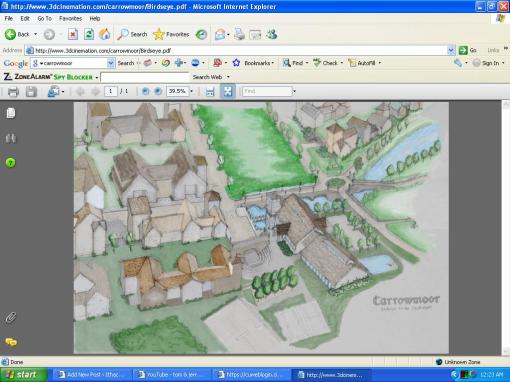
Apart from some minor subdivisions, an electrical substation and a wireless tower, the big project in the town of Ithaca is the Carrowmoor project [2].  The 400-unit project is an eco-friendly development of houses and a small village center of retail and office space. The residential units are a mix of single-family houses, townhouses and apartment buildings. The buildout is also over a period of several years. Building designs are meant to be a throwback to the days of Tudor England (for better of for worse [3 -The website for the development looks like it was built in 2000, and takes a long while to load]).

carrow1

Ithaca City

Two outparcels (small-box retail no doubt) are planned for the SW commerical district. One is in front of the Tops Plaza, the other is next to Wal-Mart. Renovation for the Hangar Theatre, finalized drfats for the Ithaca College Athletics Center, and construction for Urban Outfitters planned downtown location are also going through the board. The Hotel Ithaca is still underway- technically. The 10-story, 100 ft. building is currently being held up because the building has a nine-foot overhang over the Green Street Garage—meaning it’s in city air space, and has to go in front of the board to get approval for that air space [4]. A little bit ridiculous, perhaps, but that’s how it’s done. anyways, the preliminary design has been brought in front of the board, but no image is widely available as of yet.

Technically, the Southwest neighborhood plan is still active too, but that one might just as well be considered in hibernation given the economic situation.

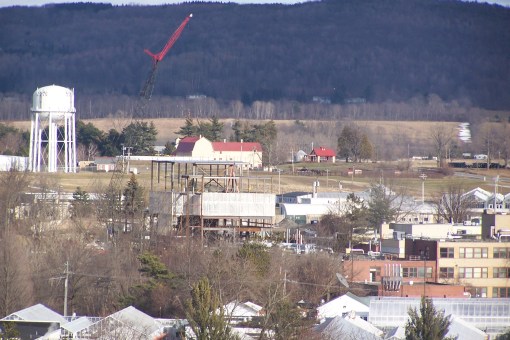
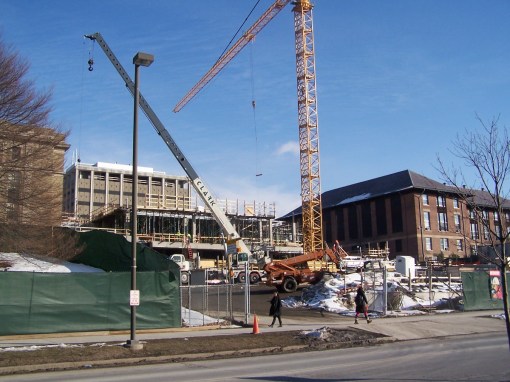
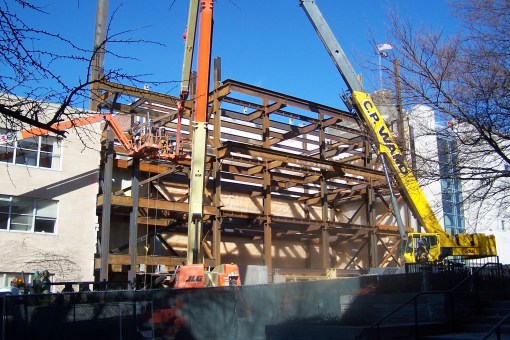
Heck, since I’m writing this, I might as well include progress photos of some of the campus projects.

100_3181

Veterinary School Animal Health Diagnostic Center

100_3100

Physical Sciences Building

100_3102

MVR North expansion

100_3318

 Hotel School Expansion

[1]http://www.lansingstar.com/content/view/4601/66/

[2]http://www.ithaca.com/main.asp?SectionID=16&SubSectionID=83&ArticleID=8385

[3]http://www.3dcinemation.com/carrowmoor/index.html

[4]http://www.theithacajournal.com/article/20090220/NEWS01/902200317/1002


Miracles Do NOT Happen…

12 02 2009

http://www.theithacajournal.com/article/20090211/NEWS01/902110328/1002#pluckcomments

So, let’s start with the article:

http://www.theithacajournal.com/article/20090211/NEWS01/902110328/1002#pluckcomments

“A group of Cornell professors is urging the university to hold off on construction of Milstein Hall, citing concern about the economic recession and the building’s environmental footprint.

In response, a group of Cornell architecture faculty is urging the university to move forward, saying the new building is needed to keep its top-ranked department accredited.

The ultimate decision on whether to go forward with Milstein Hall lies with University President David Skorton, and he has not yet made that decision, Cornell spokesman Simeon Moss said Tuesday.

Skorton announced a university-wide construction “pause” in October. The pause extends through the end of the fiscal year in June.

“Basically all projects that don’t have a shovel in the ground are subject to the pause, and the president and the executive vice president are reviewing those projects,” Moss said. On whether Cornell will move forward with Milstein Hall, Moss said, “That decision by the president hasn’t been made yet.”

Throughout its city approval process, Cornell officials repeatedly said that Milstein Hall is not subject to the construction pause.

On Monday Mark Cruvellier, chair of the Department of Architecture, sent The Journal a joint statement in favor of Milstein.

“This is a building that is urgently needed by the Department in order to maintain our accreditations as a professional school of architecture,” reads the statement signed by 13 architecture professors. “The building permit is in hand, bids have been reconciled, and it is, in today’s parlance, shovel-ready. Given the current low cost of materials and competitive bidding situation, to delay construction of Milstein Hall yet again will only add to its cost.”

Cruvellier could not be reached for comment Tuesday.

Milstein Hall has spent 10 years in the design and approval process, including two years gaining approvals from a variety of city boards. The city’s planning board and landmarks preservation commission have both signed off on the project.

Milstein Hall is proposed as a modern, glass structure that will physically connect with Rand and Sibley halls and stretch across University Avenue toward the Foundry. Another cantilevered extension would extend out into the arts quad.

A group of at least 25 Cornell faculty and alumni have petitioned the university to halt construction of Milstein, using The Cornell Daily Sun, other media and, today, the university’s faculty senate, government professor Elizabeth Sanders said.

Those opposed include an architecture professor, Jonathan Ochshorn, and music professor Martin Hatch, who has spoken against Milstein before a variety of city boards over the last two years.

Sanders contrasted the process and design for Milstein with Ithaca College’s new Park Center.

The Park Center received the highest rating possible from the U.S. Green Building Council, a LEED Platinum, and cost $19 million, according to the Ithaca College Web site.

“And we’re going to spend $60 (million) and get less space and much lower sustainability and a lot of offensive aspects?” Sanders said. “If Ithaca College can do this, why can’t Cornell do this?”

Andrew Magre, project manager for Milstein Hall and the Central Avenue Parking Garage, said last month the total project cost would be approximately $54 million.

Milstein Hall would be roughly 50,000 square feet, according to information presented to Ithaca’s planning board, and will include studio, gallery, meeting and exhibition space, and a 275-seat auditorium. The parking garage will include two underground levels and one surface level for a total of 199 parking spaces.”

***

Let’s consider the Park Center for a moment.

Photo by Granger Macy

Photo by Granger Macy

The Park Center was a $19 million dollar project to build a 38,800 sq ft building [1] on the Ithaca College campus that was completed in early 2008 (it’s also the building that caught fire during the fourth of July celebrations).

So, let’s consider some key differences between the Park Center and Milstein Hall.

-Milstein is cantilvered and is connected to two structures that are a century old (Rand Hall) and ~110 years old (East Sibley). Park Center isn’t. The area was home to a green space that bordered a parking lot (and oddly enough, was not a suggested building site on the Ithaca College master plan [2], and to the contrary seems to throw off the master plan by cutting off the proposed green avenue through the main campus).

-Milstein had to go through red tape hell after Paul Milstein’s original $10 million donation in 2000. Park Center was launched with a major donation from Dorothy Park in 2002 [1]. The cost has gone from somewhere in the 20 million dollar range when first proposed to $40 million from a couple of years ago to about $54 million today. I wonder if that total includes the $2 million Cornell paid for University Avenue so they could actually build the damn building.

-Milstein incorporates a parking garage, auditorium, and bus stop. Park Center has a large atrium, but otherwise it’s mostly offices and smaller lacture spaces [1]. Park Center is LEED platinum (highest ranking), and Milstein is gold (second highest ranking).

My issue is that the comparison does an unfair presentation of facts. If we were to plop Milstein out on the alumni fields or near the vet school, I bet it would be a lot of cheaper too. Park Center didn’t have the red tape issues or ambient environment issues that Milstein Hall has to deal with.

My other issue is that some people are finding fault with the modern design. Let’s not start that crap again. In my own opinion. this is probably the least offensive design of the three that have been planned, if but just because it spares Rand from the wrecking ball. I’ll admit I’m no fan of it, but it’s less jarring than the previous two proposals. For one thing, architecture schools have a habit of wanting to be on the cutting edge of design (makes sense, considering building design is much of their field). Plus, the design is going to be different, because if people want to preserve Rand and Sibley the building has to build up or out. Being on the Arts Quad, I’m willing to wager some passionate people would rather burn the construction site down than let it build up.

As much as this site is a Cornell construction monitor, and as I much as I actually like seeing new projects go forward, I’m really torn opinion-wise. Yes, I’d like to see the the architecture build-out so it can have more (badly-needed) space. However, with operations cuts across the board, I don’t see a good reason this should be spared. My concern, however, is that prices will continue to skyrocket, costs will be prohibitive and the project will have to go back to the drawing board again, and AAP will have a crisis due to its trip through red tape hell.

[1] http://www.ithaca.edu/news/release.php?id=2501
[2]http://www.ithaca.edu/masterplan/reports/sept_2002_content_pages.pdf


News Tidbits 1/8/09: Miracles Do Happen

8 01 2009

All I can say is, it’s about time.

http://www.theithacajournal.com/article/20090108/NEWS01/901080319/0/NEWSFRONT2

ITHACA – Cornell’s Milstein Hall project will benefit Cornell and the public while minimizing negative impacts, Ithaca’s Planning Board decided.

The Board voted unanimously Tuesday night to grant preliminary site plan approval to the $54 million project that includes a new, 59,000-square-foot building that will connect Rand and Sibley halls and stretch over University Avenue toward the Foundry.

A new Central Avenue Parking Garage will also provide 199 parking spaces on three levels, two of them underground.

The project has been delayed for at least five years with various designs and, most recently, a dispute between the university and the city’s Board of Public Works over the proposal to place part of the building over University Avenue.

After months of disagreement, the university decided to use a cantilever design rather than columns, which would have required an easement from the city. Separately, Cornell and the city later agreed that Cornell would pay to rebuild and maintain the badly deteriorated University Avenue in exchange for the city’s decision to give up its public right of way on the road.

The planning board has been reviewing an environmental impact statement on Milstein for the past two months and has heard comments from Ithacans and Art, Architecture and Planning faculty and students for and against the project.

Cornell and those in favor of the project have argued that the additional space is needed to maintain the Art, Architecture and Planning College’s accreditation and to programmatically connect the three buildings.

Planning Board Chairman John Schroeder said the existing conditions leave the Foundry disconnected and looking “like a maintenance building.” Milstein Hall would move the center of activity more toward the middle, better linking the buildings, he said.

Those against the project have argued that the very modern design of Milstein Hall will be jarring next to the historic Rand and Sibley halls.

Ithaca’s Landmarks Preservation Commission will review historic preservation concerns related to the project at their meeting at 7 p.m. Wednesday, Jan. 14 in City Hall, 108 E. Green St. The commission would have to grant a Certificate of Appropriateness for Milstein Hall to be built, Acting Planning Director JoAnn Cornish said by e-mail.

Cornell also needs final site plan approval from the Planning Board, which could come at its Jan. 27 meeting, Cornish said.

John Gutenberger, director of community relations at Cornell, said if the final approvals are granted, construction could start by early spring. Milstein Hall is not subject to the university’s construction pause, he said.

The project would be complete by December 2010, project manager Andrew Magre said.

***

In other news, the massive (by Ithaca standards) development called “Carrowmoor” continues to clear the political hurdles. From the town of Ithaca’s 1/6/09 minutes:

Consideration of designation of the Town of Ithaca Planning Board to act as Lead Agency, and the determination of a Positive Declaration of Environmental Significance for the proposed Carrowmoor development project located off Mecklenburg Road (NYS Route 79), north of Rachel Carson Way, Town of Ithaca Tax Parcel No. 27-1-14.2, Agricultural and Medium Density Residential Zones.  The proposal includes the development of 400 +/- residential condominium units, a community center complex, up to 36,000 square feet of neighborhood oriented commercial uses, up to 32 living units in an elderly residential building, a child care center, and other mixed-use development on 158 +/- acres.  The project will also include multiple new roads and walkways, open recreation areas, stormwater facilities, and community gardens.  Town of Ithaca actions also include consideration of adoption of a proposed local law to enact a Planned Development Zone in conjunction with the Carrowmoor proposal.  The Planning Board may also begin discussions of the draft scoping document for the Environmental Impact Statement (EIS).  John Rancich, Owner/ Applicant; Steven Bauman, Agent; Mary Russell, Attorney.”

Still some hurdles left though. The Planning Board must approve both the environmental review and site plan review before Carrowmoor could be built. The Town Board also has to pass a local law changing the zoning to allow for the project’s development.

***

No entries for the next week, as I’ll be mostly internet-less at a conference. For those of you planning to attend Rush Week, good luck and have fun.


The Goldwin Smith Hall Addition

20 11 2008

Perhaps I’ll still have some construction tidbits to write about after all. So, up for review for the Ithaca Planning Board this month is a sketch review of the Goldwin Smith Addition. The “Goldwin Smith Annex” is a $45.1 million, 60,000 sq. ft addition in the back of the building [1], facing East Avenue, a la the Lincoln Hall addition in 1998. The GA Annex is set for a targeted completion date of Summer 2011, but given the current economic situation, we’ll see if that changes down the line. To quote the capital budget plan (first link):

“This project will design and build a new building adjacent to Goldwin Smith Hall to provide approximately
30,000 to 35,000 net square feet of new humanities and social science classroom and academic department space on the Arts Quad. The new space will address partially a chronic shortage of academic space that has characterized this area of campus and which has been exacerbated by recent and projected growth in faculty and programs in response to university initiatives. The current shortage of space has resulted in: (a) some faculty sharing offices or rotating among offices based on the pattern of temporary faculty leaves; (b) a lack of adequately sized classrooms and lecture halls; and (c) inadequate space for lecturers, graduate students, and staff.”

Where’d they get the 60,000 sq. ft figure from? My personal guess is renovated space in Goldwin Smith.  I’m not a fan of inconsistencies. However, the old budget plan indicates that an architects should have been selected in fall 2007.

So, unfortunately, the sketch plan brings no mention of the architectural firm, which makes the task of getting a rough idea of the design a veritable hell. However, thanks to the master plan, we actually have an idea of the massing:

untitled

So, the rough massing concept seems to be three connected but otherwise independent structures, all of similar massing (and therefore roughly the same square footage). If we use the 60,000 sq. ft figure, except three two-and-a-half story buildings with footprints of about 7500 sq. ft each, which fits the area rather snugly. If it’s the 30-35,000 figure, we can except the footprint to be smaller, but the height massing will likely be about the same to maintain massing consistency with the main building.

In the meanwhile, I have requests filed in with the contact person for this project asking for any possible rendering or at least the architectural firm responsible, so I’ll come back to edit this post, hopefully in the not too distant future.

[1]http://dpb.cornell.edu/documents/1000383.pdf —page 54

[2]http://www.ci.ithaca.ny.us/vertical/Sites/%7B5DCEB23D-5BF8-4AFF-806D-68E7C14DEB0D%7D/uploads/%7BF4A05E59-733D-480A-A8C0-37224316CFF6%7D.PDF

“D. Sketch Plan, New Humanities Building, Cornell University (materials to be distributed at
meeting)”


The Story of the Vet School Incinerator

18 09 2008

So, I enjoy telling a good story as much as the next guy, and this one was actually the subject presented by my professor in an air pollution course I’m enrolled in. I might have been the only one taking notes on this, because it was meant to merely illustrate an argument, it’s historical, and an interesting piece of history worth sharing.

So, in the early 1990s, The Vet School over on the East Campus had a problem. A large number of carcasses were being generated daily. Dissections, disease studies, putting some of the farm animals to sleep, etc. So on any given day, thousands of pounds of carcasses were being produced, and they had to be disposed of.

Well, Cornell, for all the things it does have, does not have an incinerator for cremation on any of its properties. So they would have to ship the carcasses out in container trucks with hazard labels and send them to an incinerator elsewhere in the county, where they could be properly disposed. As you might imagine, this built up quite a hefty amount of fees over time. So Cornell began to explore their options to alleviate the problem.

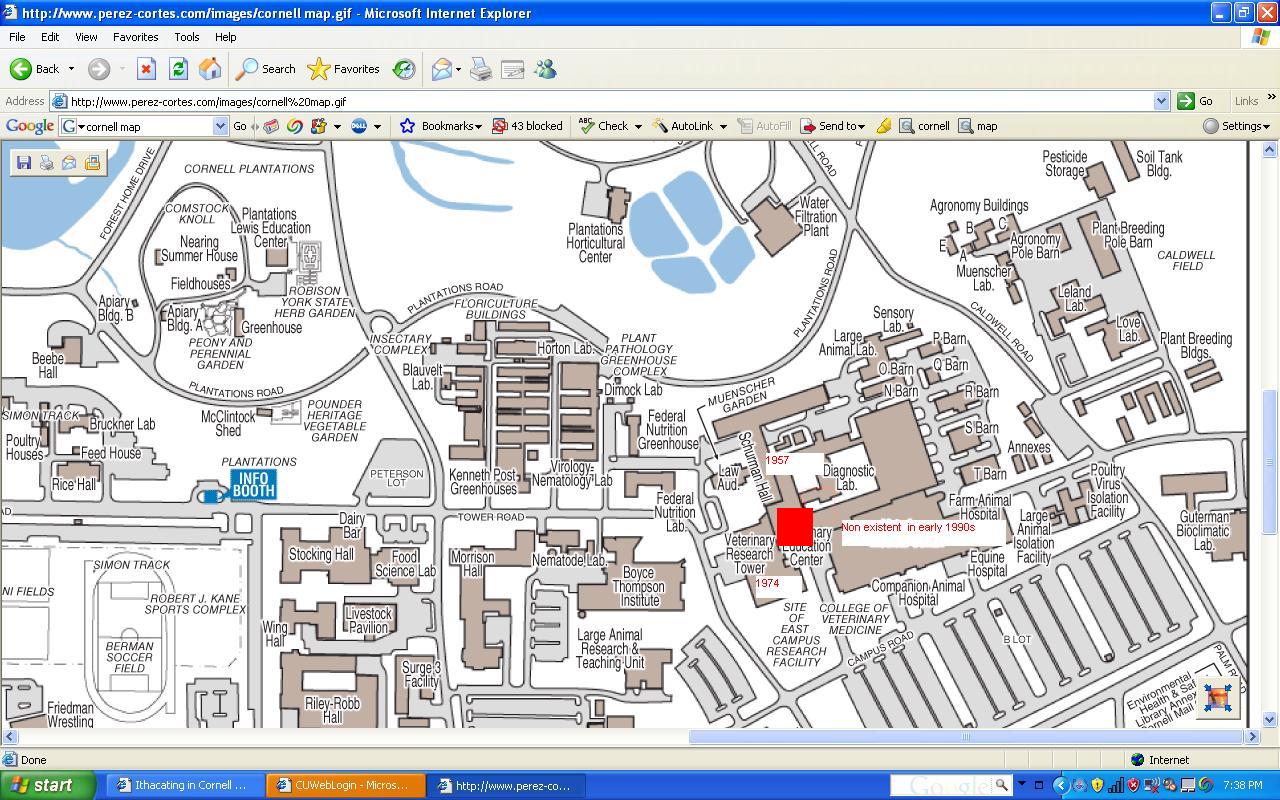
Well, the proposal that seems to work best was to build a waste disposal facility for the animal carcasses directly on the property. The site that was determined to be the best fit was just to the east of the Vet Research Tower. At this time, the Vet Hospital’s main building and the East Addition didn’t exist, so the complex was mostly barns, the tower, Schurman Hall and the scattered add-ons that comprised the property. The red square below was the approximate location for the project.

 The Vet Tower is a fairly large building, as it stands about 140 feet tall. So, in order to build the smokestack, the design had the smokestack stand about 180 feet tall, more than enough to clear the building.

Well, it went ahead in front of the town of Ithaca, and the residents of the neighboring hamlet of Forest Home had a fit. They’d be damned if they had to look at a giant smokestack from Cornell. So Cornell paid an engineering firm to survey the land from notable viewing radii to see if the structure would impose on the residents of Forest Home. Sure enough, if did, but only just barely. It was determined that if the design was shorter, it’d be okay.

So, Cornell proposed changing it to 160 feet. But, there was another issue with that. Bradfield Hall, just up the road, stands 167 feet tall. And the top floor has windows (ironically enough, the atmospheric science department is housed at the top).  So, that wasn’t going to fly unless Cornell did an air pollution study to prove it wouldn’t affect the occupants of Bradfield.

Well, here’s where we get into an issue. The company they hired, a New York-based engineering firm, decided that the air circulation patterns in Ithaca were the same as Syracuse. Syracuse built a power plant only a couple years earlier, so they decided to reuse the same data and apply it Ithaca. Essentially, they tried to swindle Cornell by selling them false data from another location.

Winds generally blow out of the west in Ithaca. However, in the situation where they would blow out of the east, as during some stormy days caused by east-coast lows, the pollution cloud was going to push over to Bradfield Hall and towards central campus. This pollution would have particulate matter that would drift down onto Tower Road and the Ag Quad. Well, no ones wants to be snowed on by cremated animal ash. Even worse, if it blew out of the northwest at a particularly strong clip, it was going to drift right over Forest Home. The increased height would have allowed it to carry farther away, but the new shorter height would cause particulates to fall a shorter diestance away, and they would be more concentrated, to unhealthy levels.

Well, the university didn’t know that at the time, so they bought the data. And it wasn’t until the final stages of the project that the mistake was realized (through an interdepartmental study independent of the project). The Town of Ithaca wouldn’t give final approval in light of the news. Well, Cornell was just a little upset, so they decided to bring a lawsuit onto the company for their actions, and Cornell had to scrap the 160-foot plan.

Well, due to the air ciruclation patterns and sight lines, a large smockstack just wouldn’t be suitable for their desired location. And Cornell was already set for a major expansion of the Vet School, so they scrapped the plan entirely. The Vet Education building, built in 1993, was the final incarnation of the incinerator project, in which there was no incinerator at all. And the large Vet Hospital would be built four years later, dooming any future proposal nearby.

So, some of you might be wondering about the heating plant, which is to the south. The smokestacks there are outfitted heavily with scrubbers, so the vast majority of the smoke is water vapor, and not nearly as toxic as the smoke from the vet school smokestack would have been.

~~~~

And in other news, House 5 has been deemed “Flora Rose House”, after a professor who was among the first to staff the school of Home Economics (Human Ecology).


News Tidbits 8/26/08

25 08 2008

So, perusing through the planning board meeting, this nifty little addition appeared for the city’s meeting Monday evening:

5. Site Plan Review
A. Site Plan Review, Delta Chi Fraternity Parking Lot Expansion, 102 The Knoll, Jagat P. Sharma,
Applicant for owner DCEF Cornell LLC. Lead Agency and Public Hearing. The applicant proposes to
expand the existing 10 car gravel parking lot along Barton Place to accommodate a total of 22 parking spaces. The proposed parking is one way, maintaining the current access and adding an egress point at the northern driveway on Barton Place. Proposed site work and improvements include removal of 2,700SF of trees, shrubs and vegetation, grading, new curbing at entrance and egress, relocation of guy wire, relocation of signage, landscaping, and installation of a masonry retaining wall approximately 4′ high and 80′ long along the northwest side of the parking area. Proposed surface of parking area is compacted gravel. This project received ILPC approval on 3-13-08. This is a Type 1 Action under both the City of Ithaca Environmental Quality Review Ordinance §176-4 B. (1) (h) [2] & [4] and an Unlisted Action under the State Environmental Quality Review Act and is subject to environmental review. (Materials sent previously)

~~~

Are you serious? Jagat Sharma, the architect of the project, has made his name by designing the apartment towers in Collegetown and some of the luxurious lakeside mansions in the Ithaca area. And Delta Chi hired his firm to design…a gravel parking lot expansion? I mean, couldn’t you get a standard construction company to just tear a base into the ground and lay the gravel without paying all the extra money for a bigger-name architectural firm to design it? If Delta Chi were building an addition, I could understand, but a gravel parking lot? Talk about money to burn.

I was wondering why there were construction permit signs going up over there with Sharma’s name listed as the architect. I honestly thought at first they were building a gatehouse or something. The other items for the meeting are nothing special; a house, roofwork on Eddygate, and a subdivision.

 EDIT 8/27: It’s a news tidbit, so I though I ‘d throw it in here.

http://cornellsun.com/node/31200

It’a a sun article talking about how Cornell gets bashed and we should give our detractors a f*ck off farewell. While I agree with the article’s sentiment wholeheartedly, I should point out one little fallacy- those pins with the “I’m the Hottest” crap were free. We gave them out as a promo to get you to buy random crap, and we still have a sh*t ton of them somewhere in our warehouse across town.


Ithaca College Master Plan

21 08 2008

So, I know recently I devoted five entries and several hours of my life to coverage of the Cornell Master Plan. But, while I back the Big Red in the spotlight, it wouldn’t be fair if I didn’t give a little attention to the neighbors on South Hill.

Ithaca College has also completed a master plan, created by Sasaki Associates and finalized in September 2002 [1]. The plan is available for perusing online, but it comes in a rather crappy resolution pdf that makes it almost impossible to pick out some of the finer features. But, let’s give it a try anyway.

Note one thing as we glance through this: The Park Business School (architect Rober A.M. Stern) , the Gateway Center (HOLT architects), and the new Athletic Center have been recently built or are currently underway in some stage of approval or construction.

Park Business School (L) Gateway Center (R)

So, a brief history on the physical plant of Ithaca College; the first five dorms and the student union were built in 1961 (previously, the college occupied rented spaces in downtown Ithaca; classes were taught in the dorms and union from 1961-63). The first academic building, Friends Hall (it was paid for by the organization Friends of Ithaca College), was built in 1963. Five more residence halls and a health center were completed by the end of the year.

A little side note; for those unaware of the living arrangements of Ithaca College, it is an all-residential college, meaning that with the exception of seniors who choose to do so, all housing is on-campus. So they have more dorms than we at Cornell would be likely to suspect.

The campus expanded rapidly in the late 1960s, but saw very little construction in the 1970s, with the exception of a few smaller projects at the beginning of the decade and the end of the decade. The next wave of construction began with Smiddy Hall, which was completed in 1981. Ithaca College tends to play favorites with architects; Tallman & Tallman designed their first twenty or so buildings up to 1971, and then with a few exceptions, HOLT architects has designed most of the rest since the mid-1980s.

Go on and tell me the sixties weren't a bad decade for architectural design. I'm all ears for any justification.

Go on and tell me the sixties weren’t a bad decade for architectural design. I’m all ears for any justification.

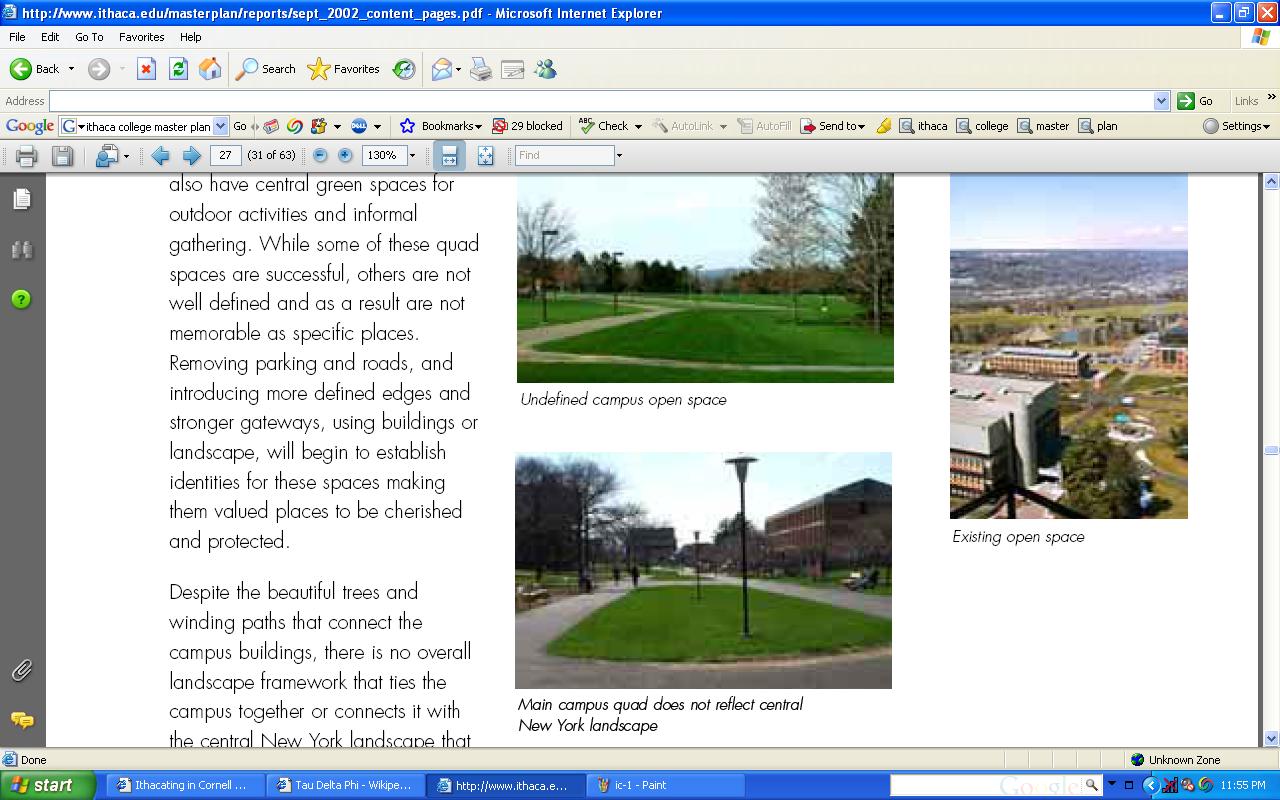
The master plan identifies the need for about 170,000 sq. ft of office space immediately, and another 200 parking spaces. It also says that despite the stunning local topography, that the campus’s open spaces fail to utilize the area properly and are unmemorable as a result.

In the Ithaca College master plan, new development is identified in a darker shade of orange, as compared to the lighter shade used to denote existing buildings in 2002.

One of the goals of the plan is to have everything on central campus within a 10-minte walk from any given location. As a result of this pursued ideal, the central campus is much denser.

The total academic/office space to be built is around 500,000 square feet, with an additional 380,000 sqaure feet of additional dorm space.

The central campus also features a “main street” connecting many of the important area of the campus.

In case anyone’s wondering, here’s a massing of the new athletic center in its location next to the rest of the campus:

So, it’s towards the Cornell-far-side, but I still think that due to its massive size, Collegetown residents will still be able to pick it out on the southern skyline.

So while we have our plans going to work, IC’s already implemented theirs and has been trying to meet their goals for a little while now. Here’s hoping that the plan is as successful as they hope it will be.

P.S. I wanted to write about the IJ article extending the Collegetown moratorium and limiting building heights even further in Collegetown (on the five or six parcels that would’ve actually been raised), but I’ve just decided that councilwoman Mary Tomlan isn’t worth the time and effort of deriding her as a backwards-thinking malcontent.


[1]http://www.ithaca.edu/masterplan/reports/sept_2002_content_pages.pdf


Cornell Master Plan, Part 4 of 5

2 08 2008

Now that I’ve said my piece on the East Campus redevelopment, I’m going to move into the far east campus towards the vet school.

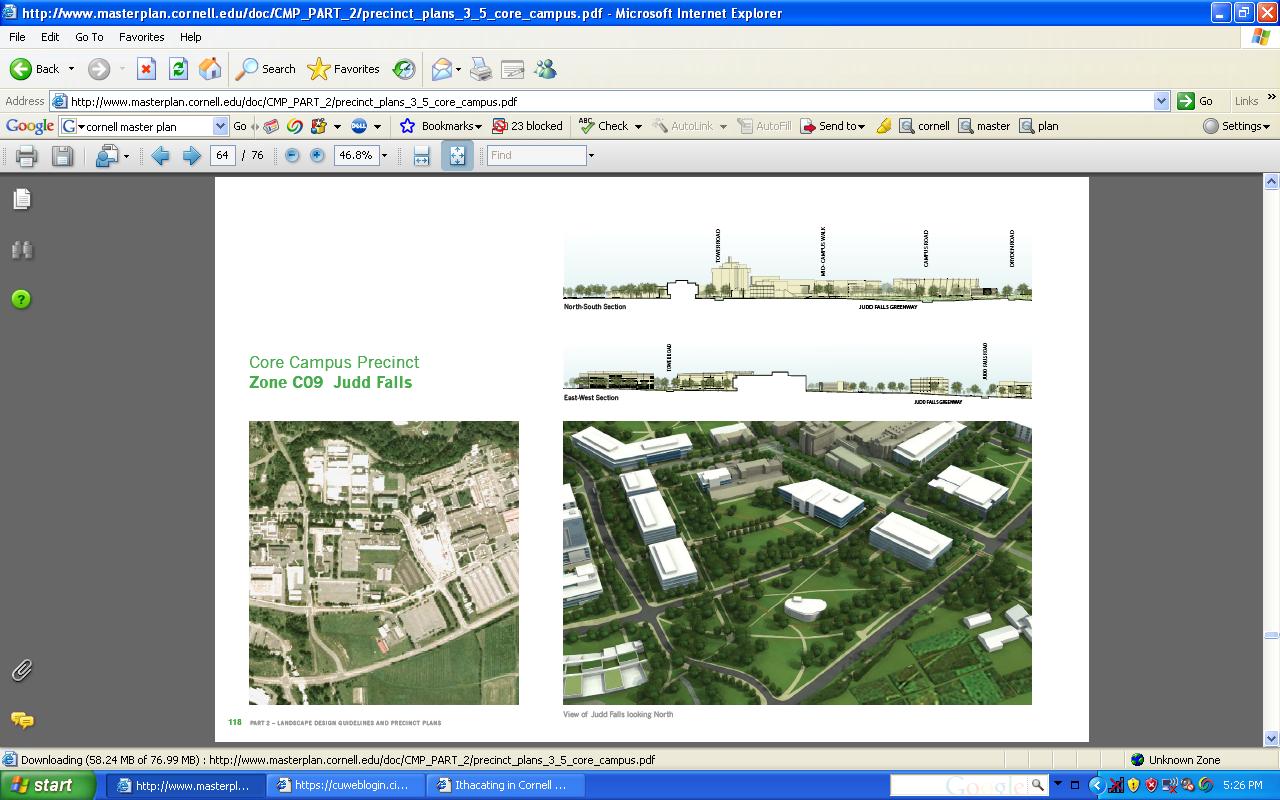
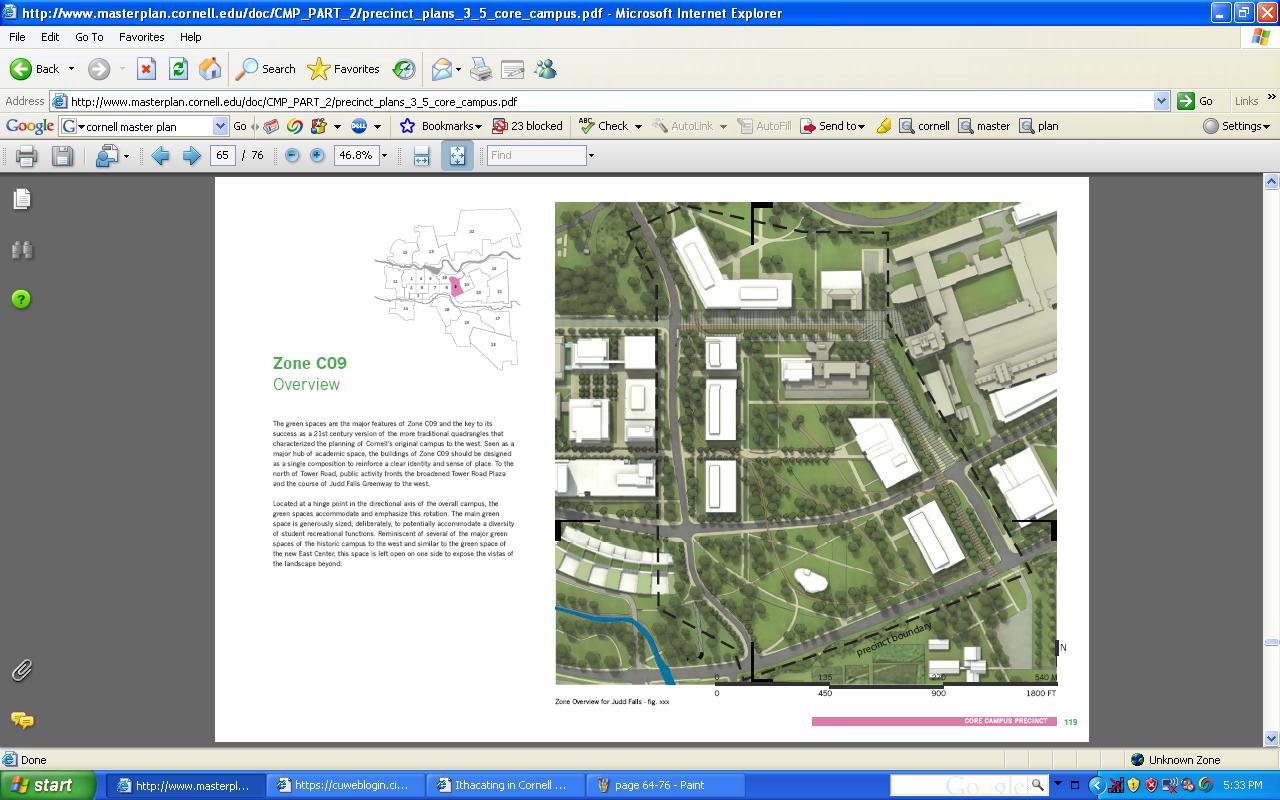
Precinct 9 is referred to in the master plan as the Judd Falls Precinct. For those of you who have never gone out towards the vet school for anything other than a prelim, Judd Falls is the name of the north-south road that passes through here, hence the name. The areas is home to some greenhouses, the U.S. Soils Lab (and its $51 million planned addition, to be completed in 2013 [1]), and Morrison Hall. The hideous piece of architecture known as the Boyce Thompson Institute (1978 ) also stands in this area.

Now, this area is almost wholly used for CALS and vet school activities. For the rest of us, it’s a relative dead zone; you’ll go to the Dairy Bar once in your time at Cornell just for the hell of it, decide its too far out from everything and not come back except for the rare event your exam was shoved in here because this was the only space available (you wanted the Statler Aud for your exam room, but you’ll be sweating it out in Morrison).

The plan to redevelop it is a praiseworthy one. Several buildings would be developed, and the area seems to be much more integrated into the rest of campus.

Because of the relative lack of use of this area, and its underdevelopment, the architects/design teams will have carte blanche to do as they wish with any future properties in this precinct. As a result, Morrison would see the wrecking ball; for some demonic reason, they decided to leave the wound on campus that is BTI. Seriously, it makes even Uris look attractive.

Photo obtained from facilities website

Photo obtained from facilities website

And this is the attractive side.

The buildings designed in the Judd Falls area should all maintain the same architectural style to enhance uniformity in the area. Considering its just a mish-mash of styles now, it would be interesting to see how this turns out. Lobby areas would be glassy and transparent. Total development space would be between 730,000 nd 1.33 million sq ft, and the buildings would average four floors (56 ft.) in height, give or take a floor. If they were to develop here, my personal hope would be that other academic uses are considered; moving some of the other departments out a little farther to fill up these buildings, perhaps. Or secondary space for the East Campus.

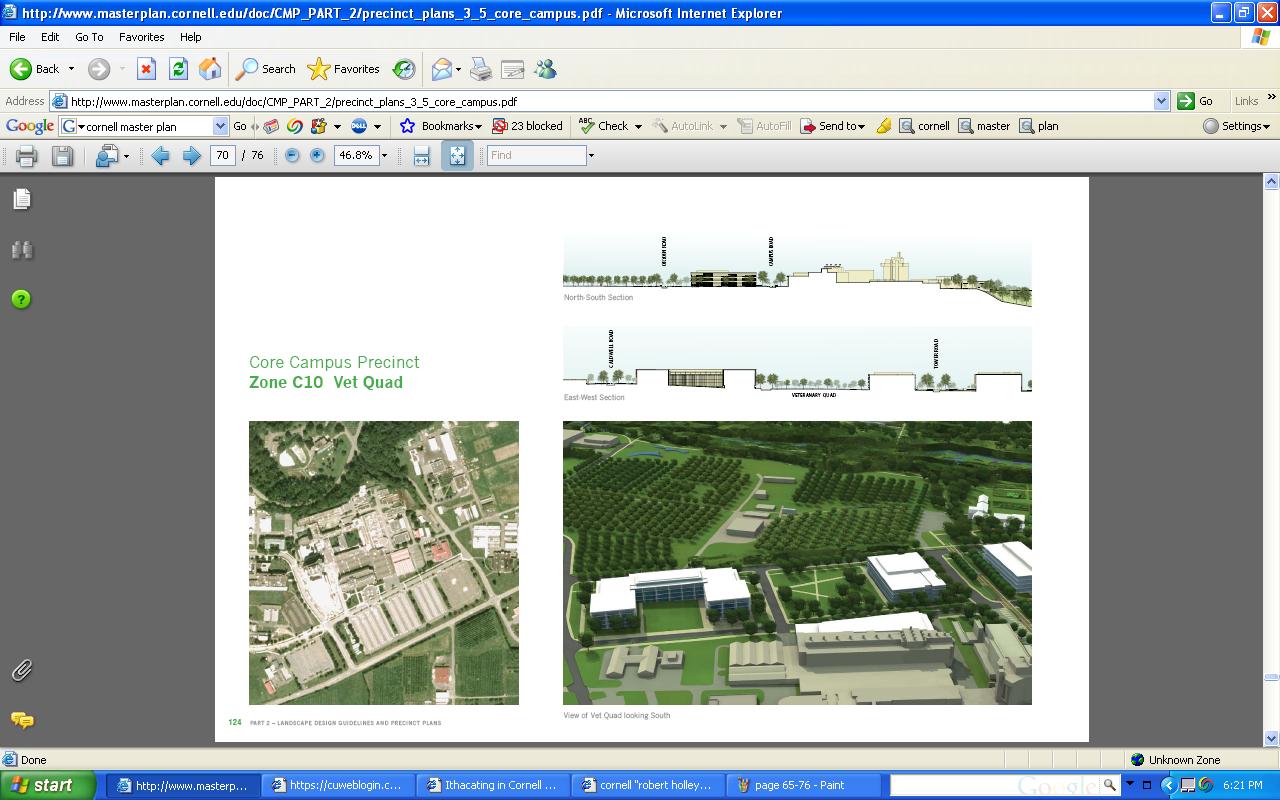
Precinct 10 is referred to as the Vet Quad. The new Vet Quad occupies an area dominated at the current time by parking lots; as the general rule seems to be in the Master Plan, parking lots should be hidden underground whenever possible, so this would never fit in if they didn’t do something with it.

A large building occupies the eastern end, possibly a centerpiece building to serve as an administrative building with some academic use mixed in. The building to the northeast is already under construction, an $80.5 million, 126,000 sq. ft Animal Diagnostic Hospital [2].

I like the plan here, for the most part. I feel it provides a dingified entryway for those coming into the university from the east, along Rt. 366. I’m not as fond of the random building they shoved in front of the animal hospital, because it strikes me as not being the best place to place another building and make the vet complex even more difficult to navigate than it already is. Things started to get confusing with Schurman Hall, and with the Vet Tower, Hospital and new wing, it’s just difficult to navigate within the Vet School (I for one became lost while trying to cut through to make it to a charity XC race on the other side of the vet school property). The total amount of space developed here would be between 400,000 and 700,000 sq. ft.

No surprise, but West Campus has no identified development parcels and the plan suggests treating developments here on a case-by-case basis. It also suggests restoring the cemetery, which I find humorous in a punny sort of way (restore the cemetery eh? Well, go to the morgue and pick up some shovels on the way over…). Yes, I’m aware that it actually means plantings and headstones.

Part 5 will cover Cornell’s New Urbanist development and North Campus. To be continued…

[1]http://forum.skyscraperpage.com/showthread.php?t=81652&page=47

[2]http://www.news.cornell.edu/stories/May08/AHDCGroundbreaking.kr.html


The Cornell Master Plan, Part 3 of 5

27 07 2008

So, picking up where we left off, we’ll be covering some of the more eye-opening parts of the Core Campus master plan.

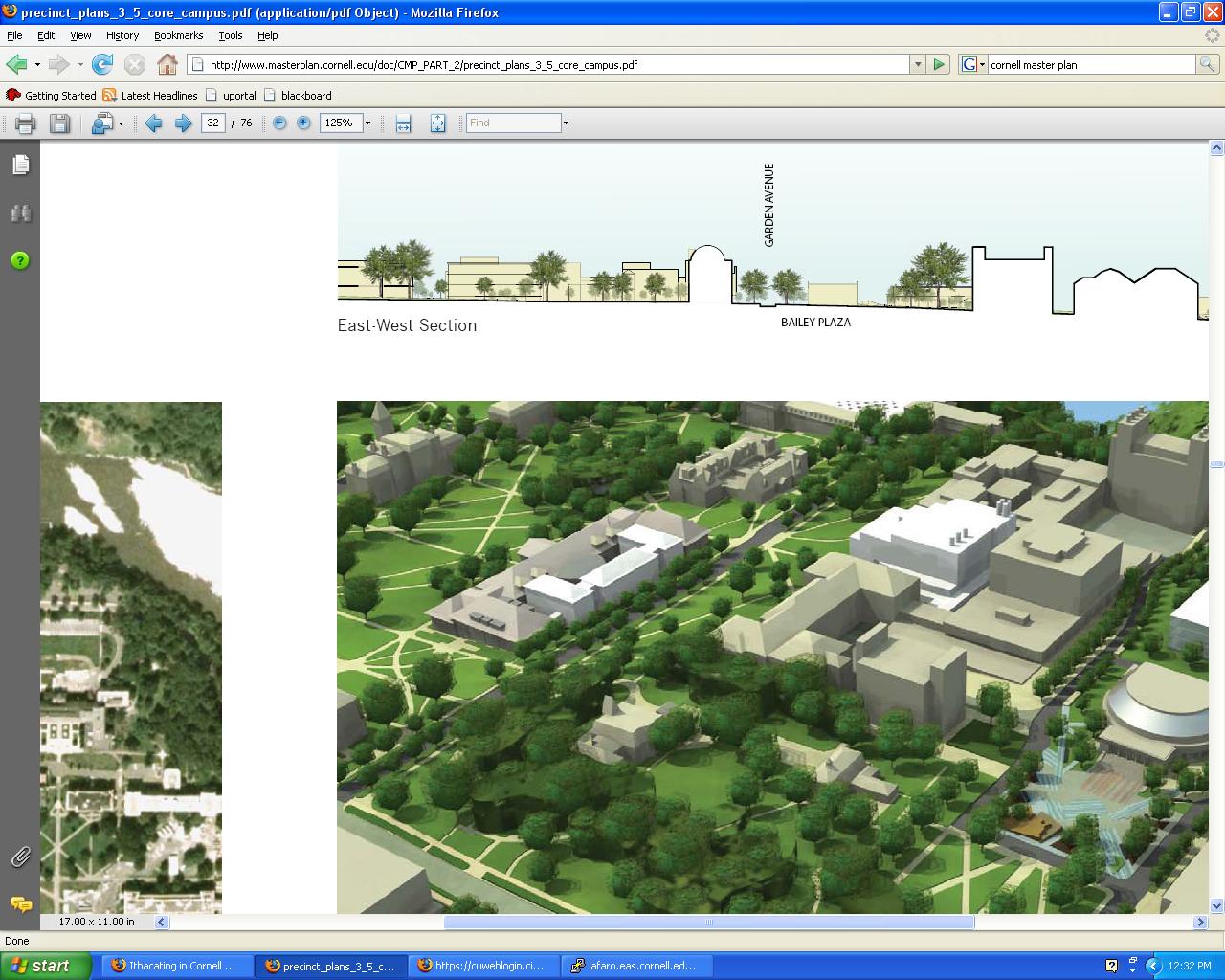
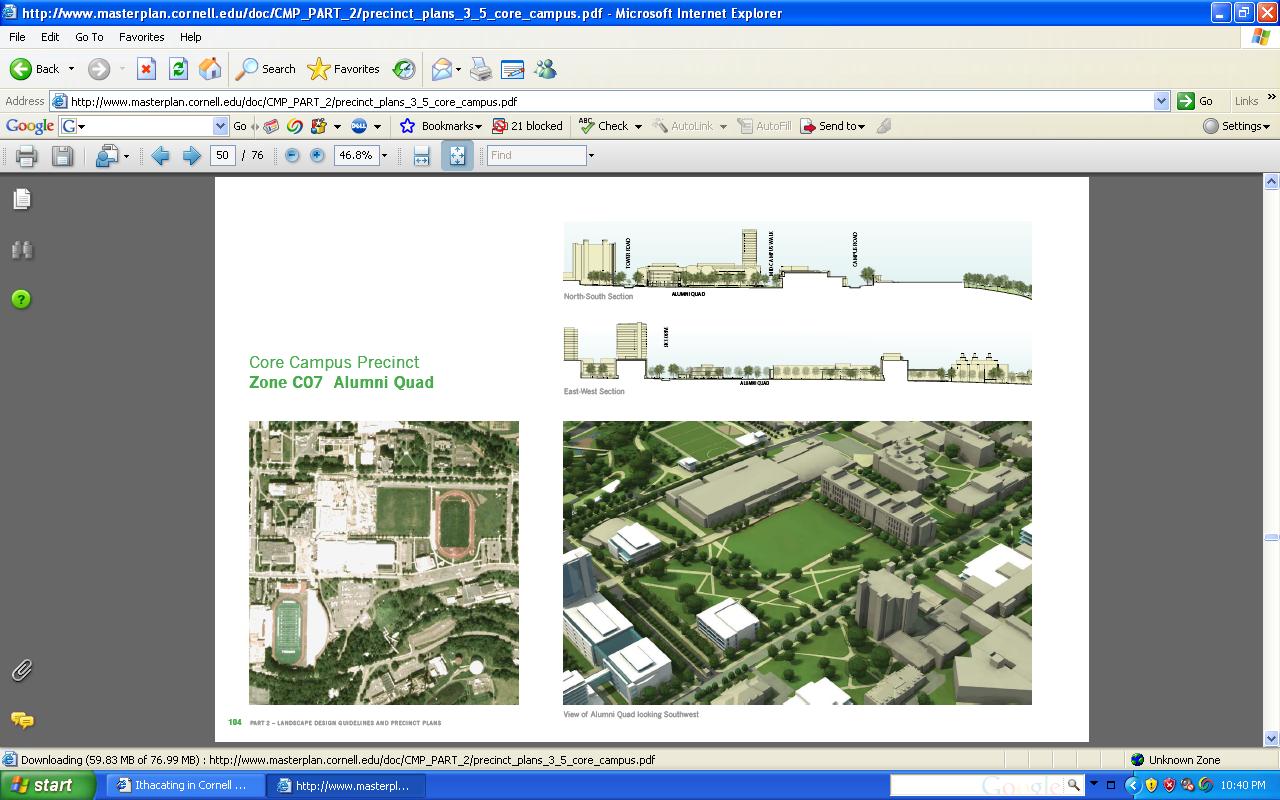
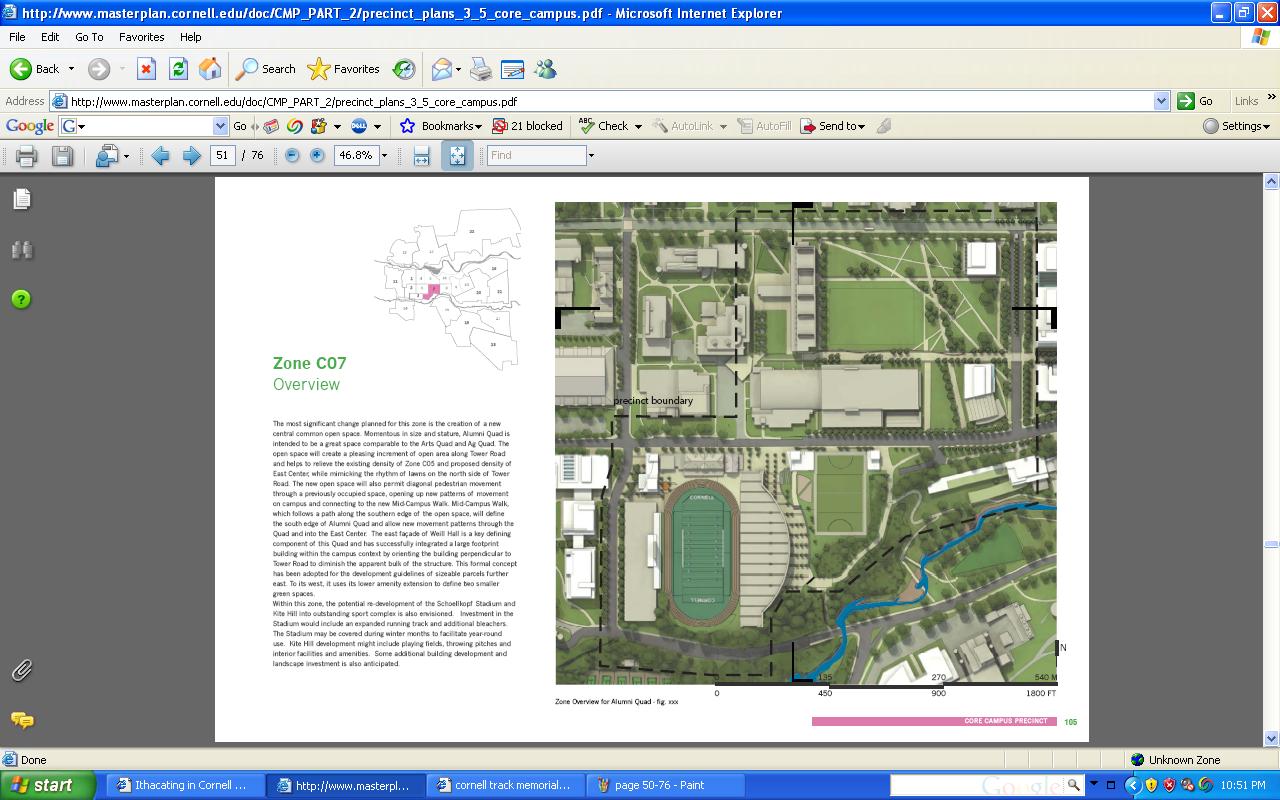
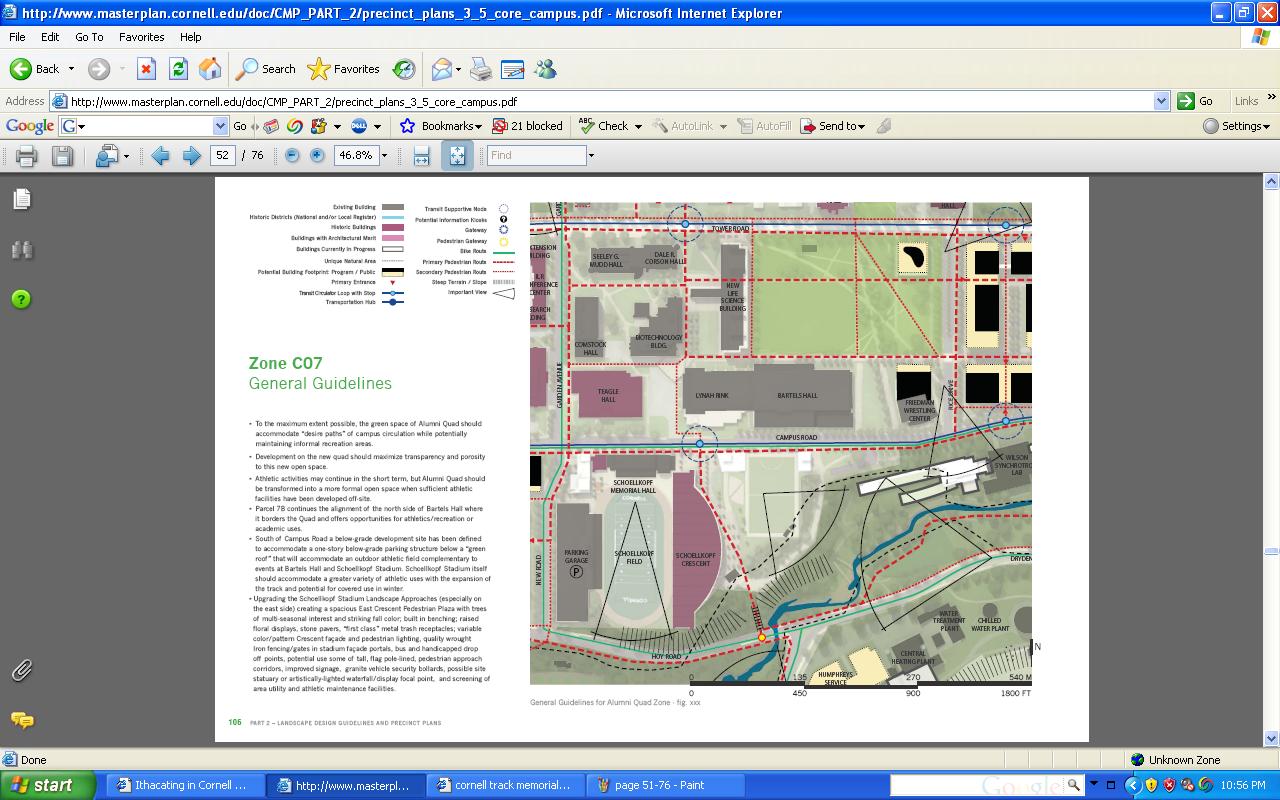
So, this is one of the brand new ideas being churned out by the brains designing the master plan. Precinct 7 is known as the Alumni Quad (my brown-nosing sensors are going off). As most may be aware, the alumni quad is currently the site of the atheltic fields (Robison). A new road (Rice Drive) is built where the western edge of the track currently sits, and so Friedman Wrestling Center ends up sitting at an intersection. The proposed mid-campus walk runs through the alumni quad, and renovation of Schoellkopf’s facilities are suggested to accomodate some of the athletic uses lost due to the elimination of the track. Additional facilities would be built at Kite Hill (which even I have barely heard of).

Apparently, the master plan thought it would be pretty cool to put Schoellkopf’s parking lot underground and build athletic facilities (not to mention their would be a huge parking lot below the alumni quad). I wish them the best of luck, because with all of their planned subterranean parking, I’m sure hell will be raised at some point (ex. safety concerns).

Like with the building planned for Day Hall’s site, they gave one of the two new buildings defining the quad an odd footprint to minimize its usage of space. their goal in the design of this quad was to break up the density between the ILR-Biology Quad area and the proposed East Campus. Also, it would appaear that whatever that is planned next to Wilson Lab is currently in currently underway at some level, and another building, the 16,000 sq. ft addition to the heating plant, is also shown to be underway at the edge of the slide. The other building appears to be an addition to Friedman, which is quite curious considering Friedman is less than six years old [1]. Neither building would be more than a couple of floors, with a sq. footage between 37,000 and 93,000 sq. ft. total.

here’s my one minor critique; the backside of Bartels, which would be facing this quad, is neither interesting nor visually appealing. unless some renovation of the backside is planned, I’m not sure I would want that fronting the new campus green space. You might just as well but up a stone fence on the entire southern edge.

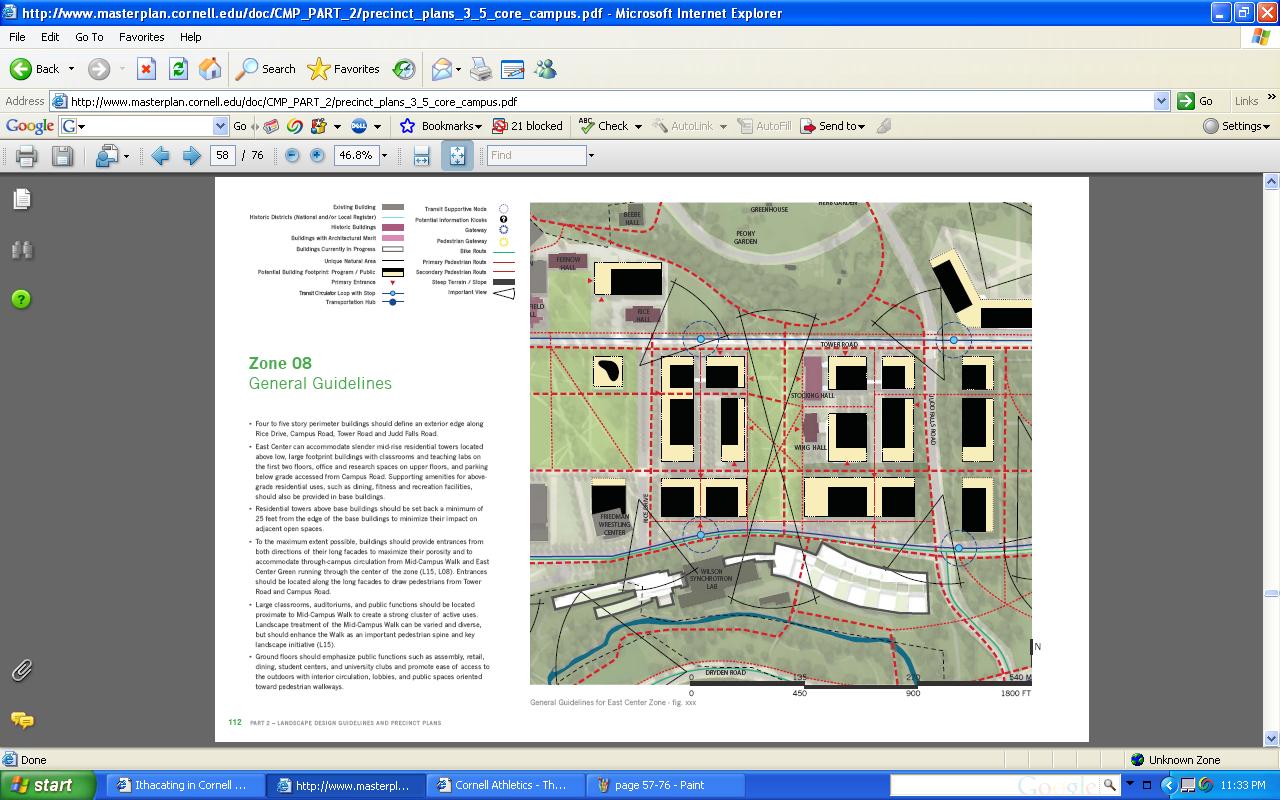
I look at precinct 8 and I don’t even know where to start. The proposed east center is a very large, massive set of new facilities that by any guess would run into the billions.

Footprint-wise, the area East Campus would cover is the area from the track field to Judd Falls Road, which is the next intersection just beyond the Dairy Bar. That’s a fairly large chunk of real estate. Withthe exception of the historical front portions of Stocking Hall and Wing Hall, all other current structures in that area would be demolished to make way for the new complex.

Most of the ten buildings in the complex have large footprints, and four of them feature tall, slender towers of slightly varying heights. Even before checking the parcel listings, you can look at the elevations and determine that they are slightly taller than Bradfield. With four to five story buildings on its perimeter, the place would be built up like a fortress, yet they try to maintain spaces between the buildings “to maintain porosity”.

Now, I remember hearing on one occasion that after the monstrosity of Bradfield Hall, Tompkins County would never allow any more tall buildings to be built on Cornell Campus. But, I’ve yet to see anything distinctly say as much, and I doubt that Tompkins County could reasonably exclude tall structures as long as they are not in the way of takeoff or landing patterns over at the airport. If you never noticed, look up at Bradfield during the night, and you’ll see the red warning lights on the roof to warn planes of its presence.

This isn’t the first time a building taller than Bradfield has been proposed either.  Fomr Blake Gumprecht’s Fraternity Row and Collegetown study (he studied Cornell for his research):

“Collegetown has undergone profound changes over the last quarter century.City officials began to press for the redevelopment of the neighborhood in 1968. The following year, a city-sponsored urban renewal plan called for theheart of Collegetown to be demolished and replaced with a massive, multipurpose development. It recommended construction of a large building on College Avenue that would include 375 apartments, 600 parking spaces, retail on the first and second floors, two movie theaters, a restaurant, and nine floorsof office space. It also called for the construction of six to eight high-rise apartment towers, the tallest eighteen to twenty-one stories. The plan went nowhere [2].”

The master plan states that the buildings would consist of classrooms and academic space on lower floors and residential/dorm space in the residential towers. Although I applaud the concept of “mixed-use”, I’m not exactly sure how well the idea would go over with the potential residents. However, it would seem the residential towers are meant for grad students, post-docs and professors. I’m not sure if this sounds more like an educational area or a self-enclosed research facility (I would sit back and watch as the city starts demanding taxes on it because they come to the same conclusion). The ground floors of the  building would have restaurants and cafes, and lounge spaces; the intention is for this area to be a vibrant 24-hour space. I would hope that all of the eating areas wouldn’t all be run my Cornell dining- the same set of baked goods and drinks gets real old, real fast.

There would be 85 to 120 units per resident building. Take that through eight to ten floors, and you have ten to fifteen units per floor. A major question that would have to be answered in the deisgn phases would be how much residentil space will be provided per unit; I can imagine that grads, post-docs and professors would want more living space than the 200 sq. ft rooms in some of the dorms. The max height of a single building entity would be about 210 feet, the same as a typical 20-story apartment tower, or a fifteen-story office building, to put it into perspective. The final square footage would be 1.5-2.2 million sqaure feet, at least six times the amount of space in Weill Hall (which is 262,000 sq. ft.).

At least 850 parking spaces will be located underneath the East Campus. The primary purpose for them is to provide parking fore the residents of the complex, but the plan also suggests that when they empty out in the evenings, they can be used by others in the Cornell community to maintain the vibrancy of the area. I just can’t get through the impression I’m getting that this isn’t so much academic as it is research, and while we are a research institution, I wonder if how much we’re trying to blur the line between Cornell the school and Cornell the research organization.

To be continued…part 4 will cover the last of the Core Campus.

[1]http://www.cornellbigred.com/Sports/general/2007/FriedmanWrestlingCenter.asp

[2]http://www.adphicornell.org/adphicor/files/FraternityRow.pdf