Beauty in the Eye of the Beholder

10 11 2011

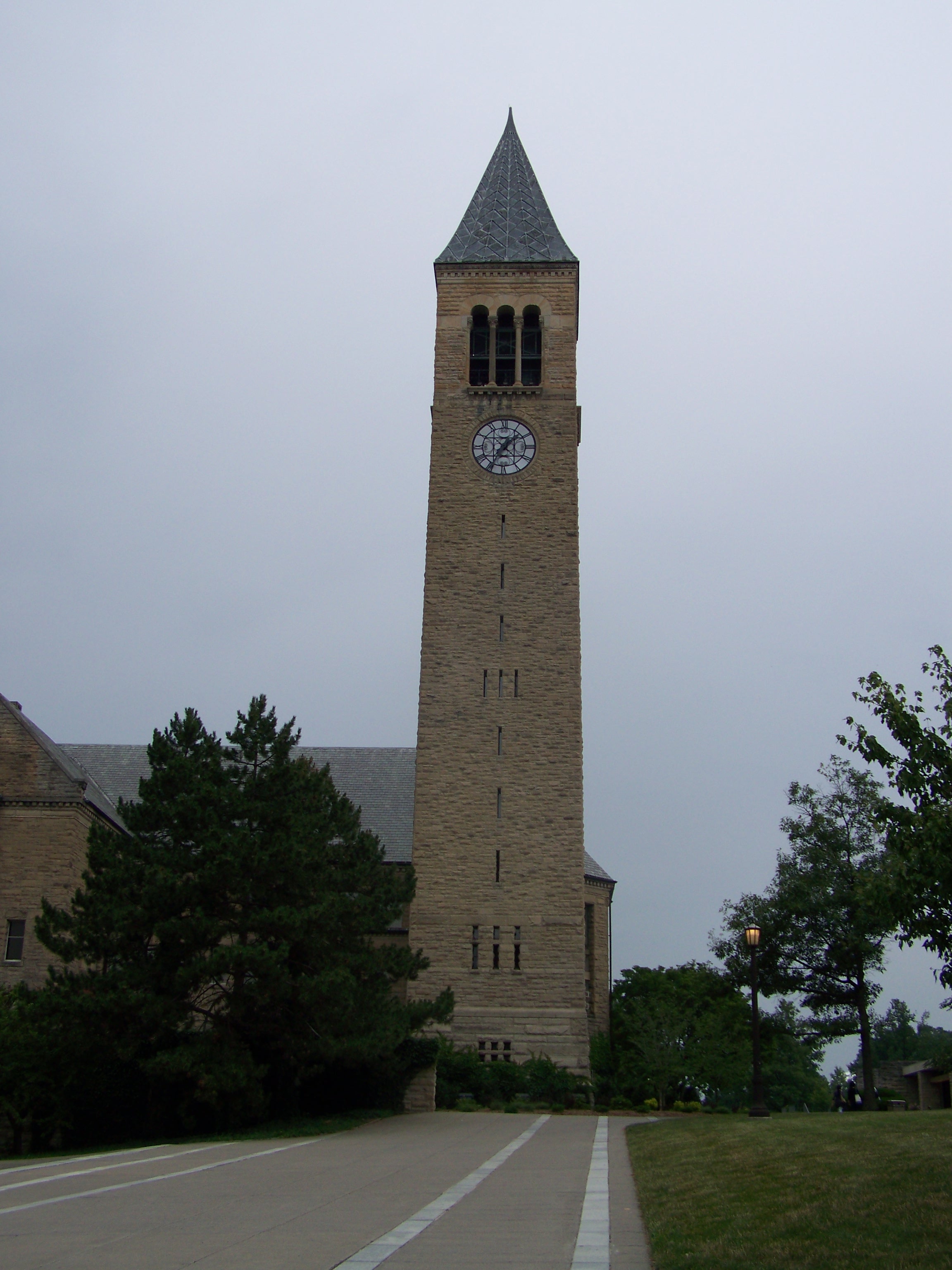
So, this is a question that I often wonder about when I play the role of armchair architecture critic. Cornell has pontificated that “each new building should reflect the spirit of Cornell as a pioneering institution and should represent an awareness of its time and place”. Back in the day, that was symbolized by A. D. White’s passionate desire to develop the campus into a New Yorker’s version of Oxford, hence his well-documented derision of red-brick buildings such as Morse Hall and Lincoln Hall, as these were very un-Oxford-esque. Lincoln Hall was built while White was overseas as the U.S. ambassador to Germany (effectively, they sneaked it in when he wasn’t looking), and it’s been said that White smiled when he first heard Morse Hall was destroyed by fire back in 1916. I’m guessing he never counted his own house, but maybe he considered that to be tucked away from the main campus, which it was back in the early days.

Cornell’s architectural preference has evolved with the times. By the 1920s, the fashion was Collegiate Gothic, as seen in buildings like Willard Straight. By the 1950s and 1960s, function was deemed more important than form, and we eneded up with buildings like Clark Hall, and Hollister et al. on the Engineering Quad. Today’s buzz is about “Starchitects” like Rem Koolhaas (Milstein Hall), Richard Meier (Weill Hall) and Thom Mayne (Gates Hall), who designed ultramodern structures that are meant to represent Cornell’s forward-thinking.

My question lies in what is interpreted as forward-thinking. It seems college campuses these days follow two rather discordant trains of thought – one of the modern or ultramodern designs as we have seen lately at Cornell (I was tempted to call them avant-garde, but I don’t think they’re radical enough to merit the term), and then a second line of thinking that delves into the Neoclassical and Gothic themes that conjure images of the romantic colleges of our grandparents’ youth.

Take for instance Princeton and their new Whitman Residential College, or Notre Dame’s new Eck law school building:

Image Property of Notre Dame University

Granted, comparing the new STEM buildings to Dorms and Social Science buildings is a bit like apples to oranges. But what are the pros and cons for the new Houses on West Campus? Were we better off with new and contemporary, or should we have revived the original 1920s era plan and constructed new Gothics?

The original West Campus Plan. Image Courtesy of Wikipedia

Any casual reader of this blog probably recognizes that I fall more into the traditionalist point of view. I guess my concern lies with the aesthetically pleasing value of a campus. Cornell has some tremendously wonderful natural spaces both in the confines of the main campus and surrounding it (the many gorges and waterfalls throughout the area assure that much). The built environment can either enhance that or detract from it, and I’d venture at Cornell it’s been hit-or-miss over the years.  I wonder though, if the increasing traditionalism of some of our peer institutions gives them a recruiting advantage for top students. I think the West Campus structures are quality constructions, but they don’t quite garner the same level of fondness as the arches and turrets Collegiate Gothic.

So I’m going to go out on a limb and throw the question out there for debate. What role does architectural style play in prospective students’ decision-making? Is Cornell being bold and progressive in its current architectural plans, or are we foregoing traditional architectural styles at a detriment to the physical appeal of the university? I’m really curious to hear others’ take on this, so please leave a comment if you’d like to contribute your opinion.

P.S. I don’t want to downplay the importance of interior design, which is important from a livability angle. But I am more interested to hear about opinions about building exteriors, since they often set the first impression.



Cornell’s Rapidly Evolving Late-Night Scene

8 08 2011

This entry was inspired by the latest set of news, that Johnny O’s is closed. This follows the news that Dino’s closed earlier this summer, reducing the number of bars and primary drinking establishments to four. While it seems there’s enough interest in the property that a desolate Ctown won’t be an issue, the article raised a very good point about late-night activities that I think bears a little bit of thought:

For many Cornell students and alumni, the closure of another bar in Collegetown prompted concerns about late-night life at Cornell.

“What is happening to the bar scene in Collegetown?” said Cara Sprunk ’10, a former Sun writer.

Lee Moskowitz ‘13 said that Dino’s and Johnny O’s “probably held about 300 people each, so now you’ve got 600 people going to about four bars, instead of six, and those bars were already crowded to begin with.”

***

Lee Moskowitz has a very valid argument. Fewer bars would seem like a good thing on the surface (less noise and rowdiness), except that that isn’t going to deter the large percentage of older students who want to party it up in the evening. I can vouch from my own experience that even when there were six bars, it was not uncommon to wait in line outside to get in, because the bars were absolutely packed. Less bars means longer lines, and eventually people are going to give up and just do more house parties to compensate (especially considering the tighter restriction on the Greek system’s parties). I firmly believe that it’s a naive notion that student drinking would somehow decrease.

While there’s no problem with house parties per se, the issue lies with the fact that while bars and Greek houses have formal regulations that they’re expected to follow, house parties don’t. If the hosts and servers aren’t careful, that can go a couple of unfortunate ways – an IPD free-for-all for citations and fines, and/or a greater risk to partygoers.

With any hope, Cornell’s new pub in the Ivy Room will open as scheduled in the fall. But elsewise, late-night life at Cornell seems to be heading in a less regulated direction, and is going to be a much bigger issue.


News Tidbits 5/6/2011: Some of Us Can’t Be At Slope Day

6 05 2011

Oh graduate finals. You take way the afternoon of one of the biggest social days of my year. Well, I’ve studied a fair amount, and since final #1 is at 3 PM, I figured I would take a brief break to tackle a few of the many news pieces to have been released lately, before they become really old news.

1. SAE’s pledge class joining TKE. Do I think this is wrong? On many levels, yes. Playing Devil’s Advocate here, I can see why they might’ve pursued this idea. It’s no great secret that TKE’s numbers have been declining recently, and the fresh blood of a sizable class adopted from a fraternity with a strong social reputation could definitely help in some respects. In a historical sense, there’s nothing particularly like it.  When Phi Sigma Kappa and Phi Sigma Epsilon merged in the mid-1980s, even though both had houses at Cornell, there’s no indication the bortherhoods merged; it seems Phi Sigma Epsilon simply closed. There are some cases of entire fraternities merging, such as Zodiac and ATO in the 1930s. In all my fact-checking, I found only one case; pledges of Theta Chi, which was booted off Cornell’s campus in 1999, asked if they could join Alpha Epsilon Pi, and the offer was accepted. AEPi partially operated out of the Theta Chi house until 2001 (first they operated both their house at 140 Thurston and the house at 40 Ridgewood, then just Ridgewood), when it became too expensive and they reverted back to just their Thurston property.

On a related note, four of the former SAE pledges (not affiliated with the TKE group) were indicted on charges related to the death of George Desdunes ’13.

If I were an alum of TKE (which I’m not, thankfully) I’d be livid. It sets a horrible example, that even though the members of your pledge class had an indirect role in someone’s death, that you’re high enough on the social ladder that another house will come to your “rescue”. For all practical purposes, the size of this group, and their former association, will likely cause Tau Kappa Epsilon to become a hybridized version of Sigma Alpha Epsilon. Arguably, that might help the house’s perceived social standing, and it provides some measure of stability, but at great expense to the house’s integrity, and it speaks volumes on how much the SAE group actually cared about their own fraternal association. It just seems ethically wrong to me.

2. Then again, being ethically wrong seems to be a running theme of the semester. I have to say, having an IFC officer mock MGLC’s step show will sexual gestures towards a large audience that included Ithaca high and middle school students, and then voting to not remove him until the associate dean “strongly advises” it and he tenders his own resignation…like really? Is the system trying to get dismantled, because honestly I can’t tell at this point.

3. last on the pieces of news to tackle, the fatal fire at 107 Cook Street. We all talk about how some of the houses in Collegetown are unsafe, but never would anyone want a tragic event such as this to happen. Argue about zoning and landlords and proper maintenance all you want, but that doesn’t change the fact that someone has lost their life just as the semester was wrapping up. As an aside, I actually knew two guys from my major who lived in this exact apartment last year, and by their accounts it wasn’t in terrible shape. But right now, what matters is that someone is gone all too soon. As a final aside, the last fatal apartment fire was on Heights Court near North Campus back in May 2006. That house was renovated, and at last check, was up for sale.

P.S. I have a backlog of entries to write; once my schedule clears up, activity on this blog should pick up.


How the Mighty Have Fallen

19 03 2011

So it’s official. Sigma Alpha Epsilon, up until now the second largest chapter in the Greek system, is being booted from campus for a period of five years. All members must vacate the university-owned facility by the end of the month. I think the following passage is the most disturbing:

“At this time, the information provided to the university indicates that George Desdunes, 19, was provided alcohol while in the care of certain members and associate members of the Sigma Alpha Epsilon fraternity, and became incapacitated. Even though the members and associate members recognized the condition Desdunes was in, they failed to call for medical care. He subsequently died.”

Let’s be honest. Associate members = pledges in this case. Also, just about anyone who’s been in a fraternity can vouch they knew “that” guy who got really, really drunk one time at a frat party or a mixer, so they gave him some water, a bucket just in case, and laid him on a couch to sleep it off (or maybe that was just in my experience). But this time, either members failed to recognize the severity of the situation – tragic but not impossible – or they realized the extent of the situation and did nothing. Which I really, sincerely hope wasn’t the case, especially since a number of criminal charges are likely in the upcoming weeks.

It’s hard to imagine a system without SAE occupying its lofty Hillcrest estate. But, there is a habit in recent years of the largest, most visible houses being shut down for one reason or another. Pi Kappa Alpha was one of the largest chapters in the system back in the 1980s and 1990s, their recognition was suspended after an incident a couple years ago sent three rushees to the hospital. Before In the mid 2000s, the largest chapter was Sigma Pi, which was suspended and forced to reorganize in 2007 after they sent Thanksgiving attendees to the hopsital with alcohol poisoning. It seems that the largest houses are more apt at screwing up.

It’s difficult to picture Cornell’s Greek Life without one of its prominent members. But under the circumstances, I would’ve been even more surprised if they had been allowed to continue on campus.


The Death Knell of Greek Life?

2 03 2011

In some sense, I’ve learned to dread days where I see the number of hits to this blog skyrocket, namely because days with extraordinarily high hits can be correlated unfortunately well with the untimely death of a student at the university. So it was with some hesitancy that I glanced at the Sun’s website this weekend.

The news is unnerving and tragic. A student is dead. Secondly, the Tompkins County sheriff has gone on the record to say that the death was likely alcohol-related. The student, George Desdunes, was a member of Sigma Alpha Epsilon fraternity, and was found unresponsive at the fraternity house on Friday morning. At this point, it was yet to be established to what extent the fraternity is responsible in his untimely death, but SAE has been suspended temporarily.

When I first heard the news, I kept hoping that the fraternity wouldn’t be responsible. SAE is considered to be one of the most visible Greek houses on Cornell’s campus. It has one of the largest memberships of any fraternity at Cornell and holds a fairly strong presence in Greek affairs, and to some extent campus affairs (a number of their members and recent alumni, such as Svante Myrick ’09 and Eddie Rooker ’10, hold prominent positions in and around the university and surrounding city). So if SAE was responsible for the death of one of its members, the effects would be profound and far-reaching through all parts of the system.

Given the problems of the system and the recent reforms forced onto it by the university, I am honestly wondering whether or not it is a sign of the end of the system. the first thing that comes to mind was Ithaca College’s ban of Greek life after the death of Joseph Parella in 1980, during a fraternity pledge event in which he was hazed. But, it’s not easy to compare the two systems. For one, Ithaca College’s fraternities were generally housed in dorms (in comparison, Cornell owns  about one-third the Greek houses), and for two, their system represented a much smaller proportion of their student body than Cornell’s does.

I suppose the usual arguments will come out – the biggest donors to the school are Greek, they can’t touch private houses, and so forth. The problem is, if SAE is found responsible, their role in the death of a student would be a very powerful and legitimate reason to favor de-recognition of Greek life. Addressing argument number two, while many chapters own their own property and would not be immediately affected, they lose the protection that the university gives — i.e. every party thrown is a target for local and campus police to bust underage drinkers. So the system wouldn’t be “shut down” per se, but it could easily be crippled.

Perhaps a better comparison would be a case from MIT that occurred about 15 years ago. On September 26, 1997, a pledge of FIJI at MIT died after a pledge event due to alcohol poisoning.  MIT is, like Cornell, a prestigious institution with substantial Greek Life – at MIT, it comprises about 42% the student body. There had been signs Greek Life had been getting out of control prior to the death of Scott Krueger. As a result of the event, RAs were put in fraternity houses, mandatory CPR training was established, all freshmen were required to live in dorms, MIT paid a $6 million settlement to the family due to negligence in preventing the event from occurring, the fraternity was shut down (and has never come back), and several of the former FIJI members were convicted of criminal offenses. It forever changed the way MIT dealt with its fraternities. But they still have a large, influential system.

But comparisons only offer ideas, not results. So what will happen with Cornell’s system? A good question.  But not one that can be answered just yet, while Cornell students mourn the loss of one of their own.


Cornell’s History, All Drugged Up

11 01 2011

So, the latest news tidbit about a Cornell student being caught with $150,000 of heroin has made the news cycles and attracted some undesriable attention toward the university. Which kinda inspired me to look at it in a historical context. It’s what I do.

It’s college. Drugs exist. Some are easier to get a hold of than others. Some are gateway drugs, others are only used by a hardcore group of students. Once in a while, the drug debate comes up in a campus context. The Cornell Daily Sun ran an article about Cornell’s drug culture about two years ago. In the article, it was noted in a 2005 anonymous Gannett survey of students, that of 1,969 respondents, 41% admitted some form of drug or alcohol use in the past 30 days, with 19.8% reporting marijuana use and 4% reporting other drug use.

(with that in mind, considering the university’s undergad pop of about 13, 800, that would suggest 550 users of other drugs, which could include cocaine, LSD and the aforementioned heroin. If [an overly-generous] 50 percent were heroin users, that gives us about 275 students. Which if the street value is correctly reported, than the student was carrying $545 worth of heroin for each user. In conclusion, with that much heroin, I wouldn’t be surprised if she was supplying the entire county).

A similar set of data from 2003 suggests 8 percent of respondents admitted Ritalin/Adderall use without a prescription, and less than 3 percent partook in white lines. Another link on Gannett’s site looks at drug use in 2000, and the rates were largely the same as in following studies (except for hard drugs – those fell a little bit). The article notes that affluent students and students in Greek Life show slightly higher usage rates. Looking at Gannett’s site, if we throw in the more prevalent drugs, tobacco use as defined as at least once in the past 30 days has gone from 21 to 16 percent from fall 2000 to fall 2005. Alcohol use defined as once in the past 30 days has hovered around 75 percent and remained fairly steady through the three studies.

So that’s handy and all, but it’s a smallish sample size compared to the entire student population, and it depends on people answering truthfully. So the numbers could be seen as dubious. Regardless, it’s obvious that students partake in drug use.

***

Now to look at things in a historical context. Drug use was around well before the university. But in 1865 in little Ithaca, the drugs of choice were generally the alcoholic or tobacco variety. The big drugs in the 19th century were alcohol, tobacco, and to a lesser extent opiates and (in later years,) cocaine. Marijuana was seen as a medicinal drug, not a recreational one (that changed after around 1910). Marijuana use at Cornell was minor prior to the 1960s, which is when it caught on with middle-class whites – i.e. most of Cornell’s student population. It is stayed relatively popular since, even after drug laws became tougher in the mid-1980s. As for the opiates, they would see occasional use throughout the next 100+ years, as opium in the late 1800s, morphine and heroin in later years. Heroin received its first notoriety among students when it caught on with the Beatnik culture of the 1950s.  With the increase of purity (strength) of heroin in the 1980s and 1990s, demand, and addiction, grew. Although, going by Gannett’s survey, usage dropped off somewhat at Cornell after 2000. Tobacco saw steady and common use by all branches of the university’s stakeholders since Cornell’s founding, and became so prevalent that in the early 1960s a person could smoke anywhere but inside Sage Chapel. But, needless to say, that’s not the case anymore.

If Cornell follows national trends, it would be safe to say that cocaine use peaked in the early 1980s, with maybe some sporadic crack use after its introduction around 1985. I would be willing to suspect that the “glamor” of powdered coke was preferable to perceived “ghetto” qualities of its freebase equivalent.

Regarding LSD, Cornellians probably first experienced the drug in the early 1960s. Well, willingly anyway. Two Cornell Medical School professors were part of a government project in the 1950s and 1960s to administer LSD and other hallucinogenic drugs on unwilling participants. It was initially hoped by the military that it could be used like a truth serum, and later studies checked it out for therapeutic qualities on mentally-deficient patients. The drug peaked in the late 1960s and saw another slight rise in the late 1990s, but otherwise has seen a general decline.

Now back to our preferred chemical companion – alcohol. The first students of Cornell would’ve usually consumed beer (liquor was as it is now – expensive) down at one of the saloons in town, and there was no standard policy against drinking (Bishop 210). “Give My Regards to Davy” celebrates this aspect of student life (although I should note that highballs are mixed drinks – scotch and soda water). A Cornell Era report from around 1890 suggests that a couple saloons was enough to serve all students, and drunkenness was uncommon. In the 1910s, drinking was common, but seen as a way to celebrate athletic victories, but drunkenness on campus was seen as grounds for dismissal (Bishop 407-408). Prohibition was a major thorn in the side of students and bar owners, but they found ways around the law – Theta Delta Chi had a speakeasy built into their house when it was built in 1926.  A Cornell Sun article from March 4, 1937 reports that drinking at colleges was on the rise after Prohibition, but that public drunkenness was abhorred. The report was “Students…admire the man who can drink like a gentleman” (pg. 3). It seems that a celebrated culture of binge drinking took off around 1980 – the “Animal House” influence, perhaps. Although underage drinking was supposed to be curtailed by the increase of the drinking age from 18 to 21 in December 1985, that has largely proven untrue.

People age, drug preferences change, but students are timeless.


The Uncertainty of the Greek System

25 08 2010

Add-ons to email services are wonderful things. Right now, I mostly sit in my grad office all day doing work (the rare exceptions will be my grad classes and my TA work, neither of which actually start until Monday). My email is one of my few escapes. Anyways, on my four-accounts-feeding-to-one setup, I have a Cornell newsfeed. Today, one of the top stories was the proposed changes to the Greek System, which seek to drastically alter the social environment. Quoting the article, which came from the Daily Sun:

“…Starting in the fall of 2011, freshmen will not be allowed to attend any fraternity parties in the second half of the fall semester. Three days of rush week during January 2012 will be dry. Mixers will be prohibited for the first six weeks of the new member process, and each sorority can have two mixers a week for the remaining two weeks.

Finally, in fall 2012, freshmen will be prohibited from all fraternity parties that involve alcohol. In January 2013, the entire rush week will be alcohol free. Social events between fraternities and sororities that involved alcohol will be prohibited during all eight weeks before new members are initiated.”

The intent is noble enough; to curtail underage drinking and prevent alcohol-related crime and illness. To someone in the Greek system though, it sounds a bit scary. Let’s acknowledge the not-so-secret fact that a substantial amount of publicity, and recruiting, comes from freshman visiting houses during parties, where alcohol is readily available. What other time are they going to learn about the houses before rush (and Greek Week doesn’t count because it is a collective show of Greek pride by all chapters at once)? Some are already bemoaning this latest act as the death of the Cornell Greek system (and some hope for as much).

First of all, it’s not. Cornell’s Greek system is much, much more  regulated than the chapters that exist at my grad school, which are basically like street gangs with Greek letters. The system may only limp forward, but it will persist.

Secondly, this isn’t the first time these plans have been espoused. In Scott Conroe’s book I Take Just Pride, one section details how in 1999, then-president Hunter Rawlings gave a speech to the Greek System where he espoused his belief that fully half of the houses on campus would likely close as a result of the execution of the Initiative and the establishment of a house system for upperclassmen. I have yet to see evidence that that has turned out to be the case. A similar intent was espoused by a residential initiative that Cornell launched in the late 1950s and 1960s (the goal there was to make small dorms that were like fraternities, but without all of the problems they cause).

Another date that Greeks were terrified of: December 31, 1985. It was the date the drinking age in New York State went from 18 to 21. In copies of the Daily Sun from 1985, fears were expressed that this would ruin the Greek System, for many of the same reason people fear the latest proposals. But, drinking went underground and everyone turned a blind eye. Kegs were banned from open parties after an alcohol-related death in 1989, but the Greek System still persisted.

Arguably, Cornell’s focus should be on a much larger scale. Fraternity parties are notorious for under-21 drinking, but it’s an issue kept behind closed doors. However, even more undiscussed are the house parties and club organizations, which are just as receptive to underage drinking. Sports teams, the Big Red Band, the Daily Sun, Glee Club…freshmen are going to drink one way or another. When the fraternities are prohibited, they’ll just migrate to the houses and private parties of Collegetown, which are mostly unregulated. I would suggest Cornell crack down on all organizations and do Collegetown foot patrols, but the thought of that is nothing short of Orwellian.

Do I see a whole lot coming from this? Not really. There will be much maneuvering, and some face laws, but I don’t see a whole lot of change occurring. Everyone is going to look for ways to let things slide under the radar once again. If it somehow turns out that the Greek System is incapacitated by the new rules, I suspect it will only take a little waiting and watching until other student organizations or even independent groups of people will step in to fill the void of underage drinking.


Hazing at Cornell: A Tradition?

12 08 2010

So, I’m sure there a couple of pro-Greek readers who are already feeling a little twinge of concern regarding the title of this article. I have little interest in pursuing current events regarding hazing (except for News Tidbits entries). I’ve graduated, and unless I get an email on my fraternity’s alumni listserve that says they’ve been suspended or kicked off campus (heaven forbid), I’m not going to pay attention to the half-hearted attempts of the current Tri-Council to police its affiliated chapters. More importantly, hazing is not just limited to the Greek system; campus clubs and intercollegiate sports teams have been guilty of hazing practices as well. According to Cornell’s anti-hazing website, the definition of hazing is very vague, and just about anything that causes physical or mental discomfort is hazing. In that vein, a pledge quiz or an extra lap for the new track team distance runners could conceivably be hazing. However, most people have a pretty good idea where the line is crossed between hazing and non-hazing.

Historically speaking though, Cornell’s tradition of hazing in its more recognizable forms goes back virtually to the founding of the university (and on a larger scale, back to the times of ancient Greece). The first hazing death at Cornell (and the first Greek hazing death in the country) would occur in October 1873, only eight years after the university’s founding.

Mortimer N. Leggett was a member of the class of 1877, a freshman who had arrived on campus only a month prior. He was well off, the son of General M. D. Leggett, the U.S. Commissioner of Internal Revenue. He wrote home nearly every day and spoke very highly of Cornell and its students. He received an offer to join the Kappa Alpha Society (up until the middle of the 20th century, freshman could join fraternities as soon as they arrived on campus), which he regarded highly for its abstinence from strong drinks and prohibition of foul language among members. Well, one night in early October, Leggett was blindfolded and transported into the countryside, and told to find his way home. After some time wandering, two sophomores of the society met up with him, removed his blindfold, and they began to walk back in what they thought was the right direction. Tragically, as they were unfamiliar with the topography, all three stumbled off a gorge cliff near modern day Giles Street in Ithaca, and fell into Six Mile Creek below. Mortimer Leggett succumbed to the injuries sustained in the fall, and the two sophomores were seriously injured. While obviously upset over the incident, General Leggett concluded no real hazing had taken place, just some “hocus-pocus” that went horribly wrong. He later accepted honorary membership into the fraternity [Bishop 132].

Twenty years later, another death from a hazing prank occurred. This one requires a bit of a background explanation. Up until about the late 1930s, the sophomore class always battled the freshman class as a rite of passage. Basically, the two classes were to beat the living crap out of each other as a way to attain/maintain dominance. Formally known as rushes, the brawls were so bad in some years that the Ithaca police had to break it up, akin to a massive riot.

Well, after the frosh won a sporting event in early 1894, the sophomores devised a scheme to pay them back. While the frosh were attending a formal dinner at the Masonic Temple in downtown Ithaca, several sophomores drilled a hole into the floor above the party, inserted a tube and attached it to a chlorine generator [Nuwer 105] . However, they misdrilled, and instead of pumping gas into the banquet hall, the chlorine was pumped into the kitchen, near a stove. It was suspected the the chlorine chemically reacted with small amounts of carbon monoxide to produce phosgene, a compound made famous as a chemical weapon during WWI (basically, it destroys the body’s ability to carry oxygen from the lungs and into red blood cells, leading to choking fits and suffocation). The freshmen began to have coughing fits and breathing difficulties and promptly evacuated the premises. It wasn’t until about 3 AM that the body of cook Henrietta Jackson was discovered in the kitchen. Cornell turned the matter over to police, but the police nor private detectives not a hefty reward from faculty could draw out the culprits of the crime. In the Book Wrongs of Passage by Hank Nuwer, at least two other hazing deaths occurred in the late 1800s, but these are not explained in detail.

Notably, these are just some of the higher-profile cases. Times change, and there haven’t been fatalities at C.U., but hazing continues in its dangerous forms.

Fast forward a century. Prior to the late 1990s, the house at 409 Elmwood Avenue in Collegetown was the house of Alpha Phi Alpha, a very-well respected, historically African-American fraternity. In the fall of 1994, an Alpha pledge named Sylvester Lloyd was beaten so badly that he needed skin grafts to repair the damage and blood transfusions to limit infection. The fraternity lost recognition and Cornell attempted to sell the house (based off later university maps, it seems they were successful, as it’s not listed as a campus property). Lloyd sued the fraternity and Cornell for several million dollars, but the case against Cornell was dismissed (can’t seem to find how much he got from the fraternity; but his linkedin profile is one of the first things that comes up in google). The fraternity closed, reopened and struggled from about 2003-2006, and closed only to restart again about two years ago. It’s a messy history and their hazing incident is a big reason why.

Then of course, there’s the expose Adam Zwecker wrote, “Hazed and Confused”, which was published in Spring 2004. The house involved has its identity kept a secret, but it seems folks have a pretty good idea who it is. I’d discuss this work more, but I’ve already profiled it in previous entries; it’s a really good read if you have a half hour of time to read through it all.

Hazing continues today; several organizations have been punished (I use that term lightly) for hazing in the past few years, the latest being Alpha Delt’s “Ivygate Affair” (fun fact – I edited the article on that incident because one pledge’s father would not leave me alone until I did). It’s not right and it’s hardly justifiable, but it still happens and it will continue to happen. Even if we had no Greek system, hazing would still exist on campus. Even if you took away the sports teams, and the service frats and the clubs, it would still exist. Sadly, I think the university can try its damndest to control it, but it will never go away completely. But it doesn’t hurt for the university to try to do what it can to protect the students’ well being.


The Dealings of the AEM Program

22 11 2009

For almost every day of the past semester, there has been something in the news about proposed budget cuts or streamlining of the university in the name of efficiency. The AEM (Applied Economics and Management) Program is probably the biggest target of the streamlining arguments, and not without good reason. Someone could effectively obtain a business major through AEM in CALS, PAM in Human Ecology, or by concentrating on a particular field within the Hotel School. The engineering school has a program set up with CALS where engineering students can minor in business through AEM.  Some aspiring entrepreneurs take classes at the Johnson as undergraduates. Point is, anyone whose interested in business (if at least because of the big financial rewards) can do so.

AEM hasn’t always been the fast track to I-banking as it is often seen today. The AEM of competing business fraternities, Wall Street ambitions and pre-MBAs is largely a recent phenomenon.The history of AEM shows how much of a radical departure the program has made in recent years, and thankfully a professor emeritus of the department recorded it in a written book about the history of the department that is available online in its entirety.

AEM started in CALS for good reason — it was first known as agricultural economics. The program has its earliest roots from around 1903, when Ag school dean Liberty H. Bailey hired Prof. Thomas Hunt, who taught the first courses on farm management. By 1907, Hunt left to become a dean of the Penn State Ag school and George Warren took over most of his duties, becoming a full professor of the Farm Crops and Farm Management Department by 1910 (the sister department at the time was Rural Economy). George Warren by and large shaped much of the early development of the program, hence Warren Hall’s dedication to him when it was built in the early 1930s. In 1919, the two sister majors were merged into one department to be called Agricultural Economics, as ordered by the Board of Trustees.

For the next several decades, Ag Economics was a major usually taken by farm kids who planned on going back to the farm or engaging in some other form of agricultural operations. By the 1970s, the program had begun to diversify somewhat, and by the 1980s the program offered a substantial number of courses that didn’t focus as much on the agriculture portion of ag economics (mostly these new offerings were in environmental and managerial economics — the managerial portion could be seen as a predecessor to today’s AEM). To reflect this, the department changed its name to Agricultural, Resource, and Managerial Economics (ARME) in 1993.

Unfortunately, the book ends off in early 2000, and a lot has changed in the past nine years. The program changed its name from ARME to AEM in 2000.  The undergraduate business program was accredited in January 2002. Doing this required a significant financial infusion on CALS’s part, one example being the hiring five key staff members that were required for full accreditation (for ratio purposes and course requirements needed for accreditation). Depending on the year, AEM has offered anywhere from six to ten concentrations, some ag based and some not. This is where the blurring has resulted from.

So, we have the kids who come straight from the farm and want to pursue agricultural objectives. That’s right in line with CALS’s objectives. But then you have the kids who are completely set on Wall Street and Wharton. the ones who scowl when you mention that CALS is state funded or poo-poo most of their intraschool brethren (I know that they’re not all like that, but all it takes is a few to set a bad example and garner a poor image). The department has definitely become more diverse, but some argue that it comes at the cost of diluting the mission of the school (of course, who am I criticize when CALS also includes atmospheric science [meteorology, which grew from crop and soil science], landscape architecture and and communication)?

Should AEM be streamlined? It would seem appropriate when you consider the variety of business programs Cornell offers. But to be frank, CALS does not give a damn what Cornell as a whole thinks when it comes to AEM. CALS invested heavily in the program in the late 1990s and early 2000s to get it accredited and propel it into the top ten in recent years. Why would they let someone deprive them of lucrative business majors (who become lucrative alumni) after they worked some hard to lure them into the program? This is more of a problem than people seem to realize. Unfortunately for me, my adviser rants about AEM’s high-and-mighty attitude roughly twice a week, so I won’t be seeing an end of those complaints anytime soon.


Trouble At “The Castle on the Rock”?

20 04 2009

100_1611

EDIT – So, they’re not going dry or closing, but they are reorganizing. Their Recruitment Chair was kind enough to offer an explanation on the validity of the rumors in the comments section.

Normally, I shy away from rumors, but this one has been persisting for some time, and so I’m going to address it now so that hopefully fact can be pulled from the fiction.

Naturally, this deals with the Greek system that has been the topic of many an entry. This is the story that rumor mill has supplied me, with little variation, from four seperate sources:

Beta Theta Pi will be either closing or going dry at Cornell University. Rumor mill claims that their alumni visited them on a Tuesday to find many of the brothers drunk, and they weren’t too happy. Apparently they were given the ultimatum to either go dry or disband. At this point, two sources said they’re going dry and half the brothers deactivated, and the other two sources said the fraternity is closing completely.

This vague passage from their website doesn’t help matters: [1]

“2009 marks a new chapter in the history of our great house. Reorganized, reenergized, and refocused, we are committed to developing worthy individuals to be the best that they can be.”

I think it’s a shame if their’s truth to the closing. Beta has been at Cornell uninterrupted since 1879 (it changed it name over after the original fraternity, Alpha Sigma Chi, merged with Beta Theta Pi [1]).

Not too surprisingly, the brothers I know in that house are staying fairly quiet about the whole situation, apart from saying that they have been having some problems lately that are being addressed. I s’pose is there was any truth to the rumors, I’d be keeping a low profile too.

[1]http://www.betadelta.org/history.html