Hazing at Cornell: A Tradition?

12 08 2010

So, I’m sure there a couple of pro-Greek readers who are already feeling a little twinge of concern regarding the title of this article. I have little interest in pursuing current events regarding hazing (except for News Tidbits entries). I’ve graduated, and unless I get an email on my fraternity’s alumni listserve that says they’ve been suspended or kicked off campus (heaven forbid), I’m not going to pay attention to the half-hearted attempts of the current Tri-Council to police its affiliated chapters. More importantly, hazing is not just limited to the Greek system; campus clubs and intercollegiate sports teams have been guilty of hazing practices as well. According to Cornell’s anti-hazing website, the definition of hazing is very vague, and just about anything that causes physical or mental discomfort is hazing. In that vein, a pledge quiz or an extra lap for the new track team distance runners could conceivably be hazing. However, most people have a pretty good idea where the line is crossed between hazing and non-hazing.

Historically speaking though, Cornell’s tradition of hazing in its more recognizable forms goes back virtually to the founding of the university (and on a larger scale, back to the times of ancient Greece). The first hazing death at Cornell (and the first Greek hazing death in the country) would occur in October 1873, only eight years after the university’s founding.

Mortimer N. Leggett was a member of the class of 1877, a freshman who had arrived on campus only a month prior. He was well off, the son of General M. D. Leggett, the U.S. Commissioner of Internal Revenue. He wrote home nearly every day and spoke very highly of Cornell and its students. He received an offer to join the Kappa Alpha Society (up until the middle of the 20th century, freshman could join fraternities as soon as they arrived on campus), which he regarded highly for its abstinence from strong drinks and prohibition of foul language among members. Well, one night in early October, Leggett was blindfolded and transported into the countryside, and told to find his way home. After some time wandering, two sophomores of the society met up with him, removed his blindfold, and they began to walk back in what they thought was the right direction. Tragically, as they were unfamiliar with the topography, all three stumbled off a gorge cliff near modern day Giles Street in Ithaca, and fell into Six Mile Creek below. Mortimer Leggett succumbed to the injuries sustained in the fall, and the two sophomores were seriously injured. While obviously upset over the incident, General Leggett concluded no real hazing had taken place, just some “hocus-pocus” that went horribly wrong. He later accepted honorary membership into the fraternity [Bishop 132].

Twenty years later, another death from a hazing prank occurred. This one requires a bit of a background explanation. Up until about the late 1930s, the sophomore class always battled the freshman class as a rite of passage. Basically, the two classes were to beat the living crap out of each other as a way to attain/maintain dominance. Formally known as rushes, the brawls were so bad in some years that the Ithaca police had to break it up, akin to a massive riot.

Well, after the frosh won a sporting event in early 1894, the sophomores devised a scheme to pay them back. While the frosh were attending a formal dinner at the Masonic Temple in downtown Ithaca, several sophomores drilled a hole into the floor above the party, inserted a tube and attached it to a chlorine generator [Nuwer 105] . However, they misdrilled, and instead of pumping gas into the banquet hall, the chlorine was pumped into the kitchen, near a stove. It was suspected the the chlorine chemically reacted with small amounts of carbon monoxide to produce phosgene, a compound made famous as a chemical weapon during WWI (basically, it destroys the body’s ability to carry oxygen from the lungs and into red blood cells, leading to choking fits and suffocation). The freshmen began to have coughing fits and breathing difficulties and promptly evacuated the premises. It wasn’t until about 3 AM that the body of cook Henrietta Jackson was discovered in the kitchen. Cornell turned the matter over to police, but the police nor private detectives not a hefty reward from faculty could draw out the culprits of the crime. In the Book Wrongs of Passage by Hank Nuwer, at least two other hazing deaths occurred in the late 1800s, but these are not explained in detail.

Notably, these are just some of the higher-profile cases. Times change, and there haven’t been fatalities at C.U., but hazing continues in its dangerous forms.

Fast forward a century. Prior to the late 1990s, the house at 409 Elmwood Avenue in Collegetown was the house of Alpha Phi Alpha, a very-well respected, historically African-American fraternity. In the fall of 1994, an Alpha pledge named Sylvester Lloyd was beaten so badly that he needed skin grafts to repair the damage and blood transfusions to limit infection. The fraternity lost recognition and Cornell attempted to sell the house (based off later university maps, it seems they were successful, as it’s not listed as a campus property). Lloyd sued the fraternity and Cornell for several million dollars, but the case against Cornell was dismissed (can’t seem to find how much he got from the fraternity; but his linkedin profile is one of the first things that comes up in google). The fraternity closed, reopened and struggled from about 2003-2006, and closed only to restart again about two years ago. It’s a messy history and their hazing incident is a big reason why.

Then of course, there’s the expose Adam Zwecker wrote, “Hazed and Confused”, which was published in Spring 2004. The house involved has its identity kept a secret, but it seems folks have a pretty good idea who it is. I’d discuss this work more, but I’ve already profiled it in previous entries; it’s a really good read if you have a half hour of time to read through it all.

Hazing continues today; several organizations have been punished (I use that term lightly) for hazing in the past few years, the latest being Alpha Delt’s “Ivygate Affair” (fun fact – I edited the article on that incident because one pledge’s father would not leave me alone until I did). It’s not right and it’s hardly justifiable, but it still happens and it will continue to happen. Even if we had no Greek system, hazing would still exist on campus. Even if you took away the sports teams, and the service frats and the clubs, it would still exist. Sadly, I think the university can try its damndest to control it, but it will never go away completely. But it doesn’t hurt for the university to try to do what it can to protect the students’ well being.



The Keyword Bar VIII

2 07 2010

Don’t mind me, I’ve just been plodding away in a lab with mounds of satellite data and computer code. In the meanwhile, I decided to do another keyword bar update. In what could be described as a “math fail”, I somehow managed to go from VI to V in the past two keyword bar entries; apparently 6 is the new 4. I make blunders quite a bit in writing up entries; there’s probably not a single entry of decent length where there isn’t a typo or grammatical error. Most importantly, though, is that the subject material remains as accurate as possible. So, without further ado…

1. ” ‘quill and dagger’ spring 2002″ (7/1/10)

The best bet to finding who was in their Spring ’02 tapping class would be to find the archived version of the Daily Sun papers from that semester and digging through them. Sucks, but that’s the only “legal” way of going about it. The graduation paper from that May would list who graduated from Q&D in 2002, so if you can’t find it in the normal paper, the graduation issue from 2003 (because Spring classes are generally comprised of juniors) might also be useful.

2. “apartments above urban outfitters ithaca” (6/31/10)

Yup, about 68 of them. Kinda funny, the story behind those. If you google the same phrase as the user who came to this site, one of the first articles you come across is Jason Fane’s editorial that Cayuga Green will fail. The article was written while the apartment building was still in the proposal phases, in November of 2005. He said, in short: 1)There is no demand for nicer housing, 2)parking is too far, contributing to 3)no retail will want to locate there and the project will fail. Note that this is coming from the same guy who owns upwards of a thousand units of housing in the Ithaca area, including most of the larger buildings in Collegetown (Jason Fane is the owner of the Ithaca Renting Company). More importantly, note that this is a man who had just renovated and opened an 85-unit apartment building (the Cityview, which opened in 2004) right across the creek from the site. This is a man who had every reason to want the project to fail, because it could take away potential renters.

Not everything went to plan for the Cayuga Green project. The cinema was reduced to a five-screen and Cinemapolis signed in to the project, thus avoiding a movie theater glut in the area. The bus stop helps with retail, but there’s always been a bus stop near the site so that’s a moot point. The Palmer Pharmacy, the Gimme! Coffee shop, and Urban Outfitters, which is considered a huge score for a project in any city let alone Ithaca — were not supposed to happen, according to Jason Fane. Also, Gateway Commons just down the street is a luxury apartment building that was built in 2006/07. That should have failed as well if we follow Fane’s logic, but as far as I know it’s doing just fine. So here’s hoping he feels just a little burned by his own words right now. The condos have yet to start construction due to the recession market, but I’m keeping my fingers crossed they’ll start sometime in the near future.

3.  how to grow ivy frat house (6/30/10)

Speaking as someone who grew up in a house that has a large amount of ivy on and around it (not really as charming as you might think since my family lives in a little ranch house), it really just grows well enough in . The older the leaves the darker they usually are. Trellises of some sort along the wall definitely help it climb but they are not necessary. It’s a low-maitenence plants that in warm, moist conditions (like a summer in the northeast) grows like a weed. A climbing weed.

4. “ithaca record cold” (6/30/2010)

This one has been covered before, but it seems a bit buried within google. The record low in Ithaca is -25 F (-32 C), set twice — Jan. 16 1957, and February 2, 1961. Record cold varies; the lowest July temperature, for instance, was a brisk 38 F, set on July 8, 1963. The last of the coldest colds for a month was set in March 1993 (-17 F, on the 19th and during the epic blizzard of 1993) and the last of the warmest warms was 69 F on December 7, 1998.  Note this is not the same as average warmth; but just google the “northeast regional climate center” for more information.

5. ” cornell cals reputation” (6/29/10)

For most of its (24?) programs, it’s among the top ten in the country. For a few, such as atmospheric science, plant science and entomology, it’s in the top three. That’s from the Gourman Report, which is published by the Princeton Review. So academically it’s well respected.

Within Cornell, CALS tends to be downcast for being a bit more state school and a bit less cosmopolitan than the other colleges. But then, every school has their negative stereotypes (we all know about engineers hiding themselves away or how easy the hotel school is).

6. “oliver s. schaufelberger cause of death”

…*edited*…

…Without meaning disrespect, I never wrote about how a student and three members of her family were killed in a car accident at the beginning of June, but that’s because it was a busy time period and I didn’t want to draw more attention to this blog for being a “list of death”, as one email put it.

EDIT: Someone asked that I take down the links and information that suggested a probable answer to the search query. I am only removing the statement out of politeness. But frankly, just because it’s no longer on this blog doesn’t make it any less plausible.

7. “gates hall 2012” (6-29-2010)

As a starting date maybe. Certainly not for completion. The reason for this is that a 70,000 sq ft building whose design hasn’t even been finalized, let alone approved by the city, would take, arguably, 12 to 18 months minimum (site prep is needed, and it’s a specialized building with sophisticated high tech components, so construction wouldn’t move all that fast). There’s nothing on the city’s planning board agenda that suggests this has come up to the board, and the building would take at least three months to get approvals. It won’t be starting anytime soon, so there’s unlikely to be completion by 2012. A start date during that year, however, is quite possible.


Cornell Students Party Too Much

13 06 2010

From the Cornell Era:

“Junior Ball week is getting rather overdone. What with the Sophomore Cotillion and the Glee Club concert and the Junior Promenade and numerous private and fraternity parties and the entertainment of guests, for a large number of students the entire week is consumed in pleasaure; more than one student cut all his university engagements last week. [1]”

The same argument could be made today, but the date of his editorial was February 11, 1893. The Cornell Era was a sort of predecessor to the Daily Sun. 

Some arguments never grow old.

[1] Morris Bishop, A History of Cornell, pp. 305.


The 2010 Cornellian Yearbook

2 06 2010

So, my time at Cornell is wrapped up. It would seem fitting, not only as a graduating student, but for historical reference, to invest in a copy of the 2010 Cornellian yearbook.

Problem is, they suck.

First of all, if someone wanted to preorder, they make it pointless by offering no discount or advantage whatsoever. Not one dime, no personalization of the cover, nothing. There’s no incentive to order early so many people don’t. Of course, they print hundreds upon hundreds of copies anyway because they know over 3500 undergrads are about to graduate.

As Elie already noted, the historical accuracy and the writing are nothing short of atrocious. It would be one thing if they seemed to try at historical accuracy. But the mistakes are glaring, appalling, and most unfortunately, frequent.

I guess what I get hung up on are the photos of the students. Okay, so they sorted them by college (not done in older yearbooks). That’s cute. Rather pointless since everyone has friends spanning all schools and it makes them difficult to look up, but I digress. But it’s just a photo and a name. Could they at least make a half-hearted attempt to capture the glory of the old yearbooks?

The old yearbooks used to give a form to graduating seniors, usually when they had their photo taken, or sometimes submitted separately. The senior would give a very brief summary of their activities and accomplishments, no more than two of three printed lines. It usually went along these lines (and it varied depending on how much the person wanted to include):

HUXLEY, Martha. Ag. Ho-Nun-De-Kah. Cornell United Religious Work. Dean’s List.

HYMES, John.  Arts. Lambda Chi Alpha. Navy ROTC. Scabbard & Blade. Dean’s List. Graduate, Moorestown High School.

In earlier years, they were included in the space next to the photos. In later years, this section was moved to the back of the yearbook. In the past few years, it has been done away with completely. Which is a real shame. One of the things your yearbook should be memorable for is the inclusion of your accomplishments as well as those of your friends and classmates. Take that away and the yearbook loses a lot of its importance (especially to me, someone who would depend on those little bios for historical analysis of individuals).

On that note, the fraternity section — crap. The staff couldn’t get a group photo from each house as they have in almost every year prior? Bullcrap. Photos of the house are token, and all can be collected with a good set of wheels and a good camera within two or three hours at most. At least attempt to get a list of seniors from each house.

The yearbook tries to offset it’s cost (which, since it costs nearly $100, must not be working) by selling back pages to the parents of students seeking to lionize their children. I for one am not a fan of public displays of adulation. I have no desire to see full page ads of your son at ages 3, 8, 12, 17, and now and read about how proud you are. Couldn’t you have just bought a nice card instead? Back in the day, the Cornellian was more reliant on donations for ad space from companies in Ithaca – clothing and other retail stores, restaurants, B&B’s and the like. It was less egocentric and, in my humble opinion, more professional.

The photos in the Cornellian? Nice, but not nearly enough to make up for the steaming pile that comprises the rest of the book. Arguably, they can’t control the lack of hundreds of seniors from the yearbook either (which I felt uncomfortable looking through and not seeing their faces, but it’s their choice whether to get their photo taken or not).

I love history and I believe yearbooks are a valuable historical tool. Cornell has a fine tradition of quality yearbooks that are a great resource for research or even just the merely curious. But this was pathetic and shameful. This yearbook does not deserve to be associated with Cornell University and has diminished historical value.

In conclusion, the 2010 Cornellian Yearbook is absolute crap.


The Keyword Bar VII

7 04 2010

It’s actually been a while since I have one of the keyword entries. Part of it has been because I’m been busy with grad school and trying to figure out where I want to spend the next few years of my life. The decision gets easier when half the schools that accept you tell you they have can’t give a funding offer, but I guess that’s how it goes. The rest of my life is sapped away by my now-completed thesis and trying the visit the schools that won’t force me to pay out-of-pocket. Anyways…

1. “ithaca craigslist” (4-6-10)

Okay, so not exactly a query as much as it was a link. Someone posted something on Craigslist about downtown Ithaca construction projects,  and they linked here, which led a few readers here. Pretty harmless compared to some of the things you find on Craigslist (i.e. disturbing fetishes). The only time I myself have ever used Criaglist was when my housemates and I bought a bunk bed so two people could share the largest bedroom. Guy drove the bed frame out from Cortland in the bed of a pickup truck with no extra charge.

2. “what are coed greek houses called” (4-4-10)

Fraternities. Actually, some sororities, such as Kappa Alpha Theta, are also technically fraternities by name. In a nutshell, not all fraternities are all male, but all sororities are all female. Some overstep the confusion by calling themselves “societies” or by vaguely referring to themselves as “organizations”.

3. “eleusis water view” (4-5-10)

Probably not. Eleusis was based out of a house at 313 Wait Avenue. The number of houses already in the area by the 1910s, combined with at least some sporadic tress (the area was relatively barren compared to today) would’ve meant that with maybe the slight exception of the rooftop offering hindered views of Beebe Lake pre-Balch Hall, there were no water views from Eleusis.

4. “highest wind speed ever reported buffalo” (4-3-10)

According to the 2009 World Almanac, the highest wind speed is 91 MPH, but in a typical year the highest wind speed is normally around 50 MPH.

5. “physical sciences building cornell” (4-2-10)

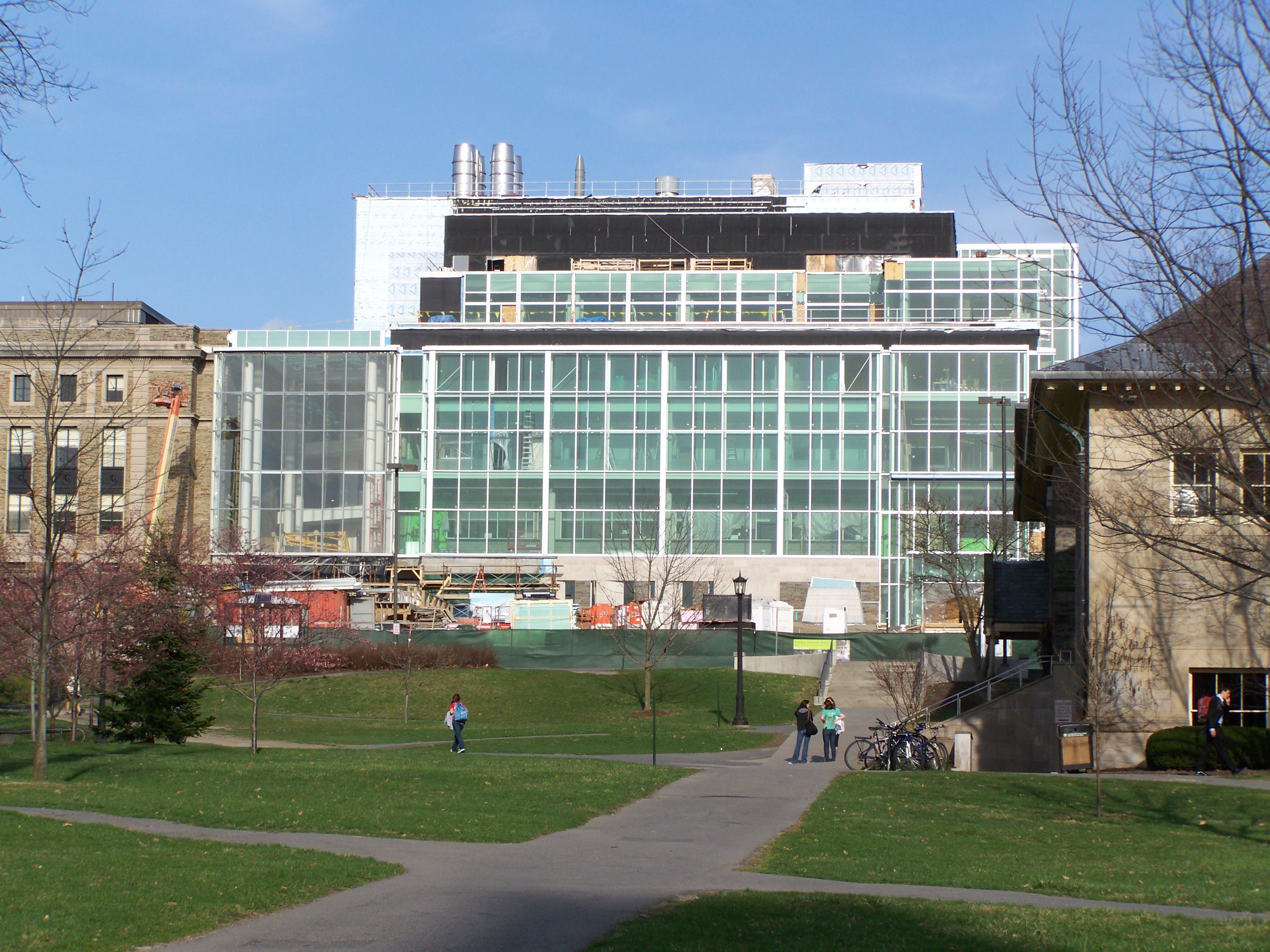
Coming along nicely. Seems to be on time for its October dedication.

6. “green cafe ithaca shutdown” (4-1-10)

Kinda funny how that turned out. It took them well over a year to renovate the old bank building on the SW corner of College and Dryden, and they were only open for a year. I went there on a date once. It was nothing special, although food-by-the-pound was an interesting take on dining out. I s’pose that one of the reasons they applied for a liquor license a few months back was to try and drum up business, but it didn’t work as well as hoped.

7. “aem vs engineering cornell” (4-1-10)

About as similar as chalk is to cheese. One is difficult, frustrating and has a low average GPA. The other isn’t. ORIE (Operations Reserach and Information Engineering) is sometimes described as a blend of the two.

8. “sage chapel hours” (4-2-10)

To be honest, I’m not sure. I want to say it opens at 8 AM and is closed by 8 PM, but I’m not positive. Perhaps someone who reads this blog has the answer to that question.


The Great “Snowicane” of 2010

27 02 2010


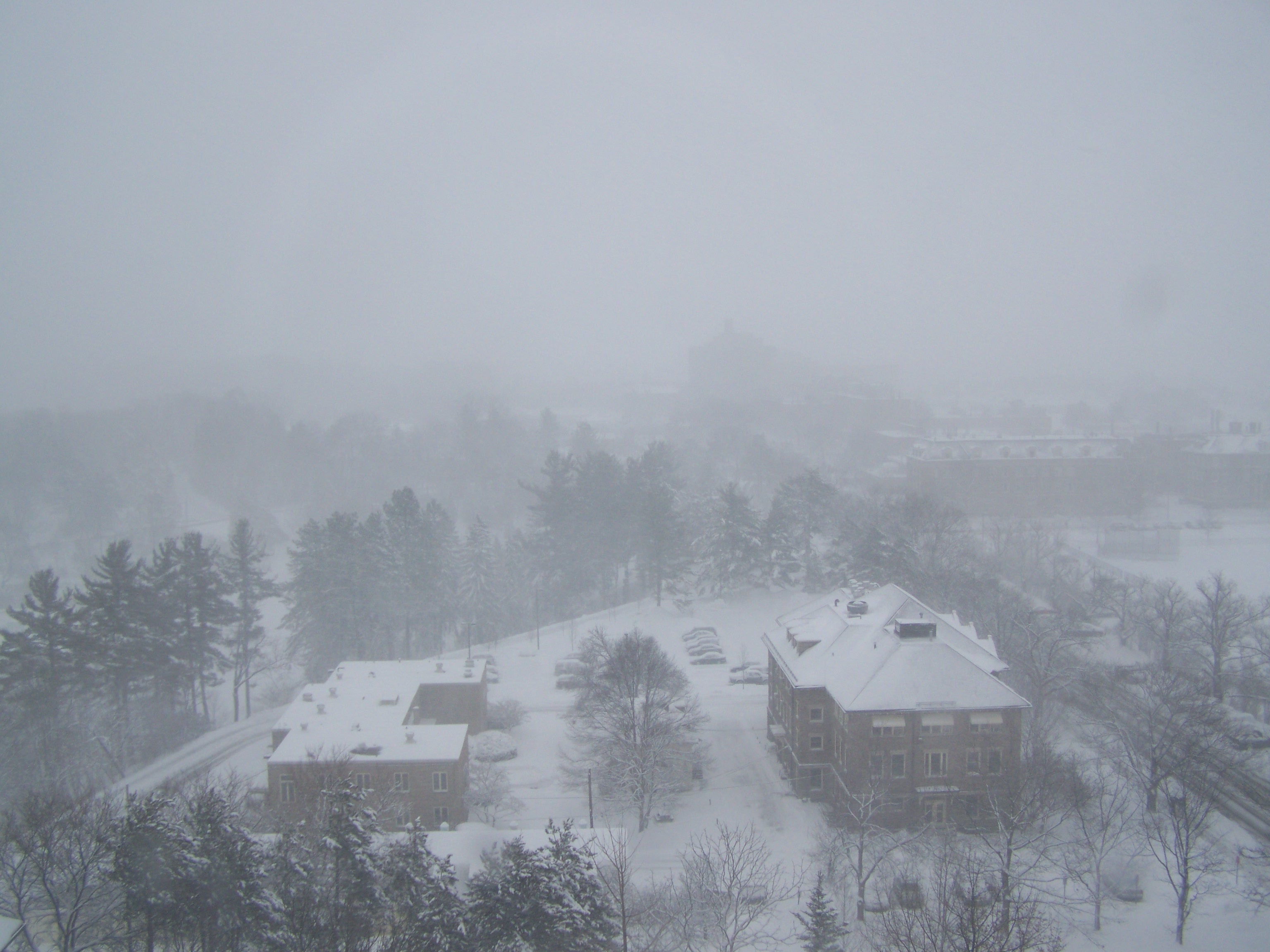
So this is storm is notable for two reasons; the snowfall amounts here and some high wind gusts reported in New England (the storm had dumped 18 inches onto Ithaca’s Game Farm Road weather station by 8 AM Friday morning, probably about 20-24 inches when all is said and done by the end of Saturday), and for letting professional sensationalism rear its ugly head.

From the meteorological perspective, this thing wasn’t even a blizzard for us, as winds were never above 35 mph. In some parts of the northeast it qualified for blizzard status, but only in a few locations. Most of the windy places were rainy. Most of the snowy places didn’t have strong winds. Only a few spots (excluding mountain tops) had both.

The storm bottomed out around 972 mb. That’s a pretty intense Nor’Easter. A strong storm is typically below 984 mb. The great Superstorm of 1993 had a central pressure of 960 mb. This was a powerful storm by any means, but certainly not the mother of all winter storms as depicted by some media outlets.

By that, I mean calling this a “snowicane”. First of all, let me start by saying that calling this a “snowicane” is completely inaccurate and irresponsible. The term was being used by the Ithaca Journal and a few commercial weather websites like Accuweather.com to describe (what was at the time the impending storm) the snowstorm that that passed through our area. The term is misleading and sensationalist. Hurricanes and snowstorms are like apples to oranges; combining the two into a catchy portmonteau because of high winds is complete bullshit. So, first came all the news headlines about the coming snowicane; then came the panic and confusion as people didn’t know what the hell was going on. Over in Bradfield, people were calling or emailing, asking what they should do about the snow hurricane. At first it was funny in a pathetic sort of way, and the NWS and a lot of broadcasting stations chastised a certain private company for trying to incite a panic. The first follow-up article on the Ithaca Journal read like this:

This is not a “snowicane.”

“That is garbage,” New York State climatologist Mark Wysocki said of the word AccuWeather.com and several news outlets are using to describe the storm. “This is really a typical storm. It’s nothing unusual. We’ve had them before, we’ll have them again.”

Of course, then I find lovely little comments like this one on the Ithaca Journal:

From TheZuneLune:

Garbage…Wysocoki’s [sic] misrepresentative critique is what’s garbage….Accuweather clearly explained that their rationale for comparing it to a hurricane was the strength of the low, and guess what? They were right as the storm is currently 978mb and strengthening.

Wyscoki [sic again] and the NBC owned Weather Channel (weather.com) are bitter because Accuweather’s meteorologists have fought the tide of meteorologists forecasting based on politics rather than science. Accuweather’s Joe Bastardi, in particular, has been assailed for refuting the notion that the recent stormy weather in the Mid-Atlantic was based on other factors than “man-made” climate change.

Ithaca Journal, please do a better job researching both sides of a story before perpetuating the far left agenda.”

Part of me is willing to wager that the poster has an affiliation of some sort to Accuweather. They’re only based two hours away in State College, PA (home of Penn State, and where its previous and current CEOs earned their meteorology degrees).

But really, what the hell does the weather have to do with politics? Like the two couldn’t be any less related. I’m a moderate Republican, but maybe because I study meteorology I don’t just write off sensationalism as an attempt of slander by the liberal media. I swear, it sounds like something right out of wingnut playbooks (if you don’t understand something, don’t worry about being uneducated, just blame it on people you hate). This is an issue of a company trying to capitalize on the fad of snow neologisms like “Snowmageddon” and “Snowpocalypse”, and being called out by other outlets for being irresponsible. No one expects Armageddon or the apocalypse with a snowstorm. But get a few people who don’t know better to hear “snowicane”, and suddenly they have thoughts of Katrina and blizzards meshed into some horrible monster of a weather system (speaking of which, Accuweather was also chastised for calling this storm “a monster”).

Interacting with people in meteorology has shown me that there is an expected level of professionalism and objectivity in forecasting, and that many in the field saw Accuweather’s descriptions as crossing the line. Yet people are twisting this argument from an issue of professionalism in a scientific field to an argument based on political bickering.

This is going to make me so bitter in a few years.

On a final note, Cornell last closed in 1993 for the aforementioned Superstorm (also known as the Storm of the Century — and these were posthumous titles). Cornell will only close if the Tompkins County sheriff shuts down the main roads like Route 13 due to extreme inclement weather conditions. Seriously, I was astounded that Cornell even gave a two-hour delay. I haven’t had those since high school.


Development Proposed for Eastern Collegetown

9 02 2010

http://www.theithacajournal.com/article/20100208/NEWS01/2080360/1126/news/Developer+seeks+town+re-zoning+in+Belle+Sherman

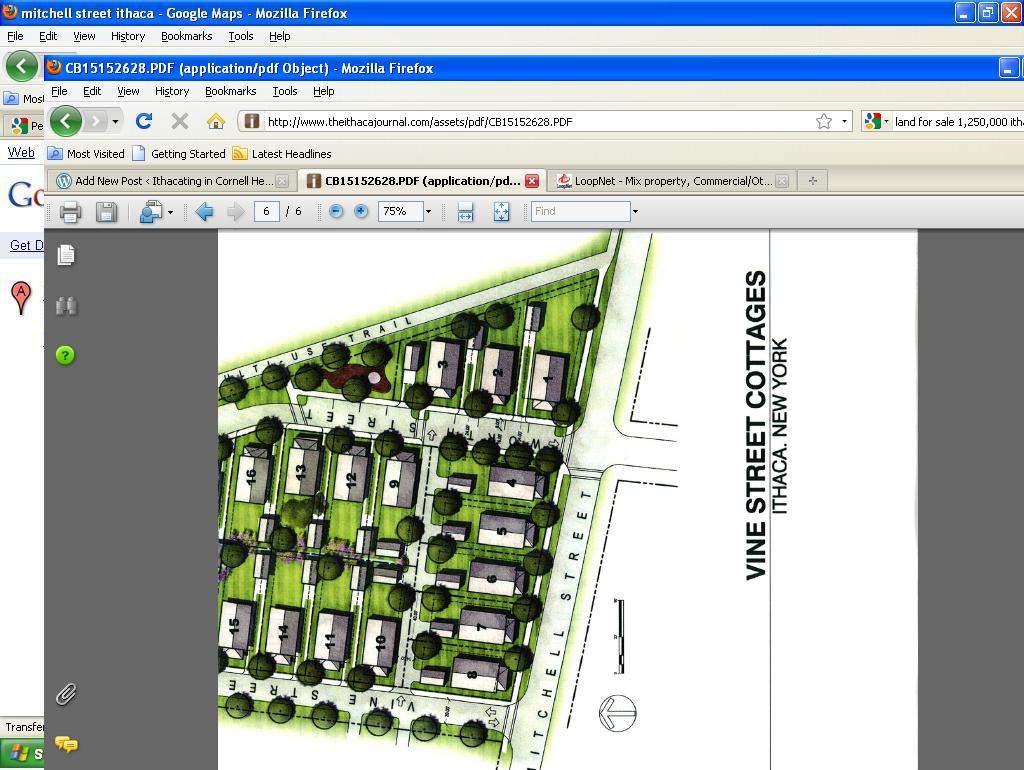
An underdeveloped piece of land between East Hill and Collegetown is the site of a proposed 26-unit single-family housing development to be called “Vine Street Cottages”. The land has been used by a trucking company since 1980, and was previously the site of an asphalt plant. The land has been marketed for the past year or so by several real estate agencies as a site for dense housing (suggested sale price: a cool $1.25 million for 3.4 acres. Mind you, this is Ithaca, so those prices are quite steep).

Photo Courtesy of Google Images

The housing is to be designed similar to the older homes in the nearby Fall Creek neighborhood, and sell for about $300k. However, the land is only zoned to hold ten lots, not 26, so a zoning appeal has to be filed and public discussion has to be undertaken. Which leads to comments like this one:

“…whose parents live on Vine Street, said the proposed development would be too dense, and the asking prices ‘are unrealistic for this area.'” A mature tree line currently buffers neighbors from the trucking operation, but all the trees would have to be removed to accommodate that many units, he said…”

I’ll give it one thing – the asking price is steep. A 1900 sq ft., 3-bedroom, 2.5 bath house that is LEED certified seems like it should only go for 200k-250k in the area. As for being too dense, apparently the joys of the frequent traffic of 18-wheelers up and down Mitchell Ave. outweigh 26 single-family houses. It’s also next to Maplewood Park, which is owned by Cornell and much denser (Maplewood Park is on the site where Vetsburg, Cornell’s housing for vets and their families, was originally placed after WWII). Cornell has its own plans to redevelop Maplewood Park within the next several years (assuming the budget kinks are worked out).

Speaking of which, the company that wants to develop the site, Agora LLC, is headed by Toby Millman, Cornell Class of 1992.

It would seem to be that this is a big win for Ithaca. The housing is intended for permanent residents and follows new urbanist principles, so it’s eco friendly and responds to concerns of students overrunning the area. But apparently, some folks think that a trucking company is better.


Better Late Than Never: 2009 OFSA Report Released

7 01 2010

It only took them until New Year’s to get it up on their website. What’s that, like six months since the numbers and data were finalized?

The PDF:

http://dos.cornell.edu/cms/greek/upload/OFSA_AnnualReport_0809.pdf

The cover is vaguely charming. I can see my fraternity’s pin on the cover. I also remember that our alumni board president didn’t know that the pins were for reunion, so we ended up putting them in storage for a while before giving them out to interested members.

Basic stats: Not a whole lot of change. Same number of chapters (AOPi closed and Alpha Phi Alpha reestablished itself). Roughly the same percentage of greek undergrads (more on that in a moment). Less community service hours, but about $6K more raised in philanthropies, but honestly no one really cares about that except when it comes time to say good (or bad, comparatively) things about the greek community.

Digging a little deeper into the IFC numbers, it looks like the percentage of Cornell male undergrads in fraternities has increased to 33.15% from 31.68%. Gross numbers, that’s about 143 more members (the total male undergrad population, Greek and non-Greek, increased by 126). Yet, the number of undergrad freshman males stayed nearly constant (up by 9), so the vast majority of the gains seem to be from upperclassmen who chose to pledge later in their college careers, and transfer students. Which is great, in my opinion; one of my best friends in my house chose to pledge as a sophomore, but I wouldn’t think of him any differently than someone that I pledged with as a freshman.

Sorority membership increased to 23.60% from 23.17%. Sororities had 78 more members in 2008-09 over the past year, but the total undergraduate female population increased by 190 students (including 120 more freshman women vs. the previous year). Average members per chapter from 73 to 81, but that’s because Panhel lost AOPi, so there were more ladies to go around.

As a guy, I think I lack the ability to understanding the dealings of Panhel. The idea of being in a chapter of 130 members isn’t too appealing, and I’ve definitely seen cases of girls in the same house not even remembering each other’s names. Whatever floats their boat, I guess.

Just stating this for the record, I write about OFSA figures and Greek life out of my own interest. No figures or statements in this blog are made with the purpose of influencing anyone towards a certain house.  This blog is only good for photos of the houses and for little history tidbits about the chapters. The only way you can figure the character of a fraternity is by visiting them and using solid judgment.


This Isn’t Your Father’s Fraternity

29 12 2009

So, with Rush Week coming up, I figured it was about time that I did another Cornell Greek System related article.

So, a fair number of guys who come back for rush week do so on their parent’s urging. Which seems a bit funny, considering the stereotypes and all, but it’s likely that the parents who are pro-Greek were in a fraternity or sorority themselves. Sometimes, someone’s father might try to prod them towards the house that they were a member of back in the day.

Well, fraternities are rather preculiar in that the character of a house can change completely in about three years, as members graduate and new brothers are initiated.  So, your father’s fratenity, while it may have been a “small nerdy house in 1970-something” or “a big jock house back in the ’80s”, may be something completely different today.

For this entry, I decided to compare the membership numbers of houses. For one thing, numbers are solid; character is subjective. Secondly, I’m only doing fraternities; sororities tend to be somewhat less elastic with numbers, especially since they operate with a quota system that sets the number of pledges a sorority may have.

The first number is the active membership number from the Spring 2009 semester for Cornell fraternities. The second number is for Spring 2005, selected merely to illustrate the dynamics of change (or lack thereof).  The last number is from Spring 1983, selected because it is a legitimate date that token rushee X’s dad might’ve graduated from college, but also because  it was easy for me to get a hold of the figures (on paper, so no links unfortunately).

A few details: Membership percentages in Greek houses in 2009 was 33.15% of the total undergrad male population, with 47 members on average (50 chapters fell under the “fraternity” designation, but that includes MGLCs – accounting for their typically small number, the reduction is to 42 chapters, then the IFC average is about 54 members). No offense meant to the MGLC folks, but I have no 1983 data for those chapters, so they are excluded.

For 2005, there were 40 IFC chapters, and an average of about 47 members per house (fraternity membership was 28.75%).

For 1983, there were 50 IFC chapters, and an average in the low 50s.The chapters that existed in 1983 that don’t today are

Phi Alpha Omega, a small collegetown-based fraternity started around 1982 and gone by 1986.

Triangle, down to eleven members. Their national would shut them down by 1985.

Theta Delta Chi, which closed in 1999 (to their credit, they have one failed recolonization attempt, from 2003). They failed to submit information in time to be included in the 1983 publication I’m using.

Phi Kappa Sigma, which closed in 1990. They had 35 members in 1983.

Phi Sigma Epsilon, which merged on the national level with Phi Sigma Kappa in 1985, closing the Cornell chapter. It had 73 members in 1983.

Chapter /Spring 2009/Spring 2005/Spring 1983

Acacia 39/29/33

Acacia was on the brink of closing in the late 1990s, when membership dwindled. It seems to have recovered well enough.

Alpha Delta Phi 57/69/56

Alpha Epsilon Pi 35/NA/NA

So, here’s the problem. The first time AEPi closed was in 1984. The second time was in 2005. Way to screw up by stats guys. I looked up their 2004 data; its membership number recorded 29 brothers.

Alpha Gamma Rho 52/63/86

Alpha Sigma Phi 51/56/71

Alpha Tau Omega 75/61/63

Alpha Zeta 55/24/53

Alpha Zeta almost closed in the mid 2000s, so that makes it upward climb more impressive. The 1983 value may be off, since this co-ed fraternity only recognized women on an honorary level at the time, so they were left off the roster. The other two values are combined co-ed.

Beta Theta Pi 30/51/49

Beta is in the midst of reorganizing, hence the low 2009 figure.

Chi Phi 73/72/ 56

Chi Psi 53/47/84

Just…ouch.

Delta Chi 82/27/65

Delta Chi closed and reopened in 2004,  hence the low 2005 figure.

Delta Kappa Epsilon 46/45/68

Delta Phi (Llenroc) 64/41/57

Delta Tau Delta 40/27/56

Delta Upsilon 66/50/60

Kappa Alpha 17/NA/39

Kappa Alpha closed in 1990 and reopened in 2007.

Kappa Delta Rho 39/34/47

Kappa Sigma 71/42/87

Lambda Chi Alpha 67/58/69

Phi Delta Theta 47/54/70

Phi Delt reorganized in 2000, when it threw out the then-current membership and started fresh as a dry fraternity.

Phi Gamma Delta (FIJI) 84/53/93

Phi Kappa Psi 72/61/87

Phi Kappa Tau 56/51/34

Closed in 1994, reopened in 2000.

Phi Sigma Kappa 51/56/65

Pi Kappa Alpha 61/56/102.

Wow. I never knew Pika was once the largest house on campus.

Pi Kappa Phi 65/48/25

Closed in 1986, reopened 1990.

Psi Upsilon 37/57/NA

Psi Upsilon was closed from 1981 to 1985. They also reorganized in 2008.

Seal & Serpent 17/20/35

What happened here was a slaughter of their reputation. That was covered in a previous entry.

Sigma Alpha Epsilon 91/89/35

On the other end of the scale, the rise of SAE is impressive. Who would’ve guessed they were such a small house back in the day?

Sigma Alpha Mu 70/52/21

Sigma Alpha Mu was rechartered in 1983/84.

Sigma Chi 67/61/79

Sigma Chi Delta 12/8/14

An item worth noting- the vast majority (80%+) of Sigma Chi Delta’s membership in the 1980s was of east Asian ethnic groups.

Sigma Nu 55/61/72

Sigma Phi 58/47/45

Sigma Phi Epsilon 51/52/50

Not as stable as it looks. Reorganized in spring 2006, closed for the fall, reopened in 2007.

Sigma Pi 39/83/94

Reorganized in 2008.

Tau Epsilon Phi 59/11/30

TEP must be doing something right.

Tau Kappa Epsilon 31/34/44

Theta Delta Chi 63/40/69

Theta Xi 23/NA/NA

Theta Xi was closed in 1970 and didn’t recolonize until 2008.

Zeta Beta Tau 43/51/NA

They didn’t submit in time for their 1983 data to be published.

Zeta Psi 53/29/43

So in conclusion, although your dad may regal you with stories of his fraternity days, don’t expect to have the same experience if you pledge his old house.


What the Hippies Are Driving These Days

23 12 2009

I figured that it would have been fun to do a little piece on the most common vehicle models in Tompkins County. Unfortunately, the statistics carried by the NYS Department of Transportation and the DMV only keep in track of the types of vehicle (basically, there are about 51,000 registered private vehicles in Tompkins County). Checking with the state department of finance didn’t reveal much, nor was there anything on the U.S. census data website (which is unusual, given that the census page usually has billions pf pieces of seemingly useless data). This is made even more frustrating when you consider that some states actually do bother to keep in track of this data, or that MSN had a “most popular vehicle by zip code” article that covered ten zip codes and then offered no means for anyone to check their own zipcodes. Lame.

It’s not like one can sit next to a window and keep track of the number of vehicles passing by. A green 2002 Honda Accord looks like any other green 2002 Honda Accord for the most part, so there’s little ability to distinguish whether two cars of the same make are genuinely unique or if it’s the same person driving by twice. Plus, most of the students driving around town aren’t registered through Ithaca zipcodes, they’re registered through their family’s permanent addresses (so, all those Audi A6s and BMW 3-series you see buzzing around campus are probably registered in Westchester, northern New Jersey or any token upscale suburb in the northeastern U.S.)

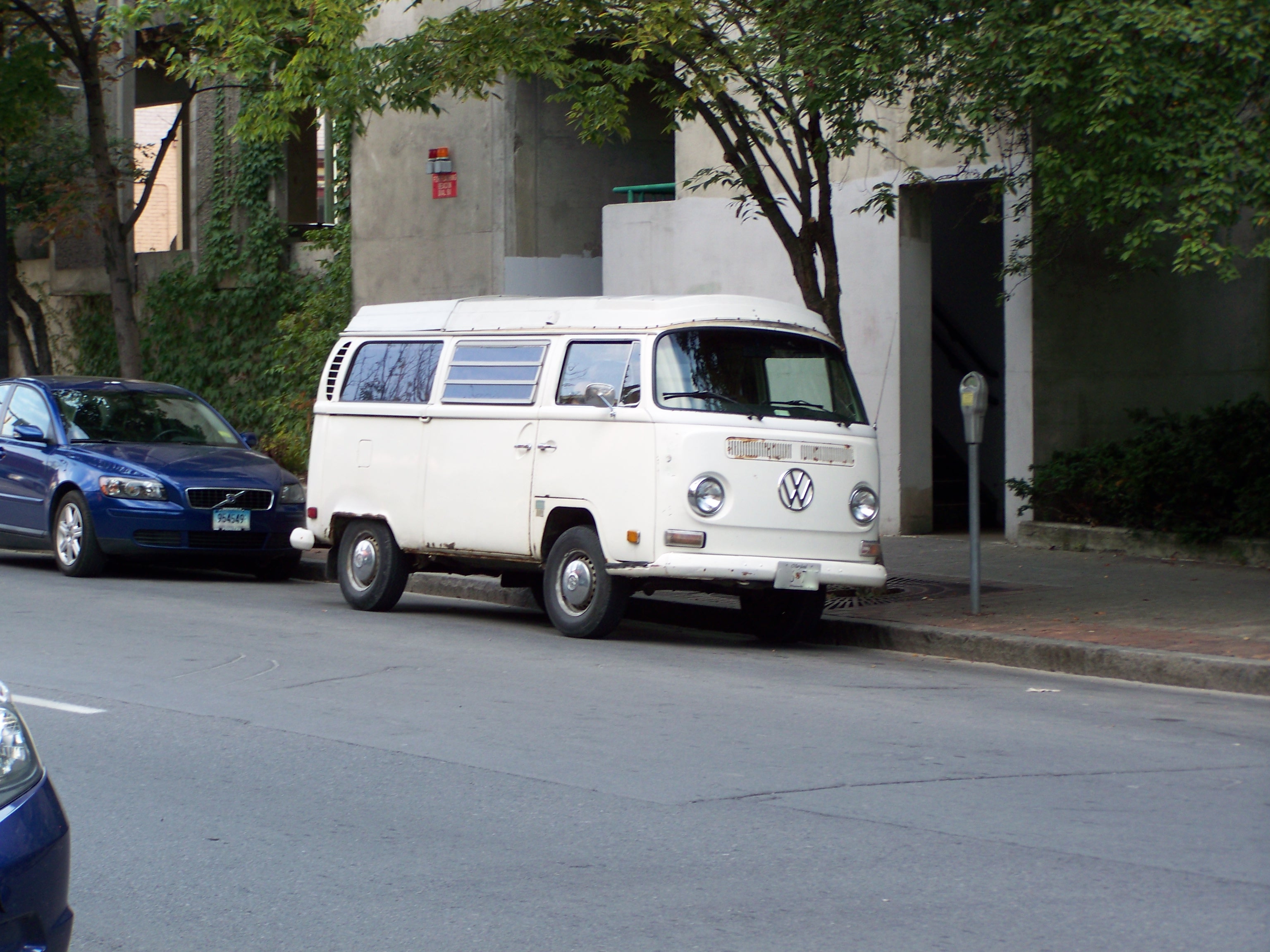
That being said, I’m willing to take a few somewhat educated guesses of the most commonly registered vehicles in Ithaca.  For one, the ubiquitous Volvos that can be found in the Ithaca area. If any particular models stand out, it’d probably be the 240 models from pre-1993, 800 series models from the mid 1990s and maybe some of the 900 series models of the later 1990s.  I’d be impressed if anyone travelling through the greater Ithaca area can go five minutes on the road without seeing the pride of Sweden in the next lane. Not to say that Volvos don’t have their attractions. They’re known for their safety and for great heating systems that prove useful for Ithaca’s long winters. Plus, in terms of cars defining people, Volvo tends to be one of those brands popular with the college faculty crowd, i.e. liberals with higher incomes.Volvos are so ingrained into the community culture that the Ithaca festival features a Volvo ballet, where they decorate the cars in “tutus” and perform on city streets.

Another brand of vehicles popular with the collegetown crowd would be Japanese automaker Subaru (fun fact of the day:  Subaru is the Japanese name for the Pleaides star cluster. This becomes readily apparent once you consider the Subaru emblem). The most popular model by my guess would be the Outback wagon of the mid 2000s or the post-2000 Subaru Forester.  What makes Subaru popular is that it tends to attract the same New Age crowd that Ithaca tends to attract. To quote a Denver paper that noted they were the most popular car in college town Boulder:

“More hip than a mini-van. Very useful. Great in snow. It’s a cool station wagon. Minivans aren’t cool. We know that. The Outback has all of the safety that an SUV doesn’t have and all the utility that the Camry does have. So I see it as a common middle ground kind of ride. It’s kind of like pilates mom instead of soccer mom…”

Lastly, if you consider things from a county level, then somewhere in the top five there have to be at least one of two truck models. Ithaca town and city make up about half the county’s populations, and probably less than half of the registered vehicles once you consider those that walk, bike or use public transit. The surrounding towns are more rural areas where agriculture is king, and many of these residents use Ford F-150s or Chevy Silverados to get around. Case in point, look in Alpha Gamma Rho’s parking lot, and you’ll see twenty trucks, five SUVs and an old Chevy Cavalier.

Seeing as their are no readily available figures, I’d love to hear other opinions on this one. Priuses, Accords, Saabs maybe? Write in and let me know.