Cornell Likes Having Friends

30 06 2013

4-8-2013 233

The majority of buildings at Cornell are named for faculty, staff, and alumni with deep pockets. A few others just have generic titles. Occasionally, a building on campus is named for someone with no association with Cornell, except that they helped out the university (usually from a financial aspect). Some of buildings named for “Friends of Cornell”, as Alumni Affairs likes to call them, are detailed below.  One exception I make is that early on, some folks who were Cornell trustees (but had no association otherwise) have buildings named for them, such as Henry W. Sage, John McGraw and Hiram Sibley; but since they served Cornell in an official capacity, I’m excluding them here.

Morrill Hall (1868)  – Like many land-grant institutions, Cornell’s Morrill Hall is named for Justin Smith Morrill, author of the Morrill Act that allowed the sale of federal lands to raise funds for colleges focused on the agricultural and technical trades (some of the other schools include Purdue, Rutgers and MIT; Morrill is known best for this legislation, with his anti-Mormon work a distant second). Morrill had no official association with Cornell, although he did pay a visit to the university at least once, in 1883.

Morse Hall (1890), Franklin Hall (1883) and Lincoln Hall (1888) – In the Gilded Age, engineering and science buildings had the pleasure of being named for “great men” that contributed to the then-present condition of the university and STEM studies. Hence, Samuel Morse (inventor of the telegraph), Benjamin Franklin (politician, scientist, and all around bad-ass), and Abraham Lincoln (president who oversaw the passage of the Morrill Act). Morse Hall burned down, and Franklin Hall became Tjaden Hall (for prominent female architect Olive Tjaden ’25 ) in 1980.

Rockefeller Hall (1903) – Named and partially paid for by John D. Rockefeller, the wealthiest man in the world at the time (and, proportionately, believed to be the wealthiest man ever). Rockefeller has recently retired from Standard Oil and was just beginning his philanthropies, funding schools he believed to be practical. Rumor has it that he was so disappointed with the (then considered unattractive) appearance of Rockefeller Hall he vowed to never donate another cent to Cornell. Which hardly dampened his funding of institutions.

Fun fact, Walter Teagle, of Teagle Hall fame, was a vice president of Standard Oil a few decades later.

Baker Lab (1923) – Funded by George F. Baker, a sort of Warren Buffet of his time, and one of the wealthiest Americans on the early 20th century. Baker also provided much of the funding for the Harvard Business school, and made his way through the Ivy League with his donations, including Columbia’s Baker Field and Dartmouth’s Baker Library.

Mudd Hall (the west wing of Corson-Mudd Hall, 1982) – Named for Seeley G. Mudd, a prominent philanthropist. The foundation established with his fortune explicitly earmarks donations for the construction of academic buildings – the wikipedia list shows no less than 30 schools that have benefited from his funds. Otherwise, Dr. Mudd has no connection to Cornell.

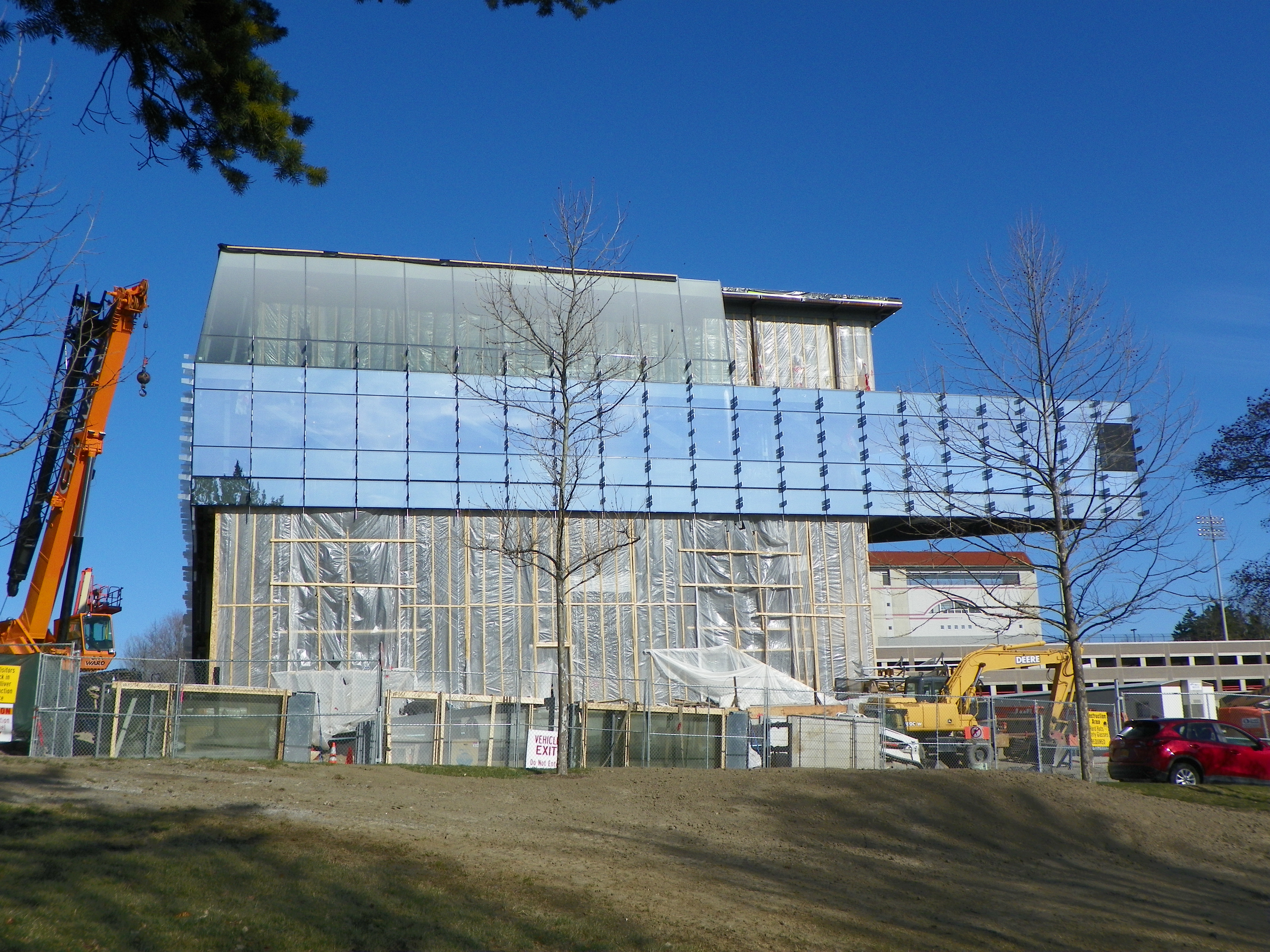
Gates Hall (2013/14) – Not unlike Mudd Hall, Gates Hall is funded with a hefty donation from the Bill and Melinda Gates Foundation, the philanthropic org maintained by Warren Buffet and  Microsoft overlord Bill Gates.

100_7116


King-Shaw Hall

21 06 2013

101_0489

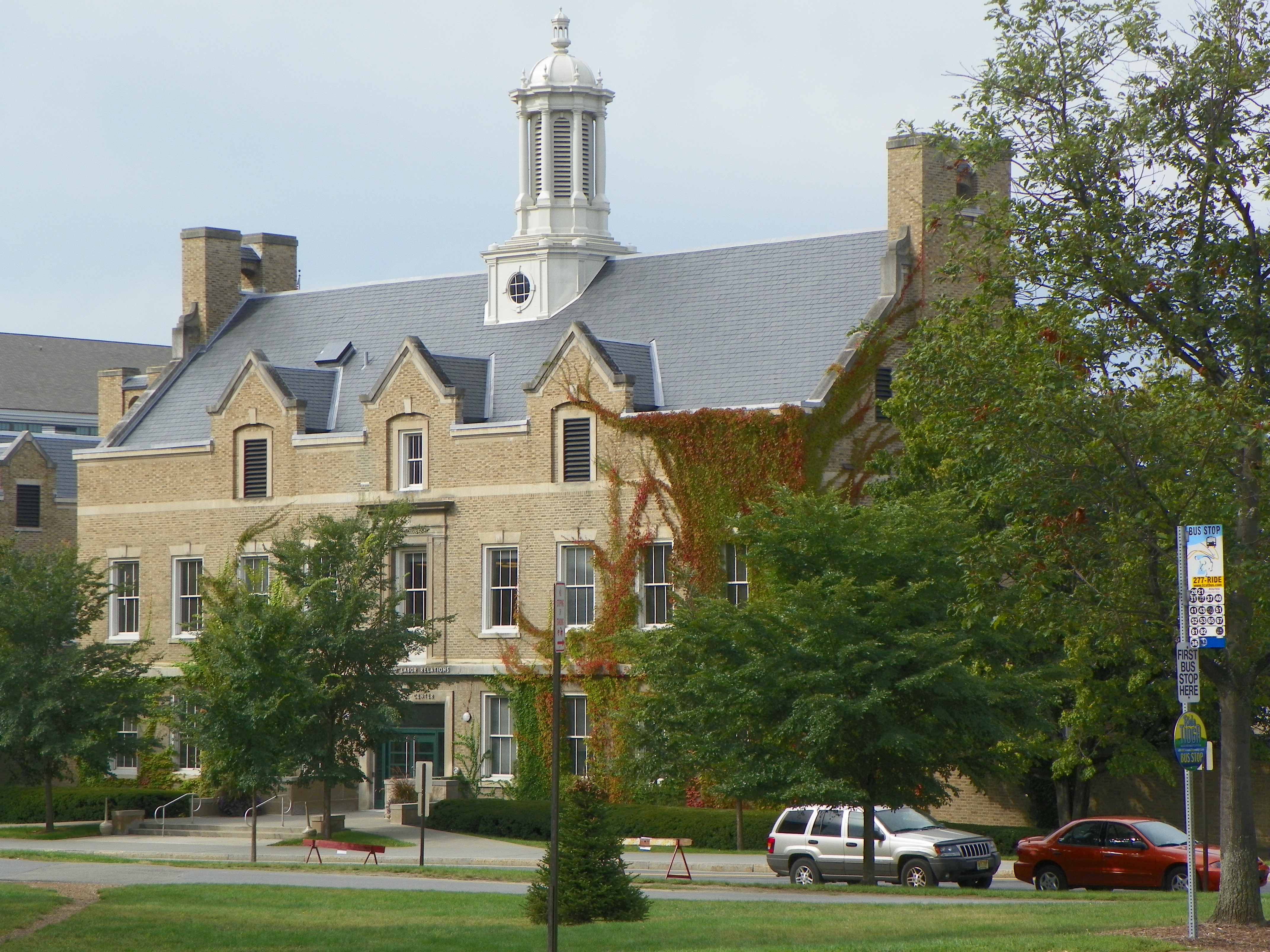
So, in doing research for a later entry, I was going through the list of facilities on Cornell’s website, and came across an unfamiliar name – King-Shaw Hall.  So I decided to check – the facilities website contains buildings that have long ago been torn down, such as Morse Hall.

To my uncomfortable surprise, the ILR Conference Center changed its name way back in October 2012. In my defense, this appears to have happened right around my first week on the job, so my mind was on other things. Secondly, if this was anything like the sudden change they made with the ILR Extension Building becoming Dolgen Hall in 2008, then I can’t be blamed too much, as that one almost flew under the radar while I was a still a student (had it not been for the lettering change outside the building, I would not have known).

According to the ILR press release, the building was renamed for Patricia and Ruben King-Shaw ’83, so two donors but not two separate donors as one might suspect (see Court-Kay-Bauer for an example of the latter). Ruben King-Shaw is the chairman of an equity firm, and according to Forbes, has an extended history serving in executive roles in healthcare administration, both public and private. For better or worse, one of his daughters currently attends Cornell; on the bright side, you can point to the building and say, with pride, it’s named for your family; on the other hand, it means every time you do well on something, or if you’re selected for a secret society, your peers will snidely whisper it’s because of the enormous amount of money your family donated to the university.  For the record, although the amount donated is undisclosed, it’s probably something similar or marginally more than the amount donated by John Dolgen, which was described as a “multimillion-dollar gift“.

As to the building itself, The ILR Conference Center was built in 1911 as an expansion of the Vet School. ILR moved in during the late 1940s. As with Dolgen and the ILR Research Building on the south end of the complex, King-Shaw Hall underwent a significant renovation from 2002-2004, but because these buildings were designated landmarks, the exteriors were relatively unaltered. I suppose at this point, it won’t be long before ILR finds a donor for the Research Building, if someone feels the urge to part with some millions for nominal immortality.


Cornell’s Office Park

1 03 2013
Image Property of Cornell Real Estate

Image Property of Cornell Real Estate

Previously, I’ve mentioned how Cornell almost had a convention center/hotel, a large hand in the airport, and a particle accelerator under the stadium. It seems almost without saying that Cornell would have a stake in an office park as well, and perhaps such a mundane asset would fly under the radar. As it has on this blog for years, not for lack of knowledge but for lack of interest.

For the uninitiated, business parks are clusters of office/commercial buildings, popular in suburban areas. In my hometown with its almighty 6,000 residents, we had one, which was so terribly stuck in the 1980s one might as well have parked a DeLorean in front of it for marketing purposes (then again, growing up in an upstate rust belt town, I can count on one hand the number of new buildings I’ve seen built there since moving away for college in 2006).

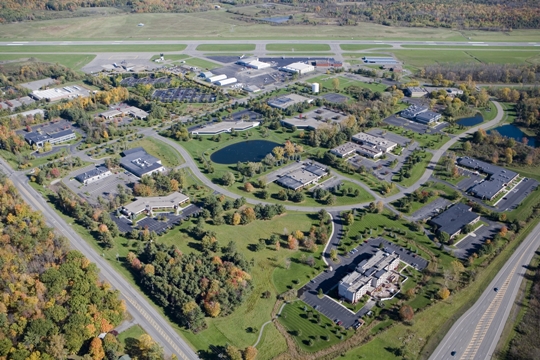
Cornell’s is just a little bit older, though most of the construction occurred in the 1980s and 1990s.  In 1951, Cornell decided to partner up with General Electric to establish a research lab near the airport. Public-private partnerships on research are nothing new. While Cornell assisted in the research, the lab was leased by GE. Unlike some of its involvements, Cornell actually owned the land and buildings for this endeavor, using old property and the lands from its airport. Cornell sold off the airport in 1956 but still owned the land to the south, donating some to the state when Route 13 was constructed in the late 1950s.

Things were a bit of a roller coaster at first. GE was the only tenant when they decided to leave in 1964, leaving the recently-completed Langmuir Lab vacant. TCAD took over development of the park while the lab building was donated to Cornell (development rights were relinquished back to Cornell in the ’80s), and CU housed some of its functions in Langmuir to keep the space occupied, with the last major university back-office leaving in 1987. The complex sort of languished through the 1970s, only taking off in the late 1980s when the trustees allowed the development of office buildings and limited commercial enterprises, rather than just research/industrial structures. It was in 1988 that its current name, the Cornell Business & Technology Park, was adopted.

Here’s an easy guide for the park – if the street name is Arrowwood or Brentwood, it’s a medical office building. If Thornwood, Brown or Warren, office or research/industrial.

The breakdown for build-out over time has been as follows:

Start-up (83 Brown Road, a former aeronautical lab renovated to start the business park in 1951, expanded ’53, ’55)

1960s: 3 structures, Langmuir Lab [1960] and 777 Warren Road [1967], 61 Brown Road [1969, addition 1997].

1970s: Diddly squat.

1980s: 6 structures: 9 Brown Road [1985],747 Warren Road [1987], 20 Thornwood Drive [1988], 33 Thornwood [1989], 579 Warren [1989], 10 Arrowwood [1989, additions 1993, 1997]

1990s: 10 structures, quite the boom:  55 Brown Road [1990], 767 Warren [1990], 757 Warren [The USPS Main Office, 1992], 53 Brown [1993], 22 Thornwood [1995], 15 Thornwood [1997], 20 Thornwood [1997], 22 Thornwood [1997, addition 1999], 10 Brentwood [1998], 30 Brown [1998]

2000s: 6 structures: Marriott Hotel [2000], 36 Thornwood [2001], 10 Brown [2001, addition 2007], 35 Thornwood [2003], 19 Brown [2006], and … It should be noted 83/85 Brown were demolished in 2005. The last building to be built was 16 Brentwood, in 2009.

So that gives about 25 structures, which total about 700,000 square feet, spread out over 200 acres. As far as I’m aware, the park has 100 acres of residential that remain undeveloped. The park has about 80 tenant companies, 1600 workers, and does in fact pay property taxes. It comes with most of the corporate amenities – outdoor picnic areas, daycare, a restaurant, over-manicured lawns and ponds, and enormous amounts of parking, bringing a little bit of everyday homogenous suburbia to the ITH. A few lots are still undeveloped, mostly parcels next to 13.

So add this to the list of developments Cornell has had its hands in. At the very least, it encourages gives Ithaca room for suburban offices….although personally I’d prefer they try downtown first.


Cornell and Carl Sagan

26 01 2013

100_1714

When I came up for the idea of this topic, I was originally a little hesitant to write an entry. Unlike A.D. White or Dear Uncle Ezra, there are probably a number of readers who can remember when Sagan was alive and active on campus (Sagan passed away in December 1996). If the number of hits I receive for his old house at 900 Stewart Avenue are any clue (~600 hits since this blog’s inception), the late astronomer and Cornell professor remains a relatively popular figure. As someone who was just a kid when Carl Sagan passed away, it’s a little harder for me to identify, and in Sagan’s place, figures such as Bill Nye and Neil DeGrasse Tyson fill different niches not-too-distant from Sagan’s public role.

With all that in mind, I decided to take an approach similar to what I did with my “Founding Fathers” entries, and provide a smorgasbord of tidbits. I have no intention of delving into his interests of extraterrestrial life, agnosticism/humanism, or marijuana use, but the wikipedia entry would be a fine substitute for those interested in those topics.

-First off, the basic facts. Carl Sagan arrived at Cornell in 1968. We should only be so lucky that the high minds of Harvard decided to deny him tenure the previous year, because they were unhappy with his “pandering to the public”. Sagan became a full professor of the astronomy department in 1971, and remained so (the David C. Duncan Professor in the Physical Sciences) until his untimely death from pneumonia while recovering from cancer a quarter-century later.

-Carl Sagan might have been an excellent publicist for science, but few would call him a focused academic. The filming of his Cosmos  television series in Los Angeles in the late 1970s forced the university to cancel several of his courses, and several grad students under his advisory had to move into the research groups of other department faculty. His astronomy colleagues were unimpressed with this shirking of duties and attempted to have his lab kicked out of the Space Science building.

-Things were not a whole lot better upon return to campus, the blessing and curse of the success of his television series and associated NYT bestseller. While Sagan garnered much favorable publicity and considerable wealth, he was also subject to death threats from those in vehement disagreement to his views. Police regularly patrolled his home, and his name was removed from the Space Science directory and from his front door, out of safety concerns (this policy must have relaxed late in his career). Some of his colleagues remained unenthused about him, accusing Dr. Sagan of being an egotist, blurring the lines between fact and fiction, and failing to give other scientists due credit.

-While at Cornell, Sagan began a critical thinking course (ASTRO 490). This course was under his guidance until he was hospitalized in 1996, when other faculty filled in. The course was discontinued after his death, but was brought back under the tutelage of other faculty a few years later. Under Sagan’s time, the course could only be enrolled into after completing a rigorous interview process for one of the 20 available slots.

-On the note of Neil deGrasse Tyson, Sagan tried to recruit him to do his undergrad at Cornell. Unfortunately, the future Dr. Tyson chose to go to Harvard instead. Bill Nye had Sagan as a professor, so perhaps Sagan has had more of a hand in the science communication to Generation Y than we realize.

-One of the more whimsical tales of Sagan is that during the height of his popularity, he had a secret tunnel from his home to campus, where he could drive his Porsche away from prying eyes. In reality, he would walk some of the back-trails along the gorge.

-Another reason to seek anonymity – Sagan used a vanity plate inscribed with “PHOBOS”, a Martian moon. These vanity plates became a hot souvenir for anyone with a screwdriver and ten minutes, since 900 Stewart has no driveway or garage (rather, it has a deep curb). Sagan eventually caved and asked the DMV for a more anonymous plate.

-I’ve already covered Sagan’s home a couple of times previous, but a quick rehash – built in 1890 as the meeting place for the Sphinx Head secret society, who sold it their neighbor, Dr. Robert Wilson, in 1969. The building went relatively unused, and was once again, this time to Dr. Stephen Mensch, in 1979. Mensch renovated the property into a home, and actually allowed Sphinx Head to make occasional use of the property. Sagan acquired the property in the 1980s, and the house is still a part of his estate, though it is vacant. According to a 1993 DUE, Sagan likely did not live in the property towards the ends of his life.

Although vacant, it would be ill-advised to try to trespass – the property is covered with security cameras, one of which is right above the entrance-way (the not-visible corner in the below photo).

On a personal note, when I had taken the photos of the former Sagan residence, I had not known this was his home. I just thought it was a highly unusual building in an area of mostly early 20th-century homes. It was not until I typed the address into my search bar when I came home that I discovered the building’s significance.

100_1690


The Cornell Stories

18 01 2013

cornell_postcards_1933

Back in the day, before the internet, TV and even radio, the best way to indulge one’s interest was by the printed word. Novels,  serials and newspaper articles were much more valued. It was also around a hundred or so years ago, when the idea of college went from the dank halls of seminaries and obscure studies of little practical worth, to a sort of idyllic playground of stories and mischief, casting collegiate life into a much more positive light.

During this time, several publications focusing on the wonders of college life were produced. Perhaps the best known are the Frank Merriwell serials, and his exploits at Yale. There were several other works of various quality produced around the same time.

Here, I offer The Cornell Stories (1898), written by James Gardner Sanderson, Class of 1896. The stories are light-hearted and fictional, but the setting and the descriptions conjure up images of a simpler, slower time, the Ithaca of a century ago.

Here’s my recommendation – make a cup of hot chocolate, settle into your favorite chair or couch with a blanket, and enjoy a good read.


A Fond Farewell to Dear Uncle Ezra

13 11 2012

It’s bittersweet. After 26 years of operation and over 20,000 responses, Dear Uncle Ezra, the “Dear Abby” of the Big Red, has gone on indefinite sabbatical. DUE was useful to this blog for its grab-bag of historical info, cited in these entries many times over the past few years. When first launched in the fall of 1986, DUE could be accessed from one of the two dozen computer sites, or few personal computers on campus.  Now in 2012, and thinking of blogs like this one and of internet culture, I suppose answers to many writers’ questions are just easier to find through google these days. But sometimes, it’s nice to just have someone hear you out, an impartial ear.

I wrote to Dear Uncle Ezra as a freshman. I don’t think the question will surprise most of the readers here.  A quick back-story on this, but my first few months at Cornell were a very trying time for me, since it was my first real experience away from home. And I guess that experience carries over somewhat to my current situation, as I moved to a new region for the first job in my post-grad school meteorology career. Having to build a new social network. Learning the ropes of my job. Not the easiest things in the world, when it seems tempting to settle into something else “easier” or closer to “home”.

From September 5, 2006:

Dear Uncle Ezra,
For years,
I’ve wanted to be a meteorologist, and I came to Cornell to study for that career. However, over the past year or so, I have had an equal if not greater interest in studying to be a history teacher at another university (it has a more focused program than Cornell’s, though I mean nothing against the school). I know that if I transfer, a lot of people will be dissappointed that I’m throwing away an “Ivy League education”. I feel confused and somewhat frustrated at being unable to make a decision, and I have to make it within the school year*. Could you weigh-in on the issue?

Dear Career-confused,

Glad to hear that you haven’t waited til the last minute and have the year to think this one through.  Choosing a career can be a very difficult process, but remember that it is a process and not just one single decision.

Fifty years ago, people in the United States got into the mind set that you chose a career (or even a company) and stayed there until retirement.  This is no longer true, as there is a lot of flexibility to combine interests into a “perfect” job, or to change positions or careers along the way as your expertise and needs change.  I myself, Ezra Cornell, was a carpenter, potter, farmer, public works engineer, communications entrepreneur, and then founder of this university.  But back to you.

In order for your direction to be the right one for you, you will need to continue engaging in the process of exploring your options.  One way to do that is to do research on what the two careers will be like.  Interview people in those positions to learn more about them.  Make an appointment with Cornell Career Services, 103 Barnes Hall, 5-5221.  They provide a wide range of services to help students reach decisions on majors and careers.  They could also help you find an internship or lead you through their career- information library, which might lead to greater clarity.

It might also help to talk to those people who think it would be a mistake to change schools: hear their thoughts and let them know your needs, goals and dreams.

Remember that it is your life and you must make the decision that is right for you after you weigh all of the information that you gather.

If you need a great sounding board along the way, feel free to contact EARS for free, confidential  and immediate counseling by phone or walk-in, 5-EARS or 211 Willard Straight Hall.

***

So I stayed the path in my career, doing my BS, my MS, and now at my first job (with what may be job number two coming up at a research facility a five hour flight away). My life is in flux, and it’s intimidating. Sometimes its good to have someone to sound off to. And for me personally, that’s what Dear Uncle Ezra was.


The Descendants of Ezra

4 09 2012

The inspiration for this entry comes from a recent Sun article detailing the rescue of a woman from the gorge, in which the first responder was a Cornell student, and descendant of Ezra Cornell.

Some famous people, like William Shakespeare and Abraham Lincoln, have no living direct descendants. Ezra Cornell, who is at least famous to those who have spent four or more years in Ithaca, is quite the contrary.

Ezra Cornell had either nine or eleven children, which sounds prodigious until you realize that couples had as many children as possible back in the mid-19th century simply to ensure that nature and probability would allow at least a few of them to survive into adulthood. Indeed, four of Cornell’s children died before the age of 25. However, that leaves behinds seven children – three boys and four girls (or five children consisting of three boys and two girls, depending on which source is correct).

The most famous of Ezra’s direct descendants is likely his son Alonzo, who served as governor of New York from 1880 to 1882, and was married twice. The wikipedia article claims he had four boys. One of them, Charles Ezra Cornell (d. 1947), served as trustee and had three children of his own, of which at least one, William Cornell, survived to adulthood. So plenty of possibilities for descendants here.

Regarding Ezra’s other surviving children, Franklin Cornell, a banker, passed away in 1908, and at that time, three of his four children were still alive – one boy, Franklin Cornell, and two daughters, Ms. Dorothy Cornell and Mrs. Eunice Cornell Taylor.

Oliver Perry Cornell, the third son of Ezra, survived well into his mature years (d. 1911). He married and had at least one son.

As for the daughters, they tend to be less easy to track, since they take the names of their husbands. There was Mary Emily Cornell  and Emma Pettit Cornell Blair (d. 1914), of which I can be certain. A Dorothy and Emma Cornell also appear in one of the sources, but this could be a repeat, someone’s wife, or some other error (and this is why I would never wish to be a genealogist). Mary went to Vassar, passed away at the age of 87 in 1935 (making her the last of the first generation), and appears to have remained unmarried. But Emma did marry, and had three boys, Charles, Cornell, and Hamilton Blair.

So, given this illustration, it is likely that there are Cornell descendants sill kicking around today, many of whom still live near the Ithaca area. Among those, Ezra Cornell IV (class of 1970), and the kid from the Sun article, Thomas Ezra Cornell Collum ’14.

On a final note, in the early days of the university, direct descendants could attend free of charge. However, with the proliferation of descendants, this practice was discontinued beyond the fourth generation, by order of the Board of Trustees in 1932. The university notes that the last folks eligible were of college-age around sixty years ago. So even if you find out you’re a seventh-generation progeny of Ezra, it won’t help your pocketbook if you attend the Big Red. But I’m sure it would make a nice conversation piece.


Quotes of Cornell

12 07 2012

A few thoughts from prominent folks about the school Far Above Cayuga:

“The university of Mr. Cornell, a really noble monument of his munificence, yet seems to rest on a misconception of what culture truly is, and is to be calculated to produce miners, or engineers, or architects, not sweetness and light. -Matthew Arnold, Preface of Culture and Anarchy, 1869 (Bishop 177)

“Columbia cannot grow, or at any rate cannot grow rapidly…unless it shall, at least to some extent, modify its plan of instruction in a more or less distant imitation of Harvard or of Cornell University”. Columbia President Frederick Barnard, 1870.

“[Cornell Vice-President Albert] Russel is a man whose nonreligious convictions are very pronounced, giving the university an air of positive irreligion. The decadence of the students is positive testimony to the evil effects of free inquiry.” – Lyman Abbott, editor of the Christian Union, 1881 (Bishop 215)

“I see, or think I see evidence of a growing disposition to drift away from the original intentions of Mr. Cornell in the founding of a purely non-sectarian university…I look to you [A. D. White] to protect my investment in Cornell from the common enemy.” Cornell Trustee Hiram Sibley to A.D. White, 1888.

“The University was sadly in need of reorganization and refitting.” – Benjamin Ide Wheeler, in reference to Cornell in the mid-1880s, quoted in 1902. (Bishop 259)

“The graduate students are the crown of the University, and Cornell cannot afford to neglect them for the sake of any others…” – David Starr Jordan, 1888

“The cry of the horse leech is modest and attenuated beside the stupendous greed and the insatiable clamor of this favored institution.” – New York Press, Nov. 1892

“[Cornell was] better endowed than any institution in the land, yet never did anything.” U.S. Sec. of Agriculture James Wilson, 1904 (Bishop 366)

“There is no university in the country in which freedom of thought and of speech is more firmly entrenched in tradition and in policy.” – Prof Henry A. Sill to Carl Becker, 1917

“[Cornell students] are good because it is too much trouble to be bad.” Romeyn Berry, Alumni News, 1926

“No more do the better students chant their Alma Mater in a happy trance; they sing from the side of the mouth, with the air of cynical priests of old Egypt.” – Alumni News, 1931.

“Cornell is a center of revolutionary communistic activity.” – State Sen. John J. McNaboe, 1936

“CORNELL GOES BOLSHEVIST” – Headline, New York World-Telegram, 1944

“We must retain private initiative and management in certain important fields, and certainly some of it in higher education.” -Edmund Ezra Day, 1948.

“At a time when Cornell was becoming a multicultural place, the Board of Trustees has thrown a dart into our celebration.” – Prof. Kenneth McClane, on the decision or Trustees to not divest South African investments, 1989

“[My wish for Cornell] is that it will continue to thrive and reach new heights … welcoming men and women of every color and creed, whatever their social standing or pecuniary condition. – Ruth Bader Ginsburg, 2003

“I am grateful to Cornell. I have seen the good work you have done in every stage of life.” – Bill Clinton, 2004 Convocation speech.

“My memories are strong about this place; important. And the two times I have been here for sustained periods have always been extraordinary.” – Toni Morrison, 2009.

“I would venture to say that the students at [Bush staffer Monica] Goodling’s law school at Regent University are far more impressive than those at the Cornell agriculture school — the land-grant, non-Ivy League school Keith [Olbermann] attended.”-Political Pundit Ann Coulter, 2009

“I got an excellent education, and that’s all I got from it…If I had to do it over again, or I had known what Cornell had been like, I never would have gone there.” Political pundit Bill Maher ’78, in a 2012 podcast


Why Syracuse and Cornell Would Ever Be Mentioned in the Same Sentence

3 07 2012

I have a certain fondness for the Orange. I grew up in the Syracuse sphere of influence, where because of the lack of national sports franchises in the region (a few hardy souls follow the Buffalo Bills, who went 0-4 in a row in the Super Bowl in the 1990s; having not been to the playoffs in over a decade, beings a Bills fan requires grief therapy), the Syracuse Orangemen/Orangewomen, now using the extra PC term of Syracuse Orange, were the teams to follow, especially in football and basketball. When I was growing up in my hometown not too long ago, it was generally expected that if you were reasonably talented, you went to SU. And a couple dozen of my high school classmates did just that. I was the only one in my year that went to the Big Red, 50 miles southwest of University Hill.

In my mind, I often draw parallels to Cornell and Syracuse. They were both established in the Reconstruction Era – Cornell in 1865, and Syracuse in 1870. Both are large institutions – the combined student enrollment for Cornell is 20,939, and Syracuse is 20,407. In terms of the prestige factor, both are well-regarded, although Cornell, with its Ivy League gilding, is usually considered the more respected of the two. US News & World report ranks Cornell in a tie with Brown for 15th (roughly constant for the past few years), and Syracuse 62nd (a drop of about 12 spots since I started college in 2006). That all being said, if Syracuse had had what I wanted to study, and it was better ranked in that field than Cornell, I would’ve gone to Syracuse, lack of ivy notwithstanding.

The two are physically close, superficially similar, and their history is intertwined, which is what I want to touch on with this entry. Collegiate snobbery aside, Cornellians and Syracusans undoubtedly owe a fair amount of their history to each other.

First of all, Syracusans can thank Ezra Cornell (or curse him, perhaps) for being located where they are today. Andrew Dickson White and Ezra Cornell were state senators in the early 1860s, when the Morrill Land-Grant Colleges Act was passed; Cornell represented the Ithaca area, and White was elected out of the city of Syracuse. While they both united under the common goal of establish one strong university with those land sale proceeds, they differed on location. White wanted Syracuse to be home to the new school, and for the college to be seated on what is now University Hill. He believed that Syracuse, a burgeoning transportation hub, would make it easier to recruit faculty, and that the city would serve the university better. However, Ezra Cornell strongly disagreed; he detested Syracuse as a den of sin, citing an incident where he was twice-robbed of his wages as a young man while working in the city. Old Uncle Ezra offered up his farm in Ithaca if White agreed to keep the school out of Syracuse. White relented, and in following fashion, named the school after its biggest benefactor. On a final note, while Ezra gave $500,000 (1865 dollars) and his property to his fledgling institution, he gave $25,000 (1865 dollars) to those who supported a Syracuse school, so they would support the bill establishing the Ithaca school. In turn, this money was used to assist moving Genesee College from Lima, New York, to Syracuse, and helped SU to be established.

In many ways, the relationship between Cornell and Syracuse could be described as antagonistic. Cornell had the first school of forestry in the state, from 1898 to 1903. At that point, Bernhard Fernow had ticked off enough Adirondack land owners and wealthy vacationers that the governor vetoed funding for the school, which led to the Board of Trustees shutting it down. However, several years later, under the influence of Syracuse trustee Louis Marshall, a new forestry college was established in Syracuse, semi-associated with SU (SUNY ESF, in 1911). Rather than completely give in, Cornell continued a much smaller forestry college within the agriculture school, which annoyed the bean counters in Albany enough that they officially made SUNY ESF the primary forestry school in the 1930s, relegating Cornell to only “farm forestry“. In exchange, Syracuse had to drop all ambition of its own College of Agriculture. Today, the forestry department at Cornell is known as the Department of Natural Resources.

Competition for state money has always been a sticking point for Cornell and Syracuse. While Cornell lost the battle for the forestry school, Syracuse lost the battle for the ILR school (Industrial and Labor Relations) while it was being conceived in the late 1930s. Post WWII, academic competition between the two schools has given way as they diverged in their interests; the primary contests between the two institutions these days involve sports, where Syracuse usually has the upper hand.

So, as much as students at the two schools may taunt and jeer at each other, both institutions have played a crucial role in helping to develop the other. However, given my orange and red sympathies, I will forever be unwelcome at SU vs. Cornell games for the rest of my life.


The Freshman Beanie

11 06 2012

Distinguishing between the years of students of Cornell can be rather difficult after about the first month of the academic year.  Unless it’s orientation, Greek rush, or some other telling factor, you can take a glance at some random person crossing the quad and have no idea whether or not they’re a freshman, a junior, or perhaps even a young grad student (whereas for older grad students, they might be mistaken for professors). However, it’s not like anyone worries about that; except in the case of love and relationships (senior to senior: you’re dating a freshman? Robbing the cradle much?), someone’s year usually doesn’t merit much attention. Well, things were a bit different back in the day.

In the days of yore, it was traditional for freshman males at Cornell (known as “pikers”, like those referenced in “Give My Regards to Davy”) to wear a rather peculiar-looking felt cap called a “Beanie”, which was like a snow hat (wikipedia directs the query to “tuque”, a word I’ve never used in my life), red in color with a grey button on the top. Examples can be seen in the below photo, which dates from a 1919 Cornell football game.

Image Courtesy of Wikipedia.

The Beanie was part of the mandatory rules for freshmen, and they were required to wear it in public until the spring, when all the freshmen burned their caps in a ceremonial bonfire. This was a kinda cutesy little sentimental event meant to instill class camaraderie and make warm fuzzies, when the sophomores weren’t trying to kick the crap out of freshmen in the occasional class battles.

The cap rule, along with other rules such as not walking on the grass and not wearing any high school or prep school emblems, tended to be strictly enforced, and with harsh consequences. Violators were liable to have their heads shaved or go for a quick dunk into Beebe Lake.

Of special note regarding the beanies is the case of Frederick Morelli, a freshman originally of the class of 1924, who absolutely refused to wear his beanie. After numerous dunkings and warnings from his peers (including a double dunking into a public fountain and the lake, with a placard hung on his neck saying “Moral: wear a frosh cap”), Morelli ended up being pursued by a mob of angry upperclassmen, and had to be saved by the president of the university to avoid serious injury. The Sun actually condoned the mob’s behavior. But George Lincoln Burr, the most senior faculty member at the university at the time, threatened resignation over the manifestation of “lynch law” on the campus. Fred Morelli withdrew from the university, but returned a couple years later and graduated in the class of 1926. Perhaps his penchant of pushing his bounds played into his undoing; after graduation, he became a gangster and nightclub owner, and was gunned down outside of his club in Utica in 1947. Fun fact: the city of Utica was run by the Mafia and its associates for decades, up through the early 1990s.

The caps faded out, as did the class battles, as a result of the changing demographics post-WWII. Frankly, after killing men in trenches, and now married with children, most vets who came in under the G.I. Bill as freshmen could not give two salts for collegiate antics. When the sophomores made an attempt to enforce the rules in 1949 by shaving the heads of three frosh, the enraged students brought their grievances before the mostly G.I.-composed Student Council, who promptly banned enforcement of the practice. The beanie remained voluntary up to the early 1960s, when it faded out completely.

So nowadays, students can feel completely to engage with members of the other classes. Unless it involves doing a walk of shame to Collegetown from a freshman dorm. That would be awkward.