The Blessing and Curse of Anonymity: CollegeACB

20 11 2010

It seems increasingly common these days to read editorials and columns in the Daily Sun that reference the extremely controversial website CollegeACB (Anonymous Confession Board). That and the alcoholic energy drink Four Loko seem to be the two things that dominate the collegiate news articles this semester (personally, all the news I hear about the drink just makes me more tempted to try it, but I don’t find myself at convenience stores often enough to remember to do so). Reading through the threads on the CollegeACB Cornell page is like a lesson in everything that is “wrong” with people; the website is well-known for its tirades that seem to know no ethical bounds, which include posts that are racist, anti-Semitic, sexist, classist, fetishist and all sorts of other comments that play up the darker side of human character.

I think most people who are on the internet these days have seen something like this before. Before CollegeACB, it was Juicy Campus, before the internet people made use of public spaces; I think there was a stump that used to be near Olin Libe on the Arts Quad in the late 60s and early 70s that was used extensively for spray-painted or paper-posted anonymous messages. Anonymity gives people the guise of security; their comments can hardly be traced to them unless they write something that clearly indicates it was them, or someone sees them typing and posting onto a forum. The sex columnists (the people may change, but the pattern is familiar) go by initials or self-created nicknames so as to avoid the coming up on the radar of potential employers and put up an extra barrier to protect against unwanted attention. Sure, a lot of folks might have a pretty good idea who the writer is, but unless it can be concretely proven, they can feel somewhat secure.

CollegeACB is a site that I can despise, and in some perverse sense, understand at the same time. I think ad hominem attacks on certain individuals is wrong, but censoring those opinions isn’t exactly the right thing to do either, since people value the concept of “personal freedom” so much. It’s a moral gray area to me; I would never do it myself, but I wouldn’t necessarily take away people’s ability to do it for a site that advertises anonymity as its big asset (I am being a bit hypocritical here; I have prevented a couple offensive comments, both of which were personal attacks because I mocked the now-cancelled Ithaca Olive Garden, from being published here on the blog; I initially okayed them, but I wasn’t comfortable leaving them on the blog and deleted them within hours).

Yet, sometimes that anonymity is what it takes for someone to take their guard down and see what they really think. People at Cornell are just as capable of being racist and homophobic and sexist as anyone else, and while those posts are offensive, and some of them are just grotesque attempts at grabbing attention, I can’t help but think there’s at least an ounce of someone’s personal beliefs in there. Objectionable as those posts may be, they demonstrate that Cornell is not a perfect world, and a lot of the tension that gets swept under the rug publicly will rear its ignorant head if given the opportunity.

In a previous post, I compared finding useful information on that site to finding a diamond in a pile of crap. Occasionally, the guise of anonymity can be helpful, and an honest, valuable opinion that would otherwise been kept silent is voiced. But you never know how much truth there is in a post, so the “diamonds” might just turn out to be pebbles of glass. I think a statement and a little research can go a long way in proving a comment right, but that’s not always possible.

I guess the topic really sticks out to me because of Ithacating in Cornell Heights. This blog is written semi-anonymously, in that although I’ve never written my name once, there’s enough information out there that I write as if the posts had by name on the top of each entry…which defeats the purpose of anonymity. My major reasons for continuing it like this are partly because of routine and partly because I prefer what I write to be dissociated from me.

The posts that make up the site are unpleasant, certainly. But I think it’s more a reflection of the people writing anonymously than the existence of the site itself. Maybe people just hold themselves to a low standard. Maybe I’m holding people, myself included, to a low standard because although I don’t condone it, I accept it.  My view is pessimist because I don’t expect people to hold themselves to higher standards, which that website proves every inflammatory day.

I’m too much of a curmudgeon to put a smiley face on this and write how we should behave better. It would be nice, perhaps, but I think it would be unrealistic as well.




News Tidbits 9/1/10: Firm Selected to Design Bridge Barriers

2 09 2010

According to the latest updates from the Cornell Chronicle, architect Nader Tehrani of the firm “Office da” has been selected to design the bridge barriers for six of the gorge bridges, effectively trying to put a prettier face on suicide prevention. Two public forums will be held during the design and proposed implementation process, with the final proposal to be ready no later than May 2011.

The firm, like many selected recently by the university for its projects, is known for edgy ultermodern architecture. Normally, as readers who tolerate me are aware by now, this would be the point where I go into a rant about how such architecture fails to fit in with the surrounding environment, often fails to live up to standards, etc etc. Well, for the record, here’s a sample of their previous work, the McAllen Building in Boston:

Photo Property of Office da (www.officeda.com)

But, I don’t have a reason to complain, for three reasons. For one, they’re designing bridge barriers, which tend to have less of an impact on their surroundings than buildings. For two, it has to be cleared by public forums in conjunction with the city of Ithaca and its residents, who won’t be so gung-ho for wild design features. To be honest, the train of thought in my mind is “can they really screw this up aesthetically? Not really. ” For three, nothing can be as bad the metal behemoths we were treated to last Spring, which gave the impression of being locked into a prison yard. When you’ve already hit the lowest lows in appearance, the only way to go is up.

I’m going to be  very interested to see what comes out of their studios in the coming months.


The Uncertainty of the Greek System

25 08 2010

Add-ons to email services are wonderful things. Right now, I mostly sit in my grad office all day doing work (the rare exceptions will be my grad classes and my TA work, neither of which actually start until Monday). My email is one of my few escapes. Anyways, on my four-accounts-feeding-to-one setup, I have a Cornell newsfeed. Today, one of the top stories was the proposed changes to the Greek System, which seek to drastically alter the social environment. Quoting the article, which came from the Daily Sun:

“…Starting in the fall of 2011, freshmen will not be allowed to attend any fraternity parties in the second half of the fall semester. Three days of rush week during January 2012 will be dry. Mixers will be prohibited for the first six weeks of the new member process, and each sorority can have two mixers a week for the remaining two weeks.

Finally, in fall 2012, freshmen will be prohibited from all fraternity parties that involve alcohol. In January 2013, the entire rush week will be alcohol free. Social events between fraternities and sororities that involved alcohol will be prohibited during all eight weeks before new members are initiated.”

The intent is noble enough; to curtail underage drinking and prevent alcohol-related crime and illness. To someone in the Greek system though, it sounds a bit scary. Let’s acknowledge the not-so-secret fact that a substantial amount of publicity, and recruiting, comes from freshman visiting houses during parties, where alcohol is readily available. What other time are they going to learn about the houses before rush (and Greek Week doesn’t count because it is a collective show of Greek pride by all chapters at once)? Some are already bemoaning this latest act as the death of the Cornell Greek system (and some hope for as much).

First of all, it’s not. Cornell’s Greek system is much, much more  regulated than the chapters that exist at my grad school, which are basically like street gangs with Greek letters. The system may only limp forward, but it will persist.

Secondly, this isn’t the first time these plans have been espoused. In Scott Conroe’s book I Take Just Pride, one section details how in 1999, then-president Hunter Rawlings gave a speech to the Greek System where he espoused his belief that fully half of the houses on campus would likely close as a result of the execution of the Initiative and the establishment of a house system for upperclassmen. I have yet to see evidence that that has turned out to be the case. A similar intent was espoused by a residential initiative that Cornell launched in the late 1950s and 1960s (the goal there was to make small dorms that were like fraternities, but without all of the problems they cause).

Another date that Greeks were terrified of: December 31, 1985. It was the date the drinking age in New York State went from 18 to 21. In copies of the Daily Sun from 1985, fears were expressed that this would ruin the Greek System, for many of the same reason people fear the latest proposals. But, drinking went underground and everyone turned a blind eye. Kegs were banned from open parties after an alcohol-related death in 1989, but the Greek System still persisted.

Arguably, Cornell’s focus should be on a much larger scale. Fraternity parties are notorious for under-21 drinking, but it’s an issue kept behind closed doors. However, even more undiscussed are the house parties and club organizations, which are just as receptive to underage drinking. Sports teams, the Big Red Band, the Daily Sun, Glee Club…freshmen are going to drink one way or another. When the fraternities are prohibited, they’ll just migrate to the houses and private parties of Collegetown, which are mostly unregulated. I would suggest Cornell crack down on all organizations and do Collegetown foot patrols, but the thought of that is nothing short of Orwellian.

Do I see a whole lot coming from this? Not really. There will be much maneuvering, and some face laws, but I don’t see a whole lot of change occurring. Everyone is going to look for ways to let things slide under the radar once again. If it somehow turns out that the Greek System is incapacitated by the new rules, I suspect it will only take a little waiting and watching until other student organizations or even independent groups of people will step in to fill the void of underage drinking.


Hazing at Cornell: A Tradition?

12 08 2010

So, I’m sure there a couple of pro-Greek readers who are already feeling a little twinge of concern regarding the title of this article. I have little interest in pursuing current events regarding hazing (except for News Tidbits entries). I’ve graduated, and unless I get an email on my fraternity’s alumni listserve that says they’ve been suspended or kicked off campus (heaven forbid), I’m not going to pay attention to the half-hearted attempts of the current Tri-Council to police its affiliated chapters. More importantly, hazing is not just limited to the Greek system; campus clubs and intercollegiate sports teams have been guilty of hazing practices as well. According to Cornell’s anti-hazing website, the definition of hazing is very vague, and just about anything that causes physical or mental discomfort is hazing. In that vein, a pledge quiz or an extra lap for the new track team distance runners could conceivably be hazing. However, most people have a pretty good idea where the line is crossed between hazing and non-hazing.

Historically speaking though, Cornell’s tradition of hazing in its more recognizable forms goes back virtually to the founding of the university (and on a larger scale, back to the times of ancient Greece). The first hazing death at Cornell (and the first Greek hazing death in the country) would occur in October 1873, only eight years after the university’s founding.

Mortimer N. Leggett was a member of the class of 1877, a freshman who had arrived on campus only a month prior. He was well off, the son of General M. D. Leggett, the U.S. Commissioner of Internal Revenue. He wrote home nearly every day and spoke very highly of Cornell and its students. He received an offer to join the Kappa Alpha Society (up until the middle of the 20th century, freshman could join fraternities as soon as they arrived on campus), which he regarded highly for its abstinence from strong drinks and prohibition of foul language among members. Well, one night in early October, Leggett was blindfolded and transported into the countryside, and told to find his way home. After some time wandering, two sophomores of the society met up with him, removed his blindfold, and they began to walk back in what they thought was the right direction. Tragically, as they were unfamiliar with the topography, all three stumbled off a gorge cliff near modern day Giles Street in Ithaca, and fell into Six Mile Creek below. Mortimer Leggett succumbed to the injuries sustained in the fall, and the two sophomores were seriously injured. While obviously upset over the incident, General Leggett concluded no real hazing had taken place, just some “hocus-pocus” that went horribly wrong. He later accepted honorary membership into the fraternity [Bishop 132].

Twenty years later, another death from a hazing prank occurred. This one requires a bit of a background explanation. Up until about the late 1930s, the sophomore class always battled the freshman class as a rite of passage. Basically, the two classes were to beat the living crap out of each other as a way to attain/maintain dominance. Formally known as rushes, the brawls were so bad in some years that the Ithaca police had to break it up, akin to a massive riot.

Well, after the frosh won a sporting event in early 1894, the sophomores devised a scheme to pay them back. While the frosh were attending a formal dinner at the Masonic Temple in downtown Ithaca, several sophomores drilled a hole into the floor above the party, inserted a tube and attached it to a chlorine generator [Nuwer 105] . However, they misdrilled, and instead of pumping gas into the banquet hall, the chlorine was pumped into the kitchen, near a stove. It was suspected the the chlorine chemically reacted with small amounts of carbon monoxide to produce phosgene, a compound made famous as a chemical weapon during WWI (basically, it destroys the body’s ability to carry oxygen from the lungs and into red blood cells, leading to choking fits and suffocation). The freshmen began to have coughing fits and breathing difficulties and promptly evacuated the premises. It wasn’t until about 3 AM that the body of cook Henrietta Jackson was discovered in the kitchen. Cornell turned the matter over to police, but the police nor private detectives not a hefty reward from faculty could draw out the culprits of the crime. In the Book Wrongs of Passage by Hank Nuwer, at least two other hazing deaths occurred in the late 1800s, but these are not explained in detail.

Notably, these are just some of the higher-profile cases. Times change, and there haven’t been fatalities at C.U., but hazing continues in its dangerous forms.

Fast forward a century. Prior to the late 1990s, the house at 409 Elmwood Avenue in Collegetown was the house of Alpha Phi Alpha, a very-well respected, historically African-American fraternity. In the fall of 1994, an Alpha pledge named Sylvester Lloyd was beaten so badly that he needed skin grafts to repair the damage and blood transfusions to limit infection. The fraternity lost recognition and Cornell attempted to sell the house (based off later university maps, it seems they were successful, as it’s not listed as a campus property). Lloyd sued the fraternity and Cornell for several million dollars, but the case against Cornell was dismissed (can’t seem to find how much he got from the fraternity; but his linkedin profile is one of the first things that comes up in google). The fraternity closed, reopened and struggled from about 2003-2006, and closed only to restart again about two years ago. It’s a messy history and their hazing incident is a big reason why.

Then of course, there’s the expose Adam Zwecker wrote, “Hazed and Confused”, which was published in Spring 2004. The house involved has its identity kept a secret, but it seems folks have a pretty good idea who it is. I’d discuss this work more, but I’ve already profiled it in previous entries; it’s a really good read if you have a half hour of time to read through it all.

Hazing continues today; several organizations have been punished (I use that term lightly) for hazing in the past few years, the latest being Alpha Delt’s “Ivygate Affair” (fun fact – I edited the article on that incident because one pledge’s father would not leave me alone until I did). It’s not right and it’s hardly justifiable, but it still happens and it will continue to happen. Even if we had no Greek system, hazing would still exist on campus. Even if you took away the sports teams, and the service frats and the clubs, it would still exist. Sadly, I think the university can try its damndest to control it, but it will never go away completely. But it doesn’t hurt for the university to try to do what it can to protect the students’ well being.


(UPDATED) Cornell’s Library Shutdown Count Up to Three

23 06 2010

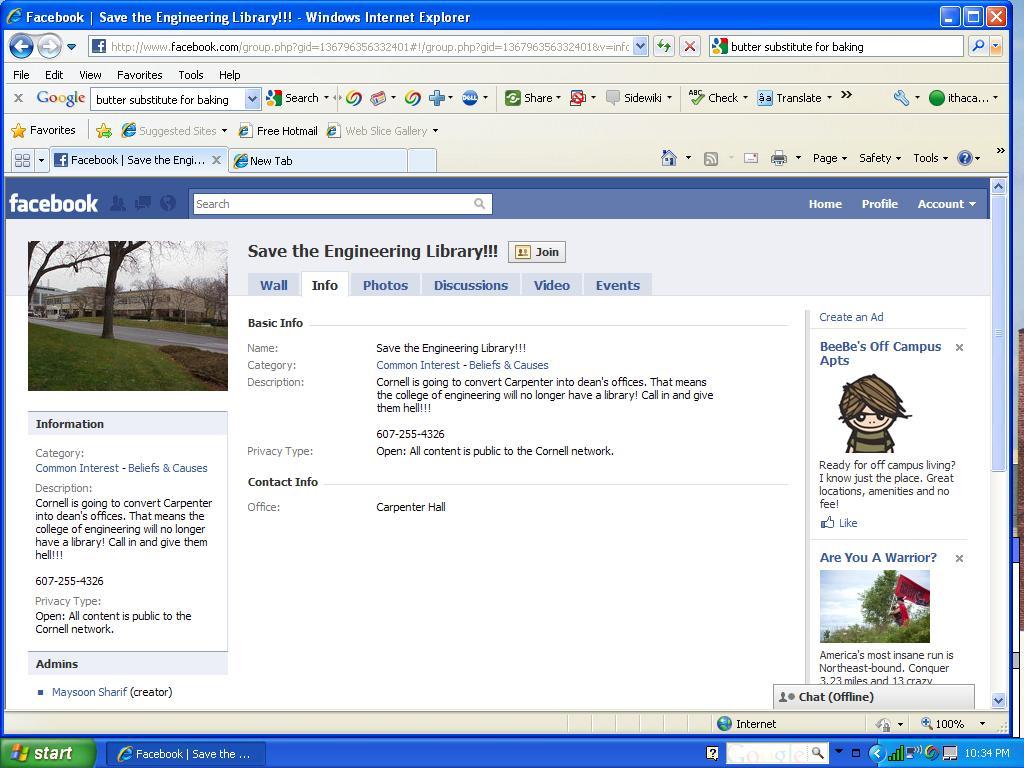
So, I log into facebook and find this page being posted into my news feed.

So, this comes as a bit of surprise. But I don’t buy into it. First of all, there’s nothing online — nothing on the Daily Sun, nothing on the engineering website, no data to back this up at all. Secondly, decisions like this are usually made over the span of months, even years (for example, the physical sciences library’s shutdown was formalized in March 2009 (an attentive reader of this blog actually told me about it before the Sun even had published the story); the library did not shut down until nearly a year afterwards (and no offense to Munier, but that library was definitely one of the lesser-used and therefore more expendable library facilties on campus). Decisions like this aren’t just “made” without a great deal of debate beforehand.

The one grain of truth I can throw into this is that the master plan indicates that the facilty to replace Hollister and Carpenter is under way — but that would suggest Carpenter getting demolished, not reappropriated. Plus, that’s still in the planning phases. Maybe a library would be in the Gates Hall plans, which are currently at the very beginning of the funding and approvals process; but I doubt it at this time.

I call bullcrap on this one until some information is published that indicates otherwise (see update). If there is any truth to it, going all alarmist  and calling the office staff (like the page suggests) is just going to make matters worse.

(UPDATED) So the author of the facebook page attached several official-lloking documents detailing the removal of the library’s book to Olin and Uris. IT would appear that the ACCEL computer labs would be kept and the labs would be made into a 24-hour unit (but isn’t that the lab in Upson exists?). Meanwhile, Munier has posted onto their page a link from Mann Library saying that the Entomology Library will be shut down and merged with Mann. So it would appear Cornell’s cost-cutting will shut down two more libraries they consider “less-used”.

I hope Cornell doesn’t release any more ads touting their expansive library system anytime soon.


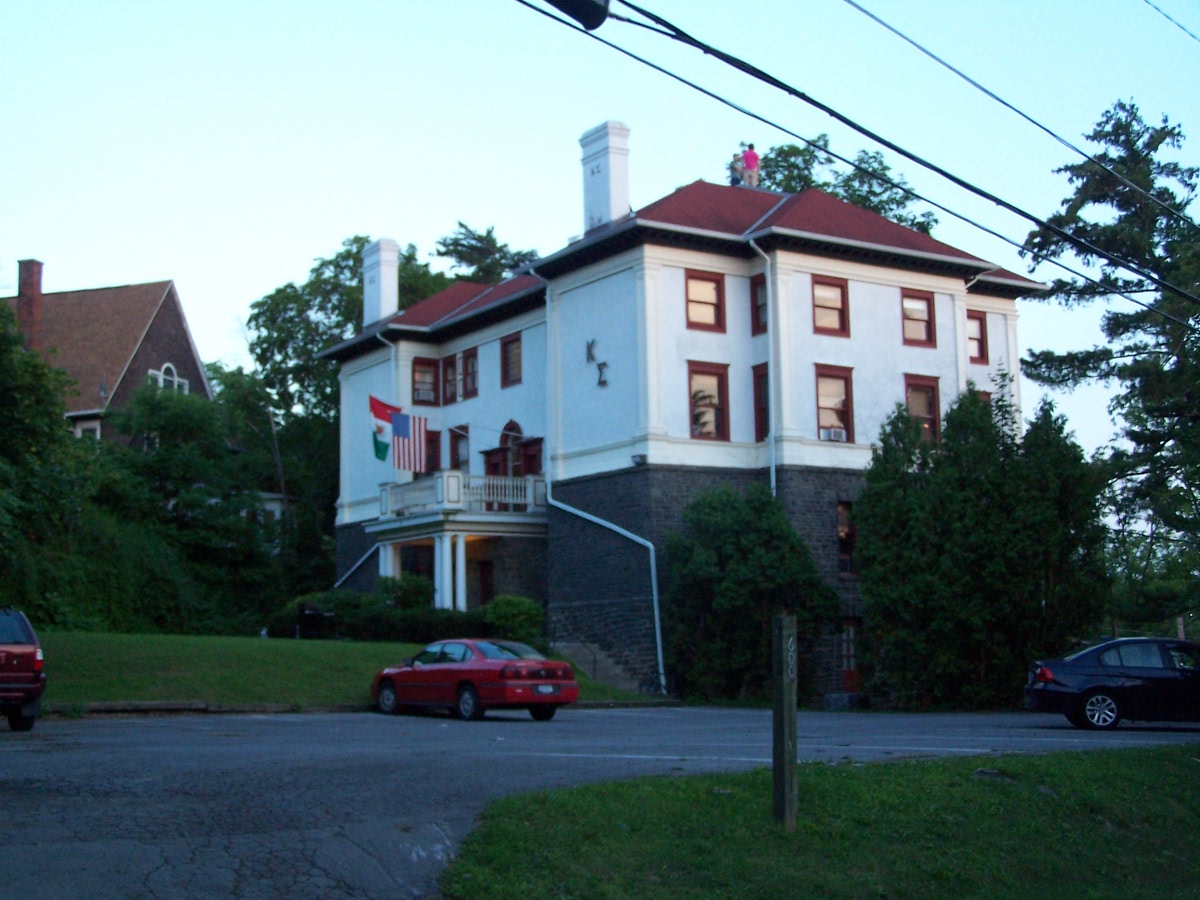
Kappa Sigma Closes its Doors

6 05 2010

…and the Greek sh*tshow continues.

Kappa Sigma fraternity will be shut down at the end of the academic year by their national governing body, according to Associate Dean of Students for Fraternity and Sorority Affairs Travis Apgar. He added that the chapter would cease to be recognized by the University. The fraternity will be closed after violating sanctions that were imposed on them by their national organization just over a year and a half ago.

Apgar said that approximately a year and a half ago, Kappa Sigma was found in violation of their national organization’s “risk management policy” and were told that they could no longer host events with alcohol, among other sanctions. When they violated this order sometime afterward, their national organization placed them under a “trusteeship,” which required them to have any events approved by a regional manager from the national organization, according to Apgar.

Apgar said that the fraternity, however, violated this sanction too. He said that a couple of weeks ago, Kappa Sigma hosted a party with alcohol without alerting their regional manager or registering it with the Interfraternity Council — in violation of both their national’s sanctions and IFC regulations. When the Office of Fraternity and Sorority Affairs found out, they alerted the chapter’s national, who decided to shut them down.

While leaders in the chapter do not dispute these facts, they did express disappointment at how their national governing body found out about the incident.

At their most recent party, a fire alarm went off and the fire department came to investigate. Rather than allow the OFSA to learn about the incident themselves, the fraternity came forward and told the OFSA. Kappa Sigma President Eduardo Garcia ’11 said that he was assured by Assistant Dean of Students Kara Miller that the OFSA would not alert the national governing body about the party unless a judicial hearing was held.

Though no hearing was ever scheduled, Garcia received an e-mail shortly after from the chapter’s national governing body that they would be closed down.

“We were blindsided,” Garcia said. “The OFSA didn’t even have the decency to send us an e-mail telling us that they were planning on alerting national.”

Apgar, however, denied that the agreement ever took place, adding, “It was not something I was ever aware of.” Miller could not be reached for comment.

In any case, the fraternity will likely remain closed for at least the next few years, though Apgar said that he believed the fraternity would be back, just “not in the immediate future.”

“This chapter has been around for many years and there are a lot of people who have put a lot of time and money into it, I think it will eventually be back,” he stated.

***

This one came almost out of the blue. I began to suspect something was up when I began to see facebook statuses yesterday from Kappa Sigs I know expressing sympathy for the chapter (my first thought was that there was a casuality of some sort). But this…Kappa Sigma was to my knowledge a fairly well-respected, low-key chapter. I don’t think anyone would’ve seen this coming.

Speaking as someone from a chapter whose national and local always seemed to have had strained relations, I am strongly sympathetic towards the Kappa Sigs sudden shutdown, but it doesn’t seem it came without its warnings. The decision to throw a party when you could be shut down for doing so is incredibly irresponsible. But I’m also appalled by the OFSA though. While Travis Apgar is head of the office, Kara Miller is usually the primary contact for houses. For her to give her word and for Apgar to notify the national either means there was horrific miscommunication or someone just got the shaft. Whatever the case, this has been handled poorly and is a big breach of trust between chapters and the OFSA. I wonder if they did it anyway as a show of force to prove that they could put the hammer down on unruly chapters. Regardless, poor display of authority, and poor decision-making on Kappa Sigma’s part.


Fencing in a Problem?

30 03 2010

For anyone (like myself) who was away for break, returning to campus brought with it an unpleasant surprise; the installment of large “temporary” fences along several of the campus bridges over the gorge. The Triphammer Foot Bridge is closed until May 26th. Stewart Avenue has no fences yet, but Cornell and the city of Ithaca are in talks on how and when to install them.

The logic to support such a move isn’t hard to figure out. It’s a very visual gesture that makes it look like Cornell is attempting the address the recent series of gorge deaths. In other places, fence installment has significantly curtailed bridge jumping, such as the Prince Edward Viaduct in Toronto. But still, it’s really unfortunate that this is what things have become, due to the recent tragedies.

I don’t like it. But apart from installing nets or filling in the gorges, there’s not much else that can be done. This is going to look really bad during Cornell Days, and for Alumni Reunion if they’re still up in June.


The Rush Week PR Disaster

24 01 2010

Pike being booted is bad enough. But it looks like sororities haven’t been able to avoid trouble either.

If anyone has read Ivygate or the Huffington Post lately, apparently Pi Beta Phi’s dress manual for sisters during rush week was leaked, substantiating just about every single embarrassing sorority stereotype known to man. Not that everyone didn’t know there was a dress code, but the shallowness of it all really echoes with the sister who wrote the six-page guide. It’s not something that Pi Phi will get in trouble for since they didn’t do anything wrong, but it’s an embarrassment and a public relations debacle.

Watch out for those dress checks, ladies.

Speaking of which, this puts Greek Life at Cornell in an unpleasant situation. We have Pike and Pi Phi caught committing activities that portray the darker side of Greek Life by exposing some of the excessive drinking and superficiality, the kind that anti-Greek zealots thrive off of.  I know I made the joke a couple of entries ago about how I hope my fraternity sends no one to the hospital during rush week, but this is ridiculous. The goal of recruitment is to invite those interested into Greek chapters, not embarrass ourselves in a stereotypical shit-show that will have repercussions through the system. The reputation of the greek system at Cornell has taken a major hit this week, and Panhel and the IFC need to something, now. Advertising the high points of Greek Life in Sun Articles and OFSA publications is only a small part of the answer. Open and extended discussion of these events will be required at the meetings of the respective councils, and ways to improve upon it. Even if they don’t (which I’m being honest here, and know that things won’t really change), it will offer some good PR.

I know that some of the comments I’ve seen on facebook and other sites question the harshness of immediately stopping Pi Kappa Alpha’s recruitment and kicking them off campus. Let’s be frank – they deserved it. Yes, they sought the freshmen medical attention. Congratulations, by not letting them die they just avoided persecution under NYS law. However, the brothers still let it happen in the first place. Did not monitor the situation, did not prevent the freshmen from drinking to the point of poisoning, did nothing until their lives were actually in danger. The freshmen were stupid, but regardless of that the brothers should have been smart and prevented the situation from occurring. But they didn’t. They deserve every punishment that Cornell, the IFC, their national org, their alumni and anyone else delivers upon them.


The Dealings of the AEM Program

22 11 2009

For almost every day of the past semester, there has been something in the news about proposed budget cuts or streamlining of the university in the name of efficiency. The AEM (Applied Economics and Management) Program is probably the biggest target of the streamlining arguments, and not without good reason. Someone could effectively obtain a business major through AEM in CALS, PAM in Human Ecology, or by concentrating on a particular field within the Hotel School. The engineering school has a program set up with CALS where engineering students can minor in business through AEM.  Some aspiring entrepreneurs take classes at the Johnson as undergraduates. Point is, anyone whose interested in business (if at least because of the big financial rewards) can do so.

AEM hasn’t always been the fast track to I-banking as it is often seen today. The AEM of competing business fraternities, Wall Street ambitions and pre-MBAs is largely a recent phenomenon.The history of AEM shows how much of a radical departure the program has made in recent years, and thankfully a professor emeritus of the department recorded it in a written book about the history of the department that is available online in its entirety.

AEM started in CALS for good reason — it was first known as agricultural economics. The program has its earliest roots from around 1903, when Ag school dean Liberty H. Bailey hired Prof. Thomas Hunt, who taught the first courses on farm management. By 1907, Hunt left to become a dean of the Penn State Ag school and George Warren took over most of his duties, becoming a full professor of the Farm Crops and Farm Management Department by 1910 (the sister department at the time was Rural Economy). George Warren by and large shaped much of the early development of the program, hence Warren Hall’s dedication to him when it was built in the early 1930s. In 1919, the two sister majors were merged into one department to be called Agricultural Economics, as ordered by the Board of Trustees.

For the next several decades, Ag Economics was a major usually taken by farm kids who planned on going back to the farm or engaging in some other form of agricultural operations. By the 1970s, the program had begun to diversify somewhat, and by the 1980s the program offered a substantial number of courses that didn’t focus as much on the agriculture portion of ag economics (mostly these new offerings were in environmental and managerial economics — the managerial portion could be seen as a predecessor to today’s AEM). To reflect this, the department changed its name to Agricultural, Resource, and Managerial Economics (ARME) in 1993.

Unfortunately, the book ends off in early 2000, and a lot has changed in the past nine years. The program changed its name from ARME to AEM in 2000.  The undergraduate business program was accredited in January 2002. Doing this required a significant financial infusion on CALS’s part, one example being the hiring five key staff members that were required for full accreditation (for ratio purposes and course requirements needed for accreditation). Depending on the year, AEM has offered anywhere from six to ten concentrations, some ag based and some not. This is where the blurring has resulted from.

So, we have the kids who come straight from the farm and want to pursue agricultural objectives. That’s right in line with CALS’s objectives. But then you have the kids who are completely set on Wall Street and Wharton. the ones who scowl when you mention that CALS is state funded or poo-poo most of their intraschool brethren (I know that they’re not all like that, but all it takes is a few to set a bad example and garner a poor image). The department has definitely become more diverse, but some argue that it comes at the cost of diluting the mission of the school (of course, who am I criticize when CALS also includes atmospheric science [meteorology, which grew from crop and soil science], landscape architecture and and communication)?

Should AEM be streamlined? It would seem appropriate when you consider the variety of business programs Cornell offers. But to be frank, CALS does not give a damn what Cornell as a whole thinks when it comes to AEM. CALS invested heavily in the program in the late 1990s and early 2000s to get it accredited and propel it into the top ten in recent years. Why would they let someone deprive them of lucrative business majors (who become lucrative alumni) after they worked some hard to lure them into the program? This is more of a problem than people seem to realize. Unfortunately for me, my adviser rants about AEM’s high-and-mighty attitude roughly twice a week, so I won’t be seeing an end of those complaints anytime soon.


Cornell Criticism

12 08 2009

100_3851


What inspired this post were the none-too-charming rankings released recently by Forbes on their “Best Colleges” list [1]. The article itself wasn’t the trigger, but the comments, however…

Where’s Cornell? Where it belongs, behind a lot of small LAC’s where teaching undergrads is actually a priority.”

“…another thing I considered: Cornell has one of the highest suicide rates of all colleges/universities in the U.S. actually, at one point, it was the highest…”

(not true according to the New York Times, but that’s beating a dead horse…)

Now, I could really care less about overall school rankings. Cornell is one of top-rated schools in my field of study, so that’s about the only ranking I ever cared to know. But, there’s a little bit of dark humor to be found in the lengths that people will go to criticize other institutions.

Cornell, of course, is not new to criticism.  The school was maligned in its early years for being co-ed, for not having a religious affiliation, and for some faculty that ran dangerously awry from the norms of the time (one of which included a professor that was an atheist, which in the religiously driven nineteenth century was truly shocking and tabloid worthy). Even today, remarks of “SUNY Ithaca” and “the safety school of the Ivies” still manage to bother some of our thinner-skinned students and alumni. Read Ivygate’s comment section for examples [2].

In the early 1940s, there was “The Dilling Affair”. A student by the name of Kirkpatrick Dilling was brought before the Student Conduct committee and put on parole for engaging in stunts such as blowing dormitory fuses and filling ceiling lights with water. Well, his parents were extreme right-wingers who were convinced that their son was put on parole due to the committee’s underlying communism. Mrs. Dilling came to Ithaca, launched her own investigation, and published a scathering magazine report detailing how the reds has infiltrated the institution from President E. E. Day down. (Bishop, 568)

Sometimes, Cornellians are their own worst enemies. Consider the little feud between Ann Coulter and Keith Olbermann earlier this year. For anyone who wasn’t living under a rock, Metaezra has the full story [3], so I’ll take the liberty of abridging the drama. Coulter, a bastion of invective conservatism, made the remark that liberal mouthpiece Keith Olbermann didn’t go to the same Cornell, but rather state school Cornell (CALS). Most of us who went to Cornell, while aware of the difference (and that the only significant differences between them are source of funding and in-state tuition), but also know that criticism is about as bad an idea as sticking a knife in an electrical socket. But, Olbermann responded back by showing off his diploma on air and bragging about his Cornell degree, Coulter just had to respond back, and the catfight resulting in nothing more than embarassing just about everyone else who ever went to school far above Cayuga’s waters. 

Here’s some of my favorites – building criticisms, as recorded from respondents in the Cornell Alumni News:

Sibley Dome – “the breast of campus”

Rockefeller Hall – “public grammar school No .16”

Baker Lab – “A U.S. Post Office Conferred by a Republican administration”

Olin Hall – “might suit a department of alchemy better than chemical engineering”

…and that was before the sixties and seventies rolled around. The aesthetic critics must be rolling in their graves.

I s’pose Cornellians are their own worst enemies. To quote one more commenter from Forbes:

Wow! A lot of references to Cornell in these comments! As a Cornell graduate, I see that “complex” is still there for many Cornellians.

[1]http://www.forbes.com/lists/2009/94/colleges-09_Americas-Best-Colleges_Rank.html

[2]http://www.ivygateblog.com/2009/03/cornell-fan-admits-cornell-does-not-belong-in-the-ivy-league/#comments

[3]http://www.metaezra.com/archive/2009/03/ann_coulter_is_an_idiot.shtml